All about dinosaurs, fossils and prehistoric animals by Everything Dinosaur team members.

Everything Dinosaur’s work with photoshop and other platforms.

19 06, 2020

The First Dinosaur Eggs were Soft

By |2024-02-23T07:26:50+00:00June 19th, 2020|Categories: Adobe CS5, Dinosaur and Prehistoric Animal News Stories, Dinosaur Fans, Main Page, Palaeontological articles, Photos/Pictures of Fossils|0 Comments

The First Dinosaur Eggs were Soft like a Turtle’s

The scientific paper has a succinct title, but the repercussions for vertebrate palaeontologists are seismic.  This week has seen the publication in the journal Nature of a paper entitled “The first dinosaur egg was soft”.  Palaeontologists have inferred and implied a great deal about dinosaur reproduction, but the assumption had been that, just like living archosaurs today, the crocodiles and birds, dinosaurs laid hard-shelled eggs.

Dr Mark Norell (American Museum of Natural History) and his co-authors propose that calcified, hard eggshells were not the “default setting” for the Dinosauria, the first dinosaur eggs were soft-shelled like those of a turtle or a snake.  In addition, the researchers conclude that hard-shelled, calcified eggs evolved at least three times independently within the Dinosauria.

Protoceratops Protects a Nest from a Marauding Oviraptorosaur
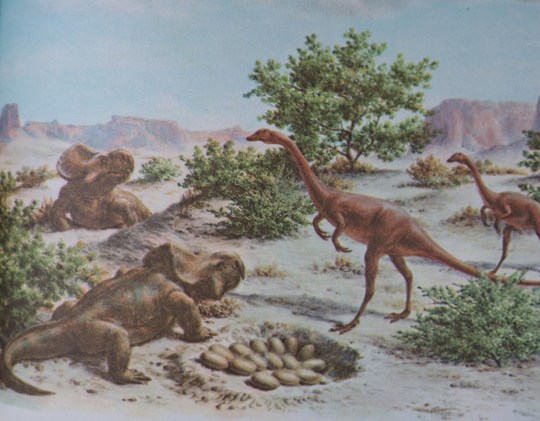
Protoceratops defends its nest from Oviraptor.
Protoceratops confronts Oviraptor- the egg thief.  An inaccurate portrayal of both the Oviraptorosaur and Protoceratops, but until now, not many had questioned the accuracy of those hard-shelled eggs.

Picture credit: Everything Dinosaur (from Zalinger)

Unscrambling Dinosaur Eggs

The research led by the American Museum of Natural History in collaboration with colleagues from Yale University, Universidad de Buenos Aires (Argentina), Montana State University, University of Calgary (Canada) and the Museo Paleontológico Egidio Feruglio, Trelew, (Argentina), applied a series of sophisticated geochemical techniques to analyse the eggs of two different non-avian dinosaurs.  They discovered that the eggs resembled those of extant turtles in their composition, microstructure and mechanical properties.

Commenting on the significance of this research, corresponding author Mark Norrell stated:

“The assumption has always been that the ancestral dinosaur egg was hard-shelled.  Over the last 20 years, we’ve found dinosaur eggs around the world.  But for the most part, they only represent three groups – theropod dinosaurs, which includes modern birds, advanced hadrosaurs like the duck-billed dinosaurs and advanced sauropods, the long-necked dinosaurs.  At the same time, we’ve found thousands of skeletal remains of ceratopsian dinosaurs, but almost none of their eggs.  So why weren’t their eggs preserved?  My guess – and what we ended up proving through this study, is that they were soft-shelled.”

Ceratopsian Eggs Were Probably Soft-shelled and This Explains their Rarity in the Fossil Record
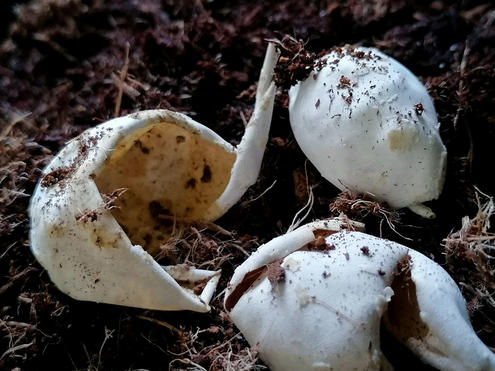
The leathery, soft shells of turtle eggs.
The leathery, soft shell of the common snapping turtle (Chelydra serpentina). The eggs of the first dinosaurs were probably very similar.

Picture credit: Jasmina Wiemann (Yale University)

Calcified Eggshells – An Evolutionary Hedge Against Environmental Stress

The amniotes, a group of tetrapods that includes the mammals, birds and the reptiles all produce eggs with an inner membrane, known as the amnion.  This inner membrane helps to prevent the embryo from drying out.  Some amniotes such as many turtles and squamates (lizards and snakes), lay soft-shelled, leathery eggs, whilst others such as birds and crocodilians produce eggs with a heavily calcified shell.  It is thought that these calcified eggs help to protect the developing embryos inside the eggs from environmental stresses, thus giving the calcified egg layers an evolutionary advantage.

The evolution of the hard-shelled egg is seen as a major step in the global dominance of the amniotes, it leading to greater reproductive success for those members of this group that developed this trait.

The Eggs from a Member of the Theropoda (Domestic Chicken)
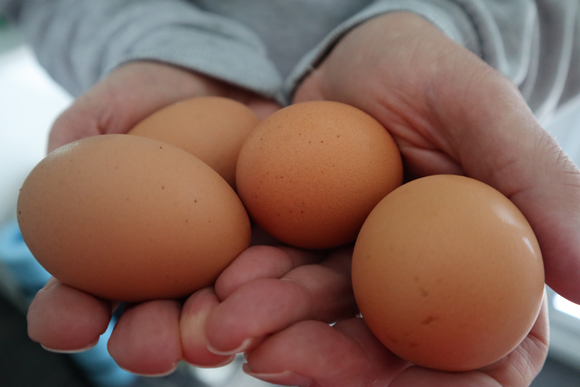
Chicken eggs (theropod dinosaur eggs).
Calcified, hard-shelled eggs such as these from a theropod (domestic chicken) were thought to be representative of all Dinosauria eggs. Picture credit: Everything Dinosaur.

Picture credit: Everything Dinosaur

The Fossil Record Shows Bias in Favour of Calcified Eggs

Soft-shelled eggs rarely preserve in the fossil record.  It is very likely that ancient turtles laid soft-shelled eggs, just like their modern counterparts, but such evidence is hard to find in the fossil record.  The same could be inferred for other amniotes, they too might have laid soft-shelled eggs but such evidence would be very difficult to find.  Therefore, studying the transition from soft-shelled eggs to biomineralised, calcified eggs is a substantial challenge for palaeontologists.  As birds and extant crocodilians lay hard-shelled eggs, this type of eggshell has been inferred for all the non-avian dinosaurs.

Protoceratops and Mussaurus

The research team undertook an intensive study of two fossil egg specimens appertaining to two very different dinosaurs – the neoceratopsian Protoceratops (P. andrewsi), known from the Upper Cretaceous Djadokhta Formation exposed in the Gobi Desert of Mongolia and Mussaurus (M. patagonicus) from the Upper Triassic-aged El Tranquilo Formation located in southern Argentina.   The beautifully preserved Protoceratops fossils include a clutch of at least a dozen eggs with embryos, half of which preserve nearly complete skeletons.  Most of the Protoceratops embryos are preserved in a posture in which their vertebrae and limbs are flexed, synonymous with a posture adopted by animals still inside their eggs.

The Protoceratops (P. andrewsi) Nest Fossil
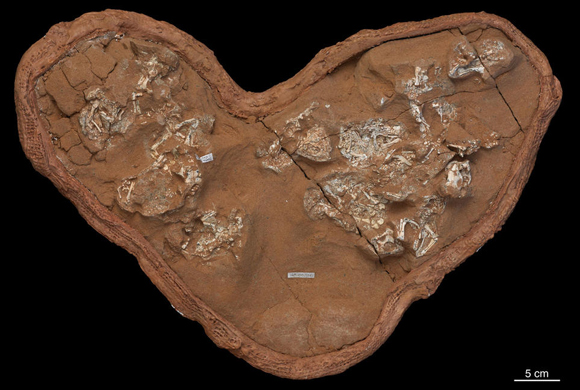
Protoceratops Fossil Nest
The beautifully preserved nest with embryos of Protoceratops andrewsi.

Picture credit: M. Ellison (American Museum of Natural History)

Some of the skeletal material is obscured by a black and white egg-shaped halo.  In contrast, two potentially recently hatched Protoceratops in the fossil specimen are largely free of this mineral halo.  The research team analysed tiny slices of this halo material using a petrographic microscope.  Further analysis was undertaken using Raman microspectroscopy, where light scattered by a high powered laser provides information on the molecular composition of a sample.  The scientists discovered chemically altered trace residues of the proteinaceous eggshell membrane that makes up the innermost layer of the eggshell of extant archosaurs.  Almost identical results were observed when the Mussaurus specimen was examined.

The Fossilised Remains of the Mussaurus Egg
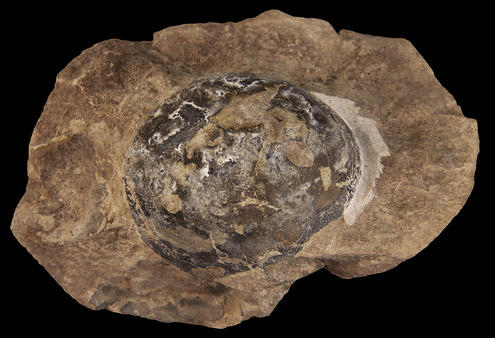
Mussaurus fossil egg.
The fossilised remains of a Mussaurus.

Picture credit: Diego Pol (Museo Paleontológico Egidio Feruglio, CONICET)

Comparing Biomineralisation Residue Signatures

The research team which included Diego Pol (Museo Paleontológico Egidio Feruglio CONICET), Darla Zelenitsky (University of Calgary) and Jasmina Wiemann (Yale University) then compared the data from the fossil material to eggshell data from other living amniotes such as turtles, birds, lizards and crocodiles.  They determined that the Mussaurus and the Protoceratops eggs were non-biomineralised and therefore they would have resembled the leathery, soft-shelled eggs of living turtles.

Graduate student Jasmina Wiemann explained:

“It’s an exceptional claim, so we need exceptional data.  We had to come up with a brand-new proxy to be sure that what we were seeing was how the eggs were in life and not just the result of some strange fossilisation effect.  We now have a new method that can be applied to all other sorts of questions, as well as unambiguous evidence that compliments the morphological and histological case for soft-shelled eggs in these animals.”

Creating a “Supertree” to Track Eggshell Evolution

In total, data from 112 extinct and living amniotes was analysed by the research team.  This enabled them to build a “supertree” to track the phylogeny of egg-shell evolution over geological time.  They concluded that the ancestors of the Dinosauria probably produced an egg that lacked a calcified layer, that these animals laid soft-shelled eggs and that the first, true dinosaurs had the same type of egg.

This element of the research suggests that calcified, hard-shelled eggs evolved independently at least three times throughout the Mesozoic era in the Dinosauria, explaining the bias towards eggshells of derived dinosaurs in the fossil record.  The calcified layer of eggshell evolved independently in ornithischian, sauropodomorph and theropod dinosaurs.

Co-author Matteo Fabbri (Yale University) added:

“From an evolutionary perspective this makes much more sense than previous hypotheses, since we’ve known for a while that the ancestral egg of all amniotes was soft.  From our study, we can also now say that the earliest archosaurs, the group that includes dinosaurs, crocodiles and pterosaurs had soft eggs.  Up to this point, people just got stuck using the extant archosaurs – crocodiles and birds to understand dinosaurs.”

Implications for the Pterosauria

This research has implications for the Pterosauria clade.  Pterosaur eggs are exceptionally rare, a fossil of the wukongopterid (Darwinopterus modularis), reveals the outline of a single egg inside the body cavity. The egg confirms that the pterosaur fossil represents a female that was gravid when she died.  More significantly, scientific papers detailing extensive fossil remains associated with the debris from a nesting colony of the pterosaur Hamipterus tianshanensis have been published and the three-dimensionally preserved eggs do resemble the leathery soft-shelled eggs now associated with members of the Dinosauria.

Fossilised Eggs of Hamipterus tianshanensis – Could They have the Same Biomineralisation Profile of Soft-shelled Dinosaur Eggs?
Egg fossils (Pterosaur).
Pterosaur egg fossils (Hamipterus tianshanensis).

Picture credit: Xinhua/Wang Xiaolin

To read our 2017 blog post about the Hamipterus colony: Hamipterus Nesting Ground Discovery.

To read our recent article about the discovery of a giant soft-shelled egg associated with a marine reptile: It’s Not a Deflated Football, it’s Probably an Egg from a Mosasaur.

Everything Dinosaur acknowledges the assistance of a media release from the American Museum of Natural History in the compilation of this article.

The scientific paper: “The first dinosaur egg was soft” by Mark A. Norell, Jasmina Wiemann, Matteo Fabbri, Congyu Yu, Claudia A. Marsicano, Anita Moore-Nall, David J. Varricchio, Diego Pol and Darla K. Zelenitsky published in the journal Nature.

The Everything Dinosaur website: Everything Dinosaur.
18 06, 2020

Tracking Down Australia’s Big Carnivorous Dinosaurs

By |2024-02-22T22:19:15+00:00June 18th, 2020|Categories: Adobe CS5, Dinosaur and Prehistoric Animal News Stories, Dinosaur Fans, Main Page, Photos/Pictures of Fossils|0 Comments

Tracking Down Australia’s Largest Ever Terrestrial Predator

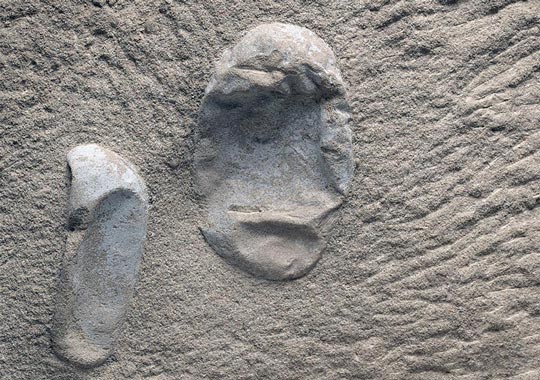
Scientists from the University of Queensland have conducted a review of the data associated with a series of Jurassic-aged theropod dinosaur prints preserved on the ceilings of coal mine galleries deep underground.  They conclude that some of these prints represent predatory dinosaurs around ten metres in length, making these trace fossils evidence of the largest terrestrial carnivores ever to have lived in Australia.

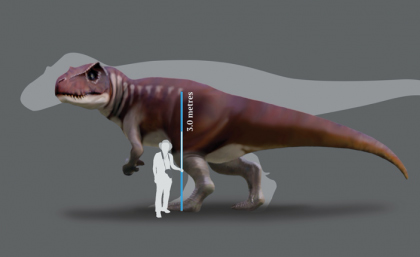
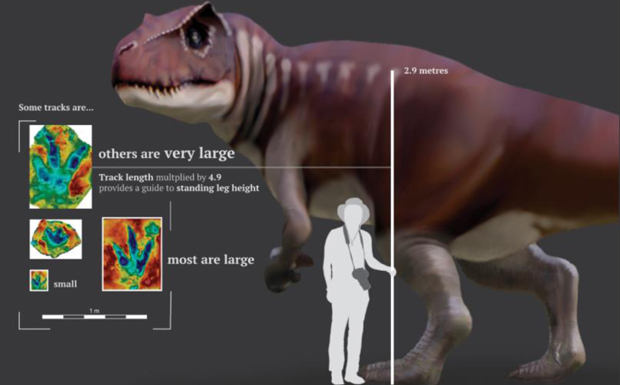
A Life Reconstruction of a Large Carnosaur Compared to a Person and a Silhouette of Tyrannosaurus rex

Calculating the size of a theropod dinosaur from its tracks.
By measuring the length of a print the approximate hip height of the track-maker can be calculated.  In this case, the largest theropod tracks indicate a hip height of 3 metres.  This suggests an overall length of around 10 metres.

Picture credit: Dr Anthony Romilio et al (University of Queensland)

Australia’s Big Carnivorous Dinosaurs

Dinosaur tracks from the coal-mines from Rosewood near Ipswich, and Oakey just north of Toowoomba in southern Queensland have been known about for decades.  The prints and trackways are located in sediments directly above coal seams and give the impression of dinosaurs defying gravity by walking on the ceiling.  The explanation for the trace fossils is rather more mundane but still quite remarkable when the age of these tracks (estimated at around 151 to 161 million years old) is considered.

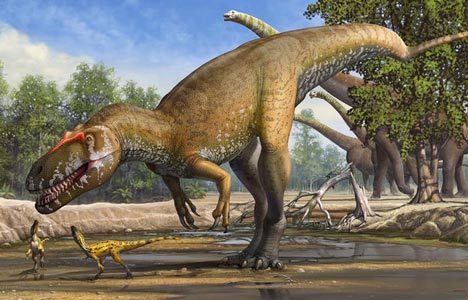
Large Theropods (Carnosauria) Left the Prints When Walking Across Swampy Ground

T. gurneyi.
Trace fossils from theropod dinosaurs indicate that giant carnosaurs roamed southern Queensland during the Middle to Late Jurassic (Callovian to Tithonian).

Picture credit:  Sergey Krasovskiy

How Were These Trace Fossils Formed?

Tridactyl prints made by theropod dinosaurs onto mats of compressed swamp-vegetation became covered with silt, mud and sand from flood-water.  Over millions of years the remains of the swamp vegetation became compressed and turned into coal, which was then excavated by Australian miners deep underground during the 19th and 20th centuries.  As the coal seams were removed, these left exposed on the ceiling of the mine galleries, the inlaid 160 million-year-old dinosaur tracks.

Many of the mines exploiting the Walloon Coal Measures from the Clarence-Morton Basin have been closed, with their access shafts filled in.  Access to many of these prints in the mines is no longer possible, so the researchers relied on previous research and unpublished archival photographs from which they were able to create three-dimensional images of some of the individual prints.

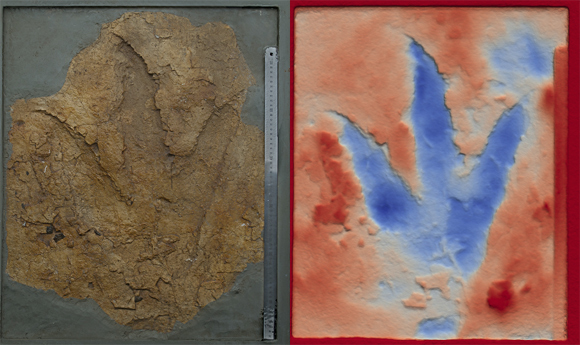
Photograph and False-Colour 3-D Map of a Tridactyl Print from the Oakey Coal Mine

Photograph and false-colour image of a theropod print.
One of the dinosaur footprints from the Oakey mine (photograph on the right and corresponding false-colour deep map on the left).

Picture credit: Dr Anthony Romilio et al (University of Queensland)

The three-toed (tridactyl), prints with claw marks, typical of theropod dinosaurs, dominate the tracksites.  The size of the prints varies, most of the prints measure between 30 to 50 cm long.  However, a number of trace fossils from the eleven track-bearing sites analysed in this study, are much bigger.  The largest measures 79 cm in length, the biggest carnivorous dinosaur footprint discovered to date in Australia.

Footprint size can be used to calculate an approximate hip-height of the theropod dinosaur that made the track.  Once a hip-height has been estimated, then palaeontologists can quickly work out just how big that dinosaur actually was.

Lead author of the research, published in Historical Biology, Dr Dr Anthony Romilio explained:

“Most of these footprints are around 50 to 60 centimetres in length, with some of the really huge tracks measuring nearly 80 centimetres.  We estimate these tracks were made by large-bodied carnivorous dinosaurs, some of which were up to three metres high at the hips and probably around 10 metres long.  To put that into perspective, T. rex got to about 3.25 metres at the hips and attained lengths of 12 to 13 metres long, but it didn’t appear until 90 million years after our Queensland giants.”

Examining the Theropod Prints from the Walloon Coal Measures

False colour images and an assessment of theropod size
A variety of different sized theropod tracks were identified with the largest 79 cm long.

Picture credit: Dr Anthony Romilio et al (University of Queensland)

Intriguingly, all the tracksites studied are dominated by the three-toed prints of theropods.  These theropod dominated trace fossil assemblages are unique among Australian dinosaur tracksites.  In the absence of any contemporaneous dinosaur body-fossils, these prints and tracks preserved on the ceilings of the coal mines provide palaeontologists with important data helping them to fill in gaps about the composition of Middle and Late Jurassic Australian dinosaur fauna.

What Type of Meat-eating Dinosaur Made the Tracks?

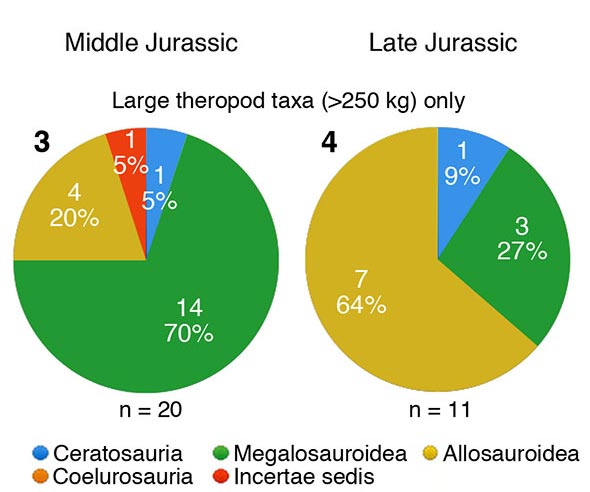
The strata in which the tracks are preserved span around ten million years or so (Callovian to Tithonian faunal stages of the Jurassic).  Palaeontologists are aware that during this time there was a change in the types of large, carnivorous dinosaurs that dominated terrestrial ecosystems.  The fossil record, although far from complete, suggests a decline in the Megalosauroidea during the Middle Jurassic and the rise to prominence of the Avetheropoda clade consisting of the Allosauroidea and the Coelurosauria.

A Faunal Turnover in Theropod Dinosaurs During the Jurassic

Theropod faunal turnover in the Jurassic.
Theropod faunal turnover (taxa estimated to be <250 kgs) the rise of the Allosauroidea.  It is likely that the type of dinosaur(s) that made the Queensland ceiling prints will never be known.

Picture credit: Palaeontologica Electronica

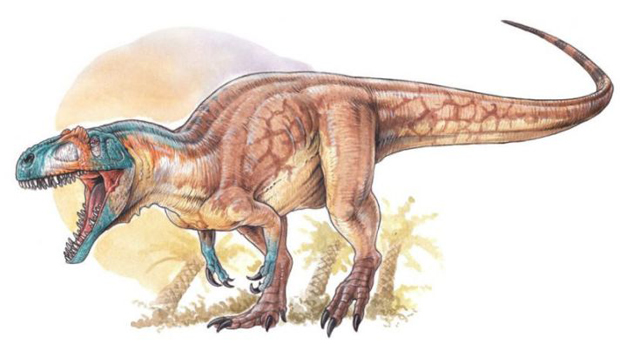
However, the taxonomy of the Theropoda, even at the superfamily level is controversial and open to debate.  For example, the Carnosauria clade had been redefined, constraining it to the allosaurs and their closest relatives.  In 2019, a new basal allosauroid from the Middle Jurassic of Argentina was described Asfaltovenator (A. vialidadi).  Asfaltovenator had a combination of primitive and more derived anatomical features.  As a result, a new phylogenetic analysis extended the Carnosauria clade to once again include the Megalosauroidea.

A Life Reconstruction of Asfaltovenator from the Middle Jurassic of Argentina

Asfaltovenator illustration.
Asfaltovenator life reconstruction.  The scientific description of this carnivorous dinosaur led to a reassessment of the components of the Carnosauria clade.

Picture credit: Gabriel Lio/Conicet

In short, the researchers are uncertain as to what types of meat-eating dinosaur left the prints.  In the absence of any other fossil evidence, we shall probably never know.

To read a related article examining three-toed tracks from the ceiling of the Australian Mount Morgan caves complex preserved in Lower Jurassic deposits: Mystery of Dinosaur Prints on Cave Ceiling Solved.

The scientific paper: “Footprints of large theropod dinosaurs in the Middle–Upper Jurassic (lower Callovian–lower Tithonian) Walloon Coal Measures of southern Queensland, Australia” by Anthony Romilio, Steven W. Salisbury and Andréas Jannel published in Historical Biology.

The Everything Dinosaur website: Everything Dinosaur.
16 06, 2020

New Mojo Tyrannosaurus rex Deluxe “Turntable Tuesday”

By |2024-02-22T07:13:39+00:00June 16th, 2020|Categories: Adobe CS5, Dinosaur Fans, Everything Dinosaur Products, Everything Dinosaur videos, Main Page, Photos of Everything Dinosaur Products, Product Reviews|0 Comments

Mojo Tyrannosaurus rex Deluxe “Turntable Tuesday”

It is “Turntable Tuesday” on Everything Dinosaur’s YouTube channel once again and this time, it is the turn of the new for 2020 Mojo Fun Tyrannosaurus rex deluxe to go for a spin on our studio turntable.  The Mojo “Prehistoric and Extinct” range of figures is a little T. rex top heavy at the moment, Everything Dinosaur has seven Mojo tyrannosaur figures in stock at the moment, if the baby T. rex figure is included. 

However, a number of the older models have been de-listed and are likely to be out of production very soon. All the more reason to focus on some of the sixteen new for 2020 dinosaurs introduced into this line, hence our decision to highlight the Mojo Tyrannosaurus rex deluxe dinosaur model.

Taking a Spin for “Turntable Tuesday” – The Mojo Fun Tyrannosaurus rex Deluxe

Video credit: Everything Dinosaur

Deluxe Mojo Fun Tyrannosaurus rex

This carefully crafted dinosaur figure shows plenty of detail, the bright yellow eye can be easily seen in the close up shots of the model when the articulated lower jaw is demonstrated.  The jaw opens quite well and the tongue has been skilfully painted.

A Close View of the Head and the Articulated Jaw of the T. rex Dinosaur Figure

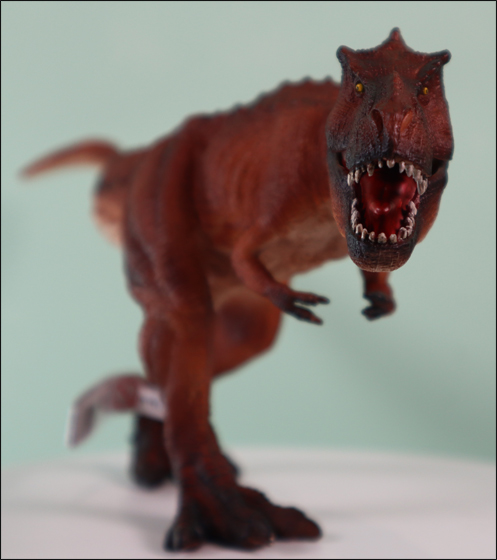
The Mojo Fun Tyrannosaurus rex deluxe figure has an articulated jaw.
A close view of the head and articulated jaw of the Mojo T. rex dinosaur model.  Can you spot the yellow eye?  Picture credit: Everything Dinosaur.

Picture credit: Everything Dinosaur

The head sculpt has been designed to emphasis the stereoscopic vision of this apex predator.  The orbit in the skull of mature T. rex specimens suggest that the actual eye of this carnivorous dinosaur was about the size of a tennis ball.  Many palaeontologists believe, that just like its close relatives the birds, Tyrannosaurus rex had excellent colour vision.

A View of the Front of the Dinosaur Model (Anterior) Showing the Stereoscopic Vision

The Mojo Fun T. rex Deluxe dinosaur model approaches.
The Mojo Tyrannosaurus rex deluxe figure demonstrates stereoscopic vision.  Picture credit: Everything Dinosaur.

Picture credit: Everything Dinosaur

Visit the Everything Dinosaur website: Everything Dinosaur.
Everything Dinosaur’s Video Review

In our short “Turntable Tuesday” review, (the video lasts 1:45), we compare this new figure to the Papo brown running T. rex figure, that was originally introduced in 2013.  Although the figures are similar and both dinosaurs have articulated lower jaws, the Mojo model is slightly smaller and has a leaner look to it.  The Mojo Tyrannosaurus rex deluxe has a darker colour scheme providing emphasis on the countershading.

A Comparison Between Two Excellent Dinosaur Figures

Comparing T. rex dinosaur models.
A comparison between the Mojo T. rex deluxe and the Papo running T. rex dinosaur model.  Picture credit: Everything Dinosaur.

Picture credit: Everything Dinosaur

The Everything Dinosaur YouTube channel has over 170 dinosaur and prehistoric animal related videos and reviews: Subscribe to Everything Dinosaur on YouTube.

To view the Mojo Fun Tyrannosaurus rex deluxe model and the rest of the Mojo “Prehistoric and Extinct” model range: .Mojo Prehistoric Animal Models.

14 06, 2020

A Video Review of “Dinosaurs – how they lived and evolved”

By |2024-02-22T06:20:40+00:00June 14th, 2020|Categories: Adobe CS5, Book Reviews, Dinosaur Fans, Everything Dinosaur News and Updates, Everything Dinosaur videos, Main Page, Press Releases|0 Comments

“Dinosaurs – how they lived and evolved” Video Review

Everything Dinosaur Facebook fans and followers will know that recently we ran a special competition to win one of three signed copies of the new dinosaur book by Darren Naish and Professor Paul Barrett.  The contest may have drawn to a close but for those of you not lucky enough to win one of the “Dinosaurs – how they lived and evolved”, we have produced a short video, providing a brief overview of this excellent publication.

“Dinosaurs – How They Lived and Evolved”

A Whizz Through “Dinosaurs – how they lived and evolved”

Video credit: Everything Dinosaur

Completely Revised and Updated

In our short video review, we highlight “Dinosaurs – how they lived and evolved”, a book originally published in 2016, but this edition has been updated and revised.  Conveniently split into six comprehensive chapters, starting with an introduction to the Dinosauria and concluding with the End-Cretaceous mass extinction event that saw the demise of the non-avian dinosaurs.  The final chapter also looks at those theropods that survived the extinction event – the birds.  This well-written book briefly highlights the diversity of the birds but also leaves the reader in no doubt that the Aves suffered extinctions at the end of the Mesozoic.

Visit the Everything Dinosaur website: Everything Dinosaur.
Beautifully Illustrated Dinosaur Book

Wonderful illustrations in the dinosaur book.
As well insightful writing, the book features the work of famous artists such as John Sibbick, Davide Bonadonna, Bob Nicholls and Mark Witton. Picture credit: Everything Dinosaur.

Picture credit: Everything Dinosaur (from “Dinosaurs – How They Lived and Evolved”)

Fantastic Dinosaur Illustrations and Artwork

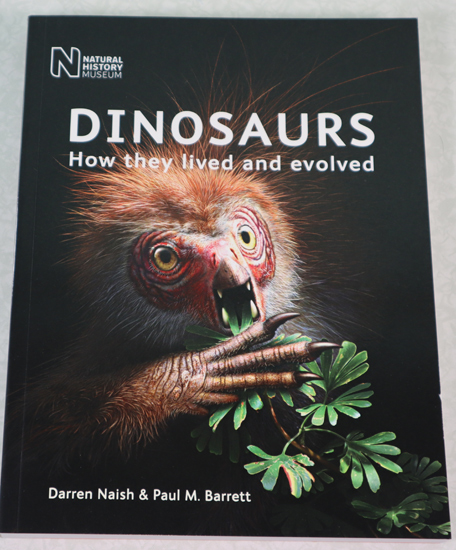
Aimed at the general reader with an interest in the Earth sciences and especially palaeontology, this new publication is eminently suitable for teenagers and above.  It is crammed full of fascinating information and provides a comprehensive overview of dinosaurs, with many detailed illustrations and cladograms provided by Darren Naish (University of Southampton).  Look out for amazing artwork produced by such luminaries as Bob Nicholls, Davide Bonadonna, Mark Witton, John Sibbick and Dr Julius Csotonyi (pronounced Chit-en-Knee).  It was Bob Nicholls who created the fascinating illustration of a ginkgo-chewing heterodontosaurid (Tianyulong confuciusi) that features on the front cover.

Tianyulong confuciusi Features on the Front Cover

The front cover of the dinosaur book.
Artwork by the very talented Bob Nicholls features on the front cover of “Dinosaurs – How They Lived and Evolved”. Picture credit: Everything Dinosaur.

Picture credit: Everything Dinosaur

An illustration of Sinosauropteryx prima

An illustration of Sinosauropteryx prima.
An illustration of Sinosauropteryx with its countershading and “bandit mask” produced by Bob Nicholls, just one of large number of superb illustrations and examples of palaeoart included in the book.

The PNSO Age of Dinosaurs range of figures includes a Sinosauropteryx.

To view this range: PNSO Age of Dinosaurs.

Everything Dinosaur Facebook Competition

Everything Dinosaur Facebook fans and followers will probably remember that we recently ran a special competition to win one of three signed copies of this brilliant dinosaur book.  Co-author Darren Naish had produced a personalised drawing on the inside front cover of each of the prizes that Everything Dinosaur gave away in their free to enter contest.

A Personalised and Signed Dinosaur Illustration on the Inside Front Cover

A sketch of Caudipteryx.
A sketch of the primitive oviraptorosaur Caudipteryx by Darren Naish.  Lucky Everything Dinosaur competition winners received a personalised and signed copy of this dinosaur book. Picture credit: Everything Dinosaur.

Picture credit: Everything Dinosaur

The Everything Dinosaur YouTube channel, is packed with lots of amazing videos all about dinosaurs and prehistoric animals: Subscribe to Everything Dinosaur on YouTube.

13 06, 2020

The New Mojo Fun Brachiosaurus Deluxe Dinosaur Model

By |2024-02-21T15:38:04+00:00June 13th, 2020|Categories: Adobe CS5, Dinosaur Fans, Everything Dinosaur News and Updates, Everything Dinosaur Products, Main Page, Photos of Everything Dinosaur Products, Product Reviews|0 Comments

The Mojo Fun Brachiosaurus Deluxe Dinosaur Model

Brachiosaurus has been a mainstay of the Mojo Fun “Prehistoric and Extinct” prehistoric animal model range since this series was introduced.  Recently, new members of the Sauropodomorpha have been added, a colourful Diplodocus was included back in 2018 and this year, the long-necked dinosaur numbers have been swelled with the addition of a Mamenchisaurus, Brontosaurus and a new Mojo Fun Brachiosaurus deluxe model.

The New for 2020 Mojo Fun Brachiosaurus Deluxe Dinosaur Model

The new Mojo Fun Brachiosaurus deluxe dinosaur model.
The new for 2020 Mojo Fun Brachiosaurus deluxe dinosaur model.

The Subdued Colouration of the Mojo Fun Brachiosaurus Model

The new Brachiosaurus figure has a more subdued colouration than the Mojo Fun Diplodocus.  There is certainly much to be admired in this new replica of “arm lizard” and at around eighteen centimetres tall, this is quite a sizeable dinosaur model too.  Prior to the model’s arrival we took the opportunity to take some photographs of the Brachiosaurus and other sauropods in the Mojo Fun “Prehistoric and Extinct” model range.

Getting to Grips with a Brachiosaurus

Mojo Fun Brachiosaurus dinosaur model.
The new for 2020 Mojo Fun Brachiosaurus dinosaur model measures around 25 cm long and that detailed head stands nearly 18 cm high. Picture credit: Everything Dinosaur.

Picture credit: Everything Dinosaur

The 2018 Mojo Fun Diplodocus Dinosaur Model

Mojo Fun Diplodocus model (2018).
Mojo Fun Diplodocus dinosaur model.  This 2018 replica had a more colourful paint scheme than the other long-necked dinosaurs within the “Prehistoric and Extinct” model range.

Commenting About the Sauropodomorpha

A spokesperson from Everything Dinosaur commented:

“Very little if anything is known about the colouration of the Sauropodomorpha.  Many of these dinosaurs were giants and although their colouration is speculative, the largest terrestrial vertebrates today, animals such as elephants and rhinos, tend to have subdued, grey colouration.  Whilst scientists cannot be certain what colour these dinosaurs were, a number of model making companies including Mojo have tended to depict these animals with more subtle colour schemes with greys and browns predominating.”

The Everything Dinosaur website: Everything Dinosaur.
The New for 2020 Mojo Fun Brachiosaurus Deluxe Dinosaur Replica

Mojo Fun Brachiosaurus deluxe.
Photographing the Mojo Fun Brachiosaurus deluxe model in the Everything Dinosaur studio. Picture credit: Everything Dinosaur.

Picture credit: Everything Dinosaur

Many of the recently introduced models in this range are larger than their predecessors.  For example, the new for 2020 Brachiosaurus is around 4 centimetres longer than the Mojo Fun “large” Brachiosaurus model.  In order to help collectors to distinguish the bigger models, many of these are termed “deluxe”.  As a further assistance, on the Everything Dinosaur website, actual model measurements are provided by clicking the “additional information” link on each product page.

To view the range of Mojo Fun “Prehistoric and Extinct” figures: Mojo Fun Prehistoric Animal Models and Figures.

11 06, 2020

Still Time to Enter Everything Dinosaur Book Competition

By |2024-02-21T15:24:01+00:00June 11th, 2020|Categories: Adobe CS5, Dinosaur Fans, Everything Dinosaur News and Updates, Main Page, Photos/Pictures of Fossils|0 Comments

Everything Dinosaur Book Competition Closes Midnight 14th June (2020)

There is still time to enter Everything Dinosaur’s fabulous competition to win one of three signed dinosaur books!  However, time is running out as our competition closes at midnight on Sunday 14th June.  Everything Dinosaur is offering to give away three very special signed copies of “Dinosaurs – how they lived and evolved” by Darren Naish and Paul M. Barrett, a fantastic book published by the Natural History Museum of London in our free to enter competition.

PLEASE NOTE THIS COMPETITION IS NOW CLOSED

Win a Fantastic Book – “Dinosaurs – How they Lived and Evolved”

A free to enter competition organised by Everything Dinosaur.
Win a signed copy of the brilliant new book “Dinosaurs how they lived and evolved” by Darren Naish and Paul M. Barrett courtesy of Everything Dinosaur. Picture credit: Everything Dinosaur.

Picture credit: Everything Dinosaur

Competition Time at Everything Dinosaur!

To enter our competition, all you have to do is “Like” Everything Dinosaur’s Facebook page, then comment on the “Dinosaurs – how they lived and evolved” picture, providing a suggested name for the Tianyulong dinosaur featured on the front cover.

Everything Dinosaur on Facebook: Visit Everything Dinosaur on Facebook.  Then “Like” our Facebook page, provide a name for the dinosaur in the comments suggestion and you have entered the competition!

We will draw the lucky winners at random and the “Dinosaurs – how they lived and evolved” competition closes at midnight Sunday 14th June.  Good luck to all those that enter, we hope you win one of these unique dinosaur books.  Each one of our prizes has been signed by Darren Naish one of the authors.  He has also included a little drawing on the inside front cover, making these prizes truly unique.

Comprehensive History of the Dinosauria – Great Photographs of Famous Fossils Too!

Coelophysis features in the dinosaur book.
The book contains lots of amazing colour photographs of famous dinosaur fossils. Picture credit: Everything Dinosaur.

Picture credit: Everything Dinosaur

Visit the Everything Dinosaur website: Everything Dinosaur.
“Dinosaurs – How they Lived and Evolved” Features the Work of Famous Artists

Wonderful illustrations in the dinosaur book.
As well insightful writing, the book features the work of famous artists such as John Sibbick and Mark Witton. Picture credit: Everything Dinosaur.

Picture credit: Everything Dinosaur

We wish everyone the very best of luck in our free to enter, dinosaur book contest.  For details of the competition including terms and conditions, hit this link here: Dinosaur Book Competition – Terms and Conditions.

PLEASE NOTE THIS COMPETITION IS NOW CLOSED

10 06, 2020

New Bullyland Ichthyosaurus Model Postponed

By |2024-02-21T10:37:04+00:00June 10th, 2020|Categories: Adobe CS5, Dinosaur Fans, Everything Dinosaur News and Updates, Everything Dinosaur Products, Main Page, Photos of Everything Dinosaur Products, Press Releases|0 Comments

New Bullyland Ichthyosaurus Model Postponed

The new Bullyland Ichthyosaurus model that was exclusively revealed by Everything Dinosaur in May has been postponed until 2021.  The model, representing an iconic marine reptile synonymous with Jurassic strata both in UK and in Germany was due to be in stock in the early summer but production issues related to the COVID-19 crisis has led to the postponement of this eagerly anticipated prehistoric animal figure.  The future of this figure remains uncertain.

Delayed Until 2021?  The Bullyland Ichthyosaurus Marine Reptile Model

The Bullyland Ichthyosaurus model.
The Bullyland Ichthyosaurus model.  It was due to be introduced this summer but it has now been delayed until 2021.  The model’s future remains uncertain.

The Bullyland Ichthyosaurus Model

On May 18th (2020), Everything Dinosaur revealed a picture of the Bullyland Ichthyosaurus model on the company’s social media pages.  Sadly, we have been informed by Bullyland that this figure has now been postponed.  It is one of a number of new models and novelties that have had to be cancelled due to the current economic conditions brought about by the pandemic.  In an email sent to Everything Dinosaur, a spokesperson from the German manufacturer explained that “Bullyland had to cancel articles and postpone novelties to 2021.”

Bullyland did not introduce any new, large prehistoric animal model figures last year (2019).  Indeed, the last new prehistoric animals (Triceratops and Archaeopteryx) came out in 2017.  In meetings with Everything Dinosaur, team members were informed about new product plans and a concept “diapsid” range of smaller figures available as a set, but like so many organisations at the moment, production plans have had to be revised.

Everything Dinosaur Comments

A spokesperson from Everything Dinosaur commented:

“Many companies are having to take appropriate strategic decisions at this difficult time.  Manufacturing has been affected and there are difficulties being encountered with global logistics.  Lots of organisations have delayed, postponed or cancelled production plans due to the coronavirus pandemic.  Bullyland figures and models are very popular with collectors and fans of dinosaurs and although they may be disappointed to hear this news, we suspect that they will understand the reasons for this decision.”

The Everything Dinosaur website: Visit Everything Dinosaur.

Bullyland Company Logo

The Bullyland logo.
The Bullyland logo. The company was founded in 1973.

Bullyland Prehistoric Animal Models

Founded in 1973 in the town of Spraitbach near Stuttgart, Bullyland offers a wide range of high-quality figures and models across several ranges.  Everything Dinosaur estimates that currently, Bullyland offers around 700 different figures and ranges like “Safari” and “Paddock” have been affected by the closure of zoos, safari parks and other attractions.

As and when Everything Dinosaur receives an update from Bullyland we will make sure that we post this information up onto our social media pages.

The Bullyland Prehistoric Animal Range Already Contains a Trio of Ancient Marine Creatures

Bullyland prehistoric marine models.
A trio of Bullyland models representing prehistoric animals that lived in ancient seas.  Elasmosaurus (top), the Liopleurodon model that was introduced in 2016 (middle) and (inset) the Bullyland ammonite model. Picture credit: Everything Dinosaur.

Picture credit: Everything Dinosaur

To view the current range of Bullyland prehistoric animal models and figures available from Everything Dinosaur: Bullyland Dinosaur and Prehistoric Animal Models.

9 06, 2020

New Mojo Fun Baryonyx “Turntable Tuesday”

By |2024-02-21T10:29:13+00:00June 9th, 2020|Categories: Adobe CS5, Dinosaur Fans, Everything Dinosaur Products, Everything Dinosaur videos, Main Page, Photos of Everything Dinosaur Products, Product Reviews|0 Comments

Mojo Fun Baryonyx “Turntable Tuesday”

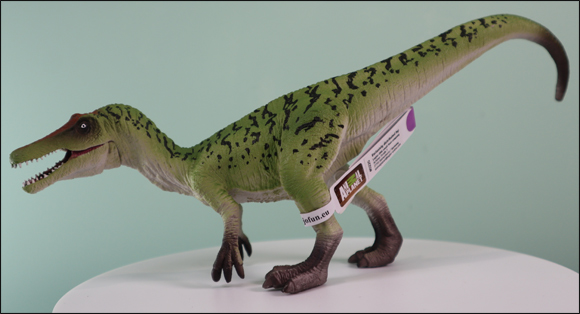
For this week’s Everything Dinosaur YouTube feature “Turntable Tuesday” we take the new for 2020 Mojo Fun Baryonyx dinosaur model for a spin.  The figure we selected to take a turn on our turntable is the Baryonyx figure with the articulated jaw.

The Mojo Fun Baryonyx Dinosaur Model (Articulated Jaw) Goes for Spin for “Turntable Tuesday”

Video credit: Everything Dinosaur

Mojo Fun Baryonyx Dinosaur Model

The Baryonyx dinosaur model is one of sixteen new dinosaurs introduced by Mojo this year (2020), within their prestigious “Prehistoric and Extinct” model range.  In the Everything Dinosaur video, the model is put through its paces and viewers are given the opportunity to get a 360 degree impression of Baryonyx walkeri.  The video review lasts for just over a minute and a half, it is the thirteenth video made in the Everything Dinosaur “Turntable Tuesday” feature,

The Beautiful Colouration on the New for 2020 Mojo Fun Baryonyx Dinosaur Model

Mojo Fun Baryonyx dinosaur model.
The new for 2020 Mojo Fun Baryonyx dinosaur model with an articulated jaw. Picture credit: Everything Dinosaur.

Picture credit: Everything Dinosaur

This hand-painted replica measures around 25 centimetres in length and it is one of five new Mojo theropod figures to have an articulated lower jaw.  The other new figures with articulated jaws are the Tyrannosaurus rex deluxe, the new Allosaurus, the feathered troodontid and the Spinosaurus deluxe.  Dinosaur fans will know that Baryonyx was distantly related to Spinosaurus, although it lived many millions of years before Spinosaurus evolved.

Mojo Baryonyx with an Articulated Jaw

The Mojo Fun Baryonyx model.
Taking its turn on the Everything Dinosaur turntable.  The new for 2020 Mojo Fun Baryonyx with an articulated jaw. Picture credit: Everything Dinosaur.

Picture credit: Everything Dinosaur

Two Baryonyx Models

There are two Baryonyx dinosaur models in the Mojo Fun model range.  These models replace the “blue” Baryonyx figure that was introduced by the company in 2018.

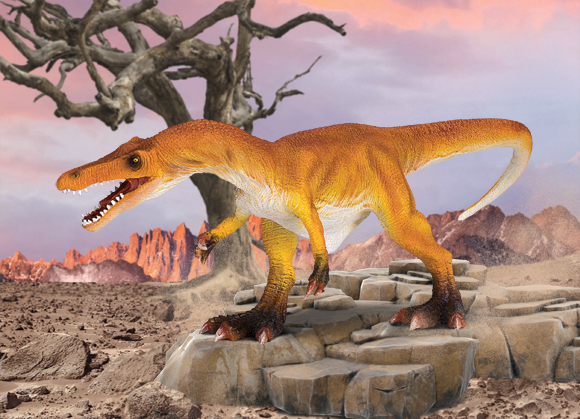
The Mojo Fun Baryonyx Deluxe Model

Mojo Baryonyx deluxe dinosaur model.
The new for 2020 Mojo Fun Baryonyx deluxe dinosaur model.

Visit the Everything Dinosaur website: Everything Dinosaur.

A spokesperson from Everything Dinosaur commented:

“Our weekly Turntable Tuesday feature on the Everything Dinosaur YouTube channel is our way of showcasing new models to fans and collectors of prehistoric animal models.  So many new Mojo models have been introduced this year, that if we were to produce a video for each one we would still be showing a Mojo Fun video in early November.  Much as we would like to cover them all, we have so many other prehistoric animal models to highlight.  Still, our studio permits us to take photographs as well so, if we don’t make a video we can take plenty of photographs and share these on-line via our various social media platforms such as Instagram, Pinterest and Facebook.”

To visit Everything Dinosaur’s YouTube channel: Visit Everything Dinosaur on YouTube and Subscribe.

Link to Mojo Fun: Mojo Fun Dinosaur and Prehistoric Animal Models.

8 06, 2020

Wild Past Protoceratops Video Review

By |2024-02-21T10:14:20+00:00June 8th, 2020|Categories: Adobe CS5, Dinosaur Fans, Everything Dinosaur videos, Main Page, Photos of Everything Dinosaur Products, Press Releases, Product Reviews|0 Comments

Wild Past Protoceratops Dinosaur Model (Video Review)

Our eagerly anticipated video review of the recently introduced Wild Past Protoceratops dinosaur model is now up on Everything Dinosaur’s YouTube channel.  In this short video (it lasts six minutes and fifty seconds), we combine a little bit of the science behind the study of this basal neoceratopsian with a review of the actual replica.  The model represents Protoceratops andrewsi, which was named and described back in 1923 (Granger and Gregory).

Everything Dinosaur’s YouTube Video Review of the Wild Past Protoceratops andrewsi Model

Video credit: Everything Dinosaur

The Wild Past Protoceratops Dinosaur Model

The Wild Past Protoceratops (P. andrewsi) model was introduced earlier this year (2020).  It is the first figure in an exciting range of replicas to be introduced by Wild Past.  In our short video review, we comment on the dinosaur model, provide size and scale information and we discuss pricing.  The production run for the Protoceratops is actually very small, not that much bigger than the number of fossil specimens of Protoceratops collected by the American Museum of Natural History expeditions between 1922 and 1925!  We discuss the production run and its effect on product pricing and provide a link in the video notes to where collectors can purchase this model.

To view the Wild Past range of dinosaur models including the Protoceratops andrewsi replica: Wild Past Prehistoric Animal Models.

Information about the Price of the Wild Past Protoceratops Dinosaur Model

Wild Past Protoceratops dinosaur model pricing (June 2020).
In the video review, Everything Dinosaur discusses the limited production run and how it has impacted on product pricing.  Pricing correct as of June 2020. Picture credit: Everything Dinosaur.

Picture credit: Everything Dinosaur

A 1/35th Scale Figure

The video review discusses the two species that are assigned to the Protoceratops genus (P. andrewsi and P. hellenikorhinus).  We explain how a second species was erected and look briefly at the differences between these two species.  In addition, we comment about the 2011 fossil discovery of a nest of Protoceratops andrewsi, complete with the fossilised remains of babies.  Although the American Museum of Natural History field team found dinosaur eggs in association with Protoceratops fossil material in their expeditions of the 1920’s, these eggs were not ceratopsid eggs.

Palaeontologists now know that the eggs the American Museum of Natural History field team found were actually laid by an oviraptorosaur, a clade of very bird-like dinosaurs which will be forever referred to as “egg thief lizards”.

The Wild Past Protoceratops Model is Supplied with a Nest Reflecting Recent Fossil Discoveries

Wild Past Protoceratops dinosaur model.
The Wild Past Protoceratops dinosaur model with nest. Picture credit: Everything Dinosaur.

Picture Credit: Everything Dinosaur

Visit the Everything Dinosaur website: Everything Dinosaur.
Comparing Triceratops and Protoceratops

Two ceratopsids together.
The Wild Safari Prehistoric World Triceratops model is used to show the size of the Wild Past Protoceratops.  In the Everything Dinosaur YouTube video review, the use of the Wild Safari Prehistoric World Triceratops as a reference for the scale of the Wild Past Protoceratops is commented upon. Picture credit: Everything Dinosaur.

Picture credit: Everything Dinosaur

To view the range of Wild Past prehistoric animal models including the Wild Past Protoceratops andrewsi: Wild Past Prehistoric Animals.

To visit Everything Dinosaur’s YouTube channel: Everything Dinosaur on YouTube.

7 06, 2020

Two New Transitional Ceratopsids – Knitting Together Horned Dinosaurs

By |2024-02-21T10:09:08+00:00June 7th, 2020|Categories: Adobe CS5, Dinosaur and Prehistoric Animal News Stories, Dinosaur Fans, Main Page, Palaeontological articles|0 Comments

Two New Transitional Horned Dinosaurs – Navajoceratops sullivani and Terminocavus sealeyi

In the last few days, a scientific paper has been published that proposes a direct evolutionary link between Pentaceratops and the younger chasmosaurine Anchiceratops.  The idea that there was a link between Pentaceratops (P. sternbergii) which roamed the New Mexico portion of Laramidia around 75.3 million years ago and Anchiceratops (A. ornatus) which lived much further north (Alberta, Canada), between 72 and 71 million years ago, had been proposed for more than two decades.

This newly published paper names two transitional species – Navajoceratops sullivani and Terminocavus sealeyi, plus describes another new ceratopsid, simply named taxon C.  Between them, these new horned dinosaurs help to fill the gap (literally) in chasmosaurine evolution.

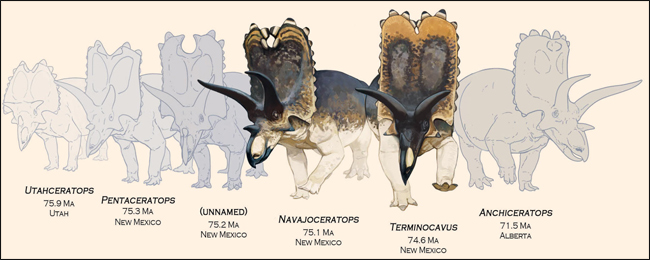
Forming Links in an Evolutionary Chain – From Pentaceratops to Anchiceratops

An evolutionary lineage linking chasmosaurines
The two new  horned dinosaurs together with an undescribed taxon form a vital link in the transition of chasmosaurine ceratopsids linking Utahceratops, Pentaceratops and Anchiceratops into an evolutionary lineage.

Picture credit: Ville Sinkkonen & Denver Fowler

It’s All About the Embayment

The Ceratopsidae in North America during the Late Cretaceous (Campanian and Maastrichtian faunal stages), diversified and evolved into many different forms.  Two great subfamilies emerged the Centrosaurinae and the Chasmosaurinae.  The evolutionary links between these two subfamilies and between the genera associated within each subfamily, has generated a great deal of discussion.  These dinosaurs are famous for their large skulls with their elaborate, extravagant head shields and horns.  Palaeontologists use the differences in the shape, orientation and size of these frills and adornments to determine one species from another.

Although, using the symmetry of the frill of a horned dinosaur to determine a new species can be controversial: Styracosaurus Provides a Head’s up When it Comes to Naming New Ceratopsids.

Navajoceratops sullivani and Terminocavus sealeyi Plus Taxon C

The problems recently highlighted with the discovery of a Styracosaurus with an asymmetrical skull notwithstanding, authors Dr Denver Fowler of the Badlands Dinosaur Museum and Dr Elizabeth Freedman Fowler (Dickinson State University, North Dakota), propose that these three new chasmosaurines, all from the Kirtland Formation of New Mexico, form a morphological succession between Pentaceratops from the older Fruitland Formation of New Mexico and Anchiceratops from the geologically much younger Horseshoe Canyon Formation of Alberta.

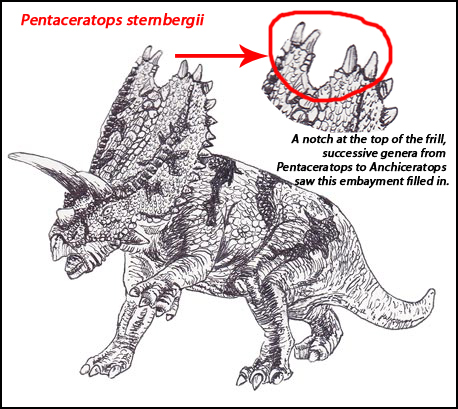
The Closing of the Notch in the Frill of Pentaceratops 

New study links Pentaceratops to Anchiceratops
A newly published scientific paper plots step changes in frill shape that suggests a line of evolutionary descent from Pentaceratops to Anchiceratops via several “transitional genera”. Picture credit: Everything Dinosaur.

Picture credit: Everything Dinosaur

Transitional Ceratopsids – The Shape of the Frills Backed by the Stratigraphy

Significantly, the scientists were able to plot a gradual change in the shape of the horned dinosaurs frills, essentially the gradual and successive filling in of a deep notch at the top of the frill (the embayment).  Anchiceratops did not have a notch at the top of its frill and the researchers demonstrate that two new partial skull specimens found in rocks intermediate in age between Pentaceratops and Anchiceratops were also intermediate in shape, showing how the notch in the frill became even deeper through time and eventually closed in on itself, explaining the lack of a notch in Anchiceratops.

Writing in the open access journal PeerJ, the researchers note that this step change in frill shape is observed in chasmosaurines that do not overlap stratigraphically.  This suggests that over hundreds of thousands of years, species evolved from a direct line of descent.  In biology, this is termed anagenesis – the slow and steady evolution of species in a sequence that forms a direct line of evolutionary descent without any obvious branching.

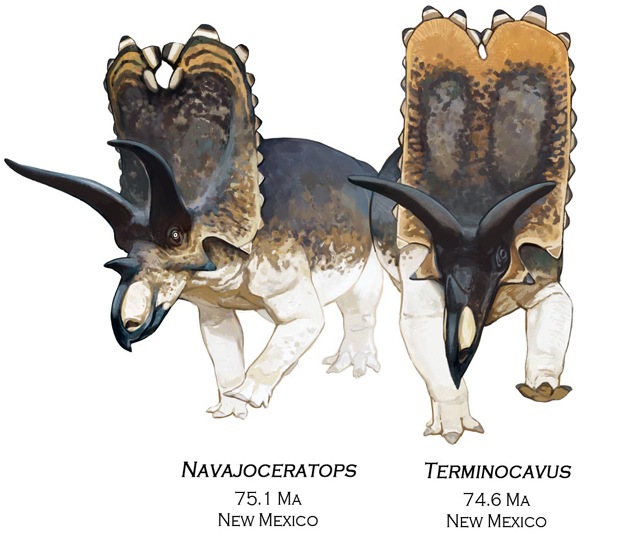
Two New Chasmosaurine Dinosaurs from the Kirtland Formation of New Mexico

Navajoceratops and Terminocavus life reconstructions.
Two new chasmosaurine dinosaurs from the Hunter Wash member of the Kirtland Formation of New Mexico.

Picture credit: Ville Sinkkonen & Denver Fowler

A Five Million Year Evolutionary Line

The two newly named horned dinosaurs Terminocavus sealeyi and Navajoceratops sullivani along with other chasmosaurine specimens from the Farmington and De-na-zin Members of the Kirtland Formation (taxon C), form a sequence of horned dinosaur evolution, stretching over five million years from Utahceratops to Pentaceratops and on to Anchiceratops.

Navajoceratops sullivani is named in honour of the Navajo people who are synonymous with New Mexico.  The species name honours the now retired, Dr Robert Sullivan who led the field expedition that resulted in the discovery of the Navajoceratops fossil material.  The name translates as “Sullivan’s Navajo horned face”.

Terminocavus sealeyi translates as “Sealey’s closing cavity”, after fossil collector Paul Sealey who found the holotype and due to the fact that the notch in the skull frill is fully closed.

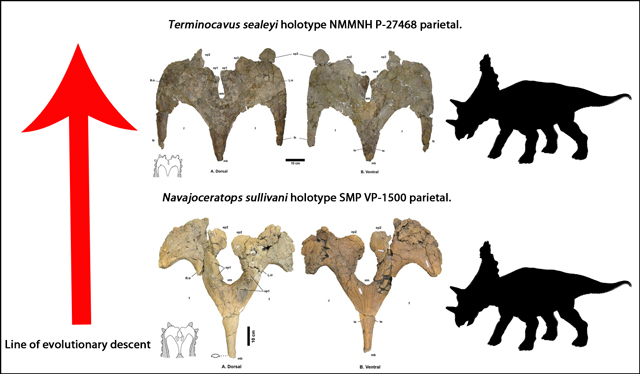
Holotype Parietal Frills of Terminocavus and Navajoceratops

The parietal frills of Navajoceratops and Terminoscavus.
Holotype specimens (parietal frills) of the two new genera, showing line of evolutionary descent and a not to scale silhouette to represent the actual dinosaur.  Although the specimens are fragmentary, both include the diagnostic posterior border of the parietal which permitted evolutionary comparisons to be made.

Picture credit: Ville Sinkkonen & Denver Fowler with additional annotation by Everything Dinosaur

An Evolutionary Split

The researchers conclude that fossil material previously assigned to Pentaceratops should be examined once more as it may not represent this taxon.  Furthermore, they suggest that there was a splitting event deep in the evolutionary history of the Chasmosaurinae subfamily, after which the Pentaceratops lineage evolved a progressively deepening of the parietal notch in the frill, in contrast to a sister group, the Chasmosaurus lineage which evolved a progressively shallower notch.

The authors propose that encroachment by the Western Interior Seaway around 85-83 million years ago, effectively cut-off dinosaur populations, with a northern and southern population isolated from each other.  This permitted two distinct lineages of chasmosaurines to evolve.  When the sea retreated around 83 million years ago the two populations were able to mix again.

The Isolation of Dinosaur Populations

The isolation of northern and southern dinosaur populations during the Santonian faunal stage as a result of rising sea levels provides an explanatory mechanism.  This mechanism in which high sea level isolated northern and southern dinosaur populations for a period of 1 to 4 million years, lays the foundation for an evolutionary splitting event and provides an explanatory mechanism for the apparent differences between northern and southern dinosaur faunas in the Late Cretaceous of western North America.

Everything Dinosaur acknowledges the assistance of a press release from Dickinson Museum Centre (North Dakota) in the compilation of this article.

The scientific paper: “Transitional evolutionary forms in chasmosaurine ceratopsid dinosaurs: evidence from the Campanian of New Mexico” by Denver W. Fowler and Elizabeth A. Freedman Fowler in PeerJ.

The Everything Dinosaur website: Everything Dinosaur.

Go to Top