

Scientists have described a new species of dicynodont from fossils discovered in Tanzania. These fossils could help palaeontologists refine the timeline for the origin of the dinosaurs. The new species has been named Dinodontosaurus isiyavamanda. It lived around 240 million years ago during the Triassic Period. Importantly, Dinodontosaurus was not a dinosaur. As a dicynodont, it is a synapsid, an evolutionary lineage that eventually produced modern mammals.
An international research team led by the University of Bristol described the new species. Their study has been published in the Journal of Vertebrate Paleontology.
Introducing Dinodontosaurus isiyavamanda
Researchers examined an associated dicynodont skeleton collected during a British expedition to Tanzania in 1963. The fossils subsequently entered the collection of the Natural History Museum in London. However, much of this material remained only partly studied. The scientists combined their examination of the historic specimen with a more recently discovered fragmentary skull. Their analysis identified the fossils as belonging to the genus Dinodontosaurus.
This identification came as a surprise. Previously, Dinodontosaurus fossils had only been confirmed from South America. Furthermore, detailed anatomical comparisons demonstrated that the Tanzanian fossils represented a new species.
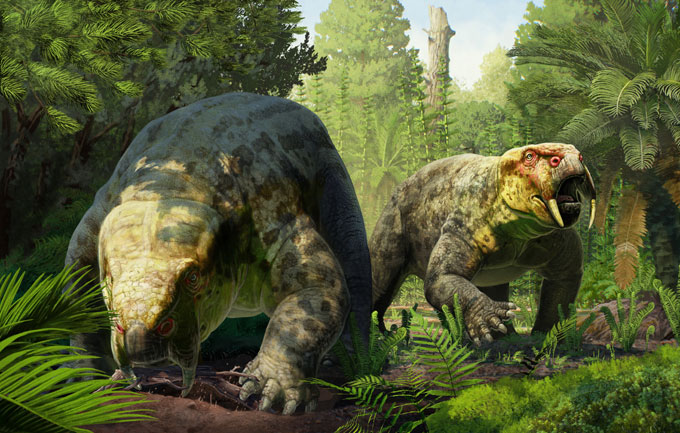
Dinodontosaurus isiyavamanda life reconstruction. Picture credit: Gabriel Ugueto.
Picture credit: Gabriel Ugueto
The species name “isiyavamanda” refers to the land of the Wamanda people. They inhabit the region of Tanzania where the fossils were discovered.
Hady George, a PhD student at the University of Bristol and lead author of the study, explained:
“Our discovery marks the first confirmed record of the genus Dinodontosaurus outside South America. The finding links the Tanzanian and South American fossil-bearing rocks, showing they are of equivalent age.”
A related article: The Oldest Dinosauromorph from South America.
A new silesaurid from the Dinodontosaurus Assemblage Zone: Gondwanax – A New Silesaurid Taxon.
An Important Triassic Herbivore
Dicynodonts were extremely successful synapsids. They first evolved during the Permian and survived the devastating end-Permian mass extinction. These generally stocky animals subsequently became important components of many Triassic terrestrial ecosystems. The last dicynodonts lived during the Late Triassic around 205 million years ago. For example, the giant Lisowicia (L. bojani), roamed what is now known as Poland during the Rhaetian age of the Late Triassic. Lisowicia is the largest known dicynodont, as well as the largest non-mammalian synapsid.
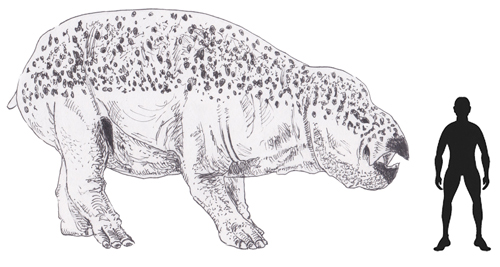
A scale drawing of the giant dicynodont Lisowicia bojani. Picture credit: Everything Dinosaur.
Picture credit: Everything Dinosaur
The researchers identified several anatomical characteristics that distinguish Dinodontosaurus isiyavamanda from the South American species. For example, the new species possessed a distinctive structure to its palate. The researchers suggest this feature could relate to food processing. In addition, this autapomorphy hints at niche partitioning. Perhaps D. isiyavamanda exploited different food resources compared to other coeval dicynodonts. Such resource partitioning could have helped several large herbivores coexist.
Rethinking the Timeline of Dinosaur Origins
The Tanzanian fossils come from the famous Manda Beds. These rocks have yielded an extraordinary assemblage of Middle to Late Triassic vertebrates. Crucially, the Manda Beds have also produced fossils linked to the earliest stages of dinosaur evolution. These include Nyasasaurus, a possible early dinosaur, and the dinosauriform Asilisaurus.
Everything Dinosaur’s 2012 article highlighting the discovery of Nyasasaurus parringtoni: Pushing Back the Date of Dinosaur Evolution.
An article from 2010 examining fossil evidence from Tanzania that sheds light on the evolution of the Dinosauria: Dinosauria Evolved Ten Million Years Earlier.
Determining the age of these rocks is therefore extremely important. Previously, scientists correlated parts of the Manda Beds with fossil-bearing deposits in South Africa. This correlation supported an older Middle Triassic age for some of the Tanzanian fossils.
However, the identification of Dinodontosaurus in Tanzania provides another way to correlate these rocks. Dinodontosaurus is also known from South America. Therefore, its presence provides a biostratigraphic link between fossil deposits separated today by the Atlantic Ocean.
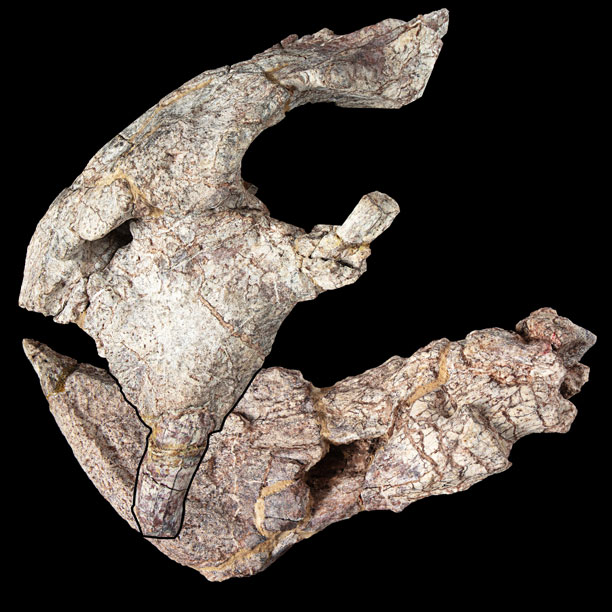
Dinodontosaurus isiyavamanda front of the skull and the lower jaw. Picture credit: Jonathan Jackson and Hady George.
Picture credit: Jonathan Jackson and Hady George
Dating the Manda Beds
Around 240 million years ago, Africa and South America formed parts of the enormous supercontinent Pangaea. Consequently, animals could disperse across regions that are now widely separated. Recent radiometric dating of South American rocks indicates that these deposits are younger than the South African rocks used in earlier correlations. The difference could be as much as ten million years.
The new study therefore supports a late Ladinian to Carnian age for the relevant Manda Beds. This has important consequences for interpreting the earliest dinosaur fossils.
Hady George commented:
“This helps confirm that the oldest dinosaur candidates from Tanzania are probably no older than those from South America, refining the timeline of dinosaur origins.”
Rather than demonstrating that dinosaurs had already evolved substantially earlier in Africa, the Tanzanian fossils may be broadly contemporary with early dinosaur evidence from South America.
A Fossil Waiting More Than Sixty Years
The research also demonstrates the enormous scientific importance of museum collections. Some of the material used to describe Dinodontosaurus isiyavamanda has been cared for by the Natural History Museum for more than six decades. Indeed, palaeontologist Nigel Larkin first studied the dicynodont skeleton during his MSc at University College London in 1994. At the time, he concluded that it probably represented a species new to science.
However, almost three decades passed before work began to formally describe it.
Nigel Larkin stated:
“Techniques have improved vastly over the last 30 years too – we can do so much more with Micro CT scanning etc to examine such specimens than we ever could have imagined in the 1990s, and international collaboration is so much easier.”
Modern scanning technology allows palaeontologists to examine fossil anatomy in extraordinary detail. Furthermore, researchers can study internal structures without damaging precious specimens.
Dr Mike Day, Curator of Non-Mammalian Tetrapods at the Natural History Museum, highlighted the importance of historic collections.
He added:
“It goes to show how revisiting museum collections can change our understanding of the past just as much as finding new fossils in the field.”
More Dinodontosaurus Fossils to Study
The story of Dinodontosaurus isiyavamanda is far from complete. A substantial amount of Tanzanian material still awaits detailed examination. In particular, researchers intend to investigate more of the postcranial skeleton. The scientists plan to compare these bones with Dinodontosaurus fossils from South America. In addition, they hope to investigate the biomechanics of these remarkable herbivores.
This research could reveal how several large dicynodont species shared the same environments and food resources.
More than sixty years after its discovery, an overlooked museum specimen has acquired a unique scientific identity. Moreover, it is helping palaeontologists piece together events near the dawn of the Dinosauria. The description of Dinodontosaurus isiyavamanda demonstrates that old fossils can still produce new surprises. In this case, they could even help change our understanding of when the first dinosaurs evolved.
Everything Dinosaur acknowledges the assistance of the University of Bristol in the compilation of this article.
The scientific paper: “Craniomandibular osteology of Dinodontosaurus isiyavamanda sp. nov. (Therapsida: Anomodontia) from the Manda Beds of Tanzania and new support for a younger age for the alleged oldest dinosaurs” by Hady George, Juan A. Escobar, Edmund R.R. Moody, Charles B. Saanane, Michael O. Day and Nigel R. Larkin published in the Journal of Vertebrate Paleontology.
For museum quality replicas of dicynodonts and other prehistoric creatures: Models of Prehistoric Creatures.

Leave A Comment