

Amazing Permian Raindrops – An Ephemeral Moment Preserved for 275 Million Years
Fossils can preserve evidence of extraordinary events. However, sometimes the most mundane traces of the past prove equally remarkable. Everything Dinosaur team members recently visited the Museum für Naturkunde Berlin. There, they photographed exquisite Permian raindrop impressions preserved in sandstone.
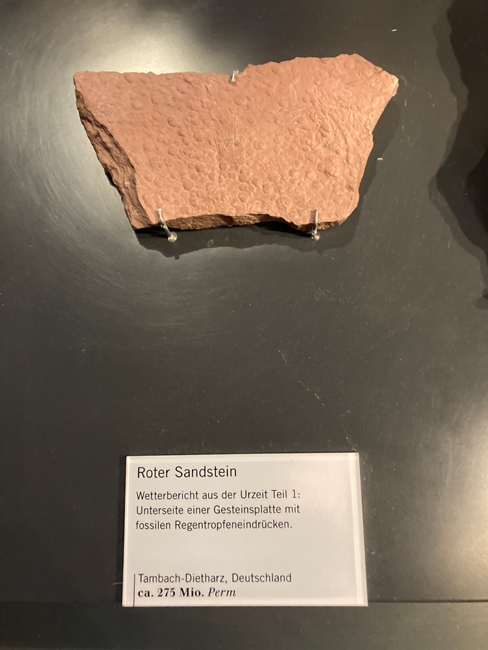
A record of rainfall from 275 million years ago. Individual water drops left marks, and these impressions were preserved when the sand turned into sandstone. Picture credit: Everything Dinosaur.
Picture credit: Everything Dinosaur
Permian Raindrop Impressions
We suspect that the impressions come from the famous Bromacker deposits of central Germany. These rocks date from the Permian. They preserve evidence of an ancient terrestrial ecosystem. Moreover, fossils from Bromacker provide palaeontologists with a remarkable window into Permian life. For example, evidence for the earliest synapsid cloaca has been identified from fossil material discovered at the UNESCO Global Geopark.
To read more about this remarkable research: Earliest Synapsid Cloaca Identified from Trace Fossil.
Recently, Everything Dinosaur wrote about a study that mapped the ontogeny of the smallest Dimetrodon species known to science: Study Reveals Different Growth Strategies for Tiny Dimetrodon Species.
Yet the raindrop impressions offer something rather different.
Rain is the very definition of something ephemeral. A drop falls, strikes the ground and disappears almost instantly. Nevertheless, under exceptional circumstances, its impact can leave a tiny impression in soft sediment. Subsequent sediment then covers these delicate marks. Eventually, geological processes transform the sediment into rock.
Consequently, an event lasting perhaps a fraction of a second can survive for hundreds of millions of years.
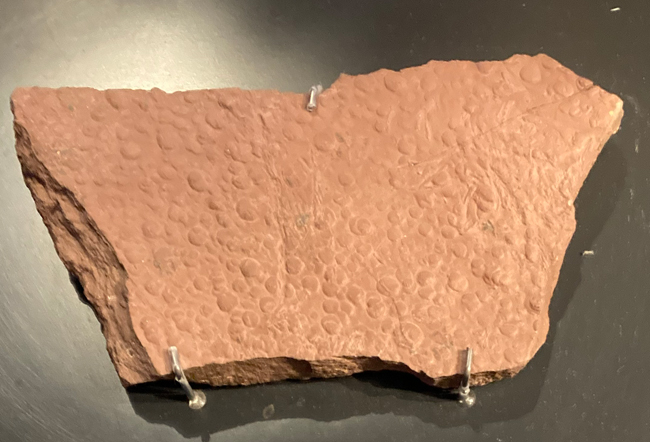
The sandstone has preserved marks made by individual raindrops. Picture credit: Everything Dinosaur.
Picture credit: Everything Dinosaur
Mike from Everything Dinosaur commented:
“There is something wonderfully humbling about looking at the marks made by raindrops that fell around 275 million years ago.”
The Bromacker rocks preserve much more than raindrops. Fossils include vertebrate remains, footprints, invertebrates, plants and even skin impressions. Together, they help scientists reconstruct this ancient environment.
However, the Permian raindrop impressions have a special appeal. They capture a fleeting moment in deep time.
A brief shower passed across an ancient landscape. Incredibly, evidence of that ephemeral event remains with us today.
The award-winning Everything Dinosaur website: Models of Palaeozoic Creatures.