

Remarkable Study Reveals the Origins of Bat Evolution
A huge international study has shed new light on bat evolution. The research suggests that bats originated in Europe around 65 million years ago. Moreover, both powered flight and echolocation appear to have evolved very early in their history.
The study represents the largest investigation yet to combine bat genomes with evidence from the fossil record. An international team of 137 researchers from 64 countries took part. Scientists from the Museum für Naturkunde Berlin also contributed to the research.
The findings have been published in the journal Nature.
Combining Bat Fossils with Genetic Evidence
Researchers analysed high-quality genomes representing 103 bat species. Significantly, these species represent all 21 currently recognised bat families. The scientists also incorporated 44 fossil bats from different parts of the world.
By combining these two sources of evidence, the team reconstructed the evolutionary history of bats. Their analysis also helped resolve several long-standing questions about relationships between the major bat groups. Previous studies proposed that bats originated in Asia, Africa or North America. However, the new research points towards Europe as their place of origin.
The first bats probably appeared around 65 million years ago. This date places their origins close to the beginning of the Cenozoic Era.
Early bats subsequently spread from Europe into Africa. Therefore, the researchers propose a European-African area from which bats later dispersed farther afield. Eventually, they reached Asia, the Americas and Australia.
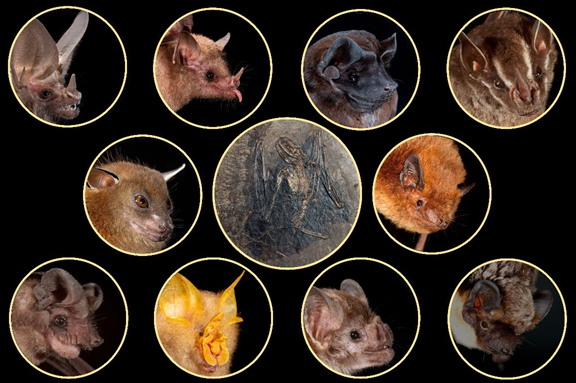
A variety of extant bat species surrounding a photograph of Palaeochiropteryx tupaiodon known from the Middle Eocene of Europe. Fossils of this species are associated with the remarkable Messel Shale site in Germany. Picture credit: BAT1K
Picture credit: BAT1K
Individual image credits:
Bat species, from top left to bottom right: Macrotus waterhousi © Charles Francis; Glossophaga mutica © Brock and Sherri Fenton; Molossus nigricans © Brock and Sherri Fenton; Uroderma convexum © Elizabeth Clare; Cynopterus sphinx © Charles Francis; Palaeochiropteryx tupaiodon [fossil] © Matthew Jones; Pipistrellus nathusii © Jens Rydell; Tadarida brasiliensis © Elizabeth Clare; Rhinolophus trifoliatus © Charles Francis; Desmodus rotundus © Charles Francis; Vespertilio murinus © Jens Rydell.
Echolocation Evolved Early
The study also provides important evidence about the origins of echolocation. Researchers examined the position of the fossil bat Vielasia on the bat family tree. Its placement within one of the oldest branches suggests that echolocation evolved extremely early.
Indeed, echolocation probably appeared before the major modern bat lineages diverged. Powered flight also developed very early in bat evolution. Consequently, the two characteristics most closely associated with bats were present near the beginning of their evolutionary history.
These remarkable adaptations may help explain their subsequent success.
Today, more than 1,500 bat species are known. They account for approximately one-fifth of all living mammal species. Furthermore, bats have colonised environments across much of the world.
The Remarkable Success of Bats
Bats are the only mammals capable of powered flight. Many species can also navigate and hunt in complete darkness using echolocation. However, their remarkable biology extends far beyond flight and sophisticated senses. Bats perform important ecological roles. For example, some species pollinate plants or disperse seeds. Others consume huge numbers of insects, including agricultural pests.
In addition, many bats show unusual resistance to disease. They can also live exceptionally long lives relative to their body size. The new genomic dataset could help scientists investigate the biological mechanisms responsible for these traits.
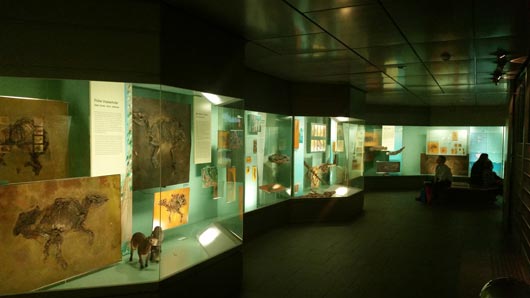
The atmospheric Messel gallery at the Senckenberg Museum (Frankfurt). Fossil bat specimens examined in this study are associated with the remarkable Messel Shales. Picture credit: Everything Dinosaur.
Picture credit: Everything Dinosaur
Reconstructing the Ancestral Bat Genome
As part of the project, researchers reconstructed the genome of the common ancestor of living bats. This achievement gives scientists a powerful new research resource. They can now investigate genetic changes associated with the extraordinary diversification of bats. Researchers can study changes affecting individual DNA building blocks. They can also examine much larger sections of genetic material. As a result, scientists hope to identify genetic changes linked to flight, echolocation, longevity and disease resistance.
Such research could eventually have implications beyond the study of bats. In particular, understanding their longevity and immune systems might contribute to research into human ageing and disease.
A New Framework for Studying Bat Evolution
The research was undertaken as part of the international Bat1K consortium. This initiative aims to produce and analyse high-quality reference genomes for all living bat species. For decades, scientists have debated fundamental questions concerning the origins of bats. The relationships between different bat families have also proved difficult to resolve. By bringing fossils and genomic evidence together, this enormous study provides a new evolutionary framework.
It suggests that the story of bats began in Europe approximately 65 million years ago. Soon afterwards, these pioneering mammals possessed two extraordinary adaptations – powered flight and echolocation. These abilities would ultimately help bats become one of the most diverse and successful groups of mammals on Earth.
Everything Dinosaur acknowledges the assistance of a media release from the Museum für Naturkunde Berlin in the compilation of this article.
The scientific paper: “Reference genomes and fossils revise bat family phylogeny and biogeography” by Morales, A.E., Liang, Y., Thomas, W.R. et al published in the journal Nature.
The award-winning Everything Dinosaur website: Models of Prehistoric Mammals.