

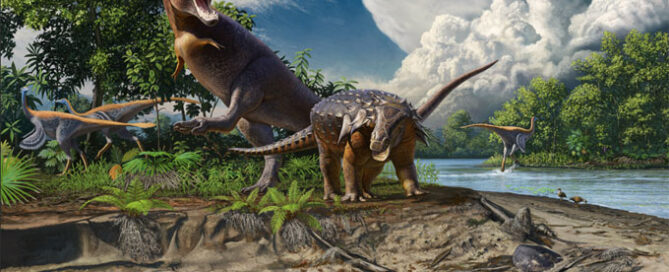
Extraordinary Probable T. rex Trackway Discovered in North Dakota
An extraordinary trace fossil probably a Tyrannosaurus rex trackway has been discovered in North Dakota. It provides a rare glimpse of a giant theropod walking through the Late Cretaceous landscape. The four huge footprints date to approximately 66.5 million years ago (Maastrichtian faunal stage).
Scientists from the Denver Museum of Nature & Science and Liverpool John Moores University studied the trackway. Their research has been published in the Journal of Vertebrate Paleontology.
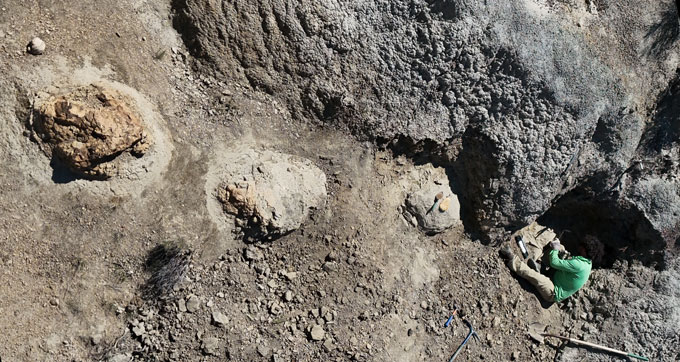
An aerial view of the tridactyl trackway excavation. Picture credit: Kent Hups.
Picture credit: Kent Hups
Dinosaur tracks, particularly those associated with large theropods are extremely rare within the Hell Creek Formation. The trackway exceeds seven metres in length and consists of four large three-toed prints. It represents two left and two right footprints – a walking sequence. Each print is around a metre in length. The size and tridactyl nature of the tracks is consistent with an adult T. rex trackmaker. Moreover, numerous Tyrannosaurus rex bones have been found in this locality. These body fossil finds support the hypothesis that these tracks were indeed produced by an adult T. rex.
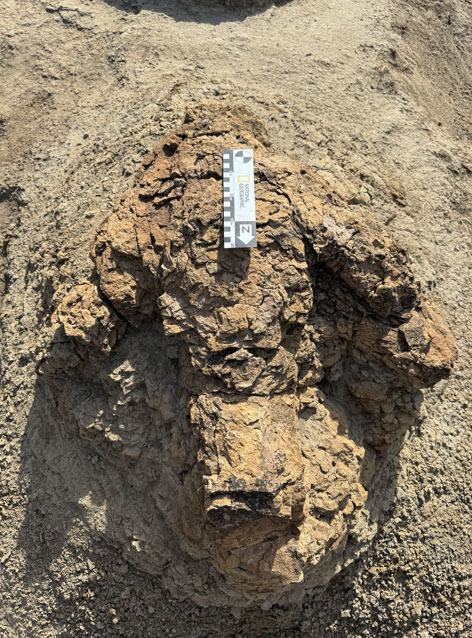
An isolated tridactyl track from the probable Tyrannosaurus rex trackway. Picture credit: Tyler Lyson.
Picture credit: Tyler Lyson
Studying Theropod Locomotion
Stride lengths and foot dimensions indicate a walking speed in the region of 1.5 to 2 metres per second. This is roughly comparable to a brisk human walking pace. The velocity estimate is consistent with the walking speeds calculated for other large theropod tracks.
Each track in the sequence is preserved as fine-grained sandstone concretions cemented with calcium carbonate. They nucleated around footprint depressions and the resultant footprint casts are harder than the surrounding rock. However, the surfaces of the footprint casts are heavily fractured and retain little anatomical detail beyond size and number of digits. Nevertheless, this is an important data point that marks the first report of a trackway that is likely attributable to an adult Tyrannosaurus rex.
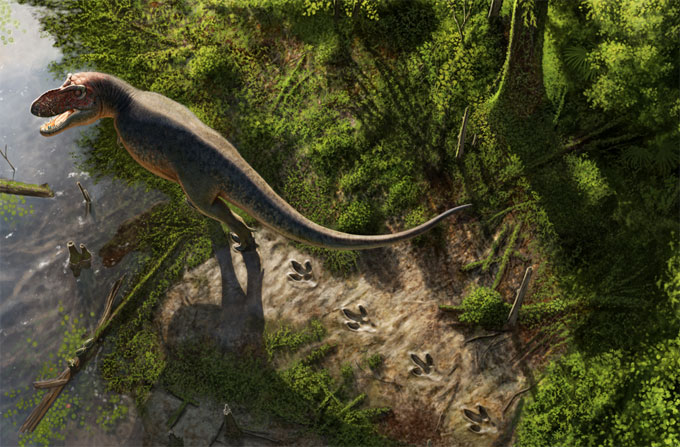
A reconstruction of an adult Tyrannosaurus rex leaving tracks in the soft substrate. Picture credit: Andrey Atuchin.
Picture credit: Andrey Atuchin
Is This a Tyrannosaurus rex Trackway?
The researchers identified an adult Tyrannosaurus rex as the most likely trackmaker. They based this conclusion on several lines of evidence. These include the enormous size of the prints and the relatively narrow toes. Furthermore, T. rex fossils are abundant in the surrounding area.
Individual footprints have previously been attributed to adult T. rex. However, this discovery represents the first described sequence of tracks probably made by an adult tyrannosaur.
For example, back in 2007 we wrote about the discovery of a single, large theropod print in the Hell Creek Formation. It could represent a T. rex footprint.
To read about this trace fossil discovery: The Mystery Tyrannosaur Footprint.
Co-author of the study Tyler Lyson (Denver Museum of Nature & Science) commented:
“Bones tell us an enormous amount about these animals, but footprints capture a moment of behaviour. With a trackway, we can actually follow an animal as it moved across the landscape. That is incredibly rare for T. rex.”
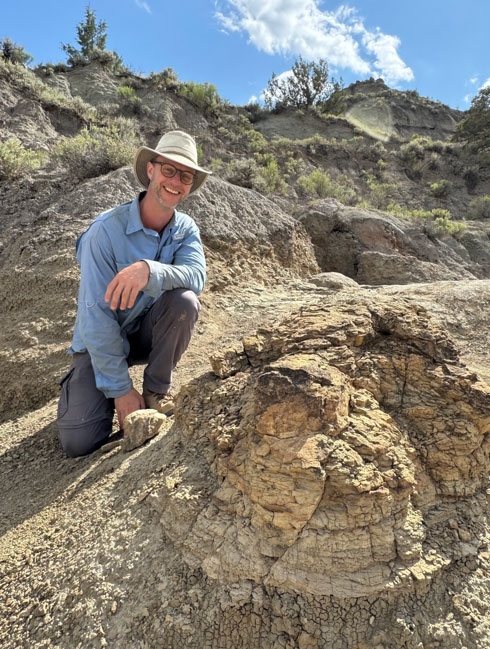
Co-author of the scientific paper Tyler Lyson next to one of the tridactyl tracks. Picture credit: Natalie Toth.
Picture credit: Natalie Toth
Following the Footprints of a Theropod Dinosaur
Whilst the weathered nature of the tracks hinders extensive study, the researchers propose that the trackway records a stride length of approximately four metres. The heavily weathered footprints prevent a more detailed assessment.
The trackway was discovered in 2025 on federal land administered by the U.S. Forest Service near Marmarth, North Dakota. The team used high-resolution 3D surface scanning to document each footprint and the full trackway. The resulting digital models allow scientists to examine the tracks in detail and create physical 3D reproductions.
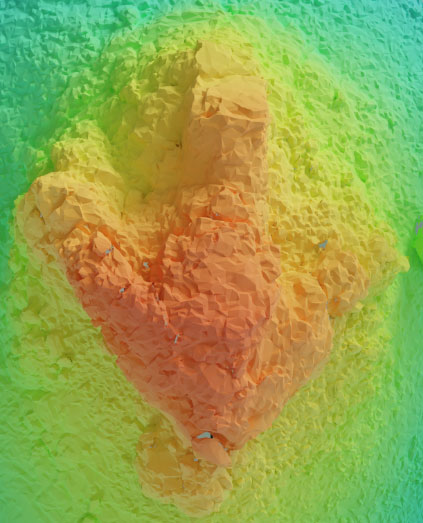
A computer-generated relief map of one of the large tridactyl prints. Picture credit: Antoine Bercovici.
Picture credit: Antoine Bercovici
Peter Falkingham, a professor of palaeobiology at Liverpool John Moores University and a dinosaur track expert, was lead author of the study, despite never having seen the tracks in person.
Professor Falkingham explained:
“The technology we’re able to apply in the digital age means my colleagues could scan the tracks in the field and then send the 3D information over to me to visualise on my computer and in VR, enabling me to take as close a look as they did in person.”
Fossilised bones reveal the anatomy of extinct animals. In contrast, footprints preserve fleeting moments in their lives. These remarkable tracks may therefore record several seconds in the life of an adult Tyrannosaurus rex some 66.5 million years ago.
Everything Dinosaur acknowledges the assistance of a media release from the Denver Museum of Nature & Science in the compilation of this article.
The scientific paper: “A large tridactyl trackway from the Upper Cretaceous Hell Creek Formation of North Dakota, likely attributable to an adult Tyrannosaurus rex” by Peter L. Falkingham, Kent M. Hups, Evan M. Tamez-Galvan, Antoine D. Bercovici and Tyler R. Lyson published in the Journal of Vertebrate Paleontology.
The Everything Dinosaur website: Models of Tyrannosaurs and Other Dinosaurs.