

Pioneering Palaeontologist Dorothea Bate Honoured with National Blue Plaque
A Dorothea Bate blue plaque has been unveiled at the Natural History Museum at Tring (Hertfordshire). The plaque celebrates one of Britain’s most remarkable fossil hunters. Furthermore, it recognises a pioneering woman who helped transform our understanding of prehistoric animals and life on Earth.
Dorothea Bate (1878–1951) was a palaeontologist and archaeozoologist. She discovered extinct species across the Mediterranean. In addition, her research helped establish the foundations of modern archaeozoology. Archaeozoology is the scientific study of the remains of animals found at archaeological sites.
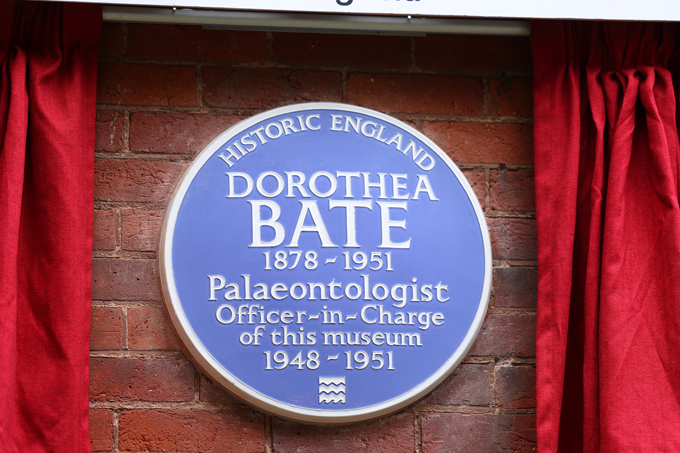
The newly unveiled blue plaque commemorating the contribution of Dorothea Bate. © Historic England. Shared by HE Comms.
Picture credit: © Historic England. Shared by HE Comms
Everything Dinosaur welcomes this recognition of an important scientist. The company has long championed the contribution made by women to palaeontology and the Earth Sciences.
Mike from Everything Dinosaur commented:
“Everything Dinosaur has always championed the contribution of women to palaeontology and the Earth Sciences. Dorothea Bate was a remarkable scientist and an inspirational fossil hunter. This blue plaque provides a fitting opportunity to celebrate her achievements. It also highlights the vital contribution women have made, and continue to make, to our understanding of the history of life on Earth.”
Indeed, we often commemorate the role of women in science on International Women’s Day which is celebrated annually on March the 8th.
Celebrating the role of female scientists (2020): Women in Science on International Women’s Day.
Honouring women in science (2022): Celebrating International Women’s Day – 2022.
Dorothea Bate – A Remarkable Fossil Hunter
Dorothea Bate was born in Carmarthen, Wales, in 1878. She developed a fascination with natural history at an early age. She received little formal education. Instead, she largely taught herself through observation, research and fieldwork. As a young woman, she explored the Gloucestershire countryside and caves searching for fossils. In 1900, Bate travelled to the Natural History Museum in London. She approached museum staff and asked for work behind the scenes. Her determination paid off. She became an assistant and began an association with the institution lasting more than half a century.
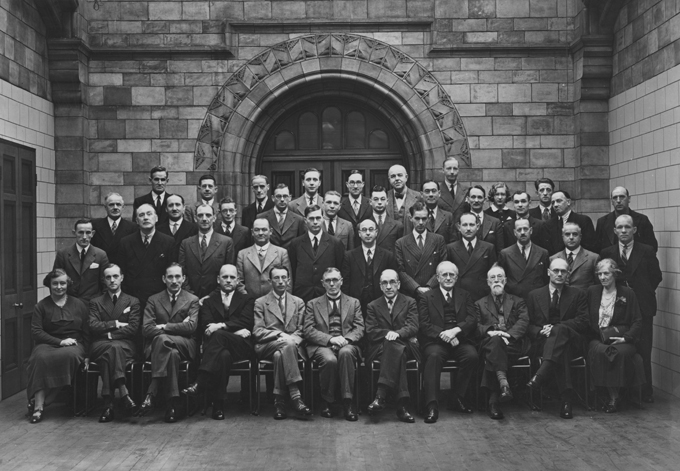
Natural History Museum Geology Department. Dorothea Bate is sat in the front row to the far right. Picture credit: From the Library and Archives, NHM London. Shared by Cordelia Porter.
Picture credit: From the Library and Archives, NHM London. Shared by Cordelia Porter
Remarkably, she published her first scientific paper in 1901.
Bate subsequently undertook expeditions throughout the Mediterranean. Often travelling alone, she explored remote caves looking for evidence of prehistoric animals.
In Cyprus, she discovered a previously unknown dwarf elephant. Later, while working in the Balearic Islands, she discovered Myotragus. This extraordinary extinct animal has been described as a goat-like antelope.
To read our article from 2009 about some remarkable research: Myotragus – The Goat That Behaved Like a Reptile.
Her fieldwork could be extremely challenging. Bate crossed difficult terrain carrying a relatively simple collection kit. Nevertheless, she recovered fossils that would make an enormous contribution to science.
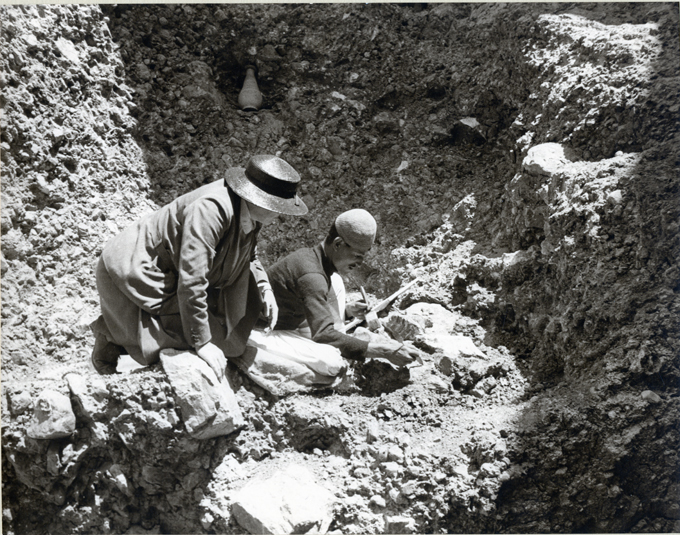
Dorothea on a dig. Picture credit: From the Library and Archives, NHM London. Shared by Cordelia Porter.
Picture credit: From the Library and Archives, NHM London. Shared by Cordelia Porter
Understanding Ancient Animals and Environments
Later in her career, Bate worked closely with archaeologists. She studied animal remains recovered from ancient cave sites. As a result, she helped pioneer the modern science of archaeozoology.
Importantly, she recognised that changes in animal communities could provide evidence about past environments. Her research helped scientists understand how climatic changes affected wildlife and early human populations. During the Second World War, Bate transferred to the Natural History Museum at Tring. In 1948, she became Officer-in-Charge, a senior role in the organisation. She was responsible for managing and displaying the museum’s collections.
Her scientific achievements were substantial. Dorothea Bate published more than eighty scientific papers. However, she spent much of her career without a permanent paid position.
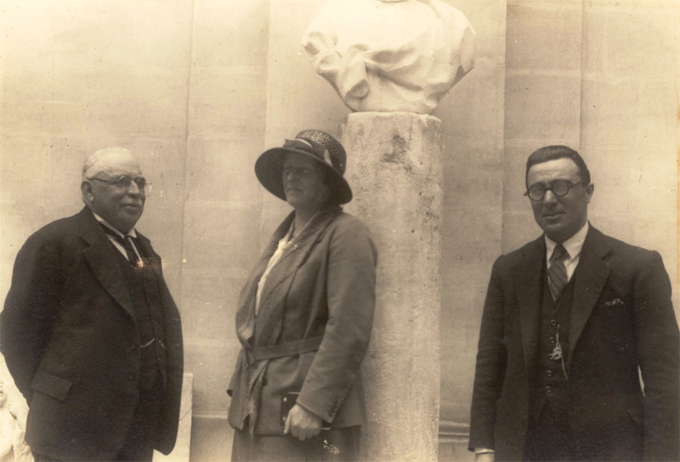
Dorothea Bate with Sir Temi Zammit (Museum Director) & Dr. Joseph Baldacchino (Curator of Natural History) at the National Museum, Valletta. Malta. Picture credit: © National Museum of Archaeology/Heritage Malta. Shared by HE Comms.
Picture credit: © National Museum of Archaeology/Heritage Malta. Shared by HE Comms
Championing Women in the Earth Sciences and the Dorothea Bate Blue Plaque
Bate’s achievements become even more remarkable when considered in their historical context. Opportunities for women in science were extremely limited during much of her career. She was one of the first women to work at the Natural History Museum. Consequently, her success helped demonstrate the enormous contribution women could make to palaeontology and natural history.
Dr Sandra Knapp, Director of Research at the Natural History Museum, highlighted how the role of female scientists in natural history has often been overlooked. She explained that Bate’s research on fossil mammals was innovative and helped establish a path for others.
Dr Knapp explained:
“The role of women scientists in natural history is often hidden – but Dorothea Bate’s work with fossil mammals was both innovative and set a path for others, despite obstacles.”
The national blue plaque helps ensure that Dorothea Bate receives greater recognition.
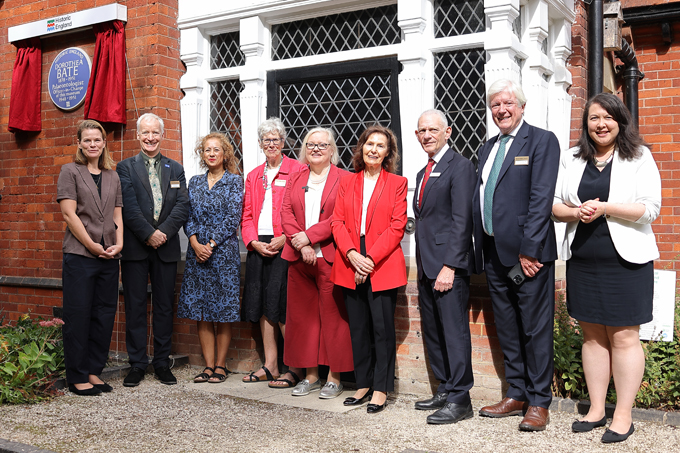
Staff and officials attending the unveiling ceremony. © Historic England. Shared by HE Comms.
Picture credit: © Historic England. Shared by HE Comms
Everything Dinosaur believes highlighting pioneers such as Bate is important. Women now make vital contributions across palaeontology, geology, evolutionary biology and the wider Earth Sciences. Moreover, recognising scientists from the past can inspire the scientists of the future.
Dorothea Bate combined curiosity, determination and formidable field skills. Her fossil discoveries continue to have scientific importance. More than seventy years after her death, her influence remains.
The national blue plaque at Tring provides a fitting tribute to an exceptional scientist and fossil hunter. It also celebrates a woman who helped pave the way for generations of scientists who followed her.
Everything Dinosaur acknowledges the assistance of a media release from Historic England and email correspondence with the media team at the London Natural History Museum in the compilation of this article.