All about dinosaurs, fossils and prehistoric animals by Everything Dinosaur team members.
5 01, 2021

The Beautiful PNSO Domingo the Carnotaurus Model

By |2024-05-18T08:20:17+01:00January 5th, 2021|Categories: Adobe CS5, Dinosaur Fans, Everything Dinosaur News and Updates, Everything Dinosaur Products, Main Page, Photos of Everything Dinosaur Products, Press Releases|0 Comments

PNSO Domingo the Carnotaurus Model

Having announced the introduction of a replica of the giant South American theropod Carnotaurus (C. sastrei), on their various social media platforms, Everything Dinosaur have dedicated a blog post to this new for 2021 PNSO dinosaur model.  This provides the UK-based Everything Dinosaur the opportunity to post up some more images of this eagerly anticipated dinosaur, a figure that will be in stock later this year, perhaps in just a few weeks.

The New for 2021 Domingo the PNSO Carnotaurus Model

The PNSO Domingo the Carnotaurus dinosaur model.

PNSO Domingo the Carnotaurus dinosaur model.  The colouration and detailing on this new for 2021 theropod replica are quite remarkable.

Domingo the PNSO Carnotaurus

It is appropriate that the PNSO Carnotaurus (number 36 in the PNSO prehistoric animal models that accompany your growth series), has been given a Latin name (Domingo).  Fossils of this famous abelisaurid are known from southern Argentina.  Indeed, the majority of the abelisauroids described to date herald from the southern hemisphere (the ancient landmass of Gondwana).

Domingo the Carnotaurus Makes an Appearance on the Everything Dinosaur Blog

The PNSO Domingo the Carnotaurus dinosaur model.

PNSO Domingo the Carnotaurus dinosaur model.  The tiny forelimbs can be seen in this view of the dinosaur model.

Model Measurements

The PNSO Carnotaurus figure measures around 23.5 cm in length.  The height of those prominent head crests, the helped to give this dinosaur its name (Carnotaurus means meat-eating bull), are around 11.5 cm off the ground.  Although PNSO do not declare a scale for their mid-size range of dinosaurs, Everything Dinosaur team members estimate that this new for 2021 figure is in around 1/32th scale.

The Model Measurements and a Skeletal Reconstruction of Carnotaurus sastrei

The PNSO Domingo the Carnotaurus dinosaur model (model measurements).

PNSO Domingo the Carnotaurus dinosaur model (model measurements).  The model is approximately 23.5 cm long and the head height is around 11.5 cm.

A Dinosaur Model with an Articulated Jaw

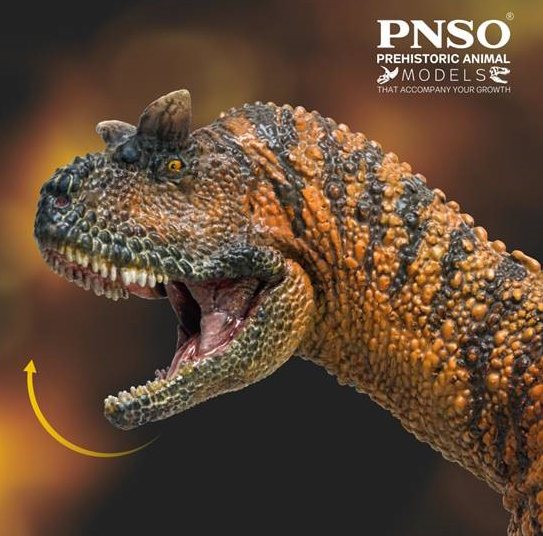
In common with other recently announced PNSO theropod replicas (A-shu the Qianzhousaurus and the new Wilson Tyrannosaurus rex model), this new Carnotaurus has an articulated lower jaw.

Domingo the Carnotaurus (PNSO) Complete with an Articulated Lower Jaw

PNSO Domingo the Carnotaurus dinosaur model (close-up view of the head).

The PNSO Domingo the Carnotaurus dinosaur model (close-up view of the head).  The close up view of the head of the new dinosaur model with its articulated lower jaw.

A spokesperson from Everything Dinosaur commented:

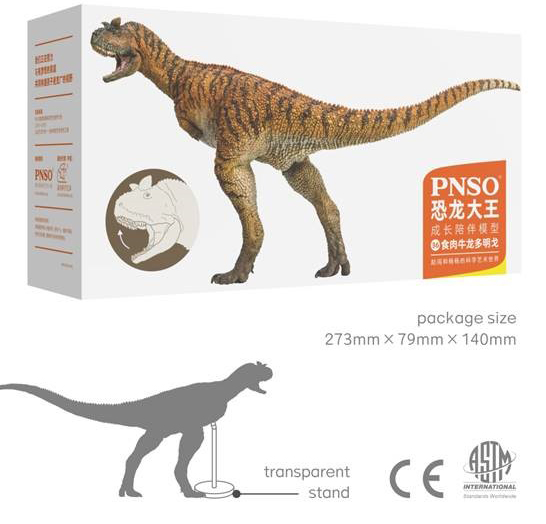
“The new PNSO Carnotaurus has been very carefully modelled on the fossil material and the body proportions including those reduced front limbs and that deep skull have been skilfully reproduced.  The hind legs are in the correct body proportions too.  A clear plastic support stand is provided to help stabilise the figure when on display.”

The Everything Dinosaur website: Dinosaur Toys.

The Carnotaurus Packaging and a Diagram Showing the Chest Support for the Dinosaur Model

The PNSO Carnotaurus model (product packaging).

PNSO Carnotaurus (product packaging).  With realistic body proportions the model requires a support stand to help stabilise the figure.

This remarkable model of a Late Cretaceous carnivorous dinosaur will be in stock at Everything Dinosaur in 2021.

To view the huge range of PNSO prehistoric animal models available from Everything Dinosaur: PNSO Age of Dinosaurs.

4 01, 2021

Early Dinosaur’s Brain Reveals New Insights into Sauropodomorpha

By |2023-07-03T15:01:59+01:00January 4th, 2021|Categories: Adobe CS5, Dinosaur and Prehistoric Animal News Stories, Dinosaur Fans, Main Page, Palaeontological articles|0 Comments

The Brain of Thecodontosaurus

Analysis of the brain and inner ear of the Late Triassic basal Sauropodomorpha Thecodontosaurus (T. antiquus), reveals that it may have been bipedal, able to hold a steady gaze whilst running and possibly predatory.  These are some of the conclusions drawn by researchers from the University of Bristol and the Oxford University Museum of Natural History in a new study published in the Zoological Journal of the Linnean Society.

The Research Team Used CT-scans and 3-D Modelling to Construct the Brain and Inner Ear of Thecodontosaurus
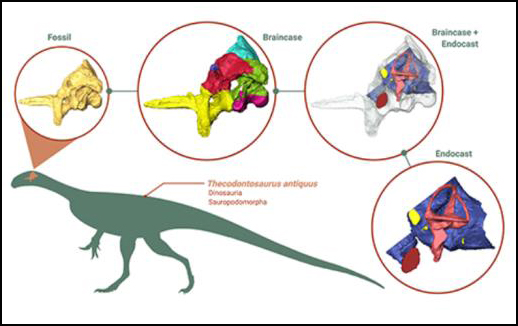
CT-scans and computer modelling used to construct the brain of Thecodontosaurus.

Building up a picture of the brain and the inner ear based on the fossilised braincase of Thecodontosaurus antiquus.

Picture credit: Antonio Ballell et al

Thecodontosaurus antiquus

Named in 1836 (it was only the fourth dinosaur to be scientifically described), Thecodontosaurus is regarded as a basal member of the lizard-hipped Sauropodomorpha, a clade of dinosaurs that includes Brontosaurus, Brachiosaurus, Diplodocus and Argentinosaurus.  Thecodontosaurus was much smaller than its illustrious Jurassic and Cretaceous descendants.  It was approximately two metres long, more than half its body length was made up by its long, thin tail and it was lightly built with most palaeontologists estimating that it weighed around 20-25 kilograms, about as heavy as a border collie.

As an early member of the lineage of long-necked dinosaurs, a study of the fossilised remains of Thecodontosaurus can provide palaeontologists with a better understanding of the evolutionary history of the Sauropodomorpha.

For models and replicas of members of the Sauropodomorpha: CollectA Age of Dinosaurs Popular Figures.

Bristol University has Researched the “Bristol Dinosaur” For Decades
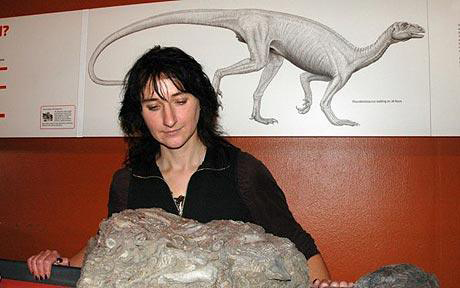
Thecodontosaurus study.

Thecodontosaurus fossil block with life reconstruction in the background.  In the picture (above), from 2009, a researcher stands in front of a block of Thecodontosaurus bones with a life reconstruction of the dinosaur in the background.  Note that in 2009, Thecodontosaurus was thought to be quadrupedal, this new study suggests that it may have been bipedal.

Picture credit: Simon Powell/University of Bristol

Three-dimensional Modelling Techniques

Research, led by the University of Bristol, used advanced imaging and 3-D modelling techniques to digitally rebuild the brain of Thecodontosaurus.  The scientists suggest that Thecodontosaurus could have eaten meat.  Although the substantial part of its diet was plant matter, its brain morphology indicates that this little dinosaur had a good sense of balance and that it was agile.  Traits that may have helped it supplement its vegetarian diet with the occasional meal of captured prey.

Lead author of the study, Antonio Ballell stated:

“Our analysis of Thecodontosaurus’ brain uncovered many fascinating features, some of which were quite surprising.  Whereas its later relatives moved around ponderously on all fours, our findings suggest this species may have walked on two legs and been occasionally carnivorous.”

The research team was able to deploy imaging software to extract new information from the fossils in a non-destructive manner.  Numerous three-dimensional models were generated from CT scans by digitally extracting the bone from the rock, identifying and classifying anatomical details about the brain and the inner ear which were previously unknown in this taxon.

PhD student Antonio explained the basis of the research:

“Even though the actual brain is long gone, the software allows us to recreate brain and inner ear shape via the dimensions of the cavities left behind.  The braincase of Thecodontosaurus is beautifully preserved so we compared it to other dinosaurs, identifying common features and some that are specific to Thecodontosaurus.  Its brain cast even showed the detail of the floccular lobes, located at the back of the brain, which are important for balance.  Their large size indicate it was bipedal.  This structure is also associated with the control of balance and eye and neck movements, suggesting Thecodontosaurus was relatively agile and could keep a stable gaze while moving fast.”

The Diet of Thecodontosaurus

The diet of Thecodontosaurus, nicknamed the “Bristol dinosaur” as a result of its association with the city, remains uncertain, although this new study suggests that it may have been omnivorous.

Antonio added:

“Our analysis showed parts of the brain associated with keeping the head stable and eyes and gaze steady during movement were well-developed.  This could also mean Thecodontosaurus could occasionally catch prey, although its tooth morphology suggests plants were the main component of its diet.  It’s possible it adopted omnivorous habits.”

The researchers were also able to reconstruct the inner ears, allowing them estimate how well it could hear compared to other dinosaurs.  Its hearing frequency was relatively high, potentially inferring some sort of social complexity, an ability to recognise varied squeaks and honks from different animals.

Comparing the Brain Cast of Thecodontosaurus to Other Dinosaurs
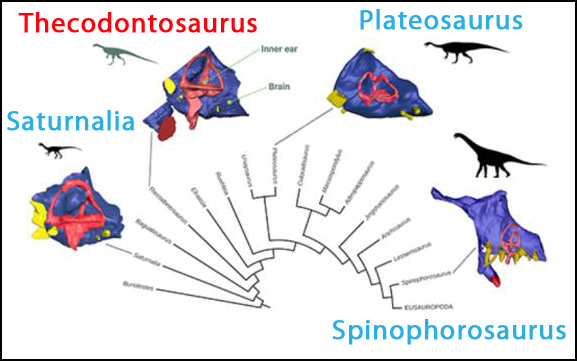
The changing shape of sauropod brains.

Structure, size and shape of the inner ear and brain examined in relation to the evolution of the Sauropodomorpha.

Picture credit: Antonio Ballell et al with additional notation by Everything Dinosaur

Comparing Thecodontosaurus to Other Members of the Sauropodomorpha

The application of these technologies enabled the research team to compare the brain and inner ear of Thecodontosaurus to Saturnalia tupiniquim – an earlier basal sauropodomorph which roamed the Southern Hemisphere around twenty-five million years before Thecodontosaurus evolved.  Comparisons were also carried out between Plateosaurus, which is also known from the Late Triassic and the much later sauropod Spinophorosaurus (S. nigerensis) from the Middle Jurassic.

Professor Mike Benton, study co-author, said:

“It’s great to see how new technologies are allowing us to find out even more about how this little dinosaur lived more than 200 million years ago.”

The distinguished professor added:

“We began working on Thecodontosaurus in 1990, and it is the emblem of the Bristol Dinosaur Project.  We’re very fortunate to have so many well-preserved fossils of such an important dinosaur here in Bristol.  This has helped us understand many aspects of the biology of Thecodontosaurus, but there are still many questions about this species yet to be explored.”

Everything Dinosaur acknowledges the assistance of a media release from the University of Bristol in the compilation of this article.

The scientific paper: “The braincase, brain and palaeobiology of the basal sauropodomorph dinosaur Thecodontosaurus antiquus” by A. Ballell, J. L. King, J. M. Neenan, E. J. Rayfield and M. J. Benton published in the Zoological Journal of the Linnean Society.

Visit Everything Dinosaur’s website: Everything Dinosaur.

3 01, 2021

The New ITOY Studio Resurrection Dilophosaurus

By |2024-05-18T08:10:28+01:00January 3rd, 2021|Categories: Dinosaur Fans, Everything Dinosaur Products, Main Page, Photos of Everything Dinosaur Products, Press Releases, Product Reviews|0 Comments

ITOY Studio Resurrection Dilophosaurus

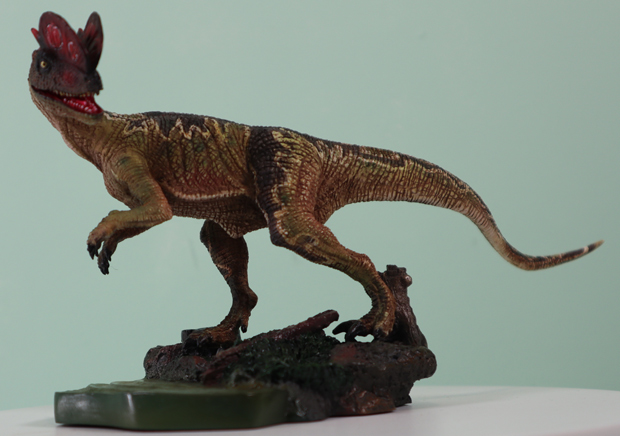
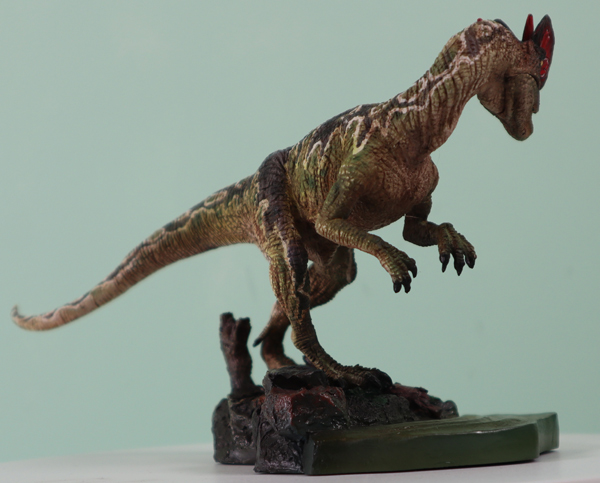
The ITOY Studio Resurrection Dilophosaurus dinosaur model has certainly caused a stir with prehistoric animal fans and dinosaur model collectors since its arrival at Everything Dinosaur.  This beautiful replica, depicting what is now believed to have been one of the largest terrestrial carnivores on the planet during the Early Jurassic.  It ticks all the boxes when it comes to dinosaur replicas, with its innovative colouration, stability and stunning detail.

The ITOY Studio Dilophosaurus Dinosaur Model

ITOY Studio Dilophosaurus dinosaur model.

The ITOY Studio Dilophosaurus dinosaur model.  This dinosaur figure comes with its own beautifully detailed display base, complete with plants, logs and water.  Picture credit: Everything Dinosaur.
Picture credit: Everything Dinosaur

ITOY Studio Resurrection Dilophosaurus and Revising Dilophosaurus

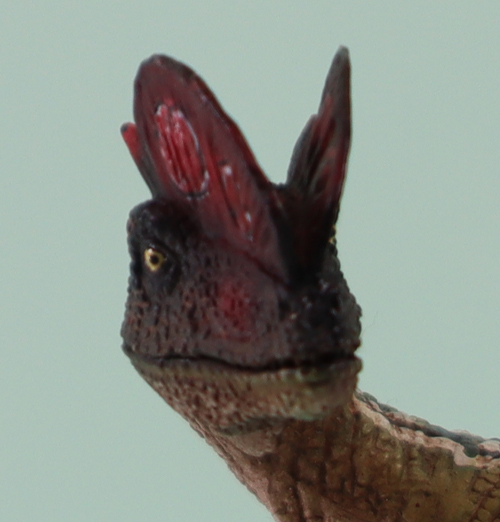
A recent revision of Dilophosaurus fossil material (D. wetherilli) revealed that the lower jaw (dentary), was more robust than previously realised and it has been suggested that this dinosaur was a much more formidable predator, a terror of the contemporary Sarahsaurus, a member of the Sauropodomorpha.  The large crests on the ITOY figure reflect the latest thinking in terms of the crest size and the design team have given their figure crimson head crests, possibly a nod towards the idea that these crests were primarily used for display.  The inside of the mouth is particularly well painted.  The Dilophosaurus has an articulated jaw, so the figure can be posed with mouth closed, mouth open or indeed somewhere in between.

Here’s Looking At You!  A Very Formidable Dilophosaurus Model

Staring at you! The ITOY Studio Dilophosaurus dinosaur model.

Here’s looking at you!  A stare from the ITOY Studio Dilophosaurus dinosaur model.  Picture credit: Everything Dinosaur.
Picture credit: Everything Dinosaur

Model Measurements

The Model measures a fraction over twenty centimetres in length.  The head is some seven and a half centimetres off the ground.  Naturally, when placed on its display base the figure appears a little taller.  Team members at Everything Dinosaur have enjoyed taking photographs and videos of this replica.  There are plans to make a more detailed video in the future showcasing this model and revealing just how securely this dinosaur stands on its base.

The Fantastic Colours and Detail on the ITOY Studio Dilophosaurus Dinosaur Model

Late Jurassic Predator Dilophosaurus

ITOY Studio Dilophosaurus.  Has it gone camera shy? Picture credit: Everything Dinosaur.

Picture credit: Everything Dinosaur

Visit the Everything Dinosaur website: Dinosaur Toys and Models.

The Product Packaging

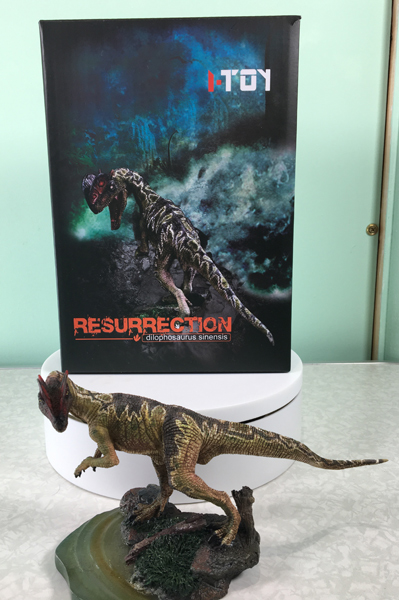
We have been asked to show the product packaging.  Many collectors prefer never to take their purchase out of its box.  We are only to happy too oblige and to include a picture of the front of the box with its striking artwork (below).

Standing Proud in Front of the Product Packaging

ITOY Studio Dilophosaurus and the product packaging.

The gorgeous ITOY Studio box art with the Dilophosaurus figure in front of the packaging.  Standing proud in front of its packaging.  Picture credit: Everything Dinosaur.

Picture credit: Everything Dinosaur

To view the ITOY Studio Dilophosaurus dinosaur model and the rest of the prehistoric animals in the ITOY range: ITOY Studio Models.

2 01, 2021

A Komodo Dragon in the Snow

By |2024-05-18T08:05:30+01:00January 2nd, 2021|Categories: Animal News Stories, Dinosaur and Prehistoric Animal Drawings, Main Page, Photos|0 Comments

A Komodo Dragon in the Snow

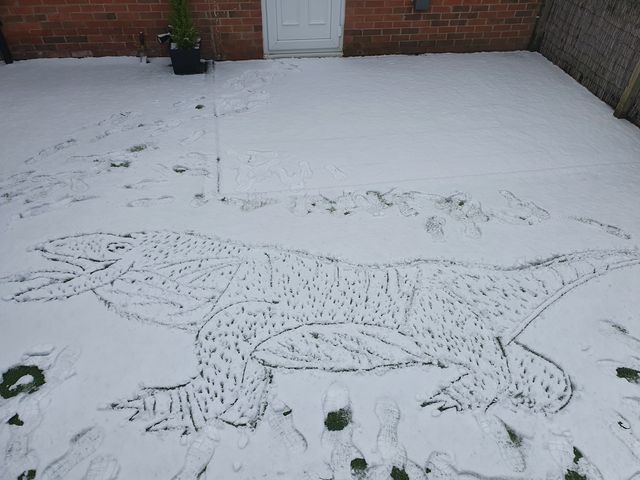
A good artist can turn their hand to using a variety of materials and techniques to express themselves.  Take for instance, this excellent illustration of a Komodo dragon (V. komodoensis), created after a recent snowfall by Caldey.  A fine example of snow art, depicting the largest living lizard, a reptile that would have been very uncomfortable in such a cold environment, however Caldey’s Komodo dragon looks very much at home in her back garden.

A Komodo Dragon in the Snow

Komodo dragon in the snow

Creating a Komodo dragon in the snow.

Picture credit: Caldey

Plotting Proportions and Adding Details

When working on a large project, many professional artists sketch out their design at first and use this as a blueprint for the much larger artwork. By taking this approach, the proportions can be plotted prior to the outline being made and the details added.  We are not sure how Caldey created her lizard, but she has done well to plot the proportions and scale the animal to fit the space that was available.  Our congratulations!  What a clever and innovative piece of work.

Getting Creative in the Snow – Creating a Komodo Dragon

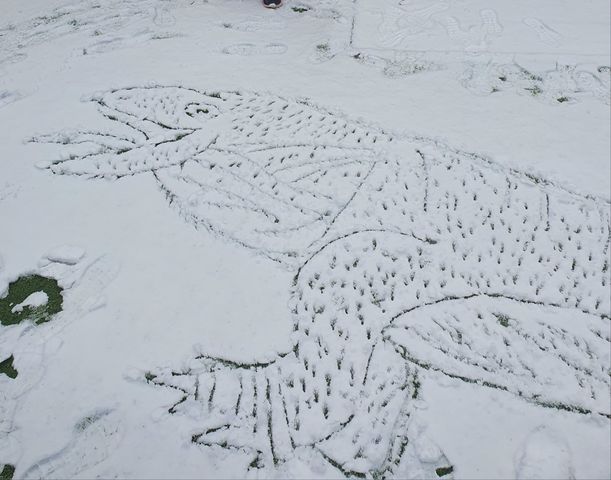
Komodo dragon in the snow.

Getting creative in the snow.  An illustration of a Komodo dragon by Caldey.  A close-up view of the head of the Komodo dragon snow drawing.

Picture credit: Caldey

A spokesperson from Everything Dinosaur commented:

“With the recent snowfalls in the UK, we have seen lots of pictures of snowmen on social media, but we can’t recall ever seeing a Komodo dragon before.  Our congratulations to Caldey for her clever and innovative use of “solid precipitation”.  We suspect there are not many gardens graced with drawings of lizards.”

Sadly, given the vagaries of the British weather, the Komodo dragon will not be on view for very long.

1 01, 2021

A Trio of Rebor Oddities G-2016 Embryos

By |2024-05-18T08:12:51+01:00January 1st, 2021|Categories: Adobe CS5, Dinosaur Fans, Everything Dinosaur News and Updates, Everything Dinosaur Products, Main Page, Photos of Everything Dinosaur Products, Press Releases|1 Comment

A Trio of Rebor Oddities G-2016 Embryos

Time to start the New Year (2021) with a bang!  At midnight on the 31st December, Everything Dinosaur made the three new Rebor Oddities (Rebor Oddities Specimens: G-2016 Embryos), available for pre-order.  These innovative, science-fiction/fantasy pieces have already attracted a lot of interest from model collectors and dinosaur fans.  In a co-ordinated post with Rebor, customers of Everything Dinosaur are able to guarantee themselves one of these figures.

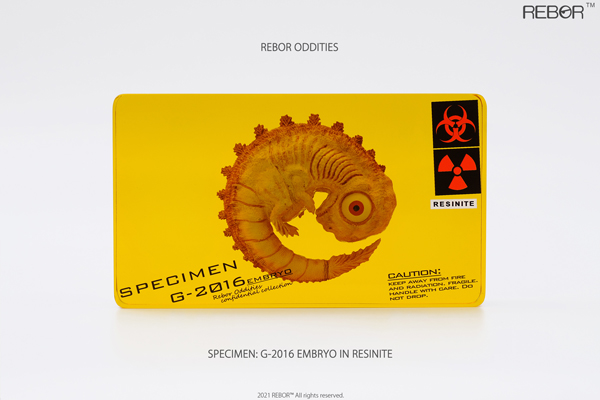
Rebor Oddities Specimen: G-2016 Embryo in Resinite

Rebor Oddities Specimen: G-2016 Embryo in Resinite

The Rebor Oddities Specimen: G-2016 Embryo in Resinite.  The embryo of the fantasy creature with the code name G-2016 is entombed in resinite.  The hand-written note inscribed on the piece reads “Rebor Oddities confidential collection.”

Rebor Oddities Specimens

The Rebor Oddities sub-brand has introduced to collectors a wide variety of innovative items.  The first to be introduced was the “Fossil Studies” Tylosaurus proriger skeleton incorporated within its own light-up display base.  This figure was swiftly followed by the beautiful “Chickenosaurus” embryo model.  Recently a trio of museum quality dinosaur fossil skulls have been introduced and followers of Everything Dinosaur on social media will know that later on this year the Compsognathus longipes preserved dissection specimens will be coming into stock.

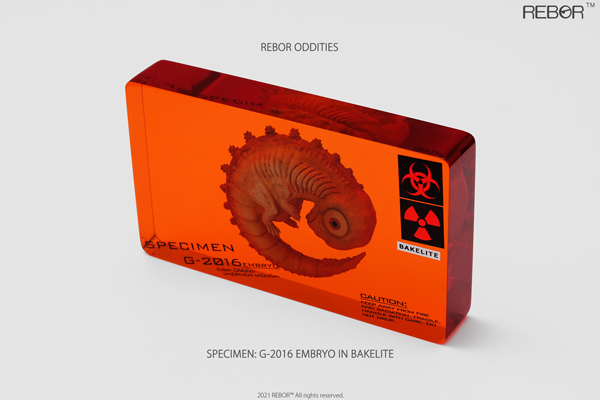
The Rebor Oddities Specimen: G-2016 Embryo in Bakelite

Rebor Oddities Specimen: G-2016 Embryo in Bakelite.

The Rebor Oddities Specimen: G-2016 Embryo in Bakelite.  A limited number of these fascinating figures have been made and collectors are urged to place pre-orders quickly in order to avoid disappointment.

Limited Numbers Available

In a statement put out by Rebor on social media, they have explained that pre-ordering will only be available for a few days.  Rebor went onto add that all three variants (Bakelite, Epoxide and Resinite), are extremely limited due to the high manufacturing defect rates, so a restricted number have been produced.  It is not known at this stage whether or not there will be another production run in the future.

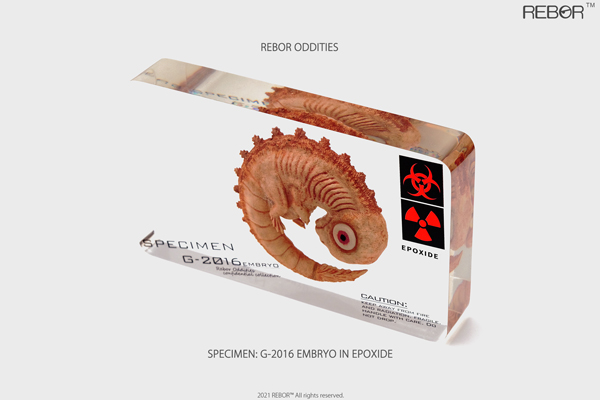
The Stunning Rebor Oddities Specimen: G-2016 Embryo in Epoxide

Rebor Oddities Specimen: G-2016 Embryo in Epoxide.

The Rebor Oddities Specimen: G-2016 Embryo in Epoxide.  All three variants pay homage to a famous fictional monster (Kaiju), that first appeared in a Japanese film made in 1954.

Model Measurements (Rebor Oddities G-2016 Embryos)

Each carefully crafted figure measures approximately 18.5 cm long.  They stand a fraction over 10.5 cm tall and the block which holds the embryo model is 3 cm deep.  Each of these clever replicas helps to showcase the innovative approach taken by Rebor.  They will provide a talking point and a highlight within a collection.

Everything Dinosaur estimates that each model will be available to send out to customers in late March.

Visit the Everything Dinosaur website: Dinosaur Toys and Figures.

An Embryo is Outlined in Silhouette

Rebor Oddities Specimen: G-2016 Embryo in Bakelite (silhouette).

The Rebor Oddities Specimen: G-2016 Embryo in Bakelite (silhouette).

To view these amazing new models and to pre-order them visit: Rebor Dinosaurs and Prehistoric Animals.

Go to Top