The famous “Jurassic Coast” stretches for 95 miles (155 kilometres). It runs from Exmouth in East Devon to Studland Bay in Dorset and the layers of sedimentary rock record approximately 185 million years of Earth’s history.
The “Jurassic Coast”
This coastline on the English Channel was designated at England’s first UNESCO natural World Heritage Site back in 2001 and although it attracts hundreds of thousands of tourists every month during the summer, there are still quiet parts to be explored and enjoyed.
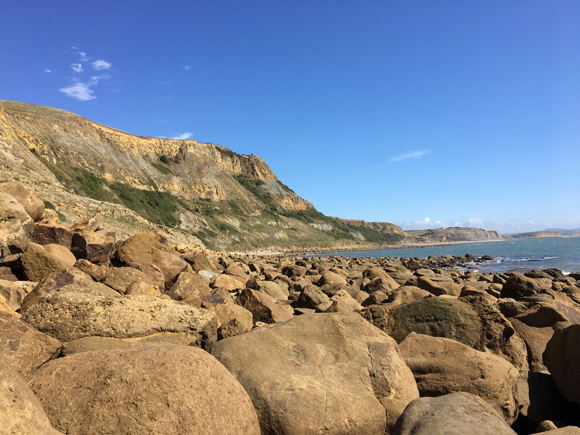
A View of the Jurassic Coast Towards Burton Bradstock East of Lyme Regis
The view towards West Bay and Burton Bradstock. A beautiful day on the UNESCO World Heritage site, the “Jurassic Coast”.Picture credit: Everything Dinosaur.
Picture credit: Everything Dinosaur
Sandstone Cliffs
The photograph shows a section of the sandstone cliffs that lie to the east of Seatown in Dorset, the view shows West Bay and on the far right the sheer sandstone cliffs of Burton Bradstock can just be made out.
What a terrific view, this area of southern England may attract huge numbers of visitors every year, but there are still some areas, especially those more difficult to access parts of the coastline, that can provide opportunities to have a small section of a UNESCO World Heritage site, all to yourself, for a few minutes at least.
By Mike|2023-10-30T08:38:13+00:00September 15th, 2018|Categories: General Teaching|Comments Off on A Beautiful Marine Reptile Model
Wonderful Model of a Pliosaurus
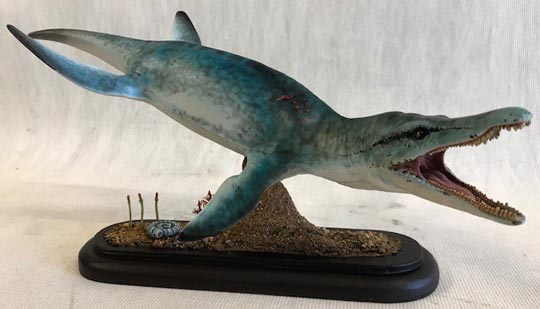
Our thanks to the model collector and prehistoric animal fan who sent in a picture of a wonderful marine reptile diorama. The figure in question is a model of the fearsome, carnivore Pliosaurus. The artist (Martin Garratt), has done a splendid job in making a prehistoric animal model that costs just a few pounds into something truly unique and spectacular.
Prehistoric Pliosaurus Model Display Piece
A customised CollectA Pliosaurus scale model.
Collecta Deluxe Pliosaurus
The image (above) shows the figure. It is a customised CollectA Deluxe Pliosaurus. It has been used to make an amazing marine reptile diorama.
To help depict the model in a dynamic swimming pose, the sculptor moulded a support and incorporated this into the base by making it look like an irregular section of the sandy seabed the marine reptile was cruising past. The fine details on this display piece help to reflect the quality of the craftsmanship involved. The sculptor has even created a coiled ammonite shell and added it to the seabed.
A spokesperson from Everything Dinosaur commented:
“We enjoy seeing pictures of prehistoric animal dioramas and we get lots sent into our offices. We look at every one, pictures of dinosaur models created by children as well as museum quality dioramas such as this one created by a professional artist.”
Yizhousaurus sunae – Chinese Dinosaur May Help Unlock Key to Giant Dinosaur Evolution
A newly described long-necked dinosaur that once roamed south-western China during the Early Jurassic is helping palaeontologists to better understand the development of a dinosaur lineage that was to lead to the evolution of the largest land animals that ever lived. The dinosaur, named Yizhousaurus sunae with its three-dimensional, well-preserved skeleton and undistorted skull provides new data on how the sauropod dinosaurs were able to achieve a giant body size.
This dinosaur lived approximately 190 million years ago and it has been estimated to have reached a length of about seven metres. Its beautifully preserved bones can help palaeontologists to fill in a gap in their knowledge as they attempt to work out how bipedal, lizard-hipped dinosaurs of the Late Triassic and Early Jurassic evolved into the giant, quadrupedal sauropods like Brontosaurus, Apatosaurus and Brachiosaurus that dominated terrestrial ecosystems in the Late Jurassic.
Scientists from the Chinese Academy of Sciences in collaboration with colleagues from the Museum of Texas Tech University (Texas, USA) and the Bureau of Land and Resources of Lufeng County (Yunnan Province, China) have published their findings in the academic journal “Scientific Reports”.
A Reconstruction of the Skeleton of Yizhousaurus sunae
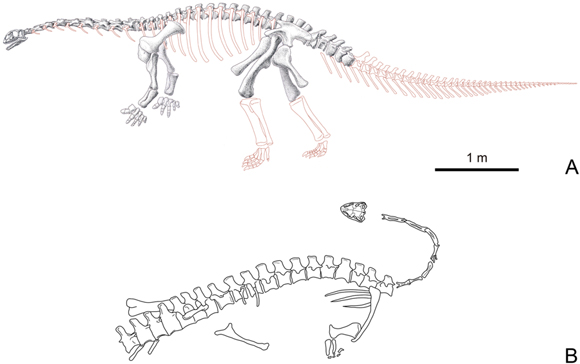
A – Yizhousaurus skeleton reconstruction with known bones shaded in grey and (B) the location of the bones at the fossil site. Note the scale bar equals 1 metre.
Picture credit: Xiao-Cong Guo (A) and Qian-Nan Zhang (B)
Yizhousaurus sunae – A Significant Discovery
The specimen was collected near Duwafang Village, Chuanjie Town, Lufeng County, (Yunnan Province). The fossils were found back in 2002 and partly reported upon at the Geological Society of America Conference in 2010, where it was described as a basal sauropod. A phylogenetic analysis carried out by the research team places Y. sunae closer to the Eosauropoda (on the way to the sauropod family), than many of the other, similar dinosaurs known from this part of China, such as Lufengosaurus and Yunnanosaurus.
The skull has a lot of characteristics of a sauropod dinosaur, when the bones of the skull are examined phylogenetically without considering the postcranial fossil material, then this dinosaur is placed in a different position on the Sauropodomorpha family tree. Yizhousaurus is described as a sauropodiform, a long-necked dinosaur that is within the Sauropodamorpha clade but not quite a true sauropod, a sort of blurred evolutionary area that incorporates all the dinosaurs that have traits like sauropods but are not direct ancestors of dinosaurs such as Brontosaurus and Apatosaurus.
The Skull and Jaw of Yizhousaurus sunae with Line Drawings
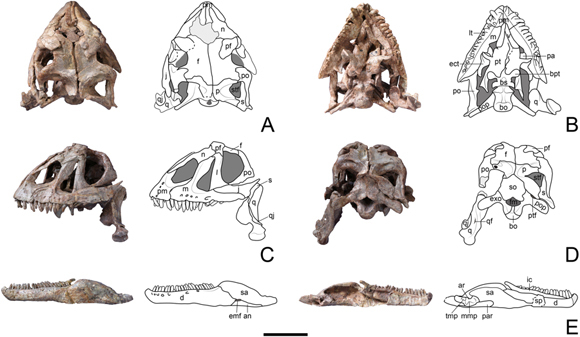
Views of the Yizhousaurus skull fossil with line drawings.
Picture credit: Scientific Reports
Commenting on the significance of the fossil material, one of the paper’s co-authors from the Chinese Academy of Sciences explained that the discovery enriches the diversity of Sauropodiformes and is significant to the studies on the origin and evolution of these types of lizard-hipped, plant-eating dinosaurs. The specimen is currently on display at the museum in Lufeng Dinosaur Valley and the bones represent one of the best-preserved skeletons to have come out of the uppermost layer of the Zhangjiaao Member of the Lower Jurassic Lufeng Formation.
Yizhousaurus sunae – What’s in a Name?
The generic name Yizhou refers to the Chuxiong Yi Autonomous Prefecture of Yunnan Province, where the fossils were found. The specific (trivial) name honours Professor Ai-Ling Sun, for her great contribution to Chinese vertebrate fossils, including those from Lufeng County.
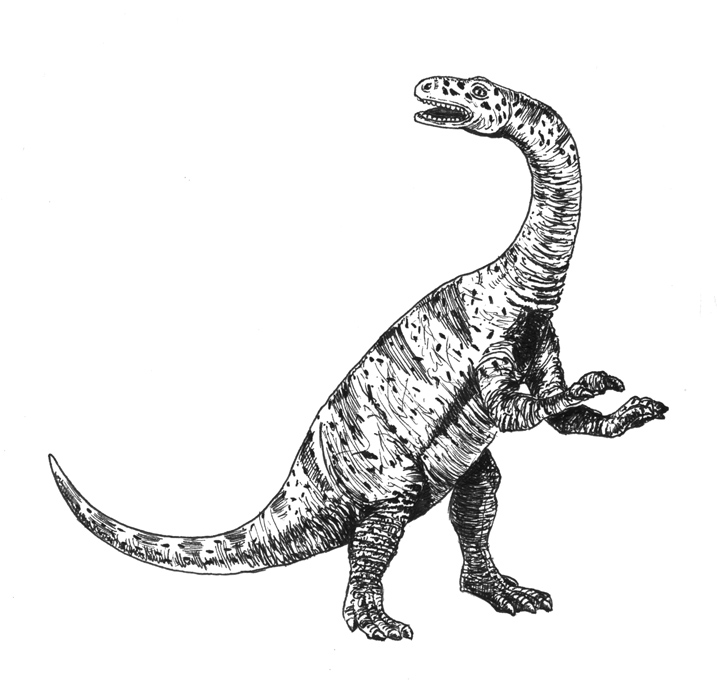
A Drawing of an Early Jurassic Sauropodiform (Based on Lufengosaurus)
An illustration of an Early Jurassic typical sauropodiform.Picture credit: Everything Dinosaur.
Picture credit: Everything Dinosaur
The Development of the Super-sized Sauropods
The transformation from bipedal forms to the super-sized, four-footed sauropods is considered to be linked to a series of complex evolutionary processes related to changes in skeleton size and shape to accommodate a larger gut and changes in the skull to accommodate a shift in feeding behaviour.
Yizhousaurus is characterised by a suite of features, which increases understanding of the anatomical variation on the relatively conservative “prosauropod” skull plan. The skull bones of Yizhousaurus are thickened and robust and the holes in the skull (fenestrae) are smaller and therefore consistent with the skull fenestrae of true sauropods. These features have led to Yizhousaurus being placed closer to the evolutionary base of the Sauropoda when compared to other Sauropodiformes, known from the Lufeng Formation.
The scientific paper: “A New Sauropodiform Dinosaur with a “Sauropodan” Skull from the Lower Jurassic Lufeng Formation of Yunnan Province, China” by Qian-Nan Zhang, Hai-Lu You, Tao Wang & Sankar Chatterjee and published in the journal Scientific Reports.
The amazing and highly collectable Kaiyodo Sofubi Toy Box T. rex figures are in stock at Everything Dinosaur. A shipment of all three versions of this articulated Tyrannosaurus rex figure has arrived at Everything Dinosaur’s warehouse and team members have been busy alerting all those customers who wanted to be placed on the company’s priority reserve list and emailed when the models arrived.
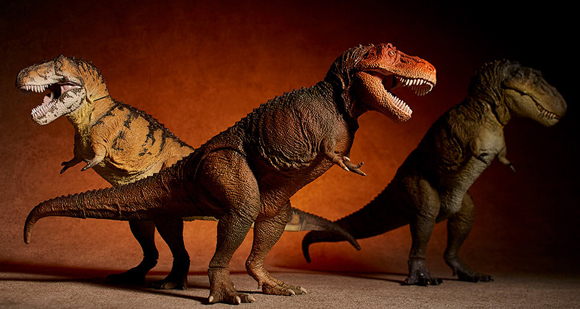
All Three Versions of the Kaiyodo Sofubi Toy Box T. rex Figures
Everything Dinosaur and the Sofubi Toy Box Tyrannosaurus rex figures. The “classic” figure is in the centre of this photograph, with the sandy-coloured “tiger-striped” figure on the left with the “smoke green” model on the right.
To view the range of Kaiyodo prehistoric animal models, including the Kaiyodo Sofubi Toy Box T. rex figures in stock at Everything Dinosaur: Kaiyodo Sofubi Toy Box T. rex Figures.
Special Edition T. rex Figures
The Japanese company Kaiyodo has built a strong reputation for high quality, innovative figures and models, some of which, like these T. rex replicas are articulated. Kaiyodo models are ideal for serious model collectors and enthusiastic dinosaur fans, the trio of T. rex figures represent a collection of hand-painted and individually sculpted prehistoric animal and extinct creatures. Many of the Kaiyodo prehistoric animals are special edition replicas with a limited production run.
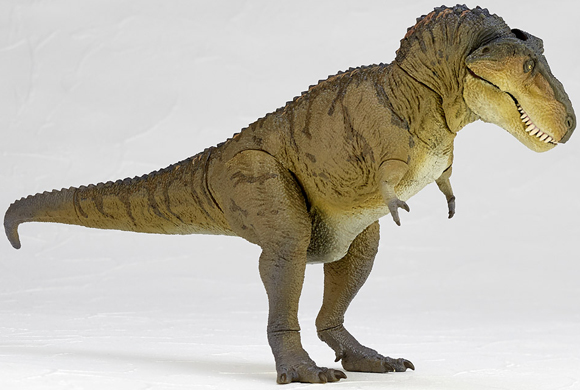
The Kaiyodo Sofubi Toy Box Tyrannosaurus rex (Smoke Green Colour Variant)
Kaiyodo Sofubi Toy Box T. rex figure (smoke green variant).
Ten Points of Articulation
Each figure has ten points of articulation, allowing the T. rex to be put in a variety of poses. These are the first collectable tyrannosaurid figures to have ten points of articulation, permitting them to be displayed in numerous positions. For example, we have been informed by some customers keen to get their hands on these dinosaurs that they want to buy a pair, so that one can be displayed in the classic “kangaroo pose” with the tail on the ground, whilst the other figure can be displayed in a more modern, anatomically correct position.
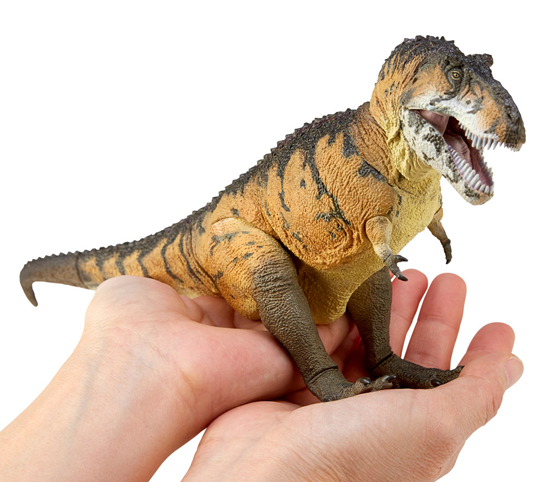
Get Your Hands On a Kaiyodo Sofubi Toy Box T. rex Figure
Kaiyodo Sofubi Toy Box T. rex dinosaur figure (T. rex A).
018A, 018B and 018C Tyrannosaurs
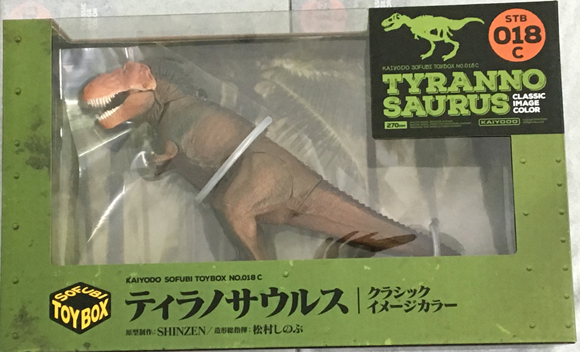
The models have an age restriction upon them, they are collectable figures and therefore not suitable for persons under 15 years of age. Kaiyodo is famous for its novel and quirky designs, even the product designations of 018A, 018B and 018C are unusual. The classic figure (018C), comes in a presentation box with a clear plastic front so that the model can be seen inside the packaging.
The Kaiyodo Sofubi Toy Box Classic T. rex Figure
The presentation box for the Kaiyodo Sofubi Toy Box classic T. rex figure.Picture credit: Everything Dinosaur.
Picture credit: Everything Dinosaur
A spokesperson from Everything Dinosaur commented:
“We are delighted to welcome these Kaiyodo figures into our product portfolio, they have proved very difficult to get hold of and we know that there has been a limited quantity made, so it is very satisfying to be able to offer all three of these articulated collectable dinosaur figures to our customers.”
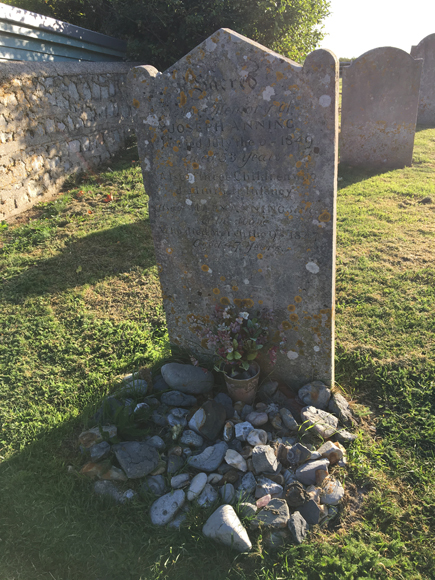
When team members at Everything Dinosaur visit the coast of Dorset, they always try and take time out of their busy schedules to visit the grave of Mary Anning and her brother Joseph. The grave of Mary and Joseph Anning can be found at St Michael the Archangel Church, in the appropriately named Church Street in the picturesque town of Lyme Regis. In 1811, Mary along with her brother Joseph, discovered the fossilised remains of an ichthyosaur, their first major, documented fossil discovery. Within the Church itself, there is a stained glass window that honours the life and work of Mary Anning. It was paid for in part, by members of the Geological Society in recognition of her contribution to this branch of scientific enquiry.
The Grave of Mary and Joseph Anning at Lyme Regis
The grave of Mary and Joseph Anning.
Picture credit: Everything Dinosaur
Paying Tribute to Mary Anning (1799-1847)
A stained glass window in the church is not the only way in which the contribution of Mary is remembered. Over the last few years it has become something of a tradition to place a fossil or a pebble from the beach on the grave. This is a touching gesture, one that allows tourists as well as professional fossil hunters to acknowledge the work of a pioneer in palaeontology.
Everything Dinosaur team members have done much to support the inclusion of the story of Mary Anning and her fossil discoveries within the English National Curriculum. Mary Anning is one of the historical figures included in many study texts and schemes of work associated with English Primary School curriculum. Her life and work provides an excellent role model for many people, especially girls, who can learn about a female scientist, someone who might help and inspire them to take a greater interest in science subjects.
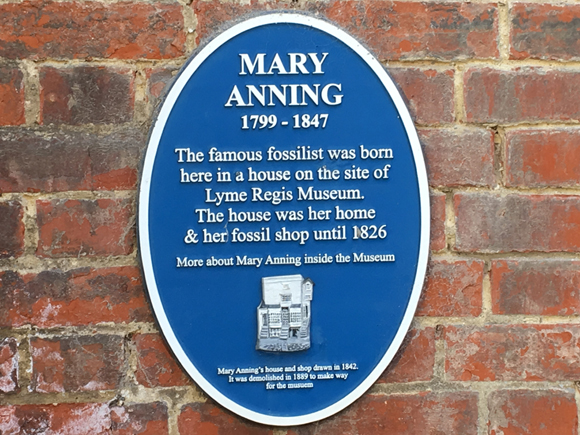
Within the town of Lyme Regis, a blue plaque has been erected on the site of the Anning family’s residence and Mary’s first fossil shop. The house has long gone, but in its place stands the Lyme Regis Museum which contains numerous displays of Mary’s fossil discoveries as well as some of her personal effects.
The Blue Plaque on the Wall of the Lyme Regis Museum Commemorating the Life and Work of Mary Anning
The blue plaque commemorating the birth of Mary Anning outside the Lyme Regis Museum.
Everything Dinosaur to Stock Rebor Vanilla Ice T. rex Models
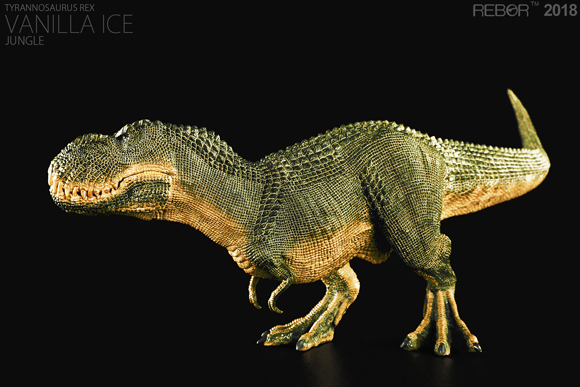
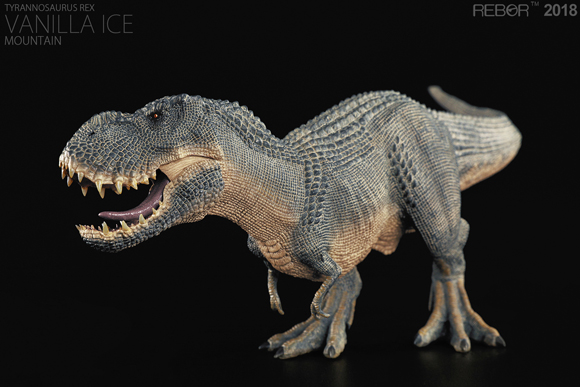
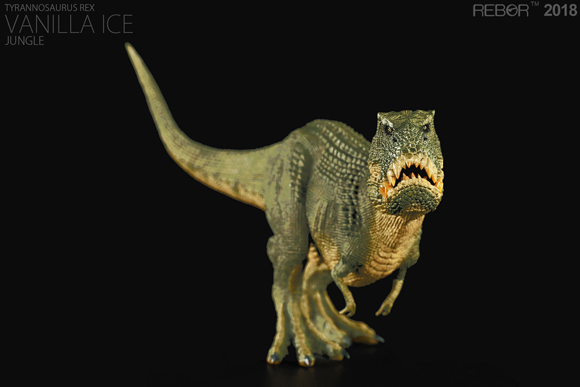
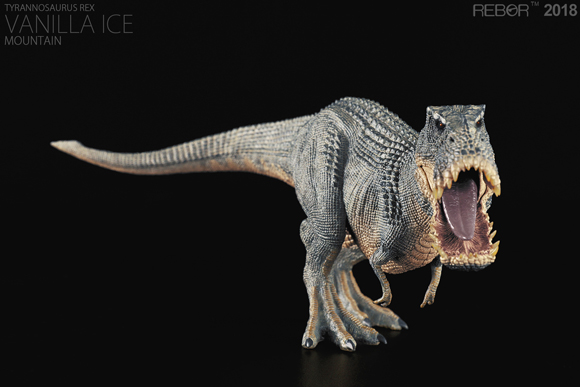
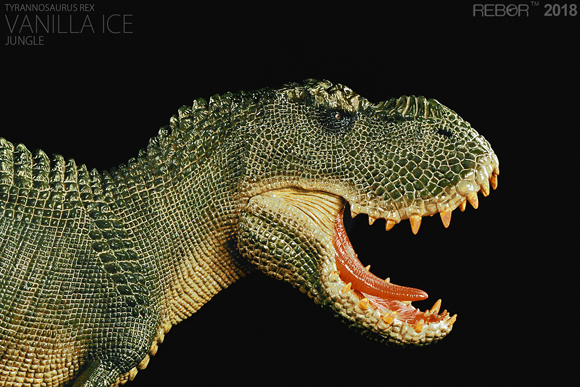
Everything Dinosaur will be stocking the Rebor Vanilla Ice T. rex dinosaur models. The beautiful 1:35 scale T. rex figure comes in two colour schemes, an eye-catching green colour scheme – “jungle” and a slate-grey version nick-named “mountain”. Both models are due to arrive at the Everything Dinosaur warehouse at the end of October or thereabouts.
Available in Autumn 2018 – The Rebor Vanilla Ice T. rex “Jungle” Replica
Vanilla Ice T. rex by Rebor “jungle”.
Picture credit: Everything Dinosaur
The Rebor Vanilla Ice T. rex Dinosaur Figure – “Mountain”
Vanilla Ice T. rex dinosaur model by Rebor – mountain colour scheme.
Picture credit: Everything Dinosaur
Rebor Vanilla Ice Tyrannosaurus rex Figures
Both colour versions of this model “jungle” and “mountain” will arrive at our warehouse at the same time, so customers will be able to choose their favourite, or perhaps they might want the pair.
The Green Rebor Vanilla Ice Figure – Jungle Colour Scheme
Vanilla Ice T. rex by Rebor “jungle”.
Picture credit: Everything Dinosaur
The Slate-grey Rebor Vanilla Ice Figure – Mountain Colour Scheme
Vanilla Ice T. rex dinosaur model by Rebor – mountain colour scheme.
Picture credit: Everything Dinosaur
Vanilla ice Measurements
Each figure measures around 42 centimetres in length and the head height is approximately 12.5 centimetres. The Vanilla Ice T. rex models are in 1:35 scale or thereabouts. They make fantastic companion pieces to the Rebor “King” Tyrannosaurus rex figure, which itself measures just under 37 cm long. Each model will have an articulated jaw, just like the Rebor “King” T. rex dinosaur replica.
The Rebor Vanilla Ice “Jungle” T. rex Figure Displayed with the Jaw Open
Vanilla Ice T. rex by Rebor “jungle”. The articulated lower jaw on this model is in the “open” position, showing the fantastic details in the mouth.
Picture credit: Everything Dinosaur
A Close View of the Head of the Vanilla Ice – Mountain Colour Scheme Model
Rebor Vanilla Ice T. rex “Mountain” close view of the head.
Picture credit: Everything Dinosaur
Stylish Tyrannosaurus rex Figures
The tail of each model will be flexible, permitting the figures to be displayed in slightly different poses. The tail is packed as a separate piece in each presentation box, so, just like the recently introduced and highly popular Ankylosaurus “War Pig” figures, the tail has to be inserted into the base of the model to complete the 1:35 scale replica.
With the Rebor Triceratops “Fallen Queen” and the Ankylosaurus “War Pig” figures, all of which are also in 1:35 scale, collectors are going to be spoilt for choice how they display these highly collectable new T. rex models. Dinosaur model fans can always display these new pieces with the theropod figures already released by Rebor, after all, there are a lot of meat-eating dinosaurs within the Rebor range. Perhaps, collectors could produce a diorama using the Ceratosaurus, Acrocanthosaurus, Carnotaurus or maybe the other tyrannosaurid figure from Rebor the Y-REX (Yutyrannus huali).
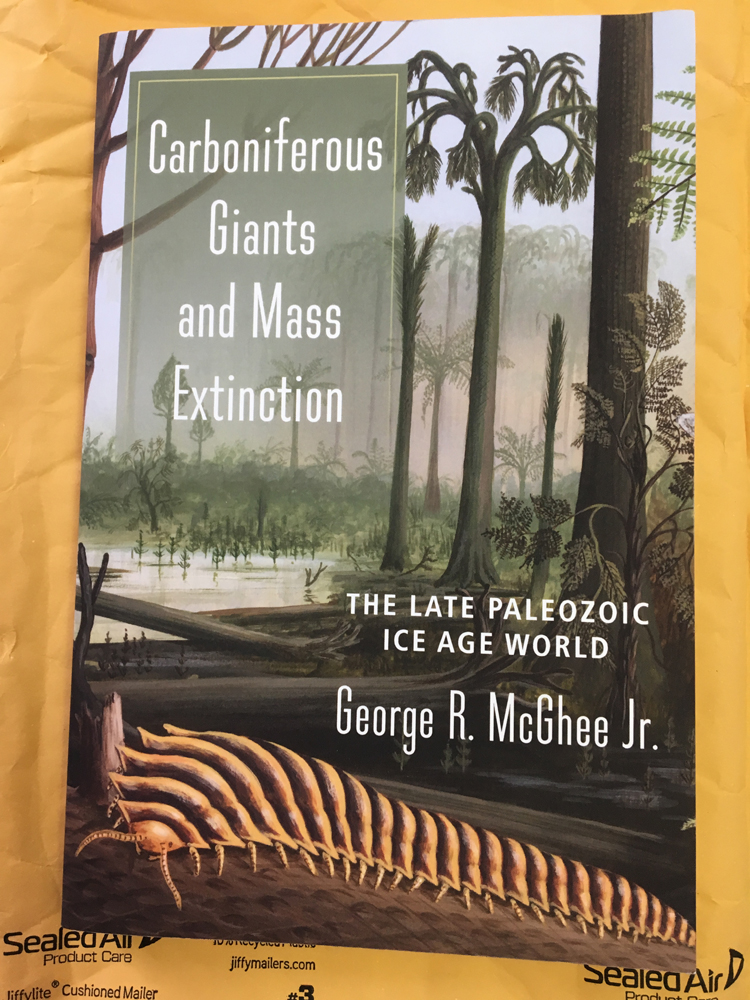
Our thanks to the generous staff of Columbia University Press who kindly sent into our office an inspection copy of a new book entitled “Carboniferous Giants and Mass Extinction” written by George R. McGhee Jr.
This well-written text documents the amazing biology, botany and geography of our planet in the Late Palaeozoic, a world of giant ice sheets, huge continents and bizarre ancient forests that harboured an array of super-sized invertebrates as well as amphibian predators the size of modern alligators.
The Late Carboniferous – Exploring the Late Palaeozoic
“Carboniferous Giants and Mass Extinction” – a guide to a long extinct prehistoric world.
Picture credit: Columbia University Press
Tropical Forests, a “Hot House” Equator and a Late Palaeozoic Ice Age
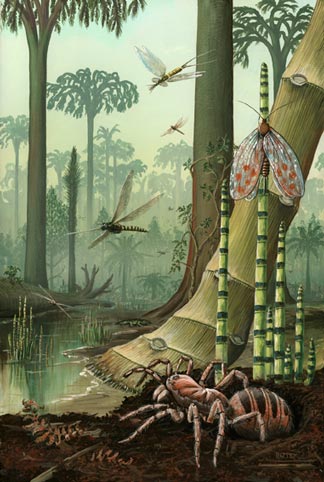
Life during the Palaeozoic consisted of a series of extremes. Many readers will be familiar with the huge insects that inhabited the Carboniferous forests, arguably the first complex terrestrial ecosystems to develop on our planet. The bizarre, tree-sized club mosses and horsetails, formed a backdrop to a dense undergrowth that was home to three-metre-long arthropods and dog-sized scorpions as well as giant spiders that fed on small vertebrates.
“Carboniferous Giants and Mass Extinction”
In the air, the first winged insects had evolved and they were giants, such as Meganeura, with a wingspan of around seventy centimetres. The land and seas surrounding the equator were so hot (temperatures exceeding forty degrees Celsius), that vast tracts of our Earth was virtually devoid of life. Sitting over the South Pole was a huge landmass, on which the largest tropical forests to have ever existed, as well as some the biggest ice sheets to have ever formed, could be found.
Insects of the Carboniferous
By the Carboniferous the insects were already highly diversified and some of the Arthropoda were huge.
Picture Credit: Richard Bizley
The author, George R. McGhee Junior, is a distinguished professor of palaeobiology at Rutgers University (New Jersey, USA) and has held prominent research positions at a number of world-renowned institutions including the American Museum of Natural History in New York. McGhee explores our strange planet in the Late Carboniferous and investigates the consequences of an intense and prolonged period of glaciation. He examines ancient climate change and examines the fascinating flora and fauna that dominated our planet, before reflecting on the circumstances that was to lead to the greatest period of mass extinction recorded in the Phanerozoic (the Eon of “visible life”).
Highly recommended.
Find “Carboniferous Giants and Mass Extinction” by George R. McGhee Jr at the Columbia University Press site: Columbia University Press.
One week ago, there was a terrible fire at the National Museum (Museu Nacional), in Rio de Janeiro that left the building a gutted ruin. Thankfully, no-one was injured by the blaze but thousands of artefacts, including numerous fossils from the famous Crato Formation of north-eastern Brazil, have probably been destroyed.
The strata that makes up the Crato Formation was laid down in the Early Cretaceous and it represents fine, silty deposits laid down in a lacustrine (freshwater lake(s) environment). It was close to the coast and it was formed as a channel dividing South America from Africa, the Atlantic Ocean, was beginning to form. The sea gradually advanced and a large, shallow saltwater lagoon formed giving rise to the slightly younger strata known as the Romualdo Formation. The rocks preserve a wide range of plant, invertebrate and vertebrate fossils. So rich and diverse is the fossil record that the Crato Formation is regarded as a Lagerstätte.
Sadly, it is likely that many of the Lower Cretaceous fossils within the collection of the Museu Nacional have been destroyed and lost to science. Many media outlets have focused on the loss of larger exhibits such as the remains of prehistoric mammals and dinosaurs. Here at Everything Dinosaur, our earlier article, published a few days ago, looked at the impact of the conflagration on pterosaur research, but it is likely that a significant portion of the fossils representing some of the smaller animals that once roamed north-eastern Brazil will have been lost to.
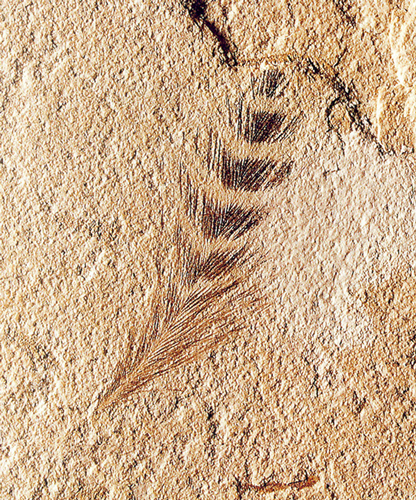
A Beautifully Preserved Single Feather from the Crato Formation
Numerous isolated feathers have been preserved indicating the presence of Avialae – primitive birds and theropod dinosaurs closely related to birds.
Picture credit: Museu Nacional
Remembering the Little Guys
The exceptionally rare dinosaur and pterosaur fossils may have grabbed the headlines but the Crato Lagerstätte includes hundreds of examples of the “little guys” that shared the Early Cretaceous with the Archosaurs. These fossils have provided palaeontologists with an insight into the ecosystem that existed around 1115 million years ago, the loss of these fossils represents a terrible blow for palaeontology in Brazil.
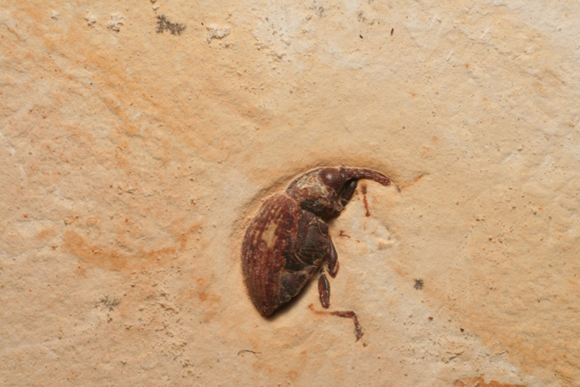
The Fossilised Remains of a Cretaceous Weevil
Large numbers of fossil insect remains are associated with the Crato Formation, including the remains of weevils.
Picture credit: Museu Nacional
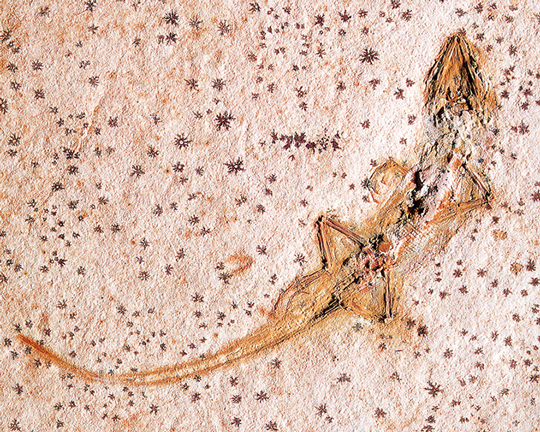
The Fossilised Remains of a Small Lizard (Squamata)
A fossil of a small lizard from the Crato Formation.
Picture credit: Museu Nacional
The fine sediments laid down at a time when the Atlantic Ocean was being created captured a wealth of information about the plants, insects, fish, amphibians and reptiles that shared the world with the dinosaurs and the Pterosauria. It is very sad to think that much of this highly important and strikingly beautiful fossil record may have been lost forever.
By Mike|2024-05-11T16:33:19+01:00September 9th, 2018|Categories: General Teaching, Key Stage 1/2|Comments Off on Getting to Grips with an Amazing K-W-L Strategy
Everything Dinosaur Helps Out Primary School with K-W-L Strategy
Team members at Everything Dinosaur have been approached by a primary school teacher to help her introduce a term topic all about dinosaurs for her Year 1 class. The teacher wants to utilise a K-W-L strategy to establish the topic and to identify what the children already know about prehistoric animals and to use the results to direct learning over the coming weeks.
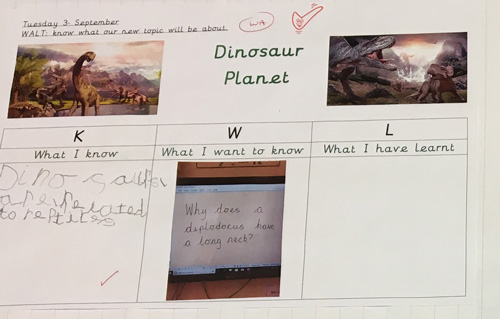
The Use of a K-W-L Strategy in the Classroom
At the start of the dinosaur topic the Year 1 children recorded what they know about dinosaurs. Picture credit: Everything Dinosaur.
Picture credit: Everything Dinosaur
Defining a K-W-L Strategy
A K-W-L strategy is essentially a tabular method of assessing the level of knowledge that children have at the beginning, in the middle and at the end of a period of work. It can be implemented over a term topic such as “Dinosaur Planet” or “Jurassic Forest” or it can be used at the individual lesson level.
K-W-L – examines:
What the children know = K
What the children would like to learn about = W
What the children have learned = L
A Three-part Strategy for Learning
This teaching tool gives pupils an opportunity to make connections between different topic areas, it appeals to visual learners and allows the teaching team to shape the subject to suit the needs and requirements of the class. It allows the teacher to identify what prior subject knowledge the children possess, in the case of dinosaurs, it is surprising how much information the children know and are very enthusiastic to divulge. The K-W-L strategy can help to guide lesson planning and to focus on appropriate teaching strategies to address the lack of knowledge uncovered during the mapping exercise.
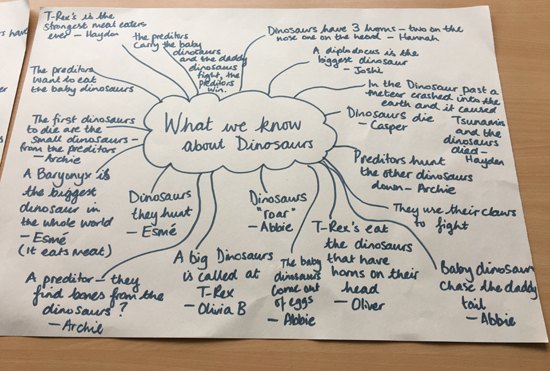
Mind Maps Can Support a K-W-L Strategy
Using the KWL technique to start a term topic all about dinosaurs. Picture credit: Everything Dinosaur.
Picture credit: Everything Dinosaur
Everything Dinosaur Answering Questions
In order to help support the teacher, Everything Dinosaur team members have promised to answer emails from the children in support of their enquiries about dinosaurs and life in the past.
A spokesperson from Everything Dinosaur commented:
“The teacher can include the children emailing our dinosaur and fossil experts within their lesson planning. The use of email to answer the children’s questions can help incorporate and develop the ICT element of the curriculum.”
Crystal Palace Statues Helping with Outdoor Learning
Recently, Everything Dinosaur has been providing advice on how best to utilise the outdoor resources at the famous Crystal Palace Park in south London. Schools have been invited to make the most of this area, with its historic “dinosaur statues”. Outdoor learning is being encouraged and the park with its hard and soft landscaping as well as its iconic prehistoric animal figures makes a fantastic open space for creative activities linked to the English national curriculum. Everything Dinosaur is delighted to support the Crystal Palace Dinosaurs.
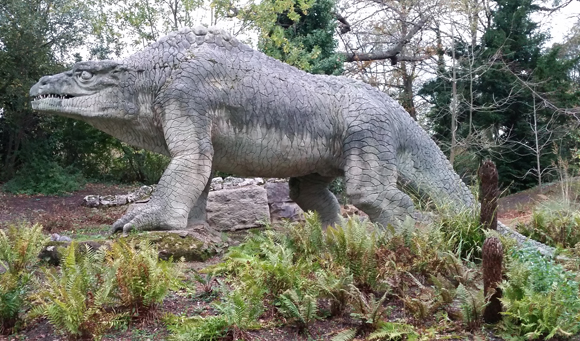
One of the Dinosaur Statues on Display at the Park (Megalosaurus)
The Megalosaurus statue at Crystal Palace – a dinosaur from 1854. Picture credit: Everything Dinosaur.
Picture credit: Everything Dinosaur
Prehistoric Animal Figures Not Just Dinosaurs
In reality, dinosaurs make up only a small proportion of the more than thirty statues on display. The figures created by Benjamin Waterhouse Hawkins with scientific input from the soon to be knighted Sir Richard Owen, who went onto to help found the London Natural History Museum, include marine reptiles, crocodilians, turtles and extinct mammals. They were erected in the middle of the 19th century (circa 1854) and they represent the first attempt to create life-size, dinosaur figures. However, our view of the Dinosauria has evolved somewhat since the 1850s and the dinosaurs, depicted as four-footed, tail-dragging scaly lizards, is wildly inaccurate by today’s standards.
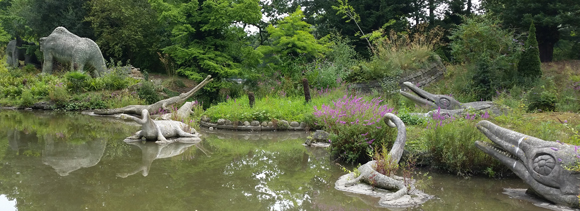
Marine Reptiles Feature at Crystal Palace – Statues Inspired by the Discoveries Made by Mary Anning
Prehistoric animal figures at Crystal Palace, the world’s first “Jurassic Park”. Picture credit: Everything Dinosaur.
All the figures are listed on Historic England’s “National Heritage List for England” as Grade 1 monuments. This listing recognises the historic importance of these statues and a lot has been done to help preserve the dinosaurs and other figures as part of our country’s scientific and historical heritage.
In our advisory work, team members have suggested ways in which our changing views about the Dinosauria can be incorporated into the teaching programme. The dinosaurs represented by the figures, the first three genera to be incorporated within the order Dinosauria, Megalosaurus, Hylaeosaurus and Iguanodon, show how our interpretation of the fossil record has changed over the last 170 years or so. The statues provide a three-dimensional testament to how scientific ideas evolve and change in the light of new evidence.
The Iguanodon (Foreground) – A Modern Interpretation of an Iguanodontid
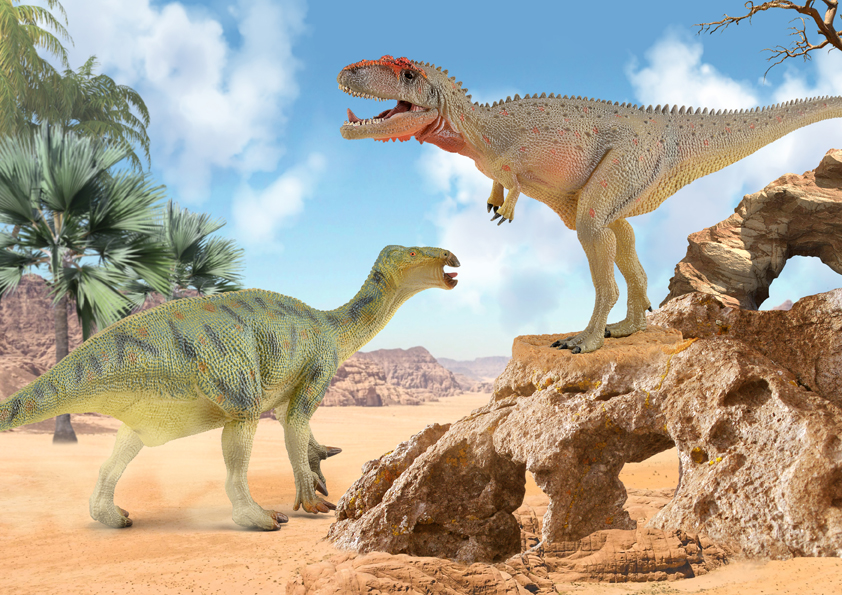
The CollectA 1:40 scale Iguanodon and Mapusaurus dinosaur models.
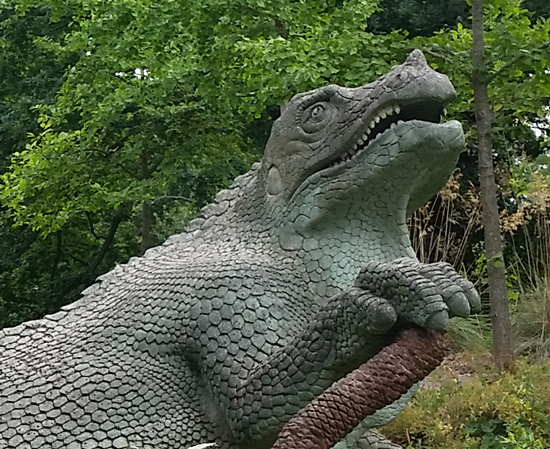
The spike associated with fossils of Iguanodon is now known to have been part of the hand (a thumb spike), whereas, in the 1854 model, the lizard-like Iguanodon statue has the spike incorrectly placed on the bridge of the snout.
One of the Iguanodon Figures on Display at Crystal Palace Park
One of the Iguanodon figures on display at Crystal Palace Park. Note the “thumb spike” placed incorrectly on the nose. Picture credit: Everything Dinosaur.
Picture credit: Everything Dinosaur
Team members at Everything Dinosaur wish all those involved in the schools outreach programme at the Park every success.