Postosuchus (P. kirkpatricki) was a member of the Order Rauisuchia of reptiles. This Late Triassic predator whose fossilised remains have been found in Arizona, New Mexico, North Carolina and the state of Texas was made famous in 1999 when it appeared in the first episode of the ground breaking BBC documentary series “Walking with Dinosaurs”. The name Postosuchus means “after or post crocodile”, a reference to this extinct creature’s affinity with the crocodile family. The genus name also gives a nod towards Post Quarry, a fossil location close to the small town of Post in Garza County (Texas).
An Illustration of Postosuchus
Scale drawing of Postosuchus. Picture credit: Everything Dinosaur.
Picture credit: Everything Dinosaur
Notes on Postosuchus
After this predator’s appearance on the television documentary series it has become one of the most popular non-Dinosaurian prehistoric animals known from the Triassic geological period amongst enthusiasts of all things Mesozoic.
Everything Dinosaur currently stocks the Postosuchus prehistoric animal model that is part of the Wild Safari Prehistoric World range of figures. To view this range: Wild Safari Prehistoric World Figures.
New Dinosaur Model Suggestions Sent into Everything Dinosaur
Amongst the many emails, feedback forms and letters received by Everything Dinosaur team members each day, we often get suggestions from dinosaur model fans about what new prehistoric animal models they would like manufacturers to make. We get two types of suggestion, ones aimed at certain manufacturers such as Papo, Collecta, Safari Ltd and so on and another type of suggestion that comprises a list of the sort of prehistoric animals that the person would like to see.
An example of the latter is an email received just the other morning which listed a top three of new prehistoric animal model suggestions:
1). Giganotosaurus dinosaur model
2). Saurophaganax
3). Dimetrodon with a bright red sail
Collecting Prehistoric Animal Model Suggestions
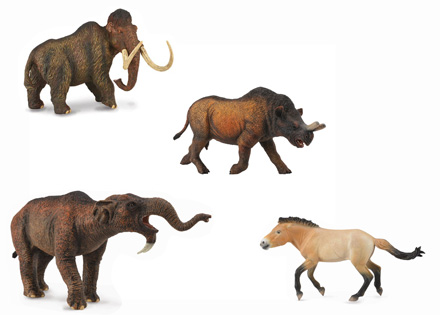
Part of the CollectA range of animal models.
Picture credit: Everything Dinosaur
Suggestions for Prehistoric Animal Models
We are grateful for all the dinosaur and prehistoric animal model suggestions that we receive. We can promise readers that they are all read and shared by our team members and we do submit product suggestions on behalf of readers to the model and figure makers.
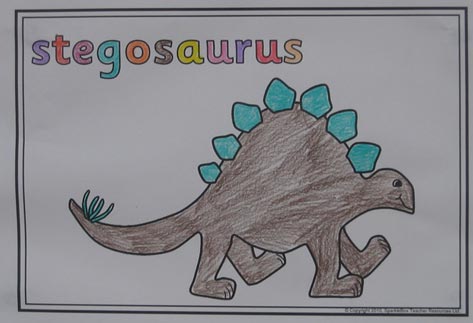
Team members from Everything Dinosaur, the UK based dinosaur company staffed by parents, teachers and real dinosaur experts saw a very colourful drawing of a friendly Stegosaurus whilst on a school visit to teach about dinosaurs. The picture had been stuck up onto an outdoor white board in the nursery play area so that the young nursery and reception aged children could also get involved with the dinosaur workshop in school that had been planned for the day.
A Drawing of a Friendly Stegosaurus
A friendly “plated lizard” – a friendly Stegosaurus. Picture credit: Everything Dinosaur.
Picture credit: Everything Dinosaur
Friendly Stegosaurus
This dinosaur certainly looks quite friendly, he has a big smile on his face. We are sure the children enjoyed learning all about dinosaurs and fossils and drawing pictures of colourful, friendly dinosaurs as part of the dinosaur teaching activities in school.
Whilst delivering dinosaur workshops in school, team members at Everything Dinosaur get told jokes about dinosaurs from the school children that they meet. Here are a selection of dinosaur jokes that Everything Dinosaur team members came across recently whilst teaching about prehistoric animals in school.
Q. Why did the dinosaur cross the road?
A. Because chickens had not evolved yet!
Q. Why do museums have old dinosaur bones on show?
A. Because they can’t afford to buy new dinosaur bones!
Q. What do you call two dinosaurs bumping into each other?
A. Tyrannosaurus wrecks!
Q. What do you call a Tyrannosaurus rex with a machine gun?
A. Sir!
Q. What do you call a dinosaur that sat on a drawing pin?
A. A Mega-sore-ass!
Q. Why did Archaeopteryx catch the worm?
A. Because it was an early bird!
Dinosaurs as a term topic for Key Stage 1 or 2 children can help them develop their vocabularies, enthuse them about reading as well as to encourage them to write creatively. When Everything Dinosaur delivers a dinosaur workshop in school, lots of ideas for extension activities follow, as for the children’s jokes, we appreciate them and we are glad to help out in schools.
Long-limbed Albertosaurs – possible hints at Dinosaur Hunting Habits
Despite their frequent appearance in monster movies the Tyrannosauridae are perhaps not as well known as many people might think, especially when they are faced with the overwhelming number of tyrannosaur exhibits on display at Natural History museums. In truth, even the mighty Tyrannosaurus rex has provided less than 40 fossil specimens for palaeontologists to study and the vast majority of these are far from complete. The popularity of these fierce carnivores is easy to understand, they were certainly impressive beasts but scientists still have a great deal to learn about these animals, their ancestry, social behaviour and morphology.
The likes of Tyrannosaurus rex is synonymous with the Hell Creek Formation of Montana in the north western United States. The exposed strata of sandstone, siltstone and mudstone represent sediment laid down towards the very end of the Cretaceous (late Maastrichtian faunal stage). It was from these beds that the first T. rex fossils were unearthed. However, a greater number of Tyrannosauridae fossils have been recovered from Canada, specifically areas such as the Dinosaur Provincial Park Formation in Alberta. The extensive outcrops of Campanian faunal stage strata from deposits termed the Belly River Group and the Judith River Formation have been dated to approximately 75 million years ago. The Theropod fossils recovered from these sites along with other body and trace fossils have enabled palaeontologists to build up a detailed picture of the eco-system that existed in this area at the end of the Cretaceous. This has led to some speculation as to the hunting habits and specialisation of the tyrannosaurs in this faunal community.
Late Cretaceous tyrannosaurids of Alberta can be classified into two sub-families, the Albertosaurinae and the Tyrannosaurinae (based on research from Phil Currie et al). The albertosaurines from the Dinosaur Provincial Park can be split into two genera, Gorgosaurus and Albertosaurus), the Tyrannosaurinae are represented by Daspletosaurus (D.torosus [Russell 1970], D horneri [Carr et al 2017]). In the 1970s the genus Gorgosaurus was dropped and it was synonymised with Albertosaurus, following a review of existing specimens where no significant characteristics were identified, permitting both genera to be valid. This viewpoint was overturned in 2003 when following a study by a Canadian led team looking at fossils recovered after the review in the early 1970s, several anatomical differences were identified between Albertosaurus and Gorgosaurus and so both taxa were validated. The Gorgosaurus genus was reinstated.
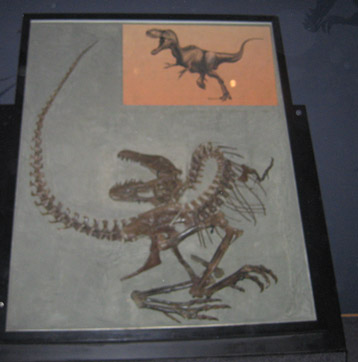
Albertosaurus Exhibit – Royal Tyrrell Museum (Alberta in Canada)
Picture credit: Everything Dinosaur
The photograph shows an almost complete and articulated restoration of an Albertosaurus specimen on display at the Royal Tyrrell museum (Alberta, Canada). The neck and head presented in a curved position over the back and hips is typical of articulated Dinosauria fossils, this effect is believed to occur as ligaments and tendons are desiccated in the carcase and their drying out leads to the head and neck curving over the back of the animal.
The albertosaurs shared their Late Cretaceous world with the likes of Daspletosaurus, (Daspletosaurus means “frightful lizard”). Both these types of tyrannosaur were apex predators, hypercarnivores and at the top of the food chain, however, examination of their fossils reveals that they may have specialised in different hunting strategies and prey.
Albertosaurs had shorter, lower skulls than many other tyrannosaurs. Their leg bones, especially the tibia (shin bone) were proportionately longer than equivalent sized tyrannosaurs. They had longer toes and although the weight of an adult Albertosaurus (A. sarcophagus), has been estimated at 2.5 metric tonnes, these animals were lighter than equivalent sized Tyrannosaurinae.
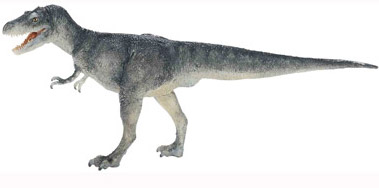
A 1:40 Scale Model of Albertosaurus (Carnegie Collection Albertosaurus)
Albertosaurus (from the now retired [2014] Carnegie Collectibles range of figures).
Picture credit: Everything Dinosaur
The picture above shows an Albertosaurus dinosaur model, part of the Carnegie Collectibles dinosaur model range (Safari Ltd) which has been retired and is out of production.
It has been speculated that the genus Albertosaurus may represent the fastest large tyrannosaurs around at the end of the Cretaceous. Models and computer simulations have estimated running speeds of up to 25mph (40kmh), this is up to 50% faster than an equivalent member of the sub-family Tyrannosaurinae. Putting this into perspective this long-limbed, long-toed carnivore could complete the 100 metres in around about 10 seconds. Assuming that an Albertosaurus could be given a running start (crossing the start line at approximately full speed), and assuming that this fierce meat-eater did not stop along the way to feast on any athletes, an Albertosaurus could compete for a medal in the sprints at the Beijing Olympics.
Some scientists have speculated that tyrannosaurs began to evolve in different ways, exploiting specific niches within the eco-system. As Albertosaurus was lighter and faster than equivalent sized Tyrannosaurinae, it could have specialised in catching lighter and faster prey types like hadrosaurs, pachycephalosaurs and ornithomimids. Indeed, a diorama of an Albertosaurus chasing a group of ostrich-like dinosaurs greets visitors to the Royal Tyrrell museum. The heavier members of Tyrannosaurinae may have specialised in hunting ceratopsians or possibly titanosaurs.
Lighter and More Gracile Tyrannosaurs
Fossil evidence does indicate that the albertosaurs evolved into lighter and more gracile forms, perhaps indicating that this genus specialised in hunting faster moving animals than the heavier predators.
The fossil evidence is complicated when social behaviour is considered. Albertosaurus bone-beds have been found in Canada. Excavations from Royal Tyrrell museum staff have revealed the remains of at least nine variously sized albertosaurs from one fossil site. Could this be evidence of pack behaviour?
The Safari Carnegie model of Albertosaurus (shown in the picture above) has been designed to replicate much of the latest scientific thinking concerning this particular dinosaur. Working on the guidance of scientists from the Carnegie museum the model has been sculpted to show the long legs and graceful features of this predator. The colouration of the model, muted greys and browns would have make this hunter inconspicuous in shadow and the dappled understorey of woodland. The back, tail and hind quarters of this particular model has darker, stripped markings, again helping to camouflage the animal and break up its outline if it was stalking from cover. In addition, the stripped markings, particularly those on the tail are a concession towards those scientists that speculate that Albertosaurus may have been a social, pack hunter. A group of these animals moving towards a potential group of prey animals at speed would have been a confusing site. Their rapid speed, the dust kicked up and the stripped markings could have disorientated prey, the stripes helping to break up the outline of individual hunters within the pack as they closed in on their unfortunate victims.
One of our favourite models of tyrannosaurs from northern Laramidia. A wonderful replica of the tyrannosaur known as Albertosaurus (fossils found in Alberta Province, Canada). At Everything Dinosaur, we research and write our own dinosaur and prehistoric animal fact sheets. Buyers of Albertosaurus models and figures (and most other prehistoric animal models for that matter), from our website also receive a fact sheet about that animal. The fact sheets explain some of the science and research behind the extinct creature.
An Albertosaurus Dinosaur Model (Safari Ltd)
Carnegie Collectibles Albertosaurus dinosaur model. This dinosaur model has been retired and is out of production – update.
Picture credit: Everything Dinosaur
Albertosaurus Dinosaur Model
Safari Ltd make a wide range of dinosaur and prehistoric animal themed replicas. The company’s scale model range of which Albertosaurus is part, is very collectible.
To view the range of Safari Ltd models available from Everything Dinosaur and other prehistoric animal replicas and figures: Dinosaur and Prehistoric Animal Models.
The Carnegie Collectibles Albertosaurus dinosaur model is a scale model of this Late Cretaceous meat-eater. Update – the Carnegie Collectibles range of dinosaur and prehistoric animal figures has been retired and is out of production (2014).
Remember the Ordovician – An important part of the Palaeozoic
Sandwiched between the geological periods of the Cambrian and the Silurian comes the Ordovician, (pronounced “Or-doe-viss-ian”). The period lasted approximately 50 million years 495 to 443 million years ago. Like the Silurian period that followed it, the Ordovician was named after an ancient British tribe, a Romano-British hill tribe the Ordovices. Evidence from rock strata indicates that during the early Ordovician, marine transgressions (sea levels rising and flooding land) were at their greatest, much of the continents around at the time became flooded. Rising seas are a problem today, a result of global climate change; but the rises experienced in the Holocene are fortunately, not likely to be on the scale as seen in the early Ordovician.
Ordovician
Marine life continued to diversify with a huge number of different types of animals and algae becoming established. However, this abundance of life was not to last. Geological data suggests that the global climate became increasingly wetter and colder. At the end of the Ordovician much of the Earth experienced an Ice Age and the subsequent locking up of vast amounts of water led to a global reduction in sea level. Estimates as to the extent of the sea level fall vary, some scientists claim that it fell by as much as 300 metres but others put forward a more conservative estimate of about 100 metres (still an immense change in climate and environment). Many of the shallow seas dried out leaving behind salt and other minerals. These changes led to a mass extinction with many forms of marine life, especially sedentary ones being killed off.
Trace Fossils
Rocks of Ordovician age show trace fossils indicating that during this period the first animals ventured out onto land. Sets of strange parallel trackways, only 10 mm wide or so have been found in upper Ordovician strata in northern England. These trackways, trace fossils, are believed to have been made by segmented arthropods as they moved over mud by the side of freshwater pools. These are some of the first signs of animals beginning to migrate onto the land.
Despite the fact that in geological terms the Ordovician comes before the Silurian it was named and described as a period of geological time after both the Cambrian and Silurian had been named. A Scottish schoolmaster and geologist (born in England; he settled in Scotland), Charles Lapworth made a detailed study of the strata in the Southern Uplands hills and mountains of Scotland. He mapped the complex succession of ancient marine strata using fossils to identify the relative age of strata, this is called biostratigraphy.
Work Published
In 1879, he published his work helping to resolve a controversy regarding the age of rocks that had raged for sometime within the scientific world. Ever since the English professor of geology, the Reverend Adam Sedgewick and his co-worker Sir Roderick Murchison named the Cambrian and Silurian periods in 1835, the actual age of ancient rocks and the order in which some of them had been laid down was debated.
Using graptolite fossils, Charles Lapworth was able to correlate successive rock strata and work out the correct chronological sequence of deposition. He identified three distinguishable and observable lower Palaeozoic faunas. It was this work that led to the recognition of the Ordovician as a distinct geological period separating the older Cambrian strata from the younger Silurian.
Another busy day at the dinosaur model and toy company Everything Dinosaur. Recently, team members had to go into a professional photographic studio so that they could take some new pictures of the dinosaur toys, plush, dinosaur models and other prehistoric animal themed merchandise that make up the company’s product range. At the end of the shoot we were able to take some more pictures of staff members having fun.
Team Members at Everything Dinosaur
Having fun with Everything Dinosaur.
Picture credit: Everything Dinosaur
With staff packing orders for customers every day, even at weekends it is important to every now and then to have some fun. After all, we do spend a lot of time either at the office or in the warehouse. Or perhaps it is because we are surrounded by dinosaur toys and prehistoric animal models all day.
The famous Chinese philosopher Confucius is believed to have said “find a job that you love and you will never have to work a day in your life”.
We at Everything Dinosaur think this is very sound advice. To see the range of dinosaur and prehistoric animal themed items we have in stock: Visit Everything Dinosaur.
Plans to display Dinosaur Trackways in Washington D.C.
When asked to comment on dinosaur discoveries in the United States most experts may cite discoveries in the Badlands of Montana or the Cleveland-Lloyd Dinosaur quarry in Utah. Certainly, it is true to say that they are many fantastic Mesozoic fossil sites in the west of the USA but the eastern part of the United States, although perhaps a little under-represented in terms of fossil evidence, can still spring a few surprises.
Dinosaur Tracks
Now a new study of fossil trackways in Maryland, north-eastern USA has provided a glimpse into a thriving dinosaur based eco-system. Many of the trackways, have been found just a few miles drive out of Washington D.C. Trackways and footprints are called trace fossils. Trace fossils preserve evidence of the activity of animals such as their trackways, borings or burrows. The problem with most sets of footprints, even the very best preserved ones, is that, unless the animal is found fossilised at the end of the trackway, scientists can never be 100% certain as to the species or genus that actually left the prints.
Trace fossils such as footprints do have a significant advantage over other types of fossil such as fossil bones, most are direct in situ evidence of the environment at the time and place the organism was living.
Studying Trace Fossils
A total of over 900 fossilised footprints from a variety of dinosaurs all dated from the Cretaceous have been identified from the area. Theropods, ankylosaurs (Nodosauridae), sauropods and ornithopods are represented by the prints. Palaeontologists have estimated that the trackways were made between 121 and 98 million years ago.
Trace fossils of other animals have also been preserved in the this part of the USA, one trackway has been identified as a flying reptile, perhaps a pterosaur flew down to get a drink and its trail was preserved in the soft sediment. Mammal tracks have also been found, indeed one trackway indicates that some mammals were quite large, tracks of a quadrupedal mammal about the size of a large dog have been recorded.
“Based on the trace fossils, over two dozen species of dinosaurs were living in Maryland at that time,” co-author of the study, Ray Stanford commented. Ray specialises in studying fossil trackways, he began to discover tracks in the area whilst out looking for native Indian artifacts, in the stream-beds that criss cross the area.
He explained that as water and human development erode such beds, “floats” can result. These are pieces of track-bearing substrate that hydrodynamically dislodge from their natural stratigraphic context during stream bank flooding.
“This is one instance where building booms and storms can benefit science,” he said.
All of the discoveries were made either in Prince George’s county, near the capital, Washington D.C. or at the White Marsh Run area of Baltimore county.
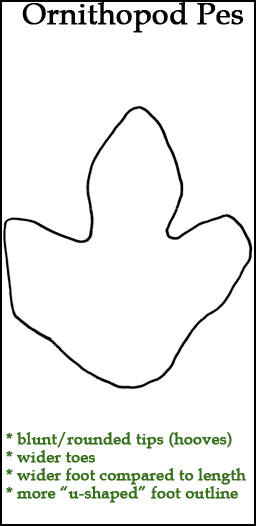
An Illustration of the Track Made by an Ornithopod Dinosaur
Line drawing of the hind footprint of a large ornithopod (iguanodontid). Picture credit: Everything Dinosaur.
Picture credit: Everything Dinosaur
Photographs show a number of footprint specimens, the peculiar, almost flower-shaped five-toed print in the foreground was most probably made by a nodosaur. Nodosaurs are members of the Ankylosauria, heavily built, slow-moving, plant-eaters with body armour and horns.
Ray Stanford in conjunction with a Johns Hopkins University palaeontologist called Davide Weishampel hope to publish a journal paper on this new genus of nodosaur. The nodosaur print in the foreground is much smaller than the cast print in the very centre of the image (the print which the model nodosaur is facing), this indicates that some of the trackways may have been made by young, immature animals. This area may have provided a Cretaceous nursery for many species, a popular nesting and breeding ground for a variety of dinosaurs.
Providing an Insight into Dinosaur Behaviour
The scientists state that they may even have uncovered trackway evidence showing youngsters following adults, a possible insight into animal’s behavioural and social relationships.
So far, Stanford has described and published Maryland’s first dinosaur track species (called an ichnospecies which translates to ‘trace species’). It consists of both front and back footprints of a hypsilophodontid dinosaur. He named the new dinosaur footprint type or species Hypsiloichnus marylandicus, meaning “trace of a hypsilophodontid dinosaur from Maryland.”
An overview of these, and other, finds was recently published in the journal Ichnos.
Analysis of the region’s geology indicates that during that dinosaur era, fresh water sources and plant life would have been plentiful. Stanford has excavated fossilised pollen for ancient plants, along with fossilised wood for a large, now-extinct fern tree similar to today’s cycads.
The Smithsonian Museum of Natural History in Washington D.C. is investigating the possibility of putting some of the tracks on display in a special exhibition. There are certain obstacles to overcome, such as how best to present the casts so that their fine detail can be seen, but such an exhibit be popular with museum visitors. After all, it would give the residents of Washington D.C. an opportunity to learn more about some of the previous residents in the neighbourhood.
By Mike|2024-04-12T08:24:46+01:00February 28th, 2008|Categories: Photos|0 Comments
A Picture of a Dodo Model
At Everything Dinosaur we get asked to source various dinosaur and prehistoric animal models for customers. As we know the Wild Safari Dinosaurs model range (Safari Ltd) quite well, it proved helpful when asked to supply a Dodo model with some dinosaur toys.
A Picture of a Dodo Model
A rare model of a Dodo. Picture credit: Everything Dinosaur.
Picture credit: Everything Dinosaur
Dodo Model
Finding dinosaur models and dinosaur toys for young palaeontologists or for keen collectors of prehistoric animal models and replicas is all in a day’s work for our team members. Updating our model collections and trying to allocate the right products into the right category on line is quite a task these days as our product range grows and grows.
The Dodo model is part of the range of figures known as “birds of the world” by the American model manufacturer Safari Ltd. Everything Dinosaur stocks the Wild Safari Prehistoric World figures made by this company.