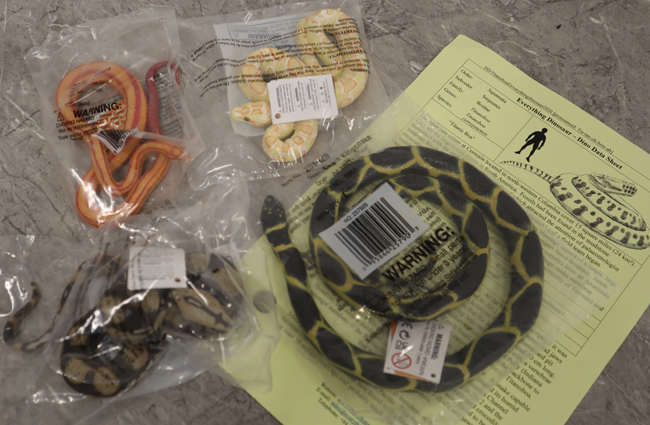
Everything Dinosaur’s team members receive lots of email enquiries every day including requests to source special models for customers. A mother of a reptile-obsessed dinosaur fan emailed us to ask could we source and supply some snake replicas. We made some enquiries and we were able to sort this out, bringing in some Squamata with our next shipment of Safari Ltd prehistoric animal models.
Getting in special orders for customers. An Everything Dinosaur customer wanted some Safari Ltd snake models, we were able to arrange to bring them in our next Safari Ltd shipment. Picture credit: Everything Dinosaur.
Picture credit: Everything Dinosaur
Snakes on a Shipment
You might have heard about the film “Snakes on a Plane”, starring Samuel L. Jackson. This film was released in 2006 to mixed reviews. In this instance, team members had to ensure there were “snakes on a shipment”, to satisfy the demands of a snake-loving dinosaur fan.
A spokesperson from Everything Dinosaur commented:
“If customers are looking to source some unusual models, or perhaps a replica that has been recently retired, we are happy to use our extensive contacts in the industry to see if we can obtain the figure for them.”
Everything Dinosaur does supply some prehistoric snake models, for example the popular Rebor Titanoboa Museum Class Maquettes “Brian Diccus” and “Monty Resurgent”. These limited-production figures were introduced in 2020, a museu-quality replica of a Titanoboa swallowing its crocodilian prey.
The Rebor Titanoboa Museum Class Maquette Brian Diccus.
When it came to handling the very realistic snake figures from Safari Ltd, team members tried not to be too squeamish, but whatever the model might be, we will try our best to source it and supply it, even if it is a green Anaconda!
To ask about how Everything Dinosaur can help you find a rare, retired or otherwise difficult to find model or figure: Contact Everything Dinosaur.
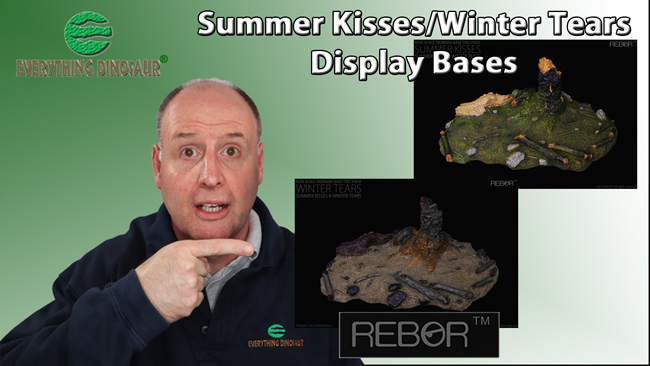
The next entry on Everything Dinosaur’s YouTube channel will be a Rebor display bases video review. The Rebor non-scale diorama base two pack entitled Summer Kisses, Winter Tears will be the focus of our next video. A short video highlighting these two excellent display bases will be posted up in a few days.
The Rebor non-scale diorama base two pack Summer Kisses and Winter Tears will be featured on Everything Dinosaur’s YouTube channel. Picture credit: Everything Dinosaur.
Picture credit: Everything Dinosaur
New Additions to the Rebor Range
Everything Dinosaur has stocked every Rebor figure, since the company burst onto the model collecting scene back in late 2014. This is the first time that Rebor have made display bases. The stunning bases are made from polystone resin and show the same landscape but at different times of the year. The Summer Kisses display base shows the landscape during the wet season and consequently, the ground is verdant and lush. In contrast, Winter Tears depicts the same ground but during the dry season, when there was little fresh vegetation about.
The Rebor diorama display bases Summer Kisses (top) and Winter Tears (bottom).
Rebor Display Bases
Although the bases have been cleverly designed, the cartons containing these beautiful models were damaged in transit. The outer carton (product packaging) is not in the usual high standard expected of the Rebor range. Everything Dinosaur has put up a note about the condition of the outer carton on the Rebor display bases product page:
“Please note the outer packaging for these figures has been damaged in transit to our warehouse. Whilst we have opened, inspected and checked all the display bases, unfortunately the outer packaging for the Rebor Non-scale Diorama bases is below the standard one would normally expect.”
Everything Dinosaur has announced that their next YouTube video will focus on the Rebor display bases – Summer Kisses and Winter Tears.Picture credit: Everything Dinosaur.
Team members concerned about customers receiving a broken model have set about opening all the Rebor bases that we have in stock. Each figure has been carefully unpacked, checked and then re-packed with extra card inserted to help support the outer carton and to prevent any damage to the beautiful bases.
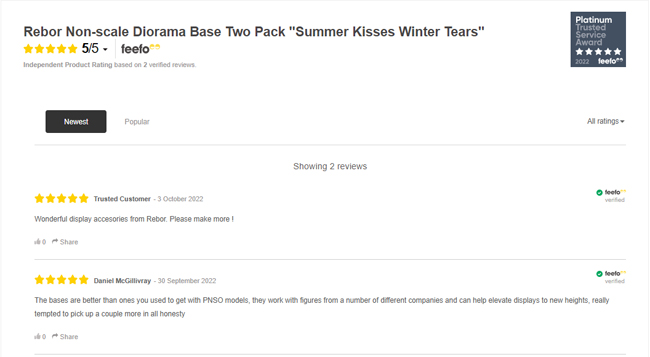
Our diligence is certainly paying off, it may be early days, these magnificent bases have only been in stock for a short while, but they have already picked up 5-star reviews.
Everything Dinosaur receives 5-star feedback for the Rebor display bases.Picture credit: Everything Dinosaur.
A spokesperson from Everything Dinosaur confirmed that they would take great care with the packing of these bases, doing all they can to ensure that the bases reach customers in tip-top condition.
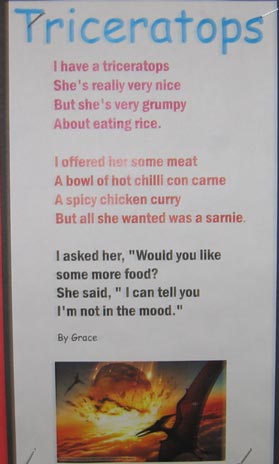
Whilst sorting through the company’s extensive teaching database a picture of a dinosaur poem spotted during a school visit was found. During a routine tidy up of the images associated with Everything Dinosaur’s work in school, a poem about a Triceratops written by a young schoolgirl called Grace was discovered.
“Three horned Face” has a poem written about it. Picture credit: Everything Dinosaur.
Picture credit: Everything Dinosaur
Helping to Gain Confidence with Writing
Dinosaurs and prehistoric animals provide a rewarding and satisfying term topic for many teachers of Key Stage 1 and Key Stage 2 pupils. The children approach the topic with enthusiasm and demonstrate lots of knowledge. The term topic lends itself to extensive activities related to English, maths and artwork as well as science. A dinosaur term topic can help children develop confidence with numeracy and literacy.
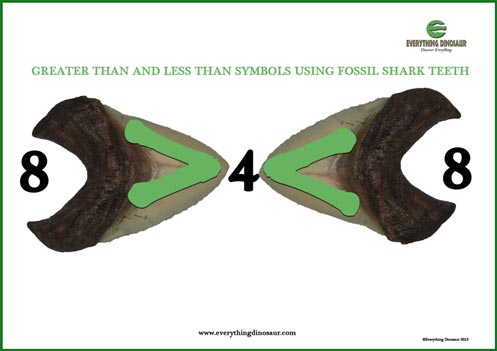
Team members at Everything Dinosaur have become quite creative in their support for teachers and teaching assistants. For example, fossil shark teeth have been used to make unusual “greater than” and “less than” symbols to help young children gain more confidence when using numbers.
Fossils used to make mathematical symbols for use in schools. Greater than and less than thanks to Otodus megalodon. Picture credit: Everything Dinosaur.
Picture credit: Everything Dinosaur
A Dinosaur Poem
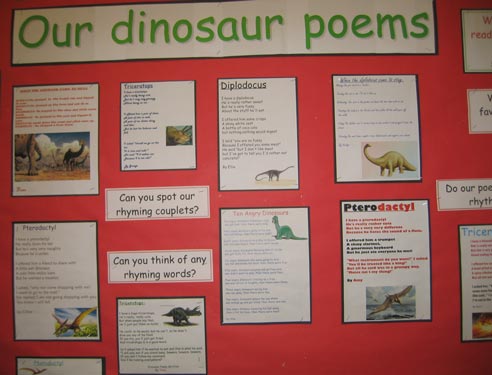
Team members have come across many instances of dinosaurs inspiring young poets to write prose. Many of the children’s poems have been posted up on the walls of the classroom and they make bright and colourful displays.
Prehistoric Animal Poems. Helping children to gain confidence with writing and literacy. Picture credit: Everything Dinosaur.
Picture credit: Everything Dinosaur
A spokesperson for the UK-based, dinosaur company commented that over the years of delivering dinosaur themed workshops and supporting teachers, team members had come across some amazing examples of prehistoric animal themed poems.
Whether limericks, free verse or even Japanese inspired poetry forms such as haiku, Everything Dinosaur team members have always tried to encourage and inspire children.
To view the extensive range of prehistoric animal models and toys, all approved by the company’s teaching team, visit Everything Dinosaur’s website: Visit Everything Dinosaur’s Website.
Everything Dinosaur team members have visited many schools. Unfortunately, during our travels we have come across many instances of inaccurate teaching materials. Educational budgets are stretched as never before and it always disappoints team members when they discover inaccurate information about dinosaurs and prehistoric animals being used in schools.
Take for example, this teaching aid downloaded and used by a school, which we came across a few years ago during a dinosaur workshop at the school.
Unfortunately, some of the dinosaur and prehistoric animal themed teaching resources available in the UK are wildly inaccurate. Picture credit: Everything Dinosaur.
Picture credit: Everything Dinosaur
The picture makes a statement about dinosaurs. The fossil record does provide evidence to support the idea that like other reptiles, dinosaurs were scaly. However, the prehistoric animal depicted on the “fact card” is a pterosaur and pterosaurs are not members of the Dinosauria.
Inaccurate Teaching Materials
A spokesperson from Everything Dinosaur commented that team members regularly came across inaccurate and misleading information about dinosaurs and other prehistoric animals in schools.
The spokesperson added:
“Organisations compile teaching materials and sell these to schools and nurseries. Unfortunately, some of the learning materials contain obvious errors and inaccuracies. When we come across these materials, we do our best to point them out to the teaching team and to offer them, free of charge, replacement teaching materials that more accurately reflect the fossil record.”
Providing Support for Teachers and Teaching Assistants
As well as providing support for teachers and teaching assistants, Everything Dinosaur team members have assisted parents who are home educating their children. We have provided helpful teaching resources and provided links to other sources of accurate facts about dinosaurs and prehistoric animals. Everything Dinosaur has also provided information about museums, events and exhibitions to visit many of which are free.
The company also provides a range of dinosaur themed toys and games including replicas of iconic animals preserved in the fossil record: Dinosaur Toys, Replicas Fossils and Gifts.
The spokesperson added that team members remained committed to helping where they could and they answered swiftly and promptly all the emails and enquiries that they received.
The recently introduced (2022) CollectA deluxe Spinosaurus dinosaur model has been well received by dinosaur fans and model collectors. The latest incarnation of the largest theropod known to science is just one of the Spinosaurus figures that have been made by CollectA. Their range of Spinosaurus replicas helps to chart how our perceptions about this carnivorous dinosaur have changed.
The CollectA Deluxe Spinosaurus dinosaur model. A recently introduced (2022) updated replica of the giant, North African theropod Spinosaurus.
The CollectA Deluxe Spinosaurus
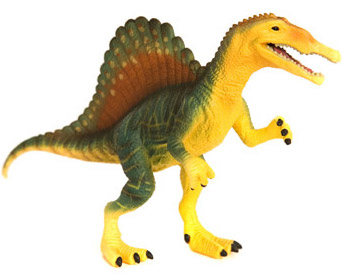
The first Spinosaurus model introduced by CollectA came out not long after the range was launched. It depicted this dinosaur as a colourful biped. The model was short-lived, it was replaced by a more muted version.
The first CollectA Spinosaurus model. The dinosaur was depicted as a colourful biped.
Spinosaurus Replicas and Models
Since the early days of the CollectA range, Spinosaurus has been an integral part of the company’s product offering. In 2010, the first Spinosaurus in the CollectA Deluxe range was added.
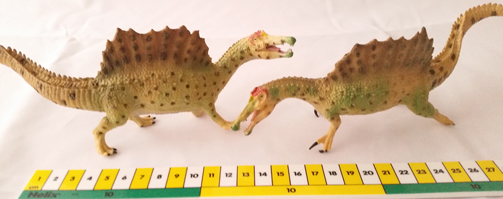
In 2015 CollectA introduced their first Spinosaurus replicas depicting this animal as an obligate quadruped (walking on all fours). Three models were introduced, a 1:40 scale CollectA Deluxe Spinosaurus replica and two smaller models (Spinosaurus walking and Spinosaurus swimming). The 2015 swimming Spinosaurus model was the first CollectA model to be introduced that depicted a swimming dinosaur. These figures commemorated the centenary of the formal scientific description and naming of this theropod (1915 Stromer). CollectA was the first toy company to make a model of S. aegyptiacus based on the comprehensive reassessment carried out the previous year in a scientific paper entitled “Semiaquatic adaptations in a giant predatory dinosaur” (Ibrahim et al). The 2015 swimming Spinosaurus model was officially retired in 2019.
CollectA Spinosaurus available from Everything Dinosaur (2015). Picture credit Everything Dinosaur.
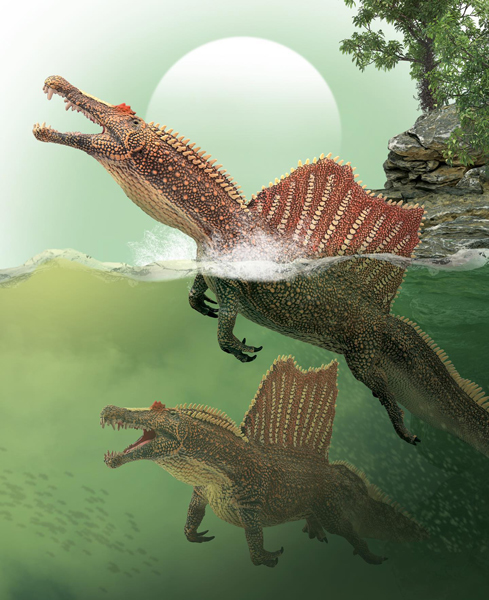
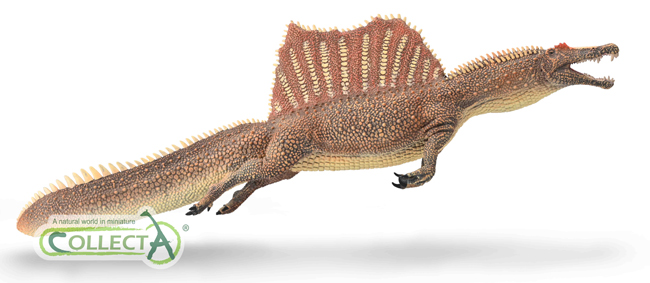
The latest version of this iconic carnivorous dinosaur to be added, the 2022 CollectA deluxe Spinosaurus has a restyled dorsal fin and the tail has been thickened to reflect yet more published research on this dinosaur: Spinosaurus – The River Monster.
The CollectA Deluxe swimming Spinosaurus in 1:40 scale (approximately).
A spokesperson from Everything Dinosaur commented that the history of CollectA Spinosaurus models closely reflects the changing views held by palaeontologists. The changing models of Spinosaurus demonstrate how perceptions about this huge dinosaur have changed over the last two decades.
The new for 2022 Spinosaurus has certainly proved popular with one model reviewer posting on Everything Dinosaur’s website that this figure was the “best CollectA model ever”.
Everything Dinosaur team members set out to update our customers on the impact of Royal Mail industrial action. This is the third blog post that we have put up in our bid to keep customers informed about the strike action as we help customers plan their purchases.
Everything Dinosaur team members have taken steps to help minimise disruption for customers, but due to industrial action UK and overseas deliveries of parcels will be subject to delays. Picture credit: Everything Dinosaur.
An Update on Royal Mail Industrial Action
We have received this information from Royal Mail, which provides details about planned strike action by the Communication Workers Union (CWU) that will cause disruption and deliveries in the UK mail network.
Royal Mail has received formal notification from the CWU for industrial action to take place on the following dates:
Thursday 20th October 2022
Tuesday 25th October 2022
In a bulletin published by Royal Mail we note that they will continue to focus their efforts on working to get services back to normal as soon as possible after this industrial action.
Trying Our Best to Minimise Delays for Customers
Everything Dinosaur, whilst unable to do much about the strike action, will continue working over weekends to make sure parcels are ready for despatch as quickly as possible in order to minimise delays.
Trust Everything Dinosaur to deliver. Team members are working weekends to ensure that parcels are packed and despatched as quickly as possible to minimise delays for customers.
What Can Customers Do?
We strongly advise customer to order early, especially any time sensitive items such as gifts for birthdays or the festive season.
Royal Mail are working hard to develop contingency plans and to ensure that normal service is resumed as quickly as possible after the strike action. We have ensured that resources are in place to pick, prepare and pack parcels as quickly as we can so that they are ready for despatch. We have also been assured by Royal Mail that our collections will resume as quickly as possible after industrial action and that customer deliveries will resume the day after the strike action finishes.
More Strike Action is Planned
Royal Mail is aware that further strike action is planned with the CWU publicly announcing further dates for industrial action including Monday 28th of November. Other dates for strike action have been proposed throughout November and December.
We advise customers to order early to avoid disappointment, especially in the lead up to the festive season.
Team members are excited by the news that we are a finalist in our local Chamber of Commerce’s Business Awards. It is official, Everything Dinosaur has been nominated for an award, we are a finalist in the 2022 South Cheshire Chamber Business Awards in the “Excellence in Customer Service” category.
The award ceremony takes place on the evening of November 18th at Reaseheath College, one of the UK’s leading specialist land-based colleges and we are honoured and humbled to have been nominated.
Everything Dinosaur has been nominated for the Excellence in Customer Service category at the prestigious South Cheshire Chamber of Commerce Business Awards.
The South Cheshire Chamber of Commerce Business Awards 2022
The prestigious Business Awards celebrate the hard work and achievements of those in our South Cheshire business community and this year’s ceremony is extra special as the Chamber will be celebrating the 25th anniversary of the awards.
In total, there are nine award categories and Everything Dinosaur has received confirmation that our mail order business has been nominated for the Excellence in Customer Service award.
Mike Walley from Everything Dinosaur commented:
“We are immensely honoured to have been nominated. We try to place customers at the very heart of everything we do and in these difficult times it is wonderful to hear that have been selected to go through to the finalist stage of the 2022 South Cheshire Chamber Business Awards.”
A Reputation for Excellent Customer Service
Everything Dinosaur has already received recognition for its record of customer service. In 2018, within twelve months of working with the independent ratings company Feefo, Everything Dinosaur was awarded the Gold standard customer award. It was won again in 2019 and in the following year, when Feefo introduced the Platinum Trusted Service Award, Everything Dinosaur was awarded that as well.
Everything Dinosaur wins the Platinum Service Award. The company has won this esteemed customer service three years in a row (2020, 2021 and 2022).
Everything Dinosaur Nominated for an Award
Sue Judd, of Everything Dinosaur added:
“Being nominated is an achievement. We listen to our customers, and we respond to their needs. Their feedback and input helps to drive our business.”
This nomination provides an affirmation of Everything Dinosaur’s business strategy, being a finalist in these esteemed awards reflects our commitment to outstanding customer service.
Research into a beautifully preserved Edmontosaurus fossil suggests that dinosaur mummies might be more common than previously thought. The Edmontosaurus specimen found by Tyler Lyson when exploring Slope County (North Dakota) and Hell Creek Formation exposures contained therein is providing palaeontologists with an insight into the fossilisation process that might produce a “dinosaur mummy”.
A mummified dinosaur was thought to require two mutually exclusive taphonomic processes in order to form. Firstly, to have the carcase exposed on the surface for a considerable portion of time to permit the remains to dry out and become desiccated. Secondly, rapid burial and deposition to preserve what remains of the corpse.
The taphonomy of the Edmontosaurus specimen (NDGS 2000), suggests that there may be other circumstances the lead to the mummified remains of dinosaurs.
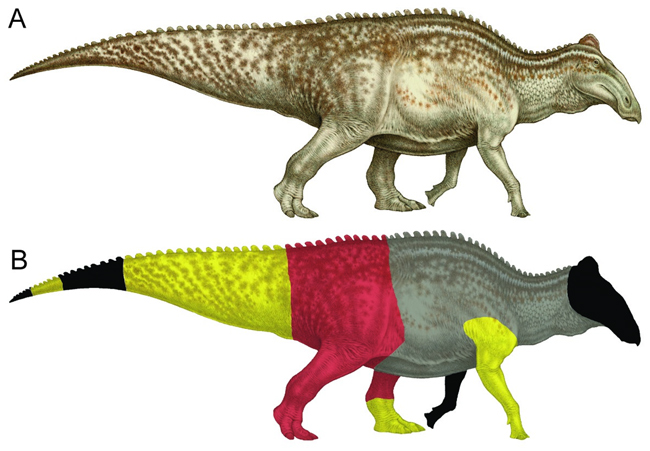
Distribution and current state of preparation of the preserved skin on the Edmontosaurus specimen (NDGS 2000). Life reconstruction by Natee Puttapipat. Black areas in the diagram indicate portions of the skeleton apparently absent from the specimen, light grey areas indicate regions where the skeleton is preserved but no skin is currently preserved, red areas indicate regions where skin is present and is still undergoing preparation. The yellow shading indicate areas where the skin is fully prepared and were examined in this study. Picture credit: Drumheller et al (PLoS One).
Dinosaur Mummies – Hooves and Fingers (E. annectens)
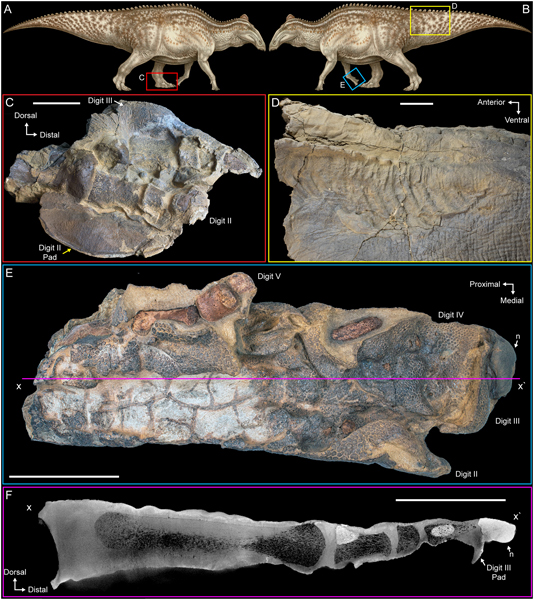
A team of scientists, including researchers from University of Tennessee–Knoxville, Knoxville, Tennessee and the North Dakota Geological Survey team, writing in the academic journal PLoS One propose a new explanation for how such fossil specimens might form. Large areas of desiccated and seemingly deflated skin have been preserved on the limbs and tail. Such is the degree of preservation of the front limb, (manus) that palaeontologists have discovered that Edmontosaurus (E. annectens) had a hoof-like nail on the third digit.
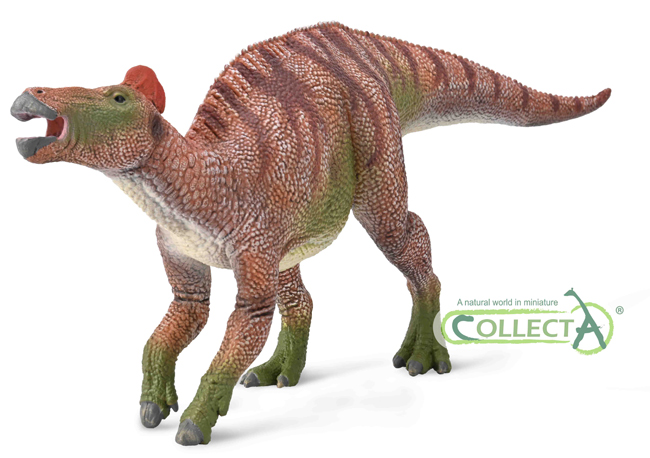
This discovery led to a substantial revision of Edmontosaurus limb anatomy in prehistoric animal replicas, as epitomised by the recently introduced CollectA Deluxe 1:40 scale Edmontosaurus.
The new for 2022 CollectA Deluxe 1:40 scale Edmontosaurus dinosaur model. CollectA had wanted to introduce a replica of this iconic Late Cretaceous hadrosaur for some time. Many of the details such as the hoof-like third digit on the hand and the enlarged scales on the neck replicate what the scientists have discovered by studying the Edmontosaurus dinosaur mummy known as Dakota.
The research team identified bite marks from carnivores upon the dinosaur’s skin. These are the first examples of unhealed carnivore damage on fossil dinosaur skin, and furthermore, this is evidence that the dinosaur carcass was not protected from scavengers by being rapidly buried, yet it became a mummy nonetheless.
Many of the marks suggest bites from the conical teeth of crocodyliforms, although pathology associated with the tail is more difficult to interpret. The researchers suggest that some of the “V-shaped” patterns identified suggest that flexible, clawed digits rather than more rigidly fixed teeth, may have been responsible for these injuries. Perhaps these marks were caused by feeding deinonychosaurs (Dakotaraptor steini) or perhaps a juvenile T. rex.
Examining the Decomposition of Carcases
If the carcase was scavenged, then it was not buried rapidly and one of the supposed pre-requisites for “dinosaur mummification” did not occur with this fossil specimen. Instead, the researchers propose an alternative route for the creation of such remarkable fossils, a theory that has been influenced by what is observed in the world today. When scavengers feed on a carcase, they rip open the body and feed on the internal organs. Punctures made in the body allow fluids and gases formed by decomposition to escape, thus permitting the skin to dry out, forming a desiccated, dried out husk.
Evidence of desiccation in the preserved remains of the Edmontosaurus (specimen number NDGS 2000). Note all scale bars equal 10 cm. Life reconstruction by Natee Puttapipat. Picture credit: Drumheller et al (PLoS One).
Dinosaur Skin More Commonly Preserved
The research team postulate that if the more durable soft tissues can persist some months prior to burial to permit desiccation to occur, then dinosaur skin fossils, although rare, are possibly, more commonly preserved than expected.
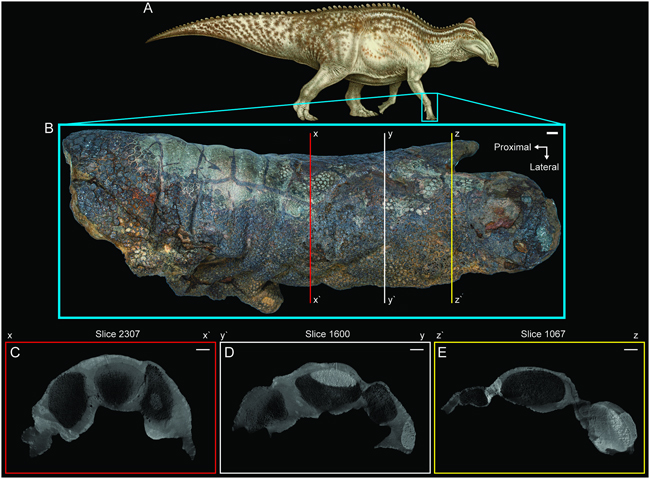
Cross sectional views through the right manus of the Edmontosaurus fossil (NDGS 2000). NDGS 2000 reconstruction in right lateral view (A). Right manus in dorsal view indicating the positions of the three cross sectional views (B). CT image along line x to x’ (C). CT image along line y to y’ (D). CT image along line z to z’ (E). In (C), (D), and (E), slice numbers from the original CT data are provided above each image. Paleoart in (A) by Natee Puttapipat. Scale bars equal 1 cm. Picture credit: Drumheller et al (PLoS One).
A New Theory on How “Dinosaur Mummies” Could Form
It is important to make clear that what a palaeontologist refers to as a “dinosaur mummy” is not the same as the mummified remains of an Egyptian deity. The skin and other soft tissues are permineralised, they are rock, although it is noted that molecular sampling of this Edmontosaurus specimen yielded putative dinosaurian biomarkers such as evidence of degraded proteins, suggesting that soft tissue was preserved directly in this specimen.
Generally, the two presumed prerequisites for mummification, that of being exposed on the surface for some time to permit the corpse to desiccate and rapid burial are incompatible. So, the researchers propose a new theory on how a “dinosaur mummy” could form:
A corpse is scavenged creating puncture marks to allow fluids and gases to escape.
Smaller organisms such as invertebrates and microbes exploit these punctures to access the internal organs and other parts of the skeleton.
Consumption from within in conjunction with decomposition allows the skin to deflate and to drape over the underlying bones that are more resistant to feeding and decay.
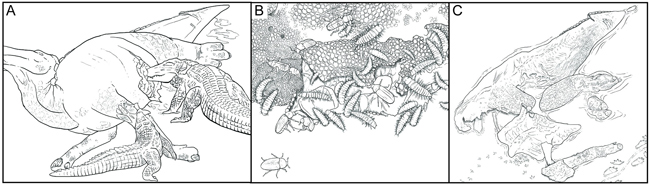
Proposed soft tissue preservational pathway for the Edmontosaurus fossil. Incomplete predation and/or scavenging of the carcass creates openings in the body wall through which fluids and gasses can escape (A). Invertebrates and microbes (B) use those openings to access the internal tissues. Removal of internal soft tissues and drainage of fluids and gasses associated with decomposition allows the deflated skin and other dermal tissues to desiccate and drape over the underlying bones (C). Illustration by Becky Barnes. Picture credit: Drumheller et al (PLoS One).
The scientists hope that this new paper will help with the excavation, collection and preparation of fossils. The presence of soft tissues and biomarkers such as degraded proteins demonstrate that rapid burial may not be a pre-requisite to permit their preservation. As a result, such evidence as skin, soft tissue and biomarkers may be more common in the fossil record than previously thought.
The scientific paper: “Biostratinomic alterations of an Edmontosaurus “mummy” reveal a pathway for soft tissue preservation without invoking ‘exceptional conditions'” by Stephanie K. Drumheller, Clint A. Boyd, Becky M. S. Barnes and Mindy L. Householder published in PLoS One.
Researchers have examined the musculature of a bone-headed dinosaur in a bid to better understand hypothesised intraspecific, head-butting combat. Pachycephalosaurs are a group of Late Cretaceous, bipedal ornithischian dinosaurs known from Asia and North America. They are characterised by their thickened skulls, which are sometimes adorned with lumps, bumps and spikes.
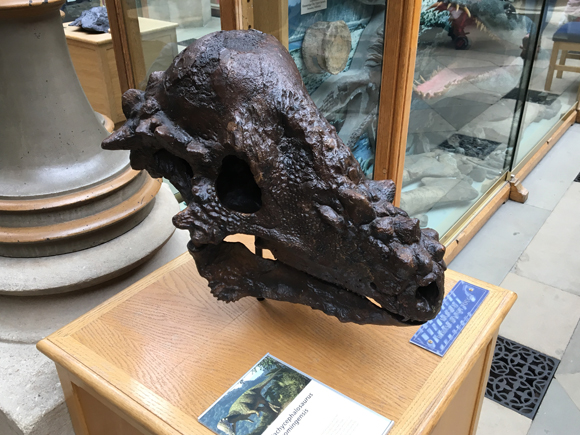
The skulls, some of which can be up to 20 cm thick have been the focus of a lot of research. It has been suggested that these thickened skull domes evolved as these dinosaurs indulged in intraspecific head-butting contests, either head-to-head impacts or using their heads to butt the flanks of their opponents.
Pachycephalosaurus wyomingensis replica skull. The thickened skull domes, which in some specimens of P. wyomingensis were up to 20 cm thick are thought to have evolved as these dinosaurs participated in intraspecific head-butting combat. Picture credit: Everything Dinosaur.
Writing in the open-access, on-line journal PLoS One, researchers from Carleton University, Ottawa in collaboration with Professor Phil Currie (University of Alberta) have examined the postcranial skeleton of a specimen of the pachycephalosaur Stegoceras validum to gain a better understanding of the musculature of the limbs, hips and the base of the tail. The specimen (UALVP 2) is one of the best preserved pachycephalosaur postcranial skeletons discovered to date and the best preserved pachycephalosaur discovered in Canada. The limb bones preserve muscle scars and other surface textures which enabled the research team to accurately construct the muscles associated with the forelimbs, hindlimbs and the pelvic region.
A charging Pachycephalosaurus.
Focusing on Muscles Not Bones
Unlike most studies relating to the Dinosauria, the fossil bones were not the central focus of this research. The scientists who include Professor Phil Currie (University of Alberta) and PhD student Bryan Moore (Carleton University), examined the bones to determine the layout, shape and size of the muscles that were attached to them. The team were interested in mapping the *myology of the back end of a pachycephalosaur so that they could assess how the postcranial skeleton would have assisted with the hypothesised head-butting contests.
The term *myology refers to the study of the shape, structure and arrangement of muscles.
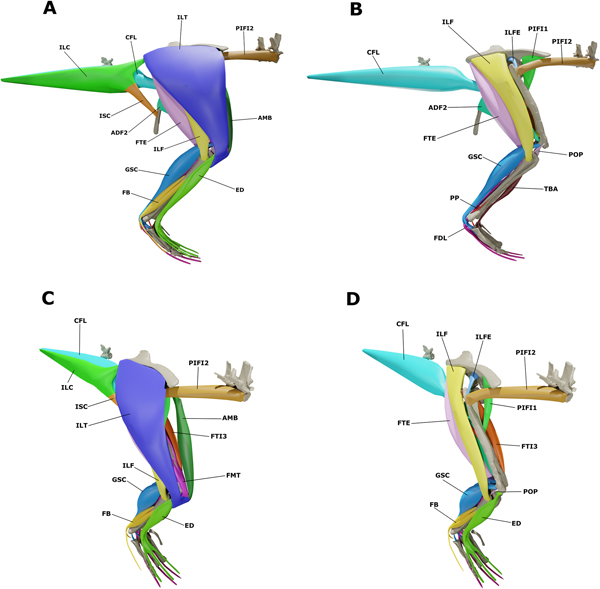
Pelvic and hind limb muscular reconstruction of Stegoceras validum. Superficial musculature in lateral view (A). Deep musculature in lateral view (B). Superficial musculature in anterodorsolateral view (C) and (D) deep musculature in anterodorsolateral view. Picture credit: Moore et al/PLoS One.
Strong Legs and a Wide Pelvis
The study of specimen number UALVP 2 demonstrated that the forelimbs of Stegoceras validum were not especially robust and strong, particularly in comparison to early, lizard-hipped bipeds such as the Triassic theropod Tawa hallae. However, in contrast, in Stegoceras the hind limbs and pelvic area were more robust with large, powerful muscles associated with the pelvis, the thighs and the base of the tail. These larger muscles, in combination with the wide pelvis and stout hind limbs, produced a stronger, more stable pelvic structure that would have proved advantageous during hypothesised intraspecific head-butting contests.
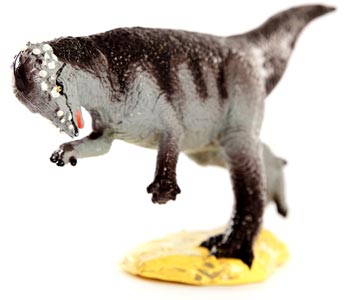
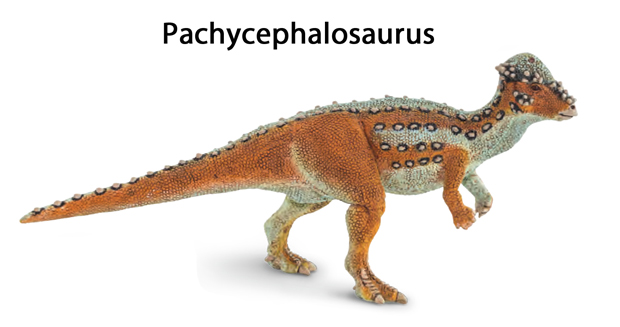
The new for 2020 Wild Safari Prehistoric World Pachycephalosaurus model. The model has a large dent in its skull dome, suggesting damage resulting from a headbutting contest with a rival.
The picture above shows a Pachycephalosaurus dinosaur model from the Wild Safari Prehistoric World range, to view this range of figures in stock at Everything Dinosaur: Safari Ltd Dinosaur Models.
The research team concludes that the hind quarters of Stegoceras evolved to help this small dinosaur deliver and absorb impact forces associated with the proposed head-butting behaviour. The scientists suggest that more research is needed to examine the potential velocity at which the thickened skull could be propelled forward during such contests. They propose additional research assessing the postcranial properties of other pachycephalosaurs and comparing their bauplan with similar sized dinosaurs such as Thescelosaurus (T. neglectus).
The scientific paper: “The appendicular myology of Stegoceras validum (Ornithischia: Pachycephalosauridae) and implications for the head-butting hypothesis” by Bryan R. S. Moore, Mathew J. Roloson, Philip J. Currie, Michael J. Ryan, R. Timothy Patterson and Jordan C. Mallon published in PLoS One.
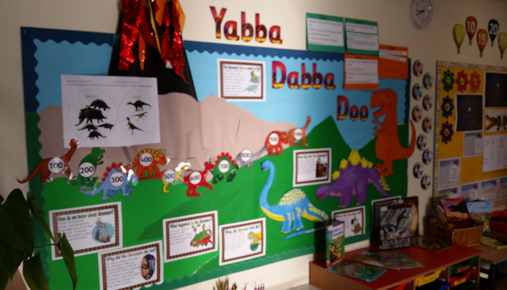
Whilst examining some old files on the Everything Dinosaur database, team members came across a picture of a wonderful dinosaur themed wall display at Pebble Brook Primary, when Everything Dinosaur visited to conduct a workshop all about dinosaurs, fossils and rocks.
The children had been studying soils, rocks and fossils as part of their work during the autumn term and to start the topic with an event, a team member was invited to the school to lead a series of dinosaur and fossil themed workshops for the day.
During a pause in the busy schedule, a photograph of a very colourful wall display created by the children was taken.
A Delightful and Colourful Dinosaur Wall Display
Year 3 children learn about dinosaurs, fossils, rocks and volcanoes in a term topic entitled “Dinosaurs Yabba Dabba Doo”! Picture credit: Everything Dinosaur/Pebble Brook Primary.
The children investigated how fossils form, how they feel and what they can tell us about animals that lived in the past and extinction. For the science element of the term topic, the class have been examining numerous types of rock, exploring the school grounds and the buildings to identify different types of stone and rock.
A spokesperson from Everything Dinosaur commented:
“We remember visiting the school on a couple of occasions to work with different classes and enrich their curriculum. The classrooms were full of colourful artwork and delightful wall displays. We all had a great time”
Everything Dinosaur stocks a wide range of prehistoric animal themed crafts and art materials as well as replicas of dinosaurs and famous animals such as trilobites, belemnites and ammonites from the fossil record. All the items that the UK-based mail order company stocks have been tested and approved by the company’s teaching team.
To view the range of products available, visit Everything Dinosaur’s award-winning website: Dinosaur Crafts for Kids.