All about dinosaurs, fossils and prehistoric animals by Everything Dinosaur team members.

Everything Dinosaur team members working in schools, helping museums and other educational bodies. Our work with and in schools.

11 06, 2014

Dinosaurs, Fossils, Extinction for Key Stages 3 and 4

By |2023-03-13T18:15:15+00:00June 11th, 2014|Categories: Educational Activities, Main Page, Teaching|0 Comments

Higher Order Thinking Skills Encouraged in Key Stages 3 and 4

Science remains at the core of the national curriculum for the United Kingdom.  Although there may be differences in the structure of the education systems in Scotland, Wales, England and Northern Ireland, there is a strong emphasis on studying science subjects and with the new curriculum due to roll out in England from next September, the focus is on learning how to work scientifically.

Dinosaurs, Fossils and Extinction

The dinosaur and fossil themed workshops conducted by Everything Dinosaur have always attempted to demonstrate the links between observation, investigation, experimentation and evaluation.  Staff are busy preparing new lesson plans, specifically aimed at students in Year 7 and upwards.

Dinosaur, Extinction and Evolution (Key Stages 3 and 4)

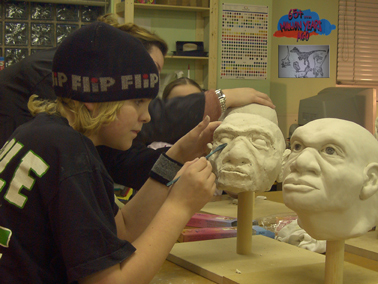
Looking at the evolution of H. sapiens with Key Stage 3.

Looking at the evolution of H. sapiens with Key Stage 3.

Picture credit: Everything Dinosaur

For Key Stage 3 for example, science teaching is now directed towards outcomes such as the encouragement of higher order thinking skills.  Students are encouraged to build on acquired knowledge learned in Key Stage 2 and to make connections between different areas of science.  At Everything Dinosaur, we use real aspects of palaeontology to explore key elements such as food chains, the interrelationships between living things, environmental change and extinction.

We aim to enthuse, motivate and engage, there are some fascinating and intriguing lesson plans and schemes of work coming together.

To learn more about our dinosaur themed gifts and toys: Dinosaur Toys and Prehistoric Animal Crafts.

9 06, 2014

Class 2T Learn About Fossils and Dinosaurs

By |2023-03-13T18:07:23+00:00June 9th, 2014|Categories: Educational Activities, Main Page, Teaching|0 Comments

Year 2 Pupils at Morecambe Primary School Study Dinosaurs

After a morning of dinosaur workshops working with children studying Key Stage 1, Everything Dinosaur set the pupils a challenge.  We had done our best to answer their questions as we explored fossils and prehistoric animals but inevitably there was not enough time to answer some of the questions that the children had prepared.  So with Mrs Todd’s and Miss Bolton’s permission (Year 2 teachers), a creative writing exercise was proposed. The children were challenged to write to the Everything Dinosaur offices telling us about their favourite dinosaur or prehistoric animal fact.  If they had a question, then this too could be sent into us for our dinosaur experts to have a look at.

Answering Questions about Dinosaurs

A few days ago, we received a big pile of letters from the children in class two.  There was even a drawing of a fearsome looking monster on the back of the envelope that contained the children’s correspondence.

Colourful Envelope with Prehistoric Animal Drawing

Colourful drawing from school children.

Colourful drawing from school children.

Picture credit: Class Two

Amazing Questions and  Drawings

There were certainly a lot of amazing questions contained in the letters and plenty of dinosaur facts as well.  Class 2 certainly enjoyed themselves, Billy, Alice B, Jack B, Ellie, Amy, Darcey, Jenny, Nathan, Freya and Zara all declared that they would like to become palaeontologists when they are older.  With over 1,200 different types of dinosaur having been discovered, I think we will be glad of their help.  The children had illustrated their letters with lots of beautiful drawings of prehistoric animals, we have posted some up onto our warehouse wall.

Zara Drew an Orange Coloured Dinosaur

A bright orange dinosaur.

A bright orange dinosaur.

Picture credit: Zara (Class Two)

Fossils and Dinosaurs

Whilst at the school, we met a budding scientist called Alexa so we told her and the rest of the class about a dinosaur that had a similar name to hers.  We discussed Alxasaurus and on return to the office we emailed over some further information about this particular dinosaur.  Gabby was pleased to hear about Alxasaurus and in answer to the question asked, scientists think that this dinosaur would have been about a metre taller than Mrs Cronshaw (teaching assistant).

Jasmine’s Letter Featured a Purple Long-Necked Dinosaur

A purple dinosaur by Jasmine.

A purple dinosaur by Jasmine.

Picture credit:  Jasmine  (Class Two)

We had lots of prehistoric animal drawings to admire.  Adam drew some ammonite shells and asked how old would the oldest T. rex be?  This is quite a tricky question, but palaeontologists think that the biggest Tyrannosaurus rex known, the dinosaur whose fossils can be seen in a museum in Chicago (USA), was probably around thirty years old when she died.  The biggest tyrannosaurs probably reached lengths of around thirteen to fourteen metres, we hope this answers Alissia’s question.  Our thanks to Isaac who informed us that T. rex lived in North America.

Why do Dinosaurs Battle?

The most popular question that we received was why do dinosaurs battle?  This question was asked by Hannah, Harry, Jack and Lawson.  Dinosaurs fighting can be seen in films and on television, although, like animals today, for much of the time, most dinosaurs kept themselves to themselves.  The carnivores would have hunted and attacked herbivores, whilst some herbivores like the horned dinosaurs may have fought amongst themselves to settle disputes in the herd.

Some meat-eating dinosaurs would have battled others of their own species in fights over resources such as territories or disputes over rights to claim a carcase of another dinosaur for a meal.  In most cases, when dinosaurs of the same species argued, it would have been rare for them to come to blows.  Usually, as with animals today most disputes were settled with displays before a fight.  Amongst most dinosaurs fighting one of their own species would have been very much a last resort – good question though.

Colourful Prehistoric Animals Drawn by Jack

Thanks for the labels Jack.

Thanks for the labels Jack.

Picture credit: Jack (Class Two)

Kaylee asked how many bones in a Tyrannosaurus rex?  This is another tricky question, as since no complete fossilised skeleton of Tyrannosaurus rex has ever been found, nobody knows for sure.  A typical human body contains 206 bones, T. rex probably had more bones than we do, it may not have had as many fingers but it had belly ribs called gastralia which we do not and it had a lot of bones in its long tail, perhaps as many as forty.  The bones that it did have in its body were much larger than the equivalent bones found in a human being, after all, Tyrannosaurus rex was much bigger than us.

Kaylee’s Prehistoric Scene in Her Letter to Everything Dinosaur

A long-necked dinosaur.

A long-necked dinosaur.

Picture credit: Kaylee (Class Two)

We also received questions about extinction.  Some children wanted to know how big was the space rock that crashed into Earth, scientists estimate that it was around ten kilometres (six miles) in diameter.  It was travelling at over thirty kilometres (eighteen miles) a second, that is quick enough to travel from Morecambe in Lancashire to Sydney in Australia in around five minutes.  Some of the very last dinosaurs to have lived were Tyrannosaurus rex, Triceratops and Edmontosaurus.  Questions about the space rock, its size and which were the last types of dinosaur were asked by Joe, Eve, Lydia and Alice T.W.

A big thank you to all the children for the letters, hopefully we have been able to answer them all.  A special thank you to Mrs McGowan, Mrs Cronshaw, Miss Bolton, Mrs Coulthard, Mrs Jackson and Miss Woodcock for their assistance during the dinosaur workshops.

Now it’s time to pop into the warehouse and pin some more pictures up onto the wall.

To learn about Everything Dinosaur’s prehistoric animal themed range of toys and games: Prehistoric Animal/Dinosaur Toys, Gifts and Games.

8 06, 2014

Prehistoric Shark Helps Key Stage 2 Get to Grips with Maths (Helpful Tips and Advice)

By |2024-04-29T15:01:26+01:00June 8th, 2014|Categories: Key Stage 1/2|Comments Off on Prehistoric Shark Helps Key Stage 2 Get to Grips with Maths (Helpful Tips and Advice)

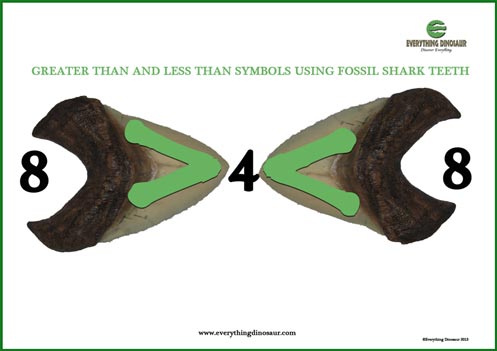
Fossilised Shark Teeth as “Greater Than” and “Less Than” Symbols

Everything Dinosaur team members have developed a number of creative lesson plans to help Key Stage one and Key Stage two pupils to get used to mathematical terms and symbols.  Whether it is using a list of extinct, prehistoric animals to encourage thinking in terms of how data might be presented or learning how to record information accurately by measuring dinosaur teeth, the Everything Dinosaur staff have developed an array of creative lesson plans.

Devising Lesson Plans

A number of Higher Learning Teaching Assistants have approached us asking for advice on how our fossil collection and dinosaur knowledge could be used to help primary school pupils get to grips with mathematical symbols and their correct usage.  For instance, our hard-working staff were asked to think up ways to help children from six years of age recognise and recall what certain signs and symbols represent.

A great deal of emphasis has been placed on young learners being able to make connections between numbers, shapes and symbols.  During upper Key Stage one, school children develop knowledge of and an understanding of symbols used in mathematics.  If we can build in a fun and creative prehistoric animal theme then the pupils will be encouraged to apply their knowledge – so why not use some giant, fossil shark teeth to help children learn about the “less than” and the “greater than” symbols.

C. megalodon Shark Teeth Fossils Help Children with Maths

Fossil shark teeth used to help demonstrate symbols in maths.
Greater than and less than thanks to C. megalodon. Picture credit: Everything Dinosaur.

Picture credit: Everything Dinosaur

Prehistoric Shark

Everything Dinosaur team members use pictures of the gigantic, fossilised teeth of a huge prehistoric shark commonly called Megalodon, with the scientific epithet – C. megalodon, to create the mathematical symbols.  As children move on from Key Stage one, they are expected to be able to recognise that the position of a number gives its value and to use correctly the “less than” and “greater than” symbols.

A Scale Drawing of Megalodon (Otodus megalodon)

Megalodon scale drawing.
Giant shark Megalodon scale drawing. Picture credit: Everything Dinosaur.

Picture credit: Everything Dinosaur

The shark teeth are from the company’s extensive fossil collection.  Fortunately, this prehistoric shark became extinct around 1.5 million years ago, extinction is another topic area that team members explore using fossil material.  Teeth from these monsters fascinate children and being able to handle one and view it up close is a memorable experience – helping to reinforce learning.

Note

Following a taxonomic revision this prehistoric shark is now known as Otodus megalodon.

To see the range of prehistoric animal themed items including prehistoric shark models available from Everything Dinosaur: Prehistoric Animal Themed Toys and Gifts.

30 05, 2014

A Fascination with Amazing Dinosaurs

By |2024-04-12T09:11:23+01:00May 30th, 2014|Categories: Early Years Foundation Reception|Comments Off on A Fascination with Amazing Dinosaurs

Children at Foundation Stage Explore Dinosaurs

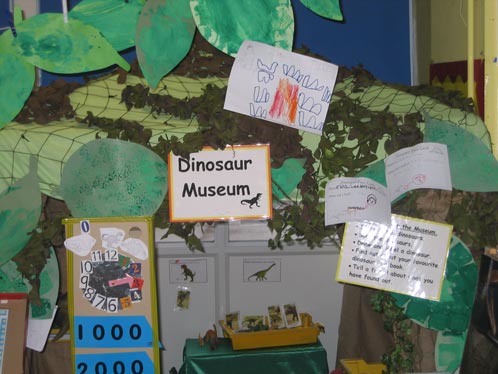
This spring was a very busy time for Everything Dinosaur team members and the first week of May saw staff helping out at St Elizabeth’s Primary as the Foundation Stage children enjoyed a dinosaur themed workshop as part of their term topic studies.  The eager pupils had been studying fossils and dinosaurs with the help of their teachers Miss Bailey and Mrs Carr.  Part of the classroom had been converted into a “dinosaur museum” and Everything Dinosaur’s dinosaur expert was given a tour of the museum by the children.

Dinosaur Museum

A “Dinosaur Museum” in the Classroom

learning about dinosaurs with a classroom dinosaur museum.
Learning about dinosaurs with a classroom dinosaur museum. Picture credit: Everything Dinosaur.

Picture credit: Everything Dinosaur

Why not Create a Dinosaur Museum in Your Classroom?

Using a space in the classroom to create a special area so that the work can be put on display is a great idea.  Our teaching expert suggested that next to the dinosaur museum, if some cushions could be spread on the floor, this could act as a special reading area to help the children explore books about dinosaurs and to encourage independent learning.

Learning About Dinosaurs

The museum itself was full of super illustrations of dinosaurs, all supervised by Mrs Driver and Mrs Wilson (the teaching assistants).  The young palaeontologists were keen to point out which dinosaurs ate meat and which ate plants.  One even explained what an omnivore was!  It was wonderful to hear how the children had grasped an understanding of the words, carnivore, herbivore and omnivore.

During the school visit, our dinosaur and fossil expert challenged Foundation Stage 2 pupils to produce some dinosaur themed writing.  Perhaps they could include their favourite dinosaur fact, or could they write about their favourite prehistoric animal.  In return, our expert agreed to send the teacher some pictures and further information about ammonites and ammonite fossils that we had examined earlier.

Ammonite Fossils Fascinated the Children

Ammonites
Examples of fossil Ammonites. Picture credit: Everything Dinosaur

Picture credit: Everything Dinosaur

Children Given a Dinosaur Themed Creative Writing Challenge

As part of Everything Dinosaur’s visit to the school, our dinosaur expert challenged Foundation Stage 2 to create a piece of prehistoric animal themed writing.  Could they write about their favourite dinosaur, pterosaur or prehistoric animal?  Perhaps they could include a dinosaur fact,  could they remember something that the dinosaur expert had said to them and then include this in their writing work?  In return for the prose, Everything Dinosaur’s expert promised (pinkie palaeontologist promise), to email a drawing of an ammonite for the children’s museum along with a fact sheet on these extinct members of the Mollusca phylum.

To view the range of educational, prehistoric animal themed toys available from Everything Dinosaur: Dinosaur Toys and Prehistoric Animal Craft Ideas.

21 05, 2014

Mary Anning – A Role Model for Girls and Science

By |2023-03-13T11:06:52+00:00May 21st, 2014|Categories: Key Stage 1/2|Comments Off on Mary Anning – A Role Model for Girls and Science

Mary Anning – Her Story and the National Curriculum

You might be familiar with the tongue-twister that begins “she sells sea shells on the seashore”, this little ditty that originated in the early part of the 20th century is believed to have been inspired by the life and work of Mary Anning, who was one the most important fossil collectors in the early history of palaeontology.

Mary Anning

For teachers of primary school children, especially those in Years 3 and 4, the story of Mary Anning can dove-tail very neatly into the new national teaching curriculum, specifically into the Science section (rocks, fossils and soil) but elsewhere, including English, History and Mathematics.

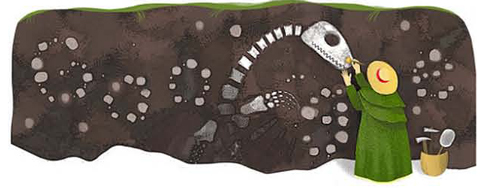
Mary Anning Fossil Collector Gets a Google Doodle

Google celebrates the life and work of Mary Anning.

Happy Birthday Mary Anning.  Google celebrates the life and works of Mary Anning.

Picture credit: Google/Everything Dinosaur

Mary Anning’s (1799-1847), contribution to the nascent science of palaeontology was immense.  This pioneering amateur palaeontologist would often venture out onto the dangerous cliffs of Lyme Regis (along with her faithful dog), searching for fossils or “curios” as they were often referred to.  She is credited with finding the first Ichthyosaur fossils to be studied by scientists (the fossil discovery was made jointly with her brother Joseph).

From her humble little house at Lyme Regis (Dorset, southern England),  Mary collected the many different types of fossil exposed by tides and erosion that could be found in the Jurassic aged coastal strata.  She became prominent as an expert in fossils and fossil hunting, although she did not receive full credit for her contribution to science during her lifetime.

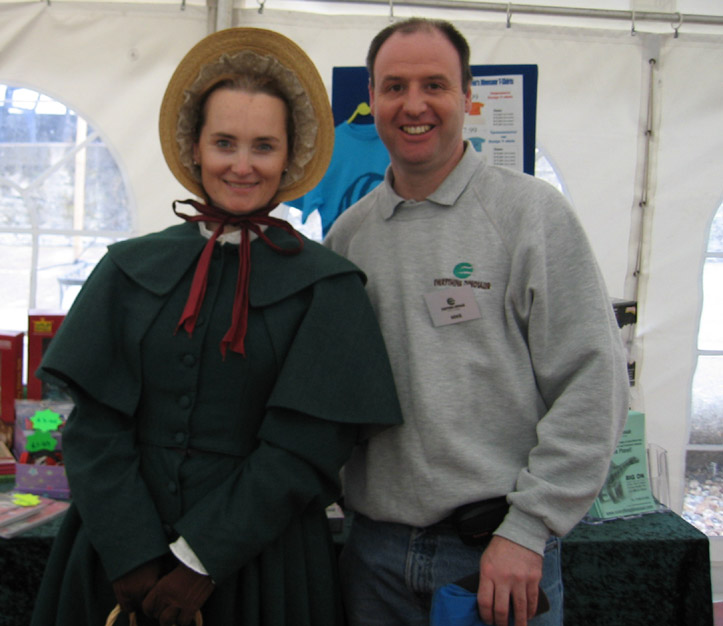
Helping to Promote Science to Girls using Mary Anning as a Role Model

Helping to promote learning in schools.

Helping to promote science for girls by dressing up as Mary Anning.  Mary Anning helping to inspire the next generation of young scientists. Picture credit: Everything Dinosaur.

Picture credit: Everything Dinosaur

The First Plesiosaur Fossil to be Scientifically Studied

Mary Anning discovered the first plesiosaur fossils in 1821 and the first pterosaur (flying reptile) fossils in England in 1828.  The pterosaur in question was named Dimorphodon and it was the first outside Germany to be described and only the third in the world to be scientifically analysed.  Many of Mary’s fossil finds can still be seen in museums today.  Her discoveries helped to build up the collections of a number of wealthy individuals but often no record was kept of her contribution or role in the research and study of such specimens.

Sadly, in Georgian times, women working in an academic capacity was strongly discouraged, Mary had much of the credit for her work taken away from her and it is only in recent years that her contribution has begun to be recognised by the public.

Mary Anning and her story makes a splendid, inspirational tale to help young children (particularly girls), think about studying science and taking up a career in the sciences.

Further information on Mary Anning and resources can be found at the following links:

Lyme Regis Remembers Mary: Lyme Regis Remembers the Contribution to Science Made by Mary Anning.

In Memory of Mary Anning: Anniversary of the death of Mary Anning.

As for a link into the English elements of Key Stage 2, here is the tongue-twister attributed to Mary in full, can your class create tongue-twisters of their own?

“She sells sea-shells on the sea-shore.
The shells she sells are sea-shells, I’m sure.
For if she sells sea-shells on the sea-shore
Then I’m sure she sells sea-shore shells.”

To view replicas of ammonites, belemnites, plesiosaurs and pterosaurs inspired by Mary Anning’s fossil discoveries, visit the models section of Everything Dinosaur’s user-friendly website: Prehistoric Animal and Dinosaur Models.

15 05, 2014

Questions We Get Asked – Providing Helpful Information

By |2024-04-12T15:46:34+01:00May 15th, 2014|Categories: Everything Dinosaur News and Updates, Press Releases, Teaching|0 Comments

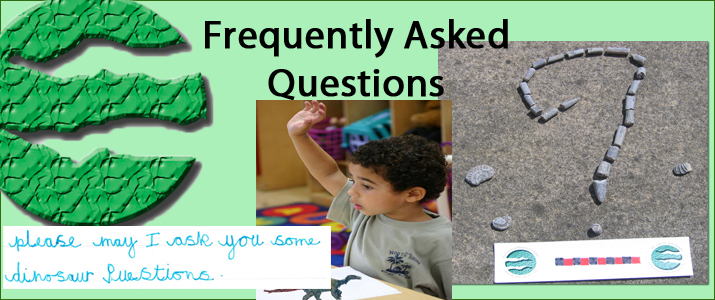
Frequently Asked Questions Page Completed

The FAQs (frequently asked questions) section of the new dinosaurs in school website being devised by Everything Dinosaur team members has been completed.  Banners have been prepared and uploaded and the text has now been added.  This is the latest part of the website to be finished and a spokesperson for the company stated that the project was on schedule with the list of typical questions that staff get asked added to the appropriate section of the new site.

Everything Dinosaur

One of the FAQs Banners Being Used on the New Website

New website nears completion.

New website nears completion.

Picture credit: Everything Dinosaur

Everything Dinosaur visits schools, museums, after school clubs, and youth groups to delivery innovative and very educational dinosaur and fossil themed workshops.  It seemed appropriate therefore, to feature both fossils and a little boy’s drawing of a dinosaur on the banner used as the featured image on the FAQs section of the new website.

These pages will provide a handy guide to those museum curators, scout group leaders and teaching staff who want to find out more about the teaching and educational services the team at Everything Dinosaur deliver.

The teaching staff always try to dove-tail their teaching work into the aims and objectives of the national curriculum whilst at the same time ensuring that the teaching is delivered in a fun, memorable and entertaining manner. Staff are away today carrying out a number of teaching sessions in Wales, working specifically with Key Stage 2 and Key Stage 3 students.  Perhaps some examples of the work of these students as they study rocks, fossils and evolution will be included on Everything Dinosaur’s new website dedicated to teaching about prehistoric life.

To visit Everything Dinosaur’s award-winning website selling dinosaur toys, models and games: Visit Everything Dinosaur.

11 05, 2014

Demonstrating Considerable Scientific Knowledge – Research into Volcanoes

By |2024-04-12T15:57:00+01:00May 11th, 2014|Categories: Key Stage 1/2|Comments Off on Demonstrating Considerable Scientific Knowledge – Research into Volcanoes

Young Geologists in Year 4 Demonstrate their Knowledge of Igneous and Sedimentary Rocks

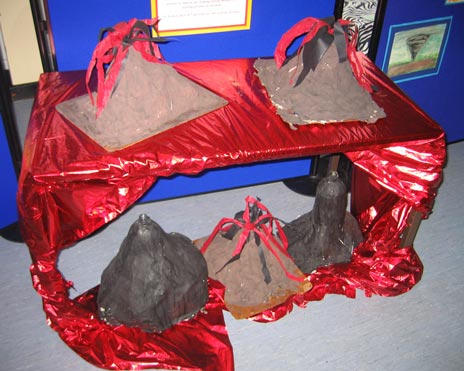
Team members at Everything Dinosaur who had been working with Year 4 pupils at a Yorkshire school were treated to a display of volcanic artwork.  The children, aged between eight and nine years of age had been learning all about the properties of rocks and a member of the Everything Dinosaur staff was invited into the school to help the students learn about fossils and how they are formed.

Demonstrating Scientific Knowledge

As part of the term topic, the teaching team had challenged the classes to come up with a display which demonstrated how volcanoes form and what happens when they erupt.  Lots of pictures were produced showing lava and there were even a couple of three-dimensional models made, one even attempted to show the inside of a volcano, very creative!

The team member from Everything Dinosaur helped the school children to appreciate how fossils are formed and there were plenty of spectacular examples on hand to impress the pupils as well as the enthusiastic teachers.

Colourful Igneous Artwork on Display

Volcano models on display.

Lava erupting from the cone shaped volcanoes

Picture credit: Year 4/Everything Dinosaur

Making Volcanoes

The lava had been made in various ways, straws had been painted and then bent over the cone of the volcano to indicate an immense eruption, other children had used red, yellow and black coloured tissue paper to make an effect of lava flowing down the sides of the volcano.  Some pupils had painted rivers of molten rock flowing down from the top of their models.  There were also a number of paintings on display as well as several illustrations of fossils.

The study of different types of rock is now an integral part of the Lower Key Stage 2 curriculum.  Everything Dinosaur team members have created a number of lesson plans and study snippets that illustrate how fossils are formed and what the remains of ancient creatures can tell us.  The emphasis is on the nature, processes and methods of working scientifically to investigate phenomena.  As with all Everything Dinosaur’s teaching work in schools the focus of each lesson is on helping to develop scientific knowledge and an understanding of important concepts that underpin the Earth sciences.

To view dinosaur toys, models and gifts available from Everything Dinosaur: Visit Everything Dinosaur.

10 05, 2014

Key Stage 3/4 – Studying the Evolution of Mankind

By |2024-05-02T09:46:23+01:00May 10th, 2014|Categories: Key Stage 3/4|Comments Off on Key Stage 3/4 – Studying the Evolution of Mankind

Useful Teaching Resources for Key Stage 3 and 4 – Evolution of Mankind

With the retirement of the series of early hominid models manufactured by Bullyland of Germany, science teachers aiming to link the evolution of our species within the topic areas related to evolution and natural selection have been a little short on models for students to study.  The German made series consisted of six replicas starting with a model of a Dryopithecus ape and concluding with a model of a Clovis Man complete with spear thrower.  Sadly, this range went out of production three years ago, with team members at Everything Dinosaur working closely with the German museum market to secure the final stocks of these hand-painted, scale models.

The Evolution of Mankind

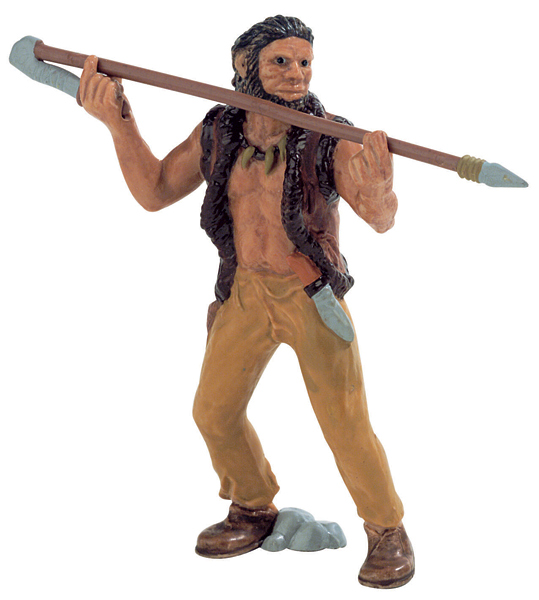
Homo sapiens (Bullyland Modern Man Replica)

Bullyland H. sapiens

A model of modern human being (H. sapiens).

Picture credit: Bullyland

The models provided a very visual illustration of the origin of our own species, which could lead onto extension activities where the effect of Darwin’s ground breaking book “The Origin of Species”, on Victorian society could be explored by the class.

The Evolution of Man

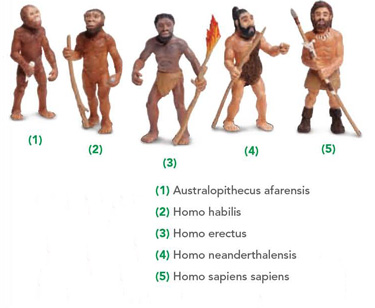
Fortunately, a new model series entitled “The Evolution of Man” is coming to the UK market very shortly.  This model series consists of five replicas, each one represents an iconic hominin and helps to shed light on the evolution of our species.  Sadly, we don’t have any female models included in the series.  However, the manufacturer has been keen to show the development of tool use within this replica range.  For example, the figure representing Homo erectus is holding a burning branch.  It is widely believed that it was this species of hominin that first mastered the ability to make fire.

The Evolution of Man Model Series (2014 Production)

Evolution of Man model set.

Tracing our evolution. The evolution of man model set.

Picture credit: Everything Dinosaur/Safari Ltd

The models begin with the Australopithecine which is thought by palaeoanthropologists to be the ancestor of the Homo genus – Australopithecus afarensis. The iconic “Lucy” is an example of this species.  The set then moves onto the H. habilis “handy man” and then onto Homo erectus “upright man”.  A Neanderthal is included and can be used to compare with the tools included with the modern human replica that concludes the series.  It is likely that this set will be available in a handy blister pack for teachers.

To view the range of prehistoric figures available in the Safari Ltd range: Wild Safari Prehistoric World Figures.

8 05, 2014

Creating New Dinosaur Counting and Sorting Games

By |2024-05-02T06:15:45+01:00May 8th, 2014|Categories: Key Stage 1/2|Comments Off on Creating New Dinosaur Counting and Sorting Games

Grouping and Classifying Prehistoric Animals

For reception aged children giving them a collection of colourful dinosaur models to sort out can be a great exercise in helping to teach children to distinguish and sort objects based on their appearance and properties.  Young children often have a fascination for prehistoric animals and a number of Foundation Stage children show a surprising degree of prior knowledge when asked to talk about dinosaurs.  From as young as three years, almost as soon as children begin to develop a sense of independent play, so their knowledge of animals including dinosaurs seems to grow.

Dinosaur Counting

When working with children in the 4-5 years age bracket we like to use the dinosaur models to help them sort them out into different colours, then we challenge more confident learners to see if they can think of another way in which the dinosaurs can be sorted.

Sorting and Grouping Dinosaurs

Different coloured dinosaur models.

Four new dinosaurs coming soon.  Picture credit: Everything Dinosaur.

Picture credit: Everything Dinosaur

Dinosaur Sorting

The teacher or learning support provider can prompt where necessary and once the dinosaurs have been sorted into groups, counting can be introduced to see how many dinosaurs are in a bigger group when compared to a smaller one.  Sorting out dinosaurs by looking at and comparing the size of their various body parts can be a good way to introduce differentiation in the class, with more capable learners challenged to consider sorting the dinosaurs into meat-eaters and plant-eaters based on their appearance.

Purchase dinosaur models for schools here: Dinosaur Toys and Gifts from Everything Dinosaur.

Confident learners can be given a reference book about dinosaurs and asked to find pictures in the book that match the prehistoric animal models on the table.

Introduce Matching Using a Dinosaur Book Supports Differentiation

CollectA Mini Dinosaur Models

Ten super prehistoric animal models in the set.  Prehistoric animal models ideal for matching games.  Picture credit: Everything Dinosaur

Picture credit: Everything Dinosaur

The models can also be used beyond Key Stage 1.  For example one of objectives of the new science curriculum is to introduce how animals are classified, Key Stage 2 children can utilise the models to help build a dinosaur classification key and make modifications to their key in the light of independent research.  For example, one key designed by Year 3 children, was re-designed when they learned that dinosaurs lived at different times.  The key was split into Jurassic and Cretaceous dinosaurs.  Such a lesson plan permitted plenty of extension activities as the pupils made changes to their classifications in the light of further study.

2 05, 2014

St Elizabeth’s Primary School – Wonderful Dinosaur Fun

By |2024-05-02T09:46:57+01:00May 2nd, 2014|Categories: Early Years Foundation Reception|Comments Off on St Elizabeth’s Primary School – Wonderful Dinosaur Fun

EYFS Children Learn All About Dinosaurs

It looks like it is going to be a very busy month for the teaching team at Everything Dinosaur.  This morning for example, our staff were at St Elizabeth’s Primary School working with Foundation Stage children conducting a series of dinosaur themed workshops.  The children had been studying dinosaurs and thanks to some helpful, free teaching resources from Everything Dinosaur the children had built their very own dinosaur museum in the classroom.

Studying Dinosaurs

EYFS Work on Display in the Classroom Dinosaur Museum

A dinosaur school display spotted by an Everything Dinosaur team member.

Children create their very own dinosaur exhibition.

Picture credit: Everything Dinosaur/St Elizabeth’s Primary School

Dinosaur Workshop

The children enjoyed the dinosaur workshop and then we were treated to a conducted tour of their dinosaur museum.   We saw examples of the posters the children had created along with some wonderful clay models and other artworks.  More capable learners had constructed a clock to show the opening and closing times of their museum, so great signs of independent learning.

The class enjoyed the practical fossil handling session and they were very happy to discuss facts about prehistoric animals and to explain the differences between omnivores, herbivores and carnivores.

Setting up a dinosaur museum as part of a term topic is very easy to do, Everything Dinosaur supplies some free downloads and plenty of advice on activities that can be undertaken by this age group.  It certainly has proved to be an inspiring term topic at St Elizabeth’s Primary, our congratulations to all the teaching staff.

To view the range of toys and gifts available from Everything Dinosaur’s award-winning website: Everything Dinosaur.

Go to Top