All about dinosaurs, fossils and prehistoric animals by Everything Dinosaur team members.

Everything Dinosaur team members working in schools, helping museums and other educational bodies. Our work with and in schools.

28 07, 2014

Dinosaur Extinction – A Perfect Storm

By |2023-03-14T11:07:49+00:00July 28th, 2014|Categories: Dinosaur and Prehistoric Animal News Stories, Dinosaur Fans, Educational Activities, Teaching|2 Comments

Bad Luck and Bad Timing for the Dinosaurs

A new collaborative study looking at the dinosaur fossil record from the Upper Cretaceous of North America suggests that if the extraterrestrial impact event had occurred a few million years before or after it actually hit, life on Earth could be very different today.  Dinosaurs could well be still roaming around.  If the Dinosauria (with the exception of the birds), had not gone extinct, then it could be argued that many of the families of mammals so familiar to us today may not have evolved.  The evolution of the primates, and indeed, our own species, might not ever have happened.

Unlucky Dinosaurs Sixty-six Million Years Ago?
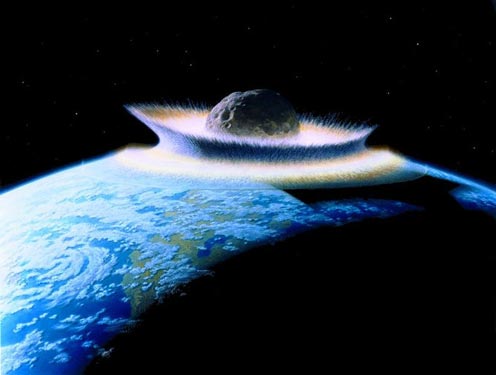
Cataclysmic impact event.

Cataclysmic impact event.

Picture credit: Don Davis (commissioned by NASA)

Dinosaur Extinction

Similar studies into the extinction event that took place approximately 66 million years ago have been carried out before, however, this new research, published in the latest edition of the academic journal “Biological Reviews” and led by the University of Edinburgh, focused on examining an updated catalogue of North American dinosaur fossils, in a bid to understand how well the Order Dinosauria was doing in terms of species diversity at around the time of the impact event.

Previous studies, examining the number of different dinosaur species and genera preserved in Upper Cretaceous strata such as the Hell Creek Formation of the western United States, have showed that the number of different types of dinosaur fossils found declines in rocks that mark the time period towards the end of the Cretaceous.  A lack of diversity in an ecosystem, or the dominance of one particular type of creature, can make such ecosystems vulnerable to sudden and dramatic changes that ultimately lead to an extinction.

An International Research Team

The research team, drawn from a number of universities and museums, conclude that prior to the impact event, our planet was experiencing dramatic environmental upheaval.  Changing sea levels, fluctuating global temperatures and enormous amounts of volcanic activity were all happening.  Many groups of animals and plants were under stress and the devastating impact from a six-mile-wide space rock provided the final “coup de grâce” that finished off the dinosaurs.

Soon to Become Extinct
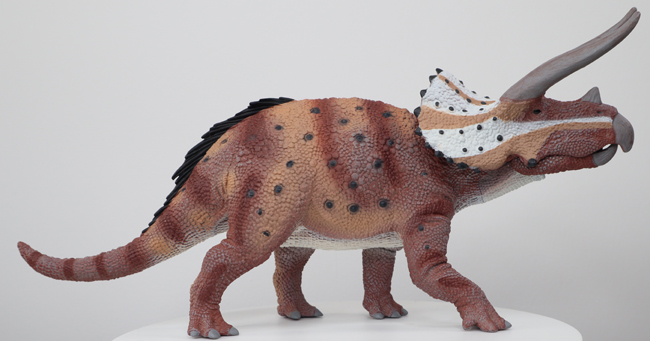
CollectA Triceratops horridus 1:40 scale dinosaur model.

The CollectA Triceratops in right lateral view. Picture credit: Everything Dinosaur.

Picture credit: Everything Dinosaur

The picture (above) shows a CollectA Deluxe Triceratops.  To view the CollectA scale model series: CollectA Deluxe Prehistoric Life Scale Models.

The research team which includes scientists from Edinburgh University, Birmingham University, Imperial College (London), Oxford University, University College (London) and Baylor University (Waco, Texas) suggest that the dinosaurs’ food chain was threatened by a lack of diversity amongst large herbivorous dinosaurs.  The lack of diversity, much of North America was dominated by a handful of plant-eating types of ornithischian dinosaur, created a “perfect storm” and the vulnerable Dinosauria was unable to recover from the extraterrestrial strike and its aftermath.

Everything Dinosaur team members have provided a number of teaching resources to schools that help to explain extinction events.  To read an article specially prepared for use in schools at Key Stage 2 and 3 about the Cretaceous mass extinction event: Dinosaur Extinction Event – Providing Teaching Resources for Schools.

A Stimulus to Evolution

Environmental change, even dramatic global events such as an asteroid impact can in fact provide a stimulus to evolution.  Earlier extra-terrestrial impacts which at first caused devastation may actually have acted as catalysts helping certain types of life to flourish.

It can be argued that once the dinosaurs became extinct, the Mammalia were able to rapidly diversify and exploit the niches left vacant by the demise of the Dinosauria, back in 2010, Everything Dinosaur reported on a scientific paper that suggested that earlier cataclysmic events and significantly benefited life on Earth.

To read this article: Extra-terrestrial Impact Led to Palaeozoic Explosion of Life.

Dr Steve Brusatte (School of GeoSciences at Edinburgh University) commented:

“Five million years earlier dinosaur ecosystems were much stronger, they were more diverse, the base of the food chain was more robust and it was harder to knock out a lot of species.  If they had a few million years more to recover their diversity they would have had a better chance of surviving the asteroid impact.  Dinosaurs had been around for 160 million years, they had plenty of dips and troughs in their diversity but they always recovered.”

A number of mass extinction events have been identified in the fossil record.  Such mass extinctions ultimately led to a change in direction for life on Earth, permitting new types of organism to evolve.

A Table Showing the Major Extinction Events of the Phanerozoic Eon

Mass Extinction in Summary

Table credit: Everything Dinosaur

The research team hope to extend their study by taking into account vertebrate fossil data from Upper Cretaceous sediments that have been examined in China and Spain.  This will help the scientists to formulate a global picture.  Naturally, with such academic papers, there is always speculation as to whether or not the dinosaurs would have survived until the present day.  Some speculators go further and ask the question would the dinosaurs have evolved greater intelligence, perhaps evolving into the reptilian equivalents of primates and eventually into a form of humanoid dinosaur – a dinosauroid?

Could the Earth Have Been Dominated by “Intelligent Dinosaurs”?

What intelligent life on Earth might have looked like if the dinosaurs had not become extinct.

What intelligent life on Earth might have looked like if the dinosaurs had not become extinct.

Picture credit: Boxtree

Dr Brusatte speculates that the Dinosauria could well have survived and that non-avian dinosaurs could make up a significant proportion of the fauna today, whilst other scientists, including a number who worked on this study remain less sure.

For example, Dr Richard Butler (Birmingham University) stated:

“We can’t re-run the tape of life and see whether an impact at a different time would have led to total extinction.  But it [extra-terrestrial impact event] did come at a particularly bad time.”
28 07, 2014

Helpful Information About the Dinosaur Extinction – Unlucky Dinosaurs

By |2024-05-02T12:18:30+01:00July 28th, 2014|Categories: Key Stage 3/4|Comments Off on Helpful Information About the Dinosaur Extinction – Unlucky Dinosaurs

Cretaceous/Palaeogene Extinction Event – Unlucky Dinosaurs

A new research paper, published this week suggests that the mass extinction event at the end of the Cretaceous could have turned out very differently.  Analysis of vertebrate fossils from Upper Cretaceous sediments in North America suggests that if the comet/asteroid impact had occurred a few million years before or after it actually happened, our planet could look very different today.

The largely Anglo-American research team propose that dinosaurs could have survived into the Cenozoic, perhaps to the present day.  If these reptiles had survived the Cretaceous mass extinction event it would have had significant implications for the evolution of mammals including the primates and ultimately our own species – Homo sapiens.

New Study Suggests Unlucky Dinosaurs

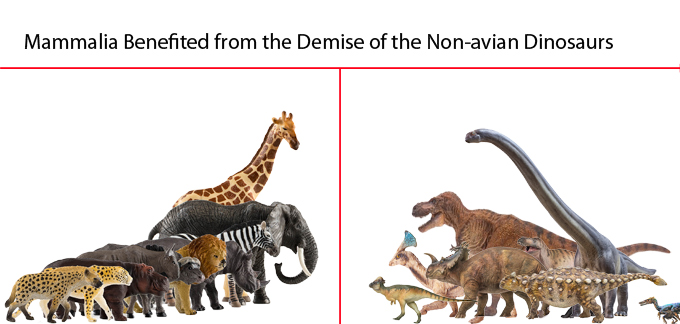
Mammals benefited from the extinction of the non-avian dinosaurs.

The extinction of the non-avian dinosaurs permitted the Mammalia to diversify and become the dominate terrestrial fauna. Picture credit: Everything Dinosaur.

Picture credit: Everything Dinosaur

Dinosaur Extinction

A large number of studies have been carried out before, but this new paper published in the academic journal “Biological Reviews” examined the number of dinosaur genera recorded as fossils in Upper Cretaceous strata.  The researchers wanted to estimate how well the Order Dinosauria was doing in terms of species diversity at the time of the impact event.  A lack of diversity within an ecosystem, or the dominance of one particular animal group can make such ecosystems vulnerable to extinction if the environment changes suddenly.

The research team, drawn from a number of American and British universities, concluded that prior to the extra-terrestrial impact, planet Earth was going through a period of dramatic climate change.  Sea levels were changing, global temperatures altering and there was enormous amounts of volcanic activity.  The space rock collision provided the final “coup de grâce” that led to the demise of the dinosaurs, pterosaurs and marine reptiles.

A Perfect Storm?

To read a more detailed article about this new research: Dinosaur Extinction – A Perfect Storm.

Extension Ideas and Activities

  • Look up recent reports and new stories about impact events or potential near misses, can the class identify where these objects are coming from?  Why are there such objects within our solar system?
  • Examine the moon and compare/contrast this to craters found on the Earth today, are there similarities?  Why do those craters on the moon persist?  What about other planets, have they suffered from extra-terrestrial impact events?  What evidence is there for such events?
  • More capable learners can be challenged to find out about the Chicxulub impact and the evidence for the impact theory in regards to dinosaur extinction
  • If the Earth is vulnerable to such impacts, what steps could be taken?  What are the moral dimensions?
  • Consider what life on Earth might have been like if the dinosaurs had not become extinct – what implications for our own species?  Intelligent dinosaurs?

To view the wide range of prehistoric animal and dinosaur themed toys and games available from Everything Dinosaur: Dinosaur Toys and Games.

25 07, 2014

Were all the Dinosaurs Feathered? A Great Question!

By |2024-05-02T12:19:33+01:00July 25th, 2014|Categories: General Teaching, Key Stage 3/4|Comments Off on Were all the Dinosaurs Feathered? A Great Question!

Fossil Discovery in Siberia Challenges Palaeontologists

Scientists have announced the discovery of a new species of dinosaur in Siberia, a one-metre long Jurassic dinosaur that had feathers as well as scales.  The dinosaur has been named Kulindadromeus (K. zabaikalicus), the genus name is pronounced, Cul-lin-dah-dro-me us, the species or trivial name is pronounced zah-bay-cal-lik-us.  This little dinosaur, most probably a biped, has been named after the Kulinda valley in Siberia and the Greek word “dromeus”, which means runner.  The trivial (species) name honours the Zabaikal krai region of Siberia in which the Kulinda valley is located.

Kulindadromeus Dinosaur

An Illustration of the New Feathered Dinosaur

Kulindadromeus Illustrated

Feathered dinosaur down amongst the horsetails.

Picture credit: Andrey Atuchin

Feathered Dinosaurs

Feathered dinosaurs have been discovered before, but until now most of the feathered dinosaur discoveries related to a specific group of saurischian dinosaurs, (lizard-hipped), known as the theropods.  Kulindadromeus is relatively basal to a group of bird-hipped dinosaurs known as the ornithischians.  This discovery suggests that feathers in dinosaurs evolved relatively early in their history and that many different members of the Dinosauria were probably covered in feathers.

To read more about this fossil discovery: Did all the Dinosaurs have Feathers?

Extension Ideas and Activities

Key Stage 2

  • Look up articles on feathered dinosaurs, from which parts of the world have these fossil discoveries come from?
  • What evidence have scientists found in fossils to suggest that some dinosaurs were feathered?
  • What reasons can the class come up with for the evolution of feathers in dinosaurs?

Key Stage 3/4

  • Just two years after Darwin’s “Origin of Species” was published a virtually complete fossil of the “First Bird” Archaeopteryx was found in Germany.  How did this fossil discovery support Darwin’s theory of natural selection?
  • Look up pictures of Archaeopteryx and fossils of this Late Jurassic creature, what similarities to modern birds can be seen, what are the differences?
  • Why might this fossil be described as “transitional”?
  • Why are there few examples of transitional fossils preserved in the fossil record?  Can the theory of natural selection explain this?

For models of feathered dinosaurs, mostly theropod dinosaurs take a look at the huge selection of models and figures available at Everything Dinosaur: Everything Dinosaur Models and Figures.

6 07, 2014

A Handy, Beautiful Ammonite Replica

By |2024-05-02T11:47:55+01:00July 6th, 2014|Categories: Key Stage 1/2, Key Stage 3/4|Comments Off on A Handy, Beautiful Ammonite Replica

Wild Safari Dinos Ammonite Replica

When it comes to teaching children about what fossils can and perhaps more importantly can’t tell us, a model of an ammonite comes in very useful.  Ammonites are extinct members of the Mollusca phylum and closely related to extant (living today), cuttlefish.  These invertebrates lived in chambered, coiled shells and it is these shells and their moulds that are frequently found as fossils.  However, it can be difficult for the teacher to get the children to relate a fossil of a shell to the living, breathing animal.

Ammonite Replica

Wild Safari Dinos Ammonite Model

A model of an Ammonite.

A great ammonite model for use in schools, museums and for model collectors. Picture credit: Everything Dinosaur.

Picture credit: Everything Dinosaur

What did Ammonites Actually Look Like?

This difficulty can be overcome by showing the students a model of an ammonite.  Although the shells of these cephalopods are common fossils particularly in Jurassic aged strata, very few preserved soft parts of prehistoric cephalopods have been preserved.  Palaeontologists believe that all ammonites lived in the outer whorl of their shells, this is referred to as the body chamber.  As the ammonite got bigger it extended its tubular shell and moved its body outwards, laying down new chamber walls behind it.  The earlier-formed chambers contained a mixture of water and gas which helped these marine creatures adjust their buoyancy.

“Head Foot”

The term cephalopod means “head foot”, a simple description of the body plan.  A series of ten arms surrounded the mouth, two of these appendages were specialised and capable of  grabbing and seizing prey.  The other arms would have helped manipulate food items and pull them closer to the mouth.  As these creatures are closely related to extant cephalopods they probably had complex eyes.  The ammonite moved through the water by shooting jets of water out of a siphon (called the hypernome) which was positioned under the body.

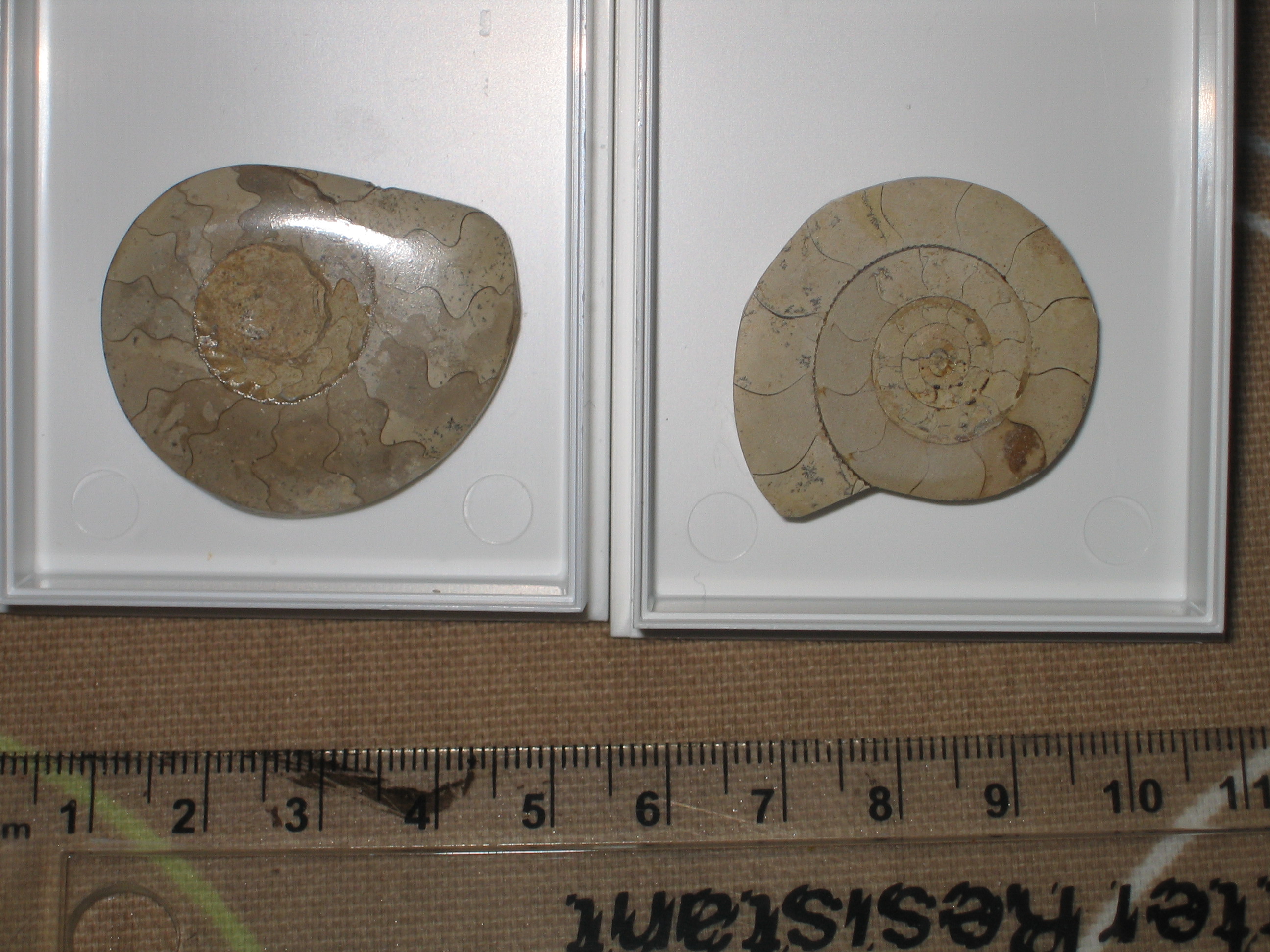
Fossil Ammonites (Somerset, western England)

Polished ammonite fossils.

Have a go a lapidary this Summer?  Examples of polished ammonite fossils. Picture credit: Everything Dinosaur.

Picture credit: Everything Dinosaur

The picture shows a cross section of an internal mould of an ammonite, the internal structure and the sutures (edges of the chamber wall) can be clearly seen.

There are very few ammonite replicas available, however, the fossil experts at Everything Dinosaur have a number of excellent, anatomically accurate replicas available.

To view a range of prehistoric animal models including an ammonite replica: Prehistoric Animal Replicas.

The model can be used to help explain how ammonites lived and how the shells are preserved as fossils but only very rarely are the soft parts preserved.

Helping Teachers with Extension Ideas

Extension Ideas

Key Stage 2

  • Get the children to examine small ammonite fossils and compare them to the replica, what clues about the life style of the ammonite can be deduced?
  • What do you think ammonites ate?  Where would they fit into a food chain?
  • Why did ammonites die out yet close relatives like cuttlefish and the nautilus survive?  Can you encourage some independent research?

Key Stage 3

  • Compare the ammonite model to pictures of extant cephalopods, what are the similarities, what are the differences?
  • What theories can be proposed as to why the ammonites became extinct?
  • Have the students find many different types of ammonite fossil pictures, look at the shells, why did so many different shell types evolve?  What does this say about the lifestyle, environment of individual species?

6 07, 2014

What Kind of Prehistoric Animal was Urvogel?

By |2023-03-14T08:49:54+00:00July 6th, 2014|Categories: Dinosaur Fans, Geology, Teaching|0 Comments

Explaining about Archaeopteryx

Earlier this week, Everything Dinosaur was emailed by a young dinosaur fan who asked about a prehistoric animal named Urvogel.  She had come across it whilst learning about the famous fossil site of Solnhofen in southern Germany.  The word “Urvogel” is German and it means “first bird”, it refers to Archaeopteryx (A. lithographica), the fossils of which are synonymous with the finely grained limestone beds of the Solnhofen quarries.

Urvogel

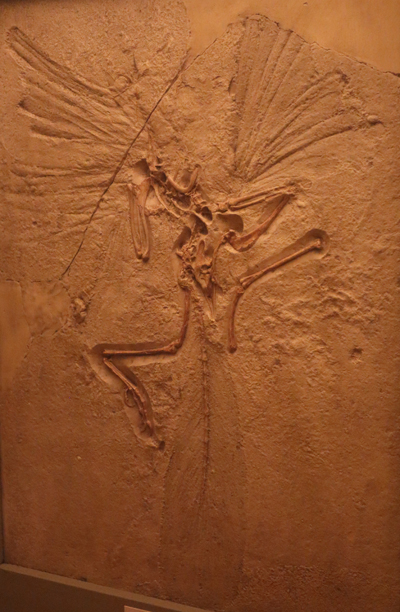
A Cast of a Fossil Specimen of the  Ancient “Dino-Bird” Archaeopteryx

Archaeopteryx fossil cast

Archaeopteryx fossil cast. Picture credit: Everything Dinosaur.

Picture credit: Everything Dinosaur

Studying Archaeopteryx

Palaeontologists now know that this creature, fossils of which show a transitional form between theropod dinosaurs and birds, was probably not the first bird to evolve.  However, when a spectacular fossil discovery was announced in 1861, Archaeopteryx became the first feathered fossil of its kind to be formerly studied and its fossils caused a sensation, as only two years before Charles Darwin had published “The Origin of Species” that outlined the case for evolution and natural selection.

The Solnhofen limestone deposits are finely grained and they outcrop in an east to west belt north of Munich and south of Nuremberg.  Hundreds of fossils of invertebrates have been found and the vertebrate fauna preserved includes over fifty types of fossil fish, around thirty reptiles (pterosaurs, marine reptiles, dinosaurs and crocodiles).  The Solnhofen deposits are regarded as a Lagerstätte.  This is a German phrase from the words Lager (which means storage) and Stätte (which means place).  It refers to a deposit of sedimentary strata that contains a lot of fossil material that is exceptionally well preserved.

During the Late Jurassic, shallow tropical lagoons and small islands stretched all the way from Portugal in the south through France and into southern Germany.  Coral reefs formed in the tropical seas and these reefs split the coastline up forming a series of isolated lagoons.  These lagoons were cut off from the sea and also from terrestrial run off.

The salinity levels rose in the lagoons and the water may have become oxygen deficient.  This made the mud on the bottom of these lagoons almost devoid of life so any animal or plant remains that drifted into the lagoon was not consumed by scavengers.  The almost stagnant waters had little current so the remains of corpses were not broken up.  Organisms buried by the soft, carbonate muds and formed as fossils in the finely grained sediment therefore have exceptional details preserved and many of these body fossils are almost complete.

PNSO offers a wide range of prehistoric animal models including a replica of Urvogel (Archaeopteryx).  To view the PNSO model range: PNSO Age of Dinosaurs Models.

5 07, 2014

New Wild Safari Dinosaurs Ammonite Model Reviewed

By |2024-05-02T11:52:09+01:00July 5th, 2014|Categories: Dinosaur Fans, Educational Activities, Everything Dinosaur Products, Photos of Everything Dinosaur Products, Product Reviews, Teaching|0 Comments

A Review of the Wild Safari Dinosaurs Ammonite Model

The design team at Safari Ltd have produced a number of prehistoric animal replicas over the years, broadening the scope of their Wild Safari Dinosaurs range to include other extinct creatures and not just dinosaurs.  In 2014, a model of an ammonite was introduced to the delight of teachers, fossil hunters and model collectors alike.

Wild Safari Dinosaurs Ammonite

The Ammonite Model (Wild Safari Dinosaurs)

Large eyes, deeply ribbed shell perhaps a model of a Pavlovia spp?

Large eyes, deeply ribbed shell perhaps a model of a Pavlovia spp?

Studying Cephalopods

Ammonites are an extinct group of cephalopods, that belong to the extremely diverse Mollusca phylum.  Ammonite fossils, because of their abundance and variety, are very important to geologists and palaeontologists.  Along with two other types of Mollusc, the bivalves and the gastropods, (for example snails), ammonite fossils help scientists to date geological strata relative to other rock formations.

Closely related to living cephalopods such as squid, the nautilus and cuttlefish, ammonites lived in chambered shells.  In most species the shells were coiled round and the animal lived in the last section of the outer whorl of the coil, in what is referred to as the body chamber.  The shells made of aragonite, a form of calcium carbonate, are extremely numerous in the fossil record, although the soft parts, the ammonite’s actual  body tissues are virtually unknown.

Describing an Ammonite

It is believed that ammonites had eight, grasping arms and  two much larger tentacles.  These two tentacles had many suckers on the end which helped these animals grab prey.  It is likely that because of the variety and diversity of ammonite species, that these creatures occupied a number of niches in marine food webs.  For example, large actively swimming species could have hunted fish, crustaceans or jellyfish, others may have been scavengers, many smaller species probably fed on plankton.

The Ammonite Model from Safari Ltd

A great Ammonite model for use in schools, museums and for model collectors.

A great ammonite model for use in schools, museums and for model collectors. Picture credit: Everything Dinosaur.

Picture credit: Everything Dinosaur

The Safari Ltd replica is beautifully painted, the coiled shell being a metallic bronze colour, the body chamber battleship grey with the animal itself painted in subtle oranges and pinks.  Note the large eye, like modern cephalopods such as squid and cuttlefish, ammonites very probably had excellent eyesight.  They were probably visual hunters, their large eyes giving them excellent peripheral vision to help them avoid predators.

When viewed from the front, a good view of the muscular arms can be obtained.  The two specialised tentacles are painted a lighter colour and can be seen projecting downwards.  The ends, of these two tentacles have been provided with a number of round suckers by the design team at Safari Ltd, these represent the soft, fleshy pad called the dactylus, the apparatus with which the ammonite could grasp and secure prey.

A View from the Front (Anterior View) of the Ammonite Model

Eight arms and two grasping tentacles.

Eight arms and two grasping tentacles. Picture credit: Everything Dinosaur.

Picture credit: Everything Dinosaur

Projecting out from underneath is the hypernome, a narrow, muscular tube that squirted water, providing the ammonite with a form of jet propulsion.

Describing the Shell

The shell has very prominent ribs which are raised in the last whorl of the shell to form two rows of parallel spines.  Such ornamentation would have helped protect the ammonite from attack, perhaps deterring a marine reptile such as a mosasaur from taking a bite.  Whilst these spines would have assisted with the animal’s defence, they do not help much with streamlining.  It may be difficult to identify the precise species that the sculptors at Safari Ltd have based their model on, but due to the shape of the shell, those large ribs and projecting points, the model probably represents quite a slow swimming species.

The Wild Safari Dinosaurs Ammonite Model

A super model of an Ammonite.

A super model of an ammonite. Picture credit: Everything Dinosaur.

Picture credit: Everything Dinosaur

This ammonite measures a fraction under eleven centimetres in length and the shell has a diameter of six and a half centimetres.  It is not possible to put a scale on this figure, most ammonite species were small, with shells only a few centimetres across, although the fossil record has preserved the remains of some giant forms with shells in excess of two metres in diameter.

To view the range of Safari Ltd models: Safari Ltd. Prehistoric Animal Models.

It is great to see a replica of an ammonite added to the Wild Safari Dinos model range.  It is ideal for use in schools as an inexpensive teaching aid when exploring fossils and in addition it can be added to the display cases of ammonite fossil material to give viewers an appreciation of what the animal actually may have looked like.

This is an exciting addition to the Wild Safari Dinosaurs model range made by Safari Ltd and it means that Everything Dinosaur now has an ammonite replica to supply to model collectors and fans of prehistoric animals.  We even supply a fact sheet all about ammonites and this will be sent out with model sales.

24 06, 2014

Site in Denmark Awarded UNESCO World Heritage Status

By |2023-03-13T20:16:05+00:00June 24th, 2014|Categories: General Teaching, Key Stage 1/2, Key Stage 3/4|Comments Off on Site in Denmark Awarded UNESCO World Heritage Status

Stevns Klint K/T Boundary Site Awarded UNESCO World Heritage Status

The members of the UNESCO World Heritage Committee have awarded World Heritage status to the nine-mile-long cliffs at Stevns Klint (Danish island of Sjaelland).  These awards reflect the cultural or national heritage of such locations and do much to help preserve such sites.  The chalk and limestone cliffs at Stevns Klint record the K-T boundary, the time in Earth’s history when the dinosaurs and about seventy percent of all terrestrial life on Earth became extinct.

Stevns Klint Cliffs

This site has huge significance to palaeontologists and geologists, as the cliffs have preserved an exceptional fossil record showing a complete succession of fauna and micro-fauna that maps the Cretaceous extinction event and charts the recovery of life on our planet.

Tertiary aged limestone strata overlies much softer, older Cretaceous chalk deposits and clearly visible to the naked eye, is an ash layer which contains substantial amounts of the rare Earth element iridium.  The ash layer is believed to represent deposits from the Chicxulub impact event which took place in the vicinity of the Yucatan peninsula (Mexico) around sixty-six million years ago.

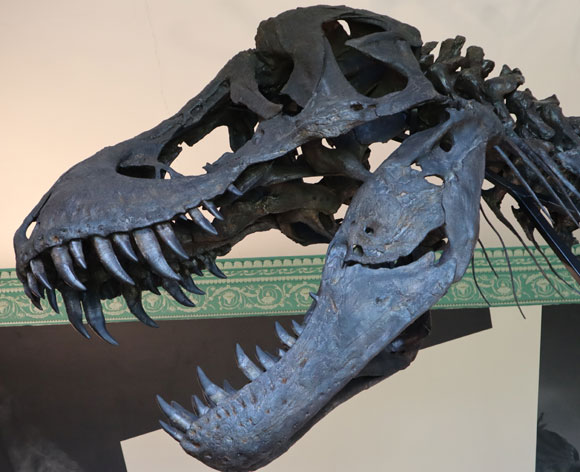
Titus the T. rex Skull and Jaws

The non-avian dinosaurs went extinct around 66 million years ago.

Picture credit: Everything Dinosaur

Congratulations to All Involved

We at Everything Dinosaur, congratulate all those people who have been involved in this award, the cliffs at Stevns Klint now join other world famous locations such as Dorset’s “Jurassic Coast” and the Great Barrier Reef of Australia as UNESCO World Heritage sites.

Visit Everything Dinosaur’s website to view dinosaur toys, models and prehistoric plush: Everything Dinosaur.

Extension Ideas

Key Stage 2

  • Explore ideas of how and why rock can be deposited in layers, more capable learners can explore what the terms igneous, sedimentary and metamorphic rocks mean
  • What does the ash layer represent?  Why is this series of sedimentary rocks important in terms of helping to explain the extinction of the dinosaurs?

Key Stage 3

  • Look up information on the fossil assemblage that is present at this site, why is this sequence of fossils important?  What does it tell us about recovery after an extinction event?
  • Discuss with the class the links that such sites have with the theory of natural selection/evolution.  Changing climates and other impact events can lead to some organisms gaining an advantage.

Useful link that explores the Stevns Klint strata in more detail: Important Geological Site Awarded World Heritage Status.

24 06, 2014

Famous K/T Boundary gets UNESCO World Heritage Status

By |2023-03-13T20:13:49+00:00June 24th, 2014|Categories: Educational Activities, Geology, Main Page, Teaching|0 Comments

Stevns Klint Awarded UNESCO World Heritage Status

The World Heritage Committee, meeting in Doha (Qatar) have granted World Heritage status to a number of new sites and locations.  These awards are given to reflect the cultural or natural heritage that such sites and locations represent.  They are important to humanity and therefore it is imperative that their value is acknowledged.

Stevns Klint

One such site is the nine-mile-long cliffs at Stevns Klint, on the Danish island of Sjaelland.  These fossil rich cliffs record the K/T boundary, (Cretaceous – Tertiary).  As a result, this site is extremely important to palaeontologists and geologists.  The cliffs have preserved an exceptional fossil record showing a complete succession of fauna and micro-fauna that charts the extinction event and the subsequent recovery of life on Earth.

An exceptional fossil record is visible at the site, showing the complete succession of fauna and micro-fauna charting the recovery after the mass extinction.  Tertiary aged limestone deposits overlie much softer, older Cretaceous chalk deposits.  Sandwiched between the two distinct rock types is a thin, ash grey coloured band with high levels of the rare Earth element iridium.  This is the ash layer that is associated with the Chicxulub impact event that occurred approximately 66 million years ago.  It marked the end of the dinosaurs and the extinction of something like 50% of all life.

Cretaceous and Tertiary Marine Fossils

This part of the Danish coast is a popular tourist destination.  It lies twenty-five miles south of Copenhagen on the east coast of Sjaelland and many types of Cretaceous and Tertiary marine fossils can be seen at the local museum.  This site is one of three known in the world that exhibit the iridium anomaly.  This anomaly helped form the basis of the extraterrestrial impact theory proposed by Walter and Louis Alvarez in 1980.

The exposed succession is around forty-five metres thick.  It shows the stratigraphic evolution from Maastrichtian (Upper Cretaceous) across the K/T boundary into the very early Tertiary (Danian faunal stage of the Palaeogene).  A huge amount of research has been undertaken in this area.  Studies into the micro-fauna, palaeontology, geochemical changes, sediment deposition and sea level changes are just some of the research that has taken place recently.  The Stevns Klint locality is defined as the type location for the classification of the Danian faunal stage. It joins such famous fossil locations as the Jurassic Coast of East Devon and Dorset and the Messel Quarry near Frankfurt (Germany) as a UNESCO World Heritage site.

Our congratulations to everyone involved in nominating this wonderful location.

Visit Everything Dinosaur’s award-winning website: Visit Everything Dinosaur.

20 06, 2014

Beautiful Soft Toy Dinosaurs Help Foundation Stage Children

By |2024-05-02T06:13:08+01:00June 20th, 2014|Categories: Educational Activities, Main Page, Teaching|0 Comments

Learning  Skills with Dinosaurs – Achievosaurs

Team members at Everything Dinosaur, with their teaching and educational backgrounds have helped teachers and teaching assistants to develop all sorts of innovative learning materials for use in schools at the Early Years Foundation Stage (EYFS).  For example, a large number of schools rely on Everything Dinosaur to supply the soft toys used in the Achievosaurs learning concept.  However, as manufacturers change product lines so some of the soft toys used in the original scheme of work are no longer available.  Not to worry, as Everything Dinosaur specialises in dinosaur toys, the company has a huge range of inexpensive, soft toy dinosaurs to help teachers in the classroom.

Dinosaur Soft Toys

Some of the Original Prehistoric Animal Soft Toys Used in the Achievosaurs Teaching Concept

Some of the original "Achievosaurs".

Some of the original “Achievosaurs”. Picture credit: Everything Dinosaur

Picture credit: Everything Dinosaur

“The Achieveosaurs”

Children in Foundation Stage or Early Years education can gain important life lessons by being introduced to key learning skills at a young age.  Many schools include a drive to develop learning skills with students as part of a co-ordinated plan to improve life-long learning.  Essentially, the Achievosaurs, or as they are sometimes called “the Achieveosaurs”, with the extra “e”, aims to teach children about positive ways in which they can improve their ability to learn.

Qualities such as being persistent and not giving up too easily, being prepared to ask questions and to share thoughts and ideas.  The children are rewarded by being able to look after a dinosaur soft toy which epitomises the learning skill that they have just demonstrated.

Many schools adopt the Achievosaurs concept across all their classes in EYFS through to Key Stage 1, it often ties in with a term topic covered by the children in Year 1 and 2 which enables them to study dinosaurs and fossils.

Some of the key learning skills covered by the dinosaur soft toys in the Achievosaurs teaching concept:

  • ASKARAPTOR – I can use my imagination and ask interesting questions (based on a “raptor” dinosaur such as Velociraptor or Utahraptor regarded as some of the more intelligent and agile of all the dinosaurs)
  • SOLVEOSAURUS REX – I can solve problems and improve (based on T. rex the most famous dinosaur of all)
  • TRYCERATOPS – I try new things, don’t give up and work really hard (based on Triceratops, a very well-known horned dinosaur with three horns)
  • STICKASAURUS  – I stick at tasks and persevere (based on Stegosaurus a popular, plant eating dinosaur with plates on its back)
  • THINKODOCUS – I think carefully about what I learn (based on the big, plant-eating dinosaur called Diplodocus)
  • SHAREOSAURUS – I share my ideas and can work well with others (based on the Spinosaurus)

These important skills can help prepare young minds for learning later on in life.  Teaching teams can come up with their on variants and new additions, however, the trouble is, finding soft toys that represent the likes of Diplodocus, Spinosaurus and Tyrannosaurus rex.  This is where our experts at Everything Dinosaur can help, they not only can advise about educational matters but guide teachers through our extensive range of prehistoric animal soft toys.

To view the range of prehistoric animal soft toys: Prehistoric Plush and Dinosaurs.

In addition, when Everything Dinosaur supplies prehistoric animal soft toys, a fact sheet on the particular dinosaur represented by the plush is included.

A Download is Available from Everything Dinosaur on the Achievosaurs

Helping to encourage learning skills.

Helping to encourage learning skills. Picture credit: Everything Dinosaur.

Picture credit: Everything Dinosaur

With the advice and support of Everything Dinosaur’s trained specialists, teachers can utilise a child’s fascination with prehistoric animals to help reinforce important lessons.  Enthusing and motivating children to learn by utilising dinosaur soft toys in school.

A spokes person for Everything Dinosaur commented:

“With all the workshops and teaching activities that we deliver in schools, it was only natural that teachers and learning support providers came to us to help develop innovative ways of getting important messages about learning across to children.”

To learn more about Everything Dinosaur’s extensive product range visit: Everything Dinosaur.

11 06, 2014

Helpful Teaching About Extinction Events at Key Stages 3 and 4

By |2024-04-12T09:03:24+01:00June 11th, 2014|Categories: Key Stage 3/4|Comments Off on Helpful Teaching About Extinction Events at Key Stages 3 and 4

Developing Thinking Skills – Challenging Current Theories

With the roll out of the new curriculum in England now only a few weeks away, it is an opportune time to reflect on how aspects of scientific enquiry will be taught at Key Stages Three and Four.  There is a greater emphasis on the individual science subject areas underpinned by the concept of applying scientific thinking and by “working scientifically”.

Teaching About Extinction

The fossil and dinosaur themed workshops conducted by team members at Everything Dinosaur already apply these principles, they demonstrate the links between observation, investigation and experimentation.  Team members are in the process of developing a range of new lesson plans, aimed at students in Year 7 and above.

Developing Creative Thinking to Challenge Established Ideas

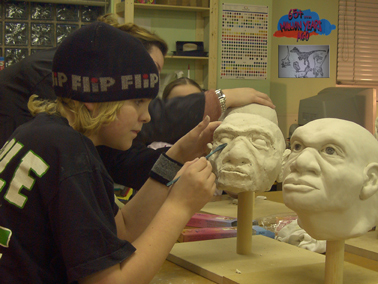
Key Stage 3 model building

Looking at the evolution of Homo sapiens with Key Stage 3.

With subject areas such as genetics, evolution and natural selection now covered at the Key Stage Three level, it is important that teaching is directed towards encouraging the development of higher order thinking skills.

Students will be asked to build on acquired knowledge from previous studies and to make connections between science subjects.  For example, learning about Darwin’s theory of natural selection as outlined in his ground-breaking book, “The Origin of Species”, then applying this knowledge to other curriculum topics such as climate change, extinction and the interrelationships between living things.

The new curriculum in England is described as “rigorous”, it will challenge both students and teaching professionals.

To receive more information about Everything Dinosaur’s product range: Everything Dinosaur.

Higher order thinking skills can be seen as a hierarchy, with a taxonomic structure from simply knowing about something to moving through several cognitive phases where by the student develops greater understanding and can apply similar concepts in other related areas of study.

Teaching professionals should encourage students to analysis and evaluate ideas.  Ultimately, when combined with a method that embraces scientific working, more able, confident students might be comfortable with challenging theories and established ideas.

Go to Top