All about dinosaurs, fossils and prehistoric animals by Everything Dinosaur team members.

Everything Dinosaur team members working in schools, helping museums and other educational bodies. Our work with and in schools.

2 06, 2015

Britain’s Oldest Sauropod Fossil as Rare Bone Described

By |2024-05-05T14:15:46+01:00June 2nd, 2015|Categories: General Teaching, Key Stage 3/4|Comments Off on Britain’s Oldest Sauropod Fossil as Rare Bone Described

Fossil Discovery Shows Dinosaurs can Still Surprise

A team of palaeontologists from Manchester University in collaboration with an independent researcher have published a scientific paper in an on line academic journal describing a tail bone from a dinosaur found in Yorkshire.  Yorkshire may be a county synonymous with puddings, tea and cricket but the North Yorkshire coast is very important to palaeontologists and geologists.  The strata exposed at Whitby and Ravenscar for example, dates from the Middle Jurassic, it is roughly the same geological age as the famous rock formations to be found on England’s “Jurassic Coast” around the Lyme Regis area.

The fossil bone had eroded out of a cliff close to the Abbey at Whitby, it represents a tail bone (caudal vertebrae) from a long-necked dinosaur, a group of dinosaurs called sauropods.  Diplodocus, Apatosaurus and Brontosaurus are typical examples of this plant-eating dinosaur suborder.

A Close-up View of the Yorkshire Sauropod Fossil Material

Primitive sauropod fossil from North Yorkshire.

The specimen is currently housed at the Yorkshire Museum (York).

Picture credit: PLOS One with additional annotation from Everything Dinosaur

Primitive Sauropod Fossil

The shape of the bone, such as the distinct keel (arrowed) seen on the bottom of the vertebra, has allowed scientists to state that this fossil very probably represents a new species of British dinosaur.  Plant rootlet fossils and remains of freshwater molluscs discovered in the surrounding matrix enabled the research team to locate the horizon within the rock formation where the fossil probably came from.  The fossil is around 176 million years old, making this specimen Britain’s oldest known Sauropod fossil.

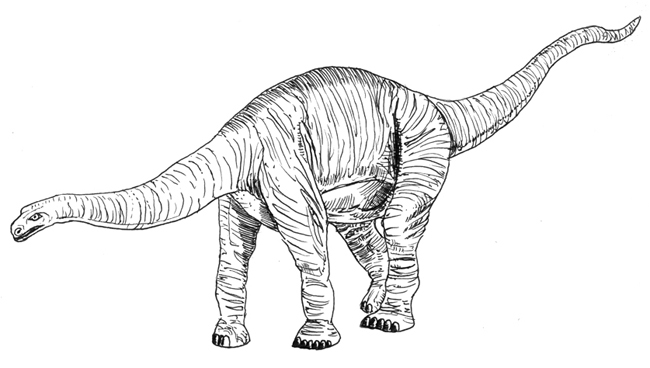
An Illustration of the New Sauropod Dinosaur

Primitive sauropod illustration.

An illustration of a typical sauropod from the Middle Jurassic (Cetiosaurus).

Picture credit: Everything Dinosaur

During the Middle Jurassic, this part of northern England was part of an extensive coastal plain.  This low-lying area was marshy and crossed by large rivers.  The sandstone strata has preserved few fossilised bones and teeth of dinosaurs but a number of fossilised dinosaur footprints have been preserved.  Yorkshire was once the UK’s “Jurassic World” and this fossil, believed to be around 176 million years old represents the oldest long-necked dinosaur fossil described to date from Britain.

To read Everything Dinosaur’s earlier blog about this fossil discovery: Britain’s Oldest Sauropod.

A spokesperson from Everything Dinosaur commented:

“This scientific paper only goes to show that palaeontologists are learning new things all the time about dinosaurs, even ones that once roamed around Britain.”

Papo have introduced various models of sauropods.  To view the Papo range of prehistoric animal models: Papo Dinosaurs and Prehistoric Animal Models.

28 05, 2015

Washington State 37th U.S. State with a Dinosaur?

By |2023-03-30T13:41:07+01:00May 28th, 2015|Categories: Dinosaur Fans, Geology, Main Page, Teaching|8 Comments

 Which States in the USA Don’t Have Dinosaur Fossils?

Everything Dinosaur’s recent article on the describing of a dinosaur fossil bone found on Sucia Island (Washington State) set team members thinking.  The fossil, which is believed to represent the partial left femur of a tyrannosaurid was the first dinosaur bone to be scientifically described from Washington State.  A number of media sites and scientific publications that covered this story listed Washington State as the latest and thirty-seventh U.S. State to have had dinosaur fossils discovered within its boundaries.  Of the fifty States that make up the USA, more than two-thirds of them are associated with the Dinosauria, either body or trace fossils or both.

The Partial Left Femur Identified as Tyrannosaur Fossil

Details of the partial left femur.

Details of the partial left femur.

Picture credit: PLOS One with additional annotation by Everything Dinosaur

Dinosaur Fossils

To read Everything Dinosaur’s article on the fossil discovery: The First Dinosaur Fossil Described from Washington State.

So, what about the remaining thirteen States in America, those inferred not to have dinosaur fossils?  Is this a case of there being none found as yet or does the fossil discovery in Washington State represent, in all likelihood, the last State in the United States to be added to the “dinosaur club”?

Let’s look at this in a little more detail.

Which U.S. States Do Not Contain Dinosaur Fossils?

Identifying the thirteen States* that don’t contain dinosaur fossils is quite a tough ask for a company this side of the Atlantic.  However, team members at Everything Dinosaur have been putting their heads together and have come up with the following list (which may or may not be accurate).

    1. Hawaii – the Hawaiian archipelago was the fiftieth and most recent State to join the USA.  As it is almost entirely made up of volcanic rock (igneous) and since it is a relatively recent geological feature, probably less than six million years old, we can state with confidence that no dinosaur fossil material will be found in the island’s rock formations.  That’s the easiest one out of the way.
    2. Florida – the “Sunshine State” it might attract millions of tourists but there are very probably no dinosaur fossils to be found.  The landmass we know as Florida today did not form in the Mesozoic.
    3. Louisiana – in the north-western portion of the State, there are some small outcrops of marine shales that were deposited in the Late Cretaceous.  As far as we know, no dinosaur fossils have been associated with this strata (located around Bienville Parish).  It is extremely unlikely that dinosaur fossils could be found in Louisiana, but it could happen.
    4. Mississippi** – the Mississippi river and delta deposits are far to recent to provide the opportunity to find dinosaur fossils.  However, in the far north-east of the State there are small exposed areas of Upper Cretaceous aged marine deposits, predominately chalk.  As far as we know no dinosaur fossils have been found and it is extremely unlikely, however, if you were to go and look, try around Ponotoc and Union Counties – we wish you luck.  South-east USA sorted (we think).
    5. West Virginia – moving up the eastern seaboard of the United States, the next candidate is West Virginia.  As far as we know at Everything Dinosaur, there are no sedimentary rocks dating from the Mesozoic to be found in this State, erosion and other forces have removed them, therefore no dinosaur fossils.
    6. Rhode Island – the smallest State in the USA.  Triassic and Jurassic sedimentary deposits are absent (we think), very few Cretaceous outcrops present, so no dinosaur fossils.
    7. New Hampshire – erosion of sedimentary materials and intrusions of igneous and metamorphic rocks leaves virtually no Mesozoic aged sedimentary formations in the State.  We don’t think any dinosaur fossils have been found here.
    8. Vermont – Triassic and Jurassic aged sediments eroded away and very little Cretaceous-aged deposits exposed.   All of these Cretaceous deposits not fossiliferous, so no dinosaur fossils as far as we know discovered in Vermont.
    9. Maine – in the far north-east of the United States there is a huge gap in the geological record with most Late Palaeozoic, Mesozoic and Cenozoic fossils eroded away (blame the glaciers and so forth).  As a result, once again, as far as we know dinosaur fossils recorded from the State of Maine = zero.  So that’s the eastern seaboard and the far north-east taken care of.
    10. Michigan – still in the Eastern Time Zone, but no dinosaur fossils have been found on either peninsula that make up this State.  Lots of invertebrates et al, but no dinosaurs (we think).
    11. Ohio – thanks to glaciation and other forms or erosion, Mesozoic aged sedimentary rocks are virtually absent.  Dinosaurs did probably roam in this part of the world but their fossils have long since be eroded away.
    12. Indiana – just like its eastern neighbour Ohio, blame the glaciers for the loss of the Mesozoic strata.  So no dinosaur fossils in Indiana either, but just like in Ohio, they did probably live in this neck of the woods.
    13. Kentucky – south of Indiana to the “Bluegrass State”.  As far as we can work out from our own notes, there are few Mesozoic rocks exposed (eroded away no doubt).  Some Cretaceous-aged outcrops are present and we have some tentative notes of plant fossils from the Cretaceous, but alas, no evidence of the Dinosauria.  Hold on a minute, that should be it, but we still have some more States to go.
    14. Illinois – into the Central Time Zone but just like its eastern neighbour Indiana, erosion has led to the removal of much of the Mesozoic strata.  Some Cretaceous-aged deposits can be found in the south of this State, but as far as we know, although dinosaurs may have lived in this part of the world there is no fossil evidence for them.
    15. Wisconsin – substantial erosion has removed the dinosaur fossil bearing strata, so according to our notes and database, there are no dinosaur fossils associated with the State of Wisconsin.

States in America with Dinosaur Fossils (2015)

Dinosaur Fossils by U.S.State.

Dinosaur Fossils by U.S. State.

Picture credit: Wikipedia Commons (map) Everything Dinosaur (annotations)

Everything Dinosaur

According to our research, the figure of thirteen U.S. States not having dinosaur fossils associated with them is inaccurate. Of course, our own database could be wrong but we make it fifteen States without any evidence of the Dinosauria.  Thanks to mountain building, glaciation, the construction of huge urban developments and the fact that parts of the United States simply did not exist during the time of the dinosaurs, these are the States that lack any dinosaur fossils.

We admit, we could have got this wrong and we would welcome any comments to help provide a more accurate picture.

Additional Notes

Thanks to J. Slattery for helping with this, we have received information about Late Cretaceous dinosaur fossils from Mississippi**.  It seems that in some uncovered outcrops of Upper Cretaceous age which represents shallow marine deposits, fragmentary dinosaur fossils (teeth and bones) have been found as a result of what we tend to call “bloat and float”.  A dinosaur carcase being washed out to sea and then being scavenged before sinking and settlement.

Visit Everything Dinosaur’s award-winning website: Visit Everything Dinosaur.

25 05, 2015

My First Toy Dinosaurs Model Set

By |2023-03-30T10:56:49+01:00May 25th, 2015|Categories: Early Years Foundation Reception|Comments Off on My First Toy Dinosaurs Model Set

Set of Six Rubber Dinosaurs

EYFS teachers can introduce dinosaurs to their class with this super set of robust, rubber dinosaurs.  The set consists of six different prehistoric animals and these models range in size from around thirty-two centimetres in length to a whopping forty-two centimetres.  They are great for creative, imaginative play and ideal for little hands.  The six dinosaurs are a plated Stegosaurus, a long-necked Brachiosaurus, a colourful duck-billed dinosaur (Parasaurolophus) and everyone’s favourite horned dinosaur – Triceratops.  In addition, the set includes a large rubber Tyrannosaurus rex and a beautifully bumpy Ankylosaurus.

My First Toy Dinosaurs

The Set of Six Rubber Dinosaurs

My First Toy Dinosaurs.

A set of six rubber dinosaurs, great for tactile play.

Picture credit: Everything Dinosaur

These models really help bring a term topic all about dinosaurs to life and the children can use the replicas to help recreate their very own prehistoric park.  The models are light, tactile and super soft.  They are suitable for children from three years and upwards and are ideal for creative, imaginative play.

To view the range of educational dinosaur themed toys available from Everything Dinosaur: Dinosaur Themed Learning Materials.

The teaching team at Everything Dinosaur have carefully selected this set of six rubber dinosaurs as they are ideal for children at Nursery or at Foundation Stage 2.  A set of six dinosaur fact sheets is supplied with each set so that teachers, learning support providers and home educationalists can use facts and information about these dinosaurs to help support learning.

Teaching Ideas Using the Rubber Dinosaurs

  • The dinosaurs are all soft and ideal for handling by younger children from three years plus.  Use the models to explore how different materials feel, bumpy or smooth?  Hard or soft.  Heavy or light?
  • The set of six rubber dinosaurs can be used to help children learn about different parts of the body.  For example, where is the head?  Where is the tail?  How many horns can you count?  Where is the mouth? Which dinosaurs walk on two legs, which ones walk on four?  Which is the meat-eater?  How do you know?
  • The dinosaurs can help children learn the names of popular prehistoric animals
  • Use the models to help young children create their own “Jurassic Park” or dinosaur zoo, these models can also be used in the sand play area.
  • Roll out some play dough and let the children use the soft, rubber dinosaurs to make patterns.  Can they make a set of footprints?  How many toes can they count?

For further information and support from the teaching team at Everything Dinosaur simply email: Email Everything Dinosaur.

This set of six rubber dinosaurs features Parasaurolophus, Brachiosaurus, T. rex, Ankylosaurus, Stegosaurus and Triceratops.  They are great for imaginative, tactile, creative play with EYFS.  Recommended for use in schools and for educational activities.

25 05, 2015

My First Toy Dinosaurs Model Set

By |2023-03-30T10:54:17+01:00May 25th, 2015|Categories: Dinosaur Fans, Educational Activities, Everything Dinosaur Products, Photos of Everything Dinosaur Products, Press Releases, Product Reviews, Teaching|0 Comments

My First Toy Dinosaurs Model Set (6 Rubber Dinosaurs)

Great for imaginative, creative play, a set of six rubber dinosaurs from Everything Dinosaur.  An ideal gift for the young dinosaur fan in your family or as a play set for use in schools.  The set of six dinosaur models includes a Tyrannosaurus rex, a long-necked Brachiosaurus, the plated dinosaur Stegosaurus, along with a bright and colourful duck-billed dinosaur, a Parasaurolophus.  The set also includes a horned dinosaur (Triceratops), and a wonderful armoured dinosaur, an Ankylosaurus.  This set of soft rubber dinosaurs makes an ideal my first dinosaurs model set as these prehistoric animals are suitable for children from three years and upwards.

My First Toy Dinosaurs Model Set (6 Rubber Dinosaurs)

A set of six rubber dinosaurs, great for tactile play.

A set of six rubber dinosaurs, great for tactile play.

Picture credit: Everything Dinosaur

My First Toy Dinosaurs

The teaching team at Everything Dinosaur have specially chosen this toy dinosaurs set as the models represent typical examples of dinosaurs and show the variety of these ancient reptiles that once roamed our planet.  The models are made from soft rubber and they are great for imaginative, tactile play.

To view the range of educational dinosaur toys including replicas of iconic fossil animals available from Everything Dinosaur: Everything Dinosaur Models, Toys and Games.

This really is a super set of soft and squeezy rubber dinosaurs.  The set makes an ideal, my first dinosaur model set for any young dinosaur fan.  They are a great way for young minds to explore materials and discover the world of dinosaurs.

One of our customers wrote this review:

“Loved the colourful models, six different ones that my little boy just loves.  A great first dinosaur model set.  Soft and squeezy rubber dinosaurs, very well made.”

Thanks for your review Mrs Jacobs.

Everything Dinosaur supplies a set of useful dinosaur fact sheets about the animals featured in this set.  This is a great dinosaur themed resource for schools.

21 05, 2015

May 21st Remembering Famous Mary Anning

By |2024-05-05T13:42:02+01:00May 21st, 2015|Categories: General Teaching, Key Stage 1/2|Comments Off on May 21st Remembering Famous Mary Anning

Mary Anning – Fossil Hunting Pioneer

Today, May 21st, we remember Mary Anning, the Englishwoman who did much to assist in the development of the science of palaeontology in the 19th century.  Mary Anning was born on this day in 1799.  Sadly, during her lifetime, her exploits and contribution to our understanding about fossils and prehistoric life were not recognised to as large an extent as they should have been.  If Mary was alive today, she would find the academic world much more accessible than it was back in Georgian and early Victorian times.

Remembering Mary Anning

Mary helped put the small, Dorset town of Lyme Regis on the scientific map.  The fossils she found and her work in studying the many specimens excavated from the the Lower Jurassic marine shales did much to shape the nascent sciences of geology and palaeontology.  Although Mary became well known as an expert in fossils and fossil hunting, she did not receive full credit for her work.  In those less enlightened days, the concept of women in science was frowned upon by many academic institutions.

Mary is credited with the discovery of the first plesiosaur fossils (1821) and the first pterosaur from the British Isles (1828).  The responsibility for studying and describing this pterosaur specimen went to the Reverend William Buckland (1829), although the fossil was well-preserved, it was missing the skull and as a result , the Reverend Buckland mistakenly identified the creature as belonging to an already described flying reptile genus known from Germany (Pterodactylus).

Remembering Mary Anning – A Pioneer in Fossil Hunting

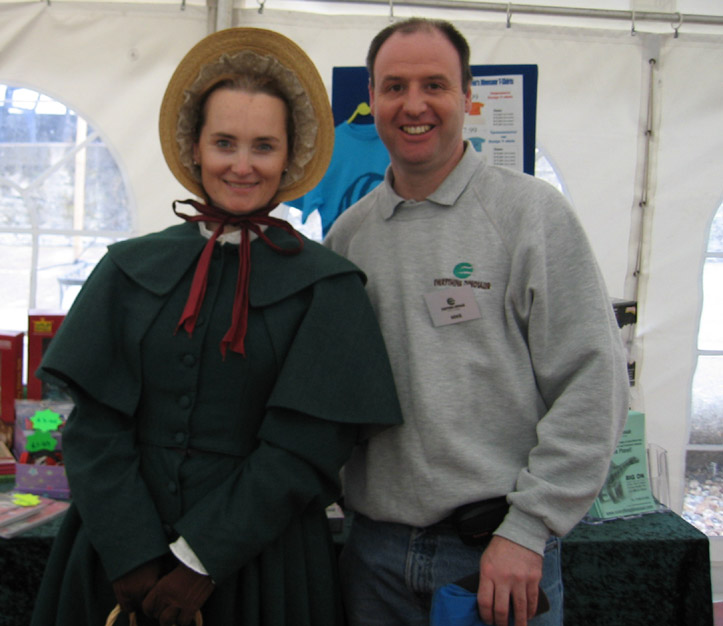
Helping to promote learning in schools.

Helping to promote science for girls by dressing up as Mary Anning.  Team members at Everything Dinosaur help support funding to commemorate the contribution to science made by Mary Anning.

Picture credit: Everything Dinosaur

Pterosaur Fossil

In fact, the fossil represented an entirely new genus of long-tailed pterosaur.  Sir Richard Owen re-examined the original fossil evidence along with a number of other fossil finds and in 1858, over a decade after Mary had sadly passed away, he established the new genus Dimorphodon.  Look out for this toothy pterosaur terrorising visitors to the Isla Nuablar theme park in the forthcoming movie “Jurassic World”.

Everything Dinosaur stocks a wide range of models of iconic fossil animals that represent specimens that Mary Anning would have been familiar with: Dinosaur and Prehistoric Animal Figures.

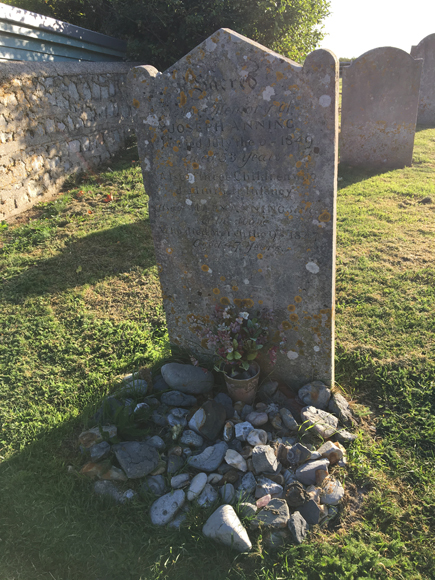
Mary died in 1847, she is buried at St Michael’s church (Lyme Regis), each time team members at Everything Dinosaur visit the Jurassic coast we pop along and pay our respects to her.

Remembering Mary Anning.

The grave of Mary and Joseph Anning at Lyme Regis.

Picture credit: Everything Dinosaur

When visiting primary schools to talk about fossils and rocks we tell the story of Mary Anning and show the children typical fossils that Mary would have found as she searched the beaches and cliffs along that part of the Dorset coast.

Recently, a new species of ichthyosaur was named in honour of Mary Anning: New Ichthyosaur Species Honours Mary Anning.

21 05, 2015

Would a Dinosaur Make a Good Pet?

By |2023-03-30T07:51:43+01:00May 21st, 2015|Categories: Dinosaur Fans, Educational Activities, Teaching|0 Comments

Year 2 at St Joseph’s Catholic Primary School Consider a Pet Dinosaur

Children in Year 2 at St Joseph’s Catholic Primary School (Matlock, Derbyshire), have been tackling the tricky question of would dinosaurs make good pets?  This poser is one of the questions being explored as part of a series of themes for the summer term.  So far the children have learned about dinosaur eggs and taken part in some outdoor measuring activities under the guidance of their enthusiastic teacher Miss Sutcliffe.  It’s a good job the school has a large playground, especially when it comes to working out how tall a Brachiosaurus was.

Everything Dinosaur Visiting Schools

Brachiosaurus was one of the largest of the dinosaurs, a huge plant-eater, fossils of which have been found in Upper Jurassic rocks.  The children estimated that a twelve metre tall Brachiosaurus would be the same height as nineteen Year 2 children.  This is a super exercise and certainly helps children gain an appreciation of the size and scale of some of the biggest dinosaurs.

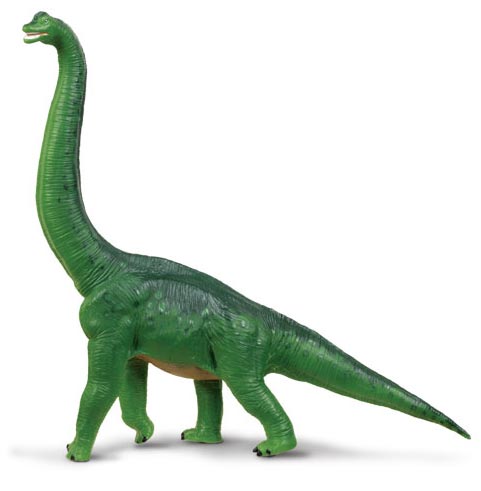
One of the Biggest Dinosaurs of the Late Jurassic

A typical Brachiosaur.

A typical brachiosaur.

Picture credit: Everything Dinosaur

Brachiosaurus

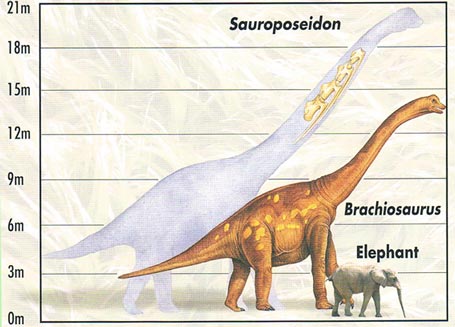
Trouble is, Brachiosaurus (the name means “Arm Lizard” as the forelimbs were larger than the back legs), was not the tallest of the Dinosauria.  As more fossils have been found so different contenders for the “tallest dinosaur “accolade are proposed.  One contender, known from four neck bones and a handful of other fossil specimens found in rocks dating from the Early Cretaceous of the United States, is Sauroposeidon (the name means “Earthquake Lizard”).  Sauroposeidon is pronounced sore-oh-poh-sigh-don.  One of the neck bones measures 1.4 metres long, that is taller than most of the Year 2 children at the school.

Size estimates for Sauroposeidon do vary.  With so few fossils to study, it is difficult to work out just how tall, or indeed just how long or how heavy this dinosaur was.  Palaeontologists are not even sure if Sauroposeidon had the same basic body shape of Brachiosaurus.  However, if it did, then it could have been around 18-20 metres tall.

Sauroposeidon Compared to Brachiosaurus

Scaling up Sauroposeidon and comparing it to Brachiosaurus and an extant African elephant.

Scaling up Sauroposeidon and comparing it to Brachiosaurus and an extant African elephant.

If nineteen Year 2 children are as tall as a twelve metre high Brachiosaurus, then can the class work out how many of them would be needed to be the same height as a twenty metre tall Sauroposeidon?

Everything Dinosaur supplies a range of long-necked prehistoric animal models to schools, home educators and museums.  To view the models and replicas section of the website: Everything Dinosaur Prehistoric Animal Models.

Everything Dinosaur Workshop

Miss Sutcliffe and her teaching assistant have certainly developed a challenging and engaging scheme of work for the class.  The dinosaur workshop we conducted certainly helped as we were able to answer the children’s questions and some of those questions were quite challenging.  For example, we were asked how did dinosaurs chew bones?  Fortunately, some of the fossils we had with us were useful in demonstrating how some types of dinosaur ate.

Everything Dinosaur’s work in schools has received praise.  To read an article about Everything Dinosaur being mentioned by Ofsted: Praised by Ofsted.

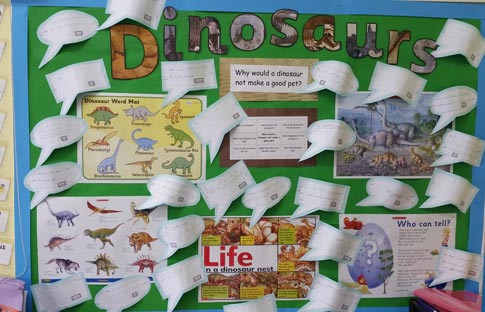
The spacious and well-organised classroom had lots of dinosaur themed displays.  We were informed that after our visit the children would be designing a habitat for their dinosaurs.  This links nicely into the English national curriculum as this enables the children to learn about living creatures and what they need to survive.

Extension Activities

Perhaps the children can compare the world of the dinosaurs with habitats seen today and the types of animals that exist in those habitats.   It was pleasing to note that Year 2 had a good grasp of the terminology related to ecosystems and food chains.  For example, the children were able to explain all about omnivores.  Our cast of the lower jaw of a pachycephalosaur (Dracorex hogwartsia), proved useful when it came to explaining about animals that ate both meat and plants.  Dracorex might make a good pet dinosaur, it would have helped keep the school’s vegetable garden pest free, but a downside might be that it would be tempted to eat all the flowers!

A Colourful Dinosaur Themed Display in the Classroom

St Joseph's Catholic Primary School (Year 2) dinosaur display.

St Joseph’s Catholic Primary School (Year 2) dinosaur display.

Picture credit: Year 2/Everything Dinosaur

We set the class a number of challenges as part of the extension ideas and activities we discussed with Miss Sutcliffe and we look forward to hearing how the children get on as they explore all things dinosaur for their summer term topic.

To learn more about Everything Dinosaur’s science outreach: Contact Everything Dinosaur.

17 05, 2015

Scientists Manipulate Genes to Create Dinosaur Snouts in Chicken Embryos

By |2023-03-29T08:30:04+01:00May 17th, 2015|Categories: Key Stage 3/4|Comments Off on Scientists Manipulate Genes to Create Dinosaur Snouts in Chicken Embryos

Chicken Embryos with the Snouts of their Dinosaur Ancestors

A team of researchers from Harvard and Yale Universities have genetically engineered chicken embryos with snout-like features reminiscent of their ancient dinosaur ancestors.  This study identifies the beak of birds as a specific adaptation and links the development of the palatine bone in the roof of the mouth to the development of bird beaks.

Dinosaur Snouts

This was no attempt to create, what the scientists euphemistically refer to as a “dino chick”, the goal was to better understand the molecular changes needed to bring about this important evolutionary transition.

It is now widely accepted that modern birds are closely related to a group of fast-running predatory dinosaurs known as the Dromaeosauridae.  Popular dinosaurs such as Velociraptor and Utahraptor are dromaeosaurids.  Birds are surviving relatives of dinosaurs, they are actually more closely related to the Dinosauria than to crocodiles and other reptiles.

Dinosaurs Like Velociraptor are Closely Related to Modern Birds

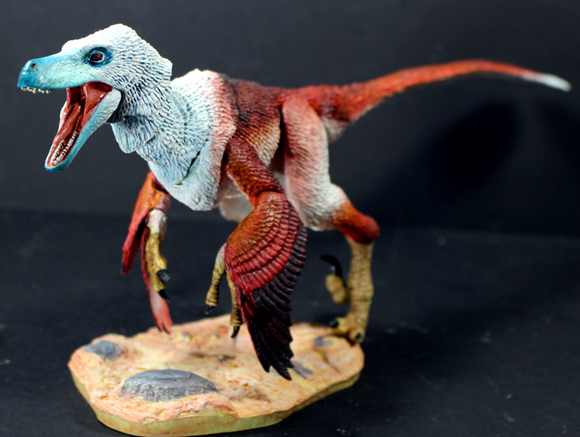
Beasts of the Mesozoic limited edition V. osmolskae figure.

Limited edition Beasts of the Mesozoic Velociraptor osmolskae figure.

Picture credit: Everything Dinosaur

The picture above shows a hand-painted, scale model of a feathered Velociraptor dinosaur.  This model is ideal for use in schools when teaching about inheritance and evolution as it shows the bird-dinosaur link extremely well.

For further information and to purchase this teaching resource: Beasts of the Mesozoic Articulated Dinosaur Models

From a Chicken’s Beak to a Dinosaur’s Snout

A quantitative assessment of fossils of creatures believed to be close to the avian/dinosaur root along with a study of living animals such as lizards, crocodiles, mammals and birds, such as emus was undertaken.  Using this data, the research team were able to formulate a hypothesis as to how the specialised bill of birds evolved from the skull and jaws of a dinosaur.

Having examined the DNA of living organisms, the research team set about trying to inhibit the proteins that cause beak development in chicken embryos, getting them to revert back to their underlying dinosaur state.

Modifying Chicken Embryos to Create Snouts not Beaks

Tracking the ancestry of the beak in birds.

Normal chick (left), modified chicken embryo (centre), alligator embryo (right)

Picture credit: Evolution

Dr Bhullar, a palaeontologist at Yale University, who has co-authored the scientific paper on this research, was surprised by the additional changes seen in the palatine bone, he explained:

“This was unexpected and demonstrates the way in which a single, simple developmental mechanism can have wide-ranging and unexpected effects.”

Professor Michael Benton of Bristol University, who has worked extensively on the evolutionary link between dinosaurs and birds, stated that this new research identifies that the beak of birds develop very different from the snouts, noses and jaws of reptiles.  A different set of genes are involved.

He stated:

“That’s what proves the beak is a real adaptation or “thing”, not just a slightly different nose shape.”

This is the first time a quantitative analysis of the fossil record and living animals has been used to identify the potential evolutionary path taken leading to specific adaptations in animals.  The scientists are confident that this technique can be applied to a wide range of scientific applications involving the manipulation of genetic material to help identify development processes.

Suggested Teaching Extensions

  • Genetics and Evolution (KS3) – linking to variation in a population: Variation can permit some organisms to compete more successfully, which means these organisms are more likely to breed and pass on their variations to the next generation.  Looking at pictures of Archaeopteryx, a transitional bird/dinosaur with jaws and teeth challenge the class to consider the evolutionary drivers involved in the development of a toothless beak from a jaw bone with teeth.

Hint – Consider the need to lighten the body to enable more efficient powered flight.

Extension – What other adaptations can be seen in modern birds when compared to the fossils of Archaeopteryx and related dinosaurs such as Velociraptor?

13 05, 2015

Asian Countries Top Global Schools Survey for Science and Maths

By |2023-03-28T08:16:58+01:00May 13th, 2015|Categories: General Teaching, Key Stage 3/4|Comments Off on Asian Countries Top Global Schools Survey for Science and Maths

Singapore Ranks First, UK Ranks Twentieth

In the most extensive research into global education practices, Asian countries have come out on top in a poll based on maths and science skills amongst fifteen year-old students.  The OECD (Organisation for Economic Co-operation and Development), set out to test the link between a country’s education system and the gross domestic product (GDP) of that country.  The better educated the workforce the greater propensity for that country’s economy to grow and for wealth to be created.

Students in Seventy-Six Countries were Tested

School children tested in science and maths.

St Joseph’s Catholic Primary School (Year 2) dinosaur display.

Picture credit: Everything Dinosaur

For educational products, visit Everything Dinosaur’s website: Everything Dinosaur.

The top five places in the rankings were all taken by Asian countries.  Singapore, a country with an extremely well-respected education system was ranked first, second was Hong Kong, then South Korea, Taiwan and Japan.

The lowest ranked countries in this OECD survey were, unsurprisingly, some of the poorest and least developed countries, although South Africa was rated very low and propping up the table, coming last of all was Ghana.

The survey compiled by Eric Hanushek (Stanford University) and Ludger Woessmann (Munich University), was commissioned by the OECD in preparation for a global education conference due to take place in South Korea next week.

The United Nations is going to set a target for raising global education standards by 2030.  The country rankings are based on an amalgamation of international assessments, including the OECD’s Pisa tests, the TIMSS tests run by United States-based academics and TERCE tests from the Latin America countries.  In this survey, both developed and developing countries have been assessed against the same criteria, this allows for accurate comparisons irrespective of a country’s economic status.

Science and Maths Tests

One notable absentee from the OECD report is China but with a third of the world’s countries surveyed the study reaffirms the long held belief that Asian countries such as South Korea and Singapore have excellent education systems, especially when it comes to maths and the science disciplines.

Andreas Schleicher (Education Director of the OECD) stated:

“This is the first time we have a truly global scale of the quality of education.  The idea is to give more countries, rich and poor, access to comparing themselves against the world’s education leaders, to discover their relative strengths and weaknesses, and to see what the long-term economic gains from improved quality in schooling could be for them.”

Whilst it may not be possible to mine the data to extract any variations between England, Scotland, Northern Ireland and Wales, which between them do have different national curricula, this study provides a useful benchmark.  The UK results do show that approximately 20% of UK school leavers have only basic maths skills and only a limited knowledge of science.  Academics propose that if basic education levels could be improved in the United Kingdom then this would result in a much more skilled and capable workforce leading to a increase in the GDP and everyone’s economic welfare.

For information on how Everything Dinosaur helps schools and home educators: Email Everything Dinosaur.

13 05, 2015

Retracing the Beak of Birds to the Snout of Dinosaurs

By |2023-03-28T08:12:21+01:00May 13th, 2015|Categories: Dinosaur and Prehistoric Animal News Stories, Dinosaur Fans, Educational Activities, Main Page, Palaeontological articles, Teaching|0 Comments

Reverse Genetic Engineering to Produce a Dinosaur Snout

A team of scientists based in the United States have tweaked the developmental processes that take place in chicken embryos to re-engineer the snouts of their dinosaur ancestors.  The research team led by University of Yale palaeontologist, Bhart-Anjan S. Bhullar and developmental biologist Arhat Abzhanov (Harvard University), have produced the first bird embryos that possess a snout similar to a dinosaur’s nose rather than a beak.  The chicken embryos developed palatial bones and a jaw configuration that resembles that seen in the fossil record, specifically in the Dromaeosauridae, a group of dinosaurs that are closely related to modern Aves.

Bird Embryos Possess a Snout Similar to a Dinosaur Snout

The dromaeosaurs, sometimes referred to as the “raptors” belong to the Suborder Theropoda.  They are part of a clade of agile dinosaurs that reduced their tails, lost their teeth and evolved into Aves (birds).  Typical dromaeosaurids are Velociraptor, Deinonychus and the recently named Saurornitholestes sullivani.

To read an article about the newly described Saurornitholestes sullivani: Sniffing Out a New Dinosaur Species.

As the Yale University press release states: “Just don’t call them Dino-chickens!”

Tweaking the Beak from Dromaeosaurs to Modern Birds
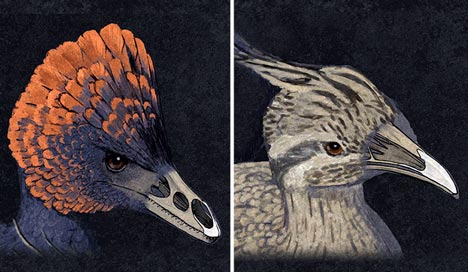
From the Dinosauria (left) to the beaks of modern Aves (right).

From the Dinosauria (left) to the beaks of modern Aves (right).

Picture credit: John Conway

Manipulating Chicken Embryos

The scientists were not in the business of trying to create a living dinosaur.  Manipulation of chicken embryos has taken place for several years, all part of research to help the understanding of how molecular processes affect the development of organisms.

Commenting on this research, which has just been published in the journal “Evolution”, lead author Dr Bhart-Anjan S. Bhullar (Department of Organismic and Evolutionary Biology, Yale) stated:

“Our goal here was to understand the molecular underpinnings of an important evolutionary transition, not to create a “dino-chicken” simply for the sake of it.”

Researching Cranial Development

For the young doctor, this is all part of his on-going research into cranial development in very young animals.  It is not part of a concerted effort to bring back the Dinosauria, a sort of “Jurassic Park from the embryo upwards”, as explained by a spokesperson from Everything Dinosaur.

There are a huge variety of bird beaks, from the curved, tearing and cutting beaks of eagles, to the sophisticated sieves of flamingos.  The beak is an essential component of avian anatomy and the researchers are trying to unravel how the beak evolved from its reptilian ancestry.  A quantitative analysis of fossils closely associated with the origins of birds was undertaken along with a study of extant animals including lizards, crocodiles and birds.

How the Beak of Birds Evolved

This examination allowed the scientists to develop a hypothesis as to how the bird beak may have evolved from the Dinosauria and the developmental stages that were involved.

The team identified that both major living lineages of birds, the abundant Neognathae (which includes virtually all species of extant birds) and the much rarer  Palaeognathae (which comprises the Tinamou family of birds from South and Central America plus the flightless ratites – cassowary, ostrich, kiwi, rhea, for example), differ from reptiles that are not closely related to birds and from mammals in that they have a unique, median gene expression zone of two different facial development genes early in embryonic development.  This median gene expression had previously only been identified in chicken embryos.

Turning Back the Evolutionary Clock

In order to have an embryo revert to its ancestral state, before the beak as it were, the gene expression for beak formation in the young chicken had to be turned off.  Microscopic beads coated in a molecule inhibiting substance were used to inhibit the activity of the proteins produced by the bird specific, median signalling zone in the chicken embryos.  This led the embryo to revert back to its reptilian ancestry with a more dinosaur-like snout forming and surprisingly, the palatine bone in the root of the mouth was also altered.

Changing the Faces of Embryos (Modified Chicken Embryo with Snout)
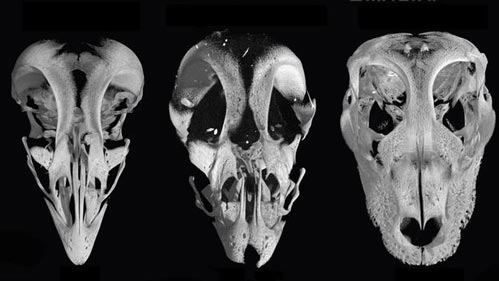
Normal chick (left), modified chicken embryo (centre), alligator embryo (right)

Normal chick (left), modified chicken embryo (centre), alligator embryo (right)

Picture credit: Evolution

Unexpected Changes

Dr Bhullar was surprised by the additional changes seen in the palatine bone, he stated:

“This was unexpected and demonstrates the way in which a single, simple developmental mechanism can have wide-ranging and unexpected effects.”

Commenting on the research, Professor Michael Benton (Bristol University), someone who knows a great deal about bird evolution, explained that this new study shows that the beak of birds develops very different from the snouts, noses and jaws of reptiles.  A different set of genes are involved.

He stated:

“That’s what proves the beak is a real adaptation or “thing”, not just a slightly different nose shape”

Why Dinosaur Snouts and Bird Beaks?

Intriguingly, although the fossil record for bird evolution is far from complete, the fantastically well preserved bird fossils of Lower Cretaceous deposits from China, specimens of Confuciusornis for instance, show that by around 125 million years ago the toothless beak had evolved.

Why the beak came about remains a point of significant debate, however, one of the most often cited reasons for a lighter, toothless structure is that as birds became more efficient fliers and spent more time in the air, the loss of a heavy, bony jaw lined with teeth was just one of a number of anatomical adaptations that occurred to help improve powered flight.

A Model of the “Early Bird” Confuciusornis sanctus from China
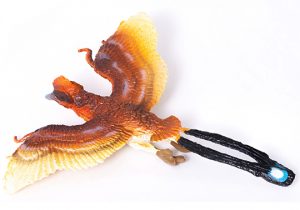
PNSO Age of Dinosaurs Confuciusornis model.

Confuciusornis model (PNSO Age of Dinosaurs).

Picture credit: Everything Dinosaur

The picture (above), depicts the PNSO Confuciusornis replica. There are a number of feathered prehistoric animal models in the PNSO range: PNSO Age of Dinosaurs.

Important Implications

The American based researchers are confident that their work has important implications for other geneticists and for palaeontologists.  For example, if a single molecular mechanism was responsible for this transformation, there should be a corresponding, linked transformation in the fossil record.  The flightless, man-sized Hesperornis, a genus of prehistoric bird known from the Late Cretaceous of North America could demonstrate that link.

An Illustration of Hesperornis (Traditional View)
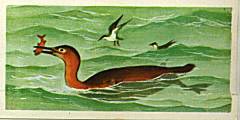
Hesperornis catching a fish.

Hesperornis catching a fish.

Picture credit: Everything Dinosaur/Brooke Bond

Dr Bhullar said:

“This is borne out by the fact that Hesperornis, discovered by Othniel Charles Marsh of the Yale Peabody Museum of Natural History, which is a near relative of modern birds that still retains teeth and the most primitive stem avian with a modern-looking beak in the form of a fused, elongate premaxillae, also possesses a modern bird palatine bone.”

The premaxillae are the bones that form the tip of the upper jaw (anterior portion) of most animals, but are enlarged and fused to form the beak of birds.

Finding a Hypothetical Developmental Path

Moving forward, the quantitative analysis to establish a proposed hypothetical developmental path of a lineage of animals which could be tested by inhibiting the behaviour of proteins in embryos can be probably be used to investigate a wide range of underlying developmental mechanisms in organisms.

The dinosaur/bird link is now well established, a theory once proposed by the likes of Henry Govier Seeley back in the 1880’s is widely accepted.  Back in 2013, Everything Dinosaur reported on research from an international team of scientists, including researchers from the Royal Veterinary College (London), that looked at how the posture of birds was derived from the gait of small, cursorial dinosaurs.

To read more about this study: The Birds Have the Dinosaurs to Thank for their Crouching Gait.

Everything Dinosaur notes the support of Yale University in the compilation of this article.

7 05, 2015

Great Wood Primary School and Dinosaurs

By |2023-03-27T07:39:21+01:00May 7th, 2015|Categories: General Teaching, Key Stage 1/2|Comments Off on Great Wood Primary School and Dinosaurs

Dinosaurs Inspire Creative Writing with Year 2 – Thank You Letters

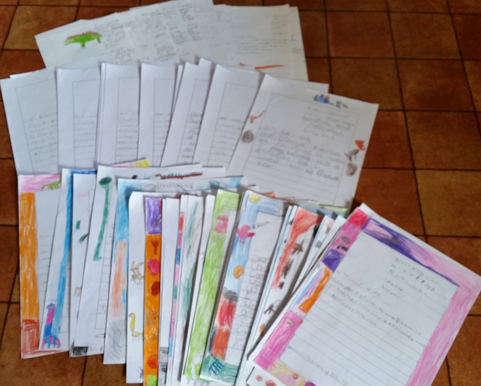
Children in classes 2P and 2T (Key Stage 1), at Great Wood Primary School (Morecambe), really enjoyed their dinosaur workshops with Everything Dinosaur, we were sent some super thank you letters.  Even the interruption caused by the fire alarm going off did not spoil the day.  Year 2 pupils have been learning all about dinosaurs and prehistoric animals as part of a term topic called the “Jurassic Forest”.  Everything Dinosaur was invited into the school to conduct a workshop to help inspire and motivate the budding young palaeontologists.

Dinosaurs Inspire Creative Writing

One of the teaching aims was to act as a provocation to help enthuse the children (and teachers), as they began this topic.  The dinosaur expert who visited the school suggested a number of extension activities including writing thank you letters to Everything Dinosaur after the workshops had been concluded.

A Super Set of Thank You Letters Sent in from Year Two

Thank you letters.

Letters and drawings sent in by children at Great Wood Primary.

Picture credit: Everything Dinosaur

Everything Dinosaur

A spokesperson from Everything Dinosaur commented:

“We try to cater for the learning objectives required by the teaching team and build them into our dinosaur and fossil workshops.  For example, one of the aims of this workshop was to help inspire the children with composition writing.  All the wonderful letters we received provides evidence as to how successful this was.”

To enquire about Everything Dinosaur’s award-winning range of toys and gifts: Contact Everything Dinosaur.

Dinosaur Workshop Inspires Year 2 with their Creative Writing

Thank you letters - inspiring creative writing.

Super examples of letter writing from the children.

Picture credit: Everything Dinosaur

The very tactile and practical dinosaur workshop appealed to visual/spatial learners and certainly inspired the children with their writing.  We received lots of letters, some of the children even sent in two pieces of writing!

To view the range of educational, prehistoric animal themed toys and games available from Everything Dinosaur: Dinosaur Toys and Games.

Go to Top