All about dinosaurs, fossils and prehistoric animals by Everything Dinosaur team members.

Everything Dinosaur team members working in schools, helping museums and other educational bodies. Our work with and in schools.

23 06, 2015

Early European Had Close Neanderthal Ancestor According to New Study

By |2024-05-05T14:18:17+01:00June 23rd, 2015|Categories: Dinosaur and Prehistoric Animal News Stories, Main Page, Teaching|0 Comments

Early Modern European Humans Interbred with Neanderthals

The very last of the Neanderthals may have died out some 28,000 years ago but their legacy lives on as the modern human genome (Homo sapiens) contains traces of Neanderthal genetic material.  The Neanderthals (Homo neanderthalensis) are the closest related species to our own, we share a common ancestor but this fact alone does not account for the one to three percent contribution to the genome of Eurasians, scientists believe that some time in the recent past these two species interbred.  It seems that interbreeding between these two related species may have taken place much more recently than previously thought.

A new scientific paper published in the journal “Nature” reports on the study of an ancient human jawbone, this research suggests that interbreeding took place as recently as some 40,000 years ago.

The Ancient Human Jawbone Used in the Genetic Study
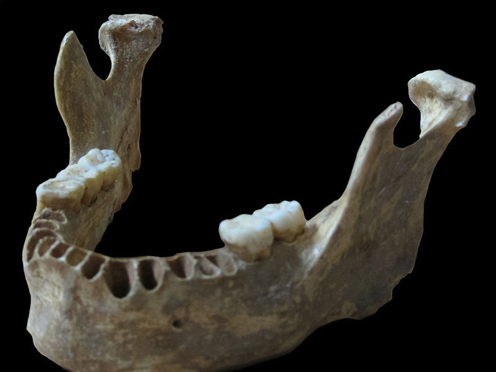
DNA analysis reveals very recent Neanderthal ancestor.

DNA analysis reveals a very recent Neanderthal ancestor.

Picture credit: Max Planck Institute for Evolutionary Anthropology/Svante Pääbo

Robust Human Jawbone

A robust human mandible was discovered in a cave system close to the town of Anina in south-western Romania back in 2002.  The cave contains a huge amount of mammal bones including large numbers of Cave Bears (Ursus spelaeus) which probably used one of the chambers in the cave system as a hibernation den.  The explorers found that a number of bones had been placed on nearby rocks, this suggested human activity and sure enough, the remains of early modern humans were found.  A beautifully preserved human jawbone (mandible) and part of a skull were discovered.

Radiocarbon dating estimates that the jawbone is around 37,800 years old, making these fossil materials the oldest modern human bones to have been found in Europe.  The cave, was called the “Peștera cu Oase”, which translates from the Romanian to mean “the cave of bones”.

Even if more conservative dating methods are used, the human remains come out at between 37,000 and 42,000 years old.  The jaw is definitely H. sapiens as it shows a number of modern human morphologies including a prominent chin.  However, a genetic analysis carried out by an international team of researchers which included scientists from Harvard Medical School, the Max Planck Institute of Evolutionary Anthropology and the Chinese Academy of Sciences, indicates that between six to nine percent of this person’s genome originates from Neanderthals.  This is far greater than any other human sequenced to date.

Neanderthal Ancestor

As large segments of this individual’s chromosomes are Neanderthal in origin, it suggests that a Neanderthal was among this person’s most recent ancestors, perhaps just four to six generations back in this Romanian’s family tree.  This new study provides substantial evidence that the first modern humans that arrived in Europe interbred with local Neanderthals.

Put simply, the person whose jawbone was found in the cave may have had a Neanderthal great grandparent!

A Researcher Carefully Extracts Fragments of Bone for the DNA Analysis
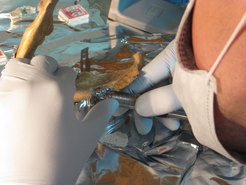
For their analysis the researchers used 35 milligrams of bone powder from the jawbone.

For their analysis the researchers used 35 milligrams of bone powder from the jawbone.

Picture credit: Max Planck Institute for Evolutionary Anthropology/Svante Pääbo

Homo sapiens bred with Homo neanderthalensis

A previous study had suggested that early modern humans migrating out of Africa mixed with Neanderthals in the Middle East between 50,000 and 60,000 years ago.  Modern humans spread eastwards into Asia and westwards into Europe.  Eventually, it was our species that spread to all parts of the world, the last of the Neanderthals dying out around 28,000 years ago.

One of the lead authors of the report Qiaomei Fu (Chinese Academy of Sciences), stated:

“The data from the jawbone imply that humans mixed with Neanderthals not just in the Middle East but in Europe as well.”

Svante  Pääbo (Max Planck Institute for Evolutionary Anthropology), added:

“It is such a lucky and unexpected thing to get DNA from a human who was so closely related to a Neanderthal.”

Removing the Contaminating DNA

The research team had to very carefully sift out all the contaminating DNA before being able to assess the presence of remnants of Neanderthal genetic material.  Most of the contamination was caused by microbial DNA in contact with the bone whilst it was in the cave, most of the hominin DNA recorded came from researchers who had handled the fossil bone.

Only a very tiny proportion of the genetic material analysed could be traced back to its Neanderthal origins.

The robust jaw and teeth do show some Neanderthal morphologies, this is to be expected given the close relatedness of this person to H. neanderthalensis.  The scientists hope to continue their studies and identify more Neanderthal genetic material from ancient human remains.  This will help them map potential Neanderthal/human interactions across Europe and Asia.

21 06, 2015

Dinosaur Day with Year 1

By |2023-03-31T08:19:21+01:00June 21st, 2015|Categories: Educational Activities, Main Page, Teaching|0 Comments

Abbey Hey Primary Academy and Dinosaurs

Another busy week with lots of dinosaur workshops with team members travelling to Staffordshire, Derbyshire and Lancashire.  There was just enough time to squeeze in a trip to Abbey Hey Primary Academy to meet all the budding young palaeontologists in Year 1 for a special dinosaur day.  The children in classes 1Wh, 1G and 1W have been studying dinosaurs and learning all about these amazing prehistoric creatures with the help of their enthusiastic teaching team.  Out in the playground our dinosaur expert spotted some wonderful dinosaur shaped chalk boards

Playground Jurassic Park

Fun and creative dinosaur themed playgrounds.

Fun and creative dinosaur themed playground accessories.

Picture credit: Everything Dinosaur

Dinosaur Day

With three classes to teach there was no time to lose, so it was straight into the Infants Hall to conduct the first dinosaur workshop with Miss Whitty’s class (1Wh) assisted by Miss Ahmed and Mr Jackson.  We were most impressed with the pictures that had been posted up onto Abbey Hey’s school website.  Clearly the children enjoyed themselves and they certainly had learned a lot.

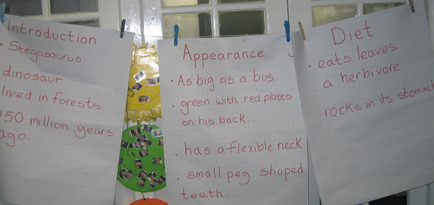
Next it was onto class 1G, to visit the children in their classroom and to conduct a second dinosaur and fossil themed session.  Our dinosaur expert marvelled at the wonderful examples of dinosaur inspired writing he saw posted up around the classroom.  The children had focused on two dinosaurs, the armoured Stegosaurus and the fearsome Tyrannosaurus rex, they had been working out what these dinosaurs were like and compiling a list of dinosaur facts on flip charts.

Stegosaurus and T. rex Inspired Facts 

Learning facts about dinosaurs.

Learning facts about dinosaurs.

Picture credit: Everything Dinosaur

Pupils Really Engaged with the Term Topic

Teacher, Miss Ellison explained that the pupils had been really engaged with this term topic and they had loved working out just how big some dinosaurs were.  Miss Russell and Miss Farrington took plenty of photographs during the dinosaur workshop, these would help in the planned recall and recount activity that the teaching team had prepared for the afternoon.  There was even a model of a big dinosaur egg in the classroom, this topic certainly seems to have captured the imagination of the teachers.

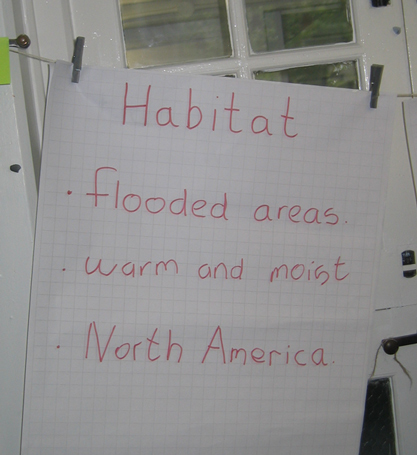
Year 1 Children Have Been Learning About Dinosaur Habitats

Year 1 explore dinosaur habitats.

Year 1 explore dinosaur habitats.

Picture credit: Everything Dinosaur

Dinosaur Habitats

A number of the classes had created their own dinosaur habitats, learning about what animals need to keep them healthy and happy.  Good job the children knew how to distinguish the carnivores from the herbivores.

In the afternoon, it was time to work with class 1W.  Miss Sarwar (the teacher), had briefed our dinosaur expert on exactly where the children were on the term topic, as a result we were able to help reinforce learning and check understanding as we explored prehistoric animals with the class.  Miss Heap and Miss Statham (teaching assistants) were on hand to help the enthusiastic children learn how Triceratops used its horns, how ammonites caught fish and the special, secret powers of armoured dinosaurs.

A spokesperson for the school, commented on the school’s class pages:

Year 1 had a visit from a dinosaur expert [Everything Dinosaur].  They were shown dinosaur fossils dating back over 150 million years.  The children thoroughly enjoyed the day and they learnt some much more about dinosaurs.”

To learn more about Everything Dinosaur’s range of inexpensive dinosaur themed toys and gifts: Dinosaur Toys and Gifts.

20 06, 2015

New Study Suggests Sixth Mass Extinction Phase

By |2024-05-05T14:18:40+01:00June 20th, 2015|Categories: Dinosaur and Prehistoric Animal News Stories, Educational Activities, Main Page, Teaching|1 Comment

Our Planet is Entering New Mass Extinction Phase

A team of international scientists based in the United States and Mexico have published a report declaring that a sixth mass extinction event is well under way and our species is running out of time to reverse this trend through conservation efforts.  Everything Dinosaur team members have written a number of articles on this blog about reports detailing the current rate of extinctions being recorded and the irreversible loss of ecosystems and biota.

Sixth Mass Extinction

This latest research takes a more conservative approach to calculating species loss than many earlier studies and this study focuses on the impact on vertebrates.  Even so, the team conclude that animals with back bones are becoming extinct more than 114 times faster than the “normal”, background extinction rate.

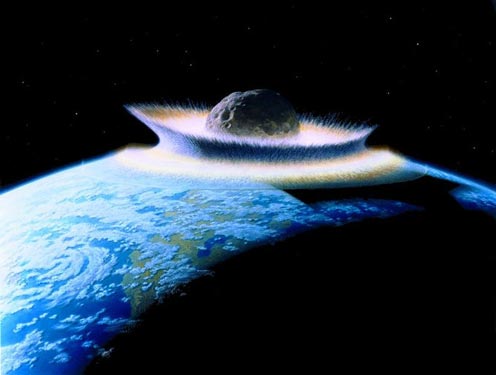
Scientists from Universidad Nacional Autónoma de Mexico, (Mexico), the University of California, Stanford University, Princeton University and the University of Florida state that the Earth is entering the sixth great mass extinction event, some sixty-five million years after the fifth mass extinction which ended the reign of the dinosaurs.

Report States This is the Greatest Extinction Phase Since the Demise of the Dinosaurs

Cataclysmic impact event that led to the extinction of the dinosaurs.

Cataclysmic impact event that led to the extinction of the dinosaurs.

Picture credit: Don Davis commissioned by NASA

Mass Extinctions Recorded in the Fossil Record

The fossil record suggests that there have been five major extinction events in the Phanerozoic Eon which represents the last 545 million years or so of our planet’s history.  The term Phanerozoic is derived from the Greek, for “visible life”, this reflects that the preserved fossilised remains of organisms become much more plentiful in rocks dated from 545 million years ago and younger.

Over this huge amount of time, there have always been extinctions.  Scientists are aware of the fact that there is a “background” level of extinction, but in this new research, the scientist report that amongst vertebrates the current trends suggest extinction rates 114 times faster than normal.

A Table Showing the Five Previous Mass Extinctions

Mass Extinction in Summary

Table credit: Everything Dinosaur

For model and replicas of prehistoric animals: Dinosaur Models and Prehistoric Animal Figures.

Scientists Comment on the Sixth Mass Extinction Event

Gerrado Ceballos, (Universidad Nacional Autónoma de Mexico), lead author of the paper, that has just been published in the academic journal “Science Advances” commented:

“We are now entering the sixth great mass extinction event.  If it is allowed to continue, life would take many millions of years to recover and our species itself would likely disappear early on.”

The report concludes that since 1900, more than four hundred species of vertebrates have died out.  Such a loss would normally occur over 10,000 years if extinction rates were at the normal, background level.

The rapid loss of biodiversity is put down to the effect of an increasing human population on our planet.   The number of humans living on our planet is estimated to have been around 1.9 billion in 1900, today, the human population is estimated to be around 7.325 billion, an increase of 385% over the last one hundred and fifteen years.  The expansion of urban populations, pollution, loss of habitats, deforestation and climate change are some of the reasons for the dramatically increasing loss of vertebrates according to the paper’s authors.

Key Vertebrate Species Dying Out

With the disappearance of key vertebrate species from an ecosystem, the other components such as insects and plant life will also be affected.   The report states that beneficial insects such as pollinating bees could be lost to humanity within three human generations.  The loss of these pollinators would have a huge impact on human food resources and place our own species Homo sapiens very much under threat.

To read an article written in 2014 about potential mass extinctions: Heading for a Sixth Mass Extinction?

The number of global mass extinction events preserved in the fossil record has been challenged recently.  Back in April of this year, Everything Dinosaur reported on a new study that suggested that there had been an additional, major extinction event around 260 million years ago in the Permian.  This extinction phase preceded the End Permian extinction event that is believed to be the most devastating extinction known from the Phanerozoic.  Some 95% of all life is believed to have died out.

To find out more: A Sixth Mass Extinction Event?

19 06, 2015

Genuine Reviews on Everything Dinosaur’s Website

By |2023-03-31T08:06:39+01:00June 19th, 2015|Categories: General Teaching|Comments Off on Genuine Reviews on Everything Dinosaur’s Website

Genuine Reviews from Teachers after Dinosaur Workshops

Teachers and their support staff can rest assured when it comes to reading reviews about Everything Dinosaur’s work in schools.  Unfortunately, other reviews, comments and feedback posted up on websites about goods and services may not be so trustworthy.

Fake Reviews on Websites

Research undertaken by the Competition and Markets Authority (CMA) has identified a number of highly dubious online practices, many of which may be unlawful.  For example, instances of businesses ambushing competitors by placing fake negative reviews on their rival’s website have been identified.  The purchase of favourable reviews about a company or its products/services is also occurring.

The CMA states that they are launching an investigation into various organisations, as the use of paid-for endorsements without a clear admission of payment may be unlawful and these attempts to boost brands, products and company profiles could be much more widespread than previously assumed.   The BBC has reported on this and even tracked down a student from Bangladesh who openly discussed how much he got paid for posting up fake reviews.

Genuine Reviews About Everything Dinosaur’s Work in Schools

Genuine reviews. Feedback after dinosaur workshop.

Genuine feedback from teachers, teaching assistants and members of the senior leadership team.

Picture credit: Everything Dinosaur

Genuine Reviews on Everything Dinosaur’s Websites

The picture above shows a typical feedback form filled in by a teacher after a dinosaur workshop with the class.  In this instance, Nikki (the Year 1 teacher), even coloured in the stars to indicate a “5 Star Rating” for our work teaching about dinosaurs and fossils in school.  We keep a written record of all the feedback that we receive, these feedback forms and customer comments help us to improve our service to schools and we have them available should any organisation such as STEMNET wish to inspect them.

To read testimonials about Everything Dinosaur from customers: Customer Testimonials.

Sue Judd of Everything Dinosaur commented:

“At Everything Dinosaur, we pride ourselves in publishing genuine feedback, reviews and comments and we would never knowingly post up information such as fake reviews and endorsements.”

Visit Everything Dinosaur’s website: Everything Dinosaur.

To read the reviews about Everything Dinosaur’s work and performance posted up on the independent ratings company Feefo’s website: Everything Dinosaur Feefo Reviews.

18 06, 2015

Year 1 (Abbey Hey Primary Academy) Study Dinosaurs

By |2023-03-30T22:17:08+01:00June 18th, 2015|Categories: General Teaching, Key Stage 1/2|Comments Off on Year 1 (Abbey Hey Primary Academy) Study Dinosaurs

Abbey Hey Primary Academy Children Study Dinosaurs

Children in Year 1 at Abbey Hey Primary Academy have been learning all about prehistoric animals and fossils as part of an exciting summer term topic with a dinosaur theme.  The three classes had a visit from one of Everything Dinosaur’s experts this week and a series of dinosaur themed workshops were conducted.

The teachers had created an interesting and varied scheme of work and our dinosaur workshop helped to reinforce learning and check understanding, as well as providing the teaching team with the opportunity to pick the brains of a dinosaur expert so that some new ideas can be incorporated into the term topic.

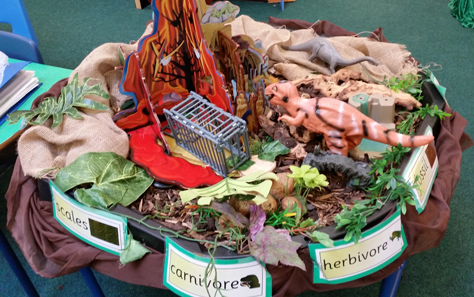
Dinosaur Habitats

Abbey Hey Children Have Been Learning About Habitats

Dinosaur habitats with Year 1 children.

Lots of tactile handling of different materials. Picture credit: Everything Dinosaur.

Picture credit: Everything Dinosaur

Tyrannosaurus rex and Stegosaurus

The children had focused on two dinosaurs, the fearsome Tyrannosaurus rex and the Jurassic herbivore Stegosaurus.  They were keen to share their newly acquired knowledge.  Lots of pictures of our dinosaur workshops were posted up on the school’s website, a spokesperson for the school stated:

Everything Dinosaur stocks a wide variety of Stegosaurus and Tyrannosaurus rex models and figures. To see the range of dinosaur and prehistoric animal replicas in stock: Dinosaur Models and Prehistoric Animal Figures.

“Today, Year 1 had a visit from Everything Dinosaur.  They were shown dinosaur fossils dating back over 150 million years.  The children thoroughly enjoyed the day and they learnt so much more about dinosaurs.”

For further information about Everything Dinosaur’s work in schools or to contact us for a quotation: Contact Everything Dinosaur.

17 06, 2015

Year Six and Dinosaur Blood

By |2023-03-30T22:12:05+01:00June 17th, 2015|Categories: Key Stage 1/2|Comments Off on Year Six and Dinosaur Blood

Year Six Study Fossils and Dinosaurs with Everything Dinosaur

Today, Everything Dinosaur visited Newcastle under Lyme School, an independent day school in the heart of Staffordshire.  Our mission was to work with the two classes of Year 6 exploring fossils, deep time and to help develop and augment the scheme of work all about palaeontology and geology created by the enthusiastic teaching team.

As part of our work with the dedicated teaching team, we brought a large number of resources with us including replicas of iconic fossil animals such as ammonites and belemnites.

To view the range of replicas of fossil animals in stock at Everything Dinosaur: Replica Fossil Animals and Prehistoric Animal Toys.

Based in one of the classrooms, our dinosaur expert marvelled at the wonderful illustrations of fossils that the children had created as part of a display.  He explained the importance of putting a scale on the drawings and after a tactile fossil handling session he set the children an exercise that involved studying some bizarre fish remains.  Good job the classes had a scale on their worksheets to help them work out how big the fossils were.

Year Six Children Learn About Palaeontology and Geology

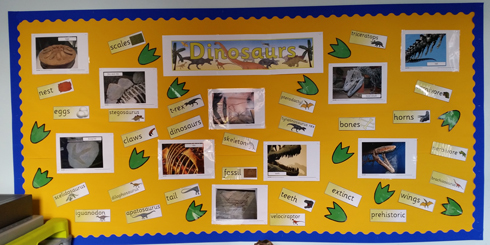
A colourful dinosaur display.

A colourful dinosaur themed display. Picture credit: Everything Dinosaur.

Picture credit: Everything Dinosaur

Students Study Dinosaurs

To conclude the dinosaur and fossil themed workshops, Everything Dinosaur shared with the class some information on research conducted by scientists at the Imperial College London.  Evidence of organic remains even potential dinosaur blood may have been discovered.  This enabled the dinosaur workshop leader to engage the children in a short debate over the perils of trying to bring back extinct creatures.  This chimed very nicely with the children as many of them had recently seen the movie “Jurassic World”.

Dinosaur Blood – Evidence of Potential Red Blood Cells Discovered in Dinosaur Fossils

Evidence of potential red blood cells preserved in 75-million-year-old dinosaur bone.

Evidence of potential red blood cells preserved in 75 million year old dinosaur bone.

Picture credit: Laurent Mekul

To learn more about Everything Dinosaur’s work with Upper Key Stage 2 children and to request further information about the dinosaur and prehistoric animal themed toys and games we supply: Contact Everything Dinosaur.

12 06, 2015

Fibres and Cellular Structures Preserved in Dinosaur Fossils

By |2023-03-30T18:51:33+01:00June 12th, 2015|Categories: Key Stage 3/4|Comments Off on Fibres and Cellular Structures Preserved in Dinosaur Fossils

Evidence of Dinosaur Blood and Soft Tissue in Fossil Bones

In rare and exceptional cases, preserved organic remains have been identified in the fossil record of vertebrates, even dinosaurs.  However, this area of research, the identification of soft tissues in the fossilised bones of dinosaurs, is highly controversial.  Researchers from Imperial College London examined samples from eight dinosaur bones that were not renowned for their exceptional preservation.

Fibres and Cellular Structures

The techniques used involved nano-analysis including FIB (focused ion beam) technology.  In one sample, the team observed structures that were consistent with the fibrous structure of collagen.  In another fossil specimen, that of an indeterminate Theropod claw, erthrocyte (red blood cell) structures were observed.  Mass spectrometry analysis of these microscopic remains provided a chemical signature similar to that of emu blood.

Potential Evidence for the Remains of Dinosaur Blood Preserved in Fossil Bone

Evidence of potential red blood cells preserved in 75-million-year-old dinosaur bone.

Evidence of potential red blood cells preserved in 75 million year old dinosaur bone.

Picture credit: Laurent Mekul

Dinosaur Fossils

All the fossils were from either the Dinosaur Provincial Park Formation or the Lance Formation (North America), the specimens are believed to date from the Late Cretaceous and are estimated to be around 75 million years old.

Potential Collagen Structures Preserved in Dinosaur Bones

Dinosaur collagen.

Fibrous structures preserved in fossilised bone.

Picture credit: Laurent Mekul

Identifying Preserved Biological Structures

Using advanced and extremely sophisticated material characterisation approaches, scientists may have identified preserved biological structures in these samples.  If these experiments can be repeated, then it might suggest that organic remains preserved in the fossil record of long extinct creatures may be more common than previously thought.

Further information on this research can be found here: Fibres and Cellular Structures Indicate Organic Remains Preserved in Dinosaur Fossils.

Teaching Guidelines

This article can be used to help explain permineralisation of materials (geology) and link into an exploration of genetics and inheritance as part of the KS3 science curriculum.  Ask the students to consider the implications of the discovery of preserved organic remains in the fossil record.  Look at Siberian Woolly Mammoths and the merits of attempts to bring back long extinct species via genetic manipulation and cloning.

Everything Dinosaur supplies a range of educational, prehistoric themed items including replicas of dinosaur fossils: Everything Dinosaur.

11 06, 2015

Updating the Exclusive Everything Dinosaur School Site

By |2024-05-05T13:42:34+01:00June 11th, 2015|Categories: Educational Activities, Teaching|0 Comments

A Busy Teaching Schedule for the Summer Term

The relatively short summer term is in full swing and so are the plans for teaching activities at Everything Dinosaur with team members undertaking a number of dinosaur and fossil workshops with children aged from 4 years up to Key Stage 3.  The Everything Dinosaur “Dinosaurs for Schools” web site, a bespoke on line presence for teachers and home educationalists, is constantly being updated with helpful posts and additional downloads of free to use dinosaur and fossil themed teaching resources.

With evolution and natural selection being incorporated into the English national curriculum, the demand for our experts is at an all time high, but team members remain determined to help all the teachers and education specialists that contact the company.

Planning and Preparing So That More Support Can Be Provided

Everything Dinosaur school website.

Planning schemes of work to support teachers.

Picture credit: Everything Dinosaur

Everything Dinosaur

Commenting on the company’s proposed teaching plans for the summer term a spokesperson for the Cheshire based organisation stated:

“We know how busy teachers are at the moment, there is so much to squeeze into this term and on top of this many senior leadership teams are well advanced with their schemes of work for 2016.  We too have put in place measures to help ensure that we can keep creating new downloadable teaching resources as well as posting up additional articles on our schools website to provide further support.  Rest assured, we shall keep working on this throughout this term and into the summer recess so educationalists can rely on us for useful, informative and helpful dinosaur and fossil themed teaching resources.”

To view the Everything Dinosaur web site: Everything Dinosaur.

In addition, the schools website will have a number of new features incorporated within it over the next two weeks.  New “quick links” will be included in the site to help teachers and learning practitioners navigate quicker to key areas such as being able to contact one of our dinosaur and fossil experts directly via email.

These improvements to this element of Everything Dinosaur’s on line presence are designed to provide an even speedier service to teachers, permitting questions about dinosaurs, requests for advice about lesson plans and so forth to be handled even quicker than before.

Everything Dinosaur must be doing something right when it comes to dinosaur workshops in schools.  Feedback from teachers and teaching assistants averages a very impressive 4.8 stars out of a maximum of 5 stars.

10 06, 2015

There were Dragons in Wales

By |2023-03-30T17:00:51+01:00June 10th, 2015|Categories: General Teaching|Comments Off on There were Dragons in Wales

New Early Jurassic Carnivorous Dinosaur From Wales

Brothers Nick and Rob Hanigan discovered the fossil find of a lifetime back in April 2014 when they found the remains of a Welsh dinosaur which had been exposed on a beach after bad weather.  The fossils come from strata at Lavernock Point (Vale of Glamorgan) and represent the remains of a three-metre-long, meat-eating dinosaur whose corpse was washed out to sea and eventually came to settle on the seabed.

Dinosaur Fossil Discovery

The rocks on this part of the Welsh coast date from the Late Triassic into the Early Jurassic.  After careful examination by a number of notable palaeontologists including Dr David Martill (University of Portsmouth), the mudstone containing the skeletal remains of the dinosaur have been assigned to the Early Jurassic (Hettangian faunal stage).  This, as yet to be fully scientifically described and named dinosaur, could well represent the earliest Jurassic dinosaur fossil ever found in Europe.

Vertebrae and Leg Bones from the Early Jurassic Dinosaur

Display of Welsh dinosaur fossils.

On display the fossils with a skeleton reconstruction.

Picture credit: National Museum of Wales

Nick Hanigan, contacted Everything Dinosaur to explain how the fossil had been prepared.  He stated:

“When the skull block was picked up, quite a bit of bone, for example, the lacrimal [bone from the front of the eye socket] and part of the maxillae [upper jaw] had already been washed out but the imprints were still left in the rock.  We took a silicon peel and made positive and negative casts of the surface and we also x-rayed and CT scanned the block before we prepared it.   As a result Rob and I built up a lot of information to support any future description and as such we can reconstruct quite a bit of the skull and missing part of the leg bones.”

A Welsh Dinosaur

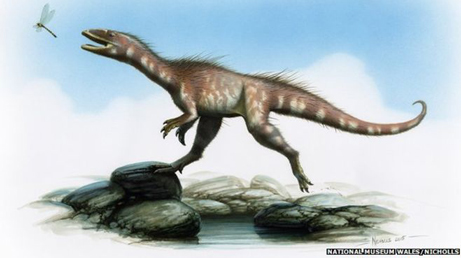
About five percent of the actual skeleton has been discovered, enough for scientists to establish this as a new genus.  The dinosaur was not fully grown when it died, it may have reached a length of more than five metres, making this “Welsh dragon” one of the largest predators known from this part of the Jurassic.

An Illustration of the Dinosaur from Wales

Early Jurassic theropod from Wales (Welsh dinosaur).

Significant dinosaur discovery.

Picture credit: National Museum of Wales/Bob Nicholls

It seems that dragons did once roam Wales, fearsome meat-eating dinosaurs.  This discovery is hugely significant as further research using the fossilised bones will help scientists to understand more about how the dinosaurs diversified into a myriad of different types of carnivorous dinosaur during the Jurassic.

Everything Dinosaur stocks a wide range of prehistoric animal models that represent creatures that lived during the Early Jurassic. Visit the models section of the company’s website: Prehistoric Animal and Dinosaur Models.

8 06, 2015

What is Oolitic Limestone? That’s a Good Question

By |2024-05-05T14:12:54+01:00June 8th, 2015|Categories: Educational Activities, Geology, Main Page, Teaching|0 Comments

Oolite (Egg Stone) Get up Close to Limestone

One of the joys of having Smartphones around the office is that these can be borrowed and taken out on fossil hunting expeditions.  Yes, they have all sorts of features, most of which we don’t use, but the camera has proved a boon. With twenty megapixels to play with team members have been able to take some lovely photographs of fossil discoveries and geological landscapes.  With this sort of imaging technology widely available there are more pictures of fossils being taken than ever before, but sometimes the rocks that contain the fossils can prove to be just as interesting, take oolitic limestone for example.

Oolitic Limestone

 A Photograph of Oolitic Limestone (Building Stone)

"egg stone" seen in a building.

Some “egg stone” seen in a building. Picture credit: Everything Dinosaur

Picture credit: Everything Dinosaur

Cotswold Building Stone

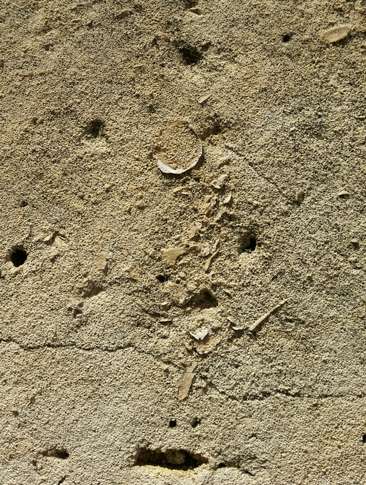
The picture above shows Cotswold building stone (Middle Jurassic), limestone that was laid down in a marine environment and a number of small shelly fossils have been preserved along with natural casts of shells.  If you were to run your hand over this finely chiselled piece of building stone it would still feel quite rough, having the texture of coarse sand paper.  It is oolitic limestone, otherwise known as “egg stone” and close up the surface of the stone has a remarkable appearance.

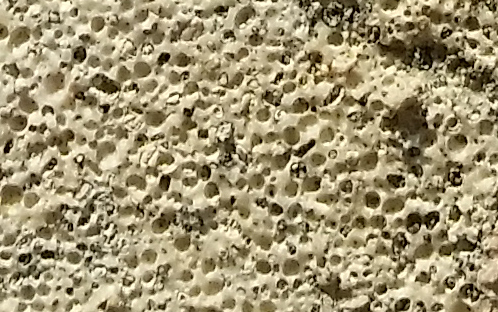
A Close Up of the Limestone Material

Made up of tiny spherical shapes.

Made up of tiny spherical shapes. Picture credit: Everything Dinosaur.

Picture credit: Everything Dinosaur

The powerful digital camera on the Smartphone can pick up fine details such as the small, bubble-like appearance of the surface of the limestone.  These are the remnants of the ooliths (sometimes also called ooids) that make up the rock.  Grains of sand or fragments of seashell are rolled around the sea floor and as they do, they collect calcium carbonate (CaCO3).  Concentric layers are formed and these give the rock its characteristic “egg stone” appearance, as the surface of the rock looks like fish roe (fish eggs). Hence the term oolitic limestone.

Limestone Oolite (Egg Stone)

Oolite (egg stone) is sedimentary rock and although most ooids are formed from the collection of calcium carbonate, this is not always the case as these structures can be composed of phosphate, dolomite or even chert.  The ancient Greek word for egg is  òoion and this might be the source of the derivations associated with this geologic structure.

In geology, sedimentary rock can be classified according to the composition of the rock as well as the diameter of the “egg stone” structures that are observed within it.  For example, oolites are technically defined as being composed of ooids that range in diameter between 0.25 mm to 2 mm.

Classifying the Rock Types

Rocks composed of ooids of a larger than 2 mm diameter are called pisolites (made up of spherical shapes called pisoids).  The terms pisolite and pisoids come from the ancient Greek word for pea, so think of the size of the spherical shapes observed in the stone like a group of small peas.

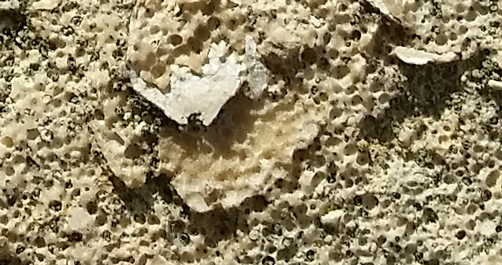
Oolitic Limestone can be Full of Fossils

Fossil shell fragments in the oolitic limestone.

Fossil shell fragments in the oolitic limestone. Picture credit: Everything Dinosaur.

Picture credit: Everything Dinosaur

Ooids are normally formed in warm, shallow seas that contain a lot of calcium and other minerals dissolved within the seawater.  Intertidal movements or currents aid in the transport of the material which helps in the formation of the ooid structures, but oolitic material can also form in freshwater.  Fragments of shell or a sand grain can act as a “seed” giving the calcium carbonate a medium which it can form around.

As these tiny “seeds” tumble around the sea bed they accumulate layers of precipitated calcite (another term for calcium carbonate), the size of the ooid (or pisoid) formed indicates the length of time the object has been exposed to the sea water before being buried by further sediment deposition.

Size Indicates Time on the Seafloor

Therefore, pisoids, being larger than ooids have been present on the seafloor longer than ooids.  Oolites with their “egg stone” grains superficially resemble sandstone and they can be white, grey or even yellow in colour (such as Portland limestone).  Under a high powered magnifying glass (or within a 20 megapixel image), the concentric rings which form the ooids can be easily made out.

Oolitic limestones are popular building materials, for example Cotswold limestone (oolitic limestone), as they are hard, resist erosion and come in a variety of hues and colours.  As they have an even structure they can be cut or sculpted in any direction.  Take a look at some of the older, stone buildings in your town.  If you live in the UK, chances are that some of these building stones are oolitic limestone and if you have a powerful camera you can record surface details yourself and record the ooids.

For models and replica of Jurassic dinosaurs and other prehistoric creatures: Nanmu Studio Jurassic Series Dinosaur and Prehistoric Animal Models.

Go to Top