All about dinosaurs, fossils and prehistoric animals by Everything Dinosaur team members.

Everything Dinosaur team members working in schools, helping museums and other educational bodies. Our work with and in schools.

8 11, 2015

Year 2 Learn about Dinosaurs as Pets

By |2023-04-08T10:20:45+01:00November 8th, 2015|Categories: General Teaching, Key Stage 1/2|Comments Off on Year 2 Learn about Dinosaurs as Pets

Why would a Dinosaur Not Make a Good Pet?

Dinosaurs as pets?  That was the question at the heart of Year 2’s science based term topic.  To help answer this question, the teaching team at Bishop King CE Primary School invited a team member from Everything Dinosaur to deliver a workshop on dinosaurs and fossils to each of the school’s two Year 2 classes.

Dinosaurs as Pets

The dinosaur themed workshop, part of a day of activities organised by Everything Dinosaur, proved to be extremely effective and the children were fully engaged and learned lots of amazing facts about prehistoric animals.

Year 2 Were Challenged to Design Their Own Dinosaur
Dinosaurs as pets

A big green dinosaur.

Picture credit: Bishop King CE Primary School/Everything Dinosaur

Extension Ideas

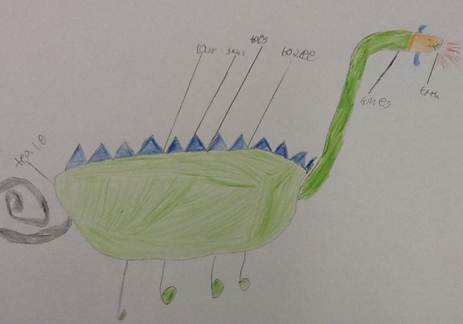
As part of a series of extension activities designed to help the children gain confidence with their handwriting, the dinosaur expert from Everything Dinosaur challenged the children to have a go at designing their very own dinosaur.  There were some wonderful and very creative examples.  The picture above shows a very colourful “Dimetriasaurus” designed by Dimetria.

A spokesperson from Everything Dinosaur praised Dimetria for the prehistoric animal drawing.

To learn more about the team members at Everything Dinosaur: About Us.

Dinosaurs as Pets – An Intriguing Term Topic

The term topic is entitled would a dinosaur make a good pet?  It permits the children to explore concepts such as food chains, ecosystems, habitats, life cycles and extinction.  With the aid of the expert from Everything Dinosaur, the teaching team were able to utilise some resources provided by the company to challenge the children with some dinosaur themed mathematical challenges.

Everything Dinosaur stocks a variety of prehistoric animal toys and games: Dinosaur Toys, Prehistoric Animal Replicas.

The budding young palaeontologists at Bishop King CE Primary (based in Lincoln, Lincolnshire), certainly rose to the challenge and could not wait to have a go at creating their own prehistoric animals.  Lots of lovely drawings with clear, well annotated labels.  Well done Year 2!

6 11, 2015

Winwick CE Primary School Study Dinosaurs and Rare Fossils

By |2024-05-05T15:02:06+01:00November 6th, 2015|Categories: General Teaching, Key Stage 1/2|Comments Off on Winwick CE Primary School Study Dinosaurs and Rare Fossils

Winwick CE Primary School Study Dinosaurs

Amongst all the correspondence in Everything Dinosaur’s mail bag this morning was a big, brown envelope full of colourful thank you letters from children at Winwick CE Primary School (Warrington, Cheshire).  Everything Dinosaur had visited Reception and Year 1 last month as the children had been learning all about fossils and dinosaurs as part of their term topic.  Our dinosaur expert (Dinosaur Mike), challenged the children to write a thank you letter to Everything Dinosaur, part of the extension resources that we had discussed with the teaching team earlier. We received some amazing and extremely colourful thank you letters from the children.

Colourful Thank You Letters

Polly Says Thank You After A Dinosaur Workshop

A colourful thank you letter from Polly.

Polly say thank you after the dinosaur workshop. Picture credit: Everything Dinosaur.

Picture credit: Winwick CE Primary School and Everything Dinosaur

Always Happy to Receive Letters

We are always happy to receive letters like these.  We do all we can to encourage handwriting skills amongst Key Stage 1 and Key Stage 2 children.  A visitor to the school provides an opportunity for the children to write a thank you letter and we loved reading the letters that Year 1 sent into us.  In addition, the wonderful drawings were a bonus, we enjoyed looking at the very colourful prehistoric animals.

To see the vast selection of prehistoric animal models available from Everything Dinosaur: Prehistoric Animal Models and Dinosaurs.

A Thank You Letter from Harry (Year 1)

A colourful thank you letter.

A colourful thank you letter from young dinosaur fan Harry. Picture credit: Everything Dinosaur.

Picture credit: Winwick CE Primary School and Everything Dinosaur

Dinosaur Workshop

Whilst conducting a dinosaur workshop we like to encourage the Year 1 children to send thank you letters to Everything Dinosaur.  We discussed a number of extension ideas and activities with the teaching team.  Team members emailed over extra resources and support materials to assist the teaching team after our visit.  The children really enjoyed the very tactile fossil handling session.  It looks like the class has a number of palaeoartists in residence too.

To learn more about Everything Dinosaur’s outreach work: Contact Everything Dinosaur.

Our dinosaur workshops are very popular with Key Stage 1 children.  It is always a pleasure to meet such an enthusiastic group of young dinosaur fans and to help them with their studies.

5 11, 2015

Warrington’s Wonderful Dinosaurs

By |2023-04-08T08:11:50+01:00November 5th, 2015|Categories: Educational Activities, Main Page, Teaching|0 Comments

A Morning with Year 1 and Reception (Winwick CE Primary)

October was a very busy month for the dinosaur experts at Everything Dinosaur with lots of school visits to squeeze in amongst all the other prehistoric animal projects that we were involved with.  On a Wednesday, towards the end of the month we delivered a dinosaur workshop to Reception and Year 1 pupils at Winwick CE Primary School (Warrington, Cheshire) and what a fun and fact filled morning it was.  The emphasis was on exploring dinosaurs and fossils so that the term topic could link into key areas of the national curriculum related to numeracy and literacy.

Lots of extension ideas and activities followed on from our visit, for example, we set the Year 1 children one of our special “pinkie palaeontologist challenges” – could they compose a thank you letter to Everything Dinosaur?

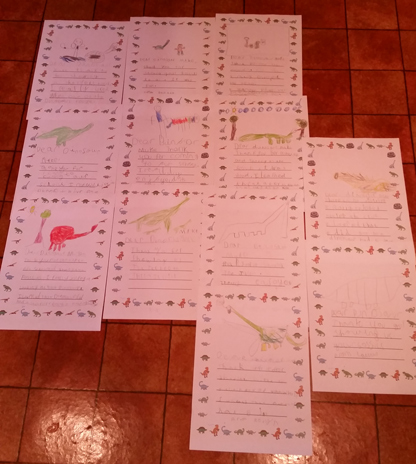
A Set of Wonderful Dinosaur Thank You Letters from Year 1

Dinosaurs Inspire Handwriting

Year 1 write thank you letters.

Picture credit: Everything Dinosaur

Sure enough, we received an envelope from the school, sent into us by the class teacher (Mrs Common) and inside we found a lovely set of thank you letters from the children.  Our dinosaur expert had asked the children to make sure they got their words onto the lines correctly, that they used capital letters and full stops.  In addition,  we wanted to see some wonderful spelling.

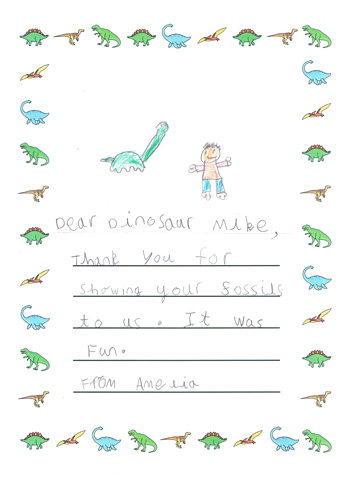
Amelia Says Thank You to Everything Dinosaur

Amelia says thank you.

Picture credit: Winwick CE Primary School and Everything Dinosaur

What super writing Amelia, well done you!

Dinosaur Workshop

Year One Class Send in Thank You Letters After Dinosaur Workshop

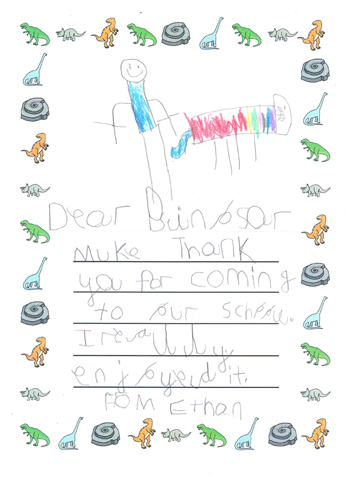
A thank you letter from Ethan. Well done!

Picture credit: Winwick CE Primary School and Everything Dinosaur

We enjoyed reading through the letters and we loved looking at the wonderful prehistoric animals that the children had drawn, especially the ammonites!

To discover more about Everything Dinosaur’s outreach work: Email Everything Dinosaur.

Commenting on the busy morning, a spokesperson from Everything Dinosaur stated:

“We had a fantastic time working with the children.  Special thanks to Mrs Dudley, Mrs Hansley, Miss Abu and Mr Bate for their help and assistance on the day.  A big Iguanodon thumbs up to Mrs Cameron who even offered us some toast at break-time.”

It sounds like Everything Dinosaur were very well looked after at the school.  Dinosaurs as a term topic provides so many opportunities for children to gain confidence with their writing, develop their vocabularies and to practice simple addition and subtraction.  A big thank you to all the children who sent in letters to us, this is greatly appreciated.

Everything Dinosaur stocks a wide variety of dinosaur and prehistoric animal themed merchanise including dinosaur themed clothing: Dinosaur Themed Clothing.

3 11, 2015

Deadly Dakotaraptor – A New Late Cretaceous Super Predator

By |2024-05-05T15:03:12+01:00November 3rd, 2015|Categories: General Teaching, Key Stage 3/4|Comments Off on Deadly Dakotaraptor – A New Late Cretaceous Super Predator

Scientists Report on Car-sized Raptor

The Hell Creek Formation of North America has provided scientists with fossils of some of the most iconic dinosaurs known.   These ancient sediments were once home to dinosaurs such as Triceratops and Tyrannosaurus rex, however, amongst the many thousands of fossils excavated from these Upper Cretaceous rocks, there were a number of large teeth, unmistakably from a huge dromaeosaur (raptor), but no bones associated with them to provide a description.  All that has changed with the publication of a paper in the academic journal “Kansas University Paleontological Contributions”.

Dakotaraptor steini

Terror of the Late Cretaceous of North America

Dakotaraptor steini

Dakotaraptor steini.

Picture credit:  Emily Willoughby

A team of scientists drawn from a number of top American institutions along with professional fossil collectors from the Black Hills Institute of South Dakota have described the partial and very fragmentary skeleton of a super-sized dromaeosaurid dinosaur that once co-existed with the likes of Triceratops and T. rex, sixty-six million years ago.  The fossils, including front limb bones and a huge, sickle-shaped toe claw were found in Harding County, South Dakota.

This dinosaur has been named Dakotaraptor steini. Although, less than ten percent of the skeleton has been excavated, comparisons made between these bones and the fossils of more complete raptors such as the famous Velociraptor, suggest that Dakotaraptor measured more than five and half metres in length.  This makes it one of the largest dromaeosaurids known and the second largest from North America.  Only Utahraptor, a meat-eating dinosaur that roamed Utah some fifty million years or so before Dakotaraptor evolved, was bigger.

Utahraptor – A Scale Drawing

A scale drawing of Utahraptor

A Utahraptor scale drawing.

Picture credit: Everything Dinosaur

The Hell Creek Ecosystem

The research team, led by Robert DePalma (Curator of Vertebrate Palaeontology at the Palm Beach Museum of Natural History (southern Florida), have speculated on where in the Hell Creek ecosystem, this agile predator may have fitted, after all, the apex predator was Tyrannosaurus rex.  It has been suggested that Dakotaraptor may have been a pack hunter and preyed on other types of herbivore and so it may not have been in direct competition with the tyrannosaurs.

Important Skeletal Features Preserved

Described as being about the size of the “raptors” that featured in the Summer blockbuster “Jurassic World”, Dakotaraptor preserves two very intriguing anatomical features on its bones.  Firstly, there is the enormous sickle-shaped claw on the second toe.  It measures sixteen centimetres in length, but when the sweeping curvature of the outer curve of the claw is considered, the claw measures an impressive twenty-four centimetres in length.  That’s roughly the same size of the toe claw found in the much larger Utahraptor.

In addition, the ulna (bone in the forearm), preserves fifteen large and distinct ulnar papillae (quill knobs).  These depressions in the bone are the places of attachment for big, pennaceous feathers.  Dakotaraptor is the largest known dinosaur which had wing feathers.

A spokesperson from Everything Dinosaur commented:

“Fossil teeth had indicated that within the Hell Creek Formation strata, evidence for a substantial dromaeosaurid would be found.  This fascinating discovery adds another dimension in terms of niche partitioning to the fauna of this part of North America during the Late Cretaceous.”

The Beasts of the Mesozoic range contains a large number of articulated dromaeosaurid models.  To view the range: Beasts of the Mesozoic Models and Figures.

2 11, 2015

Why Would a Dinosaur Not Make a Good Pet?

By |2023-04-07T21:04:49+01:00November 2nd, 2015|Categories: Educational Activities, Main Page, Teaching|0 Comments

Year 2 at Bishop King CE Primary School Study Dinosaurs

As part of the extension activities suggested by Dinosaur Mike of Everything Dinosaur during his visit to Bishop King CE Primary School (Lincoln, England), to work with Key Stage 1, the children in Year 2 were challenged to have a go at designing their very own dinosaur.  Having met Tyler and explained that in the past a huge marine reptile roamed the seas of what was to become the United States of America, one of the company’s “pinkie palaeontologist challenges” was set.  Could the pupils come up with their very own prehistoric animal?

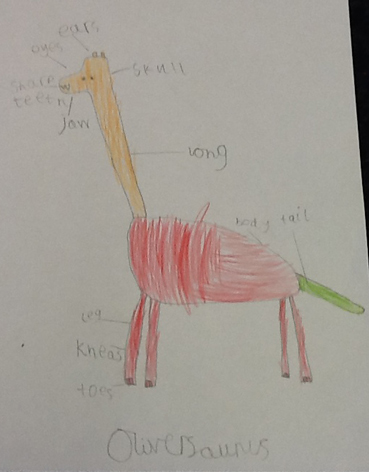
A Wonderful Oliversaurus from Oliver

Dinosaur drawings.

Oliver designs a dinosaur.

Picture credit: Bishop King CE Primary School

Dinosaur Workshop

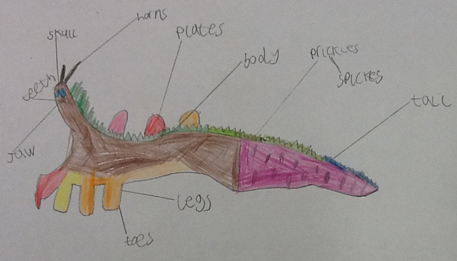
The children took to their task with gusto.  We challenged the class to think carefully about their dinosaur. For example, what colour would it be?  Would it have a long neck or a short neck?  A big body or a little body?  We wanted to see lots of lovely labels including pointing out where the dinosaur’s skull was, a word we introduced to the classes during our fossil handling activities.

Everything Dinosaur stocks a range of dinosaur themed toys and gifts: Dinosaur Toys and Gifts.

A Big Green Dinosaur with Navy Blue Spikes on His Back

Dinosaurs as pets

A big green dinosaur.

Picture credit: Bishop King CE Primary School

Year 2 Term Topic

The term topic for the two classes of Year 2 children this autumn has a science focus.  The aim is to decide whether or not a dinosaur would make a good pet.  This subject area acts as an umbrella topic, linking in with exploration of food chains, habitats and life cycles as well as learning about different parts of the body.  This particular extension exercise dovetails nicely into art as well as supporting literacy, vocabulary development and handwriting skills.

Excellent Labelling Just Like a Scientist

dinosaur drawing.

A very colourful dinosaur design.

Picture credit: Bishop King CE Primary School

When it comes to providing posters for conferences detailing research, it is important to provide accurate, well annotated diagrams.  This is a useful skill within palaeontology.  It seems from these examples here that the pupils at Bishop King CE Primary have started to hone their science skills at an early age.

Commenting on the Drawings

Commenting on the drawings, that were very kindly sent into Everything Dinosaur by class teacher Miss Knapp, a spokesperson from Everything Dinosaur stated:

“A new dinosaur is named and described approximately every three weeks.  By the time the children break up for Christmas it is very likely that a further two dinosaurs will have been formally named and described.  Dinosaurs were a very diverse group of reptiles, over the 165 million years in which dinosaurs existed they evolved into all sorts of forms, as well as the giants such as Diplodocus and Tyrannosaurus rex, some dinosaurs could fly, others lived in trees whilst some types of dinosaurs excavated burrows.”

Our congratulations to the children in Year 2.  They have come up with some beautiful and very colourful dinosaurs and Everything Dinosaur team members were most impressed with all the clear labelling.  We hope our dinosaur workshop went some way to help the children to answer the question why would a dinosaur not make a good pet?

2 11, 2015

Year 2 Get to Grips with Fossils

By |2023-04-07T20:58:58+01:00November 2nd, 2015|Categories: General Teaching, Key Stage 1/2|Comments Off on Year 2 Get to Grips with Fossils

A Day of Dinosaurs and Fossils with Year 2

Year 2 pupils at Anfield Infants and Nursery school started the second part of the autumn term with a “dino-tastic” day studying dinosaurs and fossils.  The schoolchildren received a visit from Everything Dinosaur.  All three classes in Year 2 will be studying dinosaurs and fossils as a term topic up to Christmas.  Our dinosaur expert provided a provocation session to enthuse children and teachers alike.

A Dinosaur Workshop in School

The school provides a dinosaur themed term topic each year.  There are some splendid examples of prehistoric animal themed artwork dotted around the classrooms and corridors.  Around one corner lurks a very colourful three-dimensional sculpture of a Triceratops.  One of the activities the children took part in was to explore the role played by the horns of dinosaurs in communication.  Could the children remember how Triceratops signalled to alert the herd that a Tyrannosaurus rex was approaching?

A Colourful Triceratops Spotted in School

Dinosaurs and Fossils.  A Triceratops spotted at a school.

A Triceratops spotted at a school.

Picture credit: Anfield Infants and Nursery School/Everything Dinosaur

Dinosaurs and Fossils

One of the extension activities we provided involved the children imagining what it might be like to have a pet Triceratops.  Everything Dinosaur’s expert explained about the jaws and teeth of Triceratops and then challenged the children to compose a story about a pet Triceratops visiting their school and having lunch.  Just how much would it eat on its visit?  It’s a good job we were able to demonstrate what a large appetite this dinosaur had.  We think Anfield Infants and Nursery School would have to order in more breakfast cereal!

Other extension activities we provided involved measuring dinosaur tracks and a novel way of calculating just how long a T. rex was.  With the workshops focused on tactile activities and discovery learning, these extension ideas were introduced with the specific aim of giving the children more confidence with numbers.  Our expert briefed the teachers on the extensions and provided all the resources they would need to conduct the work in the following days after the dinosaur workshop in school.

Tyrannosaurus rex Looks On

Tyrannosaurus rex model spotted at a school.

T. rex model spotted at a school.

Picture credit: Anfield Infants and Nursery School/Everything Dinosaur

We loved the teeth on the fearsome Tyrannosaurus rex artwork on display.

A Dino-tastic Day!

The children had a fantastic (or should that be “dino-tastic”) time on their first day back after the half-term break.

Commenting on the workshops provided by Everything Dinosaur, the teacher of the Year 2 class called “Bright Sparks” stated:

“It was a very interactive session, the children thoroughly enjoyed it and were so engaged!”

To view the dinosaur themed toys and gifts available from Everything Dinosaur: Dinosaur Themed Toys and Gifts.

We promised the children that if they wrote thank you letters to Everything Dinosaur, then our team of experts would answer any dinosaur related questions that they included within their thank you letters, but we did explain that we wanted to see proper use of full stops, capital letters and of course question marks.

What a great start to the second half of the autumn term for Year 2!

For further information on Everything Dinosaur’s educational and outreach work, simply email team members: Contact Everything Dinosaur.

29 10, 2015

British Birds Including Beautiful Puffins Face Extinction

By |2024-05-05T15:04:34+01:00October 29th, 2015|Categories: General Teaching, Key Stage 1/2, Key Stage 3/4|Comments Off on British Birds Including Beautiful Puffins Face Extinction

Puffins and Three Other British Birds at Risk of Extinction

There may still be several million of them, but the colourful North Atlantic Puffin (Fratercula arctica), that can be found on northern coasts of the British Isles, is in danger of extinction according to a new report from the International Union for Conservation of Nature (IUCN).  Puffins, Slavonian Grebes, Pochards and European Turtle Doves have all been added to the list of UK bird species included in the Red List of Threatened Species.

Loss of “British Wildlife”

Climate change is influencing the number and location of sand eels, the main food of Puffins and these attractive birds rely on a glut of sand eels to help them raise their young each spring.  Fewer sand eels has led to a reduction in Puffin numbers as fewer chicks are being raised.  A total of eight UK species of birds are now included on the Red List of Threatened Species of Birds.

The Curlew Sandpiper is on the endangered list.  This shorebird has been classified as “Near-Threatened”.  Loss of estuarine habitat has seen a dramatic fall in the numbers of these birds.

Puffins Face Extinction

Commenting on this revision of the IUCN Red List of Threatened Species for Birds, a spokesperson from Everything Dinosaur commented:

“Extinction is not just something that happened in the past, many species once thought of being invulnerable are under threat and a number of scientists have stated that we are now experiencing a global mass extinction event.  It is not just exotic species like Rhinos and Snow Leopards that are threatened, extinctions are happening in the British Isles as well.”

The number of UK species listed as critical has now doubled to eight, a further fourteen species associated with the United Kingdom are considered “near threatened”.

The Great Auk (Pinguinus impennis)

The Atlantic Puffin is distantly related to the Great Auk (Pinguinus impennis), a large, flightless bird that once shared much of the Puffin’s habitat.  The birds were slowly and systematically hunted during the 15th, 16th and 17th centuries.  They were hunted for their meat, their eggs were collected and the down of these black and white birds was highly prized for use in pillows.  By around 1800, this bird that had once ranged across the whole of the Northern Atlantic was virtually extinct.

The last accredited sighting of a Great Auk, occurred in 1852, when a single bird was spotted on the Grand Banks of Newfoundland.  This report, the last report of a Great Auk sighting, has been ratified by the IUCN.  Let’s hope that the Atlantic Puffin and the other birds now listed do not share the same fate.

For models of prehistoric animals and other extinct creatures: Mojo Fun Prehistoric and Extinct Animal Models.

For further information on the potential of a sixth mass extinction event, here is a link to an article published by Everything Dinosaur in 2014 that summarises a report into the potential accelerated  loss of species worldwide: Are We Heading for a Sixth Mass Extinction Event?

27 10, 2015

Life on Earth May Have Started Earlier Than Thought

By |2023-04-07T15:08:05+01:00October 27th, 2015|Categories: General Teaching, Key Stage 3/4|Comments Off on Life on Earth May Have Started Earlier Than Thought

Evidence of Photosynthesis from 4.1 Billion Years Ago

Scientist from two universities based in the California (University of California, Los Angeles and Stanford University) have published a report that proposes that life on Earth may have evolved much earlier than previously thought.  The team conclude that life could have existed as far back as 4.1 billion years ago, a remarkable statement as it is believed Earth was formed just a few hundred million years before.  Our planet is approximately 4.54 billion years old.  To claim that life existed 4.1 billion years ago, puts the origins of life some 300 million years earlier than previously claimed.

Life on Earth Earlier Than Previously Claimed

Publishing in the on line edition of the journal entitled “Proceedings of the National Academy of Sciences”, the team suggest that graphite identified within ancient zircon crystals found in Western Australia, is evidence of a biological process having taken place.  Analysis of the transition of uranium to lead isotopes preserved inside the zircon indicate that the zircon is at least 4.1 billion years old.

Therefore the graphite, which must have been older than 4.1 billion years to have become trapped inside, may suggest that biological processes that produced pure carbon were taking place on our planet that far back in deep time.

The Team Identified Dark Spots inside Ancient Zircons

Life on Earth - started earlier than previously thought.

The zircon is about the width of a human hair.

Picture credit: University of California (Los Angeles)

When Did Life on Earth Begin?

The zircons were formed as a result of volcanism.  The Jack Hills region of Western Australia preserves some of the oldest rocks known.  Analysis of dark spots found trapped inside the zircon suggests graphite (a form of pure carbon), one that is associated with the process of photosynthesis, a by-product of an ancient biological process.

The co-author of the study, Professor Mark Harrison (University of California, Los Angeles) stated:

“Twenty years ago, this would have been heretical, finding evidence of life 3.8 billion years ago was shocking.  Life on Earth may have started almost instantaneously, with the right ingredients life seems to form very quickly.”

This work has implications for understanding how life on our planet started.   This research is significant as it suggests that life in the universe may be much more abundant than previously thought.

To view the large range of prehistoric animal models available from Everything Dinosaur: Ancient Creatures/Prehistoric Animal Models.

24 10, 2015

Unmistakably Ella The Dinosaur Fan with an Excellent Thank You Letter

By |2024-05-05T15:06:03+01:00October 24th, 2015|Categories: Educational Activities, Main Page, Teaching|0 Comments

Ella’s Thank You Letter to Everything Dinosaur

Whilst going through some correspondence in the Everything Dinosaur office today, we came across a letter that we had received from a young dinosaur fan at Southglade Primary in Nottinghamshire (England).  The letter had been replied to and indeed Everything Dinosaur team members posted up a blog article all about the dinosaur workshop that we had conducted with the Year 3 class,  but this one particular letter had been put aside from all the others.

Thank You Ella

We had been discussing how lead authors and co-authors are cited in academic texts.   A colleague had remembered a thank you letter written by a enthusiastic dinosaur fan Ella, from the way that Ella had written her letter, it was clear who had been the author.

Ella’s Thank You Letter to Everything Dinosaur

Ella was definitely the author of this letter!

Ella was definitely the author of this letter!

Picture credit: Ella (definitely the lead author)

Dinosaur Fan

We could not mistake Ella as the writer of this letter.  When Everything Dinosaur conducts a dinosaurs and fossil workshop with Key Stage 1 and Key Stage 2 children we encourage the teaching team to have the class compose thank you letters to us.  Very often, it can be a challenge for the teaching team to get pupils to practice their hand-writing and the composing of a thank you letter after a dinosaur workshop provides a wonderful excuse to put pen to paper.

To learn more about Everything Dinosaur’s work helping to support learning and to contact the company: Email Everything Dinosaur.

Supporting the National Curriculum

Our team members provide a huge variety of extension ideas and activities, all linked to key components of the national curriculum.  For example, when working with Year 3 children exploring rocks and fossils, we build in links to the maths and literacy elements as well as introducing the concepts of scientific working and geological time.

We received a big pile of letters from Ella and her class mates, the children commented:

“Thank you for coming to our school and teaching us about dinosaurs”.

“I loved the part when I could hold the biggest jaw.”

“My best and favourite part was when you opened the big box.”

“Thank you for letting me hold the fossils.”

“I really liked all the dinosaur facts.”

A Year 3 Dinosaur Fan

You are most welcome, we are glad that Year 3 got so much out of our visit.  Some of the letters that we received even contained pictures of prehistoric animals.  One of the extinct creatures that was featured in the children’s illustrations was Tylosaurus.  We think this was because in the class there is a little boy called Tyler and we explained to him and his classmates all about this Late Cretaceous marine reptile.

To read the earlier blog article about Everything Dinosaur’s visit to Southglade Primary: Thank You Letters Received from Year Three.

If the letters received by Everything Dinosaur are anything to go by then dinosaur workshops in school for Year 3 are a big success.

Visit Everything Dinosaur’s award-winning website: Everything Dinosaur.

23 10, 2015

Did Dinosaurs Sleep with One Eye Open?

By |2023-04-07T14:49:32+01:00October 23rd, 2015|Categories: General Teaching, Key Stage 3/4|Comments Off on Did Dinosaurs Sleep with One Eye Open?

Did Dinosaurs Sleep with One Eye Open?

A new study into the sleeping patterns and behaviours of crocodiles suggests that these reptiles are able to sleep with one eye open.  The ability to sleep in this way probably evolved to help the animal’s stay vigilant and alert to danger.  This phenomenon is termed unihemispheric sleeping.  Half the brain rests whilst the other half, connected to the open eye remains alert.  Mammals such as dolphins can do this along with some birds and reptiles.

Did Dinosaurs Sleep with One Eye Open?

If crocodiles and some birds are capable of unihemispheric sleep, could the dinosaurs have slept in this manner?  Birds and crocodiles are the closest living relatives of dinosaurs, perhaps dinosaurs could sleep with one eye open?

Did Dinosaurs Sleep with One Eye Open?

Did dinosaurs sleep with one eye open?

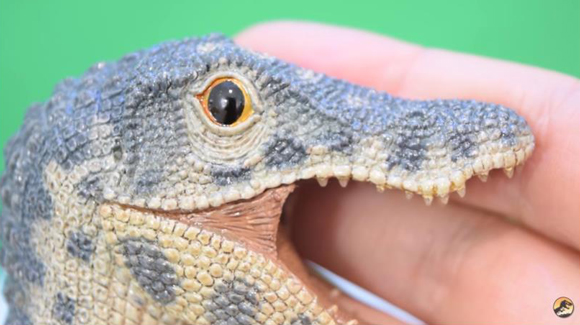
A close-up view of the glossy eye of the Rebor hatching Baryonyx figure.  Did dinosaurs sleep with one eye open?

Picture credit: Jurassic Collectibles

Studying Extant Reptiles

Researchers from the Max Planck Institute for Ornithology (Germany) along with colleagues from La Trobe University (Australia) studied the sleep patterns and behaviours of Saltwater crocodiles.  These reptiles tended to sleep with both eyes closed but when another crocodile was introduced into their tank or a person approached, they kept one eye focused on the intruder.  Dinosaurs may have been vulnerable when they slept, as close relatives of the Dinosauria, demonstrate unihemispheric sleep, it is intriguing to consider whether dinosaurs slept with one eye open.

To view the large range of dinosaur themed toys and educational gifts available from Everything Dinosaur: Dinosaur Toys and Gifts.

Extension Ideas and Activities for Schools

  • Question.  Why would some animals want to evolve the ability to keep alert whilst part of their body slept?

Answer.  When animal’s sleep they are vulnerable to attack, staying vigilant in this way can help to keep the animal’s safe.  In addition, some aquatic mammals are able to do this (dolphins etc.), they sleep with one eye open so that they can keep an eye on the rest of the pod.  It stops them becoming detached from their social group.

  • Question.  In what other ways could sleeping animals keep themselves safe?

Answer.  They could hide, for example in burrows, they could climb trees to keep themselves safe (many birds roost in trees), they could live in a group such as a herd.   Whilst some herd members slept others could keep watch.

  • Question, one aimed at more capable of learners tied in with KS3 studies.  If unihemispheric sleep is found in some mammals, birds and reptiles all vertebrates that are not that closely related to each other how did this come about?

Convergent Evolution

Answer.  This ability may have evolved in unrelated groups of animals independently, a case of convergent evolution, whereby similar characteristics evolve in unrelated animals as a result of having to adapt to similar environments or conditions.  Alternatively, this ability could have evolved long ago, in the shared, common ancestor of modern birds, mammals and crocodiles.

Ask the pupils to think about other examples of convergent evolution, for example bird wings and those of bats – similar characteristics but ones that have evolved independently in unrelated animals.

Everything Dinosaur team members work hard helping customers with their questions and queries, to view our testimonials: Everything Dinosaur Testimonials.

Go to Top