All about dinosaurs, fossils and prehistoric animals by Everything Dinosaur team members.

Everything Dinosaur team members working in schools, helping museums and other educational bodies. Our work with and in schools.

16 10, 2015

Would a Dinosaur Make a Good Pet?

By |2023-04-07T12:35:23+01:00October 16th, 2015|Categories: Key Stage 1/2|Comments Off on Would a Dinosaur Make a Good Pet?

Oakdene Primary School Year 2 Discuss Dinosaurs as Pets

Would a dinosaur make a good pet?  That was the question addressed this half-term by Year 2 pupils at Oakdene Primary School (Rainhill).  Teacher, Miss Barlow, had prepared an enriching and challenging scheme of work for the children and with the aid of Mrs Cross (Learning Assistant) and Miss Waine (Learning Support Assistant), the budding young palaeontologists had been discovering what resources animals need in order to survive as well as developing an understanding of simple food chains.  Lots of non-fiction writing exercises had been incorporated into the lesson plans, and the children had been busy writing statements about dinosaurs, facts about these prehistoric animals that they had found out through their own independent research.

Everything Dinosaur School Visit

Lots of Facts About Dinosaurs on Display

Learning about dinosaurs.

Work to “bee” proud of. Picture credit: Everything Dinosaur.

Picture credit: Oakdene Primary School/Everything Dinosaur

Would a Dinosaur Make a Good Pet?

Would a dinosaur make a good pet?  This was the “challenge question” set for the class.  One of the aims of this term is to help the Year 2 children gain more confidence with reading.  Various stories and non-fiction books had been read by the children as they explored whether or not a dinosaur would be a good pet.

A dinosaur workshop delivered by one of the fossil experts at Everything Dinosaur certainly helped, as the children learned that although the likes of Tyrannosaurus rex and Triceratops were most certainly a bad idea when it came to pet selection, some types of dinosaur, especially the small, feathery, fast-running ones that were a little smarter might actually make quite a good pet.  We discussed what it would be like to have a pet Velociraptor visit the school. Could you train a Velociraptor to catch a ball?

Learning About Dinosaurs

Shoe Box Dinosaur Worlds – Linked to Habitats

Learning about dinosaurs.  A dinosaur shoebox world.

A dinosaur shoebox world created by a pupil. Picture credit: Everything Dinosaur.

Picture credit: Oakdene Primary School/Everything Dinosaur

Year Two Pupils Learning About Dinosaurs

The Year 2 pupils were challenged to create a suitable habitat for a dinosaur, using shoe boxes and other small containers the children created mini dinosaur worlds.  Water, plants to eat, other dinosaurs to hunt and places to hide were all included.  Clearly the children had thought carefully about the resources an animal needs to survive.

After a morning of dinosaur themed activities we left the children with a couple of extension activities, one of which involved measuring just how big Ankylosaurus and T. rex actually were using toilet rolls instead of rulers.  This exercise will help encourage the children to work in small groups and to develop their problem solving skills.    We also gave the class one of our “pinkie palaeontologist challenges”, could they design their very own dinosaur?

New Fossil Discoveries

With a new dinosaur being named and described every two to three weeks or so, there are certainly a lot of different types of dinosaur now known to inspire them.

Visit Everything Dinosaur’s website: Everything Dinosaur.

The dinosaur footprint exercise and the subsequent extension activity should help the children gain more confidence in using numbers.  One of the key teaching aims this term is to help the children explore numbers further, building on the Year 1 curriculum but this time placing a greater emphasis on the value of numbers.  Comparing hands to the feet of dinosaurs and using measuring cubes to work out the difference is a useful activity and should provide plenty of opportunity for the children to gain more confidence when using simple arithmetic.

To see the range of dinosaur toys and games available from Everything Dinosaur: Dinosaur Toys and Gifts.
15 10, 2015

Special Dinosaurs at St Paul’s Primary School

By |2024-05-05T15:11:00+01:00October 15th, 2015|Categories: Educational Activities, Main Page, Teaching|0 Comments

Year 1 Study Dinosaurs

Today, one of Everything Dinosaur’s fossil experts visited St Paul’s R.C. Primary school to help Year 1 with their term topic which is all about fossils and dinosaurs.  Under the expert tutelage of the class teacher (Miss Holdsworth) and with the support of the enthusiastic teaching assistant Mrs Sharpling, the children have been busy learning about prehistoric animals and famous people from history such as Mary Anning.

Prehistoric Animal Themed Scenes

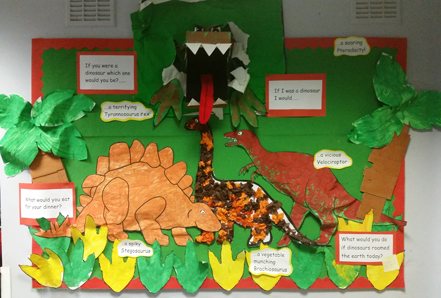
Outside the classroom, the Year 1 children had helped create a very colourful dinosaur inspired wall display.  Our dinosaur expert certainly felt at home when he saw the wonderful artwork.

Prehistoric Animal Themed Scenes Outside the Year 1 Classroom

Dinosaur workshop.

A wonderful dinosaur wall display. Picture credit: Everything Dinosaur.

Picture credit: Everything Dinosaur

Velociraptor and Tyrannosaurus rex (meat-eaters), feature on the wall display, along with a flying reptile and two dinosaurs that ate plants (Brachiosaurus and Stegosaurus).  During the morning, we explored dinosaurs that ate meat and learnt about some plant-eating dinosaurs as well.  The fierce monster bursting out of the wall in the picture above is most impressive.  A fantastic red tongue can be seen in the photograph and our dinosaur expert explained to the children just how long the tongues of some dinosaurs could be.

Visiting a Year 1 Classroom – Learning About Dinosaurs

In the Year 1 classroom, the children had a role play area in which to store their dinosaurs.  The role play table was just at the right height for the children, thanks to the excellent woodworking skills of Miss Holdsworth.  If Everything Dinosaur ever need some scaffolding put up around one of our mounted dinosaur skeletons, we now know who to call. Our congratulations to Miss Holdworth.  The table was ideal for creative, imaginative play.

A Role Play Area – Great for Creative, Imaginative Play

Dinosaur workshops

A role play table for Year 1. Picture credit: Everything Dinosaur.

Picture credit: St Paul’s Primary/Everything Dinosaur

Learning About Dinosaurs

 The walls of the well organised classroom were covered in examples of the children’s work.  A space had been set aside on one of the walls for some dinosaur bone art that had been planned for later on in the term topic.  Another wall displayed the results of a writing exercise in which the Year 1 children had written about what they would do if they were a dinosaur.  When working with Lower Key Stage 1 children in the autumn term the focus is on getting the children to feel more confident with their writing.

The exercise helped the children with the spacing of words and the use of grammar such as the full stop and comma.  The “pinkie palaeontologist challenge” we set the class which involved composing a short story about a Triceratops coming to lunch at the school should also assist the budding young scribes.

Examples of Individual Work Posted on the Classroom Wall

Learning about dinosaurs.

Work to “bee” proud of. Picture credit: Everything Dinosaur.

Picture credit: St Paul’s Primary/Everything Dinosaur

The picture above show a dinosaur themed writing display which the children can certainly be proud of.  It is a very colourful and attractive display.  We congratulate the children and their teachers.

After the morning dinosaur themed workshop had been concluded, Mrs Sharpling led the class in a singing of “Yellow Bird”, this was very appropriate as during the teaching session our dinosaur expert had informed the children that many dinosaurs might have been covered in feathers, even bright yellow ones.

Visit Everything Dinosaur’s website: The Everything Dinosaur Website.

14 10, 2015

Astonishing Dinosaur Eggshells May Hold Key to Warm-blooded Debate

By |2024-05-05T18:09:19+01:00October 14th, 2015|Categories: General Teaching, Key Stage 3/4|Comments Off on Astonishing Dinosaur Eggshells May Hold Key to Warm-blooded Debate

Eggshell Study suggests Dinosaurs Not Warm-blooded

Research published in the journal “Nature Communications” may have helped settle a 150-year-old debate amongst palaeontologists.  Analysis of the behaviour of two isotopes found in calcium carbonate, the main ingredient in eggshell suggests that dinosaurs were not warm-blooded (endotherms), neither were they cold-blooded (ectotherms) but they were somewhere in between.   The scientists conclude that dinosaurs were probably mesothermic, able to raise their internal body temperature above that of their immediate surroundings, but not all dinosaurs were able to maintain a body temperature at the level of today’s birds and mammals.

Dinosaur Eggshell Study

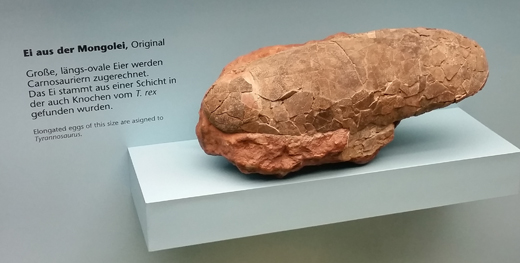
A dinosaur egg fossil.

A dinosaur egg (believed to be from a theropod dinosaur).

Picture credit: Everything Dinosaur

A total of nineteen eggs from two different types of dinosaur were studied.  Eggshells from Argentina representing a Late Cretaceous, herbivorous titanosaur along with fossilised eggs from a theropod dinosaur (oviraptorid) from Mongolia were included in this ground-breaking research.  If scientists can determine the body temperature of extinct animals this will help them calculate metabolic rates and provide valuable data on how active these animals were.

Cold-blooded reptiles (ectotherms), like crocodiles are only capable of bursts of activity and rely on external sources of heat (the sun) to help them maintain a constant body temperature.  More active animals, (endotherms) like mammals and birds can generate internal heat and are generally a lot more active than their reptile counterparts.

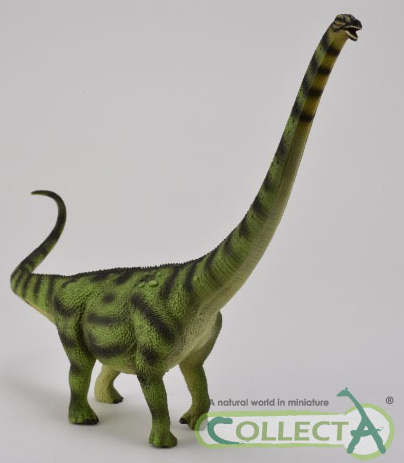
An Example of a Typical Titanosaur

Daxiatitan model by CollectA.

Perhaps up to 30 metres in length?

Picture credit: Everything Dinosaur

The picture (above) shows a sauropod model in the CollectA Age of Dinosaurs model range.

To view this range: CollectA Prehistoric Life Figures.

Dinosaur Eggshells

Commenting on the significance of this pioneering research, study co-author Aradhna Tripati (Assistant Professor of the University of California, Los Angeles) stated:

“This technique tells you about the internal body temperature of the female dinosaur when she was ovulating.  This presents the first direct measurements of dinosaur body temperatures.”

The research team conclude that clumping studies of two rare isotopes found in the eggshells show that oviraptorids (closely related to birds), were able to raise their body temperatures above that of their environment but not as high as warm-blooded animals (endotherms).  The much larger titanosaur had a body temperature slightly higher than our own.

This suggests that variable thermoregulation likely existed in the non-avian dinosaurs but not all dinosaurs had the body temperatures typical of modern birds and mammals which generally tend to be very active.

To read further articles on the dinosaur warm-blooded versus cold-blooded debate:

Clumped isotope analysis could determine endothermy: Isotope Analysis Could Help Shed Light on the Metabolism of the Dinosauria.

Warm-blooded or cold-blooded dinosaurs: Evidence to Support the warm-blooded or cold-blooded Debate in the Dinosauria.

Dinosaurs were endothermic: Endothermic Dinosaurs? The Debate Hots Up.

12 10, 2015

Remarkable Ancient Horse Foal and Mare Fossils

By |2023-04-07T10:39:18+01:00October 12th, 2015|Categories: General Teaching, Key Stage 3/4|Comments Off on Remarkable Ancient Horse Foal and Mare Fossils

Ancient Horse Foetus Identified from Fossil Remains

Scientists from the Senckenberg Research Institute (Frankfurt, southern Germany), working in conjunction with colleagues from the University of Veterinary Medicine (Vienna, Austria) have identified the fossilised remains of a prehistoric horse foetus.  The 48-million-year-old fossil was excavated from the famous oil shales of Messel (near Frankfurt).

Fossil Discovery

The fossil was discovered fifteen years ago and set in resin to preserve it.  Using a combination of scanning electron microscopy and high powered X-rays, the scientists were able to identify the remains of an unborn foal within the adult animal.

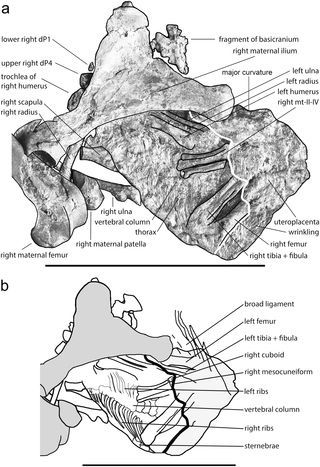
The Fossil of the Ancient Horse (White Ellipse Marks the Site of the Foetus Fossil)

Eurohippus Feotus

Scale bar 10 cm (A and B).  A line drawing and photograph of the Eurohippus foetus.

Picture credit: Senckenberg Research Institute

Eurohippus Foetus

This is the oldest equine foetus known.  The academic paper detailing this research has just been published in the scientific journal PLOS One.  It is widely believed that horses evolved from small, five-toed forest animals such as Propalaeotherium, fossils of which have been found in the Messel shales.  It seems that these ancient early horses thrived in the tropical forests of Europe that covered much of the Northern Hemisphere during the Eocene Epoch.

In this instance, the horse has been identified as an example of a genus called Eurohippus (Eurohippus. messelensis).  This is a remarkable fossil discovery.  An ancient mare preserved with her unborn foal.

For models and replicas of prehistoric animals including ancient horses: Wild Safari Prehistoric World Models.

11 10, 2015

Beautiful Dinosaurs Inspire Handwriting

By |2024-05-05T17:09:48+01:00October 11th, 2015|Categories: General Teaching, Key Stage 1/2|Comments Off on Beautiful Dinosaurs Inspire Handwriting

Dinosaurs Inspire Handwriting

Following a dinosaur workshop with Lower Key Stage 1 children at a Nottinghamshire school, Everything Dinosaur’s fossil expert was asked to provide some extension ideas to help the teaching team keep the children motivated when it came to their writing.  Our expert suggested a number of activities and once back in the office, further supplementary resources and other support materials were emailed over to assist the teachers and the teaching assistants with their dinosaur themed term topic.

Dinosaurs Inspire Handwriting

Dinosaurs Inspire Handwriting

Dinosaur workshop thank you letter.

Dinosaur workshop thank you letter. Picture credit: Everything Dinosaur.

Picture credit: Everything Dinosaur

Thank You Letters

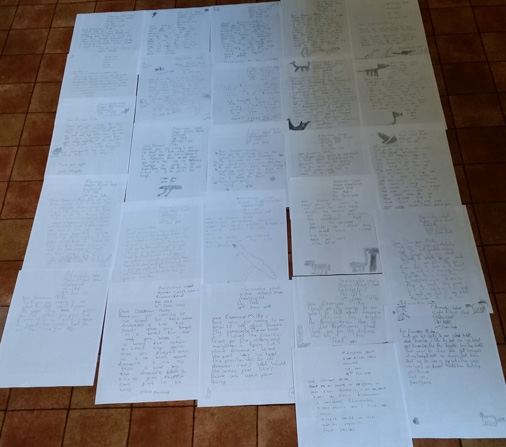
One of our suggested extension activities was to challenge the children to write us a thank you letter.  Could they include a statement in their letter telling us about their favourite part of the dinosaur workshop?  Could they use capitals and punctuation?  We received some really well crafted and well written thank you letters, a most impressive effort.  Well done to all.

Team members at Everything Dinosaur enjoyed reading all the thank you letters.  It was a case of dinosaurs inspire handwriting as a result of the dinosaur themed workshop at the school.

For further information about Everything Dinosaur’s work in schools: Email Everything Dinosaur.

To read testimonials from teachers, teaching assistants and members of the senior leadership team who have had visits from Everything Dinosaur to conduct fossil and dinosaur workshops or purchased items from Everything Dinosaur: Everything Dinosaur Testimonials.

All the Children in the Class Took Part in the Letter Writing Extension Activity

A set of thank you letters from a class.

Pupils sent in thank you letters to Everything Dinosaur. Picture credit: Everything Dinosaur.

Picture credit: Everything Dinosaur

Everything Dinosaur

A spokesperson from Everything Dinosaur commented that team members liked to provide additional support to teachers and teaching assistants by proposing lots of extension activities after a dinosaur workshop.

Everything Dinosaur stocks a huge range of prehistoric animal and dinosaur themed toys and games. To visit Everything Dinosaur’s user-friendly and award-winning website: Visit Everything Dinosaur.

10 10, 2015

Top Rocks – Best Locations UK and Ireland (Geology)

By |2023-04-07T09:16:52+01:00October 10th, 2015|Categories: General Teaching|Comments Off on Top Rocks – Best Locations UK and Ireland (Geology)

Top One Hundred Geology Sites (UK and Ireland) – In Praise of British Geology

In celebration of Earth Science week which officially starts today (10th to 17th October 2016), the British Geological Society has published a survey showing the top one hundred locations in terms of their geological significance in the UK and Ireland.   The list was compiled from photographs sent in by members of the public and then they was a popular vote to decide the “people’s choice” in terms of favourite geology sites.  Sites from all over the British Isles and Ireland were selected, four of the top ten sites listed come from Scotland, the other six can be found in England.

In Praise of British Geology

The Foreland Mountains of Sutherland (Scotland)

In Praise of British Geology

Voted number one in the British Geological Society Survey.

Picture credit: The British Geological Society

Different Categories Listed

In order to help with the many hundreds of entries, the survey was divided into ten broad categories which included “fire and ice”, “human habitation” and sites which are “historically and scientifically important”.  The famous beaches at Lyme Regis, part of the amazing “Jurassic Coast” featured, in the top fifty.

Fossils at Lyme Regis

In Praise of British Geology - Lyme Regis

Stonebarrow and Golden Cap can be seen in the background. In praise of British Geology.

Picture credit: Everything Dinosaur

The Top Ten Locations

The top ten geology locations as voted by members of the public (over 1,200 people took part) are:

  1. The Foreland Mountains Assynt (Sutherland, Scotland) with its rugged, isolated mountains (see picture at the top of this article).
  2. Ironbridge Gorge (Shropshire).
  3. Siccar Point (Scotland) the site of a world famous unconformity where the junction between the older, tilted layers of greyish sandstone and the younger Old Red Sandstone is seen.
  4. The Rotunda Museum (North Yorkshire) a building design suggested by the famous geologist William Smith (built 1829).
  5. Staffa – the basaltic columns on the island (Inner Hebrides).
  6. Stonehenge, a World Heritage site in Wiltshire.
  7. Hunstanton Cliffs – a wonderful coastal location where the red limestone is capped by white chalk.
  8. The Craster Coastline, with its unusual geology and many notable outcrops.
  9. Millook Haven – North Cornwall into Devon showing wonderful geological formations including folds of inter-bedded sandstones.
  10. Glencoe (Scotland), the remnants of a long extinct super volcano that existed back in the Palaeozoic Eon.

Everything Dinosaur – In Praise of British Geology

A spokesperson from the Cheshire based dinosaur company, Everything Dinosaur stated:

The British Isles [the United Kingdom and Ireland] have some wonderful and simply amazing geological features.  We urge members of the public to learn more about these fascinating locations and to get out and about and explore them.”

The British Geological Society (based London), may be the oldest geology society in the world, (founded in 1807), but the UK and Ireland has still got a huge array of amazing places to discover and explore that are not that well known to members of the public.

Visit Everything Dinosaur’s website: Everything Dinosaur.

9 10, 2015

Thank You Letters from Year 3

By |2023-04-07T09:09:02+01:00October 9th, 2015|Categories: Dinosaur Fans, Educational Activities, Main Page, Teaching|0 Comments

Dinosaur Workshop Helps Handwriting

Children in Year 3 at Southglade School (Nottinghamshire) got to grips with dinosaurs and fossils as part of their science term topic which focused on prehistoric life.  A fossil expert from Everything Dinosaur was dispatched and he spent a morning with the Year 3 classes helping them to explore life in the past.  One of the key aims of the teaching scheme of work was to help the children develop a better understanding of how fossils form and which rocks are likely to contain fossils.

Rocks and Fossils

The Everything Dinosaur member of staff was able to explain to the children using lots of examples in a session that was orientated towards kinaesthetic learning.

Dinosaurs in Schools

Dinosaurs in school.

Dinosaurs in school. Everything Dinosaur received thank you letters from Year 3 children.

Picture credit: Everything Dinosaur

To see the range of edcuational toys and games available from  Everything Dinosaur’s website: Dinosaur Toys and Gifts.

Dinosaur Workshop

Our dinosaur expert had been briefed about one of the teaching objectives required.  The teacher wanted to help motivate the children with their writing, particularly composition. The boys had become less than enthusiastic when it came to writing and sentence construction, although they were very enthusiastic about the dinosaur themed science topic.  During the session the children were set a number of “pinkie palaeontologist challenges” all geared of course, to helping the children with their literacy and writing.

One of the extension activities proposed was for the children to compose a thank you letter to their visitor from Everything Dinosaur, our expert challenged them to write a thank you letter which contained a statement (what they liked best about the dinosaur workshop) and to use proper punctuation.

The children responded eagerly to the challenge and the teaching assistant reported back that the children could not wait to start their letters.  We received some excellent examples, these were posted to the Everything Dinosaur offices, we did respond to all those that required a reply.

Year 3 Children Send in Thank you Letters to Everything Dinosaur

Children compose thank you letters after dinosaur workshop.

Children compose thank you letters after dinosaur workshop.

Picture credit: Everything Dinosaur

Thank You Letters

 Commenting on the letters received a spokesperson for the teaching team at Everything Dinosaur stated:

“We do appreciate how difficult it can be sometimes to motivate children in Lower Key Stage 2 with writing tasks.   However, after our workshop it was wonderful to see how enthusiastically the children responded to our challenge and our team members read every single one of the thank you letters we received.”

A teacher responsible for one of the classes praised Everything Dinosaur and stated:

“Everything Dinosaur delivered a fantastic morning.  Correspondence prior to the session was excellent and we were sent a very detailed lesson plan.  The sessions were pitched at the right level for the classes and we received lots of ideas for extension activities, it was a thoroughly enjoyable and informative experience.  Thank you very much.”

It looks like dinosaurs have proved to be a “roaring” success in Nottinghamshire.

7 10, 2015

A New Species of Bizarre Rat from Sulawesi

By |2023-04-06T08:08:56+01:00October 7th, 2015|Categories: Key Stage 3/4|Comments Off on A New Species of Bizarre Rat from Sulawesi

Hyorhinomys stuempkei – A Unique Rodent for a Unique Ecosystem

An international team of researchers led by scientists from Museum Victoria (Australia) have identified a new species of rodent in the remote forests on the Indonesian island of Sulawesi.  The rat has been named Hyorhinomys stuempkei and it just one of a number of new types of rodent believed to be endemic to the remote and mountainous forests of Sulawesi.  The name translates from the Greek, hyo meaning “hog”, rhino meaning “nose” and mys meaning “rat”, this is the hog-nosed rat, an apt description due to this little critter’s large, pink nose with forward facing nostrils.

Hyorhinomys stuempkei

Hyorhinomys stuempkei – The Hog-nosed Rat of Sulawesi

Hyorhinomys stuempkei.

The Hog-nosed rat – Hyorhinomys stuempkei.

Picture credit: Jacob Esselstyn/Louisiana State University

Sulawesi East of the “Wallace Line”

Sulawesi lies to the east of the imaginary “Wallace line”, a boundary between the faunas of Asia and Australasia that was noted by Alfred Russel Wallace, the naturalist and explorer who co-authored the famous 1858 scientific paper on the evolution of organisms by natural selection, with Charles Darwin.

The Wallace Line Dividing Asian and Australasian Faunas

The Wallace Line.

Marking the barrier between Asian and Australasian faunas.

Picture credit: Google Maps with Annotation by Everything Dinosaur

Alfred Russel Wallace (1823-1913), proposed a theory related to the zoogeographical spread of organisms.  He noted that the animals of the world could be divided up into zoogeographical zones.  Sulawesi marks a boundary between two of these zones.  Many Asian faunal lineages have their eastern most distribution on Sulawesi and conversely many Australian lineages have their most westerly distribution on the island.

How Did this Zoogeographical Zone Come About?

There is some mixing of Asian and Australasian lineages on Sulawesi, but in mammals the fauna seems to be very different from what is seen in Asia and also from the marsupial dominated Australia.  The explanation is that during the ice sheet advances during the Ice Ages, large amounts of water became locked up.  This led to a subsequent fall in sea levels,  uniting parts of south-east Asia that, today, are separated by shallow seas.  The sea level is estimated to have fallen by as much as 120 metres.  Mammals such as rodents were able to migrate across these land bridges but the deep water channel that exists today between the islands of Bali and Lombok, would still have existed, forming a natural barrier preventing the migration of Australasian mammals northwards, and Asian mammals southwards.

A spokesperson from Everything Dinosaur commented:

“Nature can still surprise us.  There are probably many types of rodent and bats awaiting discovery in some of the more remote parts of our planet.”

Visit Everything Dinosaur’s website: Everything Dinosaur.

7 10, 2015

New Species of Rat Discovered in Sulawesi

By |2023-04-06T08:05:24+01:00October 7th, 2015|Categories: Animal News Stories, Main Page, Teaching|0 Comments

The Magical Rodent Infested Forests of Sulawesi – Hyorhinomys stuempkei

The small island of Sulawesi can be found in the central part of the range of islands that form Indonesia.  The fauna of this heavily forested island has fascinated scientists for a very long time.  It is located approximately half-way from Australia and Papua New Guinea to the east and Malaysia/south-east Asia to the west.

An Ancient Ecosystem

The Philippines lie to the north.  Researchers have studied the Sulawesi ecosystem in order to gain an understanding of how organisms have migrated across land bridges that once existed in the past.  Think of Sulawesi and this part of the world as a crossroads, where the fauna of Australasia and the rest of Asia mixes.

The Magnificent and Remote Mountainous Forests of Sulawesi

A magical place with a unique fauna.  The remote forests of Sulawesi.

A magical place with a unique fauna. The remote forests of Sulawesi.

Picturecredit: Dr Kevin Rowe/Museum Victoria

Alfred Russel Wallace

The great scientist and naturalist Alfred Russel Wallace, who co-authored the 1858 paper on the theory of evolution by natural selection with Charles Darwin, spent many years exploring the jungles and forests.  It was because of his travels in this part of the world that he formulated many of his ideas on the natural world.  Wallace’s in-depth exploration of the Indonesian islands allowed him to develop a theory related to the geographical spread of organisms.  He noted that the world’s animals could be divided up into zoogeographical regions, the Mammalian fauna of Indonesia illustrate this idea nicely.

Sulawesi

Sulawesi lines to the east of an imaginary line drawn through the archipelago (the Wallace Line).  Many Asian animal types have their eastern most distribution on Sulawesi and conversely many Australian lineages have their most westerly distribution on Sulawesi.  This has led to evolution of a very unique fauna on the island, most of the human inhabitants (about twenty million) live on the coast, some parts of the island remain relatively unexplored.  The island is also very big, it is the eleventh largest island in the world, and its landmass is roughly equivalent to the size of England, Wales and Northern Island combined.

The Approximate Position of the Wallace Line

Marking the barrier between Asian and Australasian faunas.

Marking the barrier between Asian and Australasian faunas.

Picture credit: Google Maps/Everything Dinosaur

Trapping and Studying Rodents

Over the last few years, scientists from Museum Victoria, in collaboration with Indonesian colleagues and researchers from the United States have been trapping rodents in the forests found in the more mountainous and difficult to access parts of the island.  They have recorded a unique and very varied rodent assemblage, including the latest addition, the newly discovered Hyorhinomys stuempkei (hog-nosed rat).

This rat with its proportionately large ears, flat claws and bizarre hog-like nose is so genetically different from other species that it has been assigned its own genus.   A paper on the research team’s study will be published this month in the “Journal of Mammalogy”.

Hyorhinomys stuempkei (hog-nosed rat) of Sulawesi

The Hog-nosed rat - Hyorhinomys stuempkei

The Hog-nosed rat – Hyorhinomys stuempkei.

Picture credit: Jacob Esselstyn/Louisiana State University

Hyorhinomys stuempkei

H. stuempkei is not the first new rodent species to be discovered by Dr Kevin Rowe (Museum Victoria) and his colleagues.  Sulawesi seems to be home to a whole host of unique rodents.  For example, Dr Rowe was involved in the discovery and description of a very curious rat – Paucidentomys vermidax, a rodent like no other known to science.  It is almost toothless and unable to gnaw or chew.  It hunts worms and other soft-bodied creatures on the forest floor.  It’s discovery provided evidence to scientists that, under certain conditions, even highly successful traits such as gnawing teeth, a defining characteristic of the Rodent Order, can be lost.

The Almost Tooth-less, Worm Eating Paucidentomys vermidax

Paucidentomys vermidax - a bizarre newly discovered rodent from Sulawesi.

Paucidentomys vermidax – a bizarre newly discovered rodent from Sulawesi.

Picture credit: Museum Victoria

The Hog-nosed Rat (Hyorhinomys stuempkei)

In the case of the hog-nosed rat  Hyorhinomys stuempkei, the striking feature of this rodent is its large, pink and very flat nose with forward facing nostrils.  It also lacks a coronoid process on the lower jaw, an attachment site for muscles involved in chewing that is present in almost all other mammals including our own species.

Hyorhinomys stuempkei is very probably entirely carnivorous feeding on invertebrates, possibly bounding or hopping after its prey as its back legs are unusually long.  It has a disproportionately small mouth, but long incisors, which are bright white (strange for a rat as the incisors are usually orange coloured in most other rodents).  Take note of this, could companies with an interest in selling tooth-whitening products be making a bee-line for the remote forests of Indonesia?

Commenting on the Discovery

Commenting on the new rodent discovery, Dr Rowe stated:

“The Hog-nosed Rat is exciting for us because it extends the diversity of an already amazing group of rodents that are only found on the island of Sulawesi.  Even though there are only eight species in this endemic group, they exhibit a huge eco-morphological range including small grey rats, a nearly toothless vermivore, an amphibious rat, and now a long-limbed, hog-nosed rat.  There are millions of species on this Earth that are yet to be discovered and described, but I am still amazed that we can walk into a forest and a find a new species of mammal that is so obviously different from any species, or even genus, that has ever been documented by science.”

It’s worth noting that almost all of the mammals native to Sulawesi are endemic to this island and the genus name Hyorhinomys translates from the Greek as hog (hyo), nose (rhino) and rat (mys).

The Research Team

Discovered by an international team comprising Dr Kevin Rowe (Museum Victoria); Heru Handika (Museum Victoria); Anang Achmadi (Museum Zoologicum Bogoriense); and Dr Jacob Esselstyn (Louisiana State University Museum of Natural Science) this new discovery is the third new genus described by this international collaboration since 2012.

Visit Everything Dinosaur’s award-winning website: Visit Everything Dinosaur.

6 10, 2015

Year 3 Get to Grips with Rocks and Fossils

By |2023-04-06T16:58:16+01:00October 6th, 2015|Categories: Key Stage 1/2|Comments Off on Year 3 Get to Grips with Rocks and Fossils

Rocks, Fossils and Dinosaurs at Pebble Brook Primary

To  kick-off Year Three’s new topic all about rocks, fossils and dinosaurs, a team member from Everything Dinosaur was invited into the school for a morning.  Under the enthusiastic tutelage of the class teacher Mr Tinsley, the children explored how fossils form, how they feel and what they can tell us about animals that lived in the past.

The Science Topic

For the science topic, the class have been examining different types of rock, they have even been on a trip around the school grounds to find examples of different sorts of rock and stone.  Our fossil expert explained that some rocks form layers and that by looking at the order in which the layers of rocks have been laid down, then it is possible to work out the relative ages of the different layers.  The colourful “Word Wow Wall” helped to illustrate this point.

Year 3 are Learning about Rocks and Fossils

Rocks and fossils.

Rocks and fossils with Year 3. Picture credit: Everything Dinosaur.

Picture credit: Everything Dinosaur

Rocks and Fossils

The children learned that fossils are usually found in those rocks that form layers (sedimentary rocks).  Using special casting powder, that looked like flour but was actually a form of powdered rock (gypsum), the children were able to cast copies of the fossilised teeth of prehistoric animals.  Although the water used in the experiment came from the cold tap, as the casting powder slowly turned the liquid in the moulds into a solid, heat was given off.  This is a chemical reaction.  Some rocks get squeezed, pushed and heated and just like the water, they can go through a change of state.  These rocks changed by heat and pressure are called metamorphic rocks.

Volcanoes and Dinosaurs on Display

Rocks and fossils with Year 3.

Rocks and fossils with Year 3.  Picture credit: Everything Dinosaur.

Picture credit: Everything Dinosaur

There were lots and lots of dinosaurs on display too.  As the children will be learning about fossils over the next few weeks, there will be time to explore these amazing prehistoric creatures, not all of which are officially extinct.

Defining the Word Extinct

Year 3 were able to define what the word extinct means and then thanks to the fossil expert who visited the school, the class got to see some objects that suggest that there are animals around today that are so closely related to dinosaurs, that they should really be called dinosaurs!

Visit Everything Dinosaur’s award-winning website: Everything Dinosaur – Shop.

We set the class one or two extra “pinkie palaeontologist challenges” involving some maths and a writing exercise.  We look forward to hearing how the budding palaeontologists at Pebble Brook Primary fare.  They certainly enjoyed themselves, it was a super fact-filled morning – Yabba Dabba Doo!

To view the extensive range of educational toys and gifts available from Everything Dinosaur including replicas of famous fossil animals: Dinosaur Crafts and Replica Fossils.

Go to Top