All about dinosaurs, fossils and prehistoric animals by Everything Dinosaur team members.

Everything Dinosaur team members working in schools, helping museums and other educational bodies. Our work with and in schools.

11 12, 2015

An Amazing Mosasaur From Japan

By |2024-05-05T18:18:45+01:00December 11th, 2015|Categories: General Teaching, Key Stage 1/2, Key Stage 3/4|Comments Off on An Amazing Mosasaur From Japan

Scientists Describe New Species of Marine Reptile – A New Mosasaur from Japan

Scientists from the Royal Tyrrell Museum, the University of Alberta (Canada), the University of Cincinnati (USA), Hobetsu Museum, Fukuoka University (Japan) and the University of Cincinnati (USA) have published a scientific paper announcing the discovery of a new species of a type of marine reptile known as a mosasaur.  This new mosasaur has been named Phosphorosaurus ponpetelegans. The huge eye socket in the skull suggests that this animal, distantly related to  modern snakes and lizards, hunted in low light conditions.

Mosasaur from Japan

An Illustration of the Newly Described Mosasaur
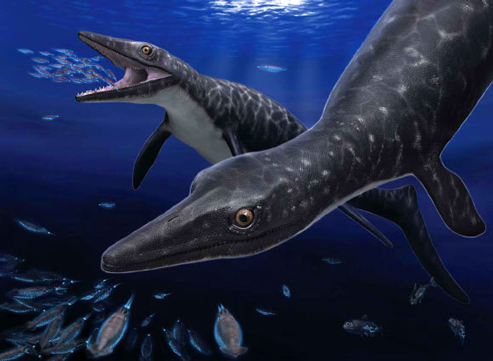
Mosasaur from Japan

The first Japanese Mosasaur to be identified.

Picture credit: Tatsuya Shinmura / Ashoro Museum of Palaeontology / Trustees of the Natural History Museum, (London).

There are a number of mosasaur models in stock at Everything Dinosaur, for example, PNSO stocks a mosasaur replica: PNSO Age of Dinosaurs Models.

A Three-metre-long Carnivore

Scientists have suggested that this three-metre-long carnivore may have specialised in hunting in deep water.  Perhaps it evolved to fill a specific ecological niche, that of a night time hunter preying on bioluminescent fish and squid.  Fossils of such fish along with cephalopods have been found in the same Upper Cretaceous strata on the island of Hokkaido (northern Japan), where the mosasaur fossils were found in 2009.

A Picture of the Prepared Fossil Skull of Phosphorosaurus Showing the Huge Eye Socket
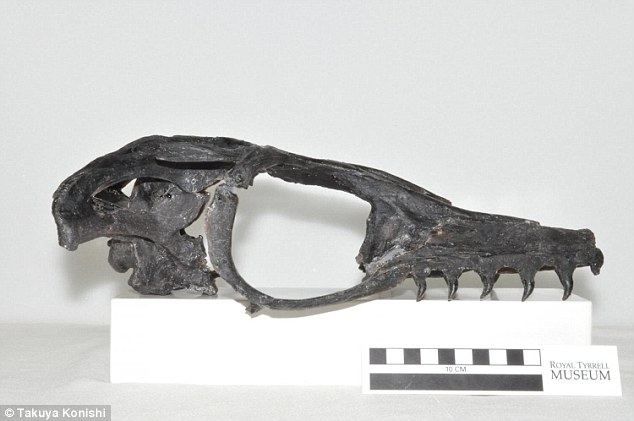
Mosasaur from Japan.

The skull in lateral view showing the huge eye-socket.

Picture credit: Takuya Konishi et al.

Teaching Ideas/Extension Ideas

  1. Note that the photograph above has a scale bar showing below the fossilised skull (line of black and white squares).  Why do palaeontologists put a scale bar on their photographs?
  2. Approximately, how long is the skull of this marine reptile (note each black and white square in the scale bar equals one centimetre)?
  3. How wide is the eye socket in centimetres?
  4. Why would a carnivorous marine reptile need big eyes (link to the environment/habitat)?
  5. What does it mean when scientists think an animal fitted a “specific ecological niche”?

Everything Dinosaur stocks a variety of mosasaur models and other replicas of marine reptiles: Marine Reptiles and Sea Monster Models.

10 12, 2015

New Dinosaur from Spain

By |2023-04-09T17:26:35+01:00December 10th, 2015|Categories: Key Stage 1/2|Comments Off on New Dinosaur from Spain

New Species of Early Cretaceous Dinosaur Named

A new dinosaur species is named and described every twenty to thirty days according to the database on dinosaur research managed by Everything Dinosaur team members.  The latest addition to the Order Dinosauria is a plant-eating dinosaur from the Early Cretaceous of Spain.  This dinosaur has been named Morelladon beltrani.  Described from the rear portion of the skeleton, including some vertebrae and hip bones, this dinosaur pronounced “mor-rell-ah-don bell-tran-eye”, is believed to have been closely related to Iguanodon.

A Dinosaur from Spain

An Illustration of the Newly Described Spanish Dinosaur Morelladon

Dinosaur from Spain.

An illustration of Morelladon.

Picture credit: Universidad Nacional de Educación a Distancia (Spain)

The bones in the back of this animal have extended spines (neural spines).  These spines may have supported a fleshy hump or perhaps a sail-like structure.

Extension Ideas

  • Challenge the class to find pictures of other dinosaurs in books or on line with humps or sails on their backs.  What do scientists think that these humps and sails were used for?

(clue – look up Spinosaurus, Amargasaurus, Ouranosaurus, Ichthyovenator)

  • Challenge the class to think of animals with humps or sails that are alive today.  Can they name some and explain why these animals have such structures?
  • Why do scientists use information about animals alive today to help them work out how extinct animals may have looked/behaved?
  • How might the hump or sail in a dinosaur evolve?  Can the children come up with some theories?

Everything Dinosaur stocks a large range of dinosaur models including replicas of ornithopods like Morelladon: Dinosaur Models.

Links to the Curriculum

Link to adaptation, variation in populations and environments.  Use to help support science curriculum objectives in Year 6 relating to the exploration of evolution and how fossils can inform us about life in the past.

The Large Spines on the Vertebrae of Morelladon Suggest a Sail or a Hump

Dinosaur from Spain. Morelladon neural spines.

A photograph of the fossil material and accompanying line drawing.

Picture credit: Universidad Nacional de Educación a Distancia (Spain)/PLOS One

Further supporting information to help with school extensions can be found here: New Species of Dinosaur Described from Spain.

6 12, 2015

Dinosaur Skeleton Dig Site Great for Sensory Play

By |2024-05-05T18:20:16+01:00December 6th, 2015|Categories: Early Years Foundation Reception|Comments Off on Dinosaur Skeleton Dig Site Great for Sensory Play

Dinosaur Skeletons and a Sensory Play Area

When thinking about creative play ideas for Early Years Foundation Stage (EYFS) or children in Year 1 who are learning about dinosaurs, try this simple and fun idea to help with exploring the properties of materials.  Dinosaurs as a topic is a great way to help children to move from free-flow play into activity centred learning.  Use a plastic tray, some sand and some plastic dinosaur models to re-create a dinosaur dig for the children.

Dinosaur Skeletons

Sensory Play – Digging up Dinosaur Skeletons

Dinosaur skeleton sensory play area.

A dinosaur sensory play area for the children. Picture credit: Everything Dinosaur.

Picture credit: Everything Dinosaur

The substrate does not have to be entirely sand, in the tray pictured above, a range of small gravels have been added to help the children explore different materials.  The paint brushes are just old brushes from the art department or from home that can’t be used for painting any more.  They make great brushes for the palaeontologists to use to brush away the sand and stones to discover dinosaur skeletons.

Dinosaur Skeleton Models – Ideal for Sensory Play Activities

Dinosaur skeleton

A set of assorted prehistoric animal and dinosaur skeletons.

Picture credit: Everything Dinosaur

To view the range of dinosaur themed learning materials including skeletons and other models: Dinosaur Themed Educational Toys.

The budding palaeontologists loved finding the skeletons in the sand, we then sorted them into matching pairs and split the skeletons into plant-eating dinosaurs and meat-eating dinosaurs.  Some newspaper under the tray is helpful to prevent too much sand ending up on the floor.  We then looked at pictures in books to see how palaeontologists excavate fossils of dinosaurs.  The children were excited when they spotted a paint brush, very similar to one that they had been using, in a photograph of a real-life dinosaur fossil dig.

This is one sensory play idea with a dinosaur theme that we highly recommend.

4 12, 2015

Time for a New Geological Epoch?

By |2023-04-09T15:56:30+01:00December 4th, 2015|Categories: Key Stage 3/4|Comments Off on Time for a New Geological Epoch?

Goodbye Holocene Say Hello to the Anthropocene

As world leaders, scientists, politicians, environmentalists and lobbyists gather in Paris for perhaps the most significant event in modern human history, the global conference on the warming of our planet (COP 21), it is worth reflecting that it already may be too late to reverse the consequences.  Most scientists now agree that climate change is a due in most part to  our species (Homo sapiens) and our impact on the environment.  For the uninitiated, COP 21 stands for the 21st Conference of the Parties to the United Nations Framework Convention on Climate Change.   A global agreement is being sought to limit fossil fuel use and other human activities that could lead to a catastrophic rise in the average annual temperature of Earth.

Is it Time to Define a New Geological Epoch?

Such is the rate of climate change, the totality of climate change and the scale, that many scientists have proposed that this time in the history of our planet deserves its own epoch.  Currently, we are living in the Holocene Epoch (it means “recent time”).  This epoch was defined in the last five years or so by the International Commission on Stratigraphy, the academic body responsible for dividing up the 4.57 billion years or thereabouts of Earth’s history into more manageable chunks of time such as eons, eras, periods and epochs.

The Holocene Epoch is defined as the last interglacial period, it began around 11,500 years ago, with the end of the last Ice Age.

At the turn of the century, scientists Paul Crutzen and Eugene Stoermer introduced the idea of the Anthropocene Epoch, a new epoch to note the dramatic change on our planet caused by human beings and their activities.  The Anthropocene is not an officially recognised scientific term.

A Working Group to Examine the Problem

Next year, a working group headed by Professor Jan Zalasiewicz of Leicester University will put forward to the International Commission on Stratigraphy a formal proposal about adopting the term Anthropocene.  This could set in motion a chain of events that will see the Anthropocene officially adopted as a geological epoch.

It is a sobering thought for many of us, we have lived through a change of millennium, now we could be on the cusp of having lived through a time when one geological epoch was replaced by another.

Visit Everything Dinosaur’s website: Everything Dinosaur.

24 11, 2015

Rocks, Fossils and Remarkable Dinosaurs

By |2024-05-05T14:51:57+01:00November 24th, 2015|Categories: Educational Activities, Main Page, Teaching|0 Comments

Rocks, Fossils and Dinosaurs with Year 3 (Broadway Primary School)

A busy morning spent working with the enthusiastic pupils in Year 3 at Broadway Primary as the children have been learning about rocks, fossils and dinosaurs.   The children were studying life in the past and exploring dinosaurs as their topic for the second part of the autumn term.  This subject area links nicely into the national curriculum science element for England at Lower Key Stage 2 (Rocks, Animals and Working Scientifically).

Aims of the Curriculum

One of the aims of that part of the curriculum related to learning about different types of rocks involves explaining how fossils form and what fossils can tell us about extinct animals.  The girls and boys got the chance to cast their own fossils from Everything Dinosaur’s collection and thanks to the classroom wall they learnt all about how sedimentary rocks get laid down.

Can you See the Fossils in the Layers of Sedimentary Rocks?

Rocks, fossils and dinosaurs

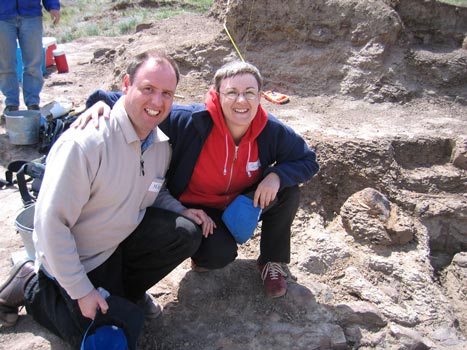
Pause for a pic next to a digs station.  Can you see the fossils in the layers of rock?

Picture credit: Everything Dinosaur

Everything Dinosaur

The picture above shows a view of the amazing Dinosaur Provincial Park Formation which can be found in Alberta (southern Canada).  These rocks were laid down in layers towards the end of “Age of Dinosaurs”, near to the end of the Cretaceous Period.  The dinosaur fossils we find in these rocks are approximately 75 million years old.  Duck-billed dinosaurs and horned dinosaur fossils can be found (herbivores).  There are also fossils of the meat-eating dinosaurs (carnivores) but these are much less common then the plant-eaters.  Can Year 3 work out why?

Visit Everything Dinosaur’s award-winning website: Everything Dinosaur.

We can also find fossils of salamanders, bony fish, lizards and several types of crocodiles, although none of these crocodiles are closely related to the crocodiles alive today.

Dinosaurs and Maths

As part of our workshop and in order to support a number of mathematical themed extension exercises, we looked at how big the teeth of Tyrannosaurus rex really are.  One of the “pinkie palaeontologist” challenges we set the class was whether or not the children could use the special “greater than” and “less than” symbols we sent over to make a table listing items in the classroom that were bigger or small than the T. rex tooth they saw.  Could the children think of a way to present their data?

Benjamin’s favourite dinosaur was Velociraptor, he and some of his chums were shown an unusual way to measure a dinosaur.  Once this relatively small dinosaur had been measured we set the class another challenge that involved them trying to measure a much larger, carnivorous dinosaur.  Let’s hope they can master their eight times table, as this would certainly help!

Dinosaur Models Made by the Children

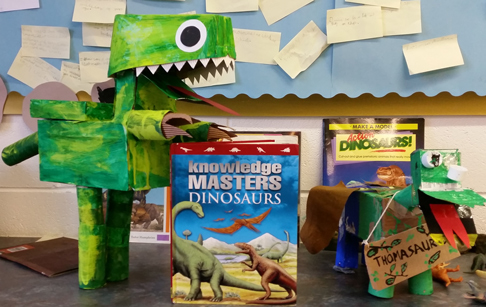
Model dinosaurs on display at Broadoak Primary School.

Model dinosaurs on display at Broadoak Primary School.

Picture credit: Broadway Primary School

On the classroom walls there was lots of excellent evidence of independent learning, the books at the back of the classroom had inspired the young researchers.  There were also a number of wonderful dinosaur models on display.   The Year 3 class had produced some excellent dinosaur replicas and we loved the “Thomasaurus”.

Dinosaurs and Literacy

In collaboration with Miss Heaton (class teacher), we were able to advise on further extension resources, focusing on literacy.  Different types of writing activities were proposed (non-fiction and fiction) and we challenged the children to use some of the resources that we had provided to write statements about prehistoric animals and also to think up some questions to pose for us.  We know Ethan and Emma have questions, we suggested that they save them in their heads and then include them in a thank you letter that they could compose and send to the Everything Dinosaur offices.

Rocks, Fossils and Dinosaurs

We look forward to seeing some of the results of the children’s research as they study rocks, fossils and dinosaurs.

Everything Dinosaur stocks a wide range of dinosaur and prehistoric animal themed toys, crafts and games that have all been approved by our teaching team.  The company even stocks replicas of iconic animals from the fossil record such as ammonites, belemnites and trilobites.

Visit Everything Dinosaur’s award-winning website: Dinosaur Toys, Games and Crafts.

20 11, 2015

Special Dinosaurs with Ysgol Parc Y Llan

By |2024-05-05T14:54:16+01:00November 20th, 2015|Categories: Early Years Foundation Reception, General Teaching|Comments Off on Special Dinosaurs with Ysgol Parc Y Llan

Deinosoriaid ar Droed (Ysgol Parc Y Llan)

Pupils at Ysgol Parc y Llan, a school in picturesque Flintshire (North Wales), have been tracking down dinosaurs and their fossils during the second half of the autumn term.  Under the enthusiastic tutelage of the class teachers Miss Lewis-Jones and Mrs Arkinstone, the budding young palaeontologists in the Reception and Nursery class, in collaboration with the dinosaur fans in the mixed class of Year 1 and Year 2 have been studying dinosaurs and other prehistoric animals.

Dinosaurs and Prehistoric Animals – A Time Machine

There were lots of colourful artwork on display in the well organised classrooms, the children in the Reception/Nursery class had even been exploring how long ago dinosaurs lived.

Dinosaur Themed Time Travel

The Ysgol Parc Y Llan time machine.

The Ysgol Parc Y Llan time machine. Schoolchildren learn about dinosaurs. Picture credit: Everything Dinosaur.

Picture credit: Ysgol Parc y Llan/Everything Dinosaur

The clock concept can help children become more confident with numbers.  It can assist the children with learning to tell the time.

Visit Everything Dinosaur’s website: Everything Dinosaur.

Dinosaur Workshop

Prior to the morning of dinosaur themed activities with the two classes, the fossil expert from Everything Dinosaur was able to take some photographs of the children’s work.  The teachers, with the able assistance of Mrs Lewis (Nursery Nurse) and Mrs Martin (Teaching Assistant) had devised a very creative and enriching scheme of work.   The displays featured lots of evidence of independent learning.

Children Explore Different Materials to Make Prehistoric Animal Pictures

A dinosaur wall.

An impression dinosaur and prehistoric animal themed display at Ysgol Parc Y Llan. Picture creidt: Everything Dinosaur.

Picture credit: Ysgol Parc y Llan/Everything Dinosaur

Workshop Aims

The aim of the two workshops conducted by Everything Dinosaur was to reinforce the learning that had already taken place and to enthuse the children (and teachers) for the rest of the autumn term.   The extension activities and additional resources provided by Everything Dinosaur, which were geared towards literacy and numeracy objectives, certainly went down well and the team members at the Cheshire based company are looking forward to seeing more of the children’s work.

Contact Everything Dinosaur to learn about our outreach work: Email Everything Dinosaur.

During the Dinosaur Workshops How to Describe Dinosaurs Using Adjectives was Explored

EYFS Dinosaur display wall.

A colourful dinosaur and prehistoric animal display spotted in a classroom. Picture credit: Everything Dinosaur.

Picture credit: Ysgol Parc y Llan/Everything Dinosaur

A Planned Scheme of Work

As part of the planned scheme of work, the teaching team intend to set aside a small area of each classroom so that the children can construct their very own dinosaur museum.  They can show off all their research and the results of the “pinkie palaeontologist challenges” that our fossil expert set them.

Looks like Wales has dinosaurs as well as dragons.

18 11, 2015

Sun Class Learn All About Amazing Dinosaurs

By |2024-05-05T14:55:53+01:00November 18th, 2015|Categories: General Teaching, Key Stage 1/2|Comments Off on Sun Class Learn All About Amazing Dinosaurs

Year 1 at Camelot Primary Study Dinosaurs

It was a busy day for Everything Dinosaur yesterday, as one of the team members visited Camelot Primary School (part of the Mayflower Federation), Peckham, London to work with the Year 1 classes which had been learning all about dinosaurs and fossils.  Under the tutelage of the enthusiastic teaching team, the children had produced some wonderful examples of writing and some very colourful dinosaur themed artwork.  Sun class had been making dinosaur footprints and decorating them, these were on display just outside the well-organised and tidy classroom.

Dinosaur Footprints on Display

Learn about dinosaurs and dinosaur footprints.

Dinosaur footprints and learning about dinosaurs. Picture credit: Everything Dinosaur.

Picture credit: Camelot Primary School/Everything Dinosaur

The dinosaur footprint extension activity that our fossil expert had brought with them should help the children appreciate the size and scale of the feet of some dinosaurs.  The extension activity provides the teaching team with an opportunity to help reinforce confidence with numbers and simple subtraction.  Another extension activity that Everything Dinosaur provided involves a very novel method of measuring the length of some dinosaurs.  This should prove to be quite a visual learning experience for the budding palaeontologists in the three Year 1 classes (Sun, Apollo and Moon).

Let’s Learn About Dinosaurs

One of the “pinkie palaeontologist challenges” set involved measuring the size of Tyrannosaurus rex.  Can the children work together to make an accurate measurement of this fearsome dinosaur?

Tyrannosaurus rex is certainly a very popular dinosaur with the children.  Miss Driver (teacher of Sun class), explained that for the children’s half-term work they had been asked to create a model or a drawing of their favourite dinosaur.  The class had created some wonderful prehistoric animals.  One young dinosaur fan, Zayne, had made a fantastic model of the “King of the Tyrant Lizards”.  Well done Zayne!

Zayne’s Super Dinosaur Model (Tyrannosaurus rex)

Let us learn about dinosaurs.

Zayne’s wonderful Tyrannosaurus rex model. Picture credit: Everything Dinosaur.

Picture credit: Camelot Primary School

To learn more about the team members at Everything Dinosaur: About Everything Dinosaur.

This is a very creative dinosaur model.  We particularly like the way that Zayne had used white triangles for the teeth of this famous, meat-eating dinosaur.

In what was a very busy morning, we challenged the Year 1 children to produce a piece of dinosaur themed artwork, but this time, could they add labels to it naming the various features of their dinosaur?  In addition, could the class think of some wonderful adjectives which could describe the dinosaur that they had created?

Children in Year 1 at Camelot Primary School  certainly enjoyed the dinosaur workshops delivered by Everything Dinosaur.

To view the range of prehistoric animal themed gifts and toys available from Everything Dinosaur: Dinosaur Gifts and Toys.

17 11, 2015

Feedback from a Year 1 Teacher

By |2023-04-08T11:22:20+01:00November 17th, 2015|Categories: General Teaching, Key Stage 1/2|Comments Off on Feedback from a Year 1 Teacher

Dinosaur Workshops Prove a “Roaring Success”

The team members at Everything Dinosaur have built up a strong reputation for their dinosaur workshops delivered in schools.  Our staff are keen to assist teaching teams and as well as providing very kinaesthetic and tactile dinosaur and fossil themed workshops which are tailored to suit the learning needs of each class, our teaching team are happy to provide advice, support and plenty of extra resources for extension activities.

Contact Everything Dinosaur team members: Email Everything Dinosaur.

For example, at one school recently we suggested that the class set up their own special “Identify a Dinosaur” table.  Could the children use dinosaur books to identify the name of the various dinosaur and prehistoric animal models on the table?  This is a fun and very engaging activity that encourages independent research and enquiry amongst the class.

Can you Name the Dinosaurs and Other Prehistoric Animals?

Dinosaur workshops

A role play table for Year 1.  Picture credit: Everything Dinosaur.

Picture credit: Everything Dinosaur

Dinosaur Workshops

As part of our work in schools, our team members get lots of lovely feedback from teachers and teaching assistants.

Here is the latest feedback sent into us by a Year 1 teacher after a dinosaur workshop with his class (Phoenix Primary School, London)

“A lovely workshop. The children were very engaged and thoroughly enjoyed it.  There were lots of positives.  The children enjoyed handling the artefacts and helping.  They also enjoyed acting out being dinosaurs stomping around the hall.   Following the session, the children were discussing it with their friends.  The follow up materials look lovely.  Going to plan to use them later this week!”

It is always a pleasure to hear from teachers that we have worked with, we are delighted to hear that the workshop was such a big success and that it has a very strong motivational effect on the pupils.  Everything Dinosaur is always happy to send out additional educational resources to help teaching teams and home educators.

To learn more about the company’s range of dinosaur and prehistoric animal toys and gifts: Dinosaur Toys and Gifts.

13 11, 2015

Rocks, Fossils and Dinosaurs with Roald Dahl Class

By |2023-04-08T11:01:19+01:00November 13th, 2015|Categories: Key Stage 1/2|Comments Off on Rocks, Fossils and Dinosaurs with Roald Dahl Class

Mixed Year 5/6 Class Explore a Strange Fossil

Children in Year 5 and Year 6 at Streethouse Primary near Pontefract (Yorkshire, England), have been learning all about rocks, fossils and dinosaurs this term.  All the classes at this school have been named after famous authors, we wonder what Roald Dahl would have thought about the class named after him that have been studying giants, which were not all “big and friendly”.  Some giant prehistoric sharks were so enormous that they could have swallowed Mrs Richardson (Roald Dahl class teacher), in one bite?

Rocks, Fossils and Dinosaurs

The fossil shark teeth resembled “less than” and “greater than” symbols that the children had been using in their maths work.  This provided Everything Dinosaur with an opportunity to send over some pictures of shark teeth so the children could use these fifteen million year old fossils as mathematical symbols.  Could the budding palaeontologists of Roald Dahl class use these mathematical symbols to sort some dinosaurs out, listing them in order of size?

A “Wow Wall” with Lots of Prehistoric Animal Information to Help Inspire Key Stage 2

A dinosaur workshop activity - a "wow wall".

An impressive extension activity after a dinosaur workshop. A dinosaur “wow wall”. Picture credit: Everything Dinosaur.

Picture credit: Streethouse Primary

One of the walls of the classroom had been set aside so that a display featuring key facts about dinosaurs and other prehistoric animals could be posted up.  We look forward to seeing some of the children’s work as they complete their dinosaur study books.  A quick glimpse at these books revealed that the teaching team had certainly put together a very creative and challenging scheme of work for the class.

To contact team members at Everything Dinosaur: Contact Everything Dinosaur Team Members.

Over the morning, the dinosaur and fossil themed workshop explored a number of key elements related to the new science curriculum.  There were also a number of “pinkie palaeontologists” challenges posed, for example, could the children write a story about having a pet Triceratops?

Lots of Topic Areas Covered

Topic areas covered during the workshop included food chains, extinction (or not in the case of the Coelacanth), exploring fossil evidence and working scientifically.  Once back in the office there was just time to sort out some additional resources which were then emailed over to the teaching team.

Lots of Photographs of Fossils were on Display

Lots of dinosaur and fossil pictures on display.

Lots of dinosaur and fossil pictures on display. Picture credit: Everything Dinosaur.

Picture credit: Streethouse Primary

The visit acted as a provocation exercise for the Year 5/6 pupils, enthusing the children and teachers alike.  The dinosaurs topic will run until the end of the autumn term, the fossil expert from Everything Dinosaur offered to answer any questions that the children emailed to the company, questions that they could not find the answers to after they had carried out their own investigations and independent research.  Looks like Roald Dahl class are going to have a fossil and dinosaur fact filled autumn term.

Visit Everything Dinosaur’s user-friendly website: Everything Dinosaur.

10 11, 2015

Beautiful Dinosaur Poems

By |2024-05-05T15:01:14+01:00November 10th, 2015|Categories: General Teaching, Key Stage 1/2|Comments Off on Beautiful Dinosaur Poems

Poems About Dinosaurs with Key Stages 1 and 2

A term topic about dinosaurs, rocks and fossils helps teachers to introduce elements of the science curriculum into the scheme of work for the class.  However, with a little planning, this subject area, which generally has a very wide appeal to children, can help to provide support for other areas of teaching.

Dinosaur Poems

Take for example, vocabulary development, reading skills and the ability to write fluently.  These are cornerstones of the curriculum for Key Stage 1 and 2 children and by Year 2 for example, teachers are required to continue the focus on establishing the accurate and rapid reading skills of their charges.  They should also be ensuring that pupils listen to and discuss a wide range of stories, (fiction and non-fiction), poems, plays and information books.

One of the statements in the recently published Department of Education comprehensive guide to English programmes in these Key Stages explains:

“The sooner that pupils can read well and do so frequently, the sooner they will be able to increase their vocabulary, comprehension and knowledge across the wider curriculum.”

Dinosaur Workshop

Everything Dinosaur’s staff members provide a wide range of resources to support extension activities linked to the English component of the national curriculum.  A visit to a school to conduct a dinosaur themed workshop provided the fossil expert with an opportunity to read some of the wonderful prehistoric animal themed poetry that the children had written.  Visit Everything Dinosaur’s website: Everything Dinosaur.

Plenty of Prehistoric Themed Poems on Display

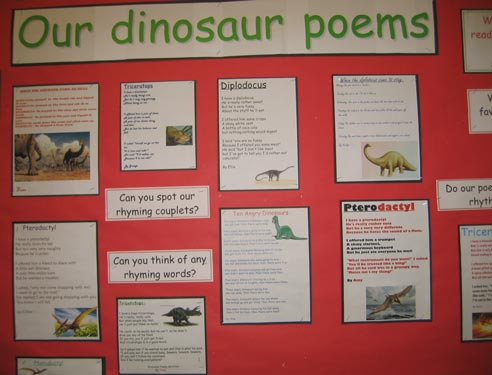
Dinosaur poems

Prehistoric animal poems on display.  Picture credit: Everything Dinosaur.

Picture credit: Everything Dinosaur

Helping to Develop Vocabulary

In writing, pupils at the beginning of year 2 should be able to compose individual poems and with dinosaurs the children seemed to be up for the challenge, having to devise rhyming couplets for words such as Triceratops, dinosaur and reptile.  All this creativity certainly helped this class cement their learning about literacy and different types of poem, we even saw some examples of Japanese Haiku poems in one school that was visited.

Writing poems about dinosaurs and other prehistoric creatures can be a good way of helping Key Stage 1 and 2 children to extend their understanding of English.  To learn more about how Everything Dinosaur helps to educate young people: Contact Everything Dinosaur.

Go to Top