Everything Dinosaur can exclusively reveal that those clever people at CollectA will be adding new Spinosaurus models to their prehistoric animal range. CollectA will be introducing a new Deluxe Spinosaurus replica into the company’s highly successful “Prehistoric Life” model collection. In total, three new Spinosaurus models will be available as CollectA updates its model range to reflect changes in the way that scientists interpret fossils.
New for 2015 Deluxe Spinosaurus Dinosaur Model
Leading the way in interpreting dinosaur fossils.
Picture credit: CollectA
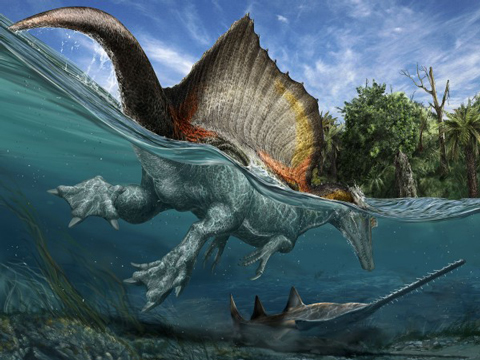
Spinosaurus is one of the most famous of all the dinosaurs and 2015 marks the 100th anniversary of the naming and formal scientific description of this iconic dinosaur, widely believed to be the largest predatory dinosaur that ever lived. Back in September of last year, Everything Dinosaur team members reported upon the publication of a new scientific paper that showed this dinosaur in a whole new light. Based on a comprehensive review of the known fossil data, scientists proposed that Spinosaurus walked on all fours rather than just its hind legs (obligate quadruped).
The title of the paper, published in the journal Science “Semi-aquatic Adaptations in a Giant Predatory Dinosaur”, just about says it all. Here was a new way of interpreting the fossils of a theropod dinosaur. Spinosaurus aegyptiacus was depicted as a predator perfectly adapted to a life in rivers and lakes. Think of Spinosaurus as “a dinosaur that decided to become a crocodile”, it’s a crude analogy but it does make the point.
A spokesperson from Everything Dinosaur commented:
“The publication of the new research into Spinosaurus was one of the most eagerly anticipated scientific papers last year. It’s amazing how quickly CollectA have been able to take the very latest information about a dinosaur and to create a replica that strongly reflects the scientific literature. This new Deluxe Spinosaurus really shows how much care and attention this company pays to the science of palaeontology.”
Ironically, Everything Dinosaur had been inundated with enquiries from dinosaur fans and serious model collectors about whether a replica showing this new interpretation of Spinosaurus was going to be produced. We can exclusively reveal that CollectA have done this, and this model will be available from Everything Dinosaur in July (or thereabouts).
The Deluxe Spinosaurus measures approximately 36cm in length making it around 4cm bigger than the Deluxe 1:40 scale T. rex dinosaur model also made by CollectA. The size of this new replica, reflects the current scientific thinking that Spinosaurus aegyptiacus was indeed, larger than Tyrannosaurus rex.
This new model has been very skilfully crafted and it will have an articulated lower jaw. The introduction of articulated jaws is going to be a feature of many of CollectA’s 2015 product offerings. Both the eagerly awaited Deluxe feathered T. rex and the 1:40 scale Acrocanthosaurus dinosaurs, which are due to be introduced in the spring, will have articulated lower jaws, as will the 1:4 scale Guidraco pterosaur replica.
CollectA Deluxe Spinosaurus will have an Articulated Lower Jaw
Model features an articulated jaw.
Picture credit: CollectA/Everything Dinosaur
In Total Three New Spinosaurus Models from CollectA in 2015
If this news wasn’t enough to get dinosaur fans roaring with excitement, CollectA will be introducing a total of three Spinosaurus replicas in 2015. The new Deluxe Spinosaurus will be replacing the company’s current Deluxe Spinosaurus. Joining it will be two smaller models in the very popular, not-to-scale model range. The existing Spinosaurus model in the not-to-scale range will be replaced by two replicas, one depicting Spinosaurus on land, the other, a model of Spinosaurus swimming.
These two figures will be available from Everything Dinosaur later on this year, and, as soon as we have photographs we will be posting them up, but we do know that each of these replicas measures around 26 cm in length.
The 2014 reinterpretation of Spinosaurus attracted a lot of attention from the scientific community. One of the most controversial areas was how this dinosaur might have protected its huge thumb claw when it walked on four legs. The idea of Spinosaurus walking on its knuckles has been suggested.
Commenting on these exciting new additions and their relationship to the recently published research, model designer Anthony Beeson stated:
“I am not happy with the idea that the animal walked on its knuckles so I have made the hands point outward when on land as is the other theory [locomotion of an obligate quadruped]. As is the case with the Ichthyovenator [a Spinosauridae dinosaur replica introduced by CollectA last year] I have given the animals many crocodilian features especially the tail scutes that are such a decorative part of those creatures.”
We at Everything Dinosaur are delighted to hear this news and we can’t wait to see the models themselves. When we have more information we will post it up. Promise!
Over the last few days we have been catching up with our correspondence and one of the tasks is to answer all the questions sent in by young dinosaur fans. We have had a larger number of questions to handle than in previous years, but we are just about on top of the job. Our thanks to Owen, Jacob, Simon, Theodore, Claire and Steven for sending in this selection of questions.
Questions from Young Dinosaur Fans
How many fingers did Tyrannosaurus rex have?
T. rex has two fingers on each hand. These dinosaurs evolved from dinosaurs that had three fingers on their hands. In some Late Cretaceous tyrannosaurid dinosaur fossils a vestigial third finger can be made out.
Was Rajasaurus a powerful dinosaur?
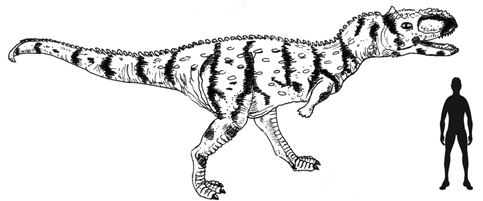
Rajasaurus (the name means “Prince Lizard”) was a member of the abelisaurid group of meat-eating dinosaurs. The fossils of this dinosaur have been found in Upper Cretaceous rocks of India. At around eleven metres in length and weighing an estimated 3-4 tonnes this was a indeed a powerful and fearsome hunter. Living at the same time as Rajasaurus was a second, slightly smaller and more lightly built abelisaurid. This dinosaur has been named Indosuchus. It has been suggested that these two predators did not compete for food, Indosuchus tackling smaller animals and the larger Rajasaurus specialising in attacking the really big herbivores such as titanosaurs.
A Scale Drawing of Rajasaurus
Probably an apex predator in its environment.
Picture credit: Everything Dinosaur
There is now strong evidence that these predatory dinosaurs also lived in Europe during the Late Cretaceous. To read an article about the discovery of an abelisaurid from France: New French abelisaurid Named after Road Builder.
Where have fossils of Liliensternus been found?
Fossils of this Late Triassic carnivorous dinosaur have been found in Germany and France.
What were the top five biggest meat-eating dinosaurs? What were the largest carnivorous dinosaurs called?
This is difficult to say as a number of the very large, carnivorous dinosaurs are known from fragmentary or partial remains. Some of the largest meat-eating dinosaurs known include Giganotosaurus, Allosaurus fragilis, Saurophaganax, Spinosaurus, Acrocanthosaurus, Torvosaurus gurneyi, Tyrannosaurus rex, Carcharodontosaurus saharicus, Tarbosaurus, Sauroniops pachytholus, Tyrannotitan, Mapusaurus, Zhuchengtyrannus magnus.
You can find out more information about these dinosaurs by searching through the articles on this web log or perhaps by looking at dinosaur books.
Was Compsognathus the fastest dinosaur?
Compsognathus was regarded as the smallest dinosaur known for a number of years, but fossil finds in the late 20th Century led to the describing of a number of new species of smaller dinosaurs. Compsognathus was certainly a swift runner and quite agile and in a study by Manchester University scientists, which compared the velocities of a number of dinosaurs, as well as humans and some flightless birds, Compsognathus came out as the faster sprinter.
However, a number ornithomimid dinosaurs (ostrich mimics), with their longer legs and bigger stride length could probably run faster, certainly in a straight line when compared to the diminutive Compsognathus. It has been estimated that a dinosaur like Sinornithomimus could have sprinted at over 40 miles per hour.
How big was the horned dinosaur Albertoceratops?
Size estimates vary, but this horned dinosaur from the Late Cretaceous of North America was probably around five to six metres in length when fully grown.
Was Mapusaurus a strong dinosaur?
Muscle mass of a dinosaur is difficult to calculate, however, the size and position of key muscle groups can be studied by looking at the scars which indicate areas of muscle attachment on fossil bone. Mapusaurus (M. roseae) was certainly a large predator. There is some evidence to suggest that these animals hunted in packs. The short arms were quite strong, but the hind legs were very powerful indeed. It has been estimated that this dinosaur could run at speeds approaching 25 miles per hour, perhaps as fast as 30 miles per hour.
Everything Dinosaur stocks a large range of theropod dinosaur models including T. rex and Mapusaurus. To view our range: Prehistoric Animal and Dinosaur Models.
What was the smallest dinosaur? Was the smallest dinosaur Bambiraptor?
A number of recent fossil discoveries has enabled scientists to reconsider which was the smallest dinosaur. For a long time Mussaurus was thought to be the smallest dinosaur, however, the fossil upon which this claim had been made was actually a baby and as a prosauropod, Mussaurus probably grew to more than three metres in length. Several different types of dinosaur are believed to have been less than a metre long, perhaps weighing less than four kilogrammes.
Bambiraptor was around a metre in length, although the holotype material probably represents a juvenile. The tiny, feathered theropod from Mongolia known as Shuvuuia has been estimated to have been just sixty centimetres long. Both Microraptor and Micropachycephalosaurus were extremely small, with estimates for the size of Microraptor at around seventy centimetres and weighing perhaps no more than two kilogrammes.
In 2011, Everything Dinosaur wrote an article all about the “Ashdown Maniraptoran” this is the smallest dinosaur known from Europe, it was about the size of a magpie.
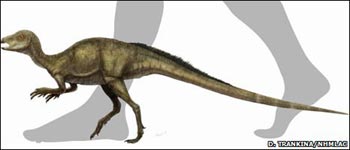
The current title holder of the “smallest dinosaur known to science” is Fruitadens (F. haagarorum). It may have reached lengths of around forty centimetres, more than half of its body length was made up of its tail. It weighed as much as two bags of sugar, around 1-2 kilogrammes. The fossils of this tiny dinosaur were found in Colorado. It is a bird-hipped dinosaur, most probably a plant-eater but it may also have eaten insects.
A Scale Drawing of Fruitadens (Fruitadens haagarorum)
An illustration of perhaps the smallest dinosaur known Fruitadens.
Picture credit: D. Trankina/NHMLAC
Which was the more powerful dinosaur Allosaurus or Suchomimus?
These are two very different theropod dinosaurs making comparisons a bit difficult. Allosaurus fragilis for example, lived during the Late Jurassic, whilst Suchomimus fossils have been found associated with Cretaceous strata at least thirty million years older. Suchomimus fossils were found in Niger (Africa), whereas Allosaurus fragilis fossils come from the western United States.
In terms of size, Allosaurus may have been slightly bigger at around twelve metres and Allosaurus probably specialised in hunting and eating other dinosaurs, whilst Suchomimus being a member of the Spinosauridae family was probably primarily a fish-eater. Suchomimus did have stronger arms and shoulders than Allosaurus (most likely).
Where were the fossils of Barosaurus found? Did the dinosaur called Barosaurus exist?
Barosaurus, the name means “heavy lizard” and the name is pronounced Bah-row-sore-us, was a sauropod that lived in the Late Jurassic. It was a member of the diplodocid dinosaur family and its fossils have been found in the western United States (South Dakota, as well as possibly Utah and Wyoming). It may have reached lengths in excess of 27 metres and weighed as much as 20 tonnes. Its fossils are relatively rare and when compared to the better known Diplodocus genus, Barosaurus had a longer neck but a shorter tail.
It has been suggested that Barosaurus was a browser of tall trees and the fossils found are associated with wetter parts of what is now known as the Morrison Formation. A wetter habitat could have allowed the trees to grow taller, ideal for a long-necked Barosaurus to browse upon.
Thank you for all the questions sent in to us, we shall continue to work hard and answer them as best as we can.
Everything Dinosaur Attempts to Forecast Future Events
It’s that time of year, when just for a little bit of fun, team members at Everything Dinosaur try to predict some of the stories and articles that will feature in this web log over the next twelve months. What will the top dinosaur and prehistoric animal themed news stories be in 2015?
We could cheat a bit and discuss the introduction of a new model of a “swimming Spinosaurus” or indeed confidently claim that a team of Utah-based researchers will reveal news about a predator trap discovery which sheds new light on Utahraptor. However, we won’t, as these stories are already scheduled to feature in our blog over the next few days or so.
Palaeontology and Fossil Predictions
So without further a do, let’s look at the predictions that we have come up with:
1). It’s a “Jurassic World”
Due to premier on June 12th and with another “teaser” trailer scheduled to be broadcast as part of this year’s Super Bowl coverage, we at Everything Dinosaur start our predictions with a no-brainer. “Jurassic World”, the fourth instalment in the “Jurassic Park” franchise is going to be huge. It might not be the top film of 2015, after all, there is going to be stiff competition from the likes of Arnold Schwarzenegger “Terminator Genisys”, a new Star Wars movie “The Force Awakens” and another Avengers film to look forward to, but it is going to be right up there and it will introduce dinosaurs to a whole new generation of young fans.
“Jurassic World” a Guaranteed Roaring Success for 2015
Jurassic World poster.
Picture credit: Universal Studios
We have already recorded some impact from the film already. Every year, Everything Dinosaur team members calculate an index of the top ten most popular prehistoric animals. In 2014, new in at number nine came Diabolus rex the big dinosaur, “bad-girl” of the film. To see part of the article we wrote on the popular prehistoric animals of 2014: Everything Dinosaur’s Top Ten List of Prehistoric Animals (Part 1).
Who knows, one of our predictions for the future is that one day, a dinosaur genus will be erected called Diabolus!
2). Metallome Research Provides Fresh Fossil Insights
Lots of people may have heard of the term genome and we do expect to write more articles related to developments in genetics and the genomes of long extinct organisms, but the metallome is still a relatively unknown term. A metallome refers to the presence of metals in relation to organic material, biometals if you like, present in cells and other organic structures. Sophisticated analytics is permitting palaeontologists to detect the minute traces of elemental metals that are associated with organic processes. They can “filter out” biometals preserved as fossils from the background of elements within the surrounding rocky matrix.
From an analysis of these “prehistoric elemental fingerprints”, palaeontologists will be able to learn more about the biological processes associated with extinct organisms. Mapping the metallome of Archaeopteryx lithographica perhaps? This branch of science is still in its nascent form, it has been around for about ten years or so, but it is developing all the time and we predict that we shall be featuring a story about metallome plotting and mapping over the next twelve months.
3). Stegosaurus into the Limelight
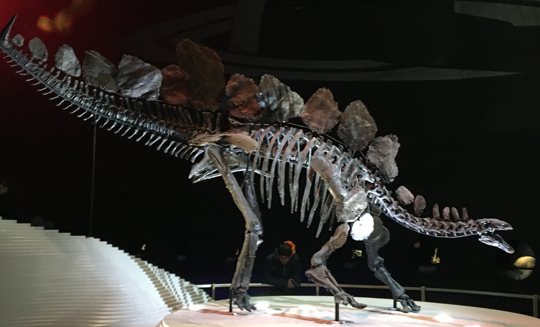
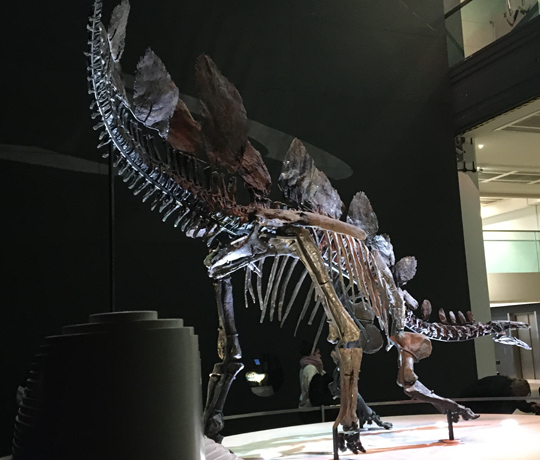
Now that “Sophie”, the 5.6 metre long specimen of Stegosaurus stenops has been safely installed at the Natural History Museum in London, we predict that a new paper will be published this year providing a fresh perspective on this iconic dinosaur. Even though, Stegosaurus featured in our top five most popular prehistoric animals of 2014, very little research on the Stegosauridae, even those famous Morrison Formation examples, has been published in the last one hundred years. We expect 2015 to change all this and we predict that fresh insights into the Stegosaurs and that tiny brain of theirs will be made.
Stegosaurus to Take Centre Stage in 2015
Sophie the Stegosaurus (S. stenops), a star exhibit at the London Natural History Museum.
Things have been a little quiet “down under” over the last couple of years or so, but we expect all that to change in 2015 with Everything Dinosaur covering a news story about further dinosaur fossil finds in Australia. Perhaps, more research will be published on the multitude of dinosaur tracks found along parts of the coast of Western Australia, or maybe will be hearing about a new body fossil find near Winton (Queensland). However, 2015 we predict is going to be an important year for dinosaur fossil discoveries in Australia. This may prove to be some consolation to Australians in 2015 as we also predict that England will win back “The Ashes” – some hope!
5). More Insights into Human Evolution – Oldest Hominid Genome Sequenced to Date
We know that scientists are working on this and we think this year, the oldest hominid genome so far, will be sequenced. In the past, Everything Dinosaur team members have reported on the research into the ancient hominid discoveries found at the Simo de Los Huesos (the “pit of bones”) in the Atapuerca Mountains of northern Spain. Back in 2013, we reported on the research into the mitochrondial DNA, passed down the maternal line. The study threw up a surprise as links to the Denisovan hominids from eastern Europe were found. Was this evidence of interbreeding between ancient Neanderthals and other species of hominid, or the ancestors of the Neanderthal lineage?
Everything Dinosaur predicts that much more complete details related to the nuclear DNA of the Spanish cave remains will be published. A 400,000 year old mystery about hominid populations and interbreeding will begin to unfold. We note that a number of science sites have made a similar prediction, they must also be following the research of educational bodies such as the Max Planck Institute for Evolutionary Anthropology.
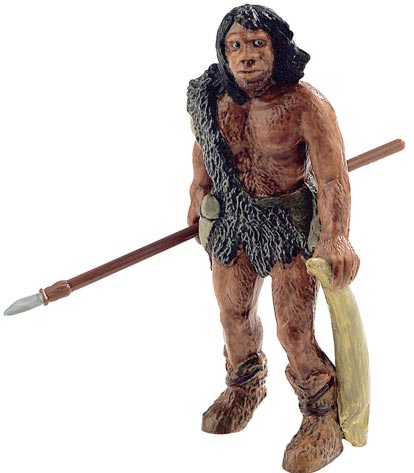
What did our Ancestors Get up To?
A model of a Neanderthal.
Picture credit: Everything Dinosaur
6). A New Chinese Pterosaur
We expect the number of genera of pterosaurs described to increase once again this year, with a number of pterosaur fossil stories being published on the Everything Dinosaur web log. One prediction is that a new genus of pterosaur from Chinese Cretaceous strata will be erected and the fossil specimen, most likely the designated holotype material, will provide palaeontologists with a fresh insight into pterosaur anatomy and/or behaviour. Perhaps, the new Chinese flying reptile will provide a new insight into the diet of dsungaripteroids, or maybe a fossil assigned to the Ornithocheiridae will help to unravel the mystery of how these reptiles nested.
Time for a Chinese Pterosaur Discovery
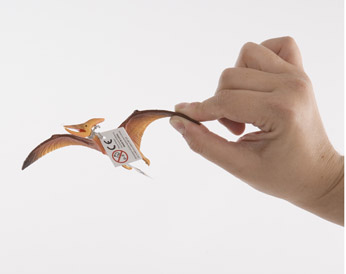
Our Pteranodon model flying.
Picture credit: Everything Dinosaur
7). Everything Dinosaur social media – Targets and more Targets
Targets and even more targets are going to be set for Everything Dinosaur and the company’s social media output. Platforms such as Facebook, Twitter and Pinterest are a great way for a small business such as ourselves to reach out and communicate with fellow fossil collectors and fans of prehistoric animals. We expect “Tyrannosaurus Sue” to be setting more targets in 2015 when it comes to our work on social media platforms. Will our Facebook page get to 2,000 likes this year?
8). Malaysia Firmly on the Dinosaur Map
They may turn out to be extremely fragmentary, perhaps there will be almost as much tooth fossil as bone found, but we predict that further dinosaur discoveries will be made in Malaysia in 2015. We have already written articles featuring dinosaur discoveries from Malaysia and we expect, as more construction work takes place, further dinosaur fossils, most likely dating from the Early Cretaceous, will be found.
9). New species of Horned North American dinosaur Announced
With Everything Dinosaur about to publish an article about a nine tonne stone block that may contain the remains of several Utahraptors, we switch to the Ornithischia for our next prediction. We believe that the spate of new Ceratopsidae discoveries will continue and that a new genus of North American horned dinosaur will be named and described this year. Perhaps, instead of a giant centrosaurine or chasmosaurine, scientists may uncover more evidence of much smaller species living alongside and amongst their giant relatives. How about another fast running, facultative biped, a little “ceratopsian critter” for 2015.
10). Fossil Finding is Child’s Play
Our final prediction and remember this is only a bit of fun, is that somewhere in the United Kingdom in the next twelve months, a young person will make an important fossil discovery. Perhaps a young girl out on a family walk will come across the bones of an Ice Age mammal, or maybe a boy taking his dog for a rum along a beach might spot a fossil of a marine reptile. As with all our predictions, we shall have to wait and see.
This time next year, 2016, now that does feel like the future, we will review our predictions and see how we got on.
In the meantime, take a look at the range of dinosaur and prehistoric animal models available from Everything Dinosaur: Dinosaur and Prehistoric Animal Models.
Everything Dinosaur Supplies Teaching Resources to Schools
In celebration of all the exciting, educational resources that Everything Dinosaur supplies to schools and museums the company has introduced a new banner for the website. The banner showcases the range of dinosaur and prehistoric animal themed resources that are supplied to schools, whether EYFS (early years foundation stage) or even Key Stage 4 and beyond.
Prehistoric Animal Themed Teaching Resources for Schools and Museums
Fossils, books, puzzles and games for schools.
Picture credit: Everything Dinosaur
A spokesperson for the Cheshire based company explained:
“We are supplying more and more items into schools and museums these days. Whether it is small dinosaur models for sorting or counting games, books or museum quality replicas we have seen demand for these items grow. We even have received requests for real dinosaur fossils. Happy to show school children fossils in our collection and we do supply a range of inexpensive fossils, including sharks teeth, but we would draw the line at supplying dinosaur fossils.”
Not so long ago we were wishing everyone a “Happy New Year 2014”! It does not seem like a year has passed but it has and we are now in 2015, still part of the Holocene Epoch, but doesn’t time fly when you are having fun. Just a quick note to wish everybody a peaceful and prosperous New Year. January is going to be a busy month for our team members. We have lots of new dinosaur and prehistoric animal toys to prepare for, video reviews to make and more teaching assignments in the next thirty days or so than in any previous thirty day period. So it’s onwards and upwards for Everything Dinosaur.
Happy New Year from Everything Dinosaur
Wishing everyone a “Happy New Year”!
Picture credit: Everything Dinosaur
Next August it is our company’s tenth birthday, ten years of supplying dinosaur models and prehistoric animal toys. Certainly, the time has flown, but before we get on with our duties for the day. Just time to wish all our customers, followers, supporters, fellow dinosaur fans and fossil collectors a peaceful and prosperous New Year.
The Top Five Most Popular Prehistoric Animals of 2014
Today, we continue our rundown of the most popular prehistoric animals as compiled by all the data sources available to Everything Dinosaur team members. We have already published information on numbers ten to six, now it is time to look at the top five.
A faller from last year, when it hit an all time high at number two, is Spinosaurus. We received a lot of enquiries about this dinosaur when the new interpretation of this piscivore was published back in September . This secured this huge reptile’s position in our top five. The scientific paper which re-examined the Spinosaurus fossil material was published in the journal “Science”. It was one of the most eagerly awaited papers of the year. The review interpreted Spinosaurus as an obligate quadruped, in essence, here was an enormous dinosaur that walked on all fours.
A perennial favourite, especially amongst the girls, is the plated dinosaur Stegosaurus. Everything Dinosaur received a constant stream of Stegosaurus themed questions and enquiries over the last twelve months or so. The interest in this Late Jurassic herbivore peaked when the new Stegosaurus exhibit at the Natural History Museum (London) was unveiled. We even invited a young dinosaur fan (thanks Milan), to blog about this Stegosaurus (S. stenops) specimen, which is affectionately known as “Sophie”.
Stegosaurus Popular with the Girls
A posterior view of the spectacular “Sophie” the Stegosaurus (S. stenops” exhibit at the London Natural History Museum.
Picture credit: Courtesy of the Natural History Museum and chosen by Milan
Everything Dinosaur confidently predicts that the research project currently being undertaken at the Natural History Museum will yield some very interesting information about stegosaurs.
Triceratops
3). Triceratops
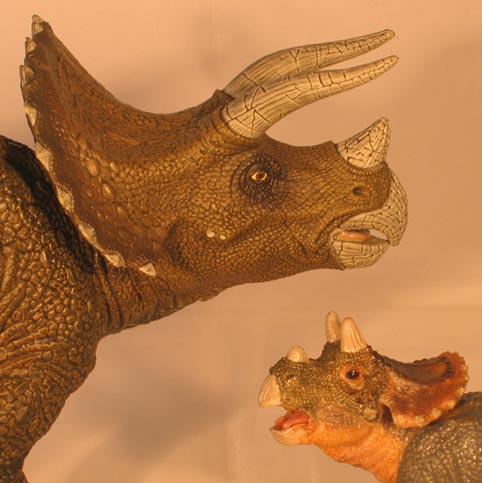
A non-mover at number three and the only representative of the horned dinosaurs in our top ten countdown is Triceratops. It is ironic that “three horned face” remains at number three in our countdown of the ten most popular prehistoric animals of 2014. This dinosaur is popular with both boys and girls and with the introduction of the Papo baby Triceratops replica in August, sales of Triceratops models were given a boost.
Helping to Keep Triceratops Popular
The baby Triceratops figure next to the adult Papo Triceratops.
Picture credit: Everything Dinosaur
The baby Triceratops certainly works well with the excellent adult Triceratops model introduced by Papo.
A number of scientific papers detailing research into the Ceratopsidae were published this year. Almost without fail, Triceratops got a mention somewhere. Despite the increase in centrosaurine and chasmosaurine dinosaurs, Triceratops remains very much the best known of all the horned dinosaurs. There was some research published in 2014 dedicated to the Triceratops genus itself.
New Triceratops Species
In July, Everything Dinosaur reported upon some fascinating research that looked at how Triceratops species evolved over the course of the latter stages of the Late Cretaceous.
Up two places from last year and into the runners up spot comes Velociraptor, a rapid rise for the “speedy bird of prey”. A short clip from the “Jurassic World” trailer showing Chris Pratt on a motorbike leading his posse of trained Velociraptors got tongues wagging and we were contacted about this by a lot of other bloggers as well as media correspondents. Could Velociraptors be trained? Would there be a “raptor show” in the “Jurassic World” theme park? These are the sort of questions we were asked.
As with all the questions we get asked, we did our best to answer them using our knowledge of the Dromaeosauridae. After all, if parrots can be trained to ride bicycles then why not train a Velociraptor to follow a motorbike?
Before we reveal our number one, a few honourable mentions for those prehistoric animals not quite in our top ten. Pachyrhinosaurus (horned dinosaur), Dolichorhynchops and Ichthyosaurus (marine reptiles), Smilodon (Sabre-toothed cat), Yutyrannus (Early Cretaceous tyrannosaurid) and the pterosaur Pteranodon.
The Most Iconic Prehistoric Animal
1). Tyrannosaurus rex
Remaining at number one and it seems more popular than ever is Tyrannosaurus rex. Interestingly, the “King of the Tyrant Lizards”, got a boost in popularity due to the increasing number of new types of tyrannosaurid that have been described over the last two years or so. As more research is published on dinosaurs such as Yutyrannus and Lythronax argestes, so just like Triceratops placed at number 3, T. rex tends to get a mention in the text and this leads to more questions being asked at Everything Dinosaur.
There is a “knock on” effect that benefits Triceratops to some extent but T. rex benefits more.
Tyrannosaurus rex is such an iconic animal that it manages to get a look in even when the initial subject matter has nothing to do with it. For example, the book, “Dinosaurs of the British Isles” features information on T. rex even though no Tyrannosaurus rex as far as we know, ever lived anywhere else except North America. A T. rex is very likely to be seen in “Jurassic World” so we confidently predict this apex predator is going to be number one next year as well.
The introduction of a new Tyrannosaurus rex model by Schleich helped T. rex dinosaur sales as did the spectacular Rebor KING T-REX 1:35 scale replica which came out in early December.
The Rebor 1:35 scale Tyrannosaurus rex Dinosaur Model
Everything Dinosaur Counts Down the Top Ten Prehistoric Animals of 2014 (Part 1)
As 2014 draws to a close, it is time for Everything Dinosaur team members to put together a list of the top ten most popular prehistoric animals over the last twelve months. We have looked at product purchases, requests for fact sheets, questions asked, email subjects, social media comments as well as information put together as a result of our many school visits.
Everything Dinosaur
All this data has been compiled to produce a top ten of the most popular dinosaurs and other prehistoric animals, this is the first part of our countdown, dealing with those animals in positions ten down to six.
10). Dreadnoughtus schrani
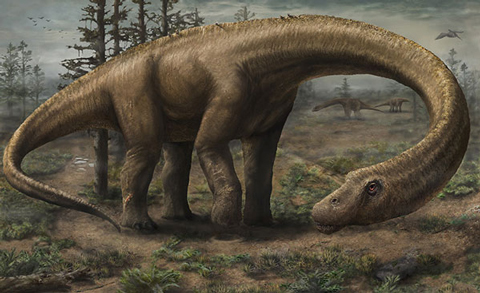
The super-heavy weight titanosaur Dreadnoughtus (D. schrani) made a Boeing-737 sized impression when the scientific paper detailing the discovery of this huge dinosaur was published back in September. We were bombarded with emails requesting further information about this enormous South American titanosaur. The blog article we wrote providing more information was widely circulated and even the scientists behind the research into Dreadnoughtus, one of the largest land animals ever described wrote to congratulate us on our work.
Making a Big Impression in 2014 – Dreadnoughtus schrani
Huge dinosaur from southern Patagonia.
Picture credit: Jennifer Hall
The Influence of “Jurassic World”
9). Diabolus rex (Jurassic World) – Indominus rex
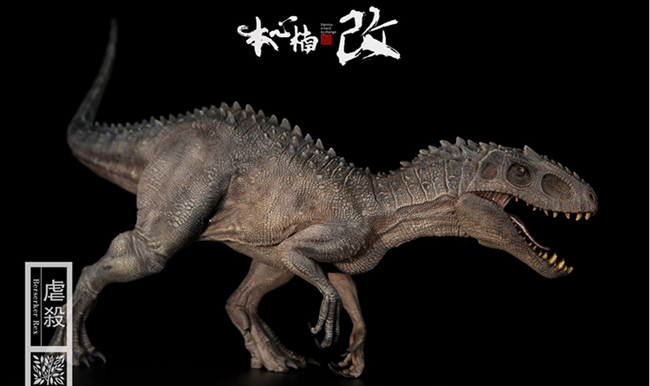
This is the first time in the history of our annual survey that a dinosaur only seen in a movie has made the top ten. In November, Everything Dinosaur’s weblog was one of the first blogs to feature the official trailer to the film “Jurassic World”. The big villain in this new film, due to premier in June 2015 is a genetically modified theropod dinosaur known as Diabolus. So far only tantalising glimpses of this new dinosaur have been provided by the film makers, but on the strength of this, we received an amazing number of enquiries.
Even pointing out that in essence, all the dinosaurs featured in the “Jurassic Park” franchise were genetically modified (dino DNA mixed with frog DNA in the book if our collective memories recall correctly), did not dampen people’s enthusiasm for this “new” type of dinosaur. Described as a cross between Tyrannosaurus rex, Velociraptor, a snake and a cuttlefish we can’t wait to see more of this new dinosaur on the block.
A Sneak Peek of Diabolus rex (Jurassic World Trailer)
A model of a genetically designed dinosaur. Inspired by InGen?
As Christ Pratt ‘s character (Owen, after Sir Richard Owen perhaps) says:
“You just went and made a new dinosaur? Probably not a good idea.”
We suspect that this dinosaur is going to climb even further up our chart in 2015.
Prehistoric Animals
8). Giganotosaurus
Not an imagined animal, but definitely for real, well as far as we can tell from the fossil record. In at number eight Giganotosaurus (Giant Southern Lizard). This Cretaceous dinosaur, which is believed to be one of the largest meat-eating dinosaurs that ever lived has remained popular all year. There was a “spike” in requests for fact sheets featuring this theropod when news about Dreadnoughtus broke but this dinosaur from Argentina remains amongst the most popular of all the carnivorous dinosaurs, particularly with young dinosaur fans (the boys anyway). Giganotosaurus retains the number eight slot in our countdown (it was number eight in 2013 and did not feature in our top ten in 2012).
The Schleich Giganotosaurus Dinosaur Model
Biggest land carnivore known to science with a “Big Bite”.
Picture credit: Everything Dinosaur
We expect this dinosaur to remain a firm favourite especially with Schleich bringing out a new replica and Papo including a Giganotosaurus in their new for 2015 tub of mini dinosaurs.
Woolly Mammoth
7). Woolly Mammoth
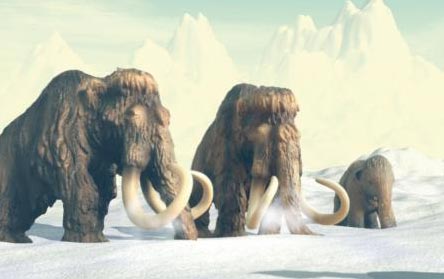
The only mammal to feature in our top ten (unless of course the genome of Diabolus rex contains mammalian DNA), is the Woolly Mammoth. We were sent a large number of Woolly Mammoth drawings this year and there was quite a lot of media interest in this extinct elephant when the documentary entitled “Woolly Mammoth – the Autopsy”, aired in late November. The controversy over the potential cloning of a Woolly Mammoth helped give this prehistoric animal’s popularity a bit of boost.
In at Number Seven – Mammuthus primigenius
Will the Woolly Mammoth return?
Picture credit: Schleich/Everything Dinosaur
Brachiosaurus
6). Brachiosaurus
Just out of the top five and falling one place from last year’s survey is Brachiosaurus. Sales of Brachiosaurus models have been particularly strong this year, leading the way, in part, was the Papo Brachiosaurus replica. The Papo Brachiosaurus is one of the largest sculpts that Papo have attempted, it certainly is a beautiful model and it has proved popular with professional collectors and young dinosaur fans alike.
The Papo Brachiosaurus Dinosaur Model
Large size model of a Brachiosaurus (Papo Brachiosaurus).
Picture credit: Papo/Everything Dinosaur
Measuring around forty centimetres in length, this 1:55 (approx.) scale model has received rave reviews since it was launched.
A typical review received recently stated:
“I don’t consider this to be a toy, it’s an awesome model that can be enjoyed by adults just as much as by children who like dinosaurs. Of course you won’t play with it as an adult, but it’s just as much fun to just look at it, put in on a place in your living room. This model is just perfect, I wouldn’t change a thing about it. The details are what makes it so special, you can see muscles, wrinkles in the skin, even the eyes look almost real.”
Praise indeed for Brachiosaurus.
In our next blog article we will conclude our countdown of the top ten most popular prehistoric animals of 2014.
The Cambrian lasted for over fifty million years and in the latter part of this period in Earth’s geological history there was a huge increase in marine animal diversity. The evolution of so many new forms of life is often referred to as the “Cambrian explosion” and thanks to localities such as British Columbia’s Burgess Shale and the amazing fossils from Chenjiang in China, palaeontologists have been able to build up a remarkably detailed picture of the fauna that flourished in the oceans of the world, during a time when our planet looked very different from today.
Cambrian Models
Thanks to the beautifully preserved fossils, scientists have been able to piece together marine ecosystems and to study the organisms the evolved in what is often regarded as the first truly significant evolutionary event in the history of life on Earth. Those clever people at Safari Ltd produced a set of replicas of ancient creatures that represent typical examples of the Cambrian biota.
“Cambrian Life”
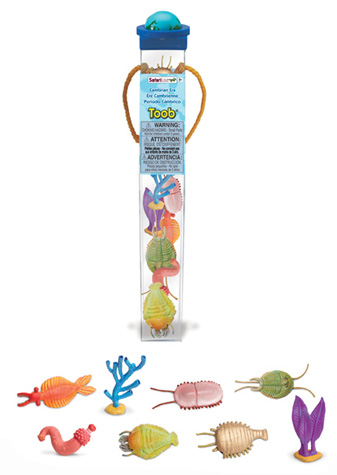
Entitled “Cambrian Life” the set includes eight models representing ancestral sponges, marine worms and, perhaps most significantly of all the Arthropoda, that huge phylum that includes the crustaceans, trilobites, spiders and insects.
The Cambrian Life Toob
Examples of the Cambrian biota.
Picture credit: Everything Dinosaur
Eight Beautiful Models
The eight models are very colourful and are great teaching aids. Trouble is, there are no data sheets on these bizarre organisms included in this model set.
The other day Everything Dinosaur received an email from a customer, it read:
“Thank you for sending my order. I wrapped the presents up and gave them to my friend’s son for Xmas. He was delighted with them but in the Cambrian tube there was not a description leaflet as there was in the Prehistoric Crocodile tube. Would it please be possible to send out the Cambrian Leaflet. Many thanks.”
Cambrian Life Fact Cards
One of our team members wrote back and explained that there was no description leaflet made for the Cambrian Life Toob, however, we decided to do something about this ourselves. We are much happier when it comes to researching vertebrates but over a morning we were able to produce four data cards. Each card features two of the prehistoric critters in the set, we have tried to provide a little more information, such as size, fossil finds and which type of animals the creature represented by the replica might be ancestral to.
A Cambrian Life Toob Data Card Made by Everything Dinosaur
Everything Dinosaur provides information on models in the Cambrian Life Toob. Providing information on Cambrian critters.
Picture credit: Everything Dinosaur
We would not claim to be experts on Cambrian fauna, however, the models are so well made and great for school projects so we thought we would do our bit to help.
Everything Dinosaur’s Top Ten Blog Articles of 2014
One of the things we like to do at this time of year at Everything Dinosaur is to review this blog site and pick out those blog articles and news stories that we have featured that have proved to be the most popular. Of the three hundred and sixty articles written in 2014 (we try to write one article per day), picking out just ten has proved to be quite a challenge.
Everything Dinosaur
However, we have looked at page views, comments, Facebook likes, retweets and a whole range of other factors to help us compile a top ten. The subjects covered this year have been as diverse as in previous years, with features ranging from three dimensional printers, the origins of life on Earth, crocodile attacks, World Heritage sites, shrinking sauropods as well as fossil discoveries, new dinosaur models, and Everything Dinosaur updates. Our top ten list reflects the breadth of the topics that we try to cover on this web log and although we would not want to claim any statistical validity for this particular piece of research, here is our top ten countdown.
Popular Blog Posts
10). A Special Year for Ichthyosaur Research
There have been a number of new marine reptiles named and described this year, including some Early Triassic animals whose fossils have been found in China. However, 2014 marks the 200th anniversary of the publication of the first academic paper that described an ichthyosaur and in at number ten is a short article we wrote back in June commemorating this anniversary.
Christmas is a time of year when families get together. In 2014, research into the “human family” has continued at a pace. Team members predicted that there would be more news stories this year about developments in hominin genetic research and it turns out that some diseases associated with our population are linked to our Neanderthal ancestry. One of the first articles we published on the blog looked at a study that had concluded that some diseases associated with H. sapiens can be related to our inherited H.neanderthalensis genes.
8). Pushing the Origins of the Pterosauria Back in Time
A fragmentary fossil of an ancient flying reptile that had been discovered in 2001 got fans of the Pterodactyloidea in a bit of a flap this year when a scientific paper was published describing a new type of pterosaur. The fossil came from north-western China and it pushed back the evolution of the Pterodactyloidea by at least another five million years. Kryptodrakon progenitor, (the name means ancestor of the hidden dragons), is the most primitive, basal member of the Pterodactyloidea pterosaur family known to science and Everything Dinosaur wrote about this exciting fossil find back in April.
New pterosaur named after “Crouching Tiger Hidden Dragon” Film.
Picture credit: Brian Andres
7). Welcome to the “Metal Age” of Palaeontology
Readers of this blog site may well be familiar with the term genome. A number of ancient creatures have had at least part of their genome mapped, Neanderthals, Woolly Mammoths and such like, but in at number seven is an article all about the work of Manchester University and their research into mapping elements such as Zinc, Copper and Nickel that can be preserved within the fossil record.
University of Manchester researchers used a synchrotron particle accelerator to bombard a fifty-million-year-old fossil leaf to help them calculate the chemical composition of an ancient plant. They then compared this data with the metallome of a modern species from a related plant. This was heralded as the start of the “metal age of palaeontology”.
This is the first article in our top ten that concerns the Dinosauria. Sadly, Everything Dinosaur has written about a number dinosaur fossil thefts in 2014. Thieves stealing fossils, especially those of dinosaurs, is a trend we see continuing over the next few years and our story at number six concerns the theft of a dinosaur footprint from Bureau of Land Management managed land in Utah. We first reported on the theft on February 22nd, a local man, the owner of a construction company, was accused of the theft, which he at first denied but in a court hearing (July) he pleaded guilty to stealing the fossil.
Moab resident Jared Ehlers (35), was sentenced on October 20th to six months house arrest and one year of probation. In addition, he was ordered to pay over $15,000 dollars in restitution to help cover the expenses incurred by the Utah Department of Public Safety as they searched the Colorado River for the fossil. Fearing prosecution, Mr Ehlers, who claimed that he had stolen the three-toed footprint as he wanted to make a coffee table out of it, threw the fossil into the river, unfortunately the fossil has never been recovered.
Moab Resident Pleaded Guilty to Trace Fossil Theft
Six months house arrest plus probation and substantial fine for fossil theft.
Into the top five and at number five is an article that featured the launch of Everything Dinosaur’s new website aimed at helping teachers and other educationalists when it comes to teaching about fossils and prehistoric animals. The specially commissioned website: Everything Dinosaur lots of helpful articles, dinosaur toys and models, free downloads and educationtional items aimed at helping teaching professionals and museum staff.
Helping to Teach About Dinosaurs and Fossils in School etc.
Teaching tips, articles, resources and free downloads.
Picture credit: Everything Dinosaur
The new site was launched at the end of August to coincide with the start of the autumn term and lots of schools have already benefited from the articles featured as well as the example lesson plans and downloadable teaching resources.
4). Jurassic World (Official Trailer)
Dinosaur fans young and old have been eagerly looking forward to the release of the fourth film in the “Jurassic Park” franchise, “Jurassic World”. The film is due to be premiered in June of 2015, but back in November, a trailer for the movie was finally released and sure enough, Everything Dinosaur’s blog site was one of the first to feature it. The film is bound to be a huge success when it finally comes out and the trailer certainly whetted the appetite and teased viewers about the new, mysterious, genetically engineered dinosaur that is the big villain of this latest instalment of “Jurassic Park”. We can’t wait to learn more about “Diabolus rex”.
The “Jurassic World” Official Trailer
Video credit: Universal Studios
The original blog article featuring the trailer was published on November 25th. Had the trailer come out slightly earlier in the year, it could well have made it to the number one spot on our list.
New Prehistoric Animal Models
3). New Prehistoric Animal Models from CollectA (2015)
2015 sees the introduction of a lot of new dinosaur and prehistoric animal models. Collectors can expect new models from Schleich, Papo and Safari Ltd. All our posts about new replicas did well in our survey of the top blog articles of this year, but our only top ten entry concerns the new 2015 releases from CollectA. We first revealed the list of models back in late October, over the following weeks we wrote several articles providing more information about these new additions to the highly successful CollectA “Prehistoric Life” model range.
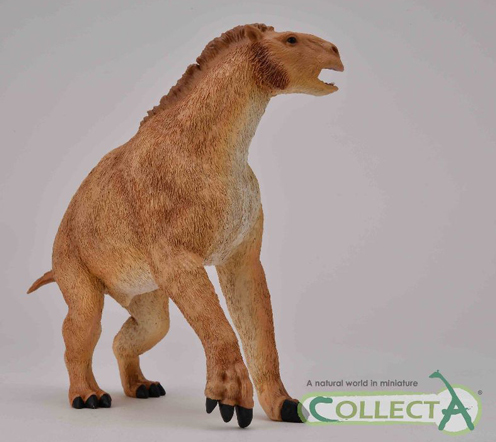
A Chalicothere is to be Included in CollectA’s New Models for 2015
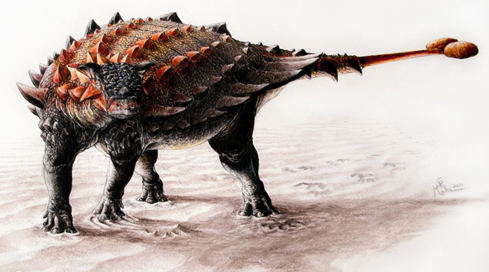
Runner up is an article we published on the 27th September. Everything Dinosaur team members had blogged about the fact that dinosaurs in the Ankylosauridae don’t seem to attract that much attention when compared to other ornithischians. How wrong we were as the naming and describing of a new type of heavily armoured dinosaur sparked a great deal of interest amongst readers.
Fragmentary fossils including beautifully preserved cranial material found in 2011 in strata related to the Kirtland Formation were described this year and a new type of armoured dinosaur named. Ziapelta sanjuanensis at over six metres in length, would have made a very formidable adversary for even the largest, hungriest theropod dinosaur.
An Illustration of Ziapelta sanjuanensis (Ankylosaur)
New Armoured Dinosaur from New Mexico.
Picture credit: Sydney Mohr
A New Armoured Dinosaur
This ankylosaurid that roamed New Mexico between 74 and 72 million years ago (Campanian faunal stage), is extremely important as the fossils indicate affinities with better known ankylosaurids whose fossils have been found in Canada (Alberta). This spiky herbivore, described as a “living tank” certainly caused a stir when the scientific paper was published.
Before we reveal our top blog article posting of the year, time for a few honourable mentions. The research into the giant titanosaur known as Dreadnoughtus schrani proved very popular, as did a number of articles published earlier in the year about Patagonian fossil finds. The introduction of the new, high quality dinosaur replica range from Rebor got collectors very excited along with our video review of the new for 2014 prehistoric animal models, including a short video we made showing how to ease the articulated jaw on the Papo Dilophosaurus.
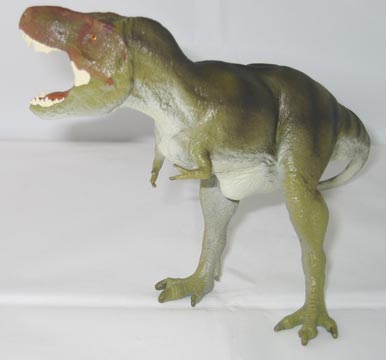
Carnegie Collectibles Tyrannosaurus rex Model
1). Carnegie T. rex (2014) Reviewed
Top of the tree, our number one article was published on the 18th of March. It concerned a review of the new Tyrannosaurus rex model made by Safari Ltd. This model, the only new Carnegie Collectible replica introduced by the company this year was reviewed by Everything Dinosaur team members and despite being introduced with a number of Wild Safari models, it was this T. rex figure that drew most of the attention. We also made a short video review of this very well made model, it also proved popular.
Everything Dinosaur’s Written Review of the Carnegie Collectibles Tyrannosaurus rex at Number One
This model featured in one of our Outlook signatures created for our emails, it must have been seen thousands of times and we also made several reviews of this particular scale replica. The red colouring around the head and its fearsome pose were commented upon by a number of blog readers and we received lots of correspondence about this model from professional collectors and from young dinosaur fans.
A very big thank you to everyone who commented, retweeted and “liked” our articles. We look forward to writing more in 2015, a year that should, if everything goes to plan, feature our 3,000th published article on this site.
Now that Christmas is over and in the lull before the New Year, team members are going to be busy in the warehouse completing our annual stocktake. This job gets bigger every year as we increase the range of dinosaur and prehistoric animal themed products that we have in our inventory. However, mince pies and plenty of hot tea will keep our spirits up.
Everything Dinosaur Warehouse
In addition to this work, we have a number of other projects to complete related to this blog site. For example, we need to compile a top ten list of the most popular blog articles over the last 12 months and publish the results of our annual survey that looks at the movers and shakers amongst prehistoric animals. Whilst working on the annual stocktake we shall also be seeking views as to what we think is going to happen in palaeontology in 2015. We shall have a go at making some predictions about what news stories we shall be covering on the Everything Dinosaur web log.
Team members shall also have the ignominious experience of looking at how our predictions made 12 months ago turned out. It may be a case of having to eat some humble pie along with those mince pies.
Many New Products Added by Everything Dinosaur in 2014
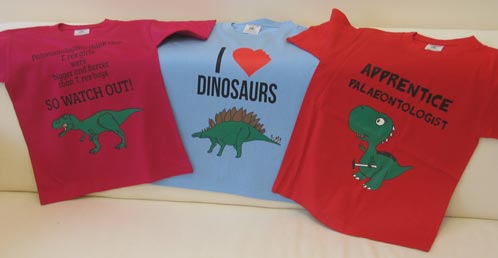
The first of the dinosaur themed T-shirts from Everything Dinosaur.
With new T-shirts, dinosaur toys, models and games having been added, this stocktake is going to be the biggest we have had to carry out so far. Not to worry, many hands make light work and just think, when it is done we don’t have to worry about doing another major inventory check until this time next year.
Naturally, we shall continue to manage all the orders for our customers.