All about dinosaurs, fossils and prehistoric animals by Everything Dinosaur team members.

Articles, features and information which have slightly more scientific content with an emphasis on palaeontology, such as updates on academic papers, published papers etc.

25 08, 2012

Dinosaur Footprints Stolen from the Vale of Glamorgan

By |2023-03-08T22:23:17+00:00August 25th, 2012|Categories: Dinosaur and Prehistoric Animal News Stories, Dinosaur Fans, Palaeontological articles|0 Comments

Dinosaur Tracks Stolen from South Wales

On the northern side of the Bristol Channel close to the harbour area of the town of Barry lies a stretch of coastline that provides a fascinating glimpse into life in the Triassic.  The area known as Bendricks rocks consists of Carboniferous limestone overlaid by Triassic siltstones and sands that date from both the Lower and Upper Triassic.  A number of the Triassic sediments mark the location of the shoreline of a shallow lake, which dinosaurs used to skirt around on their travels.  Unfortunately, Everything Dinosaur has received reports of stolen dinosaur footprints.

Stolen Dinosaur Footprints

Fossilised footprints are known from the Upper Triassic strata providing palaeontologists with important trace fossils showing archosaurs and those other members of the Archosauria – tracks made by dinosaurs.  Unfortunately, reports from local fossil hunters suggest that some of the footprints have been cut out and removed, most likely by unscrupulous fossil dealers wanting to sell these fossils on the black market.  Sadly, there have been a number of instances of areas of important scientific value being attacked by such individuals eager to grab any fossil material they can so that they can sell them on.

A number of three-toed prints can be seen on this part of the Welsh coast, indeed, there are several trackways; some of the best preserved prints have been removed and are on display at the University of Cardiff Museum.  The location which has SSSI (Site of Special Scientific Interest) status and is under the protection of the Countryside Council for Wales has been raided before, when a number of prints were removed by a local collector and offered for sale via online auction sites.  Fortunately, the police were able to recover a number of the fossil specimens.

It seems that thieves have struck again and there is evidence of stone cutting tools having been used to remove blocks which contained the dinosaur prints.  These tracks are some of the best preserved dinosaur tracks to be found anywhere in the whole of the British Isles.  However, rather than preserve them in situ for the enjoyment of all, it seems that thieves have once again targeted this location and removed fossils.

Local expert on the fossilised prints Karl-James Langford commented:

“We were horrified that in an area where we had previously examined several footprints, they have since been taken.  As readers can see from the pictures circulated, cutting instruments have been used on the 200 million-year-old Triassic rock, in an area where footprints and the fossilised remains of wave ridges had existed a few weeks ago.”

Increasing Number of Thefts

There have been an increasing number of thefts of this kind reported over recent months.   The high prices paid for dinosaur fossils by private collectors and dealers has fuelled this illegal activity.  Last year team members at Everything Dinosaur reported on the dreadful destruction of Jurassic-aged sediments as specimen hunters smashed up strata on the Isle of Skye as they searched for marine reptile remains.

To read more about this incident: Jurassic site is Ransacked.

A spokesperson from Everything Dinosaur stated:

“This is a terrible incident, sadly, this is all too common these days.  The dinosaur trackways were beautifully preserved and there for the enjoyment of everybody.  We sincerely hope that the people responsible for this vandalism are brought to justice very swiftly.”

Readers are urged to monitor on-line auction sites and anyone contacted in regards to the purchase of dinosaur footprints should, if they are suspicious, contact South Wales police: South Wales Police Website.

Update

The stolen fossilised dinosaur footprints were recovered at the end of the month (August 2012), when it was discovered that suspicious dinosaur footprints that resembled those stolen from the protected site were being offered for sale on Ebay and in a shop at Lyme Regis.  A tip off led the police to the prints, which are now likely to be kept in a museum, rather than put back in situ.  Sergeant Ian Guildford of South Wales Police said a man from the Cardiff area, whom he described as a local amateur geologist, had been cautioned for criminal damage and theft from a protected site.

Fossils can be legally collected and sold, but not if they come from a protected or restricted site.  The fossil dealers involved in this case claimed that they had received the fossils from legal sources.

To report any concerns about the sale of fossils: Email Everything Dinosaur About Fossils.

21 08, 2012

Laos Man – Rare Fossil Skull Suggests Humans Spread Rapidly into South East Asia

By |2024-04-23T15:06:36+01:00August 21st, 2012|Categories: Dinosaur and Prehistoric Animal News Stories, Palaeontological articles|1 Comment

Laos Fossil Skull Indicates Rapid Human Migration

Most palaeontologists believe that hominids (that group of upright apes to which our own species H. sapiens belongs) evolved in Africa.  This is why that continent is often referred to as the “cradle of mankind”.  However, there is still debate as to how our species came to be so widespread.  Did modern humans evolve in Africa and then migrate across the world, or did more primitive hominids living elsewhere in the world evolve into more modern humans independently?

Human Skull Fossil

The discovery of a modern human skull (Homo sapiens), found in a mountainous region of northern Laos (south-east Asia), suggests that modern people were living in this part of the world 20,000 years earlier than previously thought.  This discovery, suggests that if modern humans evolved in Africa and then spread across the world, their migration was either much more rapid than previously thought, or the spread of modern humans began earlier than the current fossil evidence from Africa and the Arabian peninsula proposes.

Ancient Human Skull from Laos

Oldest Asian back-packer known to date.

Picture credit: PNAS (USA)

The two theories of modern human evolution are known as the “multi-regional hypothesis” and the  “out of Africa theory”.  The multi-regional hypothesis, supported by a minority of palaeoanthropologists argues that modern humans evolved gradually from different populations of an earlier hominid species Homo erectus.  Constant contact and interbreeding between these populations led to the evolution of similar traits and characteristics that came to define our species, H. sapiens.

The second theory, the “out of Africa” theory proposes that the origin of our species can be traced back to Africa.  Modern humans evolved in Africa and then they spread out and displaced other indigenous hominid populations around the world.  Genetic evidence supports this theory and most palaeoanthropologists tend to support this hypothesis over the “multi-regional” concept.

Modern Humans in Asia

However, this new discovery provides evidence that modern humans had reached south-east Asia around 63,000 years ago, much earlier than other human fossil finds have indicated.  If H. sapiens fossil discoveries are plotted onto a map of the world with their estimated ages, it reveals a fascinating pattern.  Generally, the earliest dated fossils are found in locations close to Africa.  The earliest modern human fossils found outside of Africa have been found at coastal locations such as Ksar Akil (Lebanon) and in Israel at Qafzeh and Skhul.  The further away from eastern Africa you travel, the more recent the fossils of modern humans.  For example, there is fossil evidence to indicate that modern humans crossed the Beringia Land Bridge from Siberia into North America as recently as 15,000 years ago.  This Laos skull, throws the timing of human migration into south-east Asia and into Australia out, with perhaps some populations reaching Australia earlier than the currently thought 45,000 years ago.

The skull was found in the Annamite Mountains, three years ago, but the scientific paper describing the find and detailing the methods used to estimate the age of the fossil has just been published in the academic journal “The Proceedings of the National Academy of Sciences – United States”.

Laura Shackelford (University of Illinois), one of the authors of the scientific paper commented that:

“There are other modern human fossils in China or in Island Southeast Asia that may be around the same age but they either are not well dated or they do not show definitively modern human features.  This skull is very well dated and shows very conclusive modern human features.”

Although there is an amount of archaeological and genetic data to suggest a rapid migration out of Africa for modern humans this skull provides the earliest evidence known of modern people living in south-east Asia.  The location of the fossil find also suggests that these human settlers did not migrate along coasts to the islands of the Pacific, inhabiting environments which were familiar to them.  This is evidence that some of the first settlers in Asia were prepared to explore and inhabit environments that were very alien to them.

Dr Shackelford went on to add:

“This fossil find indicates that the migration out of Africa and into east and Southeast Asia occurred at a relatively rapid rate, and that, once there, modern humans weren’t limited to environments that they had previously experienced.  We now have the fossil evidence to prove that they were there long before we thought they were there.”

No other remains or artefacts such as stone tools were found in association with the skull material so the scientists believe that the bone was probably washed into the cave.  The cave site was probably not inhabited or used as a burial chamber.  The fossil was excavated from a layer of strata located 2.5 metres below the floor of the cave, radiocarbon tests and luminescence techniques indicate that the sediment is between 46,000 and 51,000 years old, but uranium/thorium degredation studies place the date of the skull at around 63,000 years.

For models and replicas of hominins and prehistoric creatures: Hominins and Prehistoric Animal Models (Wild Safari).

This modern human probably came across a much more primitive hominid, very different in appearance to modern people – “Upright Man” –Homo erectus.  It is very likely that H. erectus evolved in Africa and that in the 2 million years or so that this species has existed, it too migrated “out of Africa”, spreading as far as south-east Asia.  H. erectus may have been established in Asia for many hundreds of thousands of years before the arrival of modern humans.

The story of human evolution is very complicated, fossil evidence is fragmentary and the relationships between the various species of hominids that lived in Africa is difficult to interpret.  Recently, scientists uncovered evidence to suggest that as recently as two million years ago at least three species of hominid lived together in eastern Africa.

To read more about these fossil discoveries: Three of a Kind from Lake Turkana.

11 08, 2012

Three of a Kind from Lake Turkana

By |2023-02-04T10:08:57+00:00August 11th, 2012|Categories: Dinosaur and Prehistoric Animal News Stories, Palaeontological articles|0 Comments

At Least Three species of Hominid Co-Existed in Kenya Two Million Years Ago

Palaeoanthropologists have identified fossil hominid material in eastern Africa (Lake Turkana), that indicates that around two million years ago there were at least three types of human-like creature co-existing.  In new research published this week in the academic journal “Nature”, the research team have declared that at least three species from the mankind family tree lived in the same part of the world during the Late Pliocene Epoch.  One of these species, Homo erectus was probably part of that branch of the hominid family tree that would eventually lead to the evolution of our own species, H. sapiens.  The other two species are believed not to be direct ancestors of more modern humans and they may have become extinct, effectively ending their role in hominid evolution and development.

Scientists Explore the Extensive Sediments around Lake Turkana

Tracing human origins.

Picture credit: Mike Hettwer

Homo erectus

H. erectus, known as “upright man” due to his more human posture and gait was the first widespread human species.  For many years, palaeontologists thought that this particular species of early hominid evolved in Asia.  Scientists such as Eugene Dubois, a Dutch anatomist and anthropologist, believed that our ancestors evolved in Asia not Africa.  In 1889 he led an expedition to what is now known as Indonesia to search for fossil evidence to support his theory.  He found elements from a skull and some limb bones and named a new species of hominid Pithecanthropus erectus.  Scientists now believe that these bones represent Homo erectus and this hominid, with perhaps a brain size about three quarters the size of our own species, evolved in Africa before migrating eastwards across the Straits of Arabia into Asia and eventually into the islands of the Pacific.  With tool making skills and a mastery of fire; this human species was incredibly successful and not only have fossils been found in places many thousands of miles apart, the dates of these fossils show that this species has also persisted the longest in the human evolutionary story.  Having evolved approximately 2.2 million years ago, H. erectus survived until at least 250,000 years ago and some scientists believe that the last of this type of human actually went extinct in the very Late Pleistocene Epoch, around 50,000 years ago.

Although the fossil record is far from complete, it seems that H. erectus may have given rise to later types of hominid including the direct, common ancestor of both the Neanderthals (H. neanderthalensis) and our own species.

Lake Turkana

The other two species of early hominid found in the same layers of Lake Turkana sediment represent “evolutionary dead ends” according to the scientists.  The fossil discoveries may help to solve a forty year mystery concerning skull material found in the same part of Kenya that has caused considerable debate amongst palaeoanthropologists.  The fossil beds around Lake Turkana are  referred to as the “cradle of mankind” due to the amount of early Homo fossil specimens that have been found.

Three new hominid fossils, bones that make up part of the face, a near complete upper jaw with cheek teeth and fragments from a lower jaw excavated from a dig site to the east of Lake Turkana, appear to confirm that skull material found in the same area forty years earlier is indeed a separate species of early human.

In 1972, parts of a strange, human-like skull with a flat face was unearthed.  Calculations made regarding the size of the brain suggested that this creature had a brain size of around 750 cubic centimetres, much larger than Australopithecines and this evidence convinced many scientists that this was definitely an early member of the human family tree.  It was assigned to the species Homo habilis.  Scientists had no real idea what the skull of H. habilis looked like, as at the time very little skull material had not been discovered, so here was a convenient way of putting a “face” to an early member of the hominid family.  The skull material (KNM-ER 1470, referred to as 1470 for short), caused a great deal of debate amongst researchers.  Subsequent fossil finds showed that this skull was different from other material assigned to H. habilis and it was proposed that this skull was a male of the species and the other material represented females.  If this was the case, then the size difference between males and females of the species H. habilis was the greatest in all the primates including the modern gorilla.  Other scientists assigned this fossil to another species of early human – Homo rudolfensis.

Computer Image Showing Skull 1470 and the New Fossil Discoveries Combined

Say hello to H. rudolfensis.

Picture credit: Fred Spoor

A photographic reconstruction shows the KNM-ER 1470 cranium, discovered in 1972, combined with a new lower jaw KNM-ER 60000; both are thought to belong to the same species.  The lower jaw is shown as a photographic reconstruction, and the cranium is based on a computed tomography scan.  This is the first image of its kind taken of the “third” Lake Turkana hominid – Homo rudolfensis.

Skull 1470

Working out what the skull known as 1470 represented was proving controversial, no flat-faced skull material from the same sediments had been found and the lack of teeth and jaw bones made identification and placement in the human family tree extremely difficult.  However, these three new fossils, excavated in the area between 2007 and 2009 confirm the existence of a third, large-brained hominid that lived alongside H. erectus and H. habilis.  All these fossils were found within seven miles of each other and have been dated between 1.78 and 1.95 million years.

The Famous Lake Turkana Skull (KNM-ER 1470)

An early human face – skull 1470.

Commenting on the significance of the new fossil finds, Dr Meave Leakey, co-leader of the Koobi Fora Research Project in Kenya stated:

“For the past 40 years we have looked long and hard in the vast expanse of sediments around Lake Turkana for fossils that confirm the unique features of 1470’s face and show us what its teeth and lower jaw would have looked like.  At last we have some answers.”

The bones that make up a flat face (KNM-ER 62000) are very similar to those of KNM-ER 1470, proving that the 1972 fossil discovery was not an over-sized example of a male H. habilis.  The beautifully preserved upper jaw with most of its cheek teeth still in situ has made it possible for the research team to infer the type of lower jaw that would have fitted the skull known as 1470.

Co-author of the academic paper and leader of the scientific analysis, Professor Fred Spoor, from University College London (United Kingdom), stated: “Combined, the three new fossils give a much clearer picture of what 1470 looked like.  As a result, it is now clear that two species of early Homo lived alongside Homo erectus.  The new fossils will greatly help in unravelling how our branch of human evolution first emerged and flourished almost two million years ago.”

These fossil finds indicate that the evolution of our own species was not just a straight forward, linear progression.  On the plains of eastern Africa around two million years ago, there seems to have been a number of hominid evolutionary experiments going on with a number of different species co-existing and probably competing with each other for food and other resources.  Intense competition may well have acted as an “evolutionary accelerator”, providing a kick start to the evolution and development of our own part of the human family tree.  At least three species of hominid lived in this part of the world, H. habilis, H. erectus and H. rudolfensis.

For models and replicas of ancient hominids including H. erectus (whilst stocks last): Wild Safari Ancient Figures and Models.

8 08, 2012

New Highly Manoeuvrable Pterosaur Genus Described

By |2024-04-24T16:32:17+01:00August 8th, 2012|Categories: Dinosaur and Prehistoric Animal News Stories, Palaeontological articles|0 Comments

Aerial Acrobat of the Jurassic

The  lithographic limestone beds of Solnhofen in southern Germany are famous for their Jurassic vertebrate fossils.  Scientists have studied these  quarries for more than two hundred years and as the limestone is no longer commercially quarried so palaeontologists are usually left to themselves to search amongst the finely grained limestone layers, separately the layers like opening the pages of a book in the hope of finding new fossil material.  Every once in a while, one of the fossils found, beautifully preserved in the fine limestone beds, provides scientists with an intriguing mystery.  A little fossil of a pterosaur, a flying reptile, once thought to represent a juvenile Rhamphorhynchus has been re-examined and a research team have discovered that this specimen represents an entirely new genus and it might have been a spectacular aerial acrobat as well!

The Solnhofen deposits were laid down in a shallow, still lagoon.  They have provided palaeontologists with evidence of over fifty fish species, numerous plant fossils and many different types of invertebrate.  The most famous fossils found in these strata are those of the early bird Archaeopteryx (A. lithographica).  However, this area has also provided many hundreds of pterosaur specimens.  Pterosaurs are not closely related to birds and they are not dinosaurs, although they are members of the reptilian clade known as the Archosauria, something which they do have in common with the dinosaurs.

Two type of pterosaur are known from these Upper Jurassic deposits, short-tailed pterodactyloids and long-tailed rhamphorhynchoids.  These fossils of flying reptiles from Germany have formed the foundation as to how palaeontologists classify the Pterosauria.  However, very few actual species of flying reptile have been described from the Solnhofen material, despite the hundreds of pterosaur fossils found.  It seems that Rhamphorhynchus spp. and the short-tailed Pterodactylus spp. were the dominant types, but a closer examination of what was thought to be a juvenile Rhamphorhynchus has led to scientists identifying a new species.

Manoeuvrable Pterosaur Genus

A fossil specimen, nearly complete and like many of the flying reptiles from these deposits, beautifully preserved, has been identified as a new type of Late Jurassic pterosaur.  Although clearly closely related to Rhamphorhynchus and definitely a member of the rhamphorhynchoids, this new species has fewer teeth and a more flexible tail than the long-tailed pterosaur genus known as Rhamphorhynchus.  Even more remarkably, the fourth bone of the finger that supports the skin membrane that makes up the wing was  curved.  The distal wing finger phalanges of both wings curved outwards. This distinguishes this type of pterosaur from all the others previously described, a new genus has been assigned – Bellubrunnus and a formal scientific name for this flying reptile has been established as Bellubrunnus rothgaenger.  The genus name translates as Brunn beauty, to honour the German quarry where the fossil was found, the species name acknowledges the amateur fossil collector who first unearthed this specimen.

Aerial Master?  An Illustration of Bellubrunnus rothgaenger

A highly manoeuvrable pterosaur.

Picture credit: Matt Van Rooijen

Bellubrunnus rothgaenger

Although the skull is quite badly crushed, the international team of palaeontologists who studied this fossil are convinced that the curved wing finger phalanges are not the result of distortion or compression. Both of the distal wing bones (one in each wing) are curved to the same degree.  This means that the aerodynamic properties of the leading edge of the wings of this creature would have been different from all other pterosaurs known to science.

At just fourteen centimetres long, the fossil material looked relatively unimpressive and indistinct from so many other Rhamphorhynchus fossils that had been found in the area before.  It was the fossilised remains of a juvenile flying reptile but it has always been assumed it was an example of a Rhamphorhynchus species.  However, once the prepared specimen had been viewed under ultra-violet light a lot more detail in the fossil material could be observed.

Right distal wing of the Specimen under UV Light Showing the Pronounced Curvature 

Curved wing pterosaur.

Picture credit: PLoS One

The scale bar in the picture represents 2 cm, the key is as follows: wpx refer to the wing phalanx bones, the fourth being clearly curved in this photograph.  The initials fb refer to the fibula (leg bone) and cdv indicate caudal vertebrae (tail bones).

The strange wings of this reptile, distinguish it from any other flying vertebrate.  The shape of the wings would have made powered flight somewhat more difficult but the shape would have allowed this animal to turn and dart about very quickly.  It was perhaps, the pterosaur equivalent of a stunt aeroplane.  Being more manoeuvrable may have assisted this flying reptile which probably grew to be the size of a Magpie.  It would have helped it to twist and turn in the air and snatch up insects as it flew.

To view models and replicas of flying reptiles and other prehistoric creatures: Flying Reptiles and Other Prehistoric Creatures.

The actual fossil was found in strata that is older than the main Solnhofen deposits, this site is still being explored and the research team are optimistic that more fossils of strange pterosaurs may be discovered.

The scientific paper: “A New Non-Pterodactyloid Pterosaur from the Late Jurassic of Southern Germany” by David W. E. Hone, Helmut Tischlinger, Eberhard Frey and Martin Röper published in PLoS One.

3 08, 2012

A Surge in Mountain Building Led to Dinosaur Diversification

By |2023-03-08T13:32:17+00:00August 3rd, 2012|Categories: Dinosaur and Prehistoric Animal News Stories, Palaeontological articles|0 Comments

Geological Processes Led to the Huge Variety of Horned and Duck-Billed Dinosaurs in North America

Over the last twenty years or so, palaeontologists studying the Late Cretaceous fauna of North America have discovered an amazing variety of ornithischian dinosaurs in strata laid down between 80 million and 70 million years ago.  A number of horned dinosaurs such as Vagaceratops, Utahceratops and Kosmoceratops as well as a number of new genera of hadrosaurs (duck-billed dinosaurs) have been described from western North America.

Most palaeontologists have been focused on mapping the faunal distribution and studying the myriad of new plant-eating dinosaur species that have been found, but a number of scientists are now turning to the mystery of why so many different types of dinosaur evolved in this part of the world during the last few million years of the Cretaceous.

Utahceratops – Part of Dinosaur Diversification

Late Cretaceous dinosaur diversification in North America.

Picture credit: Everything Dinosaur

Late Cretaceous Fauna

For one team of researchers based at Ohio University, the explanation as to dinosaur diversity lies in the geology.  The rise of the Rocky Mountain range and the appearance and then disappearance of a huge, inland seaway that split North America into a series of islands, may have been the catalysts for an explosion in megafauna diversity.  The research team from the University’s Heritage College of Osteopathic Medicine have had their paper published in the on line scientific journal PloS One (public library of science).   They state that the rapid changing geology led to populations of animals being isolated which may explain the patterns of evolution, migration and rapid dinosaur diversification.

The presence of different dinosaur faunas in different parts of North America is referred to as provinciality by Everything Dinosaur team members.

Terry Gates, the lead author of the paper and a post-doctoral student at the University commented:

“Over the past century, palaeontologists have found a wide variety of dinosaurs in rocks dating to around 75 million years ago, but right before the asteroid hit at the end of the Cretaceous, there appeared to be fewer species in North America.  The reason for this discrepancy in dinosaur diversity has never been adequately explained.”

The research team set out to examine the geological record of what was to become the continent of North America, focusing on the United States and Canada.  During the Campanian faunal stage of the Cretaceous, a time in the Earth’s history that roughly relates to 83 million years ago to 74 million years ago there was extensive plate tectonic activity that led to mountain ranges being pushed up and the sinking of much of the continental landmass under an inland sea (known as the Western Interior Seaway).  At its most extensive, this seaway covered much of North America from Canada to the Gulf of Mexico.

Dinosaur Diversification

In the later Maastrichtian faunal stage, that lasted from 74 million years ago up until the mass extinction event 66 million years ago, there was less extensive plate activity.  This coincided with a decline in the number of genera of dinosaur known from the fossil record.  Palaeontologists have interpreted this as evidence as a fall in the number of dinosaur species living in North America towards the very end of the Cretaceous – dinosaur genera became less diverse.

Ornithischian Dinosaur Diversity (Horned and Duck-Billed Dinosaurs)

Rapid diversification of ornithischian dinosaurs in the Late Cretaceous.

Diagram credit: Lindsay Zanno/Ohio University

The diagram above illustrates the diversification of the horned and duck-billed dinosaurs during the Late Cretaceous.  Scientists postulate that this rapid speciation occurred as a result of high sea levels and mountain formation.  The geologic time scale is to the left of the diagram, with horizontal green divisions representing the Campanian (lower) and Maastrichtian (upper) time periods.  Silhouettes of North America demonstrating areas covered by ocean water during each of the time periods are to the right along with triangles designating the relative size of both the Western Interior Seaway and the Laramida mountain range.

Finally, the fork within the duck-billed (black) and horned (grey) dinosaur family trees show the coinciding time (yellow bar) of a major split within each group of dinosaurs.

To read a related article on dinosaur diversification in North America: Ethnicity in North American Dinosaurs.

Geologists have calculated that during the Early Cretaceous there was a substantial amount of geological activity in the western United States.  A number of processes involving subduction, the movement of ocean crust down into the Earth’s mantle occurred along what was to become the western coast of North America.  These immense geological forces caused the western part of the Americas to be lifted up and this led to the formation of an enormous mountain range that extended from Alberta (Canada) in a south-western direction to as far south as the southern United States.

The region to the east of this newly formed mountain range (the Sevier Mountains), flexed downwards and this coincided with a rise in global sea levels, flooding much of the continent and splitting what land remained above sea level into a series of large islands.  This sea (Western Interior Seaway), teemed with life and the marine deposits left behind in places as far apart as Alberta and Kansas have provided palaeontologists with an amazing variety of marine reptile fossils to study – Dolichorhynchops, elasmosaurs and huge mosasaurs such as Tylosaurus.

The Ohio based research team have focused on the dinosaur fossils that have been found in association with the islands.  At its most extensive, the Western Interior Seaway split the North American land mass into three large islands.  These islands each had a substantial and diverse population of ornithischian dinosaurs.

For replicas and models of Late Cretaceous ornithischians and other dinosaurs: Ornithischian and Other Dinosaur Figures.

Geographic and Ecological Barriers

The most western of the islands, known as Laramidia consisted of land that was to form Alberta in the north with the American states of Dakota and Montana in the middle with the land that was to become Utah forming the southern part of the island.  Formations laid down in the north of this island, the famous Dinosaur Provincial Park for example, have provided palaeontologists  with a huge range of horned and duck-billed, ornithischian dinosaurs.  Fossils found in Utah, animals such as the horned dinosaurs Kosmoceratops and Utahceratops from rocks of roughly the same age, indicate that different types of plant-eating dinosaur evolved in the south.

The Ohio University scientists have postulated that mountain building and the rising sea levels caused the available habitat for dinosaurs to shrink on Laramidia.  Populations became isolated and this was further compounded by later plate tectonic movements that led to the nascent development of what was to become the North American Rockies.

Prieto-Márquez, a Munich based palaeontologist who collaborated on the scientific paper states:

“At that time [Campanian faunal stage], it appears that geographic, as well as probably also ecological, barriers created by the rise of mountain ranges and the seaway caused isolation of the northern and southern populations of the crested duck-billed and horned plant-eating dinosaurs.  We hypothesise that such isolation facilitated rapid speciation and increased diversity in these animals.”

The team postulate that a new species of large, ornithischian dinosaur evolved every few hundred thousand years during the time that the mountain ranges and the Western Interior Seaway isolated populations.  These geological processes led to a rapid burst of dinosaur evolution in these cut-off populations, in the same way that the isolated populations of animals in the Galapagos archipelago rapidly diversified into new species.

The Changing Face of North America During the Late Cretaceous

North America 75 million years ago and 66 million years ago.

Picture credit: Dr Ron Blakey of Colorado Plateau Geosystems, Inc

The maps above show North America 75 million years ago, with the Western Interior Seaway cutting the land mass into a series of islands (A).  This is compared to the continental land mass approximately 66 million years ago with the seaway having retreated.

However, this extensive speciation of mega-herbivores was brought to an end with the continued rise of the embryonic Rocky Mountains which eventually forced the Western Interior Seaway to contract.  This opened up a large, open territory for the ornithischian dinosaurs to exploit.  This reduced the turnover in species with new species evolving at a much slower rate.  New species taking more than a million years to evolve.

The research team warn that their work on the major, herbivorous dinosaur faunas of North America cannot be used as a template to explain the rise and then the decline in dinosaur diversity on a global scale.  However, the rapidly changing geology caused by plate movements would have had an influence over the migration of dinosaurs from the Americas into Asia and into South America.

The rise of the Rocky Mountains for example, would have created a barrier that the dinosaurs could not cross.  Only dinosaur species resident north of this barrier could have migrated into Asia and only those species living in the southern part of Laramidia would have had a migration route open to them to South America.

It is also worth noting that a long, thin island such as Laramidia would have had different climates.  The most northerly part of the island was at a much higher latitude than the southern parts.  This may have encouraged different vegetation to flourish and this too, might help to explain the diversity of herbivorous dinosaurs in the region, with each species adapting to exploit a particular niche in the eco-system.

Everything Dinosaur acknowledges the help of Ohio University in creating this article.

24 07, 2012

One Person Trapped after Dorset Landslide

By |2023-02-03T12:26:31+00:00July 24th, 2012|Categories: Dinosaur and Prehistoric Animal News Stories, Everything Dinosaur News and Updates, Palaeontological articles|0 Comments

Series of Landslides at Hive Beach (Dorset) traps Walker

A woman is believed trapped on Hive Beach after being caught in a series of landslides it has been reported.  The incident took place east of Seatown on the Dorset coast.  A significant portion of the sandstone cliff, estimated at around four hundred tonnes of rock has crashed down onto the beach in what is believed to be two landslides, one following seconds after the first.  A major search and rescue effort has been taking place since the incident occurred at around 12.30pm BST today.

Helicopters have been used to search the area around Freshwater Beach Holiday Park, near Bridport.

A person thought to be a 22-year-old woman is trapped in the landslide, a Dorset fire service spokesman said.

At Everything Dinosaur, we were aware of the potential dangers and earlier this morning we wrote a short blog article on the threat of landslides and mudslips on the Jurassic coast.  This article was posted up on the Everything Dinosaur Facebook page and it follows an article written about concerns over beach safety on the 6th of July.

Our thoughts are with the family of the victim.

23 07, 2012

Important Palaeogene Fossil Site in British Columbia gets Protection

By |2023-03-09T10:59:23+00:00July 23rd, 2012|Categories: Dinosaur and Prehistoric Animal News Stories, Palaeontological articles|0 Comments

Canadian Government Officials Take Steps to Protect Fossil Location

With the current spate of vandalism to important fossil sites being reported from Canada it is very reassuring to note that  for one location in British Columbia; Government officials have stepped in to help protect it and the areas valuable fossils.  An important Palaeogene fossil site in British Columbia is to get legal protection.

Palaeogene Fossil Site

A series of highly fossiliferous strata described as a “fossil gold mine” by palaeontologists near to the small town of  Cache Creek located on the junction between the Trans Canada Highway and Highway 97 has  been granted full conservation status by the Canadian Government.  The site known as the McAbee Fossil Beds are a set of shallow lake sediments laid down between fifty and fifty-five million years ago (Palaeogene geological period).  These beds have provided a large number of plant, invertebrate and fossil fish specimens, many of which are new to science.

Impressions of feathers have even been found, preserved in the fine sediment.  The land owners had run fossil excavation trips to permit amateur fossil hunters the chance to obtain their own fossil specimen, however, although these excursions were carefully planned and supervised, the provincial government has put an end to them by declaring the location as a heritage site.

Commenting on the decision, which was formalised this spring, Forests and Lands Minister Steve Thomson stated that the declaration will secure the future of the McAbee fossil beds.  The decision has been taken so that the fossils can be properly studied by palaeontologists and to prevent important finds not reaching the scientific community.

To view prehistoric animal models and replicas of extinct creatures: Models and Replicas of Prehistoric Animals.

However, the decision does not please everyone, a number of trips had already been booked to the quarry site, (the fossils are to be found in a cliff face), these have now been cancelled.  The land owners are not happy with the compensation they have been offered, stating that the figure quoted by the provincial government covers the mineral rights but not the value of the potential fossil finds.  The decision has forced the landowners to close down their commercial fossil hunting enterprise for good.

15 07, 2012

Scientists Discover Amazing Early Human Fossil in Laboratory

By |2023-02-02T09:59:57+00:00July 15th, 2012|Categories: Dinosaur and Prehistoric Animal News Stories, Palaeontological articles|3 Comments

South African Scientists Intend not to Leave Australopithecus sediba “On the Shelf”

An innocuous looking slab of rock, simply known as Block 051 lay in a storage area of a South African laboratory for three years as scientists went about their daily business.  By chance a technician took a closer look at the one-metre wide rock and spotted a small, whitish object sticking out from it – on closer examination it turned out to be a fossilised tooth of a two-million-year-old hominid.  This was only the start, as palaeoanthropologists believe that this greyish rock nodule may contain the most complete fossilised skeleton yet discovered of Australopithecus sediba.  An amazing early human fossil found in a laboratory.

Rock May Reveal Evidence of Human Evolution

Scientist points to the tooth and shows replica skull of hominid.

Picture credit: AFP

Early Human Fossil

Scientists from the Wits Institute for Human Evolution based at the University of the Witwatersrand in Johannesburg (South Africa) have announced the discovery of a significant amount of a skeleton of a potential early human ancestor.  The skeleton is believed to be the remains of ‘Karabo’, the type skeleton of Australopithecus sediba, discovered at the Malapa Site in the Cradle of Humankind in 2009.

The remains, embedded in the rock may consist of elements of the skull plus ribs and parts of the limbs from a hominid that lived two million years ago.  Scientists are unsure as to whether the fossils represent a male or a female but a preliminary examination suggests that the bones may belong to a juvenile, aged between nine and thirteen years when they died.

Professor Lee Berger, a Reader in Palaeoanthropology and the Public Understanding of Science at the Wits Institute for Human Evolution made the announcement.  Professor Berger and his team at the University of Witwatersrand have been at the centre of the research into A. sediba fossil specimens and have excavated a number of highly significant finds of South African hominid fossils in recent years.

To read an early article on the University’s research: Fossil Find may Help to Determine how Humans Evolved.

Professor Berger commented:

“We have discovered parts of a jaw and critical aspects of the body including what appear to be a complete femur (thigh bone), ribs, vertebrae and other important limb elements, some never before seen in such completeness in the human fossil record.”

The Professor went on to add:

“This discovery will almost certainly make Karabo the most complete early human ancestor skeleton ever discovered. We are obviously quite excited as it appears that we now have some of the most critical and complete remains of the skeleton, albeit encased in solid rock.  It’s a big day for us as a team and for our field as a whole.”

The fossils are not visible on the surface of the rock, but encased within it.  Although the rock had been brought back to the laboratory three years ago it lay unnoticed in the Wits laboratories until early June.  With the tooth spotted, Professor Berger and his wife Jackie Smilg, a radiologist at the Charlotte Maxeke Hospital, who is conducting her PhD on the CT scanning of fossil material embedded in rock, scanned the large rock in a state of the art CT scanner.

A Preliminary Scan Reveals Substantial Fossil Material in the Matrix

Initial scan of the matrix proves promising.

Picture credit: University of Witswatersrand (Johannesburg)

The picture shows a probable hominin fibula (circled), in the rock known as block 051.   Note the shaft of a probable femur just above and to the left.

The scans reveal tantalising glimpses of the fossil material that lies within the rock.  In an unprecedented gesture of open access to science and public participation, the University of the Witwatersrand, the Gauteng Provincial Government and the South African national government have announced that for the first time in history, the process of exploring and uncovering these fossil remains would be conducted live, captured on video, and conveyed to the world in real time. This will allow members of the public and the scientific community to share in the unfolding discovery in an unprecedented way.

A spokesperson for Everything Dinosaur commentated:

“This is a very exciting development, giving members of the public open access to palaeoanthropology as it happens, people will get to see the fossils at the same time as the scientists”.

For replicas and models of early hominins and prehistoric animals: (Safari Ltd) – Replicas of Early Humans and Prehistoric Animals.

A laboratory studio, designed in collaboration with the National Geographic Society, will be built at the Maropeng Visitor Centre in the heart of the Cradle of Humankind World Heritage Site.  It will allow the public to view the preparation of this skeleton live if they visit Maropeng, or live on the internet.

Access to the laboratory studio will not be limited only to visitors to the Cradle of Humankind and the internet as Professor Berger explained:

“We intend to create virtual ‘outposts’ in major partner museums around the world.  These outposts will allow visitors to these partner museums the chance to interact with scientists in real time in a way we simply could not conceive of a few years ago.  It is anticipated that the laboratory and virtual infrastructure will be built within a year, expanding our ambitious tourism and smart province infrastructure programme.”

Berger added that negotiations have begun with the Shanghai Science and Technology Museum, the Natural History Museum in the United Kingdom and the Smithsonian in Washington.

Pointing out the Evidence – The Tooth

Pointing out the tooth… “the whole tooth and nothing but the tooth”.

Picture credit: University of Witswatersrand (Johannesburg) with additional annotation by Everything Dinosaur.

The photograph above shows  the tooth of a hominid embedded in a rock containing significant parts of a skeleton of an early human ancestor.  The skeleton is believed to be the remains of “Karabo”, the type skeleton of Australopithecus sediba, discovered at the Malapa Site in the Cradle of Humankind in 2009.  Team members at Everything Dinosaur have highlighted the tooth with a red circle.

Looks like it is going to be an exciting time for some of the candidate hominids involved in the search for the direct ancestry of our own species.

Everything Dinosaur is grateful to the University of Witwatersrand for the compilation of this article.

9 07, 2012

Dangerous Rivers, Hazardous Cliffs at Lyme Regis

By |2023-02-02T09:19:34+00:00July 9th, 2012|Categories: Dinosaur and Prehistoric Animal News Stories, Geology, Palaeontological articles|1 Comment

Torrential Rain Causes Flooding Threat and Makes Cliffs Dangerous

Heavy rainfall has led to a number of swollen rivers and subsequent flooding in many parts of the UK.  For the Dorset town of Lyme Regis, famous for its beaches and the fossils that can be found along the shore, the recent rain could make the cliffs even more unstable.  There have already been a number of rockfalls, particularly on Monmouth Beach.  A video shot by our chum Brandon Lennon of the river Lym in spate gives an impression as to just how much rain has fallen in the area over recent days.

The video can be found on Brandon’s YouTube channel.

Hazardous Cliffs at Lyme Regis

Brandon very kindly sent us some pictures of landslides and rock falls that occurred on the beaches of Lyme Regis and we wrote a short article about the dangers of fossil hunting in the area in the present conditions.

To read this article warning of the dangers: Bad Weather at Lyme Regis leads to Dangerous Cliffs.

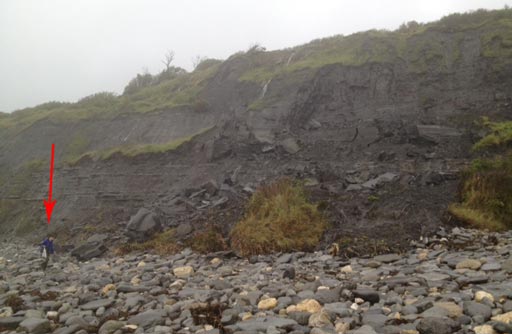
Brandon reports that the torrential rain led to another substantial land slip on Monmouth Beach on Saturday.

Frequent Rock Falls at Lyme Regis

Dangerous conditions for beachcombers.

Picture credit: Brandon Lennon

We have put an arrow on the picture so that the person in the photograph can be seen.  This gives an idea of the scale of the rock fall.

The current weather is making fossil collecting on the beaches around Lyme Regis very hazardous.  At Everything Dinosaur we would urge visitors to keep away from the cliffs and perhaps the best way to enjoy a fossil hunting trip is to take advantage of a guided tour with a professional fossil collector who knows the tides and the beaches in the area very well.

Brandon Lennon provides guided fossil hunting walks, to read more about this activity: Lyme Regis Fossil Walks.

Parts of the UK have already experienced the wettest June on record, July looks to be continuing the trend with the weather forecast for much of the country indicating that further periods of prolonged downpours are to be expected.

For replicas of ammonites and belemnites and other iconic creatures from the fossil record: Iconic Creatures from the Fossil Record (Models and Figures).

6 07, 2012

Bad Weather Making Fossil Collecting at Lyme Regis Hazardous

By |2023-02-02T09:08:08+00:00July 6th, 2012|Categories: Dinosaur and Prehistoric Animal News Stories, Educational Activities, Palaeontological articles|0 Comments

Rock Falls on Monmouth Beach

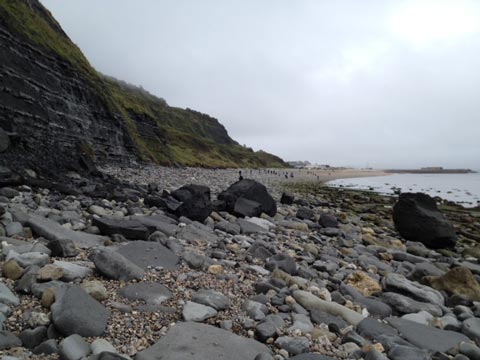
The heavy rainfall that has occurred along the south coast of England over the last few weeks has led to dangerous conditions for fossil collectors as they search along the beaches of Lyme Regis on England’s “Jurassic Coast”.  The cliffs at Lyme Regis are inherently unstable and rock falls are an ever present hazard for beachcombers as they search for ammonites and belemnites.  However, with the dreadful summer weather set to continue the cliffs are becoming saturated and rock falls and slides are more likely to occur. Fossil collecting at Lyme Regis can be dangerous in this weather.

A Recent Rock Fall on Monmouth Beach

Unstable cliffs pose a threat to beachcombers.

Picture credit: Brandon Lennon

Fossil Collecting at Lyme Regis

Local fossil expert Brandon Lennon reports that there have been several small rock falls in the Lyme Regis area over the last few days.  Brandon, who leads fossil collecting walks at Lyme Regis, commented that the cliffs at Monmouth beach were particularly unstable at the moment and yesterday (July 5th), there was a substantial rock fall with a number of sizeable boulders hurtling down onto the beach.

Brandon stated:

“The beach areas are particularly dangerous at the moment and I am concerned for the safety of visitors who come to Lyme Regis to explore this part of the Jurassic coast.  The bad weather has made the cliffs very unstable and I have already observed one large landslide that resulted in many tonnes of boulders and debris smashing onto Monmouth beach.”

The last major landslide in the area took place in May 2008, with over one hundred yards of cliff face collapsing.  Fortunately, this rock fall took place late in the evening at high tide so there were no casualties, but with thousands of would-be fossil hunters likely to hit the beaches at Lyme Regis with the onset of the Summer holidays, conditions exist for there to be a very serious incident.

A spokesperson from Everything Dinosaur commented:

“Whilst looking for fossils along the beaches of Lyme Regis can be tremendous fun, on no account should visitors stand directly under the cliffs and day trippers would be well advised to heed the warning signs and take advice from local experts who know all too well the hazards in the area”.

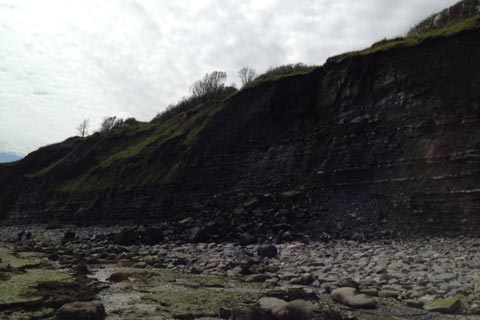
A Large Rock Fall on Monmouth Beach

Dangerous cliffs at Lyme Regis.

Picture credit: Brandon Lennon

One of the best ways to enjoy this part of the Jurassic Coast, a UNESCO World Heritage site, is to take advantage of a guided fossil walk where a professional fossil collector takes parties of visitors out to explore the beaches.  The guide can supervise the fossil hunting and take participants to less dangerous areas whilst still guaranteeing some exciting fossil finds.

To learn more about the fossil walks provided by Brandon Lennon (particularly suitable for families): Lyme Regis Fossil Walks.

Go to Top