All about dinosaurs, fossils and prehistoric animals by Everything Dinosaur team members.

Articles, features and information which have slightly more scientific content with an emphasis on palaeontology, such as updates on academic papers, published papers etc.

11 11, 2012

Flight Dynamics of Giant Pterosaurs Explained by New Research

By |2024-04-24T17:26:25+01:00November 11th, 2012|Categories: Dinosaur and Prehistoric Animal News Stories, Palaeontological articles|1 Comment

Researchers Propose that Quetzalcoatlus Used Cretaceous Runways to Take Off and Land

Scientists from the Museum of Texas Tech University have used computer modelling to assess how the last of the giant pterosaurs (flying reptiles) took to the air.  Pterosaurs, evolved during the Triassic and they went onto dominate the skies for much of the Mesozoic, until the emergence of the Aves (birds).  The very last types of flying reptile were giants, creatures like Hatzegopteryx thambema from Europe and Quetzalcoatlus northropi whose fossils have been found in the Big Bend National Park of Texas.  These pterosaurs were members of the Azhdarchidae family and some of these animals were the largest flying creatures known to science with wingspans in excess of ten metres reported.  Quetzalcoatlus, for example, had a wingspan greater than that of an American F-16 jet fighter.  Seeing this huge animal, many times bigger than the largest birds today, soaring overhead would have been a truly memorable sight.  However, how such large and heavy creatures took to the air has puzzled palaeontologists ever since the first fossils of these giant pterosaurs were discovered.

An Illustration of the Giant Texan Pterosaur Quetzalcoatlus (Q. northropi)

Taking to the air in Texas 66 million years ago.

Picture credit: Everything Dinosaur

Giant Pterosaurs

One University of Texas academic, Sankar Chatterjee (Horn Professor of Geosciences and Curator of the Palaeontology Department at the University’s Museum), has suggested that these enormous creatures needed down-sloping runways to enable them to take off.    The scientist presented a paper detailing his work on the aerodynamics of  the Azhdarchidae pterosaurs at the recent annual meeting of the Geological Society of America in Charlotte (North Carolina).

After a careful, three-dimensional study of azhdarchid fossils, Professor Chatterjee and his colleagues developed a computer simulation that showed how such an ungainly looking animal would have used a run up in order to gain momentum before finally being able to achieve lift off.  Landing would also have been very tricky for these animals, which some palaeontologists estimate may have weighed more than two hundred kilogrammes.  When coming into land, the large wings would have acted like giant air brakes, and the pterosaur would effectively “stall” before touchdown with its hind legs contacting the ground first and then the front of the body and the large head would pitch forward and a quadrupedal stance would be adopted as the flying reptile came to a halt.

Quetzalcoatlus Compared to Modern Birds and a F-16 Jet Fighter

Wingspan bigger than a jet fighter, but likely to be less noisy.

Picture credit: Museum of Texas Tech University

Commenting on his research, Professor Chatterjee stated:

“This animal probably flew like an albatross or a frigate bird in that it could soar and glide very well.  It spent most of its time in the air.  But when it comes to take off and landing, they’re so awkward that they had to run.  If it were taking off from a cliff, then it was OK.  But if Quetzalcoatlus were on the ground, it probably had to find a sloping area like a river bank, and then run quickly on four feet, then two to pick up enough power to get into the air.  It needed an area to taxi.”

How Large Pterosaurs Took to the Air

In 2010, a study published in the open access and on line journal “Public Library of Science” proposed that the largest of the pterosaurs launched themselves into the air by using their strong leg and arm muscles to “vault” upwards.  This work was conducted by researchers based at the University of Portsmouth (England).  Professor Chatterjee and his colleagues do not agree with these earlier findings.  They postulate that such a method of taking to the air may be proven in small bats, but when it comes to a two hundred kilogramme pterosaur with a wingspan in excess of ten metres; this method of becoming airborne is simply not viable.

The Texas based team report that once animals got to a certain size they would not have had the strength and power required to vault into the air.  They contend that the only way these large flying reptiles could get airborne would be by taking a long run up, preferably into the wind along a downward sloping bank or similar stretch of ground.  Starting on all fours, the animal would quickly switch to a bipedal stance and build up running speed, then just like a modern-day hang glider, it would launch itself into the air, pick up a thermal and rapidly gain height.

Computer Models

The computer model suggests that these animals could not beat their wings very rapidly.  With a high-aspect-ratio wing, similar to that observed today with modern petrels and albatrosses, the azhdarchid pterosaurs would rely on thermals and air currents to keep them aloft with the minimum of effort.  The animals would have been vulnerable and ungainly on the ground but once in the air they could soar for hours.  Professor Chatterjee and his team have suggested that such creatures could attain air speeds in excess of 36 mph (58 kmh).

These enormous creatures, some of which stood taller than a giraffe, were aerial masters, the very last of their kind.  Pterosaurs died out at the end of the Cretaceous some sixty-six million years ago.  All we have now are their amazing fossils that can be studied so that we can understand how these creatures were able to fly.

For models and replicas of azhdarchid pterosaurs and other flying reptiles as well as dinosaurs and other prehistoric animal figures: Pterosaur Models, Dinosaur Figures and Prehistoric Animal Models (Safari Ltd).

8 11, 2012

Predator/Prey Relationships in Miocene Spain

By |2023-02-06T16:11:23+00:00November 8th, 2012|Categories: Dinosaur and Prehistoric Animal News Stories, Palaeontological articles|0 Comments

Joint American and Spanish Team Study Teeth to find out what Sabre-toothed Cats Ate

A ratio of Carbon 12 to Carbon 13 isotopes preserved in the fossilised teeth of apex predators and herbivores that lived over nine million years ago has provided a joint American and Spanish research team with an insight into how food chains worked in the latter part of the Miocene epoch.  The study, the academic paper having been published in the scientific journal  “The Proceedings of the Royal Society of Biology”, focused on the diets of the top, predatory mammals and attempted to establish how large carnivores such as Sabre-toothed cats and Bear Dogs (amphicyonids) were able to live in the same habitats in the Late Miocene of Spain without necessarily competing for the same food resources.

The Late Miocene of Spain

Palaeontologists from the Museo Nacional de Ciencias Naturales (Madrid) and the University of Michigan (United States) studied the fossilised teeth of  specimens of animals that had been found at a number of fossil dig sites at Cerro de los Batallones, just 25 miles south-west of Madrid.  A substantial number of vertebrate skeletons have been discovered in this area, two dig sites are particularly rich in predator fossil bones.  Scientists suspect these sites represent “natural predator traps”, a herbivore may have become stuck fast in mud and this then attracted a number of carnivores and scavengers to the location hoping to feed on the hapless plant-eater.  The meat-eaters soon became stuck too, and the rising pile of corpses would have attracted more and more predators, thus the number of carnivore fossil specimens found at such sites are far in excess of the number of herbivore fossil specimens found.  Fossils found include those of hyenas, martens and skunks.

Two Species of Sabre-toothed Cat

The researchers studied two species of Sabre-toothed cat, Promegantereon ogygia, about the size of an African Leopard (Panthero pardus pardus) and the much larger and heavier Machairodus aphanistus, which was about the size of an extant African Lion (Panthero leo).  It is quite common to hear people describe Sabre-toothed cats as “Sabre-toothed tigers”, this is an inaccurate description, as although Sabre-tooths do belong to the same taxonomic family as today’s “Big Cats” – Felidae, Sabre-toothed cats are not  closely related to tigers.

Identifying the Role of Sabre-toothed Cats in Ancient Food Webs

Ambush predators, animals of woodlands and dense scrub?

Picture credit: Everything Dinosaur

Bear Dogs

The other type of apex predator the research team studied was the Bear Dog known as Magericyon anceps.  Bear Dogs are neither Bears or Dogs but seem to be distantly related to both types of carnivore, sharing a common vulpavine ancestor.  M. anceps was a particularly large and powerful example of the Middle to Late Miocene Bear Dogs, large specimens could weigh over 200 kilogrammes and would have stood over a metre high at the shoulder.

The study of the teeth isotopes revealed that the Sabre-toothed cats shared the same woodland habitat.  The smaller Sabre-toothed cat species probably used the abundant cover to avoid encounters with M. aphanistus.  Sabre-toothed cats have a different build when compared to modern cats.  They are not built for speed but have immensely strong front legs and shoulders.  Scientists have speculated that Sabre-toothed cats specialised in being ambush predators rather than pursuit predators, chasing after their prey.  The woodland habitat would have been ideal for ambushing herbivores.

Stable Carbon Isotope Analysis

To arrive at their findings, the researchers conducted what’s called a stable carbon isotope analysis on the animals’ teeth. Using a dentist’s drill with a diamond bit, they sampled teeth from 69 specimens, including 27 Sabre-toothed cats and Bear Dogs.  The rest were plant-eaters.  They isolated the carbon from the tooth enamel.  Using a mass spectrometer, which you could think of as a type of scale, they measured the ratio of the more massive carbon 13 molecules to the less-massive carbon 12.  An isotope is a version of an element that contains a different number of neutrons in its nucleus.

Carbon 12 and 13 are both present in the carbon dioxide that plants take in during photosynthesis.  Different plants make use of the isotopes in different ways, and so they retain different amounts of them in their fibres.  When a herbivore eats a plant, that plant leaves an isotopic signature in the animal’s bones and teeth.  The signature travels through the food chain and can be found in carnivores as well.

One of the research paper’s authors stated:

“This would be the same in your tooth enamel today.  If we sampled them, we could have an idea of what you eat.  It’s a signature that remains through time.”

Cerro de los Batallones in the Late Miocene

The Late Miocene of Spain.

Predator/prey relationships studied in the Late Miocene of Spain.

Picture credit: Mauricio Antón

Late Miocene of Spain

This illustration depicts how the region of Cerro de los Batallones in central Spain likely looked 9 million years ago.  A superb scene created by Mauricio Antón and we acknowledge the University of Michigan press information which provided this image.

Both species of Sabre-toothed cat showed no statistical differences in the ratio of Carbon 12 to Carbon 13 in their teeth samples.  This means that they probably fed on similar prey animals that lived in the woodlands, but their body sizes probably meant that they targeted different sized prey.  They may also have avoided direct competition by hunting at different times of the day.  It has been speculated that Promegantereon ogygia may have hunted after dusk, or spent more time in the trees, so as to avoid the attentions of larger types of Sabre-toothed cat in the area.  It seems that the members of the Machairodontinae living in the area that was to become central Spain preferred to eat primitive horses, animals that were not yet the highly efficient runners seen on race tracks today.

Tests on Bear Dog Teeth

The tests on the Bear Dog teeth showed a different ratio, indicating that an alternative type of prey was preferred by these carnivores.  The Bear Dogs hunted animals that lived in more open, grassland habitats, they seem to have been better suited to pursuit predation, tackling herbivores that lived in open areas such as antelopes.

It seems that nine million years ago, a number of mammalian apex predators were able to co-exist in this part of Europe as they seem to have specialised in hunting different types of prey animal.

Commenting on the study, one of the researchers stated that such investigations using isotope analysis of fossil teeth provided an insight into the diets of long extinct creatures.  This in turn gave the palaeontologists an understanding of an ancient, long extinct ecosystem.

For models and replicas of prehistoric mammals including apex predators: Wild Safari Prehistoric Animal Figures and Models.

29 10, 2012

Theory on How T. rex tackled Triceratops for Dinner

By |2023-02-06T14:10:37+00:00October 29th, 2012|Categories: Dinosaur and Prehistoric Animal News Stories, Palaeontological articles|0 Comments

Scientists Publish Theory of T. rex Feeding Behaviour on Triceratops

It seems that most dinosaur films and television programmes feature a battle between meat-eating and plant-eating dinosaurs.  Viewers can’t get enough of these huge, extinct reptiles battling one another and now a team of researchers at the Museum of the Rockies (Montana, United States) have published a rather gory paper explaining how Tyrannosaurus rex may have fed on Triceratops.  The scientists postulate that this tyrannosaur ripped the head off its victim so that it could feast on the large neck muscles that were in place immediately behind the Triceratops bony neck frill.

Tyrannosaurus rex

Denver Fowler at the Museum of the Rockies and  his colleagues studied a total of eighteen Triceratops specimens from Montana’s Hell Creek Formation, some of which showed the characteristic Tyrannosaurus bite marks.   There are a number of Triceratops skulls in the fossil record that show signs of tooth marks and punctures made by the characteristic “D-shaped” teeth of a tyrannosaurid.  In a paper presented at the recent annual meeting of the Society of Vertebrate Palaeontology, the team graphically illustrated how a dead Triceratops may have been decapitated by a feeding Tyrannosaurus rex.

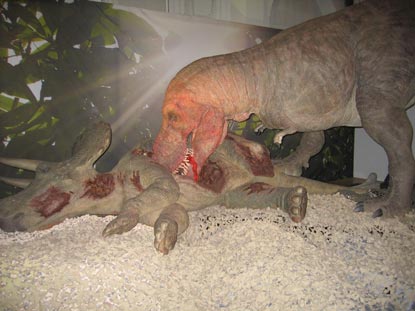
Gruesome Theory Concerning Tyrannosaurid Feeding Behaviour

Eating Triceratops one chunk at a time.

Picture credit: Mike Fredericks

Signs of injuries and disease in fossils is known as pathology.  Palaeontologists have studied the fossilised bones of both the plant-eating Triceratops and the meat-eating tyrannosaurids and there is a lot evidence to support the theory that T. rex attacked and fed upon this particular horned dinosaur.   However, in this new study the researchers were interested in working out what the marks and scars on the bones of this particular horned dinosaur said about the way in which a tyrannosaur may have fed upon a Triceratops carcase.

The Museum of the Rockies

The Museum of the Rockies team were intrigued to discover that many of the puncture and pull marks were on the bony neck frill of the fossil specimens they studied.  Triceratops had a very large skull, it was protected by three horns on its face, (the name Triceratops means “three horned face”).  It had a short nose horn and two further, much larger horns over the eyes. These horns could grow to be more than a metre long in mature adults.  Scientists have long speculated that the horns and frills of ceratopsians performed many functions.  They may have been brightly coloured, an aid to visual communication amongst herd members.  The horns and frills may have also been used in intraspecific combats, for example, two Triceratops fighting together over mates or social status.   These facial ornaments were also defensive structures, very useful when you share the same environment as thirteen-metre-long tyrannosaurs with an ability to swallow up to seventy kilogrammes of meat in one mouthful.

T. rex Feeding – A Scenario

Tyrannosaurus rex feeding habits.

The Inspiration behind the Collecta Dino Prey – Dead Triceratops?  Tyrannosaurus rex feeding habits.

Picture credit: Everything Dinosaur

The skull of Triceratops was very heavy and in comparison to the rest of the body it did not have a lot of meat on it.  The neck frill would not have offered a lot of nutrition, so why the bite and pull marks?

A Study of Ceratopsian Skulls

An analysis of the fossilised Triceratops skull material revealed deep, parallel groves on the neck frill, suggesting that a feeding Tyrannosaurus rex may have used its immensely strong jaws and neck muscles to pull on the frill in order to reposition the carcase for feeding or indeed to move the corpse.  Many predators today; after they have made a kill attempt to drag the corpse of their victim to a concealed place so that they can feast in peace without being disturbed by scavengers or worse still, a bigger predator coming along and chasing them away from their dinner.  Leopards for example have been known to drag the body of a gazelle up into a tree so they can feed without being disturbed by lions.  Perhaps T. rex attempted to move their victims so that they could eat without the risk of being attacked by other tyrannosaurs.  However, the prospect of dragging a seven tonne “dead weight” any distance would have been quite daunting and it would have wasted a lot of energy, perhaps the pull marks indicate where the body was torn apart – a sort of how to eat a Triceratops – one chunk at a time scenario.

Tyrannosaurus rex Feeding Habits

If T. rex was attempting to reposition its prey then the scientists speculate that the bony neck frill would have prevented the carnivore from accessing the large muscles on the neck of Triceratops.  The team have proposed that this nasty predator probably used its teeth and jaws to pull on the frill in an effort to get at the meat behind the frill.

The gruesome conclusion made by the palaeontologists is that the easiest way to get to the large neck muscles is to pull the head right away from the body.  In this academic paper, it is postulated that T. rex ripped the heads of its Triceratops victims.

Further evidence to support the “heads-ripped-off-Triceratops” theory was found by the scientists when they examined the joint that attaches the neck to the skull.  This ball and socket joint, known as the occipital condyles showed signs of bite marks on the anterior surface.  The scientists concluded that such marks could only have been made if the head had been removed from the body.

The problem with this rather gruesome area of research is that we cannot rely on observations using extant animals (animals alive today) to support this theory.  The Tyrannosaurus rex versus Triceratops predator prey relationship involves a biped attacking a quadruped.  As we humans (H. sapiens) are the only true biped amongst the Mammalia alive today finding evidence to support this theory in the natural world is very difficult.  Wolves attack horned bison but observations of a wolf pack’s behaviour suggests that they avoid attacking the head and neck region and prefer to try to bring down their quarry by attacking the hind legs.  A wolf weighs fifty times less than a large bison, whereas an adult T. rex and an adult Triceratops were much more evenly matched in terms of body mass.  Scientists do not know whether tyrannosaurs were solitary hunters or pack animals, if they were pack animals then this would suggest differences in hunting and feeding strategies.

Moreover, there are a number of Triceratops skulls preserved in the fossil record for palaeontologists to study.  Other parts of the Triceratops anatomy, the front legs for example are rarely found in the fossil record.  It has been speculated that the front legs rarely fossilised as this part of the body of a Triceratops was readily consumed as the carcase was broken up.

Bite Marks on Neck Frills

The Museum of the Rockies team point to the fact that the bite marks on many of the neck frills show no signs of healing. This, they suggest indicates that these injuries occurred after the Triceratops had expired and provide evidence of feeding behaviour.  Unfortunately, an attack by a tyrannosaurid as it attempted to bring down its prey, would have resulted in extensive bite marks too.  If the attack proved fatal then these wounds which were inflicted during the fight between these two protagonists could be easily confused with those pathologies caused as a result of feeding.

For models and replicas of Tyrannosaurus rex, Triceratops and other famous dinosaurs: Nanmu Studio Jurassic Series Dinosaurs.

It seems that we may never know the exact methods used by tyrannosaurs to maximise their feeding with the minimum of effort when it came to eating a Triceratops, however, this new research “heads” us in an interesting direction.

The scientific paper: “How to eat a Triceratops: large sample of toothmarks provides new insight into the feeding behavior of Tyrannosaurus” by D. Fowler, J. Scannell, M. Goodwin and J. Horner published in the Journal of Vertebrate Paleontology.

26 10, 2012

Canadian Researchers Find Evidence of Feathered Ornithomimids According to New Study

By |2024-04-24T17:09:14+01:00October 26th, 2012|Categories: Dinosaur and Prehistoric Animal News Stories, Palaeontological articles|1 Comment

Scientists Suggest “Wing Feathers” Evolved for Courtship

A new study into the fossilised bones of “bird mimic” dinosaurs, a clade of the Dinosauria known as the ornithomimids, by a team of scientists based in Canada has revealed that these dinosaurs too were covered in feathers, just like their maniraptoran cousins.  However, the study which examined the fossils of juveniles as well as adults has concluded that wing feather-like structures are only to be found in older, more mature specimens.  This suggests that wing feathers may have evolved in some types of dinosaur to assist in courtship displays to find a mate.

Feathers on Ornithomimid Dinosaurs

The ornithomimids (bird mimics) are a group of Cretaceous theropod dinosaurs known from the Northern Hemisphere (North America and Asia).  They were named ornithomimids, not because scientists first thought that these reptiles were feathered, but from anatomical studies of their fossilised bones it was clear that these dinosaurs shared a lot of common features with modern ground dwelling birds.  They had lightly built skeletons, light bones and as a group they tended to have small skulls, beaks but with jaws mostly lacking teeth, long legs and long tails.

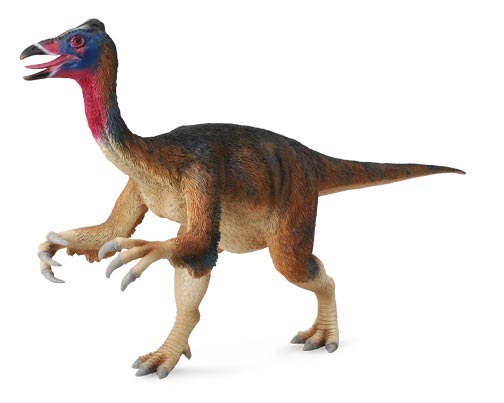
Although ornithomimids had similar body plans individual genera are distinguished by differences in their beaks, the size of the arms and hands and their body proportions.  Deinocheirus (Deinocheirus mirificus) is believed to have been a member of the ornithomimids – the largest discovered to date with some palaeontologists estimating this animal to have been about the size of a Tyrannnosaurus rex.

Feathered Ornithomimid – Deinocheirus

Giant, winged theropod.

Picture credit: Everything Dinosaur

A Collaboration Between Scientists

The study, a collaboration between scientists at the University of Calgary and the Royal Tyrrell Museum, both in Alberta, Canada, suggests that feathers associated with dinosaur fossils may actually be found in strata that was previously thought to be too coarse grained to preserve delicate structures such as the filaments from primitive feather-like structures.

Palaeontologists François Therrien (curator at the Royal Tyrrell Museum) and Darla Zelenitsky (University of Calgary) studied a series of Ornithomimus fossils that had been found in Upper Cretaceous strata exposed in the Canadian Province.  Ornithomimus was first named and described by the American palaeontologist Othniel Charles Marsh in 1890.

A number of species are associated with this genus and Ornithomimus seems to have been a particularly widespread ornithomimid with fossils having been discovered all over the western part of North America, from Alberta in the North to Texas in the south.  The particular Ornithomimus fossils studied by the Canadian scientists come from the Badlands of Alberta and date from approximately 75 million years ago (Campanian faunal stage).

The specimens studied included a juvenile and two adult skeletons preserved in a sandstone deposit.  Although the fossils had been known for many years, it was only recently the evidence of feathers was found after the fossil material was subjected to intense analysis using ultra violet light scans and computerised tomography.

It had long been suspected that ornithomimids were covered in downy, insulating feathers but this is the first time that feathered dinosaur specimens have been found in the western hemisphere.  The discovery of the feathers re-affirms earlier research that suggested that most if not all ornithomimids were covered in a coat of feathers.

Assistant Professor Darla Zelenitsky commented that this was “a really exciting discovery”.  Although many different types of “bird-mimic” dinosaur are known these Canadian specimens are the first to reveal that ornithomimids were covered in feathers, just like other types of theropod dinosaur such as the Dromaeosaurs.

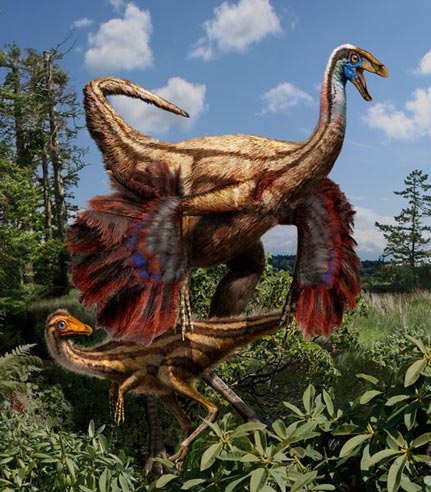
Parents with Wing-like Forearms in the Ornithomimidae

Mums and dads with wings in the Ornithomimidae.

Picture credit: Press Association (illustration by Julius Csotonyi)

Interestingly, the research team noted differences in the feathers between the juvenile and the adult animals.  The mature, older individuals had developed larger feathers on their arms, these formed a wing-like structure but clearly adult Ornithomimus were too big to fly, with some specimens reaching over four metres in length.

Associate Professor Zelenitsky explained the significance of this finding by stating:

“This pattern differs from that seen in birds, where the wings generally develop very young, soon after hatching.”

The development of primordial wing structures in adult animals suggests that juveniles and sub-adults did not have these feathered structures on their arms until they had grown up and become old enough to mate and reproduce.

Therrien postulated that:

 “The fact that wing-like forelimbs developed in more mature individuals suggests they were used only later in life, perhaps associated with reproductive behaviours like display or egg-brooding.”

The finding of evidence of fossilised feathers in sandstone rocks has potential implications for future discoveries of feathered dinosaurs in North America.  Feathered dinosaurs are known from fine grained formations such as those from the Liaoning Province of China.  The discovery of traces of feathers on dinosaurs excavated from sandstone, a very common fossil bearing sedimentary substrate suggests that a more detailed examination of existing fossil dinosaurs from sandstone deposits may reveal more signs of dinosaur plumage.

For models and replicas of ornithomimids and other theropod dinosaurs: CollectA Prehistoric Animals (Age of Dinosaurs Popular).

The ornithomimid specimens used in this study will be put on display as part of a larger exhibition on theropods at the Royal Tyrrell Museum.  These fossils also indicate that primordial wing-like structures on the arms of dinosaurs evolved earlier than previously thought amongst non-maniraptoran theropods.

Although such structures were never intended for flight, a set of feathery arms would have helped an adult to brood a clutch of eggs, sheltering them and keeping them warm whilst the adult sat on the nest.  Once the eggs had hatched than the feathery structures could act as a shade for the youngsters in the nest as well as providing warmth and shelter.  If the family went on the move then the adult could use the feathered arms to signal to their offspring, part of the non-verbal communication between a parent and young.

The scientific paper: “Feathered Non-Avian Dinosaurs from North America Provide Insight into Wing Origins” by Darla K. Zelenitsky, François Therrien, Gregory M. Erickson, Christopher L. Debuhr, Yoshitsugu Kobayashi, David A. Eberth and Frank Hadfield published in Science.

10 10, 2012

Controversial Research Proposes a Half-Life for DNA

By |2023-02-06T08:44:28+00:00October 10th, 2012|Categories: Dinosaur and Prehistoric Animal News Stories, Palaeontological articles|0 Comments

Scientists Calculate the Half-Life of DNA using Moa Fossils

A team of international researchers have used the fossilised bones of three species of extinct giant birds from New Zealand to calculate the half-life of DNA.  This study suggests that the double helix can persist in the fossil record under optimum conditions for a lot longer than previously thought with traces of genetic material being detectable in fossils as old as 6.8 million years.  The work, which is controversial, if proved valid, rules out DNA from a dinosaur surviving so there would be no chance of cloning a member of the Dinosauria from genetic material recovered from their bones or from biting insects trapped in amber.

Sorry Michael Crichton fans, but his wonderful idea about a dinosaur populated “Jurassic Park” is simply not on.

A half-life measurement records the time required for a substance to fall to half its measured value at the beginning of a time period.  One of this term’s most common applications is in the measurement of radioactive decay.  Within palaeontology for example, once a half-life of a substance such as elements from an igneous rock deposited in association with sedimentary strata is calculated, since the rate of decay is exponential, this methodology can permit scientists to accurately date rocks and potentially any fossil material associated with adjacent strata.  However, a team of scientists have worked out a half-life for DNA itself.  If this measuring technique proves valid then the dating of fossils could become a lot easier and the search for DNA samples within the fossil record can become more targeted.

Half-life of DNA

There have been a number of papers published recently that claim to have isolated extremely old, fragmentary DNA, even elements of organic material from dinosaur bones.  The need for a reliable model for DNA degradation over the passage of time has been well established.  The international team of palaeontologists took core samples from the leg bones of 158 specimens of New Zealand Moas which were very likely to have preserved in them mitochondrial DNA.  Radiocarbon dating allowed the team to accurate work out the ages of the fossil material and based on this analysis they were able to demonstrate that DNA decays at a exponential rate over time.  The half life of DNA was calculated to be 521 years, much longer than had been demonstrated in other experiments.

Fossilised Leg Bones Used in the Study

Large Moa bones used in the DNA study.

Picture credit: Morten Allentoft

After an animal dies, the cells begin to degrade.  Enzymes start to dissolve the bonds between the nucleotides that form the structure of the DNA material contained within the cell.  Micro-organisms can speed up the decay process, but it is thought that the presence of ground water and the chemical reactions brought about by its presence, is mostly responsible for the degradation of the genetic material.  As groundwater is abundant and found in most strata, so DNA buried in bone undergoing a fossilisation process should, in theory at least, degrade at a set, measurable rate.

The Rate of DNA Decay

Calculating the rate of DNA decay has been fraught with difficulties because of the problems of finding enough fossil material with large amounts of DNA with which to use in any scientific study.  Compounding this problem is the fact that variable environmental conditions such as temperature, the amount of oxygen present and the level of microbial activity all have a significant impact on the decay of organic material.

The research team led by Morten Allentoft (University of Cophenhagen, Denmark) and Michael Bunce (Murdoch University, Perth, Australia) focused their efforts on analysing the DNA from 158 leg bones that belonged to three species of extinct Moa.  Moas were giant, flightless birds (nine species) that were native to New Zealand (Dinornithiformes), some species were over 3.5 metres tall.  These birds, closely related to Australian Emus, became extinct around 1400 AD.  These creatures were once abundant on both North and South Island and the bones used in the study came from three locations all within a few miles of each other.  The close proximity of the specimens studied enabled the scientists to nullify the effect of environmental differences between locations as the fossils had been forming in almost identical preservation conditions.

All the bones have been dated between 8,000 and 600 years old, the strata in which they were being preserved had a temperature of around thirteen degrees Celsius, helping to keep the results of any DNA half-life measurement consistent over the entire sample.

By comparing the specimens’ ages and degrees of DNA degradation, the researchers calculated that DNA has a half-life of 521 years. That means that after 521 years, half of the bonds between nucleotides in the DNA would have broken; after another 521 years half of the remaining bonds would have degraded leaving only a quarter of the original material left; and so on.   Using their research, the team have postulated that detectable DNA could be found in fossils as old as 6.8 million years, but this material would be too fragmented to be used in any cloning work.  DNA’s ability to survive in the fossil record, or so it seems, has been seriously underestimated.

Post doctoral researcher, Morten Allentoft commented:

“DNA degrades at a certain rate, and it therefore makes sense to talk about a half-life.”

These results may provide a baseline for predicting long-term DNA survival in fossil bone, helping palaeontologists to assess the most likely fossils to have sustainable amounts of DNA within them.  In sub-zero conditions, such as those found in Siberia, DNA may have a half-life that it much longer, perhaps as much as 158,000 years.  This would potentially permit scientists to extract viable DNA from Ice Age mammals such as Woolly Rhinos and Mammoths.

A number of scientists have yet to be convinced by these findings.  Eva-Maria Geigl at the Jacques Monod Institute (Paris, France), remains sceptical.  She is concerned that the analysis rests on statistically weak evidence, pointing out that the correlation relies heavily on the Moa bones older than 6000 years – when fewer than 10 of the 158 bones are actually as old as this.

Michael Bunce defended his work by explaining:

“Old fossils are rare and hence there will be less data in this part of the analysis.  There is nothing we can do about it other than present what we have at hand – and clearly, the signal is present.  The correlation is highly significant.”

If genetic material has a predictable time-frame for decay, then palaeontologists may have an opportunity to obtain DNA from important fossil discoveries that reveal life on Earth in the relatively recent geological past.

Ever since the Indonesian island of Flores yielded remains of a pygmy-like hominid (Homo floresiensis), nick-named the “hobbit” speculation has been rife that some specimens might contain DNA that would help pin down its position in the human family tree.   Scientist remain uncertain whether these little people were descendants from modern humans or the much older H. erectus.

Unfortunately, exogenous factors would “cloud” the DNA half-life calculations.  The conditions in which the fossils were preserved, the degree of groundwater, the amount of oxygen, the level of microbial activity  and the ground temperature would all affect the rate of genetic decomposition.  The research scientists conclude that “a host of other factors would come into play“, including the time of year when the organism died.  Although the Moa bones used in the study had all been retrieved from very similar environments, the age of the specimens could only account for about 40% of the variation in DNA preservation.  The research team admits that the “half-life signal is very noisy“.

How a corpse rots and a whole host of other factors would influence the rate of decline of any genetic material once present, based on this work retrievable and workable DNA could potentially be recovered from a fossil that was 1.8 million years old – but beyond this time-frame sufficient DNA recovery to permit effective study would be virtually impossible.

Looks like the non-avian dinosaurs are really extinct after all.

For models and replicas of prehistoric animals and ancient creatures: Prehistoric Animal Models (Mojo Fun).

7 10, 2012

Late Jurassic Marine Crocodiles – More Like Killer Whales than Crocs.

By |2023-02-06T08:23:43+00:00October 7th, 2012|Categories: Dinosaur and Prehistoric Animal News Stories, Palaeontological articles|0 Comments

Research Suggests Marine Crocodiles Were Very Different from Todays

Scientists at the University of Edinburgh have concluded that Late Jurassic marine crocodiles may have fed more like Killer Whales than extant crocodiles and one genus could have sucked prey into its mouth or simply attacked and torn other large marine creatures apart with its strong jaws and teeth.

Marine Crocodile Research

Marine crocodiles (crocodylomorphs) represent a branch of the crocodile family tree that radiated out from land base forms during the Mesozoic and evolved into a variety of families and genera.  There is an extensive fossil record with numerous skulls and other fossilised bones as well a large numbers of individual teeth for palaeontologists to study.

Marine crocodiles shared similar characteristics, unlike their land-based ancestors these reptiles adapted to a nektonic (actively swimming) life by slowly losing their body armour (scutes/osteoderms) and becoming more streamlined.  Their limbs evolved into paddles and most species had broad tails which ended in a hypocercal tail fin.  A hypocercal tail fin is a fin which is not symmetrical along the horizontal axis in line with the caudal vertebrae (in the case of vertebrates).  The lower tail lobe is enlarged and bigger than the upper tail lobe.  It is very likely that these crocodiles propelled themselves through the water in the same way that crocodiles do today.  The tail was the source of propulsion, the limbs (paddles) may have been used to make changes in direction and small adjustments in the water column.   However, these evolutionary adaptations made these creatures much more efficient swimmers than land based crocodylomorphs.

An Illustration of a Typical Marine Crocodile

Marine crocodile model Dakosaurus.

A close-up view of the head of the PNSO marine crocodile model Dakosaurus.

The picture (above) shows the package art for the PNSO Dakosaurus replica.

To view the PNSO range of prehistoric animals including marine reptiles: PNSO Marine Crocodiles and Prehistoric Animal Models.

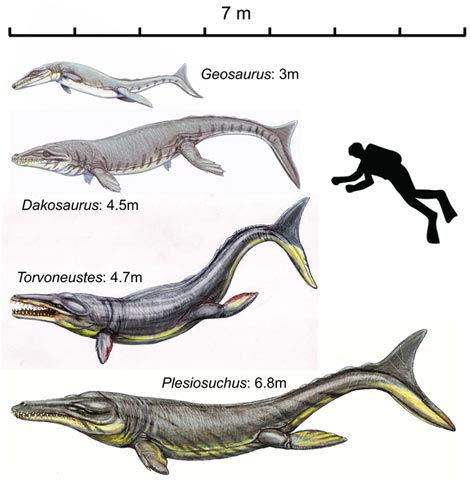
One super-family of the marine crocodiles, the Metriorhynchidae seems to have had a particularly large geographical distribution, with fossils being found in England, France, Switzerland, Italy and Germany as well as the Americas including Chile and Argentina.  As a group, these carnivorous reptiles seemed to have their heyday in the Late Jurassic but fewer fossils have been found in Lower Cretaceous strata.  The research team, led by Dr Mark Young of the School of Geosciences (University of Edinburgh) studied two types of marine crocodile Dakosaurus and the larger Plesiosuchus.  They have concluded that these large, contemporaneous predators probably predated on different types of prey.

To read about the discovery of Jurassic crocodile fossils in Switzerland: Marine Crocodile Fossils Found in the Land of Chocolate, Pen Knives and Cuckoo Clocks.

Dakosaurus

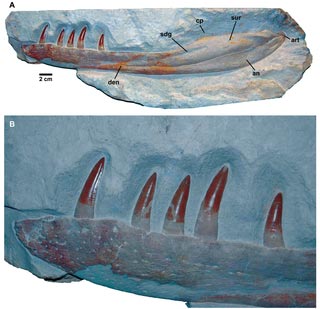
Dakosaurus spp. grew to lengths approaching five metres, they were not the largest types of marine crocodile but they did have the most robust lower jaws and in proportion to their body size, much larger teeth.  The teeth of Dakosaurus spp were designed for slicing, the Edinburgh researchers conclude that this type of marine crocodile evolved a specialism for tackling large prey.  The teeth and strong jaws being capable of dismembering large-bodied prey and crushing bones.  In addition, the research team have concluded that one species of Dakosaurus (Dakosaurus maximus) may have been capable of creating a pressure differential inside its strong jaws that permitted it to suck in prey.  Many of the teeth found in the fossilised jaws of Dakosaurus are broken and show extensive wear.  The scientists have concluded that these pathologies are indicative of the tougher, larger body parts that these animals were consuming.  Teeth may also have been broken as these crocodylomorphs tore their victims apart.

The Lower Jaw of a Dakosaurus (Dakosaurus maximus)

Robust and powerful jaws and teeth.

Picture credit: PLoS One

The Plesiosuchus genera also had strong jaws, large fenestrae  (openings in the skull) would have anchored strong muscles to give these crocodiles a powerful bite.  They could also gape their jaws very wide enabling them to tackle large prey items, but probably animals no bigger than their mouths could gape.  The teeth of Plesiosuchus spp. are proportionally smaller and more conical than the teeth of Dakosaurus.  Fossilised teeth ascribed to Plesiosuchus lack the crown breakage seen with Dakosaurus teeth.  This suggests that Plesiosuchus did not eat the same animals as the smaller Dakosaurus.  They may have killed their victims with a single bite before swallowing their meal whole.

The relationship between Dakosaurus and Plesiosuchus is very similar to that seen with North Atlantic Killer Whales today.  There is a larger type of Killer Whale that lacks broken teeth, whilst there is a smaller type of Killer Whale that tends to have extensive crown breakage.  Marine biologists have proposed that these differences in teeth wear are associated with diet.  Each type of Killer Whale specialising in different types of prey.  Plesiosuchus may have been a specialist piscivore (fish-eater) tackling prey no more than a metre in length perhaps, whereas Dakosaurus may have hunted ichthyosaurs, other marine reptiles and larger types of fish.

Size Comparisons between Different Types of Marine Crocodile

Frogman in picture is 1.8 metres tall.

Picture credit: PLoS One

Different Types of Feeding Behaviour

The research team have concluded that this different feeding behaviour helps to explain why so many apex predators were able to live together in the Late Jurassic marine environments.

Commenting on the research, one of the authors of the scientific paper that has been published on this subject, Dr Lorna Steel stated:

“The skull and tooth morphology show that they all ate different prey, and fed in different ways.”

24 09, 2012

Have Fun Fossil Hunting in London

By |2024-04-24T16:36:31+01:00September 24th, 2012|Categories: Dinosaur Fans, Educational Activities, Everything Dinosaur News and Updates, Geology, Palaeontological articles|1 Comment

Fossils are Abundant in London – If you Know Where to Look

When asked where to go fossil hunting many people advise a trip to the seaside to explore cliffs or perhaps a trip to a local quarry to study the sediment being exposed, but ironically if you know what to look for and where to look, a trip to a big city can yield a surprising number of exciting fossil discoveries. For example, you can go fossil hunting in London.

Fossil Hunting in London

A visit to London is no exception.  This city may not be the obvious choice for a person to go fossil hunting but amongst the paved streets and buildings, an observant palaeontologist can find some remarkable evidence of ancient life.  London itself, has yielded many important fossil discoveries the London clay preserves a sub-tropical, estuarine environment recording a rich diversity of life including crocodiles, turtles, birds, mammals and a number of plant fossils from a time after the extinction of the dinosaurs.  The fossilised bones of Pleistocene lions and hippos have been discovered by workmen digging under Trafalgar Square, but you don’t need to excavate or even to carry a geological hammer to find fossils in a place like London.  All you need are a sharp pair of eyes and a camera to record your discoveries.

Fossils at St Paul’s Cathedral

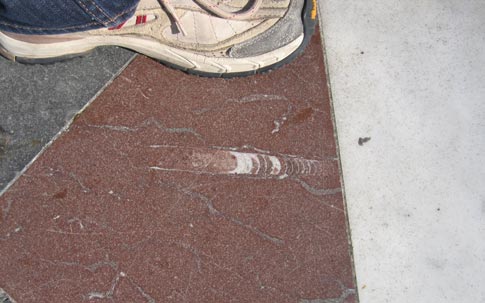
Take a visit to St Paul’s Cathedral for example.  Whilst visitors are admiring the dome and the beautiful facia of the cathedral designed by Sir Christopher Wren, take a moment to examine the steps that lead up to the main entrance.  The polished flagstones that can be found at the top of the steps leading up to the main thoroughfare contain a number of very well-preserved specimens of ancient cephalopods.  The stone for these flags came from Sweden.  They represent marine strata laid down something like 480 million years ago in the Early Ordovician geological period (Tremadocian faunal stage).  Preserved as fossils in these stones are the remains of straight-shelled nautiloids.  Nautiloids were actively swimming creatures distantly related to octopi and squid that lived in straight-chambered shells.  Some of these creatures evolved into huge predators, the first sea monsters that ever lived, with genera such as Cameroceras and Endoceras reaching lengths approaching ten metres.  These animals are only distantly related to the modern Nautilus but they had basically the same body plan.  Their long conical shells were divided internally into many chambers, these were joined by a long tube that was used to control the amount of water in each of the chambers (siphuncle).  The largest,  end chamber housed the actual animal with its head, powerful beak and grasping tentacles.

Ordovician Nautiloids at St Paul’s Cathedral

Fossils to be seen in London.

Picture credit: Everything Dinosaur (Geologist provides foot for scale)

The fossils seen on the steps of St Paul’s do not represent huge specimens but the individual chambers (septa) of the shells can be clearly made out as the specimens are viewed in cross-section. Some of these fossils are more than thirty centimetres in length.

Portland Stone

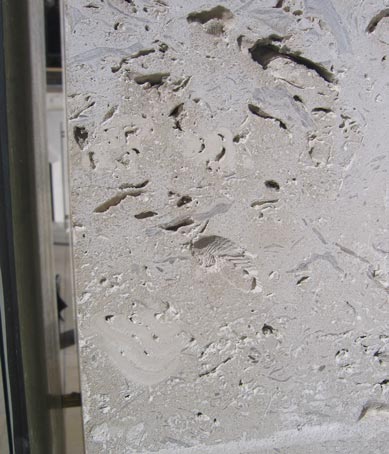
Much of the stone used to build the Cathedral is Portland stone.  This limestone, quarried from Portland in Dorset, was formed in a shallow, tropical Jurassic sea towards the end of this geological period (Tithonian faunal stage).  This type of stone adorns many of the well-known public buildings of London.   The white/grey limestone has been used as a building material in the United Kingdom since Roman times.  The splendid Guildhall of London, built in the fifteenth Century, is one such building and a careful examination of the stone blocks that make up the facia of the building opening out into the main courtyard, can yield some fossil finds for an observant palaeontologist.  The internal moulds of gastropods (snails), their argonite shells long dissolved away have been preserved, these are known as “Portland screws” as they are locally abundant in Portland limestone.  Alongside the gastropods the moulds and casts of bivalves and other invertebrate creatures can be clearly made out.  Many tourists visit the Guildhall to admire the galleries and the treasures they contain, but to a keen fossil hunter, there are 150 million year old treasures to be found in the stones that make up the building itself.

Evidence of Jurassic Invertebrates at the Guildhall

Looking for fossils of bivalves at the Guildhall.

Picture credit: Everything Dinosaur

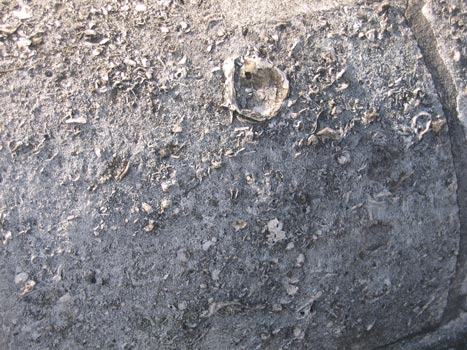
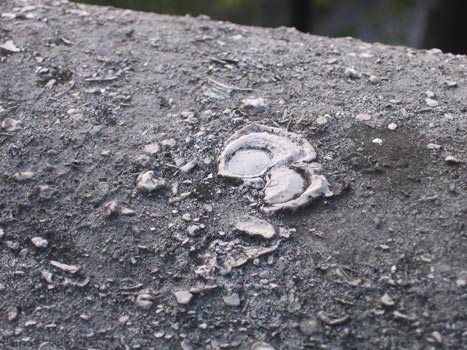
Cross the river Thames using Waterloo Bridge and take a little time to examine the coping stones that make up the supports to the pedestrian railings.  This bridge may be used by thousands of commuters and tourists each day, but how many of them stop to look carefully at the building stones on the side of the walkways.  These stones are also limestone, but they are not Portland stone.  However, they do contain fossil evidence of a catastrophe that devastated a marine environment during the age of the dinosaurs.  The limestone material represents Upper Jurassic strata and a close examination will reveal that it is packed with hundreds of fossils of marine invertebrates, all smashed up and jumbled together.  This sediment has preserved the devastation caused by a major storm event such as a tsunami that destroyed a marine ecosystem.  This habitat was probably close to shore and the shallow seascape took the fall force of huge natural disaster such as a hurricane or a tsunami.  The remains of bivales such as oysters can be clearly seen, the shells mostly a bleached white against the grey limestone matrix.  The remains of the calcite skeletons secreted by coralline algae can be made out as well, evidence of the destruction of a marine ecosystem preserved in the walls of a famous London landmark.

Fossils Preserved in the Limestone Used to Build Waterloo Bridge

Jurassic fossils on Waterloo Bridge.

Picture credit: Everything Dinosaur

It is not just London where such fossils can be found, many forms of sedimentary rock are used as building materials and with a keen eye fossils that record evidence of ancient life can be found at the very heart of big cities and towns.

For replicas of iconic fossil animals: Models of Iconic Fossil Animals.

You don’t need to go to a quarry or the seaside to go fossil hunting, next time you are in a big city take a close look at the stone building materials that are around you, or that you are walking on.  After all, most of these hidden treasures go unnoticed by the thousands of people who walk by them every day.

More Fossils found on Waterloo Bridge

Fossil hunting in the middle of London.

 Picture credit: Everything Dinosaur

21 09, 2012

Homo heidelbergensis – A Skilled Craftsman and Hunter

By |2023-02-04T18:38:39+00:00September 21st, 2012|Categories: Dinosaur and Prehistoric Animal News Stories, Palaeontological articles|0 Comments

Ancient Spears show Early Humans were Highly Skilled

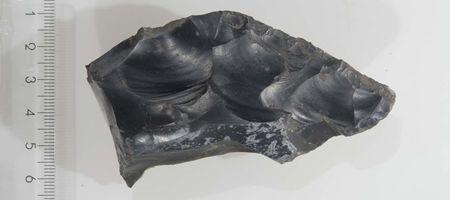
Researchers from the University of Tubingen in the southern German state of Baden-Württemberg have reported on their analysis of the animal remains, flora and evidence of skilled human craftsmen and hunters.  This study indicates that hominids that once roamed southern Germany 400,000 years ago were capable of making strong, sturdy spears tipped with finely knapped flints.  The scientists have concluded that these spears are evidence of skilled hunters, who would have used careful planning and foresight to ensure a successful hunt.  These weapons are believed to be some of the oldest ever discovered and they have been ascribed to a hominid known as Homo heidelbergensis.  The use of such sophisticated technology as early as the Middle Pleistocene epoch suggests many accepted theories on primitive human behaviour and capabilities may have to be re-written.

A Close up of One of the Flint Spearheads

Crafted with considerable skill.

Picture credit: Dr Nicholas Conrad/University of Tübingen

Homo heidelbergensis

In 1907, a workman found a human jawbone in a sand quarry near the small village of Mauer, to the south-east of the German town of Heidelberg.  Otto Shoetensack, a renowned German palaeontologist, had been convinced that early human remains would be found in the ancient layers of sand at this site and the jawbone was evidence of a primitive Neanderthal-like hominid having once lived in that area.  Subsequent skull discoveries, this time in Africa led to this jawbone and the skulls being ascribed to a new species of early human – H. heidelbergensis.  Although known from only a few fragmentary fossil bones, including a massive shin bone found in West Sussex, this hominid is believed to have been the direct ancestor of both the Neanderthals and modern humans.  H. heidelbergensis may have evolved from Homo ergaster and it was the first hominid to colonise the colder parts of northern Europe.   The flint spearheads and beautifully well-preserved wooden spear shafts have been found at an opencast coalmine just one hundred kilometres away from the site of the original H. heidelbergensis jawbone discovery.

Eight Spears Found

A total of eight spears were found at the coalmine location.  A team of researchers from the University of Tubingen’s Institute of Prehistory led by Dr Jordi Serangeli and Dr Nicholas Conrad are continuing to study the site and the remarkable information it is providing about life in the Pleistocene epoch.  The human artefacts have been found amongst the remains of butchered horses, water buffalo and aurochs (ancient cattle).  It seems that these early hunters were capable of tackling and bringing down large prey.  The site has also provided the scientists with information about the flora in Germany at the time, leaves of alder and the pine cones of fir trees have been preserved, along with pollen from many types of plants.  The weapons have been ascribed to Homo heidelbergensis, although no human remains have been found at this site, amongst the bones of elephants, rhinos and even lions.

One of the Wooden Spear Shafts Found at the Site

Ascribed to H. heidelbergensis.

Picture credit: Dr Nicholas Conrad/University of Tübingen

The strata that contains the preserved Pleistocene evidence had been under the water table and this watery environment may have helped preserve the remains, permitting the scientists to learn so much about life in northern Europe for some of our ancient ancestors.   The wooden spears do not seem designed for throwing. They were most likely used as thrusting weapons at close quarters.  The flint spearheads show considerable skill in their construction and they would have been carefully joined onto the thick, wooden spear shaft using animal sinews.  Based on the fossil evidence and these spears, it seems clear that H. heidelbergensis was physically bigger and stronger than modern people. Palaeoanthropologists have estimated that both males and females may have stood over six feet tall and that the males would have weighed around eighty kilogrammes with the females slightly lighter.  These eight spears, so carefully crafted by our ancestors may prove to be the oldest weapons ever found in Europe.

For replicas and models of ancient hominins and prehistoric animals: Models of Prehistoric Animals, Dinosaurs and Hominins.

28 08, 2012

Lyme Regis Prepares to Celebrate the Contribution of Mary Anning

By |2023-02-04T11:59:53+00:00August 28th, 2012|Categories: Dinosaur Fans, Educational Activities, Palaeontological articles|0 Comments

Mary Anning Weekend Approaches

The contribution to Earth science by the remarkable Georgian fossil collector Mary Anning is being celebrated in a weekend of special events at the end of September.  The pioneering English fossil collector and amateur palaeontologist  Mary was born in the small, seaside town of Lyme Regis (Dorset) an area of Britain’s coast famous for its Jurassic sediments and fossils of marine animals (and pterosaurs plus one dinosaur genus) as well as a whole host of prehistoric fish.

Mary Anning

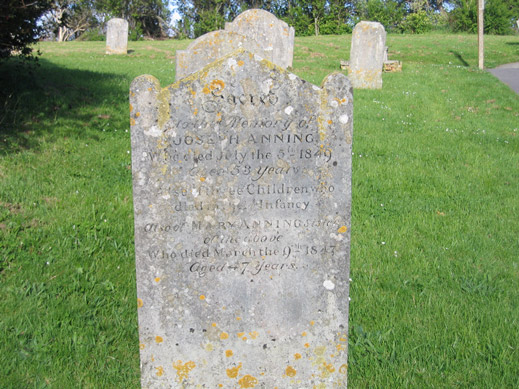
The Grave of Mary Anning at St Michael’s Church Lyme Regis

Mary Anning's grave.

Mary Anning’s grave at St Michael’s Church on the hill overlooking Lyme Regis.

Picture credit: Everything Dinosaur

Her father was a carpenter by trade, although he supplemented the family’s income by also selling curios (fossils) that they had found on the beach and in the cliffs that surround Lyme Regis.  Mary became prominent as an expert in fossils and fossil finding, although she did not receive the full credit for her contribution to science during her lifetime.  She discovered the first plesiosaur fossils in 1821 and the first Pterodactyl (flying reptile) fossils in England in 1828.  Many of her specimens can be seen in museums today, her finds helped to build up the collections of a number of wealthy individuals but often no record was kept of her contribution or role in the research and study of such specimens.

The Lyme Regis Museum

The Lyme Regis Museum, (Bridge Street, Lyme Regis), is planning a weekend of events (Saturday 29th and Sunday 30th September), to celebrate the work of the town’s most famous former resident and the focus will be on walks and talks with the chance to see some of the remarkable fossil fish that have been found on the Jurassic coast.

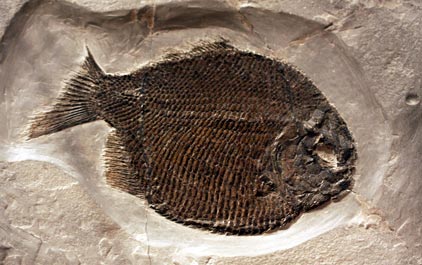
On Saturday 29th September, from 10am, the Lyme Regis museum will be displaying some of the amazing prehistoric fish fossils that have been found in the area.  Have a wander around the ground floor gallery and take a look at the bizarre  creatures that shared the Jurassic seas with giant marine reptiles.  There’s even a chance to get involved with artist Darrell Wakelam setting out to make a giant prehistoric fish sculpture.

Amazing Jurassic Fish Fossils on Display

Meet your Next of Fin!

Picture credit: Lyme Regis Museum

For models and replicas of prehistoric fish and other extinct animals: Mojo Fun Prehistoric Life Models.

Our chums Paddy, Chris and Brandon will be demonstrating ammonite polishing outside the museum from 11am (Saturday and Sunday).  Have a go and get the chance to take home your very own 190 million year old souvenir, for just a few pounds.

There will also be a series of talks given by leading scientists in the nearby Marine Theatre over the weekend.  If you have ever wanted to learn more about extinct species of ray-finned fish, now’s your chance.

Local experts will be on hand to take parties onto the beaches for a guided tour of the areas fossils and you might find one or two examples of Jurassic life yourself.

All in all, a fun weekend is planned, celebrating the diversity of vertebrate fauna that is to be found along this coast with its World Heritage status and commemorating the contribution to science made by a remarkable 19th Century amateur palaeontologist.

To catch up with Brandon Lennon on a fossil walk: Lyme Regis Fossil Walks.

27 08, 2012

Identifying the Origin of Mollusca by the Mouthparts

By |2023-03-08T22:20:48+00:00August 27th, 2012|Categories: Dinosaur and Prehistoric Animal News Stories, Palaeontological articles|0 Comments

Burgess Shale Fossils Provide Evidence of the Origins of the Mollusca

The next time you come across a slug or a snail in your garden, or perhaps if you sit down to a plate of mussels in a white wine sauce with cream nod you head in approval towards one of the most successful animal phylum known on planet Earth – Mollusca.  Now thanks to the use of a non-destructive research technique being applied by a Canadian researcher on fossil specimens from the famous Burgess Shale deposits, it seems that palaeontologists have finally begun to unravel the mystery as to how these animals first evolved.

Burgess Shale

The phylum known as Mollusca is one of the most diverse of all the animal phyla and thanks to most of its members having hard body parts and living in a marine environment, the Mollusca are perhaps the most abundant large invertebrates recorded as fossils.  There are shelled and unshelled forms of mollusc.  Although the six taxonomic classes that make up this phylum may seem very different, they all share the same basic body plan.  There are the gastropods (slugs and snails), bivalves such as oysters, cockles and mussels and of course, the cephalopods, perhaps the most advanced of all the members of the Mollusca.

The cephalopods consist of a number of extant forms, such as squid, cuttlefish and octopi, plus some very important forms that are extinct but have proved so invaluable to palaeontologists as they develop biostratigraphical profiles of rock strata – long-dead groups such as the ammonites and the belemnites.

Ammonites and Belemnites- Extinct Members of the Phylum Mollusca

Diverse Mollusca.

Picture credit: Everything Dinosaur

The picture (above) shows three invertebrate models in stock (whilst stocks last) at Everything Dinosaur.

To view models of iconic invertebrates from the fossil record: Replicas of Fossil Invertebrates.

Palaeontologists Studying Cambrian Strata

However, debate has gone on between palaeontologists studying the beautifully preserved Burgess Shale specimens (British Columbia, Canada), as to which of the many animal fossils dating from over 500 million years ago, represent the ancestors of the molluscs.  Now thanks to the work of a University of Toronto PhD student, scientists are beginning to get a better understanding of how the molluscs evolved and which of the bizarre animal fossils from the Burgess Shale represent early forms of this important phylum.

Most molluscs possess a radula, rows of tiny, interlocking teeth that can rasp away drawing food into a primitive mouth which is then passed through a one-way digestive system.  Only the filter feeding bivalves don’t have this “rasping tongue”.  Using advanced electron microscopy to produce images that could then be modelled in three-dimensions, University of Toronto student Martin Smith was able to demonstrate that two bizarre types of Burgess Shale creature from the Middle Cambrian, Odontogriphus omalus and the heavily armoured Wiwaxia corrugata were forerunners of the Mollusca.

Odontogriphus omalus specimens are extremely rare in the Burgess Shale.  This organism seems to have been a flat-bodied animal with mid-line symmetry (bilateral symmetry), a single muscular foot for locomotion and a toothed feeding structure with a simple stomach and intestine.  Some fossils from the Burgess Shale strata indicate animals that grew to lengths in excess of ten centimetres.

Wiwaxia, on the other hand is a much more common member of the Burgess Shale assemblage.  This might suggest that Wiwaxia spp. were more abundant in the warm, shallow tropical sea represented by this British Columbian strata, or it might simply reflect that greater preservation potential of Wiwaxia over Odontogriphus.  Wiwaxia was certainly a striking animal.  It had a body plan that was symmetrical around its mid-line, roughly elliptical in shape, toothed mouth-parts that were broadly conical and a primitive mouth and digestive tract.  This thimble-sized organism probably pulled itself along using a muscular foot, the sides and the upper surface of this organism was covered by rows of overlapping protective plates called sclerites.

Shooting upwards from the dorsal area were two rows of parallel spikes.  These spikes probably acted as a deterrent against attack from nektonic predators.

A Reconstruction of Wiwaxia corrugata

Spiky, basal member of the Mollusca.

Picture credit: Everything Dinosaur

Previous studies had suggested that both Odontogriphus and Wiwaxia were basal forms of either the Mollusca or the Annelid worms, or perhaps they represented evolutionary dead-ends, types of creature that died out leaving no descendants.

This new research shows that the teeth of these animals sat on a grooved, primitive tongue and the shape, number and articulation of the individual teeth components and the way these structures grew puts these particular Burgess Shale members firmly into the mollusc camp.  The ancestral molluscan radula is shorter and more squat than in similarly sized extant molluscs today.  The mouthparts were made up of two or three rows of similarly, shaped teeth (shaped like miniature shoe horns); with a symmetrical central tooth and smaller denticles along the edges.  The teeth would have moved round the end of a muscular tongue-like structure in a conveyor-belt-like fashion, scooping food and seabed detritus into the mouths of these primitive creatures.

They were not the sophisticated lettuce-munching radula of the common garden snail, but this new study by the Canadian PhD student does indicate that organisms like Odontogriphus and Wiwaxia are basal to the Mollusca.

Martin Smith, a student at the University of Torontos’s Dept. of Ecology and Evolutionary Biology and the author of the scientific paper published in the academic journal “Proceedings of the Royal Society B – Biology” utilised highly sophisticated electron microscopy to reveal new details of the mouthparts and structures in the fossil specimens.  He examined over three hundred different Burgess Shale fossils and from the images produced by his study he was able to re-create three-dimensional models of feeding systems of these 5oo million year old invertebrates.  Not only could the structure of these mouthparts be made out, the young scientist could also assess how these structures grew.

Commenting on his work, the student stated:

“I put the fossils in the microscope, and the mouth parts just leaped out.  You could see details you’d never guess were there if you just had a normal microscope.”

Martin went onto add:

“The fossils are squashed completely flat, which makes them really hard to reconstruct in 3-D.  “I surrounded myself with micrographs of the mouth parts and lumps of plasticine, and spent weeks trying to come up with a model that made sense of the fossils.  When I set out, I just hoped to be a bit closer to knowing what these mysterious fossils were.  Now, with this picture of the earliest radula, we are one step closer to understanding where the molluscs came from and how they became so successful today.”

 An Illustration of the Short and Squat Radula-like Structure of Basal Molluscs

The start of something big – the Mollusca.

Picture credit: Marianne Collins

The teeth are arranged in rows and resemble miniature shoe horns.  The Canadian research suggests that organisms like Wiwaxia and Odontogriphus used this structures to comb detritus or algae into their mouths.   Over millions of  years the radula of the molluscs has evolved and become a highly efficient feeding organ. Whether it is the rasp-like radula of a land snail that can tear up plants or the powerful mouthparts of a nektonic, active predator such as a giant squid the radula has had over 500 million years of evolution to refine it.  Under a high powered electron microscope the formidable structure of the radula can be clearly made out.

The Fearsome Radula (High Magnifcation) of a Modern Mollusc

“Jaws”?

As can be seen in the above photograph, one of the reasons for the evolutionary success of the Molluscs might be their very specialised and highly refined, effective feeding structure – the radula.  Some of the teeth in the image appear to be the same shape as those of a Great White shark (Carcharodon carcharias).

Go to Top