All about dinosaurs, fossils and prehistoric animals by Everything Dinosaur team members.

Articles, features and information which have slightly more scientific content with an emphasis on palaeontology, such as updates on academic papers, published papers etc.

4 07, 2012

Theropod Eggs Correlate Directly with Modern Bird Eggs According to New Study

By |2024-04-23T16:10:32+01:00July 4th, 2012|Categories: Dinosaur and Prehistoric Animal News Stories, Educational Activities, Palaeontological articles|0 Comments

Spanish Fossilised Eggs show Strong Link between Theropoda and Aves

Palaeontologists have been aware for some time, of the close anatomical links between certain members of the lizard-hipped dinosaurs known as the Theropoda and modern birds.  A great deal of evidence has been compiled to show that certain types of dinosaur such as the Dromaeosauridae, the raptors, were closely related to Aves (birds).  Scientists know for example, that many small, meat-eating theropods such as members of the Dromaeosauridae, dinosaurs such as Microraptor and Sinornithosaurus were covered in feathers, but there are also striking similarities between the skeletons of birds and the fossilised bones of these types of dinosaur. New research suggests that theropod eggs were extremely similar to modern bird eggs.

Some Types of Dinosaur were Feathered
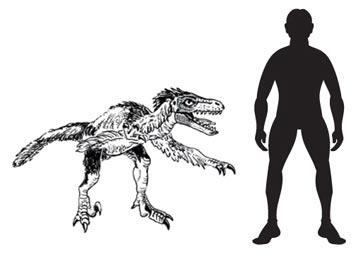
Feathered dinosaurs.

Picture credit: Everything Dinosaur

Dinosaurs and Birds

The link between dinosaurs and birds is not a new theory in palaeontology.  Granted, there have been a number of startling discoveries made of feathered dinosaurs, most notably in the Lower Cretaceous strata of Liaoning Province (northern China).  It was the likes of Thomas Henry Huxley who first proposed the dinosaur/bird link.

Thomas Henry Huxley was an English biologist and an ardent supporter of Darwinism.  When Sir Richard Owen purchased a nearly complete specimen of Archaeopteryx (A. lithographica) in the 1860s, Huxley used this fossil to support Darwin’s theory of natural selection and declared the Archaeopteryx specimen as a “transitional fossil” between reptiles and the evolution of birds.

However, one of the gaps in our knowledge regarding the relationship between certain members of the Dinosauria and the Order Aves, concerned the shape and composition of the eggs that these types of creatures laid.  A number of different shapes and sizes of dinosaur egg are known from the fossil record, but those fossil eggs ascribed to theropods do not closely resemble the shape of a modern bird’s egg such as the type of egg that a chicken would lay.  Typically, a small-meat eating dinosaur might produce relatively elongated eggs, not the ovoid shape that we are used to when we see a bird’s egg.

The discovery of the remains of dinosaur eggs in north-eastern Spain may change all that, as these eggs do resemble those of a modern bird.

Theropod Eggs

Nieves Lopez Martinez, a palaeontologist at the Complutense University of Madrid (Spain), with a doctorate in geology and biology, had been researching into the strange, ovoid and asymmetrical fossil eggs that had been found in the Montsec area of Lleida in north-eastern Spain.  Sadly, she passed away in December 2010.  Her work and that of her colleague Enric Vicens, a palaeontologist at the Universitat Autonoma de Barcelona (Spain), has just been published.  Their extensive research provides strong evidence linking theropod dinosaurs to modern birds, as the eggs found in Spain are very similar in shape and composition to those of extant birds.

The eggs were excavated from two dig sites, located on either side of the Terradets pass.  The strata in this part of Spain represents sediments laid down at the very end of the Cretaceous (Campanian and Maastrichtian faunal stages).  A number of different types of dinosaur are known from this strata – ornithopods, theropods and titanosaurs.  The geological record in this part of Spain is very important, as it is providing scientists with an insight into the flora and fauna that existed in Europe at the very end of the Age of Dinosaurs.

To read an article about “giant dinosaur eggs” being discovered: World’s Largest Dinosaur Eggs – The Facts are Scrambled.

Although, the scientists cannot determine exactly what sort of dinosaur laid the eggs, they have postulated that they were produced by a troodontid a type of dinosaur, closely related to birds.  Troodonts were small, agile, bipedal predators.  The egg fossils, which consist of many fragments plus some complete eggs have been given the scientific name of Sankofa pyrenaica.  The genus name relates to an ancient bird symbol which shows a bird looking over its back with an egg that has just dropped from its mouth.  The species name relates to the fact that the fossils were found in a part of the southern Pyrenees mountain chain.

Some of the Fossilised Dinosaur Eggs (S. pyrenaica)
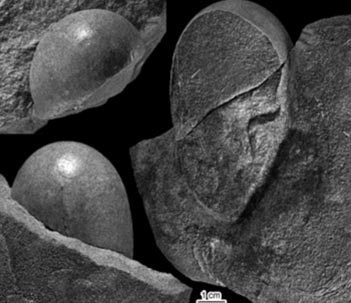
Oval-shaped and asymmetrical like a chicken’s egg.

Approximately seventy million years ago, this part of Spain was a low-lying coastal zone with many shallow lagoons that were bordered by lush, dense forests.  A number of fossils of dinosaur eggs have been found in this area, it seems that a number of different types of dinosaur laid eggs on the raised beaches that made up this coastal zone, but most of the fossil eggs found to date are large, rounded Titanosaur eggs.  These eggs are very different, measuring just seven centimetres high and with a diameter of approximately four centimetres.  The eggshell is roughly the same thickness of that of a hen’s egg.  The scientists measured the fossilised eggshell and found it to be around 0.27 mm thick.

Sectional Analysis of Theropod Eggs

Sectional analysis of those eggs that had been preserved intact showed that at the wider end of the egg there was a substantial air pocket.  Such air pockets are found in modern bird eggs.  If you take a hen’s egg and place it in water, a fresh egg will sink but it will have a degree of buoyancy.  The buoyancy is provided by a small air space contained within the egg.  The pocket of air allows the organism inside the egg to breathe during the last phases of its development prior to hatching.

Such oval-shaped, asymmetrical eggs are extremely rare in the Cretaceous fossil record.  The Spanish researchers related the shape of their eggs to that of a Late Cretaceous bird whose fossils have been found in South America.  The research team postulated that this bird and their dinosaur both laid eggs that were intermediate between modern bird eggs and those eggs laid by extinct non-avian theropods.

A microscopic analysis of the fossil eggshell of Sankofa pyrenaica did reveal significant differences in the shell structure when compared to that of a modern bird’s egg.   Bird and most reptile eggshell is composed almost entirely of calcium carbonate, the structure of the crystals and how they are organised in a bird’s egg differs from that seen in the internal structure of the eggshell ascribed to S. pyrnenaica.

The shape of an egg is dictated largely by the physiology of the organism that lays those eggs.  Asymmetry in bird eggs relates to the fact that birds only have one oviduct, they can only form one egg at a time as a result.  Most dinosaur nests show that eggs were laid in pairs, indicating that these animals had two oviducts.  Scientists believe that modern birds lost the second oviduct as an evolutionary response to the need to lighten their bodies so as to make powered flight more efficient.  The asymmetrical shape of the Spanish dinosaur eggs suggest that Sankofa pyrenaica also possessed just a single oviduct.

A Dinosaur Nest (Eggs Laid in Pairs)
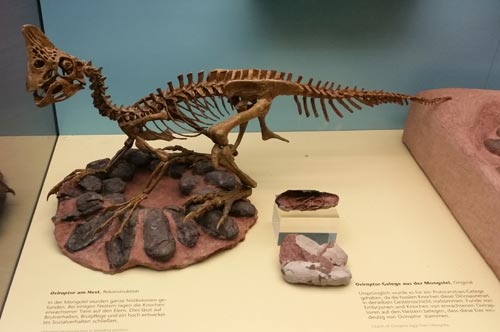
An Oviraptor and dinosaur eggs exhibit.

An Oviraptor and its nest.

Picture credit: Everything Dinosaur.

This fossil evidence strongly supports the theory that certain clades of dinosaur were indeed very closely related to birds.  Parts of the Dinosauria and Aves are very closely phylogenetically related.

Extrapolating this evidence, the next time you eat a boiled egg you are technically eating the egg of a creature very closely related to a dinosaur – or given the location where these fossil eggs were found, would you prefer a Spanish omelette?

Visit Everything Dinosaur: Our Award-winning Website.

3 07, 2012

Megalosaurs join the Dinosaur “Tufty” Club

By |2023-02-02T08:03:00+00:00July 3rd, 2012|Categories: Dinosaur and Prehistoric Animal News Stories, Palaeontological articles|0 Comments

German Fossil Discovery Suggests all Meat-Eating Dinosaurs May have been Feathered

The discovery of a beautifully preserved and very nearly complete fossil of a baby meat-eating dinosaur in Germany has ruffled a few feathers in the field of palaeontology.  An analysis of this baby member of the theropod group known as the Megalosauridae, shows that this youngster had bristle-like feathers covering its body.  This is the first time evidence of a feathered dinosaur from the megalosaur clade has been detected and the first time a fossil of a feathered dinosaur has been found in Europe.

Megalosauridae

Most scientists accept that a number of dinosaurs were indeed feathered.  The feathers were not for flight, but the main function seems to have been to help insulate these active animals, to help keep them warm.  However, most feathered theropod fossils had been up to now associated with the Liaoning deposits of northern China.  This strata represents sediments laid down in the Early Cretaceous.  In addition, feathered theropods known to date are ascribed mostly to the Coelurosauria, this new discovery suggests that other types of theropod, a megalosaur, also might have possessed feathers.

To read about the recent discovery of a dinosaur related to T. rex that also may have been feathered: The One Tonne Basal Tyrannosaur.

Dr Oliver Rauhut, conservator at the Bavarian Collection for Palaeontology and Geology studied the 98% complete fossil along with colleagues and their findings have just been published in the American scientific journal “The Proceedings of the National Academy of Sciences”.

A spokesperson from Everything Dinosaur stated:

“This is an amazing fossil, it looks too good to be true, as if it has been carved into the rock, but detailed tests have proved that this is indeed the fossilised remains of a baby dinosaur from the Late Jurassic”.

The Beautifully Preserved German Dinosaur

Baby dinosaur covered in feathers?

Picture credit: Dr Helmet Tischlinger

The seventy-two-centimetre-long baby shows typical juvenile traits such as the disproportionately large head and the presence of large orbits (eye-sockets) in the skull.  The fossil represents a new species of Tetanuran (stiff-tailed) theropod dinosaur, it has been ascribed to the megalosaurs and given the scientific name Sciurumimus albersdoerferi.  The genus name is derived from “Sciurus” – for squirrel;  a reference to the filamentous structures seen around the long tail under ultra-violet light.  It seems that this little dinosaur may have had a bushy tail just like a squirrel.  The specific name honours the private collector who helped bring this fossil discovery to light.

Very few of the bones are missing so the research team had the opportunity to study an almost complete dinosaur skeleton, perhaps one of the most complete ever found and certainly the most complete specimen of a theropod dinosaur found in Europe to date.

The actual fossils were recovered from a limestone quarry in Southern Germany, (Bavaria).  Although the research team can’t be sure how this baby dinosaur met its end, but its near perfect preservation and discovery in marine deposits suggest that this youngster drowned.

Once subjected to ultra-violet light, the remains of skin and the fibrous filaments that covered this animal’s body can be picked out.

Exposing the Fossil of Sciurumimus albersdoerferi to UV Light

A feathered baby megalosaur.

Picture credit: Dr Helmet Tischlinger

Dr Tischlinger, one of the authors of the study commented:

“Under ultraviolet light, one can see the remains of skin and the plumage as luminous spots and fibres on the skeleton.”

The scientists are unable to calculate just how big S. albersdoerferi would have been when an adult, although other types of megalosaur dinosaur were apex predators in Europe during the Late Jurassic and some members of this clade reached lengths in excess of six metres and weighed more than a 1,000 kilogrammes.   The German team have been able to write a paper on an exceptionally preserved baby dinosaur skeleton, a noncoelurosaurian theropod that had filamentous plumage at the base of its slender tail and elsewhere on its body.

Sciurumimus albersdoerferi

The filaments are similar in structure to the bristle-like structures found on the ornithischian dinosaur Psittacosaurus,(from Mongolia and China), as well as being similar to the primitive tyrannosaur Dilong and the therizinosaur Beipiaosaurus (both also Chinese dinosaurs).  As a European dinosaur, this new fossil find, will help scientists to piece together the relationship between different types of dinosaur and the different types of integumentary structures found in the Dinosauria.

For Everything Dinosaur team members, there are a number of other important elements to this particular fossil, not just the presence of feathers.  For example, this is a baby dinosaur fossil and such fossils are extremely rare.  The small bones of baby dinosaurs are seldom preserved in the fossil record and to have the chance to study such a complete specimen was described by one team member as “simply astonishing”.  We are not sure what the Reverend William Buckland, who was given the task of naming and describing the first dinosaur, ironically another megalosaur (Meglosaurus bucklandii), would have made of this new discovery, however, it is helping to clear up some of the issues relating to megalosaur classification.  The complete absence of a fourth digit on the hand is assisting scientists as they clarify the anatomical details that pertain to the megalosaurs as members of the Tetanurans.

The jaws show the teeth in such detail that the research team have been able to see that the teeth of this baby megalosaur are remarkably similar to the teeth of basal coelurosaurs.  This suggests that a number of dinosaur discoveries may have been misidentified in the past, with isolated fossilised teeth being ascribed to the coelurosaurs when they could actually have belonged to a megalosaur.

A fascinating discovery, one that will yield more secrets no doubt, but for the moment we at Everything Dinosaur are just happy to see a member of the Megalosauridae in the dinosaur “tufty” club.

To view Megalosaurus models and other dinosaur figures: Megalosaurs and Theropod Dinosaur Models (CollectA Age of Dinosaurs).

15 06, 2012

Ancient Amphibians Possessed Bites as Strong as a Crocodiles

By |2023-02-01T20:34:15+00:00June 15th, 2012|Categories: Dinosaur and Prehistoric Animal News Stories, Palaeontological articles|0 Comments

Research suggest that Capitosaurs were the “Crocodiles” of the Permian and the Triassic

Long before the reptilian ancestors of crocodiles evolved, ancient lakes and swamps had there own set of aquatic ambush predators – amphibians, members of a group known as the Temnospondyls.  Fossils of ancient amphibians have been found world-wide and it is believed these animals evolved in the Carboniferous, evolving into a myriad of terrestrial and aquatic predators.

Ancient Amphibians

A study by researchers at the Catalan Institute of Palaeontology in association with their colleagues at the University of Catalonia has assessed the bite force capabilities of number of these animals and challenged a hypothesis regarding the strength of these animal’s bites that had been put forward more than forty years ago.  It seems that both basal and more advanced forms of Temnospondyls were capable of biting down onto prey with considerable force. In contrast to the earlier theory, that postulated that the shape and size of the bones that supported the muscles were responsible for generating a strong bite force, it seems that muzzle shape and dimensions are more significant when it comes to assessing how strong a bite force one of these predators could generate.

Temnospondyls were a large and diverse group of amphibians with stout limbs, strong bodies and big, wide mouths.  Some of these creatures could grow to lengths in excess of three metres and many of them occupied environmental niches similar to modern-day crocodiles.

An Illustration of a Typical Aquatic Predator (Temnospondyl)

Amphibians that thought they were crocodiles.

Picture credit: Mauricio Anton (Catalan Institute of Palaeontology)

Temnospondyls

It had been thought that the last of the Temnospondyls died out at the end of the Triassic but Australian fossils suggest that some of these amphibians survived into the Jurassic and into the Early Cretaceous, living in parts of the world that were too cold for the crocodylomorphs to survive in.  The study focused on members of the capitosaur taxon, advanced active, predatory members of the Temnospondyls.  Seventeen taxa were studied and the research suggests that many of these animals could generate bite forces similar to those of modern crocodiles.

Extant species of amphibian such as the salamanders, although they possess wide mouths, do not have strong bites.  They suck prey items into their mouths.  This research suggests that at least some of the capitosaurs had masticatory capabilities similar to crocodylians, an article detailing the research has been published in the scientific journal “The Anatomical Record”.

Josep Fortuny (Catalan Institute of Palaeontology), along with colleagues has shown that changes to the shape of these animal’s skulls influenced the way that they fed.  These large, carnivores had a wide range of different bite strengths.

The Catalan-based researchers studied the evolution of different morphological features in the capitosaurs’ skulls using computer models and careful scans of the actual fossil material to determine the stress distribution across the skull bones for different types of bite.

Commenting on their research, Josep stated:

“Apart from explaining how capitosaurs fed, we also wanted to validate the theory by palaeontologist A. Howie from the 1970s, and here are results were somewhat surprising.”

Primitive capitosaurs  had posteriorly directed tabular horns, (bony struts associated with the back of the skull that pointed rearwards), these are the bones that anchor the muscles responsible for opening and closing the mouth.  In more derived, advanced forms, however, they moved laterally to create a small island in the back of the skull, known as the otic notch.  Howie argued that this evolution facilitated a more optimal bite, at the biomechanical level.  However, the Spanish research refutes this demonstrating that the most primitive tabular horns were also optimal for the opening of the mouth.  Therefore, the evolutionary mechanisms that led to the closure of the otic notch do not have much to do with improved biomechanics of this movement, but the scientists state that more studies are needed to better understand these morphological changes.

Illustration of Capitsosaur Skull Types

Snout size and skull widths better determinants of bite force.

Picture credit: Catalan Institute of Palaeontology

In the images of these two capitosaur skulls shown above, Parotosuchus left and Eocyclotosaurus right, tabular horns (A) and the Otic Notch (B) are observed.

In its most basal, primitive forms, as is the case of Wetlugasaurus, skulls are weaker.  As forms radiate, capitosaurs seem better able to generate a more powerful bite, perhaps in response to the evolution of their prey and increased competition from the rapidly evolving reptiles.

Computer Generated Images Indicate Bite Strengths of Various Capitosaurs

Different shaped snouts and skulls equals different bite force capabilities.

In the images deformations (top) and stresses (bottom) are observed from simulations of a bilateral bite for several capitosaur species.  The more primitive, basal form such as Wetlugasaurus (far left) had a weak bite, but Parotosuchus with its large tabulate horns had a powerful bite, challenging the theory first put forward by Howie.

The elongation of the tabular horns, with the consequent closure of the otic notch, was taken for years as an indicator of a more powerful bite.  This study shows, however, that Paratosuchus had one of the most powerful bites of the study group, along with Cyclotosaurus, although the otic notch is open and the tabular horns are not particularly long.  From the computer generated data, it seems that other factors such as the width of the skull and the snout length are equally or perhaps more important factors in generating bite force as opposed to the tabular horns or the otic notch closure.

This research suggests that these predators evolved to take advantage of a number of ecological niches as land vertebrate food chains became more complex.

For not-to-scale models of prehistoric animals including ancient amphibians (whilst stocks last): Models of Permian and Triassic Animals (CollectA).

10 06, 2012

Time to Re-think the Origin of Apes – New Evidence suggests Asian Lineage

By |2024-04-23T16:05:08+01:00June 10th, 2012|Categories: Dinosaur and Prehistoric Animal News Stories, Palaeontological articles|0 Comments

Are we all Asian Migrants?

For many years, one specialist branch of the science of palaeontology, those scientists who have been studying the origin of apes and the evolution of the primates (palaeoprimatologists), have puzzled over the exact origins of these creatures, a branch of which gave rise to the hominins and ultimately our own species H. sapiens.

The Origin of Apes

Although the fossil record of Early Cenozoic (Palaeogene) primates is exceptionally poor, a number of hypotheses had been put forward that supported an African origin for what is termed the anthropoids (monkeys, apes and ultimately hominins).  However, recent fossil finds, most notably in China had began to challenge these theories.  The discovery of four very primitive teeth in Myanmar (Burma), lends support to the notion that the anthropoids originated in the Far East and not from Africa as previously thought.  A paper has been published in the scientific journal (the Proceedings of the National Academy of Sciences), that suggests that this group of mammals originated in Asia and migrated westwards into Africa.

The anthropoids were almost all entirely arboreal (tree dwelling).  During the Palaeogene, the geological period that immediately followed the demise of the Dinosauria (Cretaceous), average annual temperatures seem to have been relatively stable, with the world being approximately six degrees warmer than today.  High humidity and rainfall led to extensive forestation.  Global temperatures began to rise and by around fifty million years ago the average, annual global temperature was somewhere in the region of twenty-eight degrees Celsius.  Earth became a lush, tropical paradise with rainforests extending from Canada down to the tip of Chile in the western hemisphere and from the southern tip of Norway to the south of Australia in the eastern hemisphere.  Even the British Isles, those bits that were above sea level; was a tropical paradise, with crocodiles basking on the banks of a river system that resembled the Congo river seen in western Africa today.

Eosimias centennicus

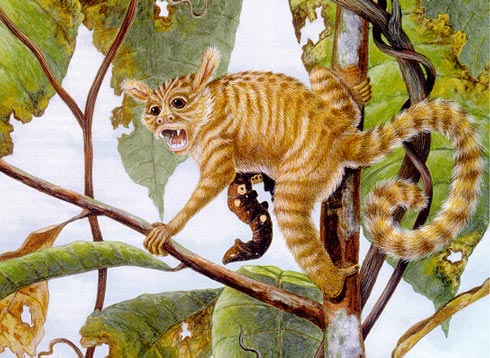
Expeditions jointly organised by the Carnegie Museum of Natural History (Pittsburgh)  and the Institute of Vertebrate Palaeontology and Palaeoanthropology (Beijing) to the Shanxi Province of China in the mid 1990s uncovered evidence of some of the earliest anthropoids known.  Specimens such as the tarsier-like Eosimias centennicus, fossils of which were found in sediments along the Yellow River show that primitive anthropoids inhabited eastern Asia millions of years before they are represented by such nearly complete fossils in the African fossil record.  Because the nearest living relative of anthropoid primates occurs only in southeast Asia and because some of the earliest and most primitive fossil Anthropoids are known from Asia, it seems likely that the anthropoid clade actually originated on the Asian landmass.  Now new fossils from Burma add weight to this hypothesis and provide a timeline for the Anthropoids migration out of Asia and into Africa.

 An Artist’s Impression of a Primitive Anthropoid (E. centennicus)

Does this mean that all humans are ultimately “Chinese Takeaways”?

Picture credit: Nancy Perkins.

Prosimians, including our early ancestors thrived and rapidly diversified.  However, animals living in forests have a poor potential for fossilisation.  Any remains are usually scavenged or rot away leaving nothing available for any type of fossilisation processes.  Occasionally, small fragments of fossil material are found, often individual teeth or part of a jawbone that had been transported by a river system, depositing the bone  and enamel material many miles from where the animal may have actually lived.

To read about a recent fossil primate discovery: New Fossil Primate Discovered – Deep in the Heart of Texas.

Building up a more complete picture of the origin and early evolution of the anthropoid apes has occupied a number of academics for many years.  Most scientists agree that our hominin branch of the ape family tree, did originate in Africa, but the discovery of just four teeth in Burma, dating from 37 million years ago, suggest that the apes themselves may have evolved in the east before migrating westwards into Africa sometime during the Middle Eocene.

An Ancient Swamp

An international team of scientists, examining the strata laid down in an ancient Eocene swampland that covered what was to become Myanmar (Burma) have found amongst the fossil remains of fish, ancient turtles and primitive hippos four fossilised molars that belong to a new species of small primate.  The teeth resemble those of an already described African species, yet they show some more primitive, basal traits.  These fossil teeth suggest that the African apes could be descended from an Asian ancestral clade that migrated westwards, skirting around and across the rapidly shrinking Tethys Ocean to Africa.

The first tooth was found in 2005, a further six years of field work only yielded three other teeth, emphasising how rare anthropoid fossils are, but these are enough for the research team to describe and name a new species.

Palaeontologist K. Christopher Beard of the Carnegie Museum of Natural History in Pittsburgh, Pennsylvania (United States) and the research team leader, Jean-Jacques Jaeger of the University of Poitiers, France, in association with colleagues were able to name and describe a new species of anthropoid based on the shape and size of the molars they had found.  The new species has been named Afrasia djijidae.

Eocene Teeth from Myanmar (Burma) indicate Asian Origin of Anthropoids

“Out of Asia” – Origins of Primates.

Picture credit: K. Christopher Beard/PNAS.

Primate fossil teeth from fossil beds in Myanmar suggest our deep primate ancestors arose in Asia.

Commenting on the difficulties of finding fossil evidence of early primates, Dr Beard, curator of Vertebrate Paleontology at Carnegie Museum of Natural History, stated:

“It’s a difficult place to work, in six years we found just four teeth.”

The teeth are extremely significant.  Scientists had postulated that early anthropoids hailed from Asia, but lacked the fossil evidence to provide an indication of the timing of a migration westwards into Africa.  The research work on the fossil beds, part of the Pondaung Formation (Mid-Upper Eocene), near to the village of Nyaungpinle in Myanmar have revealed evidence that 37-38 million years ago there was living in Asia an anthropoid that seems very closely related to, but slightly more primitive than, a genus of fossil African anthropoids.

Finding fossils of early primates is a very rare event, to read about the discovery of a new species of Tarsier from the Miocene of Thailand: The remains of an Eagle’s dinner helps scientists to identify new species of Miocene Tarsier.

These teeth, small though they are, were enough to demonstrate that the Burmese Afrasia djijidae, was closely related to another early, primitive anthropoid that lived roughly around the same time, but whose fossils have been found in North Africa (Libya) – Afrotarsius libycus.

Microscopic analysis of the teeth showed that the teeth from Burma and Libya were extremely similar, such an affinity between Asian and African anthropoid fossils has not been demonstrated before. Subtle differences, such as a tiny bulge at the back of what would have been the last, lower molar in the jaw of the Burmese anthropoid suggest that the Pondaung discoveries represent a more primitive, basal member of the anthropoid clade.

These primitive traits suggest that this group of mammals evolved in Asia and migrated to Africa somewhere between 39-37 million years ago.  Writing in the Proceedings of the National Academy of Sciences, the research team postulate that the “Out-of-Asia” migration was most likely not a single event but a complex migration of a number of genera westwards.  However, once in Africa, these primitive tarsier-like creatures thrived, perhaps the tropical conditions were ideal for them or perhaps they were fewer predators.  This particular group of the primate family tree, underwent rapid evolution and diversification and a number of species have been recorded in the fossil record of Africa just shortly after the proposed “Out-of-Asia” migration event.

Dr Beard described the rapid diversification as a “starburst of evolution.”

Others agree that if both the new species of primates from Myanmar and Libya are indeed early anthropoids, they would greatly strengthen the case for the Asian origins of this type of animal.  Vertebrate palaeontologist, Richard Kay of Duke University (North Carolina), stated:

“If proven, the biogeographical significance of these results is profound.”

Ultimately, if the apes evolved in Asia, then our own human origins can be traced back to this part of the world.  Human-like creatures (hominins) evolved in Africa but their ancestors may have originated in the East.

Dr Beard added:

“We’ve all heard about Out-of-Africa for human origins.  Now we think there was an Out-of-Asia migration into Africa first.”

For replicas and figures of prehistoric mamals and other creatures: Papo Prehistoric Animals (Les Dinosaures).

1 06, 2012

Unravelling the Mystery of an “Unravelling Ammonite”

By |2023-03-09T10:39:03+00:00June 1st, 2012|Categories: Dinosaur and Prehistoric Animal News Stories, Palaeontological articles|1 Comment

Scientists from the Natural History Museum (Vienna) – Describe New Ammonite Species

Scientists at the Naturhistorisches Museum (Natural History Museum – Vienna) are helping to unravel the story of a bizarre new ammonite species that swam in the Early Cretaceous sea that covered what was to become the South Tyrol of Austria.  Using advanced computerised tomography to create a three-dimensional image of the strange cephalopod, the researchers have been able to create a video showing how this animal swam.  They have even discovered that this strange looking beast had a shell that was covered with sharp spikes, a deterrent against being eaten by the large marine reptiles that shared its underwater world.

New Ammonite Species

Ammonites are a group of  marine, nektonic, cephalopod molluscs that lived in chambered shells.  They were an extremely successful group with a huge number of different types and forms.  The last of the ammonites died out at the same time as the dinosaurs (end of the Cretaceous).

Ammonite shell shapes varied considerably, shell shape often providing palaeontologists with an idea of how these animals lived, with each type of ammonite being adapted to a particular niche in a marine ecosystem.  Most lay people would expect all ammonite shells to be coiled, this is not the case.  During the Cretaceous, a number of ammonite families evolved bizarre shaped shells.

Some types of ammonite partially or nearly completely uncoiled, others uncoiled as they grew and then coiled up again as they reached maturity, others evolved screw-like spirals, superficially resembling the shell of a gastropod (snail).

Not All Ammonites had a Coiled Shell

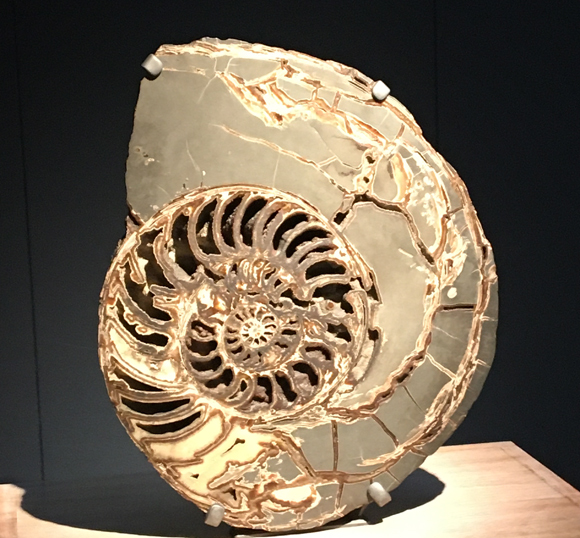
A beautiful ammonite fossil on display.

A stunning fossil of a Jurassic ammonite on display at the London Natural History Museum.

Picture credit: Everything Dinosaur

A section of fossiliferous sedimentary strata high up on the Dolomites of the South Tyrol has yielded a number of beautifully preserved ammonite and other invertebrate fossils that researchers at the Natural History Museum (Vienna) have been able to study in fine detail.  One particular specimen, a bizarre, uncoiled Ammonite, which represents a species unknown to science was subjected to intense examination using computerised tomography.

A three-dimensional image of the creature was built up by the scientists, layer by layer and this gave the team, led by Alexander Luke Eder (Department of Geology and Palaeontology), the chance to create a video depicting how this animal swam.

Fossil Slab

The fossil (slab and counter slab) was found at approximately 2,600 metres above sea-level in the Puez Park.  The ammonite has been named Dissimilites intermedius and it lived in a warm, tropical sea that covered the South Tyrol approximately 128 million years ago.  During the early Tertiary, plate movements in the Earth’s crust forced what was to become southern Europe to collide with the larger  land mass that was to become northern Europe.

As the rocks crumpled and were pushed up due to the immense forces acting upon them, the Alps began to be formed.  Sediment laid down at the bottom of a sea millions of years before, started to be elevated, and today Cretaceous-aged marine sediments can be found high up in the Dolomites mountain range.

 Dissimilites intermedius Material Studied by the Scientists

Unravelling the secrets of an ammonite.

Picture credit: Natural History Museum (Vienna)/CEN/APA

The image above shows one of the slabs of rock with the uncoiled ammonite shell preserved, in the middle are images from the CT scans showing the composite structure of the ammonite.  The specimen which is approximately thirteen centimetres in length, has provided scientists with the chance to study the fossils of this type of bizarrely-shelled cephalopod in great detail.  The computerised tomography enabled the research team to build up a picture of the fossil in a non-destructive or intrusive manner.

The results of the Austrian team’s work have been published in the highly respected scientific publication  – Acta Palaeontologica Polonica.

The X-ray analysis revealed a surprise for the scientists.  This particular ammonite seemed to have been a very spiky customer, armed with a series of three to four millimetre long spikes running almost the entire length of its shell.  The animal would have lived in the last chamber of the shell to be formed, a the front of the shell (body chamber).  The spikes probably served to protect this relatively small ammonite from being eaten.  There were many types of marine reptiles – pliosaurs, ichthyosaurs, and plesiosaurs in the marine environment, most of these animals would have been capable of attacking and eating an ammonite of this size.

Dissimilites intermedius Brought Back to Life by the Austrian Scientists

Spiky ammonite of the Cretaceous.

Picture credit: APA/Natural History Museum (Vienna)/Alexander Luke Eder.

The research team were able to pinpoint how the organism fitted inside its body chamber.  They were then able to speculate how it might have used its ten tentacles (presumed to have possessed ten tentacles, like other ammonites), to propel itself through the water with the aid of a directional water jet produced by a siphon positioned under the head.

As the creature would have only occupied the largest, last segment of the shell (body chamber), the scientists have pictured the smaller, walled-off shell chambers as being above the animal.  This is because ammonites could manage their buoyancy by filling these chambers with gas. The smaller coil sections would therefore have been lighter and would have floated above the animal’s actual body.

The discovery of spikes on the specimen, may provide palaeontologists with a clue as to why so many uncoiled variants of ammonite shells evolved.  Although some types of ammonite were strong swimmers, it is unlikely that they would have been able to swim faster than predatory fish, or even marine reptiles.  With the evolution of Teleost fishes and the abundance of other marine predators, some types of ammonite may have evolved uncoiled shells as this permitted them to evolve more placement areas for spikes.

A coiled up shell has no opportunity to have spikes forming on the inner whorls as they are strongly attached to larger, outer whorls.  An uncoiled shell, permits each whorl to have its own defences.  Since fossil evidence shows coiled ammonites being attacked from behind (bite marks left in fossilised shells), having all round protective spikes makes evolutionary sense.

Using the information obtained from the three-dimensional scans, the Austrians were able to create a computer programme that modelled how this type of ammonite may have propelled itself about. From this, the team developed a short video reconstructing a scene from the Early Cretaceous of Austria showing a group of these floating molluscs at various growth stages, from juveniles to mature adults.

This video along with the fossil specimens of Dissimilites intermedius are on display at the Natural History Museum (Vienna, Austria).

To view a range of genuine ammonite fossils and replicas: Ammonite Replicas and Fossil Replicas.

29 05, 2012

Aves – The “Peter Pans” of the Dinosauria

By |2023-03-09T10:45:19+00:00May 29th, 2012|Categories: Dinosaur and Prehistoric Animal News Stories, Palaeontological articles|0 Comments

New Study Suggests Birds are Dinosaurs that Never “Grew Up”

A new research paper, published in the scientific journal “Nature” suggests that modern birds (Neornithines) are essentially dinosaurs; as their skulls resemble the skulls found of juvenile dinosaurs in the fossil record.  Descendants resembling the juveniles of their ancestors is not unknown amongst vertebrates, this process, known as paedomorphosis has been identified as having an involvement in a number of evolutionary transitions amongst animals with back-bones.

Birds are Dinosaurs

Birds, (Aves) are very closely related to the dinosaurs.  Birds are the closest living relatives of the Order known as the Dinosauria and in this new study by Harvard scientists,  the development of large brain size and the huge variety in beaks which has led to such a radiation in bird species has been traced back to paedomorphic tendencies that led to adult birds having similar shaped heads as their reptilian ancestors – theropod dinosaurs.

One of the two fundamental aspects of paedomorphosis is the acceleration of sexual maturity relative to the rest of an organism’s development.  This is termed progenesis and in the Northern Hemisphere spring, right now, thousands of bird species are proving this point by raising young that rapidly grow up.  Some modern birds can reach sexual maturation in under three months, thus our feathered friends are able to retain the features of a juvenile dinosaur into their adulthood.

The Cenozoic may be regarded as the “Age of Mammals” due to the large amount of Mammalian mega-fauna found in eco-systems but there are more species of birds on our planet today than species of mammals, thousands more.  The success of the Aves, it could be argued could be related to their rapid development from a hatchling to a mature bird.  To put it another way, birds grow up so fast that they retain in their adult forms the skull characteristics of the Dinosaurian ancestors – they are akin to the  “Peter Pans” of the archosaurs, as one commentator put it.

The “Peter Pans” of the Archosauria

Bhart-Anjan Bhullar, Fernando Racimo and other colleagues from Harvard University, in conjunction with other scientific institutions including palaeontologists from the American Museum of Natural History (New York), compared three dimensional images of skulls of extant and extinct birds with fossilised skulls of dinosaurs.  The team discovered that compared to their dinosaurian ancestors, the faces of birds became flattened and the brain cavity grew larger.  A larger brain cavity was a pre-requisite for developing a bigger brain enabling birds to exploit a variety of ecological niches.  In short, the skulls of Neornithines resemble those of baby dinosaurs.

Skull Morphology in Birds – Gives Hint of Dinosaurian Ancestry

Dinosaurs the original “Bird Brains”.

Picture credit: Everything Dinosaur

The team used advanced computerised tomography (CT scans) to build up an inventory of archosaur skull shapes and characteristics and compared this data to the scanned skulls of extinct birds from the fossil record along with scans from animals around to day – modern birds and those rather more distant relatives of the Dinosauria, the crocodiles.

Associate Professor of Organismic & Evolutionary Biology, Harvard University Arkhat Abzhanov, one of the research paper’s authors commented:

“We examined skulls from the entire lineage that gave rise to modern birds.  We looked back approximately 250 million years, to the archosaurs, the group which gave rise to crocodiles and alligators as well as modern birds.  Our goal was to look at these skulls to see how they changed, and try to understand what actually happened during the evolution of the bird skull.”

The scientists examined such animals as confuciusornithids (primitive Birds from the Liaoning Formation of China), modern emus, alligators and the basal archosaur from the Early Triassic – Euparkeria; as well as the skull of Scipionyx (Early Cretaceous dinosaur, fossils of which have been found in Italy).

What the team found was intriguing.  Dinosaurs, even those very closely related to Aves, undergo vast morphological changes as they grow and mature, however, the skulls of juvenile and adult birds remain remarkably similar.

Associate Harvard professor, Arkhat went onto add:

“By changing the developmental biology in early species, nature has produced the modern bird – an entirely new creature – and one that, with approximately 10,000 species, is today the most successful group of land vertebrates on the planet.”

Some major evolutionary changes rely on changes to development, because it’s relatively easy to change the pace of an animal’s development, producing adults that may look very different to their ancestors.  For the modern birds, having baby-dinosaur shaped skulls may have contributed to the development of their relatively larger brains, when compared to reptiles of the same body size.  This in turn, may go some way to explaining the success of the bird clade.

For models and figures of theropods including some prehistoric birds: PNSO Age of Dinosaurs Figures and Replicas.

2 05, 2012

Dinosaurs Already on “their way out” before Mass Extinction Event

By |2023-03-09T09:42:57+00:00May 2nd, 2012|Categories: Dinosaur and Prehistoric Animal News Stories, Palaeontological articles|2 Comments

New Research Suggests some Types of Dinosaur already Facing Extinction before the end of the Cretaceous

A new study suggests that some types of dinosaur were already facing extinction before all the Dinosauria were wiped out in the Cretaceous mass extinction event that ended the Mesozoic.

Cretaceous Mass Extinction

For many years, scientists have speculated on what finally caused the dinosaurs to die out, in what has been termed the Cretaceous mass extinction event, one of five major extinctions preserved in the fossil record.  Sixty-six million years ago, a number of global climatic events – including sea level change, extensive volcanic eruptions and the impact of a huge extra-terrestrial object saw the demise of the dinosaurs – a group of reptiles that had dominated life on Earth for the previous one hundred and fifty million years.

It was not just the dinosaurs that became extinct, their archosaur relatives the pterosaurs (flying reptiles) also perished, along with the marine reptiles and many types of invertebrate.  Palaeontologists have estimated that no major Order of life was entirely unaffected by the Cretaceous extinction.  For example, some palaeobotanists have calculated that something like fifty percent of all land plant genera died out at this time in Earth’s history.

New Scientific Study

However, a study led by researcher Steve Brusatte, from Columbia University (New York, United States) indicates that some types of dinosaur were already in decline before the end of the Cretaceous.  It may not have been a serious of cataclysmic incidents that saw off the Dinosauria, but some groups of these reptiles were already endangered and highly vulnerable to climatic and environmental change.

Steve Brusatte, is a highly respected academic and author with degrees in geophysical sciences from the University of Chicago and palaeobiology from the University of Bristol (England).  A researcher based at the palaeontology department at Columbia University with strong connections to New York’s American Museum of Natural History, Steve has written extensively about the anatomy and the evolution of the Dinosauria.

This new study, adds to the huge volume of work done by scientists trying to understand the dynamics of extinction event.  The question as to whether the dinosaurs went out with a bang or with a whimper has intrigued scientists for over one hundred and fifty years.  A study of the fossilised remains of vertebrates, including dinosaurs found in the Maastrichtian age deposits of the famous Hell’s Creek formation of the western United States, showed that at the very end of the Cretaceous only a few types of dinosaur seem to have been present.

This research carried out in the 1980s showed that there were fewer different types of dinosaur around – dinosaur diversity was in decline, providing evidence that the Dinosauria were under considerable stress prior to any asteroid impact.

Now this new study, which also analysed the fossil record found in Upper Cretaceous deposits of the United States, also suggests that dinosaurs were in decline and that some groups were faring worse than others before the advent of a mass extinction.

Dinosaur Diversity – Under Threat in the Late Cretaceous

Not all the dinosaurs were thriving in the Late Cretaceous.

Picture credit: Everything Dinosaur

The picture above shows several Schleich prehistoric animal models.  To view the Schleich range of dinosaurs: Schleich Prehistoric Animal Models.

Large, herbivorous dinosaurs such as the hadrosaurs (duck-billed dinosaurs) and the ceratopsians (horned dinosaurs such as Triceratops) were already beginning to disappear in North America over the last twelve million years or so of the Cretaceous Period.  The mega predators such as the tyrannosaurids, including the famous dinosaur known as T. rex, smaller herbivores and the gigantic titanosaurs seem to have remained as relatively stable populations, or indeed diversified further.

Steve stated, that whilst most members of the public perceive the dinosaurs suddenly and dramatically coming to an end and that the Late Cretaceous was some sort of “Lost World that was violently interrupted by an asteroid impact”, this new study reveals a different picture.

He added:

“Some dinosaurs were undergoing dramatic changes during this time, and the large herbivores seem to have been mired in a long-term decline, at least in North  America.”

A paper published in a scientific journal, summarises the work undertaken by the research team.  It remains uncertain as to whether the mass extinction event was the final straw for the Dinosauria, or whether they would have survived without the intervention of a global catastrophe.  The study team looked at the biodiversity in seven major dinosaur groups.  They concluded that a number of types of dinosaur were already very vulnerable to extinction, certainly those in North America were under a great deal of population pressure.

Were Dinosaurs Already Facing Extinction?

This view contrasts with the popular belief that the non-avian Dinosaurs were thriving in the world of sixty-six million years ago.  As an Order, it is certainly true that there were more different groups of dinosaurs in the Cretaceous than in the Jurassic.  Avian dinosaurs (otherwise known as the birds) seem to have been thriving, although a number of families of birds did not survive into the Cenozoic.  Titanosaurs, believed to have been absent from North America for much of the Late Cretaceous, seem to have been making something of a comeback in the Campanian and Maastrichtian faunal stages (76 million years ago to 66 million years ago approximately).

A number of titanosaur genera seem to have migrated up from South America across land bridges and re-populated the United States.  Although many palaeontologists have speculated that these huge, long-necked creatures were limited in the geographical spread by the harsher and colder climate of more northern latitudes, the titanosaurs may have been able to increase their range in response to the demise of ornithischian herbivores such as the horned dinosaurs and the duck-bills who may have been declining in number.

It is likely that the debate as to how fast the dinosaurs became extinct is going to continue.  Similar studies of Late Cretaceous European dinosaurs for example, show a different picture with a very dynamic ecosystem with large hypsilophodontid dinosaurs sharing their environment with many other types of mega fauna, including other dinosaurs, giant birds and large mammals.

24 04, 2012

Fortieth Anniversary of the First Paper on Computerised Tomography

By |2023-03-09T09:59:57+00:00April 24th, 2012|Categories: Dinosaur and Prehistoric Animal News Stories, Educational Activities, Palaeontological articles|0 Comments

Remembering Sir Godfrey Hounsfield (1919 – 2004)

Today, the 24th April, marks the fortieth anniversary of the publication of a scientific paper by Godfrey Hounsfield (knighted in 1981), which described his new invention – the C.T. scanner.  C.T. scanners (computerised tomography), are used throughout the world and images and data they provide has revolutionised the diagnosis of internal health problems as well as finding applications in all sorts of other fields including palaeontology.

Sir Godfrey Hounsfield

Sir Godfrey, an electrical engineer and scientist, was not regarded as a particularly intelligent or gifted pupil when he was at school, indeed, he was held back a year to enable him to progress with his studies.  However, with the outbreak of the second World War, he joined the RAF and soon his interest in electronics and mathematics was noticed.  He was assigned to work on RADAR projects and after the war he was recommended to pursue his education by attending a prestigious electrical engineering establishment based in London.  He joined EMI and worked on a number of projects, eventually becoming a senior researcher to the company.

Computers and X-rays

In the early 1970s he combined a fascination with computers and X-rays to devise a method of being able to identify the what was inside boxes by focusing X-rays on the object from multiple angles and using a computer to generate an image from the data recording the level and degree of X-ray penetration.

The multi-layered use of X-ray imagery and the analysis of absorption values using a computer has changed the way that many medical conditions are diagnosed.  Godfrey was awarded the Nobel Prize (in conjunction with Allan MacLeod Cormack) for his work on the development of computer X-ray tomography.

It is not just human beings that can be scanned, all sorts of objects can now be examined in a non-destructive manner to see what lies inside.  In palaeontology, whole body scanners can provide an in-depth picture of what exactly lies inside a block of stone (matrix).  This technique can also be used to analyse internal structures of fossils to provide palaeontologists with new insights into the anatomy and physiology of prehistoric animals.

To read about the application of C.T. scans in palaeontology: Birth of a Dynasty – Earliest Ancestor of T. rex Described.

Thanks to Sir Godfrey, palaeontology as well as a number of other scientific fields have an important tool to help further our knowledge.

To view Everything Dinosaur’s website: Everything Dinosaur.

23 04, 2012

NASA Scientists Demonstrate Evidence of Substantial Extra-terrestrial Impacts During the Archean (New Research is Published)

By |2024-04-23T13:44:18+01:00April 23rd, 2012|Categories: Dinosaur and Prehistoric Animal News Stories, Palaeontological articles|0 Comments

History of Extra-terrestrial Impacts Revealed in Ancient Sediments

Research by NASA and international scientists concludes giant asteroids, similar or larger than the one believed to have killed the dinosaurs, hit Earth billions of years ago with more frequency than previously thought.

Extra-terrestrial Impacts

To cause the dinosaur extinction, the killer asteroid that impacted Earth 66 million years ago would have been almost 6 miles (10 kilometres) in diameter.  By studying ancient rocks in Australia and using computer models, researchers estimate that approximately seventy asteroids the same size or larger impacted Earth 1.8 to 3.8 billion years ago.  During the same period, approximately four similarly-sized objects hit the moon.

The Archean Eon represents a period in the Earth’s history from approximately four billion to 2.5 billion years ago.  The Archean, in relation to other Eons assigned to the modern geological time-scale is the largest Eon in terms of the period of time covered.  It is also the most difficult to define, essentially the beginning of the Eon being set by geologists to mark the end of the so-called “Great Extra-terrestrial Bombardment, otherwise known as the Late Heavy Bombardment” and the end to coincide with the change in the fundamental nature of the planet’s atmosphere with the increase in oxygen levels.

Late Heavy Bombardment

NASA scientists collaborating with a number of other international research bodies have concluded that the “Great Extra-terrestrial Bombardment” may have been more intense than previously thought.

Commenting on the study, the paper having been published in the scientific journal “Nature”, Yvonne Pendleton, Director of NASA’s Lunar Science Institute based in California stated:

“This work demonstrates the power of combining sophisticated computer models with physical evidence from the past, further opening an important window to Earth’s history.”

Evidence for these impacts on Earth comes from thin rock layers that contain debris of nearly spherical, sand-sized droplets called spherules.  These millimeter-scale clues were formerly molten droplets ejected into space within the huge plumes created by mega-impacts on Earth.  The hardened droplets then fell back to Earth, creating thin but widespread sedimentary layers known as spherule beds.

William Bottke of the Southwest Research Institute, in the aptly named Boulder (Colorado), said:

“The beds speak of an intense period of bombardment of Earth.  Their source long has been a mystery.”

The team’s findings support the theory Jupiter, Saturn, Uranus and Neptune formed in different orbits nearly 4.5 billion years ago, migrating to their current orbits about 4 billion years ago from the interplay of gravitational forces in the young solar system.  This event triggered a solar system-wide bombardment of comets and asteroids, the young planet Earth and its recently formed satellite we now call the moon were not spared and suffered from this barrage as space rocks were sent hurtling towards the inner solar system.

In the paper, the team created a model of the ancient main asteroid belt and tracked what would have happened when the orbits of the huge, gas-giant planets changed.  They discovered the innermost portion of the belt became destabilised and could have delivered numerous big impacts to Earth and the moon over long time periods.

Twelve Mega-impacts

The team has concluded that at least twelve mega-impacts produced spherule beds during the so-called Archean period 2.5 to 3.7 billion years ago, a formative time for life on Earth.  Ancient spherule beds are rare finds, rarer than rocks of any other age.  Most of the beds have been preserved amid mud deposited on the sea floor below the reach of waves.

The impact believed to have killed the dinosaurs was the only known collision over the past half-billion years that made a spherule layer as deep as those of the Archean period.  The relative abundance of the beds supports the hypothesis for many giant asteroid impacts during Earth’s early history.

The frequency of the impacts indicated in the computer models matches the number of spherule beds found in terrains with ages that are well understood.  The data also hint at the possibility that the last impacts of the Late Heavy Bombardment on Earth made South Africa’s Vredefort crater and Canada’s Sudbury crater, both of which formed about two billion years ago.

Bruce Simonson, a geologist from Oberlin College (Ohio) stated:

“The Archean beds contain enough extraterrestrial material to rule out alternative sources for the spherules, such as volcanoes.”

The impact study team also included scientists from Purdue University in West Lafayette, Indiana.; Charles University in Prague, (Czech Republic); Observatorie de la Cote d’Azur in Nice, France; and Academia Sinica in Taipei, Taiwan.

Sourced from a Press Release – NASA

Visit Everything Dinosaur’s award-winning website: Everything Dinosaur.

20 04, 2012

World’s Largest Dinosaur Eggs – The Facts are Scrambled

By |2023-01-29T10:53:08+00:00April 20th, 2012|Categories: Dinosaur and Prehistoric Animal News Stories, Palaeontological articles|0 Comments

Chechnya’s Giant Dinosaur Egg Discovery – Doubts Raised

Earlier this week we were sent some pictures taken by a team of scientists who were examining what was thought by a number of observers to be the fossilised remains of dinosaur eggs.  Construction workers undertaking the building of a new road were blasting their way through a hillside near the Chechen border with Georgia when the discovery of more than forty, strange, spherical objects embedded in the hillside was made.  The strange objects, ranging in size from a few centimetres across to a whopping 1.02 metres were described as being dinosaur eggs and their discovery led to a “scramble” amongst scientists to learn more.

Dinosaur Eggs

The Chechnya region has suffered in the past twenty years or so as separatist movements fought with Russia in a bid to form an independent state.  The war torn region has had millions of pounds of state aid poured into it in a bid to improve the living conditions for the local population, the road building project was one such regional development measure, however, the planners did not “eggspect” to have a dinosaur egg hunt on their hands.

Keen to take advantage of the find, a number of local businessmen have expressed an interest in developing guided tours to the remote hillside to view the “dinosaur eggs”.  The discovery has certainly attracted the attention of the local population with many of the curious venturing up the hillside to take a closer look at the objects.

Commenting on the strange phenomena a senior geologist at the Chechen State University stated:

“We’ve found about forty eggs so far, the exact number has not been established and there could be many more under the ground.”

Some scientists are claiming that the eggs were laid by a huge long-necked dinosaur known as a sauropod, the largest, land living animals known to science.   A number of samples and specimens have been sent to palaeontologists based in the city of Yessentuki in southern Russia’s Stavropol Region for a more thorough examination.

Other scientists have cast doubt about whether these are dinosaur eggs.  Chechyna is located in the south-eastern corner of Europe and the geology of the area is extremely complicated.  The northern Caucasus mountain range runs throughout this region, the result of extensive tectonic activity between the Eurasian and the Arabian plates.  The scientists claim that the strata within which the eggs were found dates to around sixty million years ago.  The  dinosaurs are believed to have died out many millions of years before.  The extensive seismic and volcanic activity may have led to a considerable amount of re-distribution and re-deposition but palaeontologists and geologists are sceptical whether such “fossils” such as massive eggs would have survived these physical processes.

Although once underwater, part of the massive Tethys Ocean, the region has been mountainous for much of the Cretaceous, leading scientists to question how such large animals such as sauropods, (titanosaurs) could have roamed a mountainous region and laid eggs on the sides of steep slopes.

Scientists Question Claims

The size of the objects have also led scientists to question the validity of the claim.  Contrary to popular believe, dinosaur eggs were not enormous, in fact given the size of some of the adults that laid the eggs, dinosaur eggs were not disproportionately any bigger than the eggs of many birds.  Egg size is limited by a number of factors.  It is not merely due to the ability of an egg to pass through the oviduct of the adult attempting to lay, but also if the eggs of the largest dinosaurs were more than one metre in diameter, their weight would mean that the egg shell would have to be very thick.  The thickened egg shell would interrupt gaseous exchange and any dinosaur attempting to hatch would have had an extremely difficult job.

Some of the largest dinosaur eggs known, do come from Europe, but not the Caucasus mountains, they were found in France.  A number of football-sized eggs were discovered in France in the 19th Century.  They are believed to have been laid by a Late Cretaceous (Maastrichtian faunal stage) titanosaur known as Hypselosaurus.

To read more about Hypselosaurus and to see a picture of the dinosaur eggs that some scientists ascribe to this genus: The Big Eggs of a Dinosaur.

However, the largest of the French eggs, some thirty centimetres in diameter are dwarfed by the strange eggs of Chechyna.  The objects are simply too big to be regarded as eggs.

Yuri Gubin from the Moscow Museum of Palaeontology has cast doubt about the authenticity of the find, he stated:

“The boundary between the shell and inner structure are clearly seen on the dinosaur eggs.  I haven’t mentioned it on the discovery of the Chechen specialists, I think it’s a kind of sphere-like rocks.  You can’t imagine how many such “eggs” were brought to our museum by Moscow residents”.

Photographs show a close up of some of the giant “dinosaur eggs”, however if you look closely a number of interesting points, challenging the validity of the dinosaur egg theory can be made.  Firstly one of the arrows points to an exposed area that shows the internal structure of the so-called egg.  Although it is difficult to see all the detail clearly, the  internal structure is not typical of what would be expected inside a fossilised egg, for example there is no evidence of a fossilised embryo.  The shape of the object is very nearly round, most dinosaur eggs are not that spherical in shape.  In addition, one of the arrows points at another object which seems to have been squeezed between two of the “eggs”.  The shape of the object arrowed could have been due to physical processes that occurred during fossilisation but it is more likely that these strange structures may be caused by gaseous intrusions into the layers of sedimentary rock as they were being formed.  These would create bubble-like structures and it is probably natural, geological process that has formed the unusual pattern seen in this particular rock strata.  It is unlikely that this is evidence of a giant dinosaur’s nest.

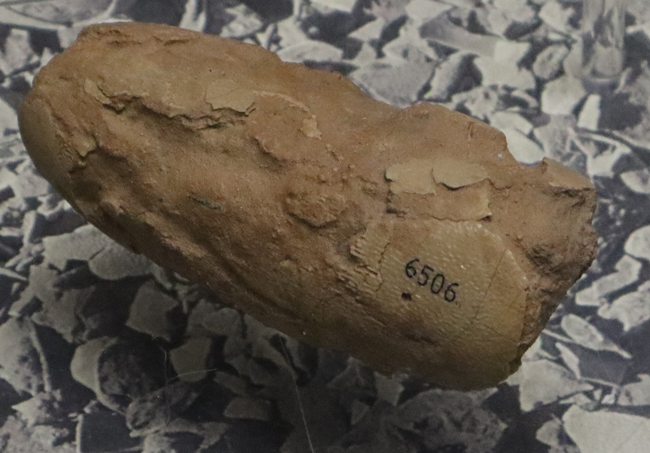
A Fossilised Dinosaur Egg

Chinese dinosaur fossils. A fossilised dinosaur egg.

A fossilised dinosaur egg (Theropoda). Picture credit: Everything Dinosaur.

Picture credit: Everything Dinosaur

Whilst it remains very likely that these egg-shaped objects are the result of natural , geological processes this has not dampened the enthusiasm or excitement of the locals, who have flocked to the area to take videos and photos of Chechnya’s very own dinosaur discovery.

For dinosaur toys and games including models of prehistoric animals visit: Everything Dinosaur.

Go to Top