All about dinosaurs, fossils and prehistoric animals by Everything Dinosaur team members.

Articles, features and information which have slightly more scientific content with an emphasis on palaeontology, such as updates on academic papers, published papers etc.

16 07, 2013

New Research Reveals T. rex Tooth Crown Found Embedded in an Edmontosaurus Tail – Predatory Behaviour?

By |2024-04-29T14:15:05+01:00July 16th, 2013|Categories: Dinosaur and Prehistoric Animal News Stories, Palaeontological articles|2 Comments

Tyrannosaurus rex – Hunter or Scavenger Debate Reignited after Fossil Find

Almost ever since T. rex was formally named and described back in 1905, debate has raged amongst scientists as to whether this Late Cretaceous dinosaur was an active hunter or primarily a scavenger.  The skull of Tyrannosaurus rex is relatively short when compared to an adult body length somewhere in excess of 13 metres and the teeth in its exceptionally strong jaws are very different in shape when compared to other large meat-eating dinosaurs such as the allosaurids and the abelisaurs.  It is true, the teeth are large, those in the maxilla and dentary (upper and lower jaws), for example, can be in excess of 18 cm long and more than 2.5 cm wide at the point where the crown would emerge above the gum line.

Theropod Teeth

However, the teeth are not necessarily recurved and sabre-like, the sort of teeth one associates with the likes of Mapusaurus, Carcharodontosaurus or even Ceratosaurus.  Having had the opportunity to study tyrannosaurid teeth in detail, it is surprising how blunt they feel at the tips, indeed one of their most remarkable features is their characteristic “D” shape in cross section.  Are these the teeth of an active hunter, or the bone crushing dentition of a scavenger?

A team of American scientists have discovered the tip of a tyrannosaur tooth, embedded in the tail bones of a large, duck-billed dinosaur.  The bone surrounding the tooth shows signs of healing.  Is this physical evidence of a tyrannosaur hunting and attacking another dinosaur?  Could the debate over the hunter versus scavenger issue be finally laid to rest?

Tyrannosaurus rex Feeding Strategies

The feeding strategies of large, theropod dinosaurs such as Tyrannosaurus rex have been debated by palaeontologists for a long time.  Fossil finds have provided some tantalising glimpses into feeding behaviour, however, it is notoriously difficult to distinguish post-mortem pathology with evidence of interspecific hunting behaviour.  There have been several Triceratops fossils found which show tell-tale puncture marks from the teeth of T. rex, but it is impossible to tell whether these wounds were made by a feeding tyrannosaurid on a Triceratops carcase or as a result of a fight between these Late Cretaceous giants.

In a paper published in the academic journal “The Proceedings of the National Academy of Sciences”, the researchers report on the discovery of a tyrannosaur tooth crown stuck fast in the tail bone of a herbivorous Edmontosaurus, the scientists conclude that this is definite evidence of predation by a T. rex, an attack by an immature tyrannosaur on a duck-billed dinosaur.

Hadrosaur with Bite Mark

At the Denver Museum of Nature and Science there is a mounted exhibit of a large, hadrosaur (Edmontosaurus annectens), with a strange “U” shaped bite mark out of its tail.  This has been described as the damage caused by an attack from a Tyrannosaurus rex, although, unlike this new study, there was no tell-tale evidence of a tooth being left behind.

Hadrosaur Exhibit Shows Evidence of Tyrannosaur Attack?
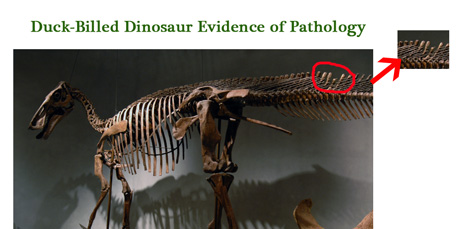
Museum exhibit may show evidence of T. rex attack.

Museum exhibit may show evidence of T. rex attack.

 Picture credit: Denver Museum of Nature and Science/Everything Dinosaur

In the picture above, the mounted hadrosaur exhibit is shown with the damage to the neural arches on some of the caudal vertebrae highlighted.

T. rex Tooth

The academic paper was produced by scientists from the Department of Palaeontology (Palm Beach Museum of Natural History, Florida), Pete Larson from the Black Hills Institute of Geological Research (South Dakota) and researchers from the University of Kansas.  One of the paper’s authors, Larry D. Martin of the University of Kansas Biodiversity Institute sadly passed away earlier this year.  This paper was one of the very last that he contributed to.  The hadrosaur fossils, ascribed to Edmontosaurus were found in South Dakota and come from the famous Hell Creek Formation.  The two traumatically fused caudal vertebrae (tail bones), partially enclose the tip (part of the crown), of a tyrannosaurid tooth, one that is believed to represent the dentition from a partial grown, immature Tyrannosaurus rex.

The Researchers Show the Fossilised Tooth Fragment Embedded in the Tail Bones

Evidence of a predatory T.rex?

Evidence of a predatory T. rex?

Picture credit: David A. Burnham/University of Kansas Biodiversity Institute

The healed bone growth indicates that the duck-billed dinosaur survived this encounter.  In February of this year, researchers from the University of Kansas and Florida reported on the discovery of evidence of a scar on fossilised skin tissue from just above the eye of an Edmontosaurus.  In a paper, published in “Cretaceous Research”, the scientists concluded that this too was evidence of an attack of a T. rex on an Edmontosaurus.

Hadrosaur Fossilised Scar – Evidence of an Attack from a T. rex?

A scar above the eye of a Hadrosaur, preserved as an impression in fossilised skin.

A scar above the eye of a hadrosaur, preserved as an impression in fossilised skin.

Picture credit: Robert DePalma/Palm Beach Museum of Natural History

A Hunter or Scavenger?

A number of eminent palaeontologists have commented on the scavenger/hunter debate over the years.  It is likely, that just like most large carnivores today, if a Tyrannosaurus rex found the corpse of another dinosaur it would very probably feed off the kill – a sort of “free lunch” for a tyrannosaur.  However, as an opportunistic feeder, if the same T. rex got the chance to approach undetected a potential meal such as a duck-billed dinosaur, then it would probably have used this chance to launch an attack.

Back in the summer of 2010, as part of Everything Dinosaur’s museum outreach programme, team members devised a presentation on the hunter versus scavenger topic.  Members of the public could examine some of the evidence and decide for themselves as to whether Tyrannosaurus rex was an active hunter or a rather ponderous meat-eater preoccupied with scavenging the kills of other dinosaurs.  To see the results of the survey: Results of the T. rex Hunter or Scavenger Survey.

 CT Scans of the Fused Hadrosaur Tail Bones

CT scans reveal the embedded tooth.

CT scans reveal the embedded tooth.

Picture credit: Robert DePalma et al

The picture above shows computerised tomography (CT) scans of the hadrosaur fossil bones.  1) the two tail bones fused together and 2) showing the cross-section of the Tyrannosaurus rex tooth buried in the bone (the white oval at the bottom of the picture (2)).  The scale bars shown represent 1 cm.

Far from being definitive prove, “smoking gun” evidence that Tyrannosaurus rex was indeed an apex predator, some scientists have challenged the paper’s findings.  Dr Paul Barrett (Natural History Museum, London), rather summed up some of the comments that have been reported by stating:

“This paper shows without question that a T. rex bit a living Hadrosaur, but it can’t show if this was a regular behaviour or not, or even if this was hunting behaviour rather than some other kind of interaction”.

For models and replicas of Tyrannosaurus rex and other prehistoric animals: Rebor Prehistoric Animal Figures and Replicas.
7 07, 2013

The Unique Fossil Heritage of Iran

By |2024-04-12T08:53:05+01:00July 7th, 2013|Categories: Dinosaur and Prehistoric Animal Drawings, Geology, Palaeontological articles|2 Comments

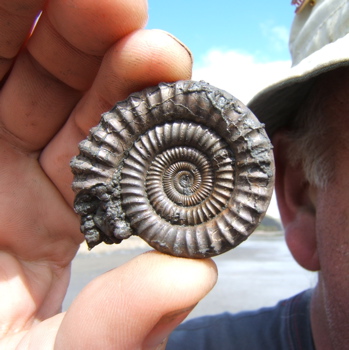
Local Farmer Finds Spectacular Ammonite Fossil

With team members at Everything Dinosaur making frequent visits to the “Jurassic Coast” of Dorset on various expeditions you would think that looking at ammonite fossils would become rather “run of the mill” for us, however, I don’t think that any of us will ever lose our fascination for these creatures.  Even the smallest fossil find, perhaps a pyritised Promicroceras spp. from Charmouth, or an example of Arnioceras from further along the coast is greeted with excitement.  There is a real buzz when you first see a fossil, that moment of realisation that you are the first person to see evidence of that living creature for some 180 million years or so.

The Joy of Fossil Hunting

A Typical Ammonite - but not all types of this Cephalopod had coiled shells

A typical ammonite – but not all types of this cephalopod had coiled shells.

Each time we visit Lyme Regis, and get out onto the beaches to search for fossils we meet people who are first time visitors to the area.  We are always happy to answer their questions and provide advice on where to look, we even give most of our fossil finds away, especially to the Mums and Dads so that their children can take something “special” away with them.

The Dorset Coast

To get the best out of a visit to the Lyme Regis and Charmouth areas, we recommend going on an organised fossil walk with one of the local experts and guides.  The cliffs are particularly dangerous, and under the expert guidance and tutelage of a professional fossil collector visitors can be safe and they get the chance to learn about the geology and the fossils that can be found.

To read more about organised fossil walks at Lyme Regis: Lyme Regis Fossil Walks.

However, ammonite fossils are not restricted to the southern coast of England.  These extinct relatives of squid, cuttlefish and octopi are distributed world wide in Mesozoic aged rocks.  We were intrigued to read about the discovery of a large ammonite specimen by an Iranian farmer in the north-eastern province of North Khorassan.  Early reports state that this fossil is approximately 70 million years old (Upper Cretaceous).

The province of North Khorassan in Iran borders Turkmenistan, although fossils from this area have been known about for centuries, some parts of this region remain relatively unexplored and there are many more thousands of fossils awaiting discovery.

Ammonite Fossil

The fossil shows the shell of the ammonite, these creatures are rarely found as fossils with their soft parts preserved.  The animal lived in the outermost chamber of its shell.  Ammonites were pelagic (living above the ocean floor) and like other cephalopods they were active swimmers (nektonic), propelling themselves along by squirting water out of a siphon.  As the ammonite grew, it extended its coiled, tubular shell outwards, laying down new chamber walls behind it. These chambers contained a mixture of gas and water which the animal used to control its buoyancy.  As ammonite fossils are abundant and widely distributed these fossils are used by geologists as zone fossils in the correlation of strata (bio-stratification).

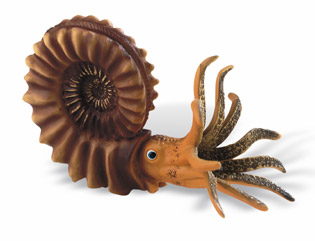
A Model of an Ammonite Showing the Soft Tissues

A model showing an Ammonite.

A model showing an Ammonite.

Picture credit: Everything Dinosaur

Everything Dinosaur team members wrote an article a couple of years ago about the discovery of marine reptile fossils in Iran, much of the fossil material from this region could represent new species.

To read about the discovery of Plesiosaurus fossils in Iran: Plesiosaur Fossils from Iran.

Local farmer Morteza Hemmati, discovered the large ammonite fossil, an internal mould of the shell of the ten-tentacled creature whilst digging.  The fossil which weighs around fifteen kilogrammes is very well preserved and it probably made its way up to the surface as a result of erosion.  The fossil looks to be in excellent condition, and where there is one ammonite fossil there is a strong possibility of a lot more being found in the area.

Let’s  hope that this specimen gets donated to a local museum or university so that it can be preserved and then studied.  Perhaps, it may even be put on public display so that local people can learn more about the geology of their province.

To view Everything Dinosaur’s range of replica fossils including models of ammonites: Models of Ammonites and other Prehistoric Animals.

25 06, 2013

The Most “Ugly” Pareiasaur Discovered to Date – Bunostegos

By |2023-02-18T12:20:26+00:00June 25th, 2013|Categories: Dinosaur and Prehistoric Animal News Stories, Palaeontological articles|0 Comments

Pareiasaur from Niger with Bizarre Lumps and Bumps on Its Head

A newly described and “ugly” pareiasaur – Bunostegos akokanensis.

A team of international scientists have discovered that animals living in what was one of the central parts of the super-continent known as Pangea may have become geographically isolated, this led to a number of ancient genera surviving into the Late Permian, whilst these creatures became extinct elsewhere.

Bunostegos akokanensis

One of the more remarkable of these “living Permian fossils” was the cow-sized, herbivorous pareiasaur which has been named Bunostegos akokanensis.  The term pareiasaur refers to a diverse group of reptiles, the “shield lizards”.  These animals were heavily built, robust creatures whose bodies were covered in bony spikes, horns and plate-like projections.  Bunostegos is known from a partial skull and it is distinctive as this specimen has more bumps and lumps on its skull than any other known species of Pareiasaur described to date.

Late Permian Specimen

The skull material has been dated to around 260 million years ago (Late Permian), it was found a few years ago during fieldwork exploring the Moradi Formation of central Niger.  A research paper has just been published in the academic publication “The Journal of Vertebrate Palaeontology”.  The genus name means “knobbly roof” a testament to the strange lumps and bumps on the animal’s skull, which in life may have been covered in skin, rather like the bumps on the top of a giraffe’s head.  The species name honours the town of Akokan in central Niger, which is close to where the fossil material was found.

Scutosaurus and Other Pareiasaurs

Better known pareiasaurs such as the three-metre-long Scutosaurus have provided scientists with evidence that some of these skull and facial features developed with age.  Cheek projections in conjunction with nose and lower jaw spikes seem to have become more prominent as individuals grew larger and matured.  This has led some palaeontologists to speculate that these features were used in mating displays or fights amongst rivals (intra-specific competition).  If this is the case, then the skull material unearthed in Niger might represent a particularly old individual.

A Typical “Shield Lizard” – Scutosaurus

Robust, heavily armoured Pareiasaurs.

Robust, heavily armoured pareiasaurs.

Picture credit: Everything Dinosaur

For models and replicas of Permian prehistoric creatures: Wild Safari Dinos Models and Replicas.

Skull Analysis

Analysis of the skull has led the researchers to conclude that Bunostegos is related to older and more primitive pareiasaurs, but it seems to have persisted in Niger whilst related species died out many millions of years previously.  This would have made Bunostegos a “living fossil”, a survivor from an ancient line of reptiles that had gone extinct elsewhere.  For much of the Permian, the land masses of the Earth were joined together into a huge super-continent (Pangea).

Scientists had thought that much of the fauna and flora was relatively uniform, in theory an animal could have walked from near to the South Pole almost to the North Pole.  The Middle and Late Permian fossil record documents a uniformity in fauna and flora as similar fossil species have been found in what would have been (back in the Permian), geographically dispersed locations.

However, this research work, focusing on the Moradi Formation of Upper Permian strata suggests that there was an isolated habitat in the central part of Pangea that enabled distinctive fauna and flora to evolve and more primitive reptiles to persist.  Bunostegos may have been around during the Late Permian as deserts surrounded its habitat providing a natural barrier preventing animals leaving the area and other creatures coming in.

Commenting on the strange appearance of this reptile, Dr Linda Tsuji from the University of Washington (Seattle) stated:

“We can’t say for sure, but it is most likely that the bony knobs on the skull of pareiasaurs did not serve a protective function.  They vary quite markedly in size and shape between different species, with some species lacking prominent knobs entirely, so I think that they were purely ornamental. The most probable use was for inter-specific [between species] or intra-specific [within species] recognition.”

An Impenetrable Desert

These deserts would have proven to be impenetrable barriers to these creatures, the fauna and flora would have been constrained to a central area, arid but with enough water and food to sustain an ecosystem.

Christian Sidor of the Department of Anatomy, New York College of Osteopathic Medicine, Old Westbury, New York, a co-author of the scientific paper concluded that:

“Our work supports the theory that central Pangea was climatically isolated, allowing a unique relict fauna to persist into the Late Permian.”

Elsewhere on the landmass of Pangea, animals and plants had much more freedom of movement with many fewer natural barriers.  This is reflected in the relatively uniform fossil record as found today in places such as South Africa and South America.

A View of the Bunostegos Skull Material

Two photographs of the skull material are at the top viewed as if looking down onto the fossil material.

Two photographs of the skull material are at the top viewed as if looking down onto the fossil material.

Picture credit: Journal of Vertebrate Palaeontology

The line drawing below is an illustration of the skull, as if viewed from looking down onto the top of the skull (dorsal view).

A spokesperson from Everything Dinosaur stated:

“It is important to explore the geological and fossil record of the super-continent known as Pangaea, especially the Upper Permian deposits.  The end of the Permian is marked by the greatest mass extinction in the history of life on our planet and scientists are still uncertain how this mass extinction event came about”.

6 06, 2013

The Discovery of the Oldest Primate to Date?

By |2024-04-18T07:34:04+01:00June 6th, 2013|Categories: Dinosaur and Prehistoric Animal News Stories, Palaeontological articles|0 Comments

Archicebus achilles – World’s Oldest Primate Fossil Named after Greek Hero

An international team of researchers has announced the discovery of the world’s oldest known fossil primate skeleton representing a previously unknown genus.  It has been named Archicebus achilles.  The fossil was unearthed from an ancient lake bed in central China’s Hubei Province, near the course of the modern Yangtze River.  In addition to being the oldest known example of an early primate skeleton, the new fossil is crucial for illuminating a pivotal event in primate and human evolution—the evolutionary divergence between the lineage leading to modern monkeys, apes and humans (collectively known as Anthropoids) on the one hand and that leading to living Tarsiers on the other.

Oldest Primate to Date?

This new species seems to be basal to the lineage that led to both Tarsiers and the true monkeys, the fossils have been dated to approximately 55 million years ago, a time when much of the northern hemisphere was covered in tropical rain-forest.

This tiny creature, with a body little more than seven centimetres in length, died and its remains were buried in the muddy sediments at the bottom of a shallow lake.  It must have been buried quickly as the carcase seems not to have been disturbed by scavengers.  Like most other fossils recovered from ancient lake strata, the skeleton of Archicebus was found by splitting apart the thin layers of rock containing the fossil. As a result, the skeleton of Archicebus is now preserved in two complementary pieces called a “part” and a “counterpart,” (slab and counter slab), each of which contain elements of the actual skeleton as well as impressions of bones from the other side.

Three Dimensional Images of the Holotype Fossil Material

The slab and counter slab, images produced by scanning the fossil material.

The slab and counter slab, images produced by scanning the fossil material.

Picture credit: Dr Ni Xijun

The picture above shows an image created following the scanning of the type specimen IVPP V18618.

Archicebus achilles

Dr Ni Xijun of the famous Institute of Vertebrate Palaeontology and Palaeoanthropology at the Chinese Academy of Sciences led the research, a paper has just been published in the academic journal “Nature”.  Working alongside Dr Xijun was Dr Christopher Beard (Carnegie Museum of Natural History in Pittsburgh); Dr Daniel Gebo (Northern Illinois University); Dr Marian Dagosto of (Northwestern University, Chicago); Dr Jin Meng and Dr John Flynn of the American Museum of Natural History in New York; and Dr Paul Tafforeau of the European Synchrotron Radiation Facility (ESRF), in Grenoble, France.

In order to study the entire fossil, the scientific team first had to scan the specimen at ultra high resolution using the state-of-the-art facilities of the European Synchrotron Radiation Facility in Grenoble, France.  Three-dimensional digital reconstruction of the fossil using the synchrotron scans allowed the team of scientists to study the tiny, fragile skeleton of Archicebus in intricate detail.

Dr Tafforeau explanined:

“During the past few years, we at the ESRF have developed the technology to look at those parts of the fossil that are still buried in the rock at a level of detail that is unique in the world.  Speaking virtually, we made the skeleton stand up.”

Oldest Primate

The skeleton of Archicebus is about seven million years older than the oldest fossil primate skeletons known previously, which include Darwinius from the Messel shales of Germany and Notharctus from the Bridger Basin in Wyoming (United States).

To read about the discovery of Darwinius masillae and the consequences for primate evolution: The Consequences of Darwinius masillae Discovery.

In addition, Archicebus is potentially very important as it belongs to an entirely separate branch of the primate evolutionary tree that lies much closer to the lineage leading to modern monkeys, apes and humans.  Darwinius and Notharctus, are believed to be Adapiform primates that are early relatives of living lemurs, the most distant branch of the primate family tree with respect to humans and other Anthropoids.

A spokesperson for the research team stated:

“Archicebus marks the first time that we have a reasonably complete picture of a primate close to the divergence between Tarsiers and Anthropoids.  It represents a big step forward in our efforts to chart the course of the earliest phases of primate and human evolution.”

An Illustration of A. achilles

Tree dwelling ancestor.

Tree dwelling ancestor.

Picture credit: Dr Ni Xijun

Dr Christopher Beard, whose earlier work on other fossil primates from China and Myanmar (Burma), has placed Asia at the heart of early primate evolution, commented:

“Archicebus differs radically from any other primate, living or fossil, known to science.  It looks like an odd hybrid with the feet of a small monkey, the arms, legs and teeth of a very primitive primate, and a primitive skull bearing surprisingly small eyes.  It will force us to rewrite how the Anthropoid lineage evolved.”

Probably Arboreal

Calculating the weight of this tiny creature at around 20-30 grammes, the research team conclude that this very small, light, animal probably lived in the tree canopy.  Studies of the teeth suggest that this mammal was an insectivore.  It probably hunted during the day (a diurnal habit), and Archicebus would probably have had to consume a lot of insects to keep its tiny body going, perhaps eating its own body weight in insects a day.

The basal evolutionary status of this new fossil, challenges an earlier theory that the first members of the Anthropoid lineage were quite large, the size of extant monkeys.  In fact, A. acihilles was slightly smaller than the smallest extant primate – the Pygmy Mouse Lemur from Madagascar.

One of the most significant observations made by the research team relates to the shape of the heel bone.  Far from being like a Tarsier’s calcaneus, the bone is more reminiscent of what one would expect in an Anthropoid.

Commenting on the importance of A. achilles anatomy, Dr Beard said:

“The heel, and the foot in general, was one of the most shocking parts of the anatomy of this fossil when we first saw it; because, frankly, the foot of this fossil primate looks like a small monkey, specifically like a Marmoset.”

The international team have taken the best part of ten years to complete their studies.  This new basal member of the evolutionary line that would eventually lead to our own species takes its name from the Greek “arche” (meaning beginning or first; the same root as archaeology) and the Latin “cebus” (meaning long-tailed monkey).  The species name achilles (derived from the mythological Greek warrior Achilles), highlights the new fossil’s unusual heel bone.

Everything Dinosaur is grateful to the Chinese Academy of Sciences for their help in the compilation of this article.

For models and replicas of prehistoric animals: PNSO Age of Dinosaurs Models and Figures.

1 06, 2013

How the Tortoise Got Its Shell

By |2023-02-17T14:27:20+00:00June 1st, 2013|Categories: Dinosaur and Prehistoric Animal News Stories, Palaeontological articles|2 Comments

New Research Sheds Light on the Evolution of the Chelonians

The chelonians, the group of reptiles that includes tortoises, turtles and terrapins are very ancient, with origins dating back to the Permian geological period.  However, the fossil record for early types of these shelled reptiles is extremely poor and scientists had very few transitional fossils to study to provide data on how and when these reptiles evolved their unique shells on the outside of their bodies.  Chelonians possess a shell, it is made up of highly modified ribs, vertebrae and shoulder girdle bones.

Chelonians

These reptiles have a unique skeletal structure amongst vertebrates, their shoulder and hip girdles are inside their rib cage.  Some tortoises for example, can pull their heads and limbs and tail inside their protective shell, some species even have hinges within their shells allowing them to close the aperture for the head completely.

Critics of the theory of evolution had cited the complex carapace and plastron of turtles as being evidence to counter the evolution hypothesis, where over thousands of generations incremental changes lead to the development of new features and characteristics and hence new species.  How could such a complicated structure come about?  A team of researchers from the Smithsonian Institute (United States), have been studying a fossil of an animal from the Late Permian of South Africa that provides new information into the evolution of the Chelonia.

Fossils of Turtles and Tortoises

Fossils of turtles and tortoises from the Late Triassic, animals such as Proganochelys from Germany already had fully formed shells, what the scientists needed were earlier fossils of ancestral Chelonia that would provide information on the transition from a non-protected body to the evolution of an enclosing carapace and plastron locked together.  Five years ago, the first of the clues was unearthed in China.  The fossilised remains of an early turtle, one that lived ten million years before Proganochelys was discovered.

This creature named Odontochelys semitestacea, lacked the characteristic beak of extant turtles, instead it had teeth in its jaws and although it had a fully developed plastron (belly plate), the carapace was only partial, made up of extended and widened ribs and vertebrae but not fused together.  O. semitestacea was a transitional fossil, but what the research team really needed was a much older specimen, not Triassic material but fossils dating from the Permian to show the initial evolutionary line of the turtles and tortoises.

An Illustration of the  Late Triassic Tortoise Proganochelys

Triassic Tortoises already had evolved fused carapace and plastron.

Triassic Tortoises already had evolved fused carapace and plastron.

How the Tortoise Got its Shell

With newly discovered fossils of a modified parareptile known as Eunotosaurus africanus, from Late Permian aged deposits in South Africa, the Smithsonian team had an opportunity to study the origins of the turtle evolutionary line.  The team’s detailed study showed that this species also had distinctively broadened ribs and it  shared many anatomical features only found in the Chelonia, such as no inter-costal muscles that run in between the ribs, paired belly ribs and a specialised mode of rib development.

This suggests that E. africanus is basal to the Chelonia and represents an early step on the evolutionary path to the turtles, tortoises and terrapins that we know today.

Fossil Discovery Helps Scientists to Understand the Evolution of the Chelonian Shell

The tortoise shell - fossil evidence suggests the shape of things to come.

The tortoise shell – fossil evidence suggests the shape of things to come.

Picture credit: Dr Tyler Lyson

Filling a Gap in the Turtle Fossil Record

Peter Buck Postdoctoral Fellow at the Smithsonian’s department of Vertebrate Zoology, Tyler Lyson one of the authors of the study commented:

“Eunotosaurus neatly fills an approximately 30–55-million-year gap in the turtle fossil record.  There are several anatomical and developmental features that indicate Eunotosaurus is an early representative of the turtle lineage; however, its morphology is intermediate between the specialised shell found in modern turtles and primitive features found in other vertebrates.  As such, Eunotosaurus helps bridge the morphological gap between turtles and other reptiles.”

The ribs in most other animals protect internal organs and help ventilate the lungs to assist breathing.  Because the ribs of turtles have been modified to form the shell, they have also had to modify the way they breathe with specialised muscles.  This presents the scientists with their next challenge.  They plan to examine the novel respiratory system in turtles and see how it evolved in conjunction with the evolution of the turtle’s shell.

Embryo Studies

Studies of the embryos of turtles in the laboratory can assist them in this work, it seems that with the discovery of the South African fossil material, researchers are finally able to explain how tortoises and turtles got their unique shells.

In the short video sequence produced as an accompaniment to this scientific research, the evolution of the shell of Chelonians is demonstrated.  The computer generated images take the viewer through a series of evolutionary steps from Eunotosaurus africanus to a number of extinct forms, each with a more complete carapace and plastron.  This video shows how the ribs, shoulder girdle and back bones were slowly modified over time to help form the protective outer shell of the Chelonia.

An Extant South African Tortoise Compared to the E. africanus Fossil Material

Comparing extant with extinct.

Comparing extant with extinct.

Picture credit: Luke Norton

The picture above shows an extant South African sideneck turtle next to its 260-million-year-old relative, Eunotosaurus africanus.

For models and replicas of prehistoric animals from the Mesozoic: Dinosaur and Prehistoric Animal Models.

30 05, 2013

New Contender for “First Bird” – Aurornis

By |2023-02-17T14:14:09+00:00May 30th, 2013|Categories: Dinosaur and Prehistoric Animal News Stories, Palaeontological articles|3 Comments

Aurornis Discovery Restores Archaeopteryx to Its Perch

At one time feathered dinosaur fossils from the Jurassic and fossils of creatures identified as being Mesozoic birds, were as rare as “hen’s teeth”, however, the fine grained and fossil rich sediments of Liaoning Province (northern China), have changed all that.  A substantial amount of fossil material of primitive birds and feathered dinosaurs has already been discovered and large  numbers of specimens await further study in museum storage.

The Evolution of Birds

One such specimen, unearthed by a farmer, purchased by a local fossil dealer, sold on and in storage at the museum at the Fossil and Geology Park in Yizhou until last year, has helped scientists to re-write the bird/dinosaur lineage and re-established Archaeopteryx as a primitive member of the Aves (birds).

The half-metre-long specimen has been named Aurornis xui, the genus name means “dawn bird” and the specific name honours the famous Chinese palaeontologist Xu Xing, a scientist who has been at the forefront of research into feathered dinosaurs.  Like many fossils from this part of China, the specimen was acquired through a fossil dealer.  The dealer claimed that the specimen had been found in western Liaoning and that it came from the Tiaojishan Formation, which dates from 165 to around 153 million years ago.  Tests on the rock confirmed this assertion and the authors of the scientific report, published in the journal “Nature” estimate the specimen to be around 160 million years old.

The Fossil Specimen (A. xui)

Known from just a single fossil - A. xui.

Known from just a single fossil – A. xui.

Picture credit: T. Hubin/IRSNB

Aurornis xui

The head of the animal faces to the right of the picture, the long tail and limbs can be clearly seen.  The slight, discoloured (black/grey) staining above the base of the tail, along the back of the neck and at the front of the chest may represent evidence of the presence of feathers.

There are a number of primitive skeletal features present, along with traces of feathers on the long tail, neck and chest.  The research team, headed by Pascal Godefroit from the Royal Belgian Institute of Natural Sciences have placed Aurornis at the base of the Avialans, a group that includes true birds and their close relatives since the divergence away from the Dinosauria.

An Artist’s Impression of Aurornis xui

"Dawn Bird" a basal member of the Avialae.

“Dawn Bird” a basal member of the Avialae.

Picture credit: Masato Hattori

Furthermore, the research team carried out an in-depth phylogenetic analysis of bird/dinosaur specimens which has led them to conclude that Archaeopteryx, once placed outside of the Aves and regarded as not being part of the Aves evolutionary lineage, should be re-assigned and placed back with the birds.

The first fossils of Archaeopteryx (A. lithographica) were found in the 1850’s and in 1861 a beautifully preserved almost complete specimen was unearthed.  Here was a creature from the Upper Jurassic strata of Solnhofen (Germany) that had feathers, skeletal features which resembled birds, but also with teeth, claws and a long tail.

A Transitional Form

The specimen seemed to be a transitional form between reptiles (Dinosauria) and birds.  However, feathered fossil finds from Liaoning Province had led a number of scientists to re-assign Archaeopteryx and place it in a less pivotal position on the evolutionary path towards true birds.  This re-classification of Archaeopteryx, placing it within the Dinosauria Order rather than with the birds, implied that powered flight must have evolved at least twice amongst different, but related types of creature.

The evolutionary line to the true birds evolved powered flight and thanks to this re-assignment of Archaeopteryx fossil material, a form of convergent evolution must have occurred with a evolutionary line of bird-like dinosaurs evolving powered flight too.

Archaeopteryx an Ancestor of True Birds

The discovery of Aurornis xui coupled with this new analysis of the fossil material has simplified the picture somewhat.  Archaeopteryx is once again considered an ancestor of true birds, implying that powered flight evolved only once, on the dinosaur to birds evolutionary line.  The analysis undertaken by Dr Godefroit and his fellow researchers was much more comprehensive than previous phylogenetic studies, the doctor commented:

“Previous phylogenetic investigations were based on maybe only 200 morphological characteristics.  Here, we recognise almost 1,500 characteristics.  So it’s a much bigger and more robust analysis, and according to this new investigation Archaeopteryx is again considered an ancestor of birds and the new creature we describe is also a basal bird; and in fact it is even more primitive than Archaeopteryx.”

This new research places Archaeopteryx, Aurornis and the genus known as Anchiornis (discovered in 2009) at the base of the Avialae lineage that would give rise to the true birds.

To read an article about the implications of the discovery of Anchiornis: In a Flap over Feathered Fossil Discoveries from China.

This scientists state that Aurornis xui was very probably incapable of powered flight.  It could have been a glider as its feathers were not the contoured, complicated pennaceous flight feathers seen in extant birds.

This new analysis of the known fossil material has implications for a number of genera once classified on the Dinosauria side of the dividing line between dinosaurs and birds.  The fossils of a number of members of the Troodontidae, a family of bird-like dinosaurs have also been re-examined.  The cursorial predator known as Balaur bondoc, a bizarre, highly specialised, Late Cretaceous carnivore from Romania (Hateg Island), which resembled Velociraptor has been placed within the Avialae.  Like Aurornis, Balaur bondoc could not fly unlike the rest of the Avialae, so far assigned.

To read an article about the discovery of Balaur bondoc: Stocky Heavyweight Dragon from Romania.

The wider implication for this research is that if powered flight only evolved once in the Dinosauria, then feathers most certainly evolved initially for other functions, flight was a later, secondary consequence of the evolution of modified scales that eventually become feathers.  Feathers may have first evolved as visual communication devices, to show status in a pack structure or hierarchy, or to help brood eggs during the nesting season.

Commenting on the implications of this new research, co-author Gareth Dyke from the National Oceanographic Centre (Southampton, England) said:

“Still, it’s unlikely that this is the final shake up in birds’ early history.  As more fossils are found in this unexplored age, these relationships are going to change – it’s currently in a great amount of flux.”

A spokesperson from Everything Dinosaur stated:

“The evolution of the bird lineage is far from fully understood.  It is very likely that more fossil material is in storage yet to be studied in detail and there may be many significant specimens in the hands of private collectors that could add to our understanding regarding the divergence of the Dinosauria and the evolution of powered flight.”

To view models of theropod and other dinosaurs: Wild Safari Prehistoric World Figures.

16 05, 2013

Remarkable Fossil from Iraq Changing the Way we View Ichthyosaur Evolution

By |2024-04-29T14:09:18+01:00May 16th, 2013|Categories: Dinosaur and Prehistoric Animal News Stories, Palaeontological articles|0 Comments

Ichthyosaur Evolution Just Got a Lot More Complicated

Ichthyosaurs were a group of marine reptiles that superficially resembled dolphins.  These streamlined, viviparous (giving birth to live young), predators seem to have evolved in the Early Triassic and became extinct towards the end of the Cretaceous.  Ichthyosaur fossils have been found all over the world, however, despite the wealth of fossil material (or perhaps because of it), there are a number of mysteries surrounding this Order that puzzle palaeontologists.  For instance, they do seem to be at least superficially, the best adapted to life in a marine environment when compared to the other types of marine reptile, the crocodile-like metriorhynchids, the mosasaurs, the long-necked plesiosaurs and their shorter-necked relatives the pliosaurs.

Ichthyosaurs

However, despite being very well suited to a nektonic lifestyle and there being a growing body of evidence to suggest that these types of “fish lizards”, were becoming better and better adapted to life in the open oceans as the Jurassic gave way to the Cretaceous, they still became extinct long before the Cretaceous mass extinction event that saw the demise of the other types of Late Cretaceous marine reptile.

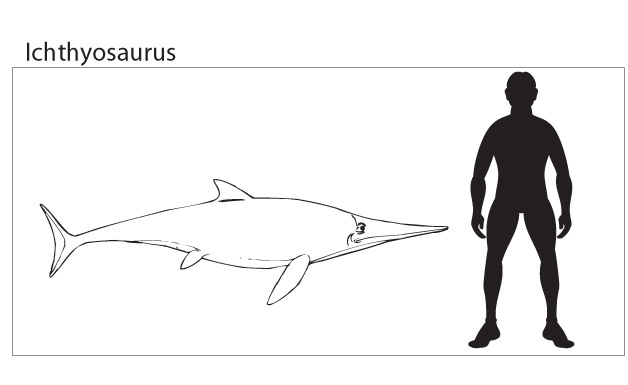
A Scale Drawing of a Typical Ichthyosaur

A typical "dolphin-like" Ichthyosaur.

A typical “dolphin-like” ichthyosaur.

Picture credit: Everything Dinosaur

The Order Ichthyosauria

The Order Ichthyosauria suffered a series of extinctions with three major extinction events identified over the duration of the Mesozoic.  As a result, those types of ichthyosaur that survived into the Cretaceous from this Order’s Jurassic heyday were believed to a single branch of what had been a diverse clade.  The Cretaceous ichthyosaurs were all relatively similar in their body plans and morphology and were believed to have shared a common Late Jurassic ancestor.  The lack of variation in Cretaceous ichthyosaur body types, the general lack of diversity in the Ichthyosauria, was believed to have played a significant role in their ultimate demise during the Cenomanian faunal stage of the Cretaceous.

The publishing of a scientific paper (Biology Letters), outlining the research undertaken on a partial ichthyosaur fossil specimen found in Iraq, may change the way in which the Cretaceous ichthyosaurs are viewed.  This ichthyosaur, named as Malawania anachronus (Mal-ah-won-nee-ah a-nack-kron-us), seems to contradict the long-held theories.  Malawania represents a “ghost lineage of ichthyosaurs”, it resembles a more primitive form of this marine reptile Order, it does not appear to be closely phylogenetically related to other known Cretaceous ichthyosaurs.

Ichthyosaur Fossil

The fossil which consists of fragments of skull bones including a partial sclerotic ring (ring of bone around the orbit) and much of the front portion of the animal was discovered by British geologists exploring Kurdistan (north-eastern Iraq) in the 1950s.  At the time of its discovery, the slab of fossil material was not being treated with much reverence.  As one of the authors of the scientific paper outlining the study of this fossil, Dr Darren Naish points out:

“Preserved within a large, flat slab of rock, it was being used as a stepping stone on a mule track.”

The Fossilised Remains of Malawania anachronus

The picture shows the fossil slab and a drawing illustrating the location of the fossil material.

The picture shows the fossil slab and a drawing illustrating the location of the fossil material.

Picture credit: Biology Letters

A Significant Fossil Specimen

Study of the specimen began during the 1970s with ichthyosaur expert Robert Appleby, then of University College, Cardiff.  Although he recognised the significance of this fossil discovery, he unfortunately passed away before determining the precise age of the specimen.  However, the research into this strange ichthyosaur, one of only two ichthyosaur fossils known from the Middle East, was taken up recently by a team of international scientists and fittingly the contribution of Robert Appleby is acknowledged as he is credited on the list of authors for the scientific publication.

The research team conclude that this fossil contradicts the previous theories about the evolution and extinction patterns seen in the Ichthyosauria.  Lead author Dr Valentin Fischer (University of Liege, Belgium) and his colleagues have named the specimen Malawania anachronus, the name means “out of time swimmer”, as despite being Cretaceous in age, the ichthyosaur represents the last known member of a kind of ichthyosaur which was believed to have become extinct during the Early Jurassic.

Analysis of the micro-fossils found on the slab of rock which contains the ichthyosaur specimen, analysis of spores and pollen grains that have been preserved indicate that this ichthyosaur lived approximately 125 million years ago (Barremian faunal stage of the Early Cretaceous).

The research team support this assertion by providing a cladistic study of the known ichthyosaur fossil material to re-design the “Fish Lizards” family tree.  Here is evidence of a ancient, primitive Ichthyosaur assigned to the Thunnosauria group of ichthyosaurs that seem to have originated in the Late Triassic.  This study suggests that in some parts of the world, primitive ichthyosaurs survived relatively unchanged for more than sixty million years.

Commenting on the implications for this research, Dr Fischer stated:

“Malawania’s discovery is similar to that of the Coelacanth in the 1930s: it represents an animal that seems ‘out of time’ for its age.  This ‘living fossil’ of its time demonstrates the existence of a lineage that we had never even imagined.  Maybe the existence of such Jurassic-style ichthyosaurs in the Cretaceous has been missed because they always lived in the Middle-East, a region that has previously yielded only a single, very fragmentary ichthyosaur fossil.”

The phylogenetic analysis undertaken by the research team suggests that several ichthyosaur groups that appeared   during the Triassic and Jurassic geological periods may have survived into the Cretaceous.  This brings the extinction phases of the Ichthyosauria into doubt.  For example, according to this new study, the supposed end of the Jurassic extinction event may not have occurred.  The fossil record for the Ichthyosauria shows a very different pattern of extinction when compared to known, accepted data on other marine reptile groups.

The Evolution of the Ichthyosauria

A table compiled by the research team that explores the evolution and radiation of the Ichthyosauria.

A table compiled by the research team that explores the evolution and radiation of the Ichthyosauria.

Table credit: Biology Letters

Malawania anachronus

The position of Malawania anachronus is shown by the red line.  The chart at the top records the passage of time from the Middle Triassic to the Late Cretaceous and places known fossil material on this chronological scale.  The line graph below shows the proposed main periods of radiation of the Ichthyosauria and the herring bone diagrams at the bottom shows the proposed phylogenetic relationship between different genera.

When this research is taken together with the 2012 literature on the discovery of a new species of German ichthyosaur known as Acamptonectes densus, another type of ichthyosaur known as an ophthalmosaur that may have survived into the Cretaceous, the discovery of Malawania revolutionises how palaeontologists view the evolution of this type of marine reptile.

To read more about this discovery: New Ichthyosaur Species Swims into View,

There is growing evidence to suggest that the ichthyosaurs remained an important and diverse group of marine reptiles, at least into the Early Cretaceous.  If this is the case, then their extinction some ninety million years ago becomes even more of a mystery.  Why did this diverse and seemingly superbly adapted group of marine reptiles die out?

A spokesperson from Everything Dinosaur suggested:

“This new research certainly muddies the waters somewhat when it comes to the final demise of the Ichthyosauria.  If they had been a small, homogeneous group filling very similar niches in the food-chain of the oceans then they could have been very vulnerable to extinction.  However, this new evidence suggests that this was not the case, the ichthyosaurs were more diverse than previously thought.  Perhaps the evolution and rapid radiation of the teleosts (modern ray-finned fishes) had an effect, at this moment in time, it is a question of having to re-think accepted theories.”

 The Evolution of the “Fish Lizards” Shows that Something “Fishy” may Have Been Going On

The "Missing" Ichthyosaurus Model

An Ichthyosaurus model.

Picture credit: Everything Dinosaur

As other areas of the Middle East are explored, perhaps more marine reptile fossils will be found and further evidence for the radiation and the eventual extinction of the Ichthyosauria will come to light.

To view models and replicas of ichthyosaurs and other ancient marine reptiles: CollectA Prehistoric Life Figures.

12 05, 2013

When is a Euoplocephalus a Euoplocephalus?

By |2023-02-16T19:01:09+00:00May 12th, 2013|Categories: Dinosaur Fans, Palaeontological articles|0 Comments

Researcher Identifies That Fossils Ascribed to Euoplocephalus Actually Represent Different Species

The taxonomic classification of the ankylosaurids just got a whole lot more complicated, or to put it another way, a University of Alberta graduate researcher has reaffirmed analysis carried out in the early part of the 20th Century that proposed more species of armoured dinosaur in North America.  It seems that fossils assigned to one species of ankylosaur, known as Euoplocephalus tutus may represent a total of four different species of armoured dinosaur.

Euoplocephalus tutus

Subtle differences noted by the student, originally identified by palaeontologists nearly one hundred years ago, suggest that the genera of Dyoplosaurus, Anodontosaurus and Scolosaurus may have to be resurrected.  This leads to the intriguing question of why were there so many kinds of big, armoured dinosaur and how were some species able to live alongside each other in the same habitats?

The research has just been published in the scientific publication,  “PLoS One”, the Public Library of Science.

Euoplocephalus Fossil Material

The ankylosaur group of dinosaurs are often referred to as “living tanks” as some members of this group of bird-hipped dinosaurs (ornithischians) were very wide-bodied, heavily armoured and possessed clubs on the end of their tails.  As these types of ankylosaur are known from Upper Cretaceous sediments of North America and Asia it had been suggested that their defensive armour and vicious tail clubs evolved so that these slow moving creatures could withstand attack from the massive tyrannosaurids, which were the apex predators.

Indeed, most media images of creatures such as Ankylosaurus (A. magniventris) and the Chinese ankylosaur Shanxia (S. tianzhenensis) depict these squat, heavy reptiles defending themselves against an attack from a tyrannosaur by swinging their savage tail clubs.  That may be the popular image of ankylosaurs, but the fossil record for these herbivores of the Late Cretaceous reveals that there may be a lot more to this clade of the Dinosauria, for example, one University of Alberta researcher has suggested that several different types of these giants could have lived in the same environment at the same time.

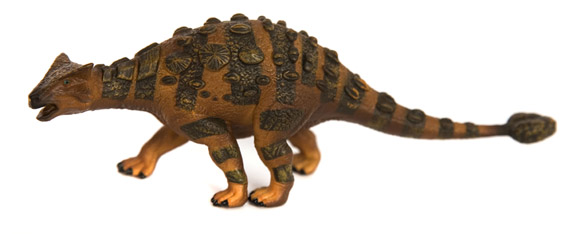
A Model of a Typical Ankylosaurid (A. magniventris)

Armoured Dinosaur - Ankylosaurus

Armoured dinosaur – Ankylosaurus

Picture credit: Everything Dinosaur

The Thyreophorans

The ankylosaurs and the stegosaurs are grouped together into a sub-group of the Ornithischia known as thyreophorans (shield bearers).  These dinosaurs are characterised by the presence of armour plates on the top and along the sides of their bodies.  Late Cretaceous ankylosaurs like the eleven-metre-long A. magniventris had huge plates of armour on the neck and shoulders, with smaller plates running in rows along the flanks.  The tail, stiffened by fused bony tendons posessed a massive, bony club on the end, in essence modified caudal vertebrae.

It was Franz Nopsca, back in 1915 who first suggested that these types of dinosaurs be classified into a sub-group, the Thyreophora, although he included the horned dinosaurs (ceratopsians) as well.  Between 1900 and the  early 1930s there was an extensive programme of dinosaur classification undertaken, partly due to the large number of new dinosaur fossils, including armoured dinosaurs being discovered in Canada and the western United States.  A number of new ankylosaurid species were established most based on fragmentary fossils such as individual skull specimens and vertebrae.

Named by Lawrence Lambe

Euoplocephalus (E. tutus) , a species named by Lawrence Lambe in 1902 was an exception.  This dinosaur is represented by a very much larger number of fossils than most other types of ankylosaurid.  It is also unusual as fossils ascribed to Euoplocephalus have been found in the Dinosaur Park, Horseshoe Canyon and Two Medicine Formations.  These Formations represent several million years of worth of geological deposits and this implies that the ankylosaur known as Euoplocephalus existed as a species for a very long time.  Earlier studies from the 20th century assigned a number of genera to the fossils, dinosaur genera such as Scolosaurus (Scolosaurus cutleri), Anodontosaurus (A. lambe) and Dyoplosaurus (D. acutosquameus) were established.

Reviewed in the 1970s

Following a review in the 1970s, all these types of ankylosaur were reclassified as belonging to the Euoplocephalus genus.  However, University of Alberta researcher, Victoria Arbour undertook a comprehensive review of the fossil material and her study suggests the 20th century scientists may have been right all along.  She visited museum collections in North America and Europe and carefully examined small variations in the configuration of the skull armour and the bony tail clubs.  Her analysis suggests that the fossils grouped together under the Euoplocephalus genus do actually constitute four individual species of dinosaur.

Arbour explained that:

“In the 1970s the earlier work was discarded and those four species were lumped into one called species Euoplocephalus.  I examined many fossils and found I could group some fossils together because their skull armour corresponded with a particular shape of their tail club.”

Simplified Explanation of Differences between the Four Ankylosaurids

Simplified comparison table.

Simplified comparison table.

Table credit: Everything Dinosaur

The four species span a period of geological time of around ten million years from the Late Campanian faunal stage of the Cretaceous into the Maastrichtian and her research shows that the Dinosaur Provincial Park Formation had three different types of armoured ankylosaurid dinosaur living in that region of Alberta at the same time.   Her work suggests that Scolosaurus, Dyoplosaurus and Euoplocephalus shared the same environment, if these very similar creatures lived in the same habitat it begs several questions such as how were the food resources divided up?

How did all three species manage to survive?  How much interspecific competition would there have been?

Stratigraphic Distribution of Campanian-Maastrichtian Ankylosaurids in the Study

Stratigraphic distribution of Campanian-Maastrichtian Ankylosaurid species.

Stratigraphic distribution of Campanian-Maastrichtian ankylosaurid species.

Table credit: Journal PLoS One

Ankylosaur Tail Clubs

Previously, Victoria had examined ankylosaur tail clubs with a view to understanding how they might have been used as defensive weapons, to read an article about her earlier research: Ankylosaurs had a Smashing Time.

This also has implications for the fossil material that remains ascribed to Euoplocephalus.  The re-division of the Euoplocephalus fossil material into four species means that there was not the degree of individual variation in the Euoplocephalus tutus species as once thought.

Skulls of Ankylosaurids Compared (Dorsal View – looking at the tops of the skull)

Dorsal view of Ankylosaurid skull material used in study.

Dorsal view of ankylosaurid skull material used in study.

Picture credit: Journal PLoS One

Euoplocephalus Fossil Material Studied

There has been much debate between palaeontologists as to how to distinguish A. magniventris fossil material with that ascribed to E. tutus. The re-classification of a significant portion of the Euoplocephlus material to other species may muddy the waters somewhat further.  Although, E. tutus material is still substantial and it remains one of the more complete ankylosaurid genera in terms of the number of fossils known, Arbour’s research now leaves no specimen of Euoplocephalus that includes bony armour “in situ” in relation to other skeletal material.  In short, the arrangement of the armour (osteoderms) on Euoplocephalus is now very much open to question.

Ornamentation Patterns on the Tops of Ankylosaurid Skulls Compared

Cranial ornamentation in Ankylosaurids compared.

Cranial ornamentation in ankylosaurids compared.

Picture credit: Journal PLoS One

The picture above shows a number of the skulls that were analysed in the study (dorsal view, viewed from the top).  The skull marked as CMN 0210 is the holotype for Euoplocephalus tutus (top left), CMN 8530 is the holotype material associated with Anodontosaurus lambei (bottom row on left) and ROM 784 is the holotype for Dyoplosaurus acutosquameus, adjacent to the Euoplocephalus holotype.

It seems there is a lot more to learn about when it comes to these heavily armoured dinosaurs commonly referred to as “living tanks”.

For models and replicas of thyreaphorans and other dinosaurs: PNSO Age of Dinosaurs Models.

26 04, 2013

Birds have the Dinosauria to Thank for Their “Crouching Gait” According to New Research

By |2024-04-29T13:27:58+01:00April 26th, 2013|Categories: Dinosaur and Prehistoric Animal News Stories, Palaeontological articles|0 Comments

How Changing Body Shape Affected Balance and Posture During the Evolution of the Dinosauria and Aves

The bipedal birds with their crouching gait have the dinosaurs to thank for their posture.  The birds, descendants from a group of theropod dinosaurs, have a very different solution to standing on just two legs than our species H. sapiens.  Humans and birds, (birds are sometimes referred to as avian dinosaurs), may both be bipedal but their legs are held in very different stances, giving them different gaits and postures.  Humans have their leg bones held straight underneath their hips, an efficient method of supporting body weight.  Our legs are straight and directly underneath us, a bit like a column in a building being straight and positioned directly under the roof that it is holding up.

Bird Legs

Bird legs are bent into  a “z” shape with the femur (thigh bone) being held in a much more horizontal position.  Birds have adopted a “crouched standing position”, one that takes more energy and is less efficient that our own stance.  The crouched position requires more muscular effort in order to permit the organism to remain upright and balanced.

Birds and humans walk differently, birds have a digitgrade stance (walk on their toes, walking on their digits), a method of locomotion seen in theropod dinosaurs, even the likes of Tyrannosaurus rex.  Human beings on the other hand (no pun intended), and their ancestors, adopted a different method of walking – plantigrade.  Organisms that adopt a plantigrade stance walk on their toes but their body weight is supported by the vast majority of the foot (or hand), for example bears have a plantigrade stance.  We have a plantigrade stance, we walk on our toes but also our heels.

New Dinosaur Research

New research published this week in the journal “Nature” shows that the conventional view of how birds got their crouching stance, a result of tails becoming lighter and shorter may not be entirely accurate.  Evidence is presented that suggests that body shape changed during archosaur evolution and this had serious consequences for the archosaurs, the dinosaurs and eventually those descendants of the dinosaurs, the birds.

This study, a collaboration between a number of scientists including leading researchers from the Royal Veterinary College (London), proposes that it was the enlargement of the forelimbs, rather than the shortening and the lightening of the tail that led to bipedal dinosaurs gradually adopting a crouched posture, with the thigh bone (femur) held in an almost horizontal position.  This characteristic associated with the bipedal Eumaniraptora was to be inherited by their descendants the Aves (birds).

Bird Posture Inherited From Dinosaurs

Figure 1: Animal standing or at the midpoint of a step (a). For the animal to balance, forces applied by the feet (red) must match the force of body weight (blue) pointing downwards from the centre of mass (yellow/black). If the centre of mass moves forward (b), then the feet must move forward (and thus the limb must get more crouched) to maintain balance, as in (c).

Figure 1: Animal standing or at the midpoint of a step (a). For the animal to balance, forces applied by the feet (red) must match the force of body weight (blue) pointing downwards from the centre of mass (yellow/black). If the centre of mass moves forward (b), then the feet must move forward (and thus the limb must get more crouched) to maintain balance, as in (c).

Picture credit: Royal Veterinary College

The Posture of Dinosaurs

Dr Vivian Allen and Professor John R. Hutchinson of the Royal Veterinary College led the research which essentially consisted of creating extremely detailed computer models of skeletons of seventeen types of Archosaur, then adding digitally flesh and muscles to assemble the whole creature.  Sort of building up an animal from the bones outwards.  This allowed the scientists to see how body proportions changed as the Archosauria evolved.

The University of Liverpool’s Dr Karl Bates and researcher Zhiheng Li, who at the time was based at the famous Institute for Vertebrate Palaeontology and Palaeoanthropology (Beijing, China) were also part of the research team.

Dr Allen explained that the researchers created complex computerised three dimensional images of the species in the study.  Detailed reconstructions was possible using analysis of the fossilised bones as well as computerised tomography (CT scans) of extant relatives.

Studying Archosaurs

Earlier research papers had proposed that the archosaurs in the Early Triassic were anatomically very similar to modern crocodilians with long, heavy tails and a sprawling or semi-erect gait.  However, early in the evolution of the Dinosauria, perhaps as a result of the archosaurs diversifying to take advantage of gaps in food chains as a result of the Permian mass extinction, the Dinosauria seem to have become bipedal.  From these fast, cursorial bipeds the Dinosauria evolved, first the saurischian (lizard-hipped) and later the ornithischian (bird-hipped) forms.

The anatomical characteristics associated with a bipedal stance and gait were inherited by the dinosaurs descendants the birds.  Prehistoric creatures studied in this research include the famous Archaeopteryx (Upper Jurassic  strata of Germany), Microraptor a feathered, flying dinosaur from Lower Cretaceous China and Velociraptor from Upper Cretaceous fossil bearing sediments.

Microraptor’s Wings Suggest a Link to Bird Stance and Posture

Three-dimensional models of dinosaurs were created.

Three-dimensional models of dinosaurs were created.

Picture credit: Everything Dinosaur

The picture (above) shows model dinosaurs from the Wild Safari Dinos range.

To view this range of prehistoric animal figures: Safari Ltd Dinosaur Models and Figures.

It had been thought that the relatively strange way of locomotion for birds and their stance had evolved gradually as the tails of their ancestors become shorter and lighter.  Extant birds do not have a tail as such, but compressed highly reduced bones (the last five caudal vertebrae that make up the pygostyle.  As the tail got shorter and less heavy, the centre of mass of the organism was slowly shifted forward.  As certain dinosaurs became more avian, the legs needed to become less vertical and  more crouched with a near horizontal femur to keep the centre of mass balanced over the feet.

Change in Stance and Body Position

This change in stance and body position, may hot have been driven by tail shortening.  The enlargement of the forelimbs in the Dinosauria could have been the catalyst.  Birds that fly have enlarged front limbs that form wings, dinosaurs did not evolve large forelimbs for flight, this may have just been an indirect consequence of the need to evolve larger forelimbs to chase and grasp prey.

Professor Hutchinson stated:

“We’d never doubted the hypothesis that the tail was responsible for the major changes in dinosaur balance and posture. The tail is the most obvious change if you look at dinosaur bodies.  But as we analysed, and re-analysed, and scrutinised our data, we gradually realised that everyone had forgotten to check what influence the forelimbs had on balance and posture, and that this influence was greater than that of the tail or other parts of the body.”

The Centre of Mass

With an aim of trying to determine when and how the centre of mass changed its position in the Dinosauria, modern computer-based techniques were used to assess the timing of the change in stance as recorded by fossil material preserved in the fossil record.  When this change may have occurred remains controversial.  Was the change in body position and stance gradual, or was it relatively swift as the first birds evolved powered flight?

The British based researchers in collaboration with their Chinese counterparts found evidence to support both scenarios.  There were gradual changes in the fossil specimens associated with the early dinosaurs and more sudden changes associated with the first birds and just before flight may have evolved.

An implication for this research is that due to the effects on the central mass position on leg posture, the size of the forelimbs and leg function are linked bio-mechanically.  As forelimbs got larger, this altered the way the dinosaurs and their descendants stood walked and ran.

Intriguingly some super-heavy weight theropods such as the tyrannnosaurids and the abelisaurs had very much fore-shortened front-limbs.  The three-dimensional computer models in conjunction with other aspects of this research could shed light on the reasons why these large predators evolved such short arms.

19 04, 2013

The First New Dinosaur Discovery in Madagascar for a Decade

By |2023-02-15T18:23:56+00:00April 19th, 2013|Categories: Dinosaur and Prehistoric Animal News Stories, Palaeontological articles|1 Comment

“Lonely Small Bandit” Confirms Hypothesis that Abelisaurid Fossils were Awaiting Discovery

The United States, Canada and possibly Mexico may be able to lay claim as being the home of Tyrannosaurus rex but the island of Madagascar can take ownership of another short-armed Cretaceous terror, with the announcement of the discovery of a new genus of abelisaurid.  Although, very fragmentary and consisting of a handful of vertebrae and bone fragments the fossils are distinct enough for palaeontologists to assign them to a brand new genus of abelisaur, the first new species/genus to be described from Madagascar in almost ten years.

New Dinosaur Discovery

The fossils were found in Upper Cretaceous strata and have been dated to the Cenomanian faunal stage, approximately 90 million years ago.  They were found near to the city of Antsiranana (formerly known as Diego-Suarez), in the Diana region of northern Madagascar.  First evidence of the fossils was discovered in 2007 and a second expedition to extract more fossil material took place in 2010.  It was Dr Joseph Sertich, curator of Vertebrate palaeontology at the Denver Museum of Nature & Science who discovered the dinosaur in a collaborative venture with the Raymond M. Alf Museum of Palaeontology (California, United States).

This new theropod has been named Dahalokely tokana (pronounced Dah-hah-loo-kah-nah), it means “lonely small bandit” in the local dialect, a reference to the size of this dinosaur relative to other known abelisaurids from the Southern Hemisphere and from the fact that when this dinosaur roamed, Madagascar had separated from the landmass of Africa.

An Illustration Showing the Estimated Size of D. tokana

The bones depicted indicate the actual fossil material found.

The bones depicted indicate the actual fossil material found.

Picture credit: Denver Museum of Nature and Science

“World’s Oldest Island”

Madagascar, is regarded by many scientists as the “world’s oldest island”, its isolation for millions of years explains the unique fauna and flora to be found, on what is today the world’s fourth largest island with a total area of more than 2.25 times the size of the United Kingdom.  The researchers have declared this discovery as providing a link between older abelisaurid fossil material and younger fossils dated to near the end of the Cretaceous geological period.  They describe the fossils as helping to plug an important gap in knowledge regarding the evolution of the abelisaurids.

Estimated to have measured between three and four and half metres in length, this bipedal predator may have stood something like one and a half metres high at the hips.  D. tokana is known from a handful of cervical vertebrae (neck bones), dorsal vertebrae, (back bones) and fragments of rib.  Distinct and unique features on the vertebrae led the scientists to assign the fossil material to a new species, representing the first dinosaur to be described from rocks laid down when Madagascar and India were joined together (Indo-Malagasy landmass).

Up to the discovery of D. tokana, no dinosaur fossils from between 165 million years old to around 70 million years of age could be identified and classified down to species level.  This significant gap has been reduced to 165 – 90 million years approximately.

A Student Working on the Dinosaur Excavation in 2010

University of Antananarivo student Liva Ratsimbaholison excavates Dahalokely in 2010

University of Antananarivo student Liva Ratsimbaholison excavates Dahalokely in 2010.

Picture credit: Denver Museum of Nature and Science

New Species of Abelisaurid

Something like two million years after this dinosaur existed, Madagascar split from India.  A rising plume of extremely hot, molten rock began to force its way up into the crust from the mantle under the Indo-Malagasy landmass and this began to stretch the crust forcing it to rift apart.  This rifting led to the separation of India and Madagascar.  The fact that this new species of abelisaurid lived before the split has led to speculation that this type of dinosaur may have been ancestral to the later abelisaurs of India, large super-predators such as Rajasaurus (R. narmadensis) and Late Cretaceous abelisaurs from Madagascar, dinosaurs such as Majungatholus also known as Majungasaurus.

The research team hope to find more fossils of Dahalokely so that they can determine the taxonomic relationships between these different types of carnivores.

A Typical Abelisaurid Dinosaur – Illustrated by Everything Dinosaur

A typical Abelisaurid dinosaur.

A typical abelisaurid dinosaur.

Picture credit: Everything Dinosaur

Cretaceous Theropod Models

CollectA have created a range of Late Cretaceous theropod dinosaur models including several abelisaurids.

To view the range: Age of Dinosaurs Models (CollectA Popular Figures).

Commenting on the significance of this dinosaur discovery Dr Sertich stated:

“This dinosaur was closely related to other famous dinosaurs from the southern continents.  This just reinforces the importance of exploring new areas around the world where undiscovered dinosaur species are still waiting to be found”.

Project leader, Andrew Farke, (Augustyn Family Curator of Palaeontology at the Raymond M. Alf Museum of Palaeontology) said:

“We had always suspected that abelisauroids were in Madagascar ninety million years ago, because they were also found in younger rocks on the island.  Dahalokely nicely confirms this hypothesis.  The fossils of Dahalokely are tantalisingly incomplete, there is so much more we want to know.  Was this dinosaur closely related to the later abelisauroids of Madagascar, or did it die out without descendants?”

Dr Andrew Farke at the Site of the Fossil Discovery (2007)

Dr. Andrew Farke, pointing out the first traces of the dinosaur fossil.

Dr Andrew Farke, pointing out the first traces of the dinosaur fossil.

Picture credit: Denver Museum of Nature and Science

As with many dinosaur discoveries, this fragmentary specimen leaves more questions unanswered than answered but it has potentially provided important evidence linking Indian abelisaurids and Madagascan abelisaurids to a common ancestral form.

Everything Dinosaur is grateful to the Denver Museum of Nature and Science  for their help in the compilation of this article.

Go to Top