All about dinosaurs, fossils and prehistoric animals by Everything Dinosaur team members.

Articles, features and information which have slightly more scientific content with an emphasis on palaeontology, such as updates on academic papers, published papers etc.

30 01, 2014

New Study Suggests that Some Diseases in Modern Humans Linked to Neanderthal DNA

By |2024-05-02T09:19:46+01:00January 30th, 2014|Categories: Dinosaur and Prehistoric Animal News Stories, Palaeontological articles|0 Comments

Neanderthal Genes Linked to Modern Human Diseases

Modern humans (Homo sapiens) are susceptible to some diseases as a result of inherited genes due to our interbreeding with Neanderthals (Homo neanderthalensis) according to a study published in the academic journal “Nature”.   A joint American and German-based team of researchers from Harvard Medical School, (Boston, Massachusetts) and the Max Planck Institute for Evolutionary Anthropology (Leipzig, Germany), have looked at the genetic makeup of over 1,000 people and compared this to the analysed genome of a Neanderthal toe-bone that is believed to be around 50,000 years old.

Inherited Genes from Neanderthals

The team also concluded that along with our susceptibility to some diseases, the inability to give up tobacco in some portions of the human population may be due to genes passed onto us from Neanderthals (not that Neanderthals smoked, as far as we know).  In addition, other traits such as hair colour, strong nails and the ability to adapt better to cold climates could be a result of our partial Neanderthal heritage.

Study Suggests Neanderthal DNA May Make Parts of Modern Human Population Susceptible to Diseases

Neanderthal skeleton compared to modern human skeleton

A Neanderthal skeleton (left) compared to a modern human skeleton (right). Picture credit: Ian Tattersall/ Max Planck Institute for Evolutionary Anthropology.

Picture credit: Ian Tattersall/ Max Planck Institute for Evolutionary Anthropology

Related Research Projects into the Human Genome

This study is one of a number of related research projects (no pun intended), as scientists attempt to unravel the complex relationship between early hominid species in Europe.  To read a news story on a research paper published late last year that looked at the genetic inheritance for a prevalence for diabetes in the human population: Modern Human’s Risk of Diabetes Inherited from Neanderthals.

In those members of our present population who are non-African in origin, there is a small amount of Neanderthal DNA present in their genetic make-up.  The level of Neanderthal DNA varies from approximately 2% to 4%.  Some Neanderthal DNA would be expected due to the belief that modern humans and Neanderthals shared a common ancestor.  However, the relatively high level suggests that there was interbreeding between these two species in the past.

New research suggests that in parts of the Old World, there were as many as four different types of hominid living at the same time.  The genetic relationship between these populations is very complex.  Part of this complexity is put down to interbreeding between species.

Adaptations for a Colder Climate

One of the genetic traits identified in this new research is that the Neanderthal’s genes to help adaptation to a colder climate by having tougher skin and nails may have been passed onto Homo sapiens that migrated northwards out of Africa.

People alive today, who are indigenous to sub-Saharan Africa, whose ancestors did not migrate out of Africa when Neanderthals were still present in Europe, carry very little Neanderthal DNA.  What they do carry would be as a result of our species sharing a common, ancient ancestor with the Neanderthals or perhaps a species of hominid from very far back in the human evolutionary line.

One of the conclusions made from the genetic study of the Neanderthal toe bone suggests that based on this evidence Neanderthal populations may have been very inbred.  The exact genetic relationship between Neanderthals and a third species of human that lived in Europe the same time as Neanderthals as well as H. sapiens has yet to be fully understood.

To read more about this: Mystery of the Denisovans.

Implications for Diabetes Research

Everything Dinosaur team members have already reported on one of the findings from research of this kind, the prevalence for type 2 diabetes being an inherited trait from Neanderthals.  In addition, it seems that Neanderthal genes may also predispose parts of the modern human gene pool to lupus, long-term depression, Crohn’s disease (inflammation of the digestive tract, a condition that affects around one person in every 700 in the United Kingdom), plus an autoimmune disease of the liver.  When Crohn’s disease is considered, it seems that Neanderthals passed on different genetic markers that increase and decrease the risk of this condition.

Commenting on the research, one of the authors of the academic paper, Professor David Reich (Harvard Medical School) stated:

“Now that we can estimate the probability that a particular genetic variant arose from Neanderthals, we can begin to understand how that inherited DNA affects us.  We may also learn what Neanderthals themselves were like.”

The London Natural History Museum’s Professor Chris Stringer, although not an author of this research, is regarded as an authority on the study of ancient hominids.  He explained that the findings added a new dimension to the debate over how early humans interacted with Denisovans and Neanderthals.  He stated that this research, in his opinion, did not challenge the current thinking that our ancestors originated in Africa.

Professor Stringer commented:

“The genetic data also shows there are thousands of DNA changes that are unique to Homo sapiens, and these distinctions are likely to have accumulated during the several hundred thousand years since Homo sapiens separated from the Neanderthal and Denisovan lineages as they evolved in Africa and Eurasia respectively.  Our genetic heritage is still largely from a recent African origin, despite the interbreeding with other human populations that undoubtedly occurred.”

No Traces of Neanderthal DNA in Parts of the H. sapiens Genome

This research also found that some areas of the human genome had no traces of Neanderthal DNA present within them.  This could be explained by alleles (pronounced al-eels) to these genes being dominant and the genes from the Neanderthals that may have been detrimental to the individual with those genes in some way, being lost out of the general population as a result of natural selection

Post-doctoral Fellow, Sriram Sankararaman (Harvard Medical School), one of the authors of this new research paper, explained:

“We find that there are large regions of the genome where most modern humans carry little or no Neanderthal ancestry.  This reduction in Neanderthal ancestry was probably due to selection against genes that were bad – deleterious – for us.”

The evidence suggests that some Homo neanderthalensis/H. sapiens hybrids may have had reduced fertility, or in some cases they may have been sterile.  Sterility in such hybridisation indicates that our species and Neanderthals, despite probably sharing a common ancestor, were so genetically far apart at the time of interbreeding, that these two species were only just compatible in terms of the ability to produce fertile offspring from any such union.

Unravelling More of the Neanderthal/Modern Human Genome
Human and Neanderthal genetic research.

Models of Neanderthals.

Picture credit: Everything Dinosaur

Neanderthal Models and Figures

To view Neanderthal figures (whilst stocks last) and other prehistoric animal figures: CollectA Prehistoric Life Figures and Models.

Exploring the issue of infertility occurring as a result of mating, Professor Reich added:

“It tells us that when Neanderthals and modern humans met and mixed, they were at the very edge of being biologically compatible.”

There have been a number of papers published recently highlighting the research into the various taxonomic and genetic relationships between our species and other ancient hominids.  At the turn of the year, Everything Dinosaur team members made a number of predictions about what news stories this web log was likely to cover over the next twelve months.  We confidently predicted that further genetic research such as this would reveal more data relating to the linkages between our species and other hominid branches on the human family tree.

To view Everything Dinosaur’s 2014 predictions in full: Everything Dinosaur’s Predictions for 2014.

30 10, 2013

Argentinosaurus Walks Again After 94 Million Years

By |2023-02-28T14:45:55+00:00October 30th, 2013|Categories: Dinosaur and Prehistoric Animal News Stories, Palaeontological articles|0 Comments

University of Manchester Scientists Digitally Recreate Argentinosaurus Locomotion

It may not have won any awards for its speed, but simply being able to walk when you weigh in excess of eighty metric tonnes and are longer than three double-decker buses is quite an achievement.  One of the debates about the largest land animals that ever lived, those long-necked dinosaurs, was how were they able to move their great bulk around at all.

Thanks to a study undertaken by University of Manchester scientists, in collaboration with researchers from Argentina, some further light has been shed on the locomotion of the super-heavy weights of the Dinosauria.

University of Manchester Research

Under the guidance of Dr Bill Sellers from the University’s Faculty of Life Sciences and an authority on computer modelling to assess vertebrate locomotion, a forty-metre-long reconstruction of the skeleton of Argentinosaurus was scanned by lasers and the data used to model how this huge titanosaur moved.

Argentinosaurus (A. huinculensis) may only be known from fragmentary fossil remains discovered in Patagonia, but it is regarded as one of the largest land-living vertebrates known to science.  It was a titanosaur, a group of huge plant-eating dinosaurs with elongated necks, small heads, wide bodies supported on four pillar-like legs and with long, quite flexible tails.

A life-size reconstruction of the skeleton of this huge herbivore on display at the  Museo Municipal Carmen Funes, Plaza Huincul, Neuquén, (Argentina) was carefully scanned and using Dr Sellers own software and enough computer power to run 30,000 desk top pcs a computer simulation was created that enabled Argentinosaurus to take its first steps for 94 million years.

An Illustration of the Titanosaur Argentinosaurus (A. huinculensis)

Walking with Dinosaurs!

Walking with Dinosaurs!

Picture credit: Everything Dinosaur

New Scientific Study

The study, published in the academic journal Public Library of Science Online (PLoS One) provides the first ever ‘virtual’ footprints of the dinosaur and disproves previous suggestions that the animal was so large that it would have found walking incredibly difficult.  Although able to walk at around 5 mph (8 kmh), about as fast as we can when we undertake a brisk walk, the scientists also noted that under their research criteria, these huge land animals were probably reaching the theoretical limit for a body of that size to achieve efficient locomotion.

Dr Bill Sellers, whose work has led to many insights into Dinosauria locomotion already, including a study of just how fast T. rex could run commented:

“If you want to work out how dinosaurs walked, the best approach is computer simulation.  This is the only way of bringing together all the different strands of information we have on this dinosaur, so we can reconstruct how it once moved.”

To read an earlier article on the work of Dr Sellers on tyrannosaur locomotion: So T.rex could chase down David Beckham.

Dr Lee Margetts, (IT Services for Research at Manchester University), who also worked on the project added:

“We used the equivalent of 30,000 desktop computers to allow Argentinosaurus to take its first steps in over 94 million years.  The new study clearly demonstrates the dinosaur was more than capable of strolling across the Cretaceous plains of what is now Patagonia, South America.”

Argentinosaurus

The team of scientists involved in this study, included Dr Rodolfo Coria from Carmen Funes Museum, Plaza Huincal, (Argentina).  Dr Coria was one of the palaeontologists given the task of formally naming and describing this huge dinosaur twenty years ago.  It was a team led by Dr Coria who were responsible for building the first physical reconstruction of this dinosaur Argentinosaurus.  The dinosaur that was so big it was named after a whole country!

The Reconstruction of the Argentinosaurus Skeleton (Museo Municipal Carmen Funes)

The largest dinosaur yet described.

The largest dinosaur yet described.

Picture credit: Museo Municipal Carmen Funes, Plaza Huincul.

Software to Investigate Locomotion

Using Dr Seller’s own software (Gaitsym) to investigate locomotion of both extant and extinct animals the team were able to create a computer simulation that showed the gait and locomotion of Argentinosaurus.   A spokes person from Everything Dinosaur explained:

“With only a small proportion of the fossil skeleton actually known, the Argentinosaurus skeleton model has been built using better known titanosaurs as bauplans.  The important thing here is the utilisation of new research techniques and methodologies to provide fresh insights into aspects of the Dinosauria whose bones would only tell part of the story.”

Dr Sellers noted:

“The important thing is that these animals are not like any animal alive today and so we can’t just copy a modern animal.  Our machine learning system works purely from the information we have on the dinosaur and predicts the best possible movement patterns.”

Helping to Improve Understanding of Musculoskeletal Systems

Dr Sellers said the research was important for understanding more about musculoskeletal systems and for developing robots.  Knowing how the biggest land vertebrates got around has implications for studies of all vertebrates and applications in robotics and other branches of mechanical engineering.

Plotting Muscle Mass and Joint Loadings for Argentinosaurus

Argentinosaurus locomotion study.

Picture credit: PLoS One

The picture above shows: A, side, and B, front view of the unscaled hull model. C, side, and D, front view of the scaled model with extra mass in the thigh and forearm segments.

He explained:

“All vertebrates from humans to fish share the same basic muscles, bones and joints.  To understand how these function we can compare how they are used in different animals, and the most interesting are often those at extremes.  Argentinosaurus is the biggest animal that ever walked on the surface of the Earth and understanding how it did this will tell us a lot about the maximum performance of the vertebrate musculoskeletal system.”

Dr Sellers added:

“We need to know more about this to help understand how it functions in ourselves.  Similarly if we want to build better legged robots then we need to know more about the mechanics of legs in a whole range of animals and nothing has bigger, more powerful legs than Argentinosaurus.”

Approaching a Functional Limit

The research team have concluded that dinosaurs like Argentinosaurus were approaching  a functional limit and that restricting the joint ranges of motion is necessary for a model without hypothetical passive support structures.  Much larger terrestrial vertebrates may be possible but would probably require significant remodelling of the body shape, or significant behavioural change, to prevent joint collapse due to insufficient muscle mass.

The University of Manchester team how to refine their work and explore the locomotive abilities of other iconic dinosaurs such as the Triceratops and Brachiosaurus.

27 10, 2013

Sauropod Dinosaurs Could Have Used Their Long Necks as Radiators

By |2023-02-28T14:29:07+00:00October 27th, 2013|Categories: Dinosaur Fans, Palaeontological articles|0 Comments

Sauropods could have used their Long Necks to Help Maintain their Body Temperatures

The Sauropoda, those long-necked herbivores of the Dinosauria have attracted a great deal of research recently.  These creatures, the first truly large terrestrial animals, bigger than extant species today, evolved in the Triassic and went onto to form a significant proportion of the plant-eating animals in a number of ecosystems for the next 150 million years or so.

Although, the ornithischians during the Cretaceous were more numerous and diverse, the Sauropoda persisted right up to the end of the age of the dinosaurs and some genera represent the largest land living animals of all time.  Body weights in excess of eighty tonnes are frequently cited and some of these leviathans, dinosaurs such as Alamosaurus, Argentinosaurus, Andesaurus and Antarctosaurus (just to focus on Sauropoda being with the letter “A”), may have reached lengths of more than thirty metres.

An Illustration of the Late Cretaceous Titanosaur – Alamosaurus sanjuanensis

Scale Drawing of Alamosaurus.

Scale drawing of Alamosaurus.

Picture credit: Everything Dinosaur

Gigantism in the Sauropoda

A number of research teams have explored gigantism in the Sauropoda in a bid to understand how and why these reptiles were able to grow so big.  At the Society for Vertebrate Palaeontology meeting being held in the USA this week, a number of papers will be presented.  Some of these papers explore this subject area, but one study undertaken by Dr Donald Henderson (Curator of Dinosaurs, at the Royal Tyrrell Museum, Alberta, Canada), deserves a special mention.

Dr Henderson asked an intriguing question, the long-necked dinosaurs by definition are known for having long necks, could these long necks have helped to regulate the body temperatures of these colossal animals?

One of the enormous (no pun intended), difficulties with the Sauropoda, is that, there are no land animals alive today that come even close to matching them in size.  The body proportions of a sauropod, its body shape and its anatomy are very different from any living relative of the Dinosauria, so using extant species as comparators is effectively ruled out.   Large animals such as elephants and sauropods do share a common problem – how to lose heat, how to stop their bodies overheating.

The Overheating Problem

Small animals, even those that are endothemic (warm-blooded), have a high surface area to volume ratio.  They can lose heat rapidly and can struggle to maintain body temperature.  The giants of the animal kingdom, today’s elephants and the Sauropoda of the Mesozoic have the opposite problem, their large bodies helped them to retain heat, maintaining a core body temperature that was different to the surrounding temperature of the environment.  How did the sauropods stop themselves from overheating?

The problem is compounded by the ongoing debate as to whether the Sauropoda were warm or cold-blooded.  Putting this debate aside for moment, large animals such as thirty metre long Diplodocus would still struggle to lose heat and avoid the trauma and physiological damage to its organs if it did not find an effective way to cool down.

African elephants are able to use their large ears as radiators to help them remove heat from their bodies.  The ears of tropical elephants are much larger then the ears of their long extinct, cold adapted cousins the Woolly Mammoths.  The ears of the African Bush Elephant (Loxadonta africana) are very well supplied with blood vessels and are very effective at helping to cool these animals down, as proved by many infrared thermography studies.

Sauropod Dinosaurs

The long necks of the Sauropoda, as well as acting as extremely efficient food gathering devices and allowing access to food resources that other herbivores could not reach, may also have served a similar physical function to those large flapping ears of today’s biggest land mammal.

Dr Henderson calculated the surface area to body mass proportions of a number of different types of sauropods.  In total, sixteen computer generated models were created, some based on early, basal sauropods such as Shunosaurus from China, whilst other models represented diplodocoid sauropodomorphs such as Nigersaurus (from Niger, Africa) as well as Apatosaurus and Diplodocus from the United States.  Other types of sauropod studied included members of the Macronarian sauropodomorphs (big noses).

Macronarian Sauropods

This group included the likes of Camarasaurus and Brachiosaurus.  In addition to this, the study looked at juveniles and their body shapes in comparison to the adult animals.  The smallest specimen studied was a juvenile Camarasaurus estimated to weigh less than 700 kilogrammes, the largest specimen used in the study represented a mature Brachiosaurus.

Typical Models Used in the Computer Simulation (Macronarian Sauropodomorphs)

Scale bar = 2 metres

Scale bar = 2 metres

Picture credit: PLoS One

Dorsal and lateral views of the taxa used in part of the study.  The diagram above shows: (A) Camarasaurus lentus, (B) Haplocanthosaurus priscus, (C) Saltasaurus loricatus and (D) Brachiosaurus brancai.

The Metabolic Rate of Sauropods

Although a number of assumptions have had to be made, for example, the metabolic rate of sauropods is not known and there is also a great deal of uncertainty surrounding the biology of these reptiles,  Dr Henderson was able to draw some interesting conclusions from his research.  The physical length of the necks did alter surface area to body mass and volume ratios, thus suggesting that the long neck could have been used to assist in thermo-regulation.

In addition, the presence of air sacs in the neck and trunk when considered in conjunction with the active blood flow between the core and surface of the body make the long neck radiator theory certainly plausible.

The Position of the Neck

It is also worth considering the position of  the neck, although not held in the “swan-like” pose so favoured by earlier restorations, the necks were a long way off the ground in large individuals.  The necks would have been exposed to any cooling breeze and any air currents circulating – these too would have assisted with any requirement to lose heat from the body.

Dr Henderson, considered the function of dermal spines that have been found in association with some sauropod fossils and their role in helping to regulate body temperature.  Sauropod specimens assigned to the Diplodocus genus had a row of dermal spines running from the neck down the back and along the midline of the tail.  There is the intriguing possibility that these spines could have significantly increased the body surface area of these dinosaurs and therefore aided heat loss.

Testing the Role of the Spines

To test the role of these spines in thermo-regulation, a diplodocid model was generated, one with a set of dermal spines running almost the entire length of the body.  The height of the individual spines was based on the relative position of each spine in association with the vertebrae.  The largest spines were estimated to have been around forty centimetres tall.

The Dermal Spines of Diplodocus – What Effect on Cooling the Body Would These Have Had?

Did the dermal spines of some Diplodocoids act as radiators?

Did the dermal spines of some diplodocoids act as radiators?

Picture credit: Everything Dinosaur

The precise location of these spines is still debated.  In this study, it was assumed that cervical, dorsal, sacral and caudal vertebrae all had dermal spines associated with them.

An Illustration of the Diplodocoid Model used in the Study (D. carnegii)

Dermal spine arrangement used in the study.

Dermal spine arrangement used in the study.

Picture credit: PLoS One

Increasing the Surface Area

For the sets of dermal spines along the tail, trunk and neck body segments their combined surface areas  amounted to  7.94 square metres.  The total surface area of the body and limbs of the Diplodocus model was calculated to be a little under 68 square metres. Based on this model, the full dermal spine area represented 11.7% of the actual body area.  If these spines were well supplied with blood vessels (as seen in the elephant ears), then they would have a significant potential to act as radiators, helping to cool the animal down.

However, Dr Henderson did point out the speculative nature of this aspect of his research.  There is a great deal of uncertainty about the size, internal structure, and distribution of these spines on the bodies of these types of dinosaur.  Until better fossil material becomes available, the importance of any dermal spines for heat loss in sauropods will have to remain very much open to speculation.

A spokesperson from Everything Dinosaur commented:

“There have been something like two hundred different species of sauropod named and described to date.  Neck length does vary considerably between genera, most likely due to adaptations to exploit particular food resources however, this research does raise the possibility that the long necks of these dinosaurs could well have served a thermo-regulatory function.”

21 10, 2013

Ancient Arthropod Brain and Nervous System Studied

By |2023-02-28T08:07:45+00:00October 21st, 2013|Categories: Dinosaur and Prehistoric Animal News Stories, Palaeontological articles|0 Comments

Cambrian Arthropod – The World’s Oldest “Brain” is Studied

The fossil of an ancient arthropod discovered in southern China is helping scientists to understand the links between different types of animal that make up the largest phylum in the animal kingdom.  The fossil has revealed evidence of a central nervous system and a rudimentary control centre situated at the front of the animal, what could be termed a brain.

Ancient Arthropod Brain

The fossil, a member of a Cambrian arthropod genus known as Alalcomenaeus has a nervous system that is similar to that found in extant spiders and scorpions.  By studying the layout of central nervous systems in the Arthropoda, palaeontologists are able to build up a picture of the phylogenetic relationships between what is a very diverse phylum.  Arthropods include crustaceans, scorpions, spiders, millipedes, centipedes, horseshoe crabs and insects.

Alalcomenaeus is a member of the Megacheiran group of the Arthropoda (big claws).  It lived in a shallow, marine environment approximately 520 million years ago (Middle Cambrian).  The fossil is one of a number of beautifully preserved specimens that have been unearthed in the Chengjiang Formation (the Moatianshan shales of Yunnan Province, south-west China).  The shales have revealed an extensive and diverse marine fauna (something like 16 different phyla have been identified).  The site rivals the great Burgess Shales location in British Columbia (Canada), in terms of its importance to scientists when it comes to understanding the rapid diversification of animal types in what is known as the “Cambrian explosion”.

A Fossil of Alalcomenaeus

Ancient Arthropod from 520 million years ago.Picture credit: University of Arizona/N. Strausfeld

CAT Scans

The research team, which included scientists from the University of Arizona, used CAT scans to make three-dimensional reconstructions of features of the fossilised nervous system.  Laser scanning was also carried out and light microscopy studies to enable the distribution of chemical elements preserved in the fossil to be mapped.  Evidence of metals such as traces of copper and iron helped the team to outline the different neural structures in this ancient animal.

The complex structure in the animal’s head, the brain and the layout of the central nervous system and nerve network reveals similarities between the extinct creature’s nervous system and the nervous systems of several modern arthropods.  This suggests a common ancestry between Alalcomenaeus and many types of extant arthropod.

Shedding Light on Evolutionary Processes

Living arthropods are commonly separated into several major subphyla.  The chelicerates, for example, includes spiders, horseshoe crabs and scorpions.  Then there is a subphylum termed Crustacea (shrimps, crabs, lobsters and such like) and a group the includes the insects (Hexapoda).  This new study sheds light on the evolutionary processes that may have given rise to modern arthropods, and also provides clues about where these extinct mega-clawed creatures fit in with the arthropoda phylum.

Senior author of the research paper, which has recently been published in the journal “Nature”, Professor Nicholas Strausfeld (University of Arizona) stated:

“We now know that the Megacheirans had a central nervous system very similar to today’s horseshoe crabs and scorpions.  This means that the ancestors of spiders and their kin lived side by side with the ancestors of the Crustaceans in the Cambrian.”

Alalcomenaeus is a newly established genus.  It measured around three centimetres in length, had a segmented body with approximately 12 pairs of attached limbs.

Extinct and Extant Arthropod Nervous Systems Compared

Nervous systems of arthropods compared.

Picture credit: University of Arizona/N. Strausfeld

This illustration shows the nervous systems of the Alalcomenaeus fossil (left), a larval horseshoe crab (middle) and a scorpion (right).  Diagnostic features that reveal the evolutionary relationships among these animals include the forward position of the gut opening in the brain and the arrangement of optic centres outside and inside the brain supplied by two pairs of eyes.  The brown coloured objects represent the compound eyes.

Describing this strange creature Professor Strausfeld added:

“Up front, it has a long pair of appendages that have scissor-like components, basically an elbow with scissors on the end.  These are really weird appendages, and there has been a long debate about what they are and what they correspond to in modern animals.”

Studying the Nervous System

Greg Edgecombe (Natural History Museum – London) stated that the nervous system tends to be similar between major groups of related animals.  By studying these structures scientists can work out phylogenetic relationships between different taxa.  He stated that the nervous system and its layout was one of the more reliable tools in the armoury of invertebrate palaeontologists when it comes to trying to investigate the evolutionary tree of the Arthropoda.

Doctor Edgecombe commented:

“They both have an ‘elbow joint’ in the same place, and they both have a similar arrangement of a fixed and movable finger at the tip.  Because of these similarities, one of the main theories for what ‘great appendage arthropods [Megacheirans]’ are is that they were related to chelicerates.  Thus, our findings from the nervous system gave an injection of new data to support an existing theory.”

Recently, Dr Edgecombe and his fellow researchers from the Natural History Museum identified another Cambrian fossil specimen whose nervous system and brain revealed an unexpected similarity to the brains of modern Crustacea.  When these two studies are put together, they reveal important and significant information regarding the evolution and early diversity of the Arthropoda.

A Close up of the Head of Alalcomenaeus

Superimposed colours reveal the presence of elements preserved within the fossil material.

Picture credit: University of Arizona/N. Strausfeld

Alalcomenaeus Fossil Specimen

The picture shows a highly magnified view of the head region of the Alalcomenaeus fossil specimen.  It includes superimposed colours of a microscopy technique that reveal the distribution of chemical elements in the fossil. Copper shows up as blue, iron as magenta and the CT signatures as green. The coincidence of iron and CT denote nervous system components.  The creature boasted two pairs of eyes (ball-shaped structures at the top).

Professor Strausfeld explained:

“Our new find is exciting because it shows that mandibulates (to which Crustaceans belong) and Chelicerates were already present as two distinct evolutionary trajectories 520 million years ago, which means their common ancestor must have existed much deeper in time.  We expect to find fossils of animals that have persisted from more ancient times, and I’m hopeful we will one day find the ancestral type of both the mandibulate and chelicerate nervous system ground patterns.  They had to come from somewhere.  Now the search is on.”

A spokes person from Everything Dinosaur added:

“This new research in conjunction with the earlier published papers, is helping to shed new light on the evolutionary relationships concerning the arthropods.  The Cambrian explosion, a sudden burst of evolution, specifically of those organisms with hard, mineralised parts marks the start of the Phanerozoic Eon – the “time of visible life”, these fossils, many of which are microscopic are playing an important role in helping scientists to unravel the tree of life.”

3 10, 2013

Conditions at Lake Urmia shed Light on Palaeozoic Environments

By |2023-02-24T10:31:14+00:00October 3rd, 2013|Categories: Dinosaur and Prehistoric Animal News Stories, Geology, Palaeontological articles|2 Comments

Salt Lake in northwestern Iran Mirrors Permian Environmental Crisis

Observations made as environments change today can sometimes provide scientists with valuable insights when it comes to studying the fossils of extinct creatures.  Studies into the way climate change affects animals and plants can provide researchers with helpful information when it comes to interpreting fossil evidence.  One such example of this concerns comparisons being made by scientists as Lake Urmia in northwestern Iran dries up to the plight of an ancient ecosystem that was to form part of South America.

Lake Urmia

For Iranian biologist Amin Khaleghparast and Dr Graciela Piñeiro (from Uruguay), breeding stress observed amongst Lake Urmia’s Flamingo population might be mirroring stress amongst a population of ancient Parareptiles as their environment changed.  Lake Urmia was the third largest salt water lake on Earth, and the largest body of salty water in the entire Middle East.  However, over the last fifty years or so the volume of the Lake has been much reduced.  Dams constructed across the rivers that feed Lake Urmia, the increasing demand for water for agriculture and the impact of severe droughts have reduced the Lake to a fraction of its former size.

The Flamingos are filter feeders and rely on brine shrimp (Artemia urmiana) as a food source.  As the water volume of the Lake is reduced, much of what was formerly open water is changing into a salt marsh.  This has led to a reduction in suitable habitat for the Flamingos and a decline in brine shrimp numbers.  With the drying up of Lake Urmia the scientists have witnessed a severe decrease in Artemia populations which has had dire consequences for other animals further up the food chain, including the Lake’s Flamingos.  Many Flamingos have failed to breed, a number of eggs have been aborted and a substantial number of Flamingo hatchlings have died.

Drawing Parallels with the Permian

The scientists have drawn parallels between these observations and a similar situation that may have affected a population of reptiles, (mesosaurs) in South America some 280 million years ago.

To read a short article on the drying up of Lake Urmia: The Ecological Crisis at Lake Urmia.

Dr Piñeiro and her colleagues produced an academic paper, published in 2012 (International Journal of Paleobiology), that highlighted the discovery of a number of Mesosaurus fossils including amniotic embryos, some of the earliest evidence yet of reptile embryos and possible viviparity (live birth) in the Reptilia Class.  Intriguingly, the discovery of an isolated embryo might suggest breeding stress in the population that led to the abandonment of this egg or a possible miscarriage.

Mesosaurs

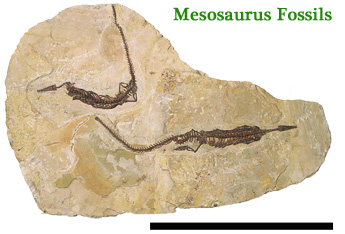
Mesosaurs such as Mesosaurus were small aquatic reptiles that lived during the Permian.  They had elongated jaws lined with very fine, needle-like teeth that would have helped them to strain arthropods such as brine shrimps out of the water in which they lived.  These reptiles were perhaps the first group of amniotes to adapt to living in marine habitats.  Although mesosaurs are descended from terrestrial reptiles, their long, flexible bodies, paddle-like tails and webbed digits indicate adaptations to a nektonic, marine lifestyle.  These reptiles had thickened ribs which palaeontologists believe was an adaptation to help these small animals counteract their own buoyancy and helped them to remain underwater.

Mesosaurus Specimens

Ancient reptiles adapted to marine environments.

Ancient reptiles adapted to marine environments.

Picture credit: Everything Dinosaur

The scale bar in the picture is approximately seventy-five centimetres long.

Permian Reptilian Fauna

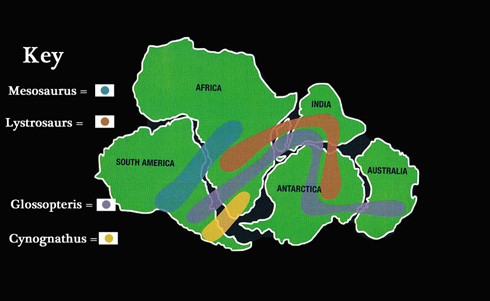
Although, these animals were not the most spectacular looking of the Permian reptilian fauna, their fossils, which have been found in Uruguay, Brazil as well as in western Africa helped to reaffirm the theory of continental drift first proposed by the German meteorologist Alfred Wegener.   Wegener observed that the coastline of west Africa fitted neatly into that of South America’s east coast, even though the Atlantic Ocean separated these two landmasses.  He proposed that some time in the past these two continents had been joined together.  His observations were supported by fossil evidence of creatures such as the mesosaurs which have been found in rocks on now widely separated continents.  Mesosaurs were unlikely to be capable of crossing such vast bodies of water as today’s oceans, so such fossils supported the idea that some time back in ancient history South America and Africa were joined together.  Such evidence helped to establish the theory of plate tectonics (continental drift).

The Fossil Record Provides Supporting Evidence for Plate Tectonics

Fossils support evidence of plate movements.

Fossils support evidence of plate movements.

Plate Tectonics

The diagram above shows where fossils of Mesosaurus, lystrosaurs (a terrestrial dicynodont), Cynognathus (a terrestrial cynodont) and Glossopteris (a pteridosperm [seed fern]) have been found.  These discoveries provide supporting evidence for the theory of these disparate land masses once being joined into a super-continent.

In the Carboniferous, a group of terrestrial animals evolved that would eventually dominate vertebrate life on our planet. These were the amniotes a group that includes mammals, birds and reptiles today.  The early amniotes evolved a unique way of protecting embryos inside their eggs.  Amniotic eggs have a semi-permeable shell that protects the egg from drying out.  An internal membrane known as the amnion surrounds the yolk and the embryo, this effectively means that the free-swimming larval stage seen in the Amphibia could be dispensed with.  Later synapsid amniotes evolved the ability to retain embryos internally thus affording the embryo greater protection (as seen in extremis in marsupial and placental mammals today).

Amin Khaleghparast and Dr Graciela Piñeiro postulate a relationship between an ancient salt lake in Pangea and Lake Urmia:

“There is it some similarity between intense evaporation of the ancient Great Salt Lake where Mesosaurus lived and conditions that lead to the drying Lake Urmia, a great salt lake in northwestern Iran, turning large part of it into a salt marsh in last decade. Like Flamingos filter-feed on brine shrimp (Artemia urmiana) in the salt lake, Mesosaurus filter-fed on an extinct group of crustaceans (Pygocephalomorpha) in waters poorly oxygenated and highly saline during the Early Permian. With the drying Lake Urmia,unfortunately, we witnessed severe decrease of Artemia, Flamingos’ abortion, death of many Flamingo young and at last Flamingo migration.”

Mesosaur Fossil Discovery

The discovery of an isolated fossilised embryo could demonstrate that the population of mesosaurs was under environmental pressure as their habitat changes.  According to the scientists this fossil could represent “either a miscarried embryo or an aborted egg”.

The bodies of the animals perished in hypersaline conditions, the degree of preservation is exceptional.  This can be explained by the fact that hypersaline states are associated with very low concentrations of oxygen which in turn creates an environment in which bacteria, responsible for the decomposition of organic matter cannot act.  These amniotic mesosaur embryos provide some of the earliest evidence yet of reproduction biology of vertebrates preserved in the fossil record.  In some specimens, the absence of a recognisable eggshell in association with articulated well-preserved embryos within an adult suggest that mesosaurs may have been viviparous or at least that they laid eggs in an advanced state of development.

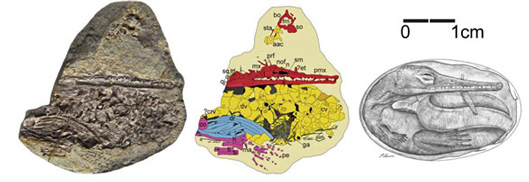
Mesosaurus Embryo Fossils – Did they Face the Same Fate as Lake Urmia’s Flamingos?

Sharing the same fate as Lake Urmia's Flamingos?

Sharing the same fate as Lake Urmia’s Flamingos?

The picture above shows on the left the fossil of the meosaurus embryo curled up within its amniotic membrane (no egg shell preserved).  The middle component shows a stylised tracing of the fossil, with a life-size drawing of the Mesosaurus embryo on the right.

To read more about the South American fossil discoveries: Early Evidence of Viviparity from South America.

Everything Dinosaur acknowledges the help of Amin Khaleghparast in the compilation of this article and for pointing out the relationship between Lake Urmia and the drying up of shallow seas in the Carboniferous.

23 09, 2013

Giant Prehistoric Straight-Tusked Elephant Butchered by H. heidelbergensis in Kent According to New Research

By |2024-05-01T15:07:02+01:00September 23rd, 2013|Categories: Dinosaur and Prehistoric Animal News Stories, Palaeontological articles|0 Comments

University of Southampton Researchers Uncover a Rich Treasure Trove of Palaeolithic Fossils including Many Hand Axes

Research by a University of Southampton archaeologist suggests that early humans, who lived thousands of years before Neanderthals, were able to work together in groups to hunt and slaughter animals as large as a prehistoric elephant.

Straight-tusked Elephant

The fossil evidence of a straight-tusked elephant (Palaeoloxodon antiquus) has provided tantalising evidence that Homo heidelbergenis was very capable of co-ordinating the butchering of a large animal carcase, with the research team proposing that at least four individuals worked on the corpse, extracting the cuts of meat.  It is not known whether, in this instance, H. heidelbergensis actually hunted and killed the elephant but other H. heidelbergensis sites from Germany indicate that they may well have hunted these mega herbivores.

Dr Francis Wenban-Smith discovered a site containing remains of an extinct straight-tusked elephant in 2003, in an area of land at Ebbsfleet in Kent, during the construction of the High Speed 1 rail link from the Channel Tunnel to London.  Investigation of the area was carried out with the independent heritage organisation Oxford Archaeology, with the support of HS1 Ltd.

Extensive Fossil Remains

Excavation revealed a deep sequence of deposits containing the elephant remains, along with numerous flint tools and a range of other species such as; wild aurochs, extinct forms of rhinoceros and lion, Barbary macaque, beaver, rabbit, various forms of vole and shrew, frogs and a diverse assemblage of snails.  These remains confirm that the deposits date to a warm period of climate around 420,000 years ago, the so-called Hoxnian interglacial, when the climate was probably slightly warmer than the present day.

The Tusks of the Prehistoric Elephant Uncovered During the Fossil Excavation

Straight tusks of prehistoric elephant slowly emerge

Straight tusks of prehistoric elephant slowly emerge.

Picture credit: University of Southampton

Evidence for Homo heidelbergensis

Since the excavation, which took place in 2004, Francis has been carrying out a detailed analysis of evidence recovered from the site, including eighty undisturbed flint artefacts found scattered around the elephant carcass and used to butcher it.  The prehistoric elephant was twice the size of today’s African variety and much heavier.

Dr Wenban-Smith commented:

“Although there is no direct evidence of how this particular animal met its end, the discovery of flint tools close to the carcass confirm butchery for its meat, probably by a group of at least four individuals.  Early hominins of this period would have depended on nutrition from large herbivores.  The key evidence for elephant hunting is that, of the few prehistoric butchered elephant carcasses that have been found across Europe, they are almost all large males in their prime, a pattern that does not suggest natural death and scavenging.  Although it seems incredible that they could have killed such an animal, it must have been possible with wooden spears.  We know hominins of this period had these, and an elephant skeleton with a wooden spear through its ribs was found at the site of Lehringen in Germany in 1948.”

Early Humans

These early humans suffered local extinction in northern Europe during the great ice age known as the Anglian glaciation 450,000 years ago, but re-established themselves as the climate grew warmer again in the following Hoxnian interglacial.

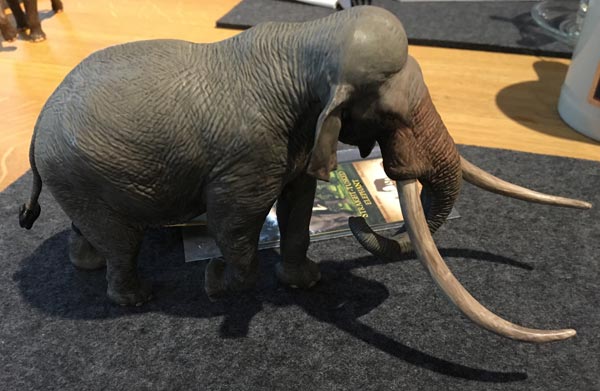
A Model of a Straight-tusked Elephant (Palaeoloxodon antiquus)

Eofauna Scientific Research Straight-tusked elephant.

Straight-tusked elephant (Palaeoloxodon antiquus) model.  Picture credit: Everything Dinosaur.

The picture (above) shows a Straight-tusked elephant from the Eofauna Scientific Research range.

To view this range of scale prehistoric animal figures: Eofauna Scientific Research Models.

An Ability to Hunt Large Mammals

An ability to hunt large mammals, and in particular elephants, as suggested by the Ebbsfleet find, would go some way to explaining how these people then managed to push northwards again into what is now Britain.  The flint artefacts of these pioneer settlers are of a characteristic type known as Clactonian, mostly comprising simple razor-sharp flakes that would have been ideal for cutting meat, sometimes with notches on them that would have helped cut through the tougher animal hide.

The discovery of this previously undisturbed elephant grave site is unique in Britain, where only a handful of other elephant skeletons have been found and none of which have produced similar evidence of human exploitation.  The Ebbsfleet location is just a few miles from the West Sussex gravel beds where further evidence of H. heidelbergensis hunters have been found (Boxgrove).

Ancient Ebbsfleet

Dr Wenban-Smith explains the Ebbsfleet area would have been very different from today:

“Rich fossilised remains surrounding the elephant skeleton, including pollen, snails and a wide variety of vertebrates, provide a remarkable record of the climate and environment the early humans inhabited.  Analysis of these deposits show they lived at a time of peak interglacial warmth, when the Ebbsfleet Valley was a lush, densely wooded tributary of the Thames, containing a quiet, almost stagnant swamp.”

The layer of earth containing the elephant remains and flints is overlain by a higher level of sediment, rich in so-called Acheulian tool types, hand axes of various forms from later in the same interglacial.  Controversy surrounds whether or not these represent a later wave of colonisation of Britain, or whether the Clactonians themselves evolved a more sophisticated tool-kit as they developed a more sustained occupation.

To read an article on the discovery of a baby Woolly Mammoth carcase in Siberia that shows signs of being butchered by humans (H. sapiens): Baby Mammoth Killed by Lions and then Butchered by Humans.

Everything Dinosaur acknowledges the contribution of the University of Southampton in the compilation of this article.

22 09, 2013

Silurian Placoderm from China – a “Jaw-Dropping” Fossil Discovery

By |2023-02-24T07:58:23+00:00September 22nd, 2013|Categories: Dinosaur and Prehistoric Animal News Stories, Palaeontological articles|0 Comments

Say Hello to “Fish Face” Entelognathus primordialis – Crucial New Evidence into the Evolution of Jawed Vertebrates

The evolution of jaws was perhaps one of the most significant events in the history of the vertebrates (and this group includes us by the way).  Jaws permitted vertebrates to eat bigger items, more diverse types of food, develop different feeding styles and in the case of fish, to push more oxygen bearing water through the expanded mouth cavity, a substantial aid to respiration.  It can be argued that the development of a complex jaw gave the gnathostomes (jawed vertebrates) the edge over the invertebrates, perhaps most notably the arthropods and the Mollusca as these groups battled it out for the position of apex predators in the Palaeozoic seas.

The Evolution of Jaws

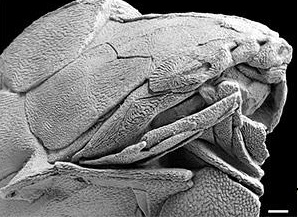
The discovery of cranial elements from an armoured fish at a quarry near to Xiaoxiang Reservoir, Yunnan Province, China, dated to approximately 419 million years ago is shedding new light on the evolution of jaws.  This fossil shows the earliest evidence discovered to date of jaws and facial bones seen in gnathostomes.  Other bones are more primitive, typical of a placoderm (armoured fish).  This sets up the intriguing hypothesis that the face was the first modern skeletal feature to evolve.

The fish, which swam in shallow seas during the Silurian, has been named Entelognathus primordialis, the name means “primordial complete jaw”.

The beautifully preserved fossil skull shows details of the individual bones that make up the skull and jaws, its discovery is extremely significant as the placoderm group is believed to have given rise to the two major classes of extant fish, the cartilaginous fish such as sharks and rays which are known as Chondrichthyes and the bony fish, the Osteichthyes, which encompasses fish with bony skeletons and all other vertebrates that bear limbs with distinct digits, that’s amphibians, reptiles, mammals, birds and of course us.  E. primordialis has dermal marginal jaw bones (premaxilla, maxilla and a dentary) and as such it is the first stem gnathostome to show such anatomical features.

Placoderms (Placodermi)

Placoderms (the name means plated skins) were primitive jawed fish.  They are named after the broad, flat, bony plates that covered their heads and the front parts of their bodies.  Although during the Silurian and up to the Middle Devonian this group was extremely diverse, this type of fish becomes increasingly rare in the fossil record from then onwards and it is believed that placoderms became extinct at the end of the Devonian around 360 million years ago. Features such as the braincase of E. primordialis indicate a strong affinity with the placoderms but, the pattern of the bones in the jaws is almost identical to that seen in fish of the class Osteichthyes and their descendants, terrestrial animals with backbones.

Silurian Placoderm

Member of the research team, Xiaobo Yu (Kean University in Union, New Jersey) commented:

“This is a unique pattern, that is found only in bony fishes.  As such, finding the pattern in what otherwise looks like a placoderm is a real surprise.”

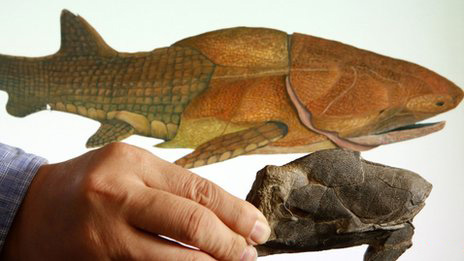
 The Holotype Fossil Material with an Artist’s Impression of E. primordialis in the Background

"Hello Funny Face".

“Hello Funny Face”.

Picture Credit: Reuters

Dermal Armour

The dermal armour at the front of placoderm bodies bears little resemblance to the skeletons of extant vertebrates.  Scientists had thought that the descendants of the placoderms lost their dermal bones entirely with two main classes of fish evolving, the Chondrichthyes such as the sharks and the Osteichthyes.  The sharks and rays continued to evolve without bony skeletons, these fish have skeletons supported by cartilage.  The Osteichthyes class re-evolved the bony skeleton, a successful body plan of all bony fish and their descendants the tetrapods (amphibians, reptiles, birds and mammals).

This new fossil find, is something of a smack in the mouth for the “second evolution” of the bony skeleton theory.  The dermal plates of the placoderm may survive today in the jaws of gnathostomes, and that includes human beings as well.  Placoderms may not have lost their dermal armour, it simply evolved into elements of the modern bony skeleton such as the upper and lower jaws.  The face may have been the fist element of a modern gnathostome skeleton to evolve.

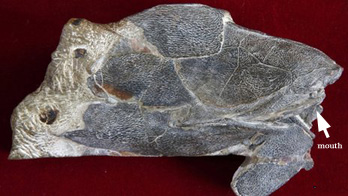
A Close up of the Fossil Material

Something to get your teeth into the evolution of facial features.

Something to get your teeth into the evolution of facial features.

Picture credit: Reuters with the mouth highlighted by Everything Dinosaur

Previously, the common perception had been that the sharks and rays with their skeletons made of cartilage were more primitive than the bony fishes.  Their lack of a bony skeleton rather suggests that the Chondrichthyes arguably, have evolved further from the ancestral form than the bony fishes have.  It may not be a case of having a cartilaginous skeleton being a primitive trait, this new discovery suggests that in terms of a support structure for their bodies, sharks and rays may be more different from basal forms than the bony fishes.  Sharks and rays have evolved further from the ancestral, basal body structure.

A Computer Generated Image of the Fossil Material Revealing Skeletal Features

"Fossilised Face"

“Fossilised Face”

Picture credit: Nature

A spokesperson from Everything Dinosaur stated:

“This intriguing find, one of a number of Silurian fossil fishes that have been discovered in rocks making up the Kuanti Formation (Late Ludlow) Formation, might lead to a revision in the taxonomic relationships between basal members of the modern, vertebrate groups.”

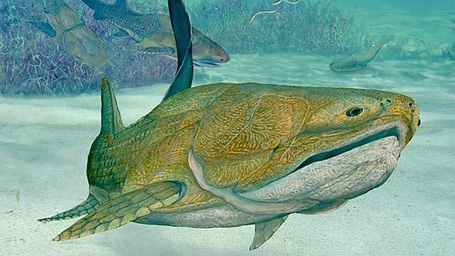
Life in the Silurian Seas – Entelognathus primordialis

The first "Jaws"?

The first “Jaws”?

Picture credit: Brian Choo

E. primordialis

The illustration above shows a life restoration of E. primordialis swimming in a warm, tropical sea that was to form the province of Yunnan (western China).  Scientists believe that this fossil discovery re-writes the history of the evolution of jaw bones, including our own.

The scientific paper: “A Silurian placoderm with osteichthyan-like marginal jaw bones” by Min Zhu, Xiaobo Yu, Per Erik Ahlberg, Brian Choo, Jing Lu, Tuo Qiao, Qingming Qu, Wenjin Zhao, Liantao Jia, Henning Blom and You’an Zhu published in the journal Nature.

4 09, 2013

Oldest Known Terrestrial Animal from Gondwanaland – A Sting in the Tail

By |2023-02-22T13:38:14+00:00September 4th, 2013|Categories: Dinosaur and Prehistoric Animal News Stories, Geology, Palaeontological articles|0 Comments

A tourist to the south eastern tip of what was to become the continent of Africa 350 million years ago would have had to watch where they were treading as scorpions were lurking amongst the primitive plants.  We know this because Dr Robert Gess from the Evolutionary Studies Institute at the University of Witswatersrand (Johannesburg), has discovered the fossilised exoskeleton of one such creature.  This unique specimen, a new species named Gondwanascorpio emzantsiensis represents the oldest known terrestrial animal from the super-continent of Gondwana discovered to date.

Gondwanascorpio emzantsiensis

Fossils of terrestrial animals are known from the super-continent of Laurasia, but this is a first for the ancient landmass that dominated the Southern Hemisphere during the Late Devonian and into the Carboniferous.

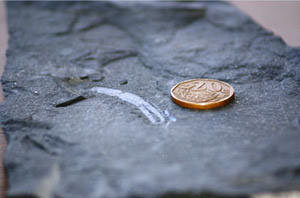
A Photograph showing the Scorpion’s Pincers (Gondwanascorpio emzantsiensis)

Coin provides scale
Coin provides scale.

Picture credit: University of Witwatersrand

Oldest Known Terrestrial Animal

Commenting on his fossil find, Dr Gess stated that early life arose in the sea and that colonisation of the land took place much later on in the history of life on Earth.  This process is believed to have begun back in the Silurian geological period, approximately 420 million years ago, although some palaeobotanists have suggested that microscopic spores preserved in Ordovician strata indicate that plant life was established on land even earlier.

Once plants had become established on land in significant numbers, then detritus and plant eating invertebrates followed, animals such as primitive arthropods.  By the Late Silurian, around 415 million years ago, terrestrial food chains were much more complex with apex predators such as mites, scorpions and early spiders feeding on the herbivorous invertebrates.  By the Late Devonian, some 365 million years ago, the first vertebrates (tetrapods) had ventured out onto land.

The First Tetrapods

Some palaeontologists believe that the first vertebrates were established on land some 390 million years ago, click the link below to read an article published by Everything Dinosaur in 2010, that provides details of a remarkable fossilised trackway studied by Polish scientists: Tetrapods Venture onto Land Thirty-Five Million Years Earlier.

Fossils found in Palaeozoic strata that represent the land mass of Laurasia, a super-continent the straddled much of the northern hemisphere in the Devonian, suggest that this landmass was inhabited by a diverse and abundant group of invertebrates.  Laurasia and Gondwana were separated by an ocean over a thousand miles across at its widest extent.

Evidence of the earliest colonisation of land animals has until now come only from the Northern Hemisphere continent of Laurasia (land that was to form North America, parts of Europe and Asia), and there has been no evidence that Gondwana was inhabited by land living invertebrate animals at that time, however, the discovery of this Southern Hemisphere scorpion suggests that Gondwana too, had its fair share of creepy crawlies.

An Invertebrate Predator on Land

The discovery of an invertebrate predator leads to the assumption that there were other invertebrates present that this creature would have fed upon.  This new species has been named Gondwanascorpio emzantsiensis.

Dr Gess stated:

“For the first time we know for certain that not just scorpions, but whatever they were preying on were already present in the Devonian.  We now know that by the end the Devonian period Gondwana also, like Laurasia, had a complex terrestrial ecosystem, comprising invertebrates and plants which had all the elements to sustain terrestrial vertebrate life that emerged around this time or slightly later.”

The Witpoort Formation

The fossil fragments were found in black carbonaceous shale which represents a marine lagoon and an estuarine environment.  The fossiliferous material is from the Witpoort Formation (Witteberg Group) at a location known as Waterloo Farm, near Grahamstown, South Africa.  Other organic material identified includes traces of algae, terrestrial plants, small fish, a sea scorpion (Eurypterid) and a number of molluscs.  All the fossil material ascribed to G. emzantsiensis consists of two-dimensional compressions in which all the original organic material has been replaced by secondary metamorphic mica.  The mica has largely been altered to chlorite during the uplifting of the strata.  The Witpoort Formation strata at the Waterloo Farm location were laid down towards the end of the Devonian (Famennian faunal stage), approximately 360 million years ago.

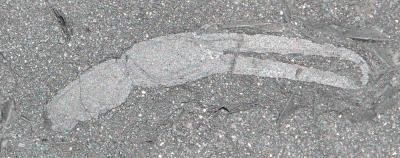
A Close up of the Preserved Pincers

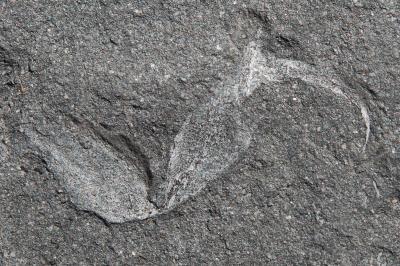
The fossil shows a pincer of the terrestrial scorpion.
The fossil shows a pincer of the terrestrial scorpion. Picture credit: University of Witwatersrand.

Picture credit: University of Witwatersrand

The Discovery of a Palaeozoic Scorpion

The fossil material represents the first discovery of a Palaeozoic scorpion from Gondwana.  In the scientific paper, published in the academic journal “African Invertebrate”, the researchers note that this fossil find is extremely unusual as it comes from rocks deposited at a far higher latitude (much closer to the South Pole), than that at which extant or fossil scorpions are known to have occurred.  The authors suggest that this discovery may suggest that the climate in the southern hemisphere during the Late Devonian was much more uniform than it is today.  Temperatures at high latitudes may have been much higher than they are today.

Gondwanascorpio emzantsiensis Possessed a Powerful Sting

Gondwanascorpio sting
Scorpion had a powerful sting. Picture credit: University of Witwatersrand.

Picture credit: University of Witwatersrand

Devonian Ecosystems

The scientists report that the presence of this scorpion from Gondwana, one that is similar to already described Laurasian taxa is consistent with the growing body of evidence that suggests globally comparable terrestrial ecosystems by the end of the Devonian.  Gondwanascorpio, as the oldest terrestrial animal from Gondwana and its fossil material along with progymnosperm plant material (Archaeopteris) that has also been described from fossils found at Waterloo Farm, suggests that marine marginal ecosystems may have been very similar across the world during the Late Devonian.  It has been speculated that this uniformity may have been a consequence of the increasing proximity of Laurasia to Gondwana as the deep ocean that once separated these super-continents began to close up.

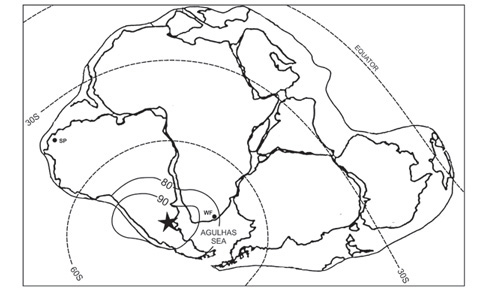
The Location of the Waterloo Farm Site Mapped onto a Late Devonian Map of Gondwana

Waterloo Farm site (South Africa)
Map showing the location of the Waterloo fossil site. Picture credit: University of Witwatersrand.

Picture credit: University of Witwatersrand

The map above shows a reconstruction of the super-continent of Gondwana with the South Pole represented by a large black star.  The Waterloo Farm location is marked by the symbol “WF”.  The map shows the position of landmasses towards the end of the Devonian/early Carboniferous.  The Waterloo Farm deposits are coastal and close to the South Pole.

Everything Dinosaur acknowledges the assistance of a media release from the University of Witwatersrand in the compilation of this article.

For models and replicas of Palaeozoic creatures: CollectA Prehistoric Life Replicas.

13 08, 2013

Neanderthals Made the First Specialised Bone Tools In Europe

By |2023-02-21T16:58:18+00:00August 13th, 2013|Categories: Dinosaur and Prehistoric Animal News Stories, Geology, Palaeontological articles|0 Comments

Neanderthals Shaped Animal Bones So That They Could Work Leather

For many thousands of years, modern humans (Homo sapiens) and Neanderthals (Homo neanderthalensis) lived in western Europe, it is not known how much interaction there was between these two species of hominids.  Neanderthals, far from being the slow-witted, ape-men of Victorian literature were very well adapted to living in cold climates, skilled tool makers and very capable hunters. In Neanderthal fossil sites dated to near the time when this species became extinct, a few thousand years after the arrival of modern humans in western Europe, tools and other objects have been found that are very similar to those found in contemporaneous fossil sites of modern humans.

Neanderthals

Neanderthals show behaviours similar to those associated with modern humans and have similar fine tools, such as small stone blades and bone implements.

Evidence of Neanderthals Being Skilled Leather Workers

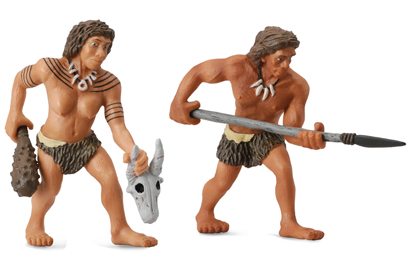
CollectA Neanderthal Models.

Human and Neanderthal genetic research. Evidence suggests that Neanderthals were skilled leather workers and therefore able to make clothes.

The picture (above) shows two CollectA Neanderthal models, to view these replicas (whilst stocks last): CollectA Prehistoric Life Figures.

Sophisticated Behaviours

It had been thought that much of these sophisticated behaviours inferred from artefacts found at Neanderthal fossil sites, had been developed as a result of contact between Neanderthals and our own species.  Modern humans arrived in western Europe around 40,000 years ago and it is after this date that such sophisticated tools turn up in Neanderthal dig sites.

In a new study, published in the academic journal the Proceedings of the National Academy of Sciences (USA), a team of researchers report the discovery of specialised bone tools previously only associated with Homo sapiens that date from a Neanderthal site that is at least 50,000 years old  – before (so it is thought),  the arrival of modern man in western Europe.  This suggests that Neanderthals did not learn sophisticated tool making skills from us, they may have developed such technologies themselves.

Tools Made from Animal Bones

Co-author of the study, Zenobia Jacobs of the University of Wollongong (New South Wales, Australia) stated that the tools were polishing tools made from animal bones.  These “lissoir” tools were used to work the hides of animals and the Neanderthal bone tools predate similar discoveries made in western Europe by about 10,000 years.

The tools were found in south-western France and the University of Wollongong has been engaged in a major project to assess Neanderthal and early human European cultures.  This new study, forms just part of the University’s research.

This discovery implies that the two hominid species either learned how to work animal skins separately, or modern humans may have picked up the skills required from the Neanderthals.  Dr. Jacobs suggests that it may have been the later, with modern humans learning from Neanderthals.

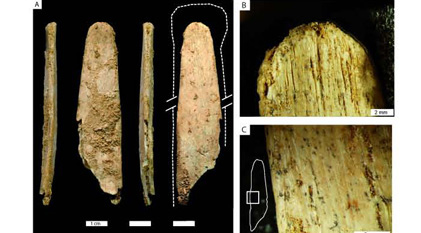
The Bone Tools Discovered at the Site in South-western France

Bone tools shaped by Neanderthals for working animal skins.

Bone tools shaped by Neanderthals for working animal skins.

Picture credit: Proceedings of the National Academy of Sciences

Picture A shows a bone tool, the dotted line shows the original shape of the bone before it was sculpted and shaped into a tool for use in leather work.  The close up images of the bones show evidence of wear as seen in modern lissoir tools used today in the fashion industry.

Used to Prepare Animal Hides

Dr Jacobs said the tools were used to smooth and burnish deer hides and make them water resistant.  They were identically shaped to plastic lissoir tools used today by top fashion houses.  The specialised bone tools  have microscopic wear patterns preserved on them, the wear is consistent with the use of lissoir in modern times to obtain supple, lustrous, and more impermeable hides.

The discovery contradicts theories that Neanderthals were “cognitively challenged dead-ends” who had been supplanted by Homo sapiens because they were stupid, Dr Jacobs said.  Neanderthals have also been found to have had the genetic and anatomical features necessary for speech.

Dr Jacobs added:

“I don’t think they were stupid at all.  They were probably quite capable of inventing all sorts of things that modern humans would like to claim as their own.”

Smart Neanderthals

Dr Jacobs commented that  it had long been believed that humans began behaving in a modern fashion, characterised by the use of symbols, when they reached Europe.

“Now it’s generally accepted that we probably had those abilities over the last 100 to 150 thousand years,” the doctor stated.

While it is not clear why Homo sapiens displaced the Neanderthals, Dr Jacobs said there had been plenty of interbreeding and most people now had between 2.5 per cent and 4 per cent of Neanderthal DNA in their genes.

She quipped:

“Maybe those leather workers are the ones with more Neanderthal genes.”

As these finds clearly predate the oldest known age for the use of similar objects in Europe by anatomically modern humans, they could also be evidence for cultural diffusion from Neanderthals to modern humans.

29 07, 2013

New Study Shows Dinosaur Brains Pre-programmed for Flight

By |2024-04-29T14:49:24+01:00July 29th, 2013|Categories: Dinosaur and Prehistoric Animal News Stories, Palaeontological articles|0 Comments

Dinosaur “Bird Brains” – Enlarged Brains in the Dinosauria Aided the Evolution of Powered Flight

New research published in the academic journal “Nature” provides evidence that some types of dinosaur developed the brain power required to manage the complex co-ordinated movements that are necessary for powered flight.  It seems that, according to this new study, some dinosaurs were “bird- brained”.

Dinosaur Brains

The term “bird-brained” can be used in a derogatory sense, however, the brains of birds can be quite large in proportion to their body size, previous research has shown that parts of the brains of birds are highly developed, even when compared to mammals.  After all, it takes great skill and co-ordination to achieve the balance and control required for powered flight.  It seems that members of the Dinosauria evolved “bird-brains” long before their descendants actually took to the skies as true birds.

Avian and Non-Avian Dinosaur Brain Study

Research suggests some dinosaurs were "bird brains".

Research suggests some dinosaurs were “bird brains”.

Picture credit: AMNH/M. Ellison

Intelligent Birds

Some extant birds are remarkably intelligent, the humble pigeon can demonstrate amazing feats of memory as they navigate, parrots and members of the starling family (Sturnidae) such as the famous Mynah bird are wonderful mimics. In 2009, Everything Dinosaur team members reported on a study involving members of the crow family (Corvidae) which demonstrated the problem solving abilities of some birds.

To read more about the clever crows: Birds show how clever their “bird-brains” are.

Lead author Amy Balanoff, a research associate at the American Museum of Natural History (New York) and a post-doctoral researcher at Stony Brook University, along with her colleagues has shown that a number of non-avian dinosaurs had brains that were at least as big (in proportion to body size), as that of Archaeopteryx lithographica.  This suggests that at a few of the members of the Dinosauria possessed the neurological hard-wiring essential for flight.

Computer Model Showing the Endocast of Archaeopteryx (A. lithographica)

The brain cast of Archaeopteryx lithographica, one of the earliest known birds, partitioned into neuroanatomical regions: brain stem (yellow), cerebellum (blue), optic lobes (red), cerebrum (green), and olfactory bulbs (orange)

The brain cast of Archaeopteryx lithographica, one of the earliest known birds, partitioned into neuroanatomical regions: brain stem (yellow), cerebellum (blue), optic lobes (red), cerebrum (green), and olfactory bulbs (orange).

Picture credit: AMNH/Dr. Balanoff

Amy commented:

“Archaeopteryx has always been set up as a uniquely transitional species between feathered dinosaurs and modern birds, a half-way point.”

Examining Archaeopteryx

Recent studies, have suggested that the likes of Archaeopteryx may not be the first bird after all, its position as a transitional fossil has also been brought into question.  In the light of this new research, it seems that the brain of the Late Jurassic Archaeopteryx may not have been unique.

Amy went onto add:

“By studying the cranial volume of closely related dinosaurs, we have learned that Archaeopteryx might not have been that special.”

Archaeopteryx must be one of the most intensively studied vertebrates in the whole of the fossil record.  Back in 2009, a team of scientists based at the Natural History Museum (London) analysed Archaeopteryx fossil material in a bid to understand more about the brain function and sensory abilities of this crow-sized, feathered creature.  The research team concluded that Archaeopteryx could hear as well as an extant Emu.

To read an article on this research: Examination of the Senses of Archaeopteryx.

Comparing Birds to Reptiles

When compared to extant reptiles, for their body size, birds generally have larger brains.  This “hyperinflation” is most obvious in the forebrain, an area of the brain dedicated to processing data from the optic nerve (eyesight) and co-ordinating body movement.  These anatomical and neurological features, once thought as exclusive amongst Aves (birds), may also be present in the Dinosauria.

The Model of a Woodpecker’s Brain with Endocast Partitioned to Show Neuroanatomical Positions

A modern woodpecker (Melanerpes aurifrons) with its brain cast rendered opaque and the skull transparent. The endocast is partitioned into the following neuroanatomical regions: brain stem (yellow), cerebellum (blue), optic lobes (red), cerebrum (green), and olfactory bulbs (orange).

A modern woodpecker (Melanerpes aurifrons) with its brain cast rendered opaque and the skull transparent. The endocast is partitioned into the following neuroanatomical regions: brain stem (yellow), cerebellum (blue), optic lobes (red), cerebrum (green), and olfactory bulbs (orange).

Picture credit: AMNH/Dr. Balanoff

Computerised Tomography

The scientists used high-powered computerised tomography scans (CT scans) to piece together the braincases of more than two dozen specimens, modern birds such as woodpeckers, the ancient Archaeopteryx and closely related non-avian dinosaurs such as tyrannosaurs and oviraptorids.  The three-dimensional images that were created allowed the research teams to identify specific portions of the brain such as forebrain as well as permitting a calculation regarding overall cranial capacity.  Major regions of the brain such as the olfactory bulbs, cerebrum, cerebellum, brain stem and optic lobes could be identified.

Reflecting on this study, co-author Gabriel Bever (Assistant Professor of Anatomy at the New York Institute of Technology), said:

“The story of brain size is more than its relationship to body size.  If we also consider how the different regions of the brain changed relative to each other, we can gain an insight into what factors drove brain evolution as well as what developmental mechanisms facilitated those changes.”

Studying Brain Volume

When compared to the members of the tyrannosaur family, or to oviraptorids, the research team discovered that in terms of brain volume, Archaeopteryx is not in a unique, transitional position between what are termed non-avian dinosaurs and extant birds.  Several other non-avian dinosaurs examined, including oviraptorids and troodontids, actually had larger brains relative to body size when compared to A. lithographica.

A spokesperson from Everything Dinosaur, stated:

“Relatively large and well developed brains in certain families within the Dinosauria are not that surprising when you consider some of the niches that these reptiles may have occupied.  The dinosaurs included in this study were probably very active, possibly living in packs or family groups with attendant complex behaviours.  They were active, agile hunters and as many were very probably feathered, it is also likely they performed complicated movements as part of courtship or other types of visual displays.”

The Endocast of the Oviraptorid Citipati (C. osmolskae)

The transparent skull and opaque brain cast of Citipati osmolskae, an oviraptor dinosaur, is shown in this CT scan. The endocast is partitioned into the following neuroanatomical regions: brain stem (yellow), cerebellum (blue), optic lobes (red), cerebrum (green), and olfactory bulbs (orange).

The transparent skull and opaque brain cast of Citipati osmolskae, an oviraptor dinosaur, is shown in this CT scan. The endocast is partitioned into the following neuroanatomical regions: brain stem (yellow), cerebellum (blue), optic lobes (red), cerebrum (green), and olfactory bulbs (orange).

Picture credit: AMNH/Dr. Balanoff

In conclusion, Dr Balanoff stated:

“If  Archaeopteryx had a flight-ready brain, which is almost certainly the case given its morphology, then, so did at least some of the non-avian dinosaurs.”

Oviraptorids Included in the Study

Note the Tail Plume

Note the tail plume.

Picture credit: Everything Dinosaur

The research team also examined another factor which is vital to powered flight in modern birds, a neurological structure referred to as the wulst, which has an important role in data processing and motor control.  In the scans of the Archaeopteryx cranial region, the scientists discovered an indentation that might be homologous to the wulst seen in the brains of extant birds.  No evidence of this indentation could be found in the brains of the dinosaurs that were involved in this study, even though proportionately, these dinosaurs had bigger brains than Archaeopteryx.

The evolution and development of the wulst is an area  of research which the American based team are keen to explore.

Everything Dinosaur is grateful to the American Museum of Natural History for information used in the compiling of this article.

Go to Top