All about dinosaurs, fossils and prehistoric animals by Everything Dinosaur team members.

Articles, features and information which have slightly more scientific content with an emphasis on palaeontology, such as updates on academic papers, published papers etc.

26 03, 2014

New Data on Mesozoic CO2 Levels Can Help Map Today’s Climate Change

By |2023-03-11T15:50:34+00:00March 26th, 2014|Categories: Dinosaur and Prehistoric Animal News Stories, Geology, Palaeontological articles|0 Comments

Mesozoic CO2 Levels Much Higher than Today

A new study published by University of Utrecht researchers and published in the “Proceedings of the National Academy of Sciences” suggest that for much of the Mesozoic, carbon dioxide levels in the Earth’s atmosphere were much higher than they are today, even with global warming caused by greenhouse gases such as higher levels of CO2.  Earlier studies had come to similar conclusions but this new research suggests that at the onset of the Triassic and into the Jurassic global CO2 levels could have been as much as five times their current levels.

Mesozoic

The new methodologies used to model the ancient CO2 levels could have implications for how climatologists plot changes in our environment as CO2 levels rise.

Scientists have known for some time that a large amount of volcanic activity results in more CO2 being released, but with previous analytical methods, it had been tricky to weigh up all the variables and to come up with an overall assessment of CO2 concentrations.

Lots of CO2 Around in the Mesozoic with the Dinosaurs

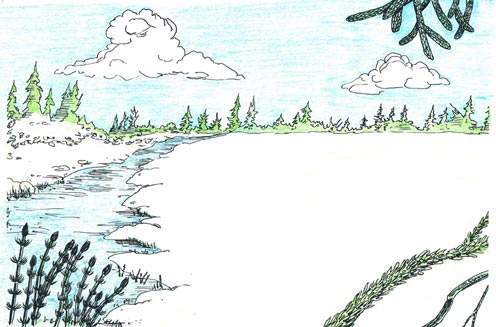
A warm and humid Earth back in the early Mesozoic.

A warm and humid Earth back in the early Mesozoic. Picture credit: Everything Dinosaur.

Picture credit: Everything Dinosaur

As the Mesozoic progressed so the super-continent of Pangaea began to break up into two smaller landmasses, essentially Laurasia in the Northern Hemisphere and Gondwana further south.   The huge amount of plate movements led to extensive subduction and a great deal of volcanic activity.  It was this volcanism that drove the release of CO2 into the Earth’s atmosphere, thus leading to a “greenhouse” world which was warm and humid and the dinosaurs thrived in.

CO2 Levels in the Atmosphere

Lead author of this new study, geoscientist Douwe van der Meer, (Utrecht University), explained that previous research had led to widely varying amounts of CO2 in the atmosphere, making such work of limited use when trying to model current climate change.

The Utrecht University research team used a state-of-the-art imaging technique called seismic tomography to reconstruct 250 million years of volcanic CO2 emissions.  Seismic waves were analysed as they travelled through the rock layers that make up the Earth’s crust, this gave the team the opportunity to create a model of the structure of the Earth’s interior.

For dinosaur models, clothing and toys: Visit Everything Dinosaur.

Lead author, van der Meer stated:

“This method is comparable to CT scans used in hospitals to image inside bodies.  With sufficient earthquake wave travel times, we can create a velocity model of the Earth.  Faster regions are more dense, colder material plates that sank into the Earth as a result of subduction processes due to plate tectonics.”

Carbon dioxide is not the only greenhouse gas.  Herbivorous dinosaurs may have played an indirect role in global warming by producing a lot of methane as they digested large amounts of plant matter.

To read an article about the role of sauropod dinosaurs in global warming: The Winds of Change – Methane Produced by Dinosaurs May Have Led to Global Warming.

25 03, 2014

Nanuqsaurus hoglundi – An update on “Polar Bear Lizard”

By |2023-03-11T15:47:47+00:00March 25th, 2014|Categories: Dinosaur and Prehistoric Animal News Stories, Dinosaur Fans, Palaeontological articles|2 Comments

Nanuqsaurus hoglundi – Tyrannosaur from the High Arctic

Earlier this month, an academic paper was published on a newly discovered tyrannosaur which once roamed the very far north of an ancient Cretaceous strip of land called Laramidia.  This new dinosaur might only be known from a few fragmentary fossils, fossils which were overlooked at the time they were first found back in 2006, but it is believed that this member of the tyrannosaurine may have been very closely related to T. rex.

Nanuqsaurus hoglundi

Named Nanuqsaurus hoglundi the fossils of this predatory dinosaur were found in a well-known horned dinosaur excavation site more than five hundred kilometres inside the Arctic Circle.  The site is called Kikak-Tegoseak and it represents Upper Cretaceous deposits that form part of the extensive Prince Creek Formation in North Slope Borough, Alaska.  The fossil material consists of three disarticulated pieces of skull including elements from the front of the jaw.  These pieces were found in close proximity to each other and are believed to represent fragments from the same skeleton.

Comparison with Other Tyrannosaurs

Based on comparisons with better known tyrannosaurs, this dinosaur is believed to have been a “pygmy tyrannosaur”.  It bucks the trend seen in tyrannosaurids known from the Maastrichtian faunal stage of the Cretaceous, when if anything, the tyrannosaurs roaming North America at the very end of the Cretaceous period tended to be bigger than their forebears from the Campanian faunal stage.

The Fossil Material Discovered to Date – Nanuqsaurus hoglundi 

The fossil material.

The fossil material.

Picture credit: PLOS One

Diagram A indicates where on the tyrannosaur skull the three pieces of fossil would be located.  The actual shape of the skull is based on more complete specimens.  The research team led by Dr Anthony Fiorillo and Dr Ronald Tykoski of the Perot Museum of Nature and Science in Dallas, Texas came across the fossils in 2006 when trying to locate more material related to a horned dinosaur, one that would turn out to be a new species of Pachyrhinosaurus (P. perotorum).

It was only later, back in the preparation laboratory that the scientists realised the importance of their discovery.

To read more about the discovery of the third species of pachyrhinosaur: New Species of Polar Horned Dinosaur is Announced.

The Tyrannosaur Family Tree

This latest edition to the tyrannosaur family tree, measured around six metres in length.  It was approximately half the size of its more illustrious cousin from the south, Tyrannosaurus rex.  The name Nanuqsaurus hoglundi  is derived from the local dialect for Polar Bear, a reference to the fact that as far as any one knows, this dinosaur was the apex predator in the environment.  The specific or trivial name honours Forrest Hoglund in recognition of his career in the Earth Sciences and his work to help fund the Perot Museum.

A team member from Everything Dinosaur commented:

“Although this part of the world was not as cold back in the Late Cretaceous as it is now, Nanuqsaurus lived in a high-latitude continental environment with seasonal extremes.  It may have been covered in a thick, coat of shaggy feathers, helping to insulate this dinosaur from the worst of the winter weather.”

The team member went onto state:

“For a significant amount of the year, the sun would not have risen above the horizon, its world would have been a very dark place, which explains why analysis of the skull material discovered to date suggests that this predator had a powerful sense of smell.  Helpful when you live in a world of almost perpetual twilight for much of the year.”

Everything Dinosaur’s Illustration of Nanuqsaurus hoglundi

Potentially a very, shaggy coated Tyrannosaur!

Potentially a very, shaggy coated tyrannosaur!

Picture credit: Everything Dinosaur

The academic paper’s authors have suggested the smaller body mass of Nanuqsaurus hoglundi compared to other Late Cretaceous tyrannosaurs may reflect an adaptation to the fluctuating amount of food resources available in its Arctic environment.  In the summer, when daylight was almost constant, it is likely that large numbers of herbivorous dinosaurs migrated northwards up Laramidia to take advantage of the huge amounts of plant food available.

For models and replicas of members of the Tyrannosauroidea: CollectA Age of Dinosaurs Popular Models.

As the days grew shorter, the carnivores had much slimmer pickings as many prey animals probably moved out of the area.  Of course, this is just speculation, this tyrannosaur may have migrated northwards from lower latitudes following the herds of herbivores.

The diversification of the Dinosauria in this part of the Americas at the end of the Cretaceous may stem from the partial isolation of the very northernmost parts of Laramidia with the pushing up of a mountain range (the Brooks Range), which may have cut-off part of the north of Laramidia during the Late Campanian faunal stage.

A Comparison of Nanuqsaurus hoglundi with other Tyrannosaurs

N. hoglundi compared to other Tyrannosaurs and predators from the Arctic.

N. hoglundi compared to other Tyrannosaurs and predators from the Arctic.

Picture credit: PLOS One

The diagram above compares N. hoglundi with T. rex (B – Sue from the Field Museum), a second Tyrannosaurus rex from the American Museum of Natural History (gracile form) – (C).  Other theropods depicted include Daspletosaurus torosus (D) and Albertosaurus sarcophagus (E).

The other two theropods featured in the diagram above are not tyrannosaurs.  The discovery of a “pygmy tyrannosaur” has intrigued a number of palaeontologists who are trying to build up a detailed picture of the fauna at the “top of the world” during the Late Cretaceous.  Back in 2008, Dr Fiorillo discovered some super-sized troodontid teeth from the Colville River area.  The Alaskan fossils represented animals that were 1.5 times bigger than the Troodons known from more southerly latitudes.  In the diagram, Troodon formosus is represented by (F), the much large Troodon species from Alaska is (G).

In the diagram the scale bar equals 1 metre.

Why should we have much larger Troodon type predators yet evidence of a “pygmy” tyrannosaur living in the same environment?  A number of theories have been proposed.  Perhaps the proportionately larger eyes of the troodontids enabled them them to hunt larger prey than their southern cousins which did not have the predatory advantage of all that darkness.

24 03, 2014

Man Charged over Dinosaur Footprint Theft In Utah

By |2023-03-11T15:41:43+00:00March 24th, 2014|Categories: Dinosaur and Prehistoric Animal News Stories, Main Page, Palaeontological articles|0 Comments

Man Charged with Stealing Fossilised Dinosaur Footprint

A grand jury has charged a resident of the town of Moab (Grand County, eastern Utah), with four federal offences related to the theft and subsequent loss of a fossilised dinosaur footprint from Bureau of Land Management administered land.  Thirty-five year old, Jared Frederick Ehlers has been indicted on one count each of removal of palaeontological resources, depredation of government property, destruction of evidence and theft of government property.

Dinosaur Footprint

The motive for the removal of the three-toed dinosaur footprint from a sandstone ridge near to the Hell’s Revenge off-road jeep trail and the alleged subsequent dumping of the fossil in the Colorado river remains unclear, however, given the high prices the sale of such fossil material can fetch on the black market, it is suspected that the fossil was stolen for commercial gain.

Staff have been monitoring the progress of the investigation closely since Everything Dinosaur team members carried the story of the fossil theft on this blog back on February 22nd.

To read about the fossil theft: Dinosaur Footprint Stolen in Utah.

Fossil Theft

Over the weekend of 8th/9th March, Utah State officials organised a dive team to search an area of the Colorado River as it was believed that the fossil specimen had been thrown into the water from the Dewey Bridge but despite an intense search the fossil was not retrieved.

Explaining how difficult it was to search the riverbed, Grand County Sheriff Steven White stated:

“You’re searching by Braille, everything is by hand.  You have zero visibility, you’re dealing with changing currents, you’re dealing with obstacles.  It was very hazardous diving conditions.”

The river search was instigated after a suspect came forward and informed State officials where the 190 million year old, Early Jurassic print had been allegedly dumped.  It remains unclear as to whether this person was Jared Ehlers.

Facing Prosecution

Ehlers is facing prosecution under the Paleontological Resources Preservation Act, (American spelling), a law that was passed by the United States Government to help prevent the theft of fossils from public land and to prosecute any person or persons who vandalises fossils.  Violators face civil and criminal penalties including fines and possible incarceration.

Moab Man Charged with Four Federal Offences Related to Fossil Footprint Theft

Jared Ehlers facing four federal charges over alleged fossil theft

Jared Ehlers facing four federal charges over alleged fossil theft.

Picture credit: Grand County Jail

A Maximum Prison Sentence of Twenty Years

The most serious count, that Elhers is facing, the destruction of evidence, carries a maximum prison sentence of twenty years.  The other three counts carry a maximum prison sentence of between five and ten years.  No date has been set yet for Mr Ehler’s first court appearance, if he is convicted on all four counts, he could face a maximum possible sentence of forty-five years in prison.

A spokes person from Everything Dinosaur commented:

“The federal authorities are to be congratulated for the swift and speedy way in which they have pursued this case.  However, the fossil specimen itself remains lost and as it is sandstone, it will quickly begin to erode and abrade if it remains in the river.  At this juncture, it is very hard to say whether or not the fossil will ever be recovered.  Even if the fossil is found, it may be virtually destroyed as a trace fossil.”

Visit Everything Dinosaur’s award-winning website: Dinosaur Toys, Models and Games.

22 03, 2014

Putting the “Chicken from Hell” into Context

By |2023-03-11T15:31:50+00:00March 22nd, 2014|Categories: Dinosaur and Prehistoric Animal News Stories, Palaeontological articles|0 Comments

Anzu wyliei – Probably Feathered and an Omnivore from the very end of the Cretaceous

With the publication of the scientific paper on the newest member of the very bird like Oviraptorosauria published this week in the on line journal PLoS One (Public Library of Science),  team members at Everything Dinosaur attempt to put the discovery of the “chicken from Hell” into context.  The dinosaur has been named Anzu wyliei and this genus has been erected based on the fossils of three individual dinosaurs discovered in Upper Cretaceous deposits of North and South Dakota (United States).

The fossil sites are around fifty kilometres apart and they represent a dinosaur, whose presence in the Hell Creek Formation (Maastrichtian faunal stage) had long been suspected but these fossils provide definitive proof that such creatures roamed the western United States at the end of the Cretaceous.

A Scale Drawing of Anzu wyliei

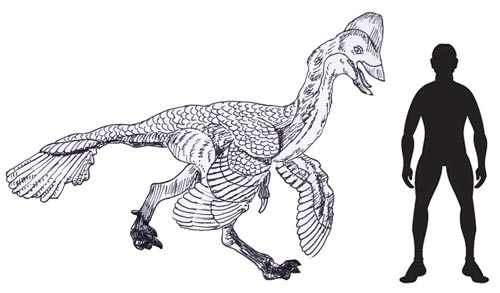
Anzu wyliei scale drawing.

A scale drawing of Anzu wyliei. Picture credit: Everything Dinosaur.

Picture credit: Everything Dinosaur

Oviraptorosaurs

Most discoveries of oviraptorosaurs have been made in Asia, most notably in China and Mongolia.  Much of what has been inferred about A. wyliei has been based on comparisons with Asian Oviraptors, even though the remains of the three individuals when combined together represent about 80% of the total skeleton.  For example, Anzu wyliei has been pictured as a feathered dinosaur, although no fossilised feathers have been associated with the Hell Creek Formation specimens.

The covering of a shaggy coat of feathers is inferred, as a result of Asian specimens preserved in finer grained matrices which have permitted feather preservation.  The discovery of skull material, including a hyper extended premaxilla indicates that this dinosaur had a large rounded crest on the top of its skull.  This feature is common to a number of Oviraptor genera.

An Illustration of Anzu wyliei

Scale bar = one metre

Scale bar = one metre.   A skeletal reconstruction of A. wyliei.

Picture credit: PLoS One/Everything Dinosaur

The picture above gives an overall impression of what this new dinosaur species looked like.  The post cranial bones coloured grey represent fossil specimens.  The skull material indicated represents the extent of the fossil material found to date.  The Oviraptorosauria can be split into a number of families, one such family is the Caenagnathidae (the name means “recent jaws” – as the group were originally thought to be a Cretaceous clade of birds). The jaws are very bird-like and these dinosaurs had no teeth.  Intriguingly, compared to other North American members of the Caenagnathidae such as Chirostenotes spp. known from older rocks found in Alberta, Canada (Campanian faunal stage), Anzu wyliei was a real bruiser!

Anzu wyliei

Body mass estimates based on femur (thigh bone) measurements suggest that this dinosaur weighed between 200 and 300 kilogrammes and that it probably stood around 1.5 metres high at the shoulder and had an overall length approaching 3.5 metres.  Some of the Canadian caenagnathines were probably only around 20 kilogrammes in weight when fully grown.

The Reconstructed Skull of Anzu wyliei

A reconstruction of the skull (left side view)

A reconstruction of the skull (left side view).

Picture credit: Donald E. Hurlbert (Smithsonian Institute)

 The American scientists from Utah University, the Smithsonian Institute and the Carnegie Museum of Natural History re-examined the fossil material that had been collected a few years earlier.  Their research helps palaeontologists to piece together a little more about the other types of dinosaur that shared the same environment with more famous dinosaurs like Triceratops and Tyrannosaurus rex.

Phylogenetic analysis suggests that this new species of dinosaur was most closely related to Caenagnathus collinsi (known from Campanian-aged strata from Alberta, Canada).  The fossils have also suggested that A. wyliei and other caenagnathines may have preferred open expanses such as floodplains, as to what they might have been eating way back at the end of the Cretaceous, these animals were probably generalist omnivores.

It is likely that the bulky Anzu wyliei fed on small mammals, insects, lizards, baby dinosaurs and plants.  It may even have specialised in eating the eggs of other dinosaurs.  Scientists have nick-named this dinosaur the “chicken from Hell” a reference to the Hell Creek Formation where the fossils were found.

An Illustration of a Typical Oviraptor

Part of the Carnegie Collectibles Range from Safari Ltd

A typical feathered Oviraptor.

A spokes person from Everything Dinosaur commented:

“This research is extremely important as it helps to fill in the gaps in terms of the smaller, theropods that lived at the very end of the Cretaceous.  These fossils represent some of the youngest Oviraptor fossils discovered to date.”

To view models and replicas including a model of Anzu wyliei (whilst stocks last): Safari Ltd Prehistoric Animal Figures.

10 03, 2014

Diving for a Rare Dinosaur Footprint

By |2024-05-02T10:12:27+01:00March 10th, 2014|Categories: Dinosaur and Prehistoric Animal News Stories, Geology, Palaeontological articles|0 Comments

State Officials Go Diving for a Stolen Dinosaur Footprint

Back on February 22nd, Everything Dinosaur reported on the shocking theft of a three-toed dinosaur footprint that had been stolen from an adventure trail called Hell’s Revenge close to the town of Moab in Grand County (eastern Utah).

The Bureau of Land Management, responsible for the management of the site had said in a statement that the theft of such objects was becoming all too commonplace and an appeal went out to help try to locate the missing theropod dinosaur footprint.

To read the article about the theft: Dinosaur Footprint Stolen in Utah.

We are pleased to say that there have been a number of developments in the case, which might lead to the footprint fossil being recovered.  Over the weekend, officials from the State, organised a dive team to explore an area of river bed downstream of the Dewey Bridge over the Colorado River.  Unfortunately, the divers were unable to locate the missing fossil.

Dinosaur Footprint

Their efforts were hampered by the very poor visibility and the fact that unfortunately, that part of the Colorado river has a very rocky riverbed.  It’s not the easiest of tasks groping around in near zero visibility looking for a rock amongst many hundreds of other rocks.

According to a statement from the Grand County Sheriff’s Office, investigators had identified a suspect but this person’s name was not being released for the moment.  The area of river bed immediately below and just downstream of Dewey Bridge on State Road 128 is being explored as this is where the print is believed to have been dumped.

The dinosaur track which measures around twenty-five centimetres in length is thought to have been stolen sometime around the 17th or 18th of February.  No explanation for the reason for the robbery has been given, but it is known that dinosaur fossils such as this single foot print may fetch very high prices on the black market.

A Reward Offered

The Bureau of Land Management offered a reward for information leading to the identification of the culprit or culprits, other parties such as a group of off-road enthusiasts that use the Hell’s Revenge trail also chipped in and the various rewards offered now total somewhere in the region of $9,000 USD (£5,400 GBP).

Commenting on the loss of the 190-million-year-old theropod footprint, Rebecca Hunt-Foster, a palaeontologist for the Bureau of Land Management stated that this specimen was one of the nicest tracks in the area and that the three-toed print was most probably made by a large, meat-eating dinosaur – a likely ancestor of the Utah State Dinosaur, the Allosaurus.

Locals are incensed about the loss of this fossil.  The area is known for its dinosaur tracks and many visitors to the area come up to the Hell’s Revenge trail to view the evidence of dinosaurs preserved in what is now sandstone, but was once a sandy shoreline next to an early Jurassic lake.

A Picture of the Fearsome Late Jurassic Predator Allosaurus (A. fragilis)

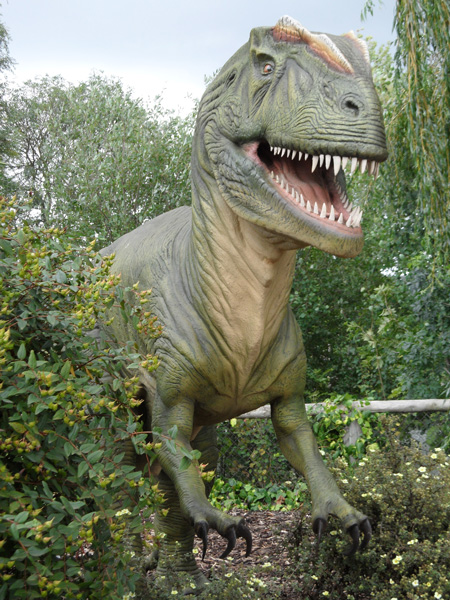
Allosaurus attacks
Allosaurus attacks.

Picture credit: Everything Dinosaur

Team members at Everything Dinosaur wish the Utah State authorities well in their search for the fossil and hopefully this rare and very important dinosaur fossil will be found soon.

Visit Everything Dinosaur’s award-winning website: Dinosaur Toys and Models.

6 03, 2014

Europe’s Largest Meat-Eating Dinosaur Described to Date

By |2023-03-11T11:50:15+00:00March 6th, 2014|Categories: Dinosaur and Prehistoric Animal News Stories, Dinosaur Fans, Palaeontological articles|2 Comments

Torvosaurus gurneyi – Monster Megalosaur from Portugal

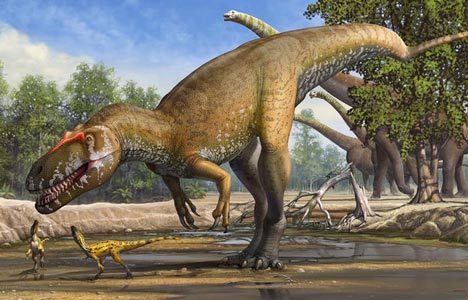
The scientific paper has just been published that permits a new species of Torvosaurus to be announced to the world.  Torvosaurus means “savage lizard” and joining Torvosaurus tanneri, a meat-eating dinosaur known from the famous Upper Jurassic Morrison Formation of the United States, is T. gurneyi from the Lourinhã Formation of central west Portugal.  Based on the size of the skull material and using other fragmentary fossils from the Lourinhã Formation that had been found previously, palaeontologists estimate that this dinosaur measured around ten metres in length and weighed between four and five tons.

Torvosaurus

Based on these dimensions, this dinosaur can lay claim to the title of being one of Europe’s largest meat-eating dinosaurs described to date.

“Savage Lizard” Torvosaurus gurneyi Apex Predator of the Late Jurassic of Europe

Top predator of Portugal from the Late Jurassic

Top predator of Portugal from the Late Jurassic.

Picture credit: Sergey Krasovskiy

Authors of the scientific paper, Professor Octávio Mateus and Christophe Hendrickx of the Museu da Lourinhã, (Lourinhã, Portugal), which has just been published on line in PLoS One, collated the known fossil material ascribed to Torvosaurus spp. found in Portugal and thanks to the discovery of part of a skull and jaws, they are able to distinguish this species from the Torvosaurus known from the United States.

Lourinhã Fossils

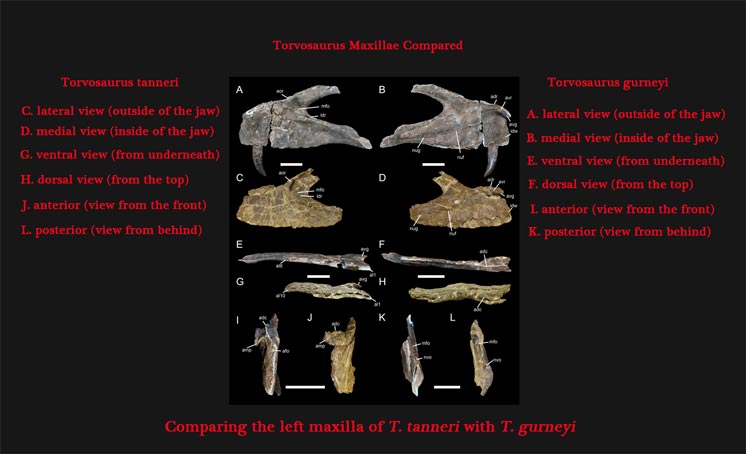
A study of the fossils from Lourinhã reveal a number of differences between them and the North American fossil material.  For example, the near complete left maxilla ( a bone from the upper jaw), was found in Portugal by the Dutch amateur fossil collector Aart Walen in 2006.  It was carefully prepared and it was the finding of this fossil that really gave the Portuguese scientists the opportunity to compare their material with the fossils of Torvosaurus tanneri.

The maxilla in large theropod dinosaurs can be very characteristic, it helps to determine affinities amongst meat-eating dinosaurs and, importantly in this case, can help palaeontologists identify a new species.  When the Portuguese maxilla was compared to the maxilla of a Torvosaurus tanneri the researchers were able to point out some subtle differences.  For example, the maxilla of the Portuguese specimen had fewer teeth (less than eleven), this and other anatomical differences permitted the team to create a distinct Portuguese species of Torvosaurus.

Comparing the Left Maxilla of T. gurneyi with T. tanneri

Torvosaurus jaw bones compared.

Torvosaurus jaw bones compared.

Picture credit: Journal PLoS One with additional notation by Everything Dinosaur

Torvosaurus tanneri

Although closely related to Torvosaurus tanneri, this new predator lived thousands of miles away on the eastern tip of the Eurasian and African landmass.  The species name honours the American artist and illustrator James Gurney who created the “Dinotopia” series of books all about a magical land where dinosaurs and people live together.  James Gurney was born in California and so from a geographical perspective he is much closer to the Torvosaurus known from the United States than from this new European dinosaur.

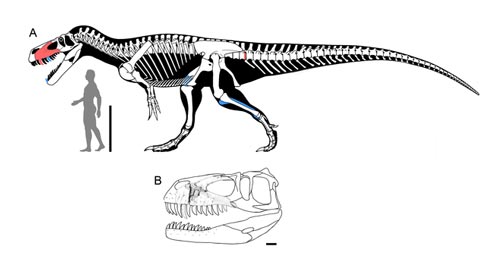
A Scale Drawing Giving the Approximate Size of T. gurneyi

A scale drawing of Torvosaurus

A scale drawing of Torvosaurus.

Picture credit: Journal PLoS One/Scott Hartman (A) with additional skull drawing by Simão Mateus (B)

The drawing above gives an approximate size estimate for this new species of carnivorous dinosaur.  The maxilla is shaded red in drawing (A) and the scale bar is approximately 1 metre.  The other parts of the skeletal drawing shaded blue refer to fragmentary fossil material found previously that has been assigned to Torvosaurus gurneyi.  The skull drawing (B) indicates the position of the holotype left maxilla (ML1100) in relation to the rest of the skull.  The scale bar represents 10 centimetres.  Torvosaurus gurneyi has been assigned to the megalosaur family.

Trackway

A trackway with individual prints measuring up to seventy-nine centimetres in length has been assigned to this new species.  Although it is very difficult to tie down the fossil print to a species, there is no other known Portuguese theropod of comparable size so these trace fossils have been attributed to T. gurneyi.  Dinosaur eggs and some fossilised embryos from the Sobral Member of the Lourinhã Formation have also been attributed to this new dinosaur species.

The fauna and flora of the Iberian area of Europe in the Late Jurassic was very similar to that found in the western United States, as epitomised by the Morrison Formation.  Both the Morrison Formation and the Lourinhã Formation sediments were laid down at approximately the same time, these strata cover the Late Oxfordian, the Kimmeridgian and the Early Tithonian faunal stages of the Late Jurassic.  However, during this period in Earth’s history the continents of North America and Europe were already separated by an intercontinental sea (the early Atlantic).

Professor Mateus and his colleagues put forward an hypothesis a few years ago now, that suggested that during the Early Oxfordian and the preceding faunal stage of the Late Jurassic, the Callovian, uplift of continental plates formed temporary land bridges between Europe and the Americas.  This allowed an exchange of terrestrial faunas between the United States and Iberia.  When these land bridges were lost as sea levels rose, these two, now separate ecosystems which shared common ancestors were left to evolve in isolation.

Footnote

At Everything Dinosaur we are aware of the hyperbole that has surrounded the publication of the scientific paper on Torvosaurus gurneyi. It is certainly an impressive dinosaur and we do not dispute the size estimates (extrapolated from inferred skull size and skull size to body ratio) along with assigned limb bones and such like.  The left maxilla (ML1100) shows enough characteristics to allow a new species to be created, but the title of “Europe’s largest meat-eating dinosaur described to date”, is easier to justify than some of the other headlines used in articles.

For example, we have come across the misleading headline “Europe’s biggest dinosaur”, this is simply not true, many herbivorous dinosaurs were much bigger than Torvosaurus spp. and there are a number of fragmentary remains of meat-eating dinosaurs that could challenge the claim made by other writers that T. gurneyi is Europe’s biggest meat-eating dinosaur.  For example, the specimen of Baryonyx walkeri from the Wealden Clay of south-east England was not fully grown when it died and it could have potentially rivalled Torvosaurus in size.

For models and replicas of European dinosaurs including Torvosaurus, whilst stocks last: CollectA Age of Dinosaurs Deluxe Models.

5 03, 2014

Unravelling the Sequence of Deposition in North-eastern China

By |2023-03-11T08:53:51+00:00March 5th, 2014|Categories: Dinosaur and Prehistoric Animal News Stories, Dinosaur Fans, Palaeontological articles|0 Comments

The Daohugou Biota – China 160 Million Years Ago

A team of international researchers based at the Chinese Academy of Sciences have identified a stratigraphic sequence of Middle Jurassic deposits thanks to fossils of a salamander.  The huge assemblage of vertebrate fossils and other material has provided scientists with an exquisite insight into an ecosystem that thrived in north-eastern China around 160 million years ago.  The series of highly fossiliferous sites are being linked into one large group of sedimentary material that can be put together in terms of their geological age thanks to the common range of fossils these different locations contain.

Sequence of Deposition

The locations (six in total scattered across the provinces of Hebei and Liaoning), are described as the Daohugou Biota.  They form part of the Tiaojishan Formation (or at least most of the locations seem to do so), but importantly, the strata has been recognised as being much older than the Jehol Biota.  The Jehol Biota is associated with Lower Cretaceous deposits (Barremian and Aptian stages of the Early Cretaceous), however, the Daohugou Biota is dated to around the Bathonian faunal stage of the Middle Jurassic.

The Jehol Biota

The Jehol Biota epitomised by the wonderfully well preserved fossil remains of Liaoning Province, is famous for its feathered primitive bird and feathered theropod dinosaur fossils representing an ecosystem that consisted of a series of large lakes, forests and nearby volcanoes.  Periodically, the volcanoes would erupt, bury large areas of the surrounding landscape with ash and devastate the fauna and flora.

The fine grain sediments that were deposited helped preserve fossils in amazing detail.  At first, all the fossils from this part of China were thought to be of Lower Cretaceous age, after all, such beautifully preserved fossils are exceptionally rare, but it now seems that prior to the environment which formed the Jehol Biota and fossil assemblage, there existed in the same location but around 30 million years earlier another ecosystem which has been preserved in equal detail thanks again to volcanic activity.

Identifying the Biota

Just like their Jehol Biota counterparts, the Daohugou theropod dinosaurs are feathered, with a lot of anatomical detail preserved thanks to the fine lacustrine (lake) beds in which the fossils are found.  Something like 142 different vertebrate species have been identified from the Jehol Biota, pterosaurs, feathered and non-feathered dinosaurs, amphibians, fish, lizards and of course primitive birds.  The authors of a new study, which confirm the Midddle Jurassic age of the Daohugou Beds have documented at least thirty different vertebrate taxa to date, including two lizards, a tadpole from a frog, five dinosaurs, four early mammals and thirteen pterosaurs.

No Birds Found

Intriguingly, no birds, however, this may not be so much of a surprise as birds may not have evolved at the time of deposition of the first fossil assemblage.  What is known for certain is that a number of the dinosaur species identified to date from the Daohugou Beds are very similar to birds, Anchiornis for example, was extremely bird-like.

To read an article on the discovery of Anchiornis: Older than Archaeopteryx – Dinosaurs on their Way to Becoming Birds.

At an estimated 160 million years old, the Daohugou Beds are older than all the major bird-bearing fossil strata known, no definitive bird fossil may have been identified to date, but that is not surprising as at the time of the separation of the Aves from the Dinosauria, the birds closest relatives those non-avian Theropods, are going to look very similar.  What can be inferred from the evidence is that the ecosystem preserved as the Daohugou Biota represents the closest known to that point in geological time when the birds and the Dinosauria effectively split.

The Daohugou Biota

The Daohugou Biota is named after a small Chinese village close by to one of these six fossil locations.  What the international team of researchers have done is to link these locations together to prove that they represent a sequence of strata that was laid down at roughly the same point in deep time.  Radiometric dating has identified the age of the strata, but it is the presence of a signature fossil that has enabled the scientists to correlate the age of the separated deposits based on the fossils they contain.  The presence of the fossilised remains of a salamander (Chunerpeton tianyiensis) links these six locations together.  This amphibian’s fossils have effectively become a zonal fossil tying these six deposits together.

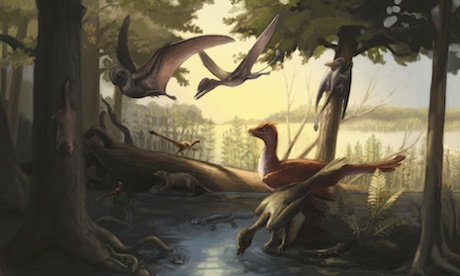
North-eastern China in the Middle Jurassic – Daohugou Biota

A rich and diverse Jurassic environment dominated by small mammals, Pterosaurs and feathered Theropods.

A rich and diverse Jurassic environment dominated by small mammals, pterosaurs and feathered theropods.

Picture credit: Julia Molnar

Biostratigraphy

The method of using the fossils of one or more species to identify the relative age of rock strata is called biostratigraphy.  C. tianyiensis has become a zonal fossil, a role more often than not played by invertebrates such as ammonites, graptolites and crinoids.

More importantly, although there are a number of families of vertebrates common to both the Daohugou Biota and the younger Jehol Biota, these two formations together represent an different ecosystems millions of years apart. The Daohugou Biota and the Jehol Biota are separate Lagerstätte assemblages that between them provide scientists with an unparalleled window into life in the Middle Jurassic and the Early Cretaceous of north-eastern China.

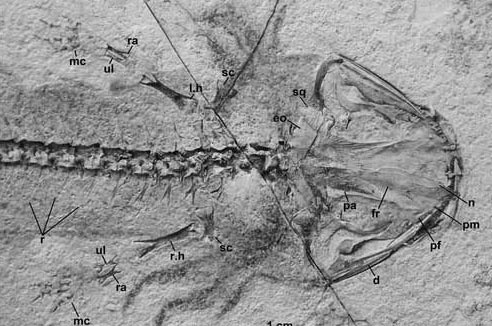
The Preserved Forequarters of a Specimen of C. tianyiensis (A Salamander)

Even the fine gills have been preserved.

Even the fine gills have been preserved.

Picture credit: Chinese Academy of Sciences/Journal of Vertebrate Palaeontology

Dating the Lioaning and Hebei Sediments

A spokes person from Everything Dinosaur commented:

“There has been confusion over the dating of the Lioaning and Hebei sediments, caused in part due to the large amount of fossil material that was made available to study which came from dubious sources such as local fossil collectors and dealers who rarely revealed exactly where the specimens came from, but now it seems that we have two “lost worlds” to study, one representing the Middle Jurassic and one representing younger sediments dating from the Cretaceous.  It is very likely that the Daohugou Beds will prove to be at least as biologically diverse as the fossil material that makes up the Jehol Biota, so we can expect to hear more announcements soon about further vertebrate discoveries.”

The Middle Jurassic deposits from these six Chinese locations have already provided fascinating glimpses into the weird and wonderful animals that lived in the forests and lakes that covered this part of the world 160 million years ago.  For instance, in 2008, Everything Dinosaur reported on the discovery of the bizarre fanged, feathered little dinosaur called Epidexipteryx.

Epidexipteryx

It has been suggested that this little dinosaur, which was no more than thirty centimetres in length, may have climbed trees.  For fans of the Pterosauria, the Daohugou Beds have provided a whole array of basal and derived forms of flying reptile such as the anurognathid pterosaur called Jeholopterus ningchenensis (note the confusing name from Jehol, although according to this new scientific paper, this pterosaur belongs to the Daohugou Biota and not the later Jehol Biota).

A number of rhamphorhynchid pterosaurs have been identified and sharing the same Jurassic skies was the recently discovered member of the Wukongopteridae pterosaur family called Darwinopterus modularis.

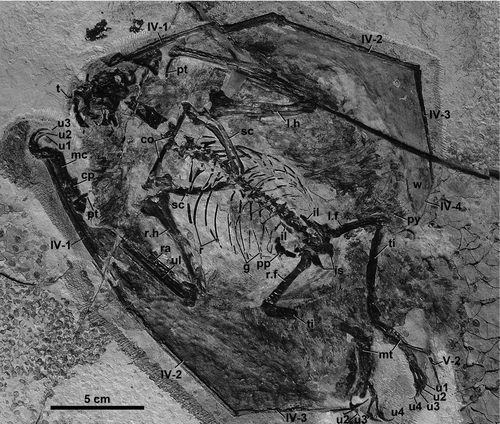
Composite Image of the Main Slab and Counter Slab of the Holotype Material of J. ningchenensis

Pterosaur material.

Pterosaur fossil material.

Picture credit: Chinese Academy of Sciences/Journal of Vertebrate Palaeontology

To read more about the discovery of the flying reptile called Darwinopterus: New Transitional Pterosaur Fossil Discovery from North-eastern China.

Shedding Light on the Evolution of Mammals

These sediments are also shedding light on the evolution of mammals and what bizarre forms there were in the Middle Jurassic.  Fossils of a tree climbing mammal with a membrane of skin stretched between its limbs have been found. It has been suggested that this creature, called Volaticotherium, occupied the same niche in the arboreal ecosystem as today’s flying squirrel from Asia.  Living alongside the abundant salamanders was the peculiar Castorocauda, a mammal adapted to an aquatic lifestyle with a broad, flattened tail to help it swim.

These creatures may seem strange to us, but we suspect that lurking in the finely-grained sediments of the Daohugou Beds even more bizarre vertebrates are awaiting discovery.

To view replicas and models of prehistoric animals from the Daohugou Biota: PNSO Age of Dinosaurs Models.

22 02, 2014

Dinosaur Footprint Stolen in Utah

By |2023-03-10T21:25:24+00:00February 22nd, 2014|Categories: Dinosaur and Prehistoric Animal News Stories, Palaeontological articles|0 Comments

Dinosaur Footprint Vanishes from a Site near Moab (eastern Utah)

Bureau of Land Management officials responsible for dinosaur tracks to be found on an adventure trail called Hell’s Revenge near Moab in Utah, have reported the theft of a three-toed, theropod footprint from the site.  The area is renowned for a number of dinosaur tracks and footprints that have been preserved in the 190-million-year-old sediments.

Dinosaur Footprint

At least three different types of dinosaur footprint have been identified by ichnologists (an ichnologist specialises in studying footprints and trackways), the prints were made by dinosaurs as they crossed damp sand and this location is one of just a handful known in the world where Early Jurassic trace fossils of dinosaurs have been discovered.

Three-toed Print

The three-toed print, which measures around twenty-five centimetres in length, was most probably made by a theropod dinosaur.  The Hell’s Revenge trail has about twenty different dinosaur tracks and footprints preserved, it seems that a person or persons unknown chiselled the print out of its surrounding sandstone, the fossil may have been stolen to order, ending up in the hands of a private collector or the fossil could have been pinched in the hope of making a lot of money as dinosaur fossils can sell for thousands of dollars.

Another possibility is that this footprint was stolen by a fossil collector with no intention to sell, merely to keep the specimen in their own collection.

Fossil Theft

Sadly, such thefts are all too common.  Bureau of Land Management staff have reported a number of fossil and other thefts from public land over the last few years.  In 2012, Everything Dinosaur reported the theft (and eventual recovery) of a set of dinosaur footprints that were removed from an exposure on the Bristol Channel.  In this case, the thief offered the fossils for sale on Ebay and also to a fossil dealer in Lyme Regis.

Thanks in part to the publicity generated by sites such as this blog, the fossils were recovered, but sadly they are now deemed to precious to be returned to their original location.  Instead, these fossil prints are stored in a secure location under lock and key.

To read more about this fossil theft: Dinosaur Footprints Stolen from the Vale of Glamorgan.

Commenting on the Utah theft, palaeontologist with the Bureau of Land Management Field Office in Moab, Rebecca Hunt-Foster said:

“They’re priceless to us, you can’t replace them.”

Visitors to the area, instead of seeing a pristine three-toed (tridactyl) dinosaur footprint, can now see an ugly triangular scar left in the sandstone where a section of rock containing the print was removed.

Such thefts are becoming more commonplace, a spokesperson from Everything Dinosaur stated that fossil thefts of this nature were probably fuelled by the high prices such specimens can fetch on the black market.  Bureau of Land  Management staff have found that a number archaeological artefacts as well as fossils are taken from public lands each year.  When it comes to dinosaur footprints, some visitors attempt to create their own casts using latex or silicon to make moulds, this can often damage the tracks and Everything Dinosaur team members would strongly discourage anyone from attempting to cast their own print.

In the light of the fossil theft, Bureau of Land Management staff have proposed putting up signs to inform visitors about the tracks and to warn them not to damage or deface them.

The United States has some of the strictest national laws to protect fossils and other ancient relics on public land, taking any such items from public land is an offence and offenders can face a possible prison sentence.

A spokesperson from Everything Dinosaur said:

“It is so very sad to hear of this fossil theft and we urge all our readers to be vigil and to keep a look out on auction sites to see if this specimen is offered for sale.  Let’s hope that this dinosaur track can be recovered and returned to the Hell’s Revenge trail.”

Visit Everything Dinosaur’s website: Everything Dinosaur.

20 02, 2014

Happy Birthday to Dinosaurs

By |2023-03-10T21:15:38+00:00February 20th, 2014|Categories: Dinosaur Fans, Everything Dinosaur News and Updates, Famous Figures, Palaeontological articles, Press Releases|0 Comments

Dinosaurs Celebrate Their 190th Birthday

Today, marks the 190th anniversary of the meeting of the Geological Society in London when the first formal presentation regarding the fossilised bones of an animal that was later to be described as a dinosaur was made.  On the evening of February 24th, the Society’s President the Reverend William Buckland rose to address the assembled audience and described the fossilised remains of what had been termed the “Stonesfield Reptile”.

This was William Buckland’s first meeting as president and one that would contain not only his description of a dinosaur (now known as Megalosaurus), but Buckland’s friend the Reverend Conybeare also presented to the society the fossilised remains of a Plesiosaurus that had been collected and prepared by Mary Anning, after its discovery at Lyme Regis.

Happy Birthday to the Dinosaurs

The arrangements to view the fossils brought to London for the Society’s delectation did not go as planned.  For a start, Mary Anning had carefully encased the near complete Plesiosaurus specimen in plaster, this was contained in a crate measuring ten feet by six feet.  It proved too large, for it to be manhandled up the stairs to the allotted meeting room.  As Conybeare later wrote, “the gentlemen of the Society were obliged to satisfy their curiosity by peering at the creature in a dark passage by candlelight.”

The Plesiosaurus was named Plesiosaurus giganteus, the specimen resides in the collection of the Natural History Museum although it has been taxonomically re-assigned (P. dolichodeirus).

Then it was the turn of the President of the Society, William Buckland to address the members and invited guests.  The fossils of the “Saurian” as it was called had been known about for several years.  They had been safely stored at the Ashmolean Museum (Oxford), and no doubt, Buckland would have got around to publishing a paper on them, but he may have been rushed into delivering his presentation as at the end of 1823, the discoveries of Gideon Mantell were gaining a lot of attention and Buckland wanted to be the first to present on this strange group of ancient reptiles.

Dinosaurs Get Discussed at the Geological Society of London

Megalosaurus bucklandii fossils.

A view of the skull and jaw material associated with the first dinosaur to be scientifically described (Megalosaurus). Picture credit: Everything Dinosaur.

Picture credit: Everything Dinosaur

Dinosauria

As professor of Geology at Oxford University, the Reverend had been working on the fossils for about ten years.  Commencing his presentation, Buckland said:

“I am induced to lay before the Geological Society the representations of various portions of the skeleton of the fossil animal discovered at Stonesfield, in the hope that such persons as possess other parts of this extraordinary reptile may also transmit to the Society such further information as may lead to a more complete restoration of its osteology.”

Thus, in this way dinosaurs were introduced to the scientific world, although the term Dinosauria was not coined until the early 1840s.  The name of this dinosaur Megalosaurus (M. bucklandii) was formerly assigned in 1824, although the name had originally been used by another scientist James Parkinson when describing the fossilised jaw, other bones and teeth.

So, it is happy birthday to the dinosaurs, as on this evening 190 years ago the world was introduced to its first “terrible lizard”.  Happy birthday dinosaurs.

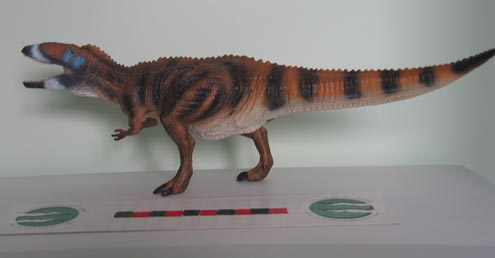
To commemorate this event Everything Dinosaur is giving one lucky person the chance to be the proud owner of the 1:40 scale Carcharodontosaurus dinosaur model, part of the Collecta Deluxe range of dinosaur models.

To have a chance to win this excellent thirty-two centimetre long model, the first off the production line, simply visit Everything Dinosaur’s Facebook page, leave a comment on the Carcharodontosaurus competition image and give our page a “like”.

On Friday March 14th we will put all the entrants names into a hat and pull out one lucky winner who will receive the world’s first 1:40 scale Carcharodontosaurus dinosaur model to mark the birthday of the dinosaurs.

The CollectA 1:40 scale Carcharodontosaurus Dinosaur Model

Win this Amazing dinosaur model.

An amazing dinosaur model.

Picture credit: Everything Dinosaur

Everything Dinosaur’s range of award-winning CollectA Deluxe prehistoric animal figures: CollectA Deluxe Prehistoric Animal Figures and Models.

Good luck!  Please note this competition has now closed.

8 02, 2014

Oldest Footprints Outside of Africa Discovered (New Research is Published)

By |2024-05-02T08:04:55+01:00February 8th, 2014|Categories: Dinosaur and Prehistoric Animal News Stories, Palaeontological articles|0 Comments

The “Happisburgh Family” – Potentially Homo antecessor

It’s a common enough pastime, taking a stroll with the family.  It seems that any family taking a walk along the beaches of Norfolk (East Anglia, England), in the spring (presuming we ever get a spring after all the stormy weather), might just be mirroring events that took place between 800,000 and perhaps as long ago as one million years BC.  Scientists have discovered ancient, hominin footprints at Happisburgh on the Norfolk coast.

Oldest Footprints

The footprints left in the Pleistocene mud and preserved thanks to rapid burial, represent as many as five individuals, these might have been made by a family group exploring the banks of an estuary for food.  This discovery is hugely significant for palaeoanthropologists, as these are the oldest footprints found to date outside Africa.

Stone tools have been found in the UK and elsewhere in Europe which have been tentatively dated to around these dates but this is the first trace fossil evidence of hominins being present during the latter stages of the Late Calabrian, (Early to Middle Pleistocene) in what was later to become the British Isles.

Exploring the Preserved Silt Layer

Site of ancient footprints.

Site of ancient footprints.

Picture credit: PLoS One

Sometimes scientific discoveries are made after a great deal of research and painstaking effort, but in this instance it was sheer luck that the impressions were spotted and identified.  Rapid coastal erosion of the surrounding cliffs has exposed large portions of the underlying estuarine muds and silts that form part of a formation known as the Hill House Formation.  These sediments were laid down by large, slow-moving rivers during the Early to Middle Pleistocene.  These exposures have been explored as they reveal important information about the fauna and flora during what was a relatively warm, interglacial period for this part of Europe.

A Pleistocene Ecosystem

In early May 2013, a layer of compacted silt was exposed by tidal action.  A cursory examination of this layer, by one of the researchers studying the Pleistocene ecosystem, revealed a series of hollows and other impressions that resembled human footprints that had been preserved in Holocene-aged horizons.  The area, approximately twelve metres square, was then extensively mapped and photographed.  The surface of the exposure was assessed using multi-image photogrammetry and laser scanning to record the pattern of the impressions in extreme detail.

The team had to work fast as each time the tide came in the site was covered over and the silts exposed to erosion.  Within four weeks, the surface in which the prints had been found had become completely eroded.  All evidence of ancient human activity had been destroyed by tidal action.

Footprints this old are extremely rare in the fossil record.  For such a trace fossil to be preserved a number of factors have to be considered:

  • First of all, an ancient human must walk over a soft substrate of the right consistency to make an imprint.
  • There must be minimal erosion of the imprinted surface as it is exposed, the print must retain its shape and details.
  • Rapid burial must take place to help preservation, but such burial must be carried out without the print itself becoming too misshapen or eroded.  Such rapid burial comes about when material is laid over the print by slowly flowing/rising water or by air fall deposition such as volcanic ash – the 3.6 million year old Australopithecus prints discovered at Laetoli (Tanzania), for example.
  • Last but not least, the preserved impressions then have to be exposed and recorded before being eroded away, in this case it took less than a month for the elements to totally destroy the footprints made as far back as a million years ago.

Dr Nick Ashton (British Museum, London) one of the authors of the scientific paper describing this discovery that has been published in the on line journal PLoS One (Public Library of Science) commented:

“At first we weren’t sure what we were seeing.  But as we removed any remaining beach sand and sponged off the seawater, it was clear that the hollows resembled prints, perhaps human footprints, and that we needed to record the surface as quickly as possible before the sea eroded it away.”

Studying the Footprints

Heel and foot arch ridges have been identified, one print even had the outline of toes preserved.  But actually who made these prints, presents the research team including archaeologists from John Moores University (Liverpool), the University of London and the University of York, with a bit of a challenge.  One candidate is the enigmatic and very poorly known Homo antecessor (Pioneer Man).  H. antecessor is the second oldest hominid species to have been found in Europe.

This species of hominin is known from fossils excavated from sites in Atapuerca (northern Spain).  The fossils have been dated from around 1.2 million years ago to 800,000 years ago, so H. antecessor is known to have been in Europe (albeit one thousand miles away), when these tracks may have been made).

Views of the Happisburgh Site Showing Footprint Surface

Top photograph - view from the north Bottom photograph - view from the south

Top photograph – view from the north
Bottom photograph – view from the south.

Picture credit: PLoS One

Calculating Height

By carefully measuring the length of the footprints, the scientists were able to establish that the individuals who made these impressions measured from around 0.93 metres tall to a height of 1.73 metres.  To calculate the height, the research team used a standard hominin ratio measurement based on the foot length being approximately fifteen percent of the height of the person who made the print.

[Readers can try this for themselves, measure their height in centimetres then multiply this figure by 0.15 and this should give you the size of your own foot.  You can check the accuracy of the calculation by subsequently measuring your own foot length.]

A Close up of a Single Footprint

Camera lens cover provides scale.

Camera lens cover provides scale.

Picture credit: Martin Bates, Department of Archaeology (University of Wales)

A Family Group?

With the variation in heights plotted, the scientists have speculated that this could have been a family group foraging together.  At the time the prints were made, sea levels world-wide were much lower than they are today, the group of hominins whose prints had been found on the Norfolk coast, had actually been walking along the banks of a large, slow-moving estuarine river several kilometres inland.  The river system formed part of the massive Thames drainage basin, a forerunner of today’s course of the River Thames and its tributaries.

The largest print has been ascribed to a male and based on this height evidence the prints do fit within the framework of reference associated with Homo antecessor, so in the published academic paper, the footprints are tentatively assigned to H. antecessor.  However, the authors do note that during the Early to Middle Pleistocene at least two other species of hominin were present in Europe.

Evidence for Homo heidelbergensis is known from Germany and West Sussex, fossil material and other artefacts indicate that H. heidelbergensis was present in Europe from around 600,000 years ago.  In addition, early Neanderthals Homo neanderthalensis remains have been recorded from Sima de los Huesos in Spain, the same vicinity from which Homo antecessor fossils have been excavated and from Swanscombe (Kent, south-east England).

Commenting on this remarkable discovery, Professor Chris Stringer, an expert on early hominins, based at the Natural History Museum (London) stated:

“These people were of a similar height to ourselves and were fully bipedal.”

The professor went on to add:

“They [Homo antecessor]  seem to have become extinct in Europe by 600,000 years ago and were perhaps replaced by the species Homo heidelbergensis.  Neanderthals followed from about 400,000 years ago, and eventually modern humans some 40,000 years ago.”

The Happisburgh footprints are the oldest hominin tracks to be discovered in Europe to date.  Prior to their discovery, the oldest prints known were the “Ciampate del Diavolo”, the “Devil’s footprints”, a series of tracks preserved in volcanic ash discovered in the Roccamonfina region of central, southern Italy, about 35 miles north-west of Naples.  These prints indicate individuals around 1.5 metres in height and it has been speculated that these tracks were left by a group of Neanderthals.  The Italian prints are estimated to be around 345,000 years old (Mid to Late Ionian).

An Overview of the Map of the Happisburgh Site with Footprints Highlighted

Mapping the Location (footprints highlighted)

Mapping the location (footprints highlighted).

Picture credit: PLoS One with additional notes from Everything Dinosaur

Anyone imagining what it would be like to travel back in time the best part of one million years to meet these ancient hominins needs to take heed.  Cut marks on H. antecessor bones from the Spanish site (Atapuerca) indicate that at least one group of these ancient humans were cannibals.

For models and replicas of Pleistocene animals and other long extinct creatures: Mojo Fun Prehistoric and Extinct Animal Figures.

Go to Top