All about dinosaurs, fossils and prehistoric animals by Everything Dinosaur team members.

Articles, features and information which have slightly more scientific content with an emphasis on palaeontology, such as updates on academic papers, published papers etc.

7 05, 2014

The Dinosauria Shrank to Continue to Evolve

By |2023-03-13T08:14:46+00:00May 7th, 2014|Categories: Dinosaur and Prehistoric Animal News Stories, Dinosaur Fans, Palaeontological articles|0 Comments

New Study Suggests that Birds Survived Mass Extinction Events Because they Stayed Small

There has been a lot of media coverage today with regards to a paper published in the scientific journal PLOS Biology (Public Library of Science),  that used an analysis of dinosaur and bird body masses to examine how quickly members of the Dinosauria including the ancestors of modern birds evolved to exploit new ecological niches.  A lot of emphasis has been placed on the size and scale of the non-avian dinosaurs, we shall come to this in due course, but the main thrust of the academic paper does not concern itself with just how big some of the dinosaurs got.

Measuring Body Mass

In this instance, measuring body mass is a means to an end, the research suggests that on that branch of the Dinosauria family tree that leads to the birds (Aves), there was a sustained and very lengthy period of evolution of species.  Birds and their direct dinosaur ancestors seem to have evolved rapidly for at least 170 million years, quickly diversifying and becoming more speciose to exploit niches in ecosystems as and when they arose.  Other types of dinosaur, those not directly related to extant birds, seemed to evolve at a slower rate, once an initial burst of adaptive radiation took place to exploit those gaps left in the world’s terrestrial ecosystems after the End Triassic extinction event.

An International Team

The international team of researchers including academics from Oxford University, the Royal Ontario Museum of Canada, the University of Toronto, the Smithsonian Institute, Imperial College, University College of London, the IVPP (Beijing) and Sweden’s Uppsala University also suggest that the evolutionary ability of those birds that existed during the time of Cretaceous mass extinction event, to remain small may have assisted their survival.  The larger, less diverse dinosaurs, the likes of Tyrannosaurus rex and Triceratops horridus died out.

Decreasing Body Size to Continuously Exploit New Ecological Niches

small body size helped birds evolve rapidly.

Small body size helped birds evolve rapidly.

Picture credit: Everything Dinosaur

Decreasing Body Size

The research team believes that the group that eventually evolved into birds decreased their body volume to continuously take advantage of new ecological niches through their evolution, becoming the successful species they are today.  Small, may indeed have been beautiful when it came to surviving major extinction events and the more speciose your clade was, the more niches you as a clade occupied the better your chances of survival.

Let’s start at the beginning, the first dinosaurs evolved sometime in the Middle Triassic, palaeontologists can’t be certain as to when or even where, although some of the latest research suggests that the very first dinosaurs as we now know them evolved in Africa.

To read an article on what might have been one of the first dinosaurs: The First Dinosaur?

The first birds may have evolved in the region of 170 million years ago (Middle Jurassic), the problem with both the early dinosaurs and those early birds is that the fossil record is extremely poor and material fragmentary.  It is difficult to establish a clear, evolutionary lineage.

To read an article about one of the first types of bird to evolve: New Contender for the “First Bird” – Aurornis.

What the fossil record does show is that in all the major groups of animals there was a rapid burst of evolution with lots of new body shapes and sizes rapidly evolving during their early history.  Different types evolve to exploit niches in food chains.  There is a rapid explosion of adaptive radiation amongst organisms.  Adaptive radiation, to an evolutionary biologist is a process in which living things rapidly diversify into a vast array of new forms.

Mass Extinction Event

This burst of natural selection is often prompted by a mass extinction event that eliminates competitors or through climate change that opens up new territories and habitats to exploit.  For example, the dinosaurs rapidly diversified into a number of different Superfamilies in the Early Jurassic, perhaps a biological response to the gaps left after the End Triassic extinction event.

Problem is, very few studies of adaptive radiation have looked at how Orders evolve over deep geological time, so the links between how diverse a modern day Order might be in relation to major extinct groups remains relatively unclear.  This is what the international team of scientists set out to examine.  Today, there are over 10,000 species of birds, they are the most speciose of all the living tetrapod clades, how did the evolution of the birds and their dinosaur ancestors compare to the evolutionary rates of other types of dinosaur not that closely related to the Aves?

Measuring the Pace of Development

To measure the pace of evolutionary development, the scientists chose to look at the variations in body mass.  Put simply the idea is this:

  • Look at the family tree of the dinosaurs and examine each of the major branches.
  • Look at the body sizes of the different types of prehistoric animal (estimating body mass was undertaken by measuring the robustness and size of limb bones notably femurs)

Work on the basis that if closely related animals are similar in body size then evolutionary rates were probably slow.

However, if closely related animals show a very wide range in body size then evolutionary rates were probably very rapid

A comprehensive data set of body mass was compiled for the major types of dinosaur and birds that evolved in the Mesozoic.  Although it is difficult to accurately estimate the weight of long extinct animals (a source of continual debate amongst scientists), in living creatures the scaling model based on the size and shaft circumference of major limb bones such as the thigh bone seems the most reliable.

From this study, the scientists concluded that the heaviest dinosaur known was Argentinosaurus (Argentinosaurus huinculensis) with an estimated body mass of around 90,000 kilogrammes.

Dinosaur Super-Heavyweight Argentinosaurus

Argentinosaurus model (CollectA)

Biggest dinosaur known to science.

Estimating Body Weights of Dinosaurs

The body weights of 426 dinosaurs were estimated and when added to the number of bird species studied the total exceeds 600, the smallest and lightest species analysed was Qiliania (Q. graffini), a primitive bird whose fossils date from around 120 million years ago and come from China.  Qiliania graffini weighed six million times less than Argentinosaurus huinculensis.  However, Qiliania may have been tiny, but there are very few Mesozoic creatures that can claim to have been named after the founder of a punk rock band (Dr Gregory Graffin).

Estimated Body Masses of Various Types of Dinosauria (the Smallest Examples)

The estimated size of the smallest member of various dinosaur Superfamilies

The estimated size of the smallest member of various dinosaur Superfamilies.

Table credit: PLOS One Biology

The table above lists the smallest Dinosauria members known by type of dinosaur, weights are given in kilogrammes.

Estimated Body Masses of Various Types of Dinosauria (the Biggest Examples)

Estimated size of the biggest members of the Dinosauria.

Estimated size of the biggest members of the Dinosauria.

Table credit: PLOS One Biology

The table above shows the body mass estimates of some of the biggest dinosaurs and birds known (weight in kilogrammes).

The Heaviest Types of Dinosaurs

The international team of researchers did not set out to re-classify the heaviest types of dinosaur and submit new information to the Guinness Book of Records, this is what has intrigued a number of media outlets and journalists who have focused on the estimated size and scale of these long extinct creatures.  There are one or two notable points worth making.  For instance, using the limb robustness and shaft circumference method, Tyrannosaurus rex comes out significantly heavier than Giganotosaurus carolinii.  The herbivorous Iguanodon (I. bernissartenis) and Triceratops (T. horridus) are approximately twice as heavy as the fearsome T. rex.

But enough of this, let’s focus on the main aspect of this new research.  The Dinosauria evolved very rapidly early on in their evolutionary history, but the speed of evolutionary change for most of the Superfamilies slowed down, if the relative body masses of closely related dinosaur types is used as a measure of evolutionary change.

Only in the Maniraptora, that clade of coelurosaurian theropods that gave rise to modern birds did that initial high rate of evolutionary change continue.  According to Dr David Evans, the Curator of Vertebrate Palaeontology at the Royal Ontario Museum and one of the co-authors of the paper, the branch of the dinosaur family tree that led to the birds represents “the second major adaptive radius ring of dinosaurs”.

Examining Body Sizes

Closely related groups of dinosaurs with similar body sizes may not have evolved to exploit new opportunities with quite the same rapidity as the birds.  As a result, when there was intense pressure put on the Superfamily because of environmental changes such as those that occurred at the end of the Cretaceous, extinction was the outcome.

Dinosaur Phylogeny Showing Nodes which indicate Exceptional Evolution of Body Size 

The Aves (Avialae) have been ringed faintly in red.

The Aves (Avialae) have been ringed faintly in red.

Picture credit: PLOS One Biology 

Feathered maniraptoran dinosaurs, including those now classified as Mesozoic birds sustained a rate for rapid evolution, suggesting these taxa would have been much quicker at adapting to new ecological niches.  Birds retained their ability to evolve very rapidly, a precondition of which was their relatively small size when compared to other dinosaurs.

The research team conclude that the smaller body masses attained by the Aves was the key to their survival, the birds lowered the body mass threshold of the Dinosauria below one kilogramme, subsequently individuals would need fewer resources to survive.  It is thanks to these factors that the birds remain the most speciose of all the tetrapod vertebrates alive today.

Finally, for all those who wanted to see just how big Argentinosaurus was, we have reproduced below a drawing of a huge titanosaur.  This dinosaur is only known from fragmentary remains and the casts have been made based on scaling up the sizes of bones from better known, more complete titanosaurs.

Just How Big was Argentinosaurus?
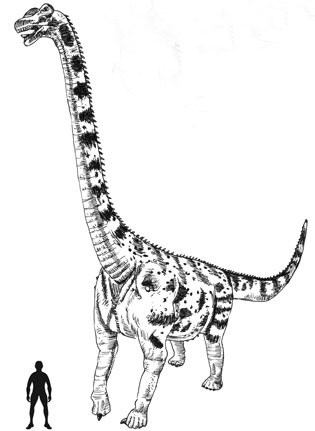
Illustration of a giant titanosaur.

Huge dinosaurs – titanosaurids.

For dinosaur models and prehistoric animal figures: Dinosaur Models and Prehistoric Animal Models.

29 04, 2014

Fossil Find Provides Information on the Evolution of Herbivores

By |2023-03-12T10:17:26+00:00April 29th, 2014|Categories: Dinosaur and Prehistoric Animal News Stories, Main Page, Palaeontological articles|0 Comments

Earliest Ancestor of Terrestrial Herbivores Discovered

When watching a wildlife documentary it is easy to overlook some fundamental truths about today’s complex ecosystems with their multi-layered food chains.  Lions attacking zebras on the Serengeti, caribou grazing on Arctic lichens and mosses, foxes chasing after rabbits for instance.  We have predators which prey on primary consumers of plant materials, the predator/prey relationship.  However, such complex ecosystems have not been present throughout the history of land vertebrates, back in the days of the very first land animals with backbones ecosystems were populated by carnivores, it seems the ability to digest tough plant materials such as cellulose had to evolve and that herbivory has its roots amongst the meat-eaters.

Fossil Find

Newly published research into the fossil of a reptile discovered in Kansas, by scientists from the University of Toronto Mississauga in collaboration with researchers from Museum für Naturkunde and Humboldt-University (Berlin), had shed light on the evolutionary processes that led to the transition of carnivores into land herbivores.  The specimen which consists of some cranial material from the back of the skull, the backbone, ribs, elements from the pelvic girdle and the right rear limb was collected by Dr Larry Martin, the curator of the Dyke Museum of Natural History, University of Kansas.  Dr Martin was exploring a highly fossiliferous location known as Hamilton Quarry in south-eastern Kansas.  Strata laid down at this site were formed in a tidal environment with changing sea levels.

A diverse variety of fauna and flora has been preserved including many fish species, some amphibians and a few, rare reptiles.   The twenty centimetre long specimen was poorly preserved with those bones exposed in the matrix showing signs of erosion.  To preserve the fossil and to allow it to be properly studied, the fossil was loaned to the Biology Department at the University of Toronto. It was encased in epoxy resin to stabilise it and to permit further cleaning and preparation.  Unfortunately, the acidic solution used to clean the fossil and to reveal important anatomical details dissolved the fine, conical teeth that had been preserved in the jaw.

Photograph and Illustration of the Fossil Material (KUVP 9616b)

Scale bar = 1cm

Scale bar = 1 cm

Picture credit: PLOS One/Reisz RR, Fröbisch J.

The skull material is located in the top right of the image, with the hind limb and the pelvic bones located top left.  The fossil material is believed to represent a juvenile.

Eocasea martini

The little reptile has been named Eocasea martini.  The genus name means “dawn or first Caseidae”, the clade of synapsids that this animal belonged to.  The specific or trivial name honours Dr Larry Martin.  Caseids are an ancient group of terrestrial vertebrates that form part of a larger group known as synapsids.  Synapsids represent a diverse and unusual group of vertebrates, that include the ancestors of modern reptiles and all mammals, plus those reptiles that have closer affinities to Mammalia than they do to extant reptiles, the so-called mammal-like reptiles.  The fearsome Dimetrodon is an example of a synapsid along with the tusked dicynodonts such as Placerias and the ancestors of today’s mammals.

An Illustration of Eocasea martini

Ancient fossil shed light on the earliest ancestors of land herbivores.

Ancient fossil shed light on the earliest ancestors of land herbivores.

Picture credit: Danielle Dufault

A “Ghost Lineage”

The fossil has been dated to around 300 million years ago, (Upper Pennsylvanian of the Carboniferous).  The discovery helps to close a twenty million year gap between E. martini and the next oldest caseid known from the fossil record.  When scientists map the evolution of closely related organisms and find large gaps in the known fossil material, leading back to a very early ancestral form, as in this case, it is referred to as a “ghost lineage”.

Commenting on the significance of the research, Professor Robert Reisz of the Department of Biology at the University of Toronto stated:

“The evolution of herbivory was revolutionary to life on land because it meant terrestrial vertebrates could directly access the vast resources provided by terrestrial plants.  These herbivores in turn became a major food resource for large land predators.”

One of the authors of the paper published in the on line scientific journal PLOS One, Jörg Fröbisch (Museum für Naturkunde and Humboldt-University in Berlin), added:

“Eocasea is one of the oldest relatives of modern mammals and closes a gap of about twenty million years to the next youngest members of the caseid family.  This shows that caseid synapsids were much more ancient than previously documented in the fossil record.”

Analysis of the fossil material indicates that Eocasea martini was a basal member of the caseids, a carnivore feeding on small animals and insects but fossils of caseids dating from the Permian provide clear evidence that terrestrial herbivores evolved from this group’s small, carnivorous members, animals such as Eocasea.

Evidence for Herbivory

The evolution of the ability to consume, process and digest tough plant material is regarded by many scientists as one of the most important developments in the evolution of land living animals with backbones.  Adapting to a diet largely consisting of vegetation requires some modifications to the body plan of an animal, these adaptations can be observed by studying the fossil bones of long extinct creatures.  For example, in order to cope with hard to digest cellulose, the digestive tract tends to get much bigger and a larger, wider body is required to support a bigger gut.  A longer or broader trunk region can be seen in preserved fossils when their skeletons are compared to those of similar sized carnivores.

The body cavity becomes modified to house a bigger digestive tract, which in turn has to house a huge number of symbiotic bacteria to permit the fermentation and and breakdown of plant cells.  Palaeontologists, can therefore identify Palaeozoic herbivores because their rib cages are typically much wider with a bigger capacity than closely related insectivores and carnivores.

 The Wide Body of Edaphosaurus (Herbivorous Pelycosaur)

Wide-bodied Edaphosaurus a herbivorous sail-backed reptile.

Wide-bodied Edaphosaurus a herbivorous sail-backed reptile.

Picture credit: Everything Dinosaur

The image (above) shows a Bullyland Edaphosaurus figure.  To view the range of Bullyland “Prehistoric World” figures including the Edaphosaurus (whilst stocks last): Bullyland “Prehistoric World” Models.

The researchers conclude that Eocasea is one of the first animals to have started the process that would result in the establishment of modern ecosystems, with many plant-eaters supporting fewer types of predator – the start of more complex food chains.

Intriguingly, the research team went onto identify that the ability to digest and process vegetation was not just established in the lineage that includes the caseids, it arose independently at least five times more, including twice in the Reptilia.

Professor Reisz added:

“When the ability to feed on plants occurred after Eocasea, it seems as though a threshold was passed.  Multiple groups kept re-evolving the same herbivorous traits.”

The five groups developed the novel ability to live off plants in staggered bursts with synapsids such as Eocasea preceding reptiles by nearly 30 million years.  This shows that herbivory as a feeding strategy evolved first amongst those synapsids that are the ancestors of the Mammalia.  Our ancestors evolved a taste for plants long before that branch of the terrestrial vertebrates that includes extant reptiles, the dinosaurs and Aves (birds).

Moving onto a plant-eating diet, resulted in a dramatic change in the size of early herbivores over the duration of the Permian geological period.  Four of the five groups showed that as the Permian progressed so herbivores got bigger and bigger.  The age of the super-sized grazer had dawned.  Professor Reisz observed that the caseids showed the most extreme examples of size increase.  The earliest member of the group, the diminutive Eocasea martini probably weighed less than two kilogrammes when fully grown.  Later caseids weighed more than two tonnes, one of the largest known being the enormous, fat bellied Cotylorhynchus whose fossils have been found in the United States.

The research team have stated that the study of Eocasea has led to more questions being asked then answers found.  For example, why didn’t the ability to digest plant material evolve earlier on?  Why did herbivory evolve independently in at least five lineages of vertebrates?

Perhaps there are fossils out there which will shed further light on these mysteries.

28 04, 2014

Pushing the Evolution of the Pterodactyloidea Back in Time

By |2023-03-12T10:16:32+00:00April 28th, 2014|Categories: Dinosaur and Prehistoric Animal News Stories, Dinosaur Fans, Palaeontological articles|0 Comments

Basal Member of the Pterodactyloidea – Kryptodrakon progenitor

Fans of the Pterosauria, that enigmatic Order of reptiles that evolved powered flight and lived alongside the Dinosauria for much of the Mesozoic are in a bit of a flap at the moment.  A newly described, fragmentary pterosaur fossil found in north-west China has pushed back the evolution of the most successful group of pterosaurs, the Pterodactyloidea by another five million years.

At least one hundred and sixty three million years ago, these leathery winged creatures were soaring overhead and the Pterodactyloidea were to radiate and evolve into a huge range of different types of flying reptile.  Something like 120 different genera of Pterodactyloidea have been identified so far.

Discovered in 2001

The fossil was found in 2001, it consists of some pieces from the enlarged fourth digit (the wing fingers) from the right and left wings, elements from the metacarpals, the radius, part of the left humerus and other fragmentary elements including a scapula.  Although, only about 10% of the skeleton was found and no cranial material identified, the length of the fourth metacarpal in relation to the other bones that make up the forelimb places this flying reptile at the base of the pterodactyloid group of pterosaurs.

This group of pterosaurs radiated and diversified throughout the Late Jurassic and into the Cretaceous Period.  They produced a myriad of forms which include the Late Cretaceous Azhdarchidae some of the largest flying creatures known to science with some species standing taller than a modern day giraffe.

The Start of Something Big!

Pterodactyloidea a diverse SubOrder of the Pterosauria.

Pterodactyloidea a diverse Suborder of the Pterosauria.

Picture credit: Everything Dinosaur

A “Dinosaur Death Pit”

The bones were found in a “dinosaur death pit”, red mudstone strata that represents fine sediments, including volcanic ash which acted like “quicksand” trapping many animals and leaving their bodies piled up on top of each other.  Such locations have revealed a “treasure trove” of fossil material, including these largely uncompressed pterosaur bones.  For the international research team involved in the 2001 field study, it would have been quite a odd feeling working in what are virtually vertical bone beds, but the fossil material that has been excavated has provided a rare insight into a rich and diverse Upper to Middle Jurassic terrestrial environment.

To read more about dinosaur death pits from China: Dinosaur Death Pits Reveal Dozens of Fossils.

The fossil comes from the famous Shishugou Formation of Xinjiang Province (north-western China), the scientific paper on this new genus of flying reptile has just been published in the academic journal “Current Biology”.  Lead authors of the paper include University of South Florida palaeontologist Brian Andres, James Clark of the George Washington University and Xu Xing of the Chinese Academy of Sciences.

The specimen is currently stored in the Institute of Vertebrate Palaeontology and Palaeoanthropology (Beijing).  It has taken time to realise the significance of this discovery, at first the fragmentary bones were thought to be that of an unknown species of theropod dinosaur.  The fossils were found in an ash bed some thirty-five metres below a layer of rock that had been dated to 161 million years ago (Bathonian/Callovian faunal stages of the Middle to Late Jurassic).

Commenting on the length of time taken to identify the specimen, a spokes person from Everything Dinosaur stated:

“It is not unusual for ten years or more to pass before a formal scientific description is published.  The wealth of the fossil material being found in China leads to a backlog in the research and the importance of the discovery was not recognised at first.  A basal Pterodactyloid pterosaur was not expected, not many people would have considered this possibility when the fossils were first found and catalogued.”

Kryptodrakon progenitor

The new species has been named Kryptodrakon progenitor.  The genus name means “hidden dragon” a reference to the fact that the martial arts film “Crouching Tiger Hidden Dragon”, directed by Ang Lee and released in 2000 was filmed in the same locality as where the fossils were found.  The trivial or species name means “ancestor”, reflecting the fact that this flying reptile has been ascribed to a basal position in the Pterodactyloidea.

Fossil Material Assigned to Kryptodrakon progenitor

New Pterosaur named after "Crouching Tiger Hidden Dragon" Film.

New pterosaur named after “Crouching Tiger Hidden Dragon” Film.

Picture credit:  Brian Andres

The diagram shows the fragmentary remains of Kryptodrakon progenitor found in the famed “dinosaur death pits” area of the Shishugou Formation in north-western China.  The red mudstone strata from which the fossil was obtained can be seen in the background, the pterosaur skeleton used to give an impression of what this flying reptile may have looked like represents Pterodactylus antiquus (original drawing by Peter Wellnhofer).  The scale bar represents five centimetres.

This pterosaur lived on a flood plain, many miles from the sea. It had been thought that pterosaurs evolved in areas that were close to the sea and that the majority of early pterodactyloid forms were fish-eaters.  The discovery of the fossils of K. progenitor far inland challenges this long held assumption.  It is likely that the first members of the Pterodactyloidea evolved far inland.

Phylogenetic comparative analysis of wing shape supports this theory as the research team support the idea of there being a significant correlation between wing morphology and the environment in which the animal lived.  Such a strong relationship between wing shape and environmental suitability is seen in extant flying vertebrates, this indicates that pterosaurs lived in or were at least adapted to the environments represented by the strata in which their fossils have been preserved.

For models and replicas of pterosaurs and other prehistoric creatures: Schleich Prehistoric Animal Figures.

Dr Clark explained the significance of their fossil discovery:

“Kryptodrakon is the second pterosaur species we’ve discovered in the Shishugou Formation and it deepens our understanding of this unusually diverse Jurassic ecosystem.  It is rare for small, delicate fossils to be preserved in Jurassic terrestrial deposits and the Shishugou fauna is giving us a glimpse of what was living alongside the behemoths like Mamenchisaurus [Sauropod dinosaur].“

20 04, 2014

Amazing Ancient Shark Fossil Provides Insight into Jaw Evolution in Vertebrates

By |2024-05-02T09:48:04+01:00April 20th, 2014|Categories: Dinosaur and Prehistoric Animal News Stories, Palaeontological articles|0 Comments

325-Million-Year-Old Fossil Suggests Sharks are Not “Primitive”

Often described as a group of animals that have remained virtually unchanged for millions of years, extant shark species (and there are something like 470 known species) are actually more highly evolved than previously thought.  The discovery of a remarkably well-preserved specimen of an ancient shark-like creature that once swam in a marine ecosystem more than 325 million years ago (Pennsylvanian Epoch of the Carboniferous), has provided palaeontologists with evidence to suggest that early cartilaginous and bony fishes have more to tell us about the evolution of jaws.

The Evolution of Jaws

A study published in the academic journal “Nature”, vividly demonstrates how new fossil discoveries can dramatically alter our understanding of the evolution of vertebrates.  The fossil, a three-dimensional concretion, shows a combination of primitive and more advanced anatomical features in a cartilaginous fish, evidence of a sophisticated jaw has been identified along with a complete gill section.  Importantly, the fossil shows the arrangement of the jaw and the gills “in situ”, the fossil has preserved these delicate organs in their natural, life position.

The layout of these anatomical features are very similar to that found in bony fishes as well as cartilaginous fish.  This suggests that this specimen might represent a common ancestor of these extremely important vertebrates.

The Concretion that Represents the Fossilised Jaws and Gill Structures of a Palaeozoic Fish

Scale bar = 10 millimetres

Scale bar = 10 millimetres.

Picture credit: American Museum of Natural Hisotory/Pradel

The picture shows two lateral views (views from sideways on) of the fossil material that was later scanned at the European Synchrotron Radiation Facility to reveal its internal structures.

Ancient Shark Fossil

The first fish are believed to have evolved from Chordate animals (animals that possess a stiff rod that runs along or part-way along their body length for at least a portion of their life cycle).  The evolutionary links remain poorly known but fossils found in China indicate that the first jawless fish, (agnathans) may have evolved more than 530 million years ago.  It is believed that sometime during the Silurian geological period, a crucial development in the history of life on Earth occurred, the first vertebrates with true jaws (gnathostomes) evolved.

Part of the American Museum of Natural History Collection

Although, this fossil, part of an enormous fossil collection donated to the American Museum of Natural History by Ohio University, may not represent the earliest jawed fish, its state of preservation has provided scientists with an insight into the evolution of jaws from modified gill arches.

The Evolution of Jaws in Fish (Agnathan compared to a Gnathostome)

How jaws may have evolved.

How jaws may have evolved.

Studying Agnathans

In jawless fish (agnathans), the first and second gill arches (branchial arches) support the first gill slit.  In jawed vertebrates, the first gill arch has become a pair of jaws and the first gill slit a spiracle to let water pass over the remaining gills.

Lead author of the research paper, post-doctoral researcher at the New York based museum, Alan Pradel stated:

“Sharks are traditionally thought to be one of the most primitive surviving jawed vertebrates.  Most textbooks in schools today say that the internal jaw structures of modern sharks should look very similar to those in primitive shark-like fishes, but we’ve found that’s not the case.  The modern shark condition is very specialised, very derived and not primitive.”

The story of this significant breakthrough, starts with Ohio University professors Royal and Gene Mapes and their students, who over the years amassed in excess of half a million Palaeozoic fossils from Arkansas, Oklahoma and Texas.  The fossils represent marine ecosystems and consist of invertebrates such as trilobites, ammonites, brachiopods and gastropods, as well as a number of fossils of primitive fish.

Ozarcus mapesae

The fossilised skull of the new species named Ozarcus mapesae is so well preserved it allowed scientists to create a three-dimensional model to show the organisation of the jaw in relation to the gill arches.  The trivial name for this new species honours the Ohio University professors.

Fish heads, including cartilaginous fish such as sharks and rays, are segmented into the jaws and a series of arches that support both the jaw and the gills.  However, as the fossils of most early gnathostomes (jawed fish) are poorly preserved and usually distorted and flattened, this is the oldest known specimen found to date that shows the jaw/gill arch relationship in such clarity.

A Computer Generated Image that shows the Internal Structures of the Fossil

3-D image of fossil produced.

3-D image of fossil produced.

Picture credit: American Museum of Natural History/Pradel

The picture above shows one of the three-dimensional images created after the fossil material had been bombarded with X-rays to produce the computer model.  The brain case can be seen at the top (shaded a tan colour), the structure of the jaws are shaded red, the jaws having evolved from the first gill arch.  The second gill arch, known as the hyoid arch is shown in blue.  The remaining gill arches are shaded yellow.

The Importance of this Donated Specimen

Commenting on the importance of this donated specimen, one of the study authors, John Maisey (American Museum of Natural History) added:

This beautiful fossil offers one of the first complete looks at all of the gill arches and associated structures in an early shark.  There are other shark fossils like this in existence, but this is the oldest one in which you can see everything.   There is enough depth in this fossil to allow us to scan it and digitally dissect out the cartilage skeleton.”

In order to study the three-dimensional concretion so the layout and the orientation of the delicate branchial arches (gill arches) could be mapped, the scientists took the specimen to the European Synchrotron Radiation Facility (ESRF), located at Grenoble in France so that high-resolution X-rays could bombard the specimen and produce a detailed, computer generated image of the fossil in three-dimensions.  The team discovered that the arrangement of gill arches is not like that seen in modern, extant sharks.  Instead the gill layout is fundamentally similar to that seen in bony fishes (osteichthyans).

The authors state that it is not unexpected that sharks, because of their long evolutionary history, would undergo evolution of these anatomical structures, but bony fish may have more to tell us about the first jawed ancestors of land-living vertebrates such as ourselves than living sharks.  Bony fish are the most successful group of gnathostomes.  All tetrapods (that includes us) are descended from bony fish.

Sharks – A very Diverse and Geographically Widespread Group

Sharks - a diverse group with over 470 extant species.

Sharks – a diverse group with over 470 extant species.

Picture credit: Everything Dinosaur

For models and replicas of marine sea monsters and prehistoric sharks: PNSO Age of Dinosaurs Models.

18 04, 2014

Extracting a Rare Ichthyosaur Fossil

By |2024-04-12T18:28:30+01:00April 18th, 2014|Categories: Everything Dinosaur News and Updates, Everything Dinosaur videos, Palaeontological articles|0 Comments

Newly Discovered Ichthyosaur Fossil Removed from Beach

After the exhilaration of finding a fossil specimen such as a near complete ichthyosaur, comes the hard work of extracting the specimen.  This has to be done with great care and planning, as the aim is to remove the material as intact as possible without damaging any of the actual fossils.  For Ben and his dad Dave, they also had to cope with the threat of an incoming tide as Ben found his ichthyosaur on the eastern beach of Lyme Regis (Dorset, England) and although the specimen was exposed at low tide, once the tide starts to turn, it comes in really quickly, so there is added pressure.

For models and replicas of ichthyosaurs and other marine reptiles: Wild Safari Prehistoric Dinos Models.

Ichthyosaur Fossil

The specimen, representing a young ichthyosaur was found by Ben a couple of days ago.  He and his father then set about working most of that day and into the evening trying to prepare the fossil for that all important lift, the first time that the ichthyosaur would have been moved for 180 million years or so.

Our chum Brandon, a local fossil expert himself, was on hand to record the moment when the fossil was ready for extraction.

Carefully Extracting an Ichthyosaur Specimen from the Beach at Lyme Regis

Video credit: Brandon Lennon

Fragile Specimen

The specimen was quite fragile, so glue was used to help secure the fossil and keep it intact.  Once this had been done,  it was time to prepare the block of Blue lias in which the fossil was located for lifting.  Chisels were then hammered into key points underneath the block to allow it to be freed from the bed.  Once this process had been completed it was time to get ready to lift the specimen and remove it.  This in itself is a tricky process, in the video you can see just how much water was seeping into the dig site and Ben and Dave were aware of the oncoming tide.

With skill and care the two intrepid fossil hunters were able to lift out the fossil.  The tail section broke, if you look carefully on the video you can see that there is a natural fault on the block and as a result the end piece broke off.  However, we can report that the rest of the specimen was removed safe and sound.

The two pieces of rock will now be prepared so that the skeleton can be fully exposed.

Lyme Regis is a great place to visit and fossil hunting on the beach is a lot of fun, however, we at Everything Dinosaur suggest that visitors take advantage of a guided fossil walk led by a local expert.

To read more about guided fossil walks: Lyme Regis Fossil Walks.

Congratulations to Ben and Dave, glad all their hard work paid off.

13 04, 2014

The Weird and the Wonderful – Chinese Triassic Marine Reptiles

By |2023-03-12T07:12:04+00:00April 13th, 2014|Categories: Dinosaur and Prehistoric Animal News Stories, Main Page, Palaeontological articles|0 Comments

Parahupehsuchus longus – Armoured Marine Reptile with a “Corset”

As life on Earth recovered from the devastating End Permian mass extinction event which took place some 250 million years ago, it seems that a myriad of strange and bizarre vertebrates evolved to take advantage of vacant niches in ecosystems that had arisen due to the extinction of so many different types of organism.  One of the strangest marine creatures known to science has just been described in the on line scientific journal PLOS One.  It seems that as environments and ecosystems recovered in the Early Triassic, so marine tetrapods evolving the capability to eat other marine tetrapods came about in earnest and the first tetrapod apex predators of the sea appeared.

Marine Tetrapods

This led to the evolution of body armour and other forms of protection in smaller marine tetrapods that were now the potential prey.  Step forward the bizarre Parahupehsuchus longus, around a metre long, marine reptile that evolved a bony tube that completely surrounded its body wall, like a sort of armoured corset.  Just like a corset, breathing movements and body movements may have been restricted, but the primary role for this unusual pseudo carapace was probably protection against attacks from a much larger predatory marine reptile that shared P. longus’s watery world.

Parahupehsuchus longus

Back in 2011, scientists from the Wuhan Centre of China Geological Survey undertook a field excavation in Yuan’an County, Hubei Province, (east central China), to find Early Triassic marine reptile fossils.  The strata in this part of China represents exposures of marine sediments laid down in a shallow tropical sea around 248 million years ago (Jialingjiang Formation).  The area had been mapped and studied since the late 1950’s and a number of marine reptile genera unique to this part of the world had already been named and described.  However, when Chinese scientists first studied these fossil rich deposits, the strata was believed to be younger, dated to the Anisian faunal stage of the Middle Triassic.

Triassic Marine Strata

The rocks at this location were thought to be roughly the same age as Triassic marine strata found in the provinces of Yunnan and Guizhou (south-western China).  More recent studies have assigned the sediments exposed around Yuan’an County to be up to three million years older than most of the sedimentary rocks bearing marine reptile fossils in Yunnan and Guizhou.  The rocks which entombed Parahupehsuchus longus date to around 248 million years ago (Olenikian faunal stage of the Lower Triassic).

This is significant because the vertebrate fossils found in Yuan’an County are much closer to the End Permian extinction event than those from south-western China, the ecosystem represented is one that is at an earlier stage of recovery from the most devastating extinction event known.

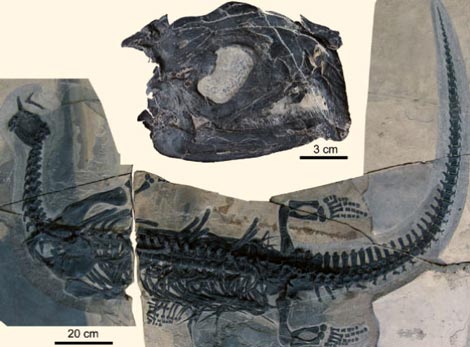
Parahupehsuchus longus (Holotype Material WGSC 26005)

Scale bar = 10cm

Scale bar = 10cm.

Picture credit: PLOS One

In the diagram above the strange bony carapace-like structure surrounding the body of this new species of marine reptile can be clearly made out.  The labels in red have been added by Everything Dinosaur to help readers gain a better understanding as to the layout of the fossil as the skull and much of the tail is missing.

Ten Marine Reptile Specimens

The research team identified more than ten marine reptile specimens, one partially complete fossil represents this new genus.  Most of the marine reptile specimens discovered represented animals of around a metre in length, but one fossil suggests a marine reptile of around 4 metres in length.  Although not formally described yet, the skull is robust and the teeth that of a meat-eater.  It has been suggested that this reptile was the apex predator.  Parahupehsuchus evolved its corset-like body to resist attacks from this much larger marine reptile.

Surprisingly, very few fish fossils have been found in the strata that contains the marine reptile fossils.  This might be a reflection of fossil preservation bias, but if there were few fish species present and this may not be that surprising as something like 57% of all marine families died out at the end of the Permian, it seems that marine reptiles evolved to attack and hunt other marine reptiles.  The corset of Parahupehsuchus may have evolved as a response to the predatory pressure.

The Order Hupehsuchia

Parahupehsuchus has been assigned to the Hupehsuchia Order of marine reptiles.  This Order currently consists of just three genera, all of which are found in the Lower Triassic sediments of Hubei Province.  The first named and described was Nanchangosaurus, then in 1972 a near complete specimen of a new type of marine reptile that had been discovered was named this was Hupehsuchus.  Palaeontologists consider that Parahupehsuchus was closely related to Hupehsuchus.

Parahupehsuchus pronounced “par-rah-hoop-pay-sook-cus” means beside Hupehsuchus which refers to the taxonomic relationship between these two genera.  The term Hupehsuchus is derived from Hupeh, an alternative spelling for Hubei Province and the Greek word for crocodile.

Hupehsuchus nanchangensis  Fossil Material (specimen number WGSC 26004)

Scale bar = 10cm

Scale bar = 10cm.

 Picture credit: PLOS One

The more complete specimen (diagram B) above, provides scientists with clues to how Parahupehsuchus might have looked.  It may have had a long narrow, toothless snout like its close relative Hupehsuchus.  It was probably capable of moving around on land as well as being adapted to a marine environment and although the tail is missing in the holotype specimen it is likely that the tail was quite powerful and Parahupehsuchus propelled itself through the water with sideways movements of its tail, in a similar to modern crocodilians today.

Toothless Jaw

If indeed Parahupehsuchus had a toothless jaw, then it may have eaten soft-bodied creatures such as squid.  This bizarre marine reptile remains unique amongst vertebrates for the strange configuration of its trunk.

Its body is completely surrounded by a bony tube, around fifty centimetres long and nearly seven centimetres deep.  The tube is made up of overlapping ribs and gastralia (belly ribs).  This tube and the presence of dermal armour on the dorsal surface of the skeleton (back) have been interpreted as defensive features to withstand the bites of larger marine reptiles.  This is evidence that by the Early Triassic, ecosystems had recovered enough from the End Permian extinction event to permit the establishment of complex marine tetrapod food chains dominated by large apex vertebrate predators.

The Front Dorsal Region of Parahupehsuchus longus

White scale bar shown on actual fossil material = 1cm

White scale bar shown on actual fossil material = 1cm.

Picture credit: PLOS One

The unique corset-like body protection is made up of a combination of fused true ribs, belly ribs (gastralia) and neural spines.

Key

red = dermal armour, scales and ossicles (da)

dark brown = first segment of neural spine (ns1)

dark green = second segment of neural spine (ns2)

grey = ribs (ri)

orange = lateral gastralia (lg)

white = median gastralia (mg)

green = bones of the left forelimb

arf (pink) = anterior rib facet extending from the parapophysis, dia (light brown) = diapophysis of the neural arch, para (yellow) = parapophysis main facet.

Note that ribs and gastralia overlap in a complex manner and the double rib articulation prevents rib motion.  This would have made chest movements difficult for breathing and restricted the body movements to aid swimming and locomotion on land.

Although, the ribs are expanded in a similar way to that of a turtle’s shell, Parahupehsuchus is not closely related to the Chelonia (turtles, tortoises and terrapins).  This might be an example of convergent evolution.

Scientists hope to find more fossils of this strange marine reptile in rocks that make up the Jialingjiang Formation and with further research they intend to build up a more detailed picture of the food chain that is represented by this Lower Triassic fossil material.

For models and replicas of marine reptiles and other creatures: PNSO Age of Dinosaurs Figures and Models.

10 04, 2014

Bizarre New Triassic Marine Reptile Described

By |2023-03-11T18:47:01+00:00April 10th, 2014|Categories: Dinosaur and Prehistoric Animal News Stories, Palaeontological articles|0 Comments

Atopodentatus unicus from Yunnan Province

The fossils of a bizarre marine reptile with a unique mouth have been discovered in south-western China.  Although its body resembles other types of marine reptile, the skull and the mouth are extremely unusual and nothing like them has been seen before in the fossil record.   A number of scientists have speculated about this strange anatomical arrangement, the upper jaw resembles a vertical slit with fine teeth arranged to form sieve-like structure.  A prehistoric animal that has a “zipper” for an upper jaw.   These adaptations indicate that this three-metre long sea creature evolved to fit a very specialist niche in the marine ecosystem of 245 million years ago.

Marine Reptile Fossils

The animal has been named Atopodentatus unicus, the name translates from the Latin to mean “peculiar teeth of unique shape” and one glance at an illustration of this particular beastie shows why the nomenclature is so appropriate.

An Illustration of A. unicus

Strange Triassic marine reptile.

Strange Triassic marine reptile.

Picture credit: Nobu Tamura 2014

A Bizarre Creature

This is one of those occasions when the interpretation of the fossil material and a resulting illustration needs to proceed any further discussion so that the reader can gain an impression of just how weird this animal was.

The land that makes up the border between the south-western Chinese provinces of Guizhou and Yunnan is very important to palaeontologists as they try to reconstruct how life on Earth bounced back following the End Permian mass extinction.  The rocks laid down in this region represent Early and Middle Triassic marine faunas, the fine sediments that were deposited at the bottom of a shallow, tropical sea have preserved a wealth of marine reptile fossils, along with fishes and a vast array of invertebrates.

Triassic Marine Diversity

By recording the diversity of life preserved within this series, scientists can see how life on Earth recovered from the mass extinction event that marked the end of the Permian geological period.

The Atopodentatus fossil material was found in  Luoping County (Yunnan Province), the strata in this area has been dated to around 245 million years ago (Anisian faunal stage of the Middle Triassic), a little over five million years since the extinction event that saw an estimated 95% of life on the planet wiped out.  At this time in the Triassic, a number of different types of marine reptile had evolved, all of which were descended from terrestrial ancestors.

Atopodentatus unicus

A large number of ichthyosaur specimens have been discovered, some ichthyosaurs co-existed with Atopodentatus but in younger Triassic rocks (Ladinian to Carnian faunal stages 230 to 225 million years ago), it seems that ichthyosaurs had established themselves as the largest and most important marine reptile group.  The other types of marine reptile that lived alongside Atopodentatus are almost as bizarre.

There are primitive sauropterygians, such as nothosaurs and animals that are ancestors of the much more familiar plesiosaurs and pliosaurs, protorosaurs, partially marine reptiles that were to give rise to the long-necked Tanystropheus and other peculiar archosauriforms.

It seems that this part of the world was a “melting pot” for marine reptile evolution with some groups, surviving into the Jurassic, with other types completely dying out within a few million years.

A Specimen of the Sauropterygian Nothosaur called Keichousaurus

Keichousaur Fossil

 These rocks have been explored and mapped for more than ten years, by an international team of scientists. The report on the strange Atopodentatus has been published in the academic journal “Naturwissenschaften”, the study into A. unicus was conducted by scientists from the Canadian Museum of Nature, the Wuhan Institute of Geology and Mineral Resources as well as the Chinese Academy of Sciences.

A Newly Described Creature

Dr Xiao-Chun Wu (Canadian Museum of Nature) and his colleagues named the new prehistoric creature Atopodentatus unicus and suggest it belonged to a Superorder of reptiles called the sauropterygians.  Staff from Everything Dinosaur, having reviewed the fossil bones have suggested it might be a type of Nothosaur, but one with a very specialised feeding method.  The body of the animal was quite long, the neck short and the skull much deeper than other similar sized Triassic marine creatures.

Most nothosaurs were fish-eaters, but the dentition and the morphology of the jaws suggest that this newly discovered reptile had a weak bite and teeth unsuitable for tackling struggling prey.

Atopodentatus unicus Mouth

On each side of the mouth, A. unicus had around 35 small, pointed teeth in the front of the upper jaw.  There were around 140 similarly shaped teeth in the rest of the upper jaw, with at least 100 located in the horizontal portion with the remainder located in the vertical, zipper-like portion of the top jaw.  There were nearly 200 teeth located in the lower jaw, over half of which were in the horizontal portion with the remainder located in the shovel-headed front part.

All the teeth were covered in enamel, indicating even wear across all parts of the crown of the tooth, but the teeth do not look very worn, perhaps this hints at the sort of prey this animal specialised in catching.  Whatever it was eating, it probably had this food resource all to itself amongst the vertebrates as no other creature found to date has anything approaching the jaw anatomy of this marine reptile.

The Prepared Fossils (Atopodentatus unicus)

Bizarre Triassic marine reptile.

Bizarre Triassic marine reptile.

Picture credit: Long Cheng/Wuhan Institute of Geology and Mineral Resources

The picture shows the long, serpentine body of the reptile with the deep, shovel-shaped skull shown as an inset.  Note the well developed limbs, particularly the large humerus.  This prehistoric animal was probably only partially marine, still capable of venturing out onto land, although the broad wrist bones and elongated fingers and toes enabled the limbs to be used to help the animal swim.

The Diet of Atopodentatus?

As to what this animal actually ate, no one knows for sure, there is nothing similar living today that seems to have anything remotely like its specialised feeding apparatus, or is there?  The Bowhead Whale (Balaena mysticetus), has plates of baleen made from keratin in its mouth which it uses to sieve out planktonic organisms as it swims through Arctic waters.

The mouth of Atopodentatus may have been adapted for sieving out small creatures but not from open water like the huge-mouthed Bowhead, but from soft mud on the sea floor.  Dr Wu and his colleagues, suggest that the broad, shovel-like head of this marine reptile may have ploughed through soft sediments with its teeth sieving out soft-bodied creatures such as marine worms.

The doctor added:

“It is obvious that such delicate teeth are not strong enough to catch prey, but were probably used as a barrier to filter micro-organisms or benthic invertebrates such as sea worms.  These were collected by the specialised jaws, which may have functioned as a shovel or push-dozer and a grasper or scratcher.”

At the moment, the actual function of the jaws remain a mystery.  Perhaps a specimen will be found with stomach contents preserved or perhaps some trace fossils will be discovered the reveal a ploughed up seabed.  One of the few certainties surrounding this bizarre creature is that like a number of the strange marine reptiles that existed in the Middle Triassic seas of China, within a few million years this particular branch of the marine family tree had become extinct.

For models and replicas of prehistoric animals including Atopodentatus (whilst stocks last): PNSO Age of Dinosaurs Models and Figures.

5 04, 2014

New Research Reveals Earliest Cardiovascular System in Study of Unique Cambrian Animal

By |2024-05-02T09:54:34+01:00April 5th, 2014|Categories: Dinosaur and Prehistoric Animal News Stories, Palaeontological articles|0 Comments

Oldest Known Cardiovascular System Identified – Fuxianhuia protensa

The fossil of an arthropod found in rocks laid down around 520 million years ago with an exquisitely preserved cardiovascular system has been described by a team of scientists led by researchers from the Natural History Museum in London.  The specimen represents the oldest known fossil showing a rudimentary heart and blood vessels known to science.

Burgess Shale and Other Remarkable Fossil Sites

Thanks to remarkable fossil sites such as the Burgess Shale deposits in British Columbia and beautifully preserved remains of Cambrian creatures from highly fossiliferous strata from south-western China, palaeontologists have built up an astonishing amount of data on life in the seas and oceans of the world around 520 to 500 million years ago, a period in the geological history of planet Earth known as the Cambrian explosion due to the range and diversity of organisms that had evolved at that time.

The exquisitely preserved specimen represents Fuxianhuia protensa from the Middle Cambrian aged strata of the Chengjiang Formation (the Moatianshan shales of Yunnan Province, south-west China).  Fossils of this shrimp-like creature are very common in these marine shales, sixteen different phyla that have been identified from the Chengjiang Formation, a location that rivals the Burgess Shales in terms of the rich fossil record that has been preserved, although the material from the Chengjiang Formation is slightly older than the fossils from the Walcott Quarry section of the Burgess Shale deposits.  Until this particular specimen had been studied, it has been assumed that most of the internal organs of early arthropods would not survive the fossilisation process.

Fuxianhuia protensa

Some fossils had been found that indicated the presence of a digestive tract and back in October 2013, Everything Dinosaur reported the discovery of an arthropod (Alalcomenaeus spp.) from the same region of Yunnan Province that showed signs of a brain and the soft tissue preservation of a nervous system, here we report on the discovery and mapping of a complete cardiovascular system in a 520-million-year-old arthropod.

To read more about this earlier discovery: Ancient Arthropod Brain and Nervous System Studied.

Although many fossils of F. protensa are known, its taxonomic position with the Arthropoda remains unclear, it is thought to be a basal member of this phylum, which today is the largest phylum of animals and includes crustaceans, insects, spiders, mites, scorpions, centipedes, king crabs millipedes and a number of extinct Orders such as the Trilobita.

The external skeleton is most commonly preserved, either as parts shed as the animal grew or as complete specimens that represent animals that died, however, due to the exquisite degree of preservation in some specimens from the Chengjiang Formation, scientists now have a much better understanding of the internal anatomy of early arthropods.  What is remarkable, is that sophisticated cardiovascular and nervous systems seem to have evolved in the Arthropoda at an early stage in the history of life on Earth.

Fuxianhuia Fossils that have been used in the Study

Cardiovascular system in 520 million year old Arthropod preserved.

Cardiovascular system in 520-million-year-old arthropod preserved.

Picture credit: Journal of Nature Communications

Fossil Examples

The photograph shows examples of the F. protensa fossil material used in the study.  Diagram (a) is a view of specimen YKLP 11336 from above (dorsal view), the location of the digestive tract running down the centre of the body is indicated by the black arrows.

Illustration (b) shows the head and the front of the animal (anterior view), specimen number YKLP 11337, the white arrows indicate the mouth of the creature.  Part (c) shows the filled gut within the abdominal segments, the gut has been preserved as carbon in this specimen (YKLP 11338).  Diagram (d) shows empty gut area marked by arrows in abdominal segments Ab9 to Ab14.

Diagram (e) shows the preserved outline of the cardiovascular system (YKLP 11335), A1 in the photograph marks the position of the left antenna and ey marks the position of the right eye.  The black triangles towards the top of the picture indicate the position of the bottom portion of the animal’s headshield.  The white outlined triangles towards the bottom of photograph (e) show the end of the thorax portion of the animal’s body.

Scale Bars

Most complete specimens of F. protensa are around 30 mm in length, the scale bars in the photographs are:

(a) = 5 mm

(b, c and d) = 1 mm

(e) = 4 mm

Commenting on the significance of this fossil discovery, palaeontologist Xiaoya Ma (Natural History Museum, London), one of the authors of the scientific paper published in the journal “Nature Communications” stated:

“It is an extremely rare and unusual case that such a delicate organ system can be preserved in one of the oldest fossils and in exquisite detail.  However, under very exceptional circumstances, soft tissue and anatomical organ systems can be preserved as fossils.”

The Internal Anatomy of an Ancient Arthropod

Scientists now have an excellent understanding of the internal organisation of the anatomy of this arthropod.  Usually, soft tissue decays rapidly after death and fossils typically only preserve the hard parts of an organism, such as the exoskeleton in the case of the Arthropoda.  With Fuxianhuia protensa the fossils show a tubular heart in the middle of the body with a complex system of blood vessels leading to the creature’s antennae, eyes, brain and limbs.

The cardiovascular system consists of the heart and the blood vessels.  It allows blood to circulate and to deliver oxygen and nutrients around the body.  Most higher forms of life in the Kingdom Animalia have such a system, although those organisms without a real body cavity such as flatworms and jellyfish do not.

The specimens studied suggest that as early as 520 million years ago, arthropods had evolved a complex internal anatomy which is very similar in structure to the internal anatomy found today in extant arthropods such as shrimps.

The Chengjiang Formation

Like the Burgess Shales, the Chengjiang Formation material has preserved much of an ecosystem that thrived in a shallow marine environment more than half a billion years ago.  It seems that these two ancient environments suffered much the same fate as each other even though just like today, in the Cambrian, these two locations were thousands of miles apart.  Both the Burgess Shale Formation and the Chengjiang Formations represent shallow marine environments which were on slopes.

From time to time mudflows, buried entire ecosystems and as a result, a wealth of organic material has been preserved.  A large number of Fuxianhuia fossil material is known from Yunnan Province, scientists believe that this Arthropod was benthic (living on the sea floor), although it is not known whether this animal was an active hunter or a scavenger.

A Schematic Diagram of the Internal Anatomy of Fuxianhuia protensa

Digestive tract and cardiovascular system of Fuxianhuia protensa

Digestive tract and cardiovascular system of Fuxianhuia protensa.

Picture credit: Journal of Nature Communications

The Anatomy of F. protensa

The diagram above shows the internal anatomy of F. protensa.  Diagram (a) shows the cardiovascular system (red) shown in relation to the brain and central nervous system (blue).  Diagram (b) shows the whole reconstruction, with brain and segmental ganglia (blue) overlaid against the external skeleton of the animal.  Diagram (c) shows the cardiovascular system in relation to the digestive tract (green).  In all three diagrams, the tubular heart organ can be seen running down the central region of the thorax.

Thanks to highly detailed fossils from British Columbia and south-western China, scientists have been able to acquire a lot of knowledge about life in the oceans of the world during the Cambrian geological period.  Although, advanced and highly evolved cardiovascular systems were present in many organisms, the paucity of the fossil record that pre-dates the Cambrian prevents scientists from calculating when key structures such as hearts and brains first evolved.

Given the degree of sophistication seen in the Fuxianhuia material two competing theories have been put forward.  Firstly, such specialised internal structures such as hearts, brains and a cardiovascular system must have evolved gradually with incremental changes many millions of years before the Cambrian.  Secondly, the evolution of such specialised internal organs occurred relatively quickly in response to the development of predator/prey interactions and the increased availability of food resources.

The research team are able to conclude that organisms had cardiovascular systems before Fuxianhuia, but evidence of lacking in the fossil record so no further light on the subject can be cast for the time being.

The genus name Fuxianhuia is after Lake Fuxian in Yunnan Province, the specific or trivial name “protensa” means “elongated” a reference to the elongated thorax of the creature.

For replicas and models of Palaeozoic creatures including invertebrates: CollectA Prehistoric Life Models and Replicas.

4 04, 2014

Dinosaurs Beginning with “Z” Providing Helpful Information and Advice

By |2024-05-02T09:51:05+01:00April 4th, 2014|Categories: Dinosaur Fans, Palaeontological articles|0 Comments

Dinosaurs Whose Names Start with the Letter “Z”

With a number of new Chinese dinosaur fossil discoveries being announced over the last few years or so, the number of dinosaurs, whose names begin with the letter “Z” has increased dramatically.  For example, the thyreophoran (armoured dinosaur) from China called Zhejiangosaurus and the hadrosaur called Zhuchengosaurus.  These are both examples of ornithischian dinosaurs known from Cretaceous aged strata.  However, Jurassic, lizard-hipped dinosaurs (saurischians) get a look in to at the end of the alphabet thanks to the discovery of Zigongosaurus (long-necked sauropod dinosaur from the Jurassic).

Dinosaurs

It is not just dinosaurs from China that dominate the very last letter of the alphabet.  Our experts at Everything Dinosaur can think of two dinosaur genera from Argentina that both begin with the letter “Z”.  Firstly, there is the poorly known Triassic theropod called Zupaysaurus, whose fossils date from the Middle Triassic.  Then there is the much larger Zapalasaurus, a diplodocid sauropod from Cretaceous aged strata.

Dinosaurs Beginning with the Letter “Z”

Our favourite dinosaur beginning with the letter “Z” is the horned dinosaur from North America called Zuniceratops (Zuniceratops christopheri) which was formally named and described in 1998.

An Illustration of the North American Ceratopsian Zuniceratops

Reconstruction based on the likes of Zuniceratops.

Reconstruction based on the likes of Zuniceratops.

Picture credit: Everything Dinosaur

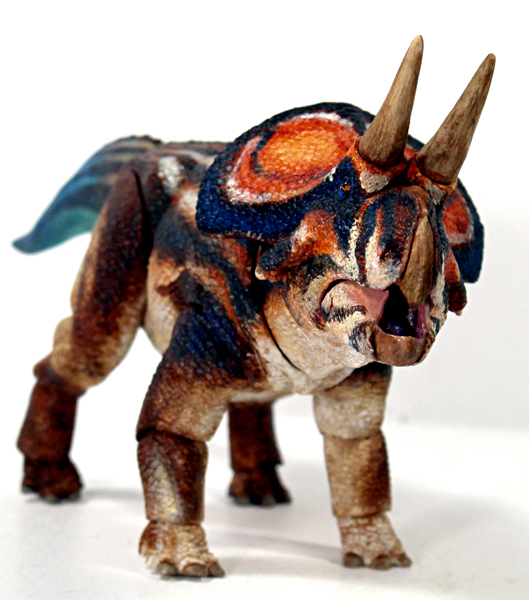
An articulated replica of Z. christopheri was introduced to the Beasts of the Mesozoic model range.

The Beasts of the Mesozoic Articulated Zuniceratops Horned Dinosaur Figure

Beasts of the Mesozoic Zuniceratops christopheri dinosaur model.

The Beasts of the Mesozoic Zuniceratops christopheri dinosaur model.

The view the range of “raptors” and horned dinosaurs in this model series: Beasts of the Mesozoic Models and Figures.

In 2011, a giant tyrannosaurine dinosaur was named and described from a bone bed found in Shandong Province in China.  This dinosaur was named Zhuchengtyrannus magnus.  Unfortunately, the press releases announcing the discovery were sent out by the Chinese press agency on March 31st and they arrived in UK news rooms the next day.  Many media groups thought the story some kind of elaborate April Fool’s joke.  However, roaming north-eastern China in the Late Cretaceous was a very large, tyrannnosaurine dinosaur that may have been about the same size as Tyrannosaurus rex.

To read more about Zhuchengtyrannus: New Tyrannosaur Named and Described from China.

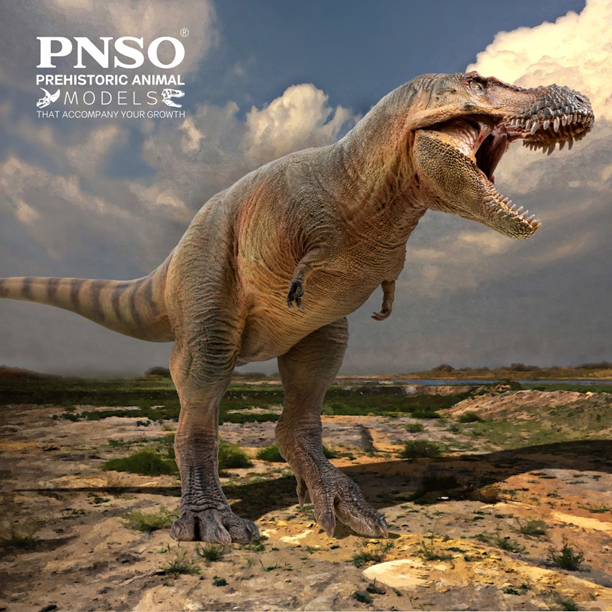
PNSO have added a spectacular replica of Zhuchengtyrannus to their mid-size model range.

A Replica of the Chinese Tyrannosaur Zhuchengtyrannus

PNSO Zhuchengtyrannus dinosaur model

The new PNSO Zhuchengtyrannus model.

To view the range of PNSO prehistoric animal models and figures: PNSO Prehistoric Animal Models and Replicas.

With so many new Chinese dinosaurs, we can expect many more dinosaurs to have names starting with the twenty-sixth letter of the western alphabet.

1 04, 2014

Digitally Reconstructing a Famous Dinosaur Trackway

By |2023-03-11T17:48:06+00:00April 1st, 2014|Categories: Dinosaur and Prehistoric Animal News Stories, Dinosaur Fans, Palaeontological articles|0 Comments

Dinosaur Tracks Lost to Science for Decades Recreated Using Digital Technology

A set of dinosaur tracks, one from a large sauropod dinosaur, the second set from a meat-eating dinosaur, have been digitally recreated permitting scientists to study the complete tracks for the first time in more than seventy years.  The footprints, which cover a distance of approximately forty-five metres, are part of a number of dinosaur trackways preserved in near marine sediments that were laid down between 113 and 110 million  years ago (Cretaceous geological period).  The theropod dinosaur’s three-toed prints overlie the larger sauropod prints and this indicates that the large herbivorous dinosaur passed first, perhaps the carnivore was stalking the sauropod.

“Dinosaur Chase Tracks”

The tracks, now forming part of the bed of the Paluxy River in Texas are often referred to as the “dinosaur chase tracks”, although scientists cannot be certain whether or not the theropod was stalking its prey.

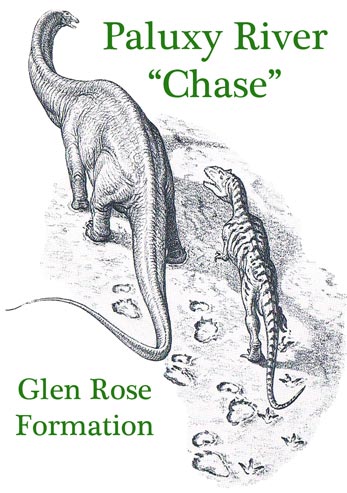
The Famous Dinosaur “Chase” Tracks (Paluxy River, Texas)

Famous dinosaur tracks - Theropod and Sauropod tracks.

Famous dinosaur tracks – theropod and sauropod tracks.

Picture credit: Everything Dinosaur from original artwork by John Sibbick

The picture above shows a potential interpretation of the Paluxy River tracks, with the huge, plant-eating dinosaur being stalked by the bipedal, theropod dinosaur.  It is difficult to assign a genus to these dinosaur footprints, but it has been speculated that the theropod may have been a member of the Acrocanthosaurus genus, as fossils of this large predator have been found in similar aged rocks and a dinosaur bone from the Glen Rose Formation, has been assigned to Acrocanthosaurus.

Famous Dinosaur Trackway

Using a technique called photogrammetry, scanning and combining photographs taken during research at the location back in the 1940s, the scientists were able to build a digital model of the site.  The computer model created is the only complete record available to study as some of the physical tracks themselves have been lost.

The Paluxy River dinosaur tracksite is among the most famous in the world.  In 1940, Dr Roland T. Bird, a American palaeontologist from the American Museum of Natural History (New York), described and excavated a portion of the site containing associated theropod and sauropod trackways, the so-called “dinosaur chase tracks”.  As the river flow was in danger of completely eroding away the dinosaur footprints, it was decided to remove the tracks in a serious of carefully excavated blocks.

The trackway was thus broken up into a number of sections.  Split up as it was, the fossil specimens were housed in different museum collections and over the years the slabs have deteriorated and a portion of the track has been lost.

International Research Team

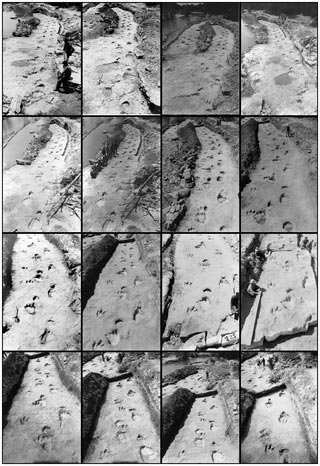
The research team, which included scientists from Liverpool University, the Royal Veterinary College (London) and Indiana-Purdue University, Indiana, applied state-of-the-art photogrammetric techniques to seventeen black and white photographs of the tracks that had been taken by Dr Bird during the 1940 trace fossil study.  By producing highly detailed scans of the original photographs and their corresponding negatives the researchers were able to digitally reconstruct the site prior to its fateful excavation.

Furthermore, the three-dimensional study was able to corroborate sketches drawn by Dr Bird when the trackway was first scientifically described.

Sixteen of the Photographs from the 1940 Expedition Used to make the 3-D Digital Map

Some of the original photographs used to create the 3-D image.

Some of the original photographs used to create the 3-D image.

Picture credit: PLOS One

This new mapping technique demonstrates the exciting potential for digitally recreating palaeontological, geological, or archaeological specimens that have been lost to science, but for which photographic documentation still exists.

Dinosaur Footprints

Using dinosaur footprints made back in the Aptian/Albian faunal stage of the Cretaceous, this work has dramatically illustrated the potential for the technique of historical photogrammetry, permitting the creation of highly detailed and precise 3-D maps of sites that may have been physically lost and just preserved in photographs.  In this instance, the last time the set of dinosaur tracks was complete was back in 1940 prior to the removal of the footprint blocks.

Commenting on the significance of this study, lead researcher Dr Peter Falkingham (Royal Veterinary College) stated:

“Here we’re showing that you can do this to lost or damaged specimens or even entire sites if you have photographs taken at the time.  That means we can reconstruct digitally, and 3-D print, objects that no longer exist.”

Go to Top