All about dinosaurs, fossils and prehistoric animals by Everything Dinosaur team members.

Articles, features and information which have slightly more scientific content with an emphasis on palaeontology, such as updates on academic papers, published papers etc.

8 03, 2021

Unlocking Evolutionary Secrets – A Plant Pompeii

By |2024-05-21T07:14:17+01:00March 8th, 2021|Categories: Adobe CS5, Main Page, Palaeontological articles, Photos/Pictures of Fossils|0 Comments

Stunning fossil plants preserved within a volcanic ash fall in China have shed light on an evolutionary race 300 million years ago, which was eventually won by the seed-bearing plants that dominate the flora of our planet today.

New research into fossils found at the “Pompeii of prehistoric plants”, in Wuda, Inner Mongolia, reveals that the plants, called Noeggerathiales, were highly-evolved members of the lineage from which came seed plants.

Reconstruction of the crown of Paratingia wuhaia
A reconstruction of the crown of Paratingia wuhaia. A newly described prehistoric plant from the Early Permian.

The Importance of Noeggerathiales

Noeggerathiales were important peat-forming plants that lived around 325 to 251 million years ago (Late Carboniferous to the end of the Permian). Understanding their relationships to other plant groups has been limited by poorly preserved examples until now. The beautiful fossils found in China have allowed experts to work out that Noeggerathiales are more closely related to seed plants than to other fern groups.

No Evolutionary Dead-end

No longer considered an evolutionary cul-de-sac, they are now recognised as advanced tree-ferns that evolved complex cone-like structures from modified leaves. Despite their sophistication, Noeggerathiales fell victim to the profound environmental and climate changes of 251 million years ago that destroyed swamp ecosystems globally (End Permian mass extinction event).
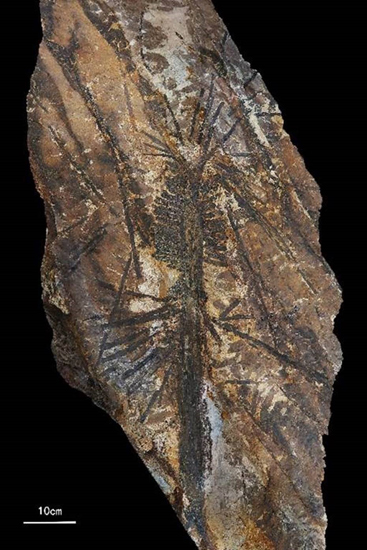
Fossil specimen of the new species (Paratingia wuhaia)
Fossil specimen of the new species (Paratingia wuhaia) preserving the crown of the tree with leaves and its fertile organs attached to the stem.

Co-author of the scientific paper, published this month in the Proceedings of the National Academy of Sciences (PNAS), Dr Jason Hilton, Reader in Palaeobiology at the University of Birmingham’s Institute of Forest Research, commented:

“Noeggerathiales were recognised as early as the 1930s, but scientists have treated them as a ‘taxonomic football’, endlessly kicked around without anyone identifying their place in the story of life. The spectacular fossil plants found in China are becoming renowned as the plant equivalent of Pompeii. Thanks to this slice of life preserved in volcanic ash, we were able to reconstruct a new species of Noeggerathiales that finally settles the group’s affinity and evolutionary importance.”

A Stark Warning for Us

The researchers comment that the fate of advanced Noeggerathiales is a stark reminder of what can occur when a sophisticated and seemingly well-adapted form of life is faced with rapid, dramatic environmental change.

The scientists studied complete Noeggerathiales preserved in a bed of volcanic ash 66 cm thick formed 298 million years ago (Early Permian), smothering all the plants growing in a nearby swamp. The ash stopped the fossils from rotting or being consumed and preserved many complete individuals in microscopic detail.
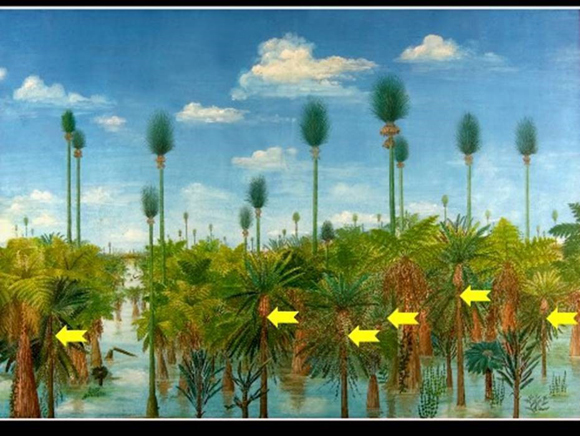
A Life Reconstruction of the Early Permian Wuda Tuff Flora
A life reconstruction of the swamp (yellow arrows indicate the newly named plant species (Paratingia wuhaia).

Lead-Author Jun Wang, (Nanjing Institute of Geology and Palaeontology), added:

“Many specimens were identified in excavations in 2006-2007 when a few leaves were visible on the surface of the ash. It looked they might be connected to each other and a stem below – we revealed the crown on site, but then extracted the specimens complete to take them back to the lab. It has taken many years to study these fully and the additional specimens we have found more recently. The complete trees are the most impressive fossil plants I have seen and because of our careful work they are also some of the most important to science.”

An Extensive Ancestral Lineage

The research team postulate that that the ancestral lineage from which seed plants evolved diversified alongside the earliest seed plant radiation during the Devonian, Carboniferous and Permian periods, and did not rapidly die out as previously thought.

Everything Dinosaur acknowledges the assistance of a press release from the University of Birmingham in the compilation of this article.

The scientific paper: “Ancient noeggerathialean reveals the seed plant sister group diversified alongside the primary seed plant radiation” by Jun Wang, Jason Hilton, Hermann W. Pfefferkorn, Shijun Wang, Yi Zhang, Jiri Bek, Josef Pšenička, Leyla J. Seyfullah and David Dilcher published in the Proceedings of the National Academy of Sciences.

The Everything Dinosaur website: Dinosaur Toys and Gifts.

7 03, 2021

The First Rebbachisaurid Sauropod Reported from Asia

By |2024-05-21T07:12:17+01:00March 7th, 2021|Categories: Dinosaur and Prehistoric Animal News Stories, Dinosaur Fans, Main Page, Palaeontological articles, Photos/Pictures of Fossils|0 Comments

An open-access paper has recently been published in the on-line academic journal PLOS One announcing the discovery of a new species of rebbachisaurid sauropod. The newly described dinosaur named Dzharatitanis kingi is the first member of the Rebbachisauridae family to have been found in Asia. Rebbachisaurids are known from Europe, Africa South America and possibly North America. They are related to diplodocids such as Brontosaurus and Apatosaurus and most palaeontologists group them in the Diplodocoidea superfamily along with the Diplodocidae and the rare and enigmatic Dicraeosauridae dinosaurs.

A Life Reconstruction of Dzharatitanis kingi
Dzharatitanis kingi the first rebbachisaurid to be described from Asia. Picture credit: Alexander Averianov. The large pterosaurs walking in the same direction as the sauropod probably represent the azhdarchid Azhdarcho, the only pterosaur to have been described to date from fossils found in the Bissekty Formation.

Described from a Single Fossil Bone

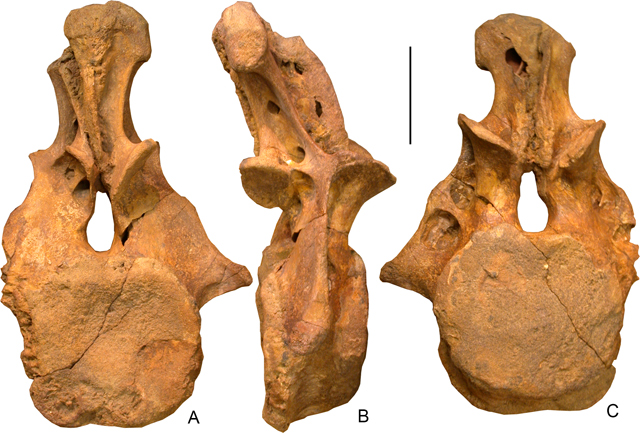
Described from a single, well-preserved tail bone from the base of the tail (anterior caudal vertebra), this herbivore is estimated to have been around 15 to 20 metres in size. The fossil bone was found in 1997, by David Ward and one of the authors of the scientific paper, Hans-Dieter Sues, during the Uzbekistan/Russian/British/American/Canadian exhibition to map and document Late Cretaceous Dzharakuduk escarpment outcrops associated with the Bissekty Formation in the Kyzylkum Desert of Uzbekistan.

Dzharatitanis is (as far as Everything Dinosaur team members are aware), the first sauropod to have been formally described from the Bissekty Formation.

The strata associated with the fossil find are believed to be around 90 million years of age (Turonian stage of the Late Cretaceous). D. kingi represents one of the geologically youngest known rebbachisaurids.

Dzharatitanis caudal vertebra
Dzharatitanis kingi, USNM 538133 (holotype), anterior caudal vertebra in posterior (A), right lateral (B), and anterior (C) views. Note scale bar = 10 cm. Picture Credit: Alexander Averianov and Hans-Dieter Sues

“Dzharakuduk titan”

The genus name is derived from the Dzharakuduk escarpment and translates as “Dzharakuduk titan”, whereas the species name honours the late Dr Christopher King who did much to map and document the geology of the Cretaceous-aged strata of central Asia.

Numerous “pencil-shaped” teeth along with isolated bones indicate the presence of sauropods within the Bissekty Formation however, D. kingi is the first member of the Sauropoda to be described. The caudal vertebrae of these types of dinosaur are very diagnostic. Their shape and characteristics help palaeontologists to identity related genera and this single fossil bone, believed to represent the first bone of the tail was sufficient to merit the erection of a new dinosaur species.

The sauropods from the Bissekty Formation now comprise at least two taxa, the rebbachisaurid Dzharatitanis kingi and an indeterminate and as yet unnamed titanosaur.

The scientific paper: “First rebbachisaurid sauropod dinosaur from Asia” by Alexander Averianov and Hans-Dieter Sues published in PLOS One.

The Everything Dinosaur website: Everything Dinosaur.

6 03, 2021

New Research Suggests Troodontids in Europe

By |2024-05-21T07:09:48+01:00March 6th, 2021|Categories: Adobe CS5, Dinosaur and Prehistoric Animal News Stories, Dinosaur Fans, Main Page, Palaeontological articles, Photos/Pictures of Fossils|0 Comments

A team of international scientists including Steve Brusatte (University of Edinburgh), have confirmed the presence of troodontids in the Late Cretaceous of Europe. A new species of troodontid has been erected based on the discovery of a single metatarsal bone (the second metatarsal bone from the right foot), from Late Cretaceous strata in the Talarn Formation exposed at the Sant Romà d’Abella site in the southern Pyrenean region of Spain. This new dinosaur has been named Tamarro insperatus.

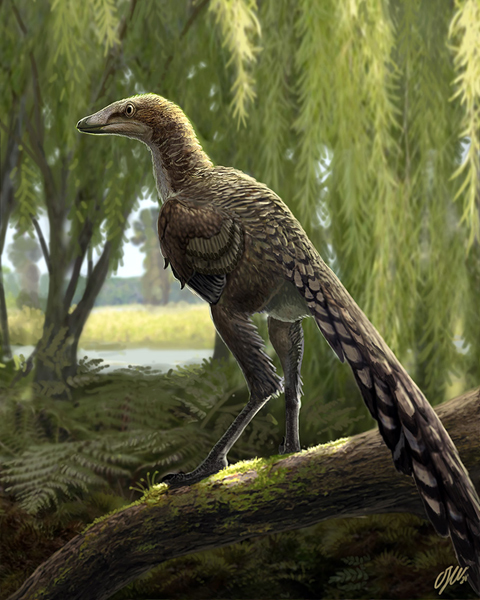
Tamarro insperatus Life Reconstruction
A life reconstruction of the first troodontid confirmed from the Late Cretaceous of Europe Tamarro insperatus.

Picture credit: Oscar Sanisidro

Found in 2003

The single fossil bone indicating the presence of troodontids in Europe was found in September 2003 by a team of palaeontologists from the Museu de la Conca Dellà (Lleida, Isona, Spain) at the Sant Romà d’Abella site (Spain). It was found in fluvial floodplain deposits believed to have been laid down just 200,000 years or so before the K-Pg mass extinction event.

The fossil bone was found in the same horizon as plant fossils and the type specimen of the lambeosaurine Pararhabdodon isonensis, the metatarsal was found in close proximity to the Pararhabdodon type specimen, these are the only two vertebrates known from this site.

The Dinosaurs from the Late Cretaceous of Europe

During the Late Cretaceous, high sea levels ensured that much of the European landmass we know today was underwater. Numerous islands existed, creating an extensive archipelago and several dinosaurs associated with these islands exhibit dwarfism or other unusual features associated with isolated ecosystems. Very little is known about the Theropoda that inhabited these islands. For example, the presence of troodontids in Europe has been debated for a long time. Several troodontid-like and Paronychodon teeth (a nomen dubium taxa referred by some to the Troodontidae), were recovered from the Campanian and Maastrichtian deposits of the ancient Hateg (Romania) and Ibero-Armorican (Portugal, France and Spain) islands, but this fossil bone provides definitive, unequivocal proof of these theropods being present in the Late Cretaceous of Europe.

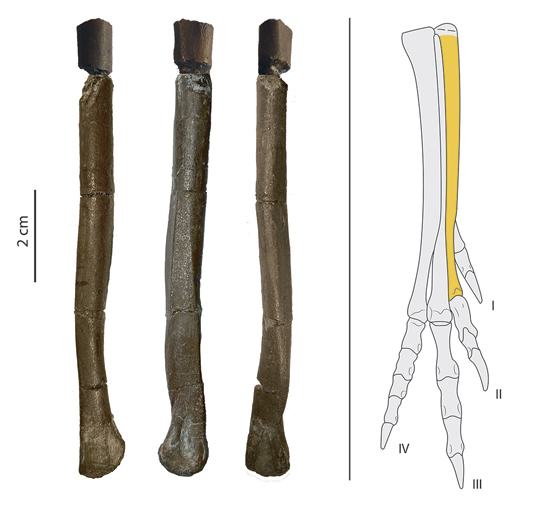
The Single Fossil Bone (Metatarsal) of Tamarro insperatus
Views of the second metatarsal (metatarsal II from the right foot), plus line drawing showing the skeletal position of the bone.

Picture credit: Albert G. Sellés (Institut Català de Paleontologia Miquel Crusafon/Museu de la Conca Dellà)

A Basal Troodontid with Asian Origins

An analysis of the bone and a phylogenetic assessment suggests that Tamarro is a basal member of the Troodontidae family and most likely a representative of the Asian subfamily the Jinfengopteryginae. The research team speculate on how a dinosaur with relatives in Asia could have become established in Europe. Maastrichtian troodontids like Tamarro could have reached Europe during the Cenomanian faunal stage and persisted on these islands until the K-Pg extinction event.

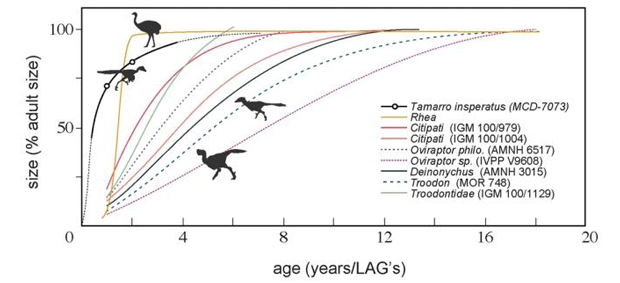
Estimated at around two metres in length Tamarro is around twice the size of other related troodontids. A close examination of the bone (cross-sectional histology), reveals that the metatarsal came from a subadult animal that was growing rapidly. Although troodontids are known to have fast growth rates, Tamarro seemed to be growing much quicker than other members of the Troodontidae, perhaps reaching full maturity in around two years.

Tamarro insperatus Growth Rate
Growth rate of Tamarro insperatus compared to other members of the Maniraptora. When compared to other taxa from the group of dinosaurs most closely related to birds (including Aves), Tamarro has a rapid growth rate reaching a subadult state in around one year.

The genus name is derived from the Catalan word “Tamarro” which refers to a small, mythical creature from local folklore. The species or trivial name “insperatus” is from the Latin for unexpected, a reference to the unexpected discovery of the fossil bone.

The scientific paper: “A fast-growing basal troodontid (Dinosauria: Theropoda) from the latest Cretaceous of Europe” by Albert G. Sellés, Bernat Vila, Stephen L. Brusatte, Philip J. Currie and Àngel Galobart published in Scientific Reports.

The Everything Dinosaur website: Dinosaur Models and Gifts.

3 03, 2021

Ninjatitan zapatai the Earliest Known Titanosaur Unveiled by New Research

By |2024-05-21T06:31:17+01:00March 3rd, 2021|Categories: Dinosaur Fans, Main Page, Palaeontological articles, Photos/Pictures of Fossils|0 Comments

Scientists have identified a new species of titanosaur from fragmentary fossil remains found in northern Patagonia (Argentina). Readers of Everything Dinosaur’s blog will know that there have been many amazing titanosaur fossil discoveries from Argentina featured on this site. Some of the largest dinosaurs known to science have been described from fossil material found in Patagonia, giants such Argentinosaurus, Patagotitan and Dreadnoughtus as well as slightly smaller ones, for example Sarmientosaurus (S. musacchioi)* with its beautifully preserved skull and the recently described Punatitan and Bravasaurus**.

However, the new species named Ninjatitan zapatai, is perhaps much more significant when it comes to the Titanosauria clade. The fossils from this titanosaur come from the Lower Cretaceous Bajada Colorada Formation located in Neuquén Province. Ninjatitan roamed Argentina around 140 million years ago, as such it could be the earliest known titanosaur sauropod, further strengthening the theory that these types of sauropod originated from South America.

A Life Reconstruction of Ninjatitan zapatai

Ninjatitan Life Reconstruction
Ninjatitan zapatai life reconstruction.

Picture credit: Jorge A. González courtesy of Fundación Azara.

Known from Fragmentary Remains

In 2014, Jonatan Aroca, a technician at the Ernesto Bachmann Municipal Museum, was exploring a rocky outcrop close to the Limay River between the towns of Picún Leufú and Piedra del Águila (Neuquén Province), when he spotted a large fossil bone eroding out of the sediments. This fossil proved to be the scapula (shoulder blade) and subsequent excavations revealed two dorsal vertebrae, a fibula, part of the femur and a tail bone. After the materials had been extracted and technically prepared and cleaned in the laboratory of the Chocón Museum, it was determined that this was a new species of sauropod titanosaur.

The Scapula (Shoulder Blade) is Excavated

Ninjatitan Scapula Being Excavated
The scapula of Ninjatitan is slowly and carefully excavated.

Picture credit: Jorge A. González courtesy of Fundación Azara.

The Origin of the Titanosauria

In recent years, several studies have postulated that the origin of the Titanosauria clade would have been in the early Cretaceous (about 140 million years ago) and somewhere in South America. However, until now, these hypotheses were not clearly supported by fossil evidence, but were the results of theoretical studies with statistical models.

Lead author of the scientific paper, Pablo Gallina, a CONICET (Consejo Nacional de Investigaciones Científicas y Técnicas), palaeontologist from the Palaeontology Area of the Azara Foundation and Maimonides University commented:

“This finding allows us to reinforce the idea that titanosaurs appeared in South America. It was thought that they might have first appeared there, but there was no real evidence, with fossils, to prove it. This finding gives more support to this theory.”

The Stunning Landscape of the Limay River

The Lower Cretaceous Bajada Colorada Formation (Argentina)
The Lower Cretaceous Bajada Colorada Formation in Neuquén Province, Argentina. The rocks from which the Ninjatitan fossil material came are believed to be around 140 million years old.

Picture credit: Jorge A. González courtesy of Fundación Azara.

Everything Dinosaur acknowledges the assistance of a media release from CONICET in the compilation of this article.

At an estimated 20 metres in length Ninjatitan may not be the largest titanosaur from Argentina, but because of its age, it might just prove to be one of the most important South American titanosaur discoveries ever made.

Read our article about Sarmientosaurus* here: A New Late Cretaceous Titanosaur from Patagonia – Sarmientosaurus.

For our recent article on the titanosaurs Punatitan and Bravasaurus** click here: Two New South American Titanosaurs.

The scientific paper: “The Earliest Known Titanosaur Sauropod Dinosaur” by Pablo Ariel Gallina, Juan Ignacio Canale and José Luis Carballido published in Ameghiniana.

The Everything Dinosaur website: Dinosaur Models and Toys.

2 03, 2021

Why So Few Medium-sized Carnivorous Dinosaurs?

By |2024-05-21T06:27:00+01:00March 2nd, 2021|Categories: Dinosaur and Prehistoric Animal News Stories, Dinosaur Fans, Main Page, Palaeontological articles|0 Comments

Researchers from the University of Nebraska-Lincoln and University of New Mexico have come up with a novel explanation as to why there are so few medium-sized carnivorous dinosaurs found in the fossil record.

In a scientific paper published in the academic journal “Science” they propose that sub-adults and juveniles of much larger species out-competed similarly sized adults of medium-sized meat-eating dinosaurs resulting in a transformation of dinosaur community populations.

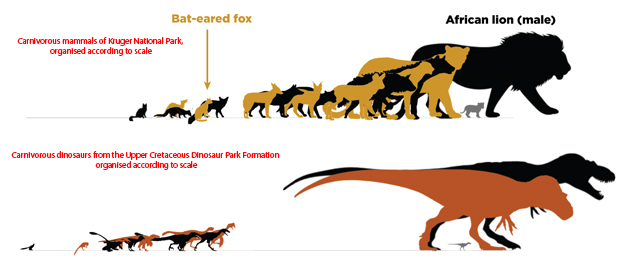
Comparing Mammalian and Dinosaurian Carnivorous Communities

Comparing Mammalian Predator Communities to Dinosaur Predator Communities
Did juvenile and sub-adult hypercarnivores drive out the medium-sized meat-eaters?

Picture credit: Schroeder et al (Science)

Communities with Megatheropods Lacked Medium-sized Carnivores

The researchers identified that based on the known fossil record, communities of dinosaurs with super-sized theropods such as the Dinosaur Provincial Park fauna (Campanian faunal stage of the Late Cretaceous), lacked medium-sized carnivorous dinosaurs in the size range from 100 kilograms to 1,000 kilograms.

In contrast, modern mammalian communities such as that which exists on the savannah of Kruger National Park in South Africa have predators in a range of sizes, small ones such as mongooses, medium-sized species such as wild dogs as well as mega-carnivores such as leopards and lions. Each meat-eating species is able to exploit a food resource (prey animals). The distinctive biology of the Dinosauria wherein, all predators hatched from eggs so started out as tiny in size perhaps less than ten kilogrammes for even the largest tyrannosaurids, may have led to a fundamental shift in predator community dynamics.

Rapidly growing juveniles and sub-adults of the larger species could have out-competed the fully grown medium-sized carnivores (mesocarnivores).

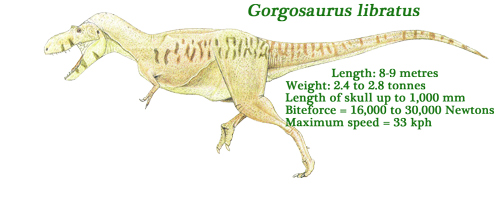
Gorgosaurus libratus – An Apex Predator of the Dinosaur Park Formation

Gorgosaurus libratus illustrated.
Did juvenile and sub-adult tyrannosaurids such as Gorgosaurus and Daspletosaurus out-compete mesocarnivores? Picture credit: Everything Dinosaur.

Picture credit: Everything Dinosaur

Lead author PhD student Katlin Schroeder (University of New Mexico), explained:
“Dinosaur communities were like shopping malls on a Saturday afternoon — jam-packed with teenagers. They made up a significant portion of the individuals in a species and would have had a very real impact on the resources available in communities.”

Compiling Physiological Data on Dinosaur Dominated Ecosystems

The researchers compiled physiological and fossil data on more than 550 different dinosaur species from 43 different dinosaur dominated ecosystems. They found that there was an absence of mesocarnivores. The scientists concluded that it was the teenage megatheropods that created and filled this gap in the community. After dividing this 100 to 1,000 kilogram gap into different weight categories, they found that juvenile megatheropods made up more than 50% of the total dinosaur biomass in every weight class. This is like a boxer destined to be the heavyweight champion dominating the bantam, lightweight and middleweight classes during their rise to the top.

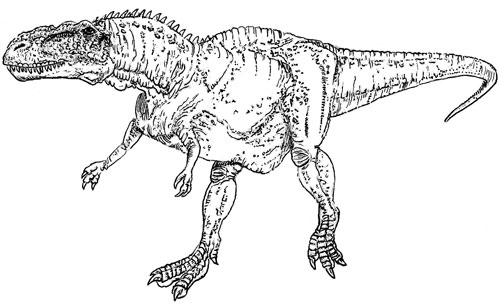
Abelisaurids Also Drove out Mesocarnivores

A drawing of a dinosaur (Abelisaurus).
A typical large theropod dinosaur. Like the Tyrannosauridae, abelisaurs were the megatheropods in a number of dinosaur communities that lacked mesocarnivores. Picture credit: Everything Dinosaur.

Picture credit: Everything Dinosaur

Driving Out the Medium-sized Meat-eaters

Although herbivorous dinosaurs were found in a range of different body sizes, including medium-sized ones, the team concluded that when it came to the meat-eaters, the way in which large carnivorous dinosaurs grew was an important factor that helped shape dinosaur community structure and diversity.

Co-author of the study, Kate Lyons (Assistant Professor of Biological Sciences at the University of Nebraska-Lincoln), added that the research:

“Essentially says that megatheropods were consuming 50% or more of the energy available to dinosaurs at a respective body size, leaving very little for other species to consume. If they were consuming the majority of the energy at that body size, then they were going to be outcompeting anything else that might try to feed at that size, as well.”

A Difference in Jurassic and Cretaceous Dinosaur Communities

It was noted that there was a subtle difference between dinosaur communities from the Jurassic with those from the Cretaceous. Generally, there were smaller gaps in the size range of carnivorous dinosaurs during the Jurassic when compared to the size gap seen in later communities dating from the Cretaceous.

Katlin Schroeder postulated that this difference came about because:

“Jurassic megatheropods don’t change as much, the teenagers are more like the adults, which leaves more room in the community for multiple families of megatheropods as well as some smaller carnivores. The Cretaceous, on the other hand, is completely dominated by tyrannosaurs and abelisaurs, which change a lot as they grow.”

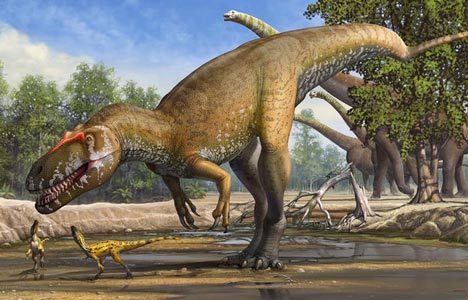
Jurassic Ecosystems

T. gurneyi.
Torvosaurus gurneyi a top predator of Portugal from the Late Jurassic but there were also mesocarnivores in this ecosystem too such as Lourinhanosaurus, Ceratosaurus and Lusovenator.

Picture credit: Sergey Krasovskiy

The scientific paper: “The influence of juvenile dinosaurs on community structure and diversity” by Katlin Schroeder, S. Kathleen Lyons and Felisa A. Smith published in Science.

Visit the Everything Dinosaur website: Everything Dinosaur.

26 02, 2021

Concentrated Levels of Iridium Found at Chicxulub Impact Site

By |2024-05-19T12:06:38+01:00February 26th, 2021|Categories: Adobe CS5, Dinosaur Fans, Geology, Main Page, Palaeontological articles|0 Comments

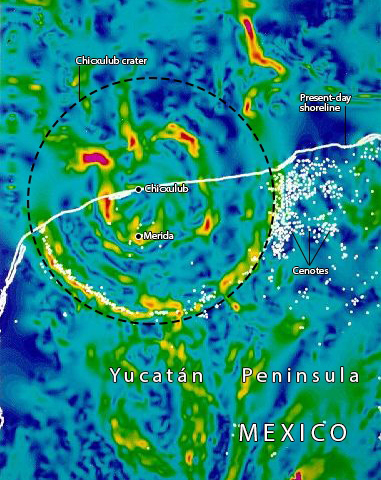
High levels of the rare Earth element iridium have been found in drill cores taken from the peak-ring sequence of the Chicxulub impact site located on the Yucatan peninsula (Mexico). This evidence further supports the theory that the extra-terrestrial space object that smashed into our planet some 66 million years ago is linked to the Cretaceous-Palaeogene (K-Pg) mass extinction event.

The day that everything changed. Scientists have found more evidence linking the Chicxulub impact event to the K-Pg mass extinction.

Picture credit: Map from Nature Geoscience / illustration courtesy of NASA

In 2016, IODP-ICDP* Expedition 364 drilled into the Chicxulub crater’s peak ring, an irregular ring of hills that surrounds the crater’s centre bringing around 835 metres of rock to the surface for detailed laboratory analysis.

* IODP (International Ocean Discovery Program) and the ICDP (International Continental Scientific Drilling Program).

The Chicxulub Impact Site

Iridium is extremely rare on Earth. However, a spike in levels has been recorded at numerous sites around the world that represent deposits laid down around 66 million years ago. The researchers state that the iridium levels found in the drill cores are four times more concentrated than elsewhere. The scientists found iridium levels were highest across the transition into early Paleogene sediments (Danian faunal stage).

Geophysical Map of the Chicxulub Impact Crater
A geophysical map of the impact crater and the Chicxulub crater peaks from which the drill cores were taken.

Picture credit: NASA

A Vapourised Bolide

Writing in the academic journal “Science Advances” the researchers conclude that this evidence combined with the spike in worldwide iridium deposits at the time of the mass extinction event, constitutes indisputable evidence that the suspected dinosaur-killing bolide that created the Chicxulub crater was indeed the culprit.

Commenting on the significance of this research, co-author Professor Joanna Morgan (Imperial College London) stated:

“This asteroid was vaporised and ejected from the impact site at high speed. Iridium, and other asteroidal material, then circled the Earth above the stratosphere within a fast-moving dust cloud and may have taken up to two decades to settle through the atmosphere and ocean before being deposited at the impact site.”

Lead author of the study, Professor Steven Goderis of the Free University of Brussels-VUB added:

“It’s quite remarkable that we found concentrations this high within the impact structure itself. In the first hours to months after the impact, the crater was a highly turbulent environment affected by tsunamis and earthquakes. Luckily, the iridium layer was preserved. This unquestionably ties the formation of the crater to the mass extinction event that marked the end of the Cretaceous and confirms that the asteroid impact and dinosaur extinction are indisputably linked.”

Identifying the K-T Boundary (Iridium Clay Layer)
Identifying concentrations of the rare Earth element iridium in a clay layer. At various locations around the world geologists have identified an iridium rich clay layer that marks the end of the Cretaceous and the beginning of the Palaeogene (K-T boundary).

Picture credit: The Open University/Everything Dinosaur

Everything Dinosaur acknowledges the contribution of a media release from Imperial College London in the compilation of this article.

To read a related article looking at how palaeontologists interpret fossil evidence of a global impact event: Quarry Site Might Reveal Evidence of Cretaceous Mass Extinction Event.

The scientific paper: “Globally distributed iridium layer preserved within the Chicxulub impact structure” by Steven Goderis, Honami Sato, Ludovic Ferrière, Birger Schmitz, David Burney, Pim Kaskes, Johan Vellekoop, Axel Wittmann, Toni Schulz, Stepan M. Chernonozhkin, Philippe Claeys, Sietze J. de Graaff, Thomas Déhais, Niels J. de Winter, Mikael Elfman, Jean-Guillaume Feignon, Akira Ishikawa, Christian Koeberl, Per Kristiansson, Clive R. Neal, Jeremy D. Owens, Martin Schmieder, Matthias Sinnesael, Frank Vanhaecke, Stijn J. M. Van Malderen, Timothy J. Bralower, Sean P. S. Gulick, David A. Kring, Christopher M. Lowery, Joanna V. Morgan, Jan Smit, Michael T. Whalen and the IODP-ICDP Expedition 364 Scientists published in Science Advances.

Visit the Everything Dinosaur website: Everything Dinosaur.

16 02, 2021

How Long is a Dinosaur’s Tail?

By |2024-05-19T08:11:13+01:00February 16th, 2021|Categories: Dinosaur and Prehistoric Animal News Stories, Dinosaur Fans, Main Page, Palaeontological articles, Photos/Pictures of Fossils|0 Comments

How Long is a Dinosaur’s Tail?

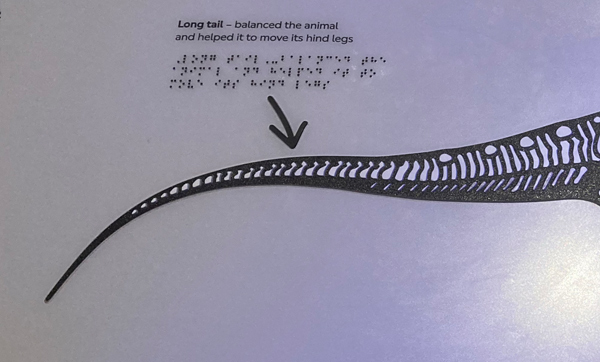
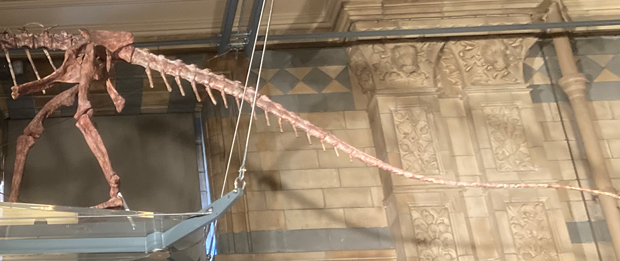
How long is the tail of a dinosaur?  That’s a good question, one that has quite a complicated answer, but if a definitive assessment of the morphology of caudal vertebrae (tail bones) of the Dinosauria could be carried out, then palaeontologists would be better able to piece together (literally), the tails of dinosaurs and assess their length from even fragmentary remains.

The Tail of a Huge Titanosaur (Sauropod Dinosaur)

A dinosaur tail (titanosaur).

The tail of a dinosaur (titanosaur). Picture credit: Everything Dinosaur.

Picture credit: Everything Dinosaur

For dinosaur and prehistoric animal models: Prehistoric Animal and Dinosaur Models.

A Dinosaur Tail

Research led by Dr David Hone (Queen Mary University of London), in collaboration with colleague Dr Steven Le Comber (who sadly passed away in 2019) and Dr Scott Persons of Mace Brown Museum of Natural History (Charleston, South Carolina, USA), permitted a comprehensive dataset of dinosaur tails to be built up.  The data indicates that there is considerable variation in the caudal vertebrae of members of the Dinosauria.  The number of tail bones varies, as does their morphology (shape).  In addition, overall length of the tail as a proportion of body size is inconsistent within the very diverse dinosaur clade.

With such variation, comparing tails of different genera or even dinosaurs from the same family will prove troublesome.

However, the scientists did identify some general patterns that could prove useful when it comes to learning about a genus with only a few tail bones to work with.

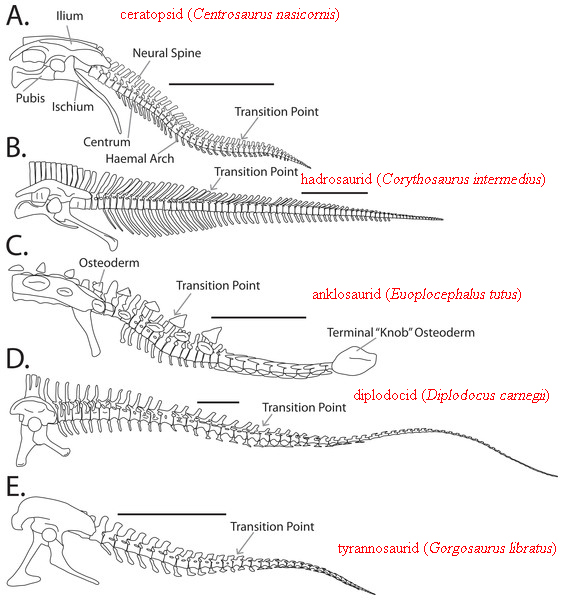
What’s in a Tail?  The Great Variation within the Tails of Dinosaurs

Different types of dinosaur tail.

Examples of different dinosaur tails.  Note scale bar = 1 metre.

Picture credit: Hone et al (PeerJ) with additional annotation by Everything Dinosaur

General Principles of Dinosaur Tails

Patterns of changes in centra lengths (the central part of each vertebra) along the tails of dinosaurs do vary.  However, the researchers did identify some general principles in terms of the bones that make up the tails.  For example, when viewing the tail bones from the base of the tail down to the tip, several different dinosaurs show a pattern of short centra, followed by a sequence of longer centra, with the remainder of the tail being made up of a long series of centra tapering in length.

The team suggest that this general pattern is consistent with the function of different parts of the tail, the longer centra quite near to the base of the tail help to provide support for the attachment of the large muscles associated with the top of the leg and this region of the tail.  This general pattern is not found in many early types of dinosaur, so the researchers conclude that this trait must have evolved independently in different kinds of dinosaurs over time.

A Reconstruction of the Tail of a Massospondylus

Massospondylus dinosaur tail.

Massospondylus dinosaur tail. Picture credit: Everything Dinosaur.

Picture credit: Everything Dinosaur

Deducing Form and Function

Writing in the on-line journal “PeerJ”, the scientists state that the number of vertebrae in a given section of tail can indicate its flexibility or its stiffness.  The more vertebrae recorded over a given distance then it is likely that this section of tail was quite flexible.  Conversely, the fewer joints in any length of tail will imply reduced flexibility.

General conclusions about dinosaur tails could be made, for example:

  1. The base of many dinosaur tails was flexible and allowed virtually the whole tail to be swung as a collective whole, helping to stabilise the animal as it moved and perhaps also having a defensive function in some herbivores.
  2. Just passed the tail base there was a zone of relative stiffness that supported the muscles associated with the tail and rear legs (caudofemoralis musculature).
  3. After the termination of the caudofemoralis and for a highly variable distance, the remaining vertebrae tapered to a reduced size.

The scientific paper: “New data on tail lengths and variation along the caudal series in the non-avialan dinosaurs” by David W. E. Hone, W. Scott Persons and Steven C. Le Comber published in PeerJ.

Vist the Everything Dinosaur website: Everything Dinosaur.

5 02, 2021

Research Suggests Horned Dinosaurs Evolved Frills to Attract Mates

By |2024-05-18T22:04:02+01:00February 5th, 2021|Categories: Dinosaur and Prehistoric Animal News Stories, Dinosaur Fans, Main Page, Palaeontological articles, Photos/Pictures of Fossils|0 Comments

Horned Dinosaurs Evolved Frills to Attract Mates

The ornate and very diverse head crests and frills of horned dinosaurs (ceratopsians) probably evolved to help them attract a mate.  That is the conclusion from a study recently published in the Proceedings of the Royal Society B.

Why Did Some Horned Dinosaurs Have Elaborate Frills?

Ever since the first horned dinosaurs were discovered, palaeontologists have debated why these plant-eating dinosaurs evolved such elaborate neck shields (these features are produced by elaborate extensions to the parietal and squamosal skull bones).  It had been thought that these frills provided some protection from attack from theropod dinosaurs such as the contemporaneous tyrannosaurs, or perhaps they had a role in thermoregulation.

With so many different types of large ceratopsians known from the Late Cretaceous of North America it had also been suggested that these crests and frills played a role in species recognition.  An extensive analysis of the skulls of “first horned face” – Protoceratops (P. andrewsi), suggests that they played a role in sexual selection.

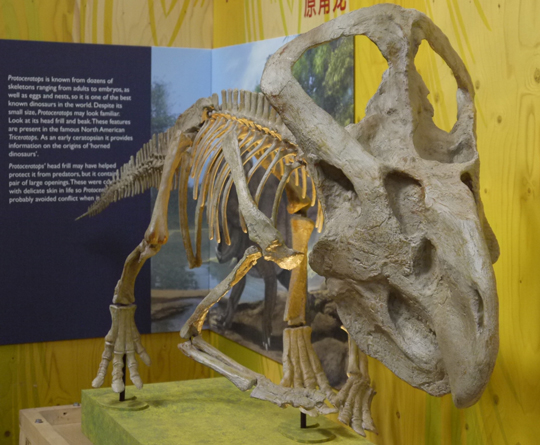
A Reconstruction of the Skeleton of Protoceratops (P. andrewsi)

Protoceratops skeleton on display.

A skeleton of a Protoceratops on display.  The elaborate head crest complete with fenestrae (two large holes), probably evolved as a result of sexual selection.  Picture credit: Everything Dinosaur.

Picture credit: Everything Dinosaur

Sexual Selection in Horned Dinosaurs

Sexual selection is a method of natural selection in which members of one biological sex choose mates of the other sex to mate with.  Certain characteristics in organisms are favoured by members of the opposite sex and organisms that possess the favoured feature(s) are the ones that breed.  This leads over time to these preferred characteristics becoming more intricate and elaborate.  There are plenty of examples to be found in the natural world today, most certainly amongst the closest living relatives of the Dinosauria the birds.  The elaborate but cumbersome tails of peacocks for instance, or the ornate and very beautiful plumes of the birds of paradise.

The researchers, which included scientists from the Natural History Museum (London) and Queen Mary University of London, used computer modelling to map how the skull of Protoceratops changed as the dinosaur grew.  Protoceratops has a rich and extensive fossil record.  Hundreds of specimens have been found ranging from embryos in unhatched eggs up to large, very old adults.  This extensive fossil record made this type of horned dinosaur an ideal candidate for this study.

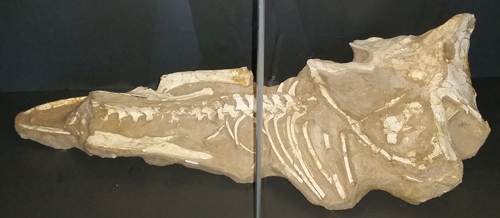
The Fossilised Remains of a Protoceratops

The fossils of a Protoceratops.

Protoceratops fossil display in Frankfurt Museum (could be a cast).  Picture credit: Everything Dinosaur.

Picture credit: Everything Dinosaur

An Important Driver of Evolution

Sexual selection is predicted to be an important driver of evolution.  It influences adaptation and the development of new species.  There are anatomical traits and characteristics that can be identified in the fossil record that indicate sexual selection within a species is at work.   The fossilised skulls of horned dinosaurs can be studied to see if any of these traits and characteristics can be found.

Predicted characteristics of horned dinosaur skulls that indicate sexual selection having an influence include:

  • Low integration with the rest of the skull.
  • A significantly higher rate of change in size and shape as the dinosaur grows.
  • A higher morphological variance in the parietal and squamosal when compared to other bones of the skull.

The computer modelling used to assess these traits supported the theory that sexual selection was at work within Protoceratops andrewsi.

No Evidence of Sexual Dimorphism in Protoceratops

Whilst it is notoriously difficult to identify males from females using just the fossil record, the large number of Protoceratops specimens gave the researchers the opportunity to see if they could spot evidence of male Protoceratops having different skull frills compared to the females.  Although the research involved a substantial sample set, no evidence of sexual dimorphism in skull shape was found.  This suggests that either there were no differences in frill shape between the boys and the girls or that any differences between the genders was very small.

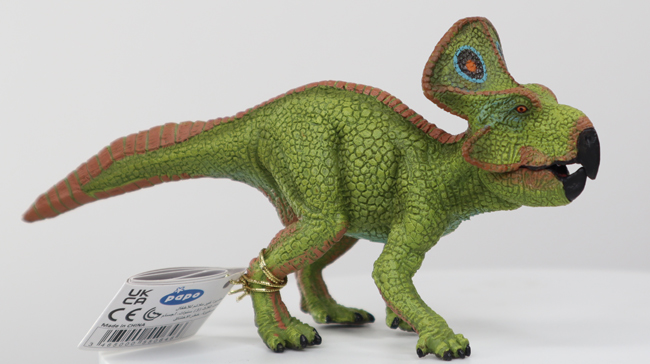
A Model of an Adult Protoceratops

Papo Protoceratops dinosaur model.

Papo Protoceratops dinosaur model.  Picture credit: Everything Dinosaur.

Picture credit: Everything Dinosaur

The image (above) shows a Papo Protoceratops dinosaur model.

To view the Papo dinosaur model range: Papo Dinosaurs and Prehistoric Animal Models.

The scientific paper supports the idea that the elaborate frills of horned dinosaurs did play a role in sexual selection.  Scientists have suspected that many of these strange anatomical features found in the Dinosauria were linked to sexual selection and display.  This evidence is extremely hard to find using the fossil record alone, however, the computer modelling and in-depth analysis used here provides evidence for the presence of signalling structures linked to sexual selection in Protoceratops andrewsi.

The scientific paper: “Three-dimensional geometric morphometric analysis of the skull of Protoceratops andrewsi supports a socio-sexual signalling role for the ceratopsian frill” by A. Knapp, R. J. Knell and D. W. E. Hone published in the Proceedings of the Royal Society B.

Visit the Everything Dinosaur website: Everything Dinosaur.

27 01, 2021

Ancient Placoderm Could Turn Vertebrate Evolution on its Head

By |2024-05-18T17:30:02+01:00January 27th, 2021|Categories: Dinosaur and Prehistoric Animal News Stories, Main Page, Palaeontological articles, Photos/Pictures of Fossils|0 Comments

Cutting-edge Technology Provides New Insights into Ancient Fish

Sophisticated, cutting-edge MicroCT scanning employed to look inside the fossilised skull of a prehistoric fish from the Early Devonian of New South Wales (Australia), has provided scientists with new insights into early vertebrate evolution and challenged the current view regarding the phylogeny and taxonomy of the bony, armoured prehistoric fishes known collectively as placoderms.

The research team, which included scientists from the University of Birmingham, the Chinese Academy of Sciences and colleagues based in Australia and Sweden, used MicroCT scanning to view the internal structures of the skull of a 400 million-year-old Brindabellaspis (Brindabellaspis stensioi) specimen.  A fish nicknamed the “platypus fish” due to its elongated snout.

Ancient Placoderm Study

Computer software was used to create a digital reconstruction of brain cavity and the inner ear.  The team discovered that Brindabellaspis possessed an inner ear that was surprisingly compact with closely connected components resembling the inner ear of modern jawed vertebrates such as sharks and bony fishes.  Some features of the inner ear from this ancient fish are remarkably similar to the structure of our own inner ear.

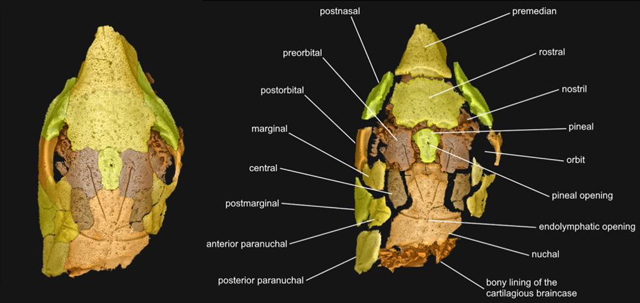
A Digital Model Showing the Skull and its Constituent Parts (Brindabellaspis stensioi)

A digital model of the skull of Brindabellaspis stensioi.

The skull of Brindabellaspis stensioi digitally recreated after MicroCT scan analysis.

Picture credit: Institute of Vertebrate Palaeontology and Palaeoanthropology

Important Implications for the Placodermi

Brindabellaspis is a member of the Placodermi, a diverse, geographically and temporally widespread class of armoured fish which thrived during the Devonian between 420 and 360 million years ago.  Most placoderms have less complex inner ear structures, with a large sac, called a vestibule, placed in the centre and separating all the other components.  The remarkably well-preserved and three-dimensional nature of the specimens from New South Wales provided the research team with an opportunity to examine the brain cavity and inner ear of Brindabellaspis for the first time.

Their findings could change the way in which the tree of life representing early vertebrates is constructed.

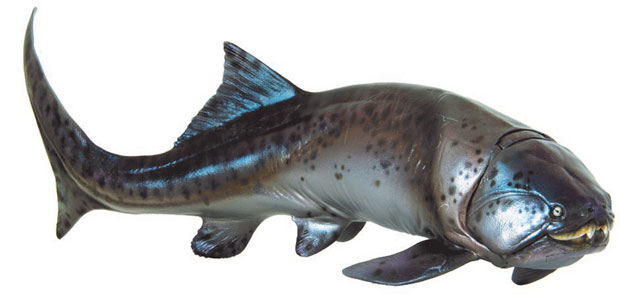
Life Reconstruction of a Devonian fish – The Giant Placoderm Dunkleosteus

Zaha the Dunkleosteus (PNSO)

A stunning model of an ancient placoderm – the PNSO Dunkleosteus model.

The picture above shows a replica of Dunkleosteus, a giant placoderm.  The model is from the PNSO range of figures.

To view this range: PNSO Prehistoric Animal Models.

Re-writing the Evolutionary History of Early Vertebrates

Previous studies had suggested that prehistoric fish such as Brindabellaspis were closely related to primitive, jawless fish (agnathans), that first evolved around 500 million years ago.  This study challenges the assumption that placoderms are a distinct group, as considerable variation has been identified in the brain cavities and inner ears of “placoderms”.

Furthermore, this research suggests the possibility that these types of fish may be the ancestors of modern jawed vertebrates (the Gnathostomata).

Co-author of the scientific paper, published in the journal Current Biology, Dr Sam Giles (University of Birmingham), stated:

“The inner ear structure is so delicate and fragile that it is rarely preserved in fossils, so being able to use these new techniques to re-examine specimens and discover this wealth of new information is very exciting.  This fossil has revealed a really intriguing mosaic of primitive features and a surprisingly modern inner ear.  We don’t yet know for certain what this means in terms of our understanding of how modern jawed vertebrates evolved, but it’s likely that virtual anatomy techniques are going to be a critical tool for piecing together this fascinating jigsaw puzzle.”

Sensitive Snouts

An earlier research paper suggested that the snout of Brindabellaspis was sensitive and may have played a role in locating food or avoiding predators.  To read Everything Dinosaur’s article from 2018 about this study: A Primitive Placoderm Platypus Fish from Australia.

Everything Dinosaur acknowledges the assistance of a media release from the University of Birmingham in the compilation of this article.

The scientific paper: “Endocast and Bony Labyrinth of a Devonian “Placoderm” Challenges Stem Gnathostome Phylogeny” by You-an Zhu, Sam Giles, Gavin C. Young, Yuzhi Hu, Mohamed Bazzi, Per E. Ahlberg, Min Zhu and Jing Lu published in Current Biology.

Visit the Everything Dinosaur website: Everything Dinosaur.

25 01, 2021

Baby Tyrannosaurs Born Ready to Hunt

By |2024-05-18T17:22:49+01:00January 25th, 2021|Categories: Adobe CS5, Dinosaur and Prehistoric Animal News Stories, Dinosaur Fans, Main Page, Palaeontological articles, Photos/Pictures of Fossils|0 Comments

Baby Tyrannosaurs Born Ready to Hunt

A new scientific paper published this week suggests that tyrannosaurs were able to hunt and to look after themselves soon after they hatched.  In addition, tyrannosaur hatchlings were surprisingly large, perhaps more than a metre long when they broke out of their eggs and if this the case, then tyrannosaur eggs would have been colossal, perhaps larger than any other dinosaur egg known to science.

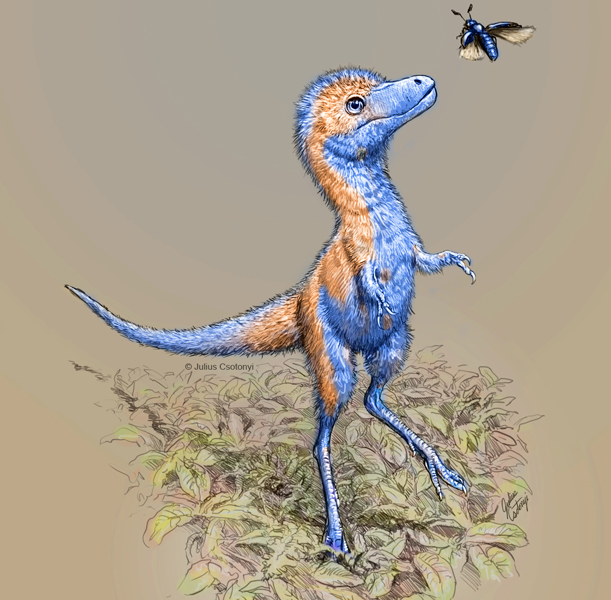
A Life Reconstruction of a Baby Tyrannosaur

Juvenile tyrannosaur life reconstruction.

A life reconstruction of a juvenile tyrannosaur.  This illustration by the talented palaeoartist Julius Csotonyi, depicts a baby tyrannosaur covered in a coat of insulating protofeathers.

Picture credit: Julius Csotonyi

As Big as a Collie Dog

Writing in the latest edition of the Canadian Journal of Earth Sciences, the scientists which include such eminent figures as Phil Currie, “Jack” Horner and Stephen Brusatte, have written up an on-line presentation from last October which took place at the virtual Society of Vertebrate Palaeontology Conference and they indicate that young tyrannosaurs were big babies.  With a length of in excess of 1 metre, that’s about the size of a border collie dog.

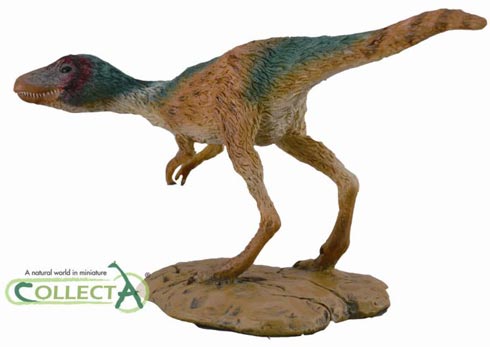
A Model of a Young Tyrannosaurus rex

A juvenile T. rex.

A young T. rex.  Research suggests that Late Cretaceous tyrannosaurs may have been around a metre in length when very young.  Rare fossil bones from perinatal tyrannosaurs from North America also suggest that these predators were highly developed and capable of hunting for themselves – precocial development – mobile and relatively fully developed when first hatched.

The model (above) is from the CollectA Prehistoric Life Age of Dinosaurs range.

To view this range: CollectA Prehistoric Life Figures.

Perinatal Tyrannosaurid Bones and Teeth

Perinatal tyrannosaurid bones and teeth from the Campanian–Maastrichtian of western North America provide the first window into this critical period of the life of a tyrannosaurid.  An embryonic dentary (Daspletosaurus horneri) from the Two Medicine Formation of Montana, measuring just 3 cm in length, already exhibits distinctive tyrannosaurine characters like a “chin” and a deep Meckelian groove, and reveals the earliest stages of tooth development.  When considered together with a remarkably large embryonic claw bone (ungual) from the Horseshoe Canyon Formation of Alberta and believed to have come from an Albertosaurus sarcophagus, a minimum hatchling size for tyrannosaurids could be estimated by the research team.

Corresponding author for the paper, Gregory Funston (University of Edinburgh), stated:

“It appears that tyrannosaurs were born ready to hunt, already possessing some of the key adaptations that gave tyrannosaurs their powerful bites.  So, it’s likely that they were capable of hunting fairly quickly after birth, but we need more fossils to tell exactly how fast that was.”

Tyrannosaur Babies Bigger than Other Dinosaur Babies

The dentary and the claw bone indicate that Late Cretaceous tyrannosaurs were bigger than any other known dinosaur babies.  The researchers conclude that they must have hatched from enormous eggs, perhaps exceeding the 43 cm length of largest dinosaur eggs described to date.

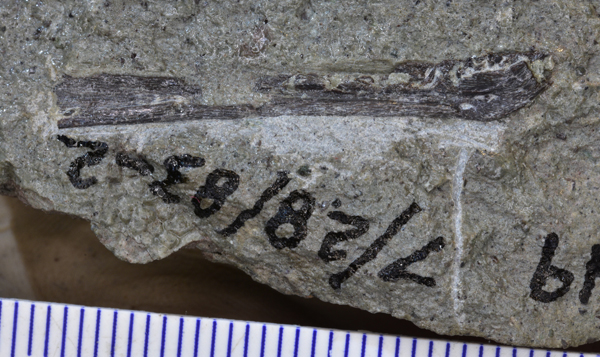
The Embryonic Tyrannosaur Dentary

Daspletosaurus horneri juvenile jawbone.

The fossilised lower jawbone (dentary) of a Daspletosaurus horneri, one of the first baby tyrannosaurs ever discovered.

Picture credit: Gregory F. Funston (University of Edinburgh)

Studying Embryonic Fossil Material

Co-author of the paper, Mark Powers a PhD student at the University of Alberta (Canada), commented:

“Tyrannosaurs are represented by dozens of skeletons and thousands of isolated bones or partial skeletons, but despite this wealth of data for tyrannosaur biology, the smallest identifiable individuals are aged three to four years old, much larger than when they would have hatched.  No tyrannosaur eggs or embryos have been found even after 150 years of searching—until now.”

The study, focused on the two fossils representing perinatal development of tyrannosaurids.  The ungual was found near Morrin in the province of Alberta, whilst the dentary came from Montana. The ungual is approximately 71.5 million years old, and the jawbone a little older at around 75 million years old.

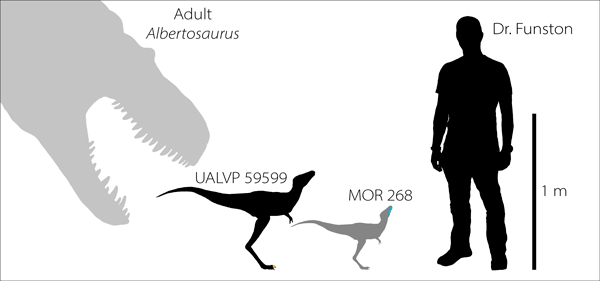
Comparing the Tyrannosaurid Fossil Material with Dr Funston and an Adult Albertosaurus

Comparing the juvenile tyrannosaur specimens.

This diagram compares the size of a full-grown Albertosaurus with that of palaeontologist Greg Funston and the two dinosaur embryos whose toe claw and jawbone were identified in a newly published study.

Picture credit: Gregory F. Funston (University of Edinburgh)

Mark Powers, who completed the research as a master’s student supervised by Phil Currie added:

“The discovery of embryonic material is a huge find in our efforts to understand how some of the most popular and charismatic dinosaurs began their life and grew to immense sizes.  It provides a much-needed—and until now, missing—data point depicting the starting point for tyrannosaur growth.”

Surprising Results

The researchers were surprised to find that the small tyrannosaur teeth in the lower jaw were distinct from the teeth of older tyrannosaurids.  They had not developed true serrations running along the cutting edges.  In addition, the toe claw (specimen number UALVP 59599), came from an animal estimated to be about 1.1 metres long, whilst the tiny jawbone (MOR 268), came from a tyrannosaur around 71 cm in length.

The size estimates for perinatal tyrannosaurs based on this study reinforce the work of the late American-Canadian palaeontologist Dale Russell, who back in 1970 provided some of the first insights into tyrannosaur development and ontogeny.  This study was published in a special issue of the Canadian Journal of Earth Sciences which honours the contribution made to vertebrate palaeontology by Professor Russell.

Everything Dinosaur acknowledges the assistance of a media release from the University of Alberta in the compilation of this article.

The scientific paper: “Baby tyrannosaurid bones and teeth from the Late Cretaceous of western North America” by Gregory F. Funston, Mark J. Powers, S. Amber Whitebone, Stephen L. Brusatte, John B. Scannella, John R. Horner and Philip J. Currie published in the Canadian Journal of Earth Sciences.

Visit the award-winning Everything Dinosaur website: Everything Dinosaur.

Go to Top