All about dinosaurs, fossils and prehistoric animals by Everything Dinosaur team members.

Articles, features and information which have slightly more scientific content with an emphasis on palaeontology, such as updates on academic papers, published papers etc.

31 01, 2022

How Much do we Know About Sauropod Necks?

By |2024-10-16T07:40:00+01:00January 31st, 2022|Categories: Palaeontological articles|0 Comments

The Sauropodomorpha consists of the long-necked sauropods and their ancestors. This clade contains many of the most famous and popular dinosaurs – Brontosaurus, Diplodocus, Brachiosaurus, Mamenchisaurus and Argentinosaurus. Casts of these huge dinosaurs, some of which represent the biggest terrestrial animals known to science, dominate the halls and exhibition spaces of the world’s natural history museums. “Dippy” the Diplodocus, the famous plaster cast of Diplodocus carnegii (specimen number CM 84), arguably one of the most easily recognised of all museum exhibits, in common with just about every other sauropod neck on display, might be hiding a surprising and unpalatable truth.

It seems that palaeontologists don’t know that much about the necks of these long-necked herbivores.

That is the conclusion made in a paper published this month.

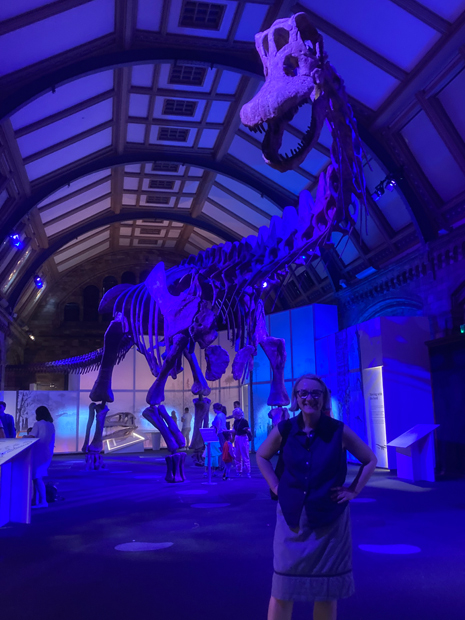
Patagotitan skeleton on display.

Sue from Everything Dinosaur poses in front of the colossal Patagotitan skeleton which is being exhibited at the Natural History Museum (London). Picture credit: Everything Dinosaur.

Picture credit: Everything Dinosaur

Not All is What it Seems

Writing in the on-line, open access journal “PeerJ”, Mike Taylor, an honorary research associate at the University of Bristol and renowned sauropod expert, concludes that all those beautifully displayed sauropod specimens in museums are in essence, misleading. The anatomy of the necks of these iconic dinosaurs is much less well known than is often assumed.

Very few complete sauropod necks have been scientifically described and famous specimens such as the Berlin brachiosaur have been constructed based on an incomplete and often substantially distorted cervical vertebrae sequence.

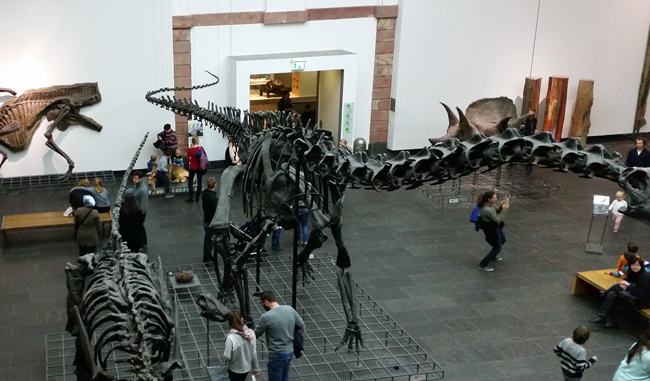
Sauropod skeleton (cast) on display.

A sauropod (diplodocid) skeleton exhibit on display at the Frankfurt Natural History Museum (Naturmuseum Senckenberg). Picture credit: Everything Dinosaur.

Picture credit: Everything Dinosaur

Surprisingly, given the number of sauropod specimens reconstructed for display in museums, few complete necks have been described in the literature. The paper lists nine fossil specimens with unambiguously complete necks, each of them articulated and known to include the bone at the base of the neck that lies in association with the first dorsal vertebra. The author also lists additional sauropod specimens thought to have complete necks but have yet to be fully described.

The paper describes yet more sauropod necks which are probably complete but are missing the first cervical (atlas bone). The first cervical is often much smaller than the other neck bones and easily lost during fossilisation along with the skull.

The cervical bones of Silutan sinensis.

Silutitan sinensis gen. et sp. nov. (holotype-IVPP V27874) in left lateral view. Note scale bar in (B) = 50 cm. Picture credit: Wang et al.

Picture credit: Wang et al

Very Little Information on Diplodocid Necks

In older museum reconstructions, missing bone is often difficult to identify as the restorers were tasked with making the fossil specimen look more complete. Furthermore, even those cervical vertebrae that are complete are often badly distorted due to taphonomic processes (crushed or distorted during fossilisation), so attempts to understand the anatomy of the neck, the posture of the head and the range of motion in the neck are severely hampered.

Famous dinosaurs such as Apatosaurus and Diplodocus are barely represented in terms of complete neck fossils. Outlining the size of the problem, author Mike Taylor commented that in December 2021 the Paleobiologiy Database listed a total of 342 sauropod species. Of these, only nine had unambiguously complete and articulated necks. Only one in every thirty-eight sauropod species named (2.6%) had a complete set of cervical vertebrae that had been scientifically described.

Comparing Giraffatitan Cervical Vertebrae

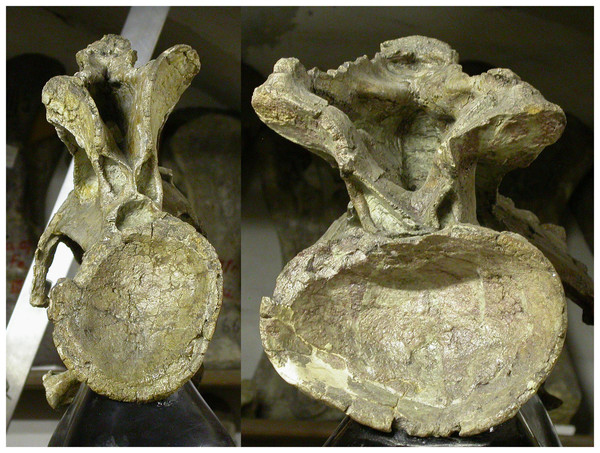
Comparing cervical vertebrae of Giraffatitan brancai (lectotype MB.R.2180). Cervical vertebra 4 (left) looks very different from cervical vertebra 6 (right). Distortion has occurred and this makes conducting a mechanical analysis of neck movements extremely difficult. Picture credit: Michael P. Taylor.

Picture credit: Michael P. Taylor

A Need to Acknowledge the Ambiguity

Palaeontologists remain uncertain about how many neck bones famous sauropods such as Diplodocus and Giraffatitan had. The fossil record of cervical vertebrae of sauropods is poor and it is important that researchers acknowledge this paucity. The author of the paper cautions against blithely asserting “facts” about sauropod necks without the caveat of acknowledging the lack of evidence to support hypotheses.

Michael Taylor asserts that the presence of a partial fossil record on cervical vertebrae is not too onerous, but it is important to properly acknowledge the degree of uncertainty that surrounds studies. He cautions against drawing firm conclusions about sauropod neck posture and other aspects of sauropod neck anatomy based on limited data.

The scientific paper: “Almost all known sauropod necks are incomplete and distorted” by Michael P. Taylor published in PeerJ.

For models of sauropods and other prehistoric animals: Prehistoric Animal Models and Toys.

29 01, 2022

More Theropods from Appalachia

By |2024-10-15T17:37:20+01:00January 29th, 2022|Categories: Palaeontological articles|0 Comments

An analysis of fragmentary dinosaur fossil remains recovered from Lewisville Formation exposures around the Dallas/Fort Worth area of Texas have provided scientists with a fresh perspective on the theropod fauna of Appalachia during the Cenomanian stage of the Late Cretaceous. Around 95 million years ago, the extreme western edge of Appalachia was home to a variety of meat-eating dinosaurs including a tyrannosauroid and a larger carcharodontosaurid.

Theropods from Appalachia

Although the fossil remains consisting mainly of shed teeth and small portions of bone are highly fragmentary, the researchers are confident that this material confirms for the first time, the presence of a large carcharodontosaur allosauroid in Appalachia.

The researchers conclude that the Lewisville Formation theropod biota was similar in composition to contemporaneous deposits known from Laramidia. This confirms that theropod dinosaur communities were probably very similar across North America during the early Late Cretaceous and extends our knowledge regarding the non-avian dinosaur fauna of Appalachia shortly after the establishment of the Western Interior Seaway that divided the continent into two separate landmasses.

Siats meekerorum .

Siats meekerorum has nothing to fear from these two tyrannosaurs. Picture credit: Julio Lacerdo.

Picture credit: Julio Lacerdo

The researchers who included lead author Christopher Noto (University of Wisconsin-Parkside), examined fossils that had been recently collected from four sites in the Fort Worth/Dallas area of Texas as well as many specimens housed in museum collections.

They found that fossils representing a large-bodied carcharodontosaur and a mid-sized tyrannosauroid were present at a number of locations. This suggests that big, meat-eating dinosaurs roamed extensively over the delta represented by the Lewisville Formation deposits. The fossilised remains of much smaller theropods such as troodontids and dromaeosaurids were in contrast, restricted to just one or two sites.

Lewisville Formation carcharodontosaurid teeth.

Teeth assigned to the Carcharodontosauria from the Lewisville Formation. Scale bars of unbordered images in A–E are 5 mm, (J)–(V) are 10 mm. Scale bars of bordered images are 1 mm. Picture credit: Noto et al.

Picture credit: Noto et al

The First Evidence of Tyrannosauroidea and Troodontidae in Appalachia

Whilst largely fragmentary, the researchers are confident that the material is sufficiently diagnostic to identify six or seven new taxa representing small, medium and large theropods. As well as recording the first carcharodontosaurid fossil material from Appalachia, the team concluded that there were also specimens representing the Tyrannosauroidea and Troodontidae too, the first occurrence of these groups in Appalachia.

Lewisville Formation Tyrannosauroidea teeth.

Teeth assigned to the Tyrannosauroidea from the Lewsiville Formation. Scale bars of bordered images are 1 mm, except P which is 0.5 mm. Picture credit: Noto et al.

Picture credit: Noto et al

Size Assessment Based on Komodo Dragon Tooth Research

The body size of each dinosaur was estimated using a formula based on the size of the serrations (denticles) found on the teeth of Komodo dragon lizards of various sizes, D’Amore and Blumenschine (2012). The researchers hope that more body fossils will be found to provide a clearer picture of the theropod biota of Appalachia during the early Late Cretaceous.

A List of the theropod taxa with maximum size based on Komodo dragon tooth comparisons stated:

  • Carcharodontosauria maximum body length 5.7 metres*
  • Tyrannosauridae maximum body length 4.8 metres*
  • Dromaeosaurinae (a theropod potentially similar to Deinonychus or Utahraptor) maximum body length 5.1 metres*
  • Dromaeosauridae maximum body length 1.9 metres*
  • Troodontidae
  • Coelurosauria maximum body length 1.6 metres*
  • Indeterminate theropod maximum body length 2.6 metres*

Maximum body length* based on D’Amore and Blumenschine (2012).

Text in green indicates new taxa for Appalachia.

Transitional Fauna

Comparison with other, roughly contemporaneous fossil assemblages across North America supports the presence of a cosmopolitan fauna throughout the Early Cretaceous. These theropod fossils from south-western Appalachia are remarkably similar to contemporaneous deposits known from Laramidia to the west. However, the opening up of the Western Interior Seaway led to a considerable divergence in the composition of dinosaur dominated terrestrial communities between Laramidia and Appalachia.

Lewisville Formation in association with the Western Interior Seaway

Palaeogeographic maps showing North America in the late Early Cretaceous and early Late Cretaceous (A) Albian stage approximately 110 million years ago, with (B) the late Albian approximately 105 million years ago. During the late Albian the first vestiges of the Western Interior Seaway began to form separating North America into two landmasses, Appalachia to the east and Laramidia to the west. Early Cenomanian approximately 100 million years ago, showing short-term regression of the shallow seaway that led to the two landmasses being connected once again. Finally (D), middle Cenomanian approximately 95 million years ago depicting the establishment of the Western Interior Seaway separating the landmasses once again. The black star marks the location of the Lewisville Formation. Maps redrawn from Scotese (2021). Picture credit: Noto et al.

Picture credit: Noto et al

By the Late Cretaceous distinctive dinosaur faunas had evolved on the two North American landmasses. The Lewisville Formation documents the transitional nature of Cenomanian coastal ecosystems in Texas while providing additional details on the evolution of Appalachian communities shortly after Western Interior Seaway extension. These fossils indicate that the faunal transition between Early and Late Cretaceous dinosaur groups was already underway around 95 million years ago (early-middle Cenomanian).

The scientific paper: “A newly recognized theropod assemblage from the Lewisville Formation (Woodbine Group; Cenomanian) and its implications for understanding Late Cretaceous Appalachian terrestrial ecosystems” by Christopher R. Noto​, Domenic C. D’Amore, Stephanie K. Drumheller and Thomas L. Adams published in PeerJ.

Visit the Everything Dinosaur website: Dinosaur Toys.
25 01, 2022

A New Study of Struthiosaurus austriacus – Differences Between Nodosaurids and Ankylosaurids

By |2024-10-15T17:02:28+01:00January 25th, 2022|Categories: Dinosaur and Prehistoric Animal News Stories, Dinosaur Fans, Main Page, Palaeontological articles, Photos/Pictures of Fossils|0 Comments

A study published this month in “Scientific Research” suggests that the Late Cretaceous European nodosaurid Struthiosaurus was not the most active of dinosaurs and probably not the most social. Analysis of the single, partial braincase (IPUW 2349/6) of S. austriacus has permitted scientists to gain a better understanding of this armoured dinosaur’s senses. The conclude that the short semi-circular canals and the shortest cochlear duct described from dinosaur fossils known to date, indicate that Struthiosaurus led a rather inert, sedentary life and compared to other members of the Dinosauria, it was comparatively inactive with limited social interactions.

The researchers calculate that Struthiosaurus had poor hearing and it probably relied on a less active style of self-defence compared to their tail club swinging relatives the ankylosaurids.

Struthiosaurus austriacus life reconstruction

An illustration of the Late Cretaceous nodosaurid Struthiosaurus austriacus from Austria. A study of this dinosaur’s braincase suggests that it was relatively inert, sluggish and partially deaf. Picture credit: Fabrizio De Rossi.

Picture credit: Fabrizio De Rossi

Sluggish and with Limited Hearing

Researchers from the University of Vienna in collaboration with a colleague from the University of Greifswald in Germany subjected the partial braincase of S. austriacus to CT scans. From this information, three-dimensional models of the 5 cm wide braincase of this dinosaur were created.

The braincase consists of several fused skull bones that housed the brain and other neurosensory tissues. Analysis of the structures preserved can provide palaeontologists with information about the sensory capabilities of the animal and more fundamental details of anatomy such as the angle at which the animal held its head.

Struthiosaurus braincase study

Photographs (C,D,G,J) and photogrammetric models (E,F,H,I,K) created from the CT scans of the holotype specimen of Struthiosaurus austriacus, (IPUW 2349/6). Right lateral view (C,E), (D,F) left lateral, (I) anterior, (J,K) ventral and (G,H) posterior views. Note scale bar = 2 cm. Picture credit: Schade et al.

Picture credit: Schade et al

The results of this study of the braincase of Struthiosaurus indicate that its brain was very similar to the brains of other nodosaurids. For example, the flocculus, an ancient part of the tetrapod brain, associated with co-ordination and motor skills was very small. Ankylosaurs with their large tail clubs, such as Euoplocephalus had a proportionately larger flocculus. A bigger flocculus might have helped ankylosaurs to co-ordinate their defensive strikes with their powerful tail clubs.

In addition, the team which included Marco Schade (University of Vienna), plotted the auditory capacity of Struthiosaurus and calculated that its hearing range was rather limited (between 296 and 2164 Hz). In contrast, humans on average have a much broader frequency of hearing range – around 31 Hz to 19,000 Hz.

S. austriacus type locality and scale drawing.

Location of the Struthiosaurus austriacus fossil finds in Austria (A). To date three species of Struthiosaurus have been scientifically described, S. transylvanicus from Maastrichtian-aged deposits or Romania, S. languedocensis from the early Campanian of France and S. austriacus which was described from fragmentary fossil material including a partial braincase discovered during coal mining operations near the town of Muthmannsdorf (early Campanian Grünbach Formation). The type locality of S. austriacus is marked by the star. Scale drawing of S. austriacus from Fabrizio De Rossi. Picture credit: Schade et al.

Picture credit: Schade et al

Nodosaurids Occupied a Different Ecological Niche

Both nodosaurids and their close relatives, the ankylosaurids were lumbering, heavily armoured animals adapted to low browsing. Although postcranial fossils are quite similar, there is a growing body of evidence to indicate marked differences between these two types of dinosaur. Nodosaurids may have preferred coastal or floodplain environments and may have evolved stronger jaws to give them a more powerful bite, an adaptation to processing tough vegetation. Gut contents associated with nodosaurids such as Borealopelta markmitchelli, suggest they were selective feeders: Borealopelta was a Fussy Eater.

This study suggests that for Struthiosaurus at least the combination of a relatively short cochlear duct, a reduced flocculus, less elaborate nasal passages and the absence of a tail club but with heavily reinforced dermal armour suggests that nodosaurids had different ecological adaptations when compared to ankylosaurs.

The researchers postulate that nodosaurids were possibly less reliant on their sense of hearing, had a less active style of self-defence and may have occupied different ecological niches than ankylosaurids.

Struthiosaurus may have lived alone and may not have moved in social groups.

PNSO Isaac the Sauropelta dinosaur model.

The recently introduced Isaac the Sauropelta model depicts the typical armour and spikes of a nodosaur. These dinosaurs may have been relatively slow moving, with a limited sense of hearing but they would have represented a formidable adversary for a younger theropod.

The scientific paper: “Neuroanatomy of the nodosaurid Struthiosaurus austriacus (Dinosauria: Thyreophora) supports potential ecological differentiations within Ankylosauria” by Marco Schade, Sebastian Stumpf, Jürgen Kriwet, Christoph Kettler and Cathrin Pfaff published in Scientific Reports.

The Everything Dinosaur website: Dinosaur Toys.

24 01, 2022

The Muscles of Thecodontosaurus Provide Clue to Super-sized Sauropods

By |2024-10-15T16:53:56+01:00January 24th, 2022|Categories: Dinosaur and Prehistoric Animal News Stories, Dinosaur Fans, Main Page, Palaeontological articles, Photos/Pictures of Fossils|0 Comments

New research into the musculature of the early sauropodomorph Thecodontosaurus antiquus has helped scientists to understand the evolutionary transition from agile bipeds to super-sized quadrupedal sauropods. Writing in the open-access, on-line journal “Royal Society Open Science”, scientists from the University of Bristol have reconstructed the limb musculature of Thecodontosaurus. Their reconstruction shows that this Late Triassic dinosaur was an agile, biped but it already had some anatomical adaptations which would permit its descendants to grow to huge sizes.

Thecodontosaurus study.

Thecodontosaurus fossil block with life reconstruction in the background. Picture credit: Simon Powell/University of Bristol.

Picture credit: Simon Powell/University of Bristol

Bristol’s Dinosaur

Thecodontosaurus (T. antiquus) fossils are known from Upper Triassic rocks exposed around the city of Bristol in England. During the Late Triassic, this region consisted of an archipelago surrounded by a warm tropical sea. Hundreds of fragmentary fossils representing many individuals are known, most of these fossils are housed at the Bristol City Museum and Art Gallery. Thecodontosaurus is believed to have measured up to 2.5 metres in length, however, its long, thin tail made up more than 50% of its entire body length.

It weighed around twenty kilograms, but it was part of the Sauropodomorpha clade of lizard-hipped dinosaurs that were to evolve into giants during the Jurassic and Cretaceous. Famous dinosaurs such as Diplodocus and Brachiosaurus from the Jurassic as well as Cretaceous leviathans such as Patagotitan and Alamosaurus.

Thecodontosaurus

Thecodontosaurus was the first Triassic genus of dinosaur to be named and described (1836).

Thecodontosaurus limb muscles

Researchers have examined tell-tale muscle scars associated with Thecodontosaurus limb bones to reconstruct the musculature of this Late Triassic dinosaur. Picture credit: Gabriel Ugueto.

Picture credit: Gabriel Ugueto

Lead author of the paper, PhD student at the University of Bristol Antonio Ballell commented:

“The University of Bristol houses a huge collection of beautifully preserved Thecodontosaurus fossils that were discovered around Bristol. The amazing thing about these fossilised bones is that many preserve the scars and rugosities that the limb musculature left on them with its attachment.”

These features on the bones permit palaeontologists to infer the shape, size and anatomical position of the musculature of the animal. For example, the muscles associated with the limbs can be reconstructed and the dinosaur’s anatomy can be further refined by comparing the computer models generated with the anatomy of extant relatives such as crocodiles and birds.

Co-author of the study Professor Emily Rayfield (University of Bristol), added:

“These kinds of muscular reconstructions are fundamental to understand functional aspects of the life of extinct organisms. We can use this information to simulate how these animals walked and ran with computational tools.”

Palaeontologists Continuing to Learn from Thecodontosaurus Fossils

Thecodontosaurus was one of the first dinosaurs to be formally named and described but palaeontologists can still learn a lot from its fossils. For example, thanks to the considerable volume of T. antiquus material, the research team were able to build the entire forelimb and hindlimb musculature. This is the first time scientists have been able to reconstruct the limb musculature of an early-branching sauropodomorph.

The analysis of the limb muscles of T. antiquus confirm that it was a fast-running, agile biped. The forelimbs were probably not used in locomotion but were very effective at grasping objects such as potential prey. The anatomy of the lithe Thecodontosaurus is in stark contrast to the later sauropods which became obligate quadrupeds.

The researchers determined that key traits of later sauropod-line dinosaurs had already evolved in this early genus.

“From an evolutionary perspective, our study adds more pieces to the puzzle of how the locomotion and posture changed during the evolution of dinosaurs and in the line to the giant sauropods. How were limb muscles modified in the evolution of multi-ton quadrupeds from tiny bipeds? Reconstructing the limb muscles of Thecodontosaurus gives us new information of the early stages of that important evolutionary transition.”

Patagotitan skeleton on display at the London Natural History Museum.

The enormous body of the titanosaur dwarfs visitors. Picture credit: Everything Dinosaur.

Picture credit: Everything Dinosaur

Everything Dinosaur acknowledges the assistance of a media release from the University of Bristol in the compilation of this article.

The scientific paper: “Walking with early dinosaurs: appendicular myology of the Late Triassic sauropodomorph Thecodontosaurus antiquus” by Antonio Ballell, Emily J. Rayfield and Michael J. Benton published in Royal Society Open Science.

Visit the Everything Dinosaur website: Everything Dinosaur.

16 01, 2022

Dating the Mammal Tree of Life

By |2024-10-14T12:06:57+01:00January 16th, 2022|Categories: Animal News Stories, Dinosaur and Prehistoric Animal News Stories, Dinosaur Fans, Main Page, Palaeontological articles|0 Comments

Recently published research has answered an important question regarding the timing of the evolutionary origins of modern types of placental mammals such as the Carnivora, the rodents and the primates. Once the non-avian dinosaurs vanished some 66 million years ago, placental mammals rapidly evolved and diversified to fill many of the niches in ecosystems vacated by the extinct members of the Dinosauria.  Researchers have shed light on the tree of life.

Researching the Mammalian Tree of Life

The research team who included scientists from Queen Mary University of London, Cambridge University, University College London, the University of Bristol and Imperial College London used a new and fast Bayesian statistical approach to plot the timeline of mammal evolution. The data generated confirms the hypothesis that although the first placental mammals evolved in the Mesozoic, it was only after the KPg extinction event that marked the end of this Era and the beginning of the Cenozoic, some 66 million years ago, that the ancestors of today’s modern placental mammal groups evolved.

Mammal tree of life.

The research team used a new and rapid Bayesian statistical approach to plot the timeline of mammal evolution. The data generated confirms the hypothesis that although the first placental mammals evolved in the Mesozoic, it was only after the KPg extinction event that marked the end of this Era and the beginning of the Cenozoic, that the ancestors of today’s modern placental mammal groups evolved. Picture credit: Mario dos Reis Barros and Sandra Alvarez-Carretero.

Picture credit: Mario dos Reis Barros and Sandra Alvarez-Carretero

Analysing the Mammalian Genomic Dataset

Writing in the academic journal “Nature”, the scientists used a novel Bayesian statistical method to analyse an enormous mammal genomic dataset, in a bid to plot more precisely the timeline of the evolution of modern mammals. They conclude that the ancestors of these modern groups postdate the KPg extinction event.

The Bayesian analysis had to be robust, not only to handle the genetic data from almost 5,000 mammal species and 72 complete genomes but also to accommodate and account for uncertainties within the huge amount of data being processed.

Tracing the Mammal Family Tree

Tracing the mammalian family tree. Picture credit: Luo Laboratory.

Picture credit: Luo Laboratory

Tackling a Contentious Topic in Evolutionary Biology

Commentating on the significance of this study, one of the co-authors of the paper, Professor Philip Donoghue (Bristol University) stated:

“The timeline of mammal evolution is perhaps one of the most contentious topics in evolutionary biology. Early studies provided origination estimates for modern groups deep in the Cretaceous, in the dinosaur era. The past two decades had seen studies moving back and forth between post- and pre-KPg diversification scenarios. Our precise timeline settles the issue.”

The statistical method developed for this study can be used to help resolve other controversial areas of research that require the detailed analysis of huge amounts of data. The scientists are confident that this technique can be applied to even grander projects such as the Earth BioGenome project which aims to plot a reliable evolutionary timescale for the development of life on Earth.

Everything Dinosaur acknowledges the assistance of a media release from the University of Bristol in the compilation of this article.

The scientific paper: “A Species-Level Timeline of Mammal Evolution Integrating Phylogenomic Data” by Sandra Álvarez-Carretero, Asif U. Tamuri, Matteo Battini, Fabrícia F. Nascimento, Emily Carlisle, Robert J. Asher, Ziheng Yang, Philip C. J. Donoghue and Mario dos Reis published in the journal Nature.

Visit Everything Dinosaur’s website: Everything Dinosaur.

10 01, 2022

The Amazing Rutland Ichthyosaur

By |2024-10-11T08:40:48+01:00January 10th, 2022|Categories: Adobe CS5, Dinosaur and Prehistoric Animal News Stories, Dinosaur Fans, Main Page, Palaeontological articles, Photos/Pictures of Fossils|0 Comments

The discovery of the remarkable Rutland ichthyosaur has featured in many news channels and media outlets. It is a stunning fossil specimen, demonstrating that even in a country like Britain, arguably the birthplace of geology and the science of palaeontology, a part of the world that has been extensively mapped, documented and studied, that there are still amazing fossils to be found.

This story highlights the many largely unsung individuals that bring to the attention of scientists, strange phenomena that they spot, often in the unlikeliest of places. In this case it was Joe Davis (Conservation Team Leader for Leicestershire and Rutland Wildlife Trust at the Rutland reservoir), who along with his colleague Paul Trevor spotted strange circular objects jutting out of the exposed Jurassic clay as they routinely inspected part of a drained lagoon back in February 2021.

These objects turned out to be bones from the spinal column, fortunately, Joe a career conservationist, was familiar with the skeletons of whales and dolphins and he had an inkling that these objects were organic in origin. The local council was called and asked whether they had a “dinosaur department” that could investigate further. Thus, was set in motion a series of events that led to award-winning ichthyosaur specialist Dr Dean Lomax setting up an exploratory dig at the site, the results of which led to a full-scale excavation over the summer.

Dr Dean Lomax dwarfed by the giant ichthyosaur skeleton.

Dr Dean Lomax provides the scale for an aerial shot of the Rutland ichthyosaur specimen. Picture credit: Anglian Water/Leicestershire and Rutland Wildlife Trust/Matthew Power Photography.

Picture credit: Anglian Water/Leicestershire and Rutland Wildlife Trust/Matthew Power Photography

An Extraordinary Marine Reptile Fossil

The ichthyosaur fossil is the largest and most complete ichthyosaur to have been found in the UK. It measures around 10.5 metres in length. As has been repeatedly stated in the plethora of media releases concerning this Jurassic monster, ichthyosaurs are not dinosaurs. Ichthyosaurs are aquatic reptiles that evolved from terrestrial ancestors. Their evolutionary origins remain obscure, but their fossil record covers most of the Mesozoic and the Rutland ichthyosaur happens to be the most complete skeleton of a large prehistoric reptile ever found in the UK.

This spectacular fossil discovery stands out well compared to the scrappy and fragmentary remains of Britain’s dinosaurs.

Some of the team members responsible for the Rutland Sea Dragon excavation

Some of the Rutland “Sea Dragon” excavation team. Left to right – Dr Emma Nicholls (Senior Curator of Natural Sciences at the Horniman Museum and Gardens, London), David Savory (Peterborough Geological and Palaeontological Group), Nigel Larkin (palaeontological conservator), Dr Dean Lomax (palaeontologist), Mick Beeson (Peterborough Geological and Palaeontological Group), Dr Mark Evans (palaeontologist at the University of Leicester), Emily Swaby (PhD student the Open University), and Darren Withers (Peterborough Museum). Picture credit: Anglian Water.

Picture credit: Anglian Water

A “Rosetta Stone” for the Temnodontosaurus Genus

The fossil specimen has been tentatively assigned to the species Temnodontosaurus trigonodon. If this proves to be the case, the identification will be confirmed when the fossils are fully cleaned and prepared, then this is the first T. trigonodon known from the British Isles.

The species Temnodontosaurus trigonodon was erected in 1843. Its fossils have been found in Germany and France, if the Rutland specimen proves to be this species it will extend the palaeogeographical range of T. trigonodon. In addition, the almost complete, articulated Rutland ichthyosaur will provide an extremely useful comparator when assessing Temnodontosaurus fossils. It will help to identify other large, but much less complete, ichthyosaur specimens housed in museums, acting as a “Rosetta Stone” for the genus.

A life reconstruction of the Rutland Ichthyosaur

The ichthyosaur specimen has been tentatively assigned to the species Temnodontosaurus trigonodon. T. trigonodon was an apex predator and it probably hunted other smaller ichthyosaurs. Picture credit: Bob Nicholls.

Picture credit: Bob Nicholls

A Huge Fossil but It’s Also the Little Details

These fossilised remains are not the first ichthyosaur fossils to have been found at Rutland Water, smaller, fragmentary material representing other species were found during construction of the reservoir. Once excavated and wrapped in plaster jackets the Rutland ichthyosaur was taken to a research facility where the job of preparing and restoring it will take place under the watchful supervision of conservator Nigel Larkin.

The bones and teeth may have been removed but the site can still provide a great deal of data. For example, the clay-rich rocks that contained the specimen represent deposits from the Whitby Mudstone Formation and analysis of microfossils preserved in the sediment have enabled researchers at the University of Birmingham to reliably date the Rutland ichthyosaur to 181.5 to 182 million years ago (Toarcian faunal stage of the Jurassic).

The composition of these microfossils indicates that this large predator lived in a tropical, marine environment with a rich and diverse ecosystem. Temnodontosaurus is thought to have lived far out to sea and away from the coast. It is hoped that further analysis of the matrix surrounding the fossil will provide more details of this animal’s palaeoenvironment.

The Rutland sea dragon excavation

The summer 2021 excavation of the Rutland ichthyosaur. The ventral elements of the skull can be seen in the foreground. This photograph was taken before prior to plaster encasement of the specimen and it being removed from the site. Picture credit: Anglian Water/Leicestershire and Rutland Wildlife Trust.

Picture credit: Anglian Water/Leicestershire and Rutland Wildlife Trust

Locked in Time

Palaeontologist Dr Dean Lomax who led the excavation, has recently published a book in collaboration with Bob Nicholls the artist that provided the Temnodontosaurus illustration.

It provides a fascinating analysis of fifty extraordinary fossils and what these discoveries can tell scientists about life in the past.

The book is available from Columbia University Press: Columbia University Press just search for Dean Lomax on this site.

Locked in Time by Dean Lomax and illustrated by Bob Nicholls

Published by Columbia University Press “Locked in Time” examines 50 extraordinary fossils that provide a remarkable glimpse into the lives and behaviours of long extinct animals. Picture credit: The University of Manchester.

Picture credit: The University of Manchester

For models of ichthyosaurs and other marine reptiles: Buy Prehistoric Animal Models.

7 01, 2022

Research into Fossils Affected by a Significant Colonial Bias

By |2024-10-10T13:56:31+01:00January 7th, 2022|Categories: Adobe CS5, Dinosaur and Prehistoric Animal News Stories, Dinosaur Fans, Main Page, Palaeontological articles, Photos/Pictures of Fossils|0 Comments

The study of fossils, the science of documenting the history of life on our planet, is heavily biased by influences such as colonialism, history and global economics. That is the conclusion from new research conducted by palaeontologists from the University of Birmingham in collaboration with colleagues from the University of Erlangen-Nürnberg (Germany), Rhodes University (South Africa), Federal University of Rio Grande do Norte (Brazil), Cambridge University and IISER Pune, Department of Earth and Climate Science (India).

Distorting Estimates of Past Biodiversity

The research team discovered that sampling biases in the fossil record distort estimates of past biodiversity. However, these biases not only reflect the geological and spatial aspects of the fossil record, but also the historical and current collation of fossil data. These findings have significance across the field of palaeontology, but also for the ways in which researchers are able to use our knowledge of ancient fossil records to gain clearer, long-term perspectives on Earth’s biodiversity.

Writing in the journal “Nature Ecology & Evolution”, the researchers investigated the influence and extent of these biases within the Paleobiology Database, a vast, widely-used and publicly-accessible resource which forms the foundation for analytical studies in the field.

They found significant bias in areas such as knowledge production, with researchers in high or upper-middle-income countries contributing to 97 per cent of fossil data. This means that wealthy countries, primarily located in the Global North control the majority of the palaeontological research power.

Percentage contribution of the top 15 countries to the total fossil data analysed in this study.

Percentage contribution of the top 15 countries to the total fossil data analysed in this study. The colour of each bar represents whether the authors of each country conducted their research domestically (that is, in the same country), in a foreign country, or in a foreign country without collaboration with local palaeontologists. Picture credit: Raja et al.

Picture credit: Raja et al

Lack of Involvement for Local Researchers

The team also found the top countries contributing to palaeontological research, carried out a disproportionate amount of work abroad, more than half of which did not involve any local researchers (researchers based in the country where the fossils are being collected).

There are many famous examples of colonial, political and economic biases across the natural sciences and humanities. During the 19th century and for most of the 20th century, specimens uncovered following exploratory expeditions were shipped back to respective imperial capitals to be housed in museums, where many are still used for scientific research today.

In a press release from Birmingham University the plight of the Parthenon sculptures, sometimes referred to as the Elgin Marbles was provided as an example. The Greek government has repeatedly requested that they be returned since they were taken from Athens in the early 19th century and transported to Britain.

There are also many other examples, such as the fossil excavations undertaken in Egypt by the German palaeontologist Ernst Freiherr Stromer von Reichenbach or the removal of many Cretaceous-aged dinosaur fossils by French field teams from the island of Madagascar.

Research into Fossils Has a Colonial Bias

The researchers postulate that these biases affect the way in which palaeontologists conduct their research and can lead to unethical practices in the most extreme cases.

Co-lead author Dr Emma Dunne (University of Birmingham) stated:

“Although we know there are these irregularities and gaps in our knowledge of the fossil record, the historical, social and economic factors which influence these gaps are not well understood. Many of the research practices that are informed by these biases still persist today and we ought to be taking action to address them.”

Dr Dunne added:

“We are familiar, for example, with ‘scientific colonialism, or ‘parachute science’, in which researchers, generally from higher income countries drop in to other countries to conduct research, and then leave without any engagement with local communities and local expertise. But this issue goes further than that – the expertise of local researchers is devalued, and laws are often violated, hindering domestic scientific development and leading to mistrust between researchers.”

The first step towards conducting research that is more equitable and ethical, argue the researchers, is to address the power relations driving the production of scientific research. This means properly involving and acknowledging local expertise.

One project which strives to do this is a research project involving researchers from both European and African universities, based in a remote area of Western Cape in South Africa. Here palaeontologists from University of Witwatersrand and the University of Johannesburg are at the forefront of the research and are working with local education specialists Play Africa to create interactive materials that can be toured around schools in the region.

The scientific paper: “Colonial history and global economics distort our understanding of deep-time biodiversity” by Nussaïbah B. Raja, Emma M. Dunne, Aviwe Matiwane, Tasnuva Ming Khan, Paulina S. Nätscher, Aline M. Ghilardi and Devapriya Chattopadhyay published in Nature Ecology & Evolution.

The Everything Dinosaur website: Prehistoric Animal Models.

31 12, 2021

Favourite and Popular Blog Articles of 2021 (Part 2)

By |2024-10-10T06:27:41+01:00December 31st, 2021|Categories: Dinosaur and Prehistoric Animal News Stories, Dinosaur Fans, Everything Dinosaur News and Updates, Main Page, Palaeontological articles, Photos/Pictures of Fossils, Press Releases|0 Comments

Recently, team members at Everything Dinosaur posted about their favourite blog articles from the first six months of 2021. Today, we conclude our look at the 360 posts or so produced in 2021 by listing our favourite articles that went up from July to December.

To read part one of this series: Favourite Blog Articles of 2021 (Part 1)

July – Lots of New Dinosaur Discoveries

In July, team members announced two dinosaurs described from fossils found in Spain. We wrote about the enigmatic Late Cretaceous hadrosauroid Fylax thyrakolasus “Keeper of the Gates of Hell”, a sister taxon to Tethyshadros (more about Tethyshadros later). We also produced articles on prehistoric crocodiles from Chile, how straight shelled ammonites avoided predators, miniature alvarezsauroids, changes to European Union law that affects parcel deliveries and the first T. rex fossils to be exhibited in England for a hundred years. Other posts highlighted the evidence that some dinosaurs nested in the high Arctic and examined the respiration of Heterodontosaurus.

Our favourite article in July took a more scatological approach. A new genus of Triassic beetle was described after its fossil remains were found in ancestral dinosaur dung: Beetle Described from Fossil Poo.

Images of the Triassic beetle Triamyxa coprolithica

Images of the newly described Triassic beetle Triamyxa coprolithica, the first insect to be named and described from a coprolite. Picture credit: Qvarnström et al.

Picture credit: Qvarnström et al

Perfect Paraceratherium Figures

August saw Everything Dinosaur team members going on their only fossil hunt of the year, off to Wales to look for ancient corals. We marked the sad passing of Dr Angela Milner, a highly influential British palaeontologist who along with her colleague Alan Charig described Baryonyx in 1986. Our blog featured articles on two new Lower Cretaceous sauropods from China, revealed the part of space where the dinosaur killing extraterrestrial bolide came from and looked at the skull of the early bird Ichthyornis.

However, our favourite article documented the arrival of the eagerly awaited, super-sized Paraceratherium model from ITOY Studio. ITOY Studio are underrated, but they produce stunning prehistoric animal figures: ITOY Studio Paraceratherium Models Arrive.

The ITOY Studio Paraceratherium.

A view of the eagerly anticipated ITOY Studio Paraceratherium model. Picture credit: Everything Dinosaur.

Picture credit: Everything Dinosaur

Spinosaurids and a Giant Late Cambrian Armoured Radiodont

In September two new spinosaurids from the Isle of Wight were announced, details of the first rhamphorhynchid pterosaur from Gondwana was published, research into the evolution of snakes demonstrated that they evolved from a handful of species and scientists got under the skin of a Carnotaurus as well as providing information on the earliest ankylosaur known to science and the first from Africa. The first Late Cretaceous carcharodontosaurian from Central Asia was described (Ulughbegsaurus uzbekistanensis) and a paper about yet another new species of abelisaurid was published.

Our favourite post whisked readers back to the Cambrian, to the famous Burgess Shale deposits of British Columbia. One of the biggest animals from the Cambrian was scientifically described. The giant, armoured radiodont Titanokorys gainesi took centre stage: Titanokorys gainesi a Giant Cambrian Radiodont.

Views of the Cambrian radiodont Titanokorys gainesi

Life reconstruction of Titanokorys gainesi (a) dorsal view, (b) ventral view, (c) lateral view and (d) anterior view. Picture credit: Lars Fields/Royal Ontario Museum.

Picture credit: Lars Fields/Royal Ontario Museum

Giant Penguins and a Dinosaur from Greenland

October blog posts included an assessment of organic molecules found in the cells of a Caudipteryx, a re-examination of another feathered Chinese theropod Beipiaosaurus, giant sea scorpions, a new species of horned dinosaur from New Mexico and Pendraig milnerae, a new species of dinosaur from Wales, named in honour of the recently passed Dr Angela Milner. Fossils found by school children on a field trip to a beach in New Zealand turned out to have come from a giant penguin, at 1.4 metres tall, Kairuku waewaeroa was a most impressive bird: A New Giant Penguin from New Zealand.

Giant penguin from New Zealand Kairuku waewaeroa

The Kawhia giant penguin Kairuku waewaeroa from the Oligocene of North Island (New Zealand). Picture credit: Simone Giovanardi.

Picture credit: Simone Giovanardi

Customer model reviews and drawings by young palaeoartists featured in November, along with new Isle of Wight iguanodonts, headless pterosaurs, Permian beetles and toothless Brazilian theropods. Everything Dinosaur produced articles and videos on the new for 2022 CollectA models and the Early Cretaceous ornithomimosaur Pelecanimimus came under the spotlight.

Our favourite post featured Issi saaneq, a sauropodomorph that roamed Greenland during the Late Triassic. It is the first non-avian dinosaur to be named from fossils found in Greenland: Issi saaneq “Cold Bones” from Greenland.

Computer generated models of skulls and a life reconstruction of Issi saaneq.

Digital interpretative reconstruction of the skulls NHMD 164741 and NHMD 164758 and living representation of Issi saaneq. (A) Digital interpretative reconstruction of the skull NHMD 164741 in left lateral view (A). Digital interpretative reconstruction of the smaller skull NHMD 164758 in left lateral view (B). Digital interpretative reconstruction of skull NHMD 164741 in dorsal view (C). Living representation of Issi saaneq (D). Scale bar = 50 mm.

December Yet More Dinosaurs and Upscaling Tethyshadros

As we entered the final month of 2021, we reported upon Stegouros elengassen, a new armoured dinosaur from Chile, research surrounding the KPg extinction event that postulated the extraterrestrial impact took place in the Northern Hemisphere late spring/summer and we helped a young dinosaur fan get reunited with a favourite dinosaur soft toy. Yet another dinosaur from the Isle of Wight was announced – Vectiraptor greeni, the largest fossilised remains of the giant millipede Arthropleura were discussed and palaeontologists got very excited about an exquisitely preserved dinosaur embryo inside a fossilised egg.

In December, we returned once again to the Late Cretaceous hadrosauriform Tethyshadros. A description of a second, much larger specimen was published and it refutes the idea that this dinosaur was a pygmy form – that Tethyshadros was an example of insular dwarfism: Sizing Up Tethyshadros.

Tethyshadros Fossils

The new skeleton of Tethyshadros insularis “Bruno” (a) preserving details of its cranial anatomy such as the nearly complete skull (b) exposing its braincase (c) adding important information for the anatomy and systematic of this taxon. Elements in black are reconstructed. Picture credit: Chiarenza et al.

Picture credit: Chiarenza et al

This completes are our run through of the blog posts of 2021. We look forward to writing about new dinosaur discoveries, fossil finds and palaeontology related news stories over the next 12 months.

The award-winning Everything Dinosaur website: Dinosaur Models and Toys.

30 12, 2021

Favourite and Popular Blog Articles of 2021 (Part 1)

By |2024-10-10T06:19:24+01:00December 30th, 2021|Categories: Dinosaur and Prehistoric Animal News Stories, Dinosaur Fans, Everything Dinosaur News and Updates, Main Page, Palaeontological articles, Photos/Pictures of Fossils, Press Releases|0 Comments

As 2021 draws to a close, it is time to reflect on some of the blog articles that we have produced over the last twelve months or so.  It has certainly been an incredible year for palaeontology with lots of new fossil discoveries although the impact of the global pandemic has continued to cause havoc when it comes to planning field expeditions. Many museums have been closed and research projects suspended or postponed. We have in our own small way tried to create a sense of normality by continuing to produce daily blog posts. Let us take a look at our favourite posts between January and June 2021 in the first of a two-part series.

In January 2021 we reported upon a study of early sauropodomorph brains, the role of plant-eating dinosaurs in seed dispersal, oviraptorid incubation, the world’s oldest cave art on the island of Sulawesi and how Ediacaran fossils were helping scientists to piece together the evolution of the first animals. Our favourite January post concerned the discovery of a three-toed dinosaur footprint discovered near the town of Barry in South Wales. Fossilised footprints are known from Mercia Mudstone Group exposures in the Vale of the Glamorgan, but not many dinosaur tracks are discovered by four-year-olds.

Grallator fossil track (South Wales).

Grallator track spotted by a 4-year-old girl at Bendrick Rock (South Wales). Picture credit: National Museum Wales

Picture credit: National Museum Wales

Here is the blog post: Four-Year-Old Finds Dinosaur Footprint.

Mammoths and “Thunderbirds”

February saw team members admiring prehistoric animal drawings sent into us by customers, articles on why horned dinosaurs evolved elaborate frills, our work on information panels for a major exhibition, the breeding habits of Neanderthals and the confirmation of concentrated levels of iridium found at the Chicxulub impact site. Our favourite article was published on the 17th of February, scientists had recovered DNA from mammoth remains that were up to 1.2 million years old. This new data provided a fresh perspective on the evolution of prehistoric elephants.

Our mammoth DNA blog: Million-year-old DNA Sheds Light on Mammoth Evolution.

In March, team members blogged about the mystery surrounding why there were so few medium-sized theropod dinosaurs, provided confirmation of troodontid dinosaurs in Europe, the earliest titanosaur on record, discussed a scientific paper that proposed that cephalopods evolved 30 million years earlier than previously thought and examined the extinction threat to extant amphibians.

Our favourite post was put up on the last day of the month. It focused on a newly published paper that proposed that the giant flightless “Thunderbirds” of Australia were related to gamefowl: Studying the Brains of Australia’s “Thunderbirds”.

Dromornis stirtoni life reconstruction.

A life reconstruction of the giant Australian “Thunderbird” Dromornis stirtoni of the Late Miocene. Picture credit: Peter Trusler.

Picture credit: Peter Trusler

Yamatosaurus and Moroccan Marine Reptiles

In April we blogged about the origins of the Amazon Rainforest, a new abelisaurid from Argentina, the legs of trilobites, ancient mammals from southern Gondwana and a new species of pterosaur from China. Our favourite post took us to Japan as we wrote about Yamatosaurus izanagii, the second hadrosaur to be named from fossils found in the “land of the rising sun”.

Japan’s second duck-billed dinosaur: Japan’s Second Hadrosaur.

The early summer sunshine of May prompted us to write about crocodile conservation at Miami Zoo, billion-year-old microfossils from Scotland, Mongolian dromaeosaurids and dinosaur bones from the dry and parched Australian Outback. However, it was an article that described a new species of giant mosasaur from the Ouled Abdoun Basin of Morocco that ticked all the boxes for us: Giant Moroccan Mosasaur – Pluridens serpentis.

Jurassic June

“Jurassic June” involved discussions on the PNSO Allosaurus and Torvosaurus models, the necks of Early Jurassic plesiosaurs and exploring the “Jurassic Coast” of Dorset. We also wrote about stegosaurs from the Arctic Circle, the official scientific description of the Australian dinosaur nicknamed “Cooper” (Australotitan cooperensis) and looked at a paper that reinterpreted the famous Burgess Shale of British Columbia.

Australotitan cooperensis life reconstruction

A life reconstruction of the newly named Australotitan cooperensis, the largest known animal to have ever lived in Australia. Picture credit: Queensland Museum

Picture credit: Queensland Museum

Our favourite post concerned the discovery of a remarkable series of pterosaur tracks in China. The extensive trackway consists of over 100 individual prints and it was given the moniker the “pterosaur dance floor”.

To read about “dancing” pterosaurs: A Pterosaur Dance Floor from China.

Pteraichnus pterosaur tracksite

A photograph of the tracksite with an interpretative line drawing. The tracks have been assigned to the new pterosaur ichnospecies Pteraichnus wuerhoensis. Picture credit Wei Gao.

Picture credit Wei Gao

This concludes our look at blog posts produced in the first half of 2021. We shall post up part two of this short series looking at our favourite blogs from July to December 2021, in the very near future.

The Everything Dinosaur website: Dinosaur Toys.

29 12, 2021

Penarth Prints are Rare Dinosaur Tracks

By |2024-10-10T06:11:01+01:00December 29th, 2021|Categories: Adobe CS5, Dinosaur and Prehistoric Animal News Stories, Dinosaur Fans, Main Page, Palaeontological articles, Photos/Pictures of Fossils|0 Comments

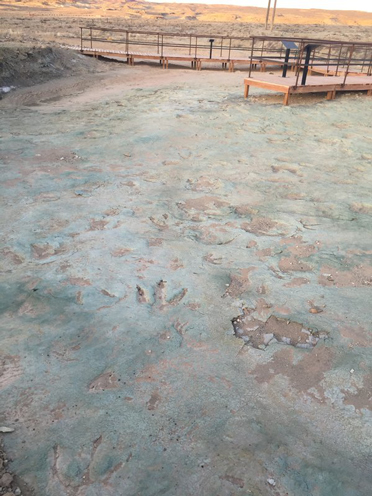
A team of researchers writing in the journal “Geological Magazine”, have confirmed that the strange impressions exposed on the beach at Penarth (south Wales), are indeed dinosaur tracks. The site had been examined back in 2009, further evidence of tracks was revealed in 2020 after more of the bedding plane was laid bare by tidal erosion. The site some 800 metres south of Penarth pier, probably represents tracks made by different types of dinosaurs but they are too badly eroded for a more precise diagnosis other than to tentatively assign the largest, rounded tracks to the ichnogenus Eosauropus.

Dinosaur trackway from south Wales.

A part of the brushed and cleaned up trackway (left) with (right) a close-up view of a single print. Picture credit: NHM/Peter Falkingham.

Picture credit: NHM/Peter Falkingham

Carefully Mapped and Recorded

The tracks, some of which are more than 50 cm in diameter, are associated with the Upper Triassic Blue Anchor Formation. Although it is difficult to identify individual trackways, the high density of impressions suggests that the area was a trample ground that might have been visited by many individuals. Although the number of taxa making these impressions cannot be reliably inferred because of their poor preservation, based on their large size, round shape and digit impressions, the research team consider it likely that they were made by large sauropodomorph dinosaurs. As such, Late Triassic sauropodomorph tracks are exceptionally rare and the research team, which consisted of scientists from Liverpool John Moores University, the London Natural History Museum, Cardiff University, the University of Lyon and National Museum of Wales, conclude that these tracks provide additional information regarding the Late Triassic biota of the UK.

Penarth dinosaur tracks

Detail images of individual tracks. (a) Individual D-shaped impression recorded in 2020, presented as photo-textured and height-mapped digital models. (b) Two to three overlapping impressions recorded in 2020, with a displacement rim spanning the centre of the deepest areas, presented as photo-textured and height-mapped digital models. (c, d) Individual tracks recorded during 2009, but showing clearer morphology in the displacement rims that we interpret as digit impressions (marked with *) (c). White scale bar = 10 cm. Picture credit: Falkingham et al.

Picture credit: Falkingham et al.

Likely to be Eroded Away in Just a Few Years

The team highlight the rapidly eroding site, more than one metre of the exposed surface has been lost since the first examination made in 2009 and the detailed mapping carried out in 2020. The loss of the bedding surface highlights the transient and vulnerable nature of these fossils. The site has been extensively photographed and mapped digitally ensuring that a computer record of these trace fossils can be stored in perpetuity.

Dinosaur tracks Penarth Tracks

Possible trackways observed on the northern surface, photo-textured models and interpretive outlines; dashed lines indicate extent of displacement rims. Picture credit: Peter Falkingham et al.

Picture credit: Peter Falkingham et al.

Team members from Everything Dinosaur visited the area in 2019 and had planned to return the following year to help record the tracks, unfortunately, COVID-19 restrictions prevented this. Still, this new study published this week confirms the presence of sauropodomorph tracks along the coastline and provides additional information on the Late Triassic biota of the British Isles.

The scientific paper: “Late Triassic dinosaur tracks from Penarth, south Wales” by Peter L. Falkingham, Susannah C. R. Maidment, Jens N. Lallensack, Jeremy E. Martin, Guillaume Suan, Lesley Cherns, Cindy Howells and Paul M. Barrett published in the journal Geological Magazine.

Go to Top