All about dinosaurs, fossils and prehistoric animals by Everything Dinosaur team members.

Articles, features and information which have slightly more scientific content with an emphasis on palaeontology, such as updates on academic papers, published papers etc.

12 09, 2008

The Importance of the Fossil Collecting Code

By |2024-04-15T12:18:28+01:00September 12th, 2008|Categories: Everything Dinosaur News and Updates, Geology, Palaeontological articles, Press Releases|0 Comments

Hints and Tips to Keep Safe when Fossil Hunting near the Coast

After so much bad weather over the last few weeks and with the increased number of mudslides and landslips along the Dorset coast, team members at Everything Dinosaur thought it would be helpful to publish a list of hints and tips to help keep fossil hunters safe, for us to provide a reminder of the fossil collecting code.  These hints and tips are useful advice for fossil collectors in general, but we have listed below a few specific guidelines to help those fossil hunters who might be exploring beaches for fossils.

When Walking on Coastal Paths or Approaching a Beach

  • Always obey the Countryside Code and be respectful of the environment
  • Keep well away from cliff edges and unsure that children and pets are kept under control and properly supervised
  • Take your litter home with you
  • Observe and obey all restricted access and diversion signs
  • Take advice from the local tourist office or National Trust Office about specific parts of the national coastal pathway
On the Beach
  • Always stay away from the cliffs
  • Do not climb on the cliffs or any recent landslips/mudflows
  • Tell a responsible person where you are going and when you are expected back
  • Have a mobile phone handy in case of emergencies
  • Beware of the threat of landslides, especially during or just after bad weather
  • Note the tide times particularly high tide and take the advice of the local coastguard etc.
  • Aim to collect fossils on a falling tide, be aware of the incoming tide especially around headlands where you could easily get cut off
  • In rough weather, be aware of strong winds and high waves and the fact that the footing underneath might be treacherous
  • Wear suitable clothing and shoes

When Collecting Fossils

  • Do not collect or hammer into the cliffs, rocky ledges or other geological features
  • The best and safest place to find fossils is on the beach where the sea has washed away soft clay and mud – let nature do some work for you
  • Keep collecting to a minimum, don’t be greedy, perhaps select a few specimens at the end of the session to take home
  • Avoid removing “in situ” material be content with a photograph, leave the fossils for someone else to enjoy
  • Do not collect from buildings or walls.  Take care not to undermine fences, bridges stone walls etc.
  • Take your litter home with you
  • Observe all notices, some land is privately owned and fossil collecting is not permitted without permission

These are just a few pointers to help make fossil hunting safe and to allow the hobby of fossil collecting to continue without causing harm to others and the environment.

Everything Dinosaur supplies a range of replicas of iconic animals from the fossil record such as belemnites, ammonites and trilobites.

To see this range in stock at Everything Dinosaur: Replica Fossil Animals and Models.

4 09, 2008

Oldest Evidence of Stone Tools in Prehistory

By |2023-02-25T17:05:27+00:00September 4th, 2008|Categories: Dinosaur and Prehistoric Animal News Stories, Main Page, Palaeontological articles|0 Comments

Australopithecus africanus – Stone Making Ancient Hunters

Although no stone tools have been found in the same sediments as Australopithecus africanus fossils, for a long time scientists believed A. africanus was a hunter (the habitat in which this species lived is believed to have been a mixed savannah-forested environment).  Precisely, when early hominins started to use tools is difficult to determine.  While working in the Afar Region of  Ethiopia (northern Ethiopia), a research project team (the Dikika Research Project), found fossilised bones bearing unambiguous evidence of stone tool use – cut marks inflicted whilst removing meat from the bone and percussion marks made when bones were deliberately broken to extract the highly nutritious marrow.

Australopithecus

Whilst it has been speculated that the Australopithecines at Dikika were using sharp-edged stones to carve meat from the bones of animals, it is not possible to determine from the marks themselves whether the stones used were simply found or shaped deliberately.  However, the bones are most definitely marked by scratches and percussion impressions.  Analysis has demonstrated that these marks were created before the bones were fossilised, eliminating the possibility that the marks could have been made more recently.

Australopithecus

At home on the plains.

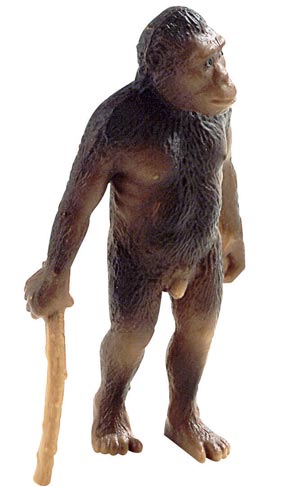
The model (above) is a retired Bullyland Australopithecus figure.  To view the range of Bullyland dinosaur and prehistoric animal models in stock: Bullyland Prehistoric Animal Models and Figures.

No flaked stone tools were found at the Dikika sites, this could indicate that the Dikika residents were simply opportunistic, just finding and using sharp-edged stones where they happened to be.  Most of the marks on the bones at Dikika do have features that indicate that they were made by stone tools.  Intriguingly, regardless of whether or not the stone tools were being made, the fact that they were being used to access the very nutritious bone marrow would have had significant implications for early hominin development and ultimately our own evolution.

23 08, 2008

Isle of Man Remains Bronze Age not Neolithic

By |2023-02-25T17:56:52+00:00August 23rd, 2008|Categories: Main Page, Palaeontological articles|0 Comments

Isle of Man Remains Bronze Age – but show Evidence of Tragedy

A team of archaeologists working at a site on the Isle of Man have uncovered evidence of a potential ancient tragedy on a site, once thought to be Neolithic but now dated to the Bronze Age.

The team from Lancaster based Oxford Archaeology North have been mapping and excavating an area of Bronze Age settlement discovered as the island’s airport is extended.

They are working on a theory that fire could have burnt part of the Bronze Age village to the ground. The fire may have been so devastating that the village was abandoned and subsequently only used as a burial ground. This may explain why three skeletons were found at the site, the area becoming a graveyard rather than being used as a settlement after the disastrous fire.

When the prehistoric human remains were found, they made headlines around the world. At this time, it was thought the site dated from the Neolithic but further research and a close examination of the many pottery fragments found indicate a more recent Bronze Age settlement.

The excavations have been completed some two weeks ahead of schedule and the site, approximately 4 acres in size, is now ready for construction work to resume.It is now believed that what has been uncovered is a further part of a Bronze Age village first discovered when the runway was built in the 1930s.Several of the half-dozen circular structures unearthed at the site featured charred earth indicating evidence of burning.  These were the homes and storage areas for these Bronze Age people.  The archaeologists believe these are Bronze Age homes dating back 3,500 years that appear to have burnt down.

Two cairns, in which were found the human skeletons, appear to be slightly more recent. One of the burials contained fragments of a ring or bangle which had been worn around the upper arm.  This indicates that after the fire the area may have undergone a change of use with the locals abandoning it and only using it for burials.

Andrew Johnson, field archaeologist at Manx National Heritage, said:

“We now think these circular structures are Bronze Age homes. It certainly seems possible that some of these buildings have in some way been burnt down.”

He went onto add:

“The site stretches from a south west to a north east direction and it does seem likely that if fire took hold in the south west then, given the direction of the prevailing wind, the possibilities of disaster are obvious. It’s an interesting speculation”.

Johnson went on to state:

“The cairns appear to have been built slightly later, potentially after the conflagration. Perhaps in what psychologists would now describe as a process of closure, the settlement’s use was changed from a living community to a place of the dead.”

Hundreds of pottery shards and pieces of worked flint were recovered, together with domestic rubbish in the form of shellfish and bones.  These items will be further analysed so that the scientists can build up a picture of living conditions on the island more than 3,000 years ago.Mr Johnson said the age of the remains had been revised after a much more detailed look at the pottery fragments. Radiocarbon dating may be used to get a more accurate date for the human skeletons.He said: “We are certainly not disappointed that we are now looking at Bronze Age rather than Neolithic remains, absolutely not. Slight revision of working theories goes with the territory.

This dig has been an enormous success in terms of working with the airport and the construction team. It has been quite a difficult job but everyone involved in it can feel justifiably proud”.
All artefacts have been removed for study and conservation and a preliminary report will be prepared by Oxford Archaeology. It is likely that the team will return in the spring of 2009, when construction work moves to the eastern end of the airport where the promontory is to be built out to sea.

16 07, 2008

Dinosaur Sounds! What Sounds did Dinosaurs Make?

By |2022-11-26T06:50:52+00:00July 16th, 2008|Categories: Educational Activities, Main Page, Palaeontological articles|0 Comments

What sort of sounds did Dinosaurs Make?

No dinosaur film or TV documentary is complete without the roaring and bellowing sounds of the animals being portrayed.  However, the noises and calls added by the dubbing team to the soundtrack are based on assumptions and scientific guesswork.  The sound an animal makes is not preserved within the fossil record, so palaeontologists have to turn detective to try to work out what sort of sounds long extinct creatures would have made.

Dinosaur Sounds

Most reptile species around today are largely silent, however, herpetologists (people who study reptiles) are beginning to understand more about the complex communication between individuals of the same species and how reptiles react to their surroundings using their senses.  For example, for many years, scientists thought that as snakes show no signs of an external ear structure they were deaf.  However, research has shown that snakes are sensitive to vibrations of the ground and that they do possess a sense of hearing although the mode of its operation is unique to the Squamata order.  The quadrate, a bone located towards the back of the skull is able to respond to airborne sounds which are transmitted through the skin.  The vibrations that are produced are transmitted to the cochlea, converted to electrical signals which can then be interpreted by the brain.  It is believed that snakes can pick up low frequency airborne sounds in this manner, having a hearing range of around middle C to high C.  Indeed, some scientists have claimed that snakes are more sensitive to sounds in this frequency range than domestic cats.

Hearing in the Squamata Order

Snakes are related to lizards and lizards have a sense of hearing so it would be logical to assume that this sense has not been lost by the snakes, merely that the external ear has disappeared and modification to the receipt of sounds has evolved.

The noisiest reptiles in the modern world are the Crocodilians – the crocodiles, alligators, caymans and gharials.  The noise levels generated varies between the species, from hissing noises that are made as a threat gesture to the low-frequency sounds made by males to attract mates in the breeding season.  A lot of work has been done on the sounds made by American Alligators.  Studies have shown that the sounds produced by the males (called bulls), varies depending on the size of the animal.  Deeper and more penetrating sounds are made by the larger males.  The larger the male the louder the sound and the greater distance it will travel.

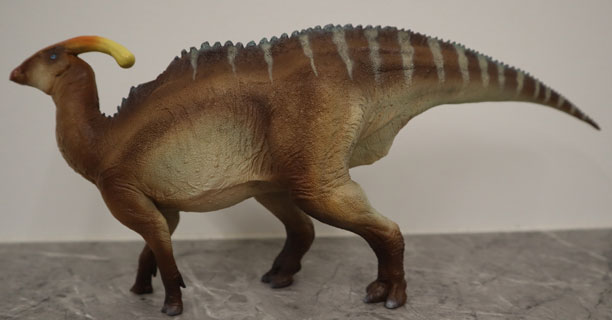
PNSO Wyatt the Parasaurolophus dinosaur model in lateral view.

PNSO Wyatt the Parasaurolophus dinosaur model in lateral view, a stunning replica of a Late Cretaceous duck-billed dinosaur.  The hollow crests of these dinosaurs could have helped them to vocalise.  Picture credit: Everything Dinosaur.

Picture credit: Everything Dinosaur

To view the PNSO range of models in stock at Everything Dinosaur including replicas of hadrosaurs: PNSO Museum Quality Dinosaur Models.

Alligators have no vocal cords as such but make noise by sucking air into their lungs and then forcing it out again.  The low frequency sounds produced are so intense that the water dances on their backs due to the vibration.  The sounds travel for long distances underwater (water is a better transmitter of sound than air).

Animals can use sounds for a variety of purposes, to keep in touch with their family group, to call to their parents (such as the beeping noise made by baby crocodiles), to ward off rivals and to attract a mate.  This kind of communication amongst dinosaurs would have been common place, however, the fossil record provides little actual evidence of the sounds dinosaurs made or indeed how their sense of hearing would have operated.

It is not clear whether dinosaurs had vocal cords, soft tissues are rarely preserved as fossils, perhaps the recently discovered Hadrosaur mummy, nicknamed “Dakota” will shed some further light on the sounds dinosaurs were capable of producing.

To read more about the discovery of this dinosaur fossil complete with skin and some internal organs preserved: Dinosaur Mummy unlocks Duck-Billed Dinosaur Secrets.

How do Birds Make Sounds?

Birds, like crocodiles are relatively close relatives of dinosaurs.  They can produce an extraordinary arrange of sounds, from beautiful, lilting birdsong to harsh cries and shrieks depending on the species.  Birds can also vary the tone and pitch of the noises they produce as well as controlling the volume of their calls.  Birds do possess a larynx, a small organ located near the top of the windpipe, but it is believed to have only a rudimentary role in sound creation, merely helping to control the flow of air.  The sounds we make are made by the larynx and our vocal cords, birds have a specialised sound producing organ (called the syrinx) at the base of their windpipe (trachea).  It is from the syrinx and the elasticated membranes within it that the sounds birds make are largely controlled.

Dinosaur Sounds

It has been assumed by scientists that vocalisation would have been very important to dinosaurs, with different species, and indeed different individuals within a species making distinct sounds.  The cheeks and beaks found in many ornithopods such as iguanodonts would have altered and helped modify the sounds these animals produced.  Perhaps, quieter, frequent chirps between herd members to keep in contact with each other and then louder, bellows to warn of danger.  The larger the animal the lower the frequency of the sound likely to be produced.  Compsognathus, a small bipedal dinosaur of the Jurassic, no more than 3 feet long would have probably produced high pitched squeaks and squawks, whilst a giant sauropod such as Apatosaurus would have produced very deep, low frequency sounds beyond the range of human hearing.  The sounds these huge animals produced would have caused vibrations (similar to the low frequency vibrations produced by alligators).  It is possible that these animals could have detected these vibrations through their feet.  Another method through which these large animals could keep in contact with each other.

The greatest amount of research into dinosaur sounds and hearing has involved studies of the duck-billed dinosaurs, known as the hadrosaurs.  The reasons for this are two-fold, there are a lot of hadrosaur fossils, particularly skull material to study and many of these animals had strange, hollow crests associated with their skulls (the lambeosaurine hadrosaurs had the most spectacular crests).

Advances in our understanding of dinosaur hearing were made when a very well preserved skull of a Corythosaurus (lambeosaurine), revealed an intact hearing bone – the columella.  Although, the Corythosaurus was over 9 metres long, the columella measured just 50 mm in length and was extremely delicate being only 2.5 mm wide at its widest part.  Such a delicate bone would have been extremely sensitive to airborne vibrations and this evidence in conjunction with studies of hadrosaur brain-cases which show a large part of the brain dedicated to hearing, indicates that these dinosaurs had a very good sense of hearing.

A Scale Drawing of Corythosaurus

Picture credit: Everything Dinosaur

A group of scientists at the Sandia National Laboratories in collaboration with palaeontologists at the New Mexico Museum of Natural History and Science took the study of dinosaur vocalisation to a new level when they used computer modelling to recreate the voice of a dinosaur.    The work, although now ten years old, represents one of the most sophisticated studies into the airways and nasal passageways of dinosaurs.

Lambeosaurine Skulls

A skull of another type of lambeosaurine duck-bill, a Parasaurolophus (P. walkeri) had been discovered in 1995, the skull was carefully cleaned and prepared before a series of CAT scans were taken to provide evidence of the internal structure of the skull.  From the analysis of the internal airways and nasal passages a computer model was constructed that would interpret the flow of air forced through the skull crest by the animal.  This enabled the team to generate sounds that the dinosaur would have made.  The result was a series of low-pitched growls and rumblings, the first dinosaur calls to have been heard for 65 million years.

It is not clear how accurate the sounds made were, but the notes produced were typical of the sounds made by a large animal with a long windpipe such as Parasaurolophus possessed.  Many scientists believe that the crests of Hadrosaurs helped them make distinctive calls as well as being used as visual signalling devices, hence the trend to show brightly coloured crests in the latest models of duck-billed dinosaurs.

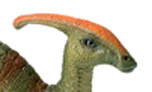
The Orange Crest of a Model Parasaurolophus

Picture credit: Everything Dinosaur

To view dinosaur models available and in stock at Everything Dinosaur: Dinosaur Models.

18 06, 2008

Dinosaur “Log jam” Discovered in the Morrison Formation of Utah

By |2022-11-25T13:36:14+00:00June 18th, 2008|Categories: Dinosaur and Prehistoric Animal News Stories, Dinosaur Fans, Main Page, Palaeontological articles|0 Comments

New Dinosaur Quarry unveiled – a chance to meet up with old Friends

An expedition hoping to find specimens for a Chicago museum have hit the jackpot with the discovery of a vast number of jumbled up dinosaur bones in an ancient river system outside of Hanksville, Utah in the USA.

The researchers, representing the Burpee Museum of Natural History, had been hoping to find specimens for the museum’s new display centre which is currently under construction.  This new discovery will give them plenty of options, as so far, six types of dinosaur have been identified along with a number of other important finds that provide a detailed picture of the western North American landscape in the late Jurassic.

It seems the team have uncovered a “log jam”, a series of fossils that represent the aftermath of a single flood event (or perhaps numerous floods), with drowned animals being washed down stream and ending up in part of a river system with more flood debris including trees and other plant material.   The site is then gradually covered over with sediments and preserved as fossils, providing a remarkable insight into the fauna and flora of this part of the world approximately 148 million years ago.

Dinosaur “Log Jam”

These “log jams” can provide palaeontologists with a tremendous amount of information about a particular ecosystem, as a vast amount of fossil material is uncovered.  This new site includes numerous dinosaur remains, some of the bones are articulated but the majority are scattered and jumbled up.  Amongst the fossil bones are the fossilised remains of conifers, so well preserved that the texture of the bark can still be made out along with growth rings on the broken branches and trunks.  These pieces probably created a natural dam which enabled the collection of all the carcases of animals caught in the floods to be washed up together in the same area.  Dendrochronologists (scientists who study the growth rings of timber), should be able to obtain climate data from the fossilised wood.  Wide growth rings followed by narrow growth rings would indicate distinct seasons, such as a wet season with rapid growth followed by a dry season with limited tree growth.  This site could help provide further information on life in the Late Jurassic (Tithonian faunal stage).

These log jam sites are very important to palaeontologists, because of the wealth of data they contain, although such finds are rare, when they do occur they permit scientists a unique access to ancient worlds.

To read about the discovery of a similar site (but dating from the Cretaceous period), in Argentina: Giant Dinosaur Discovered in Cretaceous “Lost World”.

This new quarry is within the Dinosaur National Monument Park, an area protected by the U.S. National Parks Service, an area that is one of the most important sites in the world for dinosaur fossils.  The National Monument site was established in 1915 by Presidential decree, and much of what we know about dinosaurs such as Apatosaurus, Diplodocus, Allosaurus, Camptosaurus and Dryosaurus is due to fossil discoveries made in this area.

Many Dinosaur Fossils from Utah

This part of Utah was first recognised as being scientifically important in 1909, when an almost complete Apatosaurus skeleton was discovered by an expedition from the Carnegie Museum of Natural History (Pittsburgh, Pennsylvania).  Between 1909 and 1923 the site was continually excavated and approximately 350 tonnes of fossil bones were removed, providing the backbone (no pun intended), of most of the world’s Jurassic dinosaur fossil collections.

Commenting on the discovery, Matt Bonnan an associate professor of biological sciences at Western Illinois University stated:

“What’s exciting is that it’s the first time in a long time where we have logjams of bones of a different species in one place” .

For Matt, this will give him an opportunity to study more sauropod fossils including Apatosaurus, Diplodocus (diplodocids) and the more heavily built Macronaria, a clade of sauropods that includes the brachiosaurids and camarasaurids.  The name Macronaria, literally means “big nostrils”, a reference to the distinctive box-like skulls of these huge dinosaurs, where the naris (hole in the skull for the nostrils) is bigger than the orbits (the hole in the skull for the eyeballs).  It is thought that these large nostrils were filled with moist membranes that would have cooled the brain as these animals wandered around the hot Jurassic landscape.

The area of land around the town of Hanksville has been known as a source of fossils to locals and land managers for years, but it was only in the last few weeks that its potential impact to science became apparent.  Amateur fossil hunters had picked over the site but no extensive excavations had taken place thus leaving those fossils below ground in pristine condition.  The Bureau of Land Management intends to close the site to the public to permit a proper scientific excavation to take place.

It is hoped that the Burpee group will provide more information on some already well known dinosaurs such as the meat-eater Allosaurus, plus the herbivores Stegosaurus and Camptosaurus.  Elements of a brachiosaurid type fossil have already been recovered.  Despite being a very well known dinosaur, remains of these animals in the Morrison Formation are very rare.  The only virtually complete skeleton of a Brachiosaurus was found in Tanzania, it is on display at the Humboldt Museum of Berlin.  This animal has been reclassified as a different type of brachiosaur by some scientists and re-named Giraffatitan, although this re-working of the evidence has yet to gain universal approval and most palaeontologists refer to the Humboldt specimen as a Brachiosaurus.  Perhaps the brachiosaur remains at the Hanksville site will give scientists a rare opportunity to compare the African and North America types of brachiosaur.

A Typical Model of a Brachiosaur

Brachiosaurus replica (Bullyland of Germany)

Picture credit: Everything Dinosaur

To view the Museum Line range of models from Bullyland: Bullyland Museum Line Models.

The fossil area is approximately half a mile in diameter and probably represents a sandbar deposit upon which all these organic remains came to rest.  Whether this marks a single flood event or a gradual build up of debris in one area over a number of years has yet to be determined.  One thing is for sure, this new site will help cement the Morrison Formation as one of the most important Mesozoic sites of all and provide fresh insight into well-known dinosaurs, but relatively poorly researched animals such as the North American brachiosaurids.

 “We will be able to take a look at old bones with new eyes and new techniques,” Bonnan commented. “In the old days they looked for the best specimens for display. What we tend to be interested in nowadays when you have a log jam is what it can tell you about the flow of the river system and about the ancient environment.” 

It is sometimes difficult for the public to appreciate how little is still known about famous dinosaurs such as Diplodocus and Brachiosaurus for example.  Although scientific techniques have improved and new fossils found, there is still so much more to learn about these amazing creatures.  A point that is all too often overlooked when the likes of “Walking with Dinosaurs” a ground breaking BBC TV documentary series featured the animals of the Morrison Formation in episode two of the series -“Time of the Titans”.

6 06, 2008

When is a Mass Extinction a Mass Extinction?

By |2022-11-25T06:52:34+00:00June 6th, 2008|Categories: Educational Activities, Everything Dinosaur News and Updates, Main Page, Palaeontological articles|0 Comments

Defining When a Mass Extinction Occurs

Mass extinctions by definition are substantial and significant events.   At any time in the history of life on Earth, there will be a level of background extinctions taking place as well as speciation – the evolution of new species.  The vast majority of species recorded in the fossil record have gone extinct as part of this normal background rate, this is a consequence of evolution and the process of adaptation.  However, it is the mass extinctions that grab the headlines, although the existence of such events in the geological record of this planet was not really understood and widely accepted until late on in the 19th century.

As scientists and geologists began to understand the stratigraphy (the sequences of rocks laid down in strata, indicating they were of different ages), and an appreciation of the development of life began to emerge, it was noted that many groups of fossils disappeared from the fossil record at about the same time.

Fossils such as ammonites, very abundant in strata dated from the Jurassic and Cretaceous, become more scarce and less diverse in rocks derived from Upper Cretaceous sediments, before finally disappearing from the fossil record completely.  Ammonite fossils are not found in rocks younger than approximately 65 million years.  Although present in older rocks, they are not known from younger rocks.

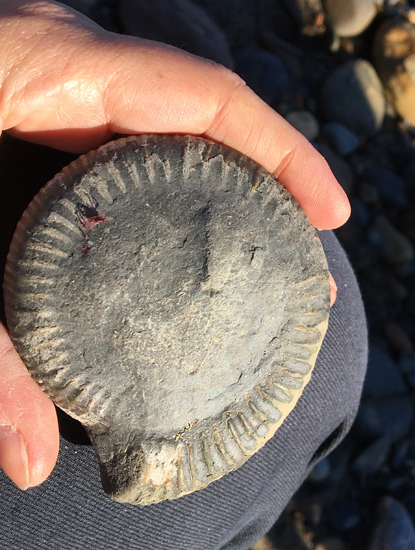
An ammonite fossil find.
An ammonite partially eroded out of a nodule. We think this is an example of Dactylioceras commune. Picture credit: Everything Dinosaur.

 Picture credit: Everything Dinosaur

It is partly due to the dramatic change in the fossil record that the boundaries between geological eras and periods are where they are in the chronological history of our planet.  For instance, the boundary between the Mesozoic and the Cenozoic eras is at approximately 65 million years ago – the time of a mass extinction that saw the end of the Dinosaurs, mosasaurs, pterosaurs and plesiosaurs.  The boundary between the Palaeozoic and the Mesozoic (Permian/Triassic periods), dated to approximately 248 million years ago marks what is believed to have been the greatest mass extinction of all time.

Geologically rapid, major reductions in the diversity of life on a global scale are termed mass extinctions.  Patterns of extinction and the severity of the extinction event are assessed by examining their impact on the taxonomic hierarchy.  Individual species may become extinct, indeed whole genera (the next taxonomic category up from species) may die out, but the term mass extinction is usually reserved for those events that impact on life at the family level – the next category up from genus/genera).  Geologists and palaeontologists have identified five especially severe mass extinction events in the history of life on planet Earth.  These are termed the “Big Five” and they are summarised in the table below.

The Big Five Mass Extinction Events (Phanerozoic Eon)

Mass Extinctions – the Big Five (Phanerozoic Eon)
EraPeriodDate (approx)Main Extinctions
PalaeozoicLate Ordovician443 million yearsTrilobites, Brachipods, Corals, Echinoderms
PalaeozoicLate Devonian355 million yearsReef dwellers – Corals, Bivalves, Sponges
Palaeozoic/MesozoicLate Permian248 million yearsCorals, Reef dwellers, Trilobites, Graptolites, Brachipods, Amphibia, Reptilia*
MesozoicLate Triassic206 million yearsGastropods, Cephalopods, Sponges, Reptila, Amphibia, Mammal-like Reptiles, Insects
Mesozoic/CenozoicLate Cretaceous65 million yearsCephalopods, Dinosauria, Pterosaurs, Plesiosaurs, Plankton, Echinoderms
Mass extinction events in Deep Time.

Source: Everything Dinosaur

Note

The Phanerozoic Eon refers to the geological time from approximately 545 million years ago to the present, this eon marks the presence of visible life in the fossil record (animals with hard parts such as shells).

The Permian mass extinction is believed to have been the greatest mass extinction of all with nearly 60% of all marine families becoming extinct.  Life on land was devastated too with many groups of amphibians, reptiles and the ancestors of mammals also perishing.  Such was the devastation that the term “dead clades walking” has been coined by scientists to describe those remnants of once diverse and abundant families of organism left behind.

It is possible for a fossil of an organism to be found in rocks which were formed after these organisms are believed to have become extinct.  This is not always due to some “living fossil” existing in a remote, isolated area after the rest of their species have died out, but perhaps due to a process called redistribution.  For example, a fossil of a sea urchin, preserved as an internal flint mould, laid down originally in Cretaceous chalk strata.  As the chalk is weathered and eroded the more robust flint nodule survives this physical process and eventually under the effects of wind and rain is deposited in a river where it mixes with sand and gravels before finally coming to rest at a bend where the river water slows down, losses energy and deposits its load of debris.  Thus the flint nodule, no doubt having suffered some weathering may find itself redistributed into younger sediments.

Everything Dinosaur stocks a range of replicas of iconic animals from the fossil record: Replicas of Iconic Fossil Animals.

1 06, 2008

A Fishy Tale Indeed – An Amazing Placoderm Parent

By |2024-04-12T19:22:53+01:00June 1st, 2008|Categories: Dinosaur and Prehistoric Animal News Stories, Main Page, Palaeontological articles|0 Comments

Live Birth Fossil – Placoderm gave birth to Live Young

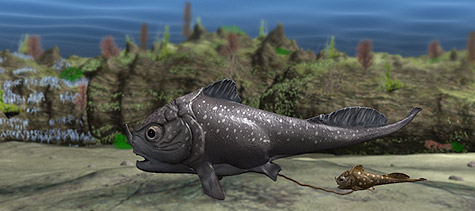
A placoderm parent!  A 380-million-year-old fossil placoderm reveals an internal embryo and a mineralised umbilical cord, indicating that these ancient fish gave birth to live young, pushing back the origins of viviparous behaviour by 200 million years.

A team of Australian scientists have claimed that this is one of the most important palaeontological finds and the earliest example of vertebrate sex discovered to date.  One of the team’s lead researchers Dr John Long (Museum Victoria) stated:

“This is one of these real eureka moments in science you have once in your lifetime.  When you look down the microscope and there it was – an embryo inside a 380-million-year-old fish – and I was blown away by the very thought of this fish giving birth to live young almost 400 million years ago.”

The fossil fish is a member of the now extinct Placodermi Class and has been dated to the  Devonian period, otherwise known as the Age of Fishes.  The 25 cm long fossil was found in the far north of Western Australia, south east of Fitzroy Crossing in a fantastically fossil rich area known as the Gogo Formation.  Approximately 380 million years ago this area of dry, scrub-land was covered by a shallow sea and teemed with life, an environment similar to the Great Barrier reef of Australia to day, the corals that provided much of the habitat were not the scleractinian corals of today, these types of corals first evolved in the Triassic, the corals that dominated this environment were rugose and tabulate corals, two types of coral that went extinct at the end of the Permian period.

The Placodermi

The placoderms were very heavily armoured fishes that possessed bony skeletons and jaws.  The head and trunk were encased in a box-like series of bony plates, the group is believed to have evolved sometime in the Silurian and diversified into as many as 200 different genera.  Fossils of placoderms have been found in sediments that represent both marine and freshwater environments.

The shales that form the Upper Devonian Gogo Formation were formed in quiet bays, that formed a link between the coral sea and the surrounding coastal areas.  The sediments contain superbly preserved fossil fish and other creatures that lived in this ancient sea.  These thick deposits contain one of the most diverse collection of animal fossils of the Devonian period with over 25 varieties of placoderms, ray-finned fishes, lobe-fins and lungfish.  Such has been the quantity and quality of fossils from this area that a placoderm has been adopted as the official state fish of Western Australia – it is known affectionately as the GoGo fish – official name Mcnamaraspis kaprios.

Preserved as original bone in limestone nodules within the shale, these fossils represent the best preserved early fishes in the world and the site is of huge importance to scientists as they try to piece together the evidence to understand how and why vertebrates moved onto land.

A Placoderm Parent

The fossil showing the embryo was found three years ago, but only after the specimen was placed in an acid bath to help dissolve away the surrounding matrix, was the significance of this particular fossil recognised.  Acid preparation is a common technique used by laboratory technicians to help reveal more of a fossil which is surrounded by a limestone matrix.  This technique was pioneered by scientists at the Natural History Museum in London and used to help reveal more of dinosaur bones embedded in calcareous rocks.

This particular placoderm, represents a new species and it has been named Materpiscis attenboroughi after Sir David Attenborough, in recognition of his work in the field of Natural History and his help in identifying the Gogo Formation as being of major scientific importance.

“The discovery is certainly one of the most extraordinary fossil finds ever made and changes our understanding of the evolution of vertebrates,” Melbourne-based Dr Long commented.

“The existence of the embryo and umbilical cord within the specimen provides scientists with the first every example of internal fertilisation – that is, sex – confirming that some placoderms had remarkably advanced reproductive biology.”

Once the cleaned and fully prepared fossil was put under a powerful CT scanner at the Australian National University in Canberra, the yolk sac and a major blood vessel inside the umbilical cord could clearly be seen.  The fossil provides evidence that the basic body plan that makes up a vertebrate was already present 380 million years ago and sheds light on how placoderms reproduced.

An Artist’s Impression of Materpiscis attenboroughi

Picture credit: Museum Victoria

The paper on this particular specimen, the oldest vertebrate mother known,  has just been published in the scientific journal Nature.  It seems that some placoderms reproduced in a very similar way to some cartilaginous fish (sharks and rays) who are also viviparous – able to give birth to live young.

Could this be evidence that the sharks and rays shared a common ancestor with the placoderms?  The fossil record of vertebrates is particularly poor in the Silurian and Ordovician and scientists are still uncertain as to the relationships between the different Orders of fish.  Perhaps this fossil of a female placoderm provides evidence of convergent evolution.  Convergent evolution is the development of similar anatomical or morphological characteristics such as the ability to give birth to live young in unrelated groups of animals or plants in response to the same environmental pressures.

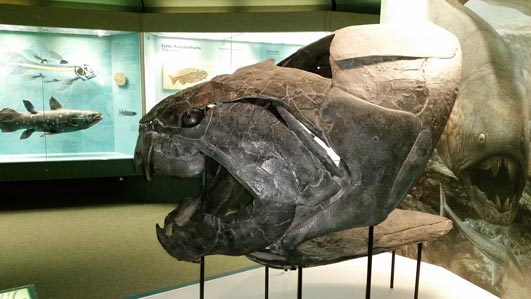
An Exhibit Featuring the Most Famous Placoderm of All – Dunkleosteus

Dunkleosteus on display. A placoderm parent?

The spectacular Dunkleosteus exhibit.  Perhaps the most famous placoderm of all.

Picture credit: Everything Dinosaur

The ability to give birth to fully developed young which had grown up inside the mother for protection would have given such creatures an advantage, helping to ensure the survival of more babies, than those species that laid eggs expelled from the body – oviparous behaviour.  There were certainly a great number of predators around ready to feast on any eggs that were found, fish such as the lung fishes, lobe-finned species as well as the large arthropod predators the sea scorpions (eurypterids).

Remarkable Fish Finds

Some other remarkable fish finds have been reported from the Gogo fossil site, including evidence of fish with muscle tissue similar to that which is found in land living vertebrates and an almost 3-D impression of a fish providing information on nerve and circulatory tissue.  Such exquisite preservation provides scientists with an opportunity to learn a great deal more about life in the Devonian seas.  Another placoderm specimen from the same formation was found in 1986, this fossil shows evidence of three internal embryos and study of the developing babies could provide the Australian team with a wealth of new data on bone formation and the growth of young placoderms.

Unfortunately, any biological advantage life birth gave some of their kind, this was have been outweighed by other factors as the entire family went extinct at the end of the Devonian – perhaps their armoured blunt bodies made them too inefficient swimmers to compete effectively with the tetrapods and the rapidly diversifying other fish families.

Everything Dinosaur stocks a range of prehistoric fish replicas including models of Dunkleosteus.  For example, the PNSO model range includes several ancient fish models including prehistoric sharks and a Dunkleosteus figure: PNSO Age of Dinosaurs Figures.

28 05, 2008

Getting Stalked by a Flock of Quetzalcoatlus

By |2022-11-15T12:59:53+00:00May 28th, 2008|Categories: Dinosaur and Prehistoric Animal News Stories, Main Page, Palaeontological articles|0 Comments

New Research into Late Cretaceous Pterosaurs – Not Flyers but Stalkers

New research published today, led by scientists from the University of Portsmouth has concluded that many of the large pterosaurs of the Late Cretaceous may have had a completely different lifestyle than previously thought.  Large azhdarchid pterosaurs may have been terrestrial hunter.  Animals may have been stalked by a flock of Quetzalcoatlus!  They may have been walkers, not long-distance gliders, patrolling the great fern plains snatching up prey with their long toothless beaks.

Pterosaurs are not Dinosaurs

Pterosaurs are not dinosaurs, but reptiles that shared a common ancestry with the dinosaurs (the Archosauria).  The first fossils of these flying reptiles date back to the middle of the Triassic, around 230 million years ago.  They evolved into a myriad of forms, from long-tailed pterosaurs with relatively short bodies and stubby wings to the huge, short-tailed pterosaurs of the Late Cretaceous with many species having wingspans in excess of 8 metres.

Pterosaur Success

These flying reptiles were very successful during the Mesozoic period, although their numbers and the diversity of the group declined sharply towards the end of the Cretaceous.  Scientists have speculated about why this group of animals declined, perhaps it was because of competition from the rapidly diversifying birds.  After all, feathered flyers would have a number of advantages over gliding or flying reptiles that were powered by flaps of skin, living tissue membranes, reinforced with tough, elastic fibres which were supported by an elongated fourth finger.

To read more about pterosaurs competing with birds: Did the Birds wipe out the Pterosaurs?

The last of the flying reptiles were giants, animals like Quetzalcoatlus and Pteranodon.  Interestingly, Pteranodon fossils (the family is called Pteranodontidae) have been mainly found in marine sediments.  This indicates that these animals lived in coastal habitats and they were probably piscivorous (fish-eaters).  In contrast, fossils of the genus Quetzalcoatlus (family is called the Azhdarchidae), are associated with sediments that were laid down inland; far away from a marine environment.  The fossil evidence revealed so far on the Azhdarchidae pterosaurs does not point to them being typical fish-eaters and there are some subtle differences in their anatomy when compared to other large pterosaurs that may indicate a totally different ecological niche for these bizarre creatures.

Stalked by a Flock of Quetzalcoatlus

This new study carried out by Mark Witton and Dr Darren Naish has reviewed the current data and published fossil material on the azhdarchids.  They have come to the conclusion that these animals may have been the prehistoric equivalent of ground-feeding birds such as the ground hornbills and some types of modern stork.

The study of azhdarchid anatomy, footprints attributed to these pterosaurs and the distribution of their fossils by the research team shows that the coastal glider, fish-eater stereotype of large pterosaurs does not necessarily apply to this particular family of flying reptiles.  Their review provides evidence that some types of azhdarchids were strongly adapted for terrestrial life.  According to the review of the fossil bones of azhdarchids the scientists have concluded that they were better adapted for walking than other types of flying reptile because they had long limbs in proportion to their bodies.  Their light, skulls ending in a sharp, pointed but toothless beak would have been well suited for picking up small animals and other food from the ground.  They would then have manipulated their food in the huge beak before swallowing it whole (probably head first like many species of ground hunting birds do today).

Azhdarchid Pterosaurs

Azhdarchids such as Quetzalcoatlus, a huge pterosaur with a wingspan of approximately 12 metres have big eye sockets in their skulls indicating large eyes, with perhaps telescopic vision, although this can only be speculated at the moment.  The placement of the eyes to the side of the head but looking forward would have enabled these large animals to judge distance accurately.  Some palaeontologists believe that these physical attributes would have helped Quetzalcoatlus scan lakes for fish on the surface or perhaps to search the terrain below them for carcases to scavenge as they flew high above, just like vultures do today.  However, this new paper reports on how effective these adaptations would be for spotting and grabbing prey as these huge reptiles wandered around on all fours.

An Artist’s Impression of Quetzalcoatlus Searching for Food
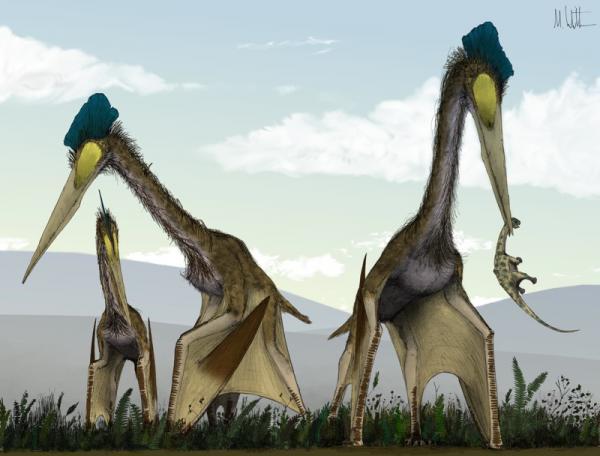
Picture credit: Mark Witton

The illustration above shows a flock of Quetzalcoatlus moving through an extensive fern plain predating on small animals including baby dinosaurs hiding in the undergrowth.  The wings may not have been particularly effective for flying with rapid wing beats, but could have served as giant shields to prevent potential prey escaping.  Moving in a line they could have co-operated together in order to stop any small animals avoiding being eaten.  Such behaviour is seen in the group hunting of some pelican species today.

If the azhdarchids did have this sort of environmental niche, it is possible to imagine them following behind the herds of hadrosaurs and ceratopsians snatching at the small creatures such as lizards, mammals and small dinosaurs disturbed by these huge herbivores as they wandered the plains.

It would be beneficial for both types of animals, the ceratopsians for example could rely on the pterosaurs with their keen eyesight to keep a look out for potential predators such as tyrannosaurs, whilst the azhdarchids could rely on the horned dinosaurs to flush out potential prey and with their horny beaks they could crop small trees and bushes helping to maintain the plains as an ideal hunting habitat for these large flying reptiles.

Loose relationships such as these can be observed on the Savannah of Africa with herds of Zebra tolerating Ostriches, as the bird’s sharp eyes can help to keep watch for predators, permitting the Zebras to remain with their heads down for longer grazing.

The Azhdarchidae

Escaping from any potential threats could pose a problem for such large pterosaurs, it had been thought that these animals needed to live by cliffs so that their take-off could be assisted by gusts of wind rising from natural obstacles.  It has also been suggested that these animals used thermals, hot air rising from the land to help them gain altitude in a manner similar to vultures and birds such as condors.  Being able to take to the air was perhaps their only effective means of defence against predators.  Although the largest species of Azhdarchidae so far described Q. northropi had a wingspan of 11-12 metres it weighed little more than 80-90 kilogrammes, so it would have been no match even for a small or sub-adult member of the tyrannosaur family.  The relatively long hind-limbs could have been quite powerful and capable of providing the impetus and initial lift to help these animals take to the air, but again the fragmentary fossil evidence of the Azhdarchidae prevents much further work on the muscle mass associated with the femur or the bones of the lower leg.

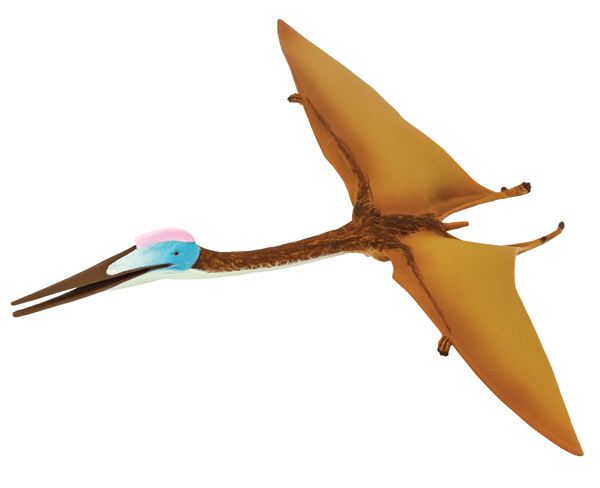
The More Typical Pose of an Azhdarchid Pterosaur
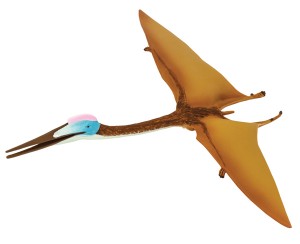
Quetzalcoatlus model.

A model of the giant Pterosaur Quetzalcoatlus.

Picture credit: Everything Dinosaur

The picture above shows a model of a Quetzalcoatlus a typical large, long-necked azhdarchid pterosaur of the Late Cretaceous.

To view a range of prehistoric animal models including pterosaur figures: Dinosaur and Prehistoric Animal Models.

Despite the lack of fossils it is now known that the azhdarchids had a substantial geographic distribution.  Fossils have been found in China, Japan, Jordan, Morocco, Russia, Senegal, Spain, North America and Uzbekistan.  Indeed, this type of pterosaur was named from the Uzbek word for dragon.

Dr Naish said: “Azhdarchids first became reasonably well known in the 1970s but how they lived has been the subject of much debate. Originally described as vulture-like scavengers, they were later suggested to be mud-probers (sticking their long bills into the ground in search of prey), and later still suggested to make a living by flying over the water’s surface, grabbing fish.

Other lifestyles have been suggested too. These lifestyles all seem radically divergent so Mark and I sat down and carefully examined the evidence and we argue that azhdarchids were specialised terrestrial stalkers. All the details of their anatomy, and the environment their fossils are found in, show that they made their living by walking around, reaching down to grab and pick up animals and other prey.”

The two researchers studied fossils in London, Portsmouth and Germany and compared the anatomy of azhdarchids with those of modern animals, that fill the sort of ecological niches previously thought to have been occupied by the azhdarchids in the Campanian and Maastrichtian faunal stages of the Late Cretaceous.  This showed that azhdarchids were strikingly different from mud-probers and animals that grab prey from the water’s surface while in flight.

Dr Naish said: “We also worked out the range of motion possible in the azhdarchid neck: this bizarrely stiff neck has previously been a problem for other ideas about azhdarchid lifestyle, but it fits with our model depicting this group as terrestrial stalkers”.

This particular group of pterosaurs have characteristically long-necks which are relatively stiff and immobile.  Such an anatomical arrangement would fit the hypothesis put forward by Mark Witton and Dr Naish as with a terrestrial, stalking habit all these animals would need to do to feed would be to raise and lower the beak in a vertical line to the ground.  Studies of the bones in neck vertebrae indicate that they could certainly do this.  The necks were also quite strong, able to support the head and a beak up to 1 metre long in the larger species, certainly some of these neck vertebrae were an impressive size, a single neck vertebrae, discovered in Jordan in 1943 and believed to have belonged to an azhdarchid was over 60 cm long.

Strong but Inflexible Necks

The strong, inflexible neck also provides evidence to support another theory about the diet of these animals, that they were scavengers operating like vultures.  The huge wings allowing them to glide effortless across the land, coupled with their excellent eye-sight would have made them superb spotters of carrion.  Once found, the carcase could be ripped open by a few strong blows of that strong, dagger-like beak.  These pterosaurs if they were scavengers living on the remains of dinosaurs would have had to break through many centimetres of tough hide to reach the flesh underneath.  The sharp beaks, powered by strong neck muscles could be capable of doing this. A long neck would enable these creatures to reach deep inside a carcase to feed.

In the scientific paper published today other aspects of azhdarchid anatomy are discussed.  Consideration is given to their relatively small padded feet which the British researchers claim would not have been suited to walking around the muddy shores of lakes, probing for burrowing shellfish and crabs.  This work casts further doubt on the mud-probers hypothesis.

In their study the researchers calculated that over 50% of all the known azhdarchid fossils are from sediments laid down inland, away from marine environments.  Significantly, the few articulated azhdarchid fossils have all been discovered in areas believed to have been a long way from saltwater when the animal perished.  The relative completeness of these finds indicate that the carcase may not have been transported very far before finally coming to rest and starting the preservation process.  This might show that the azhdarchids were very much creatures of the land and not marine environments.

From our own observations of birds such as the Marabou stork (Leptoptilos crumeniferus) on the Masai Mara, it is possible to imagine animals such as the azhdarchids filling this niche in the food chain.  Although it is worth pointing out that in the case of the Marabou stork, it scavenges carcases as well as actively hunting in the grass and reed beds of Africa.  Perhaps the azhdarchids such as Quetzalcoatlus and its close relative Montanazhdarcho were also opportunists grabbing a meal in a variety of ways.  If they were warm-blooded and this is quite likely given the pterosaur ability to fly, then they would have had to consume perhaps as much as ten times the food of a similar sized cold-blooded animal like one of the large crocodiles that also lived at the end of the Mesozoic.

No doubt the debate will continue for sometime to come.  The paucity of the fossil record for large pterosaurs does not help, there have been several attempts to review the Azhdarchidae in order to establish relationships between genera.  What is compounding the problem is that scientists are not really sure of the size of many genera so far described, many from only fragmentary remains.  For example, a single bone from the Dinosaur Provincial Park Formation in Alberta, Canada could be a femur indicating an animal with a wingspan of no more than 3 metres across.  However, if the same bone is described as a wing metacarpal, or an arm bone (ulna or radius) then with a bone diameter in excess of 60 mm this would indicate an immense animal with a wingspan approaching the size of the largest pterosaurs known (wingspan in excess of 12 metres).

Such are the difficulties that surround research into these amazing animals.  Work on the Campanian faunal stage deposits in Alberta indicates the presence of a least three genera of azhdarchid, with wingspans from 2.5 to up to 11 metres across all living in the same area at the same time.  However, the incomplete and scarce remains recovered so far mean that palaeontologists are unable to rule out the possibility that the pterosaur fossils found in this area actually represent just one genus and that the bones represent animals of different ages or perhaps even males and females.  Bennett (1992) has made a convincing case for sexual dimorphism in Pteranodon, with males believed to be up to twice the size of adult females.

The truth is, until many more fossils of azhdarchids are found then the speculation on their diet and lifestyle and even some aspects of their basic anatomy are going to continue.  Ten years ago for instance, Clark et all published a paper on a study of the posture of pterosaurs, this team concluded that the metatarsal-phalangeal joints of the azhdarchids (those bones that connect the ankle to the toes) did not seem well suited to a cursorial lifestyle.

This article has been produced using material from the Public Library of Science (2008, May 28) – Giant Flying Reptiles Preferred To Walk.

The work of Bennett referred to in the text is from a paper published in 1992 in the Journal of Vertebrate Paleontology – Sexual dimorphism of Pteranodon and other Pterosaurs with Comments on Cranial Crests.


25 05, 2008

Britain’s Most Complete Dinosaur Fossil Discovered to Date.

By |2022-11-15T12:11:20+00:00May 25th, 2008|Categories: Dinosaur and Prehistoric Animal News Stories, Main Page, Palaeontological articles|0 Comments

Britain’s most Complete Dinosaur Found to Date ready to go on Display

The most complete dinosaur fossil ever to be found in the United Kingdom is about to go on display at the Bristol museum.  The fossil is of a Scelidosaurus, an early armoured dinosaur that dates from the Jurassic.

A Magnificent Specimen

This magnificent specimen of this plant-eater, is nearly complete, a rare find indeed when it is considered that in comparison to other ornithopods these animal’s remains are very scarce in the fossil record.  The lack of fossil evidence relating to these creatures could be for a number of reasons, perhaps these herbivores were associated with environments in which the likelihood of fossil preservation would be low, dry, upland areas for example.  The small number of fossils could also be due simply to the fact that compared with other megafauna around at the time, these types of dinosaurs only made up a small proportion of the animal community.  Such relatively rare animals would be statistically less likely to be fossilised.  Certainly, there is speculation as to the habitat of these armoured dinosaurs, with scelidosaurs being associated with marine deposits, the exceptional quality of the specimen going on display has provided scientists with lots of new data to assist in our understanding of these dinosaurs.

To read more about scelidosaurs: Scelidosaurus – a uniquely British dinosaur.

In pictures that have been released, the snout is facing to the left, with the animal’s eye socket in a direct line between the tip of the fingers on the researcher’s right hand.  The teeth can clearly be seen in the photograph, they are leaf shaped and the fossilised wear pattern indicate that Scelidosaurus had a peculiar feeding habit.  The plant food, probably low lying ferns was crushed in the mouth before being swallowed.  Perhaps not the most energy efficient way of eating and not nearly as sophisticated a process such as the feeding of the later ceratopsians, iguanodonts and the hadrosaurs.  This relatively primitive chewing process could perhaps explain why there are so few fossil skeletons of this type of dinosaur about.

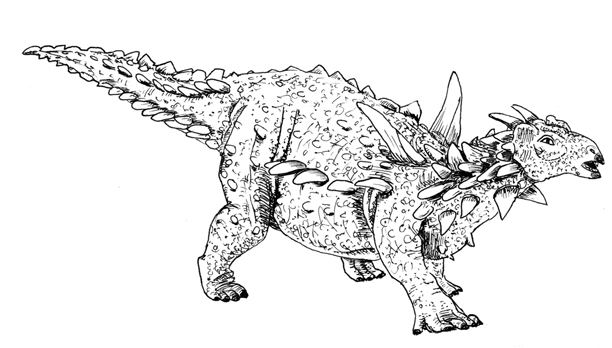
An Illustration of Scelidosaurus (S. harrisoni)

Scelidosaurus

An illustration of the Early Jurassic armoured dinosaur Sceliodosaurus.

Picture credit: Everything Dinosaur

Although permineralised, specimens of almost complete skeletons such as this are extremely rare and delicate.  It is interesting to note that the researcher is wearing rubber gloves when handling the fossil.  Our fingers tend to be acidic and this can damage the surface of fossils, after all many of them are preserved in limestone and this is dissolved by acidic substances.  It is best not to handle fossils a great deal, or indeed to pick up a specimen by the fossil element itself, pick it up by the surrounding matrix if there is any present.  Fossils like this Scelidosaurus need to be looked after, they stopped making them around 175 million years ago!

Everything Dinosaur stocks a range of armoured dinosaurs including a replica of Scelidosaurus in the CollectA Deluxe range: CollectA Deluxe Prehistoric World Dinosaur Models.

24 05, 2008

Rapid Climate Change – not for the First Time

By |2022-11-15T12:06:17+00:00May 24th, 2008|Categories: Everything Dinosaur News and Updates, Main Page, Palaeontological articles|0 Comments

Quick reflection on the Holocene

Here in the Holocene, the name given to epoch that represents the last 10,000 years or so our planet is experiencing  a period of relatively cold weather in geological terms.  The planet has steadily been getting cooler since the end of the Mesozoic (65 million years ago).  It is true, if a graph of average global temperatures were drawn, the line representing temperature would not always slope downwards to the present, for example, the world got considerably warmer during the the early Eocene with global temperatures estimated to be 2 degrees Celsius higher than in the Cretaceous.  However, there has been a trend over the last 65 million years or so for the average temperature on the planet to fall.  Despite fears regarding global warming and climate change, the average global temperature is 14 degrees Celsius, compared to nearly 19 degrees 15 million years ago.

Climate Change

Climate change has an enormous impact on life, the difference between the changes we are seeing today and some of the changes in the past is the speed of the change.  If scientific predictions are correct, global temperatures could rise by about as much as 5 degrees over 100 years.  A radical change, one that would have devastating consequences for much of the planet.  The geological time period we are living in today is called the Quaternary, this is divided into two epochs, the Pleistocene which began about 1.8 million years ago and the Holocene (recent time, the last 10,000 years).  The Quaternary was divided into two parts, with a boundary at 10,000 years ago because it was then that a major thaw in the world’s ice sheets occurred, taking no more than 15-50 years.  This dramatic warming led to a number of extinctions, particularly amongst large mammals and other mega fauna.  Since this sudden warming up, the Earth’s climate has actually been more stable than during any other 10,000 year interval in at least the last 200,000 years.

Ancient Landscapes Under Threat Due to Climate Change

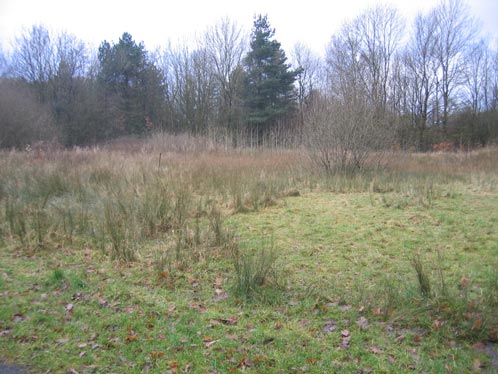
Ancient landscapes - global climate change

A wet and boggy landscape, typical of Cheshire after the last Ice Age but the UK climate is changing.

Picture credit: Everything Dinosaur

This relatively stable period of world weather, has enabled the human species to flourish, soon our population will exceed 7 billion.  Our numbers and the subsequent demand for finite resources plus the affect our species is having on the environment could spell trouble ahead, not just for the so called vulnerable species such as some of the large mammals we share the Earth with, but remember we are a large mammal too.

Go to Top