All about dinosaurs, fossils and prehistoric animals by Everything Dinosaur team members.

Articles, features and information which have slightly more scientific content with an emphasis on palaeontology, such as updates on academic papers, published papers etc.

12 11, 2008

What is a Cycad? It is an Amazing Prehistoric Plant

By |2024-04-15T13:42:25+01:00November 12th, 2008|Categories: Everything Dinosaur News and Updates, Main Page, Palaeontological articles|0 Comments

Cycads from the Permian to the Present Day

Cycads are a primitive palm-like group of plants that originated in the Permian geological period (most likely) and a number of genera can be found today mainly in the tropics and sub-tropics of the world.  Extant cycads are found in regions where frosts are either absent or not severe, as such they can be seen in garden centres and in gardens around the UK, where they can survive so long as they are protected from frost damage.  They most likely evolved from the now extinct pteridosperms and they certainly had their heyday during the Jurassic and the Cretaceous geological periods.

What is a Cycad?

Research published in 2013 suggested that these plants preferred to live in groves and that they had evolved to live in a group, just like some animals prefer to live in herds today.  Their fragmented global distribution indicates that the modern cycads are the remnants of a much more widespread group of plants, indeed the fossil record shows that during the Mesozoic, cycads were distributed worldwide, from the far north of Alaska, to Antarctica and in both the western and eastern hemispheres.

A Replica of a Cycad Tree

What is a cycad?

A welcome addition to the CollectA model range. A replica of a cycad.

The species that survive today are highly toxic to mammals, they produce a number of toxins and ingestion of cycad plant material can lead to internal bleeding, vomiting and severe kidney damage.  It has been speculated that these toxins evolved to deter herbivorous reptiles including dinosaurs, but it is thought that despite these toxins and the very sharp leaf fronds in a number of  extinct species and the coarse nature of the plant material, cycads were consumed by a large number of different types of plant-eating dinosaurs – including sauropods and ornithopods.

The cycad tree shown in this article is one of a number of prehistoric plants made by CollectA.  To view the CollectA range: CollectA Prehistoric Life Models.

9 11, 2008

Changing Views on Sauropods (New Research)

By |2024-04-15T13:16:36+01:00November 9th, 2008|Categories: Educational Activities, Main Page, Palaeontological articles|2 Comments

Changing Views on Sauropods – Long-necked Dinosaurs

The huge, long-necked sauropods such as Diplodocus and Brachiosaurus are extremely well known in popular culture but although many museums exhibit specimens of these enormous creatures, our level of scientific knowledge particularly the phylogeny of these creatures remains relatively poor.  Thanks to recent discoveries of some seemingly transitional forms from prosauropods to the true sauropods, dinosaurs such as Lessemsaurus from Argentina and Chinshakiangosaurus from China for example, our understanding of the evolution of these animals is more complete.

The sauropods were a truly remarkable group of dinosaurs, with some of the oldest sauropod fossils dating from the beginning of the Jurassic and with the last titanosaurs surviving in the Americas and other parts of the Southern Hemisphere right up to the end of the Cretaceous, approximately 66 million years ago.  Although these animals had their hey day in the Jurassic, no other type of herbivore has dominated terrestrial ecosystems quite like the sauropods.  With their massive bulk, animals like Apatosaurus for instance could weigh in excess of 30 tonnes; they decimated the vegetation within an environment before moving on in vast herds to find fresh feeding areas.

Sauropods represent a truly unique group of animals, there is nothing alive today to compare with them and their size, power and myriad of forms are truly amazing.  Most sauropods are classified into two distinct types, the Macronaria (big nostrils), nasal openings in skulls are bigger than the orbit (eye).  Sauropods typical of the Macronaria group are animals such as Brachiosaurus and Camarasaurus.

To see a scale model of Brachiosaurus and other sauropod figures: Dinosaur Models and Toys.

The other main type of sauropod are the Diplodocoidea, animals such as Diplodocus and Seismosaurus.  Some very bizarre forms of sauropod are known.  For example, scientists know that a number of later sauropods (titanosaurs) were armoured, but also many of the lesser known sauropods also possessed body armour, scutes and even clubs on the ends of the tail.

Shunosaurus from the mid Jurassic of China had a club on the end of its tail.  When the first fossils of this dinosaur were found in 1979, the tail was thought to have become damaged and the bones had not healed properly and had become infected, producing this abnormal growth in the single specimen discovered.  Several fully articulated fossil Shunosaurus are now known and all possess this club-like feature on the end of their tails.  Scientists were able to conclude that the swollen tail of this dinosaur was not the result of an injury or disease (pathology), but this dinosaur possessed the equivalent of a medieval mace on the end of its tail.

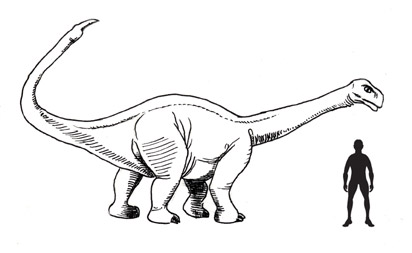
An Illustration of Shunosaurus

Picture credit: Everything Dinosaur

To view a model of Shunosaurus and other figures in the Safari Ltd model collection: Wild Safari Prehistoric World.

This particular sauropod is estimated to have reached lengths in excess of 9 metres and it was one of the most common type of long-necked dinosaur found in what was a vast, Jurassic floodplain now being excavated at the Dashanpu quarry site.

2 11, 2008

Biological Terms Associated with Phyla – Helpful Definitions

By |2024-04-13T08:45:37+01:00November 2nd, 2008|Categories: Animal News Stories, Everything Dinosaur News and Updates, Palaeontological articles|0 Comments

Defining Pelagic and Nektonic Terms in Biology

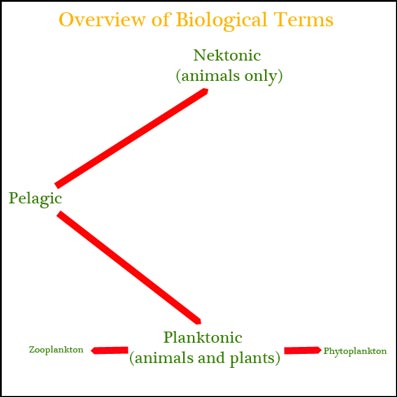
A number of terms are used by biologists and palaeontologists to provide an overview of the habit or mode of life of organisms.  Most of the terms relate to marine or freshwater environments due to the number of different habitats and modes of life that exist in the world’s oceans, lakes and rivers.  One term that is frequently seen in academic papers related to zoology or botany is the term “pelagic”.  Pelagic (pronounced pel-laj-jick) refers to animals and plants that live above the sea floor.  This term is further divided up into nektonic, (pronounced neck-ton-nick) referring only to animals that live above the sea floor or planktonic (animals and plants).  Nektonic animals are creatures that actively swim such as herring, squid and sharks.  The collective noun is nekton (pronounced neck-ton).

Biological Terms

Planktonic organisms (animals and plants) swim feebly or drift passively in water currents.  Most organisms are confined to the sunlight surface waters.  The collective noun is plankton).  The term includes phytoplankton (fie-toe-plank-ton), organisms that use the process of photosynthesis, using sunlight energy to create sugars, mostly algae and zooplankton which consists mostly of microscopic animals including the larvae of larger nektonic animals, but also so macroscopic animals that are readily visible to the naked eye, animals such as those from the Order Cnidaria such as jellyfish.

An Overview of Some Important Terms in Biology

Defining biological terms.

Defining biological terms.  Picture credit: Everything Dinosaur.

Picture credit: Everything Dinosaur

Visit Everything Dinosaur’s website: Everything Dinosaur.

29 10, 2008

Anniversary of the Birth of Othniel Charles Marsh

By |2023-02-25T20:27:37+00:00October 29th, 2008|Categories: Educational Activities, Main Page, Palaeontological articles|0 Comments

Othniel Charles Marsh 1831 – 1899

On the 29th October 1831, Othniel Charles Marsh was born.  He was destined to become one of the most influential and important palaeontologists of the 19th century.

Othniel Charles Marsh

Born in New York, Charles was educated at Yale and went onto study geology and mineralogy.  Following this he travelled to Germany to study palaeontology.  Returning to America, he was appointed professor of vertebrate palaeontology at Yale University (the first professor of palaeontology ever appointed in the United States), he went onto persuade his uncle, the wealthy entrepreneur and philanthropist, George Peabody, to establish a museum of natural history (Peabody Museum at Yale).

Marsh was one of the great pioneers of American palaeontology, leading a number of successful exhibitions to the west of the United States as the geology of this territory began to be opened up and fully explored.  He described 19 different genera of dinosaur and competed fiercely with his rival Edward Drinker Cope to find the best specimens for the museums back in the east of the USA.  Their rivalry became known as the “Bone Wars”.  Marsh’s expeditions made a number of important discoveries, they unearthed the first American pterosaur fossils and Marsh went onto name and describe some of the most famous of all the dinosaurs Allosaurus, Apatosaurus and Diplodocus.

A Model of an Allosaurus

Mojo Fun Allosaurus dinosaur model (2020).

New for 2020 the Mojo Fun Allosaurus dinosaur model. Picture credit: Everything Dinosaur.

Picture credit: Everything Dinosaur

The Mojo Fun range of models and figures includes replicas of several prehistoric animals that were named and described by Othniel Charles Marsh: Mojo Fun Prehistoric and Extinct Animal Models.

A number of extinct species have been named in honour of this professor, for example the hypsilophodontid Othnielia (fossils found in Colorado, USA), was named after Othniel Charles Marsh.

Writing Scientific Papers

Marsh also devoted a great deal of his time to writing papers and attempting to find order amongst vertebrate evolution, describing a number of toothed birds and flying reptiles.   One of his greatest contributions to science was his study of the evolution of horses, published as the Darwinian debate raged.  Marsh’s paper outlining how horses evolved from small, many-toed browsers to fleet footed, large single-toed grazers was seen by many scientists of the day of evidence in support of Darwin’s theory of natural selection.

While travelling to the western USA in 1868, Marsh was told of a strange discovery of what was believed to be human bones in Nebraska.  He was curious but doubted that the bones belonged to an ancient race of humans, however, he did ask to view them and quickly identified them (correctly), as ancient horse fossils.  Marsh insisted on having the remains sent to him for further analysis.  He determined that they had come from an animal from Pliocene times that was barely three feet tall  and had long slender legs which ended with three toes on each foot. He dubbed the small horse Equus parvulus (now known as Protohippus).

In subsequent expeditions to the the western USA more fossils of horses were found, a mystery in itself as horses were not known in America until they were introduced by the Spanish.

Using the many different types of horse fossil found and relating each discovery to the age of the rocks from which the fossil was extracted, Marsh was able to build up a picture of the evolution of equines.  In a paper published in 1874 in the scientific journal “American Naturalist”, Marsh describes some of the horse fossils he found on an expedition in Wyoming and Utah. One of these skeletons, he named Eohippus, or “the dawn horse.”

By studying the numbers of toes and different degrees of variation, especially the variations in the leg bones Marsh was able to set out a chronological order of horse development from the small browser Eohippus to the modern horse.  Marsh determined the line of descent by examining the metacarpal bones (toe bones) of the different horses.  He compared what he found to the legs of modern horses, and found remnants of digits IV and II along the cannon bones (this is more evident in the forefeet that hind).

The time scale shows the Palaeogene on the left right up to modern times with the domestic horse.  Over millions of years the primitive horses gradually evolved into the larger, faster running animals we know today.

Darwin’s theory of natural selection operates on very small differences that exist between living things in a population.  Any slight mutation or modification that an animal has may give it an advantage over its contemporaries.  This animal is more likely to survive and pass on this trait to its offspring.  As a result of heredity it is likely that these descendants will have the features of the parent and will therefore pass this feature on when they breed too.  In this way, a mutation can become inherent in an entire population over time.

Support for Darwin’s theory was difficult to obtain as central to his argument was that these differences altered organisms over vast amounts of time.  Marsh’s study of the evolution of the horse from a four-toed small browser into the single-toed animal we know today was evidence supporting Darwin’s theory.

Charles Darwin himself, although quite elderly, expressed a desire to travel to America to see Marsh and his collection at Yale.  It was this work that helped popularise the theory of natural selection amongst New World scientists and it is for this ground-breaking study, as well as his work on the dinosaurs that Othniel Charles Marsh is best remembered.

22 10, 2008

Dinosaur “Dance Floor” on the Arizona-Utah Border

By |2022-12-09T12:14:28+00:00October 22nd, 2008|Categories: Dinosaur and Prehistoric Animal News Stories, Main Page, Palaeontological articles|0 Comments

Rare Jurassic Trackways Discovered in Western USA

A series of dinosaur trackways dating from the Early Jurassic have been discovered near to the Arizona/Utah state line in the Western United States.  The site which covers approximately 3/4 acre is covered in numerous impressions, scientists estimate that at least four types of dinosaur are represented, although the researcher’s comments have led to other scientists requesting further analysis before firm conclusions can be drawn.  An estimated 1,000 footprints have been observed along with a number of strange parallel line impressions in the sandstone rock, interpreted as tail drag marks.

Dinosaur Trackways

The study of this remote site in Arizona, dating from approximately 190 million years ago (Pliensbachian faunal stage), has been undertaken by a team of researchers from the University of Utah.  It is believed that the site represents evidence of an ancient waterhole surrounded by desert.  A whole range of prehistoric animals were attracted to this source of water and their footprints have been preserved in the soft sand surrounding the water.  Interpreting the tracks could prove difficult as the trackways are muddled up and may represent activity at the oasis over a long period or the result of specific short-term conditions that led to the preservation of these impressions.  Churned up ground as a result of numerous dinosaurs stomping over a particular site even has its own special name used by palaeontologists – the phenomenon is known as “Dinoturbation”.

Commenting on the discovery, Marjorie Chan (University of Utah) stated:

“All these footprints at a watering hole might tell us something about the social life of the dinosaurs”.

Chan, the co-author of the published paper on this site with University of Utah graduate student Winston Seiler wonders which species might have mingled at this “dinosaur dance floor.”  Perhaps these tracks are evidence of a prehistoric version of Strictly Come Dancing!

The paper detailing the trackways is being published in the scientific journal Palaios, but the interpretation of the data has attracted controversy since the site was first discovered in 2006.   A number of scientists have questioned the research team’s conclusions and some of even doubted that authenticity of a number of the marks and impressions left in the sandstone.

Numerous Impressions

In the pictures supplied in press releases a number of impressions can be seen, these could be the tracks of large long-necked dinosaurs called sauropods, although other scientists have expressed doubts over the exact interpretation of these impressions.  Ichnologists (the name given to scientists who study trackways and prints), are notoriously cautious when it comes to deciphering information from such trace fossils.  A general identification can be made possibly down to family level but prints such as these cannot be linked to a specific genus or species.  To do this with any level of confidence fossilised bones have to be found in association with the footprints.  No bones have been recovered from the site, the research team have stated that perhaps conditions were not conducive for bone preservation.

Theropod (meat-eater) tracks as well as plant-eating dinosaur trackways have been identified at the site.

Smaller tracks could be smaller species or younger dinosaurs. “Sometimes it’s really hard to tell,” Chan said.  The print patterns may help scientists understand how groups of dinosaurs moved and provide information on potential herd structures.

Are They Dinosaur Tracks?

However, not all scientists are convinced by the conclusions drawn by the Utah based research team.  Alan Titus, a palaeontologist at Grand Staircase-Escalante National Monument in nearby Kanab, Utah, has not seen the site in person but remains unconvinced that these are really dinosaur tracks.

“I’ve observed thousands of tracks in Early Jurassic rocks of the Colorado Plateau and have never seen one that looked like the one in the news release,” he commented, adding that he would have to view the prints in situ to get a clearer picture.

Utah’s state palaeontologist Jim Kirkland also has not been to the site personally, but he has seen many of the researchers’ photos and agrees with some of their conclusions.  He has stated that he believes that some of the impressions are most certainly dinosaur tracks but remains sceptical about the evidence for tail drags.  Tail drag impressions are exceedingly difficult to verify.

Different Types of Dinosaur Track
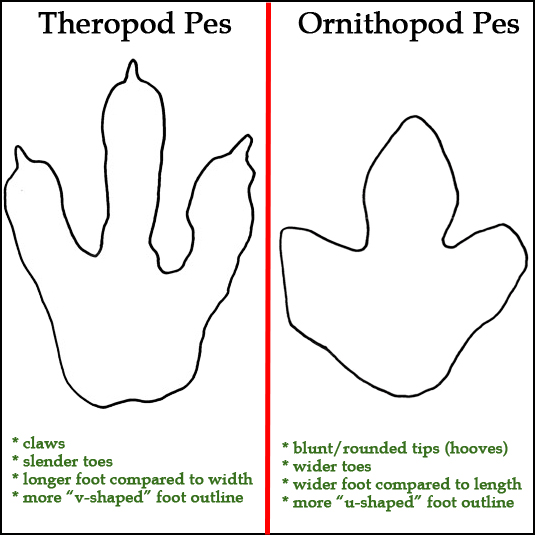
Comparing different types of dinosaur footprint.

Theropod print compared to an ornithopod print.  Different types of dinosaur track.  Picture credit: Everything Dinosaur.

Picture credit: Everything Dinosaur

In any case, he said, the find could reveal a wealth of new information about dinosaur behaviour and herd interaction.

“Someone needs to take this to the next level,” Kirkland said. “It’s an exciting site.”

A number of alternative explanations have been put forward for the strange pothole like structures, they may have been caused by water induced erosion, however, Winston Seiler, the discover of the site commented:

“Upon close inspection many of the impressions are ringed by mounds of displaced sand that had to be formed when the sand was soft, before it was turned to rock.”

Although the site is remote and difficult to access, more research will be required before the palaeontologists can get to grips with what happened at a desert oasis 190 million years ago.

Everything Dinosaur stocks a huge range of dinosaur and prehistoric animal models, toys and games.

Visit Everything Dinosaur’s user-friendly website: Everything Dinosaur.

16 10, 2008

A Helpful Definition of Benthic

By |2024-04-15T12:21:06+01:00October 16th, 2008|Categories: Everything Dinosaur News and Updates, Main Page, Palaeontological articles|0 Comments

Benthic – A Term Used in Biology

Readers of posts about fossil discoveries might come across some unusual terms, we provide a definition of benthic.

The Kingdom Animalia is made up of a number of different phyla, the most numerous of which in terms of species is the Arthropoda.  Arthropods (Cambrian geological period to today), are a very diverse phylum with a wide variety of habits, behaviours and body shapes.  Crustaceans such as crabs, lobsters, barnacles and shrimps are members of the Arthropoda.  Insects, millipedes, centipedes, arachnids, king crabs and extinct Orders like the Trilobita are members of the Arthropoda too.

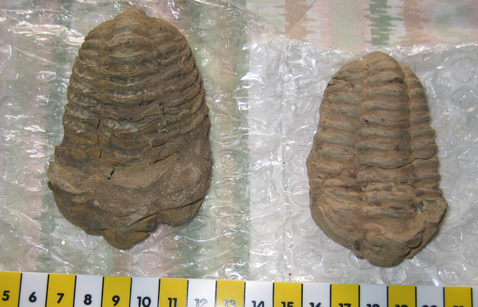
Trilobite Fossils – Many Trilobites had a Benthic Habit

The definition of benthic

“Mike and Sue” – the Trilobites. Two Calymene trilobite fossils.  Picture credit: Everything Dinosaur

Picture credit: Everything Dinosaur

A number of terms are used in biology to describe the mode of life of an organism.  The majority of terms used apply to marine or freshwater organisms because of the number of different environmental niches or settings an organism or a group of organisms can occupy within a designated ecosystem.

Everything Dinosaur stocks an extensive range of replicas of prehistoric invertebrates including many arthropod figures such as trilobites.  To view the range of replicas of iconic fossil animals in stock at Everything Dinosaur: Replicas of Iconic Fossil Animals.

Definition of Benthic

Take for example, the term benthic (pronounced ben-thick).  Benthic organisms are animals and plants that live on the sea floor, the collective noun is benthos (ben-foss).  For instance, many kinds of trilobite and extant shrimp scuttle along the sea floor either actively hunting or feeding on the rain of organic material that comes from above.  These animals are described as benthic.  The freshwater, oxygenating pond plant Elodea (Elodea spp.) is an example of a plant with a benthic habit.

9 10, 2008

Jellyfish Ancient Predators of the Palaeozoic

By |2022-12-09T10:57:53+00:00October 9th, 2008|Categories: Educational Activities, Main Page, Palaeontological articles|0 Comments

Jellyfish – An example of a “Living Fossil”

Most of us are familiar with jellyfish and have occasionally encountered them as washed up animals as we walk along a shoreline.  Others may have had the unfortunate experience of bumping into one whilst swimming and getting stung.  Depending on the species these stings can be very painful, but apart from the occasional thought about how curious these animals look, few of us rarely consider these animals or indeed recognise them as living fossils, unchanged for over 600 million years.

Jellyfish

Jellyfish belong to a phylum called Cnidaria (pronounced nigh-dare-ee-a).  This phylum consists of a huge range of animals, almost all of them associated with marine environments.  Cnidarians have a central mouth, surrounded by tentacles which possess stinging cells (called nematocysts).  The tentacles are used to catch and disable prey which is then drawn into the central mouth and consumed.  Within the fossil record, by far the most important type of Cnidarians represented are the corals.  These animals may live in colonies or have a solitary habit.  All corals secrete a hard, exoskeleton made up of calcium carbonate and the extant species today are known as scleratinian corals.  These scleratinian corals (solitary or can be linked together sharing a colonial skeleton), evolved relatively recently appearing at around the beginning of the Mesozoic, after the great Permian extinction event.  Older coral fossils found in the Palaeozoic fossil record are either rugose corals (solitary or colonial) or tabulate corals (always found in colonies).  These types of corals both went extinct at the end of the Permian but fossil corals are known to date right back to Ordovician aged sediments.

The Phylum Cnidaria

The phylum Cnidaria also has soft-bodied representatives, these are the sea anemones and jellyfish, scientists believe that these type of animals are even older than the first corals.  Being soft-bodied, jellyfish and sea anemones are very poorly represented in the fossil record, in fact these fossils are extremely rare and the number of fossil specimens found to date does not represent the diversity or indeed the abundance of these animals throughout the Phanerozoic eon (or indeed the Cryptozoic eon).

Jellyfish Fossils

There are some strange, preserved ripples and hollowed out round depressions found in very finely grained, sandstone, Cambrian sediments from around the world.  These are believed to be the fossilised remains of jellyfish.  It is thought that many of the fossils of these animals that we have were formed when mass strandings of jellyfish occurred after a storm.  Having been washed up onto a Cambrian or Ordovician shoreline, the carcases of these animals would not have been eaten by scavengers as there was no significant life on the land during these geological periods.  Some of them may have  been quickly buried and under exceptional conditions, preserved as impressions in the rocks.

It is thought that primitive life such as bacteria and cyanobacteria first evolved as far back as 3.5 billion years ago, but complex multi-celled animals appeared much later, sometime between 700 and 620 million years ago.  Multi-celled animals are termed metazoans (pronounced met-ah-zo-ans) and their appearance in the fossil record marks the ending of the Cryptozoic (hidden life also known as the Precambrian) and the start of the Phanerozoic eon (visible life).

Studying Early Life

Certainly, the fossil evidence for the first metazoans is extremely poor.  All the first complex creatures were entirely soft-bodied but their fossils are evidence of complex multi-celled organisms living in late Precambrian times.  The Ediacaran Hills in the Flinders range of mountains in South Australia was one of the first places studied.  This is why the fossils of such organisms are often referred to as “Ediacarans”.  This was a world dominated by jelly and from fossils found in places as diverse as Siberia and Namibia, scientists are able to calculate that even 620 million years ago, primitive life was abundant and diverse.  The jelly structures of the Ediacarans may have been more robust than those found in jellyfish, after all, jellyfish consist of 95% water, this may explain why Ediacaran animals may have been more readily fossilised than jellyfish.  However, certainly by the Cambrian, jellyfish were very much established and as carnivores would have been perhaps one of the most feared predators around during the early Palaeozoic.

An Illustration of a Jellyfish

Picture credit: Everything Dinosaur

The picture above is of a typical jellyfish with a bell-like structure and trailing tentacles.  Jellyfish are often termed Medusa, a reference to Greek mythology and the Gorgon Medousa who had snakes instead of hair.

To view replicas of fossil animals: Fossil Replica, Dinosaur Models, Prehistoric Animal Models.

Animals as diverse as jellyfish and corals are grouped in the Cnidaria phylum as all these organisms share a central mouth surrounded by stinging tentacles (termed nematocysts).  Scientists believe that corals, sea anemones and jellyfish are all descended from a common ancestor, that had these features.  There are many thousands of species of jellyfish found today.  They live in polar seas as well as the tropics and can be found right through the water column with nektonic forms (animals that live above the sea floor), being found in shallow seas and at extreme depths.  It is thought that there have been hundreds of thousands of species of jellyfish, but only a few specimens have been preserved in the fossil record.  Jellyfish have no definite head structure, no internal organs as such and most have only the most primitive senses.  Jellyfish are very much dependent on sea currents to move them, most species drift with the prevailing current, although a number of Classes can pulse their bells to help them move vertically through the water column.

Cambrian Animals

Although regarded as extremely simple animals when compared to the Chordates for example, during the Late Precambrian and into the Cambrian these types of animals may have been amongst the top predators around at the time.  Jellyfish predating on other organisms may have been a causal factor in the speeding up of evolution (known as the Cambrian explosion), as predator/prey relationships developed.  Our ancestors, those simple animals with a notochord would have fallen victim to the stinging tentacles of the jellyfish.  Perhaps they began to evolve improved senses, a significant head end to house these new senses and stronger groups of paired muscles around a central nervous strip to help them escape from their jellyfish foes.

The next time you see a jellyfish washed up on a beach as you walk along a shoreline, you might well give it a second glance.  It represents a type of animal that has been around for something like 600 million years and its evolution may well have contributed to the evolution of the earliest Chordates and the speeding up of evolution as predator/prey relationships developed.  Jellyfish can certainly be described as “living fossils”.

4 10, 2008

Dinosaurs linked to Birds new evidence “breathes life” into an old Debate

By |2023-02-25T20:46:17+00:00October 4th, 2008|Categories: Dinosaur and Prehistoric Animal News Stories, Main Page, Palaeontological articles|0 Comments

New Argentinian Discovery indicates close link between Theropods and Birds

A group of American and Argentinian scientists have published their research into a new meat-eating dinosaur from the Late Cretaceous of Argentina, the findings demonstrate the close link  between theropods and birds.  This new animal named as Aerosteon riocoloradensis which means “air bones from the Rio Colorado” measured around 10 metres long and was perhaps the weight of an Indian elephant.

Compared to other predatory dinosaurs discovered in Argentina such as Mapusaurus and Giganotosaurus carolinii, this dinosaur was smaller and from the fossil evidence discovered to date in no way a contender for the biggest carnivorous dinosaur yet found, but in its own way this discovery may be much more significant.

Theropods and Birds

For Aerosteon, pronounced Air-ahh-ste-on, seems to provide further evidence of the strong relationship between theropod dinosaurs and birds.  This large animal seems to have had a breathing apparatus similar to modern birds and many of the bones are pneumatised with many air sacs, helping to lighten the skeleton without losing too much skeleton strength.

The study of this 85 million-year-old fossil (Santonian faunal stage), first unearthed 12 years ago indicates that this breathing system and light bones cements further the commonly held view that bipedal, theropod dinosaurs and birds are closely related.

University of Chicago

Paul Sereno, of the University of Chicago has worked on a number of new dinosaur discoveries from South America in recent years and writing in a scientific journal Dr Sereno commented on the evidence supporting the theory that this new dinosaur had air sacs that worked like bellows, forcing air into the relatively stiff lungs in a similar process seen in modern birds.

“This dinosaur, unlike any other, provides more direct evidence of the bellows involved in bird breathing,” commented Ricardo Martinez of the Universidad National de San Juan, one of Argentina’s leading centres for palaeontological research.

The skull replica being proudly shown off by Dr Sereno, shows the characteristic antorbital fenestra and the laterotemporal fenestra  seen either side of the eye-socket, adaptations to lighten the skull without reducing the skull’s strength.  Like many other theropod dinosaurs, the scientists behind the research into Aerosteon have suggested that this animal may have been covered with simple proto-feathers, another indication of how closely related to birds some dinosaurs might be.

Birds Evolved from Theropod Dinosaurs

Most palaeontologists now believer that birds evolved from small, feathered theropods and the earliest birds such as Archaeopteryx share a number of anatomical features with dinosaurs such as Compsognathus.  The joint American/Argentinian team believe that this particular dinosaur developed bellow-like lungs to help it keep stable whilst pursuing prey, it may also have helped control body temperature.  For a large dinosaur, maintaining a steady body temperature was a lot easier than for the smaller animals with very different surface area to body mass ratios.

If meat-eaters were warm blooded and insulated with feathers then losing body heat could have been a problem at times.  Perhaps the air sacs in the bones helped cool the blood and then over time they became adapted to assist with efficient breathing.  With such big leg muscles for example, being able to oxidise muscles efficiently would have been a significant advantage.

Mammalian Lungs

The mammalian lungs (including our our breathing apparatus) does have a significant drawback, the lungs have only one entrance/exit point for the air.  We mix up the exhaled air with new air being breathed in.  As we breathe out, we never get rid of all the used air inside us, every time we inhale we just mix fresh air with oxygen extracted air we are going to breathe out.  This is not a very efficient process and as a result this contributes to the physical limitations of our bodies.  All mammals suffer from this anatomical drawback.

Birds, in contrast, are much more efficient breathers.  Instead of just one entrance/exit point in the lungs they have openings at both ends, plus a series of air sacs in front and behind the lungs.  It is these air sacs, not the lungs that inflate and deflate with each breathe.  Acting like bellows they pump the air through the lungs and out a different tube than it went in.  This is a one-way system with old, stale air never mixing with fresh oxygen rich air and as a result is a very effective system.  For their size, birds have disproportionately large hearts, these provide the pumps to enable the whole system to function.

It can be speculated that many bipedal, active meat-eating dinosaurs had breathing systems similar to modern birds, with perhaps, extra large and efficient hearts to pump blood around the body.  Soft tissue is rarely preserved in dinosaurs and clearly, much more research is required in this area, but the new study on Aerosteon provides some fresh insight.

Everything Dinosaur stocks a wide range of theropod dinosaur models, to visit the models section of the company’s award-winning website: Dinosaur Models.

25 09, 2008

The Remarkable Contents of a Dinosaur’s Stomach – Eats, Shoots and Leaves (apologies to Lynne Truss)

By |2024-04-15T12:13:28+01:00September 25th, 2008|Categories: Dinosaur and Prehistoric Animal News Stories, Dinosaur Fans, Main Page, Palaeontological articles|0 Comments

Examination of Hadrosaurine Stomach Contents

Occasionally an animal is so well preserved that extraordinary amounts of information can be gleaned from the fossil.  One such example is the wonderfully well preserved fossil of a duck-billed dinosaur from the Judith River Formation of Montana, USA.

An analysis of the probable gut contents from this fossilised dinosaur reveal that its diet at the time of its demise consisted mainly of leaves.  The leaves had been well-chewed, with many of the pieces less than 5 mm in size.

Brachylophosaurus

The fossil is of a hadrosaurine duck-billed dinosaur called a Brachylophosaurus (Brachylophosaurus canadensis) an immature sub-adult that would have grown to a length in excess of 7 metres – not bad on a diet made up of leaves.  This dinosaur fossil, in common with a number of other articulated specimens has been given a nick-name.  It is known affectionately as “Leonardo” although the sex of the animal is unclear.  The Brachylophosaurus got this nickname as  when the fossil hunting expedition found it in the summer of 2000, close by carved on a rock was some graffiti – “Leonard Webb loves Geneva Jordon 1916”.

The fossil record indicates that brachylophosaurs were relatively rare compared to other hadrosaurine hadrosaurs.  Only a few specimens have been found compared to the many hundreds of fossils of other hadrosaurs found in Upper Cretaceous strata of the Western USA and Canada.

Brachylophosaurus means “short-crested lizard”, the crest implied in the scientific name consisted of a flat plate on the top of the head.  This duck-billed dinosaur did not have much of a duck-bill either, rather than the typical broad duck-like bill of a typical hadrosaur, the horny beak of Brachylophosaurus was down-turned and flattened from side to side.  Perhaps this is indicative of an adaptation for a particular type of browsing or other feeding behaviour.  Further analysis of the gastric tract may provide more information about the type of plant material this animal ate.

Other dinosaur fossils have been analysed to establish diet, but finding fossil evidence of this nature is extremely rare.  The analysis of the gastric tract was carried out by Justin Tweet, a graduate student at the University of Colorado, working in conjunction with other students and supervising palaeontologists.

Hadrosaurine Stomach Contents

The team focused on trying to analyse the constituents of the fossil in the area believed to represent the gut of the animal.  Microscopic study identified quantities of pollen, this could then be examined to reveal the types of plants this dinosaur had been eating.  Although pollen grains are very small, they are abundant and exceedingly resistant to decay.  Fossil pollen grains can be released from rock by dissolving the matrix in hydrofluoric acid.  This powerful acid, in a high concentration is capable of etching glass, but the fossilised pollen survive this process and can be studied to indicate the plants that were being eaten, as different plants have different shaped and sized pollen grains.

It seems that “Leonardo” had grazed on a variety of plants including flowering plants and ferns.  Pollen could also enter the gut if it had been ingested as the animal drank, and indeed there are other contaminants associated with this particular fossil.  Only about 12% of the fossil material studied is organic, the rest is clay and grit, which possibly entered the animal’s digestive tract as the body was covered, or perhaps this indicates that Brachylophosaurus was a low browser and picked up soil and other debris as it pulled out plants with its strong jaws, although the relatively high concentration of inorganic matter would cast doubt on this theory – surely this dinosaur was not that messy an eater!

The dentition of these dinosaurs is very formidable with rows of self-sharpening teeth and a jaw mechanism that allowed the tooth surfaces to grind together, an excellent way to break down tough vegetation.  With the plant matter partially broken up this was then swallowed and the strong acidic gastric juices and microbes inside the gut would have continued the digestion process.

In the picture above, the rib bones can be made out along with impressions of the dinosaur’s skin.  Much of the skin of this dinosaur is also preserved, and this has revealed more information about Brachylophosaurus and its way of life.  The skin around the shin and ankle is especially thick, perhaps acting as protection as the animal made its way through the undergrowth.

The discovery of “Leonardo” has certainly helped palaeontologists learn more about this unusual dinosaur, even gaining an insight into its diet.  It also led to the discovery of another hadrosaur fossil in the same location, when a media co-ordinator found a new fossilised dinosaur at Leonardo’s site when rehearsing a visit to view the excavation of the original specimen.

To read an article about this second discovery: Media co-ordinator discovers dinosaur!

Leonardo will be put on display shortly at the Houston Museum of Natural Science in a special exhibit entitled “Dinosaur Mummy C.S.I. (Cretaceous Science Investigation), a homage to the popular U.S. TV franchise C.S.I. about forensic teams helping to solve crimes.

Ironically, for a Late Cretaceous dinosaur believed to be somewhere around 80 million years old, there was a delay of one week before the exhibition could start.  Power cuts caused by hurricane Ike had were the reason for the delay, but fortunately none of the precious museum specimens were damaged.

Members of the public will be able to see this remarkable fossil for themselves and discover more about the on-going research surrounding this superbly well-preserved specimen.  Scientists have suggested that the fossil evidence indicates a diet of leaf matter, almost the title of Lynne Truss’s book about having a zero tolerance to punctuation.

Here is a dinosaur the eats shoots and leaves, leaving us evidence of its diet in the fossil record.

Everything Dinosaur supplies a wide range of hadrosaurine dinosaur models from the figures and replicas section of its award-winning website: Dinosaur and Prehistoric Animal Models.

17 09, 2008

Another new Dinosaur Species Discovered in Australia

By |2022-12-07T07:53:11+00:00September 17th, 2008|Categories: Dinosaur and Prehistoric Animal News Stories, Main Page, Palaeontological articles|0 Comments

Two Tonnes of Dinosaur Bones likely to yield a new Species

Australian palaeontologists are confident that two tonnes of recently excavated dinosaur bones may lead to the identification of a new species of Australian dinosaur.  Australia is proving to be one of the “hot-spots” for new dinosaur discoveries with 2008 being a particularly fruitful year for the excavation of dinosaur fossils from this vast country – as predicted in Everything Dinosaur’s 2008 palaeontology prediction list for 2008.

To view the article on Everything Dinosaur predictions: New Year Predictions for 2008.

A recent expedition to a remote dig site in the west of Queensland led to the discovery of the new fossils, dated to the mid Cretaceous period.  The area the team were exploring has proved to be a successful dinosaur hunting ground in the past with the fossilised remains of a large sauropod dinosaur having been found.

Amateur paleontologist David Elliott, from the Australian Age of Dinosaurs Institute which organised the expedition, said the new bones were considered as too small to belong to a sauropod (large long-necked dinosaur).

He went onto comment on the chances of these fossils representing a species new to science as being “very, very likely simply because of the rarity of Australian dinosaurs”.

“There is very little in the way of Australian dinosaurs that have been scientifically described and because of the isolation of Australia… most Australian fauna are very different to others around the world,” he added.

For much of pre-history the land masses that were to make up the southern continents were joined together to form a single super-continent called Gondwanaland.  By the middle of the Cretaceous period this land mass had begun to break up.  South America, India and Africa were separated and Australia was joined to Antarctica by a series of tenuous and temporary land bridges that may have been severed during periods of rising sea levels, isolating the fauna and flora of Australia.  The formation of the South-east Indian ridge (a mid-ocean spreading ridge, formed at the edge of a tectonic plate), began the opening up of a sea channel between Australia and Antarctica.  Australia was slowly pushed northwards as new ocean floor was created by undersea volcanic activity and this floor spread out on either side of the ridge.

Australia is still continuing its northward progress today, and in millions of years time will collide with New Guinea.  The isolating of Australia during the mid Cretaceous permitted many unique types of dinosaurs and other animals to evolve.

It is for this reason that the Australian scientists are confident that the new fossils will prove to be a new species.  The expedition leaders estimate that there is a further eight months preparation work in the laboratory ahead of them before they can come to a clear conclusion as to just what they have dug up.

Everything Dinosaur stocks a large range of prehistoric animal models including lots of models of dinosaurs, fossils of which come from Australia: Dinosaur and Prehistoric Animal Models.

Go to Top