All about dinosaurs, fossils and prehistoric animals by Everything Dinosaur team members.

Articles, features and information which have slightly more scientific content with an emphasis on palaeontology, such as updates on academic papers, published papers etc.

2 03, 2009

The Paradox that is the Theropod Dilong

By |2023-02-28T16:47:03+00:00March 2nd, 2009|Categories: Dinosaur and Prehistoric Animal News Stories, Main Page, Palaeontological articles|0 Comments

Dilong – An Ancestor of Tyrannosaurus rex that is a bit of a Paradox

Dilong paradoxus, the “paradoxical emperor dragon” from the Yixian Formation of Liaoning Province of China is believed to be a primitive member of the Tyrannosauroidea.  The evolution of tyrannosaurs is shrouded in mystery, most palaeontologists believe that they originated in the Northern Hemisphere sometime in the Late Jurassic and eventually displaced allosaurs as the apex predators in most parts of the world.  Indeed, recent research into the later tyrannosaurids, the large carnivores of the Late Cretaceous (Campanian to Maastrichtian faunal stages), indicates that these animals did not originate in North America.

An animal such as Tyrannosaurus rex, the archetypal dinosaur, without whom no Jurassic Park movie would be the same, was probably descended from tyrannosaurids that migrated into North America from Asia.

T. rex is synonymous with the USA, however, its ancestors may have originated in China, another case of “made in China” I’m afraid.

The Evolution of the Tyrannosauroidea

There is a lot scientists still don’t know about the evolution of the tyrannosaurs.  Fossils of predators are extremely rare in the fossil record, much rarer than the relatively more common herbivores for example.  In any ecosystem the herbivores will tend to outnumber the meat-eaters, the ratio depends on the amount of food meat-eaters have to consume, the number of herbivores required to sustain them.  Calculations have been made indicating that large predators such as a size-able tyrannosaurs,Tarbosaurus or Gorgosaurus for example, may have required large numbers of herbivores to sustain them with a ratio of meat-eaters to herbivores in the mega fauna population being in excess of 1:50.

The discovery of Eotyrannus (E. lengi) by the amateur fossil collector Gavin Leng has further complicated the evolutionary path of the tyrannosaur group.  Eotyrannus is evidently another primitive tyrannosauroid.

The structure of the skull shows similarities with other tyrannosaurs and the dentition in the premaxilla is typical of a tyrannosaur,being broad, slightly re-curved and having the characteristic “D” shaped cross section.  Trouble is Eotyrannus is associated with the Wessex Formation of the Isle of Wight.  Dilong another primitive member of the tyrannosaurs is associated with Liaoning Province in China.  From the fossils found so far, scientists have concluded that Dilong and Eotyrannus were very similar, in fact some palaeontologists have suggested that they are the same genus.  The difficulty is, if both Dilong and Eotyrannus are basal forms of tyrannosaurs, in what part of the world did the tyrannosaurs evolve?

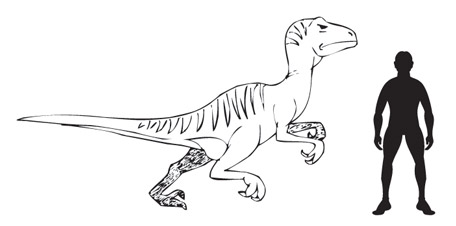
An Illustration of Dilong – A Primitive Tyrannosaur

Picture credit: Everything Dinosaur

Dilong

Dilong was a lightly built predator, with an estimated size of approximately 2 metres.  The most complete fossil skeleton of this dinosaur found to date is of an individual with an estimated length of 1.5 metres, but this is believed to represent a sub-adult, so a fully grown animal was probably bigger.  Although, Dilong is know from at least four fossil specimens, only one fossil shows evidence of protofeathers.  This particular fossil, discovered in a layer of shale, had been extensively flattened and the bones were found in a disarticulated state and the specimen is far from complete.

However, surrounding the tail and in the area representing the back of the head indications of simple, filamentous feathers were found.   Some of these simple protofeathers were up to 3 cm long.  The presence of protofeathers is evidence that an ancestor of the big tyrannnosaurs such as T. rex had feathers.

Does this mean that dinosaurs such as Tyrannosaurus rex were also feathered?

Although, the feathered specimen is far from complete, the fine sediment that surrounded this particular fossil has permitted evidence of feathers to be preserved.  Scientists have concluded that this little dinosaur was probably covered in a downy coat of simple feathers.  These feathers would have helped insulate the animal and prevent too much heat loss, reinforcing the theory that at least some dinosaurs were endothermic (warm-blooded).

A Model of Dilong (Carnegie Collection Dilong Model)

Picture credit: Everything Dinosaur

To view models of Tyrannosaurus rex and other tyrannosaurids: Dinosaur and Prehistoric Animal Models.

Scientists believe that the larger, later tyrannosaurs were not feathered, not fully covered in feathers and not feathered as adults.  Their reasoning is quite simple and in the absence of tangible fossil evidence, this is the best the scientists can do for the moment.

If feathers originally evolved as a form of insulation for small animals, this would make sense for smaller genera of tyrannosaur and even juvenile members of larger genera.  However, the bigger an animal grows, the larger the mass the animal has in relation to its surface area.   Large mammals like elephants for example, need to lose heat from their bodies rather than hold onto it.

Consequently, these animals are nearly hairless.  An adult T. rex weighing something like 7,000 kilos would have great difficulty losing heat if it was covered in a thick, insulating coat of protofeathers.  A hatchling T. rex perhaps weighing little more than a kilogramme on the other hand would find a downy coat a great benefit to help it regulate its temperature.  A warm-blooded, young Tyrannosaurus rex may have had a coat of protofeathers, but as it grew it may have gradually shed its coat until it had lost it virtually entirely as an adult.

T. rex may have retained some protofeathers, perhaps on the back of the neck or head which could have had a display function in mature adults, but this is speculation for the moment.  It is doubted whether this animal would have had feathers around the mouth and surrounding the neck as they would have been very difficult for this short-armed animal to clean and they would quickly have been covered in blood and gore as the animal fed.  Many vultures for example, have bald heads and necks, an adaptation reflecting their habit of having to reach deep into carcases to feed.

Dilong paradoxus

The species D. paradoxus  is Mandarin for Emperor dragon, named after a dragon from ancient Chinese mythology.  The actual species name is derived from the Greek, meaning “against accepted wisdom”.  This primitive, feathered tyrannosaurid when discovered did represent a paradox when viewed against the existing tyrannosaur fossil record.  A feathered ancestor of T. rex, well it had been speculated upon, but here was evidence indicating the link between the fearsome later “Tyrant Kings” and feathers.
12 02, 2009

Happy Birthday Charles Darwin Many Happy Returns!

By |2024-04-15T13:47:58+01:00February 12th, 2009|Categories: Dinosaur and Prehistoric Animal News Stories, Educational Activities, Famous Figures, Main Page, Palaeontological articles|0 Comments

200th Anniversary of the Birth of Charles Darwin

Today, February 12th marks the 200th Anniversary of the birth of Charles Darwin, the English naturalist and scientist who influenced scientific thinking through his theories on natural selection and evolution.

Charles Darwin

Darwin’s theories although not universally accepted, are the cornerstone of palaeontological research.  Although he is credited with coming up with the theory of natural selection, other researchers, scientists and thinkers had expressed similar ideas before Darwin.   In the early 19th century, how animals changed from one species to another was not properly understood but it was referred to as “transmutation”.

Indeed, Darwin was eventually forced into publishing his theory as a second English scientist, A. R. Wallace who had been working in the Far East; was about to publish a similar paper on the origins of species.  Darwin being the meticulous man he was had gathered together a vast amount of evidence to support his theory, so much so that when the book “The Origin of Species” was published, he described it as briefing paper as he had to leave out so much of the evidence to support his theory on natural selection.  A modern edition of the book still has over 450 pages.

The Origin of Species

With the publication of his revolutionary and ground breaking work in 1859, Charles Darwin established a view of the world that challenged the long held beliefs about Divine Creation and the development of life.  He challenged the notion that all animals were created at the same time and that they remain fixed, not changing over time.  His work has far reaching implications for humanity and remains one of the most hotly contended issues in science today.  Ironically, Darwin had no knowledge of genetics or DNA so the mechanism for evolution could not be explained.  It was to be another 30 years after his death before the work of the likes of Gregor Mendel came to be recognised and another 70 years or so before the nature of DNA began to be understood.

To read more about the publication of the “Origin of Species”:

Anniversary of the Publication of the “Origin of Species”.

The work and insight of Charles Darwin has made a lasting contribution to science and philosophy, a number of events are planned this year to mark the 200th anniversary of his birth.  The events are grouped under the collective term “Darwin 200” and include documentaries on television, a season of radio programmes exploring the impact of his work, as well as events, presentations and fossil festivals.

Happy Birthday Charles Darwin.

Visit Everything Dinosaur’s award-winning website: Everything Dinosaur.

28 01, 2009

Update on Lucy – Pictures from an Exhibition

By |2023-02-26T09:48:19+00:00January 28th, 2009|Categories: Dinosaur and Prehistoric Animal News Stories, Main Page, Palaeontological articles|0 Comments

Lucy’s Legacy – The Hidden Treasures of Ethiopia

Yesterday we wrote about the fascinating early hominid fossil skeleton of Lucy (Australopithecus afarensis), known to scientists by the fossil number A.L. 288.  This 3.2 million-year-old fossil is part of an exhibit currently being held at the Pacific Science Centre in Seattle in the U.S. state of Washington.

Australopithecus afarensis

Lucy is perhaps the most famous fossil hominid, about 40% of the fossil was found and it is believed to represent a female that stood 107 cm tall and importantly, walked upright.  So far, A. afarensis fossils have only been found in Ethiopia and Tanzania.  Early hominid fossils are extremely rare and it is likely that this particular species was quite widespread across central and east Africa.  The large distance between the fossil sites has led scientists to deduce this.

The media team at the Pacific Science Centre have sent us over some more information and some exclusive pictures of the various exhibits.  The exhibition’s full title is: Lucy’s Legacy: The Hidden Treasures of Ethiopia, and it showcases the evolution of human history from the very cradle of human existence (scientists believe that our species did evolve in Africa and that that hominids first evolved on that continent).

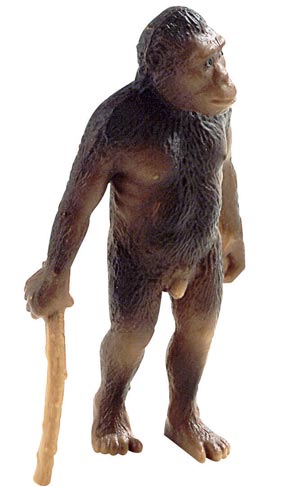
A Model of Australopithecus

Australopithecus afarensis.

At home on the plains. A model of Australopithecus.

To view replicas and figures of prehistoric animals: Bullyland Prehistoric Animal Models and Figures.

As well as getting the very rare chance to view some of the ancient fossils of hominids from Ethiopia, visitors have the opportunity to explore the rich history and culture of Lucy’s homeland – a story that dates back to 5 million years ago.

The exhibit is well worth a visit, the fossils rarely travel outside of Ethiopia and the range of cultural artefacts on display provide a fascinating insight into the story of our own species and the development of humankind.

Visit Everything Dinosaur’s website: Everything Dinosaur.

13 01, 2009

Feathered Dinosaurs – Two Types of Feather are Better than One

By |2023-02-26T09:55:21+00:00January 13th, 2009|Categories: Dinosaur and Prehistoric Animal News Stories, Main Page, Palaeontological articles|0 Comments

Chinese Dinosaur Fossil shows Evidence of Feathers – Two Different Types

Scientists have debated the origins of birds and their relationship to feathered dinosaurs for many years and the most widely accepted theory is that they evolved from meat-eating dinosaurs.  The debate over the relationship between Aves (birds) and theropod dinosaurs (meat-eaters) is actually quite old, the first discussion papers on this subject were published in Victorian times.

John Ostrom, the distinguished professor of vertebrate palaeontology at Yale University’s Peabody Museum of Natural History, published a number of papers analysing the evolution of flight.  For John Ostrom, the commonly held believe at the time, of a sluggish, overgrown reptile being the typical view of a dinosaur, simply did not reflect the evidence in the fossil record.  He was a driving force in the “Dinosaur Renaissance” of the early 1970s, depicting dinosaurs as perfectly adapted animals, active, agile and energetic.

“Dinosaur Renaissance”

His description of the dromaeosaur Deinonychus (Deinonychus antirrhopus) is regarded as one of the landmark moments in the history of modern palaeontology.   Now thanks to the amazing fossil discoveries of Liaoning in China, palaeontologists have a number of fossil specimens of different feathered dinosaurs that imply an evolutionary link between small theropods and birds.

An Illustration of Deinonychus

Picture credit: Everything Dinosaur

However, a new report on a particular feathered dinosaur from China, about the same size as Deinonychus, suggests that some dinosaurs may have had a number of different feather types adorning their bodies.  Some feathers may have been to help insulate them and keep them warm (indicating active warm-blooded animals), whilst other feathers may have served as ornamentation to help them attract a mate and signal to others within their herd (or should that be flock)?

Primitive Therizinosaurid

In a paper published on the primitive therizinosaurid (sometimes known as a Segnosaur), Beipiaosaurus, it is stated that two distinct types of feather have been found on the animal’s remains one for insulation, the other type perhaps used to signal for a mate, some of the earliest evidence of this type of feather found in the dinosaur fossil record.

Beipiaosaurus was named after the city of Beipiao, a city in Liaoning province in northern China.  The first fossils of this dinosaur were discovered in this area in 1996.  It was a very unusual looking dinosaur (we often think therizinosaurs seem to be made up of a mixture of different animal parts):

Article on therizinosaurs like Beipiaosaurus: Therizinosaurs – are they the strangest dinosaurs of all?

Beipiaosaurus

Beipiaosaurus was approximately 2-3 metres tall, heavily built and a plant-eater.  The fossils date from the Early Cretaceous (Aptian faunal stage), approximately 120 million years ago.  Beipiaosaurus had a relatively large head for a therizinosaur (later animals such as Nothronychus had proportionately smaller heads), a long neck and a broad body.

The shin bones are longer than the thigh bones and this dinosaur had three-toed feet.  Scientists have identified fine, proto-feathers associated with fossils of this dinosaur, but the discovery of the elongated, broad, filamentous feathers has excited palaeontologists, who believed that such coverings existed but had rarely found traces of them.

It is believed that dinosaurs had these broad, showy feathers at some point in the past because more advanced forms have already been discovered on dinosaur remains.

The primitive feathers on Beipiaosaurus are similar to the earliest forms seen on ancient birds.  The fossil remains of Beipiaosaurus are approximately 25 million years younger than the fossils of Archaeopteryx, the earliest bird yet discovered.  There are similarities between the wider, filamentous feathers on Beipiaosaurus and those of Archaeopteryx.  If scientists are correct in assuming that birds evolved from Theropods then the discovery of similar feathers on Beipiaosaurus proves that dinosaurs did have feathers of this type and indeed there may be other fossils of dinosaurs dating from before Archaeopteryx which would also show this feather type. They are waiting to be discovered.

Feathered Dinosaurs

Interestingly, in the report published in the scientific journal “The Proceedings of the National Academy of Sciences” by the Chinese research team, their study of the Beipiaosaurus specimen reveals information on where on the animal the various feather types grew.  Feathers from the animal have been identified on the fossilised remains of half a skeleton, including the head, neck and part of the tail.

Those that were used for communication (the wide, filamentous feathers) grew most densely on the back of the neck and at the end of the creature’s tail.  Ideal locations for a signalling device.  We can imagine a flock of Therizinosaurs bobbing their heads at each other just as flamingos do.  Or perhaps they waived their tails to communicate or combined both head and tail movements in a sort of dinosaur semaphore.  The presence of such feathers will enable scientists to speculate on elements such as animal social interaction, hierarchy and herd behaviour, unfortunately, the hard evidence for this is rarely preserved in the fossil record.

An Artist’s Impression of the Therizinosaur Beipiaosaurus

Therizinosaur drawing – Beipiaosaurus.

Picture credit: Everything Dinosaur

In the illustration above, the artist has clearly depicted Beipiaosaurus with long, quilled feathers on the head, neck and tail.  Scientists are fairly confident that dinosaurs had colour vision and the feathers may have been brightly coloured to help them to be seen in the dark, forested environment where this dinosaur lived.  Commenting on the research work, professor Xing Xu, of the Chinese Academy of Sciences (Beijing), stated:

“Feathers are diverse in morphology and function.  In Beipiaosaurus most filamentous feathers that are slender and short are probably for insulation and the specialised elongate, broad, filamentous feathers are probably for display.

The professor and his colleagues from the Shandong Tianyu Museum of Nature and the Chinese Academy of Geological Sciences who carried out the research, confirmed that although feathered, Beipiaosaurus could not fly.  It is believed that some dinosaurs from the Liaoning region were adapted to an arboreal existence and used feathers to help them glide from tree to tree, or perhaps even to flap a little, an example of powered flight.

One such dinosaur is Microraptor, a feathered dinosaur with a type of flight feather on its arms and legs.  This small, crow-sized animal could climb trees and probably lived in the forest canopy out of reach from the carnivorous dinosaurs that roamed below.

Microraptor is one of the dinosaurs illustrated in the Feathered Dinosaur Tube available from Everything Dinosaur.

To view the feathered dinosaur tube and other dinosaur models: Dinosaur and Prehistoric Animal Models.

The tube also contains models of other feathered dinosaurs from Asia, including Caudipteryx, Dilong and Velociraptor.

The Feathered Dinosaur Tube

Feathered dinosaur “Toob”.

Picture credit: Everything Dinosaur

In their report these Chinese scientists have concluded that the discovery of primitive feathers “strongly supports the hypothesis that feathers evolved and initially diversified in non-avian theropods before the origin of birds and the evolution of flight”.

19 12, 2008

The Sahara Desert – “An Ancient River of Giants”

By |2023-02-26T08:20:09+00:00December 19th, 2008|Categories: Dinosaur and Prehistoric Animal News Stories, Main Page, Palaeontological articles|0 Comments

Anglo/Irish Team announce New Prehistoric Finds in Sahara Desert

A joint British and Irish scientific team have announced the discovery of a number of new species of prehistoric animals from the Late Cretaceous of south-eastern Morocco.

Part of the beak of a huge pterosaur, possibly a relative of the giant, flying reptile Quetzalcoatlus, and bones of an enormous sauropod have been found at the site, close to the border with Algeria.  The deposits have also yielded evidence of giant fish, crocodiles and dinosaur footprints, indicating that this area of parched desert was once a lush, environment supporting a huge array of life.

Prehistoric Animals

The team endured sandstorms and had to travel over hazardous and dangerous country to reach the remote location, but the Anglo/Irish team’s efforts are being rewarded with the sediments providing some fascinating insights into a lost prehistoric world.

At the time these strange creatures roamed the region, the Sahara was covered in lush vegetation, waterways and lakes.   Commenting on the discoveries Dr David Martill of the University of Portsmouth stated:

“This river system was stuffed full of gigantic fishes, each two to four metres long. Everything there was of a huge size”.

Searching for a superlative to sum up the fossil finds Dr Martill stated:

“You could call it the ancient river of the giants.”

If National Geographic make a documentary on these finds, this would be an apt title for the programme, the rock strata indicates that during the Cretaceous a river as wide as the Danube is today, flowed across the densely vegetated landscape.

A Highlight of the Research

A highlight of the research was the discovery of a forty-cm-long beak tip, which belonged to a previously unknown pterosaur – a flying reptile.  Although, it can be difficult to speculate on the size of an animal from only a few fragmentary remains, the scientists have stated that it potentially had a wingspan in excess of 5 metres – this would make it about as long as an average family car.

The scientists believe that this pterosaur was a member of the Azhdarchidae group of pterosaurs.  These were advanced flying reptiles, with toothless beaks, long necks and some of these flying reptiles are believed to represent the largest flying animals of all time.

A one-metre-long dinosaur bone, from a giant sauropod (a long-necked dinosaur) was also uncovered.   Again it is difficult to estimate the size of an animal from only partial remains but this dinosaur was certainly very big, perhaps as much as 30 metres in length.

Dr Martill discussed the sauropod bone and indicated that it might have belonged to a macronarian sauropod (long-necked dinosaur with a box-like skull):

“We think this one might be linked with Brachiosaurus, but it is different.  The bone we found has some unusual features – it’s unusually robust for a humerus.  We’re 95% confident that it is a humerus but if its part of a femur it would mean this creature was unimaginably enormous.”

If the fossil bone turns out to be part of a thigh bone (femur) then this would represent one of the biggest dinosaur bones ever found.

Dr Martill with the Sauropod Fossil Bone

Picture credit: University of Portsmouth

Sauropod Fossil Bone

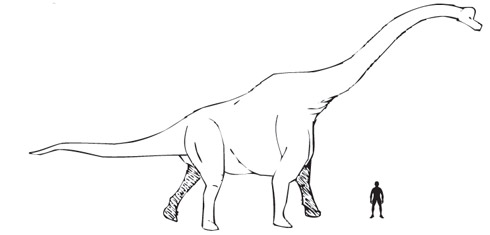
The partial bone can be seen in the picture, it is only a fragment of total limb bone, probably a humerus (arm bone) but if it is a femur (thigh bone) then the dimensions of the dinosaur would have to be scaled up.  Brachiosaurs had longer fore-limbs than hind-limbs, if this is a bone from the back legs then this dinosaur would have been a true giant.

An Illustration of a Brachiosaurus

Picture credit: Everything Dinosaur

Expedition leader Nizar Ibrahim, from the University College Dublin, said:

“It’s amazing to think that millions of years ago the Sahara was in fact a lush green tropical paradise, home to giant dinosaurs and crocodiles and nothing like the dusty desert we see today.”

What with the recent finds of new theropod dinosaurs in Argentina it seems that the Southern Hemisphere (Gondwanaland) is providing lots of new and fascinating dinosaur and prehistoric animal discoveries.

Everything Dinosaur stocks a huge range of prehistoric animal models: Models of Prehistoric Animals.

15 12, 2008

Volcanoes Killed off the Dinosaurs According to New Research

By |2024-04-15T13:45:16+01:00December 15th, 2008|Categories: Geology, Main Page, Palaeontological articles|0 Comments

Volcanism the cause of the Cretaceous Mass Extinction?

Did volanoes kill off the dinosaurs?  The debate regarding the principle cause of the Cretaceous mass extinction event some 66 million years ago is about to re-opened with the airing of a television programme claiming that massive volcanic eruptions on the Indian sub-continent were the real cause of the extinctions not the impact of an ex-terrestrial object.

US Geosciences professor Gerta Keller of Princeton University and her research colleagues have submitted a theory stating that the dinosaurs gradually died out as a result of climate change, induced by huge volcanic eruptions.

Professor Keller bases her theory on her National Science Foundation-funded field work in India and Mexico that uncovered geological evidence that the mass extinction and the meteor impact occurred at different times.  The Chicxulub event is believed to have taken place approximately 300,000 years before the extinction.  Keller and her colleagues believe that the impact event could not be the main cause of the mass extinctions, the timing is all wrong.

Volcanoes Killed Off the Dinosaurs

However, other leading writers and scientists still support the work of Luis and Walter Alvarez, an American father and son team who first published the discovery of a global K-T boundary with high levels of iridium and theorised on a catastrophic meteor or asteroid impact devastating life on Earth.  Exponents of the meteor impact theory have even stated that there may have been two impacts – 300,000 years apart that led to the demise of approximately 70% of all life on the planet.

Everything Dinosaur stocks a large range of dinosaur replicas representing animals from the very end of the Cretaceous, for example the: PNSO Age of Dinosaurs Range.

The Deccan Traps, the “smoking gun” of Keller’s theory did release an enormous amount of green house gas into the atmosphere and eruptions took place for millions of years.  Volcanism on this scale would certainly have affected the climate, whether or not this was the main factor or a contributory one to the demise of the dinosaurs is still hotly debated.

We suspect this will run and run.

To read more about the Deccan Traps: Blame the Deccan Traps.

To read more about the ex-terrestrial impact theory: Geologists get to the bottom of the Chicxulub impact crater.

14 12, 2008

Light-headed Dinosaurs According to New Research

By |2024-04-15T13:53:44+01:00December 14th, 2008|Categories: Dinosaur and Prehistoric Animal News Stories, Main Page, Palaeontological articles|2 Comments

Research Proves that Dinosaurs were Airheads

Dinosaurs for all their spectacular features such as huge teeth, enormous bodies and strange armour have often been regarded by many as being extremely stupid creatures with tiny brains, new research suggests that dinosaurs were airheads.  Whilst it is true that many types of dinosaur, the stegosaurs and the sauropods for example, had very small brains in proportion to their bodies, other dinosaurs, although not likely to ever be regarded as highly intelligent, did possess relatively big brains given their body size – troodontids are examples of this type of dinosaur. 

Troodonts such as Saurornithoides and troodon are animals of the Northern Hemisphere and Late Cretaceous.  Relatively small animals, most of this type of dinosaur are believed to have been under 2 metres long (most of this being tail), but they did have large eyes (indicated by the big orbits in what skull material has been found), and relatively large brains.  These types of dinosaurs are depicted as warm-blooded, quick, agile, little hunters with excellent co-ordination and keen senses, attributes associated with a large brain capable of processing lots of information.

Measuring Intelligence

Many of us may be familiar with a measure of intelligence called IQ, this is an abbreviation of the term Intelligence Quotient, a measure of intelligence amongst a single species such as human intelligence for example.  When it comes to comparing  intelligence amongst different types of animal, the process becomes more complicated, especially when the animals are extinct and scientists only have the fossil record to go on as in the case of the dinosaurs.

A second measure is often used, this is EQ (not to be confused with the human concept of emotional intelligence), in this sense the term EQ stand for Encephalisation Quotient, a comparison of brain size to body mass.  The principle is that the greater the proportion of brain mass in comparison to the size of the body the more intelligent the animal in relation to another organism with the same sized brain but a bigger body.

This is only a relative measure and imprecise when used to study extinct animals.  Using these principles, the large herbivorous sauropods and stegosaurs score very poorly, indicating low intelligence where as the dromaeosaurs and animals such as Troodon score relatively highly.

Having a high or low EQ score does not necessarily indicate intelligence.  The humble pigeon, for instance, not regarded as particularly intelligent is capable of navigating huge distances and demonstrating very sophisticated behaviour.  Members of the Corvidae family (crows, rooks, ravens etc.) do not have bigger brains when compared to similar sized wading birds but they are regarded as more intelligent showing learning capability, problem solving and considerable memory.

Dinosaurs were Airheads

In a recently published paper in the scientific journal “The Anatomical Record” a team of American researchers have demonstrated that the skulls of several different types of dinosaurs were sophisticated structures and that they possessed very complex olfactory areas and nasal passages as well as a number of air cavities.  Perhaps dinosaurs were light headed or simply airheads?  The research does reveal how well designed and evolved the skulls of such animals were.

Ohio University scientists Lawrence Witmer and Ryan Ridgeley used scanning technology to build up sophisticated 3-dimensional pictures of both meat-eating and plant-eating dinosaur skulls.  Using the images and computer models their work has generated, the researchers were able to show the complex structure of the olfactory areas and nasal passages determining a clearer understanding of the physiology of the animal’s airways.

This work has important implications for how important a sense of smell was for dinosaurs and the structure of airways will influence the vocalisation of these animals.  Skull material is extremely helpful to palaeontologists, it is often used as diagnostic material to help determine the relationships between different genera or to define a new species.

The team examined the skulls of two predators and two plant-eating dinosaurs.  The meat-eaters were the infamous and very well known Tyrannosaurus rex and the less well known advanced abelisaurid Majungatholus (also called Majungasaurus).  Tyrannosaurus rex is a good candidate for this type of study, a number of skulls of this Late Cretaceous dinosaur are known and work on the extensive olfactory areas in the skull has already been published.

Majungatholus was a less obvious candidate.  However, at least one nearly complete skull of this meat-eater, whose fossils have been found on Madagascar has been discovered and it does represent an entirely different type of carnivorous dinosaur compared to the tyrannosaurs.  The shape of the skull of Majungatholus is quite different, the head was broad and short with thickened bones around the nasal areas (the naris).  The lower jaw as quite delicate and when compared to the tyrannosaurs the mouth was narrow.

The scientists also studied the skulls of two plant-eating dinosaurs, both members of the thyreophoran (armoured dinosaur) group.  The herbivores studied were Panoplosaurus (Late Cretaceous, North American nodosaurid with at least three fossilised skulls to study) and Euoplocephalus a well-known ankylosaur.  Analysis of extant species such as crocodiles and ostriches were also undertaken by the research team.

Study of Predatory Dinosaurs

The study of the predatory dinosaurs revealed extensive olfactory areas, an arching airway that went from the nostrils to the throat, and many sinuses,the same cavities or pockets that give us sinus headaches.  Overall, the amount of air space was much greater than the brain cavity.  The air chambers may have acted as resonating chambers to provide each dinosaur with a distinctive call or voice.

The air spaces would have also served to lighten the weight of the skull, with the team estimating that the presence of the air cavities enabled the weight of the head of Tyrannosaurus rex to be reduced by up to 18% without any detrimental effect on the strength of the structure – very important when the forces exerted by biting or holding struggling prey are considered.  The researchers have estimated the box-like and massive head of a Tyrannosaurus would have weighed approximately 500 kgs, without the air cavities the head could have weighed over 100 kilogrammes more.

Such a heavy head would have required enormous neck muscles to support it, perhaps the air cavities and the famously small limbs of T. rex are adaptations to help reduce the weight at the front end of the animal.

A 3-D Computer Model of Tyrannosaurus rex

Picture credit: Lawrence Witmer (Ohio University)

The picture shows a computer model of Tyrannosaurus rex with the various internal air cavities and air passages highlighted in different colours.  Work from other scientists has indicated that approximately 50% of the T. rex brain (a brain that weighed as much as a bag of sugar), was dedicated to the olfactory function.  It seems that the sense of smell was extremely important to this particular dinosaur.

The 3-dimensional study of the thyreophorans (armoured dinosaur), contrasts with the work carried out on the meat-eating dinosaurs.  Unlike the large, straight, uncomplicated nasal passages of the theropods, the research team found airways that were long, twisted and convoluted.

The winding air passages were positioned alongside large blood vessels, the study showed, suggesting heat transfer.  So when the armoured dinosaurs inhaled, the blood would have warmed that inspired air before it reached the lungs.  Alternatively, these structures could have helped these large animals retain heat, perhaps absorbing heat back into the animal as they exhaled.

In addition, some of the heat from the blood vessels may have been transferred into the winding nasal passages, cooling the blood before it reached the brain.

The twisty nasal passages also probably acted as resonating chambers, affecting how these armoured dinosaurs vocalised.

“The airways may have been slightly different in each animal”, Witmer commented, “giving the animals subtle differences in their voices”.

Everything Dinosaur stocks a huge range of award-winning prehistoric animal figures and replicas including both plant-eating and meat-eating dinosaurs: Dinosaur Models and Toys.

8 12, 2008

Doting Fathers – A Dinosaur Trait passed on to Modern Birds

By |2023-02-26T09:33:11+00:00December 8th, 2008|Categories: Dinosaur and Prehistoric Animal News Stories, Main Page, Palaeontological articles|0 Comments

Parental Care – Fathers helping to Brood the Eggs

Parental care is a behaviour strongly associated with warm-blooded animals such as mammals and birds, however was parental care a dinosaur trait too?  From a human perspective, we can perceive a strong emotional tie between a mother and her offspring when we view the behaviour of a female chimp with her baby, we often superimpose human emotions onto our primate relatives.  Whether all the higher apes are capable of exhibiting such a range of emotions is open to debate.  Scientists and anthropologists frequently disagree over the breadth and depth of emotions that apes are able to exhibit, after all, our humanity and ability to express emotions and respond to others and their emotions is one of the defining characteristics of being human.

Parental Care

We perceive most mammals as having a strong bond between themselves and their young.  From a scientific perspective, mammals invest a great deal in the next generation, the females carry the embryos inside them (monotremes excepted), as opposed to the egg-laying birds and reptiles; the other members of the group of animals called amniotes.  An amniote is an animal whose young is internally fertilised.  In reptiles and birds the embryo is surrounded by fluid and is protected by a protective shell – an egg.  In virtually, all mammals, the developing embryo is also surrounded by fluid but is retained inside the mother’s body for some time before birth.

Maternal and paternal behaviours are easy to impose on fur covered mammals but with the cold-blooded reptiles it is perhaps more difficult to associate these alien looking, scaly creatures with parental responsibility.  We now know that a number of species of reptile demonstrate some form of parental care, in extant reptiles, this is perhaps developed to the highest degree by the crocodilians, those reptiles alive today that are most closely related to dinosaurs.

Dinosaur Trait

For many years, white European explorers did not believe the stories told to them by the native American Indians about Alligators looking after their young.  Scientists now know that Alligators, along with other types of crocodilian show a strong bond between their offspring and even the nest in which the eggs were laid.  Female Alligators guard the nesting sites, protecting the eggs as they incubate.  When alerted by the chirping and pipping sounds made by the young as they are about to hatch, the females will dig the nest out and escort the brood down to a nursery area, carrying many of the newly hatched baby Alligators in her jaws.  When first observed by Europeans, this behaviour was thought to be cannibalism, reinforcing the beliefs about the cold-blooded and uncaring reptiles.  Many text books written as late as the 1970s documented this behaviour and cited it as evidence of the harsh and cruel nature of crocodiles.

When the role of mammal parents is considered, the burden of responsibility for the brood and the rearing of young lies very much with the female.  In many species of mammals, the male has nothing further to do with the parenting process after mating.  Male tigers, for example, leave the impregnated female to fend for herself, give birth and to raise the cubs.  These cubs may stay with their mother for as long as two years.  The male plays no real role in raising the family – although they may offer protection indirectly by maintaining a territory and keeping rival males at bay.

With modern species of birds, in contrast, the male usually plays a role in brooding the clutch of eggs and helping to feed the hatch-lings.  Indeed, with some species of birds such as the Ostrich, it is the male who carries out the greater portion of the parental duties.  A new research paper, published in the professional journal “Science” suggests that birds may have inherited their brooding behaviours from theropod dinosaurs.

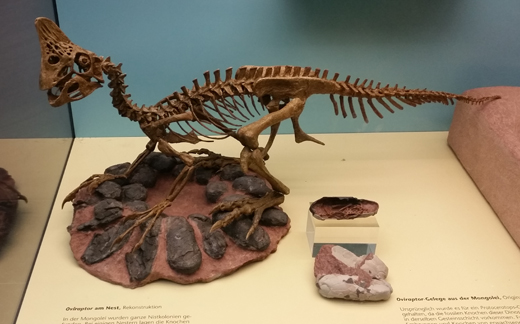
A Place for the Father – A Fossil Theropod Nest

An Oivraptor fossil with nest.

An Oviraptor dinosaur sitting on her nest.  Picture taken by Everything Dinosaur team members (Frankfurt). Picture credit: Everything Dinosaur.

Picture credit: Everything Dinosaur

The picture above is of a fossil nest of a dinosaur.  By studying the unborn, baby dinosaurs preserved inside the eggs, scientists have been able to determine that this was the nest of a oviraptorid dinosaur – a member of the theropod group.

Studying Birds

In more than 90% of modern bird species (neornithes), it is the male parent that volunteers to sit on and incubate eggs in the nest.  By comparison, males contribute to parental care in fewer than 5% of mammals and even more rarely among crocodiles, lizards and snakes.  With the majority of the mammals and reptiles it is the girls that do all the work when it comes to raising the youngsters.

However, the remains of several types of Cretaceous theropods, bird-like dinosaurs have been found in association with fossil nests.  Scientists believe that these dinosaurs were brooding the clutch of eggs, adopting what we would recognise as bird-like incubating and protecting behaviours.  The research paper, puts forward evidence to suggest that the animals brooding the nest were actually the males – but how can a scientist be certain of the sex of an animal when they only have the fossilised skeletal remains to go on?

Eggshell Formation

It is thought that theropod dinosaurs laid their clutches of eggs all in one sitting, laying eggs using both their oviducts, hence the eggs are laid in pairs and this can be seen in the picture of the fossilised theropod nest above.  In contrast, birds only have one oviduct this is believed to be an adaptation for flight, the birds evolving a lighter skeleton and losing an oviduct to save weight.  To produce the eggshells the female needs a source of calcium and phosphorous to help her make the protective shell for her embryos.  These minerals are sourced from her own bones.  Specialised reproductive bone tissue is laid down inside the bones of the female during ovulation. This extra bone tissue is converted into the resources required to produce the eggshells.  The bone used in this process is called medullary bone.  Once the temporary tissue has provided the necessary calcium and other minerals for eggshell formation; it is completely reabsorbed into the body but tell-tale bone cavities are left behind for a time after the egg-laying and if identified within a fossil bone, this is strongly indicative of the fossil bones belonging to a female dinosaur.

Medullary bone is only found in modern female birds, no other egg-laying animals, including crocodiles produce this special bone tissue naturally.

The researchers led by Dr David Varricchio of Montana State University examined the fossilised bones of three species of theropod dinosaur – Troodon formosus, Oviraptor philoceratops and Citipati osmolskae, (another oviraptorid dinosaur from Mongolia).  The fossils had all been found in association with nests and many of the specimens had been preserved in a brooding like posture.  The researchers examined the internal structure of the fossilised bones, looking for bone cavities that would have been left after the process of egg formation.  The lack of any evidence for bone cavities, led the scientists to conclude that these fossils represented males.  The assumption being that these were the fathers and that they were brooding the nests, a behaviour seen in most types of modern bird.

Generalising for a moment, in birds, large clutches of eggs are associated with paternal care (the male doing most of the brooding work).  Small clutch volumes are associated with care by both parents and medium clutch volumes with maternal care, the female doing the majority of the sitting on the nest.

Commenting on the conclusions drawn from this study Dr Varricchio stated:

“Paternal care in both troodontids and oviraptorids indicates that this care system evolved before the emergence of birds and represents birds’ ancestral condition”.

So perhaps, next Spring, when you see a male garden bird dusting his feathers or taking a dip in a puddle to refresh himself as he takes a break from his incubating duties you could dwell on that behavioural trait being a direct link between the birds you see in the garden and their dinosaur ancestors.

Deducing Behaviour from the Fossil Record

Deducing behaviour patterns from the fossil record is an extremely difficult process.  Many theories can be put forward, but the trouble is, it is very difficult without the living species to prove a behaviour conclusively.  The role of males and females in rearing dinosaurs will debated for many years to come, perhaps more fossils of dinosaur nests will be found and more evidence gathered.  One of the problems with relying on bone cavities to assess the sex of a fossil is that it is often difficult to analyse the internal structure of the bone in its permineralised (fossilised state).  Another problem is that their is no real chronological record left in the fossil record when it comes to studying dinosaur nests.  It is unclear how long the incubation period would be.  With birds for example, the gestation period can be 3 weeks with a reptile, such as an Alligator it can take up to 75 days for eggs to hatch.  With limited information available on the gestation period for dinosaurs, it is possible that the bone tissue could have returned to normal and bone cavities would not be present after a period of brooding on the nest.  If this is the case then the fossil specimens found in association with dinosaur nests could be female, the cavities could simply be no longer present by the time the animal died.

Visit Everything Dinosaur’s award-winning website: Everything Dinosaur.

3 12, 2008

New Pterosaur Discovery Announced (Despite the problem with the Car Filler)

By |2023-02-25T17:12:29+00:00December 3rd, 2008|Categories: Dinosaur and Prehistoric Animal News Stories, Main Page, Palaeontological articles|0 Comments

Discovery of new Cretaceous Pterosaur Announced

The latest edition of the scientific journal Palaeontology contains a paper on a new type of pterosaur, written by a team of researchers from Portsmouth University.  This new type of flying reptile has been named and described, despite the compressed nature of the specimen and the fact that car body filler was used in the excavation to hold all the fragments of bone in place.

New Pterosaur Discovery

The animal has been named Lacusovagus magnificens (means magnificent lake wanderer), a flying reptile with an estimated wingspan of 5 metres and standing as tall as a grizzly bear.  Although, a very imposing creature, the hollow bones and other anatomical adaptations for flight would have made this animal extremely light, perhaps weighing less than a 12 year-old child.

Lacusovagus magnificens

The fossil was discovered in the Araripe Basin, in north-east Brazil.  This specimen is providing a fresh insight into the evolution and spread of Pterosaurs as this particular creature’s nearest relatives originate from China.  The skull material is the most important part of the fossil, allowing palaeontologists to establish taxonomic relationships between different species and genera.  Lacusovagus is the biggest Pterosaur of this type found to date, most of the Chinese specimens had wingspans of less than one metre.

An Illustration of Lacusovagus magnificens

Picture credit: Mark Witton/University of Portsmouth

This toothless pterosaur (the technical term for flying reptiles – the name means winged lizard), has been dated to approximately 115 million years ago (Aptian faunal stage), but the pterosaur fossil record dates back much further into the Triassic.  These animals were the first vertebrates to develop powered flight.  Unfortunately, the remains were first discovered were so fragile that it was decided to protect them by covering them with car filler.  This certainly helped strengthen the fossil and aided the recovery process but the preparation of this specimen has proved to be extremely difficult as researchers tried to remove filler so that they could study the fossil bone.

The Car Filler Problem

The car filler was so difficult to remove, that the research team had to make do with examining the small pieces that were exposed out of the limestone and car filer matrix and rely on CAT scans of the block of stone to reveal more internal detail.

Mark Witton, the University of Portsmouth academic who identified the specimen, broke several tools trying to cut through the filler, unfortunately, this is not the first time an inappropriate material has been used in the fossil preservation process.  Another Brazilian fossil, this time of a dinosaur from strata dating from the the later Albian faunal stage proved extremely difficult for the scientists to research properly.  A skull of an unknown type of dinosaur was researched by British palaeontologist David Martill, also from the University of Portsmouth.  Unfortunately, the 80 cm skull had been doctored, with bits of filler and plaster added to make the specimen look more exciting and hence more valuable.  So frustrated by the “extra bits” added by the finder hoping to make more money from the sale, that the team reflected their angst in the naming of this particular dinosaur – it was called Irritator.

Commenting on the preservation status of this new pterosaur find, Mark Witton stated:

“The specimen was quite fragile so the guys who were collecting it – probably quarrymen – very sensibly decided to put a large slab of limestone underneath to strengthen it.  Unfortunately, they used car body filler as the glue. The infernal car filler was a real cow to get through. I don’t know how many tools I broke trying to cut it”.

Unlike the Irritator case, Mark does not believe that these people intended to defraud.

“I’m sure it was used with the best of intentions but the person who did it perhaps hadn’t thought it through,” he added.

Interpreting the Fossil Specimen

Further problems in interpreting the remains were encountered because the skull was misshapen and compressed.  The distorted skull fragments make interpretation very difficult, the position of this fossil in the matrix was quite unusual and this added to the preparation problems.

“Usually fossils like this are found lying on their sides, but this one was lying on the roof of its mouth and had been rather squashed, which made even figuring out whether it had teeth difficult.”

The skull of this particular flying reptile was much wider than is usual for pterosaurs and Mark Witton has suggested that it had a wide throat, which would have vastly increased the range of prey available to it. pterosaurs are widely thought of as fish-eaters, but he said it was likely that the new species would have eaten small dinosaurs, which it would have swallowed whole.  The toothless beak and wide throat would have enabled it to catch and swallow various prey animals – perhaps moving in groups across the fern plains flushing out lizards, mammals and even small dinosaurs a bit like the lifestyle of the Marabou stork in Africa.

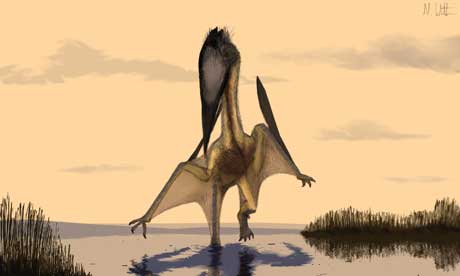
This particular habit has been proposed for pterosaurs before.   In an earlier blog article we reported on Mark Witton’s work on the Late Cretaceous pterosaur Quetzalcoatlus and speculation about these extremely large creatures having a more terrestrial lifestyle than previously thought.

To read this article: Getting stalked by a flock of Quetzalcoatlus.

For Mark and his team, fossils such as this one from Brazil are providing new insights into these amazing animals.

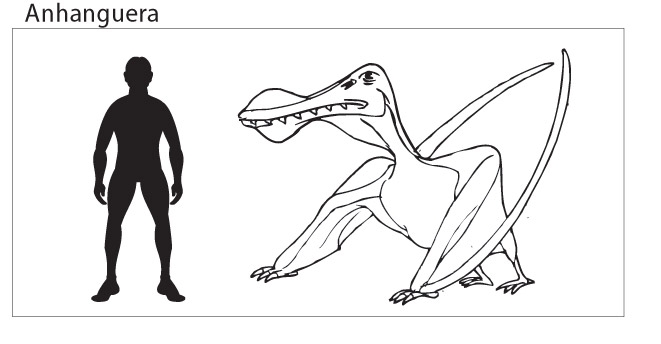
Brazil is becoming quite famous for pterosaur finds, a number of new genera have been identified from the Santana Formation of Brazil, a series of rock strata dating from the Early Cretaceous.  Both toothless and toothed types of pterosaur have been found in the upper layers of the Santana Formation, including the toothed flying reptile Anhanguera (name means old devil).  Those pterosaurs with teeth in their beaks were probably fish-feeders, swooping low over the sea (the early Atlantic ocean) and catching fish in their toothed beaks.

An Illustration of Anhanguera (Toothed Pterosaur)

Anhanguera illustrated.

Picture credit: Everything Dinosaur

To view models of pterosaurs and flying reptiles: Pterosaur and Prehistoric Animal Models.

27 11, 2008

Rare Prehistoric Crocodile Fossils Discovered in Switzerland

By |2024-04-15T13:15:27+01:00November 27th, 2008|Categories: Dinosaur and Prehistoric Animal News Stories, Main Page, Palaeontological articles|0 Comments

Switzerland – Famous for Cuckoo Clocks, Army Knives and now Jurassic Crocodiles

The village of Courtedoux in the district of Porrentruy, Switzerland may be hundreds of metres above sea-level today, but rocks dating from the Jurassic show that this area was once part of a shallow, tropical sea full of dangerous marine reptiles such as prehsitorc crocodiles.

For much of the Jurassic period (206 – 144 million years approximately), Europe was covered in warm, shallow seas that teemed with ancient life.  Swimming amongst the ammonites, belemnites and ichthyosaurs was a species of marine crocodile, the remains of one such specimen have been found near the village of Courtedoux.

Prehistoric Crocodiles

A team of researchers have announced the discovery of a 150 million-year-old fossil of an ancient crocodile, a genus called Metrioryhnchus, the first time that such a specimen has been found in Switzerland.

The area around Courtedoux is well-known for its dinosaur and other ancient fossils.  In fact fossilised trackways of Diplodocus-like footprints have been found nearby, along with a total of nearly 4,000 vertebrate fossils , all dating from the Jurassic period.  The foot prints indicate that the geology of this area has strata deposited in terrestrial as well as marine environments.  The area has been thoroughly researched over the years but new discoveries are being made all the time, such as this new crocodile.

Fossils of Metriorhynchus have been found in the UK, France and in South America (Metriorhynchus potens).

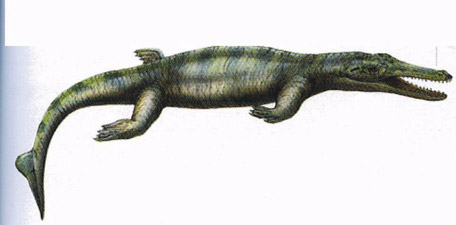
A distant relative of modern crocodiles this animal had adapted to an almost entirely marine existence, perhaps females only returned to land to lay eggs, like marine turtles.  The limbs had evolved into four strong flippers and the tail had broadened and flattened out to provide propulsion through the water.

This marine crocodile grew to lengths of over 3 metres and the many needle-like teeth in the narrow jaws indicate that it was a specialised fish and cephalopod eater.  Perhaps it fed on the many different types of ammonite and belemnite that shared its habitat.

An Illustration of Metriorhynchus

Picture credit: Illustrations of Prehistoric Animals of South America

Metriorhynchus

Metriorhynchus is pronounced met-ree-oh-rink-us, the name means “moderate snout”.  This particular fossil, found in the Porrentruy district in the west of Switzerland is dated to approximately 150 million years ago, although other fossil finds of this particular genus of marine crocodile have been dated from as early as 165 million years ago (Bathonian faunal stage).

Porrentruy district is in the canton of Jura, the Jurassic period is named after the Jura Mountains that cover much of this region.  It was the French chemist Alexandre Brongniart who named the Jurassic.

Scientists believe that this type of marine reptile was an opportunistic feeder, catching ammonites and belemnites as well as being capable of snatching pterosaurs as they swooped low over the sea.

ammonites and belemnites are cephalopods, related to squid and cuttlefish.  As a group these type of creatures are extremely important to scientists as ammonite and belemnite fossils can help to identify the relative age of widely separated areas of sedimentary rock.

Fossils of these creatures are very common and particularly diverse, scientists can use the different types of ammonite/belemnite fossil found in layers of rock to work out the sequence in which the sediments were laid down and thus, the relative age of the rock deposits.  This process is known as biostratigraphy – using key fossils to date rocks.

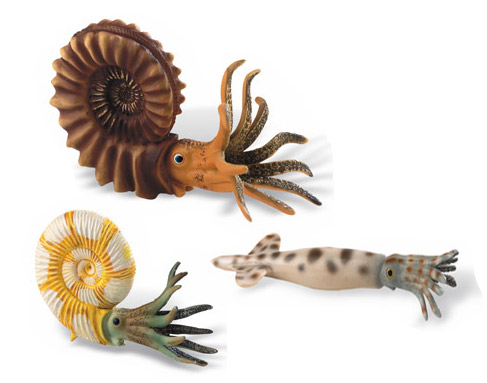
A Metriorhynchus Meal – Ammonites and Belemnites

Prehistoric crocodile sea food.

Picture credit: Everything Dinosaur

The picture above shows two ammonites and a belemnite, these nektonic (means they live above the sea floor), cephalopods would have been the stable food of Metriorhynchus and other marine crocodiles.

For dinosaur toys and games, plus prehistoric models including accurate models of ammonites and belemnites visit Everything Dinosaur’s model section on their website: Dinosaur and Prehistoric Animal Models.

Scientists have been able to build up a detailed picture of the ecosystem within these shallow, Jurassic seas that covered much of Europe during this period.  As well as marine crocodiles, there were many different types of ichthyosaur and plesiosaur.  At the top of the food chain, the top predators were the huge pliosaurs.  These animals were marine reptiles, a number of fierce meat-eating genera are known, perhaps the most famous is Liopleurodon.  This enormous predator, has been claimed by some sources to be the largest carnivore to have ever existed on the planet.

A number of species of Liopleurodon are known, but whether they really did reach lengths in excess of 25 metres as some scientists and journalists have claimed is still open to debate.   With their crown of front teeth, some of which exceeded 18 inches in length they would have been formidable hunters and a 3 metre Metriorhynchus would have been no match for this mighty pliosaur.

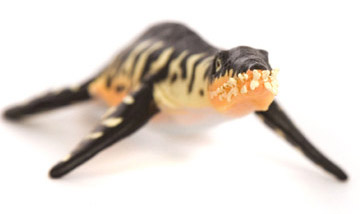
Close up of a Liopleurodon (the business end)

The fearsome Liopleurodon.

Picture credit: Everything Dinosaur

To view the model of Liopleurodon (Liopleurodon ferox) and other marine reptiles in the CollectA Prehistoric Life model series: CollectA Age of Dinosaurs.

Go to Top