All about dinosaurs, fossils and prehistoric animals by Everything Dinosaur team members.

Articles, features and information which have slightly more scientific content with an emphasis on palaeontology, such as updates on academic papers, published papers etc.

28 06, 2009

Montana Palaeontologist Sentenced to 3 Years Probation for Stealing Fossils

By |2022-12-25T16:50:49+00:00June 28th, 2009|Categories: Dinosaur and Prehistoric Animal News Stories, Main Page, Palaeontological articles|0 Comments

Well-known American Palaeontologist Sentenced after Court Case

Nathan Murphy, a self-taught palaeontologist from Montana was sentenced on Wednesday to three years probation, having been found guilty of stealing fossils from Government land.  He was convicted of stealing 13 dinosaur bones from the Hell Creek Formation in 2006, earlier this year he was sentenced to 60 days imprisonment for the theft of a dromaeosaur fossil.  He had claimed that this specimen was his own find and Mr Murphy had wanted to sell copies and casts of this particular fossil to museums.  The judge also ordered him to pay over $17,000 in restitution.

He had already pleaded guilty to charges and we covered this case in previous blog articles, an insight into the shady and murky world of black market fossil sales.

Palaeontologist from Montana

To read the earlier articles:

First article: Local Fossil Collector Charged with Theft.

Second article on the Nathan Murphy charges: Guilty Plea in Montana Dinosaur Theft Case.

The case has severely damaged the reputation of the 51-year-old, who has been responsible for finding a number of important specimens in the Montana strata.

Notwithstanding the fact that Mr Murphy sought financial gain my having casts made from at least one stolen fossil, Murphy says the fossils themselves were never at risk and were later turned over to a not-for-profit foundation.

Mr Murphy’s lawyer, Michael Moses commented:

“This case is a lesson well learned, Mr Murphy’s reputation and status within the palaeontological community has been severely affected”.

Nathan Murphy runs a company charging tourists to take part in dinosaur excavations, he was also a director of a dinosaur research facility in the state, before resigning in July 2007, the resignation coinciding with the investigation by the federal authorities.

USA Laws Tightened

Recently, the laws in the USA regarding the theft of fossils from public land were tightened when President Obama signed a new law creating a maximum prison term of up to five years for stealing fossils or other artifacts.

Palaeontologists and some public land managers, including the Bureau of Land Management (BLM) had sought a stronger measure for years, but it came too late for Mr Murphy’s case.   However, the sentencing of Mr Murphy indicates the strong action the authorities are taking to help deter the stealing of fossils .

22 06, 2009

Bizarre Jurassic Ceratosaur Points Finger at Unique Dinosaur Avian Link

By |2024-04-17T10:30:38+01:00June 22nd, 2009|Categories: Dinosaur and Prehistoric Animal News Stories, Main Page, Palaeontological articles|1 Comment

Chinese Jurassic Ceratosaur Provides Evidence of Ancestral Link between Theropods and Birds

A recently discover Jurassic ceratosaur provides further evidence of an ancestral link between theropod dinosaurs and Aves.

The link between certain types of dinosaur and birds is largely accepted by many scientists today, the first rumblings about a connection can be traced back to the 1880s the time of  Harry Govier Seeley, largely responsible for the taxonomic classification of Dinosauria.  Indeed, the likes of the Thomas Henry Huxley in the early 1860s had remarked how similar anatomically dinosaurs were to birds; fuelled no doubt by the discovery of an almost complete skeleton of Archaeopteryx in 1861.

However, the paucity of the fossil record and the lack of key, transitional fossils showing animals evolving from one type of creature to another, the stages of evolution as it were, does mean that debate still continues as to the precise relationship between Dinosauria and Aves.

The Dinosauria/Bird Link

A recent study by scientists at the Oregon State University, analysing the process of bird’s breathing and their lung structure led this particular team of researchers to conclude that birds are not the direct descendants of theropod dinosaurs.  Evidence gathered from their particular study indicated a shared, common ancestor but no direct descent.

To read more about the Oregon State University research: Controversy over the Dinosaurs/Birds Link.

This is one of the fascinating aspects of palaeontology, as new fossils are found, or as new techniques are developed to study known fossils, theories and concepts regarding Dinosauria change and evolve.

When trying to demonstrate some of the anatomical links between birds and dinosaurs a roast chicken or turkey can be dissected and some of the similarities shown.  This is not recommended at Christmas, as it can interrupt the festivities and upset the cook.  However, a couple of years ago, we did publish an article pointing out some of the things to look for when you carve the Christmas dinner.

To read this article: Christmas Dinner Links Dinosaurs to Birds.

One of the problems associated with the link between dinosaurs and birds was trying to explain the differences in the finger pattern seen in theropod dinosaurs and in birds.  Put simply, the theropod ancestors of birds and birds share a characteristic of having three fingers (digits), problem is; theropods have digits I, II and III, whilst birds have digits II, III and IV.  Now the discovery of a new, bizarre theropod with four fingers on each hand may provide evidence that explains this anomaly and help to unravel the mystery of how birds are descended from dinosaurs.

An international team of palaeontologists led by scientists from the Institute of Vertebrate Palaeontology and Palaeoanthropology (IVPP) in Beijing, have uncovered the articulated remains of a bizarre, beaked, herbivorous theropod that may shed some light on the bird/dinosaur digit mystery.  In total two skeletons were found, including evidence of gastroliths (stomach stones) it is these stones that provide evidence of a tough, fibrous diet for this little, biped.

Jurassic Ceratosaur

The remains were found in Jurassic strata (Oxfordian faunal stage), dating this dinosaur to the Middle to Late Jurassic approximately 156 million years ago.  The dinosaur has been named Limusaurus (means mud lizard), the binomial name is Limusaurus inextricabilis.

The Fossils of Limusaurus (L. inextricabilis)
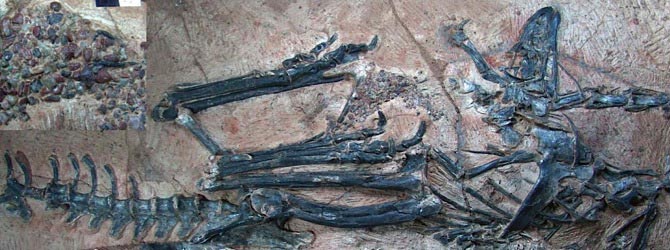
Picture credit: James Clark

A Strange Theropod Dinosaur

The head of Limusaurus is towards the right of the picture, the beautiful and very well preserved caudal vertebrae (tail bones) of this dinosaur can be seen in the bottom left.  In the centre of the picture between the claws of the hind legs a pile of gastroliths are shown, in what would have been the stomach cavity. This section of the fossil is enlarged and the individual stones can be made out (top left corner).

A total of two skeletons of this dinosaur have been found, identified as a member of the Theropoda, but a plant-eater, Limusaurus exhibits characteristics that may identify it as a transitional fossil, providing evidence on how dinosaur digits evolved and changed over time.  The remains are of juveniles (analysis of bone fusion), these animals were 1.7 metres long, and lightly built, but it is not known how big a fully grown adult would have been.

The long hind limbs indicate that this dinosaur was a fast runner and as many other theropods from China have been discovered with primitive feathers, Limusaurus is illustrated as a feathered dinosaur.  This dinosaur could not fly, but an active, cursorial lifestyle may indicate that this dinosaur was warm-blooded and the feathers would have helped insulate the animal and retain body heat.

An Artist’s Illustration of Limusaurus
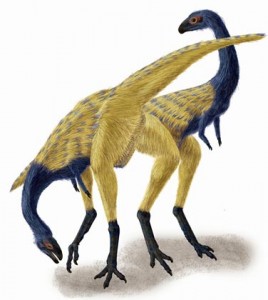
Limusaurus drawing.

Picture credit: Portia Sloan

An Unusual Theropod Dinosaur

Limusaurus is certainly an unusual theropod.  Classified as a primitive Asian ceratosaur, this long-limbed, short-armed, toothless but beaked dinosaur may prove to be a transitional fossil helping to explain the evolution of Theropoda digits to the II, III, IV digit formation of birds.  The remains were found in the Junggar Basin in the Xinjiang Uygur region of northwest China.

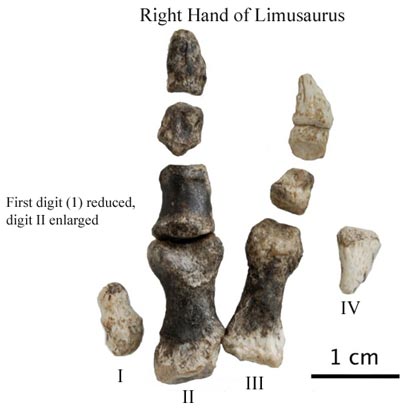
Xu Xing, one of the principal investigators and an illustrious member of the scientists at the IVPP describes this dinosaur as having four digits (fingers) on each of its small hands.  Digits I, II, III and IV equivalent to the thumb, index finger, middle and the ring fingers in humans.  However, digit I (thumb) is greatly reduced and the second finger (digit II – index) is very much larger, perhaps compensating for the vestigial state of the first digit.

Dinosaur Bird/Theory

Palaeontologists who supported the dinosaur-bird theory long faced a problem on fingers. Previous fossils of theropod dinosaurs showed earlier dinosaurs had five fingers and later ones gradually lost their ring finger and little finger, what is know as lateral shedding, the outside fingers went.  Birds show skeletal traces of former fingers, the index, middle and ring fingers, in other words digits II, III and IV.  The different digit formations is one of the major stumbling blocks when it comes to accepting the theory that birds are indeed descended from theropod dinosaurs and in essence highly evolved, avian dinosaurs.  Limusaurus may provide evidence as to how the changes in fingers came about, Xu Xing commenting on the fingers of Limusaurus stated:

“The new Limusaurus indicated a different pattern of finger reduction.  It was the thumb that was lost, instead of the ring finger”.

Co-author of the research paper on this new dinosaur, James Clark, of the George Washington University (United States) stated:

“This new animal is fascinating by itself, and when placed into an evolutionary context it offers intriguing evidence about how the hand of dinosaurs evolved into the hand of birds”.

The Right Hand (right manus of Limusaurus)
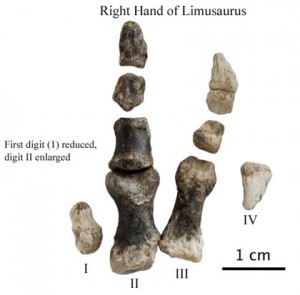
The hand of a dinosaur.

Picture credit: James Clark (annotation by Everything Dinosaur)

The international team re-examined hand skeletons of some previous fossils of theropods.

“We realised the pattern of their finger reduction was much more complicated than people had thought,” Xu added.

The scientists believe that the first digit becoming smaller and the importance of the second digit becoming greater indicate the beginnings of a trend in the evolution of dinosaur digits that would eventually lead to the configuration of II, III, IV as seen in birds.  Limusaurus marks the beginning of a trend in finger development.

A New Hypothesis

They also presented a new hypothesis to explain why advanced theropods, from which birds were believed to have evolved, had the second, third and fourth fingers but they looked like the first three ones, as some fossils showed.  Previously, palaeontologists believed that theropod dinosaurs as they evolved and changed over time, gradually lost fingers, but from the outside of the hand inwards (the lateral side).

Theropod dinosaurs have traditionally been assumed to have lost fingers from the lateral side inwards.  This differs from the bilateral reduction seen in other tetrapod groups, i.e. losing digits from both the medial and lateral sides (inside and outside digits of the hand).

This strange reduction pattern is clearly present in primitive, basal theropods and has also been inferred in other types of theropod, based on the identification of their three-fingered hands (digits I, II and III present).  However, this contrasts with the evidence from the extant theropods, the birds which have digits II, III and IV present.

Jurassic Ceratosaur

The evidence from the skeletal remains of Limusaurus indicate that the index finger may well be taking on the appearance and prominence of the thumb, a case of digit II evolving into digit I.

Xu Xing went on to state: “Homeotic changes might happen on dinosaurs, which means that the index finger has the features of a thumb.  Such changes happened in humans, for example, a person usually has seven cervical vertebraes [neck bones] but, for some people, the first thoracic vertebrae has the feature of the cervical ones”.

Commenting on these findings, Alan Feduccia, (Palaeobiologist at the University of North Carolina) stated:

“If confirmed, this would be the only early dinosaur with a hand composed of the middle three digits, which is the same pattern as that of modern birds, albeit dramatically different in overall hand morphology, as well as having a highly abbreviated forelimb”.

He went on to add:
“The new fossil answers many questions and raises still another set of unknowns”.

Guenter Wagner, a renowned Yale evolutionary biologist, responded to the paper (published in the scientific journal Nature):

“There is very strong developmental evidence that there was a homeotic change in digit identity in the evolution of the bird lineage.  I find it intriguing that there is more similarity to the 2,3,4 digits proximal, and more similarity to 1, 2, 3 digit identities distally”.

Wagner, however, remained neutral on the question of whether the morphology of this animal is a derived feature that may not be informative of the stages the bird lineage went through.  This new research does provide some very interesting and intriguing questions, whether or not Limusaurus is a true transitional fossil has yet to be determined, but it does provide an interesting insight into one potential path from cursorial three-fingered dinosaurs to the birds that can be seen today.

Reference: Xing Xu et al, “A Jurassic ceratosaur from China helps clarify avian digital homologies” Nature 459:940 doi:10.1038/nature08124


18 06, 2009

New Giant Parrot-Like Species of Dinosaur Discovered (New Species of Psittacosaurus)

By |2022-12-25T11:22:21+00:00June 18th, 2009|Categories: Dinosaur and Prehistoric Animal News Stories, Main Page, Palaeontological articles|0 Comments

New Species of Psittacosaurus Named and Described

Psittacosaurus may not be as well known as later ceratopsians such as Triceratops (horned dinosaurs), but for this genus of dinosaur it has an important place in palaeontology, simply because it is the most species diverse of all the known dinosaur genera.

Psittacosaurus

Now a new species of Psittacosaurus or “parrot lizard” has been named and described – Psittacosaurus gobiensis, making this, in our estimation the ninth type of Psittacosaur to be named and described to date.  Once regarded as an ornithopod, psittacosaurs are now believed to be a transitional form between Ornithopoda and the ceratopsians, fossils of these particular dinosaurs are associated with Asia, most famously the Gobi desert region.  Although small by dinosaur standards, with the largest species a little over 2 metres long, the numerous fossils found to date have provided scientists with a wealth of data on the evolution and behaviour of these Cretaceous animals.

In recent years some remarkable fossils associated with this genus have been discovered.  For example, remains of a group of baby Psittacosaurs were found together, perhaps evidence of herding or flocking behaviour.

To read more about this discovery: Dinosaur Nursery Unearthed in China.

Feathered theropods are known from the fossil record, but another fossil specimen of a Psittacosaurus from Liaoning (China) indicates that these ornithischians may have had feathers too, at least according to a Chinese scientific paper published recently in the journal Nature.

To read about feathered Psittacosaurs: Feathered Ornithopods upset the Scientific Apple Cart.

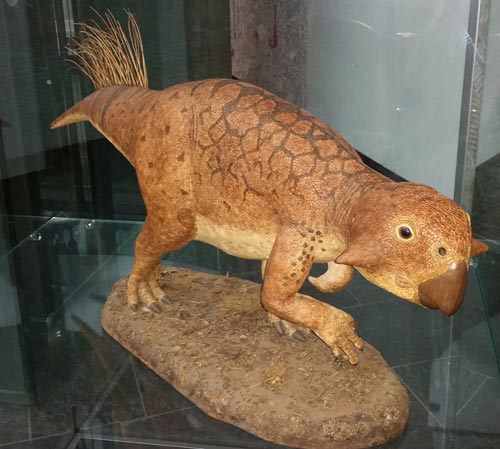
An Illustration of a Feathered Psittacosaurus

Life-size Psittacosaurus replica.

A model of the dinosaur called Psittacosaurus. Picture credit: Everything Dinosaur

Picture credit: Everything Dinosaur

Psittacosaurus was named “parrot lizard” after its parrot-like beak, this little dinosaur was a low browser, perhaps adapted to feeding on the fruits and nuts of angiosperms (flowering plants).  It had long hind legs and was capable of adopting a bipedal stance if required and some fossils indicate that it had long, quills running down its back and along its tail (as illustrated above).  Psittacosaurs are associated with Cretaceous strata, P. gobiensis for example, has been dated to approximately 112 million years ago (Aptian faunal stage).

Scientific Paper

In a paper on this new type of dinosaur, P. gobiensis, this one-metre-long dinosaur, may have had a diet dominated by nuts and seeds and this specimen is associated with gastroliths (stomach stones) which may reinforce the high fibre diet theory.  The paper on this dinosaur has been published in the Proceedings of the Royal Society B: Biological Sciences.

Picture show the skull of P. gobiensis compared to a the skull of a modern parrot (Macaw).  Analysis of the skull of this new psittacosaur indicates that this animal chewed its food in a similar way to parrots.

Professor Paul Sereno, from the University of Chicago commented:

“These and other features, along with the presence of numerous large stomach stones, suggest that psittacosaurs may have had a high-fibre, nut eating diet”.

“Parrot Lizard”

The short snout, just a third of the skull length was different to most dinosaurs, giving the skull its parrot-esque profile.

Professor Sereno went on to add:

“Psittacosaurs are all relatively small in body size, ranging from one to two metres in body length.  Their geographic range is limited to central Asia, and their temporal range may be as narrow as 10-20 million years in the mid Cretaceous”.

The head is rather square looking in profile, which along with the heavy beak makes the skull resemble a parrot’s .  There are no teeth in the front of the jaw but robust teeth further to the back of the jaws are blunt and designed for chopping and crushing.

To view models of ornithopods, ceratopsians and psittacosaurs visit the models section of the award-winning Everything Dinosaur website: Dinosaur and Prehistoric Animal Models.

11 06, 2009

Controversy over the Dinosaurs/Birds Link

By |2023-03-02T14:16:19+00:00June 11th, 2009|Categories: Dinosaur and Prehistoric Animal News Stories, Main Page, Palaeontological articles|0 Comments

New Research Questions “Birds Descended from Dinosaurs Theory”

For some time the theory that theropod dinosaurs gave rise to birds has been an accepted part of scientific thinking, a hypothesis that is largely believed by the majority of palaeontologists and academics.  However, the exact relationship between Dinosauria and the Aves has to be determined.  There are certainly enough common anatomical similarities to indicate an evolutionary relationship, but whether or not birds actually are the descendants of small, bipedal meat-eating dinosaurs has been questioned on numerous occasions.

Newly Published Research

A new research paper published in the scientific publication “The Journal of Morphology” provides a new perspective on this problem, one that was debated as long ago as the 1880s by eminent British scientists such as Huxley.

That birds may be the descendants of dinosaurs is perhaps of the most strongly accepted hypotheses in current evolutionary research.  However, there is mounting evidence to suggest that the theory is simply not right, the interpretation of the relationship may be wrong and evidence has been published by the Oregon State University in the United States that asks scientists to reassess the dinosaur-bird link.

Because of the demands associated with powered flight, birds have a very unique physiology.  Birds breathe very differently from mammals and reptiles.  Their lungs are particularly efficient and have a circulation system that does not permit oxygenated air to mix with de-oxygenated air.  These lungs are much more efficient than the lungs of a cold-blooded reptile such as a crocodile for example.

To read more about the structure of Avian lungs: Ideas on Dinosaur Breathing – A Breathe of Fresh Air.

In addition to very efficient lungs, birds have an immobile thigh bone. The locked femur has been known for some time, but the role it actually plays in aiding flight is the subject the new discovery from the Oregon University based team.  The researchers found that there is a strong relationship between the immobile femur (thigh bone) and the air-sac structure of the lungs.

The researchers state there is a strong relationship between:

“the fixed position of bird bones and musculature that keeps their air-sac lung from collapsing when the bird inhales”.

An immobile femur is unique to birds, it is not seen in other vertebrates.   According to Oregon State University’s John Ruben (Professor of Zoology) this work on the link between the femur and the lung structure may indicate that birds evolved alongside dinosaurs in the Mesozoic not directly from a specific SuperOrder such as Theropoda.

He stated that:

“This discovery probably means that birds evolved on a parallel path alongside dinosaurs, starting that process before most dinosaur species even existed”.

Theropod Dinosaurs

Understanding the lung function of dinosaurs is crucial in establishing the relationship between Aves and the Dinosauria.  However, the lack of fossil evidence (limited soft tissue preserved), has prevented scientists from making progress in this particular field of research.   Perhaps, the mummified hadrosaurine known as “Dakota” which seems to have a lot of soft tissue preserved may provide more data.  This new research from the American team, challenges the accepted, current theory.  Anatomical evidence from dinosaur fossil bones supports the theory that theropods had a mobile femur and as a result their lungs would have to be very differently structured to those of a bird.

Professor Ruben commented:

“Theropod dinosaurs had a moving femur and therefore could not have had a lung that worked like that in birds.  Their abdominal air sac, if they had one, would have collapsed”.

The question arises therefore, that if birds did not descend from theropods, then where did they come from?  There is evidence of birds in the fossil record from the post Callovian/Oxfordian faunal stages (Archaeopteryx lithographica), but there are very few fossils of birds in the known fossil record, even including those remarkable fossils from Liaoning Province in China.  If birds are not really feathered, flying theropods then this theory from the American team would suggest that they are still related and that they evolved from a common ancestor – the reptilian thecodonts (Thecodontia).

Everything Dinosaur stocks a wide range of theropod dinosaur models including: Papo Dinosaurs.

The dinosaur-bird link will remain controversial and be debated for many years to come, until some of the new technology including genetic research provides more information about known fossils or a new fossil is found to provide a fresh perspective.

5 06, 2009

A Chance to go Digging for Remarkable Dinosaurs

By |2024-04-17T10:23:24+01:00June 5th, 2009|Categories: Geology, Main Page, Palaeontological articles|0 Comments

Digging for Dinosaurs in the Dinosaur Provincial Park (Canada)

Looking for something to do over the Summer holidays, something a little bit out of the ordinary and unusual, well how do you fancy taking part in a real dinosaur excavation at a World Heritage site?

Digging for Dinosaurs

The Dinosaur Provincial Park, a UNESCO World Heritage site, situated in the Badlands of Southern Alberta, Canada, is offering a new dinosaur excavation programme.  For either one or two days participants (must be over 14), get the chance to take part in a real dinosaur bone bed excavation, working on real dinosaur fossils and helping to map the site and excavate Late Cretaceous dinosaurs.

The programme has been titled: “Bone Bed 30 – Guided Excavation Program”  not perhaps the most exciting or catchy title but an opportunity to help excavate dinosaur bones and take part in real research is a very serious business and there are very few opportunities to participate in such excavations.  The package is being offered throughout the Summer months (runs July to early September), and one or two day programmes are available.

Digging for Dinosaurs

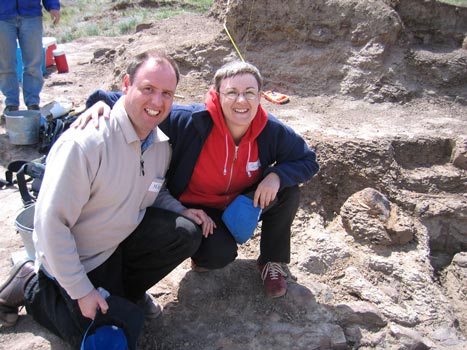
Digging for Dinosaurs

Pause for a pic next to a digs station.  Team members at Everything Dinosaur have worked on fossil dig sites.

Picture credit: Everything Dinosaur

For any person lucky enough to be in that area of southern Alberta this Summer, we would heartily recommend you taking up this opportunity to, as the tourism information says:

“Unearth the past, contribute to the future”

To learn more about the opportunity to help excavate real dinosaur bones, visit the Dinosaur Provincial Park’s official website.

Dinosaur Models

Everything Dinosaur stocks a wide variety of prehistoric animal models and replicas including many models of dinosaurs, fossils of which come from the Upper Cretaceous deposits of the Dinosaur Provincial Park Formation.

For example, the PNSO range includes models of ceratopsians, tyrannosaurs and duck-billed dinosaurs: PNSO Age of Dinosaurs Models and Figures.

2 06, 2009

Remains of a Plesiosaur found at Lyme Regis

By |2022-12-25T07:25:04+00:00June 2nd, 2009|Categories: Dinosaur and Prehistoric Animal News Stories, Geology, Main Page, Palaeontological articles|0 Comments

Plesiosaur Fossil Discovery Announced

No sooner have record visitor numbers been declared for the Lyme Regis Fossil Festival, the Dorset town is back in the news again with the announcement of the discovery of a 70% complete plesiosaur fossil on Monmouth beach.

Plesiosaur Fossil

First the good news about the Fossil Festival, according to the organisers, an estimated 15,000 to 16,000 people attended the event, which was run from Friday 23rd May to the following Sunday.  A number of team members from Everything Dinosaur attended and we are sure the excellent attendance figures were helped by the super Bank Holiday weather the Dorset coast enjoyed.

Now, the finding of a fossilised plesiosaur is a very rare event at Lyme Regis, occasionally vertebrae are found (they look like cotton reels), but to discover a 70% complete specimen including skull material is a find of a fossil hunter’s career.  This is exactly what happened to Tracey Marler and her partner, keen fossil hunter Chris Moore on a visit to Monmouth beach to the west of Lyme Regis.

A close examination of the bones (which are in association and partial articulation), reveal teeth marks where the carcass was scavenged by another prehistoric animal.  Plesiosaurs first appear in the fossil record from the Late Triassic, they were typically, long necked animals with small heads with jaws lined with needle-like teeth.  The Loch Ness monster is regarded as a plesiosaur.  It is believed these animals were specialist fish hunters (piscivores).  The new discovery from Monmouth beach is believed to represent an individual that was over 4 metres long.

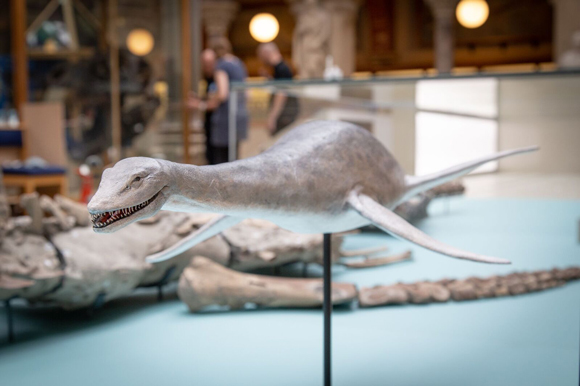
An Replica on Display in a Museum Similar to the Lyme Regis Plesiosaur

Oxford University Museum of Natural History plesiosaur.

A replica of a long-necked plesiosaur swims into view. Picture credit: Everything Dinosaur.

Picture credit: Everything Dinosaur

Richard Edmonds, Science Manager at the Jurassic Coast World Heritage site, stated:

“They [plesiosaurs] are rare.  There are only ten known examples of complete or partial skeletons of this species.  I have been doing this for thirty years and I have only ever found the odd bone”.

A Single Bone

Tracey and her partner Chris Moore, first found a single bone encased in the limestone rock, but they returned again and again to the location and were able to excavate about 150 vertebrae plus parts of the skull, the jaws and even a tooth.

To view a model of a plesiosaur, other marine reptiles and dinosaur toys: Prehistoric Animal and Dinosaur Models.

Commenting on their discovery, Mr Moore said:

“It came out in pieces but you could clearly see how it looked.  The tail bone was in position.  Some of the back bones were completely in place where they should be and the neck bones were there as well.  You could see some of the bones had actually been chewed up a bit”.

It is not known what animal could have scavenged the carcass, but some scientists have speculated that it probably was another marine reptile, probably an ichthyosaur.

To see a scale model of an ichthyosaur and dinosaur models, take a look at the range of prehistoric animal models and figures in the PNSO section of the Everything Dinosaur website: PNSO Age of Dinosaurs Models.

Plesiosaur

Natural England worked closely with the Jurassic Coast World Heritage team to ensure the fossilised bones were extracted from their matrix, it is hoped the bones will eventually be put on display at the Lyme Regis Museum.  A fitting location, as this building is very strongly associated with the famous Georgian fossil collector Mary Anning, the finder of the first plesiosaur fossils at Lyme Regis.

30 05, 2009

Swan Neck Posture of Sauropods – The Great Debate

By |2022-12-24T22:21:11+00:00May 30th, 2009|Categories: Dinosaur and Prehistoric Animal News Stories, Main Page, Palaeontological articles|0 Comments

Did Long-Necked Dinosaurs Hold their Heads Up High?

The debate over the posture of the sauropodomorphs has been opened up again with a new research paper published by a team from the University of Portsmouth, England.  The research findings based on close examination of the cervical vertebrae of a number of sauropods plus comparisons with extant mammals and birds indicate that some of these long-necked dinosaurs may have been able to lift their heads high into trees to feed.

This work is in contrast to an earlier Australian study (published in April 2009), postulating that the hearts of these massive animal’s were not able to sustain enough blood pressure to permit blood circulation if their heads were held in a more vertical position.

By examining the skeletons of living animals, animals which share the dinosaur’s unique upright stance (mammals and birds), the University of Portsmouth team have concluded that the long-necked dinosaurs may have held their heads higher for much of the time.

The research, led by Dr Mike Taylor could re-shape the way museums pose their sauropod exhibits.  The classic interpretation of the stance of sauropods (the swan-like neck), was first put forward in the late 19th century when almost complete skeletons of dinosaurs such as Diplodocus, Apatosaurus and Brontosaurus were excavated from the Morrison Formation in the Western United States.  Such large animals became the central attraction at many museums when they were put on display and the papers written about them did depict them with their heads held high.  Often in conjunction with this stance, they were depicted in water, as it was thought that these animals were to heavy to walk around on land comfortably.

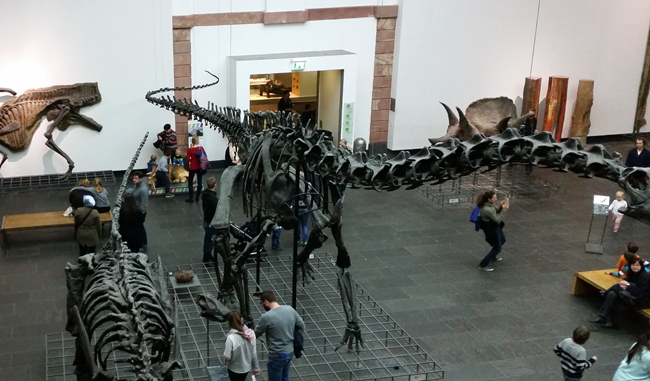
A Replica of a Sauropod Skeleton (Diplodocid) on Display at the Naturmuseum Senckenberg

Sauropod skeleton (cast) on display.

A sauropod (diplodocid) skeleton exhibit on display at the Frankfurt Natural History Museum (Naturmuseum Senckenberg). Picture credit: Everything Dinosaur.

Picture credit: Everything Dinosaur

In the picture (above), a replica of a sauropod skeleton (diplodocid) is shown on display at the Frankfurt Natural History Museum, Germany.

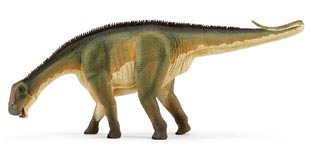
However, there is more than one way in which to articulate the vertebrae of a long-necked dinosaur and a different interpretation has taken hold over the last few years, one that shows these dinosaurs with their heads held in a more horizontal position.  Indeed, the range of movement of the necks of sauropods is believed to be very limited according to some scientists.  Sauropods such as Nigersaurus (Nigersaurus taqueti), which was named and formerly described in 1999, may have been specialist feeders on low growing vegetation and had no need to lift their heads high to feed.  In fact the structure of the vertebrae of this strange dinosaur from Africa is so bizarre that some scientists have marvelled at how it could have lifted its head at all.

The Bizarre Sauropodomorph Nigersaurus – A Specialist Low Browser?

The “Lawn Mower” Sauropod

Picture credit: Everything Dinosaur.

To view a models of various sauropods including brachiosaurids, titanosaurs and diplodocids: Dinosaur and Prehistoric Animal Models.

However, acknowledging the number of conflicting theories regarding the stance and posture of these large dinosaurs, Dr Mike Taylor and his team are not suggesting that museums reassemble their sauropod exhibits.

He went onto comment:

“The Diplodocus in the main hall vestibule of the Natural History Museum [London] is in a perfectly good posture.  It is one within a whole range of movement that would have been entirely possible”.

The University of Portsmouth researchers used X-rays and other sophisticated techniques to plot the range of movement and structure of the necks of several sauropods and then compared them to the movement shown in living animals.  Based on this study, the team have concluded that sauropods could have held their heads high (natural resting position).

Dr Taylor and his colleagues concluded that the necks of mammals and birds (who share an upright stance with dinosaurs), have necks that are “strongly vertically inclined”.  Based on these comparisons they team have suggested that sauropods too, could hold their heads high.  Explaining that fossil bones could only provide part of the story and it was important to consider muscle structure; the team have concluded that these huge necks could have been more flexible than the bones themselves suggest.

The problem is soft-tissue in dinosaurs is very rarely preserved and with sauropods even finding an articulated neck in association with skull material is an extremely rare event in itself.

Dr Taylor added, that based on this new study:

“We can be confident that they [sauropods] held their heads upright”.

This theory is in direct contrast to work published by an Australian team of scientists led by Dr Roger Seymour, who proposed that the elevation of the skull above the heart would have caused enormous problems with blood pressure, raising it to perhaps lethal levels as the dinosaurs tried to pump blood to their elevated brains.

To read more about the Australian team’s work: Dinosaurs with their Heads Held High – the Debate Continues.

Dr Taylor is not convinced by the argument put forward by the Australian team.

“There are some [living animals] where the heart is able to exert much greater pressure than Seymour’s equations predict [is possible].  We don’t see why that couldn’t also be true in sauropods.”

Dr Paul Barrett, a palaeontologist from London’s Natural History Museum, the person responsible for designing the Diplodocus in the museum’s model series, thinks the sauropods were likely to have been able to lift their heads high, but he remains unconvinced that would have been their “resting posture”.

Dr Barret stated:

“It would require lots of muscular activity, and put a lot of strain on their hearts”.

Dr Barrett explained that, since it is impossible to know how thick the pads of connective tissue between the dinosaurs’ vertebrae were, it is difficult to estimate how much of a role this tissue, along with muscles and tendons, played in the animals’ range of movement.

He went onto add:

“Finding a model in biology to explain the stance and posture of these creatures is not easy”.

To view Dr Paul Barrett’s model interpretation of Diplodocus and other prehistoric animals in the Natural History Museum’s range of prehistoric animal models: Natural History Museum Dinosaur Models.

This debate is liable to run and run as further fossil evidence is uncovered.  Perhaps scientists will be fortunate to find a more complete fossil of a sauropod, perhaps a juvenile with some soft tissue preserved so we can gain a better understanding of the range of movement of these amazing prehistoric animals.

The changing scientific opinion regarding Sauropodomorpha: The Changing Views on Sauropods.

3 05, 2009

Ancient Duck-billed Dinosaur Femur Reveals Remarkable Dinosaur Proteins

By |2024-04-15T14:38:38+01:00May 3rd, 2009|Categories: Dinosaur and Prehistoric Animal News Stories, Main Page, Palaeontological articles|0 Comments

Scientist Claim to have Isolated Preserved Dinosaur Blood and Proteins

The fossilised femur of a duck-billed dinosaur dating from the Late Cretaceous has been the subject of a controversial study by a team of American scientists who claim that they have isolated soft tissue including blood vessels and dinosaur blood.

Duck-billed Dinosaur

The 80 million-year-old Brachylophosaurus (Brachylophosaurus canadenis), a flat crested duck-billed dinosaur (hadrosaurine, hadrosaur) has yielded the oldest known proteins preserved in soft tissue.  This research was led by the same team from the Harvard Medical School that published a paper in 2007 announcing the recovery of proteins from the fossilised limb of a 68 million-year-old tyrannosaur.

The hadrosaur femur (thigh bone) had been encased in sandstone and protected to some extent from complete tissue degradation.  Team members at Everything Dinosaur stated that the specimen was probably part of a superbly preserved, almost complete Brachylophosaurus skeleton nick-named “Leonardo”, that had been found recently. This fossil preserved parts of the skin, neck muscle and even elements of the gastric tract which revealed the remains of this dinosaur’s last meal.

Dinosaur Proteins

An initial microscopic scan revealed structures resembling blood vessels, cells and collagen (type of protein).  These initial findings were confirmed by applying antibodies to the tissue that are known to react with proteins.  The tests suggested the presence of collagen and other proteins, including haemoglobin, the protein in red blood cells.

The hints of haemoglobin remain speculative and are not covered in the new, peer-reviewed study, which appears in today’s issue of the scientific journal “Science”.   As a result and until the peer review is carried out the presence of haemoglobin remains unproven.  Some scientists have commented that the haemoglobin alledged to have been found is the result of contamination.

Computational biologist Pavel Pevzner of the University of California stated:

“If it’s not a contaminant, it is much bigger than the confirmed discoveries of blood vessels and other connective tissues”. 

A confirmed dinosaur-hemoglobin discovery would open the door to the recovery of many dinosaur proteins, including DNA, this could be the first step on a very long journey that could lead to a real-life “Jurassic Park”.

Harvard scientists are comfortable with their analytical work and remain convinced that they have found evidence of haemoglobin.

Studying Tissue Samples

Team members studied the tissue samples with a mass spectrometer.  It revealed the chemical makeup by telling scientists the masses of different elements in the samples tested.

The Harvard team uncovered eight collagen proteins, colleagues compared them with samples from living animals as well as Mastodon and Tyrannosaurus rex fossils.

The results placed the hadrosaur Brachylophosaurus on the same family tree segment as the theropod tyrannosaur, as expected the findings indicate that these animals were more closely related to birds than to reptiles.

For models and replicas of Late Cretaceous dinosaurs and other prehistoric animals: Wild Safari Prehistoric World Dinosaurs.

This new study may add credence to the work of the team on the tyrannosaur fossils in 2007.  A number of scientists discredited this work claiming the findings were mistaken and the soft tissue data had been introduced into the study as a result of mishandling of the fossil specimen.

Images show a highly magnified portion of the fossilised soft tissue taken from the hadrosaur femur.  The red blood cells can be clearly made out, surrounded by white connective tissue (scale bar = 50 microns).

To read a related article on Dinosaur genetic research: Real life “Jurassic Park” not too Far Away.

22 04, 2009

New Giant Ornithomimid Reported from China

By |2022-12-22T08:18:33+00:00April 22nd, 2009|Categories: Dinosaur and Prehistoric Animal News Stories, Dinosaur Fans, Main Page, Palaeontological articles|0 Comments

Super-sized “Ostrich-like” Dinosaur from China

A new giant ornithomimid named Beishanlong grandis from Gansu Province (China).

Over the last two summers, an international team of palaeontologists have been excavating a number of new dinosaur specimens from Cretaceous aged strata in the southern part of the Gobi desert (Gansu Province, China).  A number of new discoveries have been made including an ancestor of Tyrannosaurus rex (Xiongguanlong baimoensis), pronounced shong-GWAN-long by-mo-EN-sis.  The name is a bit of a mouthful, which is appropriate for this meat-eating dinosaur as it had at least 70 sharp teeth in its jaws.  The name means Grand Pass Dragon of the White Ghost, in reference to the area the fossils were found and their proximity to a geological feature called the “White Ghost Castle”.

The new tyrannosaur and a huge ornithomimid (ostrich-mimic), another type of theropod from these sediments are described in detail in the on-line journal of the Proceedings of the Royal Society B this week.  Further detailed information on these two discoveries will be published in a special volume entitled “Recent advances in Chinese Palaeontology”, in recognition of the enormous volume of vertebrate fossils that have been discovered in China over the past few years.

The ornithomimid has been named Beishanlong grandis, pronounced bay-SHAN-long gran-DIS.  It may be the largest ornithomimid discovered to date.  Size estimates are difficult to pin down as to date only a partial skeleton has been discovered.  From these remains (part of a forelimb, leg-bones, tail chevrons and caudal vertebra the animal has been estimated to have stood at least 3 metres high at the hips and weighed over 600 kilograms, that’s over four times the weight of a male ostrich.

A Scale Drawing of the Newly Described Ornithomimid Beishanlong grandis

A scale drawing of Beishanlong grandis dinosaur.

Beishanlong grandis scale drawing.

Picture credit: Everything Dinosaur

The scale drawings the new ornithomimid compared to an adult human.  The bones in the diagrams provided by the research team represent those parts of the fossil skeleton discovered to date.

The ornithomimids (members of the Dinosaur family Ornithomimosauria), are regarded as ostrich mimics.  Their anatomy resembles extant ground dwelling birds such as ostriches, emus and rheas.  They were lightly built, with compact bodies, long legs, a long neck and a small head.  They majority of these type of dinosaurs had toothless beaks just like birds.

Research project leader Peter Makovicky commented:

“When I first saw the fossils I thought, this dinosaur is much bigger than it should be, so it took a while to identify, but it’s really cool”.

Analysis of the micro-structure of fossilised bone indicates that this particular dinosaur was aged about 14 years when it died.  It was still actively growing and had not reached full size.  The joint US/Chinese team are looking forward to unearthing even bigger specimens of this type of theropod in the near future.

The strata from which these two dinosaurs have been recovered has been dated to approximately 120 million years ago, placing these animals in the Early Cretaceous.

To view replicas of theropod dinosaurs including tyrannosaurids and ornithomimids, take a look at the models section of Everything Dinosaur’s website: Dinosaur and Prehistoric Animal Models.

17 04, 2009

Computer Software Provides New Insight for Palaeontologists

By |2023-02-28T17:01:21+00:00April 17th, 2009|Categories: Dinosaur and Prehistoric Animal News Stories, Main Page, Palaeontological articles|0 Comments

Palaeontology with Computers – Powerful Computer Programmes provide New Interpretations

A few months ago, team members at Everything Dinosaur were privileged to be shown a life size cast of the sacral vertebrae and hip structure of a large North American theropod Acrocanthosaurus.  We can’t remember the exact source of the cast, but we suspect it is of NCSM 14345 from the Black Hills Institute.  We are fairly confident that the cast is from a paratype (a specimen not related to the holotype – the original material from which the animal was named and described).

Acrocanthosaurus

We were all rather blown away by the sheer size and scale of the animal.  It is only when you get up close to casts like these and the real fossils themselves that you get an appreciation of just how sizeable some of these creatures were.  There is only one species of Acrocanthosaurus recognised at present (A. atokensis), and it was certainly an apex predator, reaching lengths in excess of 12 metres and weighing more than 4 tonnes.

Complete articulated skeletons of dinosaurs are extremely rare, associated bones are like hen’s teeth but if a palaeontologist is lucky enough to find an almost intact fossil skeleton of an animal like Acrocanthosaurus, the fossil bones only tell half the story.  A couple of new specimens of Acrocanthosaurus were discovered in the 1990s, more complete than the original holotype specimen excavated forty years earlier.

Theropod Fossils

Even so, fossils of large theropods are very special as when compared to the amount of hadrosaurine or even sauropod material in the fossil record they are amongst the rarest dinosaur fossils of all.

The fossilised bones of a complete skeleton can tell scientists a lot about the animal, but they do not make up the complete picture.  With very little soft tissue such as skin, muscle, tendons and organs preserved scientists remain very much in the dark over key aspects of Dinosauria anatomy.  When we visit classrooms we explain it using the analogy of a snooker table.  Imagine you came across a snooker table, never having seen one before.  You would see a large flat table, covered in green baize with six pockets spaced around it.  It would be difficult to work out what the table was used for, unless you found the balls, snooker cues, spiders, triangle and all the other elements associated with the game as well.

Educated Guesses

Without the soft tissues, scientists have to make educated guesses, drawing conclusions on muscle size and fixation by studying the scars on bones that indicate muscle attachments.

The fossil bones may indicate where muscles were attached but they do not reveal information about the relative sizes, their length, thickness or composition.  Left to making educated guesses palaeontologists can make widely varying assessments regarding dinosaur locomotion, gait, physical size and velocity.

For instance, if the muscles connected to the femur of a tyrannosaurid were short, this would suggest that the femur would have been angled more vertically in relation to the hip bones, as in human beings.  However, if the muscles were longer, then the thigh bone would have resembled the more horizontal position as seen in Aves (birds).

Human Femur Position compared to Modern Bird Femur Position

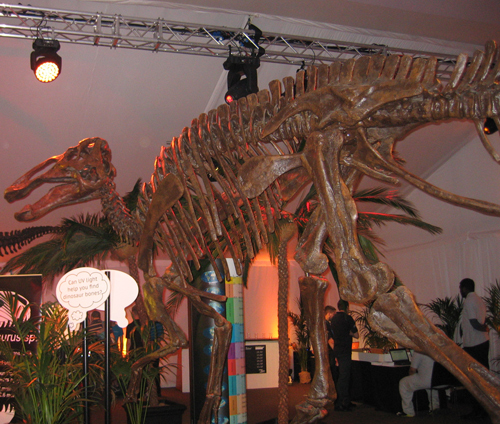
Edmontosaurus skeleton.

Duck-billed dinosaur on display.  There is more to interpreting the anatomy of the Dinosauria than just simply examining their fossilised bones.

Picture credit: Everything Dinosaur

The photograph (above) shows an articulated specimen of the hadrosaur Edmontosaurus (E. annectens).  There is much more to deduce about the anatomy of the dinosaurs than simply reconstructing their fossilised bones.

Powerful Computers and Software

A relatively new field of palaeontological study, the use of powerful computers to model concepts and create 3-D images is revolutionising the way in which soft tissue structures are visualised.  Such work is being pioneered by a team of researchers based at Manchester University.  Researchers such as Bill Sellers and palaeontologist Phil Manning create virtual muscles on scanned images of dinosaur bones to calculate how muscles worked and the anatomy of these long dead creatures.

The team from Manchester University create computer algorithms that carry out experiments to establish the most efficient method of locomotion for prehistoric animals.  At first the programmes cause the specimen being modelled to fall over but gradually the computer programmes learn from their mistakes, correct them and come up with the most likely solution.

Explaining how the process works, computer palaeontologist Peter Falkingham of Manchester University stated:

“Initial attempts to randomly decipher which pattern of muscle activation works best result almost always in the animal falling on its face“.

However, the scientists employ “genetic algorithms,” or computer programmes that can alter themselves and evolve, and so run pattern after pattern until they get consistent improvements.

Eventually, they evolve a pattern of muscle activation with a stable gait and the dinosaur can walk, run, chase or graze, Falkingham added.

Mimicking Natural Selection

Assuming the Manchester team’s computer software is mimicking the process of natural selection, then the computer generated animal should move similar to its now extinct counterpart.   By comparing their cyberspace results with real measurements of extant species such as humans and emus the Manchester team can be confident in the results computed for extinct prehistoric animals such as dinosaurs.

Now back to Acrocanthosaurus, this giant meat-eating dinosaur from the Early Cretaceous (Aptian to Albian faunal stages).  Acrocanthosaurus was named after the tall neural spines that ran along the backbone, the function of these spines, some of which measure nearly three times the height of the vertebrae from which they project, is not known.  Scientists have speculated that the spines are similar to those found in modern bison, these spines are used to support a hump that stores fat.  Perhaps this large meat-eating dinosaur had a hump which allowed it to store fat and water reserves to help it survive times when food was scarce.

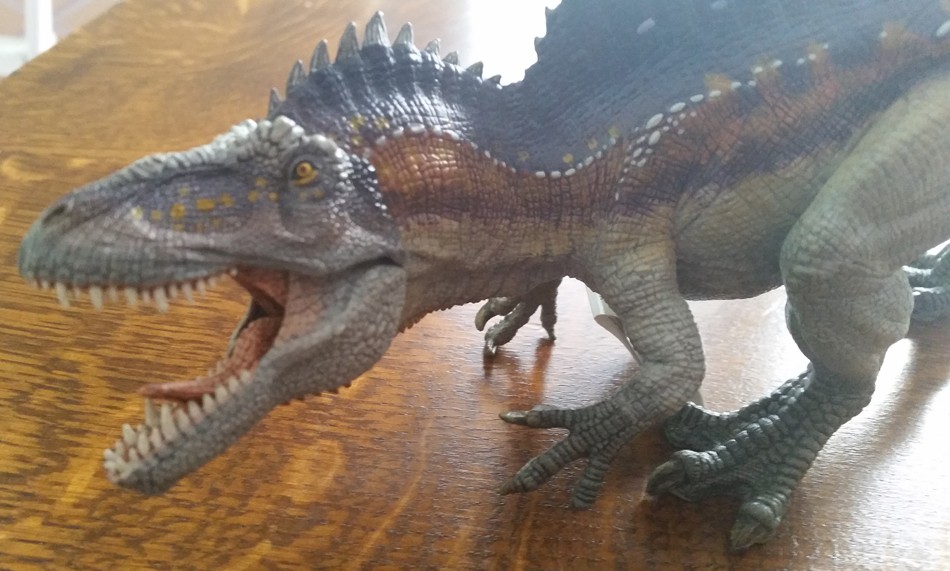
An Acrocanthosaurus Dinosaur Model

A view of the Papo Acrocanthosaurus dinosaur model.

The Papo Acrocanthosaurus dinosaur model.  A close-up view of a typical Acrocanthosaurus dinosaur replica.

Picture credit: Everything Dinosaur

The photograph (above), shows a reconstruction of the Papo model of Acrocanthosaurus atokensis. We noted that over the sacrum vertebrae there was extensive criss-crossing of tendons and other structures, as viewed by our team members when we viewed the cast of the Acrocanthosaurus fossil at Manchester University.  In the model image, the Acrocanthosaurus although typical of an allosaurid in so many ways, would have had a distinct hump.

To view a scale model of Acrocanthosaurus, Allosaurus and other theropod dinosaurs: Dinosaur and Prehistoric Animal Models.

The Work of Peter Falkingham

Peter Falkingham specialises in using the computer algorithms to interpret fossilised trackways, unlike fossil bones that may be transported a long way from where the animal lived before being deposited, footprints and trackways are preserved “in situ”.

He went on to comment:

“Tracks can tell you so much that skeletons can’t.  They can tell you about the soft parts of the feet that weren’t preserved over time.  They can tell you how the animal moved, how it walked or ran. They can even tell you about the environment they lived in, and perhaps show you they may have moved considerable distances.”

Recreating Fossil Trackways

Recreating fossil trackways as manual models and experimenting on them to calculate how the animal actually walked would be very time consuming and accurate, consistent results would be difficult to achieve.  However, by using the computer software a number of different scenarios can be tested and when this data is combined with aspects of anatomy, the locomotion and movement of a large dinosaur like Acrocanthosaurus can be better understood.

The Manchester University team have used the computer algorithms to study the way in which Acrocanthosaurus walked (fortunately there are some extensive trackways in the United States attributed to Acrocanthosaurus to assist in this research).

In this way, the team hope to shed some light as to the peculiar structure and purpose of the tall neural spines and structure of the bones making up the sacral vertebrae.  Based on this work the team have “fleshed out” this dinosaur creating a muscle map of this large, stocky meat-eater.

A Reconstruction of an Acrocanthosaurus

The Rebor Acrocanthosaurus atokensis model.

A great dinosaur model by Rebor (Acrocanthosaurus atokensis).

Picture credit: Everything Dinosaur

Neural Spines

The neural spines seem to be broader immediately behind the sacrum, could they have supported thicker muscles that may have helped counter balance the creature as it walked?  Could the structures have acted as shock absorbers to steady the animal as it ran, or could they have stored some energy in the large tendons associated with this part of the skeleton and reduced energy expenditure as the animal moved in a similar way to the long tendons found in kangaroos.

Tendons as energy stores may not have enabled this animal to “bounce” along like a kangaroo but by tensing and relaxing they may have helped this particular dinosaur maintain momentum and expend less energy as it moved about.

Three Dimensional Images of Acrocanthosaurus

Computer models help bring Acrocanthosaurus back.

Picture credit: Bates, Sellers and Manning, University of Manchester

By viewing diagram A (lateral view) it can be seen how thick set and heavy this animal appears to be.  It has a deep broad tail and powerful leg muscles to aid locomotion.  It is interesting to note diagram C (anterior view), the skull is very narrow and the jaws delicate and fine.  Light skulls are characteristic of Allosauridae but Acrocanthosaurus seems to have an out of proportion skull in comparison with its thick, heavy body.  Perhaps this large theropod has more secrets about its anatomy and position in the Cretaceous food chain awaiting discovery.

The feet are also worthy of note, they look surprisingly small when compared to the size of the animal, perhaps the peculiar lacerations and scars found on the sacral vertebrae and neural spines of this dinosaur provide a clue to this phenomenon also.

Go to Top