All about dinosaurs, fossils and prehistoric animals by Everything Dinosaur team members.

Articles, features and information which have slightly more scientific content with an emphasis on palaeontology, such as updates on academic papers, published papers etc.

19 09, 2009

Raptorex A Tiny Dinosaur that was a Blueprint for T. rex?

By |2023-03-03T16:54:03+00:00September 19th, 2009|Categories: Dinosaur and Prehistoric Animal News Stories, Main Page, Palaeontological articles|0 Comments

Raptorex – A Tiny Dinosaur with a Big Future (Upsets the Tyrannosaur Applecart)

A largely accepted theory concerning the peculiar body shape of tyrannosaurs with their massive skulls, immense jaws yet puny arms is that something had to give at the front of the animal to counterbalance the weight of that near six-foot-long skull.  So heavy was the head of a T. rex that gradually the arms got smaller and smaller as natural selection solved the problem of the need to lighten the rest of the front end of the animal to compensate for that increasingly massive, heavy head with its huge jaws.

However, the discovery of a 3-metre-long ancient ancestor of T. rex with the same body proportions has upset the scientist’s applecart.  If tyrannosauroids gradually evolved smaller arms to counterbalance the weight of the increasingly massive skulls, then how come a 1 metre tall, 1/100th scale replica of Tyrannosaurus rex has the same tiny arms and body proportions as its descendant the fearsome T. rex?

The evolution of the tyrannosaur family is unclear, the fossil record being so poor, but the announcement of the discovery of Raptorex kriegsteini in the magazine “Science” and the papers written about this near complete fossilised skeleton shed new light on the origins of T. rex.

Raptorex

Raptorex has the same big jaws, “D-shaped” teeth, and powerful legs but weighed no more than about 10 stone (65kgs), compared to the 6,500kgs of an adult Tyrannosaurus rex.  This Early Cretaceous specimen, believed to have been excavated in north-eastern China has been dated to approximately 125 million years ago (Barremian faunal stage).  The fossil indicates that the tyrannosaur body type and proportions changed little over millions of years except in overall size.

An Illustration of a Typical Large Tyrannosaurus

Picture credit: Everything Dinosaur

Tyrannosaurs

Over the last decade or so, a number of early tyrannosaur fossils have come to light.  Most palaeontologists now believe that the later, larger tyrannosaurids migrated from northern Asia to the Americas in the Late Cretaceous at some time when land bridges existed between these two landmasses.  Where tyrannosaurs originate from remains a mystery, with early tyrannosaur remains being found in places as far apart as China and the Isle of Wight.

Earlier discoveries such as the Isle of Wight Eotyrannus show that primitive tyrannosaurs were relatively small-bodied, fast running, long-armed dinosaurs.  In fact Eotyrannus has one of the largest hands of any bipedal dinosaur in relation to the size of the rest of its body.  These previous discoveries seemed to indicate that the big tyrannosaurs were descended from small-bodied, long-armed ancestors.

However, Raptorex kriegsteini looks identical to a big T. rex except that it is the best part of 100 times smaller.  The research team led by the American, Professor Paul Sereno of the University of Chicago have studied the skull of this new meat-eating dinosaur and determined that the shape of the skull with its enlarged olfactory bulbs and big eyes indicate that Raptorex has an acute sense of smell and superb eyesight just like its giant descendant.

A Drawing of Eotyrannus lengi
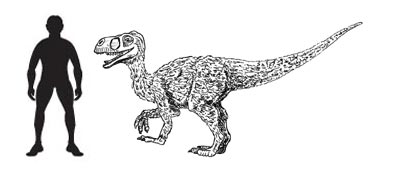
Eotyrannus scale drawing.

Eotyrannus illustrated.

Picture credit: Everything Dinosaur

Commentating on the new discovery, lead researcher Dr Paul Sereno, from the University of Chicago, stated:

 “It’s as close to the proverbial missing link on a lineage as we might ever get for T. rex.”

He went onto add:

“From the teeth to the enlarged jaw muscles, the enlarged head, the small forelimbs, the lanky, running, long hind-limbs with the compressed foot for hunting prey: we see this all, to our great surprise, in an animal that is basically the body weight of a human or 1/90th the size that ultimately this lineage would reach in T. rex at the end of the Cretaceous”.

A New Dinosaur Discovery

The researchers believe that this new dinosaur discovery overturns accepted opinion on the evolution of tyrannosaurs.  Until now it had been thought that their strange body shape evolved as a consequence of their large size.   The fossil record bears out the previous theory that as tyrannosaurs developed truly giant size over time, they needed to modify their entire skeletons so they could continue to function as a predators as they grew.

Co-author Stephen Brusatte of the American Museum of Natural History (New York) is confident that Raptorex is going to overturn the evolutionary applecart when it comes to understanding the evolution of Tyrannosauroidae.

He stated:

“Here we have an animal that’s 1/90th or 1/100th of the size of T. rex, about my size, but with all the signature features – the big head, the strong muscles, the tiny little arms – that were thought to be necessary adaptations for a large body predator.  So really we can say that these features did not evolve as a consequence of large body size but rather that they evolved as an efficient set of predatory weapons in an animal that was just 1/100th of the size of T. rex and that lived 60 million years before T. rex”.

Photographs show Dr. Paul Sereno adding the final pedal ungual to the reconstructed skeleton of R. kriegsteini.  The pedal ungual is the hoof or claw bearing bone at the end of each toe.

The known fossil record indicates that tyrannosaurs only grew to huge sizes during the last twenty million years or so of the Cretaceous.

Dr Brusatte stated:

“So that means that for most of their evolutionary history, about 80% of the time that they were on Earth, tyrannosaurs were small animals that lived in the shadow of other types of very large dinosaur predators.  In short, much of what we thought we knew about tyrannosaur evolution turns out to be either simplistic or out-and-out wrong”.

It is fascinating to speculate how the tyrannosaurs were able to become the apex predators in so many environments, gradually usurping other large theropods.  The fossilised bones of Raptorex are believed to be from a young adult, perhaps no more than six or seven years old when it died.  Although the fossils are associated with sandstone sediments laid down in a watercourse (lake bed), perhaps this early tyrannosaur hunted smaller dinosaurs, lizards and birds in wooded areas whilst trying to avoid the larger allosaur type predators such as the Sinraptoridae.

The researchers say that fragments of sand and sediment on the skeleton indicate that it came from an area of north-eastern China rich in fossils.  It was dug up illicitly and spirited out of the country and ultimately sold.

The species name is named after Henry Kriegstein, a private collector, who bought it from a dealer.  He contacted Dr Sereno in 2006 and asked him to analyse the specimen, and agreed to give it back to science.  Mr Henry Kriegstein, has helped write the research paper and has generously agreed to return the fossil to China.

Update

Debate continues as to whether this is a new genus of primitive tyrannosaur from approximately 125 million years ago, or indeed a representative of a juvenile Tarbosaurus bataar dating from approximately 70 million years ago.  The problem with this specimen is that there is not a lot of information concerning the location or indeed the geological formation from which the fossil was extracted.  In June 2011, in the peer reviewed publication PLoS One, a team of scientists after reviewing the fossil evidence suggested that this was a specimen of a very young Tarbosaurus, perhaps only 36 months old.

If the fossil is proved to be from the Early Cretaceous Yixian Formation then this specimen would date from 125 million years ago and challenge the accepted view on tyrannosaur morphology.  However, if after pollen analysis and other such tests to establish biostratigraphical relationships between this fossil matrix and other sediments then this fossil could represent a much more recent tyrannosaur, such as a juvenile Tarbosaurus.

Everything Dinosaur stocks a large range of model tyrannosaurs including the Papo model range.  To view Papo prehistoric animal models: Papo Dinosaur Models.
17 09, 2009

New Spiny Tailed Sauropod from Niger

By |2023-03-03T16:57:57+00:00September 17th, 2009|Categories: Dinosaur and Prehistoric Animal News Stories, Main Page, Palaeontological articles|0 Comments

The Discovery of a New Spiky Tailed Primitive Sauropod Announced

The discovery of a new type of sauropod dinosaur armed with spikes on its tail like a Stegosaurus has been announced after research by a joint German and Spanish team.  The fossils of this particular dinosaur were found in Niger (Africa). The dinosaur is to be named Spinophosaurus nigeris (the name means spiny lizard from Niger).  Niger has proved a successful hunting ground for dinosaur discoveries in recent years, famous palaeontologists such as the American Paul Sereno, from the University of Chicago, have led several expeditions to the country and recovered some amazing fossils of new types of dinosaur.

Spinophosaurus nigeris

Perhaps the most famous long-necked dinosaur associated with this particular African country is Nigersaurus, nick-named the Mesozoic vacuum cleaner because of the broad shape of this dinosaur’s muzzle.  Spinophosaurus dates from much earlier in the fossil record when compared to Nigersaurus.  It is a much more primitive sauropod, perhaps it is a type of cetiosaur rather than the diplodocid type of sauropod that Nigersaurus is believed to be.  Fossils of Nigersaurus have been dated to the Early Cretaceous, around 110 million years ago, whilst the strata from which the fossils of Spinophosaurus were extracted are much older.  Scientists estimate that this dinosaur dates from the Early to Middle Jurassic 170 million years ago (Bajocian faunal stage).

A Model of a Nigersaurus

Nigersaurus dinosaur model.

The “Lawn Mower” sauropod.  A model of Nigersaurus.

During the time of Spinophosaurus, this part of Africa was a vast river delta system in what was the huge, super-continent of Gondwanaland.  Commenting on the discovery of this new dinosaur, and in reference to the primitive skeletal features and strange, spines on the tail, which looked out of place on a sauropod, Professor Ulrich Joger of the State Natural History Museum in Braunschweig (Brunswick) stated:

“At the time we thought we had found another dinosaur of the Jobaria variety”.

Jobaria

Jobaria is another type of long-necked sauropod, a titanosaur that was discovered in Tanzania by a much earlier German expedition.   However, it was formerly named and described by Paul Sereno after much more fossil material was discovered in the Sahara desert in the mid 1990s.  Despite dating from the Cretaceous, roughly the same time period as Nigersaurus, Jobaria retained many features of early, primitive members of the sauropod clade.

It was a detailed study of the leg bones that led the German team to conclude that they had discovered a previously unknown type of dinosaur.  Jobaria is distinguished by having lighter forelimbs compared to its back legs, but this new dinosaur’s leg bones were very different indicating that this was indeed a new species.

Sauropod

The most remarkable feature of this mid-sized sauropod is the tail with its spikes sticking out at the end.  Such a tail would have made a very formidable weapon, although such defences on sauropods are known to science, this is still a very remarkable discovery.  The spikes on the tail resemble those on a stegosaur.  Palaeontologists refer to the spiked tails of stegosaurs as “Thagomizers”.  This is not a scientific name but the moniker has stuck after a Stegosaurus tail was described using this word in a Gary Larson cartoon “The Far Side”.

To read more about how this type of dinosaur tail got named: Thagomizer – How the Spikes on the Tail of a Stegosaurus got Named.

As more and more sauropod material is recovered and increasing numbers of caudal bones are found, it seems that several of these long-necked giants were armoured and had defensive weapons.  Although, dermal armour and spines along the body is more closely associated with later titanosaurids such as Agustinia from South America, at least one other primitive Jurassic sauropod had an armoured tail.  Fossils of Shunosaurus from the famous Dashanpu Quarry sites near Zigong in Sichuan Province, China, show that these 9-metre-long giants had a bony club on the end of the tails.

To view a models of Agustinia, Shunosaurus and other strange sauropods: Dinosaur and Prehistoric Animal Models.

Professor Joger and his team are particularly excited about the discovery of this very early type of sauropod, hoping that further examination of the skeleton will help the team to piece together the Sauropodomorpha family tree.

He commented

“The discovery is of particular importance as this dinosaur sits at the top of the sauropod genealogical tree.  With this find, Africa moves to the centre of dinosaur research.  But Africa is a politically unstable continent, often making digs there particularly difficult.  There was a far reaching river complex in the area, so the animals we found there were surrounded by an overwhelming presence of life”.

Excavation Project

The excavation project was undertaken between 2005 and 2008, mostly in the Republic of Niger. Local nomadic people showed the German scientists where the leg bones could be found, lying exposed as they were. The dig site initially revealed two skeletons, to be taken back to Germany for preparation, before the site was shut down.

Unfortunately for the Germans, it was a Spanish led group that first got hold of one of the skeletons of this newly discovered long-necked dinosaur after hearing about the exposed leg bones weathering out on the rock surface.  Since then, researchers from the two countries have been working together on the specimen in Bonn and Brunswick.

Sauropod Dinosaur

However, Professor Joger revealed that his team had discovered a third fossil specimen, not a sauropod but a meat-eating dinosaur described as a “raptor”.  This specimen was found in same area just a few hundred metres from Spinophosaurus, and it too, is probably a new genus.  If this new carnivorous dinosaur does turn out to be a raptor (dromaeosaurid type dinosaur), then this would be a very significant discovery indeed. To date such dinosaurs are associated with the Northern Hemisphere and not known from this part of Africa.

As a thank you for helping with the discovery of Spinophosaurus and the subsequent excavation work, the German scientists have worked with a charity to establish a school for the local tribe and provided many thousands of school books.  Indeed, representatives from Niger are going to be present when the restored fossils are put on display in the State Natural History Museum of Braunschweig next month.

11 09, 2009

New Research into Arboreal Velociraptors – Sickle Claws Used as Crampons

By |2024-04-18T06:59:30+01:00September 11th, 2009|Categories: Dinosaur and Prehistoric Animal News Stories, Main Page, Palaeontological articles|1 Comment

New Study Indicates that Velociraptor Climbed Trees

A newly published scientific study, looking at the claw on the second toe of dromaeosaurs such as Velociraptor suggests that these little theropod dinosaurs were tree climbers.  In essence, Velociraptor was arboreal.

With the discovery of many more small dromaeosaurs in recent years, scientists have begun to explore the environmental niche and place in the eco-system of these agile carnivores.  In a new study conducted by researchers at the University of Manchester, animals such as Velociraptor are depicted as tree climbers.  The team suggest that the so-called “sickle-shaped killing claws” on the second pes of the hind feet were not primary weapons but were used to help these animals cling onto struggling victims.

Velociraptor was Arboreal

The paper adds weight to the theory that the claws and hind leg muscles were not strong enough to disembowel prey.

Velociraptor is classified as a member of the dromaeosaurids (the name means swift lizards).  Fossils of this dinosaur have been found in Mongolia, China and Russia.  It is thought that this animal was feathered, this would have helped insulate this active warm-blooded animal.  The curved “killing claw” was up to 9 cm long and the hands had three fingers each with an eagle like talon.

The Manchester based team, claim that the hand claws were designed to help this little dinosaur climb trees.  The long, stiff tail that made up over half the length of Velociraptor was thought to help it keep balanced as it turned sharply.  However, a stiff tail could have easily helped this turkey-sized dinosaur maintain its balance on a tree branch, much in the same way as a tightrope walker’s pole does.

A Scale Illustration of a Feathered Velociraptor

Picture credit: Everything Dinosaur

Published in the New Scientist

The report, published in the New Scientist provides evidence that the toe claws of Velociraptor were not sharp enough or strong enough to rip through the hide of typical prey animals.  The scientists led by Dr Phil Manning of Manchester University used a biomechanical model of a dromaeosaur to calculate the sort of forces the claw could generate.  The team concluded that the sharp-tipped toe claw could puncture skin and help the dinosaur to cling onto prey but it was not sharp enough along the curvature to enable the hide to be ripped open.

Studies of the jaws and dentary of Velociraptor indicate that the mouth could have been opened very wide and we have always thought it was the teeth that did the majority of the damage, perhaps by clamping down on the windpipe and causing death through suffocation or from blood loss as Velociraptors attacked this vulnerable part of many hypsilophodonts and iguanodontids.

Were Dromaeosaurids Like Velociraptor Able to Climb Trees?

Dromaeosaur feet adapted to help them climb trees.

The claws on the toes of some dromaeosaurids may have helped them to climb trees.  Picture credit: Everything Dinosaur.

Picture credit: Everything Dinosaur

Examining Biomechanics

Now, an analysis of the biomechanics of the hand claw suggests it could have supported the dinosaur’s weight when it was climbing.  Dr Manning proposes that Velociraptor used its ability to climb to perch in trees and pounce onto prey animals from above.  The toe claws could act like crampons helping these dinosaurs grab onto their prey whilst the 80 or so sharp teeth in the strong jaws went about their business of subduing the poor, unsuspecting victim.

Dr Manning points out that Microraptor, a tiny dinosaur in the same sickled-clawed dromaeosaur family as Velociraptor but which lived some 50 million years before, had four feathered limbs to help it glide down from trees.

He commented:

“The leg and tail musculature show that these animals are adapted for climbing rather than running”.

The ability to climb trees may have also provided a useful escape mechanism as these smaller predators tried to avoid larger theropods.

This new paper does provide an interesting insight into the anatomical structure of the hands and feet of dromaeosaurs, after all if the majority of these dinosaurs were feathered they would not be the only feathered creatures to take to the trees, just look at the birds for example.

The Beasts of the Mesozoic range includes a variety of articulated dromaeosaurid figures.  To view this range of scale models: Beasts of the Mesozoic Models.

In commenting on the paper, Peter Makovicky, a palaeontologist at the Field Museum of Natural History (Chicago), stated that smaller ancestral dromaeosaurs such as Microraptor may have been climbers, but their descendants adapted the claw for other purposes, such as latching onto prey, much as members of the Felidae (cats) with their sharp, curved claws do today.

He stated:

“You see the same claw shape in the dromaeosaurs Utahraptor and Achillobator, both of which could grow to 6 metres long and weigh several hundred kilogrammes.  You’d be hard put to find a tree they could climb”.

If you look at modern birds, as a clade they fill a number of niches in the ecosystem.  There are large cursorial forms such as the Rhea, Ostrich and the Secretary bird as well as many other types of bird that spend much of their lives in an arboreal habitat.

Were Some Dromaeosaurs Tree Climbers?

It is certainly clear from the fossil record that there were many types of small theropod dinosaur and it is likely that this particular group of dinosaurs filled a number of places in the Dinosauria eco-system.  Certainly, if there were arboreal dromaeosaurs, forests would have been very dangerous places for small herbivorous dinosaurs.  The implications of this study on the theory of the evolution of the birds from small, bipedal theropods could also be revisited in the light of the new evidence presented in this paper.

To view a replica of the sickle-shaped claw of a Velociraptor and the other items in the extensive range of dinosaur themed toys and gifts, take a look at Everything Dinosaur’s award-winning website: Everything Dinosaur.

26 08, 2009

New Research on Prehistoric Mammals – Anyone for Tennis?

By |2024-04-17T13:41:40+01:00August 26th, 2009|Categories: Dinosaur and Prehistoric Animal News Stories, Main Page, Palaeontological articles|1 Comment

New Research Indicates the Glyptodonts were Classy Swingers

A Sabre-toothed cat on the prowl for an easy meal, might mistake the slow moving, ground hugging glyptodont for an easy target, after all, this armoured prehistoric mammal was hardly able to flee from such a predator.  However, as well as being covered in dermal body armour, strong enough to deter even the most ferocious bites, members of the Glyptodontidae had another means of defence, and a recent scientific study has provided an insight into just how effective this defence was.

Prehistoric Mammals

A number of glyptodont species have been named and described, many with elaborate tail spikes and clubs, some of which resemble medieval maces and other brutal weapons.  A new study, from a team of South American scientists indicates that these clumsy looking beasts were able to swing their tails and clubs with the precision of a Kevin Petersen off-drive or a Roger Federer back hand.

Physicist Dr Rudemar Ernesto Blanco and his colleagues from the Faculty of Science in Montevideo, Uruguay conducted experiments to assess the mechanical efficiency of the various tail clubs found on glyptodonts.  Their research, published in the scientific journal Proceedings of the Royal Society Biology, suggest that just like cricket bats and tennis racquets, the tails of glyptodonts had a “sweet spot” and this coincided with the positioning of the largest spike or part of the tail club.

This new study provides evidence that the glyptodonts were no push overs when it came to a prehistoric pecking order.  Their tail spikes and clubs were highly adapted to deliver accurate, powerful blows on any other creature brave enough to challenge them.  These tail clubs were not just used to fend of predators, but also used to settle disputes amongst rivals, perhaps fighting over mating rights.  A number of glyptodont fossils have been discovered with broken skulls, perhaps testimony to the power and accuracy of a rival’s tail club.

Hitting the “Sweet Spot”

Stars of the tennis circuit or cricket know the importance of hitting the ball with the correct part of the bat, proper use of such equipment can prevent wrist injuries and ensure a tennis ball is hit with more power or a cricket ball is thumped effortlessly to the boundary.  It seems that natural selection may have led to the evolution of “sweet spot” amongst glyptodonts.

A Scale Drawing of a Glyptodont (Glyptodon clavipes)

Picture credit: Everything Dinosaur

To see a scale model of a Glyptodon and other scale models of dinosaurs and prehistoric mammals, take a look at the CollectA Deluxe model range: CollectA Deluxe Prehistoric Life.

Dr Blanco and his team were inspired by previous studies into the mechanics of tennis racquets and baseball bats to try to engineer a better designed instrument for the sports person to use.  A large, “sweet spot” or “centre of percussion” provides a considerable advantage.  The glyptodonts originated in South America, perhaps the absence of large mammalian predators allowed this particular family from the order Xenarthra to grow large and evolve into many numerous forms.  The fossil record shows that glyptodonts migrated into North America when the land bridge connecting South America to the northern part of the Americas was formed.  Indeed, one member of the Xenarthra is still spreading northwards to this day – the armadillo.

Dr Blanco commented:

“We found in several of the large species the centre of percussion was almost at the same position of the largest spike in the tail.  These spikes were probably useful to increase the damage during a tail blow like those in the middle age spiked mace”.

Studies of smaller species of glyptodonts carried out by the South American team indicate that smaller animals used their tail clubs in slightly different ways when compared to the larger species.  These animals probably used their tail clubs in more varied ways with less power and precision.

Asked to comment on this aspect of their research Dr Blanco stated:

“We concluded several large species of glyptodonts used the tail clubs mainly for powerful blows in ritualised fighting but the small species used the tail clubs also in other situations as defence against predators”.

It seems that many of these larger species of glyptodonts (some were up to 3 metres long), were very capable of wielding their tail clubs with devastating effect.  Perhaps the hungry Smilodon had better look elsewhere for a meal.

We at Everything Dinosaur have our very own “sweet spot” for the glyptodonts.  As a fossil group, their significance cannot be doubted after all, Charles Darwin studied them and the Glyptodon name (means grooved or carved tooth) was first used by Sir Richard Owen.  Glyptodonts are often included in Ice Age mammal box sets, although they were more associated with inter-glacial periods and warmer climates than the Northern Hemisphere mammal models that normally accompany them in these box sets.

Glyptodonts

We especially like the Glyptodon mother and baby soft toys.  It is hard to imagine these cute creatures wanting to hurt anyone.

Glyptodon Mother and Baby

Prehistoric Mammal (Glyptodont Soft Toys).

Picture credit: Everything Dinosaur

To view the range of prehistoric plush and dinosaur stuffed toys available from Everything Dinosaur: Dinosaur and Prehistoric Animal Soft Toys.

25 08, 2009

Writing Yourself into the History Books using Prehistoric Ink

By |2023-03-03T17:17:12+00:00August 25th, 2009|Categories: Dinosaur and Prehistoric Animal News Stories, Main Page, Palaeontological articles|0 Comments

Ancient Cephalopod Ink Sac – Provides Ink for Self Portrait

Although the solid piece of a belemnite’s skeleton (the guard) is a common find on the beaches of Charmouth and Lyme Regis (Dorset, England), finding the preserved soft body tissues of any cephalopod is an extremely rare event.  However, such is the state of preservation at one fossil site in Wiltshire, that not only have soft tissues been preserved but scientists have been able to reconstitute the ink from the squid-like creature’s ink sac and then write and draw with it.

Prehistoric Ink

The fossil in question is a belemnite, the scientists who made the discovery commented that the chances of finding such an exquisitely well preserved belemnite specimen, one that had soft parts including an ink sac still preserved as “a billion to one chance”.

Many scientists talk about a discovery re-writing the fossil record, but in this instance the researchers were able to liquefy the ink contained in the preserved remains of a 155-million-year-old creature and draw the animal as it would have looked in life and even sign its Latin name Belemnotheutis antiquus under this unusual self portrait.

The word “belemnite” comes from the ancient Greek for a dart.  The internal skeleton or guard (made from tough, resistant calcite),  is a very common find, particularly at the famous “belemnite beds” on the Charmouth side of the Lyme Regis bay area.

An Illustration of a Belemnite

Picture credit: Everything Dinosaur

The specimen that yielded the ink for the self portrait came from a site near Christian Malford in Wiltshire.  This location had been originally discovered by engineers building the Great Western Railway in the 19th Century but the directions to it were lost and a team of researchers from the British Geological Survey set out to see if they could re-locate it.  This is a case of real fossil detective work.  They had some original notes to go on, plus the fact that the fossil site had to be found somewhere along the Wiltshire stretch of the old Great Western Railway.

Fortunately, the team were able to rediscover this special site, and some of their subsequent excavations were filmed as part of the BBC/Open University series “The Fossil Detectives”.  The site when it was discovered in the early 1840s, was quickly recognised as being of very great importance.  A number of leading scientists in the embryonic study of palaeontology wrote papers on the specimens found at the site, including Sir Richard Owen and Gideon Mantell.

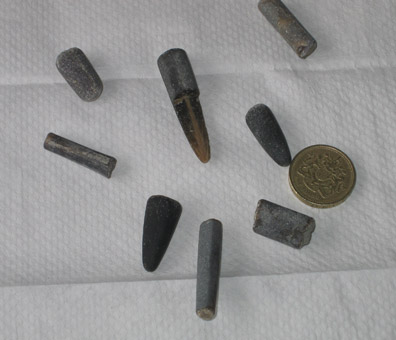
Some Fossilised Belemnite Guards (Dorset)

Picture credit: Everything Dinosaur

The pound coin provides a scale for these various pieces of fossil belemnite guard found in just a few minutes whilst searching the high water mark at Charmouth beach.

Belemnites Related to Extant Squid

Belemnites resembled squids and they probably fulfilled the same role in the marine food chain as many squid species do today. They had ten arms of equal length and each arm had as series of between 30-50 curved hooks that helped them to grasp prey and manipulate it towards their beak-shaped mouths.

Many fossils of the marine reptiles known as ichthyosaurs have belemnite hooks preserved in the area where the stomach would have been. This indicates that many of these marine predators preyed on belemnites and that they were an important food source.  Scientists have estimated that although the origins of the belemnite family can be traced back to the Palaeozoic it was during the Mesozoic that this group rapidly diversified and expanded.  An estimated 2,000 species of belemnite are known in the fossil record.  Despite being hugely successful in marine environments, no trace of belemnite fossils have ever been found in strata derived from a freshwater environment.  It seems that belemnites were entirely marine and nektonic (swimming actively).

To view a model of a belemnite and dinosaur toys we recommend that you take a look at the CollectA Prehistoric Life model range: CollectA Age of Dinosaurs Prehistoric Life Models.

Fossils of cephalopods with soft tissue elements preserved are extremely rare.  Pictures show a superbly preserved specimen of a Belemnotheutis spp.  The animal is facing towards the right and some of the hooks associated with the tentacles can be seen in the top right corner of the picture.  Belemnites probably swam backwards by projecting a jet of water through a syphon-like structure that was positioned under the front of their bodies.

We think the pictures shown, represents a Belemnotheutis spp. from the famous Solnhofen limestone deposits in Germany.

The British Geological Survey team removed a total of 240 tonnes of rock in the ten days or so they had to explore the site.  A number of extremely well preserved invertebrate fossils were found, including one of the squid-like animal that was able to yield ink from its fossilised remains.  The dark, stained area of the fossil was carefully treated with an ammonia solution which permitted the ink to be liquefied and used for the illustration.

Amazing Preservation

The amazing preservation was the result of what palaeontologists call the “Medusa effect”.  Fossilisation occurs very quickly, permineralisation is rapid and soft body parts are fossilised as well.  The soft tissue becomes mineralised with phosphatic elements and even eyes and delicate tentacles are captured by this very rare process.

Commenting on the re-discovery of the Victorian fossil site, Dr Phil Wilby of the British Geological Survey stated:

“It’s among the world’s best fossil preservation.  It’s a squid-like creature, but it’s not like anything we have in the world today.   You really don’t imagine anything so soft could be so well preserved three dimensionally.  It still looks as if it is modern squid ink.  It’s absolutely incredible to find something like this.  We felt that drawing the animal with it would be the ultimate self-portrait”.

Dr Wilby can be seen in photographs proudly showing off the drawing of the ancient marine animal.  When asked whether other drawings would be made using the prehistoric ink, Dr Wilby stated that this material was so valuable that it would be very unlikely that more drawings would be made.  Part of the remaining ink sac and ink has already been despatched to Yale University in Connecticut (United States) for further, more detailed analysis.

The British Geological Survey team remain unsure as to why conditions arose at the bottom of the sea at this precise location 155 million years ago that permitted such exquisite preservation of organic remains.

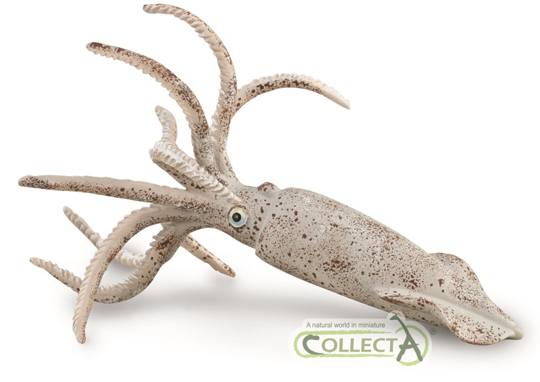
A Replica of a Belemnite (CollectA Age of Dinosaurs Popular Belemnite Model)

CollectA Belemnite model.

CollectA Age of Dinosaurs Popular Size Belemnite model.

To view the CollectA Belemnite model (whilst stocks last) and other replicas of iconic fossil animals: Everything Dinosaur Learning Materials (Fossil Replicas).

Dr Wilby stated:

“About 155 million years ago, millions of these animals were dying in this precise area.  We don’t know why that is.  In normal circumstances, the decomposition process means only the hard parts of animal are preserved, such as the bones, shell and teeth.  The odds of this find are easily a billion to one and probably much greater”.

Such fossils can tell scientists much more about these strange, squid-like creatures than the rostrum or phragmocone remains.  The fossilised soft tissue once studied will enable scientists to discover whether this particular belemnite was a fast or slow swimmer by analysing the structure of the preserved muscle fibre impressions.

More than twenty of these very special fossils have been removed from the site and added to the British Geological Survey collection at Nottingham.  It is hoped that over the next few months more data on these extinct creatures will be obtained as the fossils are prepared and studied under laboratory conditions.

One thing is for sure, a belemnite has literally managed to write its name in the fossil record.

22 08, 2009

Pterosaur Locomotion – New Evidence to support a Quadruped Gait

By |2023-03-03T08:06:12+00:00August 22nd, 2009|Categories: Main Page, Palaeontological articles|0 Comments

More Evidence to support a Quadrupedal stance in Pterosaurs

A new, scientific study has been published that examines pterosaur locomotion.

The pterosaurs are an extinct group of flying reptiles.  Known from the fossil bearing strata dating from the Triassic to the end of the Cretaceous, these bizarre creatures were the first truly diverse and successful flying vertebrates (not withstanding one or two genera of Permian gliders).  The wings of these strange reptiles were formed out of skin that stretched from the body over the forelimbs and were supported by an elongated fourth digit.

Pterosaur Locomotion

For many years scientists have debated the aerial capabilities of these flying reptiles.  Studies of endocasts of braincases and papers written on these animal’s ability to balance have been published and many researchers now believe that these animals were very capable fliers.  However, whilst graceful and fully at home whilst airborne, how these animals moved around on the ground has long been debated.  It has been argued, almost since the first pterosaur fossils were studied in the 18th Century, that these animals were clumsy on land.

Some scientists have proposed that these animals had a bipedal stance (especially the larger pterosaurs such as the Late Cretaceous azhdarchids), whilst others have proposed a quadrupedal stance.

Studying Footprints and Tracks

Ichnologists (scientists who specialise in the study of footprints and tracks), have found a number of pterosaur trackways.  A paper was published recently on a set of tracks made by a large pterosaur and preserved in Upper Cretaceous strata in Mexico.  These indicate a quadruped gait and stance.  This evidence is supported by trace fossils from perhaps the best preserved pterosaur trackway site in the world, that found in the  Upper Jurassic limestone deposits of Crayssac in south-western France.

A number of pterosaur tracks have been identified in the Crayssac site.  Some scientists have argued that previously described pterosaur trackways may actually be crocodilian but the absence of a tail drag and five digit impressions at the French location suggest that the majority of the trackways ascribed to various types of pterosaur have been accurately described.

Different Trackways

A number of different sized and different length trackways are known from this region.  They indicate the presence of a number of different types of pterosaur in the environment at the time.  The trackways were made in shallow, inter-tidal water and some of the tracks are several metres in length.  Crucially, the tracks indicate a quadrupedal gait, and, surprisingly measurements taken by French scientists indicate that some of these pterosaurs were capable of moving quite quickly when on the ground.  How these animals took off, or landed has yet to be determined, but it is suggested that these graceful reptiles were capable of touching down or taking off in a similar fashion to modern birds.

Some of the footprints indicate that certain species had webbed feet, an adaptation to their marine environment.  Perhaps these animals filled an ecological niche similar to extant pelicans of today.

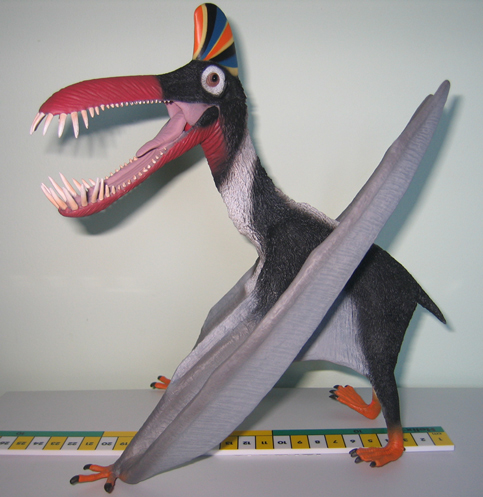
A Pterosaur Model – CollectA Deluxe/Supreme Guidraco Figure

CollectA Guidraco pterosaur model.  Study into pterosaur locomotion.

The colourful CollectA Deluxe/Supreme Guidraco pterosaur model showing the quadrupedal stance.  Model has an articulated jaw. Picture credit: Everything Dinosaur.

Picture credit: Everything Dinosaur

Everything Dinosaur stocks a wide range of pterosaur figures including the: CollectA Deluxe/Supreme model range.

17 08, 2009

Last of the Dinosaurs – Formerly Named and Described

By |2022-12-26T11:40:32+00:00August 17th, 2009|Categories: Dinosaur and Prehistoric Animal News Stories, Main Page, Palaeontological articles|0 Comments

Last of the Dinosaurs – A duck-billed dinosaur at the very end of the Cretaceous

Scientists have published a description and formal paper on one of the last types of dinosaur known to have existed, a large, duck-billed dinosaur that lived a few tens of thousands of years before the end of the Cretaceous.  In a new study, conducted by a team of Spanish scientists, and accepted for publication in the research journal Comptes Rendus Palevol, this new hadrosaur is described and may represent a link between Late Cretaceous Asian duck-billed dinosaurs and those from Europe.

Arenysaurus ardevoli

The new hadrosaur named Arenysaurus ardevoli (the name means “sand dinosaur of Aren”), has been ascribed to a basal lambeosaurine group, distantly related to the better known crested duck-billed dinosaurs such as Corythosaurus and Lambeosaurus.  From the fossils, including some excellent skull material, Arenysaurus may belong to the same family as Family as Amurosaurus, the remains of this particular hadrosaur are associated with eastern Asia, so some sort of palaeogeographical link may exist between Asia and Europe, perhaps indicating a biogeographical connection between Europe and Asia during the very late Maastrichtian.

At the Very End of the Age of Dinosaurs

Co-author of this paper Jose Ignacio Canudo, a palaeontologist with the University of Zaragoza, stated that this particular dinosaur may have lived just a few thousand  years before the end of the Mesozoic, the end of the Age of Reptiles.

“Arenysaurus was certainly one of the dinosaurs that might have seen the fall of the K/T asteroid and suffered the consequences;” he commented.

The remains of this dinosaur skull material, vertebrae and limb bones were excavated from hard sandstone sediments near the small village of Aren in Huesca, in the Pyrenees, Spain.  During the Late Cretaceous this area was a coastal plain, with marshes and several islands and islets out to sea.  The humerus (arm bone between shoulder and elbow), has a forward pointing crest, a site for muscle attachment indicating that this particular hadrosaur and very strong arms and shoulders.  The muscle attachments are similar to those seen in modern birds for powered flight, but the scientists are confident that this particular dinosaur, which may have grown up to six metres long, did not take to the air.  Instead the researchers have speculated that this animal was semi-aquatic, swimming in the tidal waters between islands in search of food.  A biomechanical study is currently being undertaken to assess the locomotive or swimming habits of this particular dinosaur.  The strong arms could have assisted this dinosaur as it waded through mud, feeding in the marshes that surrounded the coast.

Magnetostratigraphy

The remains of this dinosaur have been dated using a process called magnetostratigraphy, this looks at changes in the polarity of geomagnetic fields preserved in sediments.  The sequence once measured against already dated rock samples, establish Arenysaurus as one of the last known dinosaurs.

An earlier study by French scientists indicated that during the Late Cretaceous the dinosaurs were still flourishing in southern Europe and shared their environment with giant, flightless birds and an increasing number of mammal genera.

Dinosaur

Everything Dinosaur stocks a wide range of Late Cretaceous prehistoric animal models and figures such as the: Beasts of the Mesozoic range of articulated dinosaur figures.

4 08, 2009

New DNA Coding Technique may Help Deter Fossil Thieves

By |2023-03-03T10:35:48+00:00August 4th, 2009|Categories: Dinosaur and Prehistoric Animal News Stories, Main Page, Palaeontological articles|0 Comments

Associating Fossil Bones to their Surrounding Matrix may Prevent Thefts

A new technique that ties fossil bones to their site of origin may help deter raiders of dinosaur dig sites.  With the number of incidents of looting on the increase, then this new “finger printing” system that helps identify the source of any fossil put up for auction may act as a deterrent for would be thieves.

The Theft of Fossil Bones

The theft of fossil bones and other ancient relics from dig sites is an increasingly common occurrence.  Thieves recently stole several important sauropod fossils from a dig site in the state of Utah, this particular dig site held the fossilised bones of a young Diplodocus that lived 150 million years ago.

Commenting on the theft, Scott Williams the Collections and Exhibits Manager at the Burpee Museum of Natural History stated:

“It’s like pieces of a puzzle that are now gone”.

Unfortunately, it is highly unlikely that these fossils will ever come to light again, stolen fossils end up being sold for large amounts of money in a black market of illegal fossil sales.

However, a new fossil identifying technique being pioneered in the USA could give state officials and regulators the edge when it comes to tracking down fossil thieves.

Scientists are testing a number of methods designed to chemically match a fossil with naturally occurring elements that seep into the bones during the fossilisation process from the surrounding matrix.  Although the work is in its early stages, the techniques could help identify the unique “chemical fingerprint” of a fossil site and help link any fossil bones up for auction to a particular site.  Using this information it would be possible to determine whether the bones and other relics had been obtained for sale by legal means.

Fossil Thieves

Testing on the chemical analysis of fossil matrices is continuing in the western United States.  So far, results indicate these new methods could tie 85% to 98% of fossil samples back to their original sites.  The theft of fossils from a dig site is extremely frustrating for the palaeontologists, not only are valuable fossils removed but often the sites are damaged as the thieves recklessly dig out the bones.  Valuable information is being destroyed or lost, limiting the amount of information a fossil site can yield.

Vincent Santucci, the Head of the National Park Service Palaeontology Programme put it succinctly when he stated:

“We’re not making T. rexes any more”.

Although the impact of the recession has dampened down the prices paid for rare fossils at auction, dinosaur bones, especially those of famous dinosaurs such as T. rex or Triceratops still fetch hundreds of thousands of dollars at auction.  Wealthy private collectors keen to add a “prize specimen” to their collection will gladly pay a high price to obtain a rare and precious dinosaur fossil.

In Utah, which is rife with dinosaur quarries and regularly the source of newly found species, the losses to scientific knowledge can be dramatic, commented Jim Kirkland, the state palaeontologist.  He said he’s terrified that vandals will hit a significant site before scientists can meticulously go through it.  Hopefully, this new labelling technique that associates fossils with a particular site will deter any would be thieves and looters.

Increasing Number of Thefts and Vandalism

With several hundred reported incidents each year, any new method of helping to preserve dig sites and protect fossils is most welcome by the scientific community.  The new mapping techniques, in association with stronger legislation could help protect many important palaeontological sites, helping to preserve them so that they can be properly studied.

With looting and even vandalism of fossil sites on the increase, let’s hope that this new technique provides an effective deterrent.

Author: Mike (ezine compliance)

Visit Everything Dinosaur’s award-winning website: Everything Dinosaur.

31 07, 2009

Back to the Trees – Evidence of Earliest Tree Dwelling Vertebrate

By |2023-02-25T17:44:02+00:00July 31st, 2009|Categories: Dinosaur and Prehistoric Animal News Stories, Main Page, Palaeontological articles|0 Comments

Late Permian Fossil shows evidence of Adaptations to an Arboreal Habitat

A new paper in the scientific publication of the Royal Society journal Proceedings Biology, describes a strange ancestor of mammals that may have lived in the trees.  This is the first evidence from the fossil record of a vertebrate adapting to an arboreal lifestyle.  It also reveals a change in the eco-systems of the Palaeozoic with land animals adapting to and exploiting new food sources, such as leaves in the branches of trees.

Tree Dwelling Vertebrate

The paper describes the articulated fossils and skull material of a primitive synapsid reptile.  The fossils of several individuals, including mature adults as well as juveniles were discovered in a single block of red mudstone discovered in central Russia’s Kirov region.  The long limbs and grasping hands of this 50 cm long animal seem perfectly suited to climbing trees.  The scientists have even found evidence of an “opposable thumb”, a particular adaptation of a digit to permit it to grasp and help the hand or foot to hold things, such as the branches of a tree.

The animal has been named Suminia getmanovi and the evolutionary changes that the fossils show allowed these animals to forage for food in tree branches, away from the fierce crocodilian-like predators and pelycosaurs that roamed on the ground.

In photographs of the fossil the animal is lying with the head towards the right, the long humerus and the elongated fingers can clearly be seen .

Excavating a Mudstone Block

The mudstone block containing the fossils, perhaps a group of animals that had drowned in a flash flood was discovered in 1994, but only recently have all the skeletons been available for close examination.

The team of researchers from the Field Museum in Chicago led by lead author Dr Jorg Frobisch have claimed that this is the earliest fossil evidence of a vertebrate adapting to a life in the trees, some 100 million years before the first true mammals.

Commenting on the anatomical features of this little reptile that helped it climb trees; Dr Frobisch stated:

“The hands and feet made up almost half of the length of its whole limb.  That’s humungous, if you compare it to your own arm”.

The large manus (hand) ended in long, slender and curved fingers, ideal for climbing.  The fingers probably had claws helping this small creature to grip as it clambered up tree trunks.

Dr Frobisch explained:

“In life these probably would have been covered in a hard, keratinous coating, much like in modern-day birds, these would have helped the animal climb”.

Adapted to Climbing

But the most significant observation the team made was that one finger on each hand and foot was “opposed” to the rest, much like a thumb.  Such an adaptation can be seen in our own thumbs, part of the tree climbing ancestry of humans.

Commentating on the importance of their discovery, Dr Frobisch added:

“It’s the first time in the fossil record that we’ve seen evidence of an opposable thumb”.

Between the time when Suminia lived, and the period to which fossils of the earliest-known tree-dwelling mammals have been dated, there is a gap of about 100 million years.

Simon Conway Morris, a palaeobiologist from the University of Cambridge added:

“In this case a vertebrate, specifically a synapsid – from which the mammals themselves emerged – was ahead of the game of climbing trees.  In fact it was about 30 million years ahead of schedule”.

Visit Everything Dinosaur’s website: Everything Dinosaur.

25 07, 2009

Ancient Mammals Make their Mark on National Dinosaur Monument

By |2023-03-03T16:26:03+00:00July 25th, 2009|Categories: Dinosaur and Prehistoric Animal News Stories, Main Page, Palaeontological articles|0 Comments

Scientists Find Fossilised Mammal Trackways at the Dinosaur National Monument

The United States National Parks Service established the Dinosaur National Monument in October 1915 following a presidential decree and in recognition of the scientific importance of the Jurassic sediments exposed in the state of Utah.  The fossils of a number of famous dinosaurs have been found in this area, dinosaurs such as Allosaurus, Apatosaurus and Stegosaurus.  However, a keen-eyed scientist has discovered that sharing this Jurassic environment with the huge dinosaurs were a number of tiny mammal species.  The ancient footprints and trackways of rat-sized creatures have been discovered at the Dinosaur National Monument site and these tracks provide a record of mammal activity from 190 million years ago.

Ancient Mammals

Commenting on the discovery, Dan Chure, a palaeontologist with the National Park Service stated that this was “an amazing find”.

It was Dan and his co-worker George Engelmann of the University of Nebraska who spotted the tiny footprints preserved on the side of a fossilised sand dune.  The two scientists hope that further examinations of the area may reveal fossilised skeletons of the tiny mammals.

The trackways, which number in the hundreds, were preserved in the Glen Canyon Formation.  This formation which consists of fossilised sand dunes that covered much of Utah and Wyoming as well as parts of Colorado, northern Arizona, and New Mexico during the Early Jurassic period has already provided a number of important dinosaur fossils.

Mr Chure stated that their discovery was a testament to the diversity of life in the arid region when the giant dunes, which reached heights of up to several hundred feet, were interrupted by an occasional oasis.

Fossilised Trackways

The tracks, discovered in the Utah section of the monument in Uintah County, indicate the little mammals were walking uphill because the heel imprints are more distinct than the toes.  The coin is provided for scale in the photographs.  Mammal tracks in this area are rare but they have been found before, unfortunately, tiny trace fossils such as these can be easily overlooked, the tracks themselves are only visible when light is shone on them from a particular angle.

“It was almost like a bunch of juveniles running around,” Chure said.

One of the challenges is accurately mapping the tracks, some of which are so faint they can only be seen when the light is at a certain angle.  Mixed up with the small mammal prints are the trackways of other animals, the scientists have tentatively ascribed these tracks as to belonging to small dinosaurs.

George Engelmann commentated:

“This was a time when the ancestors of modern mammals were losing dominance on land to the dinosaurs.  It’s near the beginning of a long time when dinosaurs ruled and our ancestors tried to stay out of their way”.

Such finds enable scientists to understand more about the food chains and eco-systems in ancient environments, helping them to build up a picture of life in the state of Utah 190 million years ago.

For models of prehistoric mammals: Prehistoric Mammal Models from Everything Dinosaur.

Go to Top