All about dinosaurs, fossils and prehistoric animals by Everything Dinosaur team members.

Articles, features and information which have slightly more scientific content with an emphasis on palaeontology, such as updates on academic papers, published papers etc.

9 11, 2009

Evidence of Dinosaurs on New Zealand’s South Island

By |2023-03-03T17:29:18+00:00November 9th, 2009|Categories: Dinosaur and Prehistoric Animal News Stories, Main Page, Palaeontological articles|0 Comments

Dinosaur Footprints found on New Zealand’s South Island

Fossil evidence of dinosaurs discovered in New Zealand. Dinosaur footprints have been discovered in New Zealand.

New Zealand a land of Maoris, great rugby, sheep and beautiful landscapes has some of the most ancient fern forests of anywhere in the world.  Many people know that much of the Peter Jackson directed trilogy “The Lord of the Rings” was filmed in New Zealand, the mountains and lakes providing an ideal backdrop for orcs, hobbits, wizards and other such strange creatures.  New Zealand provided a number of locations for the ground breaking BBC TV series “Walking with Dinosaurs”, but the dinosaur fossil record for that country is extremely poor.

Dinosaurs

Until recently, dinosaurs were known from only a few fragmentary fossils, all of which were associated with North Island.  To read an article about the discovery of titanosaur fossils in New Zealand: Titanosaur Fossil Discovered in New Zealand.

Scientists have discovered the first evidence that dinosaurs roamed the South Island of New Zealand with 70-million-year-old footprints found in six locations.  These are believed to be the first dinosaur footprints found in New Zealand.  For scientist Greg Browne (a sedimentologist), who made the discoveries this marks a special day for him, as he has proved that dinosaurs roamed parts of South Island more than 70 million years ago.  As we at Everything Dinosaur, recall, and despite the fact that we would be the first to admit that our knowledge of the geology of New Zealand is very poor.  By the Late Cretaceous, the time these prints were made, New Zealand had been separated from Australia for many millions of years.

It was an island but it looked nothing like the New Zealand seen on maps today.  Rising sea levels and volcanic activity has dramatically altered the shape of the country over the late Mesozoic and Cenozoic.  Indeed, as far as we know, most of the country was under the sea for most of the time from the Late Cretaceous until the present day.

The prints, were found in the remote Whanganui Inlet in the northern part of South Island , near to the settlement of Nelson.

Dinosaur Footprints

Pictures show soft debris around a dinosaur footprint, which can be made out at the bottom right-hand side of the photograph, is being brushed away.

The prints are spread over an area of approximately 10 kilometres and in one location there are up to twenty individual impressions.  It is believed the prints belong to a type of long-necked dinosaur a titanosaur.  Titanosaurs were among some of the largest animals to ever live and are believed to be the largest animals ever to walk on land.  Greg Browne and his team cannot be certain as to which type of dinosaur species or genus made the prints but the shape and size of the impressions does indicate a small titanosaur of some sort.

An Illustration of a Typical Titanosaur (Saltasaurus)

A drawing of Saltasaurus.

Picture credit: Everything Dinosaur

To view scale models of titanosaurs and other prehistoric animals, take a look at the Wild Safari Prehistoric World model series: Safari Ltd. Wild Safari Prehistoric World Models.

Aware of the controversial nature of his discovery, Greg carefully considered all possible geological and biological explanations for the features in the rock and was able to rule them out one by one, before coming to his conclusion.  His investigations involved him comparing the New Zealand impressions with known dinosaur footprints in similar aged rocks from elsewhere in the world.

The footprints were made in beach sands and were probably quickly covered and preserved by mud from subsequent tides.

Greg went on to comment:

“What makes this discovery special is the unique preservation of the footprints in an environment where they could easily have been destroyed by waves, tides, or wind.”

As with much of New Zealand, north-west Nelson was largely submerged between 70 and 20 million years ago and the footprints would have been covered by hundreds of metres of marine sediments.

However, after the country was uplifted and north-west Nelson emerged from the sea, the overlying sedimentary rock has been eroded away over the past 20 million years to expose the footprints again, thus permitting this sedimentologist and his colleagues the chance to study footprints leading into New Zealand’s ancient past.

For models and replicas of titanosaurs visit the models section of the Everything Dinosaur website: Dinosaur and Prehistoric Animal Figures.
5 11, 2009

Birth of a Dynasty – Earliest Ancestor of Tyrannosaurus rex Described in New Study

By |2024-04-18T07:18:41+01:00November 5th, 2009|Categories: Dinosaur and Prehistoric Animal News Stories, Main Page, Palaeontological articles|0 Comments

CT scans Help Unlock Tyrannosaur Ancestry at Natural History Museum

When we are asked about the best place to find a new species of dinosaur, an answer we often give is to look more closely at fossils already in museum collections.  Often, old finds, if subjected to new research techniques can reveal some surprises.  This was exactly what happened when a beautifully preserved partial skull and jaws of a meat-eating dinosaur, originally excavated nearly 100 years ago; turned out to be a candidate for the earliest ancestor of the mighty Tyrannosaurus rex.

The fossilised remains, the oldest-known relative of the mighty tyrannosaurs discovered to date, were found in 1910, during the excavations for a new reservoir near the town of Minchinhampton in Gloucestershire.  The skull was found in rocks which form part of the Great Oolite limestone formation of the area.  These rocks were laid down in a marine environment and along with the Inferior Oolite limestone formation they make up a good proportion of the Cotswolds.  The county of Gloucestershire in south-west England is one of the most geologically diverse of all the English counties with outcrops of Cambrian, Devonian, Permian, Triassic and Jurassic aged rocks represented.

Tyrannosaur Ancestry

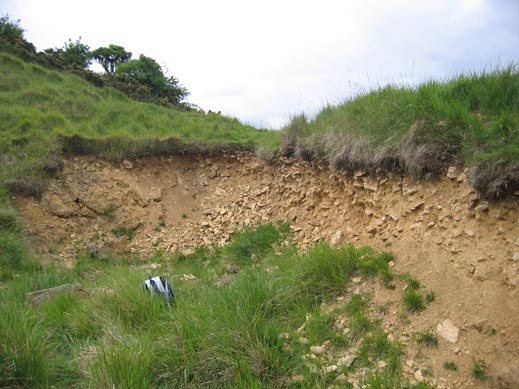
One of our team members was able to visit a fossiliferous outcrop earlier this year, dating from the Jurassic, Cleeve Hill.

To read the article on fossil hunting at Cleeve Hill: Fossil Hunting at Cleeve Hill.

Fossil Hunting at Cleeve Hill

Fossil Hunting a Cleeve Hill.

The “Hideaway” at Cleeve Hill.  Picture credit: Everything Dinosaur.

Picture credit: Everything Dinosaur

The lower portions of the skull including teeth are all the remains that have been found of this animal, but other fossils ascribed to theropods have been associated with this area.  Since this fossil was found in marine strata, it is very likely that either the animal or its carcase was washed out to sea, perhaps by a flash flood before sinking to the bottom and being quickly covered in fine sediment.

A number of terrestrial animals are known from fossils that have been discovered in marine deposits, recently the femur of a long-necked dinosaur from the Jurassic, a Cetiosauriscus was pieced together from remains found in a Gloucestershire quarry.

To read the article about the recent Cetiosauriscus find: Cetiosauriscus Leg Bone found in Gloucestershire Quarry.

Examining the Skull

The skull was believed to represent a new species of a megalosaur type dinosaur, it was named as Proceratosaurus bradleyi, shortly after its discovery.  The fossil skull was presented to the Natural History Museum in 1942 and despite representing one of the best preserved early theropod skulls in the collection, it was not studied in more detail until early in 2009 when a joint German/British team gained permission to subject the skull to CT scans to help reveal more of its internal structure.

Pictures show the fully prepared skull (the original preparation of the specimen has been augmented with more of the matrix removed to help improve the research).  The skull is placed facing to the right and the sharp, backward pointing teeth in the jaws have now been fully exposed.  The upper portion of the fossil was destroyed by an irregular fissure in the rock, so no other portions of the skull relating to this specimen have been found.

In the original 20th century paper, the dinosaur was identified as a megalosaur, known as a taxonomic waste basket, due to the amount of miscellaneous theropod remains associated with it.  The original paper commented on the crushed and flattened state of the fossilised bones, but remarked how fragile, light and delicate the skull was.

The skull seems full of holes, and to the casual observer this is seen as something of a surprise, since they imagine meat-eating dinosaurs to have huge, heavy powerful jaws and heads.  Theropod skulls were filled with air sacs, this would have helped to make them lighter.  The first hole, above the snout and completely cleared of matrix is the naris (nasal area).  A small, triangular bony projection can be seen on the top.  This is the bony core of a nose horn, this is what gave this dinosaur its name (Proceratosaurus means “first horned lizard”).

The next opening in the skull is the large antorbital fenestra, this is found behind the naris and in front of the eye socket or orbit.  The hole towards the rear of the skull behind the eye is called the laterotemporal fenestra.

The skull measures less than 30 cm long, it probably belonged to an individual no more than 3 metres long, twelve times smaller than its great descendant T. rex.

The fossil was sent to Austin, Texas where it was scanned using CT technology (computed tomography), to create X-rays and then a 3-dimensional computer image to reveal the internal structure of the fossil.  The scientists discovered that the teeth, jaws and braincase resembled those of Tyrannosaurus rex, indicating that this humble, Gloucestershire predator may be an ancestor of the giant meat-eaters that survived to the very end of the Cretaceous.

Commenting on the relationship between Proceratosaurus and T. rex, Dr Angela Milner of the Natural History Museum in London stated:

“It was quite a surprise when our analysis showed we had the oldest known relative of T. rex.”

She went on to add:

“We care for over nine million fossils here at the Museum and this discovery highlights the importance of museum collections in current and future research.  Fossils collected a century ago can now be studied again with the benefit of much greater knowledge of dinosaurs from around the world.”

To aid the scanning process some of the surrounding matrix was removed.  As a general rule, the less dense the fossil, the greater the detail that CT scanning can reveal.

Co-author of the study, which has just been published in the Zoological Journal of the Linnean Society, Dr Oliver Rauhut stated:

“This is still one of the best preserved dinosaur skulls found in Europe.  It is really surprising that it has received so little attention since its original description”.

Dr Oliver Rauhut holds dual appointments in the Department of Geological and Environmental Sciences at the Ludwig-Maximilians-Universität (LMU) in Munich and the Bavarian State Collection for Palaeontology and Geology.  He is regarded as a leading expert on the taxonomic relationships between theropods.

The use of modern techniques to study fossils found in the 19th and 20th centuries will probably lead to many more amazing discoveries, as Dr Rauhut explained:

“I’m sure that many more tyrannosaurs are still out there to be found.  I think we have just scratched the tip of the iceberg so far.”

Perhaps such new research will help to produce a more accurate cladogram of the relationships between members of the Theropoda.

To view models of dinosaurs such as Proceratosaurus and other early theropods: CollectA Age of Dinosaurs Prehistoric Life Models.

3 11, 2009

Terrible Tyrannosaurs Grew up Fighting

By |2023-03-03T17:39:02+00:00November 3rd, 2009|Categories: Dinosaur and Prehistoric Animal News Stories, Main Page, Palaeontological articles|0 Comments

Evidence of Severe Facial Wound in Juvenile T. rex

Facial wounds discovered in the fossil specimen of a juvenile T. rex.

Palaeontologists are aware of the tough lives of tyrannosaurs as they have been able to describe and infer a number of injuries as preserved in fossilised bone.  This pathology provides an insight into the lives and behaviours of these apex predators.  Being a T. rex was certainly tough, not only did they have to contend with formidable prey animals such as the ceratopsians and hadrosaurs, but there is plenty of evidence to suggest that these predators battled it out amongst themselves.

This type of conflict when an animal from one species fights or competes with another animal of the same species is referred to as intraspecific competition.  When one considers the terrible wounds inflicted on each other by tyrannosaurs, this phrase seems somewhat inappropriate.  These fights were brutal and even juveniles got in on the act.  A new study of an immature T. rex skeleton indicates that at some time in its young life, this young Tyrannosaurus suffered a severe bite to the front of its face.

Terrible Tyrannosaurs

In a new study of the fossils of an immature Tyrannosaurus rex, part of the Burpee Museum of Natural History collection in Rockford, Illinois (United States) evidence of a brutal fight between tyrannosaurs has been found.  It seems this youngster, got into a fight and suffered a terrible bite on its face, however, since the fossil bones shows signs of healing, it looks as if this particular dinosaur lived to fight another day.

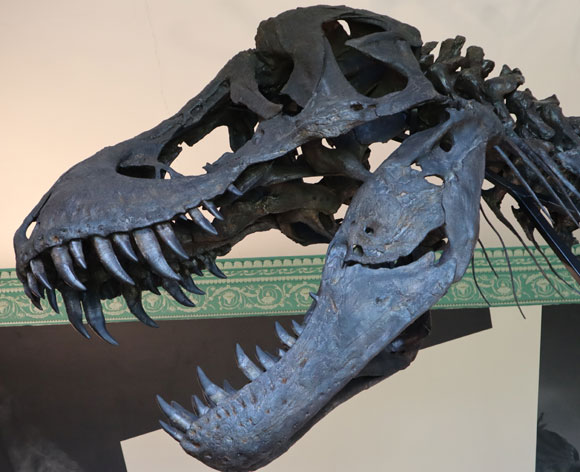
The Mounted Skull of a Tyrannosaurus rex on Display

Titus the T. rex Skull and Jaws

The skull of the T. rex exhibit on display at Wollaton Hall until August 2022.  Palaeontologists have identified facial wounds in tyrannosaurs. Picture credit: Everything Dinosaur.

Picture credit: Everything Dinosaur

The Tyrannosaurus fossil in question, nicknamed Jane (although scientists are not sure whether this animal was a female), was about 11-12 years old when it died. The injury occurred sometime earlier in the animal’s life.  This bite was more than a friendly nip, the the maxilla bone (the bone at the front of the snout) and the naris (the bone that leads off the premaxilla towards the back of the skull) have been severely damaged.  Indeed, a total of four distinct puncture wounds have been identified.

Juvenile T. rex

Examination of Jane’s bones, unearthed in 2001 in Montana, (United States) showed that the wounds were almost certainly inflicted by another T. rex of about the same age.  One explanation for the bite marks on the snout that has been suggested is that may be this T. rex was grabbed by a large crocodile at a waterhole as it came down for a drink.  Crocodiles attack large animals such as antelope and zebra in Africa,  the heads of these animals are often grabbed by the crocodile as it attacks, perhaps this young T. rex was ambushed by a crocodile as it bent its head down low to gulp some water.

However, researcher Joe Peterson of North Illinois University refuted this hypothesis, stating:

“Only a few animals could have inflicted the wound.  A crocodile or an adult T. rex would have left different types of bite marks.”

For Joe Peterson and his colleagues, they believe that the oblong shaped bite marks preserved in the fossil bone indicate that the culprit was another young Tyrannosaurus.

He went on to comment:

‘When we looked at the jaw and teeth of Jane, we realised her bite would have produced a very close match to the injuries on her own face.  That leads us to believe she was attacked by a member of the same species that was about the same age.”

“The study of the bite marks on Jane’s face demonstrates that even at a young age this dinosaur was engaging in some pretty serious combat.”

Injuries in Juvenile Tyrannosaurs

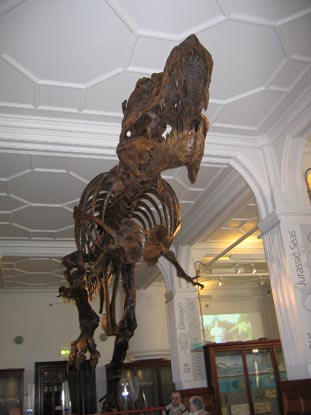
Evidence of injuries in tyrannosaur fossils is not unheard of.  For example, the fossilised skeleton called “Stan”, a gracile T. rex (museum specimen number STAN-BHI3033) discovered in 1992, shows signs of having had part of the back of the head bitten off.  It seems that even this 40 foot long individual got into a fight with an even bigger T. rex.

“Stan” the Gracile T. rex also shows Evidence of Injury

Picture credit: Everything Dinosaur

The University based team believe that in the case of “Jane”, the violence may have been sparked – as it often is today among teenagers – by a territorial ‘turf’ dispute or a simple show of macho dominance.  The paper detailing the team’s study is published this month in the scientific journal Palaios.

Co-author Professor Reed Scherer, also from Northern Illinois University added:

What’s unique about this work is we learn something very, very specific about juvenile dinosaur behaviour.  This was an animal about the same size that attacked Jane.  Whether it was a sibling or from a rival group, we don’t know, but it’s fun to speculate.”

The use of sophisticated computed tomograph (CT) scans to study the bone puncture marks in detail, taken at Rockford Memorial Hospital, confirmed that the puncture marks in Jane’s jaw were consistent with injuries that had healed when the creature was alive.

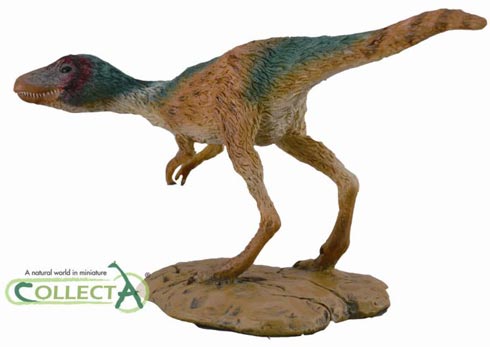
A Replica of a Juvenile T. rex

A juvenile T. rex.

A young T. rex.

Picture credit: Everything Dinosaur

Everything Dinosaur stocks a range of tyrannosaur figures including replicas of juvenile tyrannosaurs.

Visit: CollectA Prehistoric Life Figures.

Other apparent bite marks and lesions found on the skulls of adult tyrannosaurs are now believed to have been left by parasites. A paper published recently by a joint Australian and U.S. based group of scientists postulated that the lesions thought to be bite marks were actually caused by a parasite – Trichomonosis.  Jane’s scars are different and definitely caused by inflicted injury, said the Illinois researchers.

To read the article on parasites affecting tyrannosaurs: Parasitic Infection Linked to Tyrannosauridae.

24 10, 2009

Scientific Debate over Unique “Ida” Hots up (D. masillae)

By |2024-04-18T07:10:20+01:00October 24th, 2009|Categories: Dinosaur and Prehistoric Animal News Stories, Main Page, Palaeontological articles|1 Comment

Darwinius masillae – Missing Link Debate Hots Up

Earlier this year, a paper published on the discovery of an ancient primate fossil from the Messel shales, a World Heritage site in Germany, attracted a great deal of publicity.  It was heralded as an important discovery, the earliest example of a primate whose descendants were to become the higher apes and eventually the hominids.  The species was named Darwininus masillae.

To read an article on the discovery of D. masillae: The Relationship between Hominids and Lemurs – Darwinius.

Darwinius masillae

The 47-million-year-old fossil, regarded as “humanity’s long lost ancestor” and publicised as “the first link in human evolution”, was unveiled earlier this year.  The fossil was nicknamed “Ida” by Dr Jorn Hurum, the scientist who revealed the fossil to the world, Ida is the name of the doctor’s daughter.  However, other scientists have refuted the claim that this fossil represents an early ancestor of the line of apes that were to lead to humans.

There was even a documentary on the discovery narrated by Sir David Attenborough and shown at peak viewing time on the BBC.  Dr Hurum and his team identified “Ida” as having lived at around the time the primates were splitting into two distinct branches, the Haplorhines, which includes the apes and a second group which includes the lemurs, lorises and pottos (Strepsirrhines).

Lemur-like Characteristics

Darwinius excited palaeontologists as this fossil lacked lemur-like characteristics, no fused teeth in the middle of the lower jaw and no grooming claw, suggesting that this material represented the newly developing “human branch” of primates.  Dr Hurum reported this fossil as being the “first link in human evolution”, guaranteeing a great deal of media interest.

However, the significance of “Ida” is being called into doubt by a paper that will be published in the scientific magazine “Nature”.  A team of scientists, led by D. Erik Seiffert from Stony Brook University in New York, examined another primate fossil, a 37-million-year-old fossil very closely related to “Ida”.  Dr Seiffert and his team have stated that both mammals belong to a group called the Adapoids, extinct primates that are believed not to be related to Hominids.

Dr Seiffert stated:

“Phylogenetic analysis of over 300 characteristics across 117 living and extinct primates reveals that the Adapoids are not ancestors to higher primates but rather a separate lineage with no known descendants”.

He went on to add:

“This means that the features they share with higher primates, such as the loss of the upper and lower second premolar, must have evolved independently.”

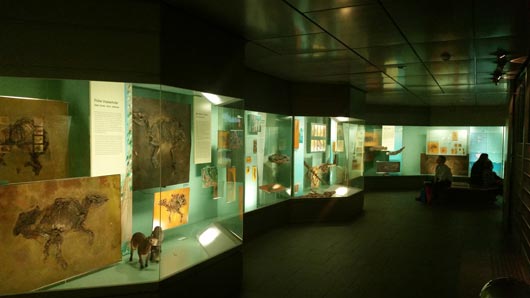
Some Examples of Messel Shale Fossils

Part of the Messel gallery (Senckenberg Museum).

The atmospheric Messel gallery at the Senckenberg Museum (Frankfurt). Picture credit: Everything Dinosaur.

Picture credit: Everything Dinosaur

This new paper is a little embarrassing considering the amount of publicity the unveiling of Darwinius generated.  It questions the main findings of the earlier discovery.  It seems that the importance of the Darwinius fossil will be debated for many years to come.

Visit Everything Dinosaur’s website for prehistoric animal figures: Prehistoric Animal Figures.

23 10, 2009

The Smallest Dinosaur Discovered to Date – Fruitadens

By |2023-03-03T17:49:14+00:00October 23rd, 2009|Categories: Dinosaur and Prehistoric Animal News Stories, Main Page, Palaeontological articles|0 Comments

Fruitadens haagarorum – Tiniest Dinosaur known to Science

Thirty years after its fossils were discovered in Colorado, a new genus of ornithischian dinosaur has been named and described, perhaps the smallest dinosaur discovered to date.  In a paper published in the scientific journal “Royal Society Journal Proceedings B (Biology)”, the research team claim that this little dinosaur weighed less than a kilogramme.  This puts the tiny Fruitadens haagarorum in pole position when it comes to identifying the smallest species of dinosaur discovered to date.  Other contenders include the feathered Microraptor gui from the Liaoning Province of north-east China.

Microraptor is estimated to have measured something like 40-60 centimetres.  The diminutive Micropachycephalosaurus, also from China was of a similar size, although the exact taxonomic classification of this Late Cretaceous ornithischian remains uncertain (incertae sedis).

Ornithischian Dinosaur

There were certainly many small theropods but for the moment it is Fruitadens haagarorum that is taking the plaudits for being the smallest dinosaur known from the fossil record,  with a body weight no more than two bags of sugar.

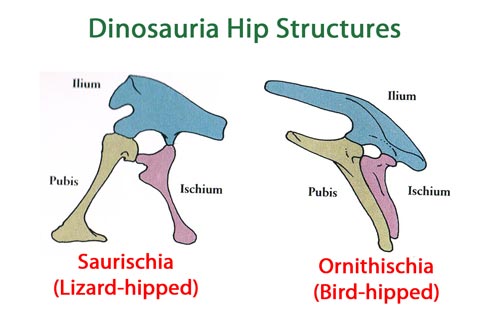
Classifying Dinosaurs

The shape of the hip bones help to classify the Dinosauria.

Classifying dinosaurs by the shape of their hip bones.

Pictures show an artist’s impression of Fruitadens haagarorum in comparison with an adult human.   The fossils had been housed at the Natural History Museum of Los Angeles County, since they were discovered in Colorado in 1979.  The partial remains of at least four individuals including skull material are known and it is believed that this animal was a a member of the Heterodontosauridae, a primitive group of ornithopods.

The fossils were found in sandstones dating from the Late Jurassic (Tithonian faunal stage), approximately 150 million years ago.  The sandstones are part of the famous Morrison Formation of rocks from the Upper Jurassic which have yielded a large number of famous dinosaurs such as Apatosaurus, Diplodocus, Allosaurus and Stegosaurus.

The study into this tiny, fleet footed dinosaur was led by Richard Butler from the Bavarian State Collection for Palaeontology in Munich, southern Germany.  Analysis of the teeth in the minute jaw indicate that this ornithischian may have been an omnivore.  Most ornithischians are totally herbivorous but this agile little dinosaur may have eaten a variety of food stuffs, plant material, insects and perhaps small mammals, amphibians and lizards.

Fruitadens haagarorum

Photographs show a tiny fragment of lower jaw with dentition (teeth) of the minute dinosaur Fruitadens.

Commenting on the prospect of an ornithischian dinosaur being an omnivore, Richard Butler stated:

“This is unusual for that group [Ornithischia] most of them were strict herbivores.  But if you’re small, it is hard to feed on just vegetation, as it is difficult to digest”.

Bigger animals with much larger guts were better able to survive on a plant-only diet.  Larger animals have bigger guts, and a big gut is what you need to help digest tough plant material.  The genus name refers to an area of Colorado called Fruita, where the fossils were first discovered.  The specific name is in honour of the Haaga family who have long been supporters of the Natural History Museum of Los Angeles County.

Dr Butler went onto add:

“Fruitadens, comes from a series of rocks, the Morrison Formation, which palaeontologists have studied intensively for 130 years, and from which dozens of dinosaur species are already known.  Yet it is still possible to discover completely unique and remarkable species.  If dinosaur ecosystems were that diverse, who knows what astonishing beasts are waiting for us to discover”?

This little dinosaur probably scampered around the undergrowth, avoiding predators such as Ornitholestes, using its speed to keep itself out of trouble.  Ironically, some of the contemporaries of Fruitadens, the sauropods were so large that this little dinosaur could have run around these leviathans without them noticing.

Everything Dinosaur stocks a huge range of models of ornithischian dinosaurs to view this range: Everything Dinosaur – Prehistoric Animal Models and Figures.

14 10, 2009

Pterosaur Transitional Fossil – Is Darwinopterus Evidence of Rapid Evolution

By |2023-03-03T18:28:09+00:00October 14th, 2009|Categories: Dinosaur and Prehistoric Animal News Stories, Main Page, Palaeontological articles|0 Comments

Darwinopterus – A Transitional Pterosaur Fossil

Pterosaurs may have quickly evolved forms to take advantage of a new food source – flying theropods like Microraptor.

One hundred and sixty million years ago the skies of north eastern China were filled with primitive feathered dinosaurs that flapped awkwardly from tree to tree.  These early aviators, descendants of small, meat-eating, bipedal dinosaurs had perhaps evolved flight feathers to escape from larger ground based predators or to exploit an environmental, arboreal niche.

Pterosaurs

However, pterosaurs, those aerial masters of the skies, whose ancestors had taken to the wing some seventy million years earlier, may have quickly evolved forms to take advantage of this new food source of flying theropods.  At least that is what can be speculated from the research and published papers of a joint Chinese and British team of scientists as they published their work on Darwinopterus. Darwinopterus may be a transitional fossil between the long-tailed rhamphorhynchoids and the later, short-tailed pterodactyloids.

An Artist’s Impression of Darwinopterus

Picture credit: Mark Witton University of Portsmouth.

Darwinopterus

The illustration depicts Darwinopterus attacking a small bird-like creature, an ancestor of modern birds, a flexible neck combined with the curved, sharp teeth in the jaws of this raven-sized pterosaur seem ideally suited to grabbing hold of small prey.  Whether this animal hunted on the wing is speculation.

The joint Chinese and British based team of palaeontologists have published their work on this 160 million-year-old Pterosaur in the scientific publication the “British Journal Proceedings of the Royal Society B”, the “B” stands for Biology.  In total, more than 20 individual fossil specimens of this pterosaur have been found.  This new type of flying reptile has been named Darwinopterus modularis, to honour the 200th anniversary of the birth of Charles Darwin and the 150th anniversary of his ground-breaking work on the theory of evolution – “The Origin of Species by means of Natural Selection or The Preservation of Favoured Races in the Struggle for Life”.

Darwinopterus modularis

The species name modularis meaning “composed of interchangeable units”.  This alludes to the fact that this pterosaur has traits of both primitive long-tailed rhamphorhynchoids and parts of its anatomy more closely associated with the more advanced, later pterodactyloids.  These specimens could be termed transitional fossils, capturing an example in the fossil record of one type of flying reptile, evolving into a different form.  It is as if a sculptor has created a whole creature, a sort of prehistoric, flying chimera from various parts of other genera.  One has to be careful about this, as there are several instances of composite fossils originating from China, perhaps most famously Archaeoraptor.

Archaeoraptor turned out to be an elaborate fake.  Instead of proving to be a transitional fossil form between theropod dinosaurs and the first birds, it was simply pieces of at least two different fossils stuck together – it fooled the National Geographic Society.

A Close up of the Skull and Jaws of Darwinopterus

Fossil material (pterosaur).

Picture credit: Lü Junchang (PA)

Darwin’s Theory

Interestingly, one of the arguments put forward by scientists in support of the idea that all species were fixed and immutable, before the publication of Darwin’s theory, and indeed an argument that was used long after Darwin had written and published his 1859 work, was that the fossil record did not show many transitional species.

The fossil record, as Darwin admitted himself was very incomplete.  The beautiful argument put forward by the likes of a number of eminent American palaeontologists later in the 19th century, for the evolution of the horse was not available to Darwin at the time of his writing of his book on natural selection.  In the famous volume – “The Principles of Geology” written by the English geologist Sir Charles Lyell , a tremendous influence on Darwin himself, it was written:

“There is no foundation in geological facts for the popular theory of successive development of the animal and vegetable world, from the simplest to the most perfect forms”.

Commenting on this new discovery, Dr David Unwin of the University of Leicester stated:

“Darwinopterus came as quite a shock to us.  We had always expected a gap-filler with typically intermediate features such as a moderately elongated tail — neither long nor short — but the strange thing about  is that it has a head and neck just like that of advanced pterosaurs, while the rest of the skeleton, including a very long tail, is identical to that of primitive forms.”

Bursts of Evolution

The long tail can be seen at the bottom of the slab on some of the fossil image.  The investigators, led by Junchang Lu of the Institute of Geology in Beijing, believe that pterosaurs went through bursts of evolution characterised by swift changes to groups of features.  They have postulated that the head and neck evolved first, followed later by the body, tail, wings and legs.

A sort of sequence of rapid evolutionary jumps.  It can be speculated as the competition between predator and prey escalated in the air, the prey animals; the flying theropods were under a great deal of evolutionary pressure to adapt quickly and evolve into more efficient flying forms.  This competition may have speeded up the evolutionary flight path (excuse the pun), of modern birds.

For replicas of pterosaurs and feathered theropods, take a look at the Safari Ltd model range: Wild Safari Prehistoric World.

8 10, 2009

Understanding Archaeopteryx – Fossil Bone Study shows Slow Growth Rate

By |2022-12-31T08:12:45+00:00October 8th, 2009|Categories: Dinosaur and Prehistoric Animal News Stories, Main Page, Palaeontological articles|0 Comments

Archaeopteryx – New Study casts doubt on Avian Lineage

A new study carried out by American scientists with support from other teams of palaeontologists in China and Germany has cast doubt over just how closely Archaeopteryx may have been to the true origin of birds.  This new research published in the on line scientific journal PloS One (Public Library of Science), suggests that the metabolism and subsequent growth rate of this Jurassic creature was perhaps more reminiscent of the growth rate expected of a dinosaur than to a modern bird.

In a microscopic study of several Archaeopteryx fossils and other extinct creatures such as some of the ancient birds from the Liaoning Formation of China, images taken of the ancient cells and blood vessels inside the bones of Archaeopteryx show slow growth.  This Jurassic animal may have taken years to mature and reach adult size.  This pattern of ontogeny (growth) is similar to what dinosaurs had.  In contrast, modern birds grow rapidly and mature in a matter of weeks.

Think of the birds in your garden or neighbourhood, you may have seen blackbirds, sparrows, and thrushes all nesting in the Spring and by late Summer the offspring are not much smaller than their parents.  Modern birds (Neornithes), grow and mature very quickly.  Most reptiles grow much slower, from this study it seems that evidence from the fossilised bones of Archaeopteryx indicate that this feathered creature, claimed to be the first bird and ancestral to all birds, grew at the same speed expected of a dinosaur, not at the same rate as your garden sparrow.

An Illustration of Archaeopteryx

Archaeopteryx lithographica by Everything Dinosaur.

Picture credit: Everything Dinosaur

Importantly, this research indicates that rapid bone growth, a trait common to all living birds was absent from the first birds.  Rapid growth and maturation was not necessary for avian dinosaur flight.

This new paper follows the recent of announcement of the discovery of several feathered dinosaurs that pre-date the 150 million-year-old Archaeopteryx, providing evidence that creatures like Archaeopteryx may have evolved from feathered dinosaurs.

To view an article about feathered dinosaurs: Older than Archaeopteryx – Supporting Evidence of Birds evolving from Feathered Dinosaurs.

The paper co-authored by a number of palaeontologists including Gregory Erickson, an Associate Professor at Florida State’s Department of Biological Science supported by scientists at the Institute of Vertebrate Palaeontology and Palaeoanthropology (IVPP) in Beijing, compares the microscopic analysis of the long bones in various Archaeopteryx fossils with extant birds as well as theropod dinosaurs and birds such as the primitive Confuciusornis from the Cretaceous of China.

Dr Erickson stated that there was already evidence to support the theory that birds are in fact dinosaurs, but this paper attempted to answer the question: – “Just how dinosaur-like, or even bird-like was the first bird? [Archaeopteryx]“.

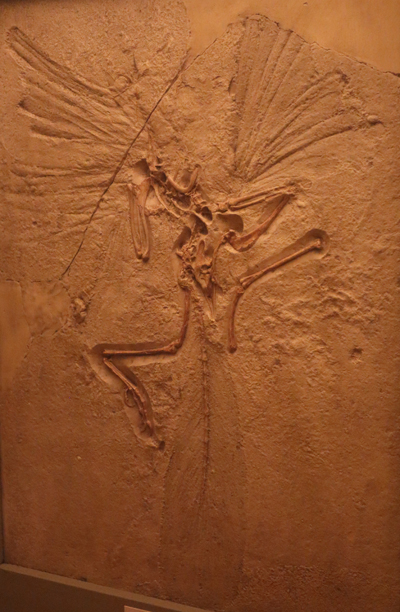
A Cast of an Archaeopteryx Fossil on Display

Archaeopteryx fossil cast

Archaeopteryx fossil cast. Picture credit: Everything Dinosaur.

Picture credit: Everything Dinosaur

There has been considerable debate over how well this crow-sized creature could fly.  Some scientists have even speculated that this early bird may not actually have been capable of powered flight, perhaps gliding from tree to tree.  However, studies carried out by scientists at the Natural History Museum in London, seemed to indicate that Archaeopteryx possessed and excellent sense of balance and had the faculties required to produce and control powered flight.  In addition, research has indicated that the structure of the inner ear of Archaeopteryx was more bird-like than reptilian.

To read an article on the London research: Let’s hear it for Archaeopteryx.

Commenting on the ontogeny of birds, Dr Erickson stated:

“Living birds mature very quickly.  That’s why we rarely see baby birds among flocks of invariably identical-size pigeons.  Slow-growing animals such as Archaeopteryx would look foreign to contemporary bird-watchers”.

Similar microscopic bone studies were carried out on the 130 million-year-old fossils of Confuciusornis.  This phase of the project was supervised by scientists from the IVPP.  It was concluded that the confuciusornithids were the first known birds to show a transition to the rapid growth rates associated with modern bird species.  Not only was the jay-sized flyer Confuciusornis more advanced anatomically than Archaeopteryx (the development of a pygostyle rather than a long, cumbersome tail is evidence of this), but it seems that the growth rate of these two creatures was also very different.  More advanced bird fossils from approximately 100 million years ago, show bones well supplied with blood vessels and were probably faster growing than the confuciusornithids.

It seems that the bird cladogram and the evolutionary path taken by our feathered friends is turning out to be every bit as complex as first thought when Huxley back in the 19th century put forward the theory of a link between Dinosauria and Aves.

Visit Everything Dinosaur’s award-winning website: Everything Dinosaur.

2 10, 2009

Oldest Known Human-Like Ape Unveiled by New Research

By |2024-04-17T11:31:34+01:00October 2nd, 2009|Categories: Dinosaur and Prehistoric Animal News Stories, Main Page, Palaeontological articles|0 Comments

Shedding Light on Human Ancestry – Ardipithecus ramidus

Older than Lucy, the famous australopithecine found at Hadar (Ethiopia), a new ape-like creature has been unveiled by scientists from the University of Berkeley, California.  The very few early hominid and ape fossils dating back from 3 million years to 6 million years ago makes calculating the human lineage very difficult.

After seventeen years of careful research by the American team, aided by colleagues and associates from Ethiopia, this new species Ardipithecus ramidus is likely to ask more questions than it provides answers.  The new papers, a series of publications relating to the work on this skeleton have been published this week, the team conclude that our human ancestors may have looked much less like chimpanzees than previously thought.

Of the higher apes, it is the chimpanzee that is believed to be our closest living relative.  Approximately, 6-7 million years ago the human lineage split from the apes, however, the family tree for hominid evolution is not well understood and the relationships between genera and species is the subject of a great deal of debate amongst anthropalaeontologists.

Ardipithecus ramidus is certainly a contender for the earliest fossil hominid known to date along with the proposed sub-species Ardipithecus ramidus kadabba however, the interpretation of the fossil evidence and the conclusions made have led to a lot of debate as to whether these fossils represent a human ancestor or a sub-branch that became extinct on the ape/human family tree.  Fossils of A. ramidus were found in Ethiopia in the 1990s, they include teeth, arm bones, elements of the skull and the pelvis, plus material from the legs.  The fossils have been dated to around 4.4 million years ago.

Discussing the research carried out on A. ramidus, Professor Tim White, the Director of Berkeley’s Human Evolution Research Centre has suggested that the gap between hominids and apes as we know them was already wide 4.4 million years ago.  The implications are that today’s extant species of ape such as the chimpanzee may only be slightly helpful in trying to understand our most primitive ancestors.

The first fossil fragments of this new species were found in 1992 in the Middle Awash region of the Afar Depression in Ethiopia.  This region is associated with a number of early hominid fossils.  In common with most other dig sites, the fossils of the first individual were nick-named, the name chosen – “Ardi”.  At least, 1.2 million years older than Lucy the fossils of A. ramidus provide scientists with an opportunity to go back further into the past to research the origins of the human family.

In total, fossils of more than thirty individuals of this species have been excavated, although they are all fragmentary and this makes interpreting the fossil evidence very difficult.

One of the team’s main conclusions in the published scientific papers is that the last common ancestor between humans and modern apes, an as yet, undiscovered species that would have lived between 6-7 million years ago, must have already acquired key human characteristics.  This challenges one of the views held by scientists regarding the evolution of early hominids – that our most distant ancestor was essentially a chimpanzee “knuckle walking, tree climbing” ape.

At a press conference held yesterday, Professor White explained:

“With Lucy, [Australopithecus afarensis], you’re only halfway back to the split.  Now with the illumination Ardipithecus throws on this issue, one can see that not only has the human line been evolving dramatically over the last six million years; for the same 6-7 million years, the chimpanzees have been evolving”.

Ardipithecus ramidus

Pictures show an artist’s impression of the most complete skeleton of Ardipithecus known, these remains are believed to be female.  This species stood a little over one metre tall.

If our ancestors had more human-like traits, characteristics and behaviours much earlier than previously thought, then studies of modern extant apes with their tree climbing habits and knuckle walking may not necessarily be part of the hominid evolutionary path.

Professor White added:

“We’re no longer forced to rely on that modern, highly evolved reference species of chimps and other apes, when we have hard data from the deep past, and that is what Ardipithecus has done”.

The research team’s work remains controversial.  Many anthropalaeontologists think that Ardipithecus is actually much more ape-like than the later Australopithecines like “Lucy”.  They point to evidence such as thin tooth enamel, a large canine tooth and the interpretation of the arm bones that concludes the elbow could be “locked” into position, a pre-adaptation for tree climbing.  Some scientists have argued that Ardipithecus is not simply ape-like but is actually an ape and is not an ancestor of hominids.

However, other researchers point to the human-like characteristics of some aspects of Ardipithecus anatomy.  For example, the lack of a “honing facet” on the lower pre-molar tooth (the next tooth to the back of the mouth next to the canine).  In extant apes, this tooth is ground against the canine in the upper jaw and helps keep the canine sharp and dagger like.  All known apes have this feature, but hominids do not.  Controversially, the new research gives Ardipithecus an upright, bipedal stance.  This form of locomotion and the position of the pelvis in the fossil skeleton reconstruction is debated by some scientists who state that the evidence for this form of human-like walking is circumstantial.

“Ardy” and “Lucy”

Commenting on the dentition (the teeth), the Berkeley based research team conclude that due to the small size of the canines found in association with the other fossils of this species, this indicates that males were living co-operatively with females and helping to raise young.  A case is put forward using an interpretation of the fossil evidence to indicate evidence of a social structure.

For Donald Johanson, the discoverer of “Lucy” back in 1974 and one of the founders of the Institute of Human Origins at Berkeley, the work on this new species is extremely important in helping to piece together the origins of mankind.

Describing the work of the research team as “exemplary” he went on to state:

“the team’s initial interpretations will undoubtedly generate widespread debate” and described the research as “terribly important for all of our thinking about human origins”.

Donald Johanson went on to state that there must have been “very rapid evolutionary change” for the human form to transform so quickly from the “Ardi” to the “Lucy”.  Whilst “Lucy” dates from 3.2 million years ago, scientists are aware that her species, Australopithecus afarensis dates back as far as 3.8 million years.

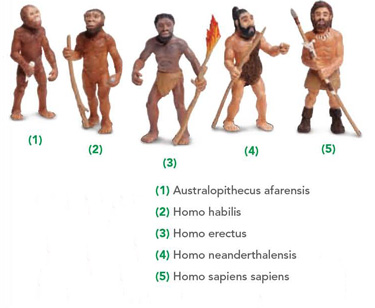
The Safari Ltd Evolution of Man Box Set

Evolution of Man model set.

Tracing our evolution. The Safari Ltd Evolution of Man model set highlights key land marks in the origins of our own species.

To view the Evolution of Man model set and to see the rest of the models and figures in the Safari Ltd prehistoric range: Wild Safari Prehistoric World Models and Figures.

The University of Berkeley team have been praised for the way in which they involved Ethiopian scientists in the research.  In a continuation of this co-operative approach, press conferences announcing the team’s initial findings were held simultaneously in Washington and Addis Ababa, the capital of Ethiopia.  The Ethiopian ambassador to the United States attended the Washington event and thanked the team for their work and for their willingness to help Ethiopian scientists and raise the profile of Ethiopia as a country of fine academic abilities and not just a dig site.

30 09, 2009

Parasitic Infection Linked to Tyrannosauridae

By |2023-03-03T16:47:26+00:00September 30th, 2009|Categories: Dinosaur and Prehistoric Animal News Stories, Main Page, Palaeontological articles|0 Comments

Parasitic Infection may be Responsible for Death of Tyrannosaurus “Sue”

A new study by joint team of Australian and U.S. based scientists has put forward a theory explaining why some tyrannosaurs may have died, they suffered from a single- celled parasitic infection that caused them to have breathing difficulties and starve to death.  A series of small, circular holes in the jaw bones of Tyrannosaurus rex fossils may be evidence of infection by a parasite that causes the death of modern birds such as raptors.  The T. rex skeleton known as “Sue” may show signs of this parasitic infection and this may have been what finally killed this 7 tonne monster.

Tyrannosaurs

“Sue” or to more appropriate SUE-BHI2033/FMNHPR2081 (the specimen number), was discovered by Susan Hendrickson on August 12th 1990.  This T. rex skeleton is perhaps the most complete found to date with approximately 80% of the skeleton recovered in the subsequent excavations.  The mounted exhibit is on display at the Field Museum in Chicago (USA).  The animal, believed to be female, is 42 feet long.  This particular exhibit opened in May 2000, the fossil skeleton of “Sue” was auctioned at Sotheby’s in October 1997, it fetched $8.36 million USD, a world record for a palaeontological item at auction.

The fossilised remains of animals can provide scientists with an insight into the lives and traumas of prehistoric creatures.  Signs of disease, traumatic injuries such as broken bones can be seen, this is called the pathology of a fossilised skeleton.  In many cases, researchers can see signs of recovery, such as healing of broken bones but perhaps those examples of pathology that are not healed or show no sign of improvement may have been the cause of death of that particular animal.

This particular study, published in the online scientific journal PLoS One was led by Dr Ewan Wolff of the University of Wisconsin and Dr Steven Salisbury of the University of Queensland, Australia.  In total they studied ten tyrannosaur fossils plus the fossilised remains of a number of extinct archosaurs.  They concluded that T. rex and other tyrannosaurid fossils often display signs of lesions and even holes in their jaw bones.

These lesions and holes in the dentary, angular, surangular and other bones of the lower jaws have been explained away previously as being the results of face biting by other tyrannosaurs or possibly from a bacterial bone infection (Actinomycosis).  However, this joint Australian and American team have speculated that the holes could have been caused by a parasite, one that regularly attacks and damages the mandibles of birds such as eagles and hawks.

The lesions and holes could be a result of the avian parasitic infection called Trichomonosis.

Commenting on the newly published paper, Dr Wolff stated:

“What drew my attention to Trichomonosis as a potential candidate for these mysterious lesions on the jaws of tyrannosaurs is the manifestation of the effects of the disease in birds”.

Trichomonosis

It is true that similar pathologies have been found in the mandibles of birds that have suffered from this parasitic infection.  However, despite newspaper articles and some dramatic headlines, this parasite was very probably not responsible for the demise of an entire species.  A severe infection in an individual would have caused respiratory problems and impaired the animal’s ability to eat.  It may have succumbed to starvation or been weakened to such an extent that its death was a consequence of having this infection.

The evolution of tyrannosaurs is not well understood, there is a paucity of evidence in the fossil record, however, it is possible that this particular taxonomic family originated in the Late Jurassic and as such it would have evolved as part of an environmental ecosystem exposed to all sorts of other organisms that were evolving with it.  It is unlikely that parasitic infections were the cause of an extinction of an entire species, but undoubtedly dinosaurs suffered from parasites and the holes in the jaw bones could be explained by an attack of Trichomonosis, certainly in studies of birds who have had this parasite, the marks on the bone do resemble those found on tyrannosaur fossils.

In the circulated pictures, the left mandibular ramus of a the Tyrannosaurus rex specimen at the Field Museum (Sue), is shown.  Photographs labelled A and B show the lower jaw bones from the lateral (viewing the bone from outside the jaw) and the medial viewing the jawbone from inside the mouth.  The suspect holes and lesions are indicated by the white arrows.

Diagram C shows the view of the left side of the skull of the Field Museum T. rex, the part shaded indicates the area that has been examined closely.  The diagrams labelled D and E show the composition of the jaw bones and lower part of the skull with the various specific bones labelled.

Did Some Tyrannosaurs Die as a Result of Parasitic Infections

"Stan" - Gracile T. rex at Manchester Museum.

Did tyrannosaurs suffer from Trichomonosis?  Picture credit: Everything Dinosaur.

Picture credit: Everything Dinosaur

The scientists have reported that their study provides evidence of an avian transmitted disease in non-avian theropod dinosaurs.  The team have also concluded that, based on the amount of lesions found in tyrannosaur fossils parasites such as Trichomonosis may have been endemic in the tyrannosaur population.

The disease may have been transmitted as tyrannosaurs fought with other members of their species, or if they fed on prey animals infected with the parasite.  For example, many pigeons carry the parasite but do not seem to be outwardly affected whereas raptors that feed on pigeons can die from a parasitic infection of this nature.  The parasite could also be transmitted if tyrannosaurs were cannibals and there is some fossil evidence indicating that tyrannosaurs did each other members of their kind.

A fascinating paper, one that perhaps sheds new light on tyrannosaur pathology.

Everything Dinosaur stocks numerous tyrannosaur models including the Papo range of prehistoric animal figures: Papo Dinosaurs and Prehistoric Animal Figures.

22 09, 2009

On the Cusp of the Phanerozoic

By |2022-12-26T21:01:44+00:00September 22nd, 2009|Categories: Dinosaur and Prehistoric Animal News Stories, Everything Dinosaur News and Updates, Main Page, Palaeontological articles|0 Comments

On the Cusp of the Phanerozoic (Visible Life)

Geological time is divided into a number of specific segments.  Most people are familiar with terms such as the Cretaceous and Jurassic.  A few may have heard of the Devonian and Silurian but not many can put these periods (for that is what they are) in the right order.  However, although a geological period can cover millions of years, for example the Cretaceous 144-66 million years ago approximately and the relatively short Silurian in comparison (443 to 417 million years ago), periods themselves are sub-sections of much larger tracts of time called eras.  We are currently living in the Cenozoic era (means recent time).  This began approximately 66 million years ago when the Mesozoic ended.  Eras themselves, are sub-sections of even larger intervals of time, these are called eons.

The Phanerozoic

Two eons are generally considered to make up all of geological time since the formation of the Earth around 4.6 billion years ago.  Firstly, there is the Cryptozoic (means hidden life), this is by far the largest of the eons, lasting over 4 billion years.  It begins at the formation of our planet and ends approximately 550 million years ago.  The second Eon, the one we are living in; is called the Phanerozoic (means visible life).  Sometime around 545-570 million years ago, one of the most important and dramatic events in the history of life on Earth started to happen.  There was a sudden burst of evolution and a much wider diversity of life suddenly shows up in the fossil record.  A whole array of new organisms appear in the fossil record, especially those with hard, exoskeletons and other robust parts that can be mineralised.  Life on Earth seems to explode, hence the term the “Cambrian Explosion”.

Body Fossils

Body fossils with hard shells and other robust appendages become abundant and the fossil record goes into overdrive.  This event is so important in the study of geology and life on Earth that it marks the end of Cryptozoic and the beginning of a new Eon, the Phanerozoic.  This is a good a place to divide up Eons, an explosion of life forms.  There were a number of soft-bodied organisms, multi-cellular organisms having evolved sometime in the Precambrian (an alternative name for the Cryptozoic), but by their very soft-bodied nature little is known about this fauna.  Collectively, this fauna is known as Ediacaran fauna -after a range of hills in Australia where soft-bodied animal fossils dating from the Precambrian have been found.

Team members at Everything Dinosaur have had chance to look at some of the remarkable fossils of early life from Canada.  These are known as the Burgess shales.  Many of these fossils are on display at the Royal Ontario Museum in Toronto.  Researchers and scientists from this Canadian museum are working in another remote part of that huge country to help make casts and replicas of some of earliest hard, shelled animals from the Cambrian Explosion.  At a site called Mistaken Point, on the Avalon Peninsula, Newfoundland, scientists are carefully making casts of fossils that date to around 565 million years ago.  Casts allow scientists to study the copies and help preserve a record of fossil material before it suffers from erosion or other damage.  By casting fossils, duplicates can be sent to other scientists to study or to be put on display all over the world.

Commenting on the casting work being undertaken at Mistaken Point, Royal Ontario Museum Associate Curator of Invertebrate Palaeontology, Jean-Bernard Caron stated:

“One advantage of casting is, obviously, is to show similar objects to a wider audience, which is the case here.  We are going to show the casts, not only in Newfoundland close to the site, but also at the Royal Ontario Museum, where a million visitors come through our doors every year”.

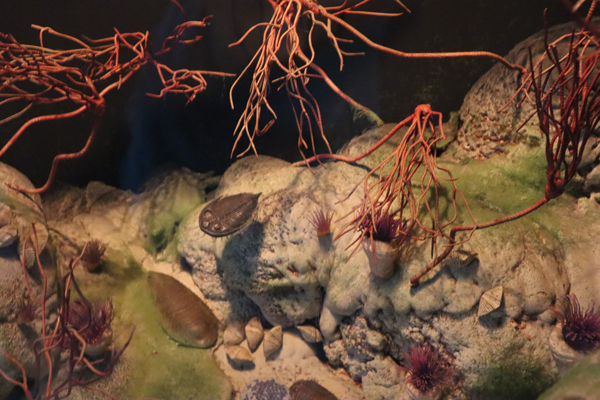
A Silurian Seascape

On the cusp of the Phanerozoic.

A marine environment from the early Phanerozoic Eon (Silurian). Picture credit: Everything Dinosaur.

Picture credit: Everything Dinosaur

Fossils Formed at the Bottom of a Shallow Sea

The fossils were formed at the bottom of a shallow sea.  They consist of the discarded exoskeletons of a number of invertebrates.  The casting process will help preserve this precious fossil data as walkers have inadvertently damaged a number of specimens and some fossil thefts have occurred as enthusiasts have chiselled individual fossils out of the rock.

Once the casting work is complete, technicians from the Royal Ontario Museum will cover over part of the site, helping to protect the fossils from further damage.

Everything Dinosaur stocks a range of replicas that represent iconic animals from the Phanerozoic. To view this range: Models of Fossil Animals.

Go to Top