All about dinosaurs, fossils and prehistoric animals by Everything Dinosaur team members.

Articles, features and information which have slightly more scientific content with an emphasis on palaeontology, such as updates on academic papers, published papers etc.

24 03, 2010

Dinosaur Buried Alive – New Dinosaur Species Discovered in Utah Sandstone

By |2023-01-03T20:39:40+00:00March 24th, 2010|Categories: Dinosaur and Prehistoric Animal News Stories, Dinosaur Fans, Main Page, Palaeontological articles|0 Comments

New Dinosaur Species Discovered – The Origins of a Native Indian Legend Perhaps?

Researchers reporting in the on line scientific journal PLoS One have described the discovery of a new species of primitive, long-necked dinosaur that was buried in a collapsed sand dune approximately 185 million years ago.  The fossil was discovered eroding slowly out of sandstone strata, close to the archaeological remains of an ancient native Indian settlement.  Could these bones be the source of the Navajo Indian legend of a sand monster that buried its victims alive in the dunes?

The sandstone block has been partially removed from its burlap and plaster covering.  The bones making up the right hand can clearly be seen, the five digits with sharp claws on the end of the fingers.  The fossil is articulated and nearly complete with just the skull, some elements of the toes and a shinbone missing.  Unfortunately, skull material is often absent with fossils of this nature.  The relatively small skull, balanced on a long neck is very often not present when the rest of the fossilised skeleton is discovered.

Seitaad ruessi

The dinosaur has been named Seitaad ruessi.  This dinosaur has been named to honour the ancient American Indian sand monster which was known as “Seit’aad”, the species name is in memory of the poet and naturalist Everett Ruess who disappeared in the sandy desert of southern Utah in 1934.

This dinosaur is a member of the Sauropodomorpha, long-necked herbivores with lizard-like feet.  It would have been around 3-5 metres long and perhaps over 1 metre high at the hips.  It lived during the early Jurassic (Toarcian faunal stage), approximately 185 million years ago.  Southern Utah during the early Jurassic was a dry, arid desert environment but with isolated strips of lush and verdant vegetation close to water sources.

Dinosaur

This dinosaur was probably a facultative biped, normally walking on all fours but capable of running or standing just on its hind legs as and when necessary.

The analysis of the fossilised bones was undertaken by palaeontologists Joseph Sertich, a Stony Brook University doctoral student and Mark Loewen of the Utah Museum of Natural History.

Commenting on the discovery, Sertich said in a statement:

“Although Seitaad was preserved in a sand dune, this ancient desert mush have included wetter areas with enough plants to support these smaller dinosaurs and other animals.”

Although, Sertich went onto add:

“Just like in deserts today, life would have been difficult in Utah’s ancient sand sea.'”

The fossil was discovered in 2004 and removed from the sandstone cliff the following year.  It is likely that more work will be carried out on the matrix that contains the fossil so that more of the skeleton can be revealed.

This particular discovery helps to confirm the success of the Sauropodomorpha in the Early Jurassic, this type of dinosaur was relatively common and would have made up some of the larger elements of the mega fauna on the super-continent of Pangaea.

The research team have stated that they believe that this particular dinosaur was unfortunate to have been buried suddenly in a collapsing sand dune, perhaps the sand was disturbed as a herd of these animals moved across the landscape.  This dinosaur was engulfed and the remains ended up stood on their head.

Plateosaurus

Perhaps the best known Sauropodomorpha is Plateosaurus (prosauropod), one of the best known dinosaurs of all.  Many thousands of plateosaur fossils have been found in Europe.  It was clearly one of the most common types of dinosaur in the Late Triassic.

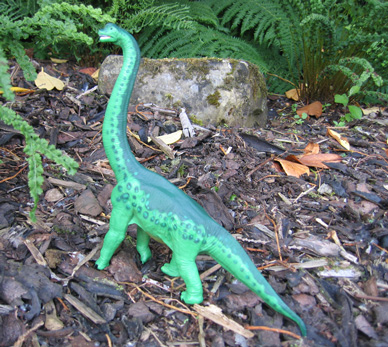
An Illustration of Plateosaurus

Picture credit: Everything Dinosaur

To view models of Plateosaurus and other Sauropodomorpha members: CollectA Prehistoric Life Models.
11 03, 2010

Remembering the Famous Roy Chapman Andrews – Naturalist, Adventurer and Explorer

By |2024-04-19T09:49:47+01:00March 11th, 2010|Categories: Dinosaur and Prehistoric Animal News Stories, Dinosaur Fans, Main Page, Palaeontological articles|0 Comments

Roy Chapman Andrews 1884-1960

Today, March 11th, marks the fiftieth anniversary of the death of Roy Chapman Andrews one of the most colourful and fascinating naturalists and museum scientists of the 20th century.  He led a number of pioneering expeditions to the Gobi desert of central Asia in the early 1920s and although the original objective of these scientific expeditions was to find mammal fossils, he is best remembered for the dinosaurs he helped discover.

Roy Chapman Andrews

Working for the American Museum of Natural History (New York), Roy Chapman Andrews and his colleagues on these expeditions discovered the first-known fossilised dinosaur nests and hatchlings as well as many new dinosaurs including Protoceratops, Velociraptor and Oviraptor.

To see models of Velociraptor, Protoceratops and Oviraptor: CollectA Age of Dinosaurs Popular Models.

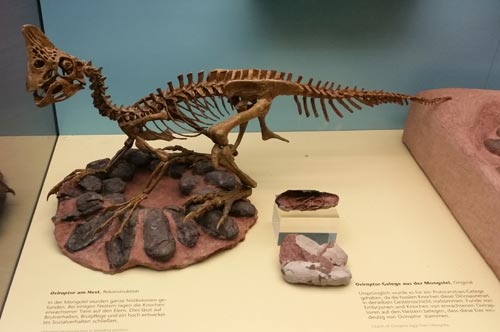
An Oviraptorid Dinosaur Sitting on a Nest

An Oviraptor and dinosaur eggs exhibit.

An Oviraptor and its nest. Picture credit: Everything Dinosaur.

Picture credit: Everything Dinosaur

Many people believe that the real life adventures of Roy Chapman Andrews formed the basis for the fictional character Indiana Jones.

To read an article about this: Would the real Indiana Jones Please Step Forward.

Although regarded as a maverick by some academics, the contribution of Roy Chapman Andrews to the collection of the American Museum of Natural History is widely recognised.  Indeed, many of the methods and techniques pioneered by his team in the 1920s in their expeditions to remote parts of the world are still used by scientific expeditions today.

6 03, 2010

Debate over the Remarkable Ida Rumbles On – Darwinius masillae

By |2024-04-19T09:52:14+01:00March 6th, 2010|Categories: Main Page, Palaeontological articles|0 Comments

Darwinius masillae Ancestor of Lemurs not Humans say Scientists

The debate over Darwinius masillae continues as scientists conclude that “Ida” was an ancestor of lemurs and not hominins.

Ever since the beautifully preserved fossil of 47-million-year-old primate nicknamed “Ida” was revealed to the world, the analysis and interpretation of this fossil has attracted controversy.  Heralded at the time as the “missing link” between ancient primates and that particular part of the primate lineage that would eventually lead to our own species, the fossil when it was formerly presented to the world at the American Museum of Natural History (New York) attracted huge interest.  However, the claim that this particular fossil represented our ancient ancestor has been already challenged and a new paper published this week supports the view that “Ida” is related to the lemurs and not a direct link to Homo sapiens.

Darwinius masillae

The fossil was originally discovered in 1983, in the famous Messel shales of Germany, a location renowned for superbly preserved early Tertiary fossils.  The original specimen was split in half when it was found, as the private individuals who discovered the specimen thought that the part and counterparts of the fossil would make more money if they were sold in separate lots.

These specimens ended up in different museum collections.  In addition, in order to enhance the value of one of the plates, it was embellished a little by the restoration team before being offered for sale.  Unfortunately, in the world of fossil dealing, this is quite common practice, it is amazing how much value can be added with a bit of a “scrape and a polish”.  One part of Ida – the nickname given to the fossil by those scientists who got the chance to prepare the fossil for display, ended up in the USA, the second part was sold to the Natural History Museum of University of Oslo.  It was a Norwegian team, led by John (Jorn) Hurum of the Natural History Museum (Oslo) that published the scientific paper claiming that Ida represented a link on the evolutionary history of our species.

One of the comments attributed to Dr Hurum was that Ida represented:

“the closest thing we can get to a direct ancestor”.

To read more about the announcement of the fossil discovery: The Relationship between Hominids and Lemurs – Darwinius masillae.

There was certainly a great deal of hyperbole and publicity when the fossil was revealed to the world at the special media event held in New York last May.  Pictures of Ida were published around the world, with the Norwegian scientists being interviewed on national television, A&E purchased the rights to make a documentary and a number of news and media companies signed agreements to cover “Ida” and her story.

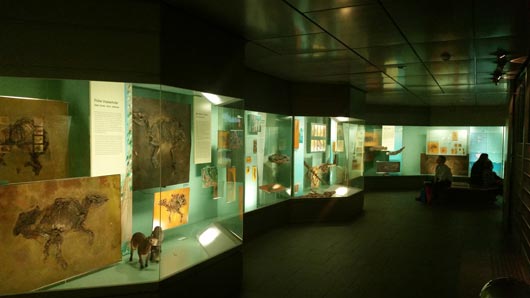
Some Examples of Remarkable Messel Shale Fossils

Part of the Messel gallery (Senckenberg Museum).

The atmospheric Messel gallery at the Senckenberg Museum (Frankfurt).

Picture credit: Everything Dinosaur

There was even a documentary shown on the BBC, narrated by Sir David Attenborough.  The fuss over this particular discovery was quite extraordinary.  Although, with the various events scheduled to take place in 2009 to commemorate the 200th anniversary of the birth of Charles Darwin, it was not surprising that this “missing link” would attract such worldwide attention.

However, it was not long before the scientific community, once having had the chance to formerly review the research papers, began to unpick the Norwegian team’s hypothesis

Dr Jens Franzen, an expert on Germany’s Messel shale fossils,  questioned the link to humans and stated:

“She belongs to the group from which humans developed, but my impression is she is not on the direct line”.

To read one of the articles, a rebuttle of the Norwegian teams’ work: The Debate over “Ida” Hots Up.

Ida does represent the most complete primate discovered to date, although the light and delicate nature of the fossil and the bones having been crushed during the preservation means that individual portions cannot be handled.  Radiographs (x-rays) have revealed a lot of information, for example, the jaw has adult teeth emerging giving an indication of the age of the animal.  The pelvic girdle suggests female and so the scientists studying “Ida” have concluded that she was an independent, fully weaned sub-adult that died in her first year of life.  She did not possess claws but had nails (just like we do) and would have been quite at home in the trees of the Messel rain-forest.

Ida was approximately 50 centimetres long, half of this length was made up of the tail.  If she had reached full adult size she would have still weighed less than 2 kilogrammes.  Darwinius masillae is a very significant discovery.  It is the most complete primate fossil found to date and will permit scientists to study her life history, diet and locomotion. Undoubtedly, any future study of early Palaeogene primates will benefit from the work done on “Ida”.

However, a new study carried out by scientists based at Duke University, (North Carolina – USA), and published in the Journal of Human Evolution also challenges the conclusions drawn by the first analysis of this fossilised primate.

Visiting Professor of Evolutionary Anthropology Blythe Williams and her colleagues contest the earlier findings and dispute the argument that Darwinius masillae was a “missing link”.

Commenting on the original paper published by Dr Hurum and his team, she stated;

“The problems with the manuscript jumped out immediately.  Yes, Darwinius masillae is, indeed, a very complete, 47-million-year-old fossil.  But that doesn’t mean it overthrows the incredibly extensive body of research that we have already built up.”

Dr Hurum and his colleagues are believed to be working on a response to rebuff the latest arguments that have been put forward, challenging their earlier findings.  It seems that the debate over the fantastically well preserved fossil of Ida is going to run and run.  The whole issue has become somewhat blurred as a result of the excessive media interest and indeed the large sums of money thrown at the scientists for exclusive book, film and television rights.  When Darwin first published his famous book “The Origin of Species”, it created a Victorian media storm, it seems that more than 200 years after Darwin’s birth a fossil named after him is going to be doing the same thing for some time to come.

Everything Dinosaur stocks a wide variety of prehistoric animal models including replicas from the Eocene.  To view this range: Replicas of Prehistoric Mammals.

2 03, 2010

Baby Dinosaurs Attacked by Snake

By |2023-03-04T19:57:35+00:00March 2nd, 2010|Categories: Dinosaur and Prehistoric Animal News Stories, Dinosaur Fans, Main Page, Palaeontological articles|0 Comments

Ancient Indian Constrictor Attacked Baby Sauropods

Scientists have discovered the remarkable fossil of a baby dinosaur that was attacked by a snake.

An adult sauropod would have had few enemies, their sheer size and strength making them invulnerable to attack from all but the most determined or foolhardy theropod.  However, the discovery of a fossil from Gujarat in Western India indicates that for baby long-necked dinosaurs, life was very hazardous, even at the moment of hatching from their eggs.

In a paper published in the scientific journal “PLoS Biology”, a team of scientists report on the macabre discovery of a 3.5 metre long snake caught in the act of raiding a sauropod dinosaur’s nest and attacking a newly hatched dinosaur.  A number of sauropod nesting sites have been discovered in Western India, in Late Cretaceous deposits (Maastrichtian faunal stage).  The nest was that of a titanosaur, the last group of sauropods to evolve.  Palaeontologists are confident that these large herbivores migrated to traditional nesting sites year after year and laid their eggs in extensive nesting colonies.

The females would scrape out a hollow in the ground and then carefully lay a clutch of eggs (as many as twelve per nest), then they carefully covered the eggs again, perhaps putting a layer of vegetation on top of the eggs to help incubate them.  Then the nest was abandoned and the eggs and any hatchlings left to their fate.  Such nesting sites would have provided a number of small predators, dinosaurs, lizards, birds and of course snakes with an easy meal once the adults had moved on.

Baby Dinosaurs

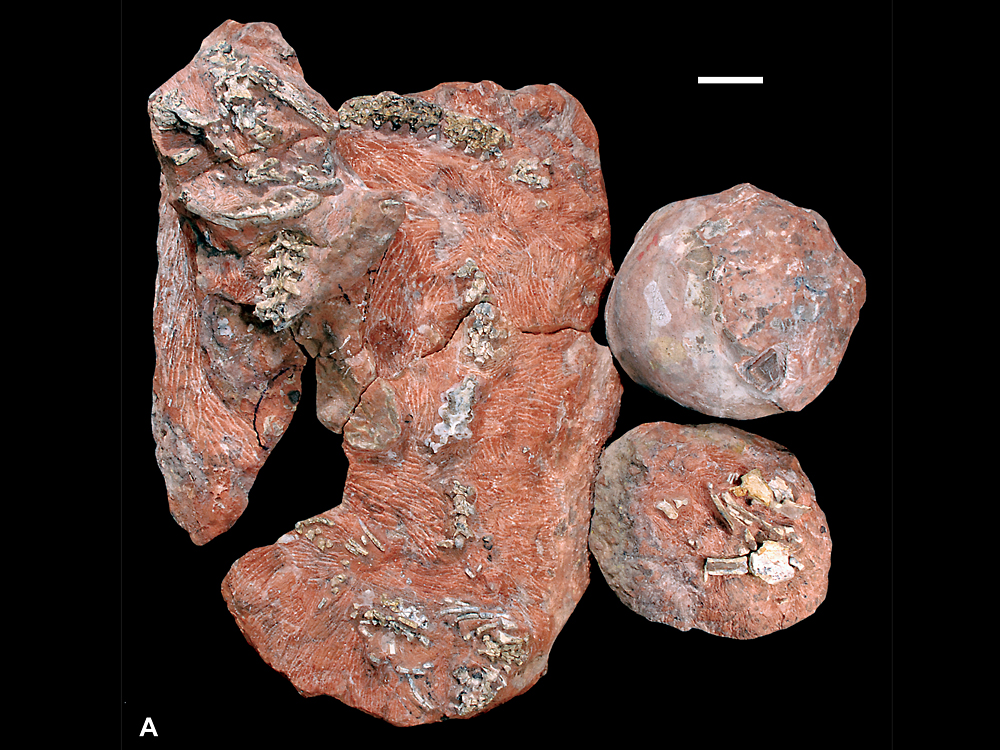
Primitive constrictor snakes had been found in association with dinosaur nesting sites on previous occasions, but this remarkable fossil shows a snake caught in the act of attacking a 40 cm long hatchling.  The fossil, known as an “ethofossil” as it shows feeding behaviour; comes from a sauropod nesting site first discovered in 1984.  The remains of the snake are preserved in close association with unhatched eggs, egg fragments and some of the bones of the newly emerged sauropod.  The nesting site is adjacent to an ancient river bed.  The snake and its victim were suddenly buried by sediment, perhaps as the result of a downpour or the collapse of part of the river bank.

The discovery was made by Jeffrey Wilson, a Professor at the University of Michigan (United States).  He had heard about the amazing fields of dinosaur eggs discovered in India and when shown a small block of matrix with the fossilised egg entombed within it, he observed the remains of the snake vertebrae which were just visible on the surface of the rock.

Professor Wilson commented:

“I was stunned when I saw it, because sort of leaping out at me were the peculiar articulations between the vertebrae of a snake”.

Having been granted permission by the Indian Government, Professor Wilson returned home with the fossil and began the year long process of cleaning and preparing the fossil.

Grain by grain the surrounding sandstone rock matrix was removed and the eggs, the snake and the hatchling were slowly and surely revealed.  The grim scene became apparent, a moment frozen in time when a 3.5-metre-long predator attacked the defenceless hatchling.

Recalling the moment when the details of the fossil were revealed, Professor Wilson stated:

“It was amazing.  We realised that not only did we have an egg, not only did we have a chain of vertebrae, but they were arranged in a coil, and on top of the coil was a skull.”

Coiled Around the Broken Eggshell

The snake was coiled around the broken eggshell and adjacent to the coil, eggshell and the bones of a baby titanosaur.  The primitive snake was unable to open its jaws wide enough to swallow the large dinosaur egg, but with an estimated gape in excess of 16 cm wide, it could manage to constrict and then swallow the newly emerged dinosaur hatchling.  It must have detected the nest and then moved in to attack the youngster as it emerged from its egg.

Wilson says scientists have since found three snake fossils and more eggs at the same site this one came from.  They add new details to a 67-million-year-old story, says the University of Michigan scientist.

Snakes and other predators would remember the location of a titanosaur nesting site and perhaps an entire eco-system sprang up around the annual dinosaur nesting.

The Fossil of the Cretaceous Snake and Sauropod Remains

Snake attacks baby dinosaurs.

Picture credit: Wilson et al 2010

The snake, a new genus has been named and described by the U.S. based team, it has been called Sanajeh indicus which means “ancient gaped one from India”.  Two other snake fossils have been found in this area, indicating that perhaps snakes and other predators congregated around the nesting site looking for an easy meal.

Palaeontologist Jason Head, of the University of Toronto, who helped produce the research paper used two recent movie titles to describe his feelings about the fossil discovery:

“It’s Anaconda meets Jurassic Park” he stated.

Dr Head went onto comment:

“These sauropods would lay these huge fields of eggs that we find in India, just kind of kilometres of dinosaur eggshell, and so with these hatchling dinosaurs it must have just been a smorgasbord where a whole ecosystem of predators could basically come in and feed on them.”

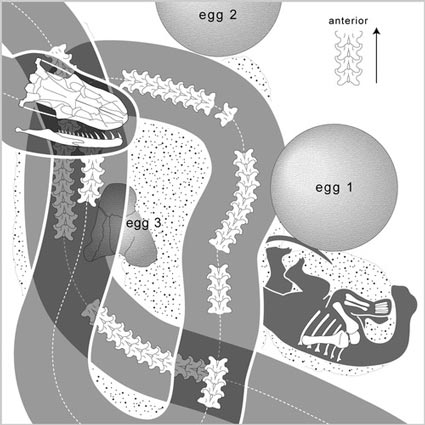
An Illustration of the Dinosaur/Snake Fossil

Attacked by a snake.

Illustration credit: Wilson et al 2010

The diagram above shows a detailed illustration of the fossil, looking down onto it.  The remains of the baby sauropod are to the right with the head of S. indicus in the top left corner.

Sanajeh indicus had a different jaw arrangement compared to modern constrictors such as Boas.  It could not unhinge its jaws to swallow large prey like a modern snake, instead the lizard like jaw was able to gape which permitted it to swallow prey wider than itself.

Dr Head went onto state:

“This is the first direct evidence of feeding behaviour in a fossil of a primitive snake, and shows us that the ecology and early evolutionary history of snakes were much more complex than we would think just by looking at modern snakes today.”

The evolution of large-gape snakes such as pythons and boas ( known as Macrostomatans) capable of feeding on large prey and their ancestral habitat has remained controversial.  Modern-day pythons have excellent jaw adaptations and an elongated skull; fully grown pythons have a gape as wide as nearly 60 cm; enabling them to swallow animals much larger than themselves. Among other adaptations, Macrostomatans have really long lower jaws and increased mobility of jaws compared with the more primitive S. indicus.

The lower jaw of S. indicus is approximately 12 cm long, and this, in conjunction with other anatomical features that give the jaws greater mobility and flexibility would have enabled Sanajeh indicus to swallow hatchling dinosaurs.

Dr Head commented that the snake probably made up for its inability to unhinge its jaws completely like a modern constrictor by growing large to increase its ability to gape.  It would have grown rapidly by consuming as many young dinosaurs as it could during the breeding season and then perhaps lying dormant until the following year.  For the sauropods, as they emerged from the nests they were extremely vulnerable without their parents to protect them.  It would seem that the best survival strategy for a young titanosaur would be to grow up as fast as possible.

Everything Dinosaur stocks a range of titanosaur models and even replicas of giant prehistoric snakes (Titanoboa). Visit the model section of the company’s website: Prehistoric Animal Models and Replicas.

The scientific paper: “Predation upon Hatchling Dinosaurs by a New Snake from the Late Cretaceous of India” by Jeffrey A. Wilson, Dhananjay M. Mohabey, Shanan E. Peters, Jason J. Head published in PLoS Biology.

24 02, 2010

Abydosaurus – Gives Sauropod Research a Head Start

By |2023-01-02T19:18:55+00:00February 24th, 2010|Categories: Dinosaur and Prehistoric Animal News Stories, Main Page, Palaeontological articles|0 Comments

Abydosaurus – Skull Material in Cretaceous Sauropoda

Sauropod skull material is a bit like London buses, you wait ages for one to turn up and then four come along at once.  Thanks to a discovery in Utah (United States), scientists at Brigham Young University have an embarrassment of riches of sauropod skull material to work on at the moment and all the skull material belongs to a single, new dinosaur genus – Abydosaurus.

An Abydosaurus Skull

Skull material in long-necked dinosaurs (sauropods) is exceptionally rare in the fossil record, less than 10% of all the articulated or associated long-necked dinosaur fossils ever discovered actually have some skull material present at the dig site.  The reason for this is quite simple, take an animal such as Diplodocus, this diplodocid dinosaur could reach lengths in excess of 25 metres, but even in an immense adult; the head was no bigger than that of a horse’s head.  So the heads were relatively small and being on a long, thin neck, skulls were prone to fall off any carcase, becoming detached.  Femurs, and vertebrae being much heavier than the skull bones have a greater chance of remaining close to other bones and surviving the preservation process.  These heavy bones are much more common than the skull.  Some sauropods, the Early Cretaceous Nigersaurus from West Africa, for example, had an exceptionally light and delicate skull.  The thin struts of bone that make up part of the skull material would only very rarely have survived the fossilisation process.  Even famous mounted exhibits in Natural History museums do not necessarily have the right head posed on the rest of the sauropod’s body.  For example, there  have been instances where both Apatosaurus and Diplodocus exhibits have had casts of Camarasaurus skulls (a Macronaria-type sauropod) stuck onto them.  This in the past was down to ignorance, or in some cases deliberately done to finish off an exhibit even though scientists were actually unaware at the time of what diplodocid dinosaur skulls looked like.

But why all the fuss about skull material, surely with several tonnes of fossil bones to be getting on with in your average sauropod skeleton, that’s enough to keep even the most grumpy palaeontologist happy.  True, but skulls can tell scientist a great deal about an animal.  If the jaws are present an insight into diet and feeding behaviour can be obtained.  Studies into the braincase can be carried out and very importantly skull material can help establish whether the fossils represent a new genus or species of a dinosaur in many cases.

Abydosaurus

A paper on the new brachiosaurid dinosaur named Abydosaurus mcintoshi was published yesterday in the German science publication Naturwissenshaften.  The research paper was compiled by scientists at Brigham Young University and this new Cretaceous brachiosaurid is significant not just for the skull material associated with it, but because brachiosaur fossils are increasingly rare in younger Mesozoic strata.   The brachiosaurs seemed to have had their hey day in the Late Jurassic, but over the course of the Cretaceous, the main types of sauropod, such as the diplodocids and brachiosaurids become increasingly rare in the fossil record.  The sauropods were by no means finished, particularly in the Southern Hemisphere, as the titanosaurs were about to come to the fore, but the food chains and ecosystems of the Cretaceous were becoming increasingly dominated by herbivorous ornithischian dinosaurs.

Dinosaur Skulls

The remains and the fossilised skulls of this new dinosaur, were found at the National Dinosaur Monument site in Utah (United States), not in the famous Morrison Formation, but in much younger, sandstone rocks dating from around 105 million years ago (Albian faunal stage) – the Cedar Mountain Formation.

Finding just one skull would be impressive, but four is beyond what any dinosaur hunter could hope for.  The skulls revealed jaws crammed with dozens of tiny, peg-like teeth.

A Model of a Brachiosaurid Dinosaur (Brachiosaurus)

Wild Safari Prehistoric World Brachiosaurus.

Wild Safari Prehistoric World Brachiosaurus dinosaur model.  A replica of a brachiosaurid dinosaur.  Picture credit: Everything Dinosaur.

Picture credit: Everything Dinosaur

To view the brachiosaurids and other figures in the Wild Safari Dinos series: Wild Safari Prehistoric World Models.

Commenting on the skull material, Professor Brooks Britt, a geologist at Brigham Young University stated:

“It’s quite a fortuitous thing.  In many dinosaurs, the bones of the head do not fuse up, especially in sauropods.  You have an array of components that are held together by soft tissue.  The only thing that stays together is the brain case.”

National Park Service employees first discovered an interesting cache of bones near the monument’s visitor’s centre in the late 1990s and enlisted Professor Britt’s help to prepare the specimens.  After the initial find, park staff delivered a two-tonne block to Brigham Young’s University Museum of Palaeontology.  Dinosaur bones, including pieces of a skull, were apparent on the surface, but as the researchers carefully prepared the sandstone block, a second almost complete skull was revealed.

The skulls are on display at the Brigham Young University Museum, where visitors can watch students work on other Abydosaurus bones in the preparation laboratory.

Professor Britt made follow-up trips to the dig site and found a fourth skull in 2003.  All four specimens belonged to juveniles who may have died in the same event and were quickly buried before scavengers and bacteria could destroy the carcasses.   Although it is difficult to estimate the size of an adult Abydosaurus from the fossil remains found so far, the research team have estimated that these animals could have reached lengths in excess of 25 metres.

The teeth of Abydosaurus are most intriguing, in a statement Professor Britt said:

“They [the teeth] are small, small as a triple-A battery cut in half, a centimetre in diameter.  Why is that?  Perhaps the teeth reflect food sources and eating habits, but the small teeth fit a pattern seen over the course of dinosaur evolution from the Jurassic to the Cretaceous.

“There is a trend from large to small teeth, packing them in there close together, not just in Brachiosaurus, but all the sauropods that survived into the Cretaceous.  In the Jurassic, they had an array of tooth sizes, but in the end everyone has these small pencil-like teeth.  We attribute it to a way to increase the enamel, so their teeth last longer.”

Researchers believe that sauropod dentition evolved over time to offer a greater surface area of enamel.  This would make them more durable and more hard-wearing when being employed to strip foliage.  It could also be an adaptation that reflects the growing numbers of Angiosperms (flowering plants) that were evolving and beginning to make up an increasing proportion of the diet of these huge animals.

20 02, 2010

New Evidence for Aquatic Dinosaurs – Swimming Spinosaurs

By |2024-04-19T09:23:20+01:00February 20th, 2010|Categories: Dinosaur and Prehistoric Animal News Stories, Dinosaur Fans, Main Page, Palaeontological articles|1 Comment

Was Spinosaurus a Swimmer?  Watery Habitat for Largest Theropod

Scientists have found evidence of flying dinosaurs, there is evidence to suggest that some dinosaurs were at home in the trees, some lived in burrows, but a dinosaur that lived an aquatic existence?  That surely must be a step too far for a group of reptiles whose suitability for life on land and simple hinge-like ankle joints gave them a significant advantage over other land animals in the post Permian extinction race for dominance of the Earth.

Swimming Spinosaurs

However, a team of French scientists have concluded that at least one type of dinosaur – the spinosaurids may have spent a considerable amount of time in water, in fact about as much time in the water as extant species of crocodiles do today.

Romain Amoit from the University of Lyon (France) and his colleagues studied the amount of an isotope of oxygen within the fossilised teeth of a number of dinosaurs.  They then compared their findings to known aquatic animals from the fossil record, turtles and crocodiles and from these results they have concluded that the spinosaurs probably spent most of their time in a watery environment.

The spinosaurids, most famously Spinosaurus, the dinosaur villain in the movie Jurassic Park III were a widespread Cretaceous theropod dinosaur.  Remains of such creatures have been discovered in England (Baryonyx), Africa, South America, China, Thailand and Japan.  These dinosaurs were characterised by having long, narrow jaws armed with many sharp, straight teeth, in most cases resembling the teeth of crocodiles.  Most of this group of large, carnivores had humps or elaborate sails along their backs.

Spinosaurus aegyptiacus, was named and described by the great German palaeontologist/geologist Ernst Stromer von Reichenbach in 1915.  He had led a number of fossil hunting expeditions to North Africa between 1911 and the outbreak of World War I.  Unfortunately, very little spinosaur fossil material or information is left from these expeditions as the Munich museum in which these items were stored was utterly destroyed by an American bombing raid during World War II.

However, based on the notes and illustrations from Stromer’s time plus more recent Spinosaurus remains from Morocco, some scientists have claimed that this type of spinosaur is the largest known predatory dinosaur in the fossil record with some size estimates putting Spinosaurus at more than 17 metres long, much larger than the biggest Tyrannosaurus rex, or Giganotosaurus.

An Illustration of a Spinosaurus

Papo Spinosaurus model.

The “classic” Papo Spinosaurus dinosaur model.

Picture credit: Everything Dinosaur/Papo

The picture shows a typical model of a Spinosaurus (2010), the distinctive big claw on the thumb can clearly be seen.  Evidence of these types of creatures being fish eaters has been found before, for example, the remains of fish scales (Lepidotes) found in association with the Surrey Baryonyx skeleton, but the French team go further, they claim that as well as eating fish, these animals spent much of their time in the water.

To view the Papo Spinosaurus model and other replica figures in the Papo “Les Dinosaures” range: Papo Dinosaur and Prehistoric Animal Models.

In a report published in the scientific journal “Nature News”, the French team provide evidence that spinosaurs avoided competition with the other large, carnivorous dinosaurs that shared their environment, by specialising as fish-eaters and by being very much at home in their watery habitats.  Such areas would have been avoided by the other types of predatory dinosaurs, the allosauroids for example, after all, there is plenty of evidence to suggest such large and heavy creatures were prone to becoming stuck in soft mud and sand in pursuit of a herbivore that had become mired.

Unable to extricate themselves from what would turn out to be their muddy grave (predator traps) many fossils of allosaurs have been found under these circumstances.

Amiot and his team took a look at oxygen isotopes locked away inside the preserved enamel of the spinosaur’s teeth and compared them to the oxygen isotopes found in the teeth of crocodiles and other dinosaurs, and turtle-shell fragments from the same geological period – the Cretaceous.

It is known that animals that spend a lot of time in a dry environment lose water through breathing and through evaporation from skin.  As one type of oxygen isotope; oxygen-16 is lighter than another isotope – oxygen-18, it is more readily released with water vapour. As a result, oxygen-18 becomes more concentrated in tissues and when tooth enamel is formed.  Analysing the types of oxygen isotopes preserved in the fossil fragments could provide an indication as to how close to water, or at least how close to a humid, watery environment did extinct animals live.

The researchers reasoned that if spinosaurs were aquatic, then the concentration of oxygen-18 in their tissues would closely match aquatic animals such as crocodiles and turtles and be lower than the isotope values of other dinosaurs, as the other dinosaurs would be presumed to be more terrestrial in their habits.  Sort of “land lubbers” to the spinosaurs being “jolly jack tars”.

The University of Lyon team studied the oxygen isotopes of a total of 133 Cretaceous specimens, a mixture of spinosaurs, other dinosaurs and animals known for their nektonic behaviour (active swimmers), such as crocodiles and turtles.  Their study showed that the spinosaurs had oxygen-18 levels that were significantly lower than those found in other more terrestrial dinosaurs.  Interestingly, the oxygen-18 values in crocodiles and spinosaurs were not significantly different.  The French team have postulated that this is evidence that spinosaurs were dwelling in aquatic habitats, perhaps occupying a specific niche in the Cretaceous food chain.

Spinosaurs in Aquatic Habitats

The evidence from the French scientists does suggest that these particular theropods may have spent a considerable amount of time in the water.  The large thumb-claw, a characteristic of the Spinosauridae would have made an effective fish hook, spearing fish as the Spinosaurus stood on the bank fishing, like a modern Grizzly Bear, but equally, it could have been used to help steady this large animal and retain its grip on the muddy bottom of a riverbed.

We think this debate is going to run and run, for example, although fish scales are associated with the Baryonyx fossils found in a Surrey clay pit, so are the remains of a small iguanodontid.  Other spinosaur fossils have been associated with the fossilised remains of their last meal, a flying reptile.  Just like most crocodiles, these animals may have been unfussy eaters, devouring anything and everything that they came across.  The bones of these creatures do not show many adaptations for an aquatic lifestyle.  For instance, there is little evidence for a deepened tail to help with swimming.

Elements such as any webbing between the toes would not necessarilly have been preserved, so the jury is still out as to just how much time this dinosaur spent swimming.

It is known that dinosaurs could swim and many took to the water, traces of their tracks as they crossed lakes and rivers have been found in various parts of the world.  In one remarkable example from northern Spain, the fossilised trackway of a theropod dinosaur as it swam across a body of water has been preserved.

To read more about this remarkable trace fossil: Swimming Dinosaurs, Evidence from Spain.

The sandstone, in which the occasional claw impressions and prints have been preserved as this animal swam across the water, occasionally touching the bottom and pushing itself off again, is approximately 125 million years old.  This date coincides to the time when the spinosaurs were around, could this be evidence of a swimming spinosaur?

17 02, 2010

Dinosaur Demise leads to our Fat Feathered Friends According to New Research

By |2024-04-19T09:23:58+01:00February 17th, 2010|Categories: Dinosaur and Prehistoric Animal News Stories, Dinosaur Fans, Main Page, Palaeontological articles|0 Comments

Dinosaur Extinction Event led to Evolution of Flightless Birds

An abundance of food in conjunction with relatively few, large ground-dwelling predators led some types of bird to give up flying and take to a wholly terrestrial, flightless existence according to a team of Australian researchers.

In a new study into the origins of flightless birds such as Emus, Rheas, Moas and Ostriches led by Dr Matthew Phillips, an ARC Postdoctoral Fellow at the Australian National University Research School of Biology, it seems that these birds became flightless independently and did not share a flightless common ancestor.  Surprisingly, the researchers, after examining the mitochondrial genome sequences of the now-extinct giant Moa birds of New Zealand; have suggested that these colossal  creatures are most closely related to small flying birds native to South America.

The team used assessments of the mitochondrial DNA of extant and extinct flightless birds, their study concluded that the ancestors of the African Ostrich, Australasian Emu plus the Cassowary, South American Rheas and New Zealand Moa became flightless independently, in close association with the extinction of the dinosaurs about 66 million years ago.

Commenting on the results from this new study, Dr Phillips stated:

“Many of the world’s largest flightless birds, known as Ratites, were thought to have shared a common flightless ancestor.  We followed up on recent uncertainty surrounding this assumption.”

He went onto add:

“Our study suggests that the flighted ancestors of Ratites appear to have been ground-feeding birds that ran well.  So the extinction of the Dinosaurs likely lifted predation pressures that had previously selected for flight and its necessary constraint, small size.  Lifting of this pressure and more abundant foraging opportunities would then have selected for larger size and consequent loss of flight.”

The demise of the dinosaurs, particularly the theropod predators, ironically those dinosaurs believed to be most closely related to birds, permitted the diversity of Aves, leading to the development of a number of flightless bird types.

When Sir Richard Owen, the founder of the Natural History Museum in London and the scientist credited with first coining the phrase “Dinosauria”, was photographed next to the giant bones of a Moa bird from New Zealand, he was not aware that the dinosaur’s demise may have led to existence of such creatures.

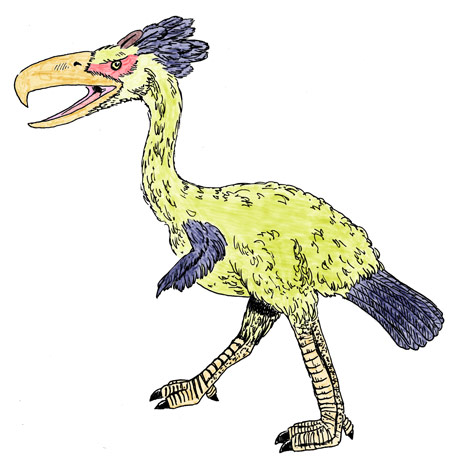
An Illustration of a Giant, Flightless Bird (Kelenken)

A drawing of Kelenken

The Kelenken in all its glory. Picture credit: Everything Dinosaur.

The finding of independent origins of flightlessness also solves a mystery of how these flightless birds dispersed across the world over marine barriers, their ancestors simply flew across them.

Dr Phillips stated that previous research had indicated that Ratite birds were thought to be relics from the super-continent Gondwanaland, which consisted of South America, Australia, India, Africa, New Zealand and Antarctica, all elements of the Southern Hemisphere.  This new study suggests that separate Ratites evolved too recently to have had a common ancestor on Gondwanaland before the super-continent broke up. The study also reveals that today’s flightless birds may have had their origins in the Northern Hemisphere.

Dr Phillips said:

“Not only have we shown that the separate Ratite lineages evolved too recently to have been on Gondwana before its continents drifted apart, but from our analyses we infer that at least ostriches, and possibly Ratites as a whole, have their origins in the northern continents.”

The research paper is published in the scientific journal “Sytematic Biology”, certainly there is something very intimidating when up close to birds like ostriches as they tower over your head.  They have quizzical jerky movements and when they fix you with a stare it is quite frightening.  However, if you want to see evidence of how closely related birds are to dinosaurs simply take a look at their feet.  The feet are very reminiscent of the feet of a theropod dinosaur and they are very reptilian in appearance.

For models of dinosaurs and also extinct, flightless birds: CollectA Deluxe Prehistoric Life Models.

7 02, 2010

New Study of Melanosomes Provides Further Proof of Feathered Dinosaurs

By |2024-04-19T07:17:35+01:00February 7th, 2010|Categories: Dinosaur Fans, Main Page, Palaeontological articles|0 Comments

Sinosauropteryx – a Ginger Dinosaur

A team of scientists from China and the United Kingdom have published a paper indicating that some small theropod, feathered dinosaurs were red heads, in fact, sort of ginger coloured all over.

The article published in the scientific journal “Nature” highlights the work done on the fine bristle-like structures found surrounding parts of the fossilised skeleton of a turkey-sized, 125 million-year-old dinosaur called Sinosauropteryx.  Scanning electron microscopes have shown melanosomes to be present, indicating that these strange features were not the remains of collagen or connective tissue, but most probably feathers.

This is further evidence that many dinosaurs were covered in downy feathers, perhaps to keep them warm but also for display.  The melanosomes contain the pigment melanin and from the ratio of different shaped melanosome structures found in the fossilised feathers the scientists have concluded that this particular Sinosauropteryx was ginger coloured.

Feathered Dinosaurs

The scientists have also discovered that this diminutive carnivore had a “Mohican” of feathers running along its head and back and a striped tail.

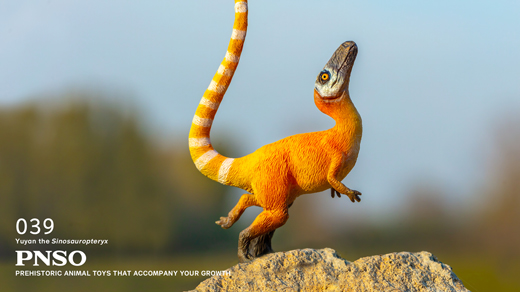
A View of a Model of Sinosauropteryx

PNSO Sinosauropteryx dinosaur model.

PNSO Yuyan the Sinosauropteryx dinosaur model.  The colouration of this dinosaur model has been inspired by the scientific paper.

Sinosauropteryx

Sinosauropteryx caused a sensation when its discovery was announced in 1996.   The fossil of this one- metre-long dinosaur, was found in the Cretaceous deposits of the Liaoning Province in China.  The fossil showed a perfectly preserved small, theropod dinosaur with a covering of an enigmatic fuzz (“protofeathers”), some of these feathery filaments were up to 4 cm long.

To view the range of prehistoric animal figures in the PNSO series: PNSO Age of Dinosaurs Models and Replicas.

The joint Chinese and British team first scanned the fossils of a Cretaceous bird – Confuciusornis.  Confuciusornis is a primitive bird that bridges the morphological and anatomical gap between creatures like Archaeopteryx and modern birds.  It is the most common bird fossil find in the Jehol deposits of Liaoning.

Using an electron microscope to look inside the feathers, researchers were able to see microscopic structures called melanosomes, which, in life, contain the pigment melanin.

Professor Mike Benton, of the University of Bristol, (UK), the leader of this research project commented:

“Melanin is what gives colour to human hair and animal fur.  They are also the most common way that colours are [produced] in feathers.”

Professor Benton explained that differently shaped melanosomes produced different colours, with blacks or greys produced by “sausage-shaped” melanosomes, and reddish or “russet” shades found in spherical ones.

“A ginger-haired person would have more spherical melanosomes, and a black-haired or grey-haired person would have more of the sausage-shaped structures,” said Professor Benton.

Having found both types of melanosomes in the fossils of the bird Confuciusornis, the team decided to turn their attention to Sinosauropteryx in a bid to understand more about he nature and structure of its own feathered coat.

The close view of pictures of the head, show the line of feathers running down the head and the neck, described by the scientific team as a “Mohican”.

The electron microscope study focused on the bands of dark and light that could be seen along the tail of the fossil Sinosauropteryx.  This close examination has shown that the dinosaur’s “Mohican” was russet or ginger-coloured, and that these bands were in fact ginger and white stripes.

“This is the first time anyone has ever had evidence of original colour of feathers in dinosaurs,” said Professor Benton.

Professor went on to add, that this study confirmed that the bristles on this “rather primitive flesh-eating dinosaur… really were feathers”.

This gives more weight to a very well-supported theory that modern birds evolved from theropods, the group of small carnivorous dinosaurs to which Sinosauropteryx belonged.

“Critics have said that these visible spiny structures could be shredded connective tissue,” Professor Benton explained. “But the discovery of melanosomes within the bristles finally proves that some early dinosaurs were indeed feathered.”

The findings also help to resolve a long-standing debate about the evolution and original function of feathers.

“We now know that feathers did not originate as flight structures,” said Professor Benton.

It seems feather-like structures evolved for insulation and display.

Dr Richard Butler, a palaeontologist at the Bavarian State Collection for Palaeontology, in Munich, Germany, said this was a “fascinating and exciting discovery with important implications for understanding dinosaur evolution and biology.  This discovery suggests that with more work we may be able to accurately reconstruct colour patterns in some dinosaur species, and begin to understand how those colour patterns may have functioned for camouflage or display.”

4 02, 2010

Darwin on the “Imperfection of the Geological Record”

By |2023-03-04T15:07:33+00:00February 4th, 2010|Categories: Famous Figures, Main Page, Palaeontological articles|0 Comments

Darwin’s Comments on the Geological Record

For Darwin, at the time of writing his ground-breaking study into evolution – “The Origin of Species”, palaeontology and geology were relatively new sciences.  Amongst the educated elite of Great Britain in the Georgian era, there were to our modern minds some very peculiar ideas.  For example, it was widely believed that Europeans were a separate species to those natives of places such as North America and the Pacific.  Women were considered intellectually inferior to men and they were not permitted to hold certain positions in society or to study at certain universities, or indeed enter a number of academic professions.  These ideas persisted into the Victorian era (indeed, some may say that they have persisted for much longer).

Darwin

It is against this background and a backdrop of a general lack of understanding concerning natural selection and evolution that Darwin attempted to argue his case for a tree of life and an all embracing single theory that could explain the great diversity of life on Earth.

Aware of the difficulties that he would encounter when attempting to convince his readers about the merits of his theory, Darwin, naturally provides extensive evidence in support of his point of view in his book.  However, he also sets out to counter the arguments that he anticipated would be put forward against his hypothesis.  Darwin was aware that his theory centred around the belief that specific forms are distinct from each other but descended from a common ancestor.

Between two specific organisms that share a common ancestor there must have been innumerable transitional links that eventually resulted in the species seen in his day.  He put forward a number of proposals as to why extant transitional forms were extremely rare, the very fact that that subsequent generations would out compete and eradicate their parent generations was one of his main points here.  However, he knew that the lack of transitional extinct forms found in the fossil record would also be used as an argument to counter the thrust of his theory.

The Imperfections of the Fossil Record

Darwin dedicates two of the fourteen chapters in his third edition to explaining why transitional forms are not found in plentiful numbers in the fossil record, some sixty pages in total.  Palaeontology and geology were very much nascent sciences, Darwin comments on the intermittent nature of the geological record and refers to the paucity of the fossil record.  He puts forward a number of points to explain why fossils are so rare and comments on the need for certain geological conditions to be present before fossilisation can occur.  To him the imperfections found in the then known geological record were no barrier to his theory on natural selection.

The “Origin of Species”, or to give this book its full title; “The Origin of Species by Means of Natural Selection or the Preservation of Favoured Races in the Struggle for Life”, was first published in 1859.  The first complete fossilised skeleton of Archaeopteryx was found in 1861.  A perceived weakness in Darwin’s theory was the lack of intermediate creatures preserved in the fossil record.  If animals and plants had been changing from one form to another over vast amounts of time, the process of evolution, then some evidence should be found in palaeontological collections.

Here was a bird with Dinosaurian features, Darwin had predicted that such forms would be found and this was seen by evolutionists as clear support from the geological record for Darwin’s point of view.

Visit Everything Dinosaur’s website: Everything Dinosaur.

1 02, 2010

Haplocheirus – Is it a bird? No, it is a Dinosaur According to New Research

By |2024-04-19T07:14:28+01:00February 1st, 2010|Categories: Dinosaur and Prehistoric Animal News Stories, Main Page, Palaeontological articles|0 Comments

Haplocheirus – Ancient Alvarezsaurid from China

The alvarezsaurids, a bizarre and little known group of swift, cursorial (running) dinosaurs have puzzled scientists since fossils of these unusual creatures came to light in the 1990s.  Are they birds, or are they dinosaurs?  These animals show features of each, for example, bird-like features include a deep keel in the chest and specialised forelimbs, fused ankles and a narrow skull.  These animals were presumably covered in downy feathers and with their long beaks and long legs they would have resembled storks.  However, they possessed a long tail, presumably to balance them as they ran and a bizarre, huge, single claw on the end of each hand.

Originally, known from Cretaceous strata from South America, it was thought these animals were an off-shoot of the Aves (birds).  They could not fly but seem to have evolved to be fast running insectivores, perhaps using their short, but strong arms and powerful claw to break into termite nests.

Whether they were birds or members of the Dinosauria is debated, however, the discovery of the fossils of a alvarezsaurid from the Middle Jurassic has swung the debate in favour of declaring alvarezsaurids as true dinosaurs.

A dinosaur fossil discovered in north-western China and reported upon in the scientific journal “Science” has provided fresh evidence that although alvarezsaurs resembled birds, they must have evolved separately – helping confirm that modern birds are indeed living dinosaurs.

Go to Top