All about dinosaurs, fossils and prehistoric animals by Everything Dinosaur team members.

Articles, features and information which have slightly more scientific content with an emphasis on palaeontology, such as updates on academic papers, published papers etc.

19 05, 2010

Demoting a Dinosaur New Skull Material Takes Azendohsaurus out of the Dinosauria

By |2023-03-06T07:33:51+00:00May 19th, 2010|Categories: Dinosaur and Prehistoric Animal News Stories, Main Page, Palaeontological articles|1 Comment

Azendohsaurus – Not a Dinosaur, as Homer Simpson would say DOH!

A prehistoric reptile that roamed what was Africa in the middle of the Triassic that was once thought to be a primitive herbivorous dinosaur has been proven to be something altogether different.  Analysis of new fossil material has identified this plant-eating reptile that shared the Triassic with the diversifying dinosaurs and pterosaurs, an animal named Azendohsaurus, as a member of the Archosauromorpha.

Azendohsaurus not a Dinosaur

A careful new analysis of Azendohsaurus madagaskarensis using more complete skull material aligns this Middle Triassic reptile with a very different and very early branch of the reptile evolutionary tree.  Although it has several anatomical features that are similar to early herbivorous dinosaurs, new research by a team of scientists at the American Museum of Natural History (AMNH), indicates that this animal was wrongly assigned to the Dinosauria.

The holotype specimen of Azendohsaurus consists of fragmentary teeth and jaws that were discovered in 1972 close by (and named after) a small village in the Moroccan Atlas mountains.  The perils of naming a genus of dinosaur based on teeth evidence alone is well documented, take for example the taxonomic difficulties which are still being encountered nearly 200 years after the naming and describing of the dinosaur genus known as Iguanodon.

The Crystal Palace Iguanodon Figures
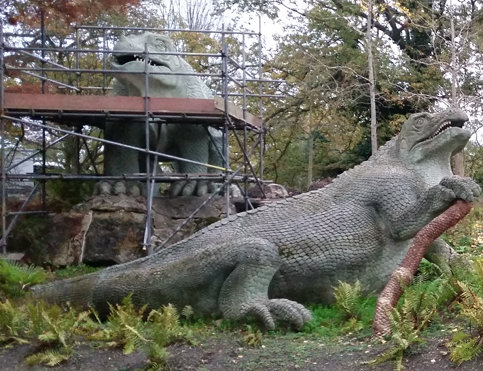
Iguanodons at Crystal Palace.

A pair of Iguanodons study the Crystal Palace landscape.  This dinosaur genus was first identified from fossil teeth. Picture credit: Everything Dinosaur.

Picture credit: Everything Dinosaur

However, the discovery of new, much more complete fossil material, including skull material and a number of individual specimens at a site in southwestern Madagascar has enabled scientists at the American Museum of Natural History (New York) to revise the classification of this particular Triassic reptile.

In a paper published in the scientific journal “Palaeontology”, the researchers state that many aspects of Azendohsaurus are far more primitive than previously assumed, which in turn means that its plant-eating adaptations, similar to those found with some early dinosaurs, were developed independently.  This is evidence of covergent evolution, where different organisms evolve the same adaptations to cope with their environments and the ecosystem.

Commenting on the new research, John J. Flynn, curator in the Division of Palaeontology at the AMNH stated:

“Even though this extraordinary ancient reptile looks similar to some plant-eating Dinosaurs in some features of the skull and dentition, it is in fact only distantly related to Dinosaurs.  With more complete material, we re-assessed features like the down-turned jaw and leaf-shaped teeth found in A. madagaskarensis as convergent with some herbivorous dinosaurs.”

Diagrams show a reconstruction of the skull of the new species of Azendohsaurus.  On top is a lateral or side view, and on the bottom, a palatal or roof of the mouth view.  Note the teeth covering the palate, a highly unusual feature among reptiles, and the down-turned front end of the lower jaw, a feature found independently in many herbivorous archosauromorphs.

This particular creature was initially described and published as an early dinosaur in the scientific journal “Science” over a decade ago, but the completeness of the more recently unearthed and studied fossils has provided the first complete glimpse of what this animal looked like and was related to.  A. madagaskarensis was not a dinosaur.

A Member of the Archosauromorpha

A. madagaskarensis lived during the period of time that dinosaurs and other archosaurs such as crocodiles and pterosaurs were beginning to diversify.  During this part of the Mesozoic one hemisphere (western) was dominated by a huge ocean (the Panthallassic Ocean) and the other hemisphere (eastern) was dominated by an enormous super-continent (Pangaea).  It is possible to have fossils of the same animal found in Morocco and the island of Madagascar today, as during the Triassic, Madagascar and Morocco formed part of Pangaea.  Madagascar did not break away from Africa until towards the end of the Mesozoic.

A. madagaskarensis was 2 to 4 metres long and weighed between 20 and 50 kilogrammes.   A. madagaskarensis was an efficient herbivore with teeth modified for slicing vegetation covering not only its jaws but also the roof of its mouth.

John J. Flynn described this animal as:

“a veritable four-legged weed-whacker.”

Even though early archosaurs were commonly thought to be primarily carnivorous, A. madagaskarensis shows that traits associated with herbivory were much more widespread across archosaur reptiles.

Commenting on this new study, André Wyss, Professor at the University of California (Santa Barbara) stated:

“Now there are many more cases of herbivorous archosaurs.  We are rethinking the evolution of diet and feeding strategies, as well as the broader evolution of the group.”

“This is the way science works,”

added Flynn, commenting on the reinterpretation of the fossils.

“As we found and analysed more material, it made us realise that this was a much more primitive animal and the dinosaur-like features were really the product of convergent evolution.”

André Wyss went onto state, that in many ways Azendohsaurus was turning out to be much more interesting as a non-dinosaur archosaur, than scientists could have imagined if it has stayed assigned to the Dinosauria as just another generic herbivore from the Middle Triassic.

Piecing together a prehistoric animal even when there is a copious amount of fossil material and data to work on is a very difficult task, with just the teeth and fragments of jaws to work with misinterpretations can occur.  However, once more fossils have been discovered a more thorough analysis can take place.  It is not uncommon for new material to lead to the revision of previously accepted work.  So Azendohsaurus is not a member of the Dinosauria after all, as Homer Simpson would say Doh!

We are grateful for the American Museum of Natural History (AMNH) for information on this subject area.

Everything Dinosaur stocks an extensive range of models of archosaurs, including dinosaurs, pterosaurs and crocodilians: Archosaur Models and Prehistoric Animal Figures.
18 05, 2010

Devonian Mass Extinction Event Cleared the way for New Vertebrates

By |2023-03-06T07:35:44+00:00May 18th, 2010|Categories: Dinosaur and Prehistoric Animal News Stories, Dinosaur Fans, Main Page, Palaeontological articles|0 Comments

Mass Extinction Event Opened up New Opportunities for Vertebrates

A paper published in the scientific journal “The Proceedings of the National Academy of Sciences”, by a team of American researchers points to a “seismic shift” in vertebrate evolution at the end of the Devonian Period.  A mass extinction event, some 360 million years ago, so affected life in freshwater and marine habitats that the older forms of vertebrate life effectively gave way and new vertebrates, our distant ancestors, had the chance to take over.  The road was laid open for the surviving tetrapods that would eventually lead to the dinosaurs, birds, mammals and of course our own species.

Late Devonian Mass Extinction

The Late Devonian mass extinction is also known as the Hangenberg event, named from the Hangenberg shale formations that help to mark the Devonian/Carboniferous boundary.  It is one of the “big five” extinction events known in the Phanerozoic Eon.  Although, there has always been a level of background extinctions and there have been many incidences of significant extinction events throughout the history of life on Earth, scientists have identified five especially severe extinction events in the Phanerozoic Eon.

The Late Devonian extinction event severely affected many invertebrate and vertebrate families, especially those of tropical reef-dwelling organisms such as corals, brachipods, bivalves and ancient sponges.  However, it is the demise of prehistoric fish groups such as the placoderms and the actinistians (lobe-finned fish) that may have led to the rapid diversification of the ray-finned fish and the early tetrapods.

The authors of this scientific paper, postulate that the mass extinction of prehistoric fish some 360 million years ago, cleared the way for the evolution of modern vertebrates.

Lead author, Lauren Sallan of the University of Chicago stated:

“Everything was hit, the extinction was global.  It reset vertebrate diversity in every single environment, both freshwater and marine, and created a completely different world.”

Compared to earlier mass extinction events in the Palaeozoic, the Late Devonian extinction does not seem to have been as severe, when the percentage loss of marine invertebrate genera (easier to measure in fossil record) is calculated.  However, by the Late Devonian, life on planet Earth had become more diverse than in earlier periods such as the Cambrian and Ordovician.  There were far more species in total and many more species per genera.  The Late Devonian mass extinction event wiped out a far higher number of taxa in absolute terms.

Devonian Mass Extinction

While the mass extinction at the end of the Devonian period is among the five most significant in the Earth’s history, researchers are not certain as to how it was triggered or indeed what the major causes of the extinction were.  The Late Devonian event, in common with most other extinctions does not appear to have been caused by a single overriding factor, this extinction seems to have been precipitated by a combination of factors that lasted over the course of some 20 to 25 million years.

Scientists have found evidence of extraterrestrial impacts in the geological record and also traces of iridium from volcanic eruptions, these factors may have helped cause instabilities in food webs and this may have contributed to the extinction event.  Although, global sea levels were much higher than they are today throughout the Devonian, there was a dramatic fall in sea level towards the end of the Devonian period.  Substantial glacier formation has been indicated, the onset of a global cooling.

This would have triggered climate change and put ecosystems under pressure.  The formation of glaciers would have locked up large amounts of water and this would have led to the lowering of sea levels, substantially affecting marine and subsequently freshwater faunas and floras.

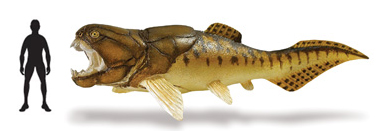
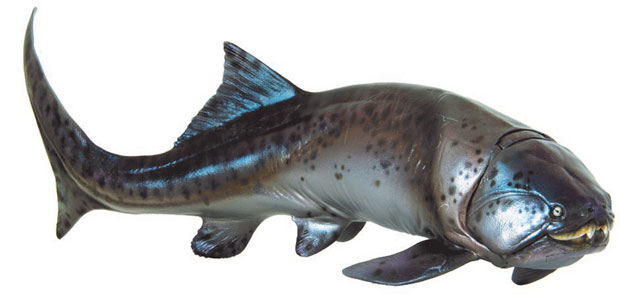
A Model of a Placoderm – Dunkleosteus

Zaha the Dunkleosteus (PNSO)

A stunning model of a placoderm – the PNSO Dunkleosteus model.

The placoderm model (above) comes from the PNSO range, to see this range: PNSO Age of Dinosaurs.

The establishment of the first masses of plant materials on land, the first forests and such like could also have had a radical effect on the atmosphere, which in turn could have affected life on Earth.

What Caused the Extinction Event?

Whatever, the cause (or causes) of the extinction event, those groups of fishes such as the armoured placoderms and the lobe-finned fish which had dominated ecosystems were replaced by the ray-finned fish in a demographic shift that persists to this day, according to the authors of this research paper.

It is certainly true, that impressive beasties such as the fearsome, 10-metre long Dunkleosteus (Placoderm) became extinct, providing an opportunity for other organisms.  Dunkleosteus (D. terrelli) was a formidable predator of marine environments feeding on fish, including primitive sharks and cephalopods.  With two pairs of tooth plates (extensions of the jaw bone) and an interlocking plate in the lower jaw, Dunkleosteus is armed with jaws that resemble a razor sharp vice.  However, these animals were to become extinct by the end of the Devonian.

A Scale Drawing of the Fearsome Placoderm Dunkleosteus

Picture credit: Everything Dinosaur

To view the Dunkleosteus model used  in the diagram and other prehistoric animal figures: Safari Ltd. Wild Safari Prehistoric World.

Commenting on the extinction event that led to the demise of such fish groups as the placoderms, co-author of the paper, biologist and anatomist at the University of Chicago, Michael Coates stated:

“There is some sort of pinch at the end of the Devonian.  It’s as if the roles persist, but the players change; the cast is transformed dramatically.  Something happened that almost wiped the slate clean and, of the few stragglers that made it through, a handful then re-radiate spectacularly.”

This is certainly true for the ray-finned or bony fishes, today for example there are an estimated 30,000 species world wide.  By examining the vertebrate fossil record, the authors of this paper, Sallan and Coates were able to pinpoint a critical shift in the diversity of vertebrates at the time of the Hangenberg extinction.

While the earliest four-limbed creatures, or tetrapods, made the first tentative steps toward a land-dwelling existence prior to this extinction event, there was a 15 million year stretch of the fossil record almost barren of tetrapods.

Sallan stated:

“Something that’s seen after an extinction event is a gap in the records of survivors.  You have a very low diversity fauna, because most things have been killed off.”

The limited number of tetrapods which survived the extinction were likely to be the early ancestors of the vast majority of modern land vertebrates, the authors speculate.  It is certainly true, that extinction events remove biodiversity and can allow niches to appear that can be readily exploited by other species.

Coates added:

“Extinction events remove a huge amount of biodiversity.  That shapes in a very significant way the patchiness of biodiversity that persists to the present day.”

A spokesperson for Everything Dinosaur commented:

“A mass extinction event can lead to a sudden reduction in biodiversity, then as the fauna and flora begins to recover new types of animal can adapt and evolve to exploit those environmental niches that are effectively empty.  This can cause a seismic shift in the evolution of life on Earth.”

11 05, 2010

New Archaeopteryx Study Reveals Chemical Link Between Dinosaurs and Birds

By |2023-01-05T13:51:15+00:00May 11th, 2010|Categories: Dinosaur and Prehistoric Animal News Stories, Main Page, Palaeontological articles|0 Comments

Archaeopteryx Reveals Chemical Link Between Dinosaurs and Birds

A team of Anglo/American researchers have published a new study on one of the most famous of all the creatures in the fossil record, Archaeopteryx.  Thanks to the use of some very sophisticated technology; the team have revealed a chemical link between this primitive Jurassic bird and modern birds.

This crow-sized bird displays an unambiguous mix of characteristics from two linked groups of animals – Theropod dinosaurs and Aves (birds).  The skeleton, beautifully preserved in a number of specimens from Solnhofen (Germany) shows many features of small, meat-eating, cursorial dinosaurs.  Archaeopteryx had a three-fingered hand like that of a theropod dinosaur but a four-toed foot with the first toe potentially reversed to the other three to help it perch in trees like a bird.  Earlier specimens of Archaeopteryx had been interpreted as having a perching adaptation, but the specimen used in the chemical analysis shows evidence of Archaeopteryx not having a reversed first toe.  The jaws were lined with fine, needle-like teeth and Archaeopteryx had a long, bony reptilian tail.  However, the most strikingly birdlike feature of Archaeopteryx is the feathers, exquisitely preserved in the fine-grained, lithographic limestone in a number of specimens.

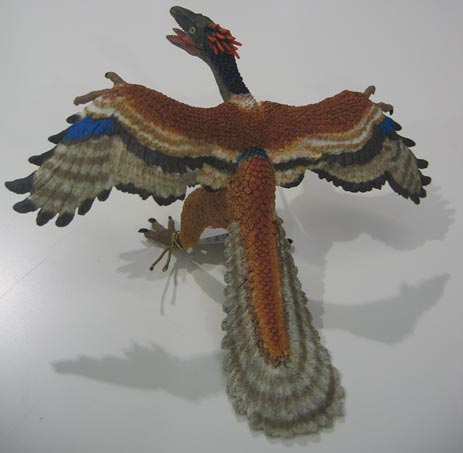
A Model of the Jurassic Bird Archaeopteryx

Papo prehistoric animal models (Papo Archaeopteryx).

Papo Archaeopteryx “ancient wing” by Papo.  Picture credit: Everything Dinosaur.

Picture credit: Everything Dinosaur

The model in the photograph (above) is the Papo Archaeopteryx figure.  To view the Papo model range: Papo Prehistoric Animals.

In the study, published in the scientific journal “The Proceedings of the National Academy of Sciences” new light is shed (literally one of the fossils was exposed to powerful X-rays), on the chemical relationship between dinosaurs and birds.

Extremely strong X-ray beams and other high tech equipment reveal that in the Archaeopteryx fossil studied, (The Thermopolis specimen, described in 2005 and on display at the Thermopolis museum in Wyoming, USA), chemical components of feathers, the residues of decayed organic materials remain in association with the fossilised bones.  Such residues would not be apparent in a visual inspection and the traces of feathers would remain undetected in a conventional analysis.

The use of such powerful x-ray equipment and sophisticated technology is helping to provide palaeontologists with new data on long extinct creatures.  The research, led by scientists at the University of Manchester and the U. S. Department of Energy’s SLAC National Accelerator Laboratory has led to the chemical mapping of the fossil and elements of the surrounding matrix.  Using powerful computer programmes, the X-ray data and chemical analysis has helped the team map out the chemical signature of the Archaeopteryx specimen used in the study.

The feathers contain phosphorous (P) and sulphur (S), these same chemical elements are found in the feathers of Neornithes (modern birds).  Trace amounts of copper  (Cu) and zinc (Zn) were also found in the fossilised bones.  Like birds today, Archaeopteryx may have required those elements to stay healthy.

Commenting on the research work, University of Manchester palaeontologist Phil Manning said:

“Archaeopteryx is to palaeontology what Tutankhamen is to the science of archaeology.  It’s simply one of the icons of our field.  You would think that after 150 years of study, we would know everything we need to know about this animal, but guess what – we were wrong.”

Lead author geochemist Roy Wogelius from The University of Manchester added:

“We talk about the physical link between birds and dinosaurs, and now we have found a chemical link between them.  In the fields of palaeontology and geology, people have studied bones for decades.  But this whole idea of the preservation of trace metals and the chemical remains of soft tissue is quite exciting.”

The researchers found significantly different concentrations of elements in the fossil than in the surrounding rock matrix, confirming that the chemicals are remnants of the animal and not minerals leached from the surrounding rock into the fossil.

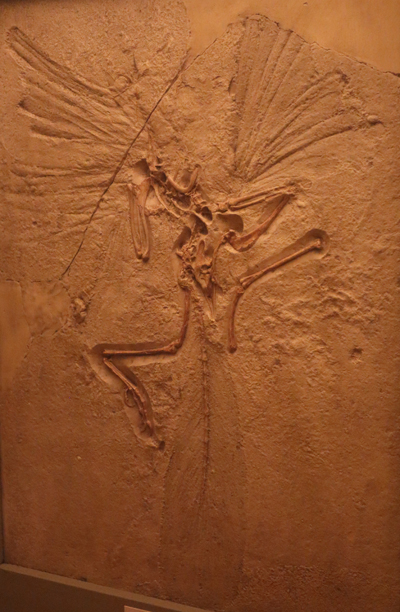
A Cast of a Famous Archaeopteryx Fossil

Archaeopteryx fossil cast

Archaeopteryx fossil cast. Picture credit: Everything Dinosaur.

Picture credit: Everything Dinosaur

SLAC physicist Uwe Bergmann, who led the X-ray scanning experiment, stated:

“People have never used a technique this sensitive on Archaeopteryx before.   Because the SSRL beam is so bright, we were able to see the teeniest chemical traces that nobody thought were there.”

Sophisticated technology such as the synchrotron are becoming as important to palaeontologists as the trusty geological hammer.  The use of such equipment is helping scientists to learn fresh insights and to gain new data about the organisms that make up our fossil record.  It is not really surprising to see the same “chemical fingerprint” of feathers in a fossil of an ancient bird as you would expect to find in a modern bird.  This X-ray scanning technique may have more significant implications when studying less well preserved theropod fossils.  The lithographic limestones in which the feathers of Archaeopteryx are preserved have enabled exquisite details of the specimen to be studied.  Other theropod fossils, perhaps those preserved in coarser grained sandstones may not show the presence of feathers.  Under X-ray scanning, a different picture may emerge, the chemical fingerprint of feathers could be inferred from the analysis of elements within the fossil matrix.  Scientists may be able to infer the existence of other feathered dinosaurs, even though no trace of the delicate feathers themselves have been preserved.

8 05, 2010

British Columbia Proposes Provincial Fossil (Four Contenders in the Running)

By |2023-03-05T13:22:59+00:00May 8th, 2010|Categories: Animal News Stories, Dinosaur and Prehistoric Animal News Stories, Main Page, Palaeontological articles|0 Comments

British Columbia wants a Provincial Fossil – Four Candidates in Contention

British Columbia, Canada’s westernmost province is looking for its own provincial fossil, to join the list of natural fauna and flora that represent this part of Canada.  A number of American states and Canadian provinces have their own stated fossil representative, for example Alaska has a Woolly Mammoth and California has adopted the Sabre-toothed cat sub-species S. fatalis in respect to the large amounts of Smilodon material found at La Brea tar pits.

Alberta has fossilised trees (petrified wood) as their provincial stone, but surprisingly this fossil rich area has no official fossil to represent it.  Only Nova Scotia in Canada has a provincial fossil – Hylonomus lyelli.  This primitive reptile, the oldest known true egg-laying (amniote).  Forty of the U.S. states have a state fossil and following this trend, British Columbia has drawn up a shortlist of four candidates.

The British Columbia Palaeontological Association (BCPA) in conjunction with a number of Canadian universities has selected the four candidates from the huge range of extinct fauna and flora in the British Columbia fossil record.  All thirteen of Earth’s major, life-bearing geological systems, from Vendian to Quaternary, are represented in the province, spanning the last 600 million years.  Examples of British Columbia fossils range from trilobites, conodonts (early relatives of back-boned animals), gastropods and bivalves, corals, early fish, ammonites, dinosaurs and prehistoric animal  tracks, huge sea reptiles from the Mesozoic and sharks.

The fossil record of plants in British Columbia is equally impressive with ferns, cycads, ancient conifers and early angiosperms.  The BCPA state in their press release that the province has “spectacular samples of the diversity of ancient life that has walked across British Columbia’s varied landscapes and lived in its oceans”.

Provincial Fossil

British Columbia has a number of provincial symbols and has celebrated its rich natural heritage through designation of a Provincial Flower (Pacific Dogwood), a Provincial Bird (Stellar Jay), a Provincial Tree (Western Red Cedar), and a Provincial Gemstone (BC Jade).   Government officials now want to add a provincial fossil to this list, a recognition of the importance of British Columbia to the Earth sciences.

Discussions amongst the membership and individual palaeontological societies of the BCPA have resulted in the short-list of four fossils.  The four candidate fossils represent a variety of animal types, each group of which has had a significant impact on the development of life on Earth and in British Columbia.

Four Candidate Fossil Specimens

Here is the short-list:

1).  The Permian Fusulinid (Yabeina columbiana)

Not the most widely known type of fossil, but a very important fossil from an extremely important group of animals in the fossil record.  Fusulinids are an extinct type of sea creature, that lived in ancient oceans from about 440 million years ago to approximately 250 million years ago.  Yabeina columbiana was one of the last types of this animal to evolve.  Individual Yabeina specimens probably lived like tiny snails, crawling along the shallow, warm sea bottom – an epifaunal lifestyle.   These animals were extremely numerous as the accumulation of shells form entire strata of blue limestone.

As the British Columbia Provincial Fossil, Yabeina columbiana would represent an exciting period in the history of the formation of the west coast of North America.  It is also abundant enough that everyone could collect a specimen, the strata in which this particular fossil is found is studied by palaeontologists and geologists from all over the world.

Pictures show a small sample of blue limestone with a number of Yabeina fossils, the rock looks like it has been pock-mocked and it is these marks that represent the fossil.  Under a powerful microscope, the fine detail of the tiny fossil shells can be made out and it is differences in the shell structure that is used to determine individual species.

2).  The Cretaceous Ammonite (Canadoceras yokoyamai)

Ammonites were cephalopods, extinct relatives of squid and cuttlefish.  They are important world wide as zonal fossils and there are many genera known from British Columbia.   Ammonite fossils are relatively common in British Columbia, especially in the Cretaceous aged rocks on the west coast as well as in the northeastern part of the province.

The ammonite selected for the shortlist is Canadoceras yokoyamai, sometimes called the “Canadian horn”.  It is known from rocks about 80 million years old that are preserved along the eastern side of Vancouver Island.   This genus of ammonite was named after Canada, the species name, yokoyamai, is named after the Japanese palaeontologist Yokoyama and examples of the species are also known from Japan.

This fossil is also known from many other regions of the Pacific Rim, including California, Alaska, and Far East Russia.  This ammonite fossil demonstrates the strong geological links between western British Columbia and other countries that border the modern Pacific ocean.Picture Credit: BCPA

The strong rib lines can clearly be seen on specimens.  Ammonites are important to palaeontologists and geologists as they can help establish the relative ages of widely separated outcrops of rock using the fossils that they contain.

3).  The Cambrian Lace Crab – Marrella splendens

Tucked along a precipitous mountain face in Yoho National Park in southeastern British Columbia, is an excavated pit which has produced some of the most important fossils the world has ever seen.  This is the famous Burgess Shale quarry pit, which exposes sedimentary rocks that accumulated during the Cambrian Period early in the Palaeozoic Era, approximately 530 million years ago.

The animal life preserved in the Burgess Shale pit, called the “Burgess Shale Fauna,” is important as it documents an abundance of soft-bodied life-forms (that is, animals lacking shells) that represent a veritable explosion of evolutionary activity early in the history of large-scale life on Earth.  Prior to this “Cambrian Explosion,” the world’s seas were seemingly the domain of simple life-forms, such as jellyfish and sponges.  But around the time of the Burgess Shale, an abundance of new, unusual, and unique life forms appeared.

One of the most abundant and fascinating of these Burgess Shale forms is the “Lace Crab,” or Marrella splendens.  Marrella has wispy appendages and unusual morphologic features which led palaeontologists starting in the 1970s to question the identification of many of the Burgess Shale fossils with the traditional arthropod groups to which they had been assigned.  In fact, many of these forms were found to represent life forms which have no modern counterpart in the modern Earth biota, that is no extant relatives.  It was only then that the true importance of the Burgess Shale fauna became clear.

The site preserves a record of many experimental life-forms that evolved early in the Palaeozoic Era, in the early beginnings of multicellular life, many of which proved to be evolutionary dead-ends which soon went extinct.  Given its importance for the history of Life on Earth, the Burgess Shale quarry has been designated a UNESCO World Heritage site.

In the wonderfully well preserved fossil in the pictures, antennae, legs and even the delicate gills are clearly visible.  Named the “Lace Crab” by Charles Doolittle Walcott, the famous American palaeontologist who discovered the first “Burgess Shale” fossils in 1909, Marrella is in fact believed to be a primitive nektonic (animal that swims actively) shrimp.

4.  The Cretaceous Elasmosaur from Puntledge River

A superbly preserved, almost complete fossil of a Late Cretaceous marine reptile makes up this quartet of potential British Columbia provincial fossils.  Elasmosaurs were long-necked plesiosaurs that lived world wide and survived until the very end of the Cretaceous period.

While individual pieces of elasmosaur specimens have been found at various localities in British Columbia, the most complete elasmosaur ever found in Canada, is the specimen on display in the Courtenay and District Museum and Palaeontology Centre on Vancouver Island.  This elasmosaur specimen was found by an amateur paleontologist Mike Trask and his daughter Heather, who were looking for fossils along the Puntledge River one fine autumn afternoon in 1988.

Expecting to find the usual ammonites and clam fossils that are mostly found in these rocks, the father and daughter team was surprised to find what appeared to be fragments of vertebrae sticking out of the strata in a rock wall along the river.  Subsequent collecting over the next several weekends turned up numerous teeth and bone fragments which eventually were found to be part of a complete jaw and skull.

Once the significance of the find was established, the Courtenay Museum organised a major scientific excavation of the fossil specimen, which galvanised local community attention.  Many hundreds of volunteers turned out to help with the excavation work, firing the interest of many in the science of palaeontology.  As a result of all this activity, one of British Columbia’s first palaeontological societies was formed, in Courtenay.

The 12-metre-long elasmosaur is one of the best preserved of all vertebrate Late Cretaceous fossils, ever found in North America.   A replica of the specimen, is the star exhibit in the Courtenay and District Museum.  The elasmosaurid is even used as the logo for this museum.

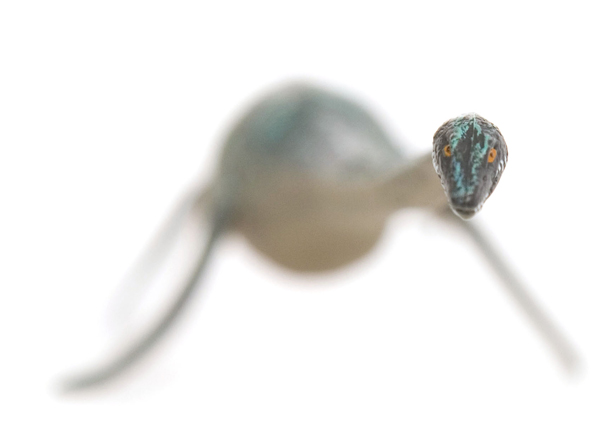
A Model of an Elasmosaurid

Provincial fossil candidate an elasmosaurid.

An elasmosaurid is a candidate for the Provincial fossil of British Columbia. Picture credit: Everything Dinosaur.

Picture credit: Everything Dinosaur

To see a replica model of an elasmosaurid and other prehistoric animal models, take a look at the CollectA Age of  Dinosaurs Model range: CollectA Prehistoric Life Age of Dinosaurs Models.

These four specimens represent the diversity of the Canadian fossil record.  British Columbia can be very proud of its fossils, all four candidates are strong contenders and the BCPA is inviting comments and feedback before a winner is selected.

After some debate amongst Everything Dinosaur team members, we have agreed to support the Marrella specimen.  Not only is the degree of preservation exquisite but the Burgess Shale has yielded thousands of Cambrian fossils, many of which have their soft parts preserved and as such it is one of the most remarkable fossil sites in the world.

3 05, 2010

Filling the Gap in the North American Ornithocheiridae

By |2023-01-05T10:27:48+00:00May 3rd, 2010|Categories: Dinosaur and Prehistoric Animal News Stories, Main Page, Palaeontological articles|0 Comments

Pterosaur Jawbone Hints at Greater Diversification of Ornithocheirids in North America

The fossilised mandible of a flying reptile (pterosaur) is helping scientists to piece together a puzzle that has confused palaeontologists for generations.  Pterosaurs, those winged reptiles, the first vertebrates to evolve powered flight, ruled the skies for much of the Mesozoic.  From their Triassic origins; this group of reptiles rapidly diversified and although they began to decline in numbers towards the end of the Cretaceous, the last of their kind persisted to the very end of the Mesozoic.

Flying Reptile

However, one particular family of pterosaurs, the Ornithocheiridae (the name means bird hand), despite being widespread and numerous were almost absent from the fossil record of Cretaceous North America.  This omission had puzzled scientists.  The Ornithocheiridae consist of a number of genera, fossils of which have been found in England, Europe, South America, Australia and Asia but to date only one fragmentary pterosaur fossil from the whole of North America has been ascribed to this particular family of flying reptiles.  Most of these fossils date from the Early Cretaceous and some specimens represent species that may have rivalled the later Azhdarchidae as being the largest flying creatures ever.  Ornithocheirus for example, a genus that represents ten species, may have had a wingspan in excess of 13 metres.  However, the true size and diversity of this genus is difficult to assign accurately as the vast majority of pterosaur fossils relating to Ornithocheirus are fragmentary and poorly preserved.

However, the fossil finds of Ornithocheiridae in the whole of North America has just been doubled, thanks to the discovery of a 95-million-year-old jawbone.  In a paper published in the scientific publication “The Journal of Vertebrate Palaeontology”, the jawbone, discovered in Texas, four years ago is formerly described and a new genus of ornithocheirid announced.  Enter Aetodactylus halli (the name means Hall’s eagle finger – after Lance Hall the amateur fossil hunter who found the fossil in 2006).

This pterosaur was very probably a fish-eater (indicated by dentition in the jawbone), it soared over what is now Dallas, approximately 95 million years ago (Cenomanian faunal stage).  For much of the Cretaceous, North America was divided in two by a shallow sea (the Western Interior Seaway).  It is likely that there were many ornithocheirids living at the time, but the geological conditions and their delicate, air-filled bones reduce the likelihood of fossil preservation.  The jawbone indicates that this animal may have had a wingspan in excess of 3 metres.

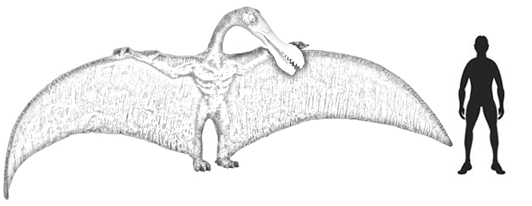
A Scale Drawing of an Ornithocheirus

Flying reptile Ornithocheirus.

Ornithocheirus “bird hand” a scale drawing.

Picture credit: Everything Dinosaur

For replicas of ornithocheirids and other flying reptiles: CollectA Age of Dinosaurs Popular Range.

The fossil jawbone is compelling scientists to review the evidence for ornithocheirids in North America, commenting on the discovery Timothy Myers of Southern Methodist University’s Huffington Dept. of Earth Sciences stated:

“The fossil hints at a diversity of pterosaurs in the Cretaceous of North America that wasn’t previously realised.”

The only other North American pterosaur fossil ascribed to the Ornithocheiridae was discovered here, too, suggesting that the dearth of other ornithocheirids in North America might be more a function of geography and geology than actual biological distribution.

The press release describing the discovery of this new genus of flying reptile states:

“The ancient sea that covered Dallas provided the right conditions to preserve… the delicate bones of flying reptiles that fell from their flight to the waters below.  The rocks and fossils here [Texas] record a time not well represented elsewhere in North America.  That’s why two species of ornithocheirids have been found here but nowhere else, and that’s why discoveries of other new fossils are sure to be made….”

Lance Hall the amateur fossil collector who found the jawbone, discovered the specimen eroding out of an exposed piece of shale near a road southwest of Dallas.  It seems likely that this animal’s body was swept out to sea, or perhaps it fell from the sky into the sea, sunk and was rapidly buried at the bottom in soft mud.

American scientists are hopeful that more fossils will be found in the strata, helping to shed further light on the diversity of Pterosaur genera in the region.

29 04, 2010

Ontogenic Characteristics of Feathered Dinosaurs

By |2023-03-05T14:01:19+00:00April 29th, 2010|Categories: Dinosaur and Prehistoric Animal News Stories, Main Page, Palaeontological articles|0 Comments

Baby Dinosaurs may have had Different Feathers from their Parents

In a few weeks time those garden birds that have nested and raised a brood successfully will be seeing their youngsters fledge and leave the nest.  A baby Blackbird for example, will moult, losing its downy insulation of feathers and develop feathers that are indistinguishable from its parents.  This youngster, that just a short while ago was an embryo, will look very similar to an adult of its species.  However, in a new paper published in the scientific journal “Nature” it seems that juvenile dinosaurs may have looked strikingly different from their parents.

Feathered Dinosaurs

In a study of two fossils one of an adult, the other of a juvenile dinosaur of the same species; by Chinese scientists, there is evidence to suggest that theropod dinosaur species at different growth stages may have had dramatically different feathers.  The fossils may indicate that as dinosaurs grew, their feathers changed dramatically.  This is the first time that such evidence has been seen in the fossil record and the interpretation of these two fossils, both recovered from the fossil rich Yixian Formation of western Liaoning (northern China), is being hotly debated by both palaeontologists and ornithologists.

The sedimentary rock formations of Liaoning Province are world famous due to the remarkably well-preserved Cretaceous fossils that they contain.  Much of our knowledge about feathered dinosaurs is due to the myriad of amazing and superbly well-preserved fossils of small theropod dinosaurs that have been discovered in quarries from this part of China.  The fine-grained, siltstones were formed by volcanic ash from nearby volcanoes that frequently erupted during the Early Cretaceous.  Animal and plant remains that had become deposited in lakes in the area were rapidly buried by the ash and this has led to the remarkable state of fossil preservation.  A number of small, feathered theropod dinosaurs are known from the area, dinosaurs such as Sinosauropteryx and Sinornithosaurus as well as birds, plant remains and even insects.

The dinosaur fossils that have attracted so much interest over how feathers may have changed dramatically as dinosaurs grew and reached maturity; are those of the small, oviraptorid Similicaudipteryx (Similicaudipteryx yixianensis).  This particular theropod is known from three specimens and it was formerly named and described in 2008.  Crucially, the local farmers who help the scientists to find fossils, found examples of an adult, whilst the other two fossils represent younger animals.

A Juvenile Similicaudipteryx

Photographs show a fossil of a juvenile Similicaudipteryx on the left with the fossilised remains of an adult on the right.  A team of researchers from the Institute of Vertebrate Palaeontology and Palaeoanthropology (IVPP) from Beijing have interpreted the fossils and produced a paper suggesting that unlike modern birds, the plumage and feathers of dinosaurs changed as these animals grew and reached maturity.

Similicaudipteryx was a small, bipedal, feathered dinosaur it was closely related to Caudipteryx (another feathered dinosaur discovered in Liaoning).

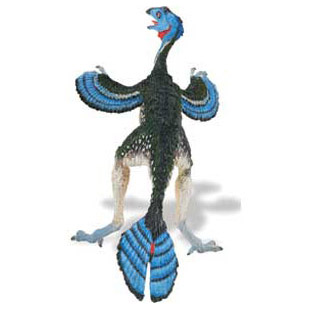
An Image of Caudipteryx

Cauditperyx. Images of feathered dinosaurs.

An image of the small, feathered dinosaur Caudipteryx.

To view models and replicas of feathered dinosaurs take a look at the Wild Safari Prehistoric World model range: Safari Ltd. Wild Safari Prehistoric World Models.

The fossils indicate that this little theropod had a maturation pattern not seen in modern birds.

Commenting on the paper, one of the authors, Xing Xu of the IVPP stated:

“This baby dinosaur has bizarre flight feathers, which are strikingly different from those of adults.  These 125-million year old fossils expand our knowledge of feather evolution.”

The wing and tail feathers of the more mature dinosaur resemble quill pens. These ‘pennaceous’ or contour feathers have a central shaft that runs through its entire length. Conversely, the feathers of the younger dinosaur have a flat, ribbon-like stem at one end, but the more familiar pennaceous feather at the tip.  The early juvenile also has smaller wing feathers than tail feathers, but this size difference is less significant in the specimen that represents an older more mature specimen.

Neither adults or juveniles could fly, it is likely primitive feather-like structures first developed to help insulate and keep warm these small active animals.  In mature adults, the feathers may have become more ornate and might have played an important role in communication and display.

Palaeobiologists say that if the Chinese team’s interpretation of the fossils is correct, it would be the first time that juvenile dinosaurs have been shown to have a different type of feather from adults.

Mike Benton from the University of Bristol (UK) added:

“Modern birds don’t make such a transition.  Apart from the downy feathers of newborns, all later stages of modern birds are characterised by the same flight feathers. This paper marks the first step in attempts to disentangle the evolution of developmental sequences among birds and their ancestors.”

However, some ornithologists and developmental biologists have questioned the conclusions made in the Chinese paper.  They query whether the younger fossil shows a ribbon-like feather or is instead from the bird’s moulting phase.

Yale University’s Richard Prum, a leading ornithologist and expert on bird plumage stated:

“Feathers are complicated.”

When modern birds regenerate their feathers, the new ones grow rolled-up in a tube sheath.  Prum has commented that the fossilised feathers of the younger dinosaur could be interpreted as a preserved image of feathers emerging from their sheath; like modern feathers in active moult.

But IVPP scientist Xu maintains that this finding is “not an artefact of preservation or temporary morphology” based on the proportions of the feathers.  If the juvenile feathers were simply in active moult, he would expect the ribbon-like part of the feather to be shorter.  If the Chinese interpretation of the fossil data is correct then this will be the first demonstration that these feathered dinosaurs could undergo changes of plumage as they grew and matured.

Pictures show an artist’s interpretation of the Similicaudipteryx fossils, the juvenile is in the foreground with the adult just behind.

Using work done by Prum, Chuong and others, Xu and his colleagues at the IVPP suggest that the unusual partially-pennaceous feather might be a result of the delayed expression of genes that are activated earlier in modern birds.

Canadian palaeontologist Phil Currie commented:

“Dinosaurs had been experimenting with feathers and feather-like structures for a period of at least 25 million years before the dinosaurs described here [Similicaudipteryx].  The wonderful thing about this paper is that it provides developmental clues that may force palaeontologists, ornithologists and developmental biologists to recognise a broader spectrum of possibilities rather than looking for some simple answer.”

23 04, 2010

Ethnicity in North American Cretaceous Dinosaurs According to New Study

By |2024-04-18T21:43:32+01:00April 23rd, 2010|Categories: Dinosaur and Prehistoric Animal News Stories, Dinosaur Fans, Main Page, Palaeontological articles|0 Comments

Researchers Refute Claims about Distinct and Separate Mega Faunas of North America

The debate about dinosaur ethnicity in North America during the Late Cretaceous continues.

During the Late Cretaceous, North America was effectively split in two by a shallow sea.  The size of this sea fluctuated during the Campanian and Maastrichtian faunal stages.  At times it stretched northwards from the Gulf of Mexico extending all the way to the Arctic Ocean, this seaway is known as the Western Interior Seaway, it persisted until the early stages of the Tertiary, however, during the Cenozoic the sea levels gradually began to fall and the land was slowly exposed again.  By approximately 45 million years ago, much of the continent of North America we know today had been reclaimed as land, with only a small, shallow area of sea left remaining covering the south-west United States.  This sea is known by geologists as the Cannonball Sea.

Dinosaur Ethnicity

Some palaeontologists, as they review the dinosaur fossils found on the eastern side of the Western Interior Seaway, that is fossils of dinosaurs found in places such as Alberta in Canada, right down to Texas and Mexico in the south, believe that there were distinct and separate dinosaur faunas.  It seems that some types of dinosaur lived in particular parts of North America, with other dinosaurs, similar genera filling the same environmental niches in other parts of the continent.  This theory – a sort of dinosaur ethnicity was touched upon in an earlier article when we reported on the discovery of a new Pachycephalosaur in Texas – Texacephale langstoni.

To read more about this recent discovery: Hard-headed dinosaur, a new genus of Pachycephalosaur from Texas.

In addition, the discovery of this pachycephalosaur fossil in Texas seems to support a theory put forward by many North American scientists that the dinosaur fauna of Canada and the northern USA was very different from those dinosaurs found in Late Cretaceous southern USA. In  interpreting the fossil evidence, a number of scientists have concluded  that there was a sort of ethnicity amongst dinosaurs, with northern genera distinct from their southern neighbours.

Commentating on this, lead author of the research paper on the new Texas pachycephalosaur; Nicholas Longrich said:

“Instead of roaming across the North American continent, we see pockets of different dinosaurs that are pretty isolated from each other.  Every time we get good fossils from Texas, they end up looking very different from those to the north.”

However, this concept of ethnicity is being challenged by a group of Canada scientists who have just published a paper refuting the dinosaur ethnicity theory in the scientific journal “Proceedings of the National Academy of Science”.  Those scientists who support the distinct fauna theory of North America suggest that some horned dinosaurs such as Triceratops lived in the interior of the west (ironically close to the coast of the Western Interior Seaway), whilst closely related ceratopsians such as Torosaurus were to be found in the south.

Duck-billed dinosaurs dominated in the northern latitudes but one of the last North American sauropods the 20-metre-long Alamosaurus, inhabited only the southern part of the United States.  Geological evidence seems to show that there were no physical boundaries to prevent dinosaur migration and a mixing of different faunas.  The climate does not seem to be a factor, as the Late Cretaceous climate of this part of the world was relatively uniform, warm and humid.

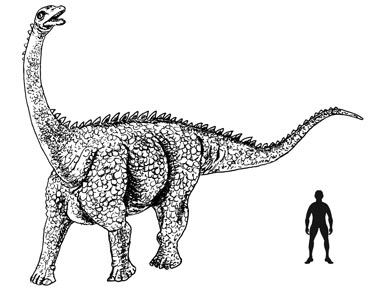
A Scale Drawing of the North American Late Cretaceous Titanosaur Alamosaurus

Alamosaurus scale drawing.

Scale drawing of Alamosaurus.  A titanosaur from the USA, its ancestors migrated into North America from South America. Picture credit: Everything Dinosaur.

Picture credit: Everything Dinosaur

Challenging the Established Order

However, palaeontologists Matthew Vavrek and Hans Larrsson of McGill University (Montreal) have challenged this belief, stating that the ethnicity that is seen in the fossil record is a result of the paucity of the fossil material of dinosaurs found to date.  They conclude that because fossils survive and are found in a totally random way, and because some sites have been studied more extensively than others our understanding of the mega-fauna is skewed in favour of seeing distinct groups of animals in the fossil record.

Extrapolating from samples found at four areas that each contained large numbers of fossils, their analysis found no evidence of distinct ranges.  Instead, they found evidence of a single dinosaur community in the warm, uniform climate of the area.

We suspect the debate will rumble on and a couple of Everything Dinosaur team members are trying to put together a Key Stage 3 (UK National Curriculum) study pack so that school children can weigh up the arguments for themselves and see what they can make of the evidence.

Visit Everything Dinosaur’s award-winning website: Everything Dinosaur.

8 04, 2010

New Evidence of Velociraptor Feeding Behaviour – Scavenging the Carcase of a Protoceratops

By |2024-04-19T10:06:16+01:00April 8th, 2010|Categories: Dinosaur and Prehistoric Animal News Stories, Dinosaur Fans, Main Page, Palaeontological articles|1 Comment

Fossil Find Shows Evidence of a Velociraptor Feeding upon Another Dinosaur

Velociraptor that speedy Late Cretaceous predator with its sickle-shaped “killing claw” on the second toe of each foot, plus a jaw lined with more teeth than a T. rex has a deserved reputation for being vicious amongst dinosaur fans and scientists.  However, with the exception of one amazing fossil find made in 1971, palaeontologists had little evidence of what this turkey-sized animal fed on, but now that has changed thanks to a remarkable discovery made in China.

A Fight to the Death

Picture credit: Polish Academy of Sciences

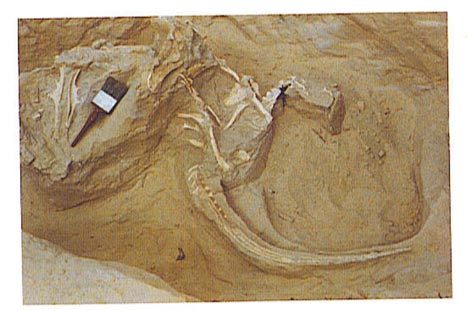
The picture above shows the partial excavation of one of the most famous dinosaur fossils discovered to date.  A Polish expedition exploring Late Cretaceous strata at a site called Toogreeg in the Gobi desert of Mongolia, uncovered evidence of a fight to the death between two dinosaurs.

A predatory Velociraptor (seen on the right of the picture) has been preserved alongside a Protoceratops (herbivore).  The tangled fossil shows that the Velociraptor had grasped the plant-eater’s head and was delivering vicious kicks to the underbelly of the Protoceratops, whilst the Protoceratops gripped the attacker’s arm in its strong beak.  It is likely that this duel led to both animals being mortally wounded, their remains being engulfed in sand and preserved.  This remarkable fossil is known as “the fighting dinosaurs” and is one of very few specimens that show fighting behaviour in Dinosauria.

However, a team of researchers have found fossil fragments of Velociraptor teeth alongside the scattered bones of a sub-adult Protoceratops and from the scratches on the bones, it seems that evidence of Velociraptor feeding behaviour has been found.  The teeth marks on the herbivore’s bones suggest that a Velociraptor scavenged the Protoceratops carcase.

Despite the “smoking gun” evidence of the 1971  discovery, scientists were unsure how often Velociraptor predated upon and fed upon other dinosaurs such as Protoceratops.  Velociraptor, with their misleading over-sized depiction in the Jurassic Park trilogy, were actually quite small theropods.  A fully grown Velociraptor (V. mongoliensis) could weigh as much as 15 kilogrammes and perhaps stood a little over a metre tall.  Protoceratops, despite being much slower than Velociraptor would have had size and strength on its side.

Adult Protoceratops would have reached lengths in excess of six feet and their squat, powerful bodies could have weighed as much as 400 kilogrammes.  Scientists have speculated that dinosaurs such as Velociraptor may have fed mainly on smaller animals such as lizards, baby dinosaurs and birds, although if they hunted in a pack they would have been capable of bringing down much larger quarry.

Protoceratops fossils in this particular rock strata are the commonest large vertebrate fossils found.  Fossils of Velociraptor, especially their teeth have been found in this strata also, this may indicate that the predatory Velociraptor interacted frequently with the relatively common herbivore Protoceratops.

This new discovery, a paper of which is due to be published shortly in the scientific journal Palaeogeography, Palaeoclimatology, Palaeoecology, suggests that Velociraptors may have regularly fed on Protoceratops.  The finding of Velociraptor teeth in association with Protoceratops bones that show scratches made from feeding dinosaurs indicates that Velociraptor may have regularly dined on Protoceratops, either by hunting or scavenging from the bodies of those animals that had already perished.

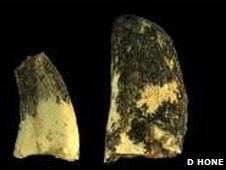
Dr David Hone of the Chinese Academy of Sciences (Beijing) made the new discovery in Upper Cretaceous deposits at Bayan Mandahu, in Inner Mongolia, China.   His colleague Dr Jonah Choiniere found a mass of badly eroded Protoceratops bones, amongst them lay two Velociraptorine-like teeth.  The scientists were keen to analyse the dinosaur bones to see if any signs of feeding behaviour had been preserved.  Dr Hone and colleagues Dr Mike Pittman and Dr Corwin Sullivan were able to identify a number of bite marks and scratches that indicated that the carcase had been scavenged by a Velociraptor-like dinosaur, the teeth were broken and shed as it fed.

Broken Velociraptorine Teeth find at the Site

Broken “Raptor” Teeth.

Picture credit: Dr. David Hone

The picture shows the shed teeth found in association with the the Protoceratops fossils.  These tiny teeth are broken at the tip and indicate that they were lost when the Velociraptor-like animal bit into the hard bones of the dead dinosaur.  Finding evidence such as this is extremely difficult, the teeth of these dromaeosaurs are extremely small and fragmentary remains of teeth are notoriously hard to spot, even when using fine screening sieves to help recover the fossils.

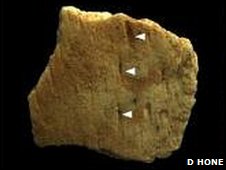
Bite Marks on the Protoceratops Fossil Bone

Bite Marks.

Picture credit: Dr. David Hone

The three white arrows in the picture show the strong scratches in the fossilised bone, indications that the Velociraptor scavenged the carcase.  The bite marks match the sort of impressions that Velociraptor teeth would have made.  As the Protoceratops was quite large (nearly fully grown) and since the bite marks were found on the jaw bones, it is likely that this fossil evidence represents scavenging behaviour and not hunting behaviour.

Dr Hone commented:

“The marks were on and around bits of the jaw.  Protoceratops probably weighed many times what a Velociraptor did, with lots of muscle to eat.  Why scrape away at the jaws, where there’s not much muscle, so heavily that you scratch the bone and lose teeth unless there was not much else there?”

This data suggests that a Velociraptor-like animal discovered the carcase, perhaps scenting the rotting flesh from many miles away and then it fed on what meat remained on the animal.

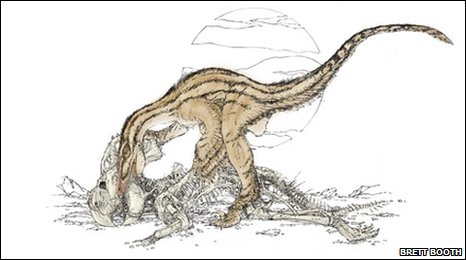
An Artists Impression of the Feeding Velociraptorine

Feeding Velociraptor.

Picture credit: Brett Booth

Dr Hone stated:

“In short, this looks like scavenging as the animal would be feeding on the haunches and guts first, not the cheeks”.

Protoceratops did have powerful jaws, it is perhaps possible that the cheeks of this animal were quite fleshy and one of the choicest cuts of meat.  Flesh from the cheeks of animals such as cows is seen as a delicacy and revered by many butchers who regard this part of the carcase as a most flavoursome and tasty cut.  We know of many local butchers who remove the cheeks from a cow whilst butchering the rest of the carcase, taking home their prize.  Could the cheeks of a Protoceratops have been a choice cut for a Velociraptor?

Such feeding behaviour is not common in extent animals, most small scavengers attempt to grab what they can from where they can, after all, if they have been attracted to the carcase then some other larger beastie may be on its way to gate crash events.

Commenting on the 1971 Polish discovery Dr Hone said:

“The fighting dinosaurs suggests predation.  Combine the two and we have good evidence for both behaviours.  Animals like Velociraptor were probably feeding on animals like Protoceratops regularly, probably including both predation and scavenging.”

No doubt this new evidence will add spice to the perennial argument surrounding the feeding habits of Theropods, particularly the larger ones such as the late Tyrannosauridae.  Did these animals scavenge most of their meals or were they active hunters?  Almost all living carnivores do a bit of both, hunting but not being averse to free lunch should they find a corpse upon which they can feed.

Discussing this point Dr Hone stated:

“It is a question of degree.  Lions mostly predate, whilst jackals mostly scavenge.”

This new fossil discovery helps confirm what many researchers have long suspected about how carnivorous dinosaurs interacted with their plant-eating counterparts.

Dr Hone concluded:

“Even the most dedicated predator won’t turn down a free meal if they chance across a dead animal with a few bits of meat still attached, and this looks like the case here.”

The Beasts of the Mesozoic model series contains a variety of dromaeosaurid figures: Beasts of the Mesozoic Models and Figures.

1 04, 2010

“Beep-Beep” – Its a Dinosaur Road Runner (Xixianykus)

By |2023-03-05T14:19:40+00:00April 1st, 2010|Categories: Dinosaur and Prehistoric Animal News Stories, Main Page, Palaeontological articles|0 Comments

New Fast Running Dinosaur Discovered in China (Xixianykus zhangi)

Scientists have described a new species of fast running dinosaur from China.  The dinosaur has been named Xixianykus zhangi.

Heralded as a sort of dinosaur equivalent of the cartoon bird roadrunner, scientists have announced the discovery of a new type of fast running theropod dinosaur.  This tiny creature with short thigh bones and long lower leg bones seems to have been built for speed.  Being agile and able to run fast would have been extremely handy for this 50 cm long dinosaur, despite not having to worry about “Wile E Coyote” there would have been plenty of predators wanting to put Xixianykus on the menu.

Remains of this new species were found in the spring of 2009 by a local farmer in China’s Henan Province (eastern China) an area already famous for its Cretaceous dinosaur fossils.  The strata from which the incomplete fossil of this new dinosaur was found dates from approximately 85 million years ago (Santonian faunal stage).  A paper on this new dinosaur, believed to be an alvarezsaurid has been published in the scientific journal “Zootaxa”.

Alvarezsaurids

Alvarezsaurids are a bizarre group of theropod dinosaurs, known from fossils found in China and south America.  Typically small, with even the largest specimens known such as Alvarezsaurus (from which the group gets its name) and Patagonykus being less than 2 metres long (and most of this length is tail), this is a very enigmatic branch of the Dinosauria.  However, classifying alvarezsaurids as dinosaurs is not that straight forward.  They have many bird-like features, such as specialised forelimbs, breast bones, fused ankles and narrow skulls.  Most likely feathered, to help insulate them and keep these small, active animals warm (no evidence of alvarezsaurids evolving the ability to fly), it is believed these animals inhabited forests and open plains.  The short thighs, long shins and feet are indicative of a cursorial lifestyle and suggest that these creatures were very fast runners indeed.  This new partial specimen, now formerly named Xixianykus zhangi, although just over half a metre long, had proportionately very long lower legs, indicating that it was a very fast runner.  With legs measuring 25 cm long these were extreme, even for the lightly built fast running Alvarezsauridae.

An Illustration of the new Alvarezsaurid (Xixianykus zhangi)

Picture credit: Matt Van Rooijen

Xixianykus zhangi

Commenting on the ratio of the upper leg bones to the lower leg bones, palaeontologist David Hone of the Chinese Academy of Sciences (Beijing), one of the scientists responsible for the study of this new dinosaur said:

“These proportions imply it could put great long strides in and move fast.”

Although the forelimbs have been lost it is likely that it had short, stubby arms with a single digit on each hand.  The digit had a massive claw on it, this and the arms are adaptations to a very specialised lifestyle.  Scientists believe that the forelimbs were adapted to digging, perhaps these little dinosaurs were specialist insectivores, breaking into termite mounds and feeding on the insects contained within.

Features of the vertebrae and the pelvic area support the idea of Xixianykus being a dinosaur adapted for digging.

David Hone stated:

“The front of the body is adapted not to twist, which saves energy when running and provides a brace for digging actions”.

X. zhangi was most likely an endurance runner, using minimal energy to cover long distances in its search for food.  It may have lived in flocks, although there is no fossil evidence as yet to support this hypothesis.

With its long, slender legs it would have had the ability to run away from trouble should any Cretaceous predator decide to try to catch it.

A Model of a Typical Aalvarezsaurid

Desert Accessory Pack (Beasts of the Mesozoic)

The amazing desert accessory pack featuring a replica of an  alvarezsaurid – Mononykus (Beasts of the Mesozoic).

To view the Beasts of the Mesozoic model range: Beasts of the Mesozoic Articulated Dinosaur Models.

Everything Dinosaur acknowledges the assistance of a media release from the Chinese Academy of Sciences (30th March 2010) in the compilation of this article.

24 03, 2010

Dinosaur Buried Alive – New Dinosaur Species Discovered in Utah Sandstone

By |2023-01-03T20:39:40+00:00March 24th, 2010|Categories: Dinosaur and Prehistoric Animal News Stories, Dinosaur Fans, Main Page, Palaeontological articles|0 Comments

New Dinosaur Species Discovered – The Origins of a Native Indian Legend Perhaps?

Researchers reporting in the on line scientific journal PLoS One have described the discovery of a new species of primitive, long-necked dinosaur that was buried in a collapsed sand dune approximately 185 million years ago.  The fossil was discovered eroding slowly out of sandstone strata, close to the archaeological remains of an ancient native Indian settlement.  Could these bones be the source of the Navajo Indian legend of a sand monster that buried its victims alive in the dunes?

The sandstone block has been partially removed from its burlap and plaster covering.  The bones making up the right hand can clearly be seen, the five digits with sharp claws on the end of the fingers.  The fossil is articulated and nearly complete with just the skull, some elements of the toes and a shinbone missing.  Unfortunately, skull material is often absent with fossils of this nature.  The relatively small skull, balanced on a long neck is very often not present when the rest of the fossilised skeleton is discovered.

Seitaad ruessi

The dinosaur has been named Seitaad ruessi.  This dinosaur has been named to honour the ancient American Indian sand monster which was known as “Seit’aad”, the species name is in memory of the poet and naturalist Everett Ruess who disappeared in the sandy desert of southern Utah in 1934.

This dinosaur is a member of the Sauropodomorpha, long-necked herbivores with lizard-like feet.  It would have been around 3-5 metres long and perhaps over 1 metre high at the hips.  It lived during the early Jurassic (Toarcian faunal stage), approximately 185 million years ago.  Southern Utah during the early Jurassic was a dry, arid desert environment but with isolated strips of lush and verdant vegetation close to water sources.

Dinosaur

This dinosaur was probably a facultative biped, normally walking on all fours but capable of running or standing just on its hind legs as and when necessary.

The analysis of the fossilised bones was undertaken by palaeontologists Joseph Sertich, a Stony Brook University doctoral student and Mark Loewen of the Utah Museum of Natural History.

Commenting on the discovery, Sertich said in a statement:

“Although Seitaad was preserved in a sand dune, this ancient desert mush have included wetter areas with enough plants to support these smaller dinosaurs and other animals.”

Although, Sertich went onto add:

“Just like in deserts today, life would have been difficult in Utah’s ancient sand sea.'”

The fossil was discovered in 2004 and removed from the sandstone cliff the following year.  It is likely that more work will be carried out on the matrix that contains the fossil so that more of the skeleton can be revealed.

This particular discovery helps to confirm the success of the Sauropodomorpha in the Early Jurassic, this type of dinosaur was relatively common and would have made up some of the larger elements of the mega fauna on the super-continent of Pangaea.

The research team have stated that they believe that this particular dinosaur was unfortunate to have been buried suddenly in a collapsing sand dune, perhaps the sand was disturbed as a herd of these animals moved across the landscape.  This dinosaur was engulfed and the remains ended up stood on their head.

Plateosaurus

Perhaps the best known Sauropodomorpha is Plateosaurus (prosauropod), one of the best known dinosaurs of all.  Many thousands of plateosaur fossils have been found in Europe.  It was clearly one of the most common types of dinosaur in the Late Triassic.

An Illustration of Plateosaurus

Picture credit: Everything Dinosaur

To view models of Plateosaurus and other Sauropodomorpha members: CollectA Prehistoric Life Models.

Go to Top