All about dinosaurs, fossils and prehistoric animals by Everything Dinosaur team members.

Articles, features and information which have slightly more scientific content with an emphasis on palaeontology, such as updates on academic papers, published papers etc.

15 07, 2010

The Extinction of Torosaurus – Second Time Around

By |2023-01-10T12:36:16+00:00July 15th, 2010|Categories: Dinosaur and Prehistoric Animal News Stories, Dinosaur Fans, Main Page, Palaeontological articles|1 Comment

American Study Suggests Torosaurus is Actually an Elderly Triceratops

The horned dinosaurs, known as ceratopsians were some of the very last kinds of dinosaur on Earth.  These horned, long-frilled prehistoric monsters grew bigger than elephants and they ranged across North America from Colorado in the south up to Alberta and Saskatchewan in the north.  Although, their bones and fossils have been studied for more than 120 years, new research suggests that the genus Torosaurus (Torosaurus latus) could well be examples of elderly Triceratops and not a separate and distinct genus from Triceratops at all.

The study of the main groups of advanced, horned ceratopsians – the centrosaurines and the Chasmosaurinae is marked by the enormous amount of classification and reclassification of these huge reptiles.  Now a new study from leading American scientists proposes that those fossils assigned to the genus Torosaurus, a genus that was originally named in 1891, actually represent mature and elderly specimens of Triceratops (T. horridus).

Scale Drawings of Triceratops and Torosaurus

Picture credit: Everything Dinosaur

Torosaurus fossils are much rarer than Triceratops remains and the claim for specimens of Torosaurus being the animal with the one of the longest skulls of any known dinosaur has been cast into doubt if the entire genus is eliminated from the Chasmosaurinae family tree.  More importantly, if this theory is proved correct, then it demonstrates that towards the end of the Cretaceous there was much less diversity amongst Dinosauria than previously thought.

The reclassification was first proposed at an international meeting of fossil experts last year.  However, a paper on the research has been published in the scientific publication “the Journal of Vertebrate Palaeontology”.  Montana State University researcher John Scannella and famous palaeontologist John “Jack” Horner lay out a detailed case for reassessing the fossils ascribed to the genus Torosaurus and placing these specimens under Triceratops as they suggest the Torosaurus fossils are just mature and much older specimens of Triceratops.

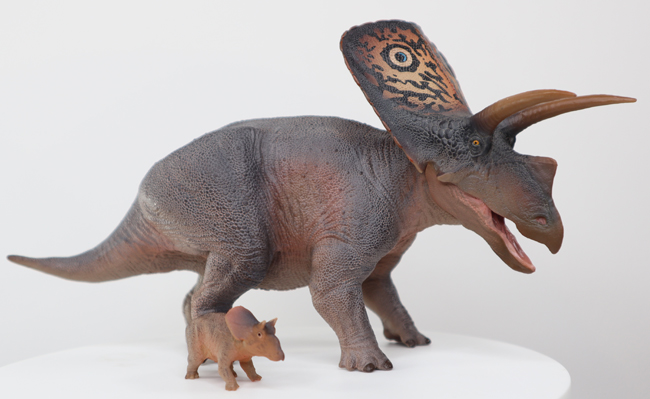
A Torosaurus Adult and Juvenile

Torosaurus dinosaur models (PNSO)

The PNSO Torosaurus pair (Aubrey and Dabei) shown in right lateral view. Picture credit: Everything Dinosaur.

Picture credit: Everything Dinosaur

To view the PNSO range of models and figures including horned dinosaur replicas: PNSO Age of Dinosaurs Figures.

The U. S. based scientists examined the skulls and other bones of fifty Torosaurus and Triceratops individuals.  Their research concluded that the distinctive size and shape of the neck frill on the fossils thought to be from Torosaurus specimens really represented examples of Triceratops that had been lucky enough to survive into the late stages of life.

Torosaurus

It is intriguing to consider that no juvenile Torosaurus skulls have been recorded, adding credence to the theory of Torosaurus being a Triceratops OAP.  The study of the growth of animals is called ontogeny, scientists are now aware that certain dinosaurs changed dramatically over their lives and these changes have often led to the misinterpretation of fossil evidence.

Significantly, the scientists state in their study, Triceratops’ elaborate headgear continued to grow and change throughout its life cycle, creating the impression of subtly different species at different dig sites.

And the revelation that Torosaurus and Triceratops are the same species, the American scientists argue, adds further evidence that dinosaur biodiversity had severely diminished in the years just before their worldwide extinction about 66 million years ago.

Scannella and Horner comment in their paper:

“Triceratops and ‘Torosaurus’ were proposed to be the last of their lineages.  Collapsing the two species into one shows that dinosaur diversity was more depleted than traditionally thought well before the end of the Cretaceous Period.”

Scannella said he and Horner tried for three years to look for alternative explanations for their findings.  They finally agreed that the Triceratops and Torosaurus were the same dinosaur.

Montana State University doctoral student John Scannella said he presented his and Jack Horner’s findings at the Society of Vertebrate Paleontology Conference in Bristol, England, last year and it was met with equal parts intrigue and scepticism.

Commenting on his work Scannella added:

“Scepticism is important and a good thing.  But, so far, all the evidence we have strongly supports the idea.”

Indeed, the two palaeontologists tried to find ways to explain their findings, examining possible alternative theories, but in the end they concluded that Torosaurus and Triceratops may, after all, not be distinct species.

Comparing Torosaurus and Triceratops

Illustrations from the scientific paper compare a Triceratops (on the left) with that of a Torosaurus (on the right).  The green and yellow colours in the enlarged frill represent additional neck frill growth if Torosaurus specimens are really older individuals of the Triceratops genus.  Scientists had long since speculated that these Maastrichtian faunal stage dinosaurs were closely related, but this new research suggests that specimens represent the same species but at different ages.  Although the skulls of these two dinosaurs are similar, many scientists had thought the neck crests were distinctive.  Triceratops for example, being regarded as having a solid neck crest, whereas, Torosaurus had a pair of large fenestrae (skin covered holes) in its skull crest.

The history of the study of ceratopsians is full of reworkings of once accepted scientific data, at one time in the past, almost a dozen species of Triceratops were assigned but now there are just two.  Like a herd of these Late Cretaceous leviathans on the move, we think this debate will rumble on.

9 07, 2010

Herrera’s Lizard – The Remarkable Herrerasaurus

By |2024-04-19T14:43:48+01:00July 9th, 2010|Categories: Dinosaur Fans, Main Page, Palaeontological articles|2 Comments

Herrerasaurus – Dinosaur or not?

The first fossils of this prehistoric animal were found in 1959 by a goat herder (Victorino Herrera) – and this animal was named after him.  It was not until 1988 that skull material of this Triassic prehistoric animal was found and the name Herrerasaurus formerly assigned.

Herrerasaurus

Known from strata close to the city of San Juan, the same formation that yielded evidence of the early saurischian dinosaur Eoraptor (E. lunenesis), scientist have struggled to place Herrerasaurus within the Dinosauria clade.  It as been assigned basal theropod status.  The animal, although one of the largest terrestrial vertebrates known from the Middle Triassic (approximately 228 million years ago) may not have been a dinosaur at all.  One of the diagnostic features of Dinosauria are the number of sacral vertebrae that are attached to the hip bones.  Dinosaurs have at least three vertebrae attached to the sacrum, Herrerasaurus only had two.  Three vertebrae attached to the sacrum is a trait shared between Dinosauria and some other archosaurs, but Herrerasaurus seems to be the exception to this rule.

This animal does possess some primitive dinosaurian features but also a number of other strange aspects of anatomy – such as the fenestra (hole) in the lower jaw and the numerous fenestrae in the skull.  The size of this meat-eater has also been the subject of considerable conjecture with estimates ranging from 2 metres in length right up to lengths in excess of 6 metres.

An Illustration of Herrerasaurus

Herrerasaurus illustrated.

Picture credit: Everything Dinosaur

Most scientists now place Herrerasaurus in the Theropoda, ascribing it to a basal theropod.  It lived during a time when the dinosaurs were yet to establish themselves as the dominant large terrestrial animals, only about 5% of vertebrate fossil material recovered from the Middle Triassic rocks of north-western Argentina has been assigned to the Dinosauria, the bulk of the fossils found are from synapsids or other archosaurs.

To view a model of Herrerasaurus and other theropod dinosaurs take a look at the CollectA Age of Dinosaurs range: CollectA Age of Dinosaurs Prehistoric Life Models.

28 06, 2010

Unique Arctic Pliocene Fossil Site may Hold Clues to Northern Hemisphere’s Future Climate

By |2024-04-19T14:56:01+01:00June 28th, 2010|Categories: Dinosaur and Prehistoric Animal News Stories, Educational Activities, Geology, Main Page, Palaeontological articles|0 Comments

Ancient Arctic Fossil Site Reveals Arctic was much Warmer Recently

Scientist’s studying the Arctic’s ancient past have issued a stark warning about the future climatic conditions the Arctic will face after an analysis of fossils and microfossils from Pliocene strata.

A team of researchers from the USA, Canada and Holland have published their conclusions in the scientific journal “Geology”.  They conclude that the Arctic Circle was much warmer than previously thought 4 million years ago, with average annual temperatures approximately 0 degrees Celsius.

The international team of scientists examined the fossil evidence at a world-renowned Ellesmere Island fossil site and calculated that the palaeo-climate was much milder and warmer than had been previously thought.  This evidence provides a stark warming for geologists and climatologists as they calculate the effect of global warming on the Arctic in the 21st century.

Ellesmere Island

Ellesmere island lies deep within the Arctic Circle and it is part of the Nunavut territory of Canada.  This heavily glaciated, snowbound island is one of the largest in the world, yet there are only a few hardy scientists as year round inhabitants as the annual temperature for this cold and mountainous region is approximately -19 (minus) degrees Celsius.

The island is very important to palaeontologists as there are many fossiliferous Cenozoic sediments plus a number of extremely significant older strata, such as the early Carboniferous sediments that represent ancient stream-beds where fossils of the ancient transitional fish/amphibian Tiktaalik (T. roseae) have been discovered.

In this study, the international team analysed the prehistoric evidence from peat deposits dating from the early Pliocene, approximately 4 million years ago.  The peat accumulated in a beaver pond (hence the name of the dig site – Beaver Pond), this pond was surrounded by a larch forest, today the only tree native to Ellesmere Island is the Arctic Willow.  The plant and animal fossils that have accumulated in these sediments are important to scientists as they provide a window into the past climate of this part of the northern hemisphere as well as helping palaeontologists to understand the interchange of mammalian fauna between Asia and North America during this part of the Earth’s relatively recent history.

Six Researchers

The team of six researchers published their findings after analysing the fossilised remains of plants, trees and animals that had been preserved in the peat deposits.  Based on this information they have calculated that the average annual temperature for this area around 4 million years ago was 0 degrees Celsius, still very cold but not as cold as scientists had thought previously.

This clearer picture of the ancient Arctic climate has potentially important and troubling implications for how quickly and severely the region could witness a temperature spike given current climate-change trends.

The team state in the journal Geology:

“The Arctic climate system may be much more sensitive to greenhouse gas warming than previously thought, and current CO2 levels may be sufficient to bring about significant and irreversible shifts in Arctic ecosystems.”

Given the dramatic increases that have been seen in atmospheric carbon dioxide levels (CO2) the team suggest:

“Our results indicate that a significant increase in Arctic temperatures may be imminent in response to current atmospheric CO2 levels.”

The research was led by University of Colorado scientist Ashley Ballantyne and the paper has been co-authored by Canadian Museum of Nature palaeontologist Natalia Rybczynski and biologist David Greenwood of Manitoba’s Brandon University.  Also contributing was palaeontologist Jaelyn Eberle, curator of fossil vertebrates at the University of Colorado Museum of Natural History.

Ancient Arctic

When the transitional animal Tiktaalik roamed; Ellesmere Island was situated a lot further south, however, the Beaver Pond site is just four million years old and dates from a time when the island was at roughly the same high northerly latitude that it is at today.

In addition, the amount of carbon dioxide in the atmosphere during that time, the Pliocene era, was almost identical to the elevated CO2 levels of today’s warmed-up globe – making the Beaver Pond site an unusually accurate “proxy” for the 21st century Arctic, the researchers conclude.

And while the Ellesmere site’s namesake species, a primitive variety of small beaver and other extinct mammals, such Pliocene rabbits and three-toed horses, are indicative of a warmer environment than today, scientists have generally estimated that the average annual temperature at Beaver Pond four million years ago was no higher than -5 (minus) degrees Celsius.

New Evidence

However, this new evidence suggests that Arctic temperatures could rise much higher, much faster if present-day climate trends continue.

Natalia Rybczynski commented:

“It is really, really compelling evidence.  That number [0 degrees Celsius] is quite a bit warmer than previous proxy estimates and it is warmer than the [climate change] models have come up with.”

She went onto add:

“We don’t imagine in 100 years we’re going to be getting a forest on Ellesmere Island.  You just don’t have the soil – it’s not going to happen.”

But the scientists predict that the warm conditions revealed by the Beaver Pond site may offer a foretelling of the Canadian Arctic’s climate future.

A team spokesperson said:

“If you just let the planet go to its equilibrium under the current CO2 levels, that is the warming that perhaps you would expect to see based on this one site.”

By studying ancient strata, scientists are able to supplement the work of climate models and computer programmes to provide fresh insights into the threat of global warming.  Unfortunately, the Beaver Pond site is under threat as a coal mine is planned for the area.  Ironically, an important fossil site that may provide clues to our future climate is threatened by the desire to get at fossil fuels that are evidence of the Earth’s climatic past.

For replicas and figures of ancient prehistoric animals: Prehistoric Animal Models and Figures.

17 06, 2010

The Whole Tooth and Nothing But The Tooth at the Centre of New Research

By |2024-04-19T14:51:01+01:00June 17th, 2010|Categories: Dinosaur and Prehistoric Animal News Stories, Main Page, Palaeontological articles|2 Comments

Ancient Mammal Tooth Marks in Prehistoric Animal Bones

Scientists have identified the tiny and faint scratch marks made by the teeth of ancient, primitive mammals as they gnawed on the remains of dinosaurs and other prehistoric animals. Evidence has been found of ancient mammal tooth marks in fossil bones.  In a paper published in the scientific journal “Paleontology”, the researchers from Yale University and the Cleveland Museum of Natural History report on the mammalian tooth marks left on the bones of several fossil bones, including the bones of dinosaurs.

Whilst studying the fossil collections at the University of Alberta Laboratory for Vertebrate Palaeontology at the Royal Tyrrell Museum (Drumheller, Alberta, Canada), Nicholas Longrich of Yale University and Michael J. Ryan of the Cleveland Museum discovered several of the bones showed signs of tooth marks.  Additional bones that seemed to have been gnawed upon were found during fieldwork in Alberta.  All the bones studied date from 75 million years ago (Campanian faunal stage of the Late Cretaceous).

The team discovered tooth marks on a femur bone (thigh bone) from a Champsosaurus, a crocodile-like, aquatic reptile that grew up to 1.5 metres long, the rib of a dinosaur, most likely a herbivorous hadrosaurid or ceratopsid; the femur of another large dinosaur that was likely another ornithischian and a lower jaw bone from a small marsupial.

The researchers believe the marks were made by mammals because they were created by opposing pairs of teeth—a trait seen only in mammals from that time.  They think they were most likely made by Multituberculates, an extinct order of archaic mammals that resemble rodents and had paired upper and lower incisors.  Several of the bones display multiple, overlapping bites made along the curve of the bone, revealing a pattern similar to the way people eat corn on the cob.

Ancient Mammal Tooth Marks

Pictures show parallel groves cut into the rib bone of a dinosaur, evidence of a mammal gnawing on bones preserved for 75 million years.

The Multituberculates are a mammalian subclass that first appeared in the Middle Jurassic and went extinct in the Eocene.  These mammals were relatively abundant in the northern hemisphere during the Late Cretaceous, probably herbivorous; many scientists believe that these creatures were mainly nocturnal.  Many Multituberculates resembled rodents although they were not closely related to modern placental mammals.

Diagrams show the typical skull of a Multituberculate mammal, showing that the tell-tale tooth marks found in the bone were probably made by the incisors as the grawed on the bone, not to strip meat but perhaps to gain important minerals and vitamins.  It was these unobtrusive animals that were to outlast the dinosaurs, as the Multituberculates survived into the Cenozoic.

Commenting on the tooth marks, the team conclude that the animals that left evidence of gnawed bones in the mega faunal fossil record of Alberta were probably no bigger than a squirrel.

Nicholas Longrich stated:

“The bones were kind of a nutritional supplement for these animals.”

He went onto add that there were probably a lot more fossils in museum collections and awating discovery that would show this behavioural evidence of primitive mammals.

“The marks stood out for me because I remember seeing the gnaw marks on the antlers of a deer my father brought home when I was young,  So when I saw it in the fossils, it was something I paid attention to.”

But he points out that the Late Cretaceous creatures that chewed on these bones were not nearly as adept at gnawing as today’s rodents, which developed that ability long after dinosaurs went extinct.

For models of prehistoric mammals: Prehistoric Mammal Replicas and Figures.

9 06, 2010

Dinosaur Biting Techniques – Something to get your Teeth Into

By |2023-01-08T18:22:33+00:00June 9th, 2010|Categories: Dinosaur and Prehistoric Animal News Stories, Main Page, Palaeontological articles|0 Comments

Theropod Dinosaurs –  A Range of Biting Styles

Bristol University researchers examine dinosaur biting techniques.  A subject area for the eager students to get their teeth into.

A new study into the biting styles and the forces that could be generated as a dinosaur bit into its prey has been published in the scientific journal “The Proceedings of the Royal Society – Biology”.  This study carried out by researchers at the University of Bristol, identifies at least four different biting techniques, it seems some dinosaurs were fast “nippers” whilst others had slower but more powerful bites.

The study focused on the bites of theropod dinosaurs.  Theropods (Theropoda) were bipedal and mostly meat-eating although a number of forms evolved to exploit different environmental niches resulting in a non-carnivorous diet in some cases.  The research shows that following a careful analysis of tooth position, tooth size, length of the jaws and the shape and design of theropod dinosaur skulls, four basic biting techniques were identified with a trade-off between bite strength and the speed of the bite.

Dinosaur Biting Techniques

The study indicates that meat-eating dinosaurs ranged from weak biters but fast biters such as the dromaeosaurs (Velociraptor, Deinonychus etc.) and the strong, more efficient biters such as the last of the tyrannosaurs (Tyrannosaurus rex).

The author of this new research, Manabu Sakamoto, a scientist in the Department of Earth Sciences at the University of Bristol (England), examined the biting characteristics of 41 different theropod dinosaurs, from Triassic, fleet-footed meat-eaters such as Coelophysis to the mighty allosaurs and tyrannosaurs.

Not surprisingly, the study shows that tyrannosaurs and allosaurs inflicted the most damaging, efficient bites.  These large predators probably relied on an swift ambush attack, then withdrawing to let their victim weaken through shock and blood-loss.  Tyrannosaurus rex had one of the best developed senses of smell known to science.  It could have used this superb sense of smell to track down its victim, even though the hapless animal may have wandered many miles from the scene of the attack.

The ceratosaurs, are also revealed as being efficient strong, biters.  Again, this is not surprising, as dinosaurs from the  Ceratosaurus genus (Ceratosaurus sp.) have some of the largest teeth in proportion to the size and width of the jaws in the reptilian fossil record.  Their dagger-like teeth seem almost too big for their own mouths.  One Ceratosaurus species Ceratosaurus ingens is only known from fossils of huge teeth that have been found.  The teeth indicate that this particular species of ceratosaurid may have been one of the biggest carnivores around during the Late Jurassic.

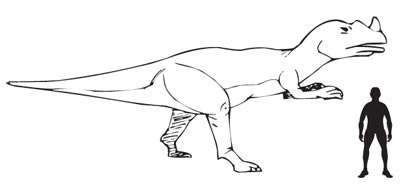
Ceratosaurus – Big Teeth = Fearsome Bite

Picture credit: Everything Dinosaur

The picture above shows a scale drawing of a typical ceratosaurid.

Interestingly, the oviraptorids come out very favourably in terms of the efficiency of their bites in this new study.  Oviraptorids were very bird-like dinosaurs, not only in their general build but also as a result of the presence of a beak.  Some scientists have suggested that this particular family of dinosaurs should not be classified as Dinosauria but as members of the Aves (birds).

Illustration of a Typical Oviraptorid

The head of Oviraptor.

Picture credit: Mike Fredericks

Everything Dinosaur stocks a wide range of theropod dinosaur figures and replicas: Theropod Dinosaur Models.

Studying Oviraptorids

Scientists are uncertain as to what sort of food oviraptorids ate.  The jaws seem to have evolved for a crushing action, perhaps these Cretaceous animals fed on nuts or hard fruit.  It has even been suggested that oviraptorids fed on shell fish, their strong jaws would have easily cracked open clams and the shells of other molluscs.

The research from the Bristol team shows that even though some dinosaurs did not have as many teeth as others, the teeth they did possess did a very efficient job.

Manabu Sakamoto commented on the efficiency on the bites of allosaurs and tyrannosaurs, he stated:

“These dinosaurs have consistently high efficiency in biting along the entirety of their relatively short tooth rows.”

The bite strength of the theropod dinosaurs studied was calculated by determining the ratio between the size of the muscles in the jaws and the biting force they could potentially generate.  This is termed “the mechanical advantage” and unlike previous studies into dinosaur bite forces, the Bristol University researchers calculated the bite strength for each tooth and biting position in the jaws.

Sakamoto discovered that the most primitive type of biting belonged to dinosaurs such as Herrerasaurus, Carcharodontosaurus, and Ceratosaurus.  Their back teeth did much of the work.

One of the most bizarre biting styles belonged to the coelophysoid dinosaurs, animals such as Coelophysis and Syntarsus.  These fast running, relatively small, meat-eaters were widespread during the Late Triassic and Early Jurassic.  Typically, they had long necks and small skulls with narrow jaws.  Coelophysids could bite with a great deal of force at the back of their mouths, but their front teeth were limited to a really weak and fast bite.  These particular dinosaurs probably preyed on smaller, fast moving prey such as lizards and other dinosaurs, but their long necks and narrow muzzles may have permitted them to scavenge the kills from larger meat-eaters.

The final type of carnivorous dino bite belonged to what Sakamoto called “the ostrich-like dinosaurs,” such as Velociraptor (dromaeosaurs).  Typically, these dinosaurs had more teeth in their jaws when compared to the larger allosaurs and tyrannosaurs.

Manabu commented on the findings:

“These dinosaurs have consistently low efficient biting across their tooth rows so they have relatively weak bites.  But, in effect, this also means that they have relatively fast biting speeds.”

He added that the research into the bite force and technique of Archaeopteryx (A. lithographica), showed that this ancient bird bit in a similar style to the Velociraptors.

Various Biting Styles

Another component of the study involved testing whether or not closely related dinosaurs bit in similar ways.  For the most part, this was true, providing evidence that the various biting styles were inherited, evolved behaviours.

However, there were one or two exceptions to this rule thrown up by the study.  The parrot-like oviraptorids and the therizinosaurs (Scythe Lizards), a bizarre type of theropod dinosaur that adapted to a vegetarian diet and are believed to have filled a “sloth-like” niche in Northern Hemisphere ecosystems; did not have predictable biting styles based on their evolutionary history.  Although, relatives of these two groups of dinosaurs were weak, yet fast biters, the oviraptosaurids and the therizinosaurids were highly efficient, strong biters.

Commenting on this aspect of the research Manabu suggested:

“A possible explanation is that the ancestral stock of this group underwent adaptive evolution and filled an open ecological and functional niche.”

3 06, 2010

New Giant Horned Ceratopsian from Mexico

By |2024-04-19T10:20:51+01:00June 3rd, 2010|Categories: Dinosaur and Prehistoric Animal News Stories, Main Page, Palaeontological articles|0 Comments

Coahuilaceratops magnacuerna – The First Horned Dinosaur from Mexico

No sooner do we write an article about the discovery of a new genus of ceratopsian (horned dinosaur) from the western United States (Medusaceratops lokii), then the University of Utah, publishes a press release about a new genus of horned dinosaur, the first to be discovered in Mexico.

To read more about Medusaceratops lokii: Mystery Horned Dinosaur from Montana.

Unlike M. lokii, there is no doubting from the fossil remains that this particular ceratopsian is a chasmosaurine, the huge brow horns are a dead give away, and although the scientists admit they have yet to find an entire horn they estimate that the brow horns on C. magnacuerna are some of the biggest known in the fossil record.

New Genus of Horned Dinosaur

This discovery has given scientists fresh insights into the ancient history of western North America, according to a research team led by palaeontologists from the Utah Museum of Natural History at the University of Utah.

“We know very little about the dinosaurs of Mexico, and this find increases immeasurably our knowledge of the dinosaurs living in Mexico during the Late Cretaceous.”

Commented Mark Loewen, a palaeontologist with the museum and lead author of the study.

The 72-million-year-old rhino-sized creature – Coahuilaceratops magnacuerna – would have weighed perhaps as much as 4 tonnes.  The fossils date from the (Maastrichtian faunal stage of the Late Cretaceous).   The name Coahuilaceratops magnacuerna (pronounced Koh-WHE-lah-SARA-tops mag-NAH-KWER-na), refers to the Mexican state of Coahuila where it was found, and to the Greek word “ceratops” meaning “horned face.”  The second part of the name, or the specific name, magnacuerna, is a combination of Latin and Spanish meaning “great horn,” in reference to the huge horns above the eyes of this dinosaur (the brow horns).

An Illustration of Coahuilaceratops magnacuerna

Picture credit: Lukas Panzarin/Utah Museum of Natural History, the University of Utah.

The illustration above shows an artist’s interpretation of the ceratopsian skull material.  The huge and strongly re-curved brow horns are depicted.

The study, partially funded by the National Geographic Society, was conducted by Mark Loewen, Scott Sampson, Eric Lund and Mike Getty, palaeontologists at the Utah Museum of Natural History.  Also involved were Andrew Farke of the Raymond M. Alf Museum in Claremont, California.; Martha Aguillón-Martínez, Claudio de Leon and Rubén Rodríguez-de la Rosa from the Museum of the Desert in Saltillo, Mexico; and David Eberth of the Royal Tyrrell Museum of Palaeontology in Alberta, Canada.

Coahuilaceratops magnacuerna

The new species is to be announced in the book “New Perspectives on Horned Dinosaurs” to be released next week by Indiana University Press.  The lead author for this publication is Dr Michael J. Ryan and the book will contain more information on the new Montana Ceratopsian M. lokii.

For most of the Late Cretaceous Period, from 97 million to 65 million years ago, high global sea levels resulted in flooding of the central, low-lying portion of North America. As a result, a warm, shallow sea extended from the Gulf of Mexico to the Arctic Ocean, splitting the continent into eastern and western landmasses.  This sea is known as the Western Interior Seaway.

The Fossil skull of this Dinosaur

Coahuilaceratops Illustration.

Picture credit: Utah Museum of Natural History, the University of Utah

Dinosaurs living on the narrow, peninsula-like western landmass – known as Laramidia – occupied only a narrow belt of plains that were sandwiched between the seaway to the east and rising mountains to the west.  Central America had not formed at the time, which made Mexico the southern tip of this island continent.

Late Cretaceous Dinosaurs

In many ways, the Late Cretaceous is the best-understood time during the Age of Dinosaurs, thanks in large part to more than 120 years of dinosaur hunting in Canada, Montana, New Mexico and the Dakotas.  Recent work has revealed new dinosaurs living at the same time in Utah, New Mexico and Texas, yet the dinosaurs from Mexico have remained virtually unknown.

Scott Sampson commented:

“As the southernmost dinosaurs on Laramidia, Mexican dinosaurs will be a critical element in unravelling the ancient mystery of this island continent.”

Loewen described the arid, desert terrain where the dinosaur was recovered as nothing like Mexico during the Late Cretaceous.  About 72 million years ago, the region was a humid estuary with lush vegetation, an area where salt water from the ocean mixed with fresh water from rivers, much like the modern Gulf Coast of the southeastern United States (ruptured oil pipelines not permitting).  Many dinosaur bones in the area are covered with fossilised snails and marine clams, indicating that the dinosaurs inhabited environments adjacent to the seashore.

The Fossil Material Superimposed on a Line Drawing of the Skull

Fearsome Ceratopsian.

Picture credit: Utah Museum of Natural History, the University of Utah

The neck crest is assumed to be fenestrated (exhibiting holes in the bone, that in life would have been covered by skin).  A pair of fenestra are believed to be present, these would have helped lighten the neck crest and the skin patches could have been flushed with blood to make vivid display patterns, perhaps a part of chasmosaurine courtship.

The rocks in which Coahuilaceratops was found also contain large fossil deposits of jumbled duck-bill dinosaur skeletons.  These sites appear to represent mass death events, perhaps associated with storms such as hurricanes that occur in the region today.

Scott Sampson went on to add:

“Sitting near the southern tip of Laramidia, this region may have been hammered by monstrous storms.  If so, such periodic cataclysms likely devastated miles of coastline, killing off large numbers of dinosaurs.”

Until recent years, there have been few large-scale palaeontological projects in Mexico focused on the Mesozoic Era.  Indeed Coahuilaceratops is among the first dinosaurs from Mexico to be named.

Coahuilaceratops comes from a rock unit known as the Cerro del Pueblo Formation, which dates to between 71.5 million and 72.5 million years ago.  The skeletons, which de Leon discovered in 2001 near the town of Porvenir de Jalpa, approximately 40 miles west of Saltillo, were excavated in 2003.  The fossils then were prepared at the Utah Museum of Natural History, requiring two years of meticulous work by skilled volunteer preparator Jerry Golden.

Based on the bone development of the skull and skeleton, the scientists believe that this animal was an adult at the time of death.  Remains of a juvenile animal of the same species were also found at the site.

Coahuilaceratops was about 7 metres long as an adult, more than 2 metres high at the shoulder and hips, with a 1.8 metre long skull, it would have weighed more than an adult male Indian elephant.

By far the most obvious characteristic of Coahuilaceratops is its massive pair of horns, one above each eye.  While the researchers lack a complete horn, they estimate from fossils they excavated that the horns were more than one metre in length.

Although such horns are common features of ceratopsian dinosaurs, those of Coahuilaceratops appear to be the largest known for the group, exceeding the size of eye horns even in Triceratops horridus.  Scientists are uncertain of the massive eye horns’ purpose, but the most widely accepted idea is that they were related to reproductive success, functioning to attract mates and fight with rivals of the same species, although they would have acted as a substantial deterrent against hungry tyrannosaurs.

Mark Loewen explained that Coahuilaceratops represents the first occurrence of an identifiable species of horned dinosaur in southern Mexico.

He added:

“The horned dinosaurs are an extraordinary example of vertebrate evolution.  They evolved and diversified on Laramidia along a thin strip of land that stretched from Alaska to Mexico. Finding this horned dinosaur so far south in Mexico offers us a different picture of what the ancestors of Triceratops were like.”

In addition to Coahuilaceratops, the research team found remains of two other horned dinosaurs, which are less well understood.  The researchers are hoping to find more fossil material so that they can gain more information on these two other types of ceratopsian.

Other Dinosaurs Found

The latest expedition also recovered remains of two duck-bill dinosaurs, as well as the remains of carnivores, including large tyrannosaurs (smaller, older relatives of T. rex) and more diminutive Velociraptor-like predators armed with sickle-claws on their feet (dromaeosaurs).

Together with an abundance of fossilised bones, researchers discovered the largest assemblage of dinosaur trackways known from Mexico, an extensive area criss-crossed with the tracks of different kinds of dinosaurs.  In all, the emerging picture shows a diverse group of dinosaurian herbivores and carnivores, perhaps representing a previously unknown assemblage of species.

Commenting on the rich and diverse fossil material Mark Loewen stated:

“Rather than focusing only on individual varieties of dinosaurs, we are attempting to reveal what life was like in Mexico 72 million years ago, and understand how the unique ecosystem of Mexico relates to ecosystems to the north at the time.”

Few North American dinosaurs from this time period are known outside of the Drumheller region of Alberta. David Eberth explained that researchers now have two points of comparison to examine not only different dinosaurs, but also different environments and ecologies.

As might be suspected, paleontologists are excited about the future palaeontological potential of this area, they are confident that more dinosaur discoveries will be made.

Don Brinkman, a researcher at the Royal Tyrrell Museum (Drumheller, Alberta) added:

“Dinosaurs from this particular period are important because this is a time that is relatively poorly understood.”

Don is studying non-dinosaur vertebrates found at the site, including turtles, fish, and lizards.

He went onto state:

“The locality in Mexico goes a long way to filling in a gap in our knowledge of the record of changes in dinosaur assemblages throughout the Late Cretaceous.”

New Genus of Horned Dinosaur

Everything Dinosaur stocks a wide range of models and figures of Late Cretaceous ceratopsians.  For example, the UK-based company stocks the Beasts of the Mesozoic articulated model range: Beasts of the Mesozoic Models.

Everything Dinosaur acknowledges the assistance of a press release from the University of Utah in the compilation of this article.


31 05, 2010

Discovery of New Horned Dinosaur from Montana

By |2023-01-07T11:08:37+00:00May 31st, 2010|Categories: Dinosaur and Prehistoric Animal News Stories, Main Page, Palaeontological articles|0 Comments

Huge Chasmosaurine Medusaceratops lokii a Montana Dinosaur Mystery

Scientists at the Cleveland Museum of Natural History have announced the discovery of a new genus of horned dinosaur (Ceratopsian) from Late Cretaceous sediments in Montana.  This new dinosaur, that roamed this part of the United States in herds, approximately 78 million years ago, is estimated to have exceeded 6 metres in length and weighed over 2 tonnes.  This new prehistoric animal, a member of the same group of horned dinosaurs (Chasmosaurine) as Pentaceratops and Triceratops, has been named Medusaceratops lokii, the genus name relating to the flamboyant crest with numerous epoccipitals (lumps, bumps, and horns around the head crest), resembling the fearsome snake covered head of Medusa from Greek legend.  The species name is in deference to the Norse God of mischief – Loki, as when fossils of this dinosaur were first discovered it confused scientists as to whether is was a member of the chamosaurine or centrosaurines (two sub-groups of ceratopsians).

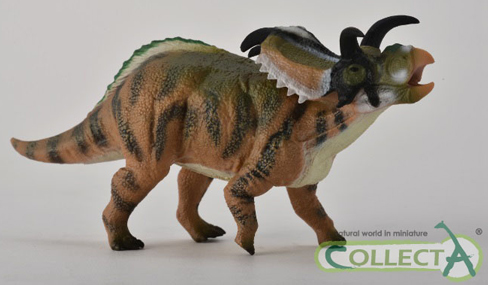
A Model of the Newly Described Dinosaur Medusaceratops

CollectA Age of Dinosaurs Medusaceratops model.

Named after the Greek Gorgon Medusa who had snakes for hair. A CollectA Medusaceratops dinosaur model.

The image (above) shows a replica from the CollectA Prehistoric Life model range: CollectA Age of Dinosaurs Prehistoric Life Models.

Horned Dinosaur

The announcement was made by the distinguished scientist and dinosaur expert Dr Michael J Ryan, who is based at the Cleveland Museum of Natural History (Ohio,United States).  The fossils of this new ornithischian ceratopsid have been dated to the Campanian faunal stage of the Cretaceous.

Dr Ryan, the curator and head of Vertebrate Palaeontology at the Cleveland museum has published his findings as lead author of a new book on North American horned dinosaurs; “New Perspectives on Horned Dinosaurs:  The Royal Tyrrell Museum Ceratopsian Symposium”.

We at Everything Dinosaur, have had the pleasure of reading a number of DrcRyan’s publications, as we sit here checking this article, a copy of “Dinosaur Provincial Park”, a volume on the ancient ecosystem of Alberta, Canada, is on a shelf in front of us.  DrcRyan was a contributor to this publication and many of the chapters written about Dinosauria contain references to his published work.

Medusaceratops belongs to the Chasmosaurinae subfamily of the horned dinosaur family Ceratopsidae.  The other subfamily is Centrosaurinae.  The specimen is the first Campanian-aged chasmosaurine ceratopsian found in Montana.  It is also the oldest known chasmosaurine ceratopsian known to science

Fossils of Medusaceratops were discovered in a bonebed on private land adjacent to the Milk river in north, central Montana.  Fossils and other material was acquired by Canada Fossil Inc. (Calgary, Alberta) in mid 1990s.  The company consulted Dr Ryan and his colleagues about the fossils, but at first the scientists were unable to make a positive identification.

Medusaceratops had giant brow bones more than 3 feet long over each eye, and a large, shield-like frill off the back of its skull adorned with large curling hooks.  Medusaceratops lokii means “Loki’s horned-faced Medusa,” referring to the thickened, fossilised, snake-like hooks on the side of the frill (the epoccipitals).

Commenting on this discovery, Dr Ryan stated:

“At first we could not figure out what we had.  Some of the material looked as if it came from a form related to Centrosaurus [centrosaurine ceratopsian, like Pachyrhinosaurus or Achelousaurus] a centrosaurine noted for having short brow horns.  The rest of the pieces had giant brow horns similar to Triceratops [Chasmosaurine].  That’s one of the problems with bonebeds – even though you can collect a large amount of material, much of it is broken and all of it is disarticulated, so the story is rarely clear cut.”

Eventually Dr Ryan found a complete articulated skull of a centrosaur with long brow horns in southern Alberta of what appeared to be the new animal from Montana, and named it Albertaceratops in 2007.  At that time, he assumed he was looking at a stray that had literally crossed the international border between what was to become Canada and the United States.

To read an article on the discovery of Albertaceratops: “Alberta Horned Face” – An Ancestor of Triceratops.

Medusaceratops lokii

After re-examining the material from Montana, Dr Ryan realised that at least some of the material in the Montana bonebed was not Albertaceratops.  Some of the elements were much larger than any other horned dinosaur from the same time period, including Albertaceratops.  Even though Albertaceratops and Medusaceratops are superficially very similar, the shape and number of the hooks and ornaments along the edge of the frill actually puts them in separate horned dinosaur groups, with Medusaceratops being a chasmosaur and Albertaceratops a centrosaurine.

Commenting on the huge frill on Medusaceratops, Dr Anthony Russell, Professor of Biological Sciences at the University of Calgary (Alberta) stated:

“Although the ornamentation on the frill is pretty spectacular, it probably was not used for defence against predators, rather it was more likely prehistoric “bling” used to attract a mate.”

The descriptive terms, used to distinguish centrosaurines from chasmosaurines are often not adequate to permit a genus to be ascribed to the appropriate subfamily of ceratopsians.  For example, the centrosaurines are often referred to as “short-frilled” dinosaurs, with large nose horns, often bigger than any brow horns, if brow horns were present.  In contrast, the chasmosaurines are known as “long-frilled” dinosaurs with large, neck frills and long snouts.  The brow horns are usually much bigger than any nose horn, if a nose horn was present.

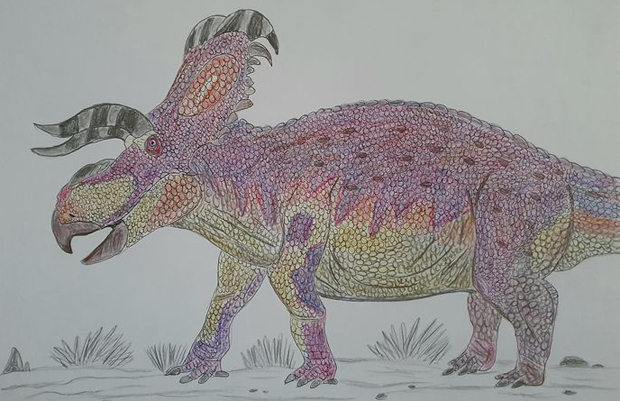
An Illustration of Medusaceratops

An illustration of Medusaceratops

An illustration of Medusaceratops. Picture credit: Caldey.

Dr Ryan said:

“Medusaceratops is the oldest member of the Chasmosaurinae in North America and shows that the group, like its most famous member, Triceratops, had long brow horns and were fairly large when they first evolved.  Later chasmosaurs that are just a bit younger [found in later strata], tend to have much shorter horns and have much lighter, smaller bodies.”

If this large, herbivore evolved large brow horns to fend off the attacks from predatory dinosaurs, then this poses an intriguing question for the scientists.  What types of really big predatory dinosaurs shared this environment with Medusaceratops?

A number of tyrannosaurid genera are known from the western part of North America (Campanian faunal stage), perhaps awaiting discovery are the fossils of a large carnivore bigger than Daspletosaurus or Gorgosaurus.

Dr Ryan said:

“Here we have something almost the size of Triceratops, but 10 million years before it lived.  T. rex was not around yet, so what was Medusaceratops squaring off against?  That’s one of the things we’re looking for in Alberta.”

The research was originally conducted when Michael Ryan was a Ph.D. candidate working with Dr Russell at the University of Calgary in Alberta, Canada.  Much of the material, including the holotype, is now in the collection of the Wyoming Dinosaur Centre in Thermopolis, Wyoming (USA), with other material curated at the Royal Tyrrell Museum in Drumheller, Alberta (Canada).

28 05, 2010

“Grinding Mouth and Wrinkle Eye” – American Scientists Announce New Dinosaur Genus

By |2023-03-06T07:19:17+00:00May 28th, 2010|Categories: Dinosaur and Prehistoric Animal News Stories, Dinosaur Fans, Main Page, Palaeontological articles|1 Comment

Jeyawati rugoculus A new Genus of Basal Hadrosaur from New Mexico

A team of American palaeontologists have announced the discovery of a new primitive duck-billed dinosaur from western New Mexico (United States).  This new ornithopod is just one of a number of discoveries made in the state of New Mexico that is permitting scientists a glimpse into life in a Cretaceous ecosystem, that until fifteen years ago was unknown to science.

Lead author and 2008 University of Nebraska-Lincoln graduate Andrew McDonald, has named this new species of dinosaur based on an incomplete skeleton found on land administered by the U.S. Bureau of Land Management.

Duck-billed Dinosaur

The new species, dubbed Jeyawati rugoculus, comes from rocks that preserve a swampy forest ecosystem that thrived near the shore of a vast inland sea 91 million years ago (Cenomanian faunal stage of the Cretaceous).  Jeyawati is a member of a remarkable assemblage of dinosaurs and other animals that was totally unknown 15 years ago.  Although the geology of the United States is extremely well known and has been intensively studied, these new finds will help palaeontologists piece together the varied faunas that existed on the coastal margins of the Western Interior Seaway.

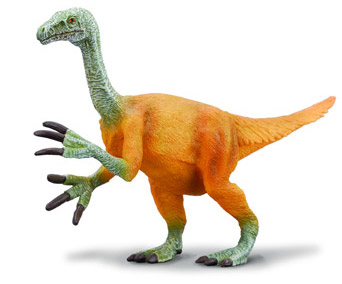
Dinosaurs that co-existed with Jeyawati include Zuniceratops, one of the earliest known North American horned dinosaurs, and Nothronychus, a therizinosaur, strange herbivorous theropod dinosaurs belonging to a lineage that, until the discovery of Nothronychus, were known only from Asia.  Jeyawati adds another fascinating character to the story of North America’s dinosaurs.

An Illustration of Zuniceratops

Zuniceratops

Zuniceratops scale drawing.

Picture credit: Everything Dinosaur

Zuniceratops (Zuniceratops christopheri), is the earliest known ceratopsian to have sported a pair of brow horns in North America.  Known from several specimens, its presence in New Mexico suggests that ceratopsians with brow horns evolved in North America and not in their ancestral home of Asia.

An Illustration of Nothronychus

Picture credit: Everything Dinosaur

Nothronychus (Nothronychus mckinleyi) is the first member of the therizinosaurids to be found outside Asia.  It is also one of the most complete fossils of these bizarre theropod dinosaurs.

To view a model of Nothronychus and other dinosaur models: CollectA Age of Dinosaurs Prehistoric Life Models.

The discovery of dinosaur fossils such as Zuniceratops, Nothronychus and Jeyawati is helping scientists to understand more about the unique fauna of the New Mexico swampland habitat.

The first part of the name Jeyawati rugoculus is pronounced “HEY-a-WHAT-ee,” essentially meaning “grinding mouth,” and is derived from two words in the language of the Zuni people, who have long inhabited western New Mexico.  The meaning of the name Jeyawati is a reference to the sophisticated chewing mechanism evolved by the herbivorous lineage of hadrosaurs to which Jeyawati belongs.  The second part of the name, rugoculus, comes from the Latin words ruga and oculus and means “wrinkle eye,” describing a unique feature of the new species.

One of the bones that forms the eye socket exhibits a peculiar rough or wrinkly texture on its outer side; in other dinosaurs, such a texture on skull bones has been suggested to have supported enlarged scales on the top of the skull.  Thus, Jeyawati rugoculus might have sported one or more large scales above and behind its eye, giving it a strangely striking appearance.

Jeyawati rugoculus

The enlarged scales around the eye, may have developed in mature adults and could have been used to communicate visually with other members of the herd.  It is not known whether Jeyawati rugoculus sported these eye markings all the time once it had reached breeding age, or whether the eye markings developed purely for the breeding season each year, in the same way that stags develop their antlers for rutting.

This herbivorous dinosaur evidently endured a hard life.  Among the many bits of ribs found with the skull bones, several large pieces have a swollen, rough surface, indicating that the animal suffered broken ribs through some misfortune and that those injuries had healed by the time the animal died.

The partial skull and other fragments including vertebrae of Jeyawati were discovered in 1996 by paleontologist Douglas Wolfe, principal investigator of the Zuni Basin Palaeontological Project, his wife Hazel, and their son Christopher.  Subsequent excavation and collection was carried out with the permission of the Bureau of Land Management over the following 13 years with the aid of James Kirkland (State Palaeontologist with the Utah Geological Survey ), volunteers from the Southwest Palaeontological Society, and many other volunteers from around the country.

Fragile Fossils

The fragile fossils were carefully freed from the remaining rock by preparators Harold and Phyllis Bolan and are being stored at the Arizona Museum of Natural History in Mesa.

In 2006, Andrew McDonald, then an undergraduate geology student at the University of Nebraska-Lincoln under the supervision of Professor David Loope, began a project to describe the fossil in the university’s Undergraduate Creative Activities and Research Experiences (UCARE) programme.  McDonald and Wolfe first met when McDonald was a student at Sacred Heart-Griffin High School in Springfield, Illinois and when it came time for him to look for a UCARE research project, he received permission from Wolfe to work on the specimen.

McDonald’s analysis revealed that the bones were sufficiently distinct from those of other dinosaurs to warrant the naming of a new species.  It also became clear that Jeyawati is a close relative of the duck-billed hadrosaurs, which were immensely abundant across the Northern Hemisphere for much of the Cretaceous.  However, Jeyawati retains some primitive features of the teeth and jaws that preclude it from being a fully-fledged hadrosaur, so it has been ascribed to basal Hadrosauridae.  McDonald, a PhD student, the lead author on the paper featuring this new dinosaur, published in the scientific journal “Journal of Vertebrate Palaeontology”, has been a student since 2008 at the University of Pennsylvania, where he works with palaeontologist Peter Dodson.

He has a more extensive project under way to determine the evolutionary relationships of Jeyawati and many of its relatives.

The above article has been sourced from media/newswire press release.

27 05, 2010

Evidence of European Ceratopsians Grows with Hungarian Discovery

By |2023-03-06T07:21:08+00:00May 27th, 2010|Categories: Dinosaur and Prehistoric Animal News Stories, Geology, Main Page, Palaeontological articles|0 Comments

Ajkaceratops kozmai – The First Ceratopsian from Europe

Evidence of European ceratopsians grows after Hungarian fossil discovery.

One of the last types of dinosaur to evolve were the horned dinosaurs. These herbivorous creatures, part of the Suborder Marginocephalia (shelf at the back of the head) include famous dinosaurs such as Triceratops, Protoceratops and Torosaurus.  Mystery still surrounds the origins of this particular dinosaur family.  It seems likely that ceratopsians (or ceratopians, as some palaeontologists prefer to call them), evolved in Asia.  Some time in the Cretaceous these animals migrated eastwards into North America.

In the northern American continent they evolved into the huge shield-necked, multi-horned forms familiar to most school children.  Ironically, the Asian forms remained relatively small and less spectacular than their North American cousins and primitive ceratopsians also existed in North America and continued unchanged until the very end of the Age of Dinosaurs.

European Ceratopsians

Although, scientists have been able to study considerable numbers of fossils of certain species and genera, thanks mainly to these animal’s fossils having been found in extensive bone-beds which contain thousands of individual bones representing a disastrous event having overcome a herd of these horned dinosaurs, the fossil record for these ornithischians is, like all vertebrate fossils, extremely patchy.  For example, the evidence for these animals having inhabited the Late Cretaceous of Europe is slight.

In Sweden, some ceratopsian-like teeth have been discovered and the re-evaluation of some dinosaur teeth found in Cretaceous sediments (Belgium) in the 19th Century have sparked a debate about whether these dinosaurs did live in what was to become Europe.

However, a discovery by a team of scientists from the Hungarian Academy of Sciences may change our perceptions about ceratopsians.  At least one genus may have lived in Europe, a dwarf form, that lived on small islands and became adapted to surviving in an environment with limited food resources.

The paper, to be published in the scientific journal “Nature” describes the discovery of unmistakable fossil evidence indicating that at least one genus of ceratopsian lived in what was to become Europe, living on a chain of islands as much of this continent was little more than an archipelago, surrounded by what was the remains of the once vast Tethys ocean.

Led by palaeontologist Attila Ősi of the Hungarian Academy of Sciences (Budapest), a team of researchers discovered the partial jaws and elements of the beak of a horned dinosaur whilst excavating at the Iharkút bauxite mine near the Hungarian town of Ajka. This area has yielded a number of vertebrate fossils, all dating from approximately 85 million years ago (Santonian faunal stage).  This new dinosaur genus has been named Ajkaceratops kozmai, honouring the town near to where the fossil remains were found.

Ajkaceratops kozmai

Photographs show the fossils of Ajkaceratops kozmai.  Top left is a side view of the rostrum and partial pre-maxilla – the definitive “beak” of a horned dinosaur.  There is a ventral view (viewed from underneath) in the top right of the picture.  The three pictures underneath show bones of the lower jaw.  The Hungarian scientists have uncovered very strong evidence to indicate that Asian forms migrated to the archipelago of eastern European islands, sometime in the Cretaceous.  A. kozmai is the first ceratopsian genus to be named and described from the European continent.

The dinosaur was small, no bigger than a sheep, a possible adaptation to living on small islands where food resources were relatively scarce.  Island animals evolving dwarf forms compared to their continental cousins is seen frequently in the fossil record and can be observed amongst extant species today.  Adapting to limited resources is referred to as “island dwarfism”, a number of diminutive dinosaur genera are known from the eastern European Tethys island archipelago.

To read more about dwarfism in dinosaurs: Dwarfism on Dinosaur Island.

The discovery of these ceratopsian fossils raises an intriguing question.  This dinosaur resembles ceratopsian forms that lived in Mongolia, animals such as Bagaceratops (Bagaceratops rozhdestvenskyi). If this dinosaur lived on islands that we now know as western Hungary, how did it get there?

An Asian Neoceratopsian – Liaoceratops

European ceratopsians.

Hehe the PNSO Liaoceratops dinosaur model.

A replica of a typical Asian member of the Neoceratopsia.  To view the PNSO range of dinosaur models and figures: PNSO Age of Dinosaurs Models.

This opens up a whole new debate on the possible migration routes of the Dinosauria.  Ősi and his colleagues speculate that Ajkaceratops might have island-hopped its way from Asia.  According to this scenario, Ősi stated:

“Our ceratopsian was able to swim short distances between islands and so reached newer and newer areas westwards.”

Pictures show the skull of Ajkaceratops (known material in black) compared to the skull of Bagaceratops.  The arrows indicate where fossils of these ceratopsians have been found and the world map shows the estimated geography during the Santonian faunal stage of the Cretaceous.  How did ceratopsians migrate from central Asia to the European margins?  Were these animals aided by the formation of land bridges during two million year climatic circles that led to intermittent falls in sea level?

Indeed, in a commentary that accompanies the paper, palaeontologist Xing Xu of the Institute of Vertebrate Palaeontology and Palaeoanthropology in Beijing suggests that such island-hopping might explain why Ajkaceratops was so small compared with giant ceratopsians such as Triceratops and Torosaurus.  He postulates that island dwarfism did occur.

Commenting on the Hungarian discovery, Peter Dodson, a palaeontologist at the University of Pennsylvania stated:

“The new specimen is absolutely and utterly convincing”. 

With no fossil evidence of European Ceratopsians having been found in 200 years of searching, Dodson commentated:

“and so we thought they weren’t there.”

Dodson says that the island-hopping scenario makes sense given what scientist know about other ceratopsians, many of whom were apparently good swimmers.

He added:

“It is a safe bet that any animal that could traverse a distance of some 6000 miles from Asia to Europe is not going to be afraid to get its feet wet.”

As to what this sheep-sized, horned dinosaur looked like, this is a little hard to say, after all, only fragmentary fossils have been found to date.

25 05, 2010

“Clumped Isotopes” May Answer Important Question of Whether or Not Dinosaurs were Endothermic

By |2024-04-19T10:14:09+01:00May 25th, 2010|Categories: Dinosaur and Prehistoric Animal News Stories, Educational Activities, Main Page, Palaeontological articles|0 Comments

Warm-blooded or Cold-Blooded Dinosaurs – “Clumped Isotopes” May Reveal the Answer

One of the key questions regarding Dinosauria and other extinct reptiles of the Mesozoic puzzled over by scientists almost since the first dinosaur fossils were scientifically studied; is whether or not these ancient creatures were warm-blooded (endothermic).  A team of U.S. based researchers have come up with a new technique that could help scientists answer this question once and for all.  The researchers have introduced the first scientific procedure to directly measure the body temperatures of extinct vertebrates and help establish the temperatures of prehistoric environments.

Clumped Isotopes

The study, a combined effort by researchers from five institutions including the University of Florida, has been published in the online scientific journal “The Proceedings of the National Academy of Sciences”.

The published report explains how the team have developed a method of using carbon and oxygen isotopes from fossils to more accurately determine whether extinct animals were endothermic (warm-blooded) or ectothermic (cold-blooded).  This new procedure will also help researchers to better estimate the temperature ranges in the environment when these animals lived.

Co-study author Richard Hulbert, a vertebrate palaeontologist at the Florida Museum of Natural History on the University of Florida campus explained:

“Without a time machine, it has previously been impossible to directly take the temperature of extinct animals such as dinosaurs and megalodon sharks.  The method described in the study has been shown to work with 12-million-year-old fossils from Florida and the next step is to look at even older fossils.  For example, we have no teeth of Titanoboa, the largest snake ever discovered, but we could use 60-million-year-old crocodylian teeth from the same deposit to find out more about the snake’s environment.”

Titanoboa is the largest known snake in the fossil record.  With an estimated length in excess of 15 metres this constrictor type snake of the Palaeocene would have been at least 1.5 times the size of the largest extant species known today.

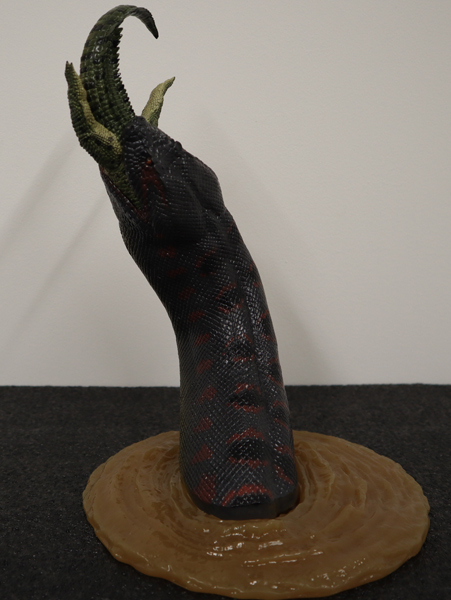
A Museum Quality Replica of Titanoboa Swallowing a Crocodilian

Rebor Titanoboa Museum Class Maquette Brian Diccus prehistoric animal model.

The assembled Rebor Titanoboa Museum Class Maquette Brian Diccus prehistoric animal model.

Picture credit: Everything Dinosaur

Rebor has created a range of scale model figures including wonderful, museum-quality replicas of the giant prehistoric snake Titanoboa.

To view the Rebor range: Rebor Prehistoric Animal Scale Models.

The fossils of this colossal snake were found in an open cast mine in north eastern Columbia.  To read more about the discovery of Titanoboa fossils: Titanoboa – Giant Snake of the Palaeocene.

The new “clumped-isotope” paleothermometer method used in the study analyses two rare heavy isotopes, carbon-13 and oxygen-18, found in tooth enamel, bones and eggshells.  Lead author and California Institute of Technology postdoctoral scholar Robert Eagle, commented:

“Clumping is temperature dependent, so at low temperatures you get more clumping together in a mineral while high temperatures mean less clumping.  If you can measure the clumping accurately enough, you can work out the temperature at which a mineral formed.  In the case of teeth and bone, this will be the body temperature of the organism.”

The use of oxygen isotopes (or at least the ratio of isotopes present) to establish ancient climatic conditions is not new.  The measurement of oxygen-16 isotope and its relationship to the heavier oxygen-18 isotope has been used by researchers to calculate temperature differences between glacial and interglacial periods.  However, this is the first time such a methodology has been used to calculate temperatures of long extinct animals such as dinosaurs.

An isotope is an atom of an element whose nucleus contains the same number of positively charged particles (called protons) as the “parent” element, but a different number of neutral particles (called neutrons).  Oxygen is present in water molecules as two isotopes – oxygen-16 and oxygen-18.  Oxygen-16 is the lighter of these two isotopes and evaporates more quickly.  During an Ice Age or glacial period, oxygen-16 enriched water vapour falls as ice and snow, depleting the ocean of this isotope and enriching it with a higher concentration of oxygen-18.

Studying Foraminiferans

Some marine organisms such as microscopic, single-celled, commonly occurring organisms called foraminiferans secrete calcium carbonate exoskeletons derived from sea water.  The oxygen content of these shells reflects the ratio of oxygen-16 to oxygen-18 isotopes in the water at the time the shell was constructed.  This ratio can also provide scientists with an indication of the sea temperature at the time.  Once a scientist has calculated the ratio of the two oxygen isotopes found in a fossilised foraminiferans, he (or she), will be able to estimate the oxygen composition of the sea water and deduce the likely climatic conditions at the time the shell was formed.

The researchers first tested the method on modern species: the white rhinoceros, Indian elephant, Nile crocodile, American alligator and sand tiger shark.  The study confirmed the rhinoceros and elephant, like all mammals, are warm-blooded, and their tooth enamel forms at about 37 degrees Celsius.  Researchers confirmed the accuracy within 2 degrees Celsius by measuring teeth of modern sharks from temperature-controlled aquariums.

In the next stage of the study, researchers tested fossils of mammoths and older extinct Florida alligator and rhinoceros species.

Robert Eagle added:“The method we present is a big advance because it allows a direct measurement of the body temperature of extinct species, free from the assumptions required with other approaches.”

Eagle said further testing of different-sized dinosaurs and other extinct vertebrates will provide more evidence about whether they were warm or cold-blooded.

Go to Top