All about dinosaurs, fossils and prehistoric animals by Everything Dinosaur team members.

Articles, features and information which have slightly more scientific content with an emphasis on palaeontology, such as updates on academic papers, published papers etc.

13 08, 2010

The Amazing Mosasaurs – A Sharks Tale!

By |2024-04-19T14:38:21+01:00August 13th, 2010|Categories: Dinosaur and Prehistoric Animal News Stories, Dinosaur Fans, Main Page, Palaeontological articles|0 Comments

New Study Indicates Mosasaurs had Shark-like Tails

Mosasaurs were a group of very large and powerful sea-living lizards.  They grew to lengths in excess of 14 metres and their fossils have been found in Cretaceous strata worldwide.  The chalk deposits formed by the tiny calcareous exoskeletons of countless planktonic micro-organisms are a particularly striking feature of the geology of Europe, take the white cliffs of Dover, for example.  These geological features were formed during the later stages of the Cretaceous.  People have quarried this soft rock for thousands of years, at first in search of flints for tool making and latterly the chalk has been worked so as to produce lime and other materials for chemical processes.

Mosasaurs

Occasionally, the chalk deposits reveal a spectacular fossil of a mosasaur, a member of the lizard family that adapted to a marine existence.  Some types of mosasaur evolved into the apex predators of the Late Cretaceous, replacing the ichthyosaurs and pliosaurs at the top of the food chain.  Although not dinosaurs, but marine lizards (Order Squamata), these impressive beasts became extinct at the end of the Cretaceous, they were the only group of lizards to die out at the same time as the dinosaurs.  One of the most impressive mosasaur specimens was discovered in a chalk mine at St Pieter’s Mount near to the southern Dutch town of Maastricht in 1770.

The discovery caused a scientific sensation around Europe and the animal dubbed the “Beast of Maastricht” was examined by a number of leading scientists of the day.  Debate raged as to whether these fossils represented a whale or a crocodile.  The creature scientifically named Mosasaurus hoffmani is actually more closely related to a modern Monitor lizard.

A Model of a Mosasaur (Tylosaurus)
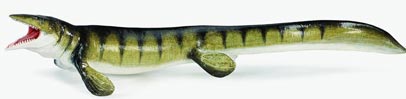
Picture credit: Everything Dinosaur

To view the model (Tylosaurus) and dinosaur toys: Safari Ltd. Wild Safari Prehistoric World.

With many specimens and something like twenty separate genera it was thought that the mosasaurs were relatively well understood.  However, new research published in the online scientific journal PloS One by two Canadian scientists suggests that there is a sting in the tale of the mosasaurs.

The traditional view of a mosasaur is a long, sleek animal with a broadened out, but ultimately tapering tail.  The tail was responsible for the propulsion of these animals.  The limbs had become flippers and the limbs particularly the back legs had become smaller.  They were probably used to help these lizards steer and manoeuvre in the water.  It was thought that the tails moved in a side-to-side motion, a little like the swimming motion as seen in a monitor lizard today.  However, two Canadian scientists, studying one of the best preserved mosasaur skeletons of all have deduced that the mosasaurs may have had fan-like tails reminiscent of sharks or indeed ichthyosaurs.

Mosasaur Makeover?

Is it time for the mosasaurs to have a makeover?

University of Alberta scientists Michael Caldwell and Takuya Konishi, in association with collaborators in Sweden and in the United States are in the process of overturning decades of conventional wisdom about the shape of mosasaur tails and their swimming style.  The researchers have pinned a shark-like tail on these marine lizards, perhaps changing our views about these huge predators forever.

Writing in the U.S. based publication of the Public Library of Science the scientists have concluded that at least one species of mosasaur (Platecarpus), on display at the Natural History Museum of Los Angeles County had a fluke on the end of its tail.

Fossils of the genus Platecarpus have been found on both sides of the Atlantic ocean.  Although quite small (approximately 7 metres in length), it was slightly bigger than a Great White Shark (Carcharodon carcharias) and it probably hunted in a similar manner.  Its long, slender jaws were lined with sharp teeth and it was a ferocious predator.

However, a long-standing theory about mosasaurs, or sea-dragons as they are sometimes called postulates that they had tapered tails that moved with eel-like undulations and propelled them forward, with the flippers acting as rudders to help steer.

In contrast, the scientific team led by Caldwell and Konishi have concluded that the shape and orientation of the lizard’s back bones indicate that these creatures had a crescent-shaped tail fin, unlikely to be preserved in fossil form.  This would have given this marine reptiles a powerful swimming thrust similar to that of a Great White Shark or even an ichthyosaur.  The team studied a number of mosasaur specimens from around the world, including a beautifully preserved specimen of Platecarpus from the Los Angeles County Museum.

A Mosaurus Model Showing the New Interpretation

The PNSO Mosasaurus "Ron".

“Ron” the PNSO Mosasaurus replica.

The picture shows “Ron” the Mosasaurus replica from PNSO: PNSO Age of Dinosaurs Models and Figures.

Like other groups of sea creatures that evolved to maximise their swimming speed and efficiency, the researchers state in the journal article, mosasaurs radically modified their tails, stiffened their backbones, and reduced their rear limbs to meet the demands of marine life.

If this new theory becomes accepted doctrine, then the mosasaur reconstructions in museums and illustrations in books will have to be changed.

Co-author of the paper, Luis Chiappe, Director of the Los Angeles Museum’s Dinosaur Institute stated in a summary:

“This fossils show evolution in action, how a successful design was developed time after time by different groups of organisms adapting to life in similar environments.  It highlights once again the potential for new discoveries to challenge well-established interpretations about dinosaurs and other animals that lived with them.”

For palaeontologists this may be a case of “deja vu”, as when the fossils of the first ichthyosaurs were discovered, it was thought that they too, had long tapering tails.  It was only when superbly well preserved fossils of ichthyosaurs were discovered in the fine grained sediments at Holzmaden in Germany that scientists got to view the outline of the body shape of an ichthyosaur and they discovered that they had dorsal fins and a forked tail which was supported by tail bones in the lower section only.

It is very likely that if mosasaurs had fish-like tails they did not swim with an undulating up and down motion like whales (as shown in the illustration).  It is most likely that these animals swam in an sideways movement, moving their bodies and their tails from side to side like crocodiles, lizards and snakes.
7 08, 2010

Ancient African Crocodile that thought it was a Mammal

By |2023-01-10T18:54:07+00:00August 7th, 2010|Categories: Dinosaur and Prehistoric Animal News Stories, Educational Activities, Main Page, Palaeontological articles|0 Comments

Paper Published on Crocodile with Mammal-like Teeth

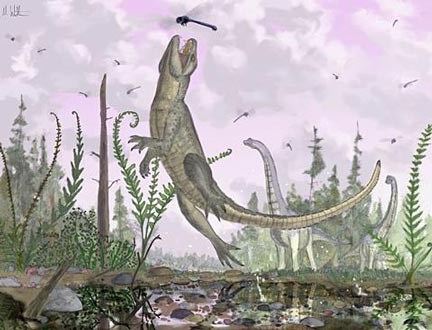
Scientists writing in the journal “Nature” have reported on their research into a strange and bizarre cat-sized, ancient African crocodile that filled a particular niche in the dinosaur dominated Cretaceous ecosystem.  The teeth of this particular reptile are similar to those seen in mammals and indicate that this little animal could bite and chew its food – a behaviour not seen in extant crocodilians.

Ancient African Crocodile

Palaeontologists unearthed an almost complete specimen in 2008, since then a number of other fossils of this 100-million-year-old creature have been found at a dig site in southwestern Tanzania.  No bigger than a domestic cat, this agile reptile scampered around the undergrowth chasing insects and small mammals whilst trying to avoid the attention of larger carnivorous dinosaurs that it shared its flood plain environment with.

Researcher Patrick O’Connor of Ohio University commented on the crocodile’s most striking feature, its teeth stating:

“If someone were just to describe those teeth, the shapes and how they interact with one another or work together, most people would read that as a very mammalian-like dental series.”

The scientist went on to discuss the latest discovery, an intact skull, complete with sharp incisors at the front of the jaws – ideal for tearing meat and interlocking upper and lower molars at the back of the jaw that were used for grinding, just like the teeth in the back of our own jaws.

The crocodile has been formally described and named Pakasuchus kapilimai.  The name means “Cat Crocodile”, from Paka the word for cat in the Swahili language and Suchus coming from the Greek word for crocodile.  A CT scan of this long-limbed terrestrial animal revealed that the molar-like teeth in the top and bottom jaws met very accurately when the animal bit down.  The creature would have eaten with a chewing action, mobile jaws in Reptilia are almost unknown (until now).

An Illustration of Pakasuchus kapilimai

Picture credit: Mark Witton (University of Portsmouth)

Pakasuchus kapilimai

The teeth of modern crocodiles are relatively simple in contrast to Pakasuchus kapilimai.  All the extant species of crocodilian have sharp, pointed conical teeth, the teeth (known as the dentition), may vary in size and angle but they are all virtually the same shape, with the same function to grab and hold onto prey.  Modern crocodiles cannot chew their food, they twist their bodies (known as a crocodile roll) and tear of chunks of flesh from their victims, these pieces are then swallowed whole.

Paul Filmer, Programme Director of Geology and Palaeobiology at the U.S. National Science Foundation, which co-funded the expedition with the National Geographic Society commented:

“The crocodilians with which you and I are familiar have a very characteristic smile, as it were.  The teeth or the dentition that they have is mainly a row of conical teeth which may vary a little bit in size and angle, but they’re pretty much all the same and they basically serve that function which is to grab and tear.”

Scientists say modern crocodiles did not evolve from the prehistoric crocodile-like creature that was a species of ancient reptiles called Notosuchian crocodyliforms that died out around the same time that other land-dwelling dinosaurs became extinct.

Notosuchian crocodyliforms

Paleontologists say Notosuchians are characterised by a variety of different tooth structures and patterns.

Researcher Patrick O’Connor says the 100-million-year-old reptiles, which flourished across a southern landmass the predated the African continent, probably filled a unique ecological niche.

“Maybe there was a certain place in the ecology or in the environment where these animals lived that allowed them to experiment with the shape of the teeth.  And as evolution works, if that was a successful experiment, then a group could go on and have a very long history.”

The crocodilians have evolved into a myriad of forms over their long evolutionary history to read an article about unusual crocodile-like animals: Five “Oddball” Crocodiles from the Mesozoic.

For models and replicas of early members of the Archosauria including models of ancient crocodilians: Prehistoric Crocodile Models and Figures.

1 08, 2010

Exclusive Update from Darren Tanke – Royal Tyrrell Museum (Alberta)

By |2024-04-19T14:36:44+01:00August 1st, 2010|Categories: Dinosaur and Prehistoric Animal News Stories, Main Page, Palaeontological articles|0 Comments

Darren Tanke – On the Mend

Dedicated scientists from the Royal Tyrrell Museum attempted to recreate a daring voyage on the Red Deer River.

Earlier this Summer we wrote in this blog about the Canadian/American expedition to re-create the voyage of Barnum Brown and company in 1910.  Barnum Brown, the then newly appointed Curator of Vertebrate Palaeontology at the American Museum of Natural History in New York, along with a dedicated team of researchers and assistants, spent the first of four seasons working along the Red Deer River in Alberta, searching for dinosaur skeletons and bone beds eroding out of the banks.

The scow (flat bottomed boat), used by Darren Tanke and his associates on their fore-shortened 2010 expedition is named Peter C. Kaisen after the technical assistant who accompanied Barnum Brown and logged their trip and discoveries.

Royal Tyrrell Museum

Unfortunately, Darren fell ill and could not continue, so the expedition was abandoned for this  year.  In an email sent to Everything Dinosaur team members Darren informed us that he was now on the mend and told us about his plans for the future.

Darren says in his email, commenting on his sudden illness:

“Blood tests revealed low haemoglobin so I was anaemic plus low potassium levels.  After two weeks of vitamins and lots of sleep I am back to normal and will resume light fieldwork soon.”

Reflecting on his voyage on the Red Deer River, Darren thinks he was probably ill before the expedition started.  He thinks the stress of organising all the last minute things that had to be done probably made him unwell.  The scow was floated down to Drumheller after Darren had to leave the expedition, so it did actually float as far (maybe further) as the 1910-1912 scow of the American Museum of Natural History.

Discussing the plans for another attempt next year, he stated:

“We are thinking of a number of modifications to the scow such as adding a thin steel bottom which should allow us to slide over rocks and definitely not allow pointy rocks to burrow into the wooden bottom.”

Darren went onto describe how he and his team could easily spin the stuck scow around 360 degrees (much like a compass needle) but had to do some serious prying and lifting to heave off the scow from any underwater obstacles they encountered.

We wish Darren all the best and hopefully we will be able to report on his plans for the Red Deer River expedition 2011 in a few months time.

Visit Everything Dinosaur’s website: Everything Dinosaur.

30 07, 2010

Prehistoric Animals were Show Offs According to New Research

By |2024-04-19T14:40:16+01:00July 30th, 2010|Categories: Dinosaur and Prehistoric Animal News Stories, Main Page, Palaeontological articles|0 Comments

New Study suggests Prehistoric Animals “Dressed to Impress”

A new study into the ornamentation of prehistoric animals that has been preserved in the fossil record concludes that fancy crests, frills and sails on the back were evolutionary adaptations to attract a mate.  An international team of scientists, led by Dr Joseph Tomkins of Hull University have studied several iconic creatures from the fossil record and concluded that many of the elaborate head crests, spines and sails that these animals had were primarily to attract mates.  In essence dinosaurs and other prehistoric animals “dressed to impress”.

Prehistoric Animals

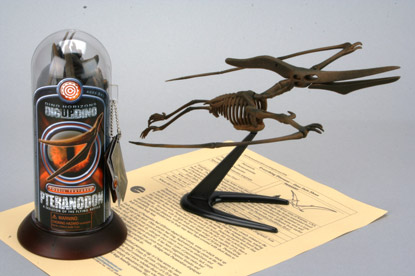
Animals in the study included the large pterosaur Pteranodon (Pteranodon longiceps) and the Permian pelycosaurs Dimetrodon and Edaphosaurus (Dimetrodon grandis and Edaphosaurus pogonias).

Earlier studies had concluded that these physical characteristics such as large head crests on pterosaurs or sails on the back of some pelycosaurs played a role in thermoregulation.  However, this latest analysis has found that the size of the Pteranodon’s head crest for example, was to big to play a role in temperature control.

Previously, scientists thought these physical characteristics were associated with thermal regulation. However, the latest study found the size of the pterosaur’s head crest was too big to play a role in temperature control.

An Illustration of a Model Skeleton of Pteranodon (P. longiceps)

Picture credit: Everything Dinosaur

To view the wide range of dinosaur and prehistoric animal themed toys and gifts available from Everything Dinosaur’s award-winning website: Visit Everything Dinosaur.

In a statement, the palaeontologists discussed the sail-back reptiles such as Dimetrodon and Edaphosaurus, they statement said:

“Furthermore, small ancestral, sail-backed pelycosaurs would have been too small to need adaptations to thermoregulation.”

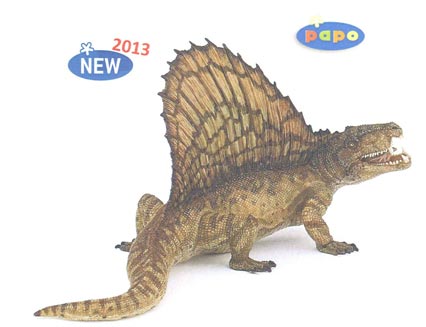
An Illustration of a Dimetrodon (D. grandis)

Prehistoric animals. The Papo Dimetrodon model.

Fearsome sail-backed reptile, with exquisite detail.  The Dimetrodon was included in the study.

Everything Dinosaur stocks a variety of Dimetrodon models, including the Papo Dimetrodon model.

View: Papo Prehistoric Animal Models.

The researchers plotted the relationship between metabolism and body size for each of the extinct creatures they studied.  They linked bigger crests and sails to the need to attract mates, with such features becoming more exaggerated over time.  We are not sure whether any extant creatures with large crests or other forms of ornamentation were studied.  Frilled lizards from Australia (Chlamydosaurus kingii) have a neck frill that is mainly used as a defence, but comparing the size of this frill and scaling it in the same way as the extant animals could provide an interesting and contrasting insight to this research.

28 07, 2010

Dr Phil Manning goes in Search of Triceratops

By |2023-01-10T15:02:50+00:00July 28th, 2010|Categories: Dinosaur and Prehistoric Animal News Stories, Main Page, Palaeontological articles, Press Releases|0 Comments

The University of Manchester’s Dr Phil Manning in Search of Triceratops

Dr Phil Manning from the University of Manchester’s School of Earth, Atmospheric and Environmental Sciences is setting out to explore the Badlands of South Dakota in a bid to find and excavate the fossilised remains of a Triceratops.  Dr Manning is part of a field team in search of Triceratops.

Last year’s prospecting of several promising locations suggested at least three skeletons of this iconic, famous three-horned dinosaur were gently weathering from 66-million-year-old rocks at a secret fossil rich site.

In Search of Triceratops

In his latest trip, Dr Manning is leading a team to evaluate the potential for excavating one of the creatures from its rocky tomb.

The pioneering palaeontologist and his team are famed for their research work on the hadrosaur Dinomummy, known as “Dakota”,  helping dinosaurs “virtually” walk, zapping Archaeopteryx lithographica with particle accelerators and tracking the enigmatic Tyrannosaurus rex in the Badlands of Montana.

The starkly-isolated Hell Creek Formation provides the most promising sites for the discovery of Late Cretaceous dinosaur remains in the world.

This is the last slice of geological time that contains the fossil remains of dinosaurs, before their mass extinction. Dr Manning, is confident that one of the Triceratops will be ideal for their research programme.

“We have been working on the exceptional preservation of soft tissue and the biomechanics of dinosaurs from the Hell Creek for over five years now, but this is our first major Manchester-led expedition to this very promising field area.”

A cast of Stan the T. rex already sits in the Manchester Museum, erected by a museum team and Dr Manning five years ago.

The Hell  Creek Formation

This fearsome predator from the Hell Creek Formation is also well-known from the area where Dr Manning and his team are working on the Triceratops

He said:

“It’s great that we have a chance to look at one of the prey animals of the mighty T. rex – who knows what we might find associated with the bones of this magnificent creature from the Cretaceous, maybe a predator tooth or three?”

The team, which includes Dr William Sellers from the University of Manchester and a group of co-workers from the University of Pennsylvania and other institutions in Philadelphia, hope to find additional pristine remains of dinosaurs this year in this very remote landscape.

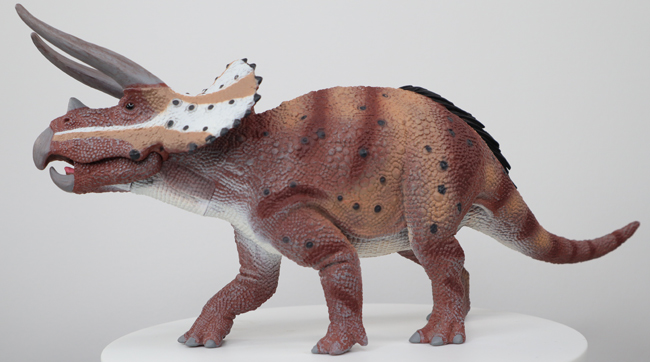
In Search of Triceratops – A Replica of T. horridus

CollectA Triceratops horridus 1:40 scale model. In search of Triceratops.

CollectA Triceratops horridus dinosaur model (left lateral view). Picture credit: Everything Dinosaur. Picture credit: Everything Dinosaur.

Picture credit: Everything Dinosaur

The Triceratops model is from the CollectA scale model range, to view this range of dinosaur and prehistoric animal figures: CollectA Deluxe Prehistoric Life Models.

Dr Sellers, who works on dinosaur locomotion at Manchester, commented:

“The bones of Triceratops will make a perfect large quadrupedal dinosaur model to study dinosaur locomotion.  We have already published on the maximum running speed of predators and even hadrosaurs, but Triceratops are just wonderful creatures to behold.  Many have compared them to rhinoceros, but our work indicates these animals moved quite differently from these modern herbivores.”

The fieldwork is part of an on-going research programme between the University of Manchester and the University of Pennsylvania, Stanford University and the Museum of Prehistoric Life in Price (Utah).

Dr Manning is head of the palaeontology research group at the University of Manchester and a research fellow at the Manchester Museum.

Dr Manning stated:

We have used techniques as diverse as evolutionary robotics, high-performance computing, finite element modelling, LiDAR, high-resolution x-ray tomography, nanoindentation, as well as recently published work using synchrotron light sources.  These cutting edge approaches have provided significant advances across the whole subject, generating high-profile international interest.”

We wish Dr Manning and his colleagues the very best and hope to hear more about their fieldwork over the next few weeks or so.

25 07, 2010

Giant Ichthyosaur Predator of the Triassic

By |2023-01-10T13:32:59+00:00July 25th, 2010|Categories: Dinosaur and Prehistoric Animal News Stories, Dinosaur Fans, Main Page, Palaeontological articles|0 Comments

Fearsome Triassic Ichthyosaur Ruled the Seas North of Laurentia

A team of scientists have identified a potentially new genus of Triassic ichthyosaur, one that was the “jaws” of its day, an apex predator probably feeding on other marine reptiles.  During the Triassic, sea levels across the world were higher than today and as a result there were extensive, shallow continental seas in which marine reptiles were rapidly establishing themselves as the dominant vertebrate predators.  The super continent of Pangaea stretched from the South Pole almost to the North Pole, it was sub-divided into two great land masses.  In the south there was Gondwanaland consisting of Antarctica, Australia, India and southern Africa.  In the north there was Laurentia made up of the land masses that were to eventually become North America and Europe.  In the shallow seas north of Laurentia, lurked a gigantic 14 metre long predatory ichthyosaur.  It ruled this watery domain, which 240 million years later was to become the arid, deserts of Nevada (United States).

Triassic Ichthyosaur

Nadia Fröbisch, a vertebrate palaeontologist at the University of Chicago unearthed the fossil in the Augusta Mountains of central Nevada in 2008.  A preliminary report on this huge beast that measured somewhere between 12 -15 metres long was published last year in the scientific journal “The Society of Vertebrate Palaeontology”.

Ichthyosaurs had been found in this region for many years, in fact the ichthyosaur is the state vertebrate fossil of Nevada.  However, the size and sharpness of the teeth found in association with these fossils indicate that this animal was something different.  It is likely that this ichthyosaur specialised in hunting other marine reptiles.

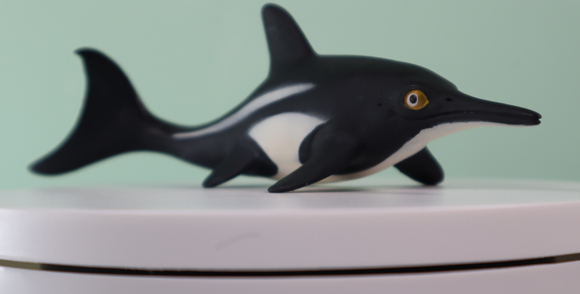
An Model of a Typical Ichthyosaur

An Ichthyosaurus model

The Ichthyosaurus model (Wild Safari Prehistoric World) ready to take its turn on the Everything Dinosaur turntable. Picture credit: Everything Dinosaur.

Picture credit: Everything Dinosaur

Rather than having a round cross-section, the teeth of this particular specimen were roughly diamond-shaped with serrations along their front and rear edges, dentition particularly well-suited to shearing flesh.

Even though erosion had removed much of the snout, the fossil was more than 10 metres long, indicating that a fully grown adult could have easily have been twice the length of a Great White Shark.

Commenting on the discovery, Fröbisch said:

“This could have been the T. rex of the seas”.

Although some later Mesozoic ichthyosaurs also had serrated teeth, those predators weren’t nearly as large and probably specialised in catching fish and smaller prey.  This giant ichthyosaur was probably the top predator around at the time.

Donald Henderson, a palaeontologist at the Royal Tyrrell Museum in Drumheller, (Alberta, Canada), stated that such sea monsters may have been quite widespread in the Early and Middle Triassic. He had recently found some isolated teeth from strata of the same age as the Nevada find, but in British Columbia.

He commented:

“I was mystified when I first saw them [the fossil teeth], I thought they had possibly belonged to a dinosaur.”

Marine Reptile Models

For models and replicas of ichthyosaurs and other marine reptiles: Prehistoric Animal Models and Figures.

23 07, 2010

Digging for Dinosaurs One Special Maniraptoran Gets his own Back on Us Mammals

By |2024-04-19T14:58:09+01:00July 23rd, 2010|Categories: Dinosaur and Prehistoric Animal News Stories, Main Page, Palaeontological articles|0 Comments

Trace Fossils Show Evidence of Dinosaur Digging for Mammals in their Burrow

For us, the concept of digging up dinosaurs is not unusual, we have had the opportunity to be involved in a number of vertebrate fossil excavations including Dinosauria.  However, a paper published in the scientific journal “Geology” discusses a remarkable find in Utah (USA) that provides Late Cretaceous evidence of a dinosaur turning the tables and digging up mammals.  This amazing trace fossil (a trace fossil preserves evidence of behaviour and/or activity) provides an insight into the hunting behaviour of a small theropod dinosaur.

Described as an “ancient crime scene”, the 77-million-year-old dinosaur claw marks and scratches were discovered next to a series of mammal burrows in the Dixie National Forest by Edward Simpson, a geologist at Kutztown University (Pennsylvania).  Some of the burrows were made by rabbit sized mammals, others were much smaller, perhaps the homes of shrew-like creatures.  However, it appears that one little dinosaur was attempting to dig out the residents, aiming to turn the mammalian burrow dwellers into lunch.  This is the first instance of this behaviour being found in the fossil record.

Commenting on the discovery, Simpson stated:

“It appears a dinosaur was digging down and trapping rodent-like mammals in a similar way to coyotes hunting prairie dog burrows today.”

A co-author of the paper that has been published in the journal “Geology” Simpson and his colleagues describe the study of this newly discovered trace fossil of signs of digging and scratch marks found in association with mammalian burrows as evidence of a predator/prey relationship.

The fossils are actually three component elements that together can be interpreted as evidence of dinosaur hunting behaviour.  All the fossils occur within a floodplain siltstone-mudstone bed of the Upper Cretaceous Wahweap Formation in southern Utah.  The strata and the fossils they contain have been dated to Campanian faunal stage and although the dinosaur cannot be specifically identified, the scientists suggest that the marks indicate a maniraptoran theropod, possibly a dromeosaurid or a troodontid.  The team conclude that the close proxmity of the digging scratches and marks to the mammalian burrows suggests that dinosaurs used excavation techniques to prey on mammals.

A study of the strata and surrounding fossil matrix paints a picture of a sparsely vegetated, dry and exposed sandy plain, crossed by meandering streams.  The trace fossil evidence was preserved when it was suddenly covered by a flood and sand was deposited  covering the tell-tale signs of dinosaur and mammalian activity.  The fossils were eventually re-exposed at the bottom of a cliff face and discovered by the geological team.

Dinosaur trace fossil expert (ichnologist) Martin Lockley of the University of Colorado agreed with Simpson and his team’s interpretation of the fossils.

He went on to state:

“Hopefully, this will encourage palaeontologists to look for more of this type of evidence.”

Although trace fossils provide extremely important “in situ” evidence of behaviour such as digging for prey, it is difficult to associate the trace fossil evidence with any known specific dinosaur genera.  However, the size of the claw marks and an assessment of the curvature has led the authors to conclude that the culprit was a one metre tall maniraptoran theropod, possibly a dromaeosaurid such as Dromaeosaurus or maybe Saurornitholestes.  The claw marks may also have been made by a member of the Troodontidae such as Troodon.

Although it is difficult to ascribe this behaviour to any known genus, it is very easy to imagine a keen eyed maniraptoran spotting a burrow entrance and then starting to dig out the hole to get to the small mammal cowering inside.

To view a large range of articulated “raptor” models including dromaeosaurids and troodontids: Beasts of the Mesozoic Models and Figures.

21 07, 2010

More Fossil Evidence of Proboscidea found in South America

By |2023-01-10T13:10:06+00:00July 21st, 2010|Categories: Dinosaur and Prehistoric Animal News Stories, Main Page, Palaeontological articles|0 Comments

Elephant Fossils Found in Brazil

When people today are asked about elephants they associate these members of the Class Proboscidea (animals with trunks) with Africa and India.  Those extant species that survive today are strongly associated with the African Savannah and the Indian sub-continent.  However, the elephant lineage is long and the fossil evidence indicates that over the course of the Cenozoic these animals have existed in some form or other over much of the globe.

For example, the United Kingdom has its fair share of prehistoric elephant fossils, perhaps most notably the West Runton elephant.  Partial remains including elements of the pelvis, skull and tusks of an enormous prehistoric elephant (Mammuthus trogontherii) were discovered eroding out of the sea cliffs at West Runton, near Cromer on the Norfolk coast in 1990.  A complete excavation took place in 1995 and evidence of a ten tonne giant elephant was revealed.

A report from Brazil states that scientists have described a fossil tooth, that could only belong to an elephant in the Amazon jungle.  The existence of elephants in South America in prehistory is not disputed, especially when one considers the excellent fossil material of Cuvieronius that has been found in Argentina and Bolivia.  This elephant genus was originally named and described by that great French scientist and anatomist Georges Cuvier back in 1808.  These fossils and those of another member of the Gomphotheridae – Stegomastodon (Stegomastodon platensis) indicate that a number of elephant genera were present in South America.

What is unusual about this fossil tooth from the Amazon, is that it has been dated to just 45,000 years ago, indicating the presence of elephants in South America during the Pleistocene Epoch, whereas the elephant fossils found to date are from the earlier geological Epoch, the Pliocene.

Scientists from Brazil say that this fossil tooth, proves the presence of pachyderms in South America as recently as 45,000 years ago.  The tooth had been discovered in the early 1990s, around the time of the excavation work on the West Runton elephant, but it was only recognised as a tooth from an elephant after a close examination by a University student from the Federal University of Minas Gerais.

Commenting on the find, palaeontologist Mario Cozzuol of Federal University stated:

“Only elephants and capybaras have teeth with this kind of laminate structure, but those of capybaras are no longer than five centimetres, while the fossil measured twelve centimetres.”

Earlier fossil discoveries had indicated that ancient elephants were present in Central America during the Pleistocene, but there was an absence of evidence to indicate that elephants from North America had migrated further south.  Both the African and Indian elephant are very much at home in enclosed forest environments, so the existence of ancient elephant species in the forested Amazon basin would not be entirely surprising.

A Trio of Papo Woolly Mammoth Models

Woolly Mammoth models.

A “Memory” of Elephants.  The collective noun for a collection of elephants.  A trio of Papo Woolly Mammoth models.  Picture credit: Everything Dinosaur.

Picture credit: Everything Dinosaur

To view a model of a prehistoric elephant (Woolly Mammoth) and lots of dinosaur replicas: Papo Dinosaur and Prehistoric Animal Models.

19 07, 2010

New Fossil Discovery from Saudi Arabia provides Evidence of Monkey/Ape Divergence

By |2023-01-10T12:57:39+00:00July 19th, 2010|Categories: Dinosaur and Prehistoric Animal News Stories, Educational Activities, Main Page, Palaeontological articles|0 Comments

Saadanius hijazensis – New Oligocene Primate sheds light on Divergence of Apes

Saudi Arabia 30 million years ago, looked very different than it does today.  Much of this desert kingdom was a lush and verdant paradise for the rapidly diversifying mammalian species.  Bordering the last remnants of the once mighty Tethys ocean there were extensive mangrove swamps and thriving in this half-way house environment between the land and sea were a number of genera of monkeys and other arboreal creatures.  The discovery of a partial cranium (part of the skull) dating from approximately 28-29 million years ago, may have shed light on the divergence of the apes from Old World monkeys.

In the hills overlooking the Red Sea a team of scientists have unearthed the fossilised elements of a skull of an ancient creature that may be a transitional fossil showing a point in the evolution of apes from monkeys.

The skull could help palaeontologists to answer questions about the life of primates in a geological epoch that until now has provided few fossil clues.  The report on this fossil and its potential implications regarding the evolution of apes is published in the scientific journal “Nature”.

Commenting on the discovery, Iyad Zalmout, a palaeontologist with the University of Michigan and an author of the paper stated:

“It turns out it’s not an ape, it’s not a monkey, it’s something intermediate.”

The expedition were a little surprised to find the fossil, their primary objective being to explore the coastal sediments to excavate ancient whale fossils, helping to piece together the evolution of this particular group of mammals. They were not expecting to find ancient monkey/primate remains, especially skull material which could provide a fresh insight into the evolution of apes from Old World monkeys.

Fossil Discovery

Pictures show an anterior view of the skull material (view from the front) on the left and a ventral view (view from the side) on the right.  Although fragmentary, the nasal concha (hole where the nose tissue would be) is clearly visible, along with the nasal bone (links nose to the eyes) and elements of the maxilla.  The face although elongated and angular does have a flattened appearance, a characteristic of apes and of our own hominid ancestors.

This new genus has been named Saadanius hijazensis and it shares morphological features with a family of apes known as the Propliopithecoidea, an ancestor of apes and monkeys that lived more than 30 million years ago.  The fossil record of monkeys from this part of the Cenozoic is particularly poor, arboreal dwelling animals do not generally have a high potential for fossilisation to occur.  This is due to a number of factors but living in a forested environment leads to very few chances of a corpse being fossilised and preserved.  S. hijazensis lacks the advanced sinuses of extant apes and monkeys (collectively called Catarrhines), however, it does have a bony ear tube that was not fully developed in the Propliopithecoidea.

Commenting on the discovery, Erik Seiffert, an anatomist at Stony Brook University in New York said:

“This fossil is really key because it has that bony tube.”

He went on to add that comparison of the bony tube and other features such as the teeth and the forward facing position of the orbit (eye sockets) with those of other primates could help palaeontologists to build up a more complete picture of the ape/monkey family tree.

Saadanius hijazensis

Zalmout and his co-authors are confident that S. hijazensis could help scientists make sense of “competing hypothesis” about how the shape of Catarrhine skulls changed over time.  One theory put forward by palaeontologists based on the limited fossil evidence found to date is that the Catarrhines developed long, flat faces relatively early on in their evolutionary history.  Other scientists, such as comparative anatomists point out that modern, extant genera such as gibbons, have rounder faces and use this evidence to suggest that long, flat faces evolved much later.

The fragmentary Saadanius fossil has a long, flat face and this discovery has excited scientists as it lends support to the theory suggesting the evolution of the flat face very early on in ape evolution.

Erik Seiffert stated:

“This evidence [Saadanius fossil] very clearly supports the palaeontological point of view.”

However, other scientists warn on the over reliance of fossil evidence to prove a particular theory.  For example, facial features may be distorted over the long preservation and fossilisation process, geological pressure can crush, compact and distort features.  Eric Delson, a palaeontologist from Lehman College of the City University (New York), suggested that fossils may only reflect part of the diversity of a group of particular animals, making it difficult to draw precise conclusions.

All the scientists agree that the discovery of more ancient transitional fossils will help to shed light on the evolutionary relationships between different groups.  Saudi officials, keen to promote tourism have already taken steps to preserve this particular dig site.  This will afford palaeontologists the opportunity to explore the area in more depth, perhaps unearthing more fossils that can indicate how Saadanius moved around its mangrove environment and what it ate.

Delson put it succinctly stating:

“It would be interesting to know whether these primates were beginning to come down from the trees and to know something about what they were eating.”

Welcoming the news that Saudi officials want to preserve the site and to promote fossil tourism Zalmout concluded:

“In my experience, if you find one primate there should be more there.  This will be important to see the whole story about fauna in Arabia and Africa.”

We at Everything Dinosaur look forward to reading about future discoveries.

To view models of prehistoric animals including mammals from the Oligocene: Figures of Prehistoric Mammals.

17 07, 2010

Cave full of Marsupial Fossil Treasures Discovered in Queensland

By |2023-03-06T08:52:33+00:00July 17th, 2010|Categories: Dinosaur and Prehistoric Animal News Stories, Main Page, Palaeontological articles|1 Comment

Australian Discovery Provides Evidence of “Mob” Behaviour in Ancient Marsupials

By the Eocene, Australia had become isolated from the rest of the world.  Here in splendid isolation, its primitive mammals, especially the marsupials were allowed to evolve unheeded without the frequent migration of other types of creature into Australian habitats.  In contrast to their South American cousins, which were usurped from many environmental niches by more modern placental mammals from North America, the Australian marsupials survived as the dominant group in this part of the world.  Researchers have been analysing a large number of marsupial fossils.

Discovery of a Cave

Scientists from the University of New South Wales have reported on the discovery of a cave which contains a substantial number of prehistoric marsupial fossils.  Their findings are reported in the scientific publication “The Journal of Vertebrate Palaeontology”, analysis of the fossils indicate that they are approximately 15 million years old (dating to the middle of the Miocene Epoch).

The cave is located in the northwest of Queensland, near to the famous Riversleigh site, an area famous for its prolific quantities of Cenozoic mammal fossils.  Riversleigh is a relatively remote area, with few townships and lots of ranches.  Evidence for Australian marsupials ranging from 23 million years ago to less than 20,000  years old have been found.

Fossils have been excavated from the Riversleigh area for more than 100 years but the real breakthrough which put this relatively obscure part of Australia firmly on the palaeontological map occurred in 1983 when a few weathered blocks of Riversleigh limestone revealed more than 30 new species of mammal.

For much of the Miocene and Pliocene Epochs this part of Australia was a lush lowland rain forest that was teeming with life.  One particular site at Riversleigh has been recorded as one of the most vertebrate fossil rich locations known.  In 1983, a two cubic metre block of limestone yielded 58 new mammal species.  The Riversleigh area is a limestone terrain which in the Miocene had a lot of surface water.  These were ideal conditions for bone preservation.

Marsupial Fossils

The cave system contains a number of complete prehistoric marsupials skeletons, their discovery has revealed some surprising similarities between these ancient creatures and extant species of modern-day kangaroos and koalas.

The cave has kept the fossils beautifully preserved.  The fossil find includes 26 skulls from an extinct, wombat-like marsupial called Nimbadon (N. lavarackorum).  The herbivorous Nimbadon was approximately the size of a sheep, but with giant claws.

Co-author of the study, University of New South Wales palaeontologist Mike Archer commented:

“It’s extraordinarily exciting for us.  It’s an extra insight into some of the strangest animals you could possibly imagine.”

The cave was found in the mid 1990s and has been extensively explored.  The scientists were amazed at how well preserved the fossils were and the large number of fossilised bones discovered at the site.  The number of skulls found together (twenty-six) suggests that these particular marsupials may have travelled as a group or to use an appropriate collective noun a “mob”.

The scientists remain unsure as to how all the animals ended up in the cave.  One theory put forward suggests that the mob of kangaroos fell into the cave through a whole in the roof that had been obscured by overgrowing vegetation.  These poor animals would have either been killed by the fall or become trapped and starved to death.

The Remains of Joeys

The fossil bones include the remains of joeys still in their mother’s pouches.  This gives the researchers an insight into how these ancient marsupials developed.  The skulls of the babies reveal that the bones at the front of the face developed quite quickly, this would have allowed the joey to suckle from its mother at an extremely young age.

Karen Black, the expedition’s leader, commented that the Nimbadon joeys developed in a similar way to extant kangaroos today, probably being born after a month’s gestation and crawling into their mother’s pouch for the remainder of their development.

The large claws indicate a potential arboreal existence, with Nimbadon climbing trees in a similar way to modern Koalas.  With large marsupial predators in the area, animals such as the carnivorous kangaroo Ekaltadeta and the marsupial “tiger” the Thylacine, being able to climb trees may have been a very effective strategy for defence.

Discussing this significant discovery, palaeontologist Liz Reed of Flinders University (South Australia) stated:

“To find a complete specimen like that and so many from an age range is quite unique.  It allows us to say something about the behaviour and growth and a whole bunch of things that we wouldn’t normally be able to do.”

Australia may be well known today for its unique fauna and flora but it seems back in the Miocene the unusual life in the Riversleigh area would have given today’s strange Australian natives a run for their money.

To view models and replicas of prehistoric mammals: Replicas of Prehistoric Mammals.

Go to Top