All about dinosaurs, fossils and prehistoric animals by Everything Dinosaur team members.

Articles, features and information which have slightly more scientific content with an emphasis on palaeontology, such as updates on academic papers, published papers etc.

3 11, 2010

High Oxygen Levels Spawn Super-sized Dragonflies

By |2023-03-06T12:41:50+00:00November 3rd, 2010|Categories: Main Page, Palaeontological articles|1 Comment

Meganeura – Here we Come!

Dragonflies with wingspans as big as hawks may not be every-body’s cup of tea, but a team of researchers from Arizona State University in a study focused on calculating the past oxygen concentrations in the atmosphere have set out to create some super-sized bugs.

Three hundred million years ago, during the Carboniferous geological period, tropical swamps were patrolled by a variety of flying insects, the largest known was the huge dragonfly Meganeura, with a wingspan approaching 75 centimetres in diameter.  Whilst down on the ground, huge arthropods, some of them more than two metres long scuttled through the undergrowth.  Not the sort of place you would want to visit if you have a disliking of creepy crawlies.

Biologists and Palaeobiologists have been working on an extensive project to assess oxygen concentrations on the effect of insect growth.  The team have managed to produce super-sized dragonflies, ones which are 15% bigger than normal by raising the insects in chambers that imitate Earth’s high oxygen concentrations during the Carboniferous.

A Dragonfly Moulting into its Adult Stage

Picture credit: Everything Dinosaur

The research, presented to the annual conference of the Geological Society of America, meeting in Denver, Colorado provides support for the theory that super-sized ancient invertebrates and high atmospheric oxygen levels were not coincidental.  The study may also help scientists to gain an insight into more recent oxygen levels on our planet, as there is conflicting data on atmospheric oxygen concentrations from the late Mesozoic and into the Cenozoic.

Lead author, palaeobiologist John VandenBrooks of Arizona State University said:

“No one has been successful growing dragonflies under controlled laboratory conditions before, at least to my knowledge.  This has allowed us to ask the question – how have oxygen levels through time influenced the evolution of insects?”

The fossil record has preserved a spectacular record of giant insects and arthropods from the Carboniferous.  During this period in Earth’s history oxygen levels were up to 50% higher than they are today, with oxygen making up something like 31% of the atmosphere, compared to today’s more modest 21%.

To read an article about the discovery of an amazing insect fossil in the United States: Spectacular insect fossil discovered in America.

In our own studies with locusts, the rate of breathing changes depending on the amount of oxygen an insect is exposed to.  If you place a locust in a sealed chamber and increase the concentration of oxygen in the air, the rhythmic movement of the abdomen slows down.  It is the beating of the abdomen that helps draw air and that all important oxygen into the creature’s body via its tracheal breathing tubes.

If the concentration of oxygen is decreased the animal has to “breath harder” and the beating of the abdomen increases.  How insects and arthropods were able to grow to huge sizes during the Carboniferous may be due to a number of factors, but the concentration of oxygen levels would have had a strong influence as this new research shows.

Super-sized Dragonflies

VandenBrooks and his team raised a number of “living fossils”, creatures such as different beetles, cockroaches and dragonflies in three habitats, each with different oxygen concentrations.  One habitat had oxygen concentrations at Carboniferous levels, the second had conditions of just 12% oxygen, (the lowest oxygen level since complex life appeared on Earth during the Cambrian).  The final habitat mimicked modern atmospheric conditions with an oxygen level of 21%.

The team discovered that dragonflies and beetles grew faster, as well as bigger, in a high-oxygen environment, while cockroaches grew slower and remained the same size. All but two species in the study grew smaller than normal at the lower concentration of oxygen.

A study of invertebrate fossils preserved in amber (fossilised tree resin) could help to correlate the data, providing a basis to help determine oxygen levels in the Earth’s atmosphere in the Cenozoic.  If measurements of the breathing tubes of these creatures preserved in Baltic amber dating from fifty million years ago, could be taken then this data and the American research could be combined to help map ancient oxygen levels.

Postdoctoral research fellow, VandenBrooks added:

“We started out with insect physiology to understand the fossil record better, in light of data from modern species.  Then we realised we might have a biological tool to estimate ancient oxygen levels – a proxy – using that physiology in specimens trapped in amber.”

Looking after the dragonflies was never going to be easy, especially since they spend the vast majority of their lives as water-loving nymphs.  The team had to hand feed their charges with worms, crustaceans and as they got bigger, larger prey such as guppy fish.  When adult dragonflies emerge, to spend the last part of the lives as swift fliers, whizzing around in a bid to find a mate, they begin breathing through a network of tracheal air tubes.

For almost six months, 225 nymphs, (75 per controlled habitat) had to be hand fed, as VandenBrooks admits:

“It wasn’t quick, but it paid off.”

After the dragonflies and the other creatures changed into their adult forms, the researchers measured their breathing-tube volumes.  They discovered that high oxygen concentrations lowered tracheal volume, while low oxygen concentrations boosted it. VandenBrooks commented that tracheal volume may be tied to prehistoric dragonfly body size:

“As you become a larger insect, more of your body is taken up by tracheal tubes.  Eventually, you reach a limit as to how big you can be.”

He went on to add:

“The more oxygen that is available, the smaller that system needs to be and the bigger you can grow.”

Dragonflies in the modern habitat with 21% oxygen levels grew normally, with wingspans of about 3.5 inches, while the hyperoxic chamber spawned dragonflies with 15 percent larger bodies and 4-inch wingspans.  Beetles also grew proportionally larger but, conversely, cockroaches did not increase in size when exposed to the rich oxygen levels. Instead, they remained the same size and developed more slowly.

VandenBrooks stated:

“We are not sure why this happened.”

However, cockroach tracheal volume still decreased along with most of the other creatures studied.

“We might be able to correlate this modern tracheal data with tracheal volumes we measure in amber fossils to find out what oxygen concentrations were during some contentious periods in history.”

He also commented that oxygen levels around 300 million years ago are better known than from 120 to 65 million years ago, a period with “conflicting and poorly resolved” oxygen models.

There is conflicting data on oxygen concentration levels in the period of Earth’s history extending from the Early Cretaceous through to the Eocene. Some scientists state that oxygen levels were generally higher than they are today, whilst other researchers have put forward data to indicate lower concentrations.  The work of the Arizona State University’s team could help to determine which of these theories is closest to the truth.

As VandenBrooks says:

“We need a good proxy to estimate historic conditions.  Amber fossils are promising if we can more tightly correlate breathing-tube volume to oxygen.  I would like to take a more in-depth look at the fossil record and expand forward to the present and backward to the past to see if amber is a viable proxy.”

The researchers want to repeat their experiments, to see if changing oxygen levels has an effect on invertebrate’s behaviour.  In particular how changes in atmospheric oxygen concentrations affect dragonflies.

VandenBrooks concluded by saying:

“We want to know how it affects their metabolism.  How does it affect their ability to perform?  Their speed?  Their efficiency?  I’d love to know these things.”

This research is certainly helping to add more information to the debate as to ancient concentrations of oxygen, and to the rise of the super-sized insects and other invertebrates of approximately 300 million years ago.  At Everything Dinosaur, we think that oxygen levels are certainly a factor but there are one or two other points to consider.

Firstly, take the Carboniferous fliers for example.  These were the first creatures to be able to exploit this medium.  A lack of competition could have aided in their evolution to giant forms.  Also, it is worth remembering that the higher concentrations of oxygen in the atmosphere during the Carboniferous as opposed to higher levels of nitrogen we see today, would have made the air denser, and thus easier to fly in, allowing insect muscles to work more efficiently.  This could have helped in the evolution of larger flying members of the Insecta.

During the Carboniferous, land based vertebrates were not as diverse, or as numerous as today.  The largest vertebrates were amphibians, slow moving animals with a very sprawling gait.  The first reptiles had evolved but these creatures for most of the Carboniferous were small, many were less than 30 centimetres in length.  The Arthropoda and the Insecta could be said to have ruled the Earth at this time in our history, the lack of vertebrate predators could have helped stimulate the evolution of large forms of invertebrates.

For models of Palaeozoic animals and other prehistoric animal figures: Prehistoric Animal Models.
24 10, 2010

Meteor Blast Led to Explosion of Palaeozoic Lifeforms Claim Scientists in New Research

By |2024-04-19T15:04:51+01:00October 24th, 2010|Categories: Dinosaur and Prehistoric Animal News Stories, Main Page, Palaeontological articles|0 Comments

Ordovician Meteor Blast Led to Explosion of Life

Many people may be aware of the impact of an extraterrestrial object on the destruction of many forms of life on Earth, such as the huge asteroid collision that aided and abetted the demise of the dinosaurs 66 million years ago.  However, asteroids and meteor collisions may have had a deeper impact on life on Earth than previously thought.  Indeed, such natural catastrophes could have helped “spur on” evolution and led to an increase in diversity of Paleozoic life.

Scientists have found evidence to suggest that an increase in Ordovician life forms may be due to a bombardment of extraterrestrial objects about 470 million years ago.  The researchers have hypothesised that the disintegration of a huge asteroid meant that planet Earth was repeatedly struck by fragments of rock at a vital stage in the evolution of life on Earth.

Palaeozoic Life

The theory that such impacts may have kick-started evolution and led to an acceleration  in the evolution of animal families is set out in a new book – “Incoming” by Ted Nield, editor of Geoscientist, the journal of the Geological Society of London.

Dr Nield, a geologist by training stated:

“The picture emerging from new research is that around 470 million years ago a stupendous collision in the asteroid belt [between Mars and Jupiter] bombarded the Earth with meteorites and this may have been responsible for the single greatest increase in biological diversity since the origin of complex life.”

Book Based on Extensive Studies

The book “Incoming” or “Why we should stop worrying and learn to love the meteorite”, is based on the extensive studies carried out by Professor Birger Schmitz of the University of Lund (Sweden).  He analysed rock samples taken from five Swedish quarries, finding that in strata dating from around 470 million years ago there was a massive concentration of fossilised meteorites.  The concentration was over 100 times what would have been expected under “normal” meteorite bombardment conditions.

Professor Schmitz commented:

“The original asteroid that broke up was perhaps a few hundred kilometres in diameter so there were a lot of fragments.  The size would have been up to 10 kilometres across, roughly the same diameter as the one that wiped out the dinosaurs.”

The professor added:

“We think that there were quite a few really big impactors and these would have had the power to change life on Earth.”

Professor Schmitz has travelled to other parts of the world, testing his theory regarding the increased concentration of fossilised meteorites in Ordovician strata.  He has recorded similar increases in meteorite fragment concentrations, reaffirming the results of his work in Sweden.

There may be a body of evidence to suggest that our planet was bombarded by space debris around 470 million years ago, planet Earth has been hit by such bodies on numerous occasions in its 4.7 billion year history.  Indeed, some scientists consider such impacts inevitable describing near space around our planet as a “cosmic shooting gallery”.  The point to consider is this – did these impacts in the Ordovician result in the sudden increase in life forms seen in the fossil record of Ordovician strata?

On this point, Professor Schmitz is more cautious, stating:

“The theory is controversial because most scientists believe that meteorite impacts cause extinction.  This is true, but 470 million years ago diversity was pretty low – so there were far fewer species to wipe out.  Our theory is that the impacts changed the climate and geology of the Earth and that species had to adapt rapidly to big changes or go extinct.”

To read another article on how extraterrestrial impacts could have affected life on Earth: Jurassic explosion could have led to the demise of the Dinosaurs.

During the Ordovician Period (lasting from around 488 million years ago to 443 million years ago), the nature of marine faunas changed dramatically.  Cambrian faunas were replaced with a more diverse assemblage in the mid-Ordovician and the first animals began to colonise the land (arthropods).  The end of the Ordovician is marked by the first major extinction event recorded in the fossil record.  Many types of arthropod, notably trilobites and other forms of marine life such as the brachiopods, graptolites and corals became extinct.

Following the “Cambrian explosion” – a rapid diversification of marine life that occurred some 80 million years before the Ordovician meteorite bombardment, the fossil record shows a relative lull in the speed of evolution.  However, from the Dapingian faunal age (at around 471 million years ago) there is evidence to suggest a burst of evolution.  This has been recorded in the fossil record.  This increase in diversity coincides with the meteor impacts – could the impacts have acted as a catalyst to speed up evolutionary development?

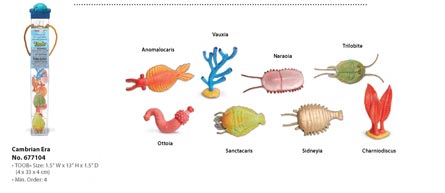
Typical Cambrian Biota

Cambrian Toob by Safari Ltd
Say hello to Cambrian wildlife.

The model set pictured (above) is the Wild Safari Dinos Cambrian life tube.

To view this range of prehistoric animal models: Wild Safari Dinos Models.

Widespread Devastation

The impacts would have brought about local, widespread devastation, altering environments and effecting the climate.  These exogenous forces would have led to the demise of some types of animal but created opportunities for others.  The break up of the asteroid and the resulting collisions with Earth could have given evolution a kick start. It changed the evolution of Palaeozoic life.

At this time in Earth’s history, the most advanced vertebrate creatures on the planet were primitive, jawless fishes.  Eight groups of these fossil fish have been identified in the fossil record (agnathans), these types of vertebrate diversified and could have benefited from the meteor impacts, thus spurring on vertebrate evolution.  Invertebrates may also have perversely benefited from the extraterrestrial interventions with more advanced cephalopods and arthropods evolving, perhaps even the motivation to colonise the land was in part dictated by conditions that arose as a result of the meteorite bombardments.

21 10, 2010

Famous Palaeontologist Awarded Special Honour

By |2024-04-19T15:04:13+01:00October 21st, 2010|Categories: Dinosaur and Prehistoric Animal News Stories, Famous Figures, Main Page, Palaeontological articles|0 Comments

Professor Philip Currie Awarded Prestigious Accolade

World famous palaeontologist, Philip Currie has been inducted into the prestigious Alberta Order of Excellence, the highest award the Canadian province of Alberta can give to a citizen.

Professor Currie is normally found either immersed in his work at the Dept. of Biological Sciences at the University of Alberta or involved in fieldwork digging up fossils including many dinosaurs.  He is just one of eight people to receive this prestigious accolade this year.  He shares this honour with former premier Ralph Klein and another esteemed member of the University of Alberta academic staff, Professor Emeritus Bob Steadward.  The awards were made in a special ceremony, held yesterday at Government House, Edmonton.

Famous Palaeontologist

A committee of volunteers, led by Alberta’s lieutenant governor Donald Ethell, considers a list of nominated citizens and the award is given to those individuals who can show a record of long service to the people of the province and for the impact their work has on people across the whole of Canada.  Another important criterion for being inducted into the Order is for that person’s work to have stood the test of time.

For Phil Currie, responsible for naming and describing something like 25 new genera of dinosaurs, and with his leading role at the Royal Tyrrell Museum (Drumheller, Alberta), his work passes the time test with flying colours.

Commenting on his award, Phil Currie stated:

“I could not be happier because this award is a milestone for palaeontology in Alberta.  There aren’t many places in the world where a government would recognise dinosaur fossils as resources that we should continue to study and develop.”

For Professor Currie, the tuxedo will have to come off and be put back safely in the cupboard, as shortly he is due to leave for Antarctica to take advantage of the Southern Hemisphere’s summer to help excavate and study a new dinosaur dig site on that frozen continent.

It is such a pleasure to hear of this award, on behalf of everyone at Everything Dinosaur we want to add our congratulations to Professor Currie, to his university colleague Bob Steadward, and to those other new members of this highly respected and select Order.

To view models and replicas of many of the prehistoric animals that Professor Currie has researched: Dinosaur and Prehistoric Animal Models.

17 10, 2010

Finding a Fossil Fish on a Bulgarian Highway

By |2023-01-13T17:45:42+00:00October 17th, 2010|Categories: Dinosaur and Prehistoric Animal News Stories, Main Page, Palaeontological articles|0 Comments

Triassic Fish Fossil Unearthed by Construction Workers

The near perfectly preserved fossil of a large predatory fish, discovered by construction workers building a relief road in Bulgaria has been identified as a new type of Triassic fish.  The fossil, which measures 58 centimetres long, was first unearthed last December and is amongst a number of fossil fish discoveries that have come to light as the 130 million Euro Sofia relief road project continues.

The relief road, designed to help ease traffic flows in western Bulgaria is known as the Lyulin highway, the building commenced four years ago and as the excavations have pressed on, so a number of interesting fossil finds have been made.  Zoologists and palaeontologists at the Pernik Regional History Museum, have concluded that the fossil represents an unknown species of Mesozoic predatory fish.  The rock containing the rare fossil has been dated to the Upper Triassic, making this fish more than 200 million years old.  Very few Triassic vertebrate fossils are known from this part of eastern Europe, although the highway construction teams have found a number of invertebrate specimens, including ammonites and ancient sea urchins.

Much of this area of Bulgaria was covered by an immense lake during the Triassic, it seems likely that the fish found itself in an isolated pool of water and perished as the pool dried up.  The specimen is going to be put on display at the Pernik Regional History Museum.

Fossil Fish

The head of the fish can be seen in the right of pictures that have been released, with the beautifully preserved pectoral fins just in front of the gill covers.  A black ruler has been placed next to the fossil to provide a scale.

In total, more than thirty other fish fossils have been found, but most are only fragmentary and date from a much more recent time (Cenozoic).  A spokesperson for the museum commented that the Bulgarian authorities were going to ask foreign palaeontologists for help with the study of these fossils as local museums did not really have the specialists in such ancient species.

It may be strange to think of the fish fossils being found in this part of Bulgaria, an area famous for its mountainous terrain, but 200 million years ago, this part of Europe was underwater and the fossil fish being found as the highway is built are testament to the geological forces that have acted upon the terrain and landscape.

For models and replicas of Triassic animals, visit the models section of Everything Dinosaur’s website: Dinosaur and Prehistoric Animal Models.

26 09, 2010

Special Silver Jubilee for Royal Tyrrell Museum (Alberta, Canada)

By |2024-04-19T19:13:00+01:00September 26th, 2010|Categories: Dinosaur and Prehistoric Animal News Stories, Dinosaur Fans, Main Page, Palaeontological articles|0 Comments

Royal Tyrrell Museum in Drumheller Celebrates 25 Years

This weekend marks the 25th anniversary of the opening of the Royal Tyrrell Museum in Drumheller (Alberta, Canada), a museum dedicated in the main to dinosaurs and the specimens to be found in the amazing strata of the Canadian province of Alberta.

Royal Tyrrell Museum

The Tyrrell opened on September 25th 1985, it did not get the “Royal” status until 1990, this museum, adjacent to numerous outcrops and exposures of  Upper Cretaceous strata, has done much to put Canada “on the map” as it were when it comes to palaeontology and related disciplines.

Don Brinkman, Director of Preservation and Research at the museum, recalls that in the early 1980’s scientists began working on an extensive horned dinosaur bone-bed, at the time a very ambitious excavation.  The project to build a museum in the area of Drumheller was already underway when he joined in 1982.

He recalled:

“We had three years for designing the building, building the building and collecting the specimens.  Looking back it was phenomenally ambitious, but we were all very young and we had no idea that a project [of that size] should take ten years.”

At first the staff worked out of offices in Edmonton, but the first museum director, David Baird decided that to work best, the scientists needed to be in and amongst the fossils, so the young Don Brinkman found himself working in a converted Co-op grocers in Drumheller, with colleagues and facilities scattered around the town.  From the beginning, he knew that working for the “Tyrrell” would be very different.

As the Royal Tyrrell staff emphasise, this museum was never going to be simply a collection of fossilised bones.  The museum is named after the famous Canadian geologist Joseph Burr Tyrrell (1858-1957), who discovered the skull of Canada’s first meat-eating dinosaur (Albertosaurus) whilst prospecting for coal on behalf of the Geological Survey of Canada.  The name is pronounced with the onus on the first syllable, as in “squirrel”.

Discussing the culture and ethos of the museum, Don added:

“It was decided that the focus would be on palaeobiology.  We wanted to understand the animals as they were living.  The foundation of palaeobiology is the fossil, but now we’ve taken an object and created a world around it.”

He admits it wasn’t a widely followed approach:

“It was viewed as wishy-washy, because there hadn’t been the scientific rigour for that kind of observation.  One of the most important things over the museum’s 25 years has been the development of this type of approach as rigorous science.”

This philosophy explains why today, although most of the galleries feature dinosaurs, there are also extensive exhibits on life on Earth over the last 300 million years or so.  The museum has experts on dinosaurs, and also geologists, palaeobotanists, and other specialist all helping to take care of over 110,000 fossil specimens and over the twenty-five years of the museum – ten million visitors.

When people visit the museum, as Don Brinkman says:

“They are seeing dinosaurs in the context of where they lived and how they interacted.”

We at Everything Dinosaur have been lucky enough to visit the museum on several occasions.  We have worked on some of the dig sites and helped in the huge fossil store rooms, indeed we would wager that there are a number of new species awaiting to be discovered, once the staff at the museum get round to studying all the fossils that have been placed with them after their excavation.

The museum really is an amazing place and very user friendly, full of helpful staff.   It is one of our favourite museums in the world.

Dr Don Brinkman, Preservation and Research Director at the Royal Tyrrell Museum, is delighted to preside over the 25th anniversary of the museum’s opening.  It is difficult to say exactly what the exhibit is in the background, but we assume it is a specimen of Albertosaurus sarcophagus, the same type of dinosaur the Joseph Burr Tyrrell discovered.

A number of special events and programmes are planned to mark the silver jubilee.  Twenty-five specimens form part of a special exhibition that tells the story of the history of the museum, one exhibit for each year of the museum’s existence.  Together they tell the story of Royal Tyrrell, chronicling the stories, the people and the events.

One of the stars of the show is the exquisitely preserved T. rex fossil known as “Black Beauty” (TMP 81.6.1), one of only two T. rex fossils found in Alberta.  The fossil specimen is jet black and represents about 25% of the entire animal, including a substantial amount of cranial material.  The jet black colour of the fossil is a result of manganese deposited by local groundwater penetrating and coating the fossil.

Senior science educator Megan McLauchlin explains that the colour is not the only thing that is special about this particular tyrannosaur fossil.  It is a fossil of a sub-adult animal, she went onto state:

“When you’re studying fossils, you really want a range of ages in the specimens.”

The specimens in this special exhibit tell uniquely local stories of scientific advancement.  The block of duck-billed hadrosaur eggs and embryos found at Devil’s Coulee in southern Alberta, for example, featured a new species of Hypacrosaurus, and helped to advance theories about how these dinosaurs cared for their young and about population dynamics.

The braincase of the Troodon, a small, meat-eating dromaeosaur, helped convince Dr Philip Currie, one of the world’s most famous palaeontologists, of the link between dinosaurs and birds.

The almost complete mosasaur skeleton, a monstrous marine reptile, included its last meal of sea turtles and large fish, a key discovery about its diet.

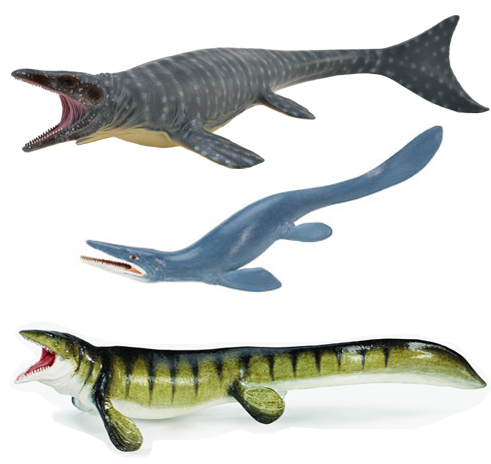
Example of Mosasaur Models

Different mosasaurs. The Royal Tyrrell Museum has a mosasaur exhibit.

Comparing different models of mosasaurs.

To view a model of a Mosasaurus, marine reptile figures and dinosaur models: Safari Ltd. Wild Safari Prehistoric World.

And that’s the secret, McLauchlin says, behind Alberta’s success in the world of palaeontology.

She added:

“We had not only great conditions for the dinosaurs to live in, but also great conditions for them to die in and then be buried.”

The parched, streaked cliffs behind her may not look like the forested, riverine plain of the Centrosaurus herd, but she says you just have to know how to read the rocks.  White sandstone indicates the fast-moving waters of oceans and rivers; darker mudstone represents slower moving swamps and lakes; black coal was once deep plant growth; and ironstone, look for the petrified wood chunks, speaks of a swampy forested environment.

And those cliffs are still talking, as Dr Brinkman says:

“We keep going back to places like Dinosaur Provincial Park because there’s high erosion there and there’s lots to be found.  Last year was one of our best years yet in terms of significance of specimens.”

Much of what we now know about the Late Cretaceous, particularly the Campanian faunal stage is down to the scientific projects and field work carried out by Royal Tyrrell staff and volunteers.  We wish them the very best for their 25th anniversary celebrations and perhaps we can get over to Alberta again ourselves soon.

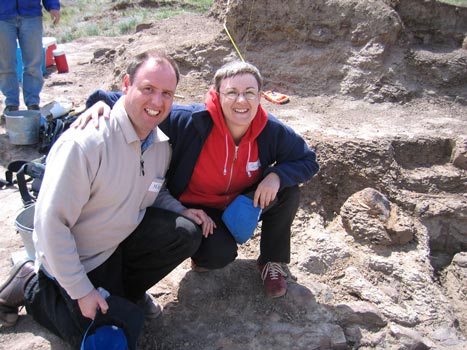
Everything Dinosaur Team Members at a Dig Site (Royal Tyrrell Field Work)

Pause for a pic next to a digs station.

Picture credit: Everything Dinosaur

Everything Dinosaur team members doing their bit for the Royal Tyrrell collection.  The pictures shows team members taking a break during a hadrosaurine excavation.

13 09, 2010

China Issues New Regulations to Protect their Fossils

By |2023-03-06T11:15:38+00:00September 13th, 2010|Categories: Dinosaur and Prehistoric Animal News Stories, Main Page, Palaeontological articles|0 Comments

China’s State Council issue New Regulations to Protect the Country’s Fossils

The Chinese Government has introduced new regulations to protect the country’s fossil heritage and to deter the illegal sale of Chinese fossils and artefacts.

China has grown in importance to palaeontologists over the last fifty years or so, as more of the geology of that vast country is explored and greater numbers of significant fossils unearthed.  Virtually, every major geological period is represented by exposed or outcropping strata in that huge country and sites such as the quarries near Zigong in Sichuan Province and sites at Sihetun in Liaoning Province are world famous for their spectacular dinosaur fossils.  In a bid to help protect China’s fossil heritage and to help deter illegal fossil hunting activities, the State Council has issued new, tighter regulations and stricter controls on the legitimate exploration, transfer and exchange of fossil material.

Fossil Heritage

The regulations come into force at the beginning of next year and they forbid the taking of fossils that have not yet been formally identified and stipulate any fossil exhibition under state protection must seek approval from the authorities before travelling abroad.  This new set of rules cover both body and trace fossils, although more recent fossil material including human remains are subject to conditions laid down by that part of the Government responsible for cultural activities.

Under these new regulations, authorities of the State Council are entitled to trace and claim fossils that were illegally transported outside China.  In addition, State-owned entities are not allowed to sell, exchange, or give away palaeontology fossils to private entities or individuals, and palaeontology fossils are not allowed to be sold, exchanged, given away or pledged to foreigners or foreign-owned organisations.  These new rules are designed to help protect China’s fossil heritage, the scale of illegal sales and fossil smuggling is unknown but it is suspected that there is a large black market for fossils from China.

Deter Smuggling

To read an article about the return of “black market” fossils to China: Dinosaur Eggs Returned to China.

Government staff will face strict penalties if they illegally possess or fail to halt the taking away of fossils.  A spokesperson with the Legislative Affairs Office of the State Council stated that the regulation is more comprehensive than the Management Measures on the Protection of Palaeontology Fossils, China’s current regulation on fossil protection, which was enacted in 2002.

The new regulations are designed to provide more guidelines on the supervision, prohibition and penalties with regard to the over-exploitation and smuggling of fossils, an official commented.

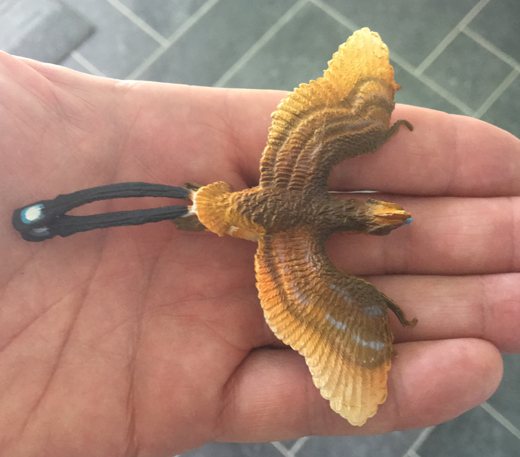
PNSO of China have been developing a beautiful range of dinosaur and prehistoric animal models and figures.  Many of these figures represent iconic animals from China’s fossil heritage such as the ancient bird Confuciusornis.

The PNSO Confuciusornis Age of Dinosaurs Model

PNSO Confuciusornis model.  Models to reflect China's fossil heritage.

“A bird in the hand”, the Confuciusornis model from PNSO. Picture credit: Everything Dinosaur

Picture credit: Everything Dinosaur

To view the range of PNSO models available from Everything Dinosaur: PNSO Museum Quality Dinosaur Models.

8 09, 2010

New European Meat-eater Discovered – One Lump or Two?

By |2023-03-06T11:19:04+00:00September 8th, 2010|Categories: Dinosaur Fans, Everything Dinosaur News and Updates, Main Page, Palaeontological articles|0 Comments

Early Cretaceous Hunchbacked Hunter from Spain

A discovery of a bizarre theropod (meat-eating dinosaur) announced in the scientific journal “Nature” has led scientists to re-examine current theories about the evolution of feathers and the dinosaur/Aves link.  This new genus of predatory dinosaur with bony bumps on its arms and a strange lump on its back may provide evidence that feathers evolved earlier than previously thought.  The dinosaur has been named Concavenator corcovatus.

This new species is just one of a number of amazing Early Cretaceous vertebrate fossils discovered at the Las Hoyas site in Spain, in the Iberian Mountain Ranges of Cuenca Province.  Due to the exceptional state of preservation, Las Hoyas, like the Liaoning area in China, is one of the world’s most important fossil sites for understanding the transition from dinosaurs to birds.

Palaeontologists have unearthed from the finely grained sediments, many thousands of well-preserved fossils of birds, most of these have been found in slightly younger strata than the rocks from which this new theropod comes from, however, this new species of meat-eating dinosaur with its strange arms may shed new light on the dinosaur/aves relationship.

Concavenator corcovatus

The new species has been named Concavenator corcovatus (the name means “humpbacked hunter from Cuenca”), although just one fossil specimen is known, it is remarkably complete and represents (we think), only the second case of a theropod dinosaur from the Calizas de la Huerguina Formation.  In fact despite the superb quality of other vertebrate specimens recovered from Las Hoyas, very few fossils of Dinosauria have been found at the site.

Perhaps the most famous dinosaur discovered in this region of Spain is Pelecanimimus polydon, the first theropod dinosaur to be found.  P. polydon is believed to be an ornithomimid, a fast running dinosaur that some scientists have suggested may have fed on fish.

Concavenator was definitely a hunter, measuring about 4 metres long, this agile dinosaur may have preyed upon other small vertebrates that shared its environment.  It has been dated to around 130 million years ago (Barremian faunal stage).  Although, the Las Hoyas area today is a hot and arid area, back in the Early Cretaceous the site was a lush, tropical, wetland paradise with many rivers leading to a large, shallow lake.

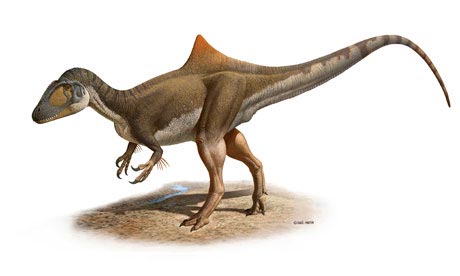
An Artist’s Interpretation of Concavenator corcovatus

Picture credit: Raul Martin

A European Hunter

The discovery of a new type of European meat-eating dinosaur is exciting in itself, but what has got the researchers really in a flap is that this new specimen may shed further light on the evolutionary link between the theropods and the birds we see around us today.  For palaeontologist Francisco Ortega of the National University of Distance Learning in Madrid, who led the research, the strange bumps on the forearms could provide evidence of feathers in a dinosaur belonging to a branch of the dinosaur family tree not known for their feathered forms.

To view a model of this dinosaur and other dinosaur models: PNSO Age of Dinosaurs Models.

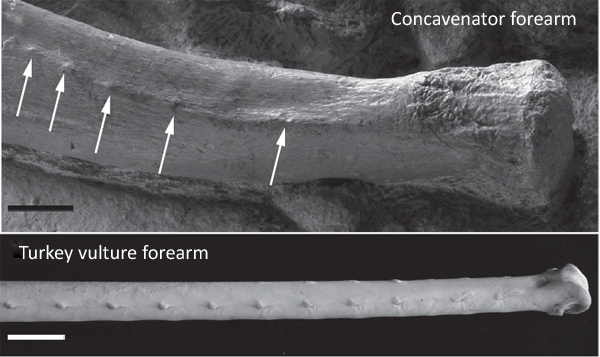
The research team think that the bumps and nodes on the forelimbs may have been part of structures that anchored the quills in proto-feathers to the arms of Concavenator.

Feathered Theropod

A feathered theropod is not that unusual, for example, a number of types of meat-eating dinosaur are believed to have been feathered, but they all belong to one particular clade within the Sub-Order Theropoda – the Coelurosauria.  This part of the theropod family tree contains clades such as Maniraptoriformes and the Dromaeosauridae types of dinosaur such as Bambiraptor, Dromaeosaurus and Velociraptor that many scientists now believe were feathered.

Analysis of the fossilised skeleton of C. corcovatus suggest that this dinosaur was not a member of the Coelurosauria, but more akin to an allosaur (Allosauroidea), a clade of dinosaurs not known for their feathers.  The allosaurs are in essence a different branch of the theropod family tree.

Commenting on the research, Professor Mike Benton, of the department of vertebrate palaeontology at the University of Bristol, (United Kingdom) stated that the bumps on Concavenator’s arms:

“look exactly like the insertions of rather massive flight feathers on bird wings.”

An Enlarged Image of the Foreman of Concavenator compared to an Extant Bird Species

Evidence of feathers on the Ulna?

Picture credit: Nature

If Francisco and his co-workers have interpreted the “bumps” correctly, this implies that dinosaurs showed feather-like structures much earlier than previously thought.  Unless the development of proto-feathers within members of the Allosauroidea is evidence of convergent evolution (the acquisition of the same biological features by unrelated lineages), this Spanish based research suggests that the common ancestor of both the Coelurosauria and the Allosauroidea may have sported primitive feathers.

Evidence of “bumps” on the ulna bones of dinosaurs have also been discovered.  In an analysis of Velociraptor material; a sequential line of bumps and nodes was found along the ulna, these too were interpreted as being evidence to suggest that Velociraptor was feathered, although no fossils indicating feather impressions have been associated with this genus.

To read more about the analysis of the ulna of Velociraptor: Evidence of feathers on the arms of Velociraptors.

Ortega went on to suggest that a member of the Neotetanurae (new stiff-tailed theropods), the common ancestor of both these two predatory dinosaur branches:

“could have been feathered.”

Feathered Dinosaurs

This hypothesis is really pushing back the date at which the first feathered dinosaurs may have evolved.  The Neotetanurae are associated with the Middle Jurassic such as the Bajocian and the Bathonian faunal stages (170 to 160 million years ago), many millions of years before the Coelurosauria are believed to have evolved.

Francisco Ortega added:

“We’re pushing back the time when bird-like structures appear.”

The scientists have been puzzling over another aspect of this, most definitely cursorial (despite the potential feathers) dinosaur, it had a strange hump on its back,  The eleventh and twelfth vertebrae stick out about twice as far from the animal’s body as the rest.  This does not seem to be pathology (evidence of an injury or disease), but some sort of support for a structure, like a hump or a fin of some kind.  Unlike the long flowing sails of Spinosaurus or indeed the extravagant appendage of the Ourannosaurus, C. corcovatus seems to have a short crest.

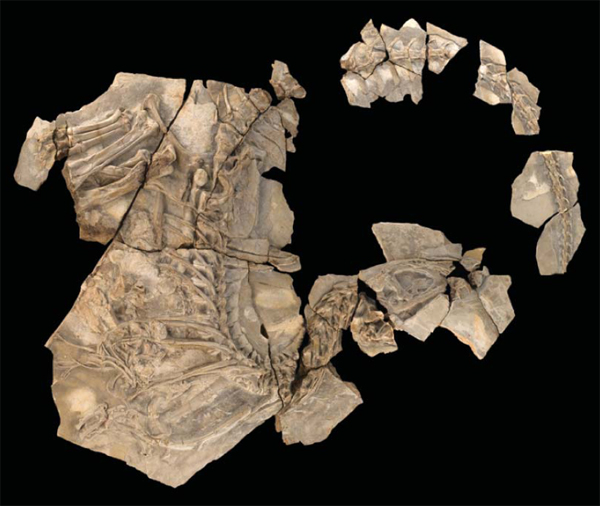
The Prepared Fossil Skeleton of C. corcovatus

Concavenator fossil specimen.

Picture credit: Nature

The picture shows the prepared fossil skeleton of Concavenator, displayed showing the typical “death posture” of a meat-eating dinosaur.  As the carcase lies on the surface undisturbed, it dries out and the tendons in the neck and tail contract leading to an arching effect as the tail and head bend towards each other.

Scientific opinion is divided as to what the crest could have been used for, perhaps it was used for visual communication between individuals or members of a hunting pack, or it could also have been used to help this relatively small dinosaur to regulate its body temperature (thermo-regulation).  If this dinosaur was feathered, or at least partly feathered; the feathers could have helped insulate the animal and keep it warm, aiding the thermoregulation offered by the crest.  Alternatively, if the crest was predominately used for display then the feathers on the arms may also have helped in the visual displays.

One thing is for certain, until more fossils of this type of dinosaur are found, the role of the crest will remain disputed, however, Professor Benton summed up this new genus very concisely when he stated that”

“We can’t say anything about it other than: isn’t it weird?”

This new dinosaur discovery poses another question in relation to bird biology according to Professor Benton:

“What is the range of feather-like structures among dinosaurs which don’t exist in any birds today?”

The bumps on Concavenator’s arm evoke those on feathered birds, but may have been anchors for other structures such as bristles built from keratin, the same protein that makes up feathers, fur and nails.  There may be other evolutionary dead ends like strange bumps on the arm of this Spanish dinosaur among dinosaurs that modern-day bird biologists would like to know about, the Professor added.

The research leader Francisco Ortega agrees that there is probably a great deal more to learn about the evolutionary relationship between Dinosauria and Aves.

He went on to state:

“We’re going to have to conceive of more dinosaurs as being more like birds.  Most allosaurids are depicted as plodding animals, quite distant from birds.  What this tells us is that they may have included more bird-like species too.”

The scientific paper: “A bizarre, humped Carcharodontosauria (Theropoda) from the Lower Cretaceous of Spain” by Francisco Ortega, Fernando Escaso and José L. Sanz published in the journal Nature.

21 08, 2010

South Australian Fossils may be “Earliest Animals” According to New Study

By |2024-04-20T07:43:33+01:00August 21st, 2010|Categories: Dinosaur and Prehistoric Animal News Stories, Main Page, Palaeontological articles|2 Comments

Sponge-like Fossils may be Evidence of Earliest Animals Known to Science

A team of researchers writing in the scientific journal “Nature Geoscience” claim that an analysis of limestone strata (stromatolites formed by bacteria) from the Flinders range in South Australia, may have produced evidence of the first complex animals known, a form of ancient sponge.  Analysis of these strange “body” fossils undertaken by Geoscientists based at Princeton University (New Jersey, United States), suggests the presence of primitive sponge-like organisms dating from approximately 650-640 million years ago.  These fossils pre-date the presence of other complex animal fossils in the fossil record by about seventy million years.

Photographs show two stromatolite formations.  Stromatolites are layered, mound-like structures, sometimes reaching more than a metre tall.   These structures are built up over many years in shallow and warm tropical waters by sheets of bacteria growing over the seabed and trapping sediment.  Evidence for stromatolites have been found in rocks dating from 3 billion years of age.

The research team, led by Professor Adam Maloof and assisted by Geoscientist Catherine Rose suggest that the strange, bizarre calcite based forms preserved in the limestone are the fossilised remains of sponges.  The shapes, which vary from ovals, anvils, wishbones and rings some of which measure more than one centimetre long represent body fossils according to the Princeton University researchers.

Broadly there are two main types of fossils.  Firstly, there are body fossils, these preserve something of the bodily remains of animals or plants.  For example, the cast exoskeleton of a lobster or trilobite, fossil bones, teeth, plant remains and such like.  Secondly, there are trace fossils, these preserve evidence of the activity of animals such as tracks, insects bore holes in wood, burrows in sediment and footprints.  Technically, there are other sorts of fossils such as what is referred to as “chemical fossils” evidence preserved in rocks of the chemicals that we know can only be produced by life processes.  There are also micro-fossils, tiny, microscopic body and trace fossils such as pollen grains and other fossil material that is only able to be viewed using microscopes or other technology.

Ancient Sponge

The American based researchers suspected that the peculiar shapes entombed in the limestone might be parts of the bodies of ancient organisms, the use of sophisticated 3-D imaging techniques affirm their theory.

A Model of an Ancient Sponge-like Animal (Vauxia)

Ancient sponge. A replica of the Cambrian sponge-like creature Vauxia.

A model of an ancient sponge.

The model of the ancient sponge-like animal is from a set of Cambrian replicas in the Wild Safari Toobs range.

To view this range: Wild Safari Prehistoric World Models and Toobs.

The theory is controversial, as if the scientists are correct, then they have discovered fossils of creatures that existed in the Cryogenian period.  This geological period is estimated to have lasted from about 850 million years ago to approximately 635 million years ago, although the exact duration of this particular part of the geological time-scale is disputed, it is thought that the Earth went through dramatic climate changes resulting in a global Ice Age, when the entire planet become covered in ice, leading to the concept of a “snowball Earth”.  To have discovered the remains of relatively sophisticated creatures that have survived beyond the Cryogenian into the Ediacaran period would be a remarkable discovery and enhance the reputation of the Flinders Formation as a major location for Proterozoic fossil finds.

Professor Maloof commented:

“No one was expecting that we would find animals that lived before the ice age [global freezing event – “snowball Earth”] and since animals probably did not evolve twice, we are suddenly confronted with the question of how a relative of these reef-dwelling animals survived the “snowball Earth”.”

A spokesperson from the National Science Foundation, which funded the study, stated that the find is at least seventy million years older than any other evidence of animal body forms in the known fossil record.

Professor Maloof added:

“People have certainly proposed complex organisms, like eukaryotic algae [organisms with cells that contain a nucleus] or protists, and have even proposed animals in the form of trace fossils (preserved tracks) prior to the sponges that we report.  But I think we could confidently say that our sponges are the first somewhat convincing body fossils of an animal before the Ediacaran period.”

The Ediacaran Hills

The Ediacaran hills, part of the Flinders Range in South Australia have already provided fossil evidence of some amazing soft bodied organisms.  In 1946, geologist Reginald Sprigg was searching for signs of mineral deposits when he discovered the remains of several bizarre Precambrian animals.  Creatures such as Tribrachidium, Yelovichnus and Spriggina (which is named in honour of him).  These animals comprise a range of organisms classified as Ediacaran fauna and are so unusual and strange that most cannot be associated with known Phylum.  For example, Spriggina could be a primitive, basal trilobite or possibly a segmented worm.

Due to the fact that the animal fossils were made of the same mineral material as the limestone rock (calcite), the scientists were unable to remove them from the matrix.  Instead, the researchers collaborated with Situ Studio, a specialist imaging company to produce digital models of the strange structures.

By carefully slicing off thin layers of rock, each about 50 microns in diameter and photographing it after each layer was removed, the team managed to create a 3-D model of the animals.  The model revealed a series of irregularly shaped bodies up to one centimetre in size (marble sized) with an internal network of interconnected millimetre-wide channels.  The presence of the channels and their structure are the interesting elements to the palaeontologists.  Such structures are found in sponges, it is these channels that have water drawn into them that permit these organisms to feed.  Could these microscopic channels be evidence of Precambrian sponge-like lifeforms?

The researchers suggest that at least three of the specimens had a short, tube-shaped pedicle at the base.  This may have been used to attach the creature to a solid surface.

Proterozoic Lifeforms

The oldest fossil sponges previously found lived around 520 million years ago.  However, chemical traces from materials of cell membranes (steranes) of sponges were discovered in 2009 in sedimentary rocks more than 635 million years old.

However, the theory put forward by the Princeton team is disputed.  In a dismissive statement; Dr Jim Gehling, a Senior Research Scientist from the South Australian Museum said that he saw no convincing evidence to support the interpretation that the “coco-pop breakfast-cereal-like forms” were ancient sponges.

He went on to add:

“They may just as easily be mineralised bacterial cells or some other sort of single-celled microbes.  Sponges should have first appeared in the Cryogenian Period about 650 million years ago – judging by times of branching in family trees in the Animal Kingdom, based on molecular clocks and the discovery of sponge biomarkers (steranes) preserved in rocks of this age.”

However, it is difficult to interpret the fossil evidence as scientists have no real data on what the earliest types of sponge-like organisms actually looked like.

Dr Gehling stated:

“The problem is that we have no idea what the very earliest sponges may have looked like.  This means that the discovery of any weird shape in rocks of this age may lead to claims of the ‘oldest sponge-grade fossils’.”

Our knowledge of Proterozoic lifeforms has increased dramatically over the last thirty years or so.  New insights into existing fossil specimens have occurred thanks in the main to the use of sophisticated new examination techniques.

18 08, 2010

Climate Change not Human Hunting Led to Mammoth Extinction

By |2023-03-06T07:40:24+00:00August 18th, 2010|Categories: Dinosaur and Prehistoric Animal News Stories, Main Page, Palaeontological articles|0 Comments

Dramatic Climate Change Led to Demise of the Woolly Mammoth

New research published in the scientific journal “The Quaternary Science Review” by a team of British based scientists suggests that dramatic global climate change led to the demise of mega fauna such as the Woolly Mammoth and not predation by humans.

Researchers from the University of Durham in collaboration with scientists at the London Natural History Museum have concluded that by 11,400 years ago, most of the large mammals that had roamed across the Northern Hemisphere, animals such as the Giant Elk (Megaloceras), the Woolly Rhino and the Woolly Mammoth had become extinct.  Although hunting from the rapidly expanding human population may have had an effect, the loss of extensive areas of grassland and the re-forestation of northern Europe and Asia was the real reason for these animals extinction.

Woolly Mammoth

Our ancestors would have competed with these large mammals for space and food but it was sudden and dramatic climate change that led to the demise of most of the mega fauna at this time the scientists conclude.

Their findings are part of the most comprehensive study carried out so far on climate change and its impact on the flora and fauna of the northern hemisphere after the height of the last Ice Age, 21,000 years ago.

A rapid and sustained period of post-glacial global warming led to a rapid decline in open grasslands as much of northern Europe and Asia became woodland and forest.  Although Mammoths were descended from forest dwelling elephants, the rapid change in habitat was just too quick to enable these large, shaggy elephants to adapt.  The climate changes that led to the change in the landscape and its flora made survival impossible for the big grazing herbivores and the predators that fed on them.

Although Woolly Mammoths are often depicted in icy, glacial environments these elephants were animals of the open plain and fed on grasses, sedges and other ground dwelling plants.  The loss of their habitat led to their demise, claim the research team.

An Illustration of a Family of Woolly Mammoths

Picture credit: Schleich

To view a model of Woolly Mammoth and dinosaur toys: Papo Prehistoric Animal Models and Dinosaurs.

Over the last two or three years, there have been a number of papers published, assessing the impact of global climate change on mammal populations.  Perhaps this is a reflection of the concerns expressed over the problem of dramatic climate change that threatens our own species.  Last year, we reported on some research work that set out to accurately date some Mammoth fossils that had been found in Shropshire, England, using radiocarbon dating.

To read more about radiocarbon dating work on Mammoth fossils: Radiocarbon dating changes date of Mammoth Extinction.

The Last Refuge of Woolly Mammoths

One of the principal authors of the study, Professor Brian Huntley of the School of Biological and Biomedical Sciences (Durham University) stated:

“Woolly Mammoths retreated to northern Siberia, 14,000 years ago, whereas they had roamed and munched their way across many parts of Europe, including the UK , for the previous 100,000 years.”

Commenting on the suggestion that our ancestors may have been at least partially responsible for the Mammoth’s extinction, Professor Huntley said:

“It would have been difficult for man to wipe them out [Woolly Mammoths] because our species was not so widespread then and did not have the technology.  We know from Mammoth fossils that they were hunted by humans, but they would not have been an easy kill because of their size.”

The British based research team point the finger at rising temperatures, the factor that led to the extinction of animals as diverse as Woolly Rhinos, the Mammoths, giant deer and the large meat-eaters that preyed on them.

Although some small, isolated pockets of animals may have clung on for a little longer, the climate change and loss of habitat that resulted had effectively sealed the fate of these species the scientists conclude.

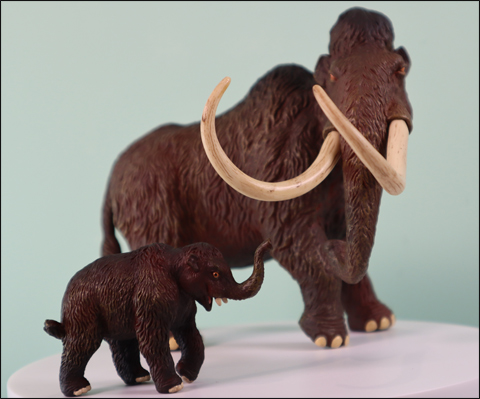
A Replica of an Adult Woolly Mammoth and Calf

CollectA Woolly Mammoth models.

The CollectA Deluxe Woolly Mammoth model in 1:20 scale and the CollectA Prehistoric Life Woolly Mammoth calf.

Picture credit: Everything Dinosaur

Summarising the study, Professor Huntley stated:

“Mega-mammals found it increasingly difficult to find food.  We believe the loss of food supplies from productive grasslands was the major contributing factor to extinction.”

14 08, 2010

Early Hominids Used Stone Tools says New Fossil Study

By |2024-04-19T14:39:12+01:00August 14th, 2010|Categories: Dinosaur and Prehistoric Animal News Stories, Main Page, Palaeontological articles|0 Comments

Evidence of Stone Tool use by Australopithecus afarensis

The fossilised remains of two ancient animal bones dating from 3.4 million years ago discovered in Ethiopia have put back the use of stone tools by early hominids by some 800,000 years according to a new scientific study.

Researcher Zeresenay Alemseged of the California Academy of Sciences believes that the bones show evidence of being cut and smashed by stone tools, this could be the first evidence of stone tools used by a species of Australopithecus (A. afarensis).

Australopithecines

The Australopithecines represent an extinct group of small but upright-walking, ape-like human ancestors that lived from approximately 4.5 million years to about 1.4 million years ago.  Australopithecus afarensis is estimated by scientists to be the most likely ancestor of the human lineage.  This particular species was named as fossil remains were first found in the Afar region of northern Ethiopia.

Perhaps the most famous of all the early hominid fossils known is that of “Lucy” a female Australopithecus afarensis, nicknamed “Lucy” after the discoverers were listening to the Beatles track “Lucy in the Sky with Diamonds” when the fossils were first located.  Known in the scientific community by the slightly less inspiring name of A. L. 288 this early hominid dates from approximately 3.2 million years ago and about 40% of the skeleton was recovered.  “Lucy” stood a little over one metre tall and importantly, the limb bones show that she walked upright.

Early hominid fossils are extremely rare and it is likely that this particular species was quite widespread across central and east Africa.  The large distance between the fossil sites has led scientists to postulate that this particular species of ape-man was quite widespread.

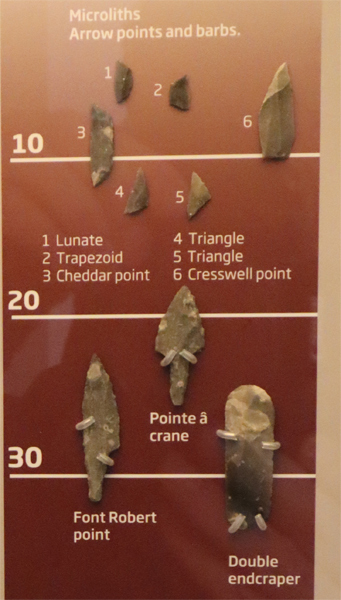
Examples of Stone Tools on Display in a Museum

Stone Age Tools. The Movius line explained.

A collection of typical Stone Age Tools. Picture credit: Everything Dinosaur.

Picture credit: Everything Dinosaur

Commenting on the conclusions drawn from the study Zeresenay Alemseged stated:

“We are putting stone tools in their hands!”

However, other palaeoanthropologists have urged caution.

The authors of the report state that the bones indicate that human ancestors used sharp stones to carve meat from the carcasses of large animals and other stones to smash bones to get to the marrow.  Being able to feed on marrow would have been very important to our ancient ancestors.  This foodstuff would not be readily accessible to other predators and even if a carcase had been picked clean by vultures and other scavengers, early hominids could still get a highly nutritious meal by breaking the bones and feeding on the protein rich marrow inside.

Some scientists have suggested that the ability to feed on protein rich marrow may have been crucial in the development of larger brains.

One of the bones analysed belonged to a herbivore about the size of a modern cow, the other bone in the study is a leg bone from an animal about goat sized.  No stone tools were found at the site.

The research team have also concluded that these fossils represent the earliest evidence for meat-eating amongst hominids.  The study authors attribute the stone tool use to A. afarensis as no other hominid species is known from that region and rock strata.  “Lucy”, herself was discovered in the same general area, so if this is “smoking gun” evidence of stone tool use then Australopithecus afarensis is the most likely to be the tool user.

Stone Age Tools

Alemseged commented that our ancient relatives probably scavenged carcasses rather than hunting live animals.  They also ate the meat raw has fire had not been mastered yet.  The research team are unable to state whether the stone tools were made or whether they were simply stones that were used as tools.  The intention is to continue the fieldwork in order to establish more evidence.

Alemseged made the point that as some A. afarensis stripped meat from a carcase, others probably stood guard to ward off other scavengers and predators in return for some of the meat, which would indicate a degree of cooperative behaviour.

Until this new study, which has been published in the scientific journal “Nature”, the earliest sign of tool use dates to approximately 2.6 million years ago, also from Ethiopia, but scientists are not sure what species used these tools.

Other experts remain sceptical regarding this particular study’s conclusions.

Nicholas Toth of Indiana University, a palaeoanthropologist who has specialised in the study of early stone tools stated:

“I’m very cautious about the conclusions.”

He went on to point out that the bones in this new study were actually found on the surface rather than being excavated from a layer of sedimentary rock.  This means that nobody can be sure exactly what strata the bones come from, which is crucial to knowing their true age.

The marks on the bones may not be from the impact and use of stone tools.  Toth noted that the pictures he had seen were inconclusive, the notches and marks could have been made by trampling or animal bites.

Tim White of the University of California (Berkeley) commented that the tooth marks in his opinion looked like the work of crocodiles, he also pointed out that the marks do not appear in the places on the bones that one would expect from a butchering.

Noting that in 30 years of searching for fossils, no stone tools as old as the bones have been found – White stated:

“The evidence is very thin here, and very ambiguous.  An extraordinary claim requires extraordinary evidence.”

Other experts are more supportive of the study’s conclusions, Bernard Wood of George Washington University declared:

“I’d be willing to bet a month’s salary that those cut marks are from stone tools and not tooth marks.”

Commenting further Bernard went on to state that the bone markings:

“Are as significant a statement about early hominid behaviour as the Laetoli footprints are about hominid locomotion.  Whilst it is reasonable to assume that A. afarensis wielded the tools, the idea about the butchers being guarded by other group members in exchange for meat is pushing the envelope a bit far.”

Wood also said the finding suggests A. afarensis ate meat but doesn’t prove it, because maybe they cut off animal flesh just to get to the marrow.

For models of early hominids including the popular “Evolution of Man” model set (whilst stocks last): Wild Safari Prehistoric World.

Go to Top