All about dinosaurs, fossils and prehistoric animals by Everything Dinosaur team members.

Articles, features and information which have slightly more scientific content with an emphasis on palaeontology, such as updates on academic papers, published papers etc.

23 02, 2011

Palaeontologists get a “Kick” out of New Sauropod Genus

By |2023-01-15T18:21:23+00:00February 23rd, 2011|Categories: Dinosaur and Prehistoric Animal News Stories, Main Page, Palaeontological articles|0 Comments

Brontomerus mcintoshi – The Dinosaur Dubbed “Thunder Thighs”

A team of American and British scientists have named a new genus of Early Cretaceous sauropod from Utah “Thunder Thighs” as they believe that this particular long-necked dinosaur possessed a strong and powerful kick.

Although only fragmentary remains have been found, partially due to the poor state of preservation of the fossils, but also due to the fact that the excavation site had been looted by private collectors, scientists are confident that this new genus of sauropod had very robust, powerful limbs, strong enough to send a predatory dinosaur flying with one swift kick.

Commenting on this large-limbed Sauropod Dr Mike Taylor of the University College London, the lead author on the scientific paper on this creature stated:

“If predators came after it, it would have been able to boot them out of the way.”.

Details regarding this new dinosaur taxon have been published in the scientific journal “Acta Palaeontologica Polonica”, it will no doubt get a lot of publicity due to the genus name resembling the now defunct taxon Brontosaurus and the fact that it had very large thighs.  Hopefully, as a result of the publicity, more will be done to help protect scientific sites from looting, as little more can be found out about this dinosaur due to the limited fossil material recovered.  The name of this new taxon literally means “thunder thighs”, but just why this dinosaur had such strong legs remains open to speculation.

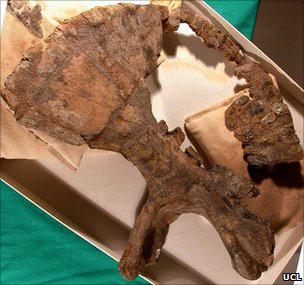
The Ilium (Hip-Bone) of B. mcintoshi
Picture credit: University College London

The ilium bone of this dinosaur has a forward projecting blade, proportionally much bigger than in similarly sized sauropods.  This suggests that large thigh muscles were anchored there.

The fossils of two specimens an adult; estimated to measure around 14 metres in length and to weigh perhaps as much as six tonnes and a pony-sized juvenile were found in close proximity.  The American and British researchers have speculated that the youngster could be the offspring of the adult, although there is little firm evidence to prove this.

However, sauropod tracks discovered last year seem to show young animals following an adult, perhaps these huge animals did protect their offspring by staying close to them, at least until the babies were big enough to look after themselves.

To read more about the sauropod trackways: Running with Baby Sauropods.

The fossils have been dated to around 110 million years ago (Albian faunal stage of the Cretaceous), a time when fast running packs of dromaeosaurs roamed the open plains.  Perhaps, this dinosaur evolved strong legs in order to kick out at and fend off attacks of predatory dinosaurs such as Deinonychus and Utahraptor.

The site, part of a quarry had been looted by commercial fossil-hunters but despite this enough fossil material was located in order to provide an analysis and the information required to identify a new taxon.

Brontomerus mcintoshi

The evidence for the large leg muscles comes from the ilium (part of the hips).  It is unusually large in comparison with other similar sized dauropods and the wide blade of the ilium projects forward providing a large area for the anchoring of leg muscles (femoral protraction and abductor muscles), muscles which would have helped to move the leg out and away from the body.  No actual leg bones have been recovered so at this time the reason for the big thigh muscles remains unknown, however, this dinosaur would have been capable of delivering a powerful kick, easily strong enough to send a hungry dromaeosaur flying.

Dr Taylor added:

“As you put the skeleton together, you can run muscles down from the hip-bone to join at the knee and that gives you a whopping thigh.  What’s interesting is that if it were a sauropod that could move particularly fast, you would expect to see very strong muscles on the back of the legs to pull it along [retractor muscles], but we don’t.

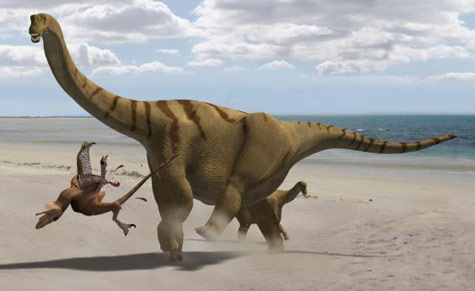
A Restoration of B. mcintoshi
Picture credit: F. Gascó.

In the picture, a mother Brontomerus is defending a juvenile by kicking out at an attacking dromaeosaur.

In addition to the unusual ilium, the shoulder blade (scapula) has strange bumps on it that probably mark the boundaries of muscle attachments, indicating that this dinosaur also had powerful forelimb as well.

Co-author of the study Dr Matt Wedel, from the Western University of Health Sciences in Pomona, California stated:

“It’s possible that Brontomerus mcintoshi was more athletic than most other Sauropods.  It is well established that far from being swamp-bound hippo-like animals, Sauropods preferred drier, upland areas; so perhaps Brontomerus lived in rough, hilly terrain and the powerful leg muscles were a sort of ‘dinosaur four-wheel drive’.”

This discovery, plus numerous other sauropod finds dating from Lower Cretaceous strata is helping to change palaeontologist’s perception about the diversity of the Sauropoda during the Early Cretaceous.  It had been thought that the lizard-hipped sauropods had been largely replaced by herbivorous ornithischian dinosaurs in the food chains of the Northern Hemisphere by around 100 million years ago.  As more sauropod fossils are discovered it seems that scientists may have to revise the views held regarding the diversity and abundance of long-necked dinosaurs.

Dr Wedel commented:

“In the past twenty years, however, we are finding more sauropods from the Early Cretaceous period, and the picture is changing.  It now seems that sauropods may have been every bit as diverse as they were during the Jurassic, but much less abundant and so much less likely to be found.”

The fossilised bones of the two dinosaur specimens are currently at the Sam Noble Museum of Natural History in Norman (Oklahoma).  Plans are at an early stage to re-visit the location to see if more fossil material relating to this new genus can be discovered.  If elements of the leg bones could be found then this may help solve the mystery of the dinosaur with the “thighs like a body builder”.  With more fossils to study, the team could perhaps provide a more accurate assessment of the phylogeny of this sauropod, at the moment it has been tentatively ascribed to the camarasaurids.

It is possible, that this dinosaur may have resembled a giraffe and the strong hind limbs could have played a role in supporting the animal’s weight as it rocked back onto its back legs so that it could crane its neck higher to reach the branches of trees that other dinosaurs could not reach.

In antelopes there are many members of this family who have adapted a basic body plan to help them feed on vegetation that other animals cannot.  The long-limbed, long-necked Gerenuk (Litocrannius walleri) of southern Africa has exceptionally strong thighs that enable it to rear up on its hind legs to feed on the branches of thorn bushes that other antelopes can’t reach – could the large thigh muscles of B. mcintoshi have helped this dinosaur to do something similar?

For models and replicas of sauropod dinosaurs: Mojo Fun Prehistoric and Extinct Figures.
19 02, 2011

What was Marrella? That is a Great Question!

By |2024-04-21T12:24:45+01:00February 19th, 2011|Categories: Main Page, Palaeontological articles|1 Comment

The Marrella Mystery

The 520-million-year-old Burgess Shale in British Columbia (Canada), is one of the world’s most important fossil sites as it contains the remains of soft-bodied organisms including remarkable specimens of Marrella splendens, that thrived in a shallow sea in the Cambrian Period.  It also documents the marine ecosystem that existed in the Middle Cambrian, including the first evidence of hard-shelled organisms.

Although, the location is now thought not to be unique, other sites in Canada that seem to have been subjected to very special geological conditions that permitted the fine fossilisation of a marine community have been found, the Burgess Shale remains exceptionally important.

To read more about similar locations to the Burgess Shale: Putting the Burgess Shales in the Shade.

One of the most abundant of all the fossils found at the site is Marrella splendens with something like over 15,000 known specimens.  However, this Canadian site is the only location known in the world where fossils of this strange creature have been found.

Marrella splendens

So despite the large number of fossils of Marrella found in British Columbia, these fossils have not been discovered elsewhere in the world.  Does this mean that Marrella sp. were localised to the Canadian province?  Or does this indicate that Marrella sp. had such a low fossilisation potential that only under exceptional conditions could fossils of this animal be formed?

There is another mystery surrounding this creature, it does not resemble any extant animal (animals living today).  Scientists debate how best to classify this bizarre creature.  Informally regarded as a “lace crab” by the American palaeontologist Charles Walcott, this strange creature may not be closely related to lace crabs.  Marrella had two distinct pairs of large, backward facing appendages, these grew out of a head-shield but rather than being hard like the calcium carbonate exoskeletons of arthropods, the head-shield seems to have been soft.

The body was composed of approximately twenty segments, each segment had pairs of jointed limbs and gill branches.  The antennae (two pairs) faced forward of the body, one pair was short and spiky with the second outer pair, much longer and thinner.

This thumb-sized animal may have been a member of the Order Arthropoda, but whether it was an ancient ancestor of crabs, trilobites or spiders remains open to intense scientific debate.

To view models and replicas of ancient Palaeozoic creatures like trilobites and Anomalocaris: CollectA Prehistoric Life Models.

14 02, 2011

One Small Step for Man a Giant Leap for Mankind

By |2023-03-06T15:26:23+00:00February 14th, 2011|Categories: Educational Activities, Main Page, Palaeontological articles|0 Comments

Best Foot Forward for Homo sapiens – Spring Loaded Heels

Our species may have had a crucial, anatomical advantage over Neanderthals when it came to surviving the environmental change that led to the development of wide expanses of tundra.  We were better at long distance running and walking.

For those of us who remember the perils of enforced cross-country runs when we were at school, it may be hard to imagine that our species may have had a mechanical advantage when it came to travelling distances, but the structure of the bones and tendons in our feet could have provided us with a crucial evolutionary advantage over Neanderthals.

Researchers studying the heels of modern humans have found that our bone structure stretches the Achilles tendon taut, storing energy more efficiently than the Neanderthal foot and allowing us to run better.

Neanderthals

However, Neanderthals (H. neanderthalensis), were no slouches when it came to walking, their feet and ankles gave them an advantage in walking uphill and the bones in the foot supported the ankle more if they jumped, so says the research team based at the University of Arizona in Tucson.

In our ancestors, just as with people today, a short, lower heel stretched the Achilles tendon tight.  This arrangement increases the tendon’s spring-like action, making it an efficient store of energy; helping us to run efficiently and to make long-distance treks.  This anatomical difference between our species and the Neanderthals, one of a number of subtle differences, could have given us the edge when hunting on the wide, open plains of prehistory.

Anthropologist, David Raichlen, who led the research, published in the “Journal of Human Evolution”, commented:

“We can say that energy costs of running differed between Neanderthals and modern humans, but our data does not really provide answers as to what happened to the Neanderthals.”

Extinction Around 28,000 Years Ago

Scientists believe that the last of the Neanderthals died out approximately 28,000 years ago.  These humans, were very well adapted to the cold European environment, they had bigger brains than us and were physically stronger, but for some reason or reasons, they became extinct and our species went onto thrive.

Anthropologists already know that compared to our ancestors, Neanderthals were stronger, heavier, had shorter legs and smaller inner-ear canals (important for co-ordination and balance) – all factors in making them less efficient runners compared to us.  However, this new line of study provides evidence to suggest that Neanderthals were disadvantaged compared to us when it came to moving long distances.

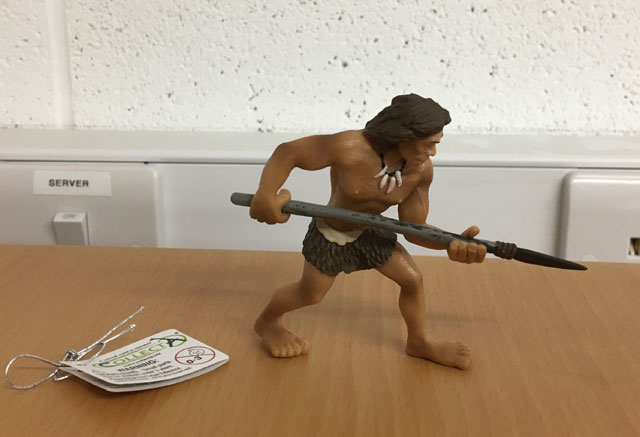
A Replica of a Neanderthal Man

CollectA Neanderthal man model

Selecting a CollectA Neanderthal man figure for an Everything Dinosaur customer. Picture credit: Everything Dinosaur.

Picture credit: Everything Dinosaur

To view the CollectA range of prehistoric figures: CollectA Prehistoric Life Figures and Models.

Homo sapiens

The research shows the distance runner’s foot and ankle was very efficient.  Measurements of part of the heel bone has helped the researchers determine how efficiently an individual could run long distances.

In a forested environment, the Neanderthals tactics of ambushing prey would have been a successful strategy.  Their strength and power would have given them an edge over H. sapiens.  However, if climate change led to a loss of forests and a more open environment, the ability to track animals over long distances, running prey to exhaustion would have been a tactic better suited to our ancestors.  Unfortunately, the lack of fossil human foot bones is preventing scientists from determining when our running-friendly, spring-loaded heels first evolved.

Raichlen and his team calculated rates of oxygen consumption for eight experienced long-distance runners as they performed on a treadmill for 10 minutes running at a pacy 16 km/h.  On a separate day, MRI scans of each person’s heel and Achilles tendons revealed the nature of the potential mechanical advantage.  Those runners who used oxygen most efficiently whilst running had shorter heel bones.

Heel Bone Measurements

Heel-bone measurements of 13 fossil Homo sapiens that lived between approximately 30,000 and 100,000 years ago resemble those of today’s runners, the scientists have stated.  On average, the measurements indicate that the ancient humans expended 6.9 percent more energy while running than their counterparts today did, not a substantial difference, according to the researchers.

Analyses of heel bones of six Neanderthals from the same time period indicate that these hominids used an average of 11.4 percent more energy while running than modern athletes did, a statistically notable disparity.

Energy efficiency while running depends far more on a person’s anatomy than on physical training, the researchers say. They used distance runners as a modern comparison group in order to account for any training effects.  The research concludes that our springy heels enabling us to run for longer may have proved decisive as hunting moved to the open plains.

Is this a case of best foot forward, in terms of hominid evolution?

1 02, 2011

Time of the Titans – Titanoceratops

By |2023-03-06T15:31:50+00:00February 1st, 2011|Categories: Dinosaur and Prehistoric Animal News Stories, Dinosaur Fans, Main Page, Palaeontological articles|0 Comments

New Genus of Chasmosaurinae Discovered in a Scientific Paper

The probable ancestor of dinosaurs such as Triceratops and Torosaurus has been discovered after a careful study of misidentified Pentaceratops material.  It turns out that what was once thought to be a Pentaceratops represents a new genus of long-frilled, long horned chasmosaurine and this dinosaur is likely to be named Titanoceratops.

Titanoceratops

The name Titanoceratops (T. ouranos), as this ceratopsian is likely to be called is technically nomen nudum – this means that a name has been given to an organism but it has yet to be formally described or to have a holotype assigned to it.  Ironically, for a horned dinosaur with a skull measuring over 2.4 metres in length and longer brow horns than Triceratops horridus it was found within the pages of a scientific journal publication.

The fossils of this dinosaur have been found in the upper Fruitland Formation of New Mexico, which dates from the Campanian faunal stage of the Late Cretaceous.  If they do represent the earliest member of the Triceratopsini, then this indicates that these type of dinosaurs evolved into much bigger animals far earlier than previously thought.  It was Yale University palaeontologist Nicholas Longrich who made the discovery, when he realised that fossil material described in a scientific paper and then only formally examined fifty years after the paper was first published, actually represented a new genus of horned dinosaur.

The re-assessment of the fossil bones including the all important skull material (found in 1941), will be clarified in a scientific paper due to be published in the journal “Cretaceous Research”.

For Nicholas, a post doctoral assistant based at the department of geology and geophysics at the University of Yale, describing new genera of ceratopsians is becoming a bit of a habit.  Last year, the paper on Mojoceratops, another new horned dinosaur named by Dr Longrich was published.

To read more about this “cool” dinosaur: Mojoceratops – what a cool name for a dinosaur.

He made the discovery whilst searching through old scientific papers.  He found a description of a partial skeleton of a horned dinosaur found in 1941, that had not been formally studied until 1995, at which point it was identified as Pentaceratops sternbergi another type of chasmosaurine dinosaur known from the Western United States.

The skeleton was reconstructed for a display exhibit at the Sam Noble Oklahoma Museum of Natural History, the frill far from complete in the original fossil specimen was remodelled to look like the frill of a Pentaceratops.  However, when Dr Longrich examined the fossil material in detail, he began to realise that something did not quite add up.

Dr Longrich commented:

“When I looked at the skeleton more closely, I realised it was just too different from the other known Pentaceratops specimens to be a member of the species.”

Although there is know variation in frill characteristics due to factors such as pathology and ontogeny, Dr Longrich could not make the fossil evidence fit the typical features of a Pentaceratops.  The other difficulty that Nicholas had to contend with was the sheer size of the specimen.  Although, Pentaceratops is regarded as an animal with a huge neck shield, one of the largest known in the fossil record, the dinosaur itself grew to about six metres in length.  The size of the misidentified skull material now ascribed to Titanoceratops indicated a horned dinosaur closer to Triceratops and Torosaurus in size

The size of this ceratopsian has led Dr Nicholas to propose the name Titanoceratops “Titanic horned face”, a reference to this animal’s impressive size – something weighing as much as an adult African elephant.  The new genus seems to be ancestral to Triceratops, but with a more elongated and thinner frill with clear fenestrae plus a wider nose horn and longer brow horns.

Dr Longrich believes that Titanoceratops was probably the ancestor of the later Torosaurus and Triceratops and that these two different types of dinosaur split several million years after Titanoceratops first evolved.  However, despite the extensive fossil material and copious amount of work, a controversial paper published last year cast doubts on the distinction between Torosaurus and Triceratops, claiming that fossil material actually represented one genus.  Evidence was presented to suggest that the Torosaurus material actually represented very old and mature individual members of the Triceratops genus.

To read  more about this paper: The Extinction of Torosaurus – Second Time Around.

Dr Longrich, when asked about the ancestral relationship between this new dinosaur discovery and the Maastrichtian chasmosaurines stated:

“This skeleton is exactly what you would expect their ancestor to look like.”

Hopefully, more fossil material will come to light from New Mexico that will permit scientists to explore further the relationship between different members of the long-frilled, horned dinosaur group.

To view articulated, scale models of horned dinosaurs: Beasts of the Mesozoic Models and Figures.

23 01, 2011

Pterosaur Males were the “Peacocks” of the Mesozoic

By |2023-01-15T10:31:44+00:00January 23rd, 2011|Categories: Dinosaur and Prehistoric Animal News Stories, Main Page, Palaeontological articles|0 Comments

Pterosaur Fossil with Egg – Vital Clues to Pterosaur Reproduction

Pterosaurs, those members of the Archosauria alongside the dinosaurs that dominated life in the air for much of the Mesozoic have long fascinated scientists and ordinary folk alike.  These creatures that evolved sometime in the Triassic and went extinct at the end of the Cretaceous, dominated life in the air until the birds, those descendants from theropod dinosaurs came onto the scene.

With no extant animals even coming close to the pterosaurs, scientists had been very much in the dark about a number of aspects about pterosaur habits, life styles, breeding strategies and such like.  However, the finding of a fossilised pterosaur complete with the remains of an unlaid egg that was inside her may provide vital clues to help palaeontologists piece together more information about these fascinating, extinct flying reptiles.

It seems that pterosaurs laid leathery eggs like turtles rather than the hard-shelled eggs that birds lay.  In addition, this new fossil suggests that it was the males of the species that had large head crests, whilst the females were less conspicuous.

The report on the discovery of a pterosaur fossil with evidence of an egg, is in this months edition of the scientific journal “Science”.  The genus concerned is a small, Chinese Pterosaur known as Darwinopterus, named in 2009 to honour the bicentennial of the birth of the naturalist Charles Darwin and also to mark the 150th anniversary of the publication of Darwin’s ground breaking book outlining his theory of natural selection “The Origin of Species”.

To read more about the discovery and naming  of this pterosaur: Pterosaur Transitional Fossil.

Pterosaur Research

The fossil of Darwinopterus was found in the Liaoning Province of China, it has been dated to approximately 160 million years ago, we have put an arrow on the picture we received to highlight the egg which had been expelled by gases inside the body cavity as the organic remains of this pterosaur rotted away.  The fossil was found in sediments that formed at the bottom of an ancient lake, it seems that this little flying reptile suffered a broken wing for some reason and fell into the water, eventually settling on the still bottom where the muddy sediments preserved her remains.

Commenting on the discovery of the egg and its implications for pterosaur gender, David Unwin, a palaeobiologist at the University of Leicester (England) stated:

“In almost none of the previous collections can we tell what the gender of the fossil is.  This is the first association of an egg with an adult, so we can identify it as a female.”

Pterosaur Egg Discovery

The discovery of this fossil, it was found by a local farmer and handed over to Chinese scientists, provides evidence to support a number of theories that had been proposed by palaeontologists.  Firstly, that female pterosaurs had larger, wider pelvic areas than the males, this would permit the storage and passage of eggs.  The lack of an ornate head crest suggests that it was the males who tended to be crested – the peacocks of the Mesozoic.

A chemical analysis of the area shows that there is an absence of calcium carbonate, the mineral responsible for making bird eggs hard.

Under high powered magnification, the researchers could identify folds and pores within the egg (see black arrows on picture).  This suggests that the pterosaur egg had a similar structure to that of a modern turtles, it would have been leathery and “parchment like”.  These soft-shelled eggs, could probably swell and grow in size, absorbing water from the environment rather than having to contain all the water required to make the egg hatch as in the case of the hard-shelled eggs of birds.

Dr Unwin stated:

“By laying soft eggs that could grow in size, pterosaurs could make a much smaller investment in terms of material effort.”

This has implications for pterosaur nesting behaviour, perhaps they buried their eggs in sand, rather than brooding them as birds do.  The fact that the egg has been found in association with the egg layer provides evidence for the relationship between the pterosaur that laid the egg and the size of the actual egg laid.

Dr Unwin went onto add:

“What we now need to do, is to look at lots of pterosaurs and look at other things such as size.  Were males typically bigger or smaller than females?  And other really fundamental kinds of things that we know for living species, we can now look at in pterosaurs.”

This is evidence for a very “reptilian” form of reproduction for the pterosaurs.  This fossil suggests that these flying reptiles, laid their eggs in moist, soft ground and then abandoned them to their fate, in a similar way to turtles today.

Based on the few fossils of juvenile pterosaurs found to date, scientists believe that, unlike birds which need a degree of parental care, pterosaurs once hatched; were fully independent, miniature versions of the adults and capable of feeding for themselves.

Dr Unwin commented:

“The y looked like tiny adults.  They were highly precocious and could almost certainly fly very soon after hatching.”

Mark Witton, a pterosaur research scientist and renowned illustrator based at the University of Portsmouth, when asked about the discovery said:

“What makes this find so special is that the egg was not found in isolation.  We could identify in some cases what species the eggs belonged to, but we have never had a pterosaur egg in association with its mother before.”

Commenting on the size ratio between the mother and the egg, Chatham University palaeontologist Michael Habib stated:

“They seem to be relatively smallish eggs.  That is consistent with most egg-laying animals, but they don’t all do that.”

Pterosaur

The absence of a discernible head crest on the female suggests that it was the male pterosaurs that possessed the ornate head crests.  If this is true, then this discovery will help scientists separate the girls from the boys in other pterosaur genera.

Based on this evidence, the research team thinks only Darwinopterus males sported head crests, which they may have used to communicate with other members of their species.

Dr Unwin, a co-author of the study paper stated that the crests could be used for communication or display, being used to signal to other males that “I’m bigger than you”, or it could be used to tell females that “here I am, carrying this enormous crest, and I’m better to mate with than the chap next door who has a smaller crest.”

To view scale models of pterosaurs such as Dimorphodon and Guidraco: CollectA Deluxe Prehistoric Animal Figures.

18 12, 2010

No Australian Tyrannosauropus After all – Lark Quarry Revisited

By |2023-03-06T15:11:37+00:00December 18th, 2010|Categories: Main Page, Palaeontological articles|0 Comments

New Interpretation of Lark Quarry Dinosaur Trackways – Suggest no Large Theropod

Every once in while a very special type of fossil site is discovered, one that provides an exciting and unique glimpse into the ancient world of the Mesozoic.  One such place is Lark Quarry, located near the small town of Winton, Queensland (Australia).  The region is very famous for its Early Cretaceous dinosaur fossils.  However, at Lark Quarry it is not fossilised bones that so excited researchers when they were first brought to the site, it is the presence of literally hundreds of beautifully preserved dinosaur footprints.

One set of footprints, was believed to show the presence of a large “T. rex-like” meat-eater causing smaller dinosaurs to stampede.  Now some further research published in the scientific journal “Cretaceous Research” offers a new interpretation.

Lark Quarry Revisited

Many scientists have studied the extensive trace fossils, but perhaps the most famous part of the site represents the preserved evidence of what took place in perhaps less than ten seconds nearly 100 million years ago.  A herd of small, plant-eaters (the footprints of which have been ascribed to Wintonopus by ichnologists), plus a large number of predatory coelurosaurs (named Skartopus) were disturbed by the approach of what was thought to be a large, carnivorous theropod dinosaur (known as Tyrannosauropus).

The large, meat-eater seemed to have the smaller dinosaurs trapped and the only chance they had to escape was to run straight past the giant predator as quickly as they could.  The tracks indicate that the smaller animals sprinted past the bigger dinosaur, running at speeds in excess of 12 miles an hour as judged by the stride length.

Fossil Trackway

This famous part of the trackways preserved in the fine grained sandstone of Lark Quarry was studied by doctors Tony Thulburn and Mary Wade, who published their results in 1984.  They cited the evidence of the large footprints to support the theory that enormous predatory dinosaurs lived in what was to become Australia, in the Early Cretaceous.  This, they thought was evidence of 11-metre-long carnivores stalking smaller dinosaurs.  The Trannosauropus’s trackway actually consists of eleven footprints, (three-toed prints), some of which were interpreted as showing the marks left in the soft sand by sharp claws on the toes.

The stride length indicates that it moved at about 3-5 miles per hour – a walking speed and it seems to have weaved about slightly, with a tendency to slow down towards the end of the tracks.  This was interpreted as the meat-eater lurching at the smaller dinosaurs but slowing down as it realised that its attack had been unsuccessful.

It was the large prints that were originally interpreted as being from a large, meat-eating dinosaur, however, a new study has indicated that this may not be the case.

New research by scientists at the University of Queensland suggests that the large footprints were not made by a carnivorous dinosaur at all.  The prints actually represent the tracks made by a large, but definitely herbivorous dinosaur.  If this new theory is accepted it means that the Lark Quarry trace fossils are not evidence of a large theropod dinosaur, something similar to a T. rex or an Allosaurus.

University of Queensland School of Biological Sciences PhD student Anthony Romilio, the lead author of the research, believes that the large prints actually represent the tracks made by an ornithopod dinosaur, perhaps something resembling a Muttaburrasaurus.

Muttaburrasaurus

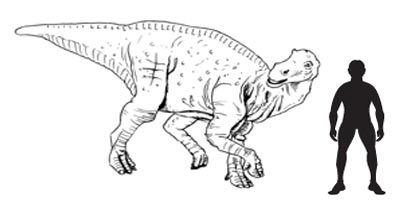
Muttaburrasaurus (M. langdoni), is known from two skeletons found in eastern Australia.  This large animal has been taxonimcally classified as an iguanodont, an ornithopod.

An Illustration of Muttaburrasaurus langdoni

Muttaburrasaurus. Picture credit: Everything Dinosaur.

Picture credit: Everything Dinosaur

To view models of Australian dinosaurs and other prehistoric animals: CollectA Deluxe Prehistoric Animal Models.

Anthony came to this conclusion after comparing the characteristics of the Lark Quarry Tyrannosauropus prints with those of other theropods and known ornithopods.

He stated:

“Making the distinction between the three-toed tracks of herbivorous ornithopod dinosaurs and the three-toed tracks of carnivorous theropod dinosaurs can be quite difficult.  This confusion has led to numerous ornithopod dinosaur tracks being incorrectly identified as belonging to theropods, and vice versa.”

Tracks Made by a Plant-eater

For many years, these large prints from the Lark Quarry site were regarded as being from a meat-eater that had caused a dinosaur stampede, but earlier work, highlighted by Mr. Romilio does suggest a big plant-eater was the culprit.

Threshold values for specific foot proportions for both theropod and ornithopod dinosaurs enabled the Queensland team to distinguish between the tracks made by different types of dinosaur and based on this research Anthony was able to conclude:

“The footprint analysis shows overwhelmingly that the Lark Quarry tracks were made by an ornithopod dinosaur.  The best preserved prints show a remarkable similarity in overall size, shape and claw outline to ornithopod tracks from Canada named Amblydactylus gethingi.  These features mean that we need to re-name the large Lark Quarry tracks Amblydactylus cf.  A. gethingi.”

The size of the prints and the fact that Muttaburrasaurus fossils have been found in sediments of the same age as the Lark Quarry deposit have led the team to suggest that a “Muttaburrasaurus-like” animal probably made them.  Muttaburrasaurus is believed to have been a facultative biped, that is, an animal that walked on all fours for most of the time, but if the need arose it could rear up onto its hind legs and walk in a bipedal fashion.

To view a model of Muttaburrasaurus and other dinosaur toys: CollectA Age of Dinosaurs Prehistoric Life Models.

Anthony’s PhD supervisor, Dr Steve Salisbury stated that the previous identification of the Lark Quarry tracks as belonging to a large, meat-eating dinosaur was central to the interpretation of the track site as a stampede.

He added:

“The approach of the large dinosaur was thought to have triggered the stampede of 150-170 smaller dinosaurs across the sandy mud nearly 100 million years ago.  Whether the presence of a large herbivore like Muttaburrasaurus was enough to spook a herd of smaller dinosaurs into a stampede is now unclear.  Further research on the actual nature of the stampede itself is what we are now focusing on.”

16 12, 2010

Geminiraptor – Part of a Record Breaking Year for Utah’s Dinosaurs

By |2023-03-06T15:12:48+00:00December 16th, 2010|Categories: Dinosaur and Prehistoric Animal News Stories, Main Page, Palaeontological articles|0 Comments

New Troodontid Dinosaur from Utah – Record Breaking Year for the American State

The announcement of the discovery of a new genus of dinosaur from Utah, makes it a record-breaking year for the State, as this is the eighth new genus of dinosaur announced in 2010.  More importantly, the discovery of a troodontid dinosaur from Lower Cretaceous strata is the first evidence of this dinosaur family living in North America in the Early Cretaceous.

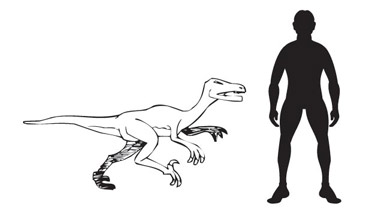
Troodonts were a group of active, relatively small theropod dinosaurs, that from a phylogenetic perspective seem to fit somewhere between the Ornithomimidae (ostrich-like dinosaurs) and the fearsome dromaeosaurids (raptors) on the dinosaur family tree.  These animals were bipedal, fast running and all the genera described to date had large eyes and big skulls.  Scientists believe that these little dinosaurs were warm-blooded and most probably covered in feathers.

The brains of troodontids were the largest brain in comparison to body size of any known type of dinosaur.  A number of palaeontologists, perhaps most notably Canadian Dale Russell, have suggested that had these meat-eaters not died out; they would possibly have evolved into an intelligent humanoid form over the sixty-five million years from the end of the Cretaceous to the Quaternary Period.

An Illustration of a Typical Troodontid (Troodon formosus)

Picture credit: Everything Dinosaur

Troodontid Dinosaur

Not only does this discovery make it a record breaking year for Utah, in terms of new dinosaurs but it adds greatly to our understanding of the Troodontidae.  Troodonts are known from the Upper Cretaceous of Asia and from the Upper Jurassic and Upper Cretaceous of North America, however, this is the first evidence of troodonts living in what was to become North America in the Early Cretaceous.

Commenting on the new dinosaur, Scott Foss, a regional palaeontologist for the U.S. Bureau of Land Management stated:

“Its skull is six times larger than other dinosaurs.  One find a year is unusual but eight is outstanding.”

He went on to add that approximately one percent of all known dinosaurs described to date have had their fossils found in Utah.  We at Everything Dinosaur, think this claim is a little exaggerated, but the importance of the western United States as a location for Mesozoic vertebrate fossils should not be underestimated.

Seven of the new types of dinosaur found this year in the State of Utah have been found on Bureau of Land Management territory, whilst the other find was from the Dinosaur National Monument.

The dinosaur has been named Geminiraptor suarezrum.  The name is derived from the Latin geminae (twins), in honour of Doctors Celina and Marina Suarez, twin geologists who discovered the fossil bearing rock strata in which this dinosaur and other dinosaurs remains have been found.  The scientific name can be interpreted as “twin thief from the Suarez site”.

The Suarez site, has produced a number of dinosaur fossils, notably the fossils of the Early Cretaceous therizinosauroid Falcarius (scythe lizard).  The rocks have been dated to the Barremian faunal stage, approximately 125 million years old, the first fossils of this particular dinosaur were found in 2004 and the animal has been estimated to have measured about two metres in length.  The upper jaw bone (maxilla) is small enough to fit in the palm of the hand.

Co-author of the scientific paper, James Kirkland of the Utah Geological Survey commented that the maxilla was hollow and could be inflated “like a balloon”.  This strange characteristic has got the scientists speculating as to what purpose this anatomical adaptation may have served.

He stated:

“There is no clue what it was used for.  Maybe it was some kind of resonating chamber for vocalisation.”

Geminiraptor suarezrum

Some birds have resonance capabilities using air to assist vocalisation and provide them with more powerful calls, if these little dinosaurs lived in flocks then perhaps the jawbone provided extra resonance for their communication calls.

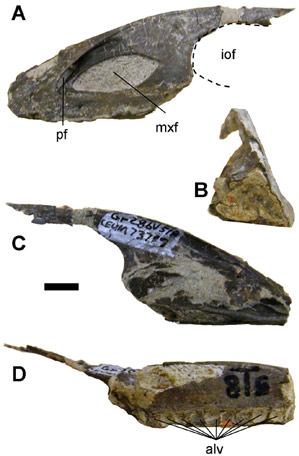
The Maxilla of Geminiraptor suarezrum

Geminiraptor fossil material.

Picture credit: PLoS ONE Journal

Key to the Illustration

(A) a side view of the maxilla (upper jawbone) – Lateral view

(B) a view of maxilla (upper jawbone) – Cranial view

(C) a view of the inside of the maxilla, from the inside of the face looking outwards – Medial view

(D) a view of the jawbone from the bottom looking up – Ventral view

The thick, black line is a scale bar of one centimetre in size and the abbreviations stand for:

alv = dental alveoli – the cavities or sockets in which the teeth were located

iof = internal antorbital fenestra – a bony opening in the skulls of archosaurs between the naris and the eye socket

mxf = maxillary fenestra – a bony opening in the maxilla bone

pf = pro-maxillary fenestra – an opening in the archosaur skull in front of the mxf (anterior to)

Only fragmentary remains of this little dinosaur have been recovered to date, but it is hoped that more troodontid material will be discovered a the Suarez location.

To view models of troodontids and other small theropod dinosaurs: Beasts of the Mesozoic Models.

28 11, 2010

A Cool and Extremely Informative Blog – Pterosauria

By |2024-04-12T08:54:14+01:00November 28th, 2010|Categories: Dinosaur and Prehistoric Animal News Stories, Main Page, Palaeontological articles|0 Comments

Recommended Web Log – Pterosauria for all things Related to the “Bird Necks”

Every once in a while team members at Everything Dinosaur get pointed towards a new on-line resource such as a website, forum or blog.  Having spent a little time reviewing some papers on the ancestry of the pterosaurs (flying reptiles), one of our colleagues was pointed in the direction of a really cool web log – dedicated to anything and everything related to Ornithodira, a clade within a larger division of the Order Reptilia – the archosaurs.

The Early Triassic was a critical time in the evolution of back-boned animals.  In the aftermath of the Permian-Triassic extinction event, a mass extinction that led to the demise of something like 70% of all vertebrate genera living on land, the foundations for many of our modern ecosystems were laid down.  The period of time immediately after the mass extinction event sees the origins of a number of today’s successful vertebrates – mammals, turtles and the archosaurs.  Extant members of the Archosauria include the birds and crocodiles.  The ornithodirans, although members of the Archosauria are characterised by their upright stance, ankle bones, and “S-shaped” necks.  The ornithodirans (the name means “bird necks”) are further divided into two related but distinctly different groups:

* Dinosauromorpha – the sub-clade that defines the Dinosaurs

* Pterosauromorpha – pterosaurs (flying reptiles)

Although the exact definition of the Ornithodira has been debated, and the phylogenic relationships between genera and families is in some cases a “grey area” in palaeontology to say the least.  For example, pterosaurs did not seem to possess an upright stance or indeed “S-shaped” necks, but their ancestors did; so they are classified in this way.

A Model of a Member of the Pterosauria

Pterosauria model.

The colourful Schleich Anhanguera pterosaur model. Picture credit: Everything Dinosaur.

Picture credit: Everything Dinosaur

To view the Schleich range of prehistoric animal models: Schleich Prehistoric Animal Figures.

Charting a course through all this is the web log Pterosauria – a blog that provides updates on research, studies and data on this important part of vertebrate evolution.  As the blog owner and writer Taylor Reints states:

“We are a blog that tries to question main dinosaur and pterosaur – ornithodiran – answers or answer ornithodiran questions.”

Either way, if you want to learn more about the ancestry of the Dinosauria and the Pterosauria then this blog is for you.  What’s more the blog contains a lot of brilliant illustrations, bringing these ancient reptiles back to life.

To view models and replicas of pterosaurs and other flying reptiles: Models of Pterosaurs and Flying Reptiles.

15 11, 2010

Pterosaurs “Pole-Vaulted” to Become Airborne

By |2023-01-13T22:16:24+00:00November 15th, 2010|Categories: Dinosaur and Prehistoric Animal News Stories, Main Page, Palaeontological articles|0 Comments

New Study Suggests Large Pterosaurs Used Their Arms and Legs to Get off the Ground

A new study published in the open access and online journal PLoS One (Public Library of Science) suggests that the largest of the pterosaurs launched themselves into the air by using the powerful muscles of their legs and arms to push off from the ground, effectively pole-vaulting over their wings.  Once airborne these huge creatures could fly long distances using air currents to help them stay aloft with the minimum of effort, just like many large birds do today.

Pterosaurs

Pterosaurs, otherwise known as flying reptiles, are an extinct group of reptiles that evolved in the Triassic and survived until the very end of the Cretaceous.  Their wings were formed out of skin that stretched from the body over the forelimbs and along an elongated fourth finger that acted as a supporting strut for the wing membrane.  A number of unrelated reptile groups had taken up gliding since the Permian Period, most likely to exploit food resources in trees and to escape from predators.  An example of an early glider would be a genus like Kuehneosaurus.  However, active flight in vertebrates, that is, being able to control movements in the air under the power of their own muscles, was first seen in the pterosaurs.  For millions of years, these highly specialised archosaurs, had the skies to themselves.  With the evolution of the birds, slowly but surely this once spectacular and diverse group of reptiles went into decline.

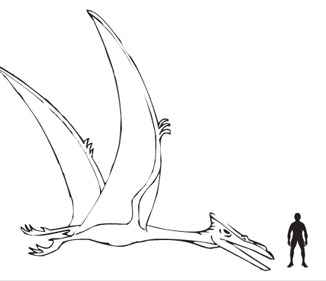
The last types of pterosaurs to evolve were huge.  The very last kinds of pterosaur that survived into the Maastrichtian faunal stage of the Cretaceous belonged mainly to a family of flying reptiles known as the azhdarchids – huge creatures like Quetzalcoatlus northropi with a wingspan in excess of 12 metres.  Scientists had puzzled for many years over how these very large and quite heavy creatures were able to launch themselves into the air in order to fly.

An Illustration of a Late Cretaceous Azhdarchidae Pterosaur – Quetzalcoatlus northropi

Picture credit: Everything Dinosaur

The Azhdarchidae Pterosaurs

Indeed, a recent theory regarding the largest of the Azhdarchidae, suggested that these reptiles, some of which were as tall as a modern giraffe, did not fly very much at all.  Instead, they roamed the Cretaceous plains, like Secretary birds; stalking small animals in the undergrowth and snatching up unwary creatures, including baby dinosaurs with their long, sharp toothless beaks.

To read an article on this theory: Getting Stalked by a Flock of Quetzalcoatlus.

The research was conducted by Dr Mark Witton, a palaeontologist from the University of Portsmouth, a specialist in pterosaur evolution and flight mechanics.  He was aided and assisted by Dr Michael Habib from Chatham University (Pennsylvania).  The two scientists examined the bones of giant pterosaurs to see if they could work how these bizarre creatures could have become airborne.  They concluded that these animals may have literally pole-vaulted themselves up into the air.

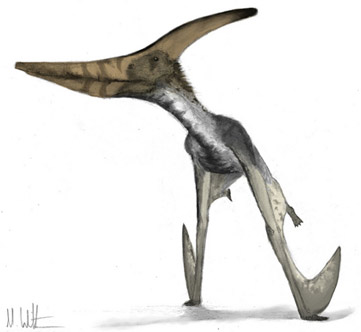
A Pterosaur “Pole-Vaulting” into the Air

Pterosaur becomes airborne.

Picture credit: Dr Mark Witton

Another, top class illustration by Dr Mark Witton shows a pterosaur, in this instance a member of the Pteranodontidae family, a Pteranodon longiceps taking to the air, by springing off the ground using its immensely strong arms.

Pterosaur Fossils

Many pterosaur fossils have been found in strata laid down in what was a marine environment.  This suggest that these particular flying reptiles lived close to the sea.  They could have launched themselves into the air by leaping from a cliff face, in the same way that many seabirds do today.  However, for those fossils of large pterosaurs found in non-marine strata, how they would have become airborne remained more problematical.  A thorny problem that now the UK and USA based researchers suggest they have a solution to.

They examined the fossil evidence and avoided trying to compare and contrast the pterosaurs with Aves (birds).

Dr Witton commentated:

”Most birds take off either by running to pick up speed and jumping into the air before flapping wildly, or if they’re small enough, they may simply launch themselves into the air from a standstill.  Previous theories suggested that giant pterosaurs were too big and heavy to perform either of these manoeuvres and therefore they would have remained on the ground.”

However, if birds are disregarded, and the fossil evidence examined with an emphasis on anatomical features, wing proportions and muscle attachment scars on the pneumatised Pterosaur bones, then it becomes clear that these flying reptiles would have achieved flight in a very different way compared to their feathered counterparts.

Dr Witton stated:

”These creatures were not birds, they were flying reptiles with a distinctly different skeletal structure, wing proportions and muscle mass.  They would have achieved flight in a completely different way to birds and would have had a lower angle of take-off and initial flight trajectory.  The anatomy of these creatures is unique.”

The two doctors propose that pterosaurs with up to 50 kilogrammes of forelimb muscle, could easily have propelled themselves into the air despite their huge size and considerable weight.

Previous theories have asserted that the largest of the pterosaurs could have been six metres in height with a wingspan of up to 12 metres but the researchers argue that five metres high with a 10 metre wingspan would have been perhaps more accurate.

Commenting on the strength of the forelimbs, Dr Witton said:

”The size of the flight muscles in a giant pterosaur would be incredible; they alone would be up to 50 kg (110lbs) and account for 20% of the animal’s total mass providing tremendous power and lift.”

Dr Habib added:

”Scientists have struggled for decades to figure out how giant pterosaurs could become airborne, and some recent proposals have simply assumed it must have been impossible.  But they may have approached the problem from the wrong end, instead of taking off with their legs alone, like birds, pterosaurs probably took off using all four of their limbs.”

This method of launching into the air, would be unique to the pterosaurs, if true, it might help to explain how they were able to grow to such huge sizes, with many genera of pterosaur far bigger in size than the largest flying birds today.

Dr Habib concluded:

”By using their arms as the main engines for launching instead of their legs, they use the flight muscles, the strongest in their bodies, to take off and that gives them potential to launch much greater weight into the air.  This may explain how pterosaurs became so much larger than any other flying animals known.”

The researchers examined anatomical aspects of large pterosaur skeletons calculating the relative strength of the bones and assessed the animal’s likely performance when “flap gliding” – the form of flight most likely to have been undertaken by these large creatures.  The team concluded that not only could flying reptiles the size of a bus, fly, they could do so extremely well and probably travelled vast distances crossing oceans and continents.  Recent studies of endocasts of pterosaur brains and other elements related to skull morphology suggest that these animals had keen senses and a great sense of balance – just what is required for active, powered flight.

The scientists found that it was unlikely that the flying reptiles would need to flap continuously to remain aloft once airborne.  Instead, these creatures would flap powerfully in short bursts with their large size allowing them to achieve rapid cruising speeds.

Commenting on this aspect of their study, Dr Witton said:

”Pterosaurs had incredibly strong skeletons, for their weight, they are probably amongst the strongest ever evolved.  And, unlike birds, where the wings become relatively weak as they grow in size, those of pterosaurs do the opposite: they become stronger.  As pterosaurs became larger, they reinforced their wings and expanded their flight muscles to ensure they could keep flying.”

A fascinating insight into how, pterosaurs could perhaps have taken off.  Whilst we at Everything Dinosaur, agree that many flying reptiles living in marine environments may have used cliffs to launch themselves into the air, how those pterosaurs that lived inland became airborne has remained a mystery.  Could this new theory provide the explanation?

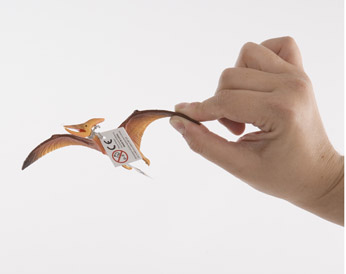
We do have our own way of making pterosaurs fly.  When we were working on the publicity shots for the new Pteranodon longiceps replica from CollectA we were asked to try to show this model flying low over the other models in the series.  The shot was achieved by the use of a strategically placed hand, some fishing line and photo-shop.

Our Pterosaur “Takes to the Air”

Pterosaurs. A flying Pteranodon.

Our Pteranodon flying.  Picture credit: Everything Dinosaur.

Picture credit: Everything Dinosaur

To view the CollectA range of not-to-scale prehistoric animal models: CollectA Prehistoric Life Models and Figures.

14 11, 2010

Intriguing Theory on Dinosaur Extinction – The Eggs that Didn’t Hatch

By |2023-03-06T12:18:23+00:00November 14th, 2010|Categories: Dinosaur and Prehistoric Animal News Stories, Main Page, Palaeontological articles|0 Comments

Global Cooling Found Dinosauria’s Achilles Heel

Many theories have been proposed regarding the extinction of the Dinosauria at the end of the Cretaceous.  Although the Cretaceous mass extinction event was not the only, or indeed, the most severe extinction event recorded in the Phanerozoic Eon, the demise of the dinosaurs seems to have attracted the most attention.  New research sheds light on the dinosaur extinction.

The Demise of the Dinosauria Explored

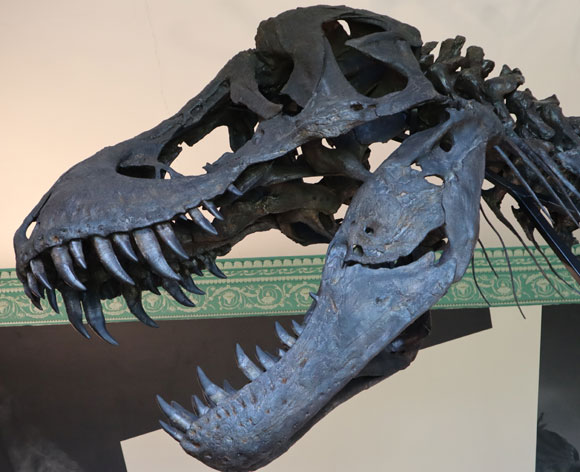
Titus the T. rex Skull and Jaws.  Dinosaur extinction.

The skull of the T. rex exhibit on display.  A fresh examination of dinosaur extinction theories.  Picture credit: Everything Dinosaur.

Picture credit: Everything Dinosaur

Victor Babbitt, from Boulder, Colorado (a great place to live if you happen to be interested in geology and palaeontology like Victor), has written an informative article speculating on why the dinosaurs may have become extinct but cold-bloodied reptiles, mammals and birds survived the extinction event.  It is well worth a read.

From the blog, a paper can be downloaded that provides the case for a sustained period of global cooling leading to the failure to hatch of dinosaur eggs.  This is a well argued article, that provides a very neat answer as to the demise of the dinosaurs but explains why their near relatives, the birds survived into the Cenozoic relatively unscathed.

Dinosaur Extinction

The paper suggests that the decades-long global cooling period caused by either asteroid impact or Deccan volcanism had a differential effect on dinosaur eggs versus bird and reptile eggs, such that many bird and reptile eggs hatched, but dinosaur eggs did not. This resulted in a “dead generation” that wiped out a 100 million years of dinosaur mega-fauna dominance in just a few decades.

If science is essentially a search for truth, it is not an exclusive club, contributions are most welcome.  Certainly a thought provoking article, one that has led to a lot of discussions amongst our team members.

For dinosaur themed toys and games, visit Everything Dinosaur’s user-friendly website: Dinosaur Toys and Gifts.

Go to Top