All about dinosaurs, fossils and prehistoric animals by Everything Dinosaur team members.

Articles, features and information which have slightly more scientific content with an emphasis on palaeontology, such as updates on academic papers, published papers etc.

21 05, 2011

The Big Brains of Mammals – Nothing to Sniff At

By |2023-04-12T13:43:42+01:00May 21st, 2011|Categories: Dinosaur and Prehistoric Animal News Stories, Main Page, Palaeontological articles|0 Comments

Brain Development in Early Mammals Linked to Development of Sense of Smell

Whilst the Dinosauria came to prominence around 215 million years ago, primitive shrew-like creatures, the ancestors of today’s modern mammals were sniffing out a survival strategy that would lead to the development of larger brains.   In a study carried out on the fossilised skulls of some ancient ancestors of true mammals, natural selection for a keener sense of smell may have been the evolutionary driver leading to bigger brains.

Early Mammals

It is not the size of the brain that makes one animal more intelligent than another, more it is a case of how the various compartments of the brain responsible for certain functions compare and the overall ratio of brain volume and capacity to body size – known as the Encephalisation Quotient or EQ.

The Encephalisation Quotient is a very simple way of  measuring the intelligence of an animal.  It is a ratio of the brain weight of the animal being studied compared to the brain weight of a control animal of the same body mass.  This method for measuring intelligence relies on the assumption that smarter animals have larger brains to body ratios than less intelligent ones.  This helps determine the relative intelligence of extinct animals, if the brain volume using CAT scans and other technology can be applied to fossil material.  In general, warm-blooded animals (like mammals) have a higher EQ than cold-blooded ones (like reptiles such as snakes and crocodiles).

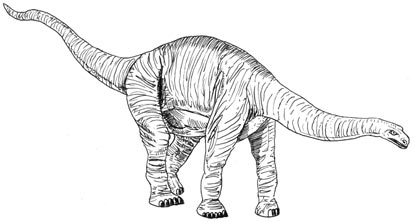
Birds and mammals have brains that are about 10 times bigger than those of bony fish, amphibians, and reptiles of the same body size, that are around today.  The Dinosauria, such a diverse Order, show a huge variation in Encephalisation Quotient.  For example, Apatosaurus (A. ajax), a Sauropod from the Late Jurassic had a body length in excess of 20 metres and weighed perhaps as much as 30 Tonnes but its brain was tiny, smaller than a cricket ball.  Even the “most intelligent” of all the known Dinosaurs – troodontids would have been about as “smart” as an Emu – a flightless bird from Australia not known for its intellect.

However, researchers have puzzled over the fact that mammals have such large brains, relative to other land vertebrates such as reptiles.  A new study co-authored by Zhe-Xi Luo, a palaeontologist at the Carnegie Museum of Natural History (Pittsburgh, Pennsylvania), suggests that it was the need to develop a super effective sense of smell that led to the evolution of larger brain size.

The palaeontologist stated:

“Mammals didn’t get our larger brains for thinking.  We got it for a more urgent and more basis need – our sense of smell was far more important.”

Brain Development

Some researchers have speculated that the early, nocturnal mammals evolved larger brains to boost their hearing, as vision was less important at night.  It is assumed that these small creatures such as the triconodont Morganucodon that was analysed in this study, were nocturnal creatures.  Choosing to live in the twilight world for fear of being eaten by the dinosaurs which were much more active during the day.  Other scientists have suggested that mammal’s brains are proportionately larger because as many early mammals evolved smaller bodies their brains failed to shrink to scale.

As an aside, the concept of having the dinosaurs roam during the day, and once dusk fell having the Dinosauria hand over to a night shift that included a number of ancestral mammals is quite an outdated concept.  True, many small mammals alive today are nocturnal, so it is likely small mammalian ancestors in the Mesozoic were also probably creatures of the night.  But many scientists now believe that there were plenty of hunters around at night, quite capable of snatching up an unwary, furry multituberculate or two.

Indeed, a recent study into the orbits (eye sockets) of some dinosaur fossil skulls, concluded that some members of the Theropoda may have been night-hunters, or at least hunters in low light levels.  The predation threat from dinosaurs may have led to the evolutionary “spur” that favoured small, mammalian ancestors with better senses and hence larger brains.

The research team reconstructed the oldest known skulls of proto-mammals, the 10 cm long, shrew-like Morganucodon and Hadrocodium.  Luo and colleagues found clues to how the mammalian brain may have begun to grow bigger.  Using CAT scanning technology the researchers created three-dimensional images of the brain endocasts,  based on the fossilised impressions of brain tissue and spaces left on the inside of the preserved fossil skulls.  This gave the team a detailed view of the surface of the brain and the nasal cavities.

The team then compared these endocasts with those for seven fossils of early cynodonts – synapsids just like mammals but primitive reptiles that were abundant during the Early Triassic.  It is the cynodonts, that scientists believe, are the ancestors of mammals.  The team also examined the endocasts of twenty-seven other primitive mammals from the Mesozoic and compared their results with an analysis of the brains of 2 two hundred and seventy living mammal species.

They found that the size of the mammalian brain evolved in three major stages. First, by the time Morganucodon was alive 190 million years ago, the brain was almost 50% larger than in cynodonts, and areas that process smell, such as the olfactory bulb, were distinctly larger. Then, a short time later in Hadrocodium, the closest known relative of living mammals, the brain had expanded another 50%, with parts involved in smell accounting for most of the increase.  Thirdly, by 65 million years ago when modern types of “crown” mammals arose, regions of the brain that control neuromuscular coordination by integrating different senses had enlarged.

Examples of Early Mammals

Prehistoric mammal models from Mojo.  Models of early mammals.

A selection of prehistoric animal models from the Mojo “Prehistoric and Extinct” range.  Models of early mammals. Picture credit: Everything Dinosaur.

Picture credit: Everything Dinosaur

To view models and replicas of early prehistoric mammals: Mojo Fun Prehistoric and Extinct Figures.

Images released show the computer generated image of the brain (pink) and the swollen front section of the brain equating to the olfactory bulbs (part of brain attributed to detection and analysis of sense of smell.

Biologist R. Glenn Northcutt of the University of California (UC), stated:

“The paper provides the first evidence of the relative size of the brains and which parts were initially enlarging during critical stages in the evolution of modern mammalian brains.  Until now, we could only speculate what changes were occurring and at what rate. Now we have data and can infer what selective pressures were driving brain evolution in the radiation that led to mammals.”

Biological anthropologist Terrence Deacon of UC Berkeley also praises the descriptive work that shows the olfactory bulb was “unambiguously enlarged” compared with the structure in reptiles.  But he warns that just because it was larger when the brain began to expand doesn’t mean that the sense of smell drove the size increase, it could just correlate with enlargement caused by another adaptation.

Deacon commented that regardless of the trigger, though the fossils show that a:

“Mammalian pattern of brain organisation is apparent at this very early stage of proto-mammalian evolution.”

20 05, 2011

New Research Back Dating the Crocodile Family Tree

By |2024-04-21T09:34:15+01:00May 20th, 2011|Categories: Dinosaur and Prehistoric Animal News Stories, Main Page, Palaeontological articles|0 Comments

Crocodile/Bird Split Pushed Back in Time due to New Study

A re-examination of a Early Triassic vertebrate fossil found in China during the 1970s originally thought to be an ancestor of both crocodiles and Aves (birds)  has led to scientists concluding that this fossil represents an ancestor of crocodiles only.  This suggests that the crocodile/bird evolutionary split took place earlier than previously thought – perhaps as far back as in the Palaeozoic more than 250 million years ago.

The only known specimen of Xilousuchus sapingensis has been re-examined by a Washington University based researcher and it has been re-classified as a member of the Archosauria, characterised by skulls with long, narrow snouts and teeth set in sockets.  After the Permian mass extinction event, it was the archosaurs that quickly diversified to become one of the dominant types of land vertebrate on the planet.  The archosaurs gave rise to the crocodiles, birds and to the dinosaurs.

The new examination dates the fossil of . sapingensis to the very Early Triassic period (247 million to 252 million years) commented Sterling Nesbitt, the University of Washington postdoctoral researcher responsible for this new study.  The new study places this particular reptile on the crocodile side of the archosaur family tree.

Drawings show the skull and neck vertebrae from the fossil archosaur. The areas coloured “white” in the diagrams released show the portions of the illustration that represent actual fossils.  The extended neural spines from the neck vertebrae numbers six onwards, suggest a sail-like structure on the back, similar in form and function to the sail on a pelycosaur such as Dimetrodon.

The researcher Nesbitt stated:

“We are marching closer and closer to the Permian-Triassic boundary with the origin of the archosaurs, and today the archosaurs are still the dominant land vertebrate, when you look at the diversity of birds.”

This new study could sharpen the debate amongst palaeontologists as to the origins of the Archosauria.  Did they exist before the Permian mass extinction, surviving the extinction event or were only archosaur precursors around in the Late Permian geological period?

Nesbitt added:

“Archosaurs might have survived the extinction or they might have been a product of the recovery from the extinction.”

The research is published this week in the online journal “Earth and Environmental Science Transactions of the Royal Society of Edinburgh.

Co-authors are Jun Liu of the American Museum of Natural History (New York) and Chun Li of the Institute of Vertebrate Paleontology and Palaeoanthropology (Beijing, China). Nesbitt did most of his work on the project while a postdoctoral researcher at the University of Texas at Austin.

The X. sapingensisspecimen consisting of a skull and ten vertebrae, was found in the Heshanggou Formation in northern China, an area with deposits that date from the early and mid-Triassic period, from 252 million to 230 million years ago, and further back, before the mass extinction event that brought the Permian geological period to an end.

The fossil was originally classified as an archosauriform, a “cousin” of archosaurs, rather than a true archosaur, but that was before the discovery of more complete early archosaur specimens from other parts of the Triassic period. The researchers examined bones from the specimen in detail, comparing them to those from the closest relatives of archosaurs, and discovered that X. sapingensis differed from virtually every archosauriform.

Among their findings was that bones at the tip of the jaw that bear the teeth likely were not down-turned as much as originally thought when the specimen was first described in the 1980s. They also found that neural spines of the neck formed the forward part of a sail similar to that found on another ancient archosaur called Arizonasaurus, a very close relative of Xilousuchus found in Arizona.

An Picture of Arizonasaurus

Picture credit: Everything Dinosaur

The family trees of birds and crocodiles meet somewhere in the Early Triassic and archosauriforms are the closest cousin to those archosaurs, Nesbitt said. But the new research places X. sapingensis firmly within the archosaur family tree, providing evidence that the early members of the crocodile and bird family trees evolved earlier than previously thought.

Commenting on the appearance of this ancestral crocodile, Sterling said:

“This animal is closer to a crocodile, but it’s not a crocodile. If you saw it today you wouldn’t think it was a crocodile, especially not with a sail on its back.”

On the Crocodilian Side of the Archosauria (Smok wawelski)

Smok wawelski Polish fossil

Smok wawelski.

To view models of Triassic archosaurs: CollectA Deluxe Prehistoric Life Models.

19 05, 2011

New Study Suggests Facultative Bipedalism in Sauropods

By |2024-04-21T09:34:46+01:00May 19th, 2011|Categories: Dinosaur and Prehistoric Animal News Stories, Dinosaur Fans, Main Page, Palaeontological articles|0 Comments

Apatosaurus ajax – Speedy Sauropods

Every once in a while we come across a really well-written, concise summary of a scientific paper accompanied by a stunning image, illustrating the particular aspect of palaeontology under investigation.  An example, of this can be seen below in a beautiful drawing interpreting a trace fossil found at the famous Morrison Formation site.  We congratulate Matthew Mossbrucker (Director and Chief Curator at the Morrison Natural History Museum) and artist Fabio Pastori for their work.

Sauropod Dinosaurs

If science is the search for truth, then truth itself is of little use unless it can be communicated effectively.  The example reproduced below regarding the analysis of trace fossils found at Quarry five in Morrison, Colorado (United States), demonstrates how to communicate studies in  palaeontology to a wider audience.

The Search for Truth – A Brontosaurus Replica

Out and about with a Mojo Fun Brontosaurus model.

A Mojo Fun Brontosaurus dinosaur model on display. Picture credit: Everything Dinosaur.

Picture credit: Everything Dinosaur

The summation produced by Matthew Mossbrucker is reproduced below, he comments on the artwork created by Fabio Pastori:

“Speedy” the sauropod Apatosaurus ajax

A ajax running babies illustration by Fabio Pastori with scientific supervision and text by Matthew Mossbrucker.

This painting depicts a historic Morrison Formation site, Quarry 5 in Morrison, Colorado.  Discovered by Arthur Lakes in the spring of 1877, this site is most significant because it produced the holotype of Stegosaurus armatus, Yale Peabody Museum specimen 1850.  Sauropod remains have been documented at this site as well.  Recent investigations at Quarry 5 yielded trace fossils on the top of the beds that contain the body fossils, including tracks likely made by juvenile and adult Apatosaurus ajax.

On a single ex situ boulder, juvenile sauropod trackways demonstrate two distinct footfall cadences – a near heel-toe hind track pattern, and a trackway that shows twice the amount of space (as compared to the aforementioned tracks) between footfalls in tracks the same size.  This indicates that the two trackways represent distinct locomotion pattern: the closer footfalls a walking speed with the wider footfalls representing a low-speed ‘run.’  While the trackway of close footfalls does demonstrate relatively shallow, lunate manual tracks, the wider footfalls have no features representing manual tracks (either overstepped or not).

This suggests the possibility that young Apatosaurus had the capability of moving short distances bipedally.

Patient work at Quarry 5 is ongoing – hampered by very hard, silicic sandstone.

Congratulations to all involved in this fine marriage of scientific study and scientific illustration.

For models and replicas of sauropod dinosaur and other prehistoric creatures: Wild Safari Prehistoric World Models.

18 05, 2011

Zooming into an Ancient Spider Thanks to New Technology

By |2024-04-21T09:35:21+01:00May 18th, 2011|Categories: Dinosaur and Prehistoric Animal News Stories, Main Page, Palaeontological articles|0 Comments

Advanced Technology Clears up Blurry Amber Revealing Treasures Within

Researchers at the University of Manchester (England), have used advanced computer imaging techniques combined with three-dimensional X-ray scanning technology to reveal the face and details of an ancient spider that lived during the Palaeogene Period, some forty-nine million years ago.

Ancient Spider

The spider, known as a Huntsman Spider (Sparassidae), was preserved in tree resin that solidified and formed amber, trapping this little arthropod and enabling scientists nearly fifty million years later to study it in fine detail.  Amber is a sticky, resin produced by certain trees, especially conifers.  Insects and other organisms become trapped in this resin and fossilised when it hardens into amber.

Unfortunately, over time in the presence of oxygen the amber can become opaque, thus obscuring the tiny creatures that it might contain.  The use of sophisticated X-ray computer tomography enables scientists to lift the veil on the hidden treasures that amber might contain, enabling them to build up amazingly detailed pictures of pollen, plant debris and small creatures that were trapped and preserved.

This is not the first time that spider fossils have been revealed by close examination of amber.  Back in 2009 we reported on the discovery of the remains of spider’s silk threads being preserved in a lump of amber found in the UK that dated from the Cretaceous Period.

To read this article: World’s Oldest Spider’s Web Discovered.

Scientists from Manchester University, working with their colleagues from the Berlin Natural History Museum explored the amber nodule to reveal the facial features of this ancient spider.  Their work is being reported in the scientific journal “Naturwissenschaften”.  This team have demonstrated how opaque amber nodules can yield important scientific data, when X-ray computer tomography and other sophisticated research techniques are applied.

Commenting on the study, Dr David Penney, of Manchester University’s Faculty of Life Sciences stated:

“More than 1,000 species of fossil spider have been described, many of them from amber.  The best-known source is Baltic amber, which is about 49 million years old and that has been actively studied for more than 150 years.”

He went onto add:

“Indeed, some of the first fossil spiders to be described back in 1854 were from the historically significant collection of Georg Karl Berendt, which is held in the Berlin Natural History museum.  A problem here is that these old, historical amber pieces have reacted with oxygen over time and are now often dark or cracked, making it hard to see the animal specimens inside.”

The Manchester University team were surprised to find the oldest example known of a Huntsman spider preserved in amber.  These strong and quick spiders would have been unlikely candidates to get caught in slow moving tree resin – but apparently one spider forty-nine million years ago may have been unlucky enough to have been caught.  To test the theory that the spider’s remains were indeed that of a Huntsman, an international team of experts in the fields of fossils and living spiders, and in modern techniques of computer analysis decided to re-study Georg Berendt’s original specimen to determine what it was.

The Face of the Forty-Nine Million Year Old Huntsman

Picture credit: Manchester University

Dr Penny said:

“The results were surprising.  Computed tomography produced three-dimensional images and movies of astounding quality, which allowed us to compare the finest details of the amber fossil with similar-looking living spiders.  We were able to show that the fossil is unquestionably a Huntsman spider and belongs to a genus called Eusparassus, which lives in the tropics and also arid regions of southern Europe today, but evidently lived in central Europe fifty million years ago.”

Professor Philip Withers of  Manchester University concluded:

“Normally such fossils are really hard to detect because the contrast against the amber is low but with phase contrast imaging the spiders really jump out at you in three-dimensions.  Usually you have to go to a synchrotron X-ray facility to get good phase contrast, but we can get excellent phase contrast in the lab.  This is really exciting because it opens up the embedded fossil archive not just in ambers.”

For models and replicas of ancient invertebrates from the Palaeozoic and the Mesozoic: CollectA Prehistoric Life Models and Figures.

17 05, 2011

New Genus of Primate Discovered – Deep in the Heart of Texas

By |2023-01-19T08:32:43+00:00May 17th, 2011|Categories: Dinosaur and Prehistoric Animal News Stories, Main Page, Palaeontological articles|0 Comments

New Primate Genus Provides Evidence of Land Bridges between Old World and New

Texas, that vast state in the southern part of the United States may be synonymous with westerns, cattle and stetsons but forty-three million years ago the area was a tropical paradise, one of the last places in North America to suffer from global cooling as the world got drier and colder.  Flourishing in this verdant, tree covered world was a primate, an animal similar to a small, modern lemur in appearance.

A Primate

The fossil evidence was found in the Devil’s Graveyard area of the Badlands of western Texas, although not complete, remains of the jaw bone have been discovered providing an insight into the animal’s facial characteristics and diet.  The animal has been formally named Mescalerolemur horneri.

M. horneri lived during the Eocene Epoch about 43 million years ago.  It is a member of an extinct primate group –- the Adapiforms, that were found throughout the Northern Hemisphere in the Eocene.  However, just like Mahgarita stevensi, a younger fossil primate found in the same area in 1973, Mescalerolemur is more closely related to Eurasian and African Adapiforms than those from North America.

Mescalerolemur horneri

Chris Kirk, Associate Professor in the Dept. of Anthropology at the University of Texas commented:

“These Texas primates are unlike any other Eocene primate community that has ever been found in terms of the species that are represented.  The presence of both Mescalerolemur and Mahgarita, which are only found in the Big Bend region of Texas, comes after the more common Adapiforms from the Eocene of North America had already become extinct.  This is significant because it provides further evidence of faunal interchange between North America and East Asia during the Middle Eocene.”

By the end of the Eocene, primates and other tropically adapted species had all but disappeared from North America due to climatic cooling, so Kirk is sampling the last burst of diversity in North American primates.  With its lower latitudes and more equable climate, West Texas offered warm-adapted species a greater chance of survival after the cooling began, a sort of safe haven against the rigours of climate change.

Associate Professor Kirk stated that Marie Butcher, a then undergraduate who graduated with degrees in anthropology and biology from The University of Texas at Austin, found the first isolated tooth of Mescalerolemur in 2005.  Since that time, many more primate fossils have been recovered by Kirk and his team at a locality called “Purple Bench.”  This fossil locality is three to four million years older than the Devil’s Graveyard sediments that had previously produced Mahgarita stevensi.

Kirk stated:
“I initially thought that we had found a new, smaller species of Mahgarita.”

However, as more specimens were prepared at the Texas Memorial Museum’s Vertebrate Paleontology Lab, Kirk realised he had discovered not just a new species, but a new genus that was previously unknown to science.

Fossils of Mescalerolemur reveal it was a small primate, weighing only about 370 grams, less than an IPad. This body weight is similar to that of the living greater dwarf lemur.  Mescalerolemur’s dental anatomy reveals a close evolutionary relationship with Adapiform primates from Eurasia and Africa, including Darwinius masillae, a German fossil primate previously claimed (in a controversial paper) to be a human ancestor.

To read more about Darwinius: Debate over “Ida” Rumbles On.

However, the discovery of Mescalerolemur provides further evidence that Adapiform primates like Darwinius are more closely related to living lemurs and bush babies than they are to humans.

For example, the right and left halves of Mescalerolemur’s lower jaws were two separate bones with a joint along the mid-line, a common trait for lemurs and bush babies.  Mahgarita stevensi, the closest fossil relative of Mescalerolemur, had a completely fused jaw joint like that of humans.

For models and replicas of prehistoric mammals: Mojo Fun Prehistoric Life Models and Figures.

The pictures released shows Mescalerolemur horneri’s partial upper jaw (in two pieces, at left) and partial lower jaw (at right) (scales = 2 mm). Explaining the significance of the difference in jawbones, Kirk said:

“Because Mescalerolemur and Mahgarita are close relatives, fusion of the lower jaws in Mahgarita must have occurred independently from that observed in humans and their relatives, the monkeys and apes.”

The new genus is named after the Mescalero Apache, native Indians, who inhabited the Big Bend region of Texas from about 1700-1880.  The species name, horneri, honours Norman Horner, an entomologist and professor emeritus at Midwestern State University (MSU) in Wichita Falls, Texas.  Horner helped to establish MSU’s Dalquest Desert Research Site, where the new primate fossils were found.  The taxonomic relationship between the various types of Old World and New World Adapiforms suggest that faunal exchange was taking place over much of the Eocene Epoch, perhaps land bridges existed that permitted this exchange of genera.

15 05, 2011

Pangea Did Have Boundaries – Speciation Prevailed

By |2023-03-07T10:23:17+00:00May 15th, 2011|Categories: Dinosaur and Prehistoric Animal Drawings, Geology, Main Page, Palaeontological articles|0 Comments

New Study Suggest Mammals Liked some Parts, Reptiles Others

One of the conundrums in the science of palaeontology, is why given the uniformity of Pangea during the Triassic was there such a huge increase in the diversity of vertebrate life?.  For speciation to occur, (new species to evolve), so the theory of evolution goes, a group of one species of animals needs to become separately from another group of animals from the same species.

For example, if you have a species of leaf-eating lizard living on the coast and in a freak storm a number of individuals are washed out to sea, perhaps floating on broken branches that have become detached from trees during the storm.  These lizards, would be able to survive a long period afloat as they need little food or water being cold-blooded.  After several weeks, the tides and currents takes this floating raft of storm debris towards a small island many hundreds of miles from the mainland where these lizards used to live.

The branches and the lizards that they contain that have have survived get washed ashore and these little mariners find themselves in a new environment.  The habitat may be different, the plant life strange and even the food chains which the lizards are introduced to as interlopers may be different.  If this population remains isolated from the mainland leaf-eating population then there is every chance that over time, the lizards will evolve and adapt to their new homes – perhaps becoming over many generations so different from the mainland lizards that they can no longer breed with them and thus, these island lizards would be classified as a separate species.  With a different diet of leaves, perhaps due to the limited number of trees on the island, the lizards may well evolve into animals with a more omnivorous diet.  Their dentition could change, the size of the jaw muscles, the anatomy of the gut and so on.

More than 200 million years ago, mammals and reptiles lived in their own separate worlds on the super-continent Pangaea, despite little geographical incentive to do so. Mammals lived in areas of twice-yearly seasonal rainfall; reptiles stayed in areas where rains came just once a year. Mammals lose more water when they excrete, and thus need water-rich environments to survive. Results are published in the Proceedings of the National Academy of Sciences.

With the super-continent of Pangea covering much of one hemisphere and being made up of North America, Europe, North Asia, Africa, South America, scientists have puzzled over why the rise and spread of so many vertebrates such as the dinosaurs, when the opportunity for a “gene pool” of a species to become isolated would have been so limited.  There were few geographical boundaries to the physical movement of animal populations, no great, continuous mountain chains, no impassable deserts, ice fields and such like.  If animals roamed freely across Pangea, gene pools would have remained very readily accessible from animals of that species moving into any area and the opportunities for extensive speciation would have been lost.  However, mammals and reptiles did keep to their own areas, each type preferring a particular climate (mammals liking hot and wet, reptiles being more successful in the drier areas.

Triassic Fossils

In a paper published in the scientific journal “The Proceedings of the National Academy of Sciences”,  a team of researchers have concluded that more than 200 million years ago, mammals and reptiles lived in their own separate worlds on the super-continent Pangea.  Despite little geographical incentive to do so.  Mammals lived in areas of twice-yearly seasonal rainfall; reptiles stayed in areas where rains came just once a year.  Mammals lose more water when they excrete, compared to reptiles and birds and thus need water-rich environments to survive.

Studying a transect of Pangea stretching from about three degrees south to 26 degrees north (a long swath in the centre of the continent covering tropical and semi-arid, temperate zones), a team of scientists led by Jessica Whiteside at Brown University (Rhode Island, USA) has determined that reptiles, represented by a group called procolophonids, lived in one area, while mammals, represented by a precursor species called traversodont cynodonts, lived in another.  Though similar in many ways, their paths evidently did not cross.

Assistant Professor Whiteside commented:

“We’re answering a question that goes back to Darwin’s time.  What controls where organisms live?  The two main constraints are geography and climate.”

Turning to climate, the frequency of rainfall along lines of latitude directly influenced where animals lived, the scientists conclude. In the tropical zone where the mammal-relative traversodont cynodonts lived, monsoon-like rains fell twice a year.  But farther north on Pangea, in the temperate regions where the procolophonids predominated, major rains occurred only once a year.  It was the difference in the precipitation, the researchers conclude, that sorted the mammals’ range from that of the reptiles.

On Pangea, the mammals needed a water-rich area, so the availability of water played a decisive role in determining where they lived.

Assistant Professor Whiteside added:

“It’s interesting that something as basic as how the body deals with waste can restrict the movement of an entire group.”

In water-limited areas, “the reptiles had a competitive advantage over mammals,” Whiteside commented.  She thinks the reptiles didn’t migrate into the equatorial regions because they already had found their niche.

The researchers compiled a climate record for Pangea during the Late Triassic period, from 234 million years ago to 209 million years ago, using samples collected from lakes and ancient rift basins stretching from modern-day Georgia to Nova Scotia.  Pangea was a hothouse then; temperatures were about 20 degrees Celsius hotter in the summer, and atmospheric carbon dioxide was five to 20 times greater than today.  Yet there were regional differences, including rainfall amounts.

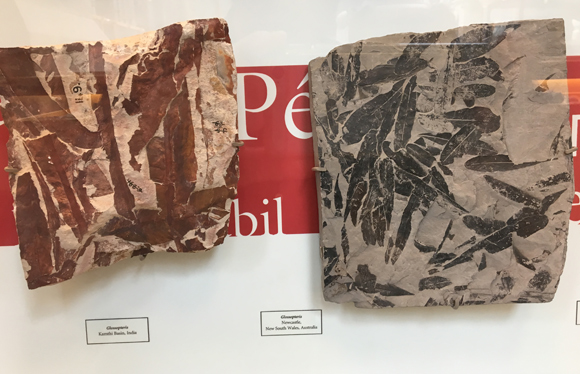
Glossopteris Plant Fossils – Provide an Insight to Pangea

Glossopteris fossil leaves.

Examples of Glossopteris fossils from different parts of the world – India (left) and Australia (right). Picture credit: Everything Dinosaur.

Picture credit: Everything Dinosaur

The researchers base the rainfall gap on variations in Earth’s precession, or the wobble on its axis, coupled with the eccentricity cycle, based on Earth’s orbital position to the sun.  Together, these Milankovitch cycles influence how much sunlight, or energy, reaches different areas of the planet.  During the Late Triassic, the equatorial regions received more sunlight, thus more energy to generate more frequent rainfall.  The higher latitudes, with less total sunlight, experienced less rain.

The research is important because climate change projections for our own time on planet Earth, show areas that would receive less precipitation, which could put mammals there under stress.

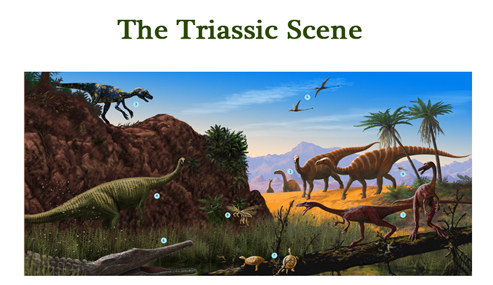
Typical Terrestrial Life During the Late Triassic

A Triassic scene from the dinosaur timeline poster.

Triassic scene from the dinosaur timeline poster. Typical terrestrial life during the Late Triassic.

Relating the Pangea evidence to today’s problem with climate change, research graduate Danielle Grogan, part of Associate Professor’s Whiteside research Group stated:

“There is evidence that climate change over the last 100 years has already changed the distribution of mammal species.  Our study can help us predict negative climate effects on mammals in the future.”

For models and replicas of Triassic prehistoric animals including early dinosaurs: CollectA Deluxe Prehistoric Animal Scale Models.

1 05, 2011

Dangerous Mudslides – Common Sense should Prevail at Lyme Regis (Providing Helpful Advice)

By |2024-04-21T09:52:30+01:00May 1st, 2011|Categories: Everything Dinosaur News and Updates, Main Page, Palaeontological articles|1 Comment

Fossil Hunters Urged to Stay Clear of Dangerous Cliffs

The Lyme Regis Fossil Festival is in full swing, but visitors to the event who decide to try to find their own fossils on the beaches surrounding the town should heed the warning of local fossil experts and keep well clear of the dangerous cliffs.  The cliffs on both sides of the Cobb are extremely dangerous and mudslides and rock falls are common.  Yet despite the dangers, unwary tourists still venture very close to the cliffs and indeed can be seen clambering over recent rock falls and mudslides in their quest for fossils.

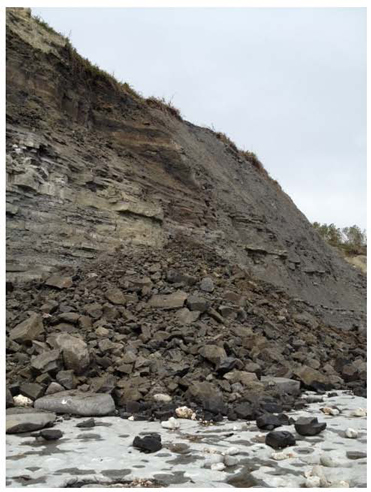
A rock fall on Monmouth beach (west of Lyme Regis) which took place on the 14th April, resulted in many tonnes of debris being scattered across the famous limestone paving.  Despite the danger of more rocks crashing down onto the beach, the picture below, taking by local fossil expert Brandon Lennon shows a number of foolhardy beachcombers straying to close to this part of the cliffs.  In the picture, a couple of people can be seen actually sitting on top of the rock fall.

The Recent Rockfall on Monmouth Beach

A rockfall at Lyme Regis

Rockfall onto the Ammonite Pavement on Monmouth Beach.

Brandon Lennon’s public fossil walk on Friday, the first day of the fossil festival, took his party past the recent rockfall.  Brandon’s father, geologist Ian can be seen at the far right of the photograph, keeping a sensible distance from the danger area and pointing out just how far onto the shoreline large boulders toppling from the unstable cliffs can reach.

Although fossils can be a source of fascination, and there is nothing as exciting as finding your own fossil, visitors to the beaches around Lyme Regis and Charmouth should take great care and avoid getting too close to the cliff faces, these areas are extremely dangerous.

A spokesperson from Everything Dinosaur stated:

“Rock falls and mudslides are very frequent along this stretch of the coastline, yet people are still venturing too close to the cliffs and even climbing onto recent rock falls in a fool hardy quest for fossils.  The best advice we can give is to go on an organised fossil walk with a local expert.”

Visitors should heed the advice of local fossil experts and take notice of the many signs posted up along the beach area, the beaches may look benign but the combination of steep cliffs and saturated strata being constantly undercut by wave action makes more mudslides and rockfalls inevitable.

For models and replicas of prehistoric animals associated with Lyme Regis and the “Jurassic Coast”: CollectA Prehistoric Life Figures.

20 04, 2011

World’s Oldest Evidence of Toothache Revealed by New Research

By |2024-04-18T21:50:09+01:00April 20th, 2011|Categories: Animal News Stories, Dinosaur and Prehistoric Animal News Stories, Main Page, Palaeontological articles|1 Comment

Dentists Had Not Evolved in the Palaeozoic

A team of North American palaeontologists have discovered the world’s oldest case of toothache in the fossilised jaws of an ancient reptile that lived in the Permian geological period.  Computerised tomography has revealed the tell-tale signs of an extensive abscess on the lower jaw of this unfortunate creature, the infection probably led to this reptile loosing a lot of its teeth.  The fossil provides evidence of dental caries in an omnivore and reminds our species (also omnivores) to look after our teeth.

Oldest Evidence of Toothache

The fossil is from a reptile known as Labidosaurus hamatus (lipped lizard), from the Lower Permian of the United States (holotype material for this species found in the Arroyo Formation of Baylor County, Texas), this one metre long reptile, was formally named and described in 1896 by that eminent American palaeontologist Edward Drinker Cope (1840-1897).

When the research team, led by Robert Reisz (Chair of the Dept. of Biology at the University of Toronto Mississauga) undertook a CT scan of the fossilised lower jaw of this anapsid reptile, they discovered evidence of a substantial infection that has caused the loss of several teeth.  The upper jaw (premaxilla) of these primitive reptiles was hooked, it had a distinct kink in it, the scientists discovered that once the jaw bones in question were studied, a sorry tale of tooth decay and tooth loss was revealed.

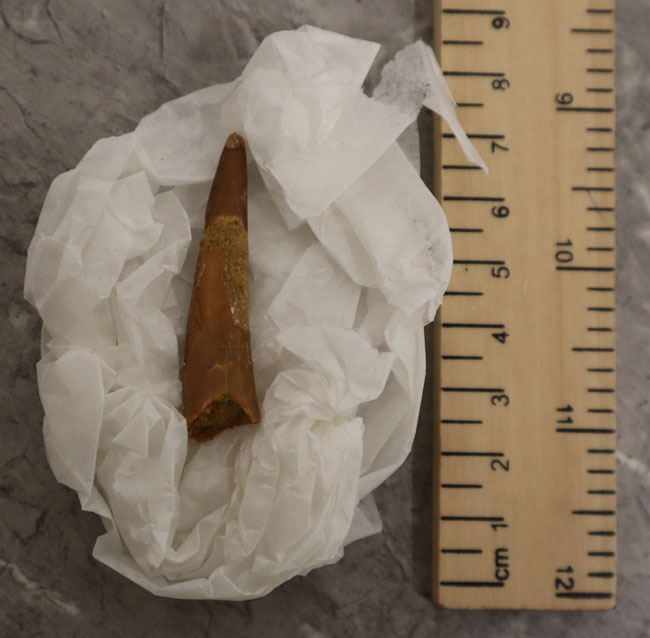
Palaeontologists Can Tell a Lot from a Single Tooth

Fossil pterosaur tooth

Palaeontologist can tell a lot from a single tooth, in this case a tooth of a pterosaur from Morocco. Picture credit: Robert

Diagrams show several views and scans of the fossilised jawbone revealing substantial tooth loss and the site of a nasty infection (abscess) in the bone.

Infection in the Jaw

The team’s analysis, which is written up in the scientific journal “Naturwissenschaften” shows the advantages and disadvantages of various evolved solutions when it comes to dentition (teeth).  These reptiles had adapted to life on land, and in doing so had given up the more primitive dental pattern of having teeth that were loosely attached to the jaw and continuously replaced, as is seen today in sharks for example.

Scientists believe that these types of reptiles were predominantly plant-eaters, but also partial to the occasional insect or small creature that they could catch – essentially omnivores.  The change to a more vegetarian diet led to the evolution of stronger teeth more firmly attached to the jaws.  Better, stronger, teeth led to more efficient biting and some grinding of plant matter in the mouth prior to swallowing.  These processes would have helped these creatures extract more nutrition from the food they ate.  However, a drawback to this was that infections and tooth decay in more semi-permanent teeth was likely to occur.

Dr Reisz and his team suggest that as these teeth were worn, dental nerves would have been exposed to bacterial infection and tooth loss was more likely, than in those animals such as many diapsid reptiles (including dinosaurs) that shed worn teeth and rapidly replaced them with new ones erupting from the jaw bones.

These findings may have a parallel with the evolution of mammals, including our own species.  Mammalian jaws are relatively simple, when compared to the jaws of many reptiles.  The mammal lower jaw is made up of one single bone the dentary, they are synapsids, named after an opening in the skull bones behind the orbit (eye).  This synapsid hole may have evolved to provide new attachment sites for jaw muscles as these creatures evolved a more effective and powerful bite.  Reptiles such as L. hamatus are members of the anapsid type.  They have no skull openings behind the eye socket.  The earliest reptiles were anapsid forms, they are represented today by the Chelonians (turtles and tortoises etc).  With a more simple jawbone, complex teeth evolved to enable synapsids to process food efficiently.  Such an evolutionary investment in tooth design, probably meant a trade off – they could not be so easily shed and replaced, as in diapsid reptiles for instance.

Dr Reisz commented:

“Our findings suggest that our own human system of having just two sets of teeth, baby and permanent, although of obvious advantage because of its ability to chew and process many different types of food, is more susceptible to infection than that of our distant ancestors that had a continuous cycle of tooth replacement.”

Different evolutionary solutions to handling tough land plants as food may have had an impact on reptile diversity, this would have affected those descendants of reptiles, the birds, who incidentally lost all their teeth in an adaptation to powered flight, and the mammals including us humans.

If you don’t want to end up with dental caries and an infected mouth best to take the advice of your dentist, after all, there were no dentists around in the Palaeozoic to assist poor Labidosaurus.

For replicas and models of prehistoric animals from the Permian: CollectA Age of Dinosaurs Popular Models.

21 03, 2011

Comparing Sauropods to Vacuum Cleaners using New Research

By |2024-04-21T10:06:36+01:00March 21st, 2011|Categories: Dinosaur and Prehistoric Animal News Stories, Main Page, Palaeontological articles|2 Comments

New Study Extols the Virtue of Having a Long-Neck for Sauropods

A team of UK based researchers have calculated that sauropods such as Apatosaurus and Nigersaurus evolved long-necks so that they could reach a lot of plant food material without having to move very far.  This new study has calculated that the long necks of these herbivores enabled them to gather a great deal of food without having to expend a lot energy.  Think of a Diplodocus as a thirty metre long feeding platform.

Sauropods

The scientists have compared the long-necks of sauropods to the long, extension nozzle fitted to post war vacuum cleaners, devices to help housewives and their partners cope with having to lug a heavy machine around the house.

The long necks of these highly successful group of lizard-hipped dinosaurs, taken to extremes by the enormously long neck of the sauropod Mamenchisaurus for example, resemble the solution that designers came up with when they realised that early vacuum cleaners were too cumbersome to manoeuvre easily around a room.  The fitting of a long, extension hose permitted the user to reach more area of the carpet, without having to move the heavy suction machine and the bag.

In a study led by Professor Graeme Ruxton (Glasgow University) and Dr David Wilkinson at Liverpool John Moores University, animals such as the Late Jurassic Brachiosaurus would have used 80% less energy foraging for food when its neck reached nine metres from its torso than if the neck was only six metres long.

Long-necked Dinosaurs – Nature’s Vacuum Cleaners

Picture credit: Everything Dinosaur

With a 6-metre-long neck, the heavy Brachiosaurus could only have reached food immediately beneath or above it and would have had to move to reach more, but a longer neck gave the creature the ability to feed on vegetation further away while standing still.

Sauropod Models and Replicas

For models and replicas of sauropods such as Nigersaurus, Apatosaurus and Brachiosaurus, take a look at the Wild Safari Prehistoric World model range: Safari Ltd. Wild Safari Prehistoric World Models.

A lot of work has already been undertaken by researchers as they try to understand the anatomy of sauropods, creatures that were the largest type of land animal ever to evolve, with some species reaching lengths in excess of thirty metres.  In the study, published in the scientific journal “Biology Letters” the researchers state:

“We draw an analogy here with the cylinder vacuum cleaners that were commonplace in households in industrialised countries from the 1950s to the 1970s.  Because the machinery required to create suction was large and heavy, the main body of the vacuum cleaner was positioned by the user in a central location within a room.  The user then moved the light head-part at the end of a long tube across the surrounding carpet.”

This is certainly an interesting comparison, one that helps to explain the “feeding platform” concept favoured by many palaeontologists.  Over recent years more fossils of Jurassic and Cretaceous sauropods have been discovered, indicating just how diverse this basic long-necked body plan became.

For example, the bizarre sauropod Nigersaurus (from Niger in Africa) has been nicknamed the “Mesozoic Lawnmower”, to read more about this peculiar long-necked dinosaur click the link below:

Nigersaurus: Nigersaurus – the dinosaur that grazed like a cow.

12 03, 2011

Remarkable Miocene Tarsier Fossils from Thailand

By |2024-04-21T10:10:17+01:00March 12th, 2011|Categories: Animal News Stories, Dinosaur and Prehistoric Animal News Stories, Educational Activities, Main Page, Palaeontological articles|0 Comments

Fossils from a Coal Mine in Thailand Reveal New Species of Primate

The Tarsiers are small, tree-dwelling prosimians found in Asia.  These small creatures are mainly nocturnal and voracious hunters of insects, tiny lizards, mammals and nestling birds.  They may not be very conspicuous up in the tree-tops but to anthropologists and palaeontologists they are extremely important in helping to decipher our own origins.  Scientists have announced the discovery of a Miocene Tarsier, fossils of which were found in a coal mine.

A number of fossilised jawbones found in a coalmine in Thailand have enabled scientists to identify a new species of Tarsier, one that may have been mainly herbivorous.  But first, why are Tarsiers so important when it comes to working out our own fossil lineage?

Miocene Tarsier

It is all to do with noses.  The Tarsier’s nostrils , which project sideways, are rounded.  Fur grows almost to the edge of them and surrounds them, separating them from the upper lip.  The nostrils of other prosimians, lemurs and pottos for example, in contrast are shaped like commas, permanently moist and linked to the upper lip by a strip of naked skin.  To a Tarsier the sense of smell is very much less important than to a lemur or another member of the prosimian group.

The only other tree-dwellers that have noses like the Tarsier’s are the true monkeys.  This suggests that the Tarsiers are ancestral to the monkeys, if this is the case, then as apes and ourselves are related to monkeys, the Tarsier may be a branch on that part of the tree of life that led to our own species H. sapiens.

The pictures circulated show a Tarsier from South-east Asia on the left compared to a Potto from West Africa on the right.  Although very similar, note the “comma” shaped nostrils of the Potto, whilst the nostrils of the Tarsier suggest that creatures such as these were the ancestors of true monkeys, and ultimately ourselves.

Tarsius sirindhornae

The new species, formally named as Tarsius sirindhornae, lived during the mid Miocene Epoch, approximately 13 million years ago.  Based on the size of the fossilised jawbones, this Tarsier species would have been a giant amongst its kind.  However, it probably weighed less than 200 grammes, about the weight of grapefruit.

Research leader, Yaowalak Chaimanee, a geologist with Thailand’s Department of Mineral Resources, stated that this Tarsier was the largest discovered to date and a total of eighteen jawbone fossils from the new species were found in deposits at disused coalmine in Lampang Province.  Each tiny jaw holds one to four teeth.

She stated:

“Tarsiers were, and still are pretty rare, so you can imagine to have eighteen jaws is marvellous.”

Like modern Tarsiers, the extinct species probably have had large eyes, would have been a great jumper and would have had the ability to rotate its neck 180 degrees.  But the fossils show that at least one trait makes the new species different from its modern cousins.

Chaimanee said:

“We know living Tarsiers eat insects or small mammals.  They have very sharp teeth.  Our fossils have very rounded teeth, every tooth has been worn.  We expect it ate something different.”

The large jaws and dentition suggest that this animal may well have been a vegetarian, perhaps feeding on leaves.  Plant material is much more difficult to digest and the teeth may have evolved to permit these prosimians to grind food up in their mouths efficiently to allow their digestive systems to extract nutrients effectively.  Being a vegetarian often leads to evolving a larger gut, perhaps this explains why this extinct Tarsier species grew to be a relative giant amongst its carnivorous relatives.

In a bid to explain why the jawbones were found in close proximity, Chaimanee and her colleagues have speculated that the area around the coalmine was dense, tropical jungle and the jawbones represent the regurgitated remains after these Tarsiers were predated upon by birds of prey.

She suggested:

“The predator made waste pellets, and then these pellets would wash out into the region that became the coal mine.  This would explain why our team found so many jaws together.”

To find the fossils of such an arboreal Miocene animal as a herbivorous Tarsier is rare, to find eighteen jawbones is truly remarkable.  The team hope to return to the coalmine site in the near future to explore the deposits in greater detail, perhaps revealing more evidence of ancient Tarsiers and of the other animals, may be even the predatory bird that shared their ancient jungle home.

For models of prehistoric mammals and other extinct creatures: CollectA Deluxe Scale Prehistoric Animal Models.

Go to Top