All about dinosaurs, fossils and prehistoric animals by Everything Dinosaur team members.

Articles, features and information which have slightly more scientific content with an emphasis on palaeontology, such as updates on academic papers, published papers etc.

12 08, 2011

Rare Dinosaur Polar Trackways – Theropod Trace Fossils on Australian Beach

By |2024-04-22T11:55:56+01:00August 12th, 2011|Categories: Dinosaur and Prehistoric Animal News Stories, Main Page, Palaeontological articles|2 Comments

Trackways found in South Australia Hint at Polar Ornithomimids

The Ornithomimidae (Ostrich mimics), so called as their skeletons superficially resemble modern, ground living birds are known from extensive fossil material from the Northern Hemisphere.  However, the discovery of a set of dinosaur tracks, in South Australia indicates that theropods such as members of the Ornithomimidae may have roamed Gondwanaland too.  These trackways support body fossil evidence that suggest that these dinosaurs were indeed common in the Southern Hemisphere.  Indeed, the tracks made during the Cretaceous Period provide evidence of such dinosaurs living in polar regions in the southern hemisphere.  Scientists have speculated that with these trace fossils, plus evidence from dig sites in northern latitudes, the “Ostrich mimics” may have been warm-blooded.

Fossil Material

As the dinosaurs roamed the southern polar regions, they left a series of distinctive three-toed prints in the wet, sandy soil as they crossed a flood plain.  Over time, these trace fossils became compacted into cliffs and it was Anthony Martin  (Emory University) who discovered them in what is now Victoria, (Australia).

All together he found twenty-four complete prints, their different sizes perhaps representing different species or may be juveniles and adults of a single type of dinosaur.

A single three-toed print can be made out in pictures, the ruler helps to provide scale.

The tracks are all of three-toed animals (that is, three toes to walk on – digitgrade stance).  The narrow toes and their overall size indicate the bird-like prints of a type of bipedal dinosaur belonging to the theropod group – ornithomimids.  These light, cursorial dinosaurs had compact bodies, long tails, long necks and very long legs. They were swift runners and palaeontologists believe that some of the larger species such as the four-metre-long Struthiomimus (Struthiomimus sedens), that lived in North America during the Late Cretaceous (Campanian faunal stage), could have reached speeds in excess of sixty kilometres an hour.

The tracks indicated that the theropods were of three different sizes, ranging from the size of a chicken to around the size of a crane.  Their size and fossil bones found at other locations in Victoria, suggest to the researchers that these tracks represent evidence of “Ostrich mimics”.

From the Milanesia Beach

The slabs of sandstone were found along the rocky and remote Milanesia Beach in Otways National Park, west of Melbourne.  The rough surf pounds the coastal cliffs, frequently fracturing slabs and breaking them away from the cliff face.  When the tracks were made, Australia was connected to Antarctica and was located much closer to the South Pole, as a part of the ancient continent of Gondwanaland.  It is thanks to amazing fossil sites such as the famous Dinosaur Cove and East Gippsland locations (Victoria, Australia) that scientists have learnt about the incredible fauna and flora of the Cretaceous polar regions.

Martin set off on the trail toward the footprints among the ragged slabs scattering the shore after he noticed ripple marks and trace fossils of insect burrows.

He commented: “The ripples and burrows indicate a floodplain, which is the most likely area to find polar dinosaur tracks.”

Researchers cannot determine the species of the theropods from the tracks.  It’s possible they were all of the same species (possibly even a theropod family), or they could have been different species travelling in the same area at roughly the same time.  Ichnologists (scientists who study trace fossils including tracks and prints), are always reluctant to name a specific species based on the trackway evidence, however, a recent, remarkable examination of a fossil of a Protoceratops unearthed in 1965 provided ichnologists with a “holy grail” of dinosaur fossils – a body fossil of a dinosaur adjacent to a footprint from the same dinosaur species (Protoceratops).

To read more about this remarkable discovery: Stopping a Dinosaur Dead in its Tracks.

Theropod Trace Fossils

When the tracks were laid down between 115 million to 105 million years ago, (Late Aptian and Albian faunal stages) the Earth was experiencing global warming, with the average temperature of the area at 68 degrees Fahrenheit (20 degrees Celsius) — about 10 F (6 C) higher than current temperatures recorded in Victoria.  The Cretaceous is one of the warmest periods in the Earth’s recent history.  However, although the area would not have been as cold as polar regions today, dinosaurs would have had to have been tough to survive the low temperatures (it would have been cold enough to permit water to freeze at certain times of the year) and the prolonged period of darkness when the sun dipped below the horizon and the region was plunged into darkness for several months.

These harsh conditions would have dramatically affected the planet’s biology and ecology.

Martin went on to add: “These tracks provide us with a direct indicator of how these dinosaurs were interacting with the polar ecosystems during an important time in geological history.”

The discovery of potential ornithomimid tracks in what would have been a polar environment adds credence to the study carried out by researchers at Canada’s Royal Tyrrell Museum (Alberta, Canada) who proposed that pits and marks preserved in fossilised Ornithomimidae arm bones suggest these dinosaurs may have been covered in proto-feathers.

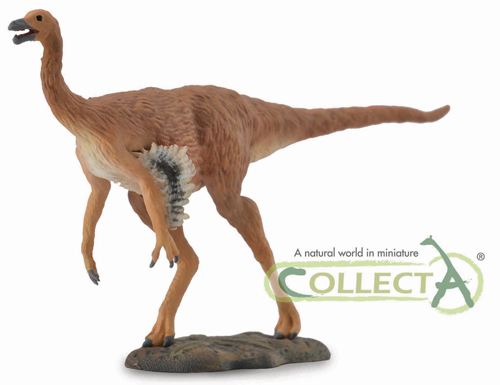
A Model of an Ornithomimid Dinosaur (Struthiomimus)

CollectA Struthiomimus dinosaur model.

A Struthiomimus dinosaur model, part of the CollectA Age of Dinosaurs Popular range.

The model shown above is a CollectA Age of Dinosaurs Popular Struthiomimus replica, to view CollectA prehistoric animal models: CollectA Ornithomimid and Other Theropod Figures.

A spokesperson for Everything Dinosaur commented about these tracks that hint at dinosaurs from polar regions:

“‘These trackways are certainly an exciting discovery and indicate that fleet-footed theropods were living in the polar regions.  However, it is impossible to tell whether these animals were residents or seasonal migrants.  Finding such trace fossils so far south adds support to the theory that these theropods may have been feathered to help insulate them and keep them warm.  This in turn suggests that these dinosaurs may have been warm-blooded.”

The report of the footprints was published on line in the journal of Australian palaeontology “Alcheringa”.

29 07, 2011

Rare Low Tide Reveals Triassic Marine Reptile

By |2024-04-22T12:26:39+01:00July 29th, 2011|Categories: Dinosaur and Prehistoric Animal News Stories, Main Page, Palaeontological articles|0 Comments

Marine Reptile Fossil Exposed at Low Tide

It is an apt location to find the fossilised remains of a 220-million-year-old marine reptile, in the inter-tidal zone of a rock strewn beach  After all, marine reptiles were very much at home in the sea, although many types did return to the land to lay eggs, to bask in the sun and so forth.  However, for one team of dedicated researchers having to extract what could be the best preserved fossil of a thalattosaur ever found in North America meant a tricky job with time and tides against them.

Marine Reptile Fossil

Thalattosaurs were a group of diapsid, marine reptiles known from Middle and Upper Triassic aged strata. These animals superficially resembled monitor lizards, but they were not closely related to modern lizards (Order Squamata).  Their fossilised remains have been found all over the world – North America, Europe and China, a number of families have been identified although their taxonomic relationship to other marine reptiles such as the ichthyosaurs remains uncertain.

Some of thalattosaurs (the name means “ocean lizards”) grew to lengths in excess of 4 metres.  Finding an almost complete fossil skeleton of such a creature is an extremely rare event.

Scientists believe that the thalattosaurs evolved from terrestrial reptiles, but adapted to an aquatic life style.  Gradually the skulls become longer and the chests deeper as these creatures evolved.

Working in very difficult conditions, Ken Olson (Museum of the Rockies) realised that he and his colleagues would need some more expert help if fossils of rare marine reptiles were to be recovered from the intertidal zone.  He turned to Patrick Druckenmiller, (Earth Sciences Curator at the University of Alaska Museum of the North), who had recently been involved in a project to excavate plesiosaur fossils in Norway.

In May of this year, an intriguing vertebrate fossil had been noticed partly exposed out of rock, but to excavate this specimen would be difficult due to the fact that for most of the time the fossil was covered in sea water, the site only being exposed at very low tides.

Tongass National Forest geologist Jim Baichtal immediately sent photographs to University of Alaska Museum of the North Earth Sciences Curator Patrick, who went through the process of eliminating what it could be:

Patrick stated:

“We know the rocks are about 220 million years old.  Based on the age of the rocks and what I could see in the picture, I was 99 percent sure that’s what it was.

Triassic Fossil

Druckenmiller and his museum colleague, Kevin May, travelled to the site in mid-June to collect the specimen from the semi-exposed outcrop near the small Alaskan town of Kake. The location lies in the intertidal zone, the tide problem meant they needed to excavate during a two-day window and would only have four hours each day, when the tide was at its lowest, (Spring tide) to retrieve the fossil.

If they missed their chance, the outcrop wouldn’t be exposed again until October (the next period of extremely low tides at which the fossil would be exposed again).

The team used rock saws to hack a series of steps down to the layer of rock surrounding the fossil.  On the first day, they were able to complete the excavation just five minutes before the site was submerged.  Druckenmiller spotted more bone penetrating the rock, so the team removed an even larger section on the second day, hoping it would contain the rest of the skeleton.

Druckenmiller added:

“We couldn’t see anything that day, we thought, ‘it’s probably here and the animal is probably this long, so we’ll take out a slab about that big.”

The two slabs of rock, weighing over 200 kilogrammes between them were transported by boat to Thorne Bay, from there, they went onto to the fossil preparation laboratory at the museum.  It will take many months to reveal the rest of the skeleton but the researchers are optimistic that they have recovered an large portion of the fossil, including skull material.

Patrick went on to state:

“It’s reasonably complete and once we reveal more of the skeleton, we will be able to compare it to other thalattosaurs to see if it is a new species.”

Even if it is a known species, it will be one of the best specimens ever found in North America and possibly anywhere else in the world.  The thalattosaur is currently one of Alaska’s most compete fossil vertebrates.

After the specimen has been prepared and formally studied and the results published, the fossil will be available for display at the museum.

For models and replicas of prehistoric animals including marine reptile figures: Marine Reptiles and Prehistoric Animal Replicas.

6 07, 2011

Natural History Museum of Los Angeles County Ready for Special Grand Opening Event

By |2024-04-22T12:23:50+01:00July 6th, 2011|Categories: Dinosaur and Prehistoric Animal News Stories, Dinosaur Fans, Main Page, Palaeontological articles|0 Comments

New Permanent Dinosaur Display to Open on July 16th

Staff at the Natural History Museum of Los Angeles County (California) are busy with the final preparations for the grand opening of their new permanent dinosaur exhibition.  The new “Dino Halls”, part of a multi-million dollar refurbishment and development programme at the Museum are being opened on Saturday 16th July.

The all-new, 14,000-square-foot Dinosaur Hall, marks the halfway point of the Museum’s seven-year transformation.  Twice the size of the Museum’s old dinosaur galleries, the new permanent exhibition will feature over 300 fossils and 20 complete mounts of dinosaurs and sea creatures.

The hall will rival the world’s leading dinosaur halls for the number of individual fossils displayed, the size and spectacular character of the major mounts, including the world’s only Tyrannosaurus rex growth series, (tyrannosaurs depicted in a family group, that will get Professor Phil Currie and his colleagues very excited no doubt), and the accessible integration of recent scientific discoveries and research into the displays.

We at Everything Dinosaur, have followed the progress of the building work with great interest, to read an earlier article on the refurbishment of the museum: New Ways to Display Your Dinosaurs – Museums for the 21st Century.

In the new, spacious, light-filled galleries, visitors come face-to-face, and in some cases can walk underneath, huge prehistoric skeletons, as well as see the dinosaurs as they were in life, illustrated on giant murals and animated in hands-on interactive and multi-media displays. It is great to hear about such innovative ways in which museum specimens can be shown to the public, we recall the excitement we all felt when we walked into the American Museum of Natural History (New York) for the first time and saw their spectacular mount of the Barosaurus mother and baby fending off an attack from two Allosaurus – simply astonishing.

In addition to views on this grand scale, visitors can also get a very detailed, close-up look at fossils at this Los Angeles County based museum, they can touch several, look at many through magnifying glasses as a scientist would, and in the interactive displays, excavate from simulated dirt and rock as palaeontologists would.

Throughout the exhibition, visitors will encounter science not as static information, but as a vibrant, ongoing investigation into dinosaur mysteries, some resolved, and some still being explored.  They will learn that the investigations are still taking place today, reinforcing the fact that discovery is not just something that happened in the past; it is work that is happening now, all around us.

Natural History Museum

In the press release we were kindly sent, an image is incorrectly labelled as a Corythosaurus, we don’t think this is so and we have asked the Dinosaur Institute to clarify (we will keep you posted on this).

Dr Jane Pisano, the Museum’s President and Director commented:

“The new Dinosaur Hall is an exciting realisation of the goal of our institution-wide transformation, which is to bring the Museum’s research and collections vividly to life for a public that is hungry for the real thing, an encounter with authentic fossils and with the genuine, fascinating process of scientific exploration.  This exhibition will emerge as one of the great dinosaur experiences in the world, and a major reason why NHM (Natural History Museum of Los Angeles County) is one of America’s leading natural history museums.”

Remarkable Specimen

To provide insight into how scientists puzzle out answers to questions about dinosaurs, to reveal the stories behind these astonishing specimens, the exhibition draws from the ambitious discovery and research programmes of the NHM’s in-house Dinosaur Institute (DI), directed by world-renowned palaeontologist and exhibition lead curator, Dr Luis Chiappe.  The DI’s field research programme has located key specimens all over the world, from the dinosaur-rich “Badlands” of the American West to remote parts of South America and Asia.

The centrepiece of the exhibition is the T. rex growth series, containing an extraordinary fossil trio of the youngest known baby, a rare juvenile, and a recently-discovered young adult, one of the ten most complete T. rex specimens in the world.

The Dinosaur Hall’s other standout exhibits include an imposing new Triceratops; the armour-backed Stegosaurus; the predator Allosaurus; a 68-foot, long-necked Mamenchisaurus; and giant marine reptiles that swam in the oceans covering what is today California.  Two-thirds of the full fossil skeletons have never been displayed before.  Specimens that were previously seen have all been re-articulated into more dynamic new poses based on recent scientific findings.

Dr Chiappe, outlining his aspirations for the new “Dino Halls” stated:

“We hope to inspire new generations of scientists, since this exhibition highlights the experience of going outdoors and finding treasures, and then understanding how they fit within the current scientific record.  Most dinosaur exhibitions are organised around specific types of dinosaurs or by periods of time.  Our approach is to use new discoveries and research findings to bring visitors into the world of dinosaurs, exploring the great questions of how they lived, behaved, and died, and whether they still exist.”

A Remarkable Experience

For those people not lucky enough to visit this museum over the opening weekend, here is a quick guide to the extensive exhibits on display at these newly refurbished galleries as provided by the Natural History Museum of Los Angeles County to staff members at Everything Dinosaur.

The Dinosaur Hall extends through two conjoining two-story galleries.  One is a part of the recently restored 1913 Building (the Beaux-Arts structure that was the Museum’s original home).  The second belongs to the newer 1920s building, which has been seismically renovated and outfitted with floor-to-ceiling windows that give passers by in Exposition Park a peek at the giants inside.

One of the exhibit goals was to bring visitors closer than ever to the real specimens,85 percent of the exhibition’s fossils are the real thing, not casts or reconstructions, and remove barriers whenever possible.  To accomplish this, the major fossil skeletons were placed on special platforms that allow the fossils to be shown without glass barriers, and to pass directly underneath a dinosaur neck and stand under a T. rex skull.

This is a key to the exhibition’s visitor experience, as many of these fossils were prepared and articulated in recent years, using modern methods that forgo the thick layers of shellac used by palaeontological conservators of decades past.  Never-before-seen details of the fossils are revealed. Some specimens have rich red and green hues, coloured by the minerals in the lands where they were found.  Some contain visible traces of skin textures, respiratory systems, and in one instance, the stomach contents of a last meal.

The Dinosaur Hall is organised around a series of questions: What is a dinosaur?  What was their world like?  How did they live, grow and behave?  And finally, what happened to them?  Such a layout is indeed innovative and will permit the curators to continually update the exhibits in the light of new scientific research.

A quick walk through the exhibit reveals these main ideas, as they appear on large, colourful mural illustrations.  For visitors who crave more background, context, and stories of discovery, multi-layered content is available for readers in text and in touchscreen kiosks, and for young non-readers, in simple mechanical, manual games.

Upstairs on the mezzanine are displays about the lab and field aspects of palaeontology.  These are hands-on experiences, with touchable specimens, magnifying glasses, and a look at the tools and tricks of dinosaur research, from a camping supply list for a fossil hunting expedition, to Dr Chiappe’s hand-written field journals.

Gallery One

As visitors enter the exhibition’s first gallery, they are immediately greeted by a magnificent, never-before displayed Triceratops, mounted on a contoured platform with details of the new research that has re-interpreted, via the animal’s forelimb, how this huge creature walked in life.  Forelimbs of Triceratops in the fossil record are extremely rare, we think that this was one of the “choicest cuts” and as they were eminently portable, at least to an adult Tyrannosaurus rex most carcases lost their forelimbs so they had little chance of being preserved in the fossil record.

Images show the fantastic views visitors can get of the museum specimens.  The state-of-the-art supporting armature, permits this Triceratops to be posed in such a way that visitors can look right into the fossilised skeleton, revealing details not seen by members of the public before – terrific!

Framing the gallery is a 40-foot “fossil wall” showcasing 100 diverse dinosaur specimens, an artful take on traditional palaeontological display, with bones, teeth, eggs, footprints, skin patches, and coprolites (fossilised droppings). Two touch-screen kiosks work as virtual indexes here, allowing visitors to explore what each bone is, and in some cases, turning them around 360 degrees on the screen.

The exhibition’s largest specimen, a 68-foot Mamenchisaurus, stands in front of the gallery’s large central windows with its long neck and tail sprawling throughout the gallery.  This is one of the exhibit’s few casts, most other mounts include real fossils.  We suspect that posing such an impressive beast using the real fossils would have been a health and safety nightmare – so for once a replica fossil specimen is used.

Suspended from the ceiling overhead, and also viewable from the gallery’s new mezzanine, are marine reptiles that lived in the warm sea that once covered California.  Here, visitors will come face to face with the exhibit’s marine monsters.

The mosasaur Plotosaurus and the plesiosaur Morenosaurus are both cantilevered over the main floor in a breath-taking, gravity-defying scene.  In some cases, large fossil plaques show animals still encased in dirt and rock, a display method that offers staggering glimpses of prehistory.  There is a mosasaur plaque, for instance, that reveals traces of a partial body outline, skin colour markings, external scales, a down-turned tail, branching bronchial tubes, and evidence of the animal’s last meal 85 million years ago – fish.

At the end of Gallery One, visitors will get an insight into the field experiences and work done by the Dinosaur Institute expedition teams, led by Chiappe.  On five television screens, video from a recent field expeditions in Utah shows the often gruelling conditions and exciting moments of discovery that characterise Dinosaur Institute excursions.  Nearby, a specimen is displayed, in the plaster “jacket” with which it was transported out of the quarry it was found in.

Gallery Two – Tyrannosaur Growth Series

The show-stopping centrepiece in this gallery is the platform featuring a very special trio: the young adult Tyrannosaurus rex nicknamed Thomas after the discoverer’s brother (34 feet, and approximately 17 years old) joined by a 20-foot juvenile (approximately 14 years old) and an 11-foot baby (2 years old).  The growth series is a fascinating look at the ways that T. rex specimens grew, a process that included incredible growth spurts and body changes.  After hatching as a 2-foot, 6-pound baby, for example, a T. rex could reach 30 to 35 feet (10,000 to 12,000 pounds) in less than two decades – if it was lucky.

But the growth series is also a snapshot of dinosaur life; the terrain on which they are mounted finds Thomas and the baby standing on one side, while the juvenile lurches toward the carcass of a duck-billed Edmontosaurus.  Though nearby content is careful to point out that theories about a long-extinct animal’s behaviour are just that, the scene intends to raise questions about the behaviour of the T. rex.  A nod perhaps towards Professor Phil Currie and his fellow researchers at the University of Alberta and the IVPP (Beijing) who have recently re-inflated the debate about pack behaviour in large theropods.

In another panel, the mystery of how and when the large dinosaurs died out is introduced, with evidence for a mass extinction event at the end of the Mesozoic.  This section also highlights the evolutionary connection between dinosaurs and birds, providing compelling evidence about why the latter should be considered living dinosaurs.

The second level of the exhibition takes a closer look at the science behind these specimens, from how we know where to look for specimens to the work we do in palaeontology labs.  One area focuses on field work and the surprising data that a quarry can reveal in addition to its fossil treasures and examples of excavation methods (which, unlike lab work, have not changed drastically over the last several decades).  Multi-media interactive kiosks allows visitors to “excavate” specimens and investigate the finds.  The companion area focuses on laboratory discoveries, research tools that have evolved to include high-tech microscopes, CT scans, and genome studies.

This is a project five years in the making with hundreds of contributors.  Inside NHM, the Dinosaur Hall was supervised by Dr Karen Wise, VP of Education and Exhibits.  Dr Chiappe was its lead curator; Jennifer Morgan was its project manager.

The exhibition was designed by Brooklyn-based Evidence Design, with graphics from Los Angeles’ Kim Baer Design Associates (KBDA).  Lexington was the fabricator, and New York-based United Field created its multi-media assets.  Two of North America’s finest fossil mount makers worked on the exhibition. Phil Fraley Productions, the company that headed the articulation of Sue, the iconic T. rex of Chicago’s Field Museum of Natural History; undertook the T. rex specimens, the giant marine reptiles, and the Triceratops.  The Ontario, Canada-based Research Casting International remounted the exhibition’s largest specimen, the 68-foot Mamenchisaurus and six additional medium-sized mounts.

The seismic retrofit and historic renovation of the Dinosaur Hall galleries was led by CO Architects Principal, Jorge de la Cal, and Cordell Corporation President, Don Webb, with Matt Construction.  We at Everything Dinosaur would like to congratulate all those people who have been involved in the project and one day, perhaps, some of our team members will get the chance to visit such an exciting museum – if only our busy schedules (and our budget) will allow.

For models ane replicas of Tyrannosaurus rex and other dinosaurs (no need to worry about a budget): Natural History Museum Dinosaur Models.

3 07, 2011

New Jersey Mine Could Provide Vital Evidence Regarding Dinosaur Extinction

By |2023-03-08T08:18:48+00:00July 3rd, 2011|Categories: Dinosaur and Prehistoric Animal News Stories, Main Page, Palaeontological articles|0 Comments

New Jersey Mine Could Show Exact Moment of Cretaceous Mass Extinction Event

A team of researchers are busily exploring a fifteen-metre-deep hole in New Jersey in a bid to find the exact moment when the Mesozoic ended and the Cenozoic began.  The site, part of a greensand mine is one of the last locations on the eastern seaboard of the United States where Cretaceous strata can be studied,  The scientists are in a race against time as the site is due to be developed and to disappear under concrete as new houses are built.

The Mesozoic

Palaeontologist Kenneth Lacovara is one of the research team members looking deep into the mine with a view to pinpointing for the exact moment, 66 million years ago, when all dinosaurs, marine reptiles and Pterosaurs perished. That secret could be harder to uncover if the fossil material at this location can no longer be unearthed after a housing and retail development is built on this open cast pit.

Lacovara, an associate professor of biology at Drexel University in Philadelphia, looks at this 40-foot plus deep hole at the end of a dirt road and sees a line in the sand where the Cretaceous period ends. Below that line are dinosaurs, above it, not a single fossil bone belonging to a dinosaur can be found.

He thinks that the creatures his team has been uncovering here all died en masse when an extra-terrestrial body struck the Earth and changed the course of the history of life on our planet. If his theory proves correct, it would be the only burial ground of its kind and provide scientists with a living laboratory to study how the dinosaurs and their cousins the marine reptiles and pterosaurs became extinct.

New Jersey as a state has a special place in the hearts of American palaeontologists.  The first nearly complete dinosaur skeleton ever discovered was a Hadrosaurus (H foulkii) found in Haddonfield (New Jersey) in 1858.   This dinosaur was named and described by the famous American anatomist Joseph Leidy.  But over the years, the numerous silt mines that made for great dinosaur digging were replaced with housing developments and shopping malls.

Today, this site in a southwestern corner of the state is the only remaining mine for greensand, a silt used for fertiliser and water softener.  It’s also the only access to the Late Cretaceous Period on the entire eastern seaboard of the United States.

Commenting on the importance of this fossil location Lacovara stated:

“This site is the last existing window into the ancient Cretaceous period in the eastern half of the United States. It’s extraordinary.”

But the township of Mantua, a community of 15,000 people, has other plans for the site.  Township officials would like to see the mine closed and a retail and lower cost housing development built in its place.  A developer has drawn up plans that include shops and affordable housing.  The fate of this location will be decided at a municipal meeting scheduled for July 15th

Inversand, the mine’s owner, has been operating the site since 1926, digging greensand.  For years, the company has had a close relationship with palaeontologists, alerting them when they came across large fossils.

Inversand President Alan Davies commented:

“If we find something beyond the routine shark tooth or clam, we call them up.”

The biggest find he recalls happened in the 1960s, when workers came across the skull of a Mosasaurus, a giant marine reptile, that now resides at the New Jersey State Museum in Trenton.  Mining for greensand is no longer economically viable for Inversand and the company would like to end operations.  If the mine were to shut down and the pump that continuously clears groundwater out of the area were to turn off, the hole would completely fill with water in a matter of weeks, transforming it into a lake. Davis says the mine could shut within three years.

Only a Few Locations in the World Have the Geology to Highlight the End of the Mesozoic

The Mesozoic landscape.

A warm and humid Earth back in the early Mesozoic. Picture credit: Everything Dinosaur.

Picture credit: Everything Dinosaur

Facing a looming deadline, Lacovara and his team have stepped up their efforts to dig, applying for grants and enlisting students and amateur palaeontologists to shovel the grey, muddy sand for pieces of natural history.

The scientists worry that without this pit, they’ll lose a historic treasure trove.  We at Everything Dinosaur, hope that a solution can be found and at least some part of the site can be kept as open access to palaeontologists to allow them to continue their studies.

For models and replicas of North American, Late Cretaeous dinosaurs and other prehistoric animals: Wild Safari Prehistoric World Figures.

1 07, 2011

Taking the Bio-Synthetic Pathway – On the Road to Identifying the Colour or Extinct Animals Thanks to New Research

By |2024-04-22T09:54:32+01:00July 1st, 2011|Categories: Dinosaur and Prehistoric Animal News Stories, Dinosaur Fans, Main Page, Palaeontological articles|0 Comments

Manchester University Leads the Way in Determining the Colouration of Extinct Animals

Powerful X-rays are helping scientists to determine trace element composition of fossils, these in turn are helping researchers to work out what colour long extinct animals were.  The technique applied to an Early Cretaceous bird as well as fossil fish and invertebrates in this study, has implications for all fossilised animals including dinosaurs.  Determining what colours T. rex and Triceratops were may not be long away.  We might be close to working out the colour of dinosaurs.

Published in a Journal

Publishing their findings in Science, the researchers have been able to show a remarkable relationship between copper and pigment within exceptionally preserved feathers and other soft tissues.

Results include important species such as the oldest beaked bird yet found, the 120-million-year-old Confuciusornis sanctus, and also the 110-million-year-old Gansus yumenensis, which looks similar to the modern Grebe and represents the oldest example of modern birds.

Pigment is a critical component of colour.  The team can map the presence of pigments over whole fossils, revealing original patterns.  The team’s findings indicate that pigment chemistry holds the future key to the ultimate goal of discovering the colour palette of past life, from dodos to dinosaurs and beyond.

Colour has played a key role in the processes of evolution by natural selection that have steered all life on Earth for hundreds of millions of years.  This unique scientific breakthrough can allow palaeontologists to reconstruct colour patterns in extinct animals, as well as provide an understanding of the way in which biological compounds are preserved in specific environments over deep time.

This could give them a far greater understanding of the feeding habits and environments occupied by extinct creatures, as well as shedding light on the evolution of colour pigments in modern species.

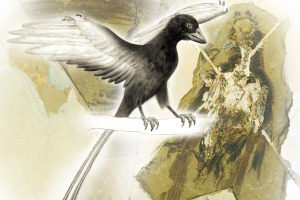
Confuciusornis sanctus Synchrontron Imaging Reveals its Colouration

Confuciusornis sanctus. Pigmentation in extinct animals.

Confuciusornis sanctus a primitive bird but it had a beak.

Picture credit: University of Manchester

The imaging technology has revealed that ancient birds like C. sanctus had dark heads and necks with paler feathers on the wings.

The X-ray team, led by Dr Roy Wogelius, Dr Phil Manning and Dr Uwe Bergmann, took the unique approach of using the synchrotron to analyse the soft tissue regions of fossil organisms.  The application of X-ray physics to palaeontology has shed new light on the tangled tale of prehistoric pigments in deep time and how to recognise its chemistry in fossils that are hundreds of millions years old.

Dr Wogelius, lead author on the paper and University of Manchester geochemist, said:

“Every once in a while we are lucky enough to discover something new, something that nobody has ever seen before.   For me, learning that copper can be mapped to reveal astonishing details about colour in animals that are over 100 million years old is simply amazing.  But even more amazing is to realise that such biological pigments, which we still manufacture within our own bodies, can now be studied throughout the fossil record, probably back much further than the 120 million years we show in this publication.”

To unlock the stunning colour patterns, the Manchester researchers teamed up with scientists at SLAC National Accelerator Laboratory (USA) and used the Stanford Synchrotron Radiation Lightsource to bathe fossils in intense synchrotron X-rays.   The interaction of these X-rays with the chemistry of each fossil allowed the team to recognise the chemistry of eumelanin, the molecule that provides the dark coloured pigmentation, in feathers from some of the most pivotal species of dino-birds and even pigment from within the eye of a 50-million-year-old fish.

Extinct Animals

The key to their work was identifying and imaging trace metals incorporated by ancient and living organisms into their soft tissues, in the same way that all living species do today, including humans.

Without essential trace metals, key biological processes in life would fail and animals either become sick or die.  It is these essential trace metals that the team has pinned down for the first time.

Dr Phil Manning, a senior author on the paper and University of Manchester palaeontologist, added:

”The fossils we excavate have vast potential to unlock many secrets on the original organism’s life, death and subsequent events impacting its preservation before and after burial.  To unpick the complicated chemical archive that fossils represent requires a multidisciplinary team that can bring in to focus many areas of science.  In doing this, we unlock much more than just palaeontological information, we now have a chemical roadmap to track similar pigments in all life.”

Results show that chemical remnants of pigments may survive even after the melanosome (biological paint pots) containing pigment has been destroyed.  Some of the samples they publish clearly preserve a chemical fossil, where almost all structure has been lost in the sands of time.  The chemical residue can be mapped to reveal details of the distribution of dark pigment (eumelanin), probably the most important pigment in the animal kingdom.

This pigment gives dark shading to human hair, reptile skin, and bird feathers.  Using rapid scan X-ray fluorescence imaging, a technique recently developed at SLAC, the team was able to map the residue of dark pigment over the entire surface of a large fossil, for the first time giving clear information about fundamental colour patterning in extinct animals.  It turns out that the presence of copper and other metals derived from the original pigment gives a non-biodegradeable record of colour that can last over deep geological time.

Dr Uwe Bergmann, SLAC physicist and co-author on the paper stated:

“Synchrotron radiation has been successfully applied for many years to many problems.  It is very exciting to see that it is now starting to have an impact in palaeontology, in a way that may have important implications in many other disciplines.  To work in a team of such diverse experts is a privilege and incredibly stimulating.  This is what science is all about.”

Using this novel method to accurately and non-destructively measure the accumulation of trace metals in soft tissues and bone, the team also studied the chemistry of living species, including birds.

Dr Wogelius added:

“This advance in chemical mapping will help us to understand modern animals as well as fossils.  We may also be able to use this research to improve our ability to sequester toxic materials such as radioactive waste and to devise new strategies for stabilising man-made organic compounds”.

For models and replicas of prehistoric animals and extinct creatures: PNSO Age of Dinosaurs Models.

29 06, 2011

Head Butting “Bone heads” New Evidence Strikes a Blow for the Pachycephalosaurs

By |2023-03-08T08:24:12+00:00June 29th, 2011|Categories: Dinosaur and Prehistoric Animal News Stories, Main Page, Palaeontological articles|0 Comments

New Study Suggest Pachycephalosaurs may have Clashed Heads After All

The pachycephalosaurs (the name means “thick-headed lizards”) are often referred to as the “Bone-heads” as the most striking feature about these bird-hipped dinosaurs was their incredibly thick skulls, which in many cases were adorned with bony nodules.  Related to the ceratopsians, scientists believe that these bipeds evolved in the Early Cretaceous and survived up to the very end of the Age of Reptiles.

Pachycephalosaurs

Most of what we know about this particular group of dinosaurs comes from skull material as many genera have been named and described on the basis of the discovery of skull bones.  This is in stark contrast to other types of dinosaur, the sauropods for example, where bones relating to the head are exceptionally rare.  The thickened skulls with their solid bone domes had excellent fossil preservation potential.  Such thick bones could withstand the stresses of the fossilisation process.

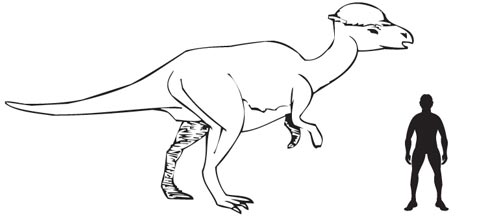
Perhaps the most famous of the pachycephalosaurids is Pachycephalosaurus wyomingensis, (from which this group of dinosaurs was named).  P. wyomingensis is known from just skull material but it has been estimated to have reached lengths in excess of 8 metres, making it the largest pachycephalosaur dinosaur discovered to date.

An Illustration of Pachycephalosaurus (P. wyomingensis)

Picture credit: Everything Dinosaur

To read more about Pachycephalosaurus: Pachycephalosaurus – The “Bone-headed” Dinosaur.

Why did these dinosaurs have such thick skulls?  It was not to protect a particularly large brain, these dinosaurs had brains no bigger than any other comparable sized ornithischian, perhaps these animals evolved well-protected heads as they engaged in head-butting contests just like some sheep and antelope do today.  The ideas of pachycephalosaurs indulging in such behaviour was first put forward by the American palaeontologist Ed Colbert in 1954.

Debating the Theory

This theory has been debated ever since.  Perhaps the most famous challenge to the theory of intra-specific conflict amongst pachycephalosaurs came in 2004 when the head-butting activities of these dinosaurs was examined by two American researchers, Mark Goodwin and John “Jack” Horner.  These researchers discovered that the radiating bone structure that was thought to provide strength to the dome of the skull was only present in juvenile specimens, and not in mature adults.  It was assumed, just like in extant animals the adults would have indulged in any head-butting, not young dinosaurs.

However, new research from the University of Calgary published in the online scientific journal “PloS One” suggests that these Cretaceous dinosaurs may indeed have used their thick heads for head butting contests.  The Canadian based research team compared the fossilised skulls of two types of pachycephalosaur with the skulls of modern herbivores some of which were known to be “head-bangers”.

Bio-mechanical Studies

They concluded that previous bio-mechanical studies may have suggested that these dinosaurs butted heads, but this had been challenged by studies on how the skull bones grew and developed as the animals matured.  However, new computer analysis and modelling using advanced statistical methodologies do support the theory first put forward by Colbert, back in 1954 – that the skulls of these dinosaurs could have withstood the impact from a clash of heads.  These dinosaurs could have been head-butters after all.

The two pachycephalosaurs involved in the study were Stegoceras validum and Prenocephale prenes.  The fossil skulls of these two dinosaurs were compared to ten skulls of artiodactyls (even-toed ungulates), known to indulge in various forms of intra-specific combat including head butting.  The team found that the bony anatomy of some pachycephalosaur domes are better at protecting the brain than in any modern head-butter.

Co-author Dr Eric Snively commented:

“Pachycephalosaur domes are weird structures not exactly like anything in modern animals. We wanted to test the controversial idea that the domes were good for head-butting.  Finding out brings us closer to their social lives: were pachycephalosaurs more likely just showing off their domes like peacocks with their tails, or were they also cracking their heads together like musk oxen?”

Using CT scanning and the new statistical method for diagnosing behaviour in fossil animals, the researchers compared the bony-headed dinosaurs with modern ungulates (hoofed animals) that engage in different kinds of combat.

Dr Snively stated:

“Our analyses are the closest we can get to observing their behaviour.  In a way, we can get inside their heads by colliding them together virtually.  We combined anatomical and engineering analyses of all these animals for a pretty thorough approach.  We looked at the actual tissue types in the skulls and heads of the animals.”

Co-author and fellow researcher Dr Jessica Theodor (Associate Professor in the Biological Sciences Dept. at the University of Calgary said:

“Head-butting is a form of male-to-male competition for access to females.  It’s pretty clear that although the bones are arranged differently in the Stegoceras, it could easily withstand the kinds of forces that have been measured for the living animals that engage in head-butting.”

Studying the Skulls

Describing the skulls of animals known to crack heads as “like a good motorcycle helmet”, the team stated that the skull of a typical head-butter was hard on the outside with a sort of spongy impact absorbing material just beneath the outer surface and then a stiff, really dense coat of hardened material to protect the brain.

Images show sections through the skulls of the dinosaur Stegoceras validum, the small African antelope known as a Duiker (Cephalophus leucogaster), regarded as morphologically close to this type of pachycephalosaur and a Bighorn sheep (Ovis canadensis).

The CT scans reveal similar dome structure. A. In the Stegoceras specimen, compact bone (z1 and z3: zones 1 and 3), occurs deep and superficial to a cancellous region (z2: zone 2:). Moderately dense compact bone shows as a green band at the base of zone 3 (white line); note cancellous bone (blue) above the line in the anterior portion of this zone. B. Cephalophus. C. Similar stratification is evident in the sectioned Ovis cranium, with nearly identical zones of cancellous and compact bone broken by a ventral sinus.

The Stegoceras had an extra layer of dense bone in the middle.  Stegoceras was a small pachycephalosaur approximately three metres long, that lived in north America during the Late Cretaceous.

The researchers concluded that Llamas would crack their skulls if they indulged in head-butting.  Giraffes would not be very good at head-banging contests – their skulls could not withstand the force of too many collisions.  Musk ox and Big Horn Sheep have the sort of adaptations to help them cope with bouts of head-butting.  In this way they have similar skulls to Stegoceras, so this could be evidence to support head-banging pachycephalosaurs.

Perhaps, Colbert was onto something after all.

To view models and replicas of pachycephalosaurs and other dinosaurs: Papo Dinosaur and Prehistoric Animal Models.

20 06, 2011

American Scientists Provide Evidence of “Warm-Blooded” Dinosaurs in New Research

By |2024-04-19T06:16:51+01:00June 20th, 2011|Categories: Dinosaur and Prehistoric Animal News Stories, Dinosaur Fans, Main Page, Palaeontological articles|0 Comments

Analysis of Teeth Provides Indication of “Warm-Blooded” Dinosaurs

Researchers at the California Institute of Technology have been utilising an isotope analysis technique that they have developed to examine the body temperatures of extinct vertebrates and they have come up with some interesting data relating to sauropods (long-necked dinosaurs).  New research into “warm-blooded” dinosaurs.

The debate on whether the Dinosauria were endothermic (warm-blooded) or ectothermic (cold-blooded) has raged since the middle of the 19th century, but many scientists have now concluded that a number of dinosaur families were active animals and not the ponderous animals envisaged by academics in the last Century and earlier.  The science of palaeontology has certainly come along way since the time of Owen, Mantell, Seeley et al, alvarezsaurids, ornithomimids, oviraptorosaurids are now all thought to be warm-blooded dinosaurs.  However, to find evidence of endothermy in sauropods, those huge lumbering lizard-hipped dinosaurs is quite remarkable.

“Warm-blooded” Dinosaurs

In a new paper, published by researchers at the California Institute of Technology (Caltech), scientists claim that isotope analysis using fossilised teeth from sauropods provides evidence that these long-necked giants had internal body temperatures as high as modern birds and on a par with our own species and most other mammals.  This new approach to taking a dinosaur’s temperature provides evidence that even the largest dinosaurs may have been endothermic.

Sauropods were plant-eating dinosaurs with small heads, long necks and tails and massive bodies supported by trunk-like legs.  They evolved in the Late Triassic and survived until the very end of the Cretaceous.  Well know sauropods include Apatosaurus (formerly known as Brontosaurus), Diplodocus and Brachiosaurus.

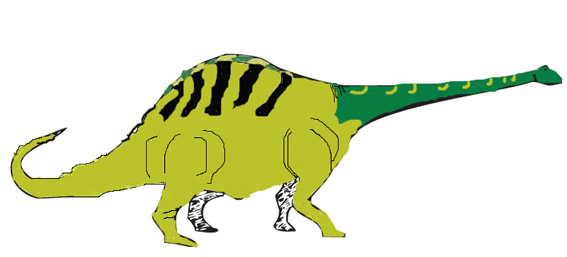
An Illustration of Apatosaurus (Sauropod)

Picture credit: Everything Dinosaur

Robert Eagle, a postdoctoral scholar at Caltech and lead author on the scientific paper commented:

“This is like being able to stick a thermometer in an animal that has been extinct for 150 million years.”

Co-author John Eiler, the Robert P. Sharp Professor of Geology and Professor of Geochemistry stated:

“The consensus was that no one would ever measure dinosaur body temperatures, that it’s impossible to do.”

Yet, using a technique pioneered in Eiler’s laboratory, the team did just that.

The researchers analysed eleven teeth, dug up in Tanzania, Wyoming, and Oklahoma, that belonged to Brachiosaurus (possibly a Giraffatitan) and Camarasaurus. These animals lived during the Late Jurassic.  The team found that the Brachiosaurus had a temperature of about 38.2 degrees Celsius (100.8 degrees Fahrenheit) and the Camarasaurus had one of about 35.7 degrees Celsius (96.3 degrees Fahrenheit), warmer than modern and extinct crocodiles and alligators but cooler than birds. The measurements are accurate to within one or two degrees, Celsius, the researchers claim.  The normal human body temperature is around 98.4 degrees Fahrenheit, putting these dinosaurs definitely in the endothermic group.

Eagle said:

“Nobody has used this approach to look at dinosaur body temperatures before, so our study provides a completely different angle on the long-standing debate about dinosaur physiology.”

The fact that the temperatures were similar to those of most modern mammals might seem to imply that dinosaurs had a warm-blooded metabolism.  But, the researchers say, the issue is more complex.  Because large sauropod dinosaurs were so huge, they could retain their body heat much more efficiently than smaller mammals like us humans.

John Eiler explained the physics of volume versus surface area in terms of its impact on thermal regulation stating:

“If you’re an animal that you can approximate as a sphere of meat the size of a room, you can’t be cold unless you’re dead.  So even if dinosaurs were “cold blooded” in the sense that they depended on their environments for heat, they would still have warm body temperatures.”

Another author of this study, Assistant Professor at the UCLA and visiting researcher in Geochemistry at Caltech, Aradhna Tripati stated:

“The body temperatures we’ve estimated now provide a key piece of data that any model of dinosaur physiology has to be able to explain.  As a result, the data can help scientists test physiological models to explain how these organisms lived.”

The measured temperatures are lower than what’s predicted by some models of body temperatures, suggesting there is something missing in scientists’ understanding of dinosaur physiology.  These models imply dinosaurs were so-called gigantotherms, that they maintained warm temperatures by their sheer size.  To explain the lower temperatures, the researchers suggest that the dinosaurs could have had some physiological or behavioural adaptations that allowed them to avoid getting too hot.  The dinosaurs could have had lower metabolic rates to reduce the amount of internal heat, particularly as large adults.  They could also have had something like an air-sac system to dissipate heat.

There is certainly evidence for this in lizard-hipped dinosaur fossilised bones.   Alternatively, they could have dispelled heat through their long necks and tails.  These parts of their body could have acted as radiators, as indeed could the long spines, frills and spikes associated with some sauropod genera.  For example, could the extended neural spines on the fossilised vertebrae of Amargasaurus point to being supports for a thermal regulation structure.

Casting Amargasaurus and other Sauropods in a New Light

Schleich Amargasaurus dinosaur model

The Schleich Amargasaurus dinosaur model shown in lateral view. Picture credit: Everything Dinosaur.

Picture credit: Everything Dinosaur

To view replicas and models from the Schleich range: Schleich Prehistoric Animal Models and Figures.

The illustration above shows an Amargasaurus, a diplodocid could the large, spines jutting up from the backbone support a thermal regulation device such as a sail-like structure?

Previously, researchers have only been able to use indirect ways to gauge dinosaur metabolism or body temperatures.  For example, they infer dinosaur behaviour and physiology by figuring out how fast they ran based on the spacing of dinosaur tracks, studying the ratio of predators to prey in the fossil record, or measuring the growth rates of bone.  But these various lines of evidence were often in conflict.

Eiler said:

“For any position you take, you can easily find counter examples.  How an organism budgets the energy supply that it gets from food and creates and stores the energy in its muscles—there are no fossil remains for that.  So you just sort of have to make your best guess based on indirect arguments.”

But Eagle, Eiler, and their colleagues have developed a so-called clumped-isotope technique that shows that it is possible to take body temperatures of dinosaurs—and there’s no guessing involved.

Eiler went onto state:

“We’re getting at body temperature through a line of reasoning that I think is relatively bullet proof, provided you can find well-preserved samples.”

In this method, the researchers measure the concentrations of the rare isotopes carbon-13 and oxygen-18 in bioapatite, a mineral found in teeth and bone.  How often these isotopes bond with each other, or “clump”, depends on temperature.  The lower the temperature, the more carbon-13 and oxygen-18 tend to bond in bioapatite.  So measuring the clumping of these isotopes is a direct way to determine the temperature of the environment in which the mineral formed, in this case, inside the dinosaur.

Eiler explains:

“What we’re doing is special in that it’s thermodynamically based.  Thermodynamics, like the laws of gravity, is independent of setting, time, and context.”

Because thermodynamics worked the same way 150 million years ago as it does today, measuring isotope clumping is a robust technique.  Identifying the most well-preserved samples of dinosaur teeth was one of the major challenges of the analysis, the researchers say, and they used several ways to find the best samples. For example, they compared the isotopic compositions of resistant parts of teeth, the enamel, with easily altered materials, dentin and fossil bones of related animals.  Well-preserved enamel would preserve both physiologically possible temperatures and be isotopically distinct from dentin and bone.

The next step would be to take temperatures of more dinosaur samples and extend the study to other species of extinct vertebrates, the researchers say.  In particular, taking the temperature of unusually small and young dinosaurs would help test whether dinosaurs were indeed gigantotherms. Knowing the body temperatures of more dinosaurs and other extinct animals would also allow scientists to learn more about how the physiology of modern mammals and birds evolved.

This research was supported by the National Science Foundation and the German Research Foundation and this article has been prepared using a California Institute of Technology press release.

10 06, 2011

Neoproterozoic Fossils with Armour Plating

By |2023-03-07T13:45:16+00:00June 10th, 2011|Categories: Dinosaur and Prehistoric Animal News Stories, Main Page, Palaeontological articles|0 Comments

Seven Hundred Million-Year-Old Fossils Pose a Puzzle

Microscopic fossils of marine organisms that lived in the Precambrian may represent the first type of life on Earth to develop the ability to secrete their own mineral coating, perhaps as protection against predators or maybe as a floatation device to help these bizarre micro-organisms remain stable in the water column.

Precambrian Fossils

The Proterozoic Eon is the name given to the period of Earth’s history that lasted from approximately 2.5 billion years ago until the start of the Palaeozoic Eon some 550 million years ago and the Cambrian geological period.  The world was very different from today, the atmosphere was probably toxic although during this immense expanse of time photosynthetic microbes began to transform the planet releasing oxygen into the atmosphere.

The continents that we know today, were not present Earth was a very alien world indeed.  However, although for much of the Proterozoic life was entirely microscopic and single-celled, by the end of this eon large, soft-bodied organisms the ancestors of plants, fungi and animals were beginning to colonise the sea bed.

It was during the Proterozoic that perhaps the most fundamental evolutionary development for life on Earth occurred – the evolution of complex cells (eukaryotes).  The first living organisms on the planet had very simple cell structures.  These organisms, most of which consisted of just one cell, had a structure that lacked a nucleus.

Over the course of this eon, cell structures gradually become more complicated with the evolution of nuclei and a cell membrane.   Now a team of U.S. based scientists have published a paper showing evidence of phosphate biomineralisation in micro-organisms dating from more than 700 million years ago – this evidence of a biochemical relationship within organisms helps support earlier published data and helps to shed light on the diversity and early evolution of eukaryotes.

Extracting Minerals from the Environment

The ability to extract minerals from the environment and use it to build a protective shell or external skeleton can be seen in a number of Phyla today.  For example, Cnidaria (corals) create exoskeletons formed from a form of calcium (argonite), more primitive corals used calcite.  Phosphates can also be used to create an exoskeleton and it is evidence of phosphate biomineralisation discovered in micro-organism fossils from rocks found in Canada that has got the researchers all excited.

Mineralised exoskeletons appear in the fossil record in abundance at the start of the Cambrian geological period, scientists believe the evolution of a mineralised exoskeleton was a key driving force in the Cambrian faunal explosion that led to a huge diversification of animal life.  Indeed, the origins of all the Phyla alive today can be traced to this period in Earth’s history.

The micro-fossils were actually discovered four years ago by a research team working on the Fifteenmile Group of strata in Yukon Province (Canada).  However, the paper detailing the research has only just been published in the scientific journal “Geology”.

Paper Published in the Academic Paper “Geology”

Images produced by scanning electron microscopes show in high resolution to plate-like structures and tiny spikes, the microfossil (Characodictyon) is approximately 20 microns long, about the fifth of a width of a human hair.

Phoebe Cohen, a postdoctoral researcher in MIT’s department of earth, atmospheric and planetary sciences, and Francis Macdonald, an assistant professor of geology at Harvard University, removed a number of candidate rocks from the remote site on the Alaskan/Canadian border and when back in the laboratory, microscopic analysis began to reveal the well-preserved fossils with their tiny shield-like plates, some even had minute spikes and points sticking out them.

Strange Organisms

These strange organisms have been identified as being members of the Characodictyon genus, lived sometime between 717 million and 812 million years ago, a time period in which single-cell organisms thrived just before the first “Snowball Earth” event, when the planet plunged into a deep freeze and became covered in vast ice sheets.

Cohen suspects the deep freeze killed off these spiny micro-organisms as no trace of such creatures have been found in younger strata.  Using scanning electron microscopy, Cohen and Macdonald, along with collaborators at UCLA, created three-dimensional images of the fossils.  The images revealed the animal was covered in plates, each about 20 microns wide (one-fifth the width of a human hair) and arranged in a honeycomb pattern, with teeth-like spines jutting out and rimming the perimeter.

The plates had patterns similar to those on modern-day Coccolithophores — spherical, single-celled algae found in enormous blooms throughout the ocean.  These algae produce their mineralised plates within vacuoles (sacs that play a role in digestion and release of waste) and ultimately extrude the plates to the surface to form protective coverings.

X-Ray Analysis

Analysis of the plate composition by X-Rays indicates that the lattice work of the plate-like structure was composed of a number of elements, shown in the images released as organic carbon (red), calcium (purple) and phosphorus (green).

The researchers think the newly discovered organisms may have formed their spiny coats similarly as these ancient creatures also lived in a water column environment.

Exactly why such a complex biomineralisation process evolved in such a simple organism remains a mystery.

Commenting on the discovery Cohen said:

“It takes a lot of effort, energy and just sheer biomass to create these.”

The researchers speculate, that the spines and plates helped the small organisms stay afloat, sort of biomineralised, phosphate based life jackets – helping to keep these sun loving creatures stable in the water column.  Today, Coccolithophores reside in the ocean’s photic zone, which extends from the surface to just above the depth at which light can no longer reach.  Maintaining the most light efficient place in this zone allows such plankton to grow and thrive — an advantage their ancient counterparts also may have developed, the researchers say.

Neoproterozoic Fossils

Intriguingly, pointing at some pre-Snowball Earth arms race, the plates may also have served as armour, discouraging other organisms from attacking them.  If this is the case then this is further evidence for more complex food chains in the Precambrian than previously thought.

Associate professor of geological sciences at the University of California, Susannah Porter stated:

“It’s a good possibility that these fossil plates functioned in defence against predators.  This would be significant if true, for it would be some of the earliest evidence for complex food webs that consist not only of primary producers … but also organisms that actively prey on other living organisms.”

The American based research team hopes that their discovery will encourage other scientists to study strata dating from a roughly similar time in the Proterozoic to search for other evidence of complex life.  This discovery provides a unique window into the diversity of early eukaryotes – the ancestors of complex celled organisms on our planet, including humans.

Visit Everything Dinosaur’s website: Everything Dinosaur.

7 06, 2011

New Technology Shows that in Early Hominins Girls Roamed whilst Boys Stayed at Home

By |2023-03-07T13:47:04+00:00June 7th, 2011|Categories: Dinosaur and Prehistoric Animal News Stories, Main Page, Palaeontological articles|0 Comments

Ancient Hominin Females Moved from the Groups they were Born Into

A team of researchers from the Max Planck Institute for Evolutionary Anthropology (Leipzig), have utilised a new research technique involving the analysis of strontium isotopes in fossilised tooth enamel to suggest that it was the females that roamed whilst the males were stay-at-homes.

Ancient Hominins

So far ranging and residence patterns amongst early hominins have been indirectly inferred from morphology, stone tool sourcing, comparison to living primates and phylogenetic models.  An international team of researchers including Sandi Copeland, Vaughan Grimes and Michael Richards (Max Planck Institute for Evolutionary Anthropology) have now investigated landscape use in Australopithecus africanus (with fossils from sites dating between 2.8-2.0 million years ago) and Paranthropus robustus (with fossils from sites dating between 1.9-1.4 million years ago) from the Sterkfontein and Swartkrans cave sites in South Africa using strontium isotope analysis. This method helps identify the geological substrate on which an animal lived during tooth mineralisation, the paper has been published in the latest edition of the science journal “Nature”.

The researchers show that a high proportion of small, but not large, hominin teeth had non-local strontium isotope compositions.  Given the relatively high levels of sexual dimorphism in early hominins, the smaller teeth probably represent females, indicating that females were more likely than males to disperse from their natal (ie. where they were born) groups.  This is similar to the dispersal pattern found in chimpanzees, bonobos, and many human groups, but dissimilar to that of most gorillas and other primates.

Established palaeontological and archaeological techniques provide little tangible evidence for how early hominins used and moved across landscapes.  For example, home range size has been estimated based on a rough correlation with body mass, and models of early hominin dispersal have relied on behaviours common among hominoids and presumed to be present in a common ancestor.

Commenting on this Dr Copeland from the Institute’s department of Human Evolution stated:

“However, the highly uncertain nature of such reconstructions limits our understanding of early hominin ecology, biology, social structure, and evolution”.

Fossil Tooth Analysis

Copeland and colleagues have now used a geochemical proxy, strontium isotope analysis of tooth enamel, to investigate early hominin landscape use.  Strontium is ingested and incorporated in trace quantities into mammalian teeth.  First, the researchers determined strontium isotopes in plant specimens that were collected within a 50 kilometre radius of the Sterkfontein and Swartkrans caves in order to establish the background of biologically available strontium across the region.  They then sampled a series of hominin tooth crowns by employing a relatively new method for measuring strontium isotopes in teeth that is called laser ablation multicollector inductively coupled plasma mass spectrometry (LA-MC-ICP-MS).

This method is almost non-destructive as it leaves only tiny traces on the enamel surface.  The researchers found that although there is no significant difference between the proportion of non-locals in P. robustus (36 %) and A. africanus (25 %), there are significant differences between subsets of hominins defined by tooth size.

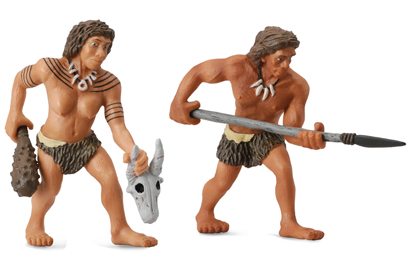
Male and Female Neanderthal Models

CollectA Neanderthal Models. Ancient hominins.

A female and a male Neanderthal model.

To view Neanderthal models and other prehistoric figures (whilst stocks last): CollectA Prehistoric Life Models.

Explaining the results of the study, which was carried out with the co-operation from scientists from other universities including the University of Colorado and Oxford University, Dr Copeland said:

“The strontium isotope data suggest differences in landscape use between males and females.  Because strontium was incorporated into the teeth before adulthood, when the hominins were probably travelling with their mothers, the data are unlikely to reflect differences in foraging areas between adult males and adult females.  Rather, the strontium isotopes probably indicate that females preferentially moved away from residential groups”.

The hominins’ female but not male dispersal pattern is similar to the one found in chimpanzees, bonobos, and many human groups, but dissimilar to that of most gorillas and other primates.  This suggests that early hominin social structure was not like that of gorillas in which one or few males dominate groups of females.

The small proportion of non-local large hominins could indicate that male australopiths had small home ranges, which would be surprising given that the evolution of bipedalism is commonly attributed to the need to move over large distances.  The results could also imply that male australopiths preferred the types of resources found on dolomite landscapes.  This study was the first to apply this method to early fossil hominins, and lays the groundwork for future studies of other fossil species, including Australopithecus and Paranthropus in East Africa, and later hominins belonging to our genus Homo.

26 05, 2011

Messel Shales Provide New Evidence of Lizard-Snake Divide

By |2024-04-21T12:31:13+01:00May 26th, 2011|Categories: Animal News Stories, Dinosaur and Prehistoric Animal News Stories, Main Page, Palaeontological articles|1 Comment

Fossil Discovery Sheds Light on Squamata Evolution

One of the most important fossil sites in the world for early Tertiary life is a large quarry area in Messel, near Frankfurt in southern Germany.  Around fifty million years ago this location was a large freshwater lake, surrounded by dense tropical forest.  The lake bed preserves the remains of plants and animals in amazing detail, preserving a record of an ecosystem dating from the Palaeogene Period.

Messel Shales

The Messel shales are an UNESCO World Heritage site, such is their geological importance, providing evidence of the diversification of mammal genera after the dinosaur mass extinction.  This location has provided a number of very important fossils, such as over seventy fossil horses, with the largest standing only sixty centimetres tall at the shoulder.  Now an scientific analysis of one particular fossil, the only specimen found to date is helping scientists to identify when limbless lizards evolved and their relationship to other members of the Order Squamata (snakes).

Although genetic studies suggest that snakes are related to monitor lizards and iguanas, they are anatomically more similar to a group of earthworm-like creatures called worm lizards.  Now a new study helps clear the confusion, suggesting that worm lizards are related not to snakes, but to Lacertids, a group of limbed lizards found in Europe, Africa and Asia.

Writing in the journal Nature, researchers identify a 47-million-year-old fossilised lizard from the Messel shales that appears to be a common relative to both Lacertids and worm lizards.

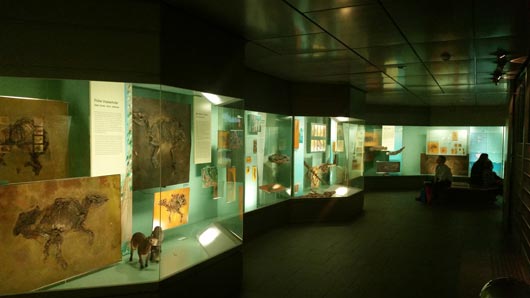
The Messel Shales Gallery at the Senckenberg Museum

Part of the Messel gallery (Senckenberg Museum).

The atmospheric Messel gallery at the Senckenberg Museum (Frankfurt). Picture credit: Everything Dinosaur.

Picture credit: Everything Dinosaur

Johannes Müller, a palaeozoologist at the Natural History Museum (Berlin) and one of the research scientists involved in this project stated that the fossil suggests:

“This was the transitionary animal, it was exactly what we were looking for.  It indirectly implies that identifying burrowing worm lizards with snakes is a mistake.”

Dr Müller and his co-authors used X-ray computed tomography, or CT scans, to study the skull of the fossilised lizard and compare it with those of extant lizards and snakes.  They found that the fossilised lizard had a thickened, capsule-like skull with no external ear opening, similar to the anatomical structure of worm lizards.

The lizard fossil has been formally described and named Cryptolacerta hassiaca, it is less than three inches in length and is the only known specimen of its kind found to date.

To view models of Cenozoic mammals and other prehistoric creatures: Prehistoric Animal Models.

Go to Top