All about dinosaurs, fossils and prehistoric animals by Everything Dinosaur team members.

Articles, features and information which have slightly more scientific content with an emphasis on palaeontology, such as updates on academic papers, published papers etc.

26 11, 2011

Prehistoric Fishermen Able to Catch Fast Swimming Tuna According to New Study

By |2024-04-22T12:00:31+01:00November 26th, 2011|Categories: Dinosaur and Prehistoric Animal News Stories, Palaeontological articles|0 Comments

East Timor Discovery Hints at Ancestors Teaching Isaac Walton a Thing or Two

Angling is a hobby enjoyed by many millions of people all over the world, these days most of the fish caught by anglers are returned to the water, but for some of our ancestors at least, catching fish with hooks and line may have been a vital to ensure their survival.  New research suggests that prehistoric fishermen were capable of catching powerful, ocean-going fish such as tuna.

Discoveries Made in East Timor

Indeed, discoveries made in a remote cave on the island of East Timor, suggest that some prehistoric humans had sophisticated and highly advanced fishing techniques enabling them to catch fast-swimming, deep ocean fish that would make today’s sports angler envious.

Excavations in a small cave, at the eastern side of the island of East Timor (north of Australia) by a team of researchers from the Australian National University have revealed the bones of more than 2,800 fish, some of which were caught as far back as 42,000 years ago.  Tuna bones found at the site suggest that by 40,000 years ago  H. sapiens had mastered the fishing skills required to catch on a regular basis the fast-swimming, powerful tuna.

There are several species of extant tuna, they are all nektonic (animals living above sea floor and active swimmers).  Tuna patrol the water column and they hunt other fish species, using their streamlined bodies and strong tails to pursue and catch their prey.  They are no easy catch for today’s sports angler or for those modern fishermen who use lines and baited hooks to lure them but for our ancestors to hook a tuna would represent a highly nutritious and protein packed addition to their diet.

The Cave/Overhang Site in East Timor

A prehistoric fisherman’s lodge?

Picture credit: Associated Press/Australian National University/Sue O’Connor

Two exploration pits dug by the archaeologists can be seen in the photograph, one in the foreground to the left and a second pit marked by sticks towards the cave wall.

Evidence of Sophisticated Skills

The East Timor discovery shows that  the people living in the region had the sophisticated cognitive skills needed to haul in such a difficult fish to catch.

The team’s findings appear in the scientific journal “Science”.

Archaeologist and Associate Professor at the Australian based university, Sue O’Connor commented:

“What the site [East Timor] has shown us is that early modern humans in island Southeast Asia had amazingly advanced maritime skills.  They were expert at catching the types of fish that would be challenging even today — fish like tuna.  It’s a very exciting find.”

Although the discovery of many thousands of fish bones gives the archaeologists evidence of what these islanders ate, it is not clear how these people actually caught the fish.  Today, tuna can be caught by rod and line, or by trailing long lines of baited hooks through the water.  Alternatively, they can be caught by trawling nets.  Some fish hooks were found at the site, but the scientists consider these hooks, made from shell not to be suitable for tackling such a strong fish as a tuna.

Associate Professor O’ Connor summarised by stating:

“Either way it seems certain that these people were using quite sophisticated technology and watercraft to fish offshore.”

The site where the discoveries were made, known as Jerimalai cave, is a small rock overhang hidden behind dense, jungle foliage, a few hundred metres from the shore. For many thousands of years it seems that this cave was inhabited by humans who may have specialised in fishing off-shore as well as beach-combing and hunting/trapping in the forest.  The cave also contained the bones and shells of a number of turtles, Everything Dinosaur team members speculate that these reptiles were not caught out at sea but captured on land as they wandered onto the shore.

Commenting on the significance of the East Timor discoveries, O’Connor stated:

“When I discovered it in 2005, I didn’t think that Jerimalai would tell us about the very early occupation of Timor, I was quite surprised when I found all these fish bones and turtle bones.”

So far, she and her colleagues have only excavated two small test pits at the cave, which contained a number of stone artefacts, bone points, animal remains, shell beads and ancient fish hooks.

Prehistoric Fishermen

In just one of those pits, 1 metre square and 2 metres deep, they found 39,000 fish bones.

The research team also unearthed another rare find — a small piece of fishing hook made from a shell, which dates to between 23,000 and 16,000 years ago.

A Picture of the Prehistoric Fish Hook

The oldest known fish hook? Dating from 14,000 – 21,000 years BC

Picture credit: Australian National University

This is the earliest example of a fishing hook that has ever been found, the researchers conclude.  They are hopeful that more extensive excavations might reveal more hooks and other fascinating evidence about human maritime existence at the site.  There are certainly other part of the overhang that need to be excavated, and there well may be other hidden caves and rock overhangs that have yet to be discovered.

In conclusion, Associate Professor O’Connor added:

“I think Jerimalai gives us a window into what maritime coastal occupation was like 40,000 to 50,000 years ago that we don’t really have anywhere else in the world.”

It seems that these prehistoric fishermen might have been able to teach Isaac Walton, known as the “father of modern angling” a thing or two.

For models of Neanderthals and other extinct creatures: Neanderthal Figures and Prehistoric Animal Replicas (CollectA Prehistoric Life).

25 11, 2011

Earliest Evidence of Human Aggression

By |2023-01-24T14:39:52+00:00November 25th, 2011|Categories: Dinosaur and Prehistoric Animal News Stories, Palaeontological articles|0 Comments

Prehistoric Skull may Show First Signs of Human Violence against Fellow Man

A prehistoric skull believed to date from more than 120,000 years ago may show the earliest recorded evidence of human violence but on the positive side, the person who was attacked, hit by some form of hard object on the skull, did live to fight another day.  Scientists have suggested the skull shows the tell-tale marks of an attack by another human being, but as the skull also shows signs of healing, the victim did at least recover from the blow.

The discovery is based on highly detailed CT scans of a 126,000-year-old human known as Maba Man, so named because his fossil remains were found near Maba in Guangdong Province (China) in 1958.  The scans revealed a skull fracture caused by blunt force trauma.  The victim was probably clubbed with a weapon such as a stone, heavy bone, or lump of wood, according to a new study, published in the Proceedings of the National Academy of Sciences.

To view replicas and models of ancient hominids such as Neanderthals: Neanderthal Figures and Prehistoric Animal Models (CollectA Prehistoric Life).
Prehistoric Skull

The skull was found in a cave and it had been gnawed by some form of giant rodent.  The researchers have speculated that the teeth marks may have been left by a porcupine.

Although, the injury could have been caused by having been hit by another person, it is also possible that the injury resulted from a severe fall – sadly there is no accident record so we can only speculate.

Researcher Lynne Schepartz, of the University of the Witwatersrand in South Africa commented:

“This person had a pretty serious injury, it would have been a real good knock to the head.”

She went onto add that the blow, if that is what it was, most likely caused bleeding and a concussion – inducing nausea, vomiting and perhaps even brain damage, leaving the victim prone and helpless.  However, if the wound shows our species violent side, the CT scans also showed that the wound eventually healed and that Maba Man lived for many years afterwards, something that indicates that the hurt man was likely cared for after his injury.  So this wound may show our darker side but also suggests evidence of human compassion.

A Picture of the “Mapa Man” Skull with Close up Showing the Wound

“Signs of a Bashing”.

Picture credit: University of the Witwatersrand

Schepartz stated:

“The bone was depressed inward, pressing on soft tissue and yet this person survived for a long period of time and it was not the immediate cause of [his] death.”

Although an accident cannot be ruled out, modern forensic science and other evidence points to foul play, the researchers report.   Consider it a bit like a game of “Cluedo”, instead of Professor Green in the library with the lead pipe, it may have been an early human in the cave, with a large rock.

An Ancient Assault

Ruling out the likelihood of a severe fall, Schepartz said:

“It’s hard to imagine how you would get just that one area of impact from, say, a fall.”

The fossilised remains of this early human indicate that he lived until his mid forties, a great age for one of our ancestors, as most early H. sapiens were lucky if they reached their thirtieth birthday.

Professor Erik Trinkhaus of Washington University (St Louis) commenting on the study, stated that older skulls showed signs of wounds and damage, but this injury was probably caused by “getting whooped by someone else” to put in bluntly.

The team says his recovery supports evidence from previous fossil studies that Neanderthals and other ancient humans, while often violently aggressive, also took care of their sick and vulnerable.  No one will ever know the real cause of the injury, but it can be postulated that it was caused by a blow from another person, the victim being cared for until he recovered.

Researchers at the University of Witwatersrand have helped provide further insights into the ancestry of our species.  Recently, Everything Dinosaur team members wrote about the discovery of ancient hominid fossils – A. sediba.

To read an article on this: Unlocking the secrets of our Ancestors.

7 11, 2011

Oviraptorids – Show Offs of the Late Cretaceous

By |2023-01-23T13:47:27+00:00November 7th, 2011|Categories: Dinosaur Fans, Palaeontological articles|1 Comment

New Paper Suggests Oviraptorids could Display their Tail Feathers to Attract a Mate

That bizarre group of theropods, the oviraptorids may have had a trick up their tail when it came to winning a mate or deterring a rival.  They might have been able to “flash” the feathered plumes at the end of their relatively short tails in a display reminiscent of a modern-day bird.

Oviraptorid Dinosaurs

That is the conclusion of Scott Persons, PhD student at the University of Alberta (Canada), who presented his paper on this research at the Society for Vertebrate Palaeontology’s annual meeting, ironically being held in Las Vegas which has plenty of “show girls” flashing feather boas and who knows what else in the many theatres.

Oviraptorids were very bird-like dinosaurs, with such features as a beak, shoulders strengthened by collarbone and a number of general anatomical characteristics that they share with the Aves (birds).  It has even been suggested by some palaeontologists that these theropods do not belong in the Dinosauria, instead, they should be re-classified as members of the bird clade.  Fossils of these animals are known from Upper Cretaceous strata of the Northern Hemisphere, most were less than three metres long, but one genus Gigantoraptor may have been the largest feathered creature that has ever lived.   Gigantoraptor may have weighed close to 1.5 tonnes and measured 8 metres in length.

An Illustration of a Typical Oviraptorid

Note the tail plume.

Picture credit: Everything Dinosaur

Feathered Dinosaurs

Scientists have evidence to suggest that many types of Oviraptor had a plume of feathers, similar to the fan of a Spanish flamenco dancer, attached to the end of their tails.  Scott, in his research paper suggests that this fan of feathers, in conjunction with a very flexible tail may have served as a display device, perhaps to settle disputes or to attract a rival.  A flash of brightly coloured tail feathers could have acted as a highly visible warning signal to other members of the flock or even have put off a predator as it attacked.

For Scott, the oviraptorid tail intrigued him.  Many of these animals had tails with a particularly dense arrangement of bones, as if the caudal vertebrae (tail bones) had been compressed.  As a number of fossil finds showed this arrangement, distortion by the fossilisation process could be ruled out.   The tails had evolved this way.

Scott commented:

“The tail of an Oviraptor by comparison to the tail of most other dinosaurs is pretty darn short.  But it’s not short in that it’s missing a whole bunch of vertebrae, it’s short in that the individual vertebra within the tail themselves are sort of squashed together.  So they’re densely packed.”

This compression of tail bones would have made the tails very flexible, much more so than in other small theropods such as the dromaeosaurs, some of which were contemporaneous of the oviraptorids.  A ruler is generally inflexible and stiff as it has no joints in it, whereas a chain made of many links is extremely flexible.  This principle can be applied to the caudal vertebrae of dinosaurs.

Bird-like Dinosaurs

These bird-like dinosaurs also had tails that were much more muscular than those belonging to modern-day reptiles, he concludes.  Fossil impressions show they also boasted a fan of feathers at the end of their tails, attached to fused vertebrae similar to that found in the tails of today’s birds.  In modern birds the remnants of their ancestral reptile tail can still be seen in their skeleton – it is the pygostyle, a plate of bone that represents five-fused tail vertebrae, all that remains of their reptilian tail ancestry.

In the research paper, Scott proposes that:

“If you combine that [tail plume] with having a muscular, very flexible tail, what you have is a tail that could, potentially at least, have been used to flaunt, to wave that tail-feather fan.”

And just like modern-day birds, the dinosaurs may well have waved their tail fans to impress potential mates, or perhaps for a variety of other display purposes.  If this is the case, then other members of the Dinosauria believed to have a tail plume may also have displayed in a similar manner – dinosaurs such as Protarchaeopteryx and Caudipteryx for example.

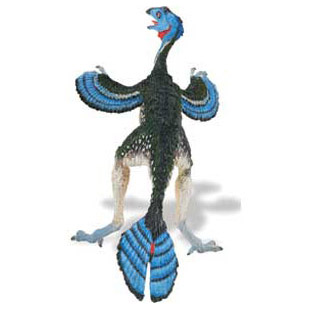
 A Model of Caudipteryx (C. zoui)

Was the tail plume combined with a short tail used for display?

Picture credit: Everything Dinosaur

To view models and feathered dinosaur figures: Wild Safari Feathered Dinosaurs and Models.

22 10, 2011

Tyrannosaurus rex – Bigger than Previously Thought According to New Study

By |2024-04-22T13:23:41+01:00October 22nd, 2011|Categories: Dinosaur and Prehistoric Animal News Stories, Dinosaur Fans, Palaeontological articles|2 Comments

Tyrannosaurus rex – All Nine Tons of It

A joint US and UK research team using sophisticated, three-dimensional laser mapping have calculated that tyrannosaurs were heavier than previously thought.  Using tyrannosaur fossil skeletons, including that of “Sue” the most complete Tyrannosaurus rex (and the biggest) found to date the scientists concluded that these Late Cretaceous predators could reach weights of up to 9 tons.

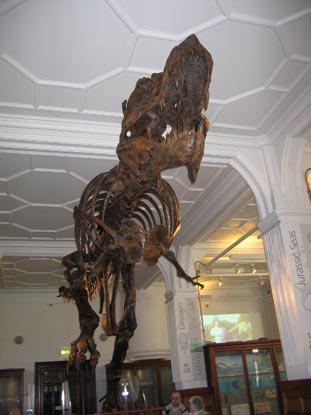
Tyrannosaurus rex

Using three-dimensional laser scans and computer modelling, British and U.S. scientists “weighed” five tyrannosaur specimens, including the Chicago Field Museum’s “Sue.  They concluded that Tyrannosaurus rex grew faster and weighed more than previously thought.  The discovery of sub-adult specimens in recent years has enabled palaeontologists to understand a little more about the ontogeny (growth) of these theropods, for example, it is now widely accepted that just like us humans, Tyrannosaurus rex underwent a growth spurt in its teenage years.

New Body Mass Estimates for Tyrannosaurus rex

Estimates of up to 9 tons in weight. Picture credit: Everything Dinosaur.

Picture credit: Everything Dinosaur

Remarkable Growth Rates of Dinosaurs

A number of studies have been published in recent years, providing evidence on the remarkable growth rates of different dinosaurs.  One recent study focused on the ontogeny of hadrosaurs (duck-billed dinosaurs), animals that were on the menu for the tyrannosaurs.  This study suggested that the herbivorous hadrosaurs actually grew faster than the predators, a strategy for survival when being small and young meant being a potential dinner for a hungry T. rex.

To read this article: Duck-Billed Dinosaurs Grew Up Fast to Avoid Being Eaten.

In the light of this Anglo/American research which suggests that T. rex may have been up to thirty percent bigger than previously estimated, so of these older papers may have to be revisited.

In an interesting twist to the T. rex growing fast and enormous research, the scientists have estimated that the smallest and youngest specimen of a Tyrannosaurus rex known, actually weighed less than previously thought.  This study indicates that T. rex grew more than twice as fast between 10 and 15 years of age as suggested in a study five years ago.  The University of California (Berkeley) conducted research into the growth of another dinosaur genus, an ornithopod called Tenontosaurus.  This research team concluded that dinosaurs may have reached maturity earlier than previously expected, their work, which involved studying the growth rings preserved in fossilised dinosaur limb bones suggested that dinosaurs did grow up fast, perhaps another survival strategy in the brutal Mesozoic.

University of California research into dinosaur growth: Dinosaurs Grew Fast, Lived Fast and Died Young.

The study, published in the online scientific journal PLoS One, (Public Library of Science) was conducted by a team of scientists led by Professor John R. Hutchinson of The Royal Veterinary College, London, and Peter Makovicky, PhD, curator of dinosaurs at The Field Museum of Natural History in Chicago.  “Sue” the biggest Tyrannosaurus rex is housed at the Chicago Museum.

According to Professor Hutchinson, who commented on the spurt growth of Tyrannosaurus rex during its teens:

“T-rex grew at 3,950lbs per year (1,790 kg) during the teenage period, which is more than twice the previous estimate.”

However, these predators sacrificed speed for power and strength as they got bigger according to this study.  The researchers concluded that heavy, adult Tyrannosaurus slowed down as they grew, but speeds around fifteen miles an hour, about as fast as a footballer can run were still possible.

The velocity that these animals could achieve slowed as they got bigger because the tyrannosaur torso became longer and heavier while its limbs grew relatively shorter and lighter, shifting its centre of balance forward.   This relates to an aspect of ontogeny studies called “distal growth”, it also explains why young animals have proportionately longer limbs than adults, try comparing a foal to its mother and you will see the difference in body proportions.

Professor Hutchinson added:

“The total limb musculature of an adult T. rex probably was relatively larger than that of a living elephant, rhinoceros, or giraffe, partly because of its giant tail and hip muscles.  Yet the muscles of the lower leg were not as proportionately large as those of living birds, and those muscles seem to limit the speed at which living animals can run.”

When commenting on the growth spurts of these apex predators, during their teenage years, Professor Hutchinson stated:

“At their fastest, in their teenage years, they were putting on 11 pounds or 5 kilograms a day.  Just think how much meat that is.  That’s a hell of a lot of cheeseburgers … it’s a whole lot of duck-billed dinosaurs they needed to be chowing down on.”

High Demands for Food

Such high demands for food to fuel their rapid growth may have had an impact on tyrannosaur behaviour.  A huge appetite would suggest that each T. rex or tyrannosaur group would need a massive territory to hunt in.  Each animal would need access to a substantial amount of potential prey – so as one spokesperson for Everything Dinosaur put it:

“Tyrannosaurs may have been few and far between.”

The rapid teenage growth spurt also suggests these reptiles must have had a high metabolic rate, fuelling the idea they were endothermic (warm-blooded).

The researchers, led by Professor Hutchinson and Dr Makovicky used scans of skeletons to build digital models and then added flesh using the structure of soft tissues in birds and crocodiles as a guide.  A number of composite models were then developed, to provide a spread of potential body masses, computer models to assess the body mass of less muscular dinosaurs and models to look at the maximum musculature that these skeletons could theoretically support.

One of the problems the team encountered was that the fossilised bones of many tyrannosaurs, including those of “Sue” from the Field Museum (Chicago) had been compressed during the fossilisation and preservation process, so assessments of the actual “life-size” of bones had to be calculated before an assessment of body mass could be carried out.  The study is further complicated by the fact that scientists believe that male and female tyrannosaurs had very different body forms.   It has been suggested that the more robust, bigger specimens represent females, smaller more gracile forms are males.   Female tyrannosaurs are believed to have been larger as they needed wider hips to allow the storage and passage of eggs.  Such dimorphism is common in Aves – close relatives of theropod dinosaurs.

For models and replicas of tyrannosaurs and other theropod dinosaurs: Tyrannosaur Models and Theropod Figures (Wild Safari).

3 10, 2011

New Species of Crocodile Discovered Down a Colombian Mine

By |2023-03-08T13:37:07+00:00October 3rd, 2011|Categories: Animal News Stories, Dinosaur and Prehistoric Animal News Stories, Palaeontological articles|0 Comments

Palaeogene Crocodile Fossil Suggests Crocodiles Quick to Exploit Dinosaur Extinction

The fossilised remains of an ancient crocodile have been discovered by a team of American scientists whilst working underground exploiting a rich, fossiliferous seam in a Colombian coal mine.   This crocodile has been identified as a new species and at more than six metres long it was a sizeable reptile, one whose ancestors survived the Cretaceous mass extinction event and quickly adapted to exploit predatory niches once occupied by the Dinosauria.

Ancient Crocodile

The new species of crocodile was discovered by a team of University of Florida researchers, led by Jonathan Bloch Associate Curator of Vertebrate Palaeontology at the Florida Museum of Natural History assisted by Carlos Jaramillo, a palaeobotanist with the Smithsonian Tropical Research Institute.

A Picture of Alex Hastings with the Fossils from the Crocodile Specimens

Assembling the fossil evidence for Acherontisuchus.

Picture credit: Kristen Grace/Florida Museum of Natural History

This crocodile Acherontisuchus guajiraensis is just one of a number of amazing fossil discoveries made by the research team as they explore the underground strata which represent sediments laid down in a tropical Amazon-like environment approximately sixty million years ago.  A species of super-thick shelled Chelonian had been described recently, the  reason for the strong carapace being revealed with the discovery of fossils of this fearsome crocodile.

To read more about this discovery: Fossil Turtle Had Super-Thick Shell to Defend Itself from Predators.

Perhaps the most astonishing discovery made to date in the Cerrejón coal mine was the fossils of an enormous snake, the largest known in the fossil record.  The snake, a constrictor is estimated to have measured more than fifteen metres long and weighed as much as 1,200 kilogrammes.  The snake was named Titanoboa cerrejonensis it would have been an apex predator in the rain forest environment but from our research the paper’s published indicate that this snake was more closely related to Boas than to the Amazon’s largest snake – the Anaconda.

To read more about Titanoboa: Titanoboa – Super huge Snake of the Tertiary.

Rebor produced a limited-edition replica of Titanoboa swallowing a Columbian crocodilian.

To view the Rebor range and the Titanoboa figures (whilst stocks last): Rebor Prehistoric Figures and Replicas.

The holotype specimen for this new species was actually collected  by Alex Hastings, a University of Florida PhD student in the department of geological sciences.  The coal mine is a particularly unpleasant place to work.  The coal seams can spontaneously combust and they give off a powerful and very unpalatable sulphurous odour.  This coupled with the extreme heat and humidity makes the excavation of fossils extremely difficult.

Acherontisuchus guajiraensis

A. guaijraensis was a member of a crocodile family that were not direct ancestors of today’s crocodiles, gharials, caiman or alligators, but this discovery is important as it is helping scientists to build up a picture of ecosystems in the aftermath of the Cretaceous mass extinction event.  Judging by the size of this new crocodile species and Titanoboa it seems that sixty million years ago reptiles still ruled the world, at least in South America.

It seems that the Acherontisuchus genera survived the cataclysm that led to the dinosaurs demise and interestingly, this fossil is the first evidence of a large crocodile member of this genera being associated with a freshwater habitat.  Previously, all fossil evidence of large crocodiles ascribed to the Acherontisuchus genera had been found in association with marine environments.  This suggests that crocodiles were quick to adapt to and exploit niches vacated by other animals that did not survive the mass extinction event.

An Illustration of Acherontisuchus guaijraensis

Colombia – sixty million years ago. Acherontisuchus guajiraensis is hunting fish. Titanoboa, the world’s largest snake, is pictured in the background.

Picture credit: Danielle Byerley/Florida Museum of Natural History.

Commenting on this discovery, student Alex Hastings stated:

“One of the questions about this group was how were they able to survive – what advantages did they [Acherontisuchus genera] have?  What this new crocodile really contributes to is that it is the first evidence of a large-bodied member of this group being found in freshwater.  Before now, it was thought that only baby crocodiles would spend any appreciable amount of time in freshwater and that adults spent most of their time in a saltwater environment.”

The size estimates for this new species have been scaled up from the larger of two individual specimens discovered at the site.  Based on an analysis of the limited skull and jaw material, scientists have described this crocodile as having a long narrow snout, superficially resembling that of an extant gharial.  It seems from the shape of the jaws that this crocodile was primarily a piscivore (fish-eater).

The Cerrejón coal mine is proving to be a rich source of evidence about tropical Palaeogene environments just a few million years after the dinosaurs disappeared.  We suspect that more amazing fossils await discovery, perhaps another big crocodile, one that could even match the likes of Sarcosuchus imperator in terms of size.

Everything Dinosaur acknowledges the assistance of a media release from the Florida Museum of Natural History (01/10/2011) in the compilation of this article.

9 09, 2011

New Fossils may Help Define Human Ancestry

By |2023-03-08T09:15:46+00:00September 9th, 2011|Categories: Dinosaur and Prehistoric Animal News Stories, Main Page, Palaeontological articles|0 Comments

Australopithecus sediba May be the Ancestor of Modern Humans

Two fossils, one of a female, one of a young male discovered in South Africa in 2008, may provide scientists with clues to our species origins – H. sapiens.  Although the brain may have been not much bigger than a chimpanzees, the fossilised bones indicate an upright walking gait, and the ability to grip and hold tools.

Australopithecus sediba

The fossilised remains of two human-like creatures who probably fell to their deaths, found in South Africa could redraw the map of human evolution and provide scientists with vital information regarding the origins of our own species.  The 1.9 million-year-old specimens were formally described last year and given the species name Australopithecus sediba, the name means “southern ape from the natural spring” a reference to the geological formation in South Africa were the fossils were found amongst many other prehistoric animal bones.

The international research team including scientists from the University of Witwatersrand (Johannesburg) and the University of Zurich have carried out a much more thorough analysis of the specimens and have published a number of papers detailing their research, suggesting that A.sediba may represent an important link in the ape to human evolutionary tree.

Co-author of the scientific papers, Professor Lee Berger (University of Witwatersrand) stated:

“We have examined the critical areas of anatomy that have been used consistently for identifying the uniqueness of human beings.  Any one of these features could have evolved separately, but it is highly unlikely that all of them would have evolved together if A. sediba was not related to our lineage.”

Professor Lee Berger with the Cranium of A. sediba

Picture credit: Witwatersrand University

A national competition was launched to find a suitable nickname for the fossilised juvenile.  This competition helped raise awareness of the importance of this South African discovery.  To read about the competition and to discover the winner: Ancient Hominid Fossil From “Human Cradle” Named.

The research team are making a very big claim.  A number of scientists have proposed fossil specimens as being transitional between the Australopithecines and the ancestral line that led to fossil humans.

Tracing the Human Family Tree

The current, most widely accepted hypothesis holds that modern humans can trace their ancestry back to a creature known as Homo erectus which lived more than a million years ago. This animal, according to many palaeoanthropologists, may in turn have had its origins in more primitive hominins, as they are known, such as Homo habilis or Homo rudolfensis.

The contention now made for A. sediba is that, although older than its “rivals”, some of its anatomy and capabilities were more advanced than these younger forms.  Put simply, it is a more credible ancestor for H. erectus, the research team propose.

Although very different to ourselves, modern humans, the importance of determining an ancestor of H.erectus cannot be underestimated.  This particular hominid probably evolved in Africa from an African ancestor, H. erectus was the first “human-like” creature to become widespread.  The best fossils of H. erectus have come from Asia and it may have been the “longest lived” human species with some scientists suggesting that may have been on planet Earth from around 1.8 million years ago to just fifty thousand years ago.

The A. sediba specimens were unearthed at Malapa in the famous Cradle of Humankind World Heritage Site, just to the north-west of Johannesburg.  The fossils were found in a pit, a depression left in the ground after the roof of a cave had collapsed.  These pits are common in the area, which is dominated by dolomitic limestone and a number of caves and cave complexes are known.

The fossil layers accumulated at the base of these shafts which may have operated as death traps.  The sediments were cemented by lime-saturated water and were sealed with flowstones.  The excellent preservation of the fossils implies a fast deposition and only minor transportation of the bodies of the animals including the remains of these two specimens of A. sediba.

Professor Berger with the Partial Remains of One Specimen Laid Out

Ancient fossils.

Picture credit: Brett Eloff (Witwatersrand University)

One hypothesis put forward by the research team is that in the search for water, animals might have fallen into the cave.  Predators could have been attracted to the smell of decomposing bodies and suffered the same fate. Subsequent rainfalls washed the intact bodies more deeply into the cave where they were submerged in an underground lake.  It is these conditions that enabled the preservation of the fragile fossil bones.

Adult Female and Juvenile Male

Identified as an adult female and a juvenile male, the two individuals were quite possibly mother and son.  What seems certain is that they died together in some tragic accident that saw them either fall into the cave complex or become stuck in it.  After death, their bodies were washed into the underground lake and cemented in time along with the remains of many other animals that got trapped in the same way; including some creatures that were probable predators of A. sediba – large hyenas and big cats.

One important area of study has involved a more accurate dating of the strata within which the fossils were found. The latest dating technologies were applied to the sediments encasing the fossils.  Whereas original estimates had put the age of the remains at somewhere between 1.78 and 1.95 million years old, the new analysis has narrowed this window of uncertainty to just 3,000 years.  The new age is now between 1.977 and 1.98 million years old.  The refined dating is important, says the team, because it puts A. sediba deep enough in time to be a realistic ancestor to H. erectus.

Dr Robyn Pickering, from the University of Melbourne, Australia, who led the dating team and one of a number of Australian based scientists who worked on this project, commented:

“This is a very interesting time in human evolution because it is when we think we should be seeing the beginnings of our genus, Homo.  Previously, we’ve had very few fossils from this time period, so the sediba fossils are remarkable in that they are so complete.”

One of the characteristics that distinguishes modern humans from other primates is the size and structure of our brains.  Fossils of H.erectus show a significant increase in brain size when compared to older primate fossils such as H. rudolfensis.  Estimates for the cranial capacity of H. erectus vary but a brain size of around 1,000 cubic centimetres in volume has been stated.  A high-resolution X-ray scan of the male specimen’s skull has produced a virtual cast of its braincase.  This was carried out at the European Synchrotron Radiation Facility in Grenoble.

From this, the researchers estimate an adult A. sediba’s brain to have been about 440 cubic centimetres in volume, about the size of a medium grapefruit.  This is smaller than much older fossils in the record such as the famous “Lucy” specimen, Australopithecus afarensis (3.2 million years), but, intriguingly, the shape is more human-like, especially at the front.  This may hint at the start of the re-organisation of the brain that would be necessary to make us what we are today with our large neocortex.

The Complicated Human Evolutionary Tree

Plotting the family history.

Picture credit: Peter Schmid (University of Zurich)

Due to the paucity of the fossil record, determining the origins of our species and our direct ancestors is extremely difficult, but these new fossils from South Africa may shed further light on this aspect of evolution.

The pelvic area also indicates very human-like characteristics.  The pelvis is short and broad just like a human pelvis. A more ancient creature like Lucy has a flatter and more flaring pelvis, very ape-like in shape.  A popular idea has been that the modern human pelvis evolved in tandem with the gradual growth in brain volume, facilitating the birth of babies with bigger heads.  A. sediba gives the lie to this theory, says the team, because it had a modern-looking pelvis while possessing a small brain.

The right-hand of the female is very nearly complete.  It is looks far more like a modern human hand than an ape hand.  Its fingers are shorter relative to the thumb than in a chimpanzee.  Yet, it appears to have possessed powerful muscles for grasping, suggesting A. sediba spent a lot of time clambering through the branches of trees, indicating an arboreal habit.  The research team also argues that the dexterity would have been there to make simple tools.  Hand axes and other stone tools have been found in association with H. erectus fossil remains.

The lower foot bones also reveal some intriguing information about these creatures.  The ankle joint is mostly human-like in form and there is some evidence for a human-like arch and Achilles tendon.  However, A. sediba possessed an ape-like heel and lower tibia, or shin bone (not as elongated as in more modern human species).  The scientists think this combination may have led to a distinctive type of walk when the creature was not climbing in trees.  This could suggest a transition between an entirely arboreal existence and a move towards spending more time out of the trees.

Whatever the correctness of the analysis, the creature certainly has a fascinating mix of features – some archaic, some modern, a mix of evolutionary traits.  A number of scientists have described these fossils as fascinating and very well preserved.

Dr William Harcourt-Smith from the American Museum of Natural History in New York, commented:

“One lineage of Australopithecus almost certainly led into the first member of our own genus called Homo, and from them eventually emerged modern humans.  But some of them are side branches, and we’re trying to work out which ones are and which ones aren’t – and that’s why this finding is so important.  In many ways, these fossils are the ‘smoking gun’ just before the emergence of our own genus.”

Professor Chris Stringer, from London’s Natural History Museum, a world renowned expert on the origins of our own species stated:

“This isn’t the end of the story.  What may be happening is that there were several Australopithecine forms all evolving human-like features in parallel as they turned to meat-eating and tool-making and moving greater distances.”

He went onto add:

“The question now is to pull out of this mess which one is really the ancestor of the genus Homo.  We know there are more remains to come from this incredible site.  Let’s see if other individuals also show this mix of features.”

31 08, 2011

Cooking – A Great Leap Forward in Human Evolution

By |2023-03-08T09:21:49+00:00August 31st, 2011|Categories: Dinosaur and Prehistoric Animal News Stories, Main Page, Palaeontological articles|0 Comments

Processed Food – Not Too Bad After All if our Ancestors are Anything To Go By

The ability to process food, to make it more edible, easier to digest and to breakdown in the human gut to release nutrients, may have helped hominids to gain the upper hand when it came to competing with other predators back in the Pleistocene and earlier.  Indeed, a paper published in the scientific journal “The Proceedings of the National Academy of Sciences”, postulates that processed food, given such a bad press today may have helped humans gain an evolutionary advantage.

Human Evolution

Compared to other extant primates, our species H. sapiens spends only one tenth the amount of time eating compared to a chimpanzee.  The new research suggests that processing food without the use of fire may date back more than two million years and it could have accelerated human evolution.  Raw food eating primates such as chimpanzees spend nearly fifty percent of their day eating, modern humans devote less than five percent of each day to this vital task – thanks to our diet and the way that we treat foodstuffs.

As well as spending much less time eating than chimpanzees and other apes, humans have also evolved far smaller teeth, jaws and guts.  The physical changes could not have evolved without the introduction of food processing, say the scientists from Harvard University (USA), a university that has produced a number of scientific papers recently on the cooking and eating habits of our ancestors.

According to the new study, there is evidence that this occurred with the emergence of Homo erectus, a direct ancestor of modern humans that evolved around 1.9 million years ago.  The research team carried out a comparative study using non-human primates, modern humans and fourteen extinct hominids.  The team analysed molar sizes, body masses, DNA, and other characteristics to infer when the pattern of reduced eating times began.  They found that H. erectus, its descendants H. neanderthalensis, and H. sapiens evolved smaller molars compared with other primates; a shift not explicable by the amount of overall evolution in the jaws and heads of these species.

Processing Foods with Tools and Fire

Processing foods with tools and fire would have softened edibles and therefore allowed smaller molars and reduced eating time. The authors’ research suggests that food processing originated after the human-chimpanzee split and before H. erectus.  This study therefore suggests that the likes of H.erectus may have been the first to process food, not cooking as we know today but perhaps by using fire and the bashing of meat to make it more easy to digest.

The stateside based authors, led by Dr Chris Organ, from Harvard University, wrote:

“Food processing would have provided higher caloric intake in the ancestors of modern humans, which likely bestowed significant advantages on reproductive success and survival.  Malnutrition resulting from a committed raw food diet strongly suggests that eating cooked and processed food is necessary for long-term survival of wild foods in Homo sapiens.  This hypothesis explains the small teeth, jaws and guts of modern humans and the universal importance that cooking has played in cultures throughout recorded history.”

Richard Wrangham, also of Harvard University produced a book back in 2009, that examined the evolution of cooking and its role in the development of our own species – a sort of scientific reaffirmation of the old saying “you are what you eat”.

Professor Wrangham (Ruth Moore Professor of Anthropology at and Chair of Biological Anthropology at Harvard), argued that the invention of cooking, even more than agriculture, the eating of meat, or the advent of tools is what led to the rise of humanity.

Wrangham’s book entitled, “Catching Fire: How Cooking Made Us Human,”  makes the case that the ability to harness fire and cook food allowed the brain to grow and the digestive tract to shrink, giving rise to our ancestor Homo erectus some 1.8 million years ago.

Professor Wrangham stated at the time his book was published:

“Cooking is the signature feature of the human diet, and indeed, of human life.  It’s the development that underpins many other changes that have made humans so distinct from other species.”

Drawing on a wide body of research, Wrangham made the case that cooking made eating faster and easier, and enabled our ancestors to gain more caloric benefit from food.  Moreover, he theorises that cooking is vitally important to supporting the outsize human brain, which consumes a quarter of the body’s energy.

This new research builds on some of the earlier Harvard University work.  This new study concludes:

“Humans are able to spend less time feeding because they typically consume higher-quality food than chimpanzees, and because they use cooking and non-thermal processing to render more calories available from food. Cooking and non-thermally processing foods also reduces food particle size and increases starch gelatinisation, which results in earlier bolus formation and swallowing.  These facts suggest that a dramatic increase in caloric intake from cooking and non-thermally processing food played an important role in shaping our evolutionary history.”

Perhaps back in the early part of the Pleistocene epoch, our direct ancestor, the hominid known as H. erectus was enjoying his or her very own version of “Master Chef”.

H. erectus has been the focus of a number of scientific papers this month, a team of experts announced the discovery of a portion of a prehistoric hominid skull, believed to be more than 170,000 years old.  This fragment of skull was unearthed near the French town of Nice, the Lazaret Caves – an excavation site that has yielded over 20,000 fossils.

Students Ludovic Dolez and Sebastian Lepvraud were working on the excavation site and discovered the skull fragment on the 13th August, part of a forehead belonging to a Homo erectus.

Palaeontologist Marie-Antoinette de Lumley, in charge of the dig site stated:

“It belonged to a nomad hunter, less than 25 years old.  He may be able to teach us more about the evolution of his successor, the Neanderthal man.”

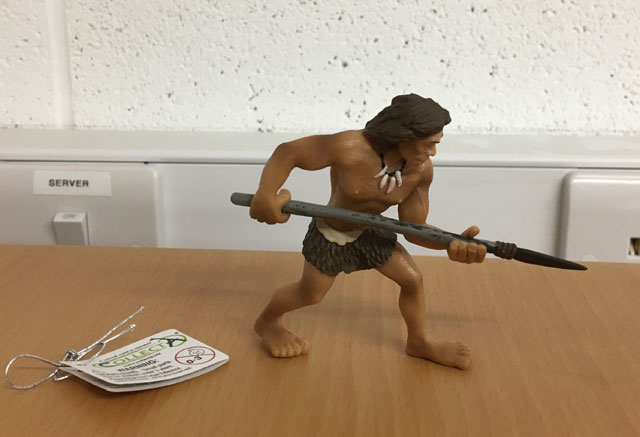
A Model of a Neanderthal Man

CollectA Neanderthal man model

Selecting a CollectA Neanderthal man figure for an Everything Dinosaur customer. Picture credit: Everything Dinosaur.

Picture credit: Everything Dinosaur

The bone was left to dry for a few days where it was discovered, before being removed for a special public announcement attended by the mayor of Nice and other local officials.

To view models of Neanderthals and other prehistoric figures (whilst stocks last): CollectA Neanderthal Models and Prehistoric Animals.

23 08, 2011

Cretaceous Mass Extinction – Exterrestrial Object Not Entirely to Blame

By |2023-03-08T12:33:40+00:00August 23rd, 2011|Categories: Dinosaur and Prehistoric Animal News Stories, Dinosaur Fans, Main Page, Palaeontological articles|0 Comments

International Team of Scientists Consider a Variety of Factors in Demise of the Dinosauria

It was American father and son, Luis and Walter Alvarez who publicised the discovery of a world-wide layer of clay rich in the rare Earth element iridium in rocks known as the K-T  boundary.  The K-T boundary marks the border between the Cretaceous and the Tertiary.  These American scientists argued that the iridium was deposited after an impact event, a collision between our planet and an exterrestrial object such as a meteorite or asteroid.

This global catastrophe has been proposed as one of the main causes of the mass extinction event that marked the end of the Mesozoic and saw something like seventy percent of all life on land wiped out – including the Dinosauria.  Time to reconsider the question: what caused the extinction of the dinosaurs?

Cretaceous Mass Extinction

However, other factors may have played a significant role in the demise of the dinosaurs and a team of international researchers have published papers detailing a ten year study into the strata and fossil record of northeastern Asia.  They conclude that rising sea levels, volcanism and climate change were also very significant in the extinction of the mega fauna in this particular part of the world.

These new findings suggest that a prehistoric exterrestrial impact is not solely responsible for wiping out the dinosaur population in northeast Asia sixty-six million years ago.  Chinese media is reporting that the scientists claim that the end of the dinosaur’s reign in some regions of northeast Asia can be linked to several other factors, including volcanic eruption, climate change and dramatic drops in sea level.

The Chinese led study, involving thirty scientists from eight different countries has yielded powerful evidence challenging the dominant, impact theory, although scientists remain fairly confident that the Chicxulub crater in the Yucatan peninsula is evidence of a large impact event approximately sixty-six million years ago.

The study was made public during an ongoing seminar of geology and palaeontology in Jiayin, a county in northeastern Heilongjiang Province, where scientists have found fossils of dinosaurs living just before this group of reptiles extinction.

To purchase models and replicas of Late Cretaceous prehistoric animals: Late Cretaceous Prehistoric Animal Models from Schleich.

The scientists, including experts from Russia, the U.S., Germany, Belgium, Britain, Japan and the Republic of Korea, were led by Sun Ge of Jilin University in northeast China. Together, they have spent the past ten years studying the extinction of dinosaurs.

The study showed that in Jiayin the K-T boundary, the geologic boundary between the rocks of the Cretaceous and Tertiary periods, does not contain high-levels of iridium, a radioactive element that linked an asteroid strike to the extinction of dinosaurs.  This may be the case as although, the Chicxulub crater indicates a collision with an object at least ten kilometres in length, the fall out from the resulting explosion may not have reached northeastern Asia, leaving no tell-tale traces of iridium.

Among conflicting and controversial hypotheses explaining dinosaur extinction, the asteroid theory is the only one that has been proven by scientific evidence and is universally recognised by scientists, Sun commented.

Scientists believe a giant asteroid/meteorite that hit the earth about sixty-six million years ago sealed the fate of dinosaurs forever with huge pyroclastic clouds, shock-waves, earthquakes and tidal waves as well as extensive fires.  Many palaeontologists believe that as dust and smoke filled the atmosphere, the sun was obscured and the planet was plunged into a “nuclear winter”.

Most large land animals and many forms of marine life such as the mosasaurs, ammonites and belemnites became extinct.  However, this new study suggests that volcanic activities around that time greatly impacted the environment of the Jiayin area and could be to blame for the mass extinction.  Certainly, these dramatic changes in the climate and atmosphere may well have contributed to environmental stress.

Geologic features of and around the K-T boundary in Jiayin are identical to those of and around the same layer in Russian regions of Siberia and the Far East, said Sun Ge.

This is not the first time (or do we at Everything Dinosaur suspect the last time), the asteroid extinction theory has been challenged.  To read a recent article on this debate: Impact Extinction Theory Challenged – Was it Global Cooling?

Regions in northeast Asia had similar geographic environments sixty-five million years ago, where volcanic eruption, climate cooling and up to 100-metre drops in sea-level might have been the major factors that wiped out the dinosaurs, said Akhmetiev M, a Russian geologist who participated in the program.

According to Sun, the world’s 105 sections of K-T boundary suggest a mega-wipeout sixty-six million years ago that destroyed over seventy percent of all the Earth’s species, including the dinosaurs.

However in conclusion the scientists state that the extinction of dinosaurs was probably caused by different factors in different regions, and an extraterrestrial impact was probably not the single cause of the Dinosauria extinction.

To read another article on the effect of volcanism on the extinction of the dinosaurs: Blame the Deccan Traps.

22 08, 2011

Evolution of the Biggest Mouths in the Natural World

By |2023-01-20T17:34:31+00:00August 22nd, 2011|Categories: Main Page, Palaeontological articles, Press Releases|0 Comments

Tiny Whale Fossil Indicates Evolution of Baleen Whales from Toothed Cetaceans

The Baleen Whales, huge creatures such as the Blue Whale (Balaenoptera musculus) and the Grey Whale (Eschrichtius robustus) feed by gulping in huge amounts of water, and straining out small sea creatures such as krill through their plates of bristle-like baleen that hang from the upper jaws.  However, these leviathans may have evolved from huge marine predators that specialised in eating much larger prey.

Museum Victoria palaeontologist Dr Erich Fitzgerald has made ground-breaking discoveries on the evolution of the world’s largest whales, the Baleen Whales, based on 25 million-year-old fossil jaws found near Torquay in Victoria (Australia).

The Evolution of Baleen Whales

Published today in the Royal Society’s journal Biology Letters, this important discovery challenges earlier scientific notions by suggesting that  Baleen Whales (e.g. Blue Whales), which feed on small organisms, first evolved their huge mouths for capturing large individual prey animals.

The new fossil evidence comes in the form of the lower jaw bones of Janjucetus,  (Janjucetus hunderi) a 3-metre-long early relative of today’s toothless baleen whales.

Dr Fitzgerald commented:

“Janjucetus had tightly connected lower jaws and lacked the elastic lower jaw joint that makes it possible for the mouths of modern Baleen Whales to greatly expand and swallow vast volumes of plankton-rich seawater.  What this amounts to is vivid evidence that Janjucetus and the earliest baleen whales could not filter feed.”

Dr Fitzgerald’s research challenges the belief that the earliest Baleen Whales had the same jaw structure as their modern day relatives.  The newly uncovered fossils suggest that early Baleen Whales had bizarrely shaped skulls structured for sucking prey into their mouths.

Whale Fossils

Dr Erich Fitzgerald cradles the fossil jaws of the tiny extinct whale (Janjucetus hunderi).  With a total body length of only three metres, this Oligocene marine mammal would have been dwarfed by its present day relative, the Blue Whale, a skeleton of which looms in the background.

Dr Fitzgerald added:

“Their skull, mouth and lips may have acted like vacuum cleaners, hoovering up larger animals, like fishes or octopuses.”

Although this fossil discovery shows Janjucetus had a rigid lower jaw joint, their upper jaws were expansive – a key feature of all Baleen Whales.

According to Dr Fitzgerald:

“The characteristic large mouth of today’s Baleen Whales is first seen in the upper jaws of non-filter feeding early species, suggesting that the wide upper jaws originally evolved as a specialisation for suction feeding.”

Although the steps by which Baleen Whales evolved from suction feeders into filter feeders remains unclear, this research demonstrates the first evolutionary step towards what are now the biggest mouths in the history of life on Earth.

Janjucetus hunderi

Images released show Janjucetus hunderi attacking a school of fish in the seas off the coast of south-east of Australia, twenty-five million years ago.

Describing just how big the mouth of a  Blue Whale (Balaenoptera musculus) is, Dr Fitzgerald stated:

“When fully expanded, a blue whale’s mouth could park a Kombi van.”

Janjucetus hunderi lived about 25 million years ago in coastal seas off south-east Australia.  The fossil jaws of Janjucetus were found near the Victorian township of Torquay in the 1970s by a dedicated amateur palaeontologist. Little had been established about the whale remains until Dr Erich Fitzgerald started his long-term research on the fossils in 2009.

Dr Fitzgerald is a palaeontologist specialising in the evolution of marine mammals.  He held a Post-doctoral Fellowship at the Smithsonian Institution and is currently the Harold Mitchell Fellow at Museum Victoria.  Erich also holds an honorary appointment at the Smithsonian Institution in Washington, DC.  This research is a result of two years of study at Museum Victoria and the Smithsonian Institution.

Museum Victoria houses the largest collection of fossil marine mammals in Australia and hosts the country’s only whale evolution research program. The paper published in the scientific journal “Biology Letters” is entitled “Archaeocete-like jaws in a Baleen Whale.”

Everything Dinosaur is grateful to Melbourne Museum and Museum Victoria for their help in the compilation of this article.

Some Toothed Whales were Giant Apex Predators (Livyatan)

PNSO Requena the Livyatan model

PNSO Requena the Livyatan prehistoric whale model anterior view.

The picture (above), shows the PNSO Requena the Livyatan model. To view the prehistoric animals in the PNSO model range: PNSO Prehistoric Figures and Replicas.

18 08, 2011

Jawbone Suggests Giant Birds May have Lived Alongside the Dinosaurs (According to New Research)

By |2024-04-22T11:52:41+01:00August 18th, 2011|Categories: Animal News Stories, Dinosaur and Prehistoric Animal News Stories, Dinosaur Fans, Main Page, Palaeontological articles|0 Comments

New Fossil Discovery Suggests Giant Birds Lived During the Mesozoic

Most scientists now agree that the birds (Aves) are descended from a particular group of dinosaurs – theropods, but the accepted view that birds were small, crow-sized creatures living very much in the shadow of their reptilian cousins has been challenged once again with the discovery of a single jawbone fragment.  This fossil suggests that giant prehistoric birds, the size of the largest bird living today (Ostrich), could have roamed amongst the dinosaurs during the Late Cretaceous.

Giant Prehistoric Birds

Ironically, the fossil languished in a museum collection before its significance was recognised, as we at Everything Dinosaur know from experience, sometimes an animal new to science can be found within a museum’s collection.  Either the key, holotype fossils have been incorrectly assigned to an already known species or in many cases the importance of the fossil is simply not recognised.  Even new dinosaur species can be found lurking inside museum cabinets and collections.

To read an article on discovery dinosaurs inside museums: The Best Place to Find a New Dinosaur Inside a Museum.

Two lengths of bone were uncovered at a dig site in southern Kazakhstan  (Kyzylorda district) by a joint Soviet-East German scientific expedition in the 1970s.  The fossil fragments were carefully prepared and put together to make a jaw almost thirty centimetres in length but the significance of the fossil was not recognised.  It was the property of a German collector for a number of years and then went on display in a Belgian museum.

Scientists Study Fossil

Fossils come from strata associated with the Bostobynskaya Formation (also known as the  Bostobe Formation).  It has been dated to the Late Cretaceous approximately 85 million years ago.  The team of scientists, including Gareth Dyke from University College Dublin, dissolved away the plaster and glue that had been used to prepare the fossil fragments in the 1970s to reveal the true fossil bone.

The research paper co-authored by scientists from University College, Dublin, University of Portsmouth, Museo Geologico e Paleontologico (Bologna) plus contributions from French and Belgium based researchers has been published in the scientific journal “Biology Letters”.

Dr Dyke commented:

“This is one of the largest birds that’s ever been described of any age.  We don’t have much of it, but we know the lower jaw is at least as big if not bigger than the Ostrich lower jaw.  At the age it is, it’s pretty exciting.”

Although, the toothless jawbone indicates a member of the Aves, some scientists have proposed that the specimen could represent a member of the Dinosauria, after all, toothless dinosaurs with beaks are known from the Late Cretaceous fossil record and a number of different types of dinosaur do have a number of anatomical features that closely resemble those of extant birds – dinosaurs such as members of the Oviraptorosauria, ornithomimids and Alvarezsauria for instance.

Giant Size in the Aves

Images show two possible body plans for S. nessovi, firstly that of a flightless bird such as an extant Emu or Ostrich, secondly, as a bird capable of flight.  The human figure (looking remarkably like the statue of David by Michelangelo), provides scale.  The small bird in the diagram represents the size of a typical Late Cretaceous flying bird as known from other fossil material found in Asia.

Dr Dyke added:

“We have always assumed that giant size in birds was something that evolved relatively late in the history of the group, so to find a specimen so early is remarkable.  This is a giant of a bird with no teeth from the Late Cretaceous.”

The world of fossilised birds has been subject to a number of seismic shocks recently.  For example, Chinese scientists have reported that the iconic fossil of Archaeopteryx (A. lithographica) may not actually represent a bird at all.  These scientists have postulated that Archaeopteryx may be a feathered, cursorial theropod.

To read more about this issue: Is Archaeopteryx about to be Knocked off Its Perch?

Samrukia nessovi

The fossil has been ascribed to the Aves and it has been formally named Samrukia nessovi.  This creature is named after a mythological phoenix-like bird from local legend – the Samruk. The specific name honours  Lev Nessov, an eccentric Russian palaeontologist who used to take the bus or train from St Petersburg into Central Asia to embark on long hikes into the desert to hunt for fossils.  He committed suicide in 1995 at the age of 48 after the breakup of the Soviet Union restricted his travels.

The researchers are unsure as to whether S. nessovi was flightless or not.  Based on measurements from the single fossil jaw, they have estimated that if it had the same body shape as an Ostrich, it would have stood between two and three metres tall.  If it resembled an Albatross it would have had a wingspan of over four metres.  Unfortunately, with only one fossil specimen to work with it is impossible to say much more about this creature.

Giant Birds of the Cretaceous

The fossil is only the second giant, land-living bird species to be discovered in Cretaceous-aged rocks and the first to be found in Asia.  A previously recognised species, Gargantuavis philoinos, was named in 1998 from France but experts have argued over its identification.  If Samrukia nessovi is a bird as scientists suggest the new, Kazakh specimen would help confirm the presence of giant prehistoric birds in the Cretaceous period.

Dr Darren Naish, an eminent palaeontologist from the University of Portsmouth, said that the creature provides significant new information on life in Cretaceous times.

He stated:

“Since the 1850s we’ve known that numerous bird species lived during the age of the dinosaurs (known as the Mesozoic Era), but virtually all were crow-sized or smaller.  The Ostrich-sized Gargantuavis from France is the one notable exception and now this new Mesozoic bird from Kazakhstan – known only from its toothless lower jaw – shows that gigantic birds also lived in Cretaceous Central Asia.”

Although unsure whether or not this bird was flightless or whether it took to the skies, Dr Naish added:

“We can now be really confident that Mesozoic terrestrial birds weren’t all thrush-sized or crow-sized animals, giant size definitely evolved in these animals and giant forms were living in at least two distinct regions.  This fits into a larger, emerging picture that Mesozoic birds were ecologically diverse, with lots of overlap between them and modern groups.”

Dr Naish concluded:

“The fragmentary nature of our Samrukia specimen will always mean that some people have doubts about it, but specialists who have seen the remains agree with our interpretation.  The French Gargantuavis has already demonstrated the presence of giant Cretaceous birds and we argue that Samrukia adds a second example and increases the significance of Gargantuavis since it shows that it wasn’t a one off.”

Unfortunately, the absence of other fossil material prevents the scientists from finding out much more about this creature that is new to science.  They can only speculate on what it ate for instance.  Did S. nessovi hunt small dinosaurs, or was it an omnivore perhaps? Just how big was this giant prehistoric bird?

Dr Naish commented:

“We have only the lower jaw, and this doesn’t provide key information on what the whole bird was like.  Hopefully new material will be unearthed to provide us with more information, such as understanding what role it was playing in Cretaceous ecosystems.  We do know that the fossil came from a floodplain environment.  This would have been a large flattish plain, criss-crossed by big, meandering rivers.  Fossil wood shows that forests were present nearby and aquatic animals indicate the continual presence of lakes, pools or big rivers.”

Dr Naish added:

“Samrukia was conceivably in danger from tyrannosaurs, dromaeosaurs and other predatory dinosaurs that occurred in the same region but we can’t say whether Samrukia itself was predatory, herbivorous or omnivorous as the lower jaws don’t reveal any obvious specialisations for, say, dedicated plant-eating or feeding on aquatic prey.”

Giant Prehistoric Birds Alongside the Dinosaurs

Hopefully, new fossil finds will help scientists to piece together (literally), more information about this strange creature from the Late Cretaceous.  If more fossil material is found, then scientists may be able to confirm that Samrukia nessovi is a bird to resolve the puzzle of whether or not it could fly and what it ate.

Dr Naish concluded:

“People tend to forget that birds co-existed with their dinosaurian relatives but it now seems that the Cretaceous was not a ‘dinosaurs-only theme park.’  This find confirms that large birds were living alongside dinosaurs and may have been more widespread than previously thought.”

For models and replicas of Late Cretaceous prehistoric animals: Wild Safari Prehistoric Animal Models and Figures.

Go to Top