All about dinosaurs, fossils and prehistoric animals by Everything Dinosaur team members.

Articles, features and information which have slightly more scientific content with an emphasis on palaeontology, such as updates on academic papers, published papers etc.

22 02, 2012

A “Permian Pompeii” Described in New Study

By |2024-04-23T06:53:44+01:00February 22nd, 2012|Categories: Dinosaur and Prehistoric Animal News Stories, Palaeontological articles|0 Comments

Chinese Fossil Site Preserves Ancient Permian Ecosystem

A treasure trove of Permian aged plant fossils have been discovered in northern China by a team of U.S./Chinese scientists.  A volcanic eruption some 298 million years ago (Asselian faunal stage of the Early Permian), buried an entire ancient forest under many layers of fine ash, and this has led to the almost perfect preservation of a vast number of plant fossils – some preserved in situ with leaves, branches and even seed cones intact.  Described as a “Pompeii-like site in recognition of the remarkable Roman town’s preservation after a volcanic eruption (Mount Vesuvius ) in AD79.  This location, part of a Chinese coal-mine will provide palaeobotanists with a fascinating insight into the flora of our planet nearly 300 million years ago.  A “Permian Pompeii” is given palaeontologists a rare opportunity to study an ancient ecosystem.

Studying the Climate of the Permian

A study by University of Pennsylvania, palaeobotanist Professor Hermann Pfefferkorn and colleagues provides information on the ecology and climate during this early part of the geological period known as the Permian.  The paper has just been published in the scientific journal “The Proceedings of the National Academy of Sciences”.

The work has been conducted in collaboration with a number of Chinese scientists, with the study site, located in a remote part of northern China covering an area of more than 1,000 square metres.  It seems that a massive volcanic eruption blanketed the surrounding area in a fine layer of ash in just a few days.  This enabled the plants and tree-like structures in the forest to be preserved in a remarkably well-defined state.  The plants have been preserved as they fell, in many cases in the exact locations where they had been growing.  Relatively little transport of material has taken place.

Commenting on the significance of this location Professor Pfefferkorn stated:

“We can stand there and find a branch with the leaves attached, and then we find the next branch and the next branch and the next branch.  And then we find the stump from the same tree.  That’s really exciting.”

The researchers also found some smaller trees with leaves, branches, trunk and cones intact, preserved in their entirety.

“Permian Pompeii”

The scientists were able to date the ash layer to approximately 298 million years ago.  That falls at the beginning of the Permian, during which Earth’s continental plates were still moving toward each other to form the super-continent Pangea.

The Permian was a period of great change, both in climate and the diversity and abundance in fauna and flora.  The drying climate of the Permian led to the destruction of the huge coal swamps that had existed during the Carboniferous.  This part of China was still close to the equator and tropical conditions here ensured the survival of this eco-system into the Permian.

An Artist’s Impression of the Chinese Coal Forest

A “Pompeii of the Permian”.

Picture credit:University of Pennsylvania/Ren Yugao

In total, the U.S./Sino study team identified three locations where ash had preserved the remnants of an ancient forest, one that would have teemed with insects, amphibians and primitive reptiles.  In all three sites, Pfefferkorn and his colleagues counted and mapped the fossilised plants they encountered.   In all, they identified six groups of trees. Tree ferns formed a lower canopy while much taller trees — Sigillaria and Cordaites provided a canopy reaching heights in excess of twenty metres.

The researchers also found nearly complete specimens of a group of trees called Noeggerathiales.  These extinct spore-bearing trees, relatives of ferns, had been identified from sites in North America and Europe but appeared to be much more common in these Asian sites.

They also observed that the three sites were somewhat different from one another in plant composition and diversity.  For instance, in one site, for example, Noeggerathiales were fairly uncommon, while they made up the dominant plant type in another site.

Professor Pfefferkorn added:

“This is now the baseline.  Any other finds, which are normally much less complete, have to be evaluated based on what we determined here.”

This is a remarkable discovery, most plant fossils consist of fragments, perhaps individual leaves, or a seed cone.  This has led to the confusing situation of having several parts of the same plant – roots, truck, leaves etc. being classified as a separate taxonomic species – the Lepidodendron is a good example of this.

In a University of Pennsylvania press release it was noted that this location (near Wuda, northern China) was remarkable because it is the first such forest reconstruction in Asia for any time interval, it’s the first of a peat forest for this time interval and it’s the first with Noeggerathiales as a dominant group.

Because the site captures just one moment in Earth’s history, Pfefferkorn noted that it alone cannot explain how climate changes affected life on Earth, but it helps provide valuable context.

The Professor commented:

“It’s like Pompeii: Pompeii gives us deep insight into Roman culture, but it doesn’t say anything about Roman history in and of itself.  But on the other hand, it elucidates the time before and the time after.  This finding is similar.  It’s a time capsule and therefore it allows us now to interpret what happened before or after much better.”

The study was supported by the Chinese Academy of Science, the National Basic Research Program of China, the National Natural Science Foundation of China and the University of Pennsylvania and we are grateful to the University of Pennsylvania for this press release information.

To view models and replicas of Permian prehistoric animals: CollectA Deluxe Prehistoric Animal Models.

12 02, 2012

Oldest Animal Fossils Discovered According to New Research

By |2024-04-22T14:22:16+01:00February 12th, 2012|Categories: Dinosaur and Prehistoric Animal News Stories, Palaeontological articles|0 Comments

Namibian Desert Discovery Dates First Animals to 700 million years ago (Approximately)

An international team of scientists think they may have discovered the microscopic fossils of the earliest known animal life form on Earth.   The researchers including geologists from St Andrews University (Scotland); have identified sponge-like fossils found in ancient Namibian rocks.  The strata, laid down at a time when the area now known as Etosha National Park, was a marine environment, preserve the delicate, minute calcium carbonate based skeletons of sponges pushing back the origins of the Animalia by tens of millions of years.

Oldest Animal Fossils

Sponges are classified into their own distinct phylum by scientists – the Porifera.  They are amongst the most simple of all multi-cellular life forms.  Water passes through pores at the surface of the organism, often to a central cavity which represents the sack-like body, the water is filtered and tiny organic particles trapped and absorbed by the sponge with the rest of the water being ejected out of a large hole out of the top (active or passive ejection).  Sponge fossils are known from around 600 million years ago, the rocks that the international team of scientists have been studying are known to be at least between 760 and 550 million years old.

Sponges are essentially organised colonies of cells.  Different cells have different functions, forming simple tissues and other structures.  Most sponges are marine, but some do live in freshwater.  All our sessile, living on the sea or lake bed, some have stalks for helping them to adhere to a rock or a piece of seaweed.

Sponge fossils start to become abundant in Cambrian aged strata (around 540 million years old), although some Protospongia (first types of sponge) fossils believed to be sponge spiricles have been dated to the end of the Ediacaran Period around 560 million years ago, however, these new discoveries could push the origins of the first animals back to the geological period before the Ediacaran, a time known as the Cryogenian Period – a time when planet Earth was plunged into a global Ice Age.

Dropstones (rounded boulders transported by glaciers and deposited) provide evidence of a global glaciation event around 700 million years ago.  Although, still controversial,  many scientists now believe that most of the planet was covered in ice for a significant part of the late Neoproterozoic.  This theory “Snowball Earth” was popularised by the likes of the British-Australian geologist Sir Douglas Mawson, who postulated that at sometime during Earth’s ancient past ice sheets covered almost all of the Earth’s surface, even at the equator.

University of St Andrews’ geologists Donald Herd, Stuart Allison and Dr Tony Prave played an important role in the discovery and analysis of these tiny structures.  The fossils described as “hollow globs”, could be classed as examples of Protospongia, essentially the ancestors of all animals, including our own species.

Electron Scanning Image of a Microscopic Structure

Meet our earliest ancestor.

Picture credit: University of St. Andrews

The picture reveals evidence of different sized holes, to pass sea water through and to expel it – evidence of a primitive sponge-like organism.

The Scottish based scientists worked closely with colleagues from the Ditsong Museum (South Africa) and Mr Karl-Heinz Hoffmann of the Namibian Geological Survey to study the sedimentary rock samples and classify the minute fossil remains.  The scientific paper, written by fellow researchers from the University of Witwatersrand (S. Africa), has been published in the South African Journal of Science.

Named Otavia antiqua, (the name translates as “old one from the Otavia Formation”) the sub-millimetre-sized fossils may have existed before the great glaciation of our planet.  If these organisms evolved before “Snowball Earth”, they survived its extremes, challenging contemporary scientific theory that suggests that complex life did not evolve until after the Earth thawed out.

This new research suggests that the Porifera (sponges) may have evolved as much as 100 million years earlier than previously thought.  A team of Australian and American scientists studying microscopic fossils from the Flinders Formation of Australia identified sponge-like fossils that may have been laid down between 650 and 640 million years ago.

To read more about the Australian discovery: South Australian Fossils indicate “Earliest Animals”.

Until the discovery, it was thought that the first animals emerged between 600 and 650 million years ago,  as calculated, in part by the study of rocks in the Flinders Formation of South Australia.   The international team’s findings echo the predictions of the key dates of early life forming by geneticists studying the ‘molecular clocks’ of other species.

The idea of a molecular clock is based on the concept the evolutionary advances occur at regular time intervals.  If it is assumed that the rate of mutation in an organism’s DNA has not changed over time, scientists can work out the “genetic distance” between two types of animal and then work backwards to calculate the approximate time when these two types of organism diverged from a common ancestor.

Commenting on the discovery, Dr Prave, a co-author of the research paper stated:

“The findings are a tribute to the labours of Bob Brain who has worked tirelessly for the better part of two decades hunting for such fossils.  It was deeply satisfying to hold them in the palm of your hand and realise that these could mark the advent of animals.”

The work of the ten-person team has led to the identification of tiny sessile, sea creatures pierced by different-sized openings that were probably used to pass nutrients into their bodies.  The scientists also found a “network of internal passageways”  believed  to be the remains of a primitive gut.

Dr Prave also stated:

“What is remarkable is that this organism appears to have evolved before, and survived through, the environmental extremes of snowball Earth.  This implies that the causes and conditions for the evolutionary leap from bacteria to animals have to be searched for much deeper in time than previously thought.”

A spokesperson from Everything Dinosaur commented:

“This new research could push back the origins of the Animalia into the Cryogenian Period, but the consequences of this study could have implications beyond our own planet and suggest the intriguing possibility of Metazoan-like organisms existing elsewhere in the solar systems such as on the frozen moon of Jupiter known as Europa.”

Everything Dinosaur acknowledges the University of St. Andrews material in helping to put together this article.

For models and replicas of early animals from the Palaeozoic (whilst stocks last): Safari Ltd. Palaeozoic Models and Prehistoric Animals.

31 01, 2012

New Deposits Magazine (Issue 29) Reviewed

By |2024-04-22T14:06:12+01:00January 31st, 2012|Categories: Geology, Magazine Reviews, Palaeontological articles|0 Comments

Deposits Magazine (Winter Edition) in Review

Finally, managed to persuade my colleagues in the office to let me have the latest copy of Deposits magazine for a review.  It arrived at Everything Dinosaur’s offices about ten days ago, but since then the team members have been avidly reading it and up until now I have not been able to get my hands on it.

Deposits Magazine

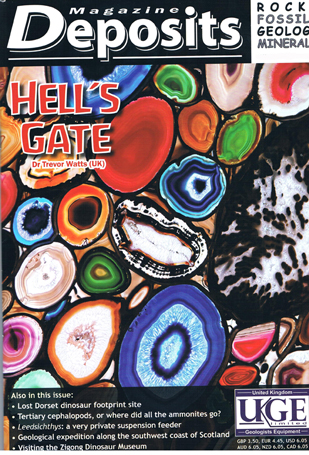
As always the latest edition, is jam packed full of interesting articles covering geology, palaeontology and of course mineralogy.  Must not forget the mineralogists, sometimes we overlook their contribution, pleasing to see the front cover is adorned with some artwork created from slices of colourful polished agate from around the world.

Front Cover of Deposits Magazine

Colourful agates adorn the front cover.

Picture credit: Everything Dinosaur

One of the good things about this magazine is that it does not limit itself to UK locations, in this issue readers are transported to far flung places such as Morocco, Kenya as well as Poland and our own Dorset coast.  Amongst the usual updates on fossil finds, book reviews, (great to see a review of the excellent publication “English Wealden Fossils”, edited by David Batten), directories of societies and so on, there is a fascinating article on one of our favourite prehistoric animals, the enigmatic Leedsichthys.  The article, written by Dr Jeff Liston documents some of the difficulties in excavating the delicate fossils associated with this huge pachycormid.  As always, the article is well illustrated with lots of photographs and some stunning artwork created by our chum Bob Nicholls of Paleocreations.com.

We looked on enviously at the pictures of recent finds from readers as well as the feature on the Zigong Dinosaur Museum, located at Dashanpu, at the heart of China’s Sichuan Province.  We regard this part of China as the “unofficial dinosaur capital of the world”, due to the amazing amount of dinosaur fossil material discovered in this area over recent years.

As guest editor, Dick Mol of he Natural History Museum (Rotterdam, The Netherlands) states:

“Deposits is an extremely attractive publication, – large sized magazine with an eye-catching layout.”

Check out issue 29, it is well worth reading.

For dinosaur and prehistoric models and figures: Dinosaur and Prehistoric Animal Models.

21 01, 2012

Picking “Tulips” from the Burgess Shale (New Research Paper)

By |2024-04-22T14:04:08+01:00January 21st, 2012|Categories: Dinosaur and Prehistoric Animal News Stories, Palaeontological articles|0 Comments

Canadian Scientists Provide Insight into Bizarre New Filter Feeding Animal 

The Burgess Shale (British Columbia, Canada) is regarded as one of the world’s most important fossil locations.  This UNESCO World Heritage site, discovered over one hundred years ago has yielded thousands of Middle Cambrian marine fossils.  The beautifully preserved specimens have provided scientists with a fascinating glimpse into an marine ecosystem that existed approximately 505 million years ago.

The Burgess Shale

Although, these highly fossiliferous shales have been known about since 1909, they are still capable of providing surprises and this week, a team of Canadian researchers have published a paper on a strange, filter feeding animal, that resembled a tulip.

The strata which contains the remains of these “Tulip beds” was first explored more than twenty-five years ago and more than 1,000 actual fossil specimens are known but these strange creatures, a bizarre type of invertebrate that is difficult to place in taxonomic phyla has just been formally named and described.  The newest member of the Burgess Shale ecosystem is to be known as Siphusauctum gregarium.  The formal scientific name describes the filtering feeding mechanism with which this animal obtained nutrients as well as recognising the gregarious nature of this bizarre Cambrian beastie.

Siphusauctum gregarium

The name means (gregarious, large cup).  Although, not living in a colonial structure such as a sponge colony or a coral, these animals did congregate together, perhaps exploiting a particularly rich feeding area.  One slab of shale contains the remains of at least sixty-five individual animals.  It seems that the group (or should we refer to them as a “field”) was wiped out when that area of the seabed suffered some catastrophic event and was covered in a sudden deposit of sediment.

The fossils indicate that these creatures reached lengths in excess of 20 centimetres and a paper analysing these has been published online in the scientific journal “The Public Library of Science”.

Strange Filter Feeder of the Middle Cambrian – S. gregarium

Bizarre filter feeder of the Middle Cambrian.

Picture credit: M. Collins/Royal Ontario Museum/University of Toronto/PLoS One

The organism seems to be adapted to a benthic existence (living on the sea floor).  There is a single hold-fast structure which would have been partially submerged in the mud helping the organism to remain in one place.  A long stem, with an an internal tube, surrounded by a sheath supports the feeding mechanism and the gut above the sea floor.  This new type of stalked filter feeder had its gut, anus, other organs including a simple, straight digestive tract housed in an egg-shaped structure that was perched on top of the stalk.

This bulbous structure (known as a calyx)  resembles the head of a tulip flower.  A flexible sheath covers the calyx, there are six small, circular openings at the base of this structure and a central orifice at the top (believed to be the anus), surrounded by other smaller openings.  The creature seems to have a six-fold radial symmetry with each of its six segments having cilia (fine hair-like appendages), surrounding a body cavity that contained the stomach and other organs.

The Scientific Paper

The paper’s lead author Lorna O’Brien, a PhD student at the University of Toronto, postulates that S. gregarium was a filter feeder, with water passing through the openings and the fine hair-like appendages could “comb out” food particles.  These creatures probably were able to actively pump water through themselves rather than passively waiting for food to drift through their various openings.  Like many other strange creatures from the Burgess Shale, scientists are unsure what animals alive to day are the descendants of these creatures, or whether S. gregarium represents an evolution of a life-form that simply left no modern descendants – a sort of evolutionary experiment that failed to work.

Student Lorna stated:

“Most interesting is that this feeding system appears to be unique among animals.  Recent advances have linked many bizarre Burgess Shale animals as primitive members of many animal groups that are found today but Siphusauctum defies this trend.  We do not know where it fits in relation to other organisms.”

How these strange creatures relate to modern phyla remains unclear, Lorna and her PhD supervisor, Jean-Bernard Caron (Curator of Invertebrate Palaeontology at the Royal Ontario Museum (Toronto), suggest that another bizarre fossilised creature Dinomischus – a stalked Cambrian filter feeder may have a similar role in the ecosystem, but S. gregarium seems to have lived at much greater depths and formed an much larger proportion of the fauna. Dinomischus spp  seem to be solitary, but S. gregarium formed large beds.

Nearly all the specimens known are compressed and fragmented, just one specimen has been found so far that was compressed vertically to reveal the six-fold radial symmetry.  It is likely that these animals were soft-bodied, but their relationship to earlier fauna, such as the Ediacaran fauna also is unclear.

Some of the Best Preserved Fossils of Siphusauctum gregarium

Tip-toe through the “tulips”.

Picture credit: Royal Ontario Museum/University of Toronto/PLoS One

The Burgess Shale (and the Chengjiang – another important Cambrian fossil site, in Yunnan, China), provide an amazing insight into the diversity of life in the oceans around 500 million years ago.  Who knows what other bizarre fossils lie awaiting discovery and study in these extensive fossil beds.

To view replicas and models of iconic Palaeozoic animals: CollectA Prehistoric Life Models.

19 01, 2012

Ancient Permian Predator from Brazil Described in New Scientific Paper

By |2024-04-22T14:28:06+01:00January 19th, 2012|Categories: Dinosaur and Prehistoric Animal News Stories, Palaeontological articles|1 Comment

Fierce Brazilian Predator that Roamed Long Before the Dinosaurs

Long before the dinosaurs evolved, terrestrial habitats were dominated by different kinds of reptiles, some of which were fearsome hunters, larger than most of the land carnivores found today.  A team of South American scientists have published a paper on one such formidable creature – an animal with huge canine teeth like a modern day tiger, but weighing twice as much as the biggest “big cats” around.

Ancient Permian Predator

Named Pampaphoneus biccai this new genus of ancient reptile is believed to be the earliest, large predator discovered to date in South America.  The name means “Bicca’s Pampas Killer”, honouring the land owner (José Bicca), as the fossils were found on his farm.  Described as a Dinocephalian therapsid, a group of Late Permian to Triassic reptile-like synapsids that include the ancestors of mammals, this animal was probably the top predator in the region in the Late Permian.

Pampaphoneus biccai – Vicious Permian Predator

The “Pampas Killer” on the hunt.

Picture credit: Voltaire Neto/Wits

Known from just a single skull, the fossils were first unearthed back in 2008, but the scientific paper which has been published in the scientific journal Proceedings of the National Academy of Sciences, was delayed as it took many hundreds of hours to carefully piece the skull together from the many fragments that had been found at the fossil site.

Pampaphoneus biccai

The discovery will help scientists to understand how this type of therapsid reptile diversified towards the end of the Permian period – Guadalupian/Lopingian epochs (265-260 million years ago), as they gradually replaced the pelycosaurs (animals such as the sail-backed reptile Dimetrodon), as the dominant large vertebrates on land.

To discover exposed sediments on the extensive grasslands of Brazil, the scientists employed images from Google Earth to assist them in their search.  Satellite images helped the team identify potential fossil sites which were not covered by vegetation, thus permitting the rock layers to be explored more easily.  This is not the first time that satellite technology has been employed to search for fossils in this way, many dinosaur fossils have been found using this technique.

With much of the Earth’s surface comprehensively mapped, scientists are able to pin point with great accuracy potential fossil yielding dig sites.  In the past, such locations were often discovered by painstakingly walking over an area or relying on reports of unusual finds from locals.

The restored skull measures over 35 centimetres in length.  It indicates that with its over-sized canines and other saw-like teeth this predator had a powerful bite.

Using more complete fossil specimens found in the Karoo Basin region of South Africa, the Brazilian palaeontologists have been able to build up a picture of what this four-footed predator looked like.   They estimate that it would have been over 3 metres in length, weighing in excess of 300 kilograms.  This makes it larger and heavier than the largest species of “big cat” predator found today.  Consider the prospect of a Komodo Dragon with the power and strength of a Siberian Tiger, and you are beginning to get an impression of what “Pampas Killer” would have been like.

The Restored Skull of Pampaphoneus biccai

Fierce Permian predator.

Picture credit: Dr Juan Cisneros

The Brazilian scientists worked with other palaeontologists and experts from Turkey and South Africa as they studied the skull bones and began to piece them together.  South Africa, the region known as the Karoo Basin, is a particularly rich source of Late Permian reptile fossils.  During the Late Permian, most of the land masses were squeezed together to form a single super-sized continent known as Pangea.

The southernmost portion of Pangea consisted of South America, Africa, India, Antarctica and Australia.  Studies of fossil plants found in these regions indicate that Pampaphoneus biccai lived in a relatively cool, forested climate.  This suggests that during the Late Permian, Brazil was actually much closer to the South Pole than it is today.

For models and replicas of prehistoric creatures from the Permian: CollectA Prehistoric Life (Deluxe Models).

Scientists hope to use the fossil evidence from South America to help build up a picture of therapsid diversification and migration during the Late Permian.  P. biccai may have been a very formidable predator, but this type of reptile was doomed to extinction just a few million years later.  Changing sea levels, an asteroid/comet impact and extensive flood basalt eruptions in what was to become Siberia led to perhaps the most devastating mass extinction event identified to date in the fossil record.

Ninety-five percent of all types of life on Earth became extinct at the end of the Permian.  The therapsid group of reptiles were severely affected.  Some twenty-one families of therapsids (63 percent) died out.

5 01, 2012

New Ichthyosaur Species Swims into View

By |2023-03-08T14:32:14+00:00January 5th, 2012|Categories: Dinosaur and Prehistoric Animal News Stories, Dinosaur Fans, Palaeontological articles|3 Comments

German Discovery – Challenges Ichthyosaur Extinction Theory

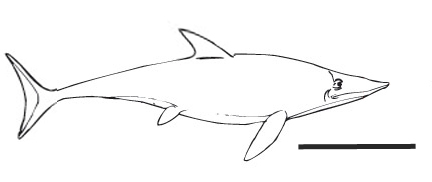
The partial remains of an ichthyosaur discovered by a fossil collector whilst exploring cuttings made by a road construction crew in Germany, may hold the key to shedding light on one of the mysteries surrounding the evolution of ichthyosaurs.  After a careful comparison with other known ichthyosaur specimens from Germany, England and the USA, this new creature has been regarded as a new ichthyosaur species and given the name Acamptonectus densus.   The name means “rigid swimmer”.

New Ichthyosaur Species

Ichthyosaurs, otherwise known as “fish-lizards” are an Order of reptiles that evolved in the Early Triassic and survived right up to near the end of the Cretaceous.  Ichthyosaurs were fast-swimming, nektonic and predatory marine reptiles.  With their dolphin-like bodies and with the ability to give birth to live young (viviparous), these creatures seemed to have been one of the most successful of all the marine reptile types.

A Model of a Typical Ichthyosaur

Affected by at least 3 major extinction events.

Picture credit: Everything Dinosaur

The picture (above) shows a Safari Ltd Ichthyosaurus replica, to view the rest of the models in this prehistoric animal model range: Prehistoric World Models.

Acamptonectus densus

However, scientists have identified at least three major extinctions that have affected the ichthyosaur Order.  Although the fossil record is far from complete, it is believed that the ichthyosaurs were subjected to the first mass extinction around 200 million years ago as the Triassic gave way to the Jurassic.  The second mass extinction took place as the Jurassic gave way to the Cretaceous around 145 million years ago, where factors such as climate change reduced the number of highly specialised ichthyosaurs surviving into the latter part of the Mesozoic.  The third major extinction event for the ichthyosaur Order took place around 90 million years ago during the Late Cretaceous.  The ichthyosaurs did not survive to the very end of the Mesozoic.

A Table Showing the Approximate Dates of Ichthyosaur Major Extinction Events

Showing the major ichthyosaur extinction events.

Table credit: Everything Dinosaur

It had been thought that the more specialised clade of ichthyosaurs known as the ophthalmosaurs, which had thrived in the Jurassic did not survive the second mass extinction event at the onset of the Cretaceous.  Ichthyosaur fossils found in Cretaceous-aged strata have tended to be representative of a second clade of these “fish-lizards”, known as the platypterygians.

There had been a number of fossil finds recorded from sediments laid down in the Cretaceous that have been ascribed to the ophthalmosaur clade, but these remains have been very fragmentary, so most scientists who had studied the ichthyosaur fossil record did believe that only the platypterygians survived into the Cretaceous geological period.  What caused these extinction events is still debated, but a number of other nektonic marine creatures, including other types of marine reptile also suffered major extinction events around these dates – especially at the Jurassic/Cretaceous boundary.

An Illustration of a Typical Ophthalmosaur Ichthyosaur

Palvennia hoybergeti illustrated
An illustration of the ophthalmosaurid Ichthyosaur Palvennia hoybergeti.

Picture credit: Everything Dinosaur.

The discovery of a much more complete ophthalmosaur ichthyosaur in Germany, provides the best evidence yet that this type of dolphin-like, marine reptile did survive well into the Cretaceous. The specimen, which represents an animal around three metres long has been studied by a number of ichthyosaur specialists. It is believed this marine reptile fed on fish and cephalopods.

A Race Against Time

Private fossil collector Hans-Dieter Macht discovered the specimen whilst collecting fossils at the construction site of a new main road in the Cremlingen area, (Lower Saxony, Northern Germany), in the late spring of 2005. After finding some isolated vertebrae the collector informed the director of the State Natural History Museum at Braunschweig and a formal excavation began. As the need to complete the roadway was pressing, the field team had just three days to study the site and remove any more fossilised bones.

Despite the extreme time pressure the scientists were able to find fragmentary skull material, parts of the jaws, elements from the scapular girdle, pieces of rib, vertebrae and a complete right humerus (upper arm bone).

Ichthyosaur Fossils Provide Evidence of Ophthalmosaurs Surviving into the Cretaceous

The crushed skull of a new species of ichthyosaur.

Picture credit: PLoS One/Fischer et al.

Commenting on the find, the director of the State Natural History Museum (Braunschweig), Ulrich Joger stated:

“With this, an entire extinction theory will be questioned.”

Since the discovery of these bones almost seven years ago, palaeontologists from Germany, Scotland, England and Belgium have compared the skeleton with a similar one found back in 1958 on the north-east coast of England and determined that there is fossil evidence to suggest ophthalmosaurus did indeed survive into the Cretaceous.

The scientific paper: “New Ophthalmosaurid Ichthyosaurs from the European Lower Cretaceous Demonstrate Extensive Ichthyosaur Survival across the Jurassic–Cretaceous Boundary” by Valentin Fischer, Michael W. Maisch, Darren Naish, Ralf Kosma, Jeff Liston, Ulrich Joger, Fritz J. Krüger, Judith Pardo Pérez, Jessica Tainsh and Robert M. Appleby published in PLoS One.

27 12, 2011

Made in China – The Evolutionary Origins of Multi-cellular Life Forms

By |2023-03-08T13:58:26+00:00December 27th, 2011|Categories: Dinosaur and Prehistoric Animal News Stories, Palaeontological articles|2 Comments

Chinese Fossils shed Light on Single-celled Ancestry of Animals

An international team of scientists have published a remarkable paper detailing their research into an amazing, microscopic fossil that provides evidence of the single-celled ancestor of all complex animal life forms.

The fossil shows an amoeba-like organism dividing in asexual cycles, first to produce two cells, then four, eight, sixteen, thirty-two and so on.  The pattern of cell division is very similar to that found in animal embryos, including our own human embryo – but the fossil dates from approximately 570 million years ago, from a geological period known as the Ediacaran (Proterozoic Eon).

The term Proterozoic means “earlier life” in Greek, and this eon covers the time between 2.5 billion years ago up to the beginning of the Cambrian geological period around 542 million years ago.  Scientists know that over this immense period of time, life on Earth slowly became more diverse and complex – although all life remained on the microscopic scale up until almost the end of this eon, a time referred to as Neoproterozoic era.

The activity of photosynthetic microbes, transformed our planet providing it with an oxygenated atmosphere, this had first begun in the Archean Eon, but this process continued and in conjunction with climatic changes, simple life forms started to become more abundant.  Although, Natural History museums, focus on vertebrate life forms such as dinosaurs and Woolly Mammoths for example, the evolutionary events taking place during the Proterozoic era had a much more significant impact on life on Earth.

During the Proterozoic, cells gradually became larger, more diverse and specialised.  Eukaryotes (cells with a nucleus) began to dominate and feeding by ingestion that would eventually lead to the evolution of a gut and digestive system took place for the first time.  The transformation of simple cells into these more advanced, specialised cells was probably the longest and hardest step in evolution – demonstrated by the fact that as the Proterozoic gave way to the Phanerozoic (visible life) Eon, there was to be a huge acceleration in evolution – known as the Cambrian explosion.

Fossil evidence of the single-celled ancestors of animals are extremely rare. However, an international team of scientists have discovered such a set of fossils in rocks dating to around 570 million years ago – Middle Ediacaran Period.  The fossils were unearthed in southern China.  The paper on this discovery has just been published in the journal “Science”.  The research team was made up of scientists from the Paul Scherrer Institute, the Chinese Academy of Geological Sciences, Bristol University and the Swedish Museum of Natural History.

Computer Generated Image of Micro-Fossil Undergoing Division

Meet your earliest Ancestor?

Picture credit: University of Bristol Press Release

The computer generated and enhanced image shows 570-million-year-old multi-cellular spore body undergoing vegetative nuclear and cell division (foreground) based on synchrotron x-ray tomographic microscopy of fossils recovered from rocks in South China.  The background shows a cut surface through the rock – every grain (about 1 mm diameter) is an exceptionally preserved gooey ball of dividing cells turned to stone.

Single-celled Ancestry

One theory as to the origins of complex life on our planet, proposes that sophisticated eukaryotic cells evolved by the symbiotic fusing of different kinds of bacteria.  For example,  bacteria capable of fermenting substances merged with swimming, mobile bacteria and the resultant life forms, over hundreds of millions of years merged with oxygenating bacteria and some of these life forms were to become the ancestors of the Animal Kingdom.

However, fossil evidence of these major evolutionary transitions is extremely rare.

The fossils, studied by the international team show in remarkable detail the stages the life cycle of an amoeba-like organism dividing in asexual cycles.  Ultimately resulting in hundreds of thousands of spore-like cells that were then released to start the cycle over again.   The pattern of cell division is so similar to the early stages of animal (including human) embryology that until now they were thought to represent the embryos of the earliest animals.

Using advanced sophisticated X-ray scanning techniques the scientists were able to view the organisation of cell structures within their protective cell walls.  These delicate structures should not have been fossilised but within their marine environment, they became buried in sediments rich in phosphates and it was these phosphates that impregnated the cell membranes, turning them into stone.

Imagine a 570-million-year-old tomb, within which can be found microscopic evidence of cell division.

Lead author on the subsequent research paper Therese Huldtgren, a doctoral student at the Department of Palaeozoology, at the Swedish Museum of Natural History, Stockholm, Sweden commented:

“The fossils are so amazing that even their nuclei have been preserved.”

The powerful X-ray microscopy methodology used by the team revealed that the fossils had features that multi-cellular embryos did not  This led the researchers to the conclusion that the fossils were neither animals nor embryos but rather the reproductive spore bodies of single-celled ancestors of animals.

The team used a gigantic microscope in Switzerland to see inside the fossils.  This machine is called the Synchrotron, and it is housed in a building the size of a football stadium.  It is the one of only a handful of machines of its kind that can produce X-ray images of the magnification and clarity to permit scientists to study micro-fossils in great detail.

Powerful generators fire high-energy electrons around a circular tube, at phenomenal speeds (close to the speed of light).   As they travel, they emit X-rays that are so strong that they can penetrate solid rock, and the tiny microscopic fossils, allowing scientists to build up a three-dimensional image of the primitive organism represented by the fossil material.

Professor Philip Donoghue, Professor of Palaeobiology at the School of Earth Sciences, (University of Bristol), stated:

“We were very surprised by our results.   We have been convinced for so long that these fossils represented the embryos of the earliest animals, much of what has been written about the fossils for the last ten years is flat wrong.   Our colleagues are not going to like the result.”

Professor Stefen Bengtson,  Professor of Palaeozoology, at the Swedish Museum of Natural History, Stockholm added:

“These fossils force us to rethink our ideas of how animals learned to make large bodies out of cells.”

Prior to this research such images were interpreted as being the embryos of early animals, sponges or perhaps even the cells of sulphur-oxidising bacteria.  Looking at and interpreting the preserved remains of organisms more than 550 million years old which measure just a few microns across is at the cutting edge of palaeobiology, but the team are confident about their findings.

Which Kingdom are You?

Animalia, Plantae, Fungi etc.

Image credit: S. A. Museum

The picture above shows another example of a micro-fossil from China.  This too dates from the Late Proterozoic Eon.  Prior to this new research such fossil images were thought to represent a number of organisms, including embryos of animals that can be found in the Ediacaran fauna, but now some images produced by high-powered X-ray tomography are being interpreted as evidence of the evolutionary origins of multi-cellular life forms.

For models and replicas of prehistoric animals including ancient invertebrates: CollectA Prehistoric Life/Age of Dinosaurs Models.

13 12, 2011

Remember the Amazing Alamosaurus – North America’s Biggest Dinosaur

By |2024-04-22T13:59:32+01:00December 13th, 2011|Categories: Dinosaur and Prehistoric Animal News Stories, Dinosaur Fans, Palaeontological articles|9 Comments

Alamosaurus Rivals Largest Titanosaurs after Recent Fossil Discovery

For a long time, this Late Cretaceous titanosaur called Alamosaurus sanjuanensis was the only known representative of the titanosaur group in North America.  Recent discoveries have revealed that other types of long-necked dinosaur may have migrated north from South America towards the end of the Age of Reptiles.  At an estimated twenty-one metres in length, scientists already knew that this particular dinosaur was a giant, but they had suggested that it was relatively lightly built and when compared to the leviathans of the titanosaur group such as Andesaurus, Antarctosaurus, Paralititan and Argentinosaurus, it remained only a “middle-weight” amongst some super-heavy-weight dinosaurs.

However, the discovery of some more fossilised bones ascribed to A. sanjuanensis may lead scientists to re-think their estimates for the size of this particular beastie, putting the Alamosaurus up there with some of the biggest land animals of all time.

New research from Montana State University’s Museum of the Rockies and the State Museum of Pennsylvania has unveiled enormous bones from North America’s biggest dinosaur.  Trust the Americans to find a dinosaur potentially as big as some of the gigantic sauropods known from South America.

In a paper published in the scientific journal –  “Acta Palaeontologica Polonica”, Montana State University researcher Denver W. Fowler and co-author Robert M. Sullivan from Harrisburg, Pa., describe two enormous vertebrae and a femur (thigh bone) that the team collected in New Mexico during expeditions that ran sporadically from 2003 to 2006.

Alamosaurus

The fossilised bones have been assigned to the  species  A. sanjuanensis a dinosaur that shared the Late Cretaceous habitat of the south-western United States with the formidable predator T. rex.

An Illustration of a Typical Giant Sauropod

Is the USA the number one spot for giant dinosaurs?

Picture credit: Everything Dinosaur

Commenting on the new fossil bones, Fowler stated:

“Alamosaurus has been known for some time; its remains were first described in 1922 from the Naashoibito beds of New Mexico.  Since then, more bones have been discovered in New Mexico, Utah, some really nice material from Texas, and Mexico, including a few partial skeletons.”

The size and scale of the newly discovered specimens indicates that Alamosaurus may have to be put up there with some of the dinosaur super-heavy-weights, perhaps rivalling the South American giants for the title of the largest land-living animal known to science.

Montana State University researcher Dr Holly Woodward, had shown in an earlier study that the femur thought to have come from an adult was still growing.  Previous height and weight estimates based on the femur and the vertebrae are going to have to be revised and scaled upwards.

Just how big?  That is the question, a spokesperson from Everything Dinosaur commented:

“Ontogeny in Dinosauria is not a precise science.  Dinosaurs for example, may have been subject to indeterminant growth, that is they kept growing throughout their lives.  The longer a sauropod lived the bigger it got – this makes determining maximum size for such creatures rather difficult.”

Fowler, postulated:

“Over the past 20 years, Argentinian and Brazilian palaeontologists have been unearthing bigger and bigger dinosaurs, putting the rest of the world in the shade.  However, our new finds not only show that Alamosaurus is newly recognised as the biggest dinosaur from North America, but also that it was right up there with the biggest South American species: the U.S. is back in the fight for the No.1 spot.”

Although comparison of the new Alamosaurus bones with the South American species gave the researchers an idea of size, giant specimens of sauropods like Alamosaurus and Argentinosaurus are only known from very fragmentary remains offering only a tantalising glimpse of what a complete Alamosaurus might look like.

Images show Nate Carroll, left, and Liz Freedman, a doctoral student in Jack Horner’s palaeontology laboratory, posing with the complete reconstruction of the neck vertebra of an Alamosaurus. Carroll, a Montana State University student majoring in Earth Sciences, made the sculpture.  Behind it is a sauropod model being attacked by a pair of dromaeosaurs in Montana States University’s Museum of the Rockies.

Fowler continued:

“We’d love to find more complete material.  Fortunately, Alamosaurus bones are quite common in the Naashoibito of New Mexico, so we have a good chance of going back and finding more, but in order to dig up one of the world’s biggest dinosaurs you need one of the world’s biggest dinosaur digging teams and large digging equipment.”

The World’s Largest Dinosaur?

With the title of the “World’s Largest Dinosaur” up for grabs perhaps some new sponsors will be happy to come forward to assist the scientists with their research – the race just might be on.

Which is the Biggest Dinosaur Known to Science?

Which country has the biggest dinosaur?

Picture credit: Montana State University/Denver Fowler

Large Titanosaur specimens are not the only fossils the scientists have found as they explore the Alamosaurus beds.  For example, the team unearthed a broken Tyrannosaurus tooth, perhaps belonging to a T. rex that broke a tooth when feeding on the Alamosaurus carcase.

The Tyrannosaur Tooth found in Association with Titanosaur Material

Did T. rex scavenge the carcase of Alamosaurus?

Picture credit: Montana State University

The discovery of the broken tooth indicates that large tyrannosaurs (potentially T. rex) co-existed with large titanosaurs.  They shared the same ecosystem.  Some scientists have suggested that in the north of its range T. rex specialised in hunting hadrosaurs and ceratopsians whilst in the south they were mainly predators of titanosaurs such as Alamosaurus.

The Alamosaurus discovery goes beyond just “size” bragging-rights, and may have important implications for other dinosaurs.  Recent discoveries by American palaeontologist Jack Horner’s and his paleo lab at the Museum of the Rockies have highlighted the importance of understanding growth and ontogeny in interpreting dinosaur evolution.

Fowler concluded by stating:

“Increasingly, we’re finding that very large or small individuals often look very different, and are often described as different species.  Our findings show that Alamosaurus was originally described based on immature material, and this is a problem as characteristics that define a species are typically only fully gained at adult size.  This means that we might be misinterpreting the relationships of Alamosaurus and possibly other sauropod dinosaurs too.”

A Model of an Alamosaurus (CollectA Prehistoric Life)

Alamosaurus
Alamosaurus dinosaur model (CollectA)

Picture credit: Everything Dinosaur

The picture (above) shows a CollectA Alamosaurus dinosaur model.

To view the range of CollectA not-to-scale models and figures: CollectA Age of Dinosaurs/Prehistoric Life Figures.

6 12, 2011

Killer Claws and Flapping Wings

By |2023-03-08T14:06:28+00:00December 6th, 2011|Categories: Dinosaur and Prehistoric Animal News Stories, Palaeontological articles|0 Comments

Dromaeosaurs with their Killer Claws Yield New Theory on the Origin of Flight

Scenes from the trilogy of Jurassic Park movies where large dromaeosaurs allegedly Velociraptors, attack people with their sickle-like, second toe claws will have to be re-shot as new research from Montana State University’s Museum of the Rockies provides a new angle on the use of those killer claws.

Claws to Hold Prey

The research team have postulated that the use of the claws to hold prey rather than kill prey, led to these meat-eaters evolving a flapping motion with their arms to help keep them stable as they struggled with their victims.  This could have led to the evolution of powered flight.

In a paper published this month, in the on line scientific journal PLoS ONE (public library of science) researchers Denver W. Fowler, Elizabeth A. Freedman and John B. Scannella along with Robert E. Kambic (Brown University in Rhode Island), describe how comparing modern raptors helped develop a new behaviour model for dromaeosaurs.

A Model of a Typical Dromaeosaurid (Schleich Velociraptor)

How did dromaeosaurs use their wings?  A model of a Velociraptor.

Velociraptor dinosaur model from Schleich. New research changes perceptions about dromaeosaurids. Picture credit: Everything Dinosaur.

Picture credit: Everything Dinosaur

Lead author Fowler commented:

“This study is a real game-changer.  It completely overhauls our perception of these little predatory dinosaurs, changing the way we think about their ecology and evolution.”

The study focuses on dromaeosaurids; a group of small predatory dinosaurs that include the famous Velociraptor and its larger relative, the man-sized Deinonychus.  The Jurassic Park movie “raptors” supposedly Velociraptors were far too large when depicted on the screen to represent the likes of Velociraptor mongoliensis.  Instead, the animals in the film were a better representation of Deinonychus antirrhopus.  Dromaeosaurids are closely related to birds, and are most famous for possessing an enlarged sickle-claw on digit two (inside toe) of the foot.

Previous researchers suggested that this claw was used to slash at prey, or help climb up their hides, to gain a purchase on large prey but the new study proposes a different type of behaviour.

Fowler said:

“Modern hawks and eagles possess a similar enlarged claw on their digit 2’s, something that hadn’t been noted before we published on it back in 2009.  We showed that the enlarged D-2 claws are used as anchors, latching into the prey, preventing their escape.  We interpret the sickle claw of dromaeosaurids as having evolved to do the same thing – latching in, and holding on.”

As in modern birds of prey, precise use of the claw is related to relative prey size.

Fowler went onto add:

“This strategy is only really needed for prey that are about the same size as the predator; large enough that they might struggle and escape from the feet.  Smaller prey are just squeezed to death, but with large prey all the predator can do is hold on and stop it from escaping, then basically just eat it alive.  Dromaeosaurs lack any obvious adaptations for dispatching their victims, so just like hawks and eagles, they probably ate their prey alive too.”

Dromaeosaurids

A spokesperson from Everything Dinosaur, stated that watching carnivorous dinosaurs attacking and killing prey would have been a horrific experience, these predators probably started to eat their victims when the prey was still alive.  If this is stomach churning, then it has to placed in context, that cuddly labrador that shares many people’s homes is in fact descended from wolves which when attacking large animals do start to eat their fill before the animal has expired in many cases.

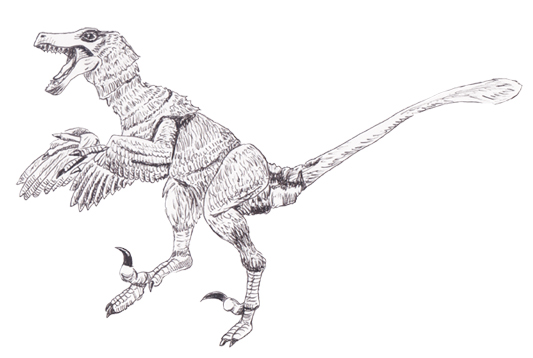
“Flapping First” Velociraptors may shed New Light on Origins of Flight

Drawing of Velociraptor osmolskae.

A drawing of Velociraptor osmolskae.  Dromaeosaurids with their “killing-claws” shed light on the origins of powered flight amongst the Theropoda.

Picture credit: Everything Dinosaur.

The picture (above) is an illustration of a dromaeosaurid from the Beasts of the Mesozoic range of articulated dinosaur figures.

To view this range: Beasts of the Mesozoic Articulated Dinosaur Figures.

Other features of bird of prey feet gave the research team clues as to the functional anatomy of their ancient relatives, toe proportions of dromaeosaurids seemed more suited for grasping than running, and the metatarsus (bones between the ankles and the toes) shows adaptations for strength rather than speed.

Fowler stated:

“Unlike humans, most dinosaurs and birds only walk on their toes, so the metatarsus forms part of the leg itself.  A long metatarsus lets you take bigger strides to run faster; but in dromaeosaurids, the metatarsus is very short, which is odd.”

Fowler thinks that this indicates that Velociraptor and its kin were adapted for a strategy other than simply running after prey.

He continued:

“When we look at modern birds of prey, a relatively short metatarsus is one feature that gives the bird additional strength in its feet.  Velociraptor and Deinonychus also have a very short, stout metatarsus, suggesting that they had great strength but wouldn’t have been very fast runners.”

The ecological implications become especially interesting when dromaeosaurids are contrasted with their closest relatives: a very similar group of small carnivorous dinosaurs called troodontids.

“Troodontids and dromaeosaurids started out looking very similar, but over about 60 million years they evolved in opposite directions, adapting to different niches.  Dromaeosaurids evolved towards stronger, slower feet; suggesting a stealthy ambush predatory strategy, adapted for relatively large prey.  By contrast, troodontids evolved a longer metatarsus for speed and a more precise, but weaker grip, suggesting they were swift but probably took relatively smaller prey.”

The study also has implications for the next closest relatives of troodontids and dromaeosaurids – the birds (Aves).   An important step in the origin of modern birds was the evolution of the perching foot.

Fowler said:

“A grasping foot is present in the closest relatives of birds, but also in the earliest birds like Archaeopteryx.  We suggest that this originally evolved for predation, but would also have been available for use in perching.  This is what we call ‘exaptation:’ a structure evolved originally for one purpose that can later be appropriated for a different use.”

The new study proposes that a similar mechanism may be responsible for the evolution of flight.

Fowler went onto state:

“When a modern hawk has latched its enlarged claws into its prey, it can no longer use the feet for stabilization and positioning.  Instead the predator flaps its wings so that the prey stays underneath its feet, where it can be pinned down by the predator’s body-weight.”

The researchers suggest that this “stability flapping” uses less energy than flight, making it an intermediate flapping behaviour that may be key to understanding how flight evolved.

The research team stated:

“The predator’s flapping just maintains its position, and does not need to be as powerful or vigorous as full flight would require.  Get on top, stay on top; it’s not trying to fly away.  We see fully formed wings in exquisitely preserved dromaeosaurid fossils, and from biomechanical studies we can show that they were also able to perform a rudimentary flapping stroke.  Most researchers think that they weren’t powerful enough to fly; we propose that the less demanding stability flapping would be a viable use for such a wing, and this behaviour would be consistent with the unusual adaptations of the feet.”

Flapping Behaviours

Another group of researchers has proposed that understanding flapping behaviours is key to understanding the evolution of flight, a view with which Fowler agrees:

“If we look at modern birds, we see flapping being used for all sorts of behaviours outside of flight.  In our paper, we are formally proposing the ‘flapping first’ model: where flapping evolved for other behaviours first, and was only later exapted for flight by birds.”

The researchers believe their new ideas will open multiple new lines of investigation into dinosaur paleobiology, and the evolution of novel anatomical structures.

Everything Dinosaur acknowledges the press release from Montana State University which has been most helpful in compiling this article.

1 12, 2011

Enter the Amazing “Fossil Zone”

By |2024-04-22T13:48:57+01:00December 1st, 2011|Categories: Dinosaur Fans, Palaeontological articles|0 Comments

Everything Dinosaur Recommends – Mike’s Minerals and Fossils AKA “The Fossil Zone”

At this time of year, what with Christmas approaching, team members at Everything Dinosaur get asked to recommend a reliable, professional source of fossils and other Earth science related materials.  We work with a number of specialists and we are happy to pass on contact details to collectors and the mums and dads of young dinosaur fans keen to start their own fossil collection.

The “Fossil Zone”

Unfortunately, as the popularity of fossil collecting grows, and the prices paid for certain rare items increases, so we have come across a number of somewhat dubious practices, in fact there is quite a cottage industry of “doctored” fossils.  For example, fragments of different fossil teeth glued together to make one single specimen or “topping and tailing” as we refer to it, the practice of taking shed head-shield (cephalon) of trilobites and joining this piece to the thorax and the tail (pygidium) to make a complete trilobite fossil.

Even great naturalists such as David Attenborough can be hoodwinked.  Once during a filming trip to Morocco, he took the opportunity to visit a shop selling locally found trilobite fossils.  He was persuaded to part with quite a substantial sum of money for what he was told was an exceptionally rare piece – two trilobites preserved in a mating position.  It is only after Sir David had left the shop with his purchase that he remembered that these arthropods did not actually need physical contact to mate.  A careful examination revealed that two separate fossils had been skilfully and very carefully stuck together to make the single exhibit.

We admire the skill of such preparators, but if you want to purchase fossils and other objects, we would recommend Mike’s Minerals and Fossils.

This Lyme Regis (Dorset) based business is run by Mike Jeffries  and the Jeffries family.  Mike is a very  knowledgeable expert on British fossils and is always willing to help.

Amazing Fossils for Sale

A reliable source of fossils.

He started the business as a hobby in 1995, selling fossils, minerals and jewellery and if you are ever in Lyme Regis, look out for Mike’s shop on Drakes Way – it is well worth a visit.

So, for a reliable and friendly fossil shop, Everything Dinosaur is happy to recommend Mike Jeffries.

Happy fossil collecting.

For further information and advice: Email Everything Dinosaur.

Go to Top