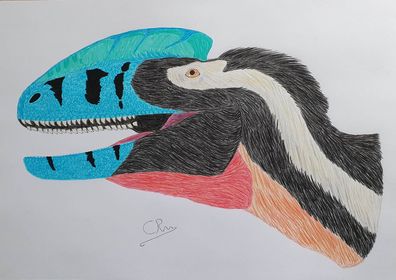
The Late Jurassic tyrannosauroid dinosaur from China Guanlong illustrated by a young fan of dinosaurs and prehistoric animals.
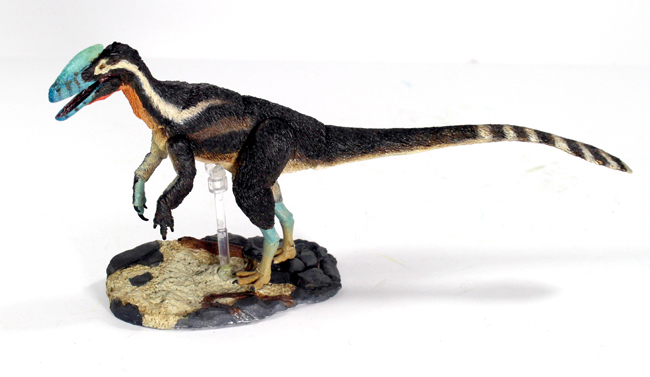
Our thanks to Caldey who sent into Everything Dinosaur a fabulous illustration of Guanlong wucaii inspired by the recently introduced Beasts of the Mesozoic articulated Guanlong figure.
A very colourful Guanlong. A beautiful illustration of the Late Jurassic tyrannosauroid inspired by the recently introduced Beasts of the Mesozoic articulated Guanlong model. Picture credit: Caldey
Picture credit: Caldey
Early Members of the Tyrannosauroidea
Assigned to the Proceratosauridae within the Tyrannosauroidea superfamily, Guanlong demonstrates that the tyrannosaurs are an ancient lineage within the Theropoda. Caldey has chosen to give the pneumatised cranial crest a striking blue colour with hints of green. The jaws too have been carefully coloured blue, but this time with patches of black. This colouration contrasts with the bold black and white stripes and bright red throat patch.
It is thought that these dinosaurs used their impressive crests in displays. Perhaps to demonstrate fitness for breeding or to ward off rivals.
A spokesperson from Everything Dinosaur thanked Caldey for her excellent drawing and commented:
“Guanlong is known from two specimens, found in close proximity to each other. Its discovery helped palaeontologists to better understand the evolutionary changes in theropod dinosaurs leading to the Tyrannosauridae family. In addition, as the two Guanlong specimens represent individuals of different ages, scientists were able to learn more about how dinosaurs changed as they matured.”
The spokesperson praised Caldey’s illustration and added:
“The large, prominent crest may indeed have been brightly coloured and Caldey has carefully observed the Beasts of the Mesozoic model and produced a wonderful illustration.”
The curators at the Museums Victoria confidently predict that their Triceratops exhibition will exceed one million visitors next month. In an email sent to Everything Dinosaur, the Museums Victoria state that “Triceratops: Fate of the Dinosaurs” will have received over a million visitors by the middle of June 2023.
“Triceratops: Fate of the Dinosaurs” is an immersive voyage into a lost world. Visitors will explore the landscapes of the Late Cretaceous and get to know the prehistoric animals that thrived there. The star exhibit is a specimen of Triceratops horridus. The fossils of this dinosaur were discovered in Montana (2014).
The bones found represent about 87% of the entire skeleton. It is one of the most complete, large dinosaur fossils ever found. The skull and neck frill are the most complete of any known Triceratops specimen (greater than 99% complete). The assembled frill measures over 1.48 metres wide.
One Million Visitors
The exhibition has proved to be extremely popular. Museum staff have predicted that the attraction would have received a million visitors by the middle of next month (June 2023).
To celebrate this milestone, staff will be dressing up as dinosaurs for the day. Visitors to Melbourne Museum, the location of the Triceratops exhibit, will also be encouraged to channel their “inner dinosaur”. Visitors will be invited to come to the museum in dinosaur fancy dress. According to the correspondence received by Everything Dinosaur, spot prizes will be offered for the best costumes.
A Triceratops Exhibit
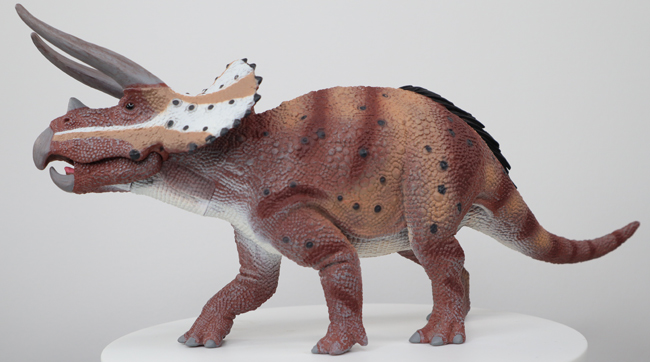
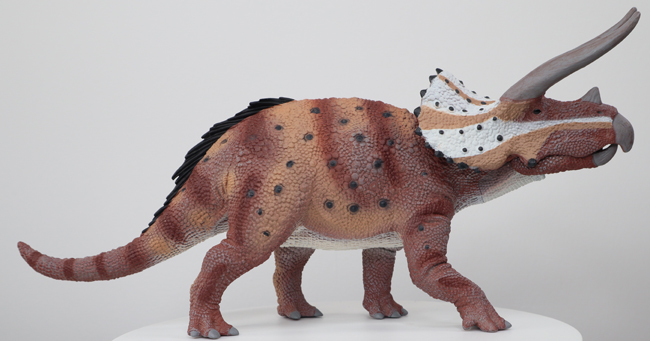
The Triceratops skeleton has been nicknamed “Horridus”. The fossils inspired CollectA to create a 1:40 scale Triceratops horridus figure.
The CollectA Triceratops in right lateral view. Picture credit: Everything Dinosaur.
Picture credit: Everything Dinosaur
A spokesperson from Everything Dinosaur stated:
“We are delighted that the Triceratops exhibit has proved to be so popular. Our customer surveys confirm that Triceratops is a favourite dinosaur. It is pleasing to see this plant-eater taking centre stage.”
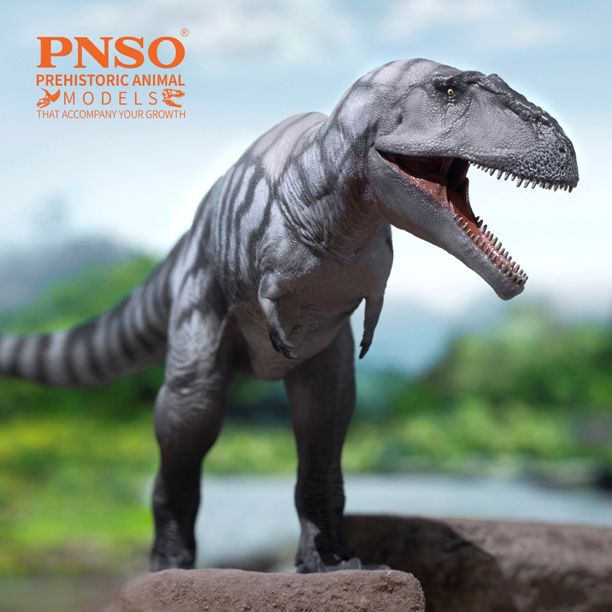
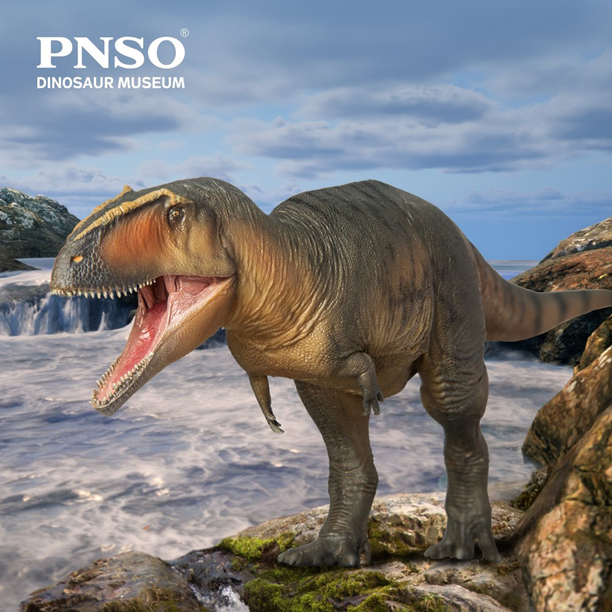
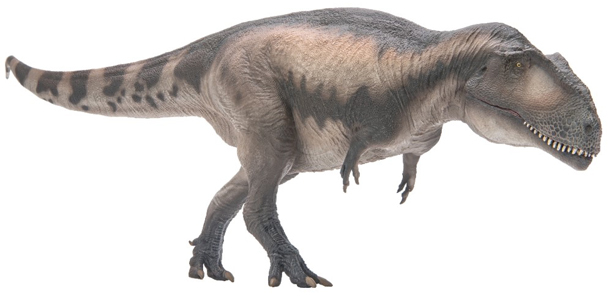
Dinosaur fan and model collector William sent into Everything Dinosaur his review of the recently introduced PNSO Meraxes model. William began his review by highlighting how quickly PNSO have produced a replica of Meraxes. This dinosaur was only named and scientifically described last year (2022).
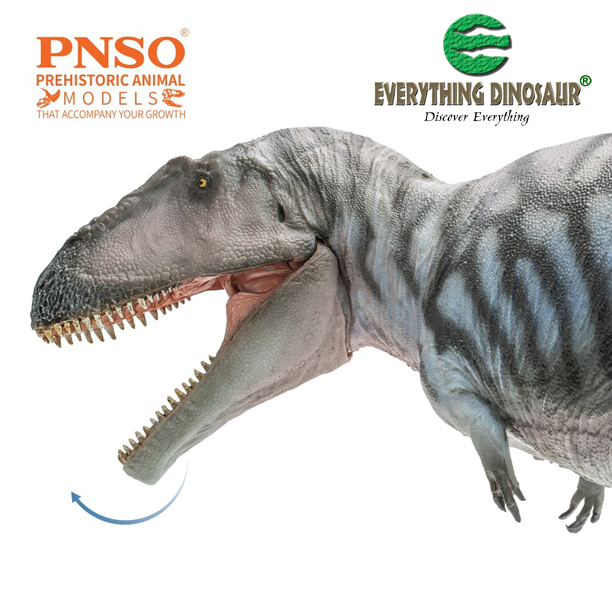
He explained that collectors can never have enough PNSO theropods in their collections. The head sculpt was praised for its scientific accuracy. The well-defined lacrimal crests and the nasal ridge were commented upon. The model has an articulated lower jaw. When the mouth is opened the characteristic “shark-like” teeth of the theropod can be seen.
The carcharodontosaurid from the Late Cretaceous of Argentina Meraxes gigas. The PNSO model is in stock at Everything Dinosaur in the spring (2023).
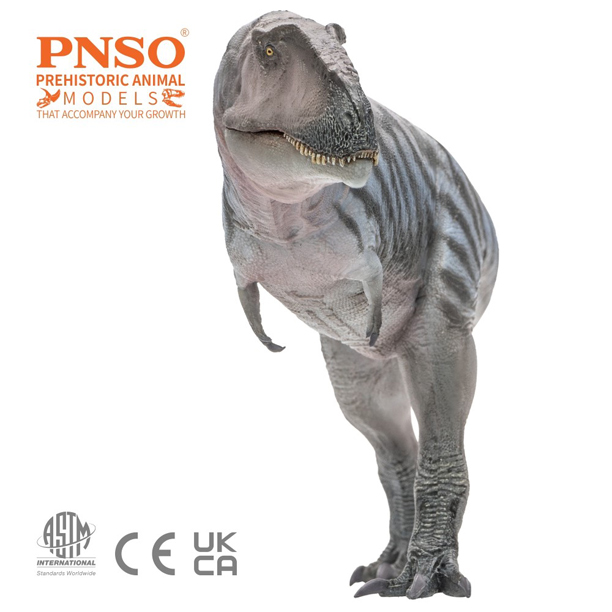
The reviewer states that the body sculpt is highly accurate and reflects what is known about this predator from the holotype fossil material. The figure has a muscular neck, a strong body and a powerful tail. He comments that members of the Carcharodontosauridae family tended to have very similar body shapes.
William explains:
“From start to finish all areas are detailed to the highest degree. No blank spots on the PNSO Meraxes model, there is even a cloaca.”
When reviewing the dinosaur’s limbs, the reviewer outlines the evolutionary path of these giant theropods. Reference is made to an earlier PNSO model review (Giganotosaurus 2.0). The small, highly detailed muscled forearms and the hands are well armed with the three fingered hand retaining powerful claws.
The reviewer comments that a new unique feature of “Mungo” are the pair of ankle spur claws that may have been used in intraspecific combat.
The new for 2023 PNSO Mungo the Meraxes dinosaur model, which will be available shortly from Everything Dinosaur.
The Dinosaur Model’s Colour Scheme
The main body colour is described as a mixture of stunning silver which phases into a silvery-blue. There is a rose tint added to the face, head, neck and jaw area. The charcoal stripes have been executed with careful consideration. The stripes on the tail are reminiscent of those seen on extant tigers.
William comments that the model measures around 11.9 inches long. The head height is 4.1 inches and the declared scale 1:35.
As with previous model reviews, William confirms that the PNSO Meraxes model is supplied with a transparent support stand, full-colour booklet and a poster.
To view the range of PNSO prehistoric animal figures available from Everything Dinosaur: Age of Dinosaurs PNSO Models.
The Meraxes model will have an articulated lower jaw.
Meraxes gigas
William also sent in some information about this dinosaur’s fossils and their discovery.
Time Period: Late Cretaceous 95–93.9 million years ago (Cenomanian stage).
Location: Argentina Province of Mendoza in the western central of the Cuyo region.
Discovery: Meraxes’s holotype the “Campanas carcharodontosaurid” was found in 2012. It is the most complete carcharodontosaurid skeleton ever unearthed. The skull material permitted scientists to better understand the skull morphology of other carcharodontosaurids including Giganotosaurus and Mapusaurus.
The name Meraxes is derived from the name of a great, grey, female dragon from the fantasy book series, “A Song of Ice and Fire” by George R. R. Martin. William speculated whether the colour scheme chosen for the PNSO figure had been influenced by this book.
Classification:
Order: Theropoda.
Superfamily: Allosauroidea.
Clade: Carcharodontosauria.
Family: Carcharodontosauridae.
Subfamily: Giganotosaurini.
Genus: Meraxes.
Species: M. gigas.
William commented that this dinosaur has been estimated to have been around 33 feet long, with a head height of 9 feet. It weighed approximately 4.26 tonnes.
In concluding his review William declared:
“Meraxes is the second of three recent Carcharodontosauridae releases by PNSO. “Mungo” alone is spectacular by himself from his sculpt to paint application, to the spurs on his heels. No soul can say he is a toy, he is a museum display piece or teaching aid demonstrating what a theropod should be.”
William added:
“Purchasing from Everything Dinosaur is fast, safe and secure with no nonsense.”
The Nanmu Studio Jurassic Series Giganotosaurus dinosaur models have arrived in stock at Everything Dinosaur. These three exciting dinosaur figures feature in the latest Everything Dinosaur company newsletter. The dinosaur replicas are named “Gustave”, “Typhon” and “King of the Border”. They pay tribute to the Giganotosaurus featured in the film “Jurassic World Dominion”.
The Nanmu Studio Jurassic Series Giganotosaurus Typhon Deluxe model complete with display base. Picture credit: Everything Dinosaur.
Picture credit: Everything Dinosaur
Jurassic Series Giganotosaurus Dinosaur Models
The headline model in the latest Everything Dinosaur newsletter is the Nanmu Studio Jurassic Series Giganotosaurus Typhon Deluxe figure. This beautifully detailed figure comes complete with a display base and an Everything Dinosaur fact sheet.
Each of the Giganotosaurus dinosaur models measures 44 cm in length approximately. When secured to their display base the models have a head height of 18.5 centimetres. The dinosaur model display base (supplied with each figure), measures 14 cm x 8 cm.
Gustave and King of the Border
The latest Everything Dinosaur customer newsletter also features Gustave and King of the Border. Everything Dinosaur offers three new Nanmu Studio Giganotosaurus figures.
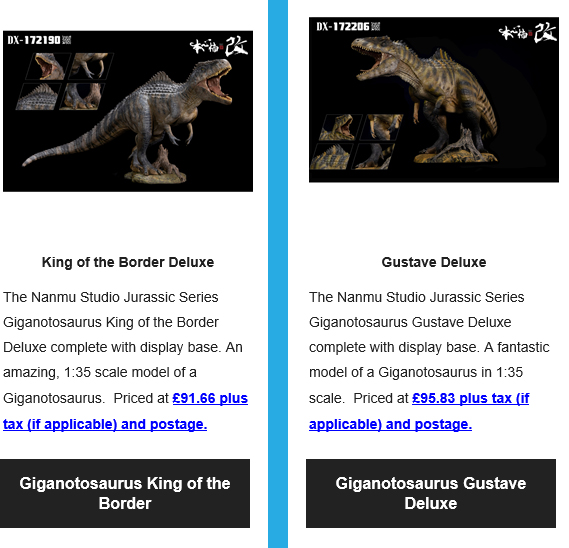
The Nanmu Studio Jurassic Series Giganotosaurus King of the Border Deluxe (left). The Nanmu Studio Jurassic Series Giganotosaurus Gustave Deluxe (right). Picture credit: Everything Dinosaur.
Picture credit: Everything Dinosaur
A spokesperson for the UK-based mail order company commented:
“We are delighted to have brought into stock these three figures. Each Giganotosaurus dinosaur model is beautifully painted. We decided to only bring the models that included display bases out of China. These figures are large and heavy, when displayed without the base they might fall over and get damaged.”
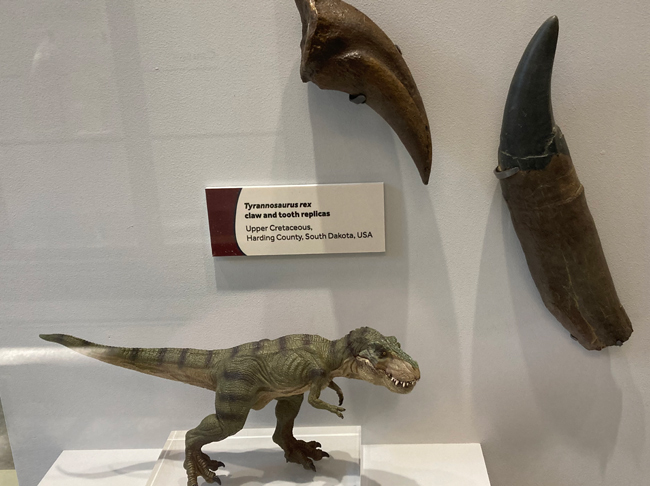
The Papo running T. rex dinosaur model was spotted by a sharp-eyed team member of Everything Dinosaur whilst on a visit to a local museum. The popular Papo dinosaur figure was in a display case next to a replica claw and a replica tooth of a Tyrannosaurus rex. The Papo running T. rex model was helping museum visitors to get an impression of what this huge theropod might have looked like.
A Papo green running Tyrannosaurus rex model on display next to a replica of a T. rex tooth and a T. rex claw. An exhibit at the Manchester Museum. Picture credit: Everything Dinosaur.
Picture credit: Everything Dinosaur
The model in the display case is not a scale dinosaur model. It does help to demonstrate the size of the claw and the T. rex tooth. This Papo running T. rex figure measures 33 centimetres long.
The Papo Running T. rex Dinosaur Model
The Papo running T. rex dinosaur model was introduced into the Papo “Les Dinosaures” range in 2012. Since its introduction, it has sold well and been a firm favourite amongst model collectors. It is one of several T. rex models in the Papo range.
A brown coloured version was also introduced. This was a limited-edition figure. The limited-edition figure was withdrawn from sale after a few months. Everything Dinosaur lobbied Papo and the model was re-introduced. The brown running T. rex figure is available from Everything Dinosaur.
A spokesperson from Everything Dinosaur commented that whilst the Papo figure may not be the most accurate figure of a T. rex, the model helps to contextualise the museum display.
Children seeing the familiar dinosaur model in a museum display can make the link between the toys that they play with and the actual animals that the model represents.
The spokesperson added:
“Children were excited to see the T. rex exhibit. Many also recognised the Papo dinosaur model. Hopefully, they can make a connection between toys and fossils.”
Our thanks to dinosaur fan and model collector William who sent into Everything Dinosaur his review of the new 2.0 PNSO Giganotosaurus figure. The reviewer commented that the head sculpt of this new PNSO theropod had been influenced by recent carcharodontosaurid research.
The detailing around the eyes and the ridges on the naris are praised.
The new PNSO Lucas the Giganotosaurus dinosaur model.
PNSO Giganotosaurus 2.0
The deep set of the nostrils and skull shape is commented upon. When the articulated jaw is opened, rows of sharp teeth are displayed.
William comments:
“The PNSO Giganotosaurus is the most accurate Giganotosaurus carolinii head sculpt created to date.”
The reviewer states that dinosaur fans have a true Giganotosaurus standing before them when the model is unpacked. It has powerful neck muscles, a broad, strong back and a muscular tail. A wealth of varied folds and scales cover the model’s main torso.
“From top to bottom no area goes unloved. All is covered in the details never missed by PNSO and the figure has a cloaca.”
Giganotosaurus Limbs
The arms end in hands with fearsome claws. The middle digit is slightly larger than the other two. The hindlimbs are robust and powerful. The left foot is slightly raised as if this dinosaur was captured in mid stride. The reviewer comments on the colour scheme chosen for the model. He praises the subtle application of ochre around the snout. The orange eye is almost watching you. The fudge brown of the lacrimal crest and nasal ridges draws the eye towards the head.
The PNSO Giganotosaurus dinosaur model in stock at Everything Dinosaur in the spring (2023).
The Model Measurements
As with previous reviews, William provides the model’s measurements.
Scale = 1:35 with a length of 14 inches and a head height of approximately 3.5 inches. He explains that the figure is supplied with a clear, support stand. The Giganotosaurus box contains a full-colour booklet and dinosaur posters.
Time Period: Late Cretaceous 99.6–95 million years ago (Cenomanian).
Location: Argentina, Patagonia, Villa El Chocón, in the Neuquén Province.
The Science Behind the PNSO Giganotosaurus
Just ten years after the discovery of the fossils of Baryonyx walkeri, once again good fortune led to the discovery of another theropod dinosaur. Rubén D. Carolini was cruising the Villa El Chocón Badlands when he spotted a dinosaur bone (tibia). He contacted professional palaeontologists and at the 1994 meeting of the Society of Vertebrate Paleontology, Giganotosaurus was introduced to the world.
Giganotosaurus carolinii means Carolini’s giant southern lizard and the first illustration was created by renowned artist James Gurney. After viewing photos taken at the fossil site of the holotype, the team was offered funding to recover the specimen by Don Lessem. The team recovered 70% of the holotype skeleton which is now preserved and exhibited in the Ernesto Bachmann Paleontological Museum in Villa El Chocón.
Lucas the Giganotosaurus has an articulated lower jaw.
Theropod Classification
As part of his review William provided information on this dinosaur’s taxonomy.
Order: Theropoda
Superfamily: Allosauroidea
Clade: Carcharodontosauria
Family: Carcharodontosauridae
Tribe: Giganotosaurini
Genus: Giganotosaurus
Species: G. carolinii
William explained that palaeontologists estimate the length of this dinosaur at around 43 feet. It may have weighed in excess of 13 tons. It was the apex predator in the ecosystem. Giganotosaurus may have hunted titanosaurs. Perhaps packs of these carnivores mobbed large titanosaurs, or perhaps hunting tactics were more co-ordinated. Our thanks to William for providing some suggestions as to the hunting tactics employed by these super-sized predators.
The reviewer concluded by praising Everything Dinosaur and the manufacturer stating that PNSO had created a most accurate version of Giganotosaurus. He commented on the other theropod dinosaurs that PNSO had recently introduced and suggested that a Concavenator model should be included in the range.
William added:
“My thanks to all the team at Everything Dinosaur. Praise where praise is due to Everything Dinosaur. A Giga thank you to you all for your hard work now and in the future. With Everything Dinosaur, we are given a great choice of delivery options, and all are fairly priced.”
Our thanks to William for sending into Everything Dinosaur his comprehensive PNSO Giganotosaurus 2.0 model review.
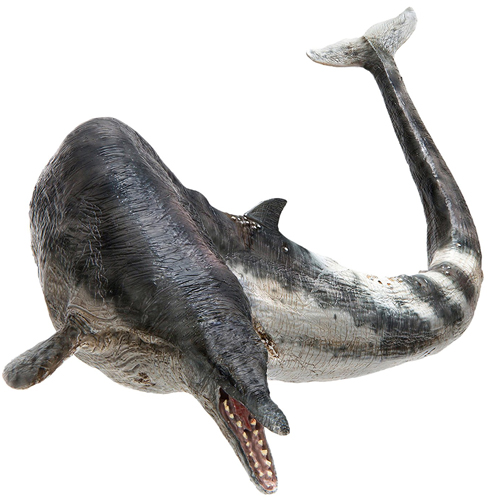
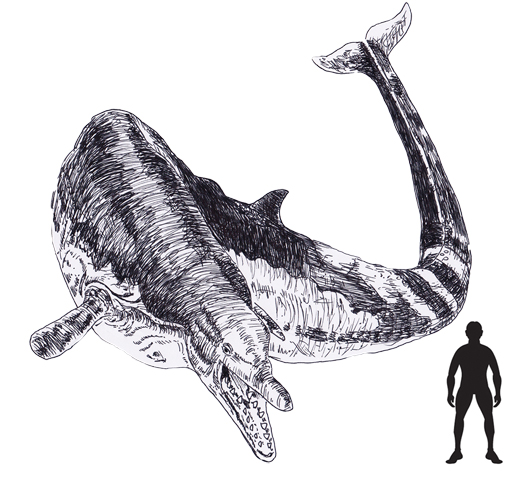
The PNSO Basilosaurus model, part of the PNSO Age of Dinosaurs range is to be retired. It was one of the first PNSO figures to be introduced, Everything Dinosaur can now confirm that it is out of production.
The PNSO Age of Dinosaurs Basilosaurus model.
The PNSO Basilosaurus Model
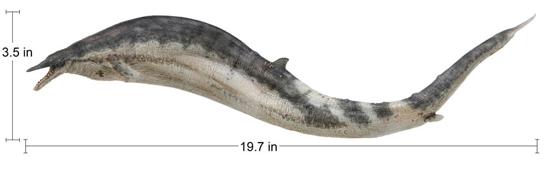
This large prehistoric whale figure was one of the first PNSO replicas to be supplied complete with transparent display stands. Measuring close to twenty inches in length (more than fifty centimetres long), this figure needed a lot of shelf space. Two species of Basilosaurus are known. Basilosaurus cetoides (the type species) was named by Sir Richard Owen (1839). A second species Basilosaurus isis was erected in 1904 (Andrews).
The Basilosaurus replica (PNSO). This replica is one of the first large figures to be made by PNSO.
A spokesperson from Everything Dinosaur commented:
“We are sorry to see the Basilosaurus retired. It was a fantastic figure of a Late Eocene prehistoric whale. PNSO have expanded their model range dramatically over recent years, model retirements are to be expected. PNSO will continue to add to their popular mid-size model range. We will announce a new PNSO figure in the very near future.”
An illustration of Basilosaurus. The human figure provides a scale. Picture credit: Everything Dinosaur.
Everything Dinosaur can confirm that two prehistoric animal models made by Schleich are now out of production and retired. With the recent introduction of five Schleich prehistoric animal figures, we can now confirm Schleich prehistoric animal model retirements.
The figures which have been retired are the Schleich Dimetrodon model that was introduced in 2019 and the Schleich pterosaur figure, the Dimorphodon.
The new for 2019 Schleich Dimetrodon model has now been retired by the German manufacturer.
The green-coloured 2019 Schleich Dimetrodon figure replaced an earlier Dimetrodon model (2016) with a reticulated pattern on its sail. It was one of five new model introductions into the Schleich prehistoric animal model range. Although not a dinosaur, Dimetrodon has proved to be a popular figure amongst collectors. Dimetrodon was a member of the Pelycosauria clade, a synapsid that lived during the Early Permian. Several species have been described.
The Schleich Dimorphodon Figure
Coincidently, the Schleich Dimorphodon figure was also introduced in 2019. It too is being retired. The Schleich Dimorphodon had distinctive “eye flashes” on its wings. It was depicted in a terrestrial pose. With its large skull and huge jaws, this pterosaur model proved to be popular with younger model collectors.
The Schleich Dimorphodon model (new for 2019).
Schleich Prehistoric Animal Model Retirements
A spokesperson from the UK-based Everything Dinosaur stated that both figures would be missed.
The spokesperson explained:
“We do appreciate that models have to be retired. Both the Dimetrodon and the Dimorphodon have been around for about four years, so they have had a good run. By taking some figures out of production this frees up space in the factory for new models.”
Our thanks to model collector and dinosaur fan William who sent into Everything Dinosaur a review of the Mila the Mapusaurus dinosaur model. The Mapusaurus figure is one of several carcharodontosaurid models offered by PNSO.
William emailed Everything Dinosaur and explained that Mila arrived along with the new Lucas 2.0 Giganotosaurus model and Mungo the Meraxes.
The reviewer commented:
“All together an impressive trio of titans from the Southern Hemisphere”.
PNSO Mila the Mapusaurus
William explained that with the discovery of the Meraxes fossil material palaeontologists had a better understanding of carcharodontosaurid cranium anatomy. The head of the Mapusaurus model was described as being well-defined with prominent lacrimal crests and a nasal ridge.
The detailing around the eyes and the skin folds associated with the head sculpt were praised.
The PNSO Mila the Mapusaurus dinosaur model.
William explained that the majority of the theropod figures supplied by PNSO have articulated jaws. He highlighted the detailing around the jaws including the roof of the mouth.
Reviewing the Model’s Body
The powerful neck is mentioned, and the point made about the completeness of the holotype fossil material aiding the carcharodontosaurid design. The similarity between carcharodontosaurid body plans is noted and the skin folds and texture praised.
William stated:
“From tip to tip every inch of Mila is an example of how to do a proper dinosaur figure. Even the cloaca is spot on.”
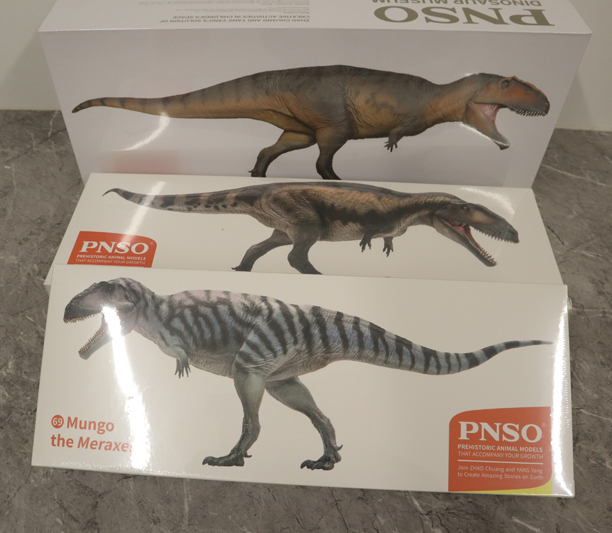
A trio of carcharodontosaurids. The new PNSO Giganotosaurus model in 1:35 scale (top) along with the PNSO Mapusaurus (middle) and Meraxes figures (bottom). Picture credit: Everything Dinosaur.
Picture credit: Everything Dinosaur
The Mapusaurus Limbs
The reduced forelimbs on the figure are examined. They were reduced in members of the Carcharodontosauridae. The reduction in size is not as extreme as within the abelisaurids or Tyrannosauridae. The reviewer explained that the highly detailed hands had three fingers. Each finger displayed a large claw, with the middle finger the largest of the three.
When referring to the hind legs, William commented:
“Mila’s hindlimbs are superbly sculpted with ripples and hints of veins. Each foot has three superb toes.”
The reviewer comments on the body colour and praised the combination of grey with a hint of rose pink. The colour scheme is a homage to the rosy, pink rocks associated with the holotype fossil material and honours Rose Letwin a sponsor of the excavation project.
The wide, charcoal stripes are highlighted, and the reviewer contrasts the Mapusaurus with other PNSO theropod figures.
Concluding his review William states:
“To the touch you can feel the fine detailing of the scales and the small scutes, the ripples folds and muscles are all very pleasing.”
An apex predator – the Mapusaurus dinosaur model from PNSO.
He also explains that the PNSO Mila the Mapusaurus dinosaur model is supplied with a transparent support stand. An information booklet and a colour poster are also included.
Time Period: Late Cretaceous 93.9–89.6 Million Years (Cenomanian faunal stage of the Late Cretaceous) Location: Argentina Province of Neuquén Cañadón del Gato.
Discovery: Over a period four years from 1997-2001 the Mapusaurus holotype was recovered by an Argentinian-Canadian Dinosaur Project. The holotype was described and named in 2006 by renowned palaeontologists Rodolfo Coria and Phil Currie.
Classifying the Dinosaur (PNSO Mila the Mapusaurus)
William also provided information on the taxonomy of Mapusaurus roseae.
He estimated that this theropod weighed around five tonnes and measured between thirty-six and forty feet in length.
Mapusaurus co-existed with several other theropods including Skorpiovenator and Ilokelesia.
Concluding his review William stated:
“All the PNSO Charcharodontosauridae figures are worthy of a place in any novice or serious collectors‘ collection. They are outstanding in every way.”
Our thanks to William for sending in his PNSO Mila the Mapusaurus dinosaur model review.
Everything Dinosaur team members have been examining generative artificial intelligence (GenAI) and how this exciting new technology might change the company. Recently, to commemorate the ninety-seventh birthday of Sir David Attenborough, Everything Dinosaur asked ChatGPT to write a short blog post. The ChatGPT artificial intelligence wrote a short biography of the naturalist and broadcaster. We also asked ChatGPT to compose a short birthday message to Sir David.
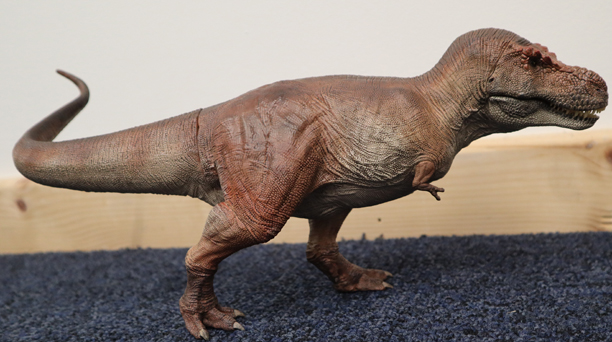
Artificial intelligence has a myriad of applications. As part of our testing programme to assess the scope of the current technology, we challenged ChatGPT (version 3.5) to provide Everything Dinosaur with five facts about Tyrannosaurus rex.
The Rebor T. rex Tusk King T. rex Requiem model is supplied with a clear plastic support base, but our models appear quite stable even standing on our office carpet without the need for the support stand. Can ChatGPT provide five facts about this famous dinosaur? Picture credit: Everything Dinosaur.
The picture (above) shows a Tyrannosaurus figure from Rebor (Tusk).
In response to our question “list five facts about Tyrannosaurus rex, here are the five facts about T. rex that ChatGPT compiled:
1). Tyrannosaurus rex lived during the Late Cretaceous period (approximately 68 to 65 million years ago).
It is true that T. rex lived during the Late Cretaceous however, we would take issue with the temporal range suggested. The date of the end-Cretaceous extinction event and the demise of the non-avian Dinosauria is now thought to have occurred around 66 million years ago. T. rex is known from several Upper Cretaceous North American formations, dating the fossil bones is notoriously difficult.
The Size of Tyrannosaurus rex
2). Tyrannosaurus rex was one of the largest land predators ever to exist, measuring up to 12 metres (40 feet) long and weighing up to 6.8 metric tonnes (15,000 pounds).
We will not dispute the ChatGPT comment about T. rex being one of the largest land predators ever. However, the size estimates could be disputed. For example, the biggest specimens described to date “Sue” and “Scotty” measure more than 12 metres in length. The robust “Scotty” is estimated to be around 13 metres long with a body weight calculated at approximately 8.8 tonnes (19,400 pounds).
3). Tyrannosaurus rex had a powerful bite force of up to 12,800 pounds per square inch – enough to crush the bones of its prey.
Not much to dispute here. There has been a considerable amount of research into the potential bite force of an adult animal. A study published in 2012 (Bates and Falkingham) did indeed suggest a bite force around 12,800 lbs, for the teeth located in the back of the mouth. The researchers suggested a potential range of bite forces, with 12,800 lbs being at the upper end of their estimates.
Banana-shaped Eyes?
4). Tyrannosaurus rex had two large, banana-shaped eyes which gave it good depth perception and probably excellent vision.
This is not true, T. rex did not have two large, banana-shaped eyes. We suspect that this is the GenAI confusing two aspects of tyrannosaur cranial anatomy. Something that a real person would intuitively consider incorrect. T. rex is famous for its large teeth, often described as being banana-shaped. Its eyes were spherical and quite big, about the size of a tennis ball.
ChatGPT is correct when it asserts that it had good depth perception and probably excellent vision. Many palaeontologists suggest that T. rex had vision as good as a modern-day bird of prey.
The Rebor GrabNGo 02 T. rex Type A in anterior view. T. rex probably had excellent, binocular vision. Picture credit: Everything Dinosaur.
Picture credit: Everything Dinosaur
5). Tyrannosaurus rex had a small brain compared to its body size, with a brain volume of only 1.5 litres (2.6 pints).
It is accurate to state that T. rex had a small brain relative to its body mass. This does not provide a measure of intelligence. For example, many birds such as crows and pigeons have small brains, but they are capable of solving complex problems and prodigious feats of memory and navigation. The statement about brain volume could also be disputed. Soft tissue preservation in the fossil record is exceptionally rare. No T. rex brain tissue has yet been found.
Brain size assessments are based on the volume of the braincase as calculated when skull bones are reconstructed. It would also be incorrect to assume that the brain of a Tyrannosaurus rex would completely fill the braincase, so only the maximum potential brain volume can be calculated.
Whilst errors can be identified in the answers given, we congratulate ChatGPT. It was a credible effort, particularly since the data set that the programme was working on was last updated in September 2021 or thereabouts.
The use of GenAI in writing books about dinosaurs, teaching about dinosaurs and perhaps providing updated display boards in museums is not too far away.