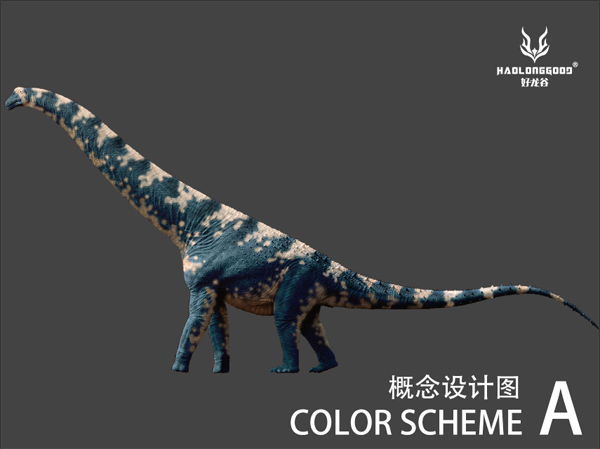
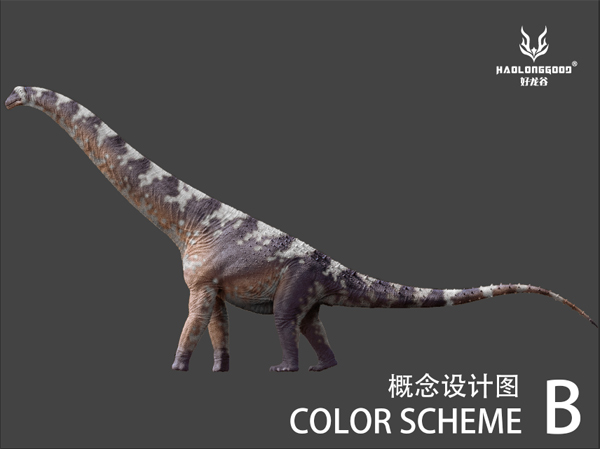
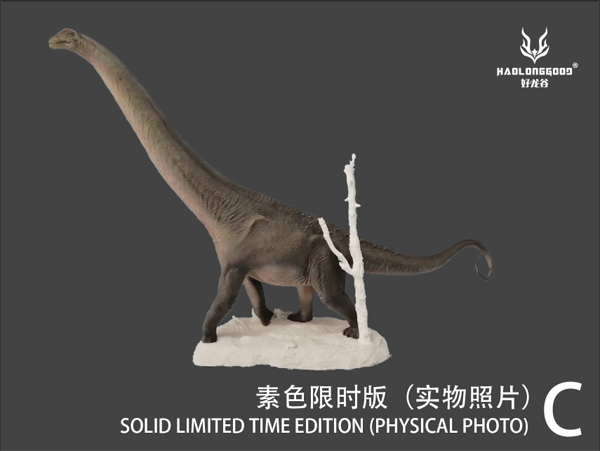
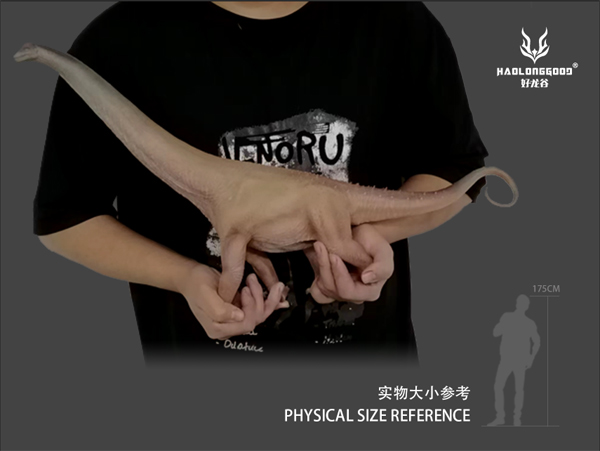
Haolonggood intend to manufacture three versions of a 1:35 scale Alamosaurus. They are not sure how many to make of each version, so they have asked Everything Dinosaur to highlight this offer and make enquiries. The three versions, A and B plus C, a limited-edition, plain version will be available in the early spring of 2024. The Haolonggood Alamosaurus offer is open until December 28th (2023). If customers reserve a figure before 28th December, the Alamosaurus will be supplied with base and pterosaur figure.
Haolonggood Alamosaurus Version A
Haolonggood Alamosaurus model. Version A colour scheme.
To help customers select which figure(s) they want, Haolonggood have supplied computer generated images of the proposed colour schemes.
Haolonggood Alamosaurus Version B
Haolonggood Alamosaurus model version B.
The third Alamosaurus model is the limited-edition, plain version (version C).
Haolonggood Alamosaurus Version C (Limited-edition, Plain)
The limited-edition, plain version of the Haolonggood Alamosaurus model.
To reserve your model, simple contact Everything Dinosaur and let them know which model (A, B or C) you would like.
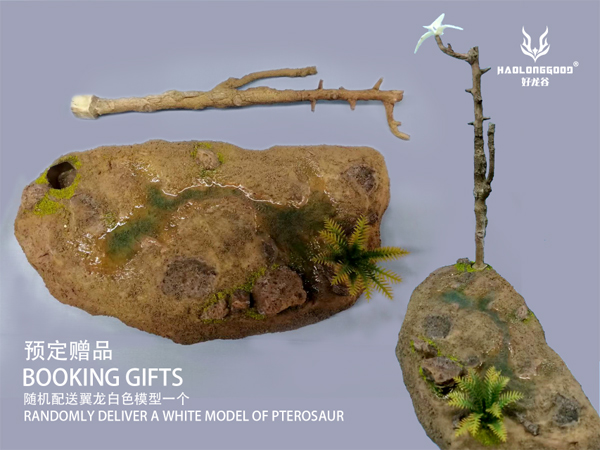
If booked before 28th December (2023), the Alamosaurus scale figure will be supplied with a base and one of two special pterosaur models.
If ordered before the cut-off date of December 28th (2023), the model will be supplied with a base and one of two white pterosaur figures.
Haolonggood Alamosaurus Model Measurements
The actual model measurements have yet to be finalised. However, each PVC figure will weigh several kilos and the proposed product packaging suggests that the 1:35 scale Alamosaurus will stand about 35 cm tall and measure around 65 cm in length.
Haolonggood supplied box dimensions: 65 cm (25.6 inches) long, width 14 cm (5.5 inches) and height 36 cm (14.1 inches).
Showing the size of the Haolonggood Alamosaurus figures.
There has been some confusion over these figures and the product offering. We can confirm that all three models are currently available. Version C will only be available for a limited time (it is a limited-edition model). It is painted in a brown colour scheme. The base and detachable tree plus the unpainted pterosaur figure (there are two pterosaur model versions), are only available for orders placed before December 28th.
It is only the pterosaur models that will require painting.
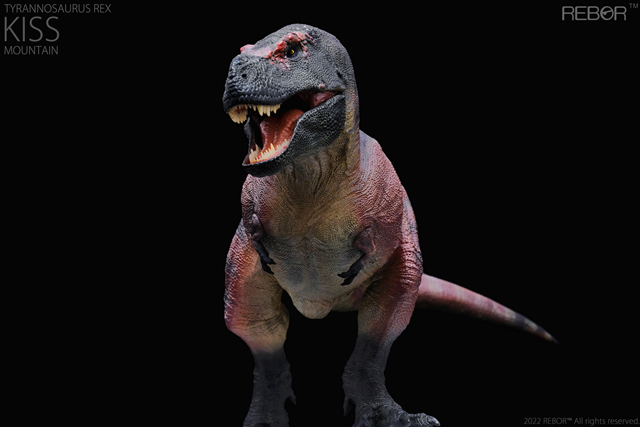
The stunning Rebor Tyrannosaurus rex “Kiss” Mountain figure is back in stock at Everything Dinosaur. Team members have been able to bring in more stock of this popular tyrannosaur in time for the festive season.
The Rebor Kiss T. rex figure (Mountain), this tyrannosaur model has been given lips. Picture credit: Everything Dinosaur.
The Rebor Tyrannosaurus rex has been beautifully painted, and the figure has been given lips. The debate about lips in the Dinosauria is on-going. Many palaeontologists believe that dinosaurs did indeed have lips.
To read an article from earlier this year (2023) about lips in the Tyrannosauridae: Tyrannosaurus rex Had Lips.
The spectacular Rebor Tyrannosaurus rex “Kiss” in the mountain colour variant measures approximately 40.5 cm long and that magnificent head stands around 14 cm high. The model is in an approximate scale of 1:35.
A spokesperson from Everything Dinosaur commented:
“It is wonderful to see this popular Rebor figure back in stock. We have been busy contacting customers who wanted to be notified when this replica arrived. The Tyrannosaurus rex figure has an articulated jaw, poseable arms and a flexible tail. It is a clever piece of dinosaur design.”
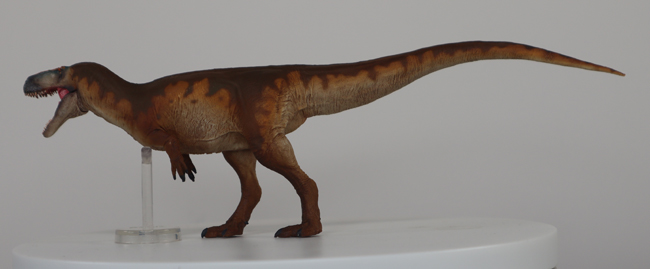
Many prehistoric animal models are photographed in lateral view. Everything Dinosaur explains the differences between right and left lateral views. It can be a little confusing for model collectors when photographs of a new prehistoric animal figure are released. Often the images include lateral views, these are images of the figure seen from the side.
The new for 2023 PNSO Megalosaurus dinosaur model. Picture credit: Everything Dinosaur.
Picture credit: Everything Dinosaur
The image (above) shows a view of the recently introduced PNSO Edward the Megalosaurus dinosaur model. The left side of the model can be seen. This photograph shows the left lateral view of the figure. That is, in a left lateral view the object faces to the left as you look at the image.
Determining whether a prehistoric animal figure is in left lateral or right lateral view is made easier if the whole of the model is shown in the image.
Left lateral view – the head of the figure faces to the left as you look at the image.
Right lateral view – the head of the figure faces to the right as you look at the image.
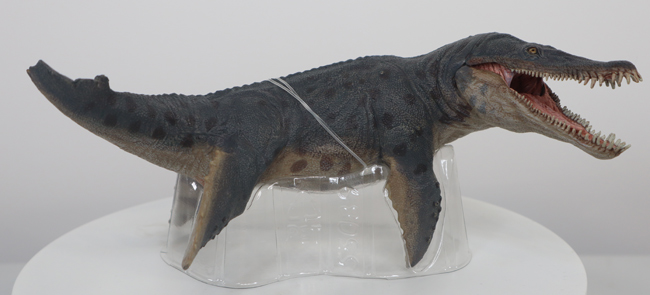
The Papo Kronosaurus marine reptile photographed in right lateral view. Picture credit: Everything Dinosaur.
Picture credit: Everything Dinosaur
In the image (above) the recently introduced Papo Kronosaurus model is facing to the right. Therefore, this model is being shown in the right lateral view.
A spokesperson from Everything Dinosaur commented:
“Our blog often features details of scientific papers. Some of them can be quite technical and we try to summarise the findings and provide simplified explanations for the general reader. Interpreting scientific drawings can be a challenge. It can also be difficult to understand the details shown on a photograph of a prehistoric animal model if the orientation is not known.”
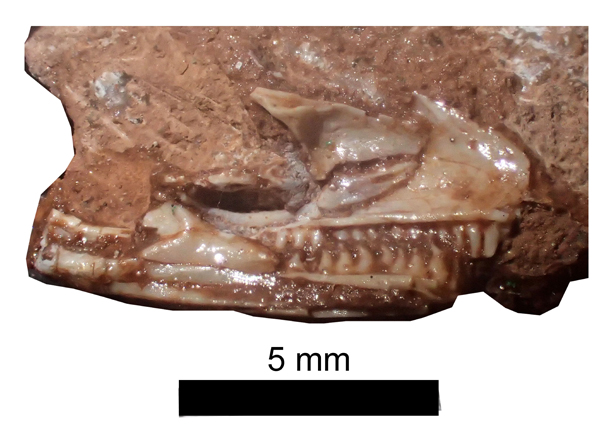
The partial skull of the lizard shown in right lateral view. Picture credit: David Whiteside, Sophie Chambi-Trowell, Mike Benton and the Natural History Museum UK
The photograph (above) shows the skull of the stem lizard Cryptovaranoides microlanius in right lateral view. Computerised tomography (CT) was used to help the researchers to construct the left side of the skull of C. microlanius. This enabled the team to construct a left lateral view of the skull.
Although left lateral and right lateral are terms that are not often used in scientific disciplines, it is helpful to have an understanding of their meaning. It is important to have standard anatomical terms and scientific papers have been published that examine the use of such terms when describing fossils.
The next time you see a photograph of a prehistoric animal model, we hope our short explanation will help you to understand whether the view is left or right lateral.
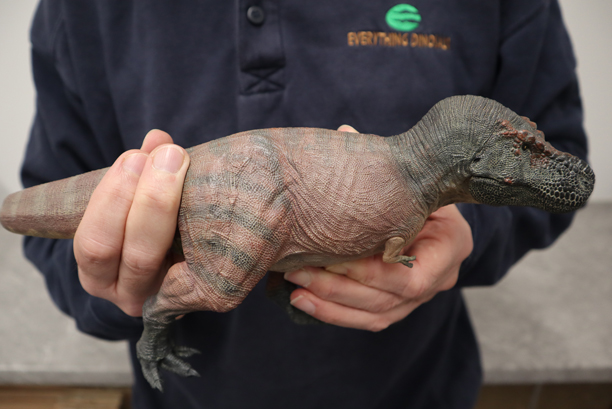
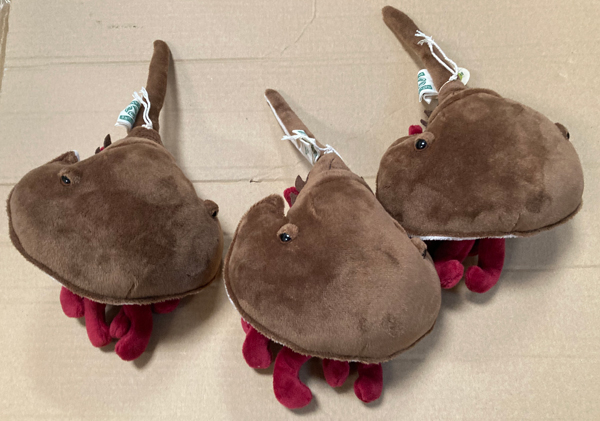
It is another hectic day at Everything Dinosaur. Team members have been busy picking and packing orders for customers. However, there was time to take a quick photograph of three Horseshoe crab soft toys. These cute and cuddly invertebrates will soon be on their way to customers.
The horseshoe crab soft toys look quite happy at the prospect of leaving our warehouse.
A trio of horseshoe crab soft toys photographed in the Everything Dinosaur warehouse. These cute and cuddly animals will soon be on their way to customers. Picture credit: Everything Dinosaur.
Picture credit: Everything Dinosaur
Prehistoric Plush
Everything Dinosaur stocks a wide range of dinosaur soft toys and prehistoric plush. We have T. rex soft toys, Triceratops and even Woolly Mammoths. We also like to stock some of the more unusual soft toys. Horseshoe crabs are still around today, but they first evolved nearly five hundred million years ago.
Our Horseshoe crab soft toys represent “living fossils”. However, these marine animals are under threat. Habitat destruction that accompanies coastal development presents a danger and the animals are used as bait in the fishing industry. Their unusual metabolism and their blue-coloured blood has been extensively studied. The blood has clotting agents (amebocytes), which are of great benefit to medical science.
A spokesperson from Everything Dinosaur commented that they thought the horseshoe crabs were cute and cuddly.
The spokesperson added:
“These are beautiful soft toys and very unusual. The horseshoe crab soft toys looked like they were smiling at us as they awaited their turn to be packed. We took a quick photograph before returning to our packing duties.”
Visit the award-winning and user-friendly Everything Dinosaur website: Everything Dinosaur.
Everything Dinosaur receives lots of five-star feedback from customers. Today, we highlight some five-star Feefo feedback sent by a customer in Germany. The UK-based mail order company has thousands of customers in Europe. Everything Dinosaur has developed an excellent reputation for customer service.
Five-star feedback from a customer in Germany. Picture credit: Everything Dinosaur.
Picture credit: Everything Dinosaur
Five-star Feefo Feedback from All Over the World
Over the last thirty days (November 7th 2023 – December 7th 2023), Everything Dinosaur has received a total of twenty-seven Feefo customer service reviews. All of these rate our customer service as five-star. Over this same period, we have also received sixty product reviews all of them rating our models and figures as excellent.
A spokesperson from Everything Dinosaur commented:
“It is wonderful to receive feedback from all over the world. We have many customers in Europe, and we welcome their comments and views.”
The German-speaking customer commented:
“Sehr guter Service, rasche Lieferung, schöne Figuren, besonders aus der neuen Serie (Halonggood).”
This translates as:
“Very good service, fast delivery, beautiful figures, especially from the new series (Haolonggood).”
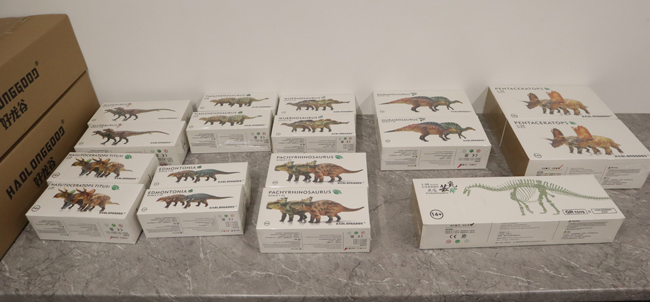
A total of nineteen different Haolonggood dinosaur models were in the first shipment of figures from China. Ten different genera of dinosaur are represented. These models have received praise from many customers. Picture credit: Everything Dinosaur.
On November 7th, 1924, the American Museum of Natural History published a short, scientific paper written by Henry Fairfield Osborn which described three types of new theropod dinosaur based on fossils from the Djadochta Formation (Gobi Desert). The first theropod documented was Velociraptor mongoliensis. Its description being based on a skull and jaws (specimen number A. M. 6515) along with additional material including the scythe-like second toe claw, although in the paper this was misidentified, it was thought the claw came from a first finger of the hand.
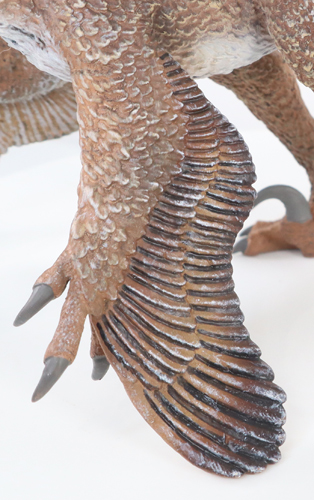
A close-up view of the detailed wing. In the 1924 scientific paper describing V. mongoliensis, the second toe claw was thought to have come from a finger. Picture credit: Everything Dinosaur.
Osborn surmised that these fossils represented an “alert, swift-moving carnivorous dinosaur”, hence the genus name Velociraptor which translates as “swift thief” or “speedy robber”. At the time Velociraptor was thought to be a diminutive member of the Megalosauridae. Over the last hundred years, more than a dozen Velociraptor mongoliensis skeletons have been found. As our understanding of theropod taxonomy has developed, these types of dinosaur, the swift lizards, the dromaeosaurs are now known to be very distantly related to the megalosaur family.
The skull was found on August 11th, 1923, by expedition member Peter Kaisen. Ironically, it was found lying alongside the skull of a Protoceratops (Protoceratops andrewsi) and indeed, ever since, these two dinosaurs Protoceratops andrewsi and Velociraptor mongoliensis have been linked together as predator and prey. Perhaps most spectacularly in the remarkable “fighting dinosaurs” specimen that preserves a Velociraptor and Protoceratops locked in mortal combat.
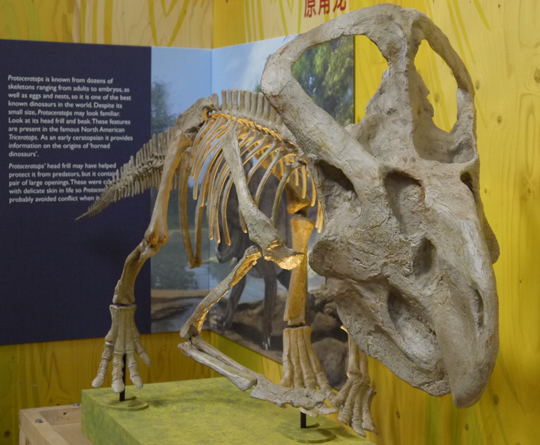
A skeleton of a Protoceratops on display. Picture credit: Everything Dinosaur.
Picture credit: Everything Dinosaur
The New CollectA Deluxe Velociraptor (2024 Release)
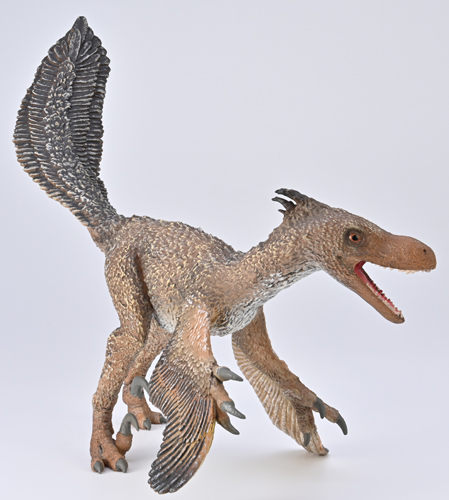
Whilst the new for 2024 CollectA Deluxe 1:6 scale Velociraptor does not show signs of an encounter with a Protoceratops, it does reflect Osborn’s original view of this being an “alert, swift-moving carnivorous dinosaur”. In addition, the figure reflects some of the very latest research into members of the Maniraptora. In 2023, researchers from the University of Tokyo applied a statistical analysis on forelimb structure that demonstrated that dinosaurs like Velociraptor had a propatagium (pronounced pro-pah-ta-gee-um). This is a soft tissue structure that joins the wrists and the shoulders. This structure is seen in living, volant birds. It helps with the wing flapping motion and provides a leading edge to the wing. Without this structure, birds could not fly.
Velociraptor could not fly, so why did it have a propatagium? This has been the subject of much debate amongst palaeontologists. Perhaps it had a role in visual display. Perhaps it acted as an additional stabiliser as the animal turned swiftly, or maybe it demonstrated fitness for breeding. It has been suggested that an enlarged surface area of the forelimb would have been beneficial in helping to shade eggs or perhaps it played some other role in the brooding process.
CollectA Deluxe Velociraptor model.
Whatever the reason or reasons for the propatagium, it is great to see CollectA have incorporated some of the very latest research into their commemorative Velociraptor figure.
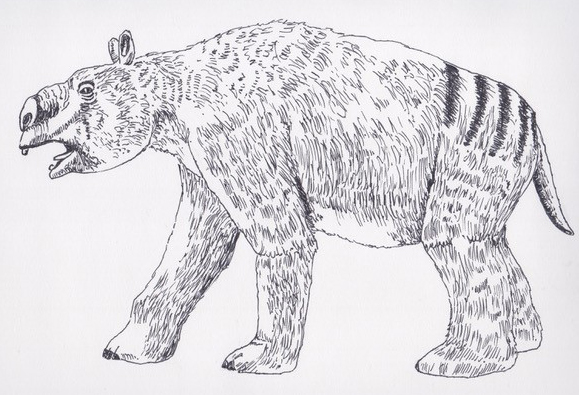
Everything Dinosaur has commissioned a CollectA Diprotodon drawing. The illustration of the largest marsupial known to science is to be used in a Diprotodon fact sheet. The fact sheet will be available from Everything Dinosaur with sales of the new for 2024 CollectA Deluxe Diprotodon model.
The recently commissioned CollectA Diprotodon drawing for use in an Everything Dinosaur Diprotodon fact sheet. Picture credit: Everything Dinosaur.
Picture credit: Everything Dinosaur
CollectA Diprotodon Drawing
The illustration will be modified, and a human figure added for scale. This drawing will then provide fact sheet readers with a visual size guide for this herbivore. The CollectA Deluxe Diprotodon is a male, and the illustration will reflect this. Males were much larger than females, perhaps reaching a length of four metres or more. The shoulder height of a fully grown male Diprotodon was around 1.8 metres.
The CollectA Diprotodon model will be available from Everything Dinosaur in 2024.
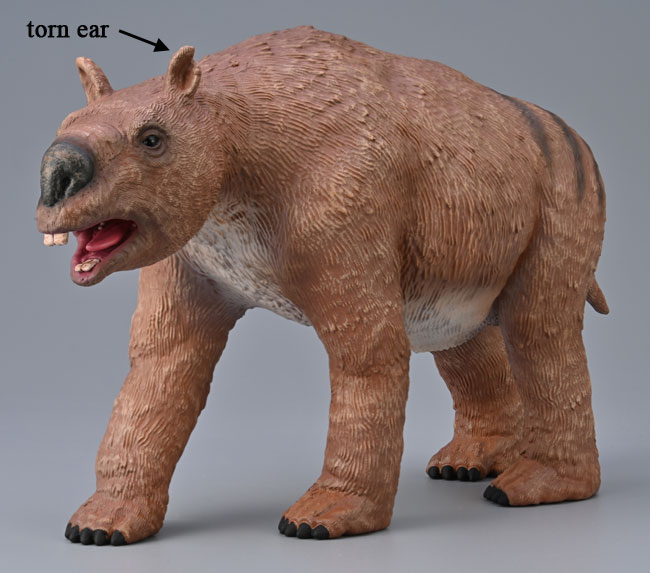
CollectA Diprotodon has a torn ear. It is likely big males fought each other for mating rates, territory and social status.
The CollectA Diprotodon figure will have a torn ear. An injury sustained most probably in a fight with another male. However, our Diprotodon illustration shows this powerful marsupial with its left ear restored.
Educating and Informing
A spokesperson from Everything Dinosaur commented that fact sheets were sent out with most of the models the company supplies as these fact sheets help to inform customers about prehistoric animals and palaeontology.
The spokesperson added:
“The fact sheet will be researched and written in plenty of time for the arrival of the CollectA Deluxe Diprotodon. We expect the Diprotodon model to be available around the middle of next year.”
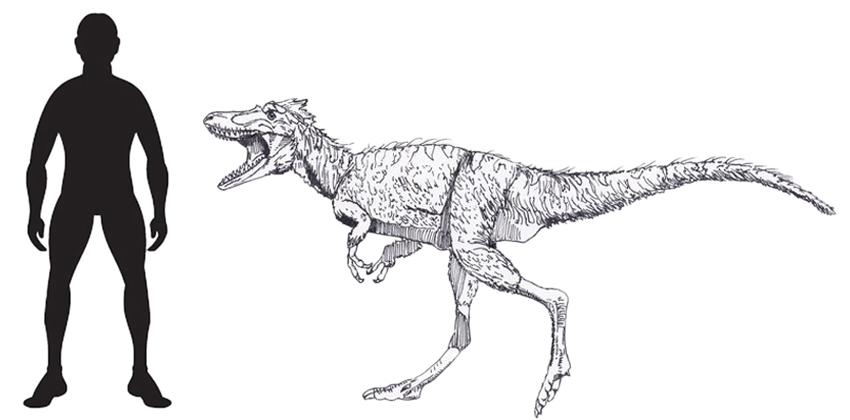
As Everything Dinosaur prepares for the arrival of the new Schleich prehistoric animal figures, we have been busy preparing fact sheets. One of our jobs was to create a Moros intrepidus scale drawing. The Schleich Moros model represents the first time we have had this tyrannosauroid in our range. We commissioned an illustration based on the image sent out with the original Moros intrepidus media release. A human figure was added to provide a scale for this three-metre-long theropod.
The recently commissioned Moros intrepidus illustration has been incorporated into a scale drawing for use in the next Everything Dinosaur fact sheet to be prepared. Picture credit: Everything Dinosaur.
A Moros intrepidus Scale Drawing
For every named prehistoric animal figure that we sell, we try to research and write a fact sheet. Our fact sheets have been well received by customers. Requests are received each week as collectors try to complete their collections. Moros intrepidus was formally named and described in 2019. At around three metres long and with it standing about 1.2 metres high at the hips, it was no giant. However, it was a distantly related forerunner of the giant tyrannosaurs that were to dominate Late Cretaceous ecosystems of North America. It lived some thirty million years before Tyrannosaurus rex.
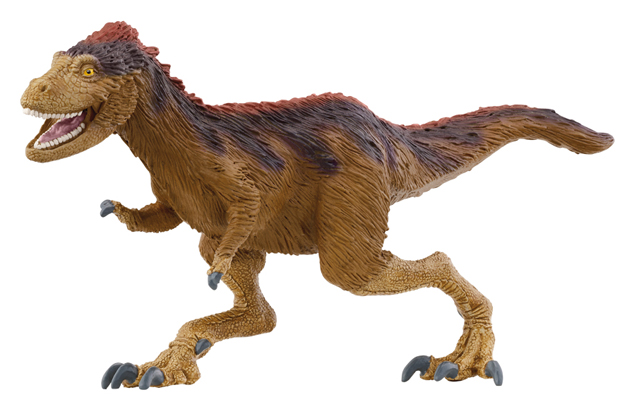
Schleich are going to introduce six new dinosaur figures in early 2024. Some of these new models will be coming into stock at Everything Dinosaur next month (December 2023). One of these figures is a replica of Moros intrepidus, hence the need to compile a fact sheet.
The new for 2024 Schleich Moros intrepidus figure.
A spokesperson from Everything Dinosaur commented:
“We try to write a fact sheet for all the prehistoric animal models and figures we stock. As Moros is one of several new Schleich figures, we needed to create a Moros intrepidus scale drawing and fact sheet. We intend to send out the fact sheet with sales of the Schleich Moros model.”
For further information about the extensive range stocked by Everything Dinosaur, visit the company’s website: Everything Dinosaur.
Today, Everything Dinosaur in collaboration with CollectA makes the fourth and final announcement about new CollectA models for 2024. We can introduce three new CollectA figures namely:
Age of Dinosaurs Popular Nanuqsaurus – Stalking.
CollectA Deluxe 1:20 scale Diprotodon.
CollectA Deluxe 1:20 scale Placerias.
All three of these new prehistoric animal models will be available from Everything Dinosaur in the middle of 2024 or thereabouts.
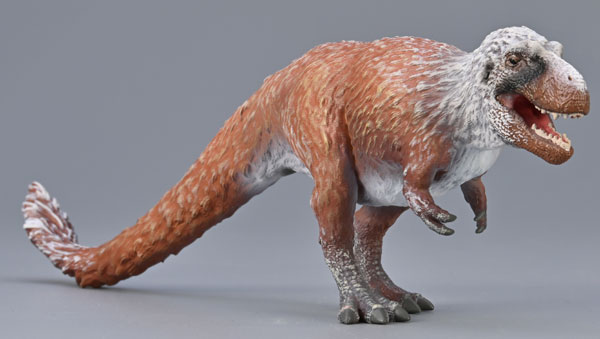
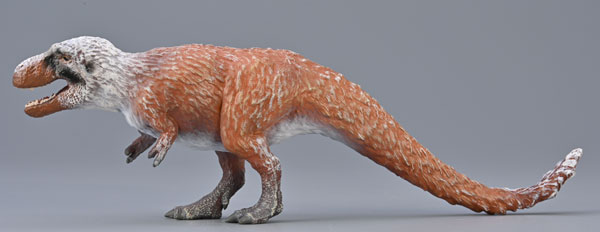
The Age of Dinosaurs Popular Nanuqsaurus – stalking figure.
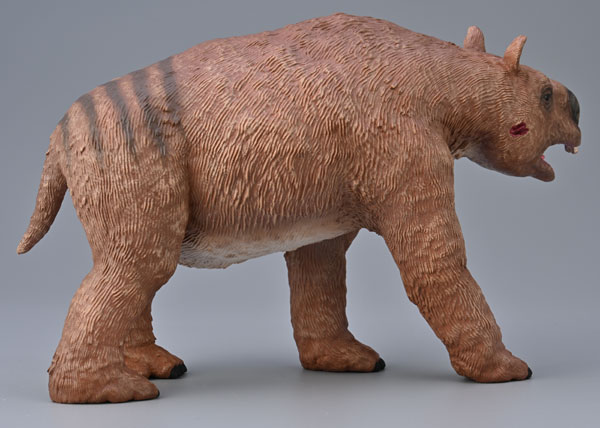
The CollectA Deluxe 1:20 scale Diprotodon model.The male Diprotodon has an injury on its cheek. It is likely that these large mammals fought rivals. The CollectA Deluxe model sports a bite from another male Diprotodon.
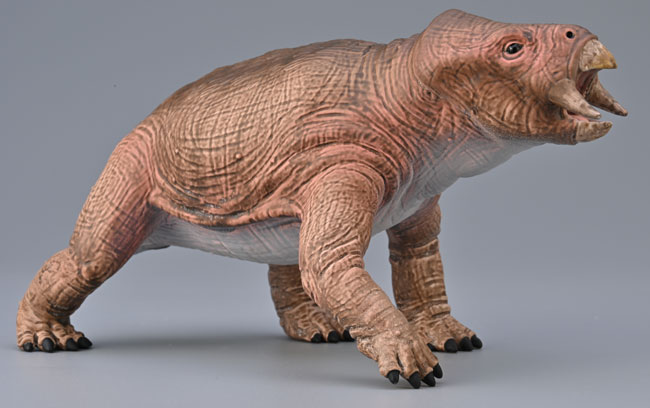
The new for 2024 CollectA Deluxe Placerias model.
New CollectA Models for 2024
The last of the figures to be announced this year, include a polar dinosaur, the biggest marsupial that ever lived and a Late Triassic dicynodont. In total, there will be seven new CollectA prehistoric animals plus the mini sauropod set.
CollectA Nanuqsaurus – stalking
The Age of Dinosaurs Popular figure reflects the very latest scientific interpretation of Nanuqsaurus (N. hoglundi). Fossils of this tyrannosaur come from the Prince Creek Formation in northern Alaska. When first described in 2014 (Fiorillo and Tykoski), this dinosaur was thought to be relatively small, perhaps around six metres in length. Subsequent discoveries including cranial and postcranial material has led to a reassessment of this theropod. A scientific paper published in August (2023) postulated that Nanuqsaurus was comparable in size to other Late Cretaceous tyrannosaurs such as Daspletosaurus.
Nanuqsaurus was probably a permanent resident of the polar north. At around nine metres long (possibly bigger), it was the apex predator in the environment.
The CollectA figure has been given a robust and powerful body. It is covered in a coat of shaggy feathers. The tail has a plume on its end. Whilst speculative (as is the entire integumentary covering), the plume could have played a role in visual communication, or perhaps this dinosaur wrapped its tail around its body to help keep it warm. This posture has been observed in other theropod dinosaurs. Nanuqsaurus would have had to endure around four months each year of almost total darkness. The paint scheme chosen would have provided excellent camouflage as this predator roamed the polar forests.
Diprotodon was the first fossil mammal from Australia to be scientifically described (1838). The CollectA Deluxe 1:20 scale Diprotodon represents a male. This huge animal stood around 1.8 metres high at the shoulder, measured approximately 4 metres in length and weighed over 3 tonnes.
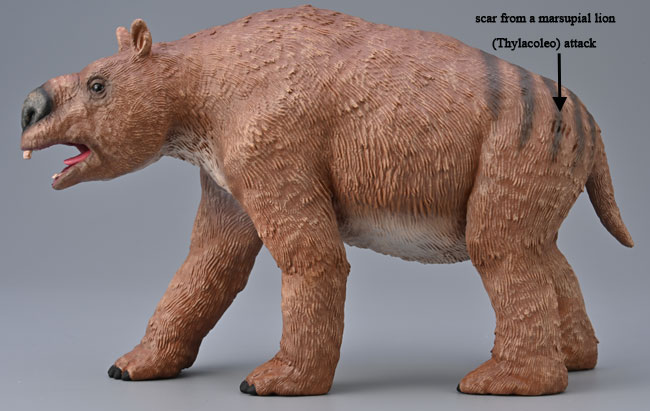
The CollectA Diprotodon has an old scar from an attack by a marsupial lion (Thylacoleo). When fully grown, a healthy male Diprotodon would have been virtually invulnerable.
The CollectA Diprotodon model has an old scar from a marsupial lion on its rump.
Related to living wombats, this gentle giant lived during the Pleistocene, becoming extinct less than 50,000 years ago. Climate change leading to extensive droughts may have been a factor, but hunting and habitat destruction by the first Aboriginal Australians cannot be ruled out. It is likely that Diprotodon males fought with each other over social status and mates, hence the fresh bite mark on the cheek and the torn ear which signifies an older injury.
The stripes on the rump are a nod in the direction of the Thylacine (Tasmanian Tiger). Advances in genetic engineering could lead to the de-extinction of the Thylacine and its reintroduction to Australia. CollectA have made a model of an extinct marsupial, and its colour scheme partly reflects the tantalising prospect of the resurrection of another iconic Australian animal.
CollectA Diprotodon has a torn ear. It is likely big males fought each other for mating rites, territory and social status.
CollectA Deluxe 1:20 Scale Placerias
The last figure for 2024 is a Deluxe Placerias. Placerias was a dicynodont and therefore distantly related to modern mammals. Fossils of this Late Triassic herbivore come from the USA, most notably from a single location in Arizona known as the “Placerias Quarry”. The remains of at least forty individuals have been found, suggesting that this herbivore lived in herds.
The new for 2024 CollectA Deluxe Placerias model.
The CollectA Deluxe Placerias joins the CollectA Lisowicia bojani model that was introduced in 2020. It is likely that Placerias spent much of its time wallowing in shallow water and feeding on bankside vegetation, filling an ecological niche similar to the extant hippopotamus.
Although associated with an equatorial environment, the CollectA Deluxe Placerias has been given a subtle coat of body hair.
The CollectA Deluxe Placerias has a sparse covering of body hair running down its back. This reflects recent research on dicynodonts.
Hair remnants found in the fossilised faeces (coprolites) of Permian carnivores indicate that dicynodonts may have been covered in a coat of insulating body hair and therefore endothermic (warm-blooded), with a metabolism similar to a modern mammal. In recognition of this recent discovery and to reflect its mammalian links, the CollectA Deluxe Placerias has been given a sparse patch of bristles running along its back to the chubby tail.
Model Measurements
Here are those all-important model measurements:
Age of Dinosaurs Popular Nanuqsaurus – stalking (length 15.7 cm, height 4.5 cm).
CollectA Deluxe 1:20 Diprotodon (length 20.5 cm). We estimate the height at the shoulder to be around 12.5 cm).
CollectA Deluxe 1:20 Placerias (length 15.7 cm, height 8 cm).
A spokesperson from Everything Dinosaur confirmed that these figures will be in stock at Everything Dinosaur by the middle of 2024.
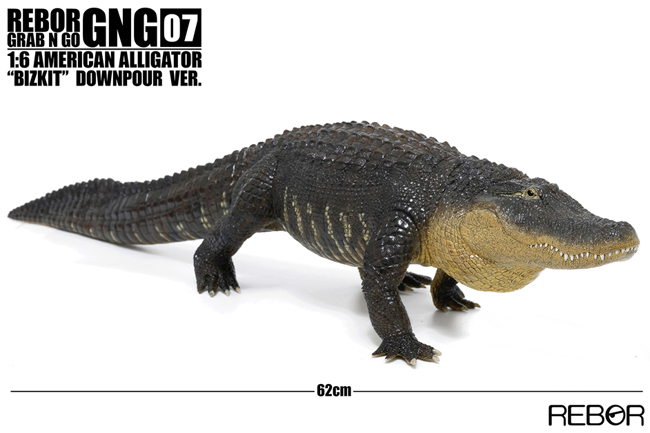
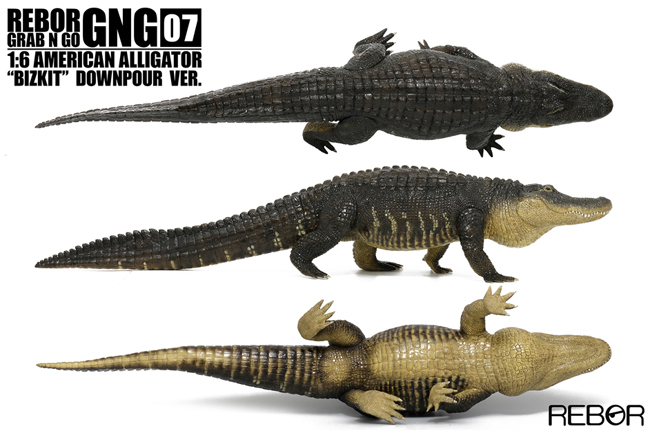
The new Rebor GNG alligator models are in stock at Everything Dinosaur. Both figures are available, the “Downpour” and the “Basking” colour schemes. The pair of alligator figures are the latest editions to the Rebor GrabNGo range.
Each Rebor GNG figure measures 62 cm long. The figures are approximately 10.5 cm high and around 10 cm wide across the back.
Rebor GNG Alligator Models
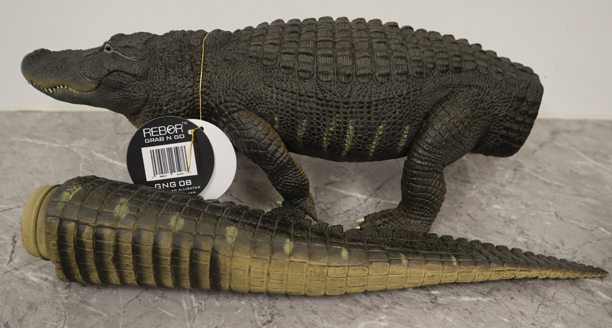
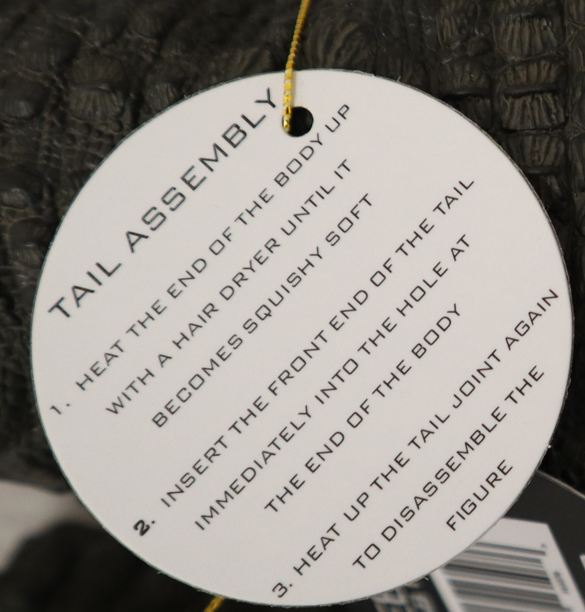
Both figures are the same sculpt, just the colouration depicted by the subtle painting schemes is different. Each figure is supplied in two parts. Some assembly is required, the tail has to be fitted into the body. When assembled the alligator figure measures approximately 62 cm long. The highest point of the back is around 10.5 cm off the ground. Across the torso, the impressive alligator model is about 10 cm wide.
The new Rebor GrabNGo alligators require some assembly. The tail and body sections have to be heated to permit insertion. The stiff plastic of the models does represent a challenge, we recommend an adult takes responsibility for inserting the tail. The model in the photograph is the “Basking” colour variant. Picture credit: Everything Dinosaur.
Picture credit: Everything Dinosaur
When inserting or removing the tail, we recommend an adult takes responsibility for this.
To view the range of Rebor models and figures in stock at Everything Dinosaur: Rebor Figures and Models.
The Rebor GrabNGo alligator fossils come with assembly and disassembly instructions. Picture credit: Everything Dinosaur.
Picture credit: Everything Dinosaur
Rebor Models and Figures
Rebor has extended its range to include extant reptiles as well as prehistoric animals. The two alligator figures join the recently introduced “Lonesome George” giant tortoise.
A spokesperson from Everything Dinosaur commented:
“The two new alligator models are extremely detailed. It is recommended that the tail piece is gently heated before inserting it into the body piece. Hot water can be used to heat up the joints. However, we urge caution as the figure is hollow and if hot water is used, it would be necessary to drain any excess water before attempting to secure the tail.”
The Rebor GNG07 alligator figure in the Downpour colouration.