All about dinosaurs, fossils and prehistoric animals by Everything Dinosaur team members.

Everything Dinosaur’s product news.

28 07, 2007

Cast of a Tyrannosaurus rex Tooth For Sale

By |2023-02-13T10:55:20+00:00July 28th, 2007|Categories: Everything Dinosaur Products, Photos/Pictures of Fossils|1 Comment

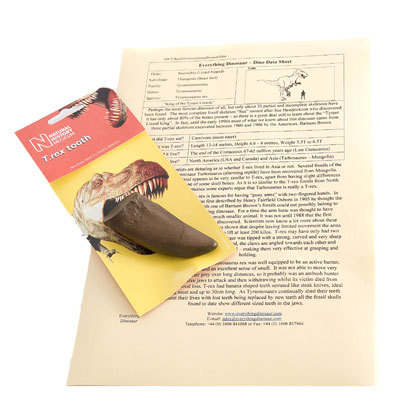
Cast of T. rex Tooth for Sale

A picture of the cast of the Tyrannosaurus rex which is a replica of real fossil material, available for sale from Everything Dinosaur.  A cast of a T. rex dinosaur tooth available to buy from Everything Dinosaur.

The Tyrannosaurus rex Tooth Cast

A wonderful dinosaur tooth!  A replica of a Tyrannosaurus rex tooth and a fact sheet from Everything Dinosaur.

Picture Credit: Everything Dinosaur

A photograph of a Tyrannosaurus rex tooth along with the accompanying Everything Dinosaur T. rex fact sheet as written and researched by our very own dinosaur experts.  A very good quality replica of a Theropod tooth.  The classic profile and the “D-shaped” cross section of a typical Tyrannosaur tooth can clearly be seen in this museum quality replica.

Visit Everything Dinosaur’s website: Visit the Everything Dinosaur Website.

28 07, 2007

How did Tyrannosaurus rex clean its Teeth?

By |2022-10-29T20:36:04+01:00July 28th, 2007|Categories: Everything Dinosaur Products, Main Page|0 Comments

Did Tyrannosaurus rex use a Tooth brush?

Developing the line of thought regarding the possibility of large Theropod dinosaurs having bacterial bites (see previous posting – Tyrannosaurus rex causes Chinese Takeaway), the question of how did the big meat-eaters like T. rex clean their teeth.

Information on tyrannosaur bacterial bite here.

In the case of most tyrannosaurs, their forelimbs were too small to reach their mouths so the could not have used their claws as tooth picks.  The truth is that T. rex probably did not have to clean its teeth, like most reptiles they have a considerable advantage over the mammals when it comes to dentition.  Dinosaurs constantly shed their teeth, with new ones growing up from the jawbone to replace old, damaged or wore teeth.  This is why when you look at a skull of a T. rex in a museum all the teeth in the jaw are different sizes. The teeth of a T. rex were shaped slightly differently depending on which part of the mouth they come from but the different sizes are due to some teeth being older than others, smaller younger teeth erupting through the jaw.

Larger crocodile species such as the Nile crocodile (Crocodylus niloticus) can have up to 40 sets of teeth in a lifetime.  There teeth are conical and not serrated like tyrannosaurs teeth, the lack of serrations (palaeontologists call these serrations denticles) would make them slightly less likely to have pieces of their last meal stuck to them and therefore less likely to harbour bacteria.  As crocodiles gape their teeth are exposed to sunlight and this helps to bleach the teeth and clean them.  It is also believed that small birds such as the Nile Plover (Pluvianus aegyptius) may have a symbiotic relationship with the crocodiles. These small birds may give crocs a grooming service – picking off skin parasites and removing pieces of food stuck in the crocodiles jaws.

T. rex lived at a time when the birds had become very well established.  There were lots of species of birds around at the end of Cretaceous that are familiar today.  Perhaps tyrannosaurs actively sought out colonies of small birds and gaped with their jaws wide open attracting birds to come over and give them a grooming.  Maybe these birds (the brave ones at least), would enter the beast’s huge mouth and remove the shreds of meat left behind from animal’s last meal.  This is pure speculation of course, behaviour like this is unlikely to be recorded in the fossil record, but if other animals can develop mutually beneficial relationships – why not dinosaurs as well?

As Everything Dinosaur has links with a number of Natural History museums we are able to get access to real T. rex teeth to study them and make casts.

Genuine museum quality replica T. rex tooth and other fossil casts and models are available from our website.

Dinosaur Crafts for Kids: Visit Everything Dinosaur.

We can even sell casts of real fossils (resin replicas) so you too can get hold of things like a Velociraptor killing claw and your very own T. rex tooth.  The tooth we sell is a resin replica of a tooth from the right lower jaw of a T. rex specimen discovered by the American palaeontologist Barnum Brown in 1900.  It was from these remains that T. rex was named and described.  The specimen code for this discovery is BM-R7995 and it is stored at the Natural History museum in London.  As only about 13% of the skeleton was recovered at the time, this T. rex has been removed from display.  The lack of bones meant that there were few options open to the curators as to how they could exhibit this specimen.  It was secured to a huge board representing a backdrop diorama of the Cretaceous and the missing elements were filled in with casts and copies.  Unfortunately, this specimen was mounted in the “kangaroo style” with the tail resting on the ground, so it was not anatomically correct.  The remains of the first proper T. rex skeleton to be discovered are now locked away in the vast vaults of the Natural History museum, however at least you can obtain your own piece of prehistoric history with a replica tooth.  You too can own replica Tyrannosaurus rex teeth!

25 07, 2007

Everything Dinosaur’s Unique Dinosaur Model Collection

By |2024-04-01T09:37:06+01:00July 25th, 2007|Categories: Everything Dinosaur Products, Photos of Everything Dinosaur Products|0 Comments

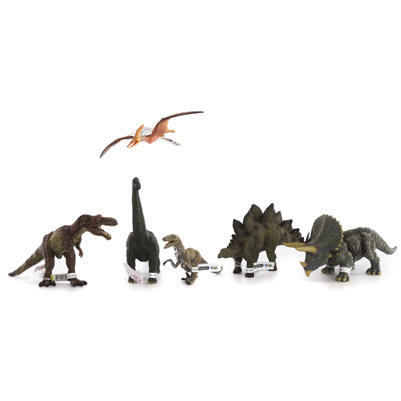
A Set of Dinosaur Models (Prehistoric Animal Models)

Some of the most popular prehistoric animal models including T. rex, Triceratops and Stegosaurus from the CollectA dinosaurs model range have been put together into this six figure dinosaur model set by team members at Everything Dinosaur.

A Set of Six Prehistoric Animal Models (CollectA Dinosaurs)

Six different dinosaur models to collect!

Picture credit: Everything Dinosaur

Part of the Everything Dinosaur CollectA range of dinosaur models, a set of six prehistoric animal models to collect. There is a Tyrannosaurus rex, Triceratops, Stegosaurus, Velociraptor, Brachiosaurus and the pterosaur Pteranodon (P. longiceps).  A popular set with dinosaur fans and serious dinosaur model collectors.

To view the extensive range of dinosaur and prehistoric animal scale models and replicas in stock at Everything Dinosaur: Dinosaur and Prehistoric Animal Models.

3 07, 2007

Blue and Yellow Tyrannosaurus rex – the Explanation

By |2022-10-29T16:54:23+01:00July 3rd, 2007|Categories: Everything Dinosaur Products, Main Page|0 Comments

Blue and Yellow T. rex – the Explanation

Yesterday we posted up a review of one of our new books, “Tyrannosaurus rex – King of the Dinosaurs”.  This hardback, pop-up book on T. rex had been well received by our young testers and their Mums and Dads.  The illustrations were particularly well liked and it was thought that they really provided a modern depiction of this fearsome dinosaur.

The artist responsible is John Sibbick.  John specialises in producing beautifully detailed illustrations of wildlife, mythology and fantasy artwork but perhaps he is most famous for his marvellous drawings of prehistoric animals and the evolution of mankind.  Many of the books which adorn our offices at Everything Dinosaur contain John Sibbick illustrations.  He has a rare and unique talent for combining anatomical accuracy with a real sense of imagery, capturing a snap shot of pre-history.

John studies the actual fossils and the diagrams produced by scientists before he starts to paint.  He works closely with palaeontologists so that he can interpret the very latest scientific thinking in his pictures.

Here is a link to John’s website where you can see some of his wonderful work:

www.johnsibbick.com

Whilst the Tyrannosaurus rex book was on test with our young readers we were asked on numerous occasions why John had decided to paint his Tyrannosaurus rex with blue and yellow markings – we put this question to John and here is his reply:

“I was asked to use bright colours by the publishers – avoiding greens, browns and greys and generally dull tones.  Because these colours would have to be consistent throughout the book and I knew that the cut away spread showing the layers of anatomical detail would have areas of reds and warm colours for the organs and muscles I needed the skin to contrast with that.

I know that some reptiles are blue – turtles, caimans and some iguanas so I chose to go with blue and yellow for the added drama and contrast.  Jack Horner (eminent American palaeontologist), is a great advocate of bright colours to emphasize the dinosaur/bird connection and feels that dinosaurs could have been as colourful as modern birds especially during display periods and, therefore, there should no limit to colour!”

John Sibbick’s T. rex (pop-up model from the book)

T. rex colourfully depicted

John is certainly right about the latest consensus on dinosaur colouration .  I remember viewing the cast of a T. rex braincase (STAN-BHI3033), and looking at the hole where the optic nerve exited – it was huge, big enough to get two of my fingers inside.  This, and the fact that both birds and crocodiles have colour vision has led palaeontologists to suspect that dinosaurs had excellent colour vision.
So why not a yellow and blue Tyrannosaurus rex!
2 07, 2007

Tyrannosaurus rex – King of the Dinosaurs (Book Review)

By |2022-10-29T16:51:04+01:00July 2nd, 2007|Categories: Book Reviews, Dinosaur Fans, Everything Dinosaur Products, Main Page|0 Comments

Tyrannosaurus rex – King of the Dinosaurs (Book Review)

One of our ambitions at Everything Dinosaur is to encourage young people to read about  dinosaurs and other prehistoric animals.  We have spent quite a long time looking at various books to see if we would like to add them to our shop.   As we have run our focus groups and Hall tests we have asked young readers to give us their views on certain books.  After much research and deliberation the first set of books is now available and we can review it here.

Tyrannosaurus rex – King of the Dinosaurs is a colourful, pop-up book with illustrations from John Sibbick (a world renowned dinosaur illustrator).  The innovative pop-up design was well liked by our young testers who recommended that the book be rated as suitable for 5 years and upwards.  They liked the pull mechanisms in the book which revealed the T.rex skull structure and showed how the legs worked and such like.

The book also contains a pull-out cardboard model of a Tyrannosaurus which is about 60cm long – this went down really well with the young scientists.

As for the Mums and Dads, they liked the hard-book robust nature of the book itself and the way in which key words and concepts were explained along the way.

Everyone agreed that the illustrations were superb, a credit to John Sibbick no doubt, although some were a little puzzled as to why T. rex would have a blue and yellow back.  Why not?  Since colour does not fossilise it is hard to say what colour Tyrannosaurus rex, or any dinosaur for that matter might be.  The dappled skin could be useful to help break up the huge animal’s outline as it moved around in poor light conditions such as early dawn or through the shafts of light from a grove of southern beech trees.

Here is a link to the Everything Dinosaur website: Everything Dinosaur.

All in all a good book, worthwhile adding to junior’s collection.  However, one point noted by our dinosaur team – the actual title “Tyrannosaurus Rex” is not quite how scientists would write the name of T. rex.  In science, when it comes to classifying animals they have a genus name i.e. Tyrannosaurus and a species name in this case rex.  When these names are written down the genus name is always in capitals and the species name, rex is written in lower case.  It is not correct to put a capital R onto rex.

Being pedantic, you are supposed to write the species name in italics like this:

Tyrannosaurus rex but on many occasions this etiquette is ignored.  These things are important to us, even in dinosaur books for children, perhaps more so.

Go to Top