All about dinosaurs, fossils and prehistoric animals by Everything Dinosaur team members.

Everything Dinosaur’s work with schools and other educational bodies. Articles, features and stories about dinosaurs and their role in education and educating young people.

8 03, 2019

Time to Celebrate International Women’s Day

By |2023-11-25T15:54:45+00:00March 8th, 2019|Categories: Educational Activities, Main Page, Photos/Schools, Press Releases, Teaching|0 Comments

Celebrating International Women’s Day

Today, March 8th is International Women’s Day, an annual event that has its origins in the early part of the 20th century.  Over the last few years, with women’s rights and inequality issues gaining much greater media attention, this day has provided an opportunity to highlight the many challenging issues and barriers women face, for team members at Everything Dinosaur, it allows us a platform to celebrate and commemorate the huge contribution women have made and continue to make to science.

Spotted in a London Primary School – Inspiring the Next Generation of Scientists
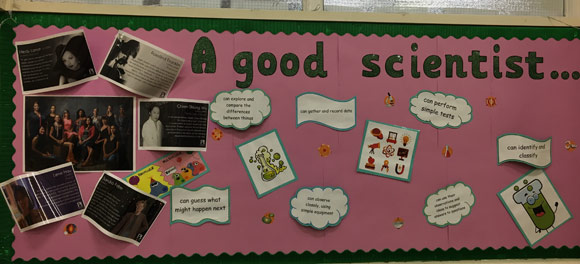
School poster acknowledges the role of women in science.
Celebrating the role of women in science. Picture credit: Everything Dinosaur.

Picture credit: Everything Dinosaur

International Women’s Day

The theme for International Women’s Day 2019 is: “Think equal, build smart, innovate for change”.  International Women’s Day has become an important date in the international calendar as it provides an opportunity to focus on the achievement of women and amongst other things to celebrate the role women play in the advancement of human knowledge and their contribution to society.  It also provides a focal point to address gender inequality.

When team members visit schools, we provide information to help the teachers to identify suitable role models for the children to learn about.  We have been lucky to have worked with some amazing scientists from all over the world and we can provide lots and lots of examples supporting the cause of gender equality in science, after all, the word scientist does not distinguish between male and female.

We Try and Breakdown Stereotypical Views about a Career in the Sciences

Developing scientists in schools.
Developing the next generation of scientists.  Helping to break down gender stereotypes.

Picture credit: Lego

Celebrating the Life and Work of Mary Anning

One of the role models we suggest is Mary Anning (1799-1847).  This famous fossil hunter from Dorset and her story has become synonymous with elements of the national curriculum for schools (primary school level).  When we visit schools, we provide lots of additional teaching resources and we often challenge the class to research and write about Mary Anning (independent learning and non-chronological reporting).

A Challenge to a Key Stage 1 Class – Ten Questions About Mary Anning

Mary Anning Non-chronological report.
A non-chronological report exercise based on the life and work of Mary Anning.  Helping to promote the role of women in science. Picture credit: Everything Dinosaur.

Picture credit: Everything Dinosaur

Tomorrow, March 9th, is the anniversary of the death of Mary Anning, at just 47 years of age.  As well as working with Key Stage 1 children exploring the fossils that Mary Anning found and her role in helping to improve our understanding of prehistoric life, when working with older children in Upper Key Stage 2, we introduce other issues that are reflected in the life and work of the famous fossil hunter.  For example, in Georgian and early Victorian times, the academic world largely shunned the idea of women making a contribution to scientific enquiry.

During her lifetime, Mary Anning received little credit and very little reward for her efforts.  These days, we live in somewhat more enlightened times, although many might argue that there is still a long way to go before true equality is achieved.

Working with Upper KS2 Students

When working with Year 5 and Year 6 students we explore how other scientists treated Mary and her endeavours.  She was not permitted to join the Geological Society of London, being a woman, this was forbidden and many of her male contemporaries not only refused to give her credit for her discoveries and insights, they actually took much of the credit for themselves.  Sadly, Mary died all too soon having spent much of her life in abject poverty.  When Everything Dinosaur team members visit Lyme Regis, where Mary was born, we make a pilgrimage to her grave at St Michael’s church and pay our respects.

Mary Anning’s Grave at Lyme Regis She is Buried Alongside Her Brother Joseph
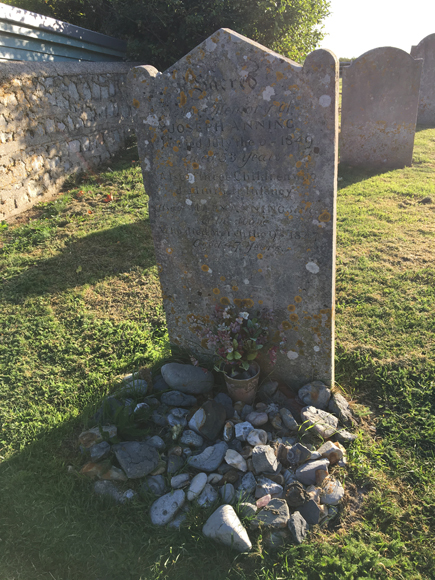
Mary and Joseph Anning are buried here.
The grave of Mary and Joseph Anning.  It has become the custom to leave a fossil at the grave as a tribute to Mary’s contribution to science. Picture credit: Everything Dinosaur.

Picture credit: Everything Dinosaur

The Royal Society Acknowleges Mary Anning

In 2010, the Royal Society published a list of the top ten British women who had most influenced the history of science.  Mary Anning was included in this list.  Much has changed in terms of gender equality in the sciences, however, despite the Royal Society having its roots in the early 1660s, it is worth remembering that the first female Fellow was not elected until 1945 (we think).

Another female scientist included in the Royal Society list was the chemist, biologist and physicist Rosalind Franklin.  Rosalind was an outstanding polymath who made an enormous contribution to our understanding of DNA and RNA and pioneered X-ray crystallography (XRC).  Rosalind Franklin is commemorated on the poster we spotted in the primary school.

Rosalind Franklin is Featured on the School Poster Praising the Contribution of Women in Science

Highlighting the work of Rosalind Franklin.
The work of Rosalind Franklin is highlighted. Picture credit: Everything Dinosaur.

Picture credit: Everything Dinosaur

Visit the Everything Dinosaur website: Everything Dinosaur.
22 01, 2019

Dinosaurs with Foundation Stage Children

By |2023-11-20T15:24:32+00:00January 22nd, 2019|Categories: Educational Activities, Main Page, Teaching|0 Comments

Dinosaurs with Foundation Stage Children

Over the last few days, the teaching team at Everything Dinosaur have been out and about visiting lots of schools to work with Foundation Stage children.  We have met some very enthusiastic and eager young palaeontologists and conducted several workshops with Reception and Nursery classes.  We have seen fossils, dinosaur drawings, prehistoric animal skeletons made from pasta shapes and even a few flying reptiles dangling from a classroom ceiling.  One class of Nursery children (Foundation Stage 1), have been helping “Trudy the Triceratops” build a nest and each weekend one of the children gets to take “Trudy” home and to look after the dinosaur for a couple of days.

“Trudy the Triceratops” – Helping with a Dinosaur Term Topic with a Nursery Class

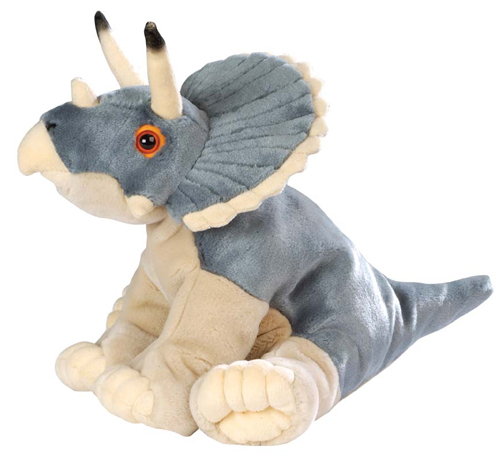
Triceratops soft toy.
A soft toy Triceratops like “Trudy the Triceratops”.

Picture credit: Everything Dinosaur

Dinosaur Soft Toys

The picture (above) shows a soft toy Triceratops. This piece of prehistoric plush is very cute and cuddly.

To view the range of prehistoric animal soft toys in stock at Everything Dinosaur: Dinosaur Soft Toys.

Trudy loves adventures and she will have a diary with her so that parents and children can record what Trudy gets up to whilst she is away from the school.  On the Monday, following Trudy’s visit, the child will be given the opportunity to tell the class what Trudy has been up to over the weekend.

Explaining about Trudy’s adventures will help improve the children’s communication skills and help develop confidence.

Labelling a Triceratops

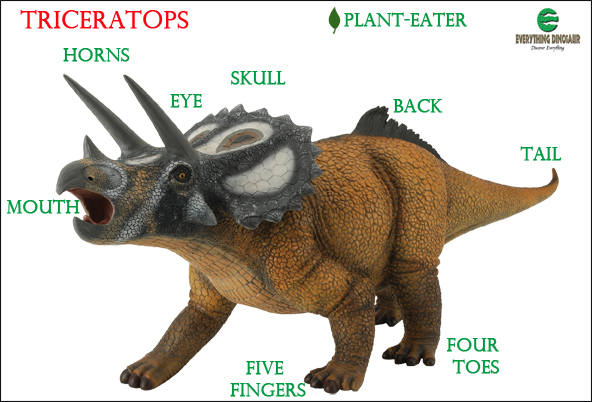
To help support the teaching team’s scheme of work we provide extra resources and teaching materials.  At one school we learned that the Nursery class teacher had a favourite dinosaur.  It was Triceratops, so we sent an illustration of what palaeontologists think Triceratops actually looked like.  We suggested that if the teacher blanked out our labels, then the children could write in their own labels and name the various parts of the body.

Can You Label a Dinosaur?

Labelling a Triceratops.
Can you label a dinosaur? Picture credit: Everything Dinosaur.

Picture credit: Everything Dinosaur

The image (above) shows a Triceratops model. This is the 1:15 scale CollectA Deluxe Triceratops figure.

To view the range of CollectA Deluxe models: CollectA Deluxe Prehistoric Life Models.

Can the children label the dinosaur?  A good exercise in helping with vocabulary development and writing, some words might be spelt correctly whilst others could be phonetically plausible.

Hatching Dinosaur Eggs

During our visits we saw lots of dinosaur eggs and nests.  We suggested that an extension activity to accompany the discovery of a dinosaur egg in the classroom would be to challenge the children to think of materials that might help to keep the egg safe and warm.  What sort of materials should we use to make a nest for a dinosaur?  This activity supports the concept of learning through play and exploration.  The children can look at the properties of materials and think through their own ideas, making links between ideas and developing strategies for achieving outcomes.

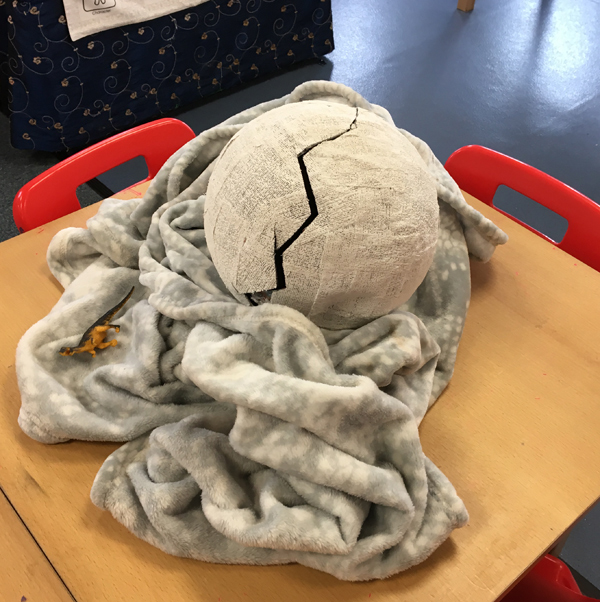
A Dinosaur Egg About to Hatch in a Reception Classroom

A dinosaur egg is about to hatch.
A hatching dinosaur egg spotted in a Foundation Stage (Reception) classroom.

Picture credit: Lum Head Primary/Everything Dinosaur

The children in the Reception class at Lum Head Primary had decided to wrap their dinosaur egg in a blanket to help keep the egg safe and warm.  A dinosaur had been added by the children to help keep the baby dinosaur company when it hatched.

For information about Everything Dinosaur’s work in schools and outreach work: Email Everything Dinosaur.

Visit the Everything Dinosaur website: Everything Dinosaur.
18 01, 2019

Celebrating the Role of Women in Science with a Special Event

By |2024-05-10T18:47:12+01:00January 18th, 2019|Categories: Educational Activities, Famous Figures, Main Page, Teaching|0 Comments

Supporting Women in Science

Whilst preparing to undertake a dinosaur and fossil workshop with a year 1 class, one of our team members spotted a superb display in the school hall, highlighting the role of women in science.  The concept of working scientifically is one of the key elements of the new national teaching curriculum that has been introduced.  It is wonderful to see the role of women in science being showcased to children at primary schools in this way.

Celebrating the Role of Women in Science

School poster acknowledges the role of women in science.
Celebrating the role of women in science.  A school poster showcases some of the leading female scientists and their contribution to building a better understanding about our world.

Picture Credit: Ilderton Primary/Everything Dinosaur

Women in Science – Chien-Shiung Wu, Hedy Lamarr, Sandra Faber and Rosalind Franklin

The poster explains some of the principles required to be a scientist such as gathering and recording data, making observations and devising experiments.  The work of four women are highlighted on this prominent poster.  Firstly, there is the physicist Chien-Shiung Wu, who worked on the Manhattan Project and become the first female tutor at the prestigious physics department at Princeton University in America.

Hedy Lamarr, perhaps better known for her acting career but also an accomplished mathematician and inventor is also featured.  She helped pave the way for today’s wireless technology.  During World War II, Hedy Lamarr worked on a radio guidance system which was more robust and difficult to jam and distort.  The principles of her work helped to lead to the development of today’s Bluetooth technology.

The poster also features Englishwoman Rosalind Franklin, a biophysicist who pioneered X-ray crystallography (XRC), a method by which the atomic and molecular structure of an object can be determined.  Her work helped to reveal the internal structures of complex minerals and most famously DNA.

A Poster in the Hall of a Primary School Celebrates the Work of Biophysicist Rosalind Franklin

The double helix of DNA.
Rosalind Franklin helped to unravel the structure of the double helix of DNA.

Last but least, the display poster features the work of astronomer Sandra Faber.  Sandra Faber has been instrumental in the Hubble Telescope programme helping to provide some of the most detailed images of the universe ever recorded.

Everything Dinosaur Comments

A spokesperson from Everything Dinosaur commented:

“It is great to see the work of famous women scientists highlighted in this way.  During our dinosaur and fossil themed workshops, we explore the contribution made to palaeontology by Mary Anning, who during her lifetime was given very little credit for her discoveries, but now is regarded as one of the pioneers of the Earth sciences.  Let’s hope the poster helps to inspire girls to think more seriously about a career in the sciences.”

Providing such positive role models to young girls may help encourage them with their own experiments in the school science classes.  It is important to highlight and celebrate diversity, helping to inspire and motivate the next generation of scientists.

Visit the Everything Dinosaur website: Everything Dinosaur.

16 01, 2019

Year 1 Children Prepare Questions About Dinosaurs

By |2023-11-19T16:44:33+00:00January 16th, 2019|Categories: Educational Activities, Main Page, Photos/Schools, Teaching|0 Comments

Dinosaur Questions from Year 1 at Barford Primary

Children in Year 1 at Barford Primary (Ladywood, Birmingham), have embarked on a new term topic.  Under the enthusiastic and expert guidance of their teachers, the children are learning all about dinosaurs, fossils and life in the past.  One of Everything Dinosaur’s dinosaur and fossil experts was dispatched to the school to visit 1G and 1L to help kick-off the dinosaur themed topic in style.

Dinosaur Workshop

Prior to delivering the two workshops (one workshop for each Year 1 class), our team member was given the chance to discuss learning objectives and outcomes with the class teachers in a spacious and very tidy Year 1 classroom.

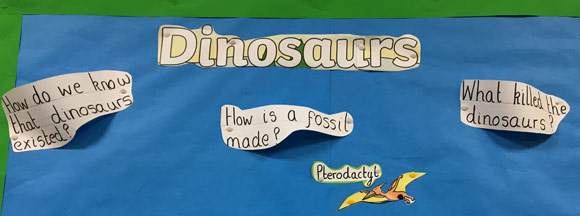
The children had been thinking of questions that they would like to know the answer to, a start had been made on one of the classroom display boards and some questions had already been posted up.

Children at Barford Primary School (Year 1) Prepare Questions About Prehistoric Animals and Fossils

Questions about dinosaurs from Year 1 (Barford Primary)

Barford Primary – dinosaur questions.  The two classes of Year 1 children had been preparing questions about dinosaurs and life in the past.

Picture credit: Everything Dinosaur/Barford Primary

Learning About Fossils

During the workshop, the children were able to handle the same sort of fossils that Mary Anning, the famous fossil hunter from Dorset would have discovered on the beach at Lyme Regis.  Mary Anning makes a fine role model for children in Key Stage 1, as she was not much older when she found the fossilised remains of a huge marine reptile (ichthyosaur) eroding out of the cliffs close to her home town.

For models and replicas of ichthyosaurs and other prehistoric animals: CollectA Age of Dinosaurs Popular Models.

Questions About Dinosaurs

One of the questions asked by the pupils was “how is a fossil made?”  Using simple language and terms our dinosaur expert leading the workshop was able to explain how most fossils are formed and that it is because we have fossils, such as bones, teeth and footprints that palaeontologists have been able to demonstrate that millions of years ago giant reptiles roamed the Earth.  All very helpful with the scheme of work for the Year 1 children as another question asked by a budding, young scientist was “how do we know that dinosaurs existed?”

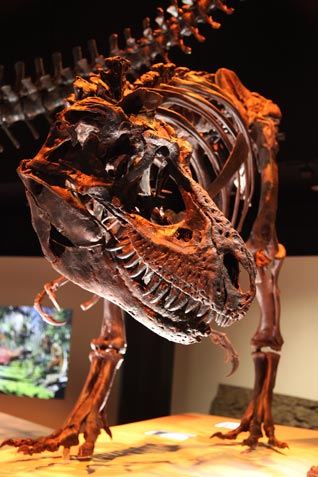
Fossils Help Scientists to Learn About Life in the Past

A Gorgosaurus on display.

Gorgosaurus fossil display.  Fossils help scientists to learn about life in the past.

Picture credit: Everything Dinosaur/Manchester University

Populating a Prehistoric Scene

One of the questions that our staff member spotted whilst visiting the Year 1 children (1G and 1L), was “what killed the dinosaurs”?  The children were keen to demonstrate their pre-knowledge and provided very confident answers, in the challenging and engaging scheme of work prepared for the term topic.  The question concerning what caused the extinction of the non-avian dinosaurs will be thoroughly researched and explored.  One theory that has been proposed is that a long period of volcanism caused global climate change, this volcanism in conjunction with an extra-terrestrial impact event led to the extinction of around seventy percent of all life on land, including the non-avian dinosaurs.

Volcanic Eruptions Could Have Played a Role in the Extinction of the Dinosaurs

Barford Primary (Year 1) design a prehistoric scene.

Primary school children design their own dinosaur landscape.  Volcanic eruptions could have been a factor in the extinction of the dinosaurs.

Picture credit: Everything Dinosaur/Barford Primary

Visit Everything Dinosaur’s website: Everything Dinosaur.

1 12, 2018

Defining Background Extinction a Helpful Explanation

By |2024-05-10T18:50:34+01:00December 1st, 2018|Categories: Animal News Stories, Educational Activities, Main Page, Teaching|0 Comments

What is Background Extinction?

Amongst the numerous emails that we receive from schools and schoolchildren every day, we were sent a query by a UK-based, Key Stage 2 teacher, who raised a question surrounding the teaching of natural selection, Darwinism and evolution with her Year 6 class.  The teacher had come across the term “background extinction”, but was unsure as to its meaning, could we help?

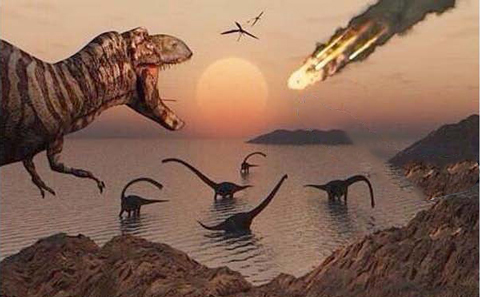
Bolide Impacts May Have Contributed to Mass Extinctions But What is Background Extinction?

The extinction of the dinosaurs.
The impact of an extra-terrestrial object such as a comet or asteroid probably contributed to the end-Cretaceous mass extinction event.

Defining Background Extinction

If ideas about natural selection are correct, then organisms in ecosystems are all competing against each other for resources.  Such competition for finite resources such as space, water and food will lead to some organisms being more successful than others.  Ultimately, those less competitive organisms within a population will not survive to reproduce.  The same idea applies on a species level, some species will be more successful than other species. 

Eventually, in the face of this competition, some species will die out.  These extinctions as a result of the operation of normal competition and natural selection are referred to as “background extinction”.  These extinctions are also sometimes referred to as the “standard rate of extinction”.

It is estimated that something like 90% of all extinctions throughout the history of our planet have taken place during times of background extinction.

To read an article (2015), that looks at why Australia’s extinction rate might be higher than on other continents: The Extinction Rate in Australia is Higher than most Other Continents.

Background Extinction – Extension Activities

In order to help the teacher’s scheme of work with the Year 6 class, we set two extension activities linked to the theme of background extinction:

1).  Could the school children draw a graph to represent mass extinction events that have occurred but also show on the same graph background extinction?

2).  Have the children research The International Union for Conservation of Nature (IUCN), can they produce a non-chronological report on this organisation, its aims, objectives and what current conservation projects are being undertaken?  There are plenty of on-line resources available including videos to support this type of independent enquiry and research.

Visit the Everything Dinosaur website: Everything Dinosaur.

11 11, 2018

Excited Foundation Stage 2 Children Study Dinosaurs

By |2023-11-11T06:43:59+00:00November 11th, 2018|Categories: Educational Activities, Main Page, Teaching|0 Comments

Foundation Stage 2 Learn All About Dinosaurs

Last week, was a very busy week for the teaching team at Everything Dinosaur.  They have lots of dinosaur and fossil workshops to try to fit in before schools begin preparing for the end of the autumn term.  On Friday, one of our teaching staff visited The Berkeley Academy in Cheshire to work with two Reception classes who had been studying life in the past and prehistoric animals.  Whilst being given a tour of the school by the dedicated teaching staff, our dinosaur expert spotted several examples of the children’s dinosaur themed arts and crafts on display.

One classroom (Class 2), had even constructed a dinosaur den in a part of their classroom.

Class 2 Children (Reception) Had Created a “Dinosaur Den” in their Classroom

A dinosaur den spotted in a Reception classroom.
Children in Class 2 (Berkeley Academy) have a dinosaur den in their classroom. Picture credit: Everything Dinosaur.

Picture credit: Everything Dinosaur

Dinosaur and Fossils Workshop

There were lots of fiction and non-fiction prehistoric animal themed books for the children to peruse.  The mission statement for the school is “It’s all about doing your best” and some of the Year 5 students had helped with decorating the dinosaur den, creating some very colourful examples of dinosaurs out of pieces of tissue paper.  These had been placed alongside some “Plateosaurs” that the Reception children had made.

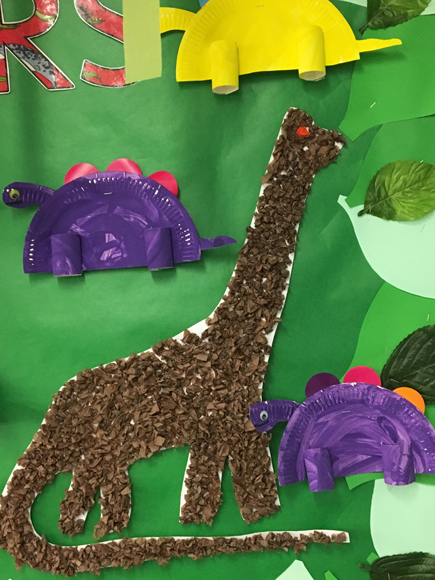
Tissue Paper Dinosaurs and “Plateosaurs” Decorate the Dinosaur Den

A Brachiosaurus spotted in the dinosaur den.
Children in Year 5 at Berkeley Academy (Cheshire), helped to decorate the dinosaur den in the Reception class. Picture credit: Everything Dinosaur.

Picture credit: Everything Dinosaur

For dinosaur toys and games: Dinosaur Toys and Games.

Berkeley Academy aims to create a learning environment in which all the children can thrive.  The eager, young palaeontologists had been developing their knowledge about dinosaurs and during our dinosaur expert’s visit the children were keen to demonstrate their pre-knowledge and they were very confident answering questions and contributing to the workshop.

Year 5 Have Helped to Decorate the Reception Class

A brightly coloured dinosaur made from tissue paper.
A brightly coloured meat-eating dinosaur created with tissue paper by Year 5 children. Picture credit: Everything Dinosaur.

Picture credit: Everything Dinosaur

A Dinosaur Den

The dinosaur den makes a wonderful safe, secure and stimulating environment for the young children to learn about simple food chains, what animals need to keep them happy and to discover famous fossil hunters like Mary Anning.

To help develop hand-to-eye co-ordination and motor skills, the children had been challenged to write their names inside a silhouette of a dinosaur.  These dinosaurs were posted up onto a “wow wall”, we hope the dinosaur feet we provided will help to further stimulate the children’s writing skills.

Writing and Dinosaurs Combine to Help Reception Children Improve their Motor Skills

Dinosaurs and writing activities (Foundation Stage 2)
The Reception class children wrote their names on a dinosaur. Picture credit: Everything Dinosaur.

Picture credit: The Berkeley Academy/Everything Dinosaur

For further information about Everything Dinosaur’s work in schools and their dinosaur and fossil resources visit the company’s website: Everything Dinosaur.

8 11, 2018

Caterpillars and Bees Learn All About Dinosaurs

By |2023-11-09T15:37:23+00:00November 8th, 2018|Categories: Educational Activities, Main Page, Teaching|0 Comments

Reception Children at Mansfield Green E-ACT Academy Learn About Dinosaurs

The children in the two Reception classes at Mansfield Green E-ACT Academy (Caterpillars and Bees), have had a very busy term learning about fossils and dinosaurs.  As part of a rich and diverse scheme of work devised by the hard-working teaching team, a staff member from Everything Dinosaur was invited into the Birmingham-based school to spend a morning delivering two workshops to the eager, young scientists.  The enthusiastic learners were keen to demonstrate their knowledge about dinosaurs and other prehistoric animals and our workshops were well received by the children and teachers alike.

Fossils and Dinosaurs

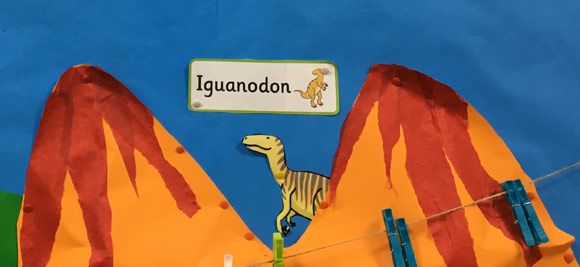
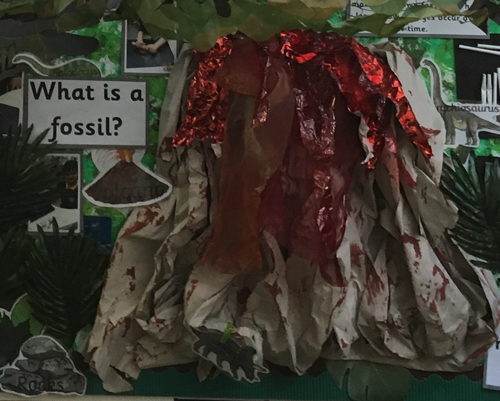
Prior to the start of the school day, our dinosaur expert was given the opportunity to view some of the wide range of activities that the classes had undertaken.  Part of one of the well-appointed and very tidy Reception classrooms had been turned into a special “dinosaur” exhibit.  The centrepiece of this display was a beautiful volcano that had been made from crumpled brown paper with bright red cellophane making excellent lava.

A Centrepiece of the Dinosaur Display in the Reception Classroom

A volcano on display in a classroom.
Reception classes learn about volcanoes and dinosaurs.

Picture credit: Everything Dinosaur/Mansfield Green E-ACT Academy

Lots of Amazing Arts and Crafts on Display

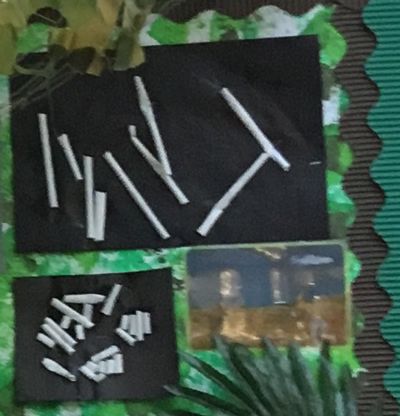
The children had been making their very own fossils out of clay and during our workshop we explored in simple terms how fossils are formed and helped the children to learn about some of their properties (hard/soft, heavy/light, hot/cold).  Our dinosaur expert spotted some dinosaur bones made out of straws that the children had used to create shapes and patterns.

Creating Shapes and Patterns Using Straw Dinosaur Bones

Straws used to make skeletons of dinosaurs (shapes and patterns).
Using straws to make dinosaur skeletons – shapes and patterns. A varied term topic learning about fossils and dinosaurs.

Picture credit: Everything Dinosaur/Mansfield Green E-ACT Academy

At Mansfield Green E-ACT Academy, the dedicated staff encourage the children to think big and to push boundaries so as to build their confidence.  One of the teachers explained that the children had been making dinosaurs out of paper plates and she was amazed when our dinosaur expert explained that there actually was a dinosaur called Plateosaurus!  The young palaeontologists had not just been looking at dinosaurs, their cousins the pterosaurs (flying reptiles), had been studied too.

A beautifully crafted model of a pterosaur had been carefully placed above one of the dinosaur themed areas of the Reception classroom.

Flying High Over the Classroom Dinosaur Display

Pterosaur on display in a classroom.
A beautiful flying reptile flying high over a dinosaur classroom display at Mansfield Green E-ACT Academy.

Picture credit: Everything Dinosaur/Mansfield Green E-ACT Academy

Plant-eaters, Meat-eaters, Habitats and Homes

The Academy had been graded “Outstanding” in all areas following a recent Ofsted (The Office for Standards in Education, Children’s Services and Skills), inspection.  There was certainly much to admire in the Foundation Stage part of the school that our dinosaur expert visited.  The staff were highly motivated and our team member observed that the school was providing a very creative and exciting curriculum for the pupils.  We are confident that the additional resources that we supplied and the lesson plan suggestions would help to augment the challenging and inspirational scheme of work that had been devised for the Reception classes. The children seemed to be enjoying learning about fossils and dinosaurs.

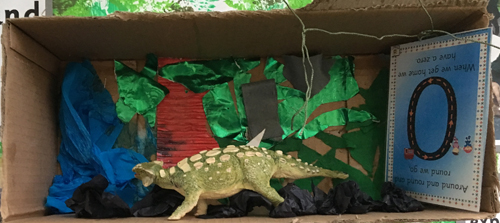
The children in Bees and Caterpillars had been learning about meat-eating and plant-eating dinosaurs along with the sort of conditions a dinosaur needs to be happy and to feel safe.  The Reception classes had even built one or two little dinosaur worlds for their dinosaur figures to live in.

An Armoured Dinosaur Finds a Home in the Dinosaur Display

A dinosaur on display in a Reception classroom.
An armoured dinosaur (Ankylosaurus) finds a home at Mansfield Green E-ACT Academy.

Picture credit: Everything Dinosaur/Mansfield Green E-ACT Academy

Visit the Everything Dinosaur website: Everything Dinosaur.

7 10, 2018

Baking Terrific and Tasty Triassic Treats

By |2024-05-11T16:35:16+01:00October 7th, 2018|Categories: Educational Activities, Everything Dinosaur News and Updates, Main Page, Teaching|0 Comments

Dinosaurs Inspire Baking

The children in Year 2 (Owls and Hedgehogs classes), at Spire Nursery and Infant School (Derbyshire), have been learning all about dinosaurs, fossils and prehistoric animals this term.  A team member from Everything Dinosaur visited the school last week to conduct some workshops with the children as part of a challenging, diverse and exciting scheme of work that had been devised by the dedicated teaching team.

“Triassic Treats”

Over the last few weeks the children have shared lots of amazing information about dinosaurs and set out what aspects of the lives of dinosaurs that they would like to explore.  The eager, young palaeontologists have been learning about when dinosaurs lived, where they lived and what they ate.  As part of an exploration of food and dinosaur body shapes the children in Year 2 made some super dinosaur themed cakes and biscuits. We took the opportunity to photograph the children’s “Triassic treats”.

Trays of Dinosaur Inspired Tasty Cakes and Biscuits

Dinosaur treats made by Year 2 children.
Dinosaur chocolate nests and biscuits.  A couple of trays of “Triassic treats”. Picture credit: Everything Dinosaur.

Picture credit: Everything Dinosaur

Developing Creativity

Taking part in a baking activity permits the children to practice their measuring and motor skills as well as introducing the idea of following a set of instructions to achieve a desired outcome.  Decorating the various dinosaur themed treats certainly brought out the children’s creative flair.

Young Elliott was Very Proud of the Dinosaur Biscuit that he had Made

A dinosaur shaped biscuit made by Year 2.
A dinosaur themed biscuit. Picture credit: Everything Dinosaur.

Picture credit: Everything Dinosaur

For “Triassic Treats” and other dinosaur themed goodies: Dinosaur Toys and Gifts.

Herbivores, Carnivores and Omnivores

Over the course of the term topic the children have been learning about simple food webs and what animal’s need to keep them safe and well.  During our workshops with the classes our dinosaur expert checked learning by testing the children’s knowledge about herbivores, carnivores and omnivores.  One of the role-play areas in a classroom had been turned into a “dinosaur dig site”, permitting the children the opportunity to search for dinosaur bones, allowing the children to experience what it is like to be a real palaeontologist.

After the Everything Dinosaur workshops in the morning, the children were going to have an afternoon of science, creating simple experiments to study the way in which some dinosaurs fed.  We hope that the additional resources, experiment ideas and lesson plans we provided helps to support, what is already a diverse and challenging scheme of work.

Whilst in one of the classrooms, our dinosaur expert was able to see some of the excellent dinosaur themed work completed by the children.  The classes had been finding out lots of information about dinosaurs from a variety of sources to help them create their own non-fiction book.  Lots of dinosaur books were on display, the Year 2 pupils had been exploring different texts, all with a prehistoric animal theme.

Shapes and Numeracy

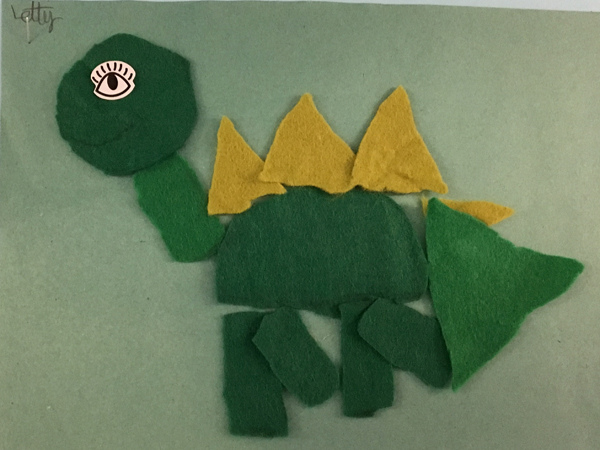
There is a big focus on helping the children gain confidence with numbers.  The children have been studying simple addition and subtraction problems, our dinosaur footprint measuring exercise that we provided should help support this area of the curriculum nicely.  The enthusiastic teaching team have been using dinosaurs to help children appreciate and learn about different shapes.  On the wall outside the Year 2 classrooms, examples of dinosaurs made from different shaped pieces of felt were on display.

Learning About Different Shapes Using Dinosaurs

Exploring shapes to make a felt dinosaur
A felt dinosaur.  The children were challenged to use different shaped pieces of felt to build a dinosaur.  This is a great way to help develop an understanding of basic geometry. Picture credit: Everything Dinosaur.

Picture credit: Everything Dinosaur

Visit the Everything Dinosaur website: Everything Dinosaur.
30 09, 2018

Everything Dinosaur Supports the Exclusive TetZooCon 2018

By |2024-05-11T16:37:30+01:00September 30th, 2018|Categories: Adobe CS5, Animal News Stories, Educational Activities, Everything Dinosaur News and Updates, Everything Dinosaur Products, Main Page, Photos of Everything Dinosaur Products, Press Releases|0 Comments

Everything Dinosaur Supports TetZooCon 2018

The countdown to the annual TetZooCon has well and truly started, there is just under a week to go until the prestigious London conference dedicated to living and extinct tetrapods.  TetZooCon opens on Saturday 6th October and for the first time, the amazing number of speakers, presenters and activities means that the fifth incarnation of this event has been extended over two days.  A whole weekend dedicated to the “TetZooniverse”!

Everything Dinosaur is honoured to be involved in this annual gathering and we have dispatched some rather special prehistoric animal models and figures that can be used as prizes for the super-tricky (but still fun), quiz that is a staple of this wonderful event.

Just Under One Week Until TetZooCon 2018

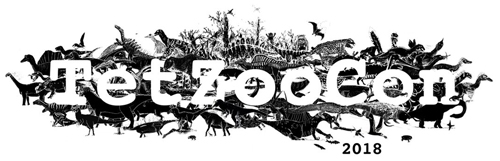
The Tetrapod Zoology Conference 2018.
The promotional banner for TetZooCon 2018.

Picture credit: Darren Naish/John Conway

Talks, Presentations, Palaeoart Workshops, Book Signings and So Much More

Our congratulations to conference organisers Darren Naish and John Conway who have put together a varied and fascinating group of speakers and other tetrapod themed events for what will, no doubt, be an extremely enjoyable and informative weekend.  Visitors to The Venue, Malet Street, London next weekend will be able to spot Everything Dinosaur’s slides that have been prepared for use in between the talks and various presentations.

Everything Dinosaur Supports TetZooCon 2018

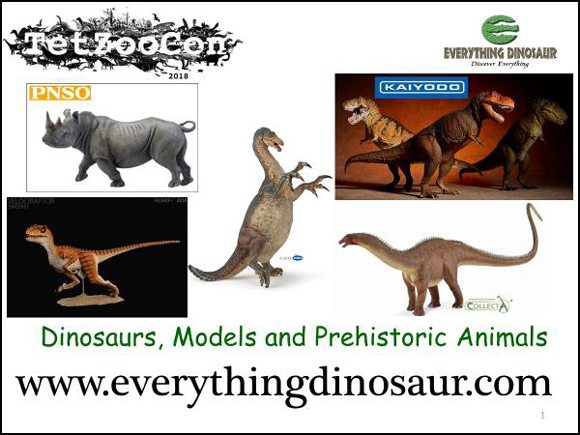
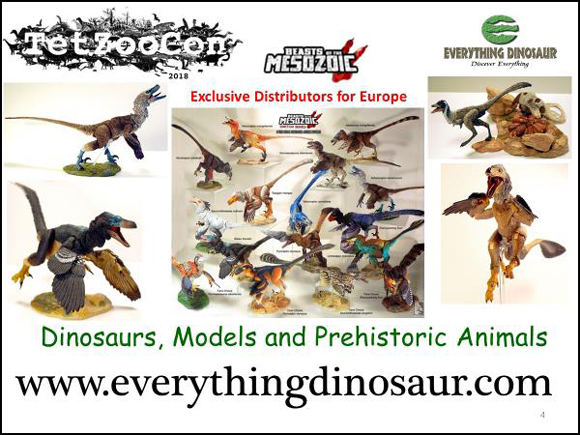
One of Everything Dinosaur's slides prepared for TetZooCon 2018.
Everything Dinosaur has prepared slides for TetZooCon 2018. Picture credit: Everything Dinosaur.

Picture credit: Everything Dinosaur

Everything Dinosaur Slides

The slides will showcase the breadth and the range of prehistoric animal figures and models that Everything Dinosaur now stocks.  Our prehistoric animal inventory is nearly as eclectic and diverse as the incredible range of presenters that have been invited to speak at this year’s TetZooCon.  Highlights of the event include a talk from herpetologist Mark O’Shea, Jennifer Jackson on the origins of baleen whales, Katrina van Grouw on the influence of Homo sapiens on the fate of Earth’s biota and Fiona Taylor providing a composer’s perspective on music used in wildlife documentaries.

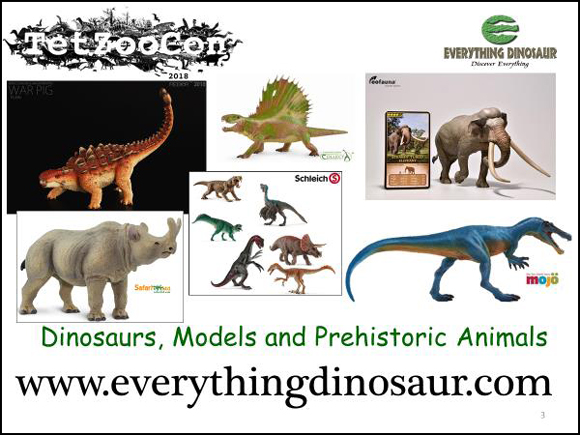
We hope that Bristol University’s Steve Zhang, another speaker at this illustrious gathering, will spot the Eofauna Straight-tusked elephant (Palaeoloxodon antiquus) figure that we have donated as a quiz prize.  After all, Steven will be one of the first speakers TetZooCon 2018, with a short presentation highlighting the rise and fall of the Straight-tusked elephant.

The Slideshow Will Highlight the Huge Range of Prehistoric Animal Figures Stocked By Everything Dinosaur

Slides for TetZooCon 2018
The Eofauna Straight-tusked elephant features on the Everything Dinosaur TetZooCon slideshow. Picture credit: Everything Dinosaur.

Picture credit: Everything Dinosaur

The 2018 TetZooCon has a Very Special Banner

Since the very first TetZooCon in 2014, a promotional banner has been created by Darren featuring some of the enormous number of illustrations that the vertebrate palaeontologist and science writer has compiled for his textbook detailing the evolutionary history of the vertebrates.  This year’s banner is a little different, it includes artwork produced by delegates at last year’s conference, helping to encapsulate the inclusive and participative elements of this unique event.

If you attended TetZooCon and contributed to the pair of giant panels produced during the palaeoart workshop, then your own illustration may have been used to help create the 2018 TetZooCon promotional banner.

Beasts of the Mesozoic Will Feature at TetZooCon 2018

Beasts of the Mesozoic slide prepared for prestigious scientific conference.
Beasts of the Mesozoic features on the 2018 TetZooCon slideshow. Picture credit: Everything Dinosaur.

Picture credit: Everything Dinosaur

A spokesperson from Everything Dinosaur commented:

“TetZooCon is now in its fifth year and it is going from strength to strength.  Our congratulations to Darren and John for putting on this not-for-profit event, it is a wonderful example of scientific outreach, bringing together a cornucopia of talented artists, illustrators and scientists all helping to inform and educate.  Special wishes to Beth Windle, who once again will be bringing a Tetrapod inspired cake along to this prestigious event.”

Eagle-eyed attendees will spot something rather special on the slide presentation that we have prepared especially for TetZooCon 2018.  Everything Dinosaur will soon be sending out an important news release about yet another exciting development at the company.  A new range of prehistoric animal figures is being added to Everything Dinosaur’s already impressive portfolio and delegates at TetZooCon 2018 will be amongst the first to find out about this.

More news about TetZooCon and the developments at Everything Dinosaur coming soon….

In the meantime, visit the Everything Dinosaur website: Everything Dinosaur.

22 09, 2018

Key Stage 1 and Beautiful Dinosaurs

By |2024-05-11T10:13:50+01:00September 22nd, 2018|Categories: Educational Activities, Main Page, Teaching|0 Comments

Key Stage 1 Classes at Strawberry Fields Primary Study Dinosaurs

The children in the three Key Stage 1 classes at Strawberry Fields Primary are certainly enjoying their term topic all about dinosaurs, fossils and life in the past.  The dedicated teaching team have developed a challenging and varied term topic for the pupils.

Studying Dinosaurs

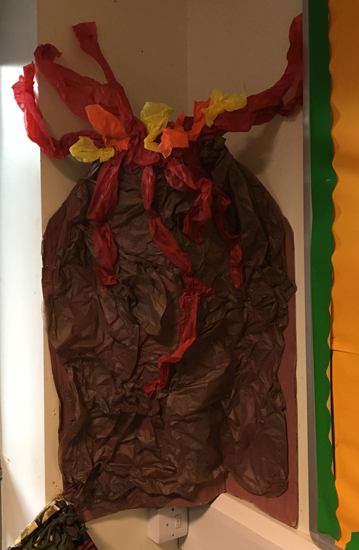
The budding young palaeontologists in Year 1 (class 1MM), have been working out whether “a dinosaur would make a good pet”.  Some of the fierce meat-eating dinosaurs we talked about during our school visit, might not make ideal pets, but some of the smaller plant-eaters, (herbivores) might have been better suited.  The dinosaurs would certainly have been curious to visit the amazing dinosaur den that had been set up in the classroom, complete with a beautiful crepe paper volcano overlooking it.

A Model of a Volcano on Display in the Classroom

Year 1 model volcano.
A wonderful representation of a volcano on display in a Year 1 classroom. Picture credit: Everything Dinosaur.

Picture credit: Everything Dinosaur

Bright and Colourful Prehistoric Animal Displays

The children in the three Key Stage 1 classes (1MM, 1/2CE and 2MC), were keen to display their knowledge and explained confidently how the dinosaurs died out.  Prior to our workshops, we provided some additional resources and we emailed over to the school a lesson plan that we had devised that examined the question “why do asteroids always land in craters”?   This lesson plan and the other materials we provided were aimed at supporting the school’s scheme of work and to engage the children with the concept of “scientific working”.

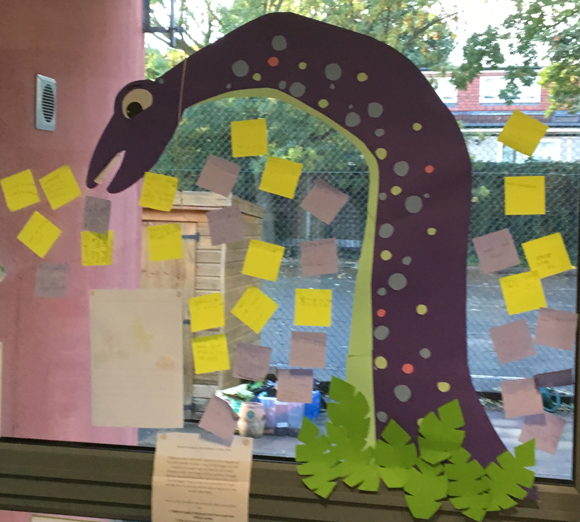
Lots of Brightly Coloured Prehistoric Animals on Display Around the Spacious Classrooms

Key Stage 1 prehistoric animal window display.
A colourful long-necked prehistoric animal window display in Key Stage 1. Picture credit: Everything Dinosaur.

Picture credit: Everything Dinosaur

A Three-dimensional Dinosaur Model

In the tidy and well-appointed classrooms, our dinosaur expert who visited the school spotted lots of excellent examples of the children’s work.  There was even a three-dimensional model of the head of a Triceratops looking down on the display boards in one of the classrooms.  These display boards were rapidly becoming filled with examples of the children’s non-chronological reports, questions that they had researched about dinosaurs, fact sheets and plenty of colourful prehistoric animal themed artwork.

The Head of a Triceratops Looks Down on the Class Display Boards

Triceratops head on display in a Key Stage 1 classroom.
A three-dimensional Triceratops head on display in the classroom. Picture credit: Everything Dinosaur.

Picture credit: Everything Dinosaur

Our very best wishes to all the young palaeontologists in Key Stage 1 at Strawberry Fields Primary and also to the hard-working teaching team that had put together such an exciting and challenging term topic for the children.

Visit the Everything Dinosaur website: Everything Dinosaur.
Go to Top