All about dinosaurs, fossils and prehistoric animals by Everything Dinosaur team members.

Drawings of dinosaurs and other prehistoric animals either done by team members or sent into Everything Dinosaur.

11 12, 2018

Prehistoric Cave Art Reveals an Understanding of Astronomy

By |2023-11-12T06:49:21+00:00December 11th, 2018|Categories: Animal News Stories, Dinosaur and Prehistoric Animal Drawings, Dinosaur and Prehistoric Animal News Stories, Main Page|0 Comments

Cave Paintings Indicate a Link with Complex Astronomical Measurements

Scientists have decoded some ancient (Palaeolithic and Neolithic), cave art and found consistent links which indicate that Stone Age people had an advanced knowledge of astronomy.  The artworks located across Europe (Spain, France and Germany, with some younger artworks studied from Turkey), are not simply depictions of animals and hunting, the wild animals that have been painted onto cave walls represent star constellations and are used to represent dates and catastrophic events such as meteor strikes.

The Famous Lascaux Shaft Cave Painting (France)
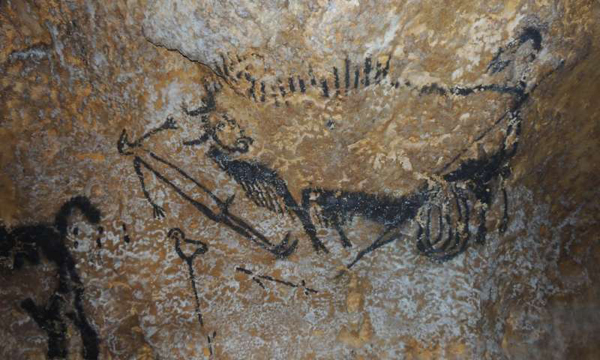
The Lascaux Shaft Cave Painting
The cave painting shows a wounded bison with its entrails hanging outside his body standing over a prone man with a bird mask.  Once thought to depict a hunting accident and also linked to shamanism, scientists now think such symbolism relates to understanding movements of celestial bodies.

Picture credit: Alistair Coombs

This research, published in the latest edition of the quarterly “Athens Journal of History”, suggests that perhaps as far back as 40,000 years ago, humans kept track of time using knowledge of how the position of the stars slowly changes over thousands of years.  The study conducted by scientists from Edinburgh University and the University of Kent, hints at the possibility that ancient peoples understood an effect caused by the gradual shift of the Earth’s rotational axis.  Discovery of this phenomenon, called precession of the equinoxes, was previously thought to have occurred much more recently (credited to the Ancient Greek civilisation).

Like Signs of the Zodiac

In western, occidental science, constellations are represented by symbols such as animals, for example, The Great Bear, Pegasus, Aries and Leo.  It seems this idea has roots far back into our ancestry.  The researchers estimate that Stone Age people could define the date of an astronomical event according to this celestial calendar to within 250 years or thereabouts.  The findings indicate that the astronomical insights of ancient people were far greater than previously believed.

One practical application of this knowledge would have been seen in navigation.  Knowledge of the movements of the stars in the night sky would have aided navigation across open water out of sight of land.  This new study may have implications for how we perceive human migration in prehistory.

Studying Palaeolithic and Neolithic Art

The scientists discovered all the ancient sites they studied across Europe and into Turkey used the same method of date-keeping based on sophisticated astronomy, even though the art was separated in time by tens of thousands of years.

The oldest art in the research project was the Lion-Man sculpture from the Hohlenstein-Stadel Cave, in southern Germany.  This sculpture is believed to have been created around 38,000 B.C.  The most recent artworks incorporated into this research come from Neolithic sites in southern Turkey which are dated to around 9,000 years ago.  Researchers clarified earlier findings from a study of stone carvings at one of these sites – Gobekli Tepe in (Turkey), which is interpreted as a memorial to a devastating comet strike around 13,000 years ago.  The extra-terrestrial impact event is believed to have caused a mini Ice Age in the Northern Hemisphere (the Younger Dryas period).

Löwenmensch Figurine or Lion-man of the Hohlenstein-Stadel Cave (Germany)
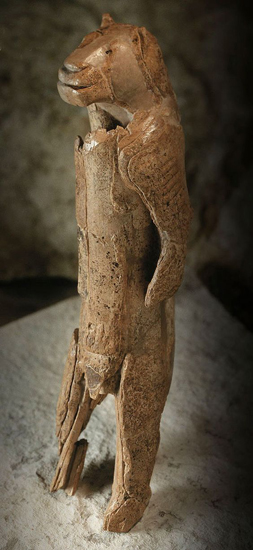
The Lion-man sculpture of Hohlenstein-Stadel.
Löwenmensch figurine or Lion-man of the Hohlenstein-Stadel cave complex.  Carved from Mammoth ivory, the figure probably took several hundred hours to make.

Studying Prehistoric Art

The scientists also decoded what is probably one of the most famous ancient cave paintings, the Lascaux Shaft Scene in France.  The artwork, which features a dying man and several animals (see above), may commemorate another comet strike around 17,200 years ago.  The team confirmed their findings by comparing the age of many examples of cave art, known from chemically dating the paints used, with the positions of stars in ancient times as predicted by sophisticated software.

Dr Martin Sweatman (School of Engineering at Edinburgh University), stated:

“Early cave art shows that people had advanced knowledge of the night sky within the last Ice Age.  Intellectually, they were hardly any different to us today.  These findings support a theory of multiple comet impacts over the course of human development and will probably revolutionise how prehistoric populations are seen.”

Everything Dinosaur acknowledges the assistance of a press release from Edinburgh University in the compilation of this article.

Visit the award-winning Everything Dinosaur website: Everything Dinosaur.
2 12, 2018

Bully for Baryonyx – A Famous Dinosaur

By |2023-11-11T13:34:36+00:00December 2nd, 2018|Categories: Dinosaur and Prehistoric Animal Drawings, Dinosaur Fans, Main Page, Photos of Everything Dinosaur Products|0 Comments

Bully for Baryonyx

When amateur fossil collector William Walker found a huge fossilised claw in a Surrey clay pit, our understanding of theropod dinosaurs began to change.  The claw (which was discovered in January 1983), was only the start of the story.  The following late spring and early summer saw a field team from the Natural History Museum in London working in the pit to extract nearly two thirds of the skeleton of an unknown and never seen before meat-eating dinosaur.

Bully for Baryonyx

The bones were entombed in hard siltstone nodules and clay.  It took a further six years of preparation before all the bones representing a single, individual specimen had been cleaned and prepared for display.  The dinosaur was named by palaeontologists Alan J. Charig and Angela C. Milner in 1986, when enough of the fossil material had been cleaned and prepared revealing a very different type of theropod dinosaur.  Baryonyx walkeri is a member of the Spinosauridae family.

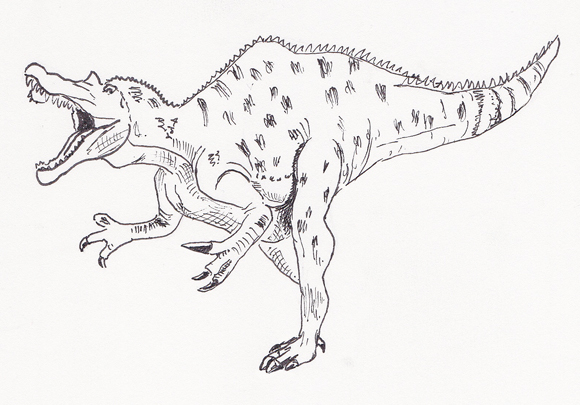
An Illustration of the Theropod Dinosaur Baryonyx (B. walkeri)

A drawing of the Theropod dinosaur Baryonyx.
An illustration of the theropod dinosaur Baryonyx. Picture credit: Everything Dinosaur.

Picture credit: Everything Dinosaur

The Theropod Baryonyx walkeri

The theropod was named Baryonyx walkeri and it has been classified as a member of the Spinosauridae family, although the exact taxonomic position of Baryonyx and related dinosaurs such as Suchomimus remains disputed.  A revision in 2018, concluded that baryonychid dinosaurs were monophyletic (all descended from a common ancestor).  Everything Dinosaur team members have been busy preparing for the arrival next year of the new CollectA 1:40 scale Baryonyx model, the illustration (above) has been commissioned so that we can update our Baryonyx fact sheet.

See the CollectA Deluxe model range: CollectA Deluxe Dinosaur Models.

The New for 2019 CollectA Deluxe Baryonyx Dinosaur Model

CollectA Deluxe Baryonyx dinosaur model.
The CollectA Deluxe 1:40 scale Baryonyx dinosaur model.

The Subfamily Baryonychinae

In their original 1986 description, palaeontologists Alan Charig and Angela Milner erected the Subfamily Baryonychinae, however, where the Baryonychinae sits within the Spinosauridae remains open to debate.

Visit the Everything Dinosaur website: Everything Dinosaur.

30 11, 2018

Tsintaosaurus Illustrated by Talented Artist

By |2023-11-11T13:07:24+00:00November 30th, 2018|Categories: Dinosaur and Prehistoric Animal Drawings, Dinosaur Fans, Main Page, Photos of Everything Dinosaur Products|0 Comments

A Life Reconstruction of Tsintaosaurus (T. spinorhinus)

Formally named and described sixty years ago (1958), we feature in today’s blog posting the bizarre Lambeosaurine Tsintaosaurus (Tsintaosaurus spinorhinus).  This dinosaur, often referred to as a “unicorn-like” dinosaur because of its bizarre crest, comes from the Wangshi Formation of Shandong Province (eastern China).

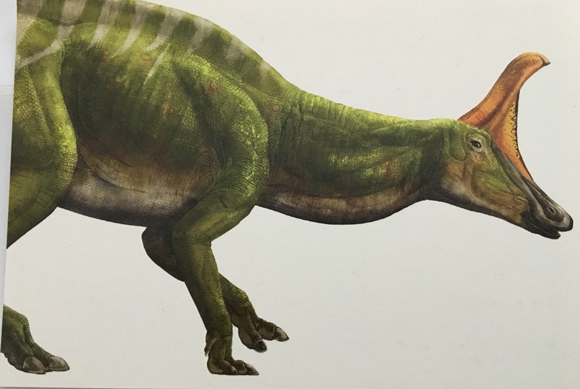
A Life Reconstruction of the Lambeosaurine Tsintaosaurus (T. spinorhinus)

A life reconstruction of the duck-billed dinosaur called Tsintaosaurus by the famous Chinese palaeoartist Zhao Chuang.
A life reconstruction of the hadrosaurid Tsintaosaurus by the renowned Chinese palaeoartist Zhao Chuang.

Picture credit: Zhao Chuang

The Anterior Portions of a Hadrosaurid

The picture above was painted by renowned Chinese palaeoartist Zhao Chuang.  This great illustrator has produced numerous paintings of dinosaurs and other prehistoric animals, many of which have been used in scientific papers and reports.  Why in this instance only the anterior portion of the dinosaur is shown, we cannot say, although this does give the viewer the opportunity to focus on that bizarre head crest.

The presence of a upright horn-like crest on the snout of Tsintaosaurus has been disputed.  Some palaeontologists noted that this sliver of bone that represented the horn could in fact be a piece of the nasal bone (naris), that had become displaced and deformed as a result of the fossilisation process.  It was the eminent French palaeontologist Eric Buffetaut, whilst studying skull material who confirmed that this strange process was indeed a horn.  Its function remains uncertain.  It may have played a role in visual communication and it could have had a flap of skin running down its front edge, a viewpoint supported by Zhao Chuang’s excellent illustration.

The CollectA Tsintaosaurus Dinosaur Model

Models and figures of this Late Cretaceous herbivorous dinosaur are few and far between but CollectA did add a Tsintaosaurus replica to their not-to-scale “Prehistoric Life” model range in 2012.

The CollectA Tsintaosaurus Dinosaur Model

CollectA Tsintaosaurus dinosaur model.
Colourful, Crested Dinosaur Model – Tsintaosaurus

Picture credit: Everything Dinosaur

To view the CollectA Age of Dinosaurs range: CollectA Age of Dinosaurs Models.

Sadly, this figure is believed to have been retired by CollectA and no more models of this Chinese duck-billed dinosaur will be produced.

Visit the Everything Dinosaur website: Everything Dinosaur.
12 11, 2018

A Super and Colourful Compsognathus

By |2023-11-11T07:46:06+00:00November 12th, 2018|Categories: Dinosaur and Prehistoric Animal Drawings, Dinosaur Fans, Main Page|0 Comments

Colourful Compsognathus

A fan of Everything Dinosaur very kindly sent into us a beautiful illustration of the small, Jurassic theropod Compsognathus.  Our thanks to Maurizio from Italy for producing such a fantastic piece of artwork and sharing it with us.

A Very Colourful Compsognathus

Compsognathus illustrated.
A beautiful illustration of the Late Jurassic theropod dinosaur Compsognathus.

Picture credit: Maurizio

Compsognathus – An Elegant Ilustration of “Elegant Jaw”

The fast-running Compsognathus was about the size of a small goose and for a time it was regarded as the smallest dinosaur known to science.  The scientific name for this European dinosaur is Compsognathus longipes, the genus name comes from the Latin for “elegant jaw”, a reference to the delicate, slender jaws of this little predator, which probably fed on insects and small vertebrates.

Commenting on the drawing, illustrator Maurizio said:

“I just wanted to send  you [Everything Dinosaur] this illustration.  The illustration features a Compsognathus inspired by the ones seen in “Jurassic Park” and the “Lost World” movies.  My Compsognathus is hiding inside some prehistoric plants.”

Maurizio Has Skilfully Drawn the “Elegant Jaw” of Compsognathus

A close-up view of the elegant jaw of Compsognathus.
A close-up view of the head of the Compsognathus longipes that had been drawn by Everything Dinosaur fan Maurizio.

Picture credit: Maurizio

Always Happy to Receiver Prehistoric Animal Drawings

A spokesperson from the UK-based dinosaur company stated that team members were always happy to receive prehistoric animal drawings from fans of dinosaurs and this person went onto state:

“We get sent a lot of illustrations and examples of prehistoric animal themed artwork and we are always happy to post up the pictures onto the walls of our office or within the company warehouse.  These drawings make a very attractive display.”

Our thanks once again to Maurizio for taking the time and the trouble to send into Everything Dinosaur an example of his artwork.

Visit the Everything Dinosaur website: Everything Dinosaur.

7 11, 2018

Preparing for a New Prestosuchus

By |2024-05-11T06:32:26+01:00November 7th, 2018|Categories: Dinosaur and Prehistoric Animal Drawings, Dinosaur Fans, Everything Dinosaur News and Updates, Everything Dinosaur Products, Maintenance on Website, Photos of Everything Dinosaur Products, Press Releases|0 Comments

Preparing for Prestosuchus

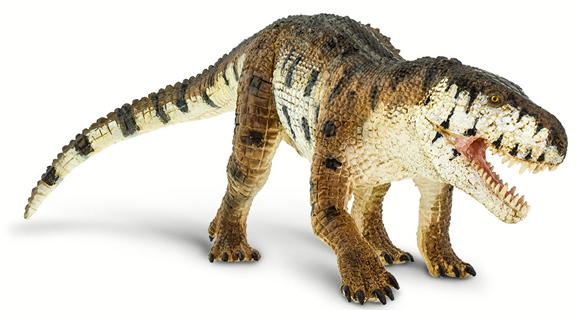
Everything Dinosaur team members are preparing for the arrival of some of the new for 2019 Wild Safari Prehistoric World models including the Prestosuchus replica.  The beautiful Prestosuchus figure is just one of a number of new Wild Safari Prehistoric World figures that Everything Dinosaur hopes to stock before Christmas.

Coming Soon – The Wild Safari Prehistoric World Prestosuchus Model

Prestosuchus model.
The Wild Safari Prehistoric World Prestosuchus model.

A Formidable Predator of the Middle Triassic of Brazil

Prestosuchus (P. chiniquensis) was not a dinosaur, but a member of the Archosauria, just like the dinosaurs, but from a lineage that is more closely related to modern crocodilians than to living birds and extinct dinosaurs.  Fossils of this large predator have been found in south-eastern Brazil from strata that date from the Middle Triassic.  Prestosuchus was named by the German palaeontologist Friedrich von Huene in 1942, the genus name honours Brazilian self-taught palaeontologist Vicentino Prestes de Almeida and the trivial name honours the town where Vicentino Prestes de Almeida was born (Chiniquá, Rio Grande do Sul).

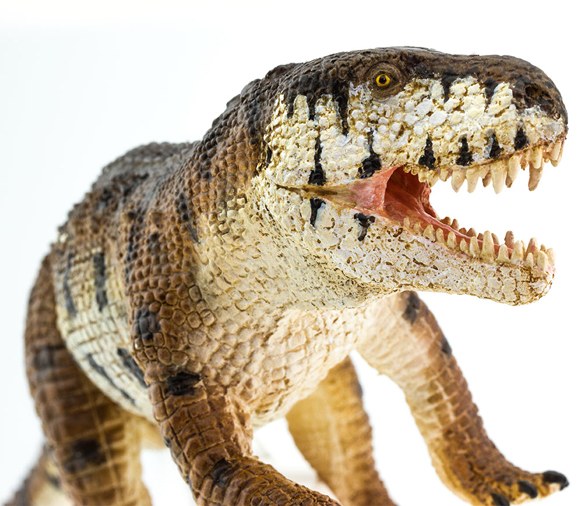
The Wild Safari Prehistoric World Prestosuchus Model

New for 2019 the Wild Safari Prehistoric World Prestosuchus.
The Wild Safari Prehistoric World Prestosuchus model.   A close-up view of the new for 2019 P. chiniquensis model from Safari Ltd.

Producing a Scale Drawing

It had been thought that this animal measured around 5 metres in length, about the size of a Nile crocodile (Crocodylus niloticus), however, a specimen described in 2010 indicated that this quadruped may have reached lengths of around 7 metres and it might have weighed 1,000 kilograms or more.  Everything Dinosaur team members have had to examine a number of scientific papers in order to produce a scale drawing for use in their Prestosuchus fact sheet.  This fact sheet will be sent out with purchases of the Prestosuchus model.

To view the Wild Safari Prehistoric World figures: Wild Safari Prehistoric World Figures.

Everything Dinosaur Prepares a Fact Sheet for the Arrival of the Wild Safari Prehistoric World Prestosuchus Model

Prestosuchus chiniquensis scale drawing.
A scale drawing of Prestosuchus chiniquensis. Picture credit: Everything Dinosaur.

Picture credit: Everything Dinosaur

To read an article from Everything Dinosaur published in 2010 that describes the discovery of this new, larger fossil specimen of Prestosuchus chiniquensisThe Most Complete Fossil of a Crocodylotarsian found in Brazil.

6 11, 2018

Beautiful Red Plates on a Stegosaurus

By |2024-05-11T06:33:22+01:00November 6th, 2018|Categories: Adobe CS5, Dinosaur and Prehistoric Animal Drawings, Dinosaur Fans, Main Page, Photos of Everything Dinosaur Products|0 Comments

Red Plates on a Stegosaurus

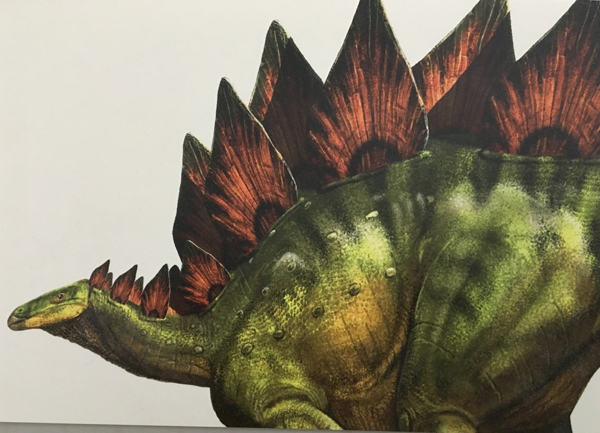
This morning, we feature a superb illustration of the Late Jurassic armoured dinosaur Stegosaurus by the renowned palaeoartist from China, Zhao Chuang.  Enormous diamond-shaped plates were located on the neck, back and tail of Stegosaurus.   These plates were not just made of bone, they also had a horny, keratin covering.  This covering has not been preserved in the known fossil record so palaeontologists don’t know how big the plates were or indeed, what shape they were in life.

A Life Reconstruction of the Armoured Dinosaur Stegosaurus

A life reconstruction of the armoured dinosaur Stegosaurus.
Stegosaurus illustration by Zhao Chuang.

Picture credit: Zhao Chuang

What Colour were the Plates on Stegosaurus?

When first described by the American palaeontologist Othniel Charles Marsh in 1877, the bizarre plates of Stegosaurus were thought to provide protection against attack.  They were regarded as armour, however, it was soon noted that although their exact position in life was difficult to determine (the plates are embedded in the skin and not attached to the bone), it was likely that these structures were too high on the back to be effective armour-plating for this plant-eating dinosaur.

As palaeontologists employed more sophisticated techniques to study these plates, it was revealed that they were quite thin with lots of blood vessels running through them.  The theory that these plates played a role in thermoregulation was postulated.  On cold mornings a Stegosaurus could face towards the sunrise and warm its plates.  The blood running through the vessels close to the surface of the plates would then be warmed up, helping the dinosaur to raise its body temperature.  Furthermore, in order to cool down, the Stegosaurus could face the sun in such a way that only a small surface area of the plates was exposed, thus permitting the body to cool down.

Thermoregulation

As the largest plates were high on the animal’s back, their position several metres in the air, would permit cooler air away from the ground surface to circulate around them, thus cooling the dinosaur still further.

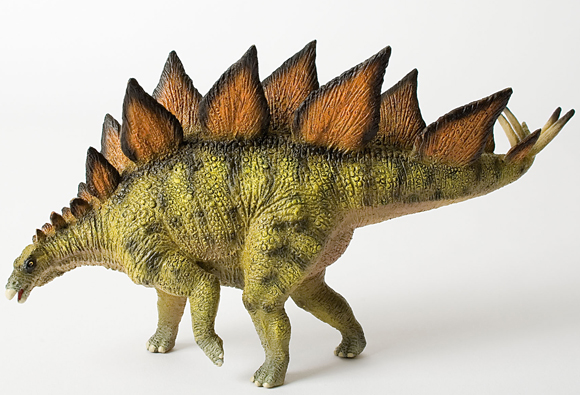
It was the scientist Kenneth Carpenter who first proposed that the plates could be flushed with blood at will and this led to the idea that these adornments could be used to display or to intimidate predatory dinosaurs.  As a result, numerous Stegosaurus illustrations and indeed models, have tended to give Stegosaurus some reddish colour plates.

A Model of a Stegosaurus (Bullyland Stegosaurus) with Red Coloured Plates

Bullyland Stegosaurus dinosaur model.
The Bullyland Stegosaurus dinosaur model.

Picture credit: Everything Dinosaur

To view the range of Bullyland prehistoric animal figures in stock at Everything Dinosaur: Bullyland Prehistoric Animal Figures.

As for the colour of Stegosaurus plates, when they were not being flushed with blood, nobody knows.

Visit the Everything Dinosaur website: Everything Dinosaur.

31 10, 2018

Happy Halloween Have a Fantastic Time

By |2024-05-11T06:35:14+01:00October 31st, 2018|Categories: Dinosaur and Prehistoric Animal Drawings, Dinosaur Fans, Main Page|0 Comments

Happy Halloween

The “witching hour” is almost upon us, time to wish all our customers and readers a happy Halloween.  “All Hallows Eve” is a time traditionally linked with monsters and demons and the fossil record is crammed full of very scary looking invertebrates and vertebrate specimens that would have been very much at home in the cast of a horror movie.

Take for example, a demonic dinosaur…

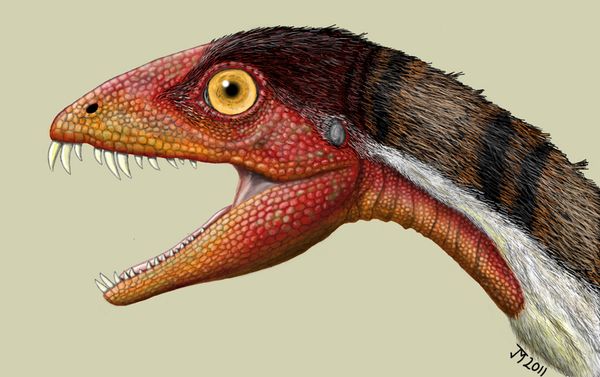
In April 2011, a scientific paper was published announcing the formal scientific description of a demonic-looking dinosaur.  A fearsome, little meat-eater that would have terrorised New Mexico in the Late Triassic.  The dinosaur was named Daemonosaurus chauliodus and the name translates as “buck-toothed evil spirit”.

Although small compared to some of its later descendants, (D. chauliodus measured less than two metres long), it had a deep skull and oversized teeth in the front of its jaws which gave this little theropod a strong and nasty bite.

A Life Reconstruction of Daemonosaurus chauliodus

Daemonosaurus chauliodus life reconstruction.
The vicious-looking Late Triassic theropod dinosaur Daemonosaurus chauliodus from New Mexico.

Picture credit: Jeffrey Martz

Happy Halloween!

Visit the award-winning and user-friendly Everything Dinosaur website: Everything Dinosaur.

20 10, 2018

Sensational Deinonychus Artwork

By |2024-05-11T06:44:28+01:00October 20th, 2018|Categories: Dinosaur and Prehistoric Animal Drawings, Dinosaur Fans, Main Page|0 Comments

Deinonychus Artwork

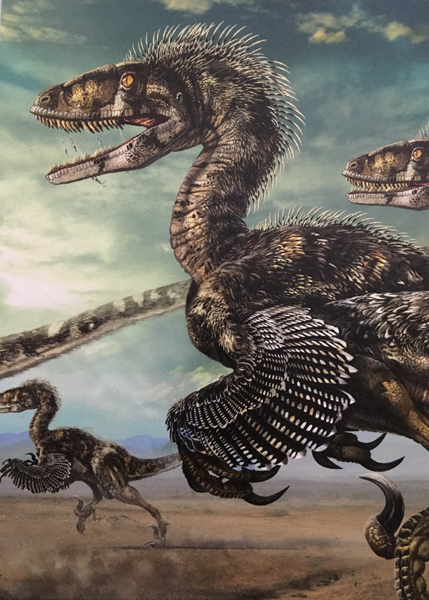
The bird-like qualities of the large dromaeosaurid Deinonychus (D. antirrhopus) have been captured in this superb dinosaur-themed artwork by the Chinese palaeoartist Zhao Chuang.  This is one of our favourite illustrations of this enigmatic, fast-running theropod, finally named and described in 1969.

An Illustration of the Large North American Dromaeosaurid Deinonychus antirrhopus

An illustration of a flock of Deinonychus.
“They are flocking this way!” A flock of dromaeosaurid dinosaurs (Deinonychus) on the move.  Artwork by Zhao Chuang.

Picture credit: Zhao Chuang

For PNSO dinosaur models and figures: PNSO Dinosaur and Prehistoric Animal Models.

Deinonychus – A Modern Interpretation with a Retrospective Look

This beautifully-crafted image was created quite recently (2016, we think), but the choice of colours and the muted tones of the backdrop give this image quite a retrospective look.  It is reminiscent of the prehistoric animal illustrations that featured in the Brooke Bond Picture Cards series “Prehistoric Animals”, that was first published in the early 1970s, ironically, just a few years after Deinonychus (which features in the card set), was named and described).

The artist has taken great care to depict this three-metre-long predator as an active, agile animal just as the palaeontologist John Ostrom envisioned it in his ground-breaking work that led to a complete re-think about the Dinosauria.  This revolution in thinking about the dinosaurs and their close relatives was termed the “dinosaur renaissance”.  The idea that these were slow-moving, clumsy, stupid animals was swept away and there was a definitive move towards portraying dinosaurs as animals that were as well adapted to their environments as modern mammals.

Moving at Speed

Zhao Chuang shows Deinonychus as a social animal, moving in a flock and at speed too.  The killing second-toe claw is raised off the ground as this dinosaur moves and it possesses a shaggy integumentary covering of simple feathers on its body as well as pennaceous feathers on its arms.  The yellow eye with its slit pupil gives this dinosaur a particularly frightening look.  A flock of Deinonychus heading your way would have been a terrifying sight.

It is a pleasure for Everything Dinosaur to  highlight the artwork of Chinese palaeoartist Zhao Chuang.  Today, we feature one of our favourite illustrations of Deinonychus.

Visit the Everything Dinosaur website: Everything Dinosaur.
7 09, 2018

Beautiful Chinese Dinosaur Art – Spinosaurus

By |2024-05-11T06:20:21+01:00September 7th, 2018|Categories: Dinosaur and Prehistoric Animal Drawings, Dinosaur Fans, Main Page|2 Comments

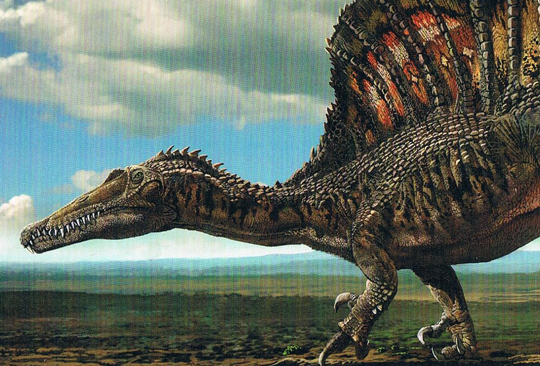
Spinosaurus aegyptiacus Illustrated by Zhao Chuang

As we approach the fourth anniversary of the ground-breaking work on Spinosaurus aegyptiacus published in September 2014 by Ibrahim et al, which depicted this North African theropod as a quadruped, very much at home in aquatic environments, we thought we would feature an illustration of Spinosaurus by Zhao Chuang.

An Illustration of the Dinosaur Spinosaurus aegyptiacus

Spinosaurus illustrated as a quadruped.
An illustration of the Cretaceous
theropod from North Africa – Spinosaurus aegyptiacus.

Picture credit: Zhao Chuang

The Artwork of Zhao Chuang

Zhao Chuang is a scientific illustrator and palaeo-artist who has been responsible for providing the artwork to accompany numerous dinosaur and pterosaur fossil discoveries.  His work has been published in leading academic journals such as “Nature” and “Science and Cell”.  He has collaborated with several museums and research institutions including the prestigious Chinese Academy of Sciences, Chicago University and the American Museum of Natural History, based in New York. 

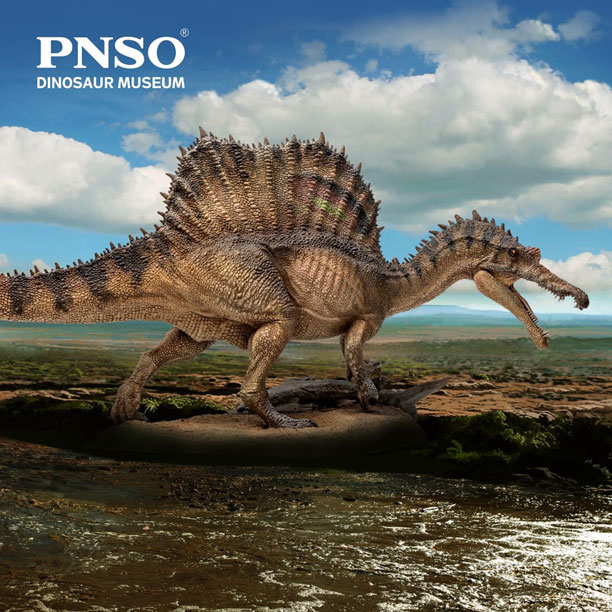
Spinosaurus aegyptiacus (PNSO).
The 1:35 scale PNSO Essien the Spinosaurus aegyptiacus model.

Spinosaurus aegyptiacus

The picture (above) shows a PNSO Spinosaurus figure. The artist Zhao Chuang is a prominent member of the PNSO team.

View the PNSO range of prehistoric animal figures: PNSO Scientific Art Models.

Visitors to the amazing exhibition “Dinosaurs of China – ground shakers to feathered flyers”, held last year at Wollaton Hall and the Lakeside Arts Centre (Nottingham, England), will have viewed a number of his works, as the prehistoric life illustrations of Zhao Chuang formed many or the backdrops and information panels to the fossils on display.

The front portion of the Spinosaurus as depicted by Zhao Chuang is a spectacular piece of art.  It is always a pleasure to feature the illustrations of palaeo-artists on this blog.

To read Everything Dinosaur’s 2014 article summarising the work undertaken to redefine Spinosaurus by Ibrahim et al: Spinosaurus – Four Legs Are Better Than Two.

The Everything Dinosaur website: Everything Dinosaur.
10 08, 2018

The Really Dangerous Predator of Hell Creek

By |2023-10-27T09:50:39+01:00August 10th, 2018|Categories: Dinosaur and Prehistoric Animal Drawings, Dinosaur Fans, Everything Dinosaur Products, Main Page, Photos of Everything Dinosaur Products, Photos/Pictures of Fossils|1 Comment

Acheroraptor temertyorum – Most Dangerous Critter of Hell Creek

Was Acheroraptor temertyorum more dangerous to smaller dinosaurs than T. rex?

If you could travel back in time and visit western North America 66 million years ago, you might find yourself within the territory of a Tyrannosaurus rex.  Not a very safe place to be you might think, you would probably be right, but the Hell Creek fauna contained another theropod dinosaur, one that was perhaps, more dangerous to a human visitor than a T. rex or for that matter the other apex predator known from the Hell Creek Formation – Dakotaraptor steini.

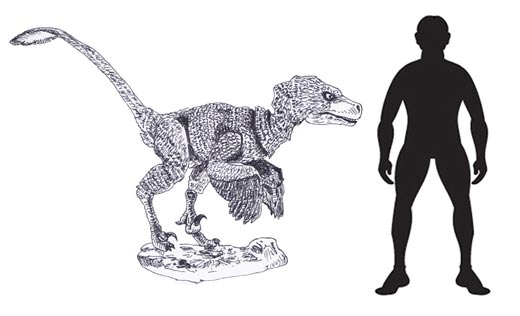
Named and scientifically described in 2013, the real man-eater of Hell Creek might have been Acheroraptor (A. temertyorum), at around three metres long and weighing as much as a German Shepherd dog, a pack of these ferocious hunters would probably have made short work of any human visitor to the Late Cretaceous who was unfortunate to encounter them.

A Scale Drawing of the Velociraptorine Dromaeosaurid Acheroraptor temertyorum

Acheroraptor temertyorum scale drawing.
A scale drawing of Acheroraptor. Picture credit: Everything Dinosaur.
Picture credit: Everything Dinosaur

Acheroraptor temertyorum – “Underworld Plunderer”

Named after the River of Pain “Acheron” in the underworld from Greek myth, Acheroraptor was one of the very last of the non-avian theropod dinosaurs and it probably played a secondary predator role in the Hell Creek ecosystem.  There were larger predators, the five-and-a-half-metre-long Dakotaraptor for example, that like Acheroraptor was one of the very last dromaeosaurids to evolve.  However, packs of Dakotaraptors and the iconic Tyrannosaurus rex may not have considered a single person much of meal and may not have expanded a lot of energy in trying to catch them.  To a pack of Acheroraptors, a human would have made a very satisfactory lunch, best to avoid Acheroraptor if you can.

To read more about the discovery of Dakotaraptor steiniDakotaraptor – A Giant Raptor.

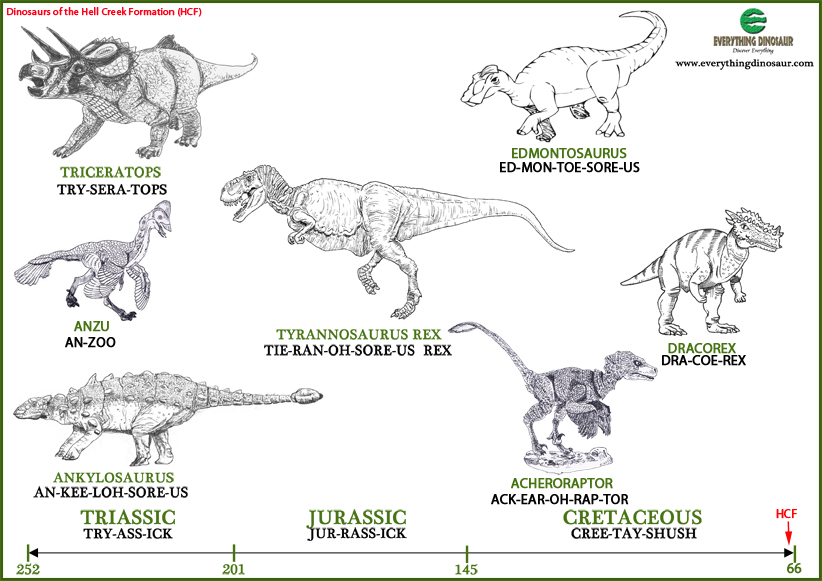
Some of the Typical Dinosaurian Fauna of the Hell Creek Formation (Maastrichtian Faunal Stage of the Late Cretaceous)

Dinosaurs of the Hell Creek Formation.
Typical dinosaurs of the Hell Creek Formation.   Although there were larger predators, to a person visiting Montana 66 million years ago, meeting a pack of Acheroraptors would have been extremely dangerous. Picture credit: Everything Dinosaur.
Picture credit: Everything Dinosaur

Part of the Vertebrate Fossil Collection at the Royal Ontario Museum

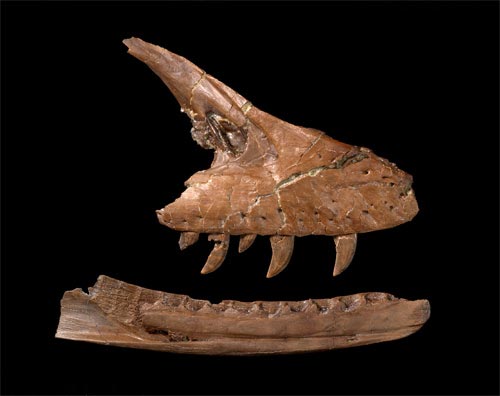
The specific or trivial name “temertyorum” was selected to honour James and Louise Temerty in recognition for their outstanding support and contribution to the Royal Ontario Museum, which houses the jaw fragments that led to the scientific description of this dinosaur back in 2013.

Acheroraptor probably lived in packs and may have had a role similar to extant hyenas or jackals in present-day ecosystems.  Palaeontologists had suspected that dromaeosaurids roamed Montana in very last years of the Cretaceous, numerous teeth with their diagnostic wide ridges (denticles) had been discovered, but the lack of fossilised bones prevented scientists from assigning a genus.

The Holotype Fossil Maxilla and Lower Jaw (Dentary) of Acheroraptor

The fossilised jawbones of Acheroraptor.
The jaws of Acheroraptor.

Picture credit: Royal Ontario Museum

Acheroraptor More Closely Related to Asian Dromaeosaurids

Palaeontologists have concluded that Acheroraptor was more closely related to Asian dromaeosaurids such as Velociraptor (V. mongoliensis), than it was to other North American dromaeosaurids.  Assigned to the Velociraptorinae subfamily of the Dromaeosauridae, the relatively long-snouted Acheroraptor provides supporting evidence to suggest the presence of a Late Cretaceous land bridge between Asia and North America.

A spokesperson from Everything Dinosaur explained:

“There is a considerable amount of evidence that supports the idea of the existence of a Cretaceous Beringian land bridge linking North America and Asia.  This land bridge may not have been permanent but appeared at times when sea levels fell, permitting a faunal exchange between dinosaur-based ecosystems.  The ancestors of Acheroraptor temertyorum probably migrated into North America.”

To read Everything Dinosaur’s recent article about Alaskan trace fossils providing evidence of a mixing of dinosaur faunas from Asia and North America: Did Alaskan Therizinosaurs and Hadrosaurs Live Together?

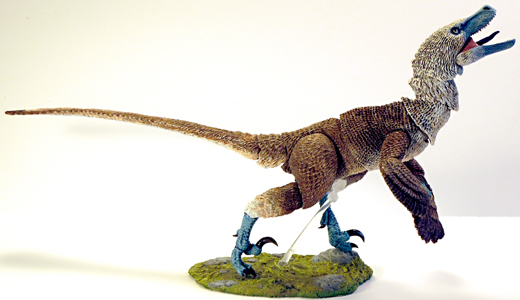
Beasts of the Mesozoic 1/6th Scale Acheroraptor temertyorum

There are lots of models of the Hell Creek Formation biota available, countless T. rex and Triceratops figures for instance, but it was the clever and talented David Silva of Creative Beast Studio who created a 1/6th scale replica of Acheroraptor within the amazing “Beasts of the Mesozoic” model range.

The “Beasts of the Mesozoic” Acheroraptor temertyorum Figure

Beasts of the Mesozoic Acheroraptor temertyorum figure.
The Beasts of the Mesozoic Acheroraptor model.

To view the beautiful Acheroraptor model and the rest of the figures in the “Beasts of the Mesozoic Raptor” range: Beasts of the Mesozoic “Raptors”.

Go to Top