Minmi paravertebra or is this Kunbarrasaurus ieversi?
Everything Dinosaur team members were reviewing some of the images from Zhao Chuang within their database and spotted an anomaly. Zhao Chuang is the talented artist responsible for many scientific illustrations of prehistoric animals including the beautiful images associated with the PNSO “Age of Dinosaurs” range. One picture of an armoured dinosaur was labelled Minmi, indicating that this was an illustration of Minmi paravertebra. However, we have seen this image used in articles associated with the naming and scientific description of another Australian member of the clade Ankylosauria – Kunbarrasaurus ieversi.
Is This Minmi or Kunbarrasaurus?
An illustration of an Australian member of the Ankylosauria clade. Is this Kunbarrasaurus or is this Minmi?
Picture credit: Zhao Chuang
Confusing Minmi paravertebra and Kunbarrasaurus ieversi
Kunbarrasaurus was named and described in 2015. The fossil remains that led to the erection of this new genus had been formerly described as Minmi (M. paravertebra). In 1989, the nearly complete skeleton of an armoured dinosaur was discovered on Marathon Station, near Richmond, north-western Queensland. The specimen (QM F18101), was provisionally assessed as a specimen of Minmi paravertebra, at the time, the only known armoured dinosaur from Australia.
However, further preparation of the fossil material and a detailed CAT scan of the fossils identified notable differences in skull anatomy when compared to the fossil material that had been ascribed to Minmi paravertebra. These autapomorphies (different traits), were deemed sufficient to permit the establishment of a new genus of armoured dinosaur and the scientific paper detailing this research was published in the journal PeerJ.
Kunbarrasaurus fossil material (QM F18101) – dorsal view.
Picture credit: The University of Queensland
How Closely Related is Kunbarrasaurus to Minmi paravertebra?
More than half a dozen fossil specimens have been ascribed to the genus Minmi, however, of these, only two have been studied in detail. Lack of relative and temporal dating information of the fossil bearing strata in Australia has hindered classification as has the presence of extensive dermal armour which has caused problems when palaeontologists attempt to identify subtle differences in skull morphology and nasal pathways.
Exactly how closely related these two Australian armoured dinosaurs were to each other remains an area of debate amongst scientists. Minmi has been assigned as a basal member of the Ankylosauridae, the family of armoured dinosaurs that includes Ankylosaurus and Euoplocephalus. However, the fossil material ascribed to the genus K. ieversi is regarded by many palaeontologists as sufficiently different that it can’t be placed within the Ankylosauridae family, but it has been assigned to the clade Ankylosauria, a broader group encompassing less closely related animals.
Further revision of the taxonomic relationships between armoured dinosaurs that roamed Gondwana is likely as more fossils are found. Therefore, it is understandable for the work of a scientific illustrator to become mixed up in the phylogenetic assessments. Whether Zhao Chuang’s illustration represents Minmi or Kunbarrasaurus is a moot point, it remains a fantastic armoured dinosaur illustration (in our opinion anyway).
Brontosaurus Fact Sheet for the CollectA Brontosaurus Model
The first of the new for 2018 CollectA figures are due in stock at Everything Dinosaur at the end of this month (March 2018). Preparations to receive the new models along with deliveries from Papo and Mojo Fun are well underway. However, as we send out a fact sheet on virtually every named animal we supply, our team members have been busy compiling a fact sheet on the famous sauropod Brontosaurus, as CollectA will be introducing a Brontosaurus figure this year.
Everything Dinosaur’s Scale Drawing of Brontosaurus
A scale drawing of Brontosaurus. Picture credit: Everything Dinosaur.
Picture credit: Everything Dinosaur
Bully for Brontosaurus
The CollectA Brontosaurus model has a release date of mid-2018, it will be part of the company’s extensive “Prehistoric Life” collection of not-to-scale dinosaur models. The double row of scutes running along the back of the figure is an interpretation of the fossil material related to diplodocids that suggests that some types of these long-necked, Late Jurassic dinosaurs had dermal armour.
The New for 2018 CollectA “Prehistoric Life” Brontosaurus Model
The CollectA Brontosaurus dinosaur model with a double row of dermal spikes running down the body.
Observant model collectors will have noticed the red flash on the neck of this herbivore. Palaeontologists believe that these large animals lived in herds and the brightly coloured patch of skin on the throat might have acted as a signalling device in visual displays. This colouration, along with the double row of dermal spikes is speculative, however, these features on this excellent figure have a grounding in science and reflect what has been deduced about these dinosaurs from their fossils and from studying animals living in herds today.
Several Sauropods in the CollectA Range
The CollectA range “Prehistoric Life” already includes several not to scale models representing sauropods. For example, the range contains Cetiosaurus, Shunosaurus, Agustinia, Amargasaurus, Ampelosaurus, Argentinosaurus, Brachiosaurus, Diplodocus, Daxiatitan, Rebbachisaurus, a rearing Rhoetosaurus and an Alamosaurus. It is great to see a replica of “Thunder Lizard” being added to this collection.
The CollectA “Prehistoric Life” Range Features Several Sauropods
A Daxiatitan replica is amongst numerous sauropods featured in the extensive CollectA “Prehistoric Life” model range.
Commenting on the impending introduction of a Brontosaurus model, a spokesperson from Everything Dinosaur stated:
“Brontosaurus has had a rather chequered taxonomic career since the genus was first erected in 1879. For a long time, Brontosaurus was thought to be a junior synonym of Apatosaurus until a substantial review of diplodocid fossils undertaken in 2015 led to the resurrection of the genus”.
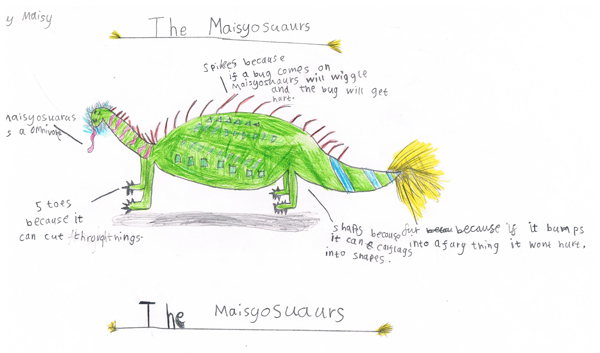
Whilst searching through our extensive archives, we came across a photograph taken during one of our many visits to schools to conduct dinosaur and fossil themed workshops. The children in a Year 1 class at Wellgate Primary have used prehistoric animal drawings to help inspire them in their art classes. Various drawings of dinosaurs and fossils were used to help the children gain an appreciation of perspective and to learn about the influence of shading on the appearance of a drawing. How very creative!
Black and White Illustrations Using Dinosaurs and Fossils
The teacher instructed the children to only use pencil to shade in their drawings and not to add anything else to their illustrations. This display formed part of an extensive collage that highlighted various painting and drawing styles, all focused on the theme of fossils and prehistoric animals. Our dinosaur and fossil expert who visited the school to conduct a workshop, took the picture to demonstrate the creative approach to the scheme of work adopted by the teaching team with its cross-curricular touch points clearly evident.
It looks like we have some budding future palaeoartists, all the various pieces of art made a fantastic display.
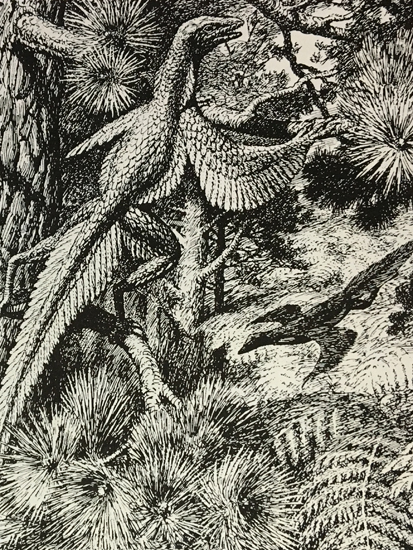
The talented palaeoartist Zhao Chuang might be renowned for his stunning colour landscapes depicting various prehistoric animals but the Chinese-based artist has also produced a number of line drawings too. Today, we showcase one of his lesser known illustrations, a black and white study of the large, Mongolian dromaeosaurid Achillobator (Achillobator giganticus).
Deadly, Dangerous Dinosaurs – A Trio a Achillobators on the Prowl
An illustration of a flock of Achillobator dinosaurs by Zhao Chuang.
Picture credit: Zhao Chuang
Achillobator giganticus
Fossils found in 1983, were formally described in 1999 and the genus name – Achillobator was erected. The name translates as “giant Achilles hero”, this five to six-metre-long dinosaur getting its name because the foot bones show evidence of particularly robust Achilles tendons. Known from fragmentary fossil material, which includes part of the upper jaw, this dinosaur would have been a very formidable predator. Although Zhao Chuang has chosen not to add feathers in his illustration, he has managed to convey an impression of danger and ferocity in his artwork. Achillobator would have been an apex predator within its environment and a pack of these hungry super-sized “raptors” would have been a blood curdling sight.
The image of the Neanderthal (Homo neanderthalensis), has changed radically over the last few decades. Gone are the images of a brutish, “ape-man” as depicted by 20th century artists such as Burian and Charles Knight. A lot of evidence has emerged in recent years that supports the idea that Neanderthals, our closest cousins, were as sophisticated as us with a rich and diverse culture.
A new study, published in the journal “Science”, proposes that Iberian Neanderthals, created cave paintings as early as 64,000 years ago and that these paintings were as complex as those associated with our own species. Neanderthal artists used symbolism, geometric shapes and linear signs just as complicated as those drawn by H. sapiens.
Abstract and Symbolic Cave Art Created by Neanderthals
La Pasiega, section C, cave wall with paintings. The ladder shape composed of red horizontal and vertical lines (centre left) dates to older than 64,000 years and was made by Neanderthals.
Picture credit: P. Saura
What Does it Mean to be Human?
Defining what it means to be human (Homo sapiens), has just become a little more complicated. It was once thought that our ability to create abstract art, to use symbols and to develop a culture was a defining characteristic that elevated our species above all the other hominins.
Lead author of the new research, Dirk Hoffmann of the Max Planck Institute for Evolutionary Anthropology (Leipzig, Germany) explained:
“The emergence of symbolic material culture represents a fundamental threshold in the evolution of humankind. It is one of the main pillars of what makes us human. Artefacts whose functional value lies not so much in their practical but rather in their symbolic use are proxies for fundamental aspects of human cognition as we know it.”
Homo neanderthalensis Had a Culture Too
Early symbolic artefacts, like pigment-coloured shells that possibly served as body ornamentation, are documented for the Middle Stone Age in North and South Africa. These have been dated to approximately 70,000 years ago (middle Tarantian stage of the Pleistocene Epoch) and are associated with anatomically and behaviourally modern humans. There is evidence in Europe for cave art, sculpted figures, decorated bone tools and jewellery made of bone, tooth, ivory, shell or stone that dates back to the so-called “Upper Palaeolithic Revolution” around 40,000 years ago. These artefacts, researchers concluded, must have been created by modern humans who were spreading all over Europe after their arrival from Africa.
A Shell with Traces of Pigmentation – An Object Dating from at Least 115,000 Years Ago
A shell with remnants of pigments found in sediments in Cueva de los Aviones (Spain). It dates to between 115,000 and 120,000 years of age.
Picture credit: João Zilhão (Catalan Institution for Research and Advanced Studies
Cave Art Previously Only Associated with Homo sapiens
Cave paintings are a particularly impressive statement of culture and the use of symbolic behaviour. To date, cave art and paintings have only been attributed to modern humans. A lack of precise dating has hindered attempts to prove that Homo neanderthalensis painted on cave walls too. The perpetrators of cave art cannot usually be identified directly, the age of the paintings is the only determinant, providing indirect evidence of who created the paintings based on their geological age. However, a new advanced dating technique has permitted more precise dating and this research suggests that Neanderthals were just as artistic as ourselves.
Post-doctoral researcher Hoffmann added:
“Dating cave art accurately and precisely, but without destroying it, has so far been difficult to accomplish. Thanks to recent technical developments we can now obtain a minimum age for cave art using Uranium-Thorium (U-Th) dating of carbonate crusts overlying the pigments.”
Uranium-Thorium Dating
Uranium-Thorium dating is very precise and it relies on the radioactive decay of uranium isotopes into thorium, this methodology can accurately date calcium carbonate deposits and formations associated with cave art and it can determine the age of calcium carbonate which is up to half a million years old – more than enough scope to chronologically test all forms of cave painting.
Dating Cave Art Using Uranium-Thorium Analysis
Calcite crust on top of the red ladder shape sign. The U-Th method dates the formation of the crust which gives a minimum age for the underlying painting.
Picture credit: João Zilhão (Catalan Institution for Research and Advanced Studies
The international team of researchers, which included scientists from the University of Southampton, analysed more than sixty carbonate samples from three different cave sites in Spain: La Pasiega in north-eastern Spain, Ardales in southern Spain and Maltravieso in the western part of the country. All three sites contain paintings mostly in red, sometimes in black, that show groups of animals, dots and geometric signs, hand stencils, hand prints and engravings.
Commenting on the team’s findings Alistair Pike (Southampton University), stated:
“Our dating results show that the cave art at these three sites in Spain is much older than previously thought. With an age in excess of 64,000 years it predates the earliest traces of modern humans in Europe by more than 20,000 years. The cave art must thus have been created by Neanderthals.”
Stencil of a Neanderthal hand on a cave wall in Maltravieso (colour enhanced), almost completely covered with calcite. It is older than 66,000 years
Picture credit: H. Collado (Quaternary-Prehistory Research Group, Spain)
Evidence of a Complex Thought Process
The early cave paintings created in red pigments comprise of dots, lines, discs and hand stencils. The hand prints were made by the artist blowing red paint over the hand, using it as a form of stencil. To create such intricate artwork, the perpetrator would have had to plan their work, provide a suitable light source and mix pigments. Choice of location was essential too.
Cave art specialist and co-author Paul Pettitt (University of Durham) asserted:
“Neanderthals created meaningful symbols in meaningful places.”
The research team concludes that Neanderthals possessed a much more rich and complex symbolic behaviour than previously assumed. This new research will help to change the long-held prejudices against the intelligence and intellectual abilities of these hominins that are so closely related to ourselves.
The Sophisticated Homo neanderthalensis
Fellow author João Zilhão (Catalan Institution for Research and Advanced Studies), explained the implications of this and other research that reveals a more sophisticated Neanderthal. It can be concluded that modern humans and Neanderthals shared symbolic thinking and must have been “cognitively indistinguishable”.
Research Professor Zilhão commented:
“On our search for the origins of language and advanced human cognition we must therefore look much farther back in time, more than half a million years ago, to the common ancestor of Neanderthals and modern humans.”
As the weekend approaches, why don’t you take time out to create some artwork, harness your inner Neanderthal…
The scientific paper: “U-Th Dating of Carbonate Crusts Reveals Neandertal Origin of Iberian Cave Art” by D. L. Hoffmann, C. D. Standish, M. García-Diez, P. B. Pettitt, J. A. Milton, J. Zilhão, J. J. Alcolea-González, P. Cantalejo-Duarte, H. Collado, R. de Balbín, M. Lorblanchet, J. Ramos-Muñoz G.-Ch. Weniger, A. W. G. Pike published in the journal “Science”.
Everything Dinosaur acknowledges the help of a press release from the Max Planck Institute for Evolutionary Anthropology in the compilation of this article.
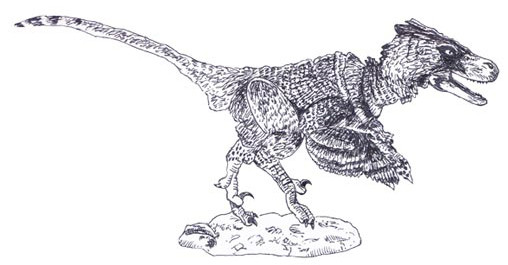
We wanted to post up another beautiful dinosaur illustration by the talented Chinese palaeoartist Zhao Chuang (Peking Natural Sciences Organisation – PNSO). So, without further ado, here is a beautiful drawing of the head and neck of a Velociraptor.
A Beautiful Drawing of the Head and Jaws of Velociraptor
Taken from “A Pictorial Guide to Palaeontology” by Zhao Chuang and Yang Ying, this Velociraptor illustration is devoid of feathers. However, although Velociraptor may have been feathered, the head and neck could have been bare. Some members of the vulture family, including species from the Old World as well as the Americas, lack feathers on the neck and head. This allows them to feed on the carcasses of other animals without getting their feathers caked in blood. In addition, the bare head and neck play a role in thermoregulation. Lack of insulating feathers around the skull and neck, permit these large birds to lose heat to their surroundings, helping them to keep cool.
The bare-necked Velociraptor illustrated by Zhao Chuang may reflect similar themes, related to avoiding getting dirty feathers whilst feeding and thermoregulation.
One of the new 1:20 scale figures from CollectA for 2018 is a model of the dinocephalian Estemmenosuchus. We are not expecting this model to arrive in stock until the middle of this year, but we are busy preparing a fact sheet to accompany sales of this Permian herbivore (most scientists state that these animals were plant-eaters). For virtually every named prehistoric animal model we sell, we include a fact sheet about that animal in with the customer’s order. Along with the fact sheet, we also provide a handy scale drawing so that readers can see at a glance just how big this prehistoric animal was.
Everything Dinosaur’s Prepared Scale Drawing of Estemmenosuchus (E. mirabilis)
A scale drawing of the bizarre Dinocephalian Estemmenosuchus (E. mirabilis). Picture credit: Everything Dinosaur.
Picture credit: Everything Dinosaur
Deciding on Which Species of Estemmenosuchus to Depict
There are currently two species of Estemmenosuchus recognised, Estemmenosuchus mirabilis and the much larger Estemmenosuchus uralensis, but which species does the CollectA Deluxe 1:20 scale figure represent?
The CollectA model is over seventeen centimetres long and at 1:20 scale this represents an animal around 3.5 metres long. This suggests that the model is getting towards the larger E. uralensis, which measured between 3.5 and 4.5 metres in length. However, the larger Estemmenosuchus uralensis only had one pair of horny projections on the skull, whilst the smaller of the two recognised species E. mirabilis, had two pairs of horns on the top of the skull.
The CollectA Deluxe Estemmenosuchus Model (New for 2018)
A Deluxe 1:20 scale Estemmenosuchus model from CollectA.
CollectA Estemmenosuchus
There are other anatomical differences too. The skull of the larger species Estemmenosuchus uralensis was up to fifty percent longer. The muzzle of E. mirabilis is proportionately smaller, but wider towards the front (anterior portion), there are also subtle differences in the morphology of the skulls, although both species show the characteristic thickened bone which is so reminiscent of the estemmenosuchids. Based on this information, we think that the new for 2018 CollectA Deluxe Estemmenosuchus represents the smaller of the two valid species (E. mirabilis).
Our scale drawing has therefore been prepared based on an animal measuring around three metres in length and weighing an estimated 750 kilograms.
Time to update and re-evaluate some of the scale drawings and details within Everything Dinosaur’s range of fact sheets. The UK-based company has produced hundreds of dinosaur and prehistoric animal data sheets and from time to time, the information and illustrations needs to be updated. Over the next few weeks our team members will be concentrating on changing some of the information associated with our theropod fact sheets, specifically those associated with maniraptorans.
Preparing Theropod Fact Sheets
Updating Dromaeosaurid Illustrations
An illustration of Deinonychus (D. antirrhopus). Picture credit: Everything Dinosaur.
Picture credit: Everything Dinosaur
The picture above shows a picture of Deinonychus, as we prepare to update our fact sheet on this large “raptor”.
The Maniraptora is a clade of theropod dinosaurs consisting of those coelurosaurian dinosaurs that are closely related to birds (Aves). It includes the birds and the non-avian dinosaurs that were more closely related to them than to ornithomimids specifically, the type species Ornithomimus velox. The theropod dinosaurs that are more closely related to birds are classified into a sub-clade Eumaniraptora.
The Eumaniraptora (it means the “true maniraptorans”), consists of all the types of dinosaur more closely related to birds than to the oviraptorosaurs. The term Eumaniraptora is often replaced by the term Paraves, although palaeontologists do differ in their views as to the exact composition of Eumaniraptora and Paraves. Essentially, a dinosaur such as the sickle-toed-clawed Deinonychus (illustrated above), as a member of the Dromaeosauridae family, along with the troodontids and the true birds (Avialae), are components of this sub-clade.
As Everything Dinosaur prepares for the introduction of the Beasts of the Mesozoic 1:6 scale range of model raptors, we are busy compiling fact sheets on all the new figures. A series of dromaeosaurid and related Maniraptora drawings have been commissioned. These illustrations will be used to show the approximate size of each of the prehistoric animals represented by a Beasts of the Mesozoic figure.
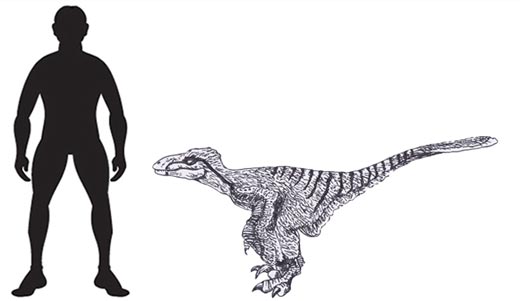
A Typical Member of the Dromaeosaurids – A Dromaeosaurid Drawing
Dromaeosaurid drawing for Everything Dinosaur. Picture credit: Everything Dinosaur.
We aim to have all the fact sheets finished by the middle of January, in plenty of time for the launch of this range. The above illustration shows the typical bauplan of a dromaeosaurid, note the addition of a feathery coat and a large fan of feathers on the end of the long tail. The family Dromaeosauridae is very diverse, geographically widespread and with a wide temporal range. The term “dromaeosaur” means “running lizard”, all the dromaeosaurids were bipedal and in all likelihood, fast runners.
Distantly related to modern birds, we shall try not to get in a flap as we compile the dozen or so fact sheets that we need.
Coming to Everything Dinosaur in 2018 the “Beasts of the Mesozoic Range”
The Deluxe Raptors in the Beasts of the Mesozoic range coming to Everything Dinosaur in 2018.
Everything Dinosaur has been informed about an article recently published in the “Siberian Times” reporting that a resident of the small and relatively remote village of Oy, in the Sakha Republic of north-eastern Russia, has found the fossilised remains of a Steppe Mammoth (M. trogontherii). The local man was hoping to plant cabbage and potatoes in their vegetable patch. Instead the digging uncovered the substantial tusks of a long-extinct member of the elephant family.
The Steppe Mammoth
The newspaper reports that the tusks measure 2.7 metres in length and at their base they are around 50 centimetres in diameter. Palaeontologists and a regional historian, Prokopiy Nagovitsyn, were called in to assess the villager’s fossil discovery. Officials are quoted as estimating the tusks at around 400,000-years-old.
A Line Drawing of a Steppe Mammoth (Mammuthus trogontherii)
An illustration of a Steppe Mammoth (Mammuthus trogontherii). Picture credit; Everything Dinosaur.
Not Revealing the Exact Location of the Fossil Find
The historian (Prokopiy Nagovitsyn), explained that due to “understandable reasons”, the exact location of the fossil find was not being revealed. If the location was known, this might attract unscrupulous ivory hunters who might attempt to steal the valuable tusks or they might be tempted to start their own excavations.
The vegetable patch discovery is described as “an extraordinary fossil find”. Numerous Woolly Mammoths (Mammuthus primigenius), specimens are known from the Sakha Republic, the finding of the fossilised remains of a much more ancient Steppe Mammoth is a much rarer event. Steppe Mammoths predate the Woolly Mammoth by hundreds of thousands of years. Larger than M. primigenius, probably the largest of the Mammoth family, with adult males estimated to have weighed as much as fifteen tonnes, the Steppe Mammoth roamed Siberia from around 600,00 years ago to as recently as 370,000 years ago.
Everything Dinosaur stocks a large range of Ice Age models. These models include a variety of prehistoric elephants and other ancient mammals.
In 2015, an almost complete fossil skeleton of a Steppe Mammoth was discovered in the same region of Russia. The Steppe Mammoth is believed to have evolved from the southern, ancestral Mammoth (Mammuthus meridionalis).