All about dinosaurs, fossils and prehistoric animals by Everything Dinosaur team members.

Fossil finds, new dinosaur discoveries, news and views from the world of palaeontology and other Earth sciences.

14 01, 2014

Scientists Get to Grips with Tiktaalik’s Rear End

By |2023-03-02T12:39:58+00:00January 14th, 2014|Categories: Dinosaur and Prehistoric Animal News Stories|0 Comments

Larger and More Developed Pelvic Girdle in Tiktaalik

A team of scientists based in the United States have published research on the pelvic girdle of a transitional sarcopterygian known as Tiktaalik (Tiktaalik roseae).  The research team have determined that, much to their surprise, the pelvic girdle of this Late Devonian creature, although primitive, is much more robust than expected.  A big, robust pelvis suggests that the hind limbs/fins of this 375 million year old animal were much bigger than previously surmised, this has significant implications for the evolution of tetrapod locomotion.

Tiktaalik

Fossil material, collected from Canada’s Ellesmere Island in 2004 led to the naming and describing of Tiktaalik in 2006.  The fossil specimens are highly significant as they represent a transitional form from a fully aquatic fish to a terrestrial animal (tetrapod).  At approaching three metres long, Tiktaalik was a sizeable animal.  It had a twenty-centimetre-long skull, which consisted of a long snout and relatively short rear portion of the skull.

The shoulder girdle was not joined directly to the back of the skull as seen in contemporaneous fossil material (Panderichthys et al), giving this animal a neck.  The front limbs were robust and had a wrist-like structure and the finger-like bones contained within the lobe of a fin.  These bones were strong and the wrist-like joint capable of a wide degree of movement suggesting that this half-fish/half amphibian could propel itself along the bottom of a body of water by “walking on its fins”.  Analysis of the first fossils also indicated that Tiktaalik had ribs.  These ribs could have helped to support the animal as it clambered around on land.

Tiktaalik (Late Devonian) A Transitional Fossil
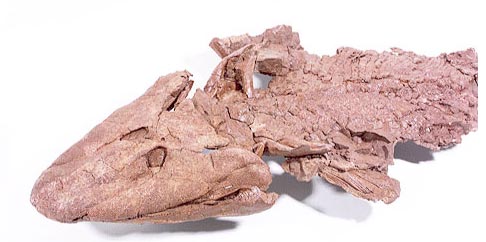
Titaalik Fossil Material (Late Devonian)

Tiktaalik fossil material (Late Devonian)

Picture credit: University of Chicago/Harvard/Academy of Natural Sciences

Tiktaalik Fossils

Intriguingly, although Tiktaalik was named and described nearly eight years ago, the genus was erected based on a study of the front portion of the animal.  The first fossils studied consisted of just the front portions, now the research team behind the first scientific descriptions have examined other material excavated from the same location on Ellesmere Island back in 2004 and these fossils have provided them with evidence as to what the rear end of this iconic animal looked like.

In a paper published in the scientific journal “The Proceedings of the National Academy of Sciences”, the research team that included the late Professor Farish Jenkins (Harvard University), one of the last papers that this esteemed professor of vertebrate palaeontology contributed to, outline evidence to suggest that that Tiktaalik had a large pelvis and strong tail fin.  This suggests that this animal was able to propel itself around using its four proto-limbs.  Such a form of locomotion, often referred to as “four-wheel drive” was thought to have evolved only in later, true tetrapods.

The Scientific Description of Tiktaalik

The authors of this paper, include Dr Neil Shubin (University of Chicago) and Dr Edward Daeschler (Drexel University, Philadelphia), these scientists along with Professor Jenkins, were responsible for the scientific description of Tiktaalik back in 2006.  Only now, once other specimens have been fully prepared can the team describe the rear end of this important transitional vertebrate.  The fossils show that Tiktaalik had a thick, powerful rear fin, but the real surprise came when the scientists took a look at the pelvic area.  The pelvis area, indicated by impressions preserved in the ancient fossilised sediments and several fossilised bones from the hind portions indicate that the rear fins were comparable in size to the front fins.  The shape and size of the hip socket also suggest that the rear fins were capable of a wide range of movement.

The rear fins could have been used to help support the animal’s weight as well as help it to swim through water.  Although, the overall structure of the pelvis is substantially more developed than that seen in other types of Devonian fish, it is still very primitive when compared to the early tetrapods like Acanthostega and Ichthyostega.  The pelvis is still more-fish like, it consists of just one bone, whereas, the pelvis of tetrapods (even ours for example consists of three bones – the ilium, the pubis, and the ischium).

Unfortunately, no evidence of a femur (thigh-bone) has been found but it is very likely that Tiktaalik had a pair of femurs.  Tiktaalik is termed a tetrapodomorph – a transitional form between an aquatic creature and one capable of living on land.

Commenting on this latest research, Dr Daeschler stated:

“The pelvis is as large as the shoulder girdle, and that’s not what we would have expected in this finned stage in the fin-to-limb transition. We would have expected the pelvic fins to be smaller.”

Based on this research, the team conclude that the basic, quadrupedal locomotion once thought to have evolved with the first true tetrapods seems to be present in anatomies of fishes like Tiktaalik.

Dr Daeschler added:

“Tiktaalik probably had the ability to use those fins as props to move along, using them to push along the shallow bottom, to work its way through plants and, who know, maybe it got out of the water briefly if it needed to move over to another watercourse.  But in no way was it specialised for getting out of the water.  It may have had some ability to do that, but everything about its reproduction, its sensory system, its hunting and breathing – all these things tied it to the water.

“Rise of the Animals”

Recently, Sir David Attenborough presented a two-part BBC television programme “Rise of the Animals: Triumph of the Vertebrates”.  This programme documented the evolution of animals with backbones from the earliest forms that swam in Cambrian seas to the evolution of mammals, primates and ultimately ourselves.  Tiktaalik featured prominently in the first part of the documentary, some wonderful animation showed how vertebrate palaeontologists imagined Tiktaalik used its appendages to get itself about.  Interestingly, in the clip the rear limbs are featured, but they do not play any part in the locomotion of the animal.  This new research suggests that Tiktaalik used its four proto-limbs in a quadrupedal motion.

Tiktaalik (T. roseae) A Life Reconstruction

Tiktaalik roseae life reconstruction.

A life reconstruction of Tiktaalik roseae.

Picture credit: Kalliopi Monoyios, (University of Chicago).
13 01, 2014

Marine Reptiles – Dressed in “Little Black Numbers”

By |2023-03-02T12:06:20+00:00January 13th, 2014|Categories: Dinosaur and Prehistoric Animal News Stories|0 Comments

Study Suggests Some Marine Reptiles May Have Been Black in Colour

Although, technically “black” is an absence of colour, a study into the organic signatures of the hides of ancient marine reptiles indicates that these creatures may have been coloured black, or at least dark-skinned.  The inability to detect evidence of other pigments does not necessarily mean that the likes of Mosasaurs, Ichthyosaurs and ancient marine turtles were all coloured black, but an intriguing report published in the scientific journal “Nature” sheds light on the possibility that extinct marine monsters could have been black or at least partially black.

Marine Reptiles

Recent research by vertebrate palaeontologists has provided an insight into the potential colouration of a number of extinct animals.  Perhaps most notably members of the Dinosauria.  Such research conducted by institutions such as Bristol University has opened up the possibility of pigments in preserved impressions of dinosaur skin being analysed (melanosome analysis) and some measure of colouration determined.

To read more about identifying the colour of dinosaurs: Ginger Dinosaurs?

The team of scientists from Lund University (Sweden) set out to investigate the potential colouration of marine reptiles, by examining fossils of a marine turtle, related to today’s extant Leatherback turtle along with the fossilised remains of a species of mosasaur (Tylosaurus nepaeolicus) and an Ichthyosaurus.

The Colouration of Extinct Marine Reptiles

Although these reptiles are only distantly related, they all represent organisms that evolved from terrestrial ancestors, at least according to most researchers, although the evolution of the Chelonia (tortoises, turtles and so forth) and how many times various branches of this particular reptilian family tree took to life in a marine environment remains open to speculation.

Under the guidance of one of the paper’s lead authors, Johan Lindgren (Lund University), the research team studied an early Jurassic ichthyosaur fossil (specimen number YORYM 993.338) dating from around 196 million years ago, along with the fossils of a Late Cretaceous mosasaur (Tylosaurus spp.) from around 86 million years ago (Santonian faunal stage) and the preserved remains of a distant relative of today’s Leatherback turtle (Eosphargis breineri) which dates from the Palaeogene – 56 million years ago.

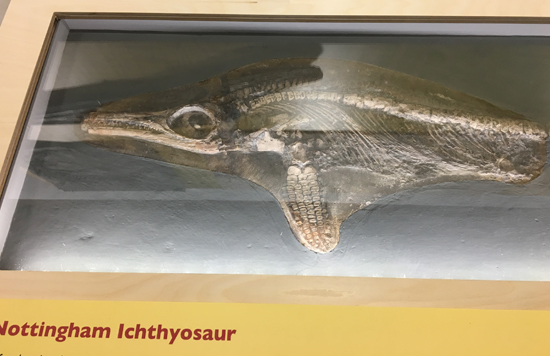
Could Ancient Ichthyosaur Fossils Yield Further Data on Animal Pigmentation?
Protoichthyosaurus applebyi

The Nottingham ichthyosaur (P. applebyi).  Do some marine reptile fossils hide secrets about colouration? Picture credit: Everything Dinosaur.

Picture credit: Everything Dinosaur

Adaptive Colouration

Scientists know that adaptive colouration (the colour of organisms) plays many critical roles, from providing camouflage, to a visual display to attract a mate or to settle disputes amongst rivals, as well as to ward off potential attackers, or to indicate to any predator that they are poisonous or unpleasant to eat and so on.  One of the most common pigments found in the animal kingdom is melanin.  It too serves a multitude of functions including permitting dark colouration that helps cold-blooded animals regulate their body temperatures.

Black tends to absorb heat from the sun, much more efficiently than lighter colours which can reflect heat away.  The higher absorption rate can help dark-skinned reptiles to warm up more quickly at the start of the day and retain heat for longer when the sun sets.  For example, marine iguanas feed by diving into the cold sea that surrounds their Galapagos Islands home.  Their black skins with large amounts of the biochrome (biochrome is another term for a natural pigment), melanin present help them to absorb heat quickly from the sun.

Scanning Electron Microscopes

In the study, the scientists used a scanning electron microscope to identify minute, traces of the shape of biochromes preserved within the fossil material.  These “organic signatures” were then analysed using a highly sensitive spectrometer to assess the likely composition of the individual molecules preserved in the specimens.

Commenting on the findings of their research, Lindgren stated:

“The most sensational aspect of the study is that it can now be established that the analysed ancient marine reptiles were, at least partially, dark-coloured in life.”

Being dark in colour offers marine animals a number of advantages, especially if they are cold-blooded.  Leatherback turtles can be found in relatively cold waters, certainly outside of the tropics.  For example, these turtles, the largest turtle species in the world, have been sighted off the coast of Cornwall and further north up the Irish Sea in the height of summer.  These turtles with their dark backs are known to bask at the surface, absorbing heat from the sun.  Their colouration helps them to warm up quicker and to reach a higher body temperature.

Dark Traces of Soft Tissue

Such colouration might help these creatures exploit food sources in otherwise inaccessible habitats, they can extend their habitable range.  The research team was able to demonstrate that dark traces of soft tissue preserved in the fossil material had large amounts of the degraded remains of eumelanin present, in intimate association with the fossilised melanosomes.  The eumelanin, which is a naturally occurring,  common form of melanin refracts light in such a way that objects appear dark brown or black.  Based on this data, the scientists concluded that at least part of the turtle, the mosasaur and the ichthyosaur were coloured black.

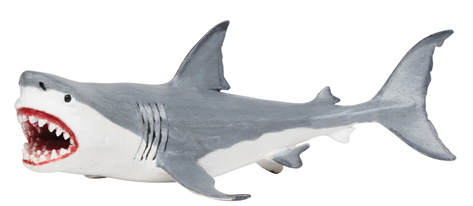
In addition, in contrast to counter shading seen in many pelagic animals (pelagic – refers to an organism living above the sea floor), such as Great White Sharks, where the top part of the animal is dark contrasting with a lighter underside some types of ichthyosaurs may have been black all over.

Typical Example of Counter Shading Seen in a Marine Animal
Counter shading - light undersides contrasts with the darker "top side".

Counter shading – light undersides contrasts with the darker “top side”.

Picture credit: Safari Ltd

The model above is from the 2014 releases by Safari Ltd.  It represents a C. megalodon, an enormous, extinct shark.  Scientists believe that this fish was an active hunter of the open sea and therefore the design team at Safari Ltd have given their replica classical counter shading of a nektonic (actively swimming) marine predator.

Note

Following a taxonomic revision most scientists describe this extinct shark as Otodus megalodon.

Identifying Biochromes

The detection method used failed to identify any notable amounts of other biochromes, notably ones responsible for yellow and red colours.  This does not mean to say that scientists can rule out the possibility of yellow mosasaurs for example.  These biochromes are perhaps less likely to survive the fossilisation process, they may also be present but not able to be detected given our current technology.

All that can be suggested from this study is that there is evidence to suggest that some types of ichthyosaur may have been dark coloured, whilst the mosasaur and the fossil Leatherback turtle provide evidence of these animals being dark coloured on the top parts of their bodies with perhaps lighter shading underneath (as seen in extant Leatherback turtles).

Evolutionary, behavioural ecologist Ted Stankowich (California State University) commented:

“While the presence of other undetected pigments cannot be ruled out, particularly dark pigmentation in these fossils suggests that they might have been able to live in more extreme environments or have used pigmentation patterns as camouflage in dark waters.”

Looking at extant Leatherback turtles, with their dark backs, the scientists suggest that dark pigmentation evolved separately amongst these ancient species which are not closely related.  This could be a case of convergent evolution with different organisms evolving the same adaptive solutions to help them survive.

That is why the streamlined bodies of ichthyosaurs, superficially resemble modern-day dolphins.  Ichthyosaurs and dolphins are not closely related but they have developed similar features.   The dark pigmentation in these marine reptiles could have evolved to help regulate internal body temperatures, as protection against sunburn and camouflage.

Examining Turtles

Lindgren added that the ancient Leatherback turtle studied probably had a similar colour and lifestyle to extant Leatherbacks.  Similarly, mosasaurs and ichthyosaurs may have benefited from their dark skins helping them to warm up between dives and to camouflage them in the darker depths of surface waters.

Other scientists are more cautious, asserting that care needs to be taken before jumping to conclusions based on limited sampling of the fossil record.  Indeed, more needs to be learned about the benefits of dark colouration for extant marine organisms before too much can be inferred with regards to the inhabitants of ancient marine ecosystems.

A spokes person from Everything Dinosaur commented:

“This study extends our understanding of pigmentation preserved in the fossil record, beyond that of analyses related to proto-feathers and other examples of integumentation.  However, if we take the Order Ichthyosauria (ichthyosaurs), this is a very diverse assemblage of marine animals.  These highly successful reptiles evolved into a number of different forms, with different sizes, body shapes and methods of feeding.  Although a uniform, dark colouration might be supported from the evidence of this study, this does not mean that all types of ichthyosaur were coloured black.”

Some Ichthyosaurs May have Been Dark Coloured
Dark coloured Ichthyosaurs according to new study.

Dark coloured ichthyosaurs according to new study.

Picture credit: Safari Ltd

Ichthyosaurus Pigmentation

The Ichthyosaurus pictured above from the Carnegie scale model collectibles range made by Safari Ltd.  The design responsible for creating this 1:10 scale model of a “fish lizard” have intuitively given their replica a dark back. A team of researchers have postulated that a number of marine reptiles, including Ichthyosaurs may well have been dark coloured.

Knowing a little about the potential colour of an animal can give palaeontologists the opportunity to obtain information on how an animal might have lived, what particular ecological niche it was adapted to.  These three disparate lineages of marine reptile (turtles, mosasaurs and ichthyosaurs), provide evidence of convergent evolution in the form of increased melanism.  Based on extant examples, such as Leatherback turtles today, this study suggests that this colouration evolved to assist with thermoregulation and/or to help these creatures adapt to living in more extreme climate conditions such as much colder waters.

Marine reptiles sporting “little black numbers” as one of our colleagues referred to this study.

To view the range of prehistoric marine reptile figures in the Safari Ltd range: Wild Safari Prehistoric World Figures.

7 01, 2014

Rare Dinosaurs from Saudi Arabia

By |2024-05-02T06:54:44+01:00January 7th, 2014|Categories: Dinosaur and Prehistoric Animal News Stories, Dinosaur Fans|0 Comments

Evidence of Abelisaurid and Enormous Titanosaur Discovered in Saudi Arabia

An international team of researchers including scientists from Museum Victoria, Monash University (Australia), Uppsala University (Sweden) and the Saudi Geological Survey have uncovered evidence of dinosaurs from Saudi Arabia.  This is the first record of substantial dinosaur fossils being found in the Gulf State.

Dinosaurs from Saudi Arabia

A series of enormous vertebrae, identified as belonging to an as yet, unknown species of titanosaur and teeth fossils believed to have come from a large, carnivorous abelisaurid were found during a scientific expedition to explore the north-western part of the Saudi Kingdom, along the coast of the Red Sea (Adaffa Formation).  During the Late Cretaceous, this part of the world, now famed for its extensive deserts, was a lush, verdant flood plain, the flora supported massive herbivores.

The rounded bones show signs of extensive abrasion the sort of damage associated with bones that were battered by waves and rolled around as a result of tidal action.  This data and an analysis of the sedimentary strata itself supports the idea that these fossils were deposited close to the sea, perhaps in the mouth of an estuary.

The Location of the Fossil Discoveries

Dinosaur fossils from Arabia.

Dinosaur fossils from Arabia.

Picture credit: PLoS One

Upper Cretaceous Fossils

The illustration above shows the location of the fossil find in relation to modern-day Saudi Arabia, a map of the world during the Late Cretaceous indicating where on the Gondwanan margins the animal’s lived and a more detailed map of the strata from which the fossil material was excavated.

The strata from which the fossils have been excavated dates from the very end of the Age of Dinosaurs, (Campanian/Maastrichtian faunal stage) and an academic paper detailing the discovery has recently been published in the on line scientific journal PLoS One (public library of science).

Dinosaurs from the Arabian Peninsula

Dr Benjamin Kear, based at Uppsala University in Sweden and lead author of the study into these taxonomically identifiable Arabian dinosaurs  commented:

“Dinosaur fossils are exceptionally rare in the Arabian Peninsula, with only a handful of highly fragmented bones documented so far. This discovery is important not only because of where the remains were found, but also because of the fact that we can actually identify them.  Indeed, these are the first taxonomically recognisable dinosaurs reported from the Arabian Peninsula.”

Dr Tom Rich, Senior Curator (Vertebrate Palaeontology and Palaeobotany) at the Museum Victoria stated:

“Dinosaur remains from the Arabian Peninsula and the area east of the Mediterranean Sea are exceedingly rare because sedimentary rocks deposited in streams and rivers during the Age of Dinosaurs are rare, particularly in Saudi Arabia itself.”

At the time when these types of dinosaurs roamed, much of the landmass we know today as the Arabian peninsula was underwater.  The titanosaur and the suspected abelisaurid lived on the area of land that formed the north-western coastal margins of the African continent.

The Fossils Found in Saudi Arabia

Two types of dinosaur fossil found.

Two types of dinosaur fossil found.

Picture credit: PLoS One

The sandy coloured objects at the top of the picture are the fossilised vertebrae of the titanosaur, the isolated teeth of the suspected abelisaurid can be seen below.

For models and replicas of Cretaceous titanosaurs and abelisaurids: CollectA Age of Dinosaurs Popular Models.

Fossil Finding Challenges

Explaining some of the problems about the lack of fossil material from Saudi Arabia, Dr Rich added:

“The hardest fossil to find is the first one.  Knowing that they occur in a particular area and the circumstances under which they do, makes finding more fossils significantly less difficult.”

The abelisaurid is estimated to have been around six metres in length, the fossils from the plant-eating titanosaur indicate an animal perhaps in excess of 20 metres long.  The recognition of titanosaurians and abelisaurids from Saudi Arabia extends the palaeo-geographical range of these groups along the entire northern Gondwanan margin during the very Late Cretaceous.

In addition, given the extreme rarity of dinosaurian fossil material from this part of the world, these fossils  hint at the diversity of these types of dinosaurs throughout this region towards the end of the Mesozoic.

Everything Dinosaur is grateful for Museum Victoria (Melbourne, South Australia) for their help in compiling this article.

31 12, 2013

Palaeontology Predictions in 2013 – How Did We Do?

By |2023-03-02T00:21:54+00:00December 31st, 2013|Categories: Dinosaur and Prehistoric Animal News Stories, Dinosaur Fans, Everything Dinosaur News and Updates, Press Releases|0 Comments

Reviewing What Everything Dinosaur Predicted in January 2013

It’s that time of  year again when we look back at our predictions made twelve months ago about what stories we would be covering in 2013.  Each year, team members at Everything Dinosaur get together with a pot a tea and the last of the Christmas cake and come up with a forecast of what is likely to happen in the world of fossil collecting, palaeontology and dinosaurs.  Back on January 3rd, we compiled a list containing eight predictions, now is the moment of truth, when we collectively look back to see how close (or how wide of the mark) we actually were.

Palaeontology Predictions

To read the January 3rd article: Everything Dinosaur’s Predictions for 2013.

 1).  New Genus of Horned Dinosaur from North America

The ceratopsian clade just gets bigger and bigger, our dinosaur experts estimate that more new types of North American horned dinosaur have been discovered and named in the first thirteen years of this century than in the whole of the 20th Century.  This was one prediction that we were very confident about and sure enough, a number of specimens were named and described this year, although the fossil finds in most cases had taken place a few years earlier.   Texas got an exciting new horned dinosaur in the shape of Bravoceratops polyphemus.

This dinosaur may have been as big as Triceratops (T. horridus), with an estimated skull length of around 2.2  metres and brow horns over one metre long, B. polyphemus is a member of the chasmosaurine group of horned dinosaurs and Everything Dinosaur reported on the announcement of this new dinosaur back in June.

Overall it was a good year for the chasmosaurines with the discovery of a baby chasmosaurus fossil, found in the famous Dinosaur Park Formation of Canada, which we also reported upon, this time in November.

To read about the discovery of Bravoceratops: New Giant Species of Ceratopsian Announced.

To see a picture and to read an article about the baby Chasmosaurus discovery: Fossils of Baby Horned Dinosaur Unearthed.

Everything Dinosaur also covered the auction of the “duelling dinosaurs from Montana”, although much of the interest was directed towards the fossils that may indicate that Nanotyrannus is a valid genus, the ceratopsian fossil preserved with this theropod, may turn out to represent a new species of chasmosaurine as well.

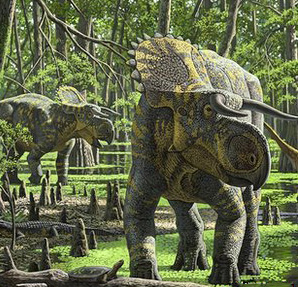
In addition, Everything Dinosaur reported on the unveiling of Nasutoceratops (N. titusi), a five metre long, horned dinosaur whose fossil remains had been found in southern Utah back in 2006.  Good to see a new type of centrosaurine dinosaur too.

To read about Nasutoceratops: “Large Horn Face” Nasutoceratops

An Illustration of the New Centrosaurine Nasutoceratops (N. titusi)

Nasutoceratops -  a Centrosaurine dinosaur from Utah

Nasutoceratops – a centrosaurine dinosaur from Utah.

Picture credit: Raul Martin

2).  Jurassic Park in 3-D to Inspire Another Generation of Dinosaur Fans

In a year when the cinema was dominated by sequels, prequels and continuing franchises, Jurassic Park in 3-D grossed nearly $20 million USD in its opening week in the United States.  At a time when speculation was rife about the future of the next Jurassic Park film (now due for release in 2015),  Universal Studios can be quite happy with a total take of around $46 million USD, placing the film at number 69 in the U.S. highest grossing film chart for 2013.  Interestingly, the new Walking with Dinosaurs in 3-D, released just a fortnight ago has taken $26 million USD despite very mixed reviews for this animated dinosaur adventure.

In the UK, we estimate that Jurassic Park in 3-D took around £400,000 GBP at the box office.  We don’t have box office figures for Walking with Dinosaurs in 3-D available at the moment.

3).  Milestones for Everything Dinosaur – What are We Going to be Doing?

Our third prediction concerned what Everything Dinosaur would be doing in terms of social media. It is always an act of bravado on our part to try to forecast exactly where we would be in terms of our company.  After all, we would readily concede that we are not gifted business forecasters and attempting to predict our work on the dynamic social media channels of today is far from easy.  Everything Dinosaur’s presence on line certainly grew in 2013, let’s recap on what we said and update our progress (or lack of it in some cases).

Six hundred and fifty Ezine articles approved and published – always a tough target, but we have produced a respectable total of several hundred articles on the Ezine platform.  There are 560 articles by Everything Dinosaur published on Ezine (86% of target).  Our viewing figures are up and the click through rate is also showing a positive upward trend.

One Thousand Facebook likes on Everything Dinosaur’s Facebook Page – we are not quite there yet, but we have 850 “likes” at the moment (85% of target).  We are genuinely grateful for every “like” that we receive and we are happy in the knowledge that every single one of them has been earned, we have not opted for any “paid for service” where likes and things like Twitter follows can be purchased for a fee.

If you want to support Everything Dinosaur on Facebook, simply click the Facebook logo below and visit our Facebook page (please give our page a “like”).

Everything Dinosaur on Facebook
Click the logo to visit our Facebook page and to give our page a "like".

Click the logo to visit our Facebook page and to give our page a “like”.

Ezine Challenge completed 365 articles approved and published since February 25th 2012 – this was achieved, in fact we published our 365th article in this Ezine challenge a month ahead of schedule.

300,000 Video Views on Everything Dinosaur’s YouTube Channel – this target was also achieved, in fact it was smashed!  The sixty-six videos on Everything Dinosaur’s YouTube video channel have been viewed over 592,000 times to date.  When this original target was likely to be exceeded back in March, we set an ambitious target of half a million video views. This target was reached early in December, we are well on the way to smashing through the 600,000 views mark.  Our thanks again to all our subscribers, commentators and loyal fans.

Back in December Everything Dinosaur’s Videos Reached Half a Million Views

Half a million views on Everything Dinosaur's Youtube channel.

Half a million views on Everything Dinosaur’s YouTube channel.

Picture credit: Everything Dinosaur

To view Everything Dinosaur’s YouTube channel: Everything Dinosaur on YouTube.

Everything Dinosaur to join Pinterest with 1,000 re-pins – Everything Dinosaur team members have posted up a total of 1,571 pictures and articles on Pinterest to date.  We have set up twenty-one boards and we have 106 likes with 160 followers so far.  This social media platform is relatively new for us, but we have far exceeded our pinning target for the year.  We shall see how these platforms develop over the months ahead.  Once again, a very big thank you to everyone who has become a follower, video fan, subscriber, etc.

4).  New Zealand to Hit the Headlines with a Prehistoric Animal Fossil Discovery

An intriguing prediction, one that certainly ranks as being a “sticking our collective heads over the parapet”, type of prediction, as there have been very few Mesozoic vertebrate fossil discoveries in New Zealand over recent years.  A number of important fossil discoveries were made in New Zealand strata this year, although we are not aware of any new Dinosauria or marine reptile material beings found or  major papers published.

The iconic Kiwi attracted a few headlines a couple of weeks ago when a paper published in a scientific journal challenged the long-held theory that this flightless bird evolved from the Moa family.  Fossils found in Otago (South Island), suggest that New Zealand’s national symbol is descended from Australian migrants.  These birds flew across the Tasman Sea more than twenty million years ago, once in New Zealand the gradually lost their ability to fly.  However, we did not report on any major Mesozoic vertebrate discoveries from New Zealand and therefore we can’t claim this as one of our successes.

5).  Controlled Cull of Saltwater Crocodiles in the Northern Territories

There were a number of fatal crocodile attacks in the Northern Territory this year, although there were calls for a cull of large crocodiles and a lot of lobbying of local politicians and government officials, we are not aware of any authority being given for an organised cull of these reptiles.  The growing Saltwater crocodile population in the Northern Territory, the increasing number of crocodile close encounters and the number of attacks, sadly some of which have proved to be fatal, has led to many demands for a cull to take place.  Perhaps 2014 will see a cull or indeed the controlled re-introduction of trophy hunting.

Remarkably, back in November we reported on a fascinating news story in which an angler fishing a lake in Hampshire claims to have spotted a small crocodile in the water.

To read about the suspected Hampshire crocodile: Fisherman Claims to Have Spotted Crocodile in Hampshire Lake.

6). New Clothing Range to be Introduced by Everything Dinosaur

In May, we were able to proclaim to the world the launch of our first clothing range with our own label.  A range of quality sweatshirts were added to Everything Dinosaur’s clothing apparel and they have proved very popular.

2013 Saw the Launch of Everything Dinosaur’s Sweatshirt Range

T. rex bites back!

T. rex bites back!

Picture credit: Everything Dinosaur

Available in a range of attractive colours, these hard-wearing sweatshirts feature a stitched diagram of a Tyrannosaurus rex skull.  The motif on the front of the sweatshirts is based on a real T. rex fossil skull.  Look out for more exciting additions to Everything Dinosaur’s product portfolio over the next twelve months.

For dinosaur themed clothing and other gifts: Everything Dinosaur – Dinosaur Themed Clothing.

7).  More Evidence of Endothermic Properties of the Dinosauria (Warm-blooded dinosaurs)

Whether or not the Dinosauria were endothermic or ectothermic remains a  subject of great debate amongst palaeontologists.  Did the Dinosauria, or at least the majority of them rely on external sources of heat to regulate their body temperature?  Lots of data has been produced in the last two or three years on this subject, 2013 was no exception.  Discoveries of dinosaur fossils that lived at high latitudes in the Northern Hemisphere have been made this year, along with some new finds of feathered dinosaur specimens from China.

In October, we published an article about the long necks of sauropods, it was speculated that those long necks could have been used to help regulate the body temperature of these massive herbivores – an interesting theory.

To read the article: Sauropods Using the Necks As Radiators.

Nothing definitive has been published to date, (as far as we know), just like a herd of sauropods, we think this debate is going to rumble on.

8).  The Arab Spring Has Some Surprising Implications for Palaeontology

The political changes in north Africa during 2012 (and continuing), may have had an impact on a number of areas of scientific enquiry, but back in the early part of 2013 we predicted that palaeontology would benefit from the opening up of parts of north Africa that had been previously very difficult to access.  Exploration of strata in areas that had been subject to much more restricted access, would, we thought lead to a number of exciting fossil finds.  For example, with the peace settlement in Angola, one of the outcomes of the conflict’s resolution was that as more of the country was explored geologically, a number of new prehistoric animal fossil discoveries were made.

Everything Dinosaur team members predicted that there might be some exciting discoveries in North Africa, we even speculated that a new type of Arthropod or early Chordate might be excavated from the Nubian sandstone deposits of Libya.

There have been a number of important discoveries made by scientists working in North Africa this year.  We did not have to wait too long to report on such a discovery, not from Palaeozoic strata but from much more recent sedimentary rocks, an exceptionally well preserved site that provides a fascinating insight into a prehistoric climate from around thirty million years ago.  This significant discovery came in Libya, from a site approximately 500 kilometres south-east of Tripoli (Zallah Oasis in the Sirt Basin (central Libya)) and we wrote about it in February.

To read the article: Researchers discovery important Oligocene fossil site in Libya.

So all in all not a bad effort, some of our predictions were inaccurate, others proved to be quite perceptive.  We will repeat this exercise again, this time looking forward into 2014 to see if we can predict what exciting adventures and news stories we will be writing about in the next twelve months.

28 12, 2013

Paying Tribute to the Remarkable Dr Bill Birch (Museum Victoria)

By |2024-05-02T06:56:35+01:00December 28th, 2013|Categories: Dinosaur and Prehistoric Animal News Stories, Famous Figures, Geology|0 Comments

“Old Rocker” Set for Retirement

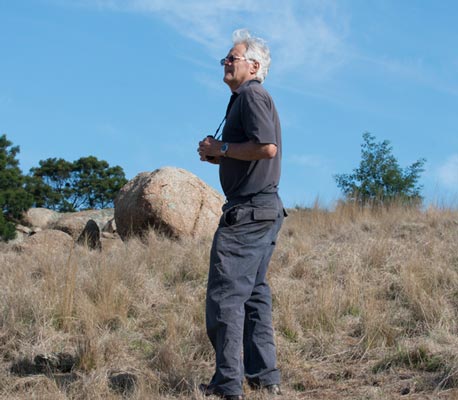
The turn of the year might be a time for new beginnings, but for one member of the Museum Victoria’s dedicated staff, the last day of December marks retirement after forty years as a curator.  The Museum’s (Museum Victoria, based in Melbourne, Victoria, Australia), longest serving employee, Senior Curator for Geosciences Dr Bill Birch is going to be leaving the museum, but the dedicated geologist will still be making a contribution to Victoria’s geological heritage.

Dr Bill Birch

Very few visitors to a museum fully appreciate the hard work and sheer effort that goes into maintaining exhibits, looking after collections and managing departments.  With the news of Dr Birch’s retirement, we at Everything Dinosaur, who do a lot of work with museums and other institutions around the world, wanted to take time out to pay tribute to all the enthusiastic and long-serving members of museum staff who do so much to help with public outreach and education.

Dr Bill Birch Set to Retire on December 31st
After forty years service Dr. Bill Birch retires.

After forty years service Dr Bill Birch retires.

Picture credit: Museum Victoria

A Long and Successful Career

Dr Birch’s career at the Museum began in January 1974.  One of his first tasks was to update the historical geological collections and to apply modern approaches to curating as well as expanding the material held at the Museum via field trips, donations and acquisitions.  As well as assembling an extensive inventory of Victoria’s diverse geological make-up, he has built the international component of the collections through expeditions to Greenland, Siberia, Pakistan, and Canada.

He regards those collecting excursions as some of many highlights of those forty years, alongside the Dynamic Earth exhibition, which opened in Melbourne Museum in 2010.

Commenting on the highly successful exhibition, Dr Birch stated:

“Before then, very few of our best specimens were on display for the public to see.  That exhibit has put some of our discoveries and acquisitions front and centre.”

Thanks to his efforts, in collaboration with colleagues, the Melbourne based museum has established a strong, world-wide reputation for geological research.  Bill, himself has written several books, had many hundreds of academic papers published and the Museum Victoria has more than forty “type” specimens of new minerals that Dr Birch helped to formally describe amongst its much expanded collections.

With a life-long passion for geology, Bill describes never having felt unhappy about going to work and states that the Museum’s collections “became the foundation of my working life”.

Dr Bill Birch on the Hunt for More Specimens
Dedicated geologist set to retire.

Dedicated geologist set to retire.

Picture credit: Museum Victoria

One of the great joys about geology (and palaeontology for that matter), is that you are never too young or too old to get involved.  Official retirement might beckon after forty years of dedicated service, but for Dr Birch there is still so much work for him to do.  He is expecting to work up to three days a week on further research as an Honorary Research Associate and Emeritus Curator with Museum Victoria.

Today, we pay tribute to all the those hard working, enthusiastic people, like Dr Bill Birch, who have contributed so much over a their long careers in the Earth Sciences.

Have a long and happy retirement.

27 12, 2013

New North American “Raptor” Described

By |2023-03-02T00:08:08+00:00December 27th, 2013|Categories: Dinosaur and Prehistoric Animal News Stories|0 Comments

New North American Dromaeosaurid with Affinities to Asia’s Velociraptor

A team of scientists from the Royal Ontario Museum (Canada) working in collaboration with a number of other Canadian palaeontologists have announced the discovery of a new type of dromaeosaur from the Hell Creek Formation of Montana (United States).  The dromaeosaurs are fast running, relatively small, carnivorous dinosaurs that flourished during the Cretaceous period.  This new genus, known from fossilised teeth as well as upper jaw material (maxilla) and lower jaws (dentary), lived at the same time as Triceratops and Tyrannosaurus rex.

North American Dromaeosaurid

The fossils represent the latest dromaeosaurid known from North America (Maastrichtian faunal stage) and a phylogenetic analysis reveals that this dinosaur is perhaps more closely related to Late Cretaceous Asian “raptors” such as Velociraptor (V. mongoliensis) and Tsaagan (T. mangas) rather than to North American dromaeosaurs that lived in the Campanian faunal stage.

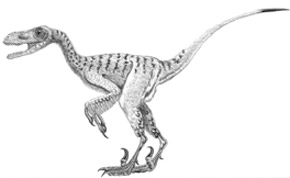
An Illustration of a Typical Feathered Dromaeosaurid Dinosaur

A typical "raptor".

A typical “raptor”.

Picture dredit: Everything Dinosaur

Acheroraptor temertyorum

This new predator has been named Acheroraptor temertyorum.  It was most probably feathered and around 2.5 to 3 metres in length, perhaps weighing as much as forty kilogrammes.  It probably hunted small mammals, birds, lizards and other small animals whilst avoiding the attentions of the much larger apex predators the Tyrannosaurs.  It may also have scavenged the kills of T. rex.  Acheroraptor (pronounced Ack-ear-oh-rap-tor) means “Acheron Robber or Plunderer”, the genus name being derived from Acheron, the River of Pain in the underworld of ancient Greek mythology, along with the Latin word “raptor” – plunderer or robber.

The species name honours James and Louise Temerty who have financially supported the palaeontology department of the Royal Ontario Museum.  A detailed paper outlining the new discovery, and the implications for the Hell Creek Formation and its fauna, has been published in the scientific journal Naturwissenschaften.

Hell Creek Formation

The size of the jaws plus the isolated teeth found in the Hell Creek Formation in the past, indicate that Acheroraptor was relatively large for a Late Cretaceous dromaeosaur.  It was certainly bigger than the better known, and perhaps more famous Velociraptor (which was about the size of a turkey).

Lead Author of the study, Dr David Evans, Curator of Vertebrate Palaeontology at the Royal Ontario Museum commented:

“Acheroraptor gives us a more complete picture of the ecosystem in North America just before the great extinction that marked the end of the Age of Dinosaurs.  The close evolutionary relationship of Acheroraptor to a small group of late-occurring Asian species that includes Velociraptor suggests migration from Asia continued to shape North American dinosaur communities right up until the end of the Cretaceous period.”

It had long been suspected that dromaeosaurs existed alongside the likes of Triceratops and Tyrannosaurus rex but apart from numerous isolated teeth, there was no definitive proof of their existence until this new fossil material was prepared and described.

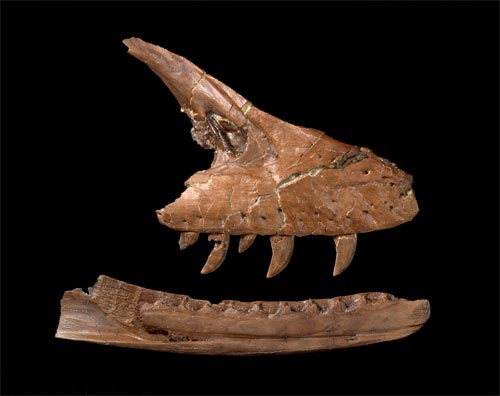
The Maxilla and Dentary of A. temertyorum

The jaws of Acheroraptor.

The jaws of Acheroraptor.

Picture credit: Royal Ontario Museum

To view an articulated model of Acheroraptor (whilst stocks last): Beasts of the Mesozoic Articulated Dinosaur Models.

Professor Phil Currie, an expert on the dromaeosaurids found in the older Dinosaur Park Formation of Alberta, Canada (Campanian faunal stage), stated:

“We have had scanty evidence for more than a century that “raptors” lived with Tyrannosaurus rex until the end of the Cretaceous, but the absence of clearly identifiable dromaeosaurid fossils has been perplexing to the dinosaur hunters who have worked in the Hell Creek area, which has otherwise produced abundant fossils.”

Large Teeth

The strongly curved, quite large teeth with distinctive serrations (denticles) had been known from the Hell Creek Formation for many decades, but in the absence of fossil bones, researchers did not have the material available to help them to understand the evolutionary relationships between this Late Cretaceous dromaeosaur and other members of the Dromaeosauridae from the Northern Hemisphere until now.

Studies of more abundant fossil material from Asia suggests that Acheroraptor, which roamed North America around 67-66 million years ago is more closely related to the long-snouted Velociraptorines of Asia than it is to earlier North American dromaeosaurids.  This suggests that even very late in the Cretaceous there was extensive migration and mixing of different species from Asia and North America.

Discussing the new dinosaur, Derek Larson, a PhD student at the University of Toronto, who studies under Dr Evans said:

The most exciting aspect of the specimen is the teeth.  We now know that those teeth all belong to the same animal and we now know enough about what that animal looks like to distinguish it as its own species.”

Analysis of Acheroraptor’s teeth in the context of a larger sample of small meat-eating dinosaur teeth suggests a decline in dromaeosaur diversity in North America just before the end-Cretaceous extinction event.

It is important to distinguish Acheroraptor from “Archaeoraptor”, the generic name given to a composite fossil that was at the centre of a scandal a few years ago.  A fossil found in China had an article published in National Geographic magazine which claimed this was a transitional, “missing link” between birds and fast-running theropod dinosaurs.  Prior to the article being published in this prestigious publication, doubts had been raised about this fossil, as it seemed to show a long-tailed dinosaur with feathers and wings.

Phil Currie was one of the scientists asked to examine the fossil material and this specimen was eventually proved to be a forgery.  It was actually a clever composite made up of several fossils skilfully glued together.  The tail was later identified as belonging to Microraptor spp. but the legs, feet and toes belonged to an entirely different creature, very probably a prehistoric bird.  The Archaeoraptor scandal, a fossil forgery that fooled a number of leading scientists highlighted the illegal fossil deals that take place in some parts of the world.

As a result of this scandal, one that ended in humiliation for a number of academics and for the National Geographic magazine, there have been calls for much more scientific scrutiny of vertebrate fossils.

26 12, 2013

Diabetes Risk in Modern Humans may have been “Inherited” from Neanderthals

By |2023-03-02T00:01:53+00:00December 26th, 2013|Categories: Dinosaur and Prehistoric Animal News Stories|0 Comments

New Study Suggests Interbreeding with Neanderthals Led to Increase in Risk of Diabetes

Now that the both the human (H. sapiens) and the Neanderthal (H. neanderthalensis) genomes have been mapped and fully documented, any research into genetic variation in modern human populations permits scientists to trace the origins of gene types back into the history of hominin evolution.  A large scale study of people living in Latin America has revealed that their increased risk of diabetes could have been inherited as a result of modern humans interbreeding with a Neanderthal population.

Neanderthals

In a paper published in the academic journal “Nature”, scientists from Harvard Medical School (Massachusetts, United States), working in collaboration with the Max Planck Institute for Evolutionary Anthropology (Leipzig, Germany) and the Broad Institute (Massachusetts),  carried out a large genome-wide association study (GWAS) on a sample of more than 8,000 Mexicans and other people from the Latin American population.  The research mapped the genomes of the study sample and sought patterns within the genes in a bid to identify different traits and characteristics.

Mapping Genes

The team found that a variant on the genetic make up of the population, a gene form named SLC16A11 which when present in a genome, predicates those in the population to a higher likelihood of getting diabetes.  This gene form has also been identified in a study of genetic material extracted from Neanderthal bones found in a cave located in the Altai Mountains, Siberia (Denisova cave).  It can therefore be speculated that since the Denisova remains pre-date the evolution of modern man, this genetic trait which makes part of the population prone to type 2 diabetes may have been inherited as a result of interbreeding between ancient Homo sapiens and Neanderthals.

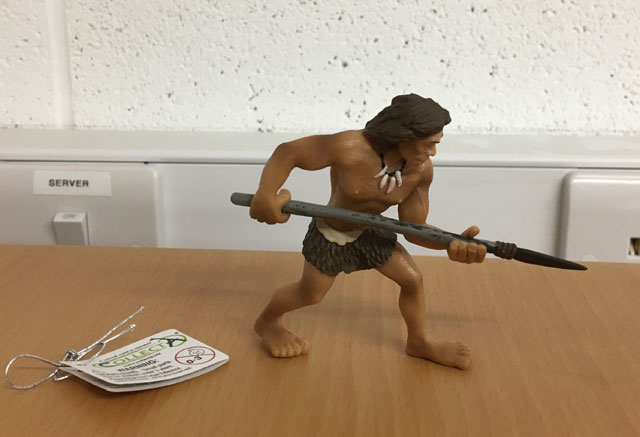
Could Neanderthals Have Passed On To Us the Gene Responsible for a Higher Risk of Diabetes?

CollectA Neanderthal man model

Could Neanderthals have passed to us a greater risk of diabetes?

Picture credit: Everything Dinosaur

Previous studies have shown that non-African modern humans carry a portion of Neanderthal (and Denisovan) genetic material in their genes.  The proportion of Neanderthal is usually less than 2% but can be approaching 4% in some groups of Europeans.  It had been thought that inherited genes from another member of the human family tree were present as H. sapiens shared a common ancestor with H. neanderthalensis, the common ancestor is believed to be Homo heidelbergensis, but the percentages were just too high for this fact to explain it all.

Inherited Genetic Material

The higher than expected levels of inherited genetic material in modern populations could only be explained by interbreeding between the two closely related species sometime in our recent past.  It is likely that interbreeding between populations took place whenever these species came into close proximity and can perhaps be linked to movements of ice sheets and inter-glacial periods permitting migrations and the geographical spread of hominins.

It is known that people who carry the higher risk version of the gene are twenty-five percent more likely to have diabetes than those who do not have this gene type.  Modern humans who have inherited copies of this gene from both parents are fifty percent more likely to have diabetes as a result.  This higher risk gene (SLC16A11)  has been found in nearly half of people with recent Native American ancestry, including the Latin American population.

This study into the gene pool of Mexicans and other members of the population with a Latin American ancestry has shown that this population is at particular risk of diabetes.  The higher risk gene, SLC16A11 is rarely found in genetic studies of European and African populations.

Co-author of the study, Jose Florez (Associate Professor of Medicine at Harvard Medical School) stated:

“To date, genetic studies have largely used samples from people of European or Asian ancestry, which makes it possible to miss culprit genes that are altered at different frequencies in other populations.  By expanding our research to include samples from Mexico and Latin America, we’ve found one of the strongest genetic risk factors discovered to date, which could illuminate new pathways to target with drugs and a deeper understanding of the disease [diabetes].”

Scientists have been able to use knowledge of the genome of some species of hominins to map the routes of genetic inheritance.  The routes and pathways are proving to be more complicated than previously thought due to the interbreeding that seems to have taken place between species.  The functional implications of such inherited genetic material is only just beginning to be understood by researchers and geneticists.

Co-author of the study, David Altshuler (Broad Institute), commented:

“One of the most exciting aspects of this work is that we have uncovered a new clue about the biology of diabetes.”

Higher Risk Gene

The higher risk gene (SLC16A11) is part of a group of genes that code proteins for the transport of metabolites around the body.  These metabolites are involved with the human body’s various chemical reactions.   A spokesperson from Everything Dinosaur speculated that the gene could have evolved as a result in changes to our ancient ancestors diet.  Changing the levels of SLC16A11 can change the amount of a type of fat that has been implicated in the risk of diabetes.

This new study indicates that SLC16A11 could be involved in the transport of an unknown metabolite that impacts on the fat levels in cells and therefore increases the risk of type 2 diabetes.

It is very likely, that more insights into the origins of our genetic make up and the genetic variation seen in human populations will be revealed in the next few years as more ancient hominin fossil material is analysed for the presence of genetic data.

20 12, 2013

Walking with Dinosaurs in 3-D in Cinemas Today

By |2023-03-01T23:41:07+00:00December 20th, 2013|Categories: Dinosaur and Prehistoric Animal News Stories, Dinosaur Fans|0 Comments

Cinema goes back to the Late Cretaceous

The long awaited “Walking with Dinosaurs” film is released in the UK today.  No doubt it will prove to be  a “monster” hit with dinosaur fans of all ages.  The story is set in the Late Cretaceous of North America and centres on the adventures or a horned dinosaur called “Patchi” and his friends.  “Patchi” is a Pachyrhinosaurus, the genus of horned dinosaur has currently got three species ascribed to it.  Everything Dinosaur team members think that the particular species of pachyrhinosaur featured in the film is Pachyrhinosaurus canadensis.

Walking with Dinosaurs

To learn a little more about the different species of Pachyrhinosaurus: Step Forward the Pachyrhinosaurs – Stars of a Dinosaur Film.

Commenting on the film, which is shot in 3-D, a spokesperson from Everything Dinosaur stated:

“This new movie will introduce cinema goers to a whole new range of dinosaurs and prehistoric animals, quite a few of which they will not have heard of before.  For example,  many people may be familiar with the horned dinosaur called Triceratops but not many will be aware of the large number of horned dinosaur species that are now known to have existed during the Late Cretaceous of North America.  The film will also feature a number of dinosaurs with feathers.”

A Primitive Bird Narrates

The story unfolds from the point of view of Alex the “Alexornis”, a primitive bird who tells the story of “Patchi”, a baby Pachyrhinosaurus and his adventures when he becomes separated from the protection of his herd.   Life is tough for a young, vulnerable pachyrhinosaur with marauding troodontids, the fleet-footed Hesperonychus (a dromaeosaurid) and sharp-beaked pterosaurs ready to snatch up the youngster.  A number of dinosaur models have been made that represent the prehistoric animals seen in the film.  Walking with dinosaurs dinosaur models are certainly big business.

To view Everything Dinosaur’s range of prehistoric animal models including Pachyrhinosaurus models: Dinosaur and Prehistoric Animal Models.

Walking with Dinosaurs in 3-D

An adult Pachyrhinosaurus surveys the situation.

An adult Pachyrhinosaurus surveys the situation.

The film makers are to be congratulated for providing such a rich and diverse cast of characters, accurately reflecting a Late Cretaceous (Maastrichtian faunal stage) ecosystem.  Over the last few years palaeontologists have uncovered some remarkable fossil finds that have formed the basis for the animals in this story.  For instance, fossils found in Alaska indicate that herds of herbivorous dinosaurs very probably undertook seasonal migrations in search of better grazing or favourite nesting sites.

Pachyrhinosaurs

The Pachyrhinosaurs and other large herbivorous dinosaurs are shown in the movie migrating.  Naturally, where the herbivores go the apex predators follow and the chief villain of the piece is Gorgosaurus, a member of the tyrannosaur family. Gorgosaurus may not have been quite as big as its famous relative Tyrannosaurus rex but at over eight metres in length it was a formidable hunter, quite capable of tackling an unwary Pachyrhinosaurus.

Although there is much to admire in this new dinosaur film, it also, unwittingly portrays a problem with palaeontology.  We at Everything Dinosaur describe the science of palaeontology as being a bit like Easter – it’s a moveable feast.  New discoveries change the way we view prehistoric animals and one of the herbivores seen in this film (Edmontosaurus)  is already in need of a make over.  The three main protagonists, the pachyrhinosaurs known as “Juniper”, “Scowler” and “Patchi”, once separated from their own herd, join up with a migrating group of edmontosaurs and head off once again to find new feeding grounds.

The edmontosaurs depicted in the movie, show a lot of anatomical detail, however, a recent dinosaur discovery has revealed that at least one species E. regalis may have sported a soft tissue crest, almost like the comb seen on a rooster.

The Edmontosaurs as Seen in the New Dinosaur Film

In future this dinosaur could sport a comb-like structure on its head.

In future this dinosaur could sport a comb-like structure on its head.

The Trouble with Palaeontology

That’s the trouble with palaeontology, new fossil finds can re-write what we know and future depictions of Edmontosaurus on the big screen could portray this huge herbivore with a comb of soft tissue on its head.

To read more about latest interpretation of Edmontosaurus: Duck-billed dinosaur with a comb like a rooster.

Neil Nightingale, Creative Director of BBC Earth, which is behind the project, has directed “Walking with Dinosaurs in 3-D”, in conjunction with animator Barry Cook, who can count Disney’s “Mulan” as one of his previous credits. Neil hopes that this film, released in time for the Christmas holidays is going to educate as well as entertain.  As for the future direction of the “Walking with” franchise, Mr Nightingale will not be drawn on whether a sequel is in the pipeline but did comment in a recent interview that “we’ve got lots of great ideas lined up.”

With the best part of 160 million years of the “Age of Dinosaurs” to explore plus the inducement of representing dinosaurs as new fossil evidence is uncovered, we think that there could well be a “Walking with Dinosaurs in 3-D (Part 2)”, coming to a cinema screen near you in a couple of years time.

19 12, 2013

The United Kingdom’s Important Contribution to Palaeontology in the 19th and 20th Centuries

By |2024-05-02T06:52:36+01:00December 19th, 2013|Categories: Dinosaur and Prehistoric Animal News Stories, Dinosaur Fans, Educational Activities, Press Releases|1 Comment

What Significant Contributions to Palaeontology has the United Kingdom Made Throughout the 19th and 20th Centuries?

This is not an easy question to answer.  After all, to provide a comprehensive overview of the contribution made in the course of two hundred years by the scientists, academics and indeed laypeople of the British Isles is no easy task.  In short, when the sciences of palaeontology and geology are considered, it could be argued that this little part of western Europe has punched well above its weight in the 19th and 20th centuries and it continues to do so.

Let’s focus our attention on just a few key, pivotal moments in a bid to shed more light on the prehistoric animals depicted in the recently released Royal Mail stamps that aimed to highlight the UK’s contribution to palaeontology.  All the prehistoric animals featured are vertebrates and from the Mesozoic era, so we will restrict ourselves for the time being, to animals with backbones that lived during the “Age of Dinosaurs” as it is often referred to.

Palaeontology

This means that we have to disregard, on this occasion, the work of the likes of Sir Roderick Murchison (1792-1871), a remarkable Scotsman, one who fought in the Napoleonic Wars and later in life, working alongside the Yorkshire born Reverend Adam Sedgwick (1785-1873), helped map, classify and date geological strata in one of the first studies of its kind.  Many of the geological periods before the “Age of Dinosaurs” were named and described by British scientists.  Not surprising really, after all, the age of the rocks that make up the British Isles are extremely varied and we have had a long history of higher education and scientific study.

The Geological Society of London is the oldest geological society in the world, formed in 1807.  In contrast, the Geological Society of America was not founded until 1888 and the Geological Society of China did not come about until 1922.

Confining ourselves to vertebrates of the Mesozoic also prevents us from detailing the contribution of Marie Stopes (1880-1958), perhaps better known as a campaigner for women’s rights and family planning, but also an expert in ancient flora who did much to unravel the mysteries of the evolution of flowering plants (angiosperms), or indeed the work of Professor Jenny Clack who in the last year’s of the 20th century helped to re-write the evolution of the first back-boned animals that evolved adaptations for living on land.  Her analysis of the primitive tetrapod  known as Acanthostega (Ah-can-tho-stay-ga) offered dramatic new insights into how fish made the transition to a life on Terra Firma.

Incidentally, Acanthostega lived during the Devonian, a period of geological time named after that county in south-west England, perhaps better known for its cream teas and sandy beaches.

British Women in the Earth Sciences

Let us continue to highlight the role of British women in the Earth sciences by focusing on the work of Mary Anning (1799-1847).  Mary was a pioneering, fossil collector born just a few miles to the east of the county of Devon, in the small, seaside town of Lyme Regis (Dorset).  Although lacking any formal scientific training and as a woman, sadly not given full credit for her work until long after her death, a consequence of, thankfully, now outdated Georgian and Victorian attitudes to the role of women in science.  Mary explored the fossil rich, Jurassic aged strata of her Dorset home, she is accredited for finding the first plesiosaur fossils and the first ichthyosaur skeleton to be correctly identified as an ancient, marine reptile.

“Jurassic Coast”

An Ichthyosaurus and a Plesiosaurus both feature in the recent  Royal Mail stamps issue, however, Mary Anning’s links with this stamp set is not restricted to the marine reptiles.  It was Mary who discovered the first Dimorphodon specimens in the Lower Lias of southern England’s famous “Jurassic Coast”.  This flying reptile also features in the Royal Mail series and the first fossils of Dimorphodon link to two other giants of nineteenth century British palaeontology, as Mary passed her pterosaur fossil to the Reverend William Buckland to study.  It was Buckland, who  wrote the first full, scientific description of a dinosaur (Megalosaurus – also featured in the stamp set) and Sir Richard Owen, a Lancastrian, who first coined the term Dinosauria, was responsible for erecting the Dimorphodon genus in 1870.

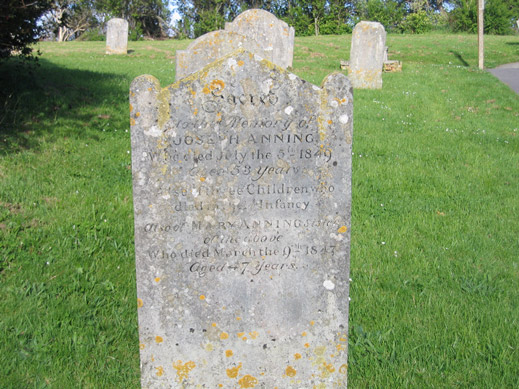
The Gravestone of Mary Anning and Joseph Anning (brother)

Mary Anning's grave at St Michael's Church on the hill overlooking Lyme Regis

Mary Anning’s grave at St Michael’s Church on the hill overlooking Lyme Regis

Picture credit: Everything Dinosaur

Dinosaurs from Britain

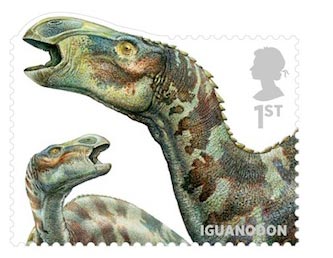
The pair of Iguanodons, beautifully illustrated by John Sibbick on one of the stamps is a reminder of the role played by this country in fundamentally changing scientific thinking about prehistoric life and the history of our planet.  Gideon Mantell, a medical man by training but with a passion for geology and palaeontology, did much to broaden our understanding regarding the prehistoric animals of the Cretaceous.  It was Mantell who first scientifically described Iguanodon and this dinosaur was one of the first to be reconstructed both as a mounted skeleton and as a representation of a living animal.

The United Kingdom has made a significant contribution to the popularising of science, especially the study of prehistoric animals.  Scotsman Bill Swinton (1900-1994) is credited with writing one of the first ever textbooks on dinosaurs.  The book, first published in 1934 with the catchy title “The Dinosaurs: A Short History of the Great Group of Extinct Reptiles”, became a standard text for students of palaeontology all over the world for the next forty years or so.

The Iguanodons that Feature on the Royal Mail Stamps

The Ornithopod Iguanodon on a stamp.

The ornithopod Iguanodon on a stamp.

Life-size replicas of prehistoric animals built by London born Benjamin Waterhouse Hawkins and first put on display in 1854 can still be seen today in south London’s Crystal Palace Park.  These concrete replicas, the first of their kind to be exhibited anywhere in the world now have Grade 1 listed status (the same status as Windsor Castle and Buckingham Palace).  The general public’s fascination for everything dinosaur seems to have continued non-stop and many British academics have been in the vanguard of popularising the study of ancient life and prehistoric ecosystems.

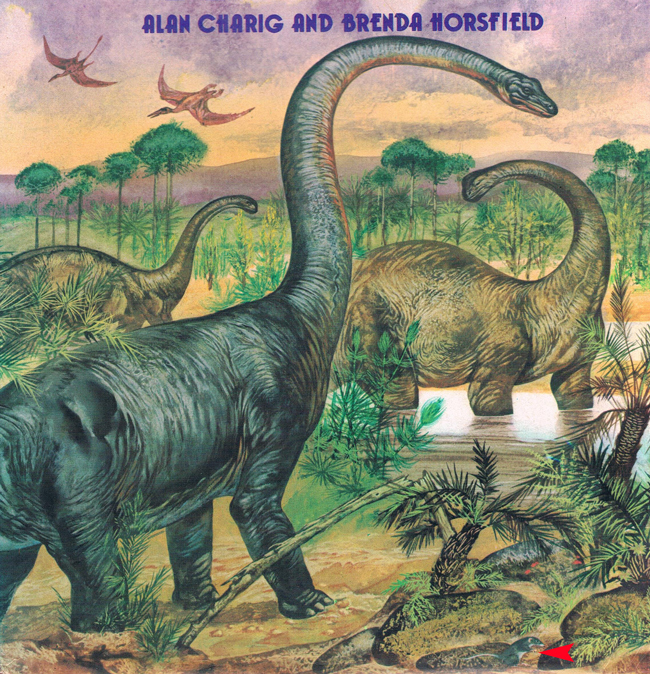
To end our very brief foray into the contribution made to palaeontology and geology in the 19th and 20th centuries by the United Kingdom, it seems fitting to end our short discourse by paying tribute to  Alan Charig (1927-1997), a research scientist who rose to become Curator of Fossil Amphibians, Reptiles and Birds at the Natural History Museum.  Dr Charig did much to popularise the subject of palaeontology in the 1970’s, with the BBC television series “Before the Ark”, the success of which, according to many commentators, paved the way for Sir David Attenborough to make the first of his ground-breaking  natural history programmes (Life on Earth).

The Front Cover of “Before the Ark”

The front cover of "Before the Ark" features a small mammal.

The 1975 BBC book “Before the Ark” depicts a small mammal (arrowed) in a world dominated by dinosaurs and other reptiles.

Picture credit: Everything Dinosaur

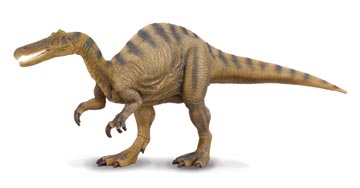
Alan Charig in conjunction with Angela Milner was given the responsibility of studying and scientifically describing a new type of predatory dinosaur unearthed by an amateur fossil hunter whilst exploring a Surrey clay pit in 1983.  Almost seventy percent of the fossilised skeleton was excavated.  This ten-metre-long leviathan was named Baryonyx (Bar-ree-on-niks) and the head and neck of this theropod dinosaur are depicted on one of the stamps in the Royal Mail set, a fitting tribute to the immense contribution made by the people of this country to the study of ancient life and in particular to the Dinosauria.

A Model of Baryonyx (B. walkeri)

Baryonyx "Heavy Claw"

Baryonyx – the name means “heavy claw”

Picture Credit: Everything Dinosaur

It is also worth noting the immense contribution paid to the prehistoric animal model industry by British designers and artists. For example, Anthony Beeson the creative force behind the much admired CollectA prehistoric animal model range.

To view the CollectA model range: CollectA Prehistoric World and Prehistoric Life Models.

17 12, 2013

Rare Diplodocus Fossil Goes to Denmark

By |2024-04-15T12:22:33+01:00December 17th, 2013|Categories: Dinosaur and Prehistoric Animal News Stories|0 Comments

“Misty”  The Diplodocus Skeleton Purchased by the Natural History Museum of Denmark

The mounted, fossilised remains of a seventeen-metre-long Diplodocus sold at auction last month has been purchased by the Natural History Museum of Denmark.  The museum, which has links to the University of Copenhagen celebrates it’s tenth anniversary on New Years Day and the purchase of this Jurassic sauropod skeleton makes a nice Christmas/Tenth anniversary present for the institution.

Diplodocus Skeleton

The Museum came into being on the 1st January 2004 with the amalgamation of a number of museums (including the geological and zoological museums) and other organisations into one body.  Everything Dinosaur reported on the auction of “Misty” – as this was the nickname of the mounted specimen, earlier in the year.  When the auction took place, the Diplodocus sold for £400,000 GBP (approximately 472,000 euros) but at the time the name of the purchaser was not revealed.

To read more about the sale of “Misty” the Diplodocus: Diplodocus Goes Under the Hammer.

Rare Specimen

Believed to one of just a handful of near complete specimens in the world that represent the Diplodocus genus, the fossil material was originally excavated in Wyoming and from there it went to Holland for further preparation work, cleaning and mounting.  In an announcement to the press, the Copenhagen based museum confirmed that it had bought this auction lot.  The dinosaur, thought to be a female, was purchased following a donation from the Obel Family Foundation.

Diplodocus on its Way to Denmark

Diplodocus Fossil Going to Danish Museum

Diplodocus Fossil Going to Danish Museum.

Picture credit: Everything Dinosaur

The model depicted on the flag of Denmark is one from the CollectA Prehistoric Life model collection, to view this extensive range: CollectA Prehistoric Life/Prehistoric World Models.

Museum Director Morten Meldgaard commented:

 “To own a giant dinosaur is, of course, the dream of any natural history museum.  In order to understand the nature and the world we live in, we have to understand the past, and more than anything else, a dinosaur is an object that connects us with the distant past.”

The Evolution of Life Gallery

The Diplodocus will very probably go on exhibit within a gallery dedicated to the evolution of life on Earth, amongst the Museum’s existing, extensive fossil collection.  With the amalgamation of the various museums and other institutions into a single attraction visitors can marvel at the fossils, hundreds of minerals and examine the huge zoological collection as well as enjoy the famed Botanical gardens.

Christen Obel, the Chairman of the Obel Family Foundation stated:

“I think it’s quite obvious and right that the Natural History Museum of Denmark should own a dinosaur.  So when we suddenly had the opportunity to give the museum this early Christmas present, we jumped at the chance.”

Despite being a small country, the geology of Denmark is extremely varied and many different types of fossil bearing sedimentary deposits are exposed and can be explored.  A number of quarries grant permission to parties of fossil hunters and there are a number of sites along Denmark’s coast where different types of fossil can be found, including many vertebrates (fish).  Intriguingly, Denmark is one of the few countries in Europe where the K-T boundary, that thin iridium layer that separates the Mesozoic from the Cenozoic can be accessed.

It looks like the Diplodocus specimen has found a good home and it is pleasing to hear that this specimen will still be able to be viewed by the public and utilised by palaeontologists carrying out research.

Go to Top